

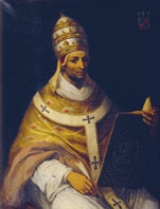
Pope John XXII

Encyclopedia
Pope John XXII born Jacques Duèze (or d'Euse), was pope
from 1316 to 1334. He was the second Pope of the Avignon Papacy
(1309–1377), elected by a conclave
in Lyon
assembled by Philip V of France
. Like his predecessor, Clement V
, he centralized power and income in the Papacy, living a princely life in Avignon and funding his court and wars. He opposed Louis IV of Bavaria as emperor, and Louis in turn invaded Italy and set up an antipope, Nicholas V
. Pope John XXII faced controversy in theology involving his views on the Beatific Vision
, and he opposed the Franciscan understanding of the poverty of Christ and his apostles. He canonized St. Thomas Aquinas
.
, Jacques Duèze studied medicine in Montpellier
and law in Paris
.
The death of Pope Clement V
in 1314 was followed by a sedisvacancy
of two years, due to disagreements between the cardinal
s, who were split into two factions. After two years, Philip V of France
(1316–1322) finally in 1316 managed to arrange a conclave
of twenty-three cardinals in Lyon
. This conclave elected Jacques Duèze, who took the name John XXII and was crowned in Lyon. He set up his residence in Avignon
rather than Rome
, continuing the Avignon Papacy
of his predecessor.
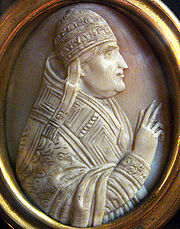 John XXII involved himself in the politics and religious movements of many European countries in order to advance the interests of the Church. This made him a very controversial pope at the time. Also his close links with the French crown created widespread distrust of the papacy.
Before John XXII's election a contest had begun for the imperial crown between Louis IV of Bavaria (1314–1347) and his opponent, Frederick I of Austria
(1308–1330). John XXII was neutral at first; but in 1323, when Louis IV had won and became Holy Roman Emperor
, the Guelph
(papal) party and the Ghibelline (imperial) party began a serious quarrel. This was partly provoked by John XXII's extreme claims of authority over the empire and also partly by Louis IV's support of the spiritual Franciscans, whom John XXII condemned in the Papal bull
Quorumdam exigit for their insistence on evangelical poverty and their belief that mendicant friars would replace the priesthood and sacraments of the Church. Louis IV was assisted in his doctrinal dispute with the papacy by Marsilius of Padua
, and later by the English Franciscan friar and scholar William of Ockham
. Louis IV invaded Italy, entered Rome and set up Pietro Rainalducci as antipope Nicholas V
(1328–1330). The project was a fiasco. Guelphic predominance at Rome was later restored, and Pope John excommunicated William of Ockham. However, Louis IV had silenced the papal claims, and John XXII stayed the rest of his life in Avignon.
Pope John XXII was involved in a theological controversy about the Beatific Vision
. Beginning before he was pope, he argued that those who died in the faith did not see the presence of God until the Last Judgment
. The point is important to Catholics, since if the dead are not in the presence of God, then the whole idea of prayers to the saints would seem to be undermined. John XXII continued this argument for a time in sermons while he was pope, although he never taught this in official documents. He eventually backed down from his position, and agreed that those who died in grace do indeed immediately enjoy the Beatific Vision.
Despite holding for many years a view widely held to be heretical, John XXII is not considered a heretic because in his day the doctrine he had contradicted had not been formally defined by the Church, a lacuna that his successor, Pope Benedict XII
(1334–1342), immediately filled by the encyclical Benedictus Deus, which formally defined this doctrine as part of Church teaching.
Pope John XXII was also an excellent administrator and did much efficient reorganizing. He had sent a letter of thanks to the Muslim
ruler Uzbeg Khan
who was very tolerant of Christians and treated Christians kindly.
John XXII has traditionally been credited with having composed the prayer "Anima Christi, sanctifica me ...", which has come down to us in English as "Soul of Christ, sanctify me ..." and as the hymn, "Soul of my Saviour, sanctify my breast".
On March 27, 1329 John XXII condemned many writings of Meister Eckhart
as heretical in his papal bull In Agro Dominico.
Pope
The Pope is the Bishop of Rome, a position that makes him the leader of the worldwide Catholic Church . In the Catholic Church, the Pope is regarded as the successor of Saint Peter, the Apostle...
from 1316 to 1334. He was the second Pope of the Avignon Papacy
Avignon Papacy
The Avignon Papacy was the period from 1309 to 1376 during which seven Popes resided in Avignon, in modern-day France. This arose from the conflict between the Papacy and the French crown....
(1309–1377), elected by a conclave
Papal conclave
A papal conclave is a meeting of the College of Cardinals convened to elect a Bishop of Rome, who then becomes the Pope during a period of vacancy in the papal office. The Pope is considered by Roman Catholics to be the apostolic successor of Saint Peter and earthly head of the Roman Catholic Church...
in Lyon
Lyon
Lyon , is a city in east-central France in the Rhône-Alpes region, situated between Paris and Marseille. Lyon is located at from Paris, from Marseille, from Geneva, from Turin, and from Barcelona. The residents of the city are called Lyonnais....
assembled by Philip V of France
Philip V of France
Philip the Tall was King of France as Philip V and, as Philip II, King of Navarre and Count of Champagne. He reigned from 1316 to his death and was the penultimate monarch of the House of Capet. Considered a wise and politically astute ruler, Philip took the throne under questionable...
. Like his predecessor, Clement V
Pope Clement V
Pope Clement V, born Raymond Bertrand de Got was Pope from 1305 to his death...
, he centralized power and income in the Papacy, living a princely life in Avignon and funding his court and wars. He opposed Louis IV of Bavaria as emperor, and Louis in turn invaded Italy and set up an antipope, Nicholas V
Antipope Nicholas V
Nicholas V, born Pietro Rainalducci was an antipope in Italy from 12 May 1328 to 25 July 1330 during the pontificate of Pope John XXII at Avignon. He was the last Imperial antipope, that is, set up by a Holy Roman Emperor.-Life:Rainalducci was born at Corvaro, an ancient stronghold near Rieti in...
. Pope John XXII faced controversy in theology involving his views on the Beatific Vision
Beatific vision
The beatific vision - in Christian theology is the ultimate direct self communication of God to the individual person, when she or he reaches, as a member of redeemed humanity in the communion of saints, perfect salvation in its entirety, i.e. heaven...
, and he opposed the Franciscan understanding of the poverty of Christ and his apostles. He canonized St. Thomas Aquinas
Thomas Aquinas
Thomas Aquinas, O.P. , also Thomas of Aquin or Aquino, was an Italian Dominican priest of the Catholic Church, and an immensely influential philosopher and theologian in the tradition of scholasticism, known as Doctor Angelicus, Doctor Communis, or Doctor Universalis...
.
Biography
The son of a shoemaker in CahorsCahors
Cahors is the capital of the Lot department in south-western France.Its site is dramatic being contained on three sides within an udder shaped twist in the river Lot known as a 'presqu'île' or peninsula...
, Jacques Duèze studied medicine in Montpellier
University of Montpellier
The University of Montpellier was a French university in Montpellier in the Languedoc-Roussillon région of the south of France. Its present-day successor universities are the University of Montpellier 1, Montpellier 2 University and Paul Valéry University, Montpellier III.-History:The university...
and law in Paris
University of Paris
The University of Paris was a university located in Paris, France and one of the earliest to be established in Europe. It was founded in the mid 12th century, and officially recognized as a university probably between 1160 and 1250...
.
The death of Pope Clement V
Pope Clement V
Pope Clement V, born Raymond Bertrand de Got was Pope from 1305 to his death...
in 1314 was followed by a sedisvacancy
Sede vacante
Sede vacante is an expression, used in the Canon Law of the Catholic Church, that refers to the vacancy of the episcopal see of a particular church...
of two years, due to disagreements between the cardinal
Cardinal (Catholicism)
A cardinal is a senior ecclesiastical official, usually an ordained bishop, and ecclesiastical prince of the Catholic Church. They are collectively known as the College of Cardinals, which as a body elects a new pope. The duties of the cardinals include attending the meetings of the College and...
s, who were split into two factions. After two years, Philip V of France
Philip V of France
Philip the Tall was King of France as Philip V and, as Philip II, King of Navarre and Count of Champagne. He reigned from 1316 to his death and was the penultimate monarch of the House of Capet. Considered a wise and politically astute ruler, Philip took the throne under questionable...
(1316–1322) finally in 1316 managed to arrange a conclave
Papal conclave, 1314–1316
The papal conclave from May 1, 1314 to August 7, 1316, held in the apostolic palace of Carpentras and then the Dominican house in Lyon, was one of the longest conclaves in the history of the Roman Catholic Church and the first conclave of the Avignon Papacy...
of twenty-three cardinals in Lyon
Lyon
Lyon , is a city in east-central France in the Rhône-Alpes region, situated between Paris and Marseille. Lyon is located at from Paris, from Marseille, from Geneva, from Turin, and from Barcelona. The residents of the city are called Lyonnais....
. This conclave elected Jacques Duèze, who took the name John XXII and was crowned in Lyon. He set up his residence in Avignon
Avignon
Avignon is a French commune in southeastern France in the départment of the Vaucluse bordered by the left bank of the Rhône river. Of the 94,787 inhabitants of the city on 1 January 2010, 12 000 live in the ancient town centre surrounded by its medieval ramparts.Often referred to as the...
rather than Rome
Rome
Rome is the capital of Italy and the country's largest and most populated city and comune, with over 2.7 million residents in . The city is located in the central-western portion of the Italian Peninsula, on the Tiber River within the Lazio region of Italy.Rome's history spans two and a half...
, continuing the Avignon Papacy
Avignon Papacy
The Avignon Papacy was the period from 1309 to 1376 during which seven Popes resided in Avignon, in modern-day France. This arose from the conflict between the Papacy and the French crown....
of his predecessor.
Before John XXII's election a contest had begun for the imperial crown between Louis IV of Bavaria (1314–1347) and his opponent, Frederick I of Austria
Frederick I of Austria (Habsburg)
Frederick the Handsome or the Fair , from the House of Habsburg, was Duke of Austria and Styria from 1308 as Frederick I as well as King of Germany from 1314 as Frederick III until his death.-Biography:He was the second son of King Albert I of Germany with his wife Elisabeth of...
(1308–1330). John XXII was neutral at first; but in 1323, when Louis IV had won and became Holy Roman Emperor
Holy Roman Emperor
The Holy Roman Emperor is a term used by historians to denote a medieval ruler who, as German King, had also received the title of "Emperor of the Romans" from the Pope...
, the Guelph
Guelphs and Ghibellines
The Guelphs and Ghibellines were factions supporting the Pope and the Holy Roman Emperor, respectively, in central and northern Italy. During the 12th and 13th centuries, the split between these two parties was a particularly important aspect of the internal policy of the Italian city-states...
(papal) party and the Ghibelline (imperial) party began a serious quarrel. This was partly provoked by John XXII's extreme claims of authority over the empire and also partly by Louis IV's support of the spiritual Franciscans, whom John XXII condemned in the Papal bull
Papal bull
A Papal bull is a particular type of letters patent or charter issued by a Pope of the Catholic Church. It is named after the bulla that was appended to the end in order to authenticate it....
Quorumdam exigit for their insistence on evangelical poverty and their belief that mendicant friars would replace the priesthood and sacraments of the Church. Louis IV was assisted in his doctrinal dispute with the papacy by Marsilius of Padua
Marsilius of Padua
Marsilius of Padua Marsilius of Padua Marsilius of Padua (Italian Marsilio or Marsiglio da Padova; (circa 1275 – circa 1342) was an Italian scholar, trained in medicine who practiced a variety of professions. He was also an important 14th century political figure...
, and later by the English Franciscan friar and scholar William of Ockham
William of Ockham
William of Ockham was an English Franciscan friar and scholastic philosopher, who is believed to have been born in Ockham, a small village in Surrey. He is considered to be one of the major figures of medieval thought and was at the centre of the major intellectual and political controversies of...
. Louis IV invaded Italy, entered Rome and set up Pietro Rainalducci as antipope Nicholas V
Antipope Nicholas V
Nicholas V, born Pietro Rainalducci was an antipope in Italy from 12 May 1328 to 25 July 1330 during the pontificate of Pope John XXII at Avignon. He was the last Imperial antipope, that is, set up by a Holy Roman Emperor.-Life:Rainalducci was born at Corvaro, an ancient stronghold near Rieti in...
(1328–1330). The project was a fiasco. Guelphic predominance at Rome was later restored, and Pope John excommunicated William of Ockham. However, Louis IV had silenced the papal claims, and John XXII stayed the rest of his life in Avignon.
Pope John XXII was involved in a theological controversy about the Beatific Vision
Beatific vision
The beatific vision - in Christian theology is the ultimate direct self communication of God to the individual person, when she or he reaches, as a member of redeemed humanity in the communion of saints, perfect salvation in its entirety, i.e. heaven...
. Beginning before he was pope, he argued that those who died in the faith did not see the presence of God until the Last Judgment
Last Judgment
The Last Judgment, Final Judgment, Day of Judgment, Judgment Day, or The Day of the Lord in Christian theology, is the final and eternal judgment by God of every nation. The concept is found in all the Canonical gospels, particularly the Gospel of Matthew. It will purportedly take place after the...
. The point is important to Catholics, since if the dead are not in the presence of God, then the whole idea of prayers to the saints would seem to be undermined. John XXII continued this argument for a time in sermons while he was pope, although he never taught this in official documents. He eventually backed down from his position, and agreed that those who died in grace do indeed immediately enjoy the Beatific Vision.
Despite holding for many years a view widely held to be heretical, John XXII is not considered a heretic because in his day the doctrine he had contradicted had not been formally defined by the Church, a lacuna that his successor, Pope Benedict XII
Pope Benedict XII
Pope Benedict XII , born Jacques Fournier, the third of the Avignon Popes, was Pope from 1334 to 1342.-Early life:...
(1334–1342), immediately filled by the encyclical Benedictus Deus, which formally defined this doctrine as part of Church teaching.
Pope John XXII was also an excellent administrator and did much efficient reorganizing. He had sent a letter of thanks to the Muslim
Muslim
A Muslim, also spelled Moslem, is an adherent of Islam, a monotheistic, Abrahamic religion based on the Quran, which Muslims consider the verbatim word of God as revealed to prophet Muhammad. "Muslim" is the Arabic term for "submitter" .Muslims believe that God is one and incomparable...
ruler Uzbeg Khan
Uzbeg Khan
Sultan Mohammed Öz-Beg, better known as Uzbeg or Ozbeg , was the longest-reigning khan of the Golden Horde, under whose rule the state reached its zenith...
who was very tolerant of Christians and treated Christians kindly.
John XXII has traditionally been credited with having composed the prayer "Anima Christi, sanctifica me ...", which has come down to us in English as "Soul of Christ, sanctify me ..." and as the hymn, "Soul of my Saviour, sanctify my breast".
On March 27, 1329 John XXII condemned many writings of Meister Eckhart
Meister Eckhart
Eckhart von Hochheim O.P. , commonly known as Meister Eckhart, was a German theologian, philosopher and mystic, born near Gotha, in the Landgraviate of Thuringia in the Holy Roman Empire. Meister is German for "Master", referring to the academic title Magister in theologia he obtained in Paris...
as heretical in his papal bull In Agro Dominico.