

St Andrews

Encyclopedia
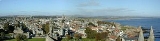
St Andrews is a university town and former royal burgh
on the east coast of Fife
in Scotland
. The town is named after Saint Andrew
the Apostle.
St Andrews has a population of 16,680, making this the fifth largest settlement in Fife.
There has been an important church in St Andrews since at least the 8th century, and a bishopric since at least the 11th century. The settlement grew to the west of St Andrews cathedral
with the southern side of the Scores to the north and the Kinness burn to the south. The burgh soon became the ecclesiastical capital of Scotland, a position which was held until the Scottish Reformation
. The famous cathedral
, the largest in Scotland, now lies in ruins.
The town is home to the University of St Andrews
, the third oldest university in the English-speaking world and one of the UK's most prestigious. The University is an integral part of the burgh, and during term time students make up approximately one third of the town's population.
St Andrews is also known worldwide as the "home of golf". This is in part because the Royal and Ancient Golf Club, founded in 1754, exercises legislative authority over the game worldwide (except in the United States and Mexico), and also because the famous links
(acquired by the town in 1894) is the most frequent venue for The Open Championship
, the oldest of golf
's four major championships
. Visitors travel to St Andrews in great numbers for several courses ranked amongst the finest in the world, as well as for the sandy beaches.
The Martyrs Memorial, erected to the honour of Patrick Hamilton
, George Wishart
, and other martyrs of the Reformation
epoch, stands at the west end of the Scores on a cliff overlooking the sea.
and Eden
during the mesolithic (middle stone age) came from the plains in Northern Europe between 10,000 to 5,000 BC. This was followed by the nomadic people who settled around the modern town around 4,500 BC as farmers cleaning the area of woodland and building monuments.
In 906AD, the town became the seat of the bishop of Alba, with the boundaries being extended to include land between the River Forth
and River Tweed
.
The establishment of the present town began around 1140 by Bishop Robert on a L-shaped vill, possibly on the site of the ruined St Andrews Castle
. According to a charter of 1170, the new burgh was built to the west of the Cathedral precinct, along Castle Street and possibly as far as what is now known as North Street. This means that the lay-out may have led to the creation of two new streets (North Street and South Street) from the foundations of the new St Andrews Cathedral
filling the area inside a two-sided triangle at its apex. The northern boundary of the burgh was the southern side of the Scores (the street between North Street and the sea) with the southern by the Kinness Burn and the western by the West Port. The burgh of St Andrews was first represented at the great council at Scone Palace
in 1357.
Recognised as the ecclesiastical capital of Scotland, the town now had vast economic and political influence within Europe as a cosmopolitan town. In 1559, the town fell into decay after the violent Scottish Reformation
and the Wars of the Three Kingdoms
losing the status of ecclesiastical capital of Scotland. Even the St Andrews University were in consideration over a re-location to Perth
around 1697 and 1698. Under the authorisation of the bishop of St Andrews, the town was made a burgh of barony in 1614. Royal Burgh
was then granted as a charter by King James VI
in 1620. In the 18th century, the town was still in decline, but despite this the town was becoming known for having links 'well known to golfers'. By the 19th century, the town began to expand beyond the original medieval boundaries with streets of new houses and town villas being built. Today, St Andrews is served by education, golf and the tourist and conference industry.
 St Andrews is represented by several tiers of elected government. St Andrews Community Council form the lowest tier of governance whose statutory role is to communicate local opinion to local and central government. Fife Council, the unitary local authority for St Andrews, based in Glenrothes
is the executive
, deliberative
and legislative body responsible for local governance. The Scottish Parliament
is responsible for devolved matters
such as education
, health and justice
while reserved matters
are dealt with by the Parliament of the United Kingdom
.
The first parliament to take place in the town was in 1304, when King Edward I
came to be received by Bishop William de Lamberton as overlordship of Scotland. As many as 130 landowners turned up to witness the event ranging from Sir John of Combo to Sir William Murray of Fort. In the early days of the union of 1707
, St Andrews elected one member of parliament along with Cupar
, Perth
, Dundee
and Forfar
. The first elected parliament was introduced on 17 November 1713 as St Andrews Burgh, which merged with Anstruther, the result of a reform bill in 1832. The act of reformation seats in 1855, would find one MP sitting for St Andrews Burgh (which would include Anstruther Easter, Anstruther Wester, Crail, Cupar, Kilrenny and Pittemweem). Prior to 1975 the town was governed by a council, provost
and baillie
s. In 1975, St Andrews came under Fife Regional Council and North East Fife District Council. The latter was abolished when a single-tier authority was introduced in 1996 as Fife Council based in Glenrothes
.
St Andrews forms part of the North East Fife
constituency, electing one Member of Parliament
(MP) to the House of Commons of the Parliament of the United Kingdom by the first past the post system. The constituency is represented by Sir Menzies Campbell, MP
of the Liberal Democrats
. For the purposes of the Scottish Parliament
, St Andrews forms part of the North East Fife constituency. The North East Fife Scottish Parliament (or Holyrood) constituency created in 1999 is one of nine within the Mid Scotland and Fife electoral region. Each constituency elects one Member of the Scottish Parliament
(MSP) by the first past the post system of election, and the region elects seven additional members to produce a form of proportional representation. The seat was won at the 2011 Scottish Parliament elections by Roderick Campbell
, for the SNP
.
At EU level, St Andrews is part of the pan-Scotland European Parliament constituency
which elects seven Members of the European Parliament (MEP)s using the d'Hondt method
of party-list proportional representation
. Scotland returns two Labour
MEPs, two SNP
MEPs, one Conservative and Unionist
MEP and one Liberal Democrat
MEP, to the European Parliament
.
According to the 2001 census, St Andrews had had a total population of 14,209. The population of St Andrews has since increased to around 16,680 in 2008. The demographic make-up of the population is much in line with the rest of Scotland. The age group from 16 to 29 forms the largest portion of the population (37%). The median age of males and females living in St Andrews was 29 and 34 years respectively, compared to 37 and 39 years for those in the whole of Scotland.
The place of birth of the town's residents was 87.78% United Kingdom (including 61.80% from Scotland), 0.63% Republic of Ireland, 4.18% from other European Union countries, and 7.42% from elsewhere in the world. The economic activity of residents aged 16–74 was 23.94% in full-time employment, 8.52% in part-time employment, 4.73% self-employed, 1.94% unemployed, 31.14% students with jobs, 9.08% students without jobs, 13.24% retired, 2.91% looking after home or family, 2.84% permanently sick or disabled, and 1.67% economically inactive for other reasons.
maritime climate, which is relatively mild despite its northerly latitude
. Winters are not as cold as one might expect, considering that Moscow and Labrador
in Newfoundland lie on the same latitude. Daytime temperatures can fall below freezing and average around 4 °C. However, the town is subject to strong winds. Night-time frosts are common, however snowfall is more rare.
The nearest official Met Office weather station for which data are available is at Leuchars, about 3.3 miles North West of St Andrews town centre.
The absolute maximum temperature is 30.8 °C (87.4 °F), recorded in August 1990. In a typical year, the warmest day should reach 26.1 °C (79 °F) and a total of 2 days should record a temperature of 25.1 °C (77.2 °F) or above. The warmest calendar month (since 1960) was July 2006, with a mean temperature of 16.8 °C (62.2 °F) (mean maximum of 21.6 °C (70.9 °F), mean minimum of 11.9 °C (53.4 °F))
The absolute minimum temperature (since 1960) stands at -14.5 C recorded during February 1972, although in an 'average' year, the coldest night should only fall to -8.3 C. Typically just short of 60 nights a year will experience an air frost. The coldest calendar month (since 1960) was December 2010, with a mean temperature of -0.8 C (mean maximum 1.9 °C (35.4 °F), mean minimum -3.5 C )
Rainfall, at little more than 650mm per year makes St Andrews one of the driest parts of Scotland, shielded from Atlantic weather systems by several mountain ranges. Over 1mm of rain is recorded on just under 117 days of the year.
Sunshine, averaging in excess of 1,500 hours a year is amongst the highest for Scotland, and comparable to inland parts of Southern England. St Andrews is about the furthest north annual levels of above 1500 hours are encountered.
All averages refer to the 1971-2000 observation period.
 St Andrews was once bounded by several "ports" (the Lowland Scots
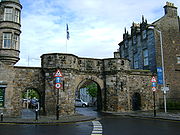
word for a town gate). Two are still extant: So'gait port (South Street, now called West Port) and the Sea Yett (as The Pends terminates to the harbour). The Category A listed West Port is one of few surviving town 'Ports' in Scotland. The towers were influenced by those seen at the base of the Netherbow Port in Edinburgh
. The central archway which displays semi-octagonal 'rownds' and 'battling' is supported by corbelling and neatly moulded passageways. Side arches and relief panels were added to the port, during the reconstruction between 1843–1845.
The Category A listed Holy Trinity (also known as the Holy Trinity Parish Church or "town kirk") is the most historic church in St Andrews. The church was initially built on land, close to the south-east gable of the Cathedral, around 1144 by bishop Robert Kennedy. The church was dedicated in 1234 by Bishop David de Bernham
and then moved to a new site on the north side of South Street between 1410–1412 by bishop Warlock. Towards the end of June 1547, this was the location where John Knox
first preached in public and to whom returned to give an inflammatory sermon on 4 June 1559 which led to the stripping of both the cathedral and ecclesiastical status. Much of the architecture feature of the church was lost in the re-building by Robert Balfour between 1798–1800. The church was later restored to a (more elaborately decorated) approximation of its medieval appearance between 1907–1909 by MacGregor Chambers. Only the north-western tower and spire with parts of the arcade arches were retained.
 To the east of the town centre, lie the ruins of the Category A listed St Andrew's Cathedral
. This was at one time Scotland's largest building, originated in the priory of Canons Regular founded by Bishop Robert Kennedy. The Category A listed St Rule's Church, to the south-east of the medieval cathedral is said to date from around 1120 and 1150, being the predecessor of the cathedral. The tall square tower, part of the church, was built to hold the relics of St Andrew and became known as the first cathedral in the town. After the death of Bishop Robert Kennedy, a new cathedral began in 1160 by Bishop Arnold (his successor) on a site adjacent to St Rule's Church. Work on the cathedral was finally completed and consecrated in 1318 by Bishop William de Lamberton with Robert the Bruce (1306–29) present at the ceremony.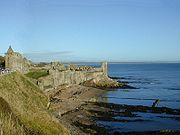 The picturesque ruins of the Category A listed
St Andrews Castle
are situated on a cliff-top, maintained by a man-made ditch (similar to Ravenscraig Castle
in Kirkcaldy
) to the north of the town. The castle was first erected around 1200 as the home of the bishops and later archbishops for use as a palace, prison and fortress, bearing the ecclesiastic ties with the town. Since several demolitions and re-built have taken shape, the majority of the castle only now dates back to between 1549 and 1571. The work was done by Archbishop John Hamilton in a renaissance style retaining the use of a palace rather than a fortress.
The apse
of the Dominican
friary, Blackfriars
, can still be seen on South Street (between Madras College and Bell Street). Other defunct religious houses that existed in the medieval town, though less visible, have left traces, as for instance the leper hospital
at St Nicholas farmhouse
(The Steading) between Albany Park and the East Sands leisure centre.
 Today, St Andrews is home to one secondary school; one private school and three primary schools.
Canongate Primary School, which opened in 1972 is located off the Canongate, beside the St Andrews Royal Botanic Gardens. The school roll was recorded in February 2008 as 215. Lawhead Primary School, which opened in 1974 is on the western edge of the town. The school roll was recorded in September 2009 as 181.
Madras College
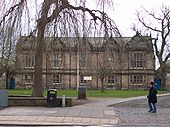
is the only secondary school in the town. The school which opened to pupils in 1832 was based on a Madras system - founded and endowed by Dr Andrew Bell (1755–1832), a native of the town. Prior to the opening, Bell was interested in the demand for a school which was able to teach both poor and privileged children on one site. The high reputation of the school meant that many children came from throughout Britain to be taught there, often lodging with masters or residents in the town. The school is now located on two campuses – Kilrymont and South Street (incorporating the original 1833 building). Pupils in S1-S3 are served by Kilrymont and S4-S6 by South Street. There are plans to build a new Madras College to serve all pupils and bring all facilities into single building.
The private school known as St Leonards School
was initially established as the St Andrews School for girls company in 1877. The present name was taken in 1882 when a move to St Leonards House was made. The school is now spread across thirty acres between Pends Road and Kinnesburn. A private school for boys was also set up in 1933 as New Park
. The operations of the school merged with the middle and junior sections of St Leonards to become St Leonards-New Park in 2005.
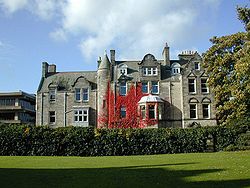 The University of St Andrews, the oldest in Scotland, dates back to 1410. A charter for the university was issued by Bishop Henry Wardlaw
between 1411 and 1412. This was followed by Avignon Pope Benedict XIII granting university status to award degrees to students in 1413. The school initially started out as a society for learned men in the fields of canon law, the arts and divinity. The chapel and college of St John the Evangelist became the first building to have ties with the university in 1415. The two original colleges to be associated with the university were St Salvator in 1450 by Bishop James Kennedy and St Leonard in 1512 by archbishop Alexander Stewart
and prior James Hepburn
.
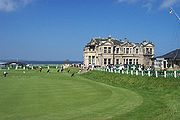 St Andrews is known widely as the "home of golf". According to the earliest surviving document from 1552, the "playing at golf" on the links adjacent to the "water of eden" was granted permission by Archbishop Hamilton. The most famous golf course in the town is the Old Course, purchased by the town council in 1894. The course which dates back to medieval times, is an Open Championship course - which was first staged in 1873. Famous winners at St Andrews have included: Old Tom Morris (1861, 1862, 1867 and 1874); Jack Nicklaus
(1970 and 1978) and Tiger Woods
(2000 and 2005). According to Jack Nicklaus
, "if a golfer is going to be remembered, he must win at St Andrews". There are seven golf courses in total - Old, New, Jubilee, Eden, Strathtyrum, Balgove and the Castle -
surrounding the western approaches of the town. The seventh golf course (the Castle) was added in 2007 at Kinkell Braes, designed by David McLay Kidd.
Other leisure facilities in the town include a canoe club; junior football team;
rugby club (known as Madras Rugby Club
);
tennis club; university sports centre and a links golf driving range. The East Sands Leisure Centre, which opened in 1988, sits on the outskirts of the town as the town's swimming pool with gym facilities. The University of St Andrews have expressed plans to provide a new multi-million pound leisure centre to replace East Sands.
Royal burgh
A royal burgh was a type of Scottish burgh which had been founded by, or subsequently granted, a royal charter. Although abolished in 1975, the term is still used in many of the former burghs....
on the east coast of Fife
Fife
Fife is a council area and former county of Scotland. It is situated between the Firth of Tay and the Firth of Forth, with inland boundaries to Perth and Kinross and Clackmannanshire...
in Scotland
Scotland
Scotland is a country that is part of the United Kingdom. Occupying the northern third of the island of Great Britain, it shares a border with England to the south and is bounded by the North Sea to the east, the Atlantic Ocean to the north and west, and the North Channel and Irish Sea to the...
. The town is named after Saint Andrew
Saint Andrew
Saint Andrew , called in the Orthodox tradition Prōtoklētos, or the First-called, is a Christian Apostle and the brother of Saint Peter. The name "Andrew" , like other Greek names, appears to have been common among the Jews from the 3rd or 2nd century BC. No Hebrew or Aramaic name is recorded for him...
the Apostle.
St Andrews has a population of 16,680, making this the fifth largest settlement in Fife.
There has been an important church in St Andrews since at least the 8th century, and a bishopric since at least the 11th century. The settlement grew to the west of St Andrews cathedral
St Andrew's Cathedral, St Andrews
The Cathedral of St Andrew is a historical church in St Andrews, Fife, Scotland, which was the seat of the Bishops of St Andrews from its foundation in 1158 until it fell into disuse after the Reformation. It is currently a ruined monument in the custody of Historic Scotland...
with the southern side of the Scores to the north and the Kinness burn to the south. The burgh soon became the ecclesiastical capital of Scotland, a position which was held until the Scottish Reformation
Scottish Reformation
The Scottish Reformation was Scotland's formal break with the Papacy in 1560, and the events surrounding this. It was part of the wider European Protestant Reformation; and in Scotland's case culminated ecclesiastically in the re-establishment of the church along Reformed lines, and politically in...
. The famous cathedral
Cathedral
A cathedral is a Christian church that contains the seat of a bishop...
, the largest in Scotland, now lies in ruins.
The town is home to the University of St Andrews
University of St Andrews
The University of St Andrews, informally referred to as "St Andrews", is the oldest university in Scotland and the third oldest in the English-speaking world after Oxford and Cambridge. The university is situated in the town of St Andrews, Fife, on the east coast of Scotland. It was founded between...
, the third oldest university in the English-speaking world and one of the UK's most prestigious. The University is an integral part of the burgh, and during term time students make up approximately one third of the town's population.
St Andrews is also known worldwide as the "home of golf". This is in part because the Royal and Ancient Golf Club, founded in 1754, exercises legislative authority over the game worldwide (except in the United States and Mexico), and also because the famous links
St Andrews Links
St Andrews Links in the town of St Andrews, Fife, Scotland, is regarded as the "home of golf". It is one of the oldest courses in the world, where the game has been played since the 15th century...
(acquired by the town in 1894) is the most frequent venue for The Open Championship
The Open Championship
The Open Championship, or simply The Open , is the oldest of the four major championships in professional golf. It is the only "major" held outside the USA and is administered by The R&A, which is the governing body of golf outside the USA and Mexico...
, the oldest of golf
Golf
Golf is a precision club and ball sport, in which competing players use many types of clubs to hit balls into a series of holes on a golf course using the fewest number of strokes....
's four major championships
Men's major golf championships
The men's major golf championships, commonly known as the Major Championships, and often referred to simply as the majors, are the four most prestigious annual tournaments in professional golf...
. Visitors travel to St Andrews in great numbers for several courses ranked amongst the finest in the world, as well as for the sandy beaches.
The Martyrs Memorial, erected to the honour of Patrick Hamilton
Patrick Hamilton (martyr)
Patrick Hamilton was a Scottish churchman and an early Protestant Reformer in Scotland. He travelled to Europe, where he met several of the leading reforming thinkers, before returning to Scotland to preach...
, George Wishart
George Wishart
George Wishart was a Scottish religious reformer and Protestant martyr.He belonged to a younger branch of the Wisharts of Pitarrow near Montrose. He may have graduated M.A., probably at King's College, Aberdeen, and was certainly a student at the University of Leuven, from which he graduated in 1531...
, and other martyrs of the Reformation
Protestant Reformation
The Protestant Reformation was a 16th-century split within Western Christianity initiated by Martin Luther, John Calvin and other early Protestants. The efforts of the self-described "reformers", who objected to the doctrines, rituals and ecclesiastical structure of the Roman Catholic Church, led...
epoch, stands at the west end of the Scores on a cliff overlooking the sea.
Name
The earliest recorded name of the area is Muckross . After the founding of a religious settlement in Muckross in around 370 AD, the name changed to Cennrígmonaid. This is Old Gaelic and composed of the elements cenn (head, peninsula), ríg (king) and monaid (moor). This became Cell Rígmonaid (cell meaning church) and was anglicized Kilrymont. The modern Gaelic spelling is Cill Rìmhinn.History
The first inhabitants who settled on the estuary fringes of the river TayRiver Tay
The River Tay is the longest river in Scotland and the seventh-longest in the United Kingdom. The Tay originates in western Scotland on the slopes of Ben Lui , then flows easterly across the Highlands, through Loch Dochhart, Loch Lubhair and Loch Tay, then continues east through Strathtay , in...
and Eden
River Eden, Fife
The River Eden is a river in Fife in Scotland, and is one of Fife's two principal rivers, along with the Leven. It is nearly 30 miles long and has a fall of around 90 metres...
during the mesolithic (middle stone age) came from the plains in Northern Europe between 10,000 to 5,000 BC. This was followed by the nomadic people who settled around the modern town around 4,500 BC as farmers cleaning the area of woodland and building monuments.
In 906AD, the town became the seat of the bishop of Alba, with the boundaries being extended to include land between the River Forth
River Forth
The River Forth , long, is the major river draining the eastern part of the central belt of Scotland.The Forth rises in Loch Ard in the Trossachs, a mountainous area some west of Stirling...
and River Tweed
River Tweed
The River Tweed, or Tweed Water, is long and flows primarily through the Borders region of Great Britain. It rises on Tweedsmuir at Tweed's Well near where the Clyde, draining northwest, and the Annan draining south also rise. "Annan, Tweed and Clyde rise oot the ae hillside" as the Border saying...
.
The establishment of the present town began around 1140 by Bishop Robert on a L-shaped vill, possibly on the site of the ruined St Andrews Castle
St Andrews Castle
St Andrew's Castle is a picturesque ruin located in the coastal Royal Burgh of St Andrews in Fife, Scotland. The castle sits on a rocky promontory overlooking a small beach called Castle Sands and the adjoining North Sea. There has been a castle standing at the site since the times of Bishop Roger...
. According to a charter of 1170, the new burgh was built to the west of the Cathedral precinct, along Castle Street and possibly as far as what is now known as North Street. This means that the lay-out may have led to the creation of two new streets (North Street and South Street) from the foundations of the new St Andrews Cathedral
Cathedral
A cathedral is a Christian church that contains the seat of a bishop...
filling the area inside a two-sided triangle at its apex. The northern boundary of the burgh was the southern side of the Scores (the street between North Street and the sea) with the southern by the Kinness Burn and the western by the West Port. The burgh of St Andrews was first represented at the great council at Scone Palace
Scone Palace
Scone Palace is a Category A listed historic house at Scone, Perthshire, Scotland. It was constructed in 1808 for the Earls of Mansfield by William Atkinson...
in 1357.
Recognised as the ecclesiastical capital of Scotland, the town now had vast economic and political influence within Europe as a cosmopolitan town. In 1559, the town fell into decay after the violent Scottish Reformation
Scottish Reformation
The Scottish Reformation was Scotland's formal break with the Papacy in 1560, and the events surrounding this. It was part of the wider European Protestant Reformation; and in Scotland's case culminated ecclesiastically in the re-establishment of the church along Reformed lines, and politically in...
and the Wars of the Three Kingdoms
Wars of the Three Kingdoms
The Wars of the Three Kingdoms formed an intertwined series of conflicts that took place in England, Ireland, and Scotland between 1639 and 1651 after these three countries had come under the "Personal Rule" of the same monarch...
losing the status of ecclesiastical capital of Scotland. Even the St Andrews University were in consideration over a re-location to Perth
Perth, Scotland
Perth is a town and former city and royal burgh in central Scotland. Located on the banks of the River Tay, it is the administrative centre of Perth and Kinross council area and the historic county town of Perthshire...
around 1697 and 1698. Under the authorisation of the bishop of St Andrews, the town was made a burgh of barony in 1614. Royal Burgh
Royal burgh
A royal burgh was a type of Scottish burgh which had been founded by, or subsequently granted, a royal charter. Although abolished in 1975, the term is still used in many of the former burghs....
was then granted as a charter by King James VI
James I of England
James VI and I was King of Scots as James VI from 24 July 1567 and King of England and Ireland as James I from the union of the English and Scottish crowns on 24 March 1603...
in 1620. In the 18th century, the town was still in decline, but despite this the town was becoming known for having links 'well known to golfers'. By the 19th century, the town began to expand beyond the original medieval boundaries with streets of new houses and town villas being built. Today, St Andrews is served by education, golf and the tourist and conference industry.
Governance
Glenrothes
Glenrothes is a large town situated in the heart of Fife, in east-central Scotland. It is located approximately from both Edinburgh, which lies to the south and Dundee to the north. The town had an estimated population of 38,750 in 2008, making Glenrothes the third largest settlement in Fife...
is the executive
Executive (government)
Executive branch of Government is the part of government that has sole authority and responsibility for the daily administration of the state bureaucracy. The division of power into separate branches of government is central to the idea of the separation of powers.In many countries, the term...
, deliberative
Deliberation
Deliberation is a process of thoughtfully weighing options, usually prior to voting. In legal settings a jury famously uses deliberation because it is given specific options, like guilty or not guilty, along with information and arguments to evaluate. Deliberation emphasizes the use of logic and...
and legislative body responsible for local governance. The Scottish Parliament
Scottish Parliament
The Scottish Parliament is the devolved national, unicameral legislature of Scotland, located in the Holyrood area of the capital, Edinburgh. The Parliament, informally referred to as "Holyrood", is a democratically elected body comprising 129 members known as Members of the Scottish Parliament...
is responsible for devolved matters
Devolution
Devolution is the statutory granting of powers from the central government of a sovereign state to government at a subnational level, such as a regional, local, or state level. Devolution can be mainly financial, e.g. giving areas a budget which was formerly administered by central government...
such as education
Education in Scotland
Scotland has a long history of universal provision of public education, and the Scottish education system is distinctly different from the other countries of the United Kingdom...
, health and justice
Scots law
Scots law is the legal system of Scotland. It is considered a hybrid or mixed legal system as it traces its roots to a number of different historical sources. With English law and Northern Irish law it forms the legal system of the United Kingdom; it shares with the two other systems some...
while reserved matters
Reserved matters
In the United Kingdom reserved matters and excepted matters are the areas of government policy where Parliament had kept the power to make laws in Scotland, Northern Ireland and Wales....
are dealt with by the Parliament of the United Kingdom
Parliament of the United Kingdom
The Parliament of the United Kingdom of Great Britain and Northern Ireland is the supreme legislative body in the United Kingdom, British Crown dependencies and British overseas territories, located in London...
.
The first parliament to take place in the town was in 1304, when King Edward I
Edward I of England
Edward I , also known as Edward Longshanks and the Hammer of the Scots, was King of England from 1272 to 1307. The first son of Henry III, Edward was involved early in the political intrigues of his father's reign, which included an outright rebellion by the English barons...
came to be received by Bishop William de Lamberton as overlordship of Scotland. As many as 130 landowners turned up to witness the event ranging from Sir John of Combo to Sir William Murray of Fort. In the early days of the union of 1707
Acts of Union 1707
The Acts of Union were two Parliamentary Acts - the Union with Scotland Act passed in 1706 by the Parliament of England, and the Union with England Act passed in 1707 by the Parliament of Scotland - which put into effect the terms of the Treaty of Union that had been agreed on 22 July 1706,...
, St Andrews elected one member of parliament along with Cupar
Cupar
Cupar is a town and former royal burgh in Fife, Scotland. The town is situated between Dundee and the New Town of Glenrothes.According to a recent population estimate , Cupar had a population around 8,980 making the town the ninth largest settlement in Fife.-History:The town is believed to have...
, Perth
Perth, Scotland
Perth is a town and former city and royal burgh in central Scotland. Located on the banks of the River Tay, it is the administrative centre of Perth and Kinross council area and the historic county town of Perthshire...
, Dundee
Dundee
Dundee is the fourth-largest city in Scotland and the 39th most populous settlement in the United Kingdom. It lies within the eastern central Lowlands on the north bank of the Firth of Tay, which feeds into the North Sea...
and Forfar
Forfar
Forfar is a parish, town and former royal burgh of approximately 13,500 people in Angus, located in the East Central Lowlands of Scotland. Forfar is the county town of Angus, which was officially known as Forfarshire from the 18th century until 1929, when the ancient name was reinstated, and...
. The first elected parliament was introduced on 17 November 1713 as St Andrews Burgh, which merged with Anstruther, the result of a reform bill in 1832. The act of reformation seats in 1855, would find one MP sitting for St Andrews Burgh (which would include Anstruther Easter, Anstruther Wester, Crail, Cupar, Kilrenny and Pittemweem). Prior to 1975 the town was governed by a council, provost
Provost (civil)
A provost is the ceremonial head of many Scottish local authorities, and under the name prévôt was a governmental position of varying importance in Ancien Regime France.-History:...
and baillie
Baillie
A baillie or bailie is a civic officer in the local government of Scotland. The position arose in the burghs, where baillies formerly held a post similar to that of an alderman or magistrate...
s. In 1975, St Andrews came under Fife Regional Council and North East Fife District Council. The latter was abolished when a single-tier authority was introduced in 1996 as Fife Council based in Glenrothes
Glenrothes
Glenrothes is a large town situated in the heart of Fife, in east-central Scotland. It is located approximately from both Edinburgh, which lies to the south and Dundee to the north. The town had an estimated population of 38,750 in 2008, making Glenrothes the third largest settlement in Fife...
.
St Andrews forms part of the North East Fife
North East Fife (UK Parliament constituency)
North East Fife is a county constituency in Fife, Scotland, represented in the House of Commons of the Parliament of the United Kingdom currently held by Sir Menzies Campbell, former leader of the Liberal Democrats...
constituency, electing one Member of Parliament
Member of Parliament
A Member of Parliament is a representative of the voters to a :parliament. In many countries with bicameral parliaments, the term applies specifically to members of the lower house, as upper houses often have a different title, such as senate, and thus also have different titles for its members,...
(MP) to the House of Commons of the Parliament of the United Kingdom by the first past the post system. The constituency is represented by Sir Menzies Campbell, MP
Member of Parliament
A Member of Parliament is a representative of the voters to a :parliament. In many countries with bicameral parliaments, the term applies specifically to members of the lower house, as upper houses often have a different title, such as senate, and thus also have different titles for its members,...
of the Liberal Democrats
Liberal Democrats
The Liberal Democrats are a social liberal political party in the United Kingdom which supports constitutional and electoral reform, progressive taxation, wealth taxation, human rights laws, cultural liberalism, banking reform and civil liberties .The party was formed in 1988 by a merger of the...
. For the purposes of the Scottish Parliament
Scottish Parliament
The Scottish Parliament is the devolved national, unicameral legislature of Scotland, located in the Holyrood area of the capital, Edinburgh. The Parliament, informally referred to as "Holyrood", is a democratically elected body comprising 129 members known as Members of the Scottish Parliament...
, St Andrews forms part of the North East Fife constituency. The North East Fife Scottish Parliament (or Holyrood) constituency created in 1999 is one of nine within the Mid Scotland and Fife electoral region. Each constituency elects one Member of the Scottish Parliament
Member of the Scottish Parliament
Member of the Scottish Parliament is the title given to any one of the 129 individuals elected to serve in the Scottish Parliament.-Methods of Election:MSPs are elected in one of two ways:...
(MSP) by the first past the post system of election, and the region elects seven additional members to produce a form of proportional representation. The seat was won at the 2011 Scottish Parliament elections by Roderick Campbell
Roderick Campbell
Roderick Campbell is SNP MSP for North East Fife, elected in 2011.Campbell was educated at Reading School and graduated BA in politics from Exeter University...
, for the SNP
Scottish National Party
The Scottish National Party is a social-democratic political party in Scotland which campaigns for Scottish independence from the United Kingdom....
.
At EU level, St Andrews is part of the pan-Scotland European Parliament constituency
Scotland (European Parliament constituency)
Scotland constitutes a single constituency of the European Parliament. For 2009 it elects 6 MEPs using the d'Hondt method of party-list proportional representation.- Boundaries :...
which elects seven Members of the European Parliament (MEP)s using the d'Hondt method
D'Hondt method
The d'Hondt method is a highest averages method for allocating seats in party-list proportional representation. The method described is named after Belgian mathematician Victor D'Hondt who described it in 1878...
of party-list proportional representation
Party-list proportional representation
Party-list proportional representation systems are a family of voting systems emphasizing proportional representation in elections in which multiple candidates are elected...
. Scotland returns two Labour
Labour Party (UK)
The Labour Party is a centre-left democratic socialist party in the United Kingdom. It surpassed the Liberal Party in general elections during the early 1920s, forming minority governments under Ramsay MacDonald in 1924 and 1929-1931. The party was in a wartime coalition from 1940 to 1945, after...
MEPs, two SNP
Scottish National Party
The Scottish National Party is a social-democratic political party in Scotland which campaigns for Scottish independence from the United Kingdom....
MEPs, one Conservative and Unionist
Conservative Party (UK)
The Conservative Party, formally the Conservative and Unionist Party, is a centre-right political party in the United Kingdom that adheres to the philosophies of conservatism and British unionism. It is the largest political party in the UK, and is currently the largest single party in the House...
MEP and one Liberal Democrat
Liberal Democrats
The Liberal Democrats are a social liberal political party in the United Kingdom which supports constitutional and electoral reform, progressive taxation, wealth taxation, human rights laws, cultural liberalism, banking reform and civil liberties .The party was formed in 1988 by a merger of the...
MEP, to the European Parliament
European Parliament
The European Parliament is the directly elected parliamentary institution of the European Union . Together with the Council of the European Union and the Commission, it exercises the legislative function of the EU and it has been described as one of the most powerful legislatures in the world...
.
Demography
| St Andrews | Fife | Scotland | |
|---|---|---|---|
| Total population | 14,209 | 349,429 | 5,062,011 |
| Foreign born British nationality law British nationality law is the law of the United Kingdom that concerns citizenship and other categories of British nationality. The law is complex because of the United Kingdom's former status as an imperial power.-History:... |
11.60% | 1.18% | 1.10% |
| Over 75 years old | 10.51% | 7.46% | 7.09% |
| Unemployed | 1.94% | 3.97% | 4.0% |
According to the 2001 census, St Andrews had had a total population of 14,209. The population of St Andrews has since increased to around 16,680 in 2008. The demographic make-up of the population is much in line with the rest of Scotland. The age group from 16 to 29 forms the largest portion of the population (37%). The median age of males and females living in St Andrews was 29 and 34 years respectively, compared to 37 and 39 years for those in the whole of Scotland.
The place of birth of the town's residents was 87.78% United Kingdom (including 61.80% from Scotland), 0.63% Republic of Ireland, 4.18% from other European Union countries, and 7.42% from elsewhere in the world. The economic activity of residents aged 16–74 was 23.94% in full-time employment, 8.52% in part-time employment, 4.73% self-employed, 1.94% unemployed, 31.14% students with jobs, 9.08% students without jobs, 13.24% retired, 2.91% looking after home or family, 2.84% permanently sick or disabled, and 1.67% economically inactive for other reasons.
Weather and climate
St Andrews has a temperateTemperate
In geography, temperate or tepid latitudes of the globe lie between the tropics and the polar circles. The changes in these regions between summer and winter are generally relatively moderate, rather than extreme hot or cold...
maritime climate, which is relatively mild despite its northerly latitude
Latitude
In geography, the latitude of a location on the Earth is the angular distance of that location south or north of the Equator. The latitude is an angle, and is usually measured in degrees . The equator has a latitude of 0°, the North pole has a latitude of 90° north , and the South pole has a...
. Winters are not as cold as one might expect, considering that Moscow and Labrador
Labrador
Labrador is the distinct, northerly region of the Canadian province of Newfoundland and Labrador. It comprises the mainland portion of the province, separated from the island of Newfoundland by the Strait of Belle Isle...
in Newfoundland lie on the same latitude. Daytime temperatures can fall below freezing and average around 4 °C. However, the town is subject to strong winds. Night-time frosts are common, however snowfall is more rare.
The nearest official Met Office weather station for which data are available is at Leuchars, about 3.3 miles North West of St Andrews town centre.
The absolute maximum temperature is 30.8 °C (87.4 °F), recorded in August 1990. In a typical year, the warmest day should reach 26.1 °C (79 °F) and a total of 2 days should record a temperature of 25.1 °C (77.2 °F) or above. The warmest calendar month (since 1960) was July 2006, with a mean temperature of 16.8 °C (62.2 °F) (mean maximum of 21.6 °C (70.9 °F), mean minimum of 11.9 °C (53.4 °F))
The absolute minimum temperature (since 1960) stands at -14.5 C recorded during February 1972, although in an 'average' year, the coldest night should only fall to -8.3 C. Typically just short of 60 nights a year will experience an air frost. The coldest calendar month (since 1960) was December 2010, with a mean temperature of -0.8 C (mean maximum 1.9 °C (35.4 °F), mean minimum -3.5 C )
Rainfall, at little more than 650mm per year makes St Andrews one of the driest parts of Scotland, shielded from Atlantic weather systems by several mountain ranges. Over 1mm of rain is recorded on just under 117 days of the year.
Sunshine, averaging in excess of 1,500 hours a year is amongst the highest for Scotland, and comparable to inland parts of Southern England. St Andrews is about the furthest north annual levels of above 1500 hours are encountered.
All averages refer to the 1971-2000 observation period.
Landmarks
Scots language
Scots is the Germanic language variety spoken in Lowland Scotland and parts of Ulster . It is sometimes called Lowland Scots to distinguish it from Scottish Gaelic, the Celtic language variety spoken in most of the western Highlands and in the Hebrides.Since there are no universally accepted...
word for a town gate). Two are still extant: So'gait port (South Street, now called West Port) and the Sea Yett (as The Pends terminates to the harbour). The Category A listed West Port is one of few surviving town 'Ports' in Scotland. The towers were influenced by those seen at the base of the Netherbow Port in Edinburgh
Edinburgh
Edinburgh is the capital city of Scotland, the second largest city in Scotland, and the eighth most populous in the United Kingdom. The City of Edinburgh Council governs one of Scotland's 32 local government council areas. The council area includes urban Edinburgh and a rural area...
. The central archway which displays semi-octagonal 'rownds' and 'battling' is supported by corbelling and neatly moulded passageways. Side arches and relief panels were added to the port, during the reconstruction between 1843–1845.
The Category A listed Holy Trinity (also known as the Holy Trinity Parish Church or "town kirk") is the most historic church in St Andrews. The church was initially built on land, close to the south-east gable of the Cathedral, around 1144 by bishop Robert Kennedy. The church was dedicated in 1234 by Bishop David de Bernham
David de Bernham
David de Bernham was Chamberlain of King Alexander II of Scotland and subsequently, Bishop of St. Andrews. He was elected to the see in June 1239, and finally consecrated, after some difficulties, in January, 1240. He died in 1253, and was buried at Nenthorn, near Kelso.-References:*Dowden, John,...
and then moved to a new site on the north side of South Street between 1410–1412 by bishop Warlock. Towards the end of June 1547, this was the location where John Knox
John Knox
John Knox was a Scottish clergyman and a leader of the Protestant Reformation who brought reformation to the church in Scotland. He was educated at the University of St Andrews or possibly the University of Glasgow and was ordained to the Catholic priesthood in 1536...
first preached in public and to whom returned to give an inflammatory sermon on 4 June 1559 which led to the stripping of both the cathedral and ecclesiastical status. Much of the architecture feature of the church was lost in the re-building by Robert Balfour between 1798–1800. The church was later restored to a (more elaborately decorated) approximation of its medieval appearance between 1907–1909 by MacGregor Chambers. Only the north-western tower and spire with parts of the arcade arches were retained.
St Andrew's Cathedral, St Andrews
The Cathedral of St Andrew is a historical church in St Andrews, Fife, Scotland, which was the seat of the Bishops of St Andrews from its foundation in 1158 until it fell into disuse after the Reformation. It is currently a ruined monument in the custody of Historic Scotland...
. This was at one time Scotland's largest building, originated in the priory of Canons Regular founded by Bishop Robert Kennedy. The Category A listed St Rule's Church, to the south-east of the medieval cathedral is said to date from around 1120 and 1150, being the predecessor of the cathedral. The tall square tower, part of the church, was built to hold the relics of St Andrew and became known as the first cathedral in the town. After the death of Bishop Robert Kennedy, a new cathedral began in 1160 by Bishop Arnold (his successor) on a site adjacent to St Rule's Church. Work on the cathedral was finally completed and consecrated in 1318 by Bishop William de Lamberton with Robert the Bruce (1306–29) present at the ceremony.
St Andrews Castle
St Andrews Castle
St Andrew's Castle is a picturesque ruin located in the coastal Royal Burgh of St Andrews in Fife, Scotland. The castle sits on a rocky promontory overlooking a small beach called Castle Sands and the adjoining North Sea. There has been a castle standing at the site since the times of Bishop Roger...
are situated on a cliff-top, maintained by a man-made ditch (similar to Ravenscraig Castle
Ravenscraig Castle
Ravenscraig Castle is a ruined castle located in Kirkcaldy which dates from around 1460. The castle is an early example of artillery defence in Scotland...
in Kirkcaldy
Kirkcaldy
Kirkcaldy is a town and former royal burgh in Fife, on the east coast of Scotland. The town lies on a shallow bay on the northern shore of the Firth of Forth; SSE of Glenrothes, ENE of Dunfermline, WSW of Dundee and NNE of Edinburgh...
) to the north of the town. The castle was first erected around 1200 as the home of the bishops and later archbishops for use as a palace, prison and fortress, bearing the ecclesiastic ties with the town. Since several demolitions and re-built have taken shape, the majority of the castle only now dates back to between 1549 and 1571. The work was done by Archbishop John Hamilton in a renaissance style retaining the use of a palace rather than a fortress.
The apse
Apse
In architecture, the apse is a semicircular recess covered with a hemispherical vault or semi-dome...
of the Dominican
Dominican Order
The Order of Preachers , after the 15th century more commonly known as the Dominican Order or Dominicans, is a Catholic religious order founded by Saint Dominic and approved by Pope Honorius III on 22 December 1216 in France...
friary, Blackfriars
Blackfriars, St Andrews
Blackfriars is the modern name for the Dominican friary of St Mary which existed in St Andrews, Scotland, in the later Middle Ages. The name is also used for the modern ruins.-History:...
, can still be seen on South Street (between Madras College and Bell Street). Other defunct religious houses that existed in the medieval town, though less visible, have left traces, as for instance the leper hospital
St Nicholas Hospital, St Andrews
St Nicholas Hospital was a medieval hospital in St Andrews, Fife. It was located around what is today St Nicholas farmhouse at the Steading, between Albany Park and the East Sands Leisure Centre. Of unknown origin, the establishment served as a hospice for lepers outside the town between the beach...
at St Nicholas farmhouse
St Nicholas Hospital, St Andrews
St Nicholas Hospital was a medieval hospital in St Andrews, Fife. It was located around what is today St Nicholas farmhouse at the Steading, between Albany Park and the East Sands Leisure Centre. Of unknown origin, the establishment served as a hospice for lepers outside the town between the beach...
(The Steading) between Albany Park and the East Sands leisure centre.
Education
Canongate Primary School, which opened in 1972 is located off the Canongate, beside the St Andrews Royal Botanic Gardens. The school roll was recorded in February 2008 as 215. Lawhead Primary School, which opened in 1974 is on the western edge of the town. The school roll was recorded in September 2009 as 181.
Madras College
Madras College
Madras College is a secondary school in St. Andrews, Fife in Scotland.-History:Madras College, founded in 1832, takes its name from the system of education devised by the school's founder, the Rev Dr Andrew Bell....
is the only secondary school in the town. The school which opened to pupils in 1832 was based on a Madras system - founded and endowed by Dr Andrew Bell (1755–1832), a native of the town. Prior to the opening, Bell was interested in the demand for a school which was able to teach both poor and privileged children on one site. The high reputation of the school meant that many children came from throughout Britain to be taught there, often lodging with masters or residents in the town. The school is now located on two campuses – Kilrymont and South Street (incorporating the original 1833 building). Pupils in S1-S3 are served by Kilrymont and S4-S6 by South Street. There are plans to build a new Madras College to serve all pupils and bring all facilities into single building.
The private school known as St Leonards School
St Leonards School
St Leonards School, formerly St Leonards School for Girls, is an independent school, founded by the University of St Andrews in the nineteenth century....
was initially established as the St Andrews School for girls company in 1877. The present name was taken in 1882 when a move to St Leonards House was made. The school is now spread across thirty acres between Pends Road and Kinnesburn. A private school for boys was also set up in 1933 as New Park
New Park School
- Founding and Development :New Park School was an independent preparatory school in St Andrews, Fife, Scotland. The school was founded in 1933 by Cuthbert Dixon, a teacher at Merchiston Castle School....
. The operations of the school merged with the middle and junior sections of St Leonards to become St Leonards-New Park in 2005.
Henry Wardlaw
Henry Wardlaw was a Scottish church leader, Bishop of St Andrews and founder of the University of St Andrews.He was a son of II Laird of Wilton Henry Wardlaw who was b. 1318, and a nephew of Walter Wardlaw Henry Wardlaw (died 6 April 1440) was a Scottish church leader, Bishop of St Andrews and...
between 1411 and 1412. This was followed by Avignon Pope Benedict XIII granting university status to award degrees to students in 1413. The school initially started out as a society for learned men in the fields of canon law, the arts and divinity. The chapel and college of St John the Evangelist became the first building to have ties with the university in 1415. The two original colleges to be associated with the university were St Salvator in 1450 by Bishop James Kennedy and St Leonard in 1512 by archbishop Alexander Stewart
Alexander Stewart (Archbishop of St Andrews)
Alexander Stewart was an illegitimate son of King James IV of Scotland and his mistress Marion Boyd. He was the eldest illegitimate child of King James IV of Scotland his mistress Marion Boyd...
and prior James Hepburn
James Hepburn (bishop)
James Hepburn was a Scottish prelate and administrator. He was the son of Alexander Hepburn of Whitsome. His name occurs as the rector of Dalry and king's clerk on 1 August 1511. Hepburn was Treasurer of Scotland between from at least June 1515, until October the following year...
.
Sport and recreation
Jack Nicklaus
Jack William Nicklaus , nicknamed "The Golden Bear", is an American professional golfer. He won 18 career major championships on the PGA Tour over a span of 25 years and is widely regarded as one of the greatest professional golfers of all time. In addition to his 18 Majors, he was runner-up a...
(1970 and 1978) and Tiger Woods
Tiger Woods
Eldrick Tont "Tiger" Woods is an American professional golfer whose achievements to date rank him among the most successful golfers of all time. Formerly the World No...
(2000 and 2005). According to Jack Nicklaus
Jack Nicklaus
Jack William Nicklaus , nicknamed "The Golden Bear", is an American professional golfer. He won 18 career major championships on the PGA Tour over a span of 25 years and is widely regarded as one of the greatest professional golfers of all time. In addition to his 18 Majors, he was runner-up a...
, "if a golfer is going to be remembered, he must win at St Andrews". There are seven golf courses in total - Old, New, Jubilee, Eden, Strathtyrum, Balgove and the Castle -
surrounding the western approaches of the town. The seventh golf course (the Castle) was added in 2007 at Kinkell Braes, designed by David McLay Kidd.
Other leisure facilities in the town include a canoe club; junior football team;
rugby club (known as Madras Rugby Club
Madras College FP RFC
Madras College Former Pupils Rugby Football Club is a rugby union side based in St Andrews in Fife, Scotland. They will play in Caledonia Regional League Division 2 midlands in Season 2011/12. They play at Station Park, St Andrews and field two men's fifteens each weekend, as well as a women's team...
);
tennis club; university sports centre and a links golf driving range. The East Sands Leisure Centre, which opened in 1988, sits on the outskirts of the town as the town's swimming pool with gym facilities. The University of St Andrews have expressed plans to provide a new multi-million pound leisure centre to replace East Sands.
See also
- All Saints Church, St Andrews
- Bishop of St Andrews
- Celtic artCeltic artCeltic art is the art associated with the peoples known as Celts; those who spoke the Celtic languages in Europe from pre-history through to the modern period, as well as the art of ancient peoples whose language is uncertain, but have cultural and stylistic similarities with speakers of Celtic...
- Pictish stones at St Andrews. - The New Picture HouseThe New Picture HouseThe New Picture House is an independent cinema located in St Andrews, Scotland, which was first opened in 1934. It contains three cinema screens, the largest of which contains a row of special "VIP" seats consisting of electronic black recliners and has both a ground level and balcony seating area...
- St Nicholas Hospital, St AndrewsSt Nicholas Hospital, St AndrewsSt Nicholas Hospital was a medieval hospital in St Andrews, Fife. It was located around what is today St Nicholas farmhouse at the Steading, between Albany Park and the East Sands Leisure Centre. Of unknown origin, the establishment served as a hospice for lepers outside the town between the beach...
- St Andrews Community HospitalSt Andrews Community HospitalSt Andrews Community Hospital is a small hospital to the south of the university town of St Andrews in Fife, Scotland. The 10,800m2 complex hosts the town's three General Medical Practices, a pharmacy, and a range of inpatient and outpatient health services...