

North-West Europe

Encyclopedia
North-West Europe is a term that refers to a northern area of Western Europe
, although the exact area or countries it comprises varies.
, it is almost always used to include the United Kingdom
and Ireland
; the northern and western parts of France
and Germany
; the Benelux
countries; and the nordic countries
(though possibly not Finland
). It would normally exclude the Iberian peninsula
, Italy
; Switzerland
, southern and eastern parts of France and Germany and Austria
. This usage is helpful when discussing issues of climate
or biology
. Broadly speaking, it represents the area whose climate and biogeography is significantly modified by the Gulf Stream
.
, and the Finns. However there's no longer a sharp distinction as Germanic languages
or Romance Languages
have at least co-official status in all of the traditionally Celtic polities and the region has a history of Protestantism that differentiates it from its Mediterranean Latin
or Eastern Europe
an Slavic
neighbors. This leads to much the same definition as the geographical one above, but would tend to exclude France and southern Belgium
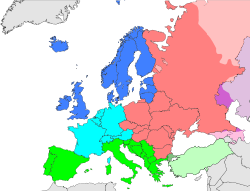
including areas which retained Celtic elements into the middle ages as well as Austria and parts of Southern Germany. Measured by this attribute it would therefore be closer to the area shown on the map as Northern Europe
plus the low countries and Northern Germany.
history, North-West Europe has been used to refer to the land campaigns in that approximate area during World War II
. Two separate battle honours were awarded to regiments who took part in these campaigns "North-West Europe Campaign of 1940
" and "North-West Europe Campaign of 1944-1945
". The North-West Europe Campaign of 1940, during the Battle of France
, was restricted to Belgium and the French Channel ports
. The North-West Europe Campaign of 1944-1945 started with the landings
in Normandy
and ended with Field Marshal Montgomery taking the German military surrender of all German forces in Holland, Northwest Germany and Denmark on Lüneburg Heath
in Northwest Germany was fought by the British 21st Army Group
. In the First campaign the French Army was responsible for the rest of the Western Front from Luxembourg to Switzerland, as were the American 12th Army
and 6th Army Groups
during the second campaign.
Units of the First Canadian Army
fought in five major campaigns in North-West Europe, including the Battle of Normandy
, the battles for the Channel Ports, the Battle of the Scheldt
, the Rhineland fighting in February and March 1945, and the final operations east of the River Rhine. A period of static warfare existed from 1 November 1944 to 8 February 1945 during which time the First Canadian Army manned positions in the Nijmegen Salient.
Western Europe
Western Europe is a loose term for the collection of countries in the western most region of the European continents, though this definition is context-dependent and carries cultural and political connotations. One definition describes Western Europe as a geographic entity—the region lying in the...
, although the exact area or countries it comprises varies.
Geographic definition
GeographicallyGeography
Geography is the science that studies the lands, features, inhabitants, and phenomena of Earth. A literal translation would be "to describe or write about the Earth". The first person to use the word "geography" was Eratosthenes...
, it is almost always used to include the United Kingdom
United Kingdom
The United Kingdom of Great Britain and Northern IrelandIn the United Kingdom and Dependencies, other languages have been officially recognised as legitimate autochthonous languages under the European Charter for Regional or Minority Languages...
and Ireland
Ireland
Ireland is an island to the northwest of continental Europe. It is the third-largest island in Europe and the twentieth-largest island on Earth...
; the northern and western parts of France
France
The French Republic , The French Republic , The French Republic , (commonly known as France , is a unitary semi-presidential republic in Western Europe with several overseas territories and islands located on other continents and in the Indian, Pacific, and Atlantic oceans. Metropolitan France...
and Germany
Germany
Germany , officially the Federal Republic of Germany , is a federal parliamentary republic in Europe. The country consists of 16 states while the capital and largest city is Berlin. Germany covers an area of 357,021 km2 and has a largely temperate seasonal climate...
; the Benelux
Benelux
The Benelux is an economic union in Western Europe comprising three neighbouring countries, Belgium, the Netherlands, and Luxembourg. These countries are located in northwestern Europe between France and Germany...
countries; and the nordic countries
Nordic countries
The Nordic countries make up a region in Northern Europe and the North Atlantic which consists of Denmark, Finland, Iceland, Norway and Sweden and their associated territories, the Faroe Islands, Greenland and Åland...
(though possibly not Finland
Finland
Finland , officially the Republic of Finland, is a Nordic country situated in the Fennoscandian region of Northern Europe. It is bordered by Sweden in the west, Norway in the north and Russia in the east, while Estonia lies to its south across the Gulf of Finland.Around 5.4 million people reside...
). It would normally exclude the Iberian peninsula
Iberian Peninsula
The Iberian Peninsula , sometimes called Iberia, is located in the extreme southwest of Europe and includes the modern-day sovereign states of Spain, Portugal and Andorra, as well as the British Overseas Territory of Gibraltar...
, Italy
Italy
Italy , officially the Italian Republic languages]] under the European Charter for Regional or Minority Languages. In each of these, Italy's official name is as follows:;;;;;;;;), is a unitary parliamentary republic in South-Central Europe. To the north it borders France, Switzerland, Austria and...
; Switzerland
Switzerland
Switzerland name of one of the Swiss cantons. ; ; ; or ), in its full name the Swiss Confederation , is a federal republic consisting of 26 cantons, with Bern as the seat of the federal authorities. The country is situated in Western Europe,Or Central Europe depending on the definition....
, southern and eastern parts of France and Germany and Austria
Austria
Austria , officially the Republic of Austria , is a landlocked country of roughly 8.4 million people in Central Europe. It is bordered by the Czech Republic and Germany to the north, Slovakia and Hungary to the east, Slovenia and Italy to the south, and Switzerland and Liechtenstein to the...
. This usage is helpful when discussing issues of climate
Climate
Climate encompasses the statistics of temperature, humidity, atmospheric pressure, wind, rainfall, atmospheric particle count and other meteorological elemental measurements in a given region over long periods...
or biology
Biology
Biology is a natural science concerned with the study of life and living organisms, including their structure, function, growth, origin, evolution, distribution, and taxonomy. Biology is a vast subject containing many subdivisions, topics, and disciplines...
. Broadly speaking, it represents the area whose climate and biogeography is significantly modified by the Gulf Stream
Gulf Stream
The Gulf Stream, together with its northern extension towards Europe, the North Atlantic Drift, is a powerful, warm, and swift Atlantic ocean current that originates at the tip of Florida, and follows the eastern coastlines of the United States and Newfoundland before crossing the Atlantic Ocean...
.
Ethnographic definition
Historically and linguistically, in "North-West Europe" the remaining major groupings are Celtic Europe, Germanic EuropeGermanic languages
The Germanic languages constitute a sub-branch of the Indo-European language family. The common ancestor of all of the languages in this branch is called Proto-Germanic , which was spoken in approximately the mid-1st millennium BC in Iron Age northern Europe...
, and the Finns. However there's no longer a sharp distinction as Germanic languages
Germanic languages
The Germanic languages constitute a sub-branch of the Indo-European language family. The common ancestor of all of the languages in this branch is called Proto-Germanic , which was spoken in approximately the mid-1st millennium BC in Iron Age northern Europe...
or Romance Languages
Romance languages
The Romance languages are a branch of the Indo-European language family, more precisely of the Italic languages subfamily, comprising all the languages that descend from Vulgar Latin, the language of ancient Rome...
have at least co-official status in all of the traditionally Celtic polities and the region has a history of Protestantism that differentiates it from its Mediterranean Latin
Latin Europe
Latin Europe is a loose term for the region of Europe with an especially strong Latin cultural heritage inherited from the Roman Empire.-Application:...
or Eastern Europe
Eastern Europe
Eastern Europe is the eastern part of Europe. The term has widely disparate geopolitical, geographical, cultural and socioeconomic readings, which makes it highly context-dependent and even volatile, and there are "almost as many definitions of Eastern Europe as there are scholars of the region"...
an Slavic
Slavic Europe
Slavic Europe is a region of Europe where Slavic languages are spoken. This area is situated in Central and Eastern Europe and the Balkans, and includes the nations of Belarus, Bosnia and Herzegovina, Bulgaria, Croatia, the Czech Republic, the Republic of Macedonia, Montenegro, Poland, Russia,...
neighbors. This leads to much the same definition as the geographical one above, but would tend to exclude France and southern Belgium
Belgium
Belgium , officially the Kingdom of Belgium, is a federal state in Western Europe. It is a founding member of the European Union and hosts the EU's headquarters, and those of several other major international organisations such as NATO.Belgium is also a member of, or affiliated to, many...
including areas which retained Celtic elements into the middle ages as well as Austria and parts of Southern Germany. Measured by this attribute it would therefore be closer to the area shown on the map as Northern Europe
Northern Europe
Northern Europe is the northern part or region of Europe. Northern Europe typically refers to the seven countries in the northern part of the European subcontinent which includes Denmark, Estonia, Latvia, Lithuania, Norway, Finland and Sweden...
plus the low countries and Northern Germany.
World War II Theatre
In British and Canadian militaryMilitary
A military is an organization authorized by its greater society to use lethal force, usually including use of weapons, in defending its country by combating actual or perceived threats. The military may have additional functions of use to its greater society, such as advancing a political agenda e.g...
history, North-West Europe has been used to refer to the land campaigns in that approximate area during World War II
World War II
World War II, or the Second World War , was a global conflict lasting from 1939 to 1945, involving most of the world's nations—including all of the great powers—eventually forming two opposing military alliances: the Allies and the Axis...
. Two separate battle honours were awarded to regiments who took part in these campaigns "North-West Europe Campaign of 1940
North-West Europe Campaign of 1940
North-West Europe Campaign of 1940 is a battle honour given to several regiments in the British Army. It refers to the land campaign starting with the invasion of France in May 1940 and ending with the evacuation from Dunkirk....
" and "North-West Europe Campaign of 1944-1945
North-West Europe Campaign of 1944-1945
North-West Europe Campaign of 1944–1945 is a battle honour given to several regiments in the British Army.It refers to the land campaign starting with the landings in Normandy and ended with Field Marshal Montgomery taking the German military surrender of all German forces in Holland, Northwest...
". The North-West Europe Campaign of 1940, during the Battle of France
Battle of France
In the Second World War, the Battle of France was the German invasion of France and the Low Countries, beginning on 10 May 1940, which ended the Phoney War. The battle consisted of two main operations. In the first, Fall Gelb , German armoured units pushed through the Ardennes, to cut off and...
, was restricted to Belgium and the French Channel ports
Battle of Dunkirk
The Battle of Dunkirk was a battle in the Second World War between the Allies and Germany. A part of the Battle of France on the Western Front, the Battle of Dunkirk was the defence and evacuation of British and allied forces in Europe from 26 May–4 June 1940.After the Phoney War, the Battle of...
. The North-West Europe Campaign of 1944-1945 started with the landings
Operation Overlord
Operation Overlord was the code name for the Battle of Normandy, the operation that launched the invasion of German-occupied western Europe during World War II by Allied forces. The operation commenced on 6 June 1944 with the Normandy landings...
in Normandy
Normandy
Normandy is a geographical region corresponding to the former Duchy of Normandy. It is in France.The continental territory covers 30,627 km² and forms the preponderant part of Normandy and roughly 5% of the territory of France. It is divided for administrative purposes into two régions:...
and ended with Field Marshal Montgomery taking the German military surrender of all German forces in Holland, Northwest Germany and Denmark on Lüneburg Heath
Lüneburg Heath
The Lüneburg Heath is a large area of heath, geest and woodland in northeastern part of the state of Lower Saxony in northern Germany. It forms part of the hinterland for the cities of Hamburg, Hanover, and Bremen and is named after the town of Lüneburg. Most of the area is a nature reserve...
in Northwest Germany was fought by the British 21st Army Group
British 21st Army Group
The 21st Army Group was a British headquarters formation consisting primarily of British and Canadian forces. The Army Group was an important Allied force in the European Theatre of World War II. It was established in London during July 1943 under the command of Supreme Headquarters Allied...
. In the First campaign the French Army was responsible for the rest of the Western Front from Luxembourg to Switzerland, as were the American 12th Army
U.S. 12th Army Group
The Twelfth United States Army Group was the largest and most powerful United States Army formation ever to take to the field. It controlled the majority of American forces on the Western Front in 1944 and 1945...
and 6th Army Groups
U.S. 6th Army Group
The Sixth United States Army Group was an Army Group of the Allies during World War II, and as contained armies from both the United States Army and the French Army it is also referred to as the Southern Group of Armies.-History:...
during the second campaign.
Units of the First Canadian Army
First Canadian Army
The First Canadian Army was the senior Canadian operational formation in Europe during the Second World War.The Army was formed in early 1942, replacing the existing unnumbered Canadian Corps, as the growing number of Canadian forces in the United Kingdom necessitated an expansion to two corps...
fought in five major campaigns in North-West Europe, including the Battle of Normandy
Operation Overlord
Operation Overlord was the code name for the Battle of Normandy, the operation that launched the invasion of German-occupied western Europe during World War II by Allied forces. The operation commenced on 6 June 1944 with the Normandy landings...
, the battles for the Channel Ports, the Battle of the Scheldt
Battle of the Scheldt
The Battle of the Scheldt was a series of military operations of the Canadian 1st Army, led by Lieutenant-General Guy Simonds. The battle took place in northern Belgium and southwestern Netherlands during World War II from 2 October-8 November 1944...
, the Rhineland fighting in February and March 1945, and the final operations east of the River Rhine. A period of static warfare existed from 1 November 1944 to 8 February 1945 during which time the First Canadian Army manned positions in the Nijmegen Salient.