

Kingdom of Strathclyde

Encyclopedia
Strath
A strath is a large valley, typically a river valley that is wide and shallow .An anglicisation of the Gaelic word srath, it is one of many that have been absorbed into common use in the English language...
of the Clyde
River Clyde
The River Clyde is a major river in Scotland. It is the ninth longest river in the United Kingdom, and the third longest in Scotland. Flowing through the major city of Glasgow, it was an important river for shipbuilding and trade in the British Empire....
"), originally Brythonic Ystrad Clud, was one of the early medieval
Scotland in the Early Middle Ages
Scotland in the early Middle Ages, between the end of Roman authority in southern and central Britain from around 400 and the rise of the kingdom of Alba in 900, was divided into a series of petty kingdoms. Of these the four most important to emerge were the Picts, the Scots of Dál Riata, the...
kingdoms of the celtic people called the Britons
Britons (historical)
The Britons were the Celtic people culturally dominating Great Britain from the Iron Age through the Early Middle Ages. They spoke the Insular Celtic language known as British or Brythonic...
in the Hen Ogledd
Hen Ogledd
Yr Hen Ogledd is a Welsh term used by scholars to refer to those parts of what is now northern England and southern Scotland in the years between 500 and the Viking invasions of c. 800, with particular interest in the Brythonic-speaking peoples who lived there.The term is derived from heroic...
, the Brythonic-speaking parts of what is now southern Scotland
Scotland
Scotland is a country that is part of the United Kingdom. Occupying the northern third of the island of Great Britain, it shares a border with England to the south and is bounded by the North Sea to the east, the Atlantic Ocean to the north and west, and the North Channel and Irish Sea to the...
and northern England
Northern England
Northern England, also known as the North of England, the North or the North Country, is a cultural region of England. It is not an official government region, but rather an informal amalgamation of counties. The southern extent of the region is roughly the River Trent, while the North is bordered...
. The kingdom developed during the post-Roman
Sub-Roman Britain
Sub-Roman Britain is a term derived from an archaeological label for the material culture of Britain in Late Antiquity: the term "Sub-Roman" was invented to describe the potsherds in sites of the 5th century and the 6th century, initially with an implication of decay of locally-made wares from a...
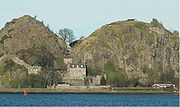
period. It is also known as Alt Clut, the Brythonic name for Dumbarton Rock, the medieval capital of the region. It may have had its origins with the Damnonii
Damnonii
The Damnonii were a people of the late 2nd century who lived in what is now southern Scotland. They are mentioned briefly in Ptolemy's Geography, where he uses both of the terms "Damnonii" and "Damnii" to describe them, and there is no other historical record of them. Their cultural and...
people of Ptolemy
Ptolemy
Claudius Ptolemy , was a Roman citizen of Egypt who wrote in Greek. He was a mathematician, astronomer, geographer, astrologer, and poet of a single epigram in the Greek Anthology. He lived in Egypt under Roman rule, and is believed to have been born in the town of Ptolemais Hermiou in the...
's Geographia
Geographia (Ptolemy)
The Geography is Ptolemy's main work besides the Almagest...
.
The language of Strathclyde, and that of the Britons in surrounding areas under non-native rulership is known as Cumbric
Cumbric language
Cumbric was a variety of the Celtic British language spoken during the Early Middle Ages in the Hen Ogledd or "Old North", or what is now northern England and southern Lowland Scotland, the area anciently known as Cumbria. It was closely related to Old Welsh and the other Brythonic languages...
, a dialect or language closely related to Old Welsh. Place-name and archaeological evidence points to some settlement by Norse
Norsemen
Norsemen is used to refer to the group of people as a whole who spoke what is now called the Old Norse language belonging to the North Germanic branch of Indo-European languages, especially Norwegian, Icelandic, Faroese, Swedish and Danish in their earlier forms.The meaning of Norseman was "people...
or Norse-Gaels
Norse-Gaels
The Norse–Gaels were a people who dominated much of the Irish Sea region, including the Isle of Man, and western Scotland for a part of the Middle Ages; they were of Gaelic and Scandinavian origin and as a whole exhibited a great deal of Gaelic and Norse cultural syncretism...
in the Viking Age, although to a lesser degree than in neighbouring Galloway
Galloway
Galloway is an area in southwestern Scotland. It usually refers to the former counties of Wigtownshire and Kirkcudbrightshire...
. A small number of Anglian
Old English language
Old English or Anglo-Saxon is an early form of the English language that was spoken and written by the Anglo-Saxons and their descendants in parts of what are now England and southeastern Scotland between at least the mid-5th century and the mid-12th century...
place-names show some limited settlement by incomers from Northumbria
Northumbria
Northumbria was a medieval kingdom of the Angles, in what is now Northern England and South-East Scotland, becoming subsequently an earldom in a united Anglo-Saxon kingdom of England. The name reflects the approximate southern limit to the kingdom's territory, the Humber Estuary.Northumbria was...
prior to the Norse settlement. Due to the series of language changes in the area, it is not possible to say whether any Goidelic
Goidelic languages
The Goidelic languages or Gaelic languages are one of the two branches of the Insular Celtic languages, the other consisting of the Brythonic languages. Goidelic languages historically formed a dialect continuum stretching from the south of Ireland through the Isle of Man to the north of Scotland...
settlement took place before Gaelic
Scottish Gaelic language
Scottish Gaelic is a Celtic language native to Scotland. A member of the Goidelic branch of the Celtic languages, Scottish Gaelic, like Modern Irish and Manx, developed out of Middle Irish, and thus descends ultimately from Primitive Irish....
was introduced in the High Middle Ages
Scotland in the High Middle Ages
The High Middle Ages of Scotland encompass Scotland in the era between the death of Domnall II in 900 AD and the death of king Alexander III in 1286...
.
After the sack of Dumbarton Rock by a Viking army from Dublin in 870, the name Strathclyde comes into use, perhaps reflecting a move of the centre of the kingdom to Govan
Govan
Govan is a district and former burgh now part of southwest City of Glasgow, Scotland. It is situated west of Glasgow city centre, on the south bank of the River Clyde, opposite the mouth of the River Kelvin and the district of Partick....
. In the same period, it was also referred to as Cumbria, and its inhabitants as Cumbrians. During the High Middle Ages, the area was conquered by the kingdom of Alba
Kingdom of Alba
The name Kingdom of Alba pertains to the Kingdom of Scotland between the deaths of Donald II in 900, and of Alexander III in 1286 which then led indirectly to the Scottish Wars of Independence...
, becoming part of the new kingdom of Scotland. It remained a distinctive area into the 12th century.
Origins

Roman Empire
The Roman Empire was the post-Republican period of the ancient Roman civilization, characterised by an autocratic form of government and large territorial holdings in Europe and around the Mediterranean....
invasion and the establishment of Roman Britain
Roman Britain
Roman Britain was the part of the island of Great Britain controlled by the Roman Empire from AD 43 until ca. AD 410.The Romans referred to the imperial province as Britannia, which eventually comprised all of the island of Great Britain south of the fluid frontier with Caledonia...
in the first century AD. As well as the Damnonii, Ptolemy lists the Otalini
Votadini
The Votadini were a people of the Iron Age in Great Britain, and their territory was briefly part of the Roman province Britannia...
, whose capital appears to have been Traprain Law
Traprain Law
Traprain Law is a hill about 221m in elevation, located east of Haddington in East Lothian, Scotland. It is the site of an oppidum or hill fort, which covered at its maximum extent about 16 ha and must have been a veritable town...
; to their west, the Selgovae
Selgovae
The Selgovae were a people of the late 2nd century who lived in what is now the Stewartry of Kirkcudbright and Dumfriesshire, on the southern coast of Scotland. They are mentioned briefly in Ptolemy's Geography, and there is no other historical record of them...
in the Southern Uplands
Southern Uplands
The Southern Uplands are the southernmost and least populous of mainland Scotland's three major geographic areas . The term is used both to describe the geographical region and to collectively denote the various ranges of hills within this region...
and, further west in Galloway
Galloway
Galloway is an area in southwestern Scotland. It usually refers to the former counties of Wigtownshire and Kirkcudbrightshire...
, the Novantae
Novantae
The Novantae were a people of the late 2nd century who lived in what is now Galloway and Carrick, in southwestern-most Scotland. They are mentioned briefly in Ptolemy's Geography The Novantae were a people of the late 2nd century who lived in what is now Galloway and Carrick, in southwestern-most...
. In addition, a group known as the Maeatae
Maeatae
The Maeatae were a confederation of tribes who lived probably beyond the Antonine Wall in Roman Britain. The historical sources are vague as to the exact region they inhabited....
, probably in the area around Stirling
Stirling
Stirling is a city and former ancient burgh in Scotland, and is at the heart of the wider Stirling council area. The city is clustered around a large fortress and medieval old-town beside the River Forth...
, appear in later Roman records. The capital of the Damnonii is believed to have been at Carman, near Dumbarton, but around 5 miles inland from the river Clyde
River Clyde
The River Clyde is a major river in Scotland. It is the ninth longest river in the United Kingdom, and the third longest in Scotland. Flowing through the major city of Glasgow, it was an important river for shipbuilding and trade in the British Empire....
.
Although the northern frontier appears to have been Hadrians Wall for most of the history of Roman Britain, the extent of Roman influence north of the Wall is obscure. Certainly Roman forts existed north of the wall, and forts as far north as Cramond may have been in long-term occupation. Moreover, the formal frontier was three times moved further north. Twice it was advanced to the line of the Antonine Wall
Antonine Wall
The Antonine Wall is a stone and turf fortification built by the Romans across what is now the Central Belt of Scotland, between the Firth of Forth and the Firth of Clyde. Representing the northernmost frontier barrier of the Roman Empire, it spanned approximately 39 miles and was about ten feet ...
, at about the time when Hadrian's Wall was built and again under Septimius Severus
Septimius Severus
Septimius Severus , also known as Severus, was Roman Emperor from 193 to 211. Severus was born in Leptis Magna in the province of Africa. As a young man he advanced through the customary succession of offices under the reigns of Marcus Aurelius and Commodus. Severus seized power after the death of...
, and once further north, beyond the river Tay
River Tay
The River Tay is the longest river in Scotland and the seventh-longest in the United Kingdom. The Tay originates in western Scotland on the slopes of Ben Lui , then flows easterly across the Highlands, through Loch Dochhart, Loch Lubhair and Loch Tay, then continues east through Strathtay , in...
, during Agricola
Gnaeus Julius Agricola
Gnaeus Julius Agricola was a Roman general responsible for much of the Roman conquest of Britain. His biography, the De vita et moribus Iulii Agricolae, was the first published work of his son-in-law, the historian Tacitus, and is the source for most of what is known about him.Born to a noted...
's campaigns – although each time it was soon withdrawn. In addition to these contacts, Roman armies undertook punitive expeditions north of the frontiers. Northern natives also travelled south of the wall, to trade, to raid and to serve in the Roman army. Roman traders may have travelled north, and Roman subsidies, or bribes, were sent to useful tribes and leaders. The extent to which Roman Britain was romanised is debated, and if there are doubts about the areas under close Roman control, then there must be even more doubts over the degree to which the Damnonii were romanised.
The final period of Roman Britain saw an apparent increase in attacks by land and sea, the raiders including the Picts
Picts
The Picts were a group of Late Iron Age and Early Mediaeval people living in what is now eastern and northern Scotland. There is an association with the distribution of brochs, place names beginning 'Pit-', for instance Pitlochry, and Pictish stones. They are recorded from before the Roman conquest...
, Scotti
Scoti
Scoti or Scotti was the generic name used by the Romans to describe those who sailed from Ireland to conduct raids on Roman Britain. It was thus synonymous with the modern term Gaels...
and the mysterious Attacotti
Attacotti
Attacotti refers to a people who despoiled Roman Britain between 364 and 368, along with Scotti, Picts, Saxons, Roman military deserters, and the indigenous Britons themselves. The marauders were defeated by Count Theodosius in 368...
whose origins are not certain. These raids will have also targeted the tribes of southern Scotland. The supposed final withdrawal of Roman forces around 410 is unlikely to have been of military impact on the Damnonii, although the withdrawal of pay from the residual Wall garrison will have had a very considerable economic effect.
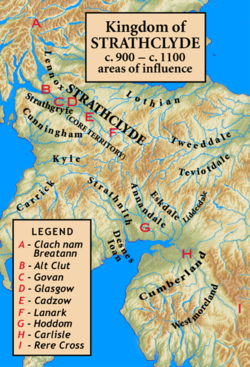
No historical source gives any firm information on the boundaries of the kingdom of Alt Clut, but suggestions have been offered on the basis of place-names
Toponymy
Toponymy is the scientific study of place names , their origins, meanings, use and typology. The word "toponymy" is derived from the Greek words tópos and ónoma . Toponymy is itself a branch of onomastics, the study of names of all kinds...
and topography
Topography
Topography is the study of Earth's surface shape and features or those ofplanets, moons, and asteroids...
. Near the north end of Loch Lomond
Loch Lomond
Loch Lomond is a freshwater Scottish loch, lying on the Highland Boundary Fault. It is the largest lake in Great Britain by surface area. The lake contains many islands, including Inchmurrin, the largest fresh-water island in the British Isles, although the lake itself is smaller than many Irish...
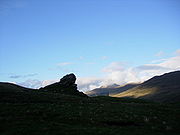
, which can be reached by boat from the Clyde, lies Clach nam Breatann, the Rock of the Britains, which is thought to have gained its name as a marker at the northern limit of Alt Clut. The Campsie Fells
Campsie Fells
The Campsie Fells are a range of hills in central Scotland, stretching east to west, from Denny Muir to Dumgoyne, in Stirlingshire. . The highest point in the range is Earl's Seat which is 578 m high...
and the marshes between Loch Lomond and Stirling
Stirling
Stirling is a city and former ancient burgh in Scotland, and is at the heart of the wider Stirling council area. The city is clustered around a large fortress and medieval old-town beside the River Forth...
may have represented another boundary. To the south, the kingdom extended some distance up the valley of the Clyde, and along the coast probably extended south towards Ayr
Ayr
Ayr is a town and port situated on the Firth of Clyde in south-west Scotland. With a population of around 46,000, Ayr is the largest settlement in Ayrshire, of which it is the county town, and has held royal burgh status since 1205...
.
The Old North
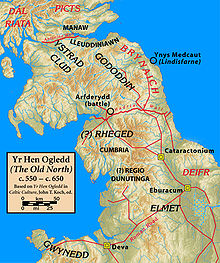
Irish sources report events in the kingdom of Dumbarton only when they have an Irish link. Excepting the 6th century jeremiad
Jeremiad
A jeremiad is a long literary work, usually in prose, but sometimes in poetry, in which the author bitterly laments the state of society and its morals in a serious tone of sustained invective, and always contains a prophecy of society's imminent downfall....
by Gildas
Gildas
Gildas was a 6th-century British cleric. He is one of the best-documented figures of the Christian church in the British Isles during this period. His renowned learning and literary style earned him the designation Gildas Sapiens...
and the poetry attributed to Taliesin
Taliesin
Taliesin was an early British poet of the post-Roman period whose work has possibly survived in a Middle Welsh manuscript, the Book of Taliesin...
and Aneirin
Aneirin
Aneirin or Neirin was a Dark Age Brythonic poet. He is believed to have been a bard or 'court poet' in one of the Cumbric kingdoms of the Old North or Hen Ogledd, probably that of Gododdin at Edinburgh, in modern Scotland...
, in particular Y Gododdin
Y Gododdin
Y Gododdin is a medieval Welsh poem consisting of a series of elegies to the men of the Britonnic kingdom of Gododdin and its allies who, according to the conventional interpretation, died fighting the Angles of Deira and Bernicia at a place named Catraeth...
, thought to have been composed in Scotland in the 7th century, Welsh sources generally date from a much later period. Some are informed by the political attitudes prevalent in Wales in the 9th century and after. Bede
Bede
Bede , also referred to as Saint Bede or the Venerable Bede , was a monk at the Northumbrian monastery of Saint Peter at Monkwearmouth, today part of Sunderland, England, and of its companion monastery, Saint Paul's, in modern Jarrow , both in the Kingdom of Northumbria...
, whose prejudice is apparent, rarely mentions Britons, and then usually in uncomplimentary terms.
Two kings are known from near contemporary sources in this early period. The first is Coroticus or Ceretic
Ceretic of Alt Clut
Ceretic Guletic of Alt Clut was a king of Alt Clut in the 5th century. He has been identified with Coroticus, a Britonnic warrior addressed in a letter by Saint Patrick. Of Patrick's two surviving letters, one is addressed to the warband of this Coroticus...
(Ceredig), known as the recipient of a letter from Saint Patrick
Saint Patrick
Saint Patrick was a Romano-Briton and Christian missionary, who is the most generally recognized patron saint of Ireland or the Apostle of Ireland, although Brigid of Kildare and Colmcille are also formally patron saints....
, and stated by a 7th century biographer to have been king of the Height of the Clyde, Dumbarton Rock, placing him in the second half of the 5th century. From Patrick's letter it is clear that Ceretic was a Christian
Christian
A Christian is a person who adheres to Christianity, an Abrahamic, monotheistic religion based on the life and teachings of Jesus of Nazareth as recorded in the Canonical gospels and the letters of the New Testament...
, and it is likely that the ruling class of the area were also Christians, at least in name. His descendant Rhydderch Hael
Riderch I of Alt Clut
Riderch I , commonly known as Riderch or Rhydderch Hael , was a ruler of Alt Clut and the greater region later known as Strathclyde, a Brittonic kingdom that existed on the valley of the River Clyde in Scotland during the British Sub-Roman period...
is named in Adomnán
Adomnán of Iona
Saint Adomnán of Iona was abbot of Iona , hagiographer, statesman and clerical lawyer; he was the author of the most important Vita of Saint Columba and promulgator of the "Law of Innocents", lex innocentium, also called Cáin Adomnáin, "Law of Adomnán"...
's Life of Saint Columba
Columba
Saint Columba —also known as Colum Cille , Colm Cille , Calum Cille and Kolban or Kolbjørn —was a Gaelic Irish missionary monk who propagated Christianity among the Picts during the Early Medieval Period...
. Riderch was a contemporary of Áedán mac Gabráin
Áedán mac Gabráin
Áedán mac Gabráin was a king of Dál Riata from circa 574 until his death, perhaps on 17 April 609. The kingdom of Dál Riata was situated in modern Argyll and Bute, Scotland, and parts of County Antrim, Ireland...
of Dál Riata
Dál Riata
Dál Riata was a Gaelic overkingdom on the western coast of Scotland with some territory on the northeast coast of Ireland...
and Urien
Urien
Urien , often referred to as Urien Rheged, was a late 6th century king of Rheged, an early British kingdom of the Hen Ogledd . His power and his victories, including the battles of Gwen Ystrad and Alt Clut Ford, are celebrated in the praise poems to him by Taliesin, preserved in the Book of Taliesin...
of Rheged
Rheged
Rheged is described in poetic sources as one of the kingdoms of the Hen Ogledd , the Brythonic-speaking region of what is now northern England and southern Scotland, during the Early Middle Ages...
, to whom he is linked by various traditions and tales, and also of Æthelfrith
Æthelfrith of Northumbria
Æthelfrith was King of Bernicia from c. 593 until c. 616; he was also, beginning c. 604, the first Bernician king to also rule Deira, to the south of Bernicia. Since Deira and Bernicia were the two basic components of what would later be defined as Northumbria, Æthelfrith can be considered, in...
of Bernicia
Bernicia
Bernicia was an Anglo-Saxon kingdom established by Anglian settlers of the 6th century in what is now southeastern Scotland and North East England....
.
The Christianisation of southern Scotland, if Patrick's letter to Coroticus was indeed to a king in Strathclyde, had therefore made considerable progress when the first historical sources appear. Further south, at Whithorn
Whithorn
Whithorn is a former royal burgh in Dumfries and Galloway, Scotland, about ten miles south of Wigtown. The town was the location of the first recorded Christian church in Scotland, Candida Casa : the 'White [or 'Shining'] House', built by Saint Ninian about 397.-Eighth and twelfth centuries:A...
, a Christian inscription is known from the second half of the 5th century, perhaps commemorating a new church. How this came about is unknown. Unlike Columba, Kentigern
Saint Mungo
Saint Mungo is the commonly used name for Saint Kentigern . He was the late 6th century apostle of the Brythonic Kingdom of Strathclyde in modern Scotland, and patron saint and founder of the city of Glasgow.-Name:In Wales and England, this saint is known by his birth and baptismal name Kentigern...
, the supposed apostle to the Britons of the Clyde, is a shadowy figure and Jocelyn of Furness
Jocelyn of Furness
Jocelyn of Furness was a Cistercian hagiographer, known for his Lives of Saint Waltheof, Saint Patrick, Saint Kentigern and Saint Helena....
's 12th century Life is late and of doubtful authenticity though Jackson believed that Jocelyn's version might have been based on an earlier Cumbric original.
The Kingdom of Alt Clut
.png)
At the beginning of the 7th century, Áedán mac Gabráin may have been the most powerful king in northern Britain, and Dál Riata was at its height. Áedán's byname in later Welsh poetry, Aeddan Fradawg (Áedán the Treacherous) does not speak to a favourable reputation among the Britons of Alt Clut, and it may be that he seized control of Alt Clut. Áedán's dominance came to an end around 604, when his army, including Irish kings and Bernician exiles, was defeated by Æthelfrith at the battle of Degsastan
Battle of Degsastan
The Battle of Degsastan was fought c. 603 between king Æthelfrith of Bernicia and the Gaels under Áedán mac Gabráin, king of Dál Riada. Æthelfrith carried the day, winning a decisive victory, although his brother Theodbald was killed. We know almost nothing else about the battle, not even where...
.
It is supposed, on rather weak evidence, that Æthelfrith, his successor Edwin
Edwin of Northumbria
Edwin , also known as Eadwine or Æduini, was the King of Deira and Bernicia – which later became known as Northumbria – from about 616 until his death. He converted to Christianity and was baptised in 627; after he fell at the Battle of Hatfield Chase, he was venerated as a saint.Edwin was the son...
and Bernician and Northumbrian kings after them expanded into southern Scotland. Such evidence as there is, such as the conquest of Elmet
Elmet
Elmet was an independent Brythonic kingdom covering a broad area of what later became the West Riding of Yorkshire during the Early Middle Ages, between approximately the 5th century and early 7th century. Although its precise boundaries are unclear, it appears to have been bordered by the River...
, the wars in north Wales
Wales
Wales is a country that is part of the United Kingdom and the island of Great Britain, bordered by England to its east and the Atlantic Ocean and Irish Sea to its west. It has a population of three million, and a total area of 20,779 km²...
and with Mercia
Mercia
Mercia was one of the kingdoms of the Anglo-Saxon Heptarchy. It was centred on the valley of the River Trent and its tributaries in the region now known as the English Midlands...
, would argue for a more southerly focus of Northumbrian activity in the first half of the 7th century. The report in the Annals of Ulster
Annals of Ulster
The Annals of Ulster are annals of medieval Ireland. The entries span the years between AD 431 to AD 1540. The entries up to AD 1489 were compiled in the late 15th century by the scribe Ruaidhrí Ó Luinín, under his patron Cathal Óg Mac Maghnusa on the island of Belle Isle on Lough Erne in the...
for 638, "the battle of Glenn Muiresan and the besieging of Eten" (Din Eidyn, later Edinburgh
Edinburgh
Edinburgh is the capital city of Scotland, the second largest city in Scotland, and the eighth most populous in the United Kingdom. The City of Edinburgh Council governs one of Scotland's 32 local government council areas. The council area includes urban Edinburgh and a rural area...
), has been taken to represent the capture of Din Eidyn by the Northumbrian king Oswald
Oswald of Northumbria
Oswald was King of Northumbria from 634 until his death, and is now venerated as a Christian saint.Oswald was the son of Æthelfrith of Bernicia and came to rule after spending a period in exile; after defeating the British ruler Cadwallon ap Cadfan, Oswald brought the two Northumbrian kingdoms of...
, son of Æthelfrith, but the Annals mention neither capture, nor Northumbrians, so that this is rather a tenuous identification.
In 642, the Annals of Ulster report that the Britons of Alt Clut led by Eugein
Eugein I of Alt Clut
Eugein I was a ruler of Alt Clut , the kingdom later known as Strathclyde, sometime in the mid-7th century. According to the Harleian genealogies, he was the son of Beli I, presumably his predecessor as king, and the father of Elfin, who ruled sometime later...
son of Beli
Beli I of Alt Clut
Beli I was a ruler of Alt Clut , the Brythonic kingdom later known as Strathclyde, some time in the 7th century. Very little is known of him, but his family appears to have been very well connected in northern Britain....
defeated the men of Dál Riata and killed Domnall Brecc
Domnall Brecc
Domnall Brecc was king of Dál Riata, in modern Scotland, from about 629 until 642...
, grandson of Áedán, at Strathcarron, and this victory is also recorded in an addition to Y Gododdin. The site of this battle lies in the area known in later Welsh sources as Bannawg, the name Bannockburn
Bannockburn
Bannockburn is a village immediately south of the city of Stirling in Scotland. It is named after the Bannock Burn, a burn running through the village before flowing into the River Forth.-History:...
is presumed to be related, which is thought to have meant the very extensive marshes and bogs between Loch Lomond and the river Forth
River Forth
The River Forth , long, is the major river draining the eastern part of the central belt of Scotland.The Forth rises in Loch Ard in the Trossachs, a mountainous area some west of Stirling...
, and the hills and lochs to the north, which separated the lands of the Britons from those of Dál Riata and the Picts, and this land was not worth fighting over. However, the lands to the south and east of this waste, were controlled by smaller, nameless British kingdoms. Powerful neighbouring kings, whether in Alt Clut, Dál Riata, Pictland or Bernicia, would have imposed tribute on these petty kings, and wars for the overlordship of this area seem to have been regular events in the 6th to 8th centuries.
There are few definite reports of Alt Clut in the remainder of the 7th century, although it is possible that the Irish annals
Irish annals
A number of Irish annals were compiled up to and shortly after the end of Gaelic Ireland in the 17th century.Annals were originally a means by which monks determined the yearly chronology of feast days...
contain entries which may be related to Alt Clut. In the last quarter of the 7th century, a number of battles in Ireland, largely in areas along the Irish Sea
Irish Sea
The Irish Sea separates the islands of Ireland and Great Britain. It is connected to the Celtic Sea in the south by St George's Channel, and to the Atlantic Ocean in the north by the North Channel. Anglesey is the largest island within the Irish Sea, followed by the Isle of Man...
coast, are reported where Britons take part. It is usually assumed that these Britons are mercenaries, or exiles dispossessed by some Anglo-Saxon conquest in northern Britain. However, it may be that these represent campaigns by kings of Alt Clut, whose kingdom was certainly part of the region linked by the Irish Sea. All of Alt Clut's neighbours, Northumbria, Pictland and Dál Riata, are known to have sent armies to Ireland on occasions.
The Annals of Ulster in the early 8th century report two battles between Alt Clut and Dál Riata, at "Lorg Ecclet" (unknown) in 711, and at "the rock called Minuirc" in 717. Whether their appearance in the record has any significance or whether it is just happenstance is unclear. Later in the 8th century, it appears that the Pictish king Óengus
Óengus I of the Picts
Óengus son of Fergus , was king of the Picts from 732 until his death in 761. His reign can be reconstructed in some detail from a variety of sources.Óengus became the chief king in Pictland following a period of civil war in the late 720s...
made at least three campaigns against Alt Clut, none successful. In 744 the Picts acted alone, and in 750 Óengus may have cooperated with Eadberht of Northumbria
Eadberht of Northumbria
Eadberht was king of Northumbria from 737 or 738 to 758. He was the brother of Ecgbert, Archbishop of York. His reign is seen as a return to the imperial ambitions of seventh-century Northumbria and may represent a period of economic prosperity. He faced internal opposition from rival dynasties...
in a campaign in which Talorgan, brother of Óengus, was killed in a heavy Pictish defeat at the hands of Teudebur of Alt Clut
Teudebur of Alt Clut
Teudebur of Alt Clut was the ruler of Alt Clut , in the early-to-mid eighth century . According to the Harleian genealogies, he was the son of Beli II, his probable predecessor as king. Such information is confirmed by both the Irish and Welsh annals...
, perhaps at Mugdock, near Milngavie
Milngavie
Milngavie , is a town in East Dunbartonshire, Scotland. It is on the Allander Water, at the northwestern edge of Greater Glasgow, and about from Glasgow city centre. It neighbours Bearsden....
. Eadberht is said to have taken the plain of Kyle in 750, around modern Ayr
Ayr
Ayr is a town and port situated on the Firth of Clyde in south-west Scotland. With a population of around 46,000, Ayr is the largest settlement in Ayrshire, of which it is the county town, and has held royal burgh status since 1205...
, presumably from Alt Clut.
Teudebur died around 752, and it was probably his son Dumnagual
Dumnagual III of Alt Clut
Dumnagual III was the ruler of Alt Clut, later known as Strathclyde , for some time in the mid-eighth century . According to the Harleian genealogies, he was the son of Teudebur, one of his predecessors as king...
who faced a joint effort by Óengus and Eadberht in 756. The Picts and Northumbrians laid siege to Dumbarton Rock, and extracted a submission from Dumnagual. It is doubtful whether the agreement, whatever it may have been, was kept as Eadberht's army was all but wiped out, whether by their supposed allies or recent enemies is unclear, on its way back to Northumbria.
After this, little is heard of Alt Clut or its kings until the 9th century. The "burning", the usual term for capture, of Alt Clut is reported in 780, although by whom and what in what circumstances is not known. Thereafter Dunblane
Dunblane
Dunblane is a small cathedral city and former burgh north of Stirling in the Stirling council area of Scotland. The town is situated off the A9 road, on the way north to Perth. Its main landmark is Dunblane Cathedral and the Allan Water runs through the town centre, with the Cathedral and the High...
was burned by the men of Alt Clut in 849, perhaps in the reign of Artgal
Artgal of Alt Clut
Artgal was a king of Alt Clut and Strathclyde , a Brythonic kingdom in the Hen Ogledd or "Old North" of Britain, for some time in the mid-9th century. Artgal's reign is notable in that he is the first certain king of Alt Clut since Dumnagual III of Alt Clut a century before...
.
The Viking Age
In 870 an army led by the Viking chiefs known in Irish as Amlaíb ConungAmlaíb Conung
Amlaíb Conung was a Norse or Norse-Gael leader in Ireland and Scotland in the years after 850. Together with his brothers Ímar and Auisle he appears frequently in the Irish annals....
and Ímar laid siege to Alt Clut, a siege which lasted some four months and led to the destruction of the citadel and the capture of a very large number of captives. The siege and capture are reported by Welsh and Irish sources, and the Annals of Ulster say that in 871, after overwintering on the Clyde:
King Artgal mac Dumnagual, called "king of the Britons of Strathclyde", was among the captives, and it is reported that he was killed in Dublin in 872 at the instigation of Causantín mac Cináeda
Constantine I of Scotland
Causantín or Constantín mac Cináeda was a king of the Picts. He is often known as Constantine I, in reference to his place in modern lists of kings of Scots, though contemporary sources described Causantín only as a Pictish king...
. He was followed by his son Run of Alt Clut
Run of Alt Clut
Run was probably a ruler of Alt Clut and Strathclyde , a Brythonic kingdom in the Hen Ogledd or "Old North" of Britain...
, who was married to Causantín's sister. Eochaid
Eochaid of Scotland
Eochaid mac Run, known in English simply as Eochaid, may have been king of the Picts from 878 to 889. He was a son of Run, King of Strathclyde, and his mother may have been a daughter of Kenneth MacAlpin...
, the result of this marriage, may have been king of Strathclyde, or of the kingdom of Alba
Kingdom of Alba
The name Kingdom of Alba pertains to the Kingdom of Scotland between the deaths of Donald II in 900, and of Alexander III in 1286 which then led indirectly to the Scottish Wars of Independence...
.
From this time forward, and perhaps from much earlier, the kingdom of Strathclyde was subject to periodic domination by the kings of Alba. However, the earlier idea, that the heirs to the Scots throne ruled Strathclyde, or Cumbria as an appanage
Appanage
An apanage or appanage or is the grant of an estate, titles, offices, or other things of value to the younger male children of a sovereign, who would otherwise have no inheritance under the system of primogeniture...
, has relatively little support, and the degree of Scots control should not be overstated. This period probably saw a degree of Norse, or Norse-Gael settlement in Strathclyde. A number of place-names, in particular a cluster on the coast facing the Cumbraes
The Cumbraes
The Cumbraes are a group of islands in the Firth of Clyde, Scotland. The islands belong to the traditional county of Bute and the modern unitary authority of North Ayrshire.The main islands in the group are:* Great Cumbrae* Little Cumbrae...
, and monuments such as the hogback
Hogback (sculpture)
Hogbacks are stone carved Anglo-Scandinavian sculptures from 10th-12th century England and Scotland. Their function is generally accepted as grave markers.-Geography and description:...
graves at Govan, are some of the remains of these newcomers.
A Welsh tradition in the Brut y Tywysogion
Brut y Tywysogion
Brut y Tywysogion is one of the most important primary sources for Welsh history. It is an annalistic chronicle that serves as a continuation of Geoffrey of Monmouth’s Historia Regum Britanniae. Brut y Tywysogion has survived as several Welsh translations of an original Latin version, which has...
claimed that in 890: "[t]he men of Strathclyde, those that refused to unite with the English, had to depart from their country and go into Gwynedd." This seems confused or misdated as Edward the Elder
Edward the Elder
Edward the Elder was an English king. He became king in 899 upon the death of his father, Alfred the Great. His court was at Winchester, previously the capital of Wessex...
was not master of his own kingdom of Wessex
Wessex
The Kingdom of Wessex or Kingdom of the West Saxons was an Anglo-Saxon kingdom of the West Saxons, in South West England, from the 6th century, until the emergence of a united English state in the 10th century, under the Wessex dynasty. It was to be an earldom after Canute the Great's conquest...
in 890, let alone a force north of the Humber Estuary, and still less in Strathclyde. Later in Edward's reign, and in that of Athelstan
Athelstan of England
Athelstan , called the Glorious, was the King of England from 924 or 925 to 939. He was the son of King Edward the Elder, grandson of Alfred the Great and nephew of Æthelflæd of Mercia...
, the kings of Wessex did extend their power far north. Athelstan defeated the men of Strathclyde in 934 and at the battle of Brunanburh
Battle of Brunanburh
The Battle of Brunanburh was an English victory in 937 by the army of Æthelstan, King of England, and his brother Edmund over the combined armies of Olaf III Guthfrithson, the Norse-Gael King of Dublin, Constantine II, King of Scots, and Owen I, King of Strathclyde...
in 937.
Following the battle of Brunanburh, Dyfnwal ab Owein became king of Strathclyde, perhaps reigning from c. 937 until 971. It has been supposed that he was installed as king by Máel Coluim mac Domnaill
Malcolm I of Scotland
Máel Coluim mac Domnaill was king of Scots , becoming king when his cousin Causantín mac Áeda abdicated to become a monk...
to whom Edmund
Edmund I of England
Edmund I , called the Elder, the Deed-doer, the Just, or the Magnificent, was King of England from 939 until his death. He was a son of Edward the Elder and half-brother of Athelstan. Athelstan died on 27 October 939, and Edmund succeeded him as king.-Military threats:Shortly after his...
of Wessex had "let" the kingdom of Strathclyde, but again, as with earlier ideas of an appanage, this is probably to overstate the case and to follow John of Fordun
John of Fordun
John of Fordun was a Scottish chronicler. It is generally stated that he was born at Fordoun, Mearns. It is certain that he was a secular priest, and that he composed his history in the latter part of the 14th century; and it is probable that he was a chaplain in the St Machar's Cathedral of...
's version of history more closely than the facts merit. Dyfnwal died, on pilgrimage in Rome
Rome
Rome is the capital of Italy and the country's largest and most populated city and comune, with over 2.7 million residents in . The city is located in the central-western portion of the Italian Peninsula, on the Tiber River within the Lazio region of Italy.Rome's history spans two and a half...
, in 975. In this period, the kingdom of Strathclyde may have extended far to the south, perhaps beyond the Solway Firth
Solway Firth
The Solway Firth is a firth that forms part of the border between England and Scotland, between Cumbria and Dumfries and Galloway. It stretches from St Bees Head, just south of Whitehaven in Cumbria, to the Mull of Galloway, on the western end of Dumfries and Galloway. The Isle of Man is also very...
into modern English Cumbria
Cumbria
Cumbria , is a non-metropolitan county in North West England. The county and Cumbria County Council, its local authority, came into existence in 1974 after the passage of the Local Government Act 1972. Cumbria's largest settlement and county town is Carlisle. It consists of six districts, and in...
, although this is far from certain. Local tradition in English Cumbria
Cumbria
Cumbria , is a non-metropolitan county in North West England. The county and Cumbria County Council, its local authority, came into existence in 1974 after the passage of the Local Government Act 1972. Cumbria's largest settlement and county town is Carlisle. It consists of six districts, and in...
recounts how Dunmail
Dunmail
Dunmail, last King of Cumbria is a figure of both history and legend.In 945AD the Saxon king Edmund I of England conquered Strathclyde and ceded Cumbria to his ally, Malcolm I MacDonald, king of Scotland...
(presumably Dyfnwal III) the so-called "Last King of Cumbria" was killed at the Battle of Dunmail Raise
Dunmail Raise
Dunmail Raise is a hill in the English Lake District, the highest point of a pass on the Keswick-Kendal road, the A591, to the south of Thirlmere reservoir on the way to Grasmere, in the Lake District National Park...
in 945. A large cairn on what was the boundary between Cumberland
Cumberland
Cumberland is a historic county of North West England, on the border with Scotland, from the 12th century until 1974. It formed an administrative county from 1889 to 1974 and now forms part of Cumbria....
and Westmorland
Westmorland
Westmorland is an area of North West England and one of the 39 historic counties of England. It formed an administrative county from 1889 to 1974, after which the entirety of the county was absorbed into the new county of Cumbria.-Early history:...
– thus the boundary between the Cumbrians and the English – marks where he is supposed to have fallen. His sons are said to have escaped up the nearby mountain and thrown the Cumbrian crown jewels into Grisedale Tarn
Grisedale Tarn
Grisedale Tarn is a tarn in the Lake District between Fairfield and Dollywagon Pike.It is the legendary resting place of the crown of the kingdom of Cumbria, after the crown was conveyed there in 945 by soldiers of the last king, Dunmail, after he was slain in battle with the combined forces of the...
before being themselves captured, blinded and castrated by the victorious English.
The End of Strathclyde
If the kings of Alba imagined, as John of Fordun did, that they were rulers of Strathclyde, the death of Cuilén mac Iduilb and his brother Eochaid at the hands of Amdarch of StrathclydeAmdarch of Strathclyde
Amdarch was a military leader of the Kingdom of Strathclyde, the probable son of King Dyfnwal III of Strathclyde, and noted in the historical records only as the slayer of King Cuilén of Scotland in 971....
in 971, said to be in revenge for the rape or abduction of his daughter, shows otherwise. A major source for confusion comes from the name of Amdarch's successor, Máel Coluim
Máel Coluim I of Strathclyde
Máel Coluim I of Strathclyde was ruler of the Kingdom of Strathclyde, the probable son of one of his predecessor King Dyfnwal III of Strathclyde; he was brother of Amdarch, who possibly held the throne in 971....
, now thought to be a son of the Domnall mac Eógain who died in Rome, but long confused with the later king of Scots Máel Coluim mac Cináeda
Malcolm II of Scotland
Máel Coluim mac Cináeda , was King of the Scots from 1005 until his death...
. Máel Coluim appears to have been followed by Owen the Bald who is thought to have died at the battle of Carham in 1018. It seems likely that Owen had a successor, although his name is unknown.
Some time after 1018 and before 1054, the kingdom of Strathclyde appears to have been conquered by the Scots, most probably during the reign of Máel Coluim mac Cináeda who died in 1034. In 1054, the English king Edward the Confessor
Edward the Confessor
Edward the Confessor also known as St. Edward the Confessor , son of Æthelred the Unready and Emma of Normandy, was one of the last Anglo-Saxon kings of England and is usually regarded as the last king of the House of Wessex, ruling from 1042 to 1066....
dispatched Earl Siward of Northumbria against the Scots, ruled by Mac Bethad mac Findláich
Macbeth of Scotland
Mac Bethad mac Findlaích was King of the Scots from 1040 until his death...
(Macbeth), along with an otherwise unknown "Malcolm son of the king of the Cumbrians", in Strathclyde. The name Malcolm or Máel Coluim again caused confusion, some historians later supposing that this was the later king of Scots Máel Coluim mac Donnchada
Malcolm III of Scotland
Máel Coluim mac Donnchada , was King of Scots...
(Máel Coluim Cenn Mór). It is not known if Malcolm/Máel Coluim ever became "king of the Cumbrians", or, if so, for how long.
By the 1070s, if not earlier in the reign of Máel Coluim mac Donnchada, it appears that the Scots again controlled Strathclyde. It is certain that Strathclyde did indeed become an appanage, for it was granted by Alexander I
Alexander I of Scotland
Alexander I , also called Alaxandair mac Maíl Coluim and nicknamed "The Fierce", was King of the Scots from 1107 to his death.-Life:...
to his brother David
David I of Scotland
David I or Dabíd mac Maíl Choluim was a 12th-century ruler who was Prince of the Cumbrians and later King of the Scots...
, later David I, in 1107.
External links
- The Chronicle of the Kings of Alba
- The Rolls edition of the Brut y Tywyssogion (pdf) at Stanford University Library
- CELT: Corpus of Electronic Texts at University College Cork including the Annals of UlsterAnnals of UlsterThe Annals of Ulster are annals of medieval Ireland. The entries span the years between AD 431 to AD 1540. The entries up to AD 1489 were compiled in the late 15th century by the scribe Ruaidhrí Ó Luinín, under his patron Cathal Óg Mac Maghnusa on the island of Belle Isle on Lough Erne in the...
, the Annals of TigernachAnnals of TigernachThe Annals of Tigernach is a chronicle probably originating in Clonmacnoise, Ireland. The language is a mixture of Latin and Old and Middle Irish....
and the Chronicon ScotorumChronicon ScotorumChronicon Scotorum is a medieval Irish chronicle.According to Nollaig Ó Muraíle, it is "a collection of annals belonging to the 'Clonmacnoise group', covering the period from prehistoric times to 1150 but with some gaps, closely related to the 'Annals of Tigernach'...
. - The Anglo-Saxon ChronicleAnglo-Saxon ChronicleThe Anglo-Saxon Chronicle is a collection of annals in Old English chronicling the history of the Anglo-Saxons. The original manuscript of the Chronicle was created late in the 9th century, probably in Wessex, during the reign of Alfred the Great...
, Mss. D and E, various editions including an XML version by Tony Jebson. - Google Books includes the Chronicon ex chronicis attributed to Florence of WorcesterFlorence of WorcesterFlorence of Worcester , known in Latin as Florentius, was a monk of Worcester, who played some part in the production of the Chronicon ex chronicis, a Latin world chronicle which begins with the creation and ends in 1140....
and James Aikman's translation (The History of Scotland) of George BuchananGeorge BuchananGeorge Buchanan may refer to:*George Buchanan , Scottish humanist*Sir George Buchanan , Scottish soldier during the Wars of the Three Kingdoms*Sir George Buchanan , Chief Medical Officer...
's Rerum Scoticarum Historia