

College of Arms

Encyclopedia
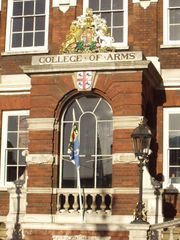
The College of Arms, or Heralds’ College, is an office regulating heraldry
and granting new armorial bearings for England
, Wales
and Northern Ireland
. It was founded in 1484 by King Richard III
, and is a private
corporate
body consisting of the professional herald
s who are delegated heraldic authority by the British monarch.
, the College is one of the few remaining official heraldic authorities in Europe. Scotland
has its own heraldic authority in Lord Lyon King of Arms
and the Court of the Lord Lyon
. The College also grants arms to citizens of other Commonwealth
countries that do not have their own heraldic authorities. (Canada
and South Africa
have their own heraldic authorities, the Canadian Heraldic Authority
and the Bureau of Heraldry
, respectively).
In addition to designing and granting new arms, the College fields many requests from people attempting to demonstrate descent from an armigerous (arms-bearing) person; a person descended in the male line (or through heraldic heiress
es) from such an ancestor may be reissued that ancestor's arms (with differencing marks if necessary to distinguish from senior-line cousins). To that end, the college is involved in genealogy
and the many pedigree
s (family trees) in their records, although not open to the public, have official status. Anyone may register a pedigree with the college, where they are carefully internally audit
ed and require official proofs before being altered.
Heralds were originally messengers
; and to this day the officers of the College of Arms occasionally step back into that role by publicly reading Royal proclamations, notably at the accession
of a new sovereign
. They also have a part in planning for and guiding participants through state ceremonies, such as coronations
, the introduction of new peers
into the House of Lords
, and the ceremonies of orders of chivalry
. For these public appearances, the officers of the college wear costume representing their place in the Royal Household
, either simple red livery
or the herald's traditional colourful outfit of a tabard
emblazoned with his master's arms (in this case the royal arms
). On these occasions they are sometimes preceded by state trumpet
ers (with whom they should not be confused).
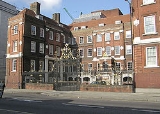
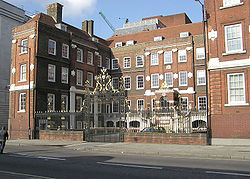
The College of Arms occupies a building on Queen Victoria Street
in the City of London
, not far to the south of St. Paul's Cathedral. The site was granted to the college when it was re-incorporated by Philip
and Mary I
in 1555, and the present seventeenth century building dates from after the Great Fire of London
in 1666.
On the morning of 5 February 2009, a fire broke out on the top floor of the College building. The fire brigade were called immediately and the building was safely evacuated with no casualties. There was also no damage to any of the records and the building remained open for business whilst repairs took place.
 The Earl Marshal
, a hereditary office held by the Duke of Norfolk
, oversees the College, though he is not a member of that body; arms may not be granted without his consent. Furthermore, the Earl Marshal may, in theory, hear cases and controversies relating to the use of arms in the Court of Chivalry
, although the court has not sat since 1954. In practice, the Earl Marshal usually leaves affairs to the professional herald
s of the College.
There are, historically, three levels of officers of arms: Kings of Arms
, Herald
s and Pursuivant
s. The officers of arms occupy posts bearing traditional titles with royal connotations.
The various officers of arms have their own private practices in heraldry and genealogy, and receive only nominal salaries as officers of the College. These salaries were set centuries ago and reflect the living costs of the day. They were fixed at higher levels by James I
but reduced by William IV
in the 1830s. The salaries of the officers of arms are listed below, which is not taxable income:
 The Kings of Arms grant coats of arms by letters patent
. Before they can even consider the granting of arms, an application must be made to the Earl Marshal, and a fee paid.
The Kings of Arms are authorised in their patents of appointment to grant (with the consent of the Earl Marshal) to "eminent men", a phrase which first appeared in the patent of appointment of Stephen Leake as Clarenceux King of Arms in 1741. Originally, the test applied was one of wealth or social status, because any man entitled to bear a coat of arms was expected to be a gentleman
. By 1530, the heralds applied a property qualification, requiring successful candidates for a grant of arms to have an income from land of £10 per annum, or movable wealth of £300. But since the heralds receive fees for granting arms, they have always had an incentive to be generous rather than restrictive in their interpretation of who should be allowed a grant. In 1616, Ralphe Brooke, York Herald, tricked Garter King of Arms, Segar, into granting a coat of arms to the common hangman for a fee of 22 shillings.
In 1673, the authority of the Earl Marshal
, which the heralds had challenged, was established in its modern form by a royal declaration which stated, among other things, that no patents of arms should be granted without his consent. This established the system, which is still operated, whereby royal authority to approve candidates for grants of arms is exercised by the Earl Marshal, and royal authority to grant the arms themselves is exercised by the Kings of Arms from the College of Arms. The application to the Earl Marshal (the Duke of Norfolk) is in the form of a petition, called a "Memorial", in the name of the prospective grantee. The wording of the Memorial is important because it is closely followed (for example, as to the description of the grantee of arms by profession, place of residence, etc.) in any subsequent Letters Patent containing the grant of arms.
There are no fixed criteria as to whether a modern application for a grant of arms should be allowed. If a herald is approached and does not consider that the application has merit, he may tactfully suggest to the applicant that he or she should not proceed. If it does proceed, its success or otherwise will depend on the approval of the Earl Marshal, who may apply his own standards. Peter Gwynn-Jones
, Garter King of Arms, wrote that "In practice, eligibility depends upon holding a civil or military commission, a sound university degree or professional qualification, or having achieved some measure of distinction in a field beneficial to society as a whole". (Gwynn-Jones, 1998; p 121)
If the Earl Marshal finds the application in the "Memorial" satisfactory, he will grant a Warrant authorising the Kings of Arms to proceed with the designing of arms. One of the heralds then works with the applicant to devise arms pleasing to him as well as heraldically correct. Once a final form is reached, the Kings of Arms grant letters patent (colourfully illuminated and decorated) authorising the use of arms blazoned therein to the grantee and his heirs.
They, or a differenced version of them using marks of cadency
, will be inherited by all of the legitimate children of an individual and such children and their descendants may bear the arms (or a differenced version of them) from the moment of birth: they do not (as with other inheritance) have to wait for the death of the previous generation. Nor is there any requirement for the College of Arms to approve the use of the arms in each generation: the original grant of arms is the only authority required. Although daughters and sons inherit the right to bear arms for themselves personally, the right passes only through the male line: hence, a son transmits the arms to his children, but a daughter, while bearing them for herself, does not transmit them to her children. A partial exception to this rule is the case of a woman who has no brothers, or whose brothers have no issue; such a woman is called an heraldic heiress
and may transmit the arms to her children as a quartering with their father's arms, and so consequently to their descendants.
The costs involved are quite substantial. The applicant does not buy a coat of arms: the arms themselves are freely given, but fees must be paid to the heralds and artists involved as professionals, and to support the buildings and other running costs of the College. Currently, the cost of an individual personal grant of both arms and crest is £4,225 as of January 2010. Aside from the heralds' traditional nominal salaries, given above, the College of Arms is not financed by the taxpayer.
there is no obligation to undergo any particular formality in order to change one's name. However it is possible to execute a deed poll
as a demonstration of intention to adopt and henceforth use a new name, and deeds poll may be enrolled either in the High Court or in the College of Arms. On being enrolled the deed is customarily 'gazetted', that is published in the London Gazette
. (The deed poll is not entered on the registers, but is still published, if the name change does not amend the surname.)
, the official register created by Royal Warrant of 1 June 2004 for the purposes of recording hereditary
and life
peers.
Heraldry
Heraldry is the profession, study, or art of creating, granting, and blazoning arms and ruling on questions of rank or protocol, as exercised by an officer of arms. Heraldry comes from Anglo-Norman herald, from the Germanic compound harja-waldaz, "army commander"...
and granting new armorial bearings for England
England
England is a country that is part of the United Kingdom. It shares land borders with Scotland to the north and Wales to the west; the Irish Sea is to the north west, the Celtic Sea to the south west, with the North Sea to the east and the English Channel to the south separating it from continental...
, Wales
Wales
Wales is a country that is part of the United Kingdom and the island of Great Britain, bordered by England to its east and the Atlantic Ocean and Irish Sea to its west. It has a population of three million, and a total area of 20,779 km²...
and Northern Ireland
Northern Ireland
Northern Ireland is one of the four countries of the United Kingdom. Situated in the north-east of the island of Ireland, it shares a border with the Republic of Ireland to the south and west...
. It was founded in 1484 by King Richard III
Richard III of England
Richard III was King of England for two years, from 1483 until his death in 1485 during the Battle of Bosworth Field. He was the last king of the House of York and the last of the Plantagenet dynasty...
, and is a private
Private sector
In economics, the private sector is that part of the economy, sometimes referred to as the citizen sector, which is run by private individuals or groups, usually as a means of enterprise for profit, and is not controlled by the state...
corporate
Incorporation (business)
Incorporation is the forming of a new corporation . The corporation may be a business, a non-profit organisation, sports club, or a government of a new city or town...
body consisting of the professional herald
Herald
A herald, or, more correctly, a herald of arms, is an officer of arms, ranking between pursuivant and king of arms. The title is often applied erroneously to all officers of arms....
s who are delegated heraldic authority by the British monarch.
Background
Based in LondonLondon
London is the capital city of :England and the :United Kingdom, the largest metropolitan area in the United Kingdom, and the largest urban zone in the European Union by most measures. Located on the River Thames, London has been a major settlement for two millennia, its history going back to its...
, the College is one of the few remaining official heraldic authorities in Europe. Scotland
Scotland
Scotland is a country that is part of the United Kingdom. Occupying the northern third of the island of Great Britain, it shares a border with England to the south and is bounded by the North Sea to the east, the Atlantic Ocean to the north and west, and the North Channel and Irish Sea to the...
has its own heraldic authority in Lord Lyon King of Arms
Lord Lyon King of Arms
The Lord Lyon King of Arms, the head of Lyon Court, is the most junior of the Great Officers of State in Scotland and is the Scottish official with responsibility for regulating heraldry in that country, issuing new grants of arms, and serving as the judge of the Court of the Lord Lyon, the oldest...
and the Court of the Lord Lyon
Court of the Lord Lyon
The Court of the Lord Lyon, also known as the Lyon Court, is a standing court of law which regulates heraldry in Scotland. Like the College of Arms in England it maintains the register of grants of arms, known as the Public Register of All Arms and Bearings in Scotland, as well as records of...
. The College also grants arms to citizens of other Commonwealth
Commonwealth of Nations
The Commonwealth of Nations, normally referred to as the Commonwealth and formerly known as the British Commonwealth, is an intergovernmental organisation of fifty-four independent member states...
countries that do not have their own heraldic authorities. (Canada
Canada
Canada is a North American country consisting of ten provinces and three territories. Located in the northern part of the continent, it extends from the Atlantic Ocean in the east to the Pacific Ocean in the west, and northward into the Arctic Ocean...
and South Africa
South Africa
The Republic of South Africa is a country in southern Africa. Located at the southern tip of Africa, it is divided into nine provinces, with of coastline on the Atlantic and Indian oceans...
have their own heraldic authorities, the Canadian Heraldic Authority
Canadian Heraldic Authority
The Canadian Heraldic Authority is part of the Canadian honours system under the Queen of Canada, whose authority is exercised by the Governor General. The Authority is responsible for the creation and granting of new coats of arms , flags and badges for Canadian citizens, permanent residents and...
and the Bureau of Heraldry
Bureau of Heraldry (South Africa)
The Bureau of Heraldry is the South African heraldic authority, established in Pretoria on 1 June 1963. It is headed by a National Herald and its functions are to register arms, badges, flags and seals , to keep a public register, to issue registration certificates and, since 1980, to advise the...
, respectively).
In addition to designing and granting new arms, the College fields many requests from people attempting to demonstrate descent from an armigerous (arms-bearing) person; a person descended in the male line (or through heraldic heiress
Heraldic heiress
In English heraldry an heraldic heiress is a daughter of deceased man who was entitled to a coat of arms and who carries forward the right to those arms for the benefit of her future male descendants...
es) from such an ancestor may be reissued that ancestor's arms (with differencing marks if necessary to distinguish from senior-line cousins). To that end, the college is involved in genealogy
Genealogy
Genealogy is the study of families and the tracing of their lineages and history. Genealogists use oral traditions, historical records, genetic analysis, and other records to obtain information about a family and to demonstrate kinship and pedigrees of its members...
and the many pedigree
Pedigree chart
A pedigree chart is a diagram that shows the occurrence and appearance or phenotypes of a particular gene or organism and its ancestors from one generation to the next, most commonly humans, show dogs, and race horses....
s (family trees) in their records, although not open to the public, have official status. Anyone may register a pedigree with the college, where they are carefully internally audit
Audit
The general definition of an audit is an evaluation of a person, organization, system, process, enterprise, project or product. The term most commonly refers to audits in accounting, but similar concepts also exist in project management, quality management, and energy conservation.- Accounting...
ed and require official proofs before being altered.
Heralds were originally messengers
Courier
A courier is a person or a company who delivers messages, packages, and mail. Couriers are distinguished from ordinary mail services by features such as speed, security, tracking, signature, specialization and individualization of express services, and swift delivery times, which are optional for...
; and to this day the officers of the College of Arms occasionally step back into that role by publicly reading Royal proclamations, notably at the accession
Accession Council
In the United Kingdom, the Accession Council is a ceremonial body which assembles in St. James's Palace upon the death of a monarch , to make a formal proclamation of the accession of his or her successor to the throne, and to receive a religious oath from the new monarch...
of a new sovereign
Sovereign
A sovereign is the supreme lawmaking authority within its jurisdiction.Sovereign may also refer to:*Monarch, the sovereign of a monarchy*Sovereign Bank, banking institution in the United States*Sovereign...
. They also have a part in planning for and guiding participants through state ceremonies, such as coronations
Coronation of the British monarch
The coronation of the British monarch is a ceremony in which the monarch of the United Kingdom is formally crowned and invested with regalia...
, the introduction of new peers
Peerage
The Peerage is a legal system of largely hereditary titles in the United Kingdom, which constitute the ranks of British nobility and is part of the British honours system...
into the House of Lords
House of Lords
The House of Lords is the upper house of the Parliament of the United Kingdom. Like the House of Commons, it meets in the Palace of Westminster....
, and the ceremonies of orders of chivalry
British honours system
The British honours system is a means of rewarding individuals' personal bravery, achievement, or service to the United Kingdom and the British Overseas Territories...
. For these public appearances, the officers of the college wear costume representing their place in the Royal Household
Royal Household
A Royal Household in ancient and medieval monarchies formed the basis for the general government of the country as well as providing for the needs of the sovereign and his relations....
, either simple red livery
Livery
A livery is a uniform, insignia or symbol adorning, in a non-military context, a person, an object or a vehicle that denotes a relationship between the wearer of the livery and an individual or corporate body. Often, elements of the heraldry relating to the individual or corporate body feature in...
or the herald's traditional colourful outfit of a tabard
Tabard
A tabard is a short coat, either sleeveless, or with short sleeves or shoulder pieces, which was a common item of men's clothing in the Middle Ages, usually for outdoors. It might be belted, or not...
emblazoned with his master's arms (in this case the royal arms
Royal coat of arms of the United Kingdom
The Royal coat of arms of the United Kingdom is the official coat of arms of the British monarch, currently Queen Elizabeth II. These arms are used by the Queen in her official capacity as monarch of the United Kingdom, and are officially known as her Arms of Dominion...
). On these occasions they are sometimes preceded by state trumpet
Trumpet
The trumpet is the musical instrument with the highest register in the brass family. Trumpets are among the oldest musical instruments, dating back to at least 1500 BCE. They are played by blowing air through closed lips, producing a "buzzing" sound which starts a standing wave vibration in the air...
ers (with whom they should not be confused).
The College of Arms occupies a building on Queen Victoria Street
Queen Victoria Street, London
Queen Victoria Street, named after the British monarch from 1837 to 1901 is a long street in the City of London which runs east by north from its junction with New Bridge Street in Castle Baynard Ward, along a section that divides those of Queenhithe and Bread Street , then lastly through the...
in the City of London
City of London
The City of London is a small area within Greater London, England. It is the historic core of London around which the modern conurbation grew and has held city status since time immemorial. The City’s boundaries have remained almost unchanged since the Middle Ages, and it is now only a tiny part of...
, not far to the south of St. Paul's Cathedral. The site was granted to the college when it was re-incorporated by Philip
Philip II of Spain
Philip II was King of Spain, Portugal, Naples, Sicily, and, while married to Mary I, King of England and Ireland. He was lord of the Seventeen Provinces from 1556 until 1581, holding various titles for the individual territories such as duke or count....
and Mary I
Mary I of England
Mary I was queen regnant of England and Ireland from July 1553 until her death.She was the only surviving child born of the ill-fated marriage of Henry VIII and his first wife Catherine of Aragon. Her younger half-brother, Edward VI, succeeded Henry in 1547...
in 1555, and the present seventeenth century building dates from after the Great Fire of London
Great Fire of London
The Great Fire of London was a major conflagration that swept through the central parts of the English city of London, from Sunday, 2 September to Wednesday, 5 September 1666. The fire gutted the medieval City of London inside the old Roman City Wall...
in 1666.
On the morning of 5 February 2009, a fire broke out on the top floor of the College building. The fire brigade were called immediately and the building was safely evacuated with no casualties. There was also no damage to any of the records and the building remained open for business whilst repairs took place.
Officers in Ordinary
Earl Marshal
Earl Marshal is a hereditary royal officeholder and chivalric title under the sovereign of the United Kingdom used in England...
, a hereditary office held by the Duke of Norfolk
Duke of Norfolk
The Duke of Norfolk is the premier duke in the peerage of England, and also, as Earl of Arundel, the premier earl. The Duke of Norfolk is, moreover, the Earl Marshal and hereditary Marshal of England. The seat of the Duke of Norfolk is Arundel Castle in Sussex, although the title refers to the...
, oversees the College, though he is not a member of that body; arms may not be granted without his consent. Furthermore, the Earl Marshal may, in theory, hear cases and controversies relating to the use of arms in the Court of Chivalry
Court of Chivalry
Her Majesty's High Court of Chivalry of England and Wales is a civil court in England. It has had jurisdiction in cases of the misuse of heraldic arms since the fourteenth century....
, although the court has not sat since 1954. In practice, the Earl Marshal usually leaves affairs to the professional herald
Herald
A herald, or, more correctly, a herald of arms, is an officer of arms, ranking between pursuivant and king of arms. The title is often applied erroneously to all officers of arms....
s of the College.
There are, historically, three levels of officers of arms: Kings of Arms
King of Arms
King of Arms is the senior rank of an officer of arms. In many heraldic traditions, only a king of arms has the authority to grant armorial bearings. In other traditions, the power has been delegated to other officers of similar rank.-Heraldic duties:...
, Herald
Herald
A herald, or, more correctly, a herald of arms, is an officer of arms, ranking between pursuivant and king of arms. The title is often applied erroneously to all officers of arms....
s and Pursuivant
Pursuivant
A pursuivant or, more correctly, pursuivant of arms, is a junior officer of arms. Most pursuivants are attached to official heraldic authorities, such as the College of Arms in London or the Court of the Lord Lyon in Edinburgh. In the mediaeval era, many great nobles employed their own officers of...
s. The officers of arms occupy posts bearing traditional titles with royal connotations.
The various officers of arms have their own private practices in heraldry and genealogy, and receive only nominal salaries as officers of the College. These salaries were set centuries ago and reflect the living costs of the day. They were fixed at higher levels by James I
James I of Scotland
James I, King of Scots , was the son of Robert III and Annabella Drummond. He was probably born in late July 1394 in Dunfermline as youngest of three sons...
but reduced by William IV
William IV of the United Kingdom
William IV was King of the United Kingdom of Great Britain and Ireland and of Hanover from 26 June 1830 until his death...
in the 1830s. The salaries of the officers of arms are listed below, which is not taxable income:
- £Pound sterlingThe pound sterling , commonly called the pound, is the official currency of the United Kingdom, its Crown Dependencies and the British Overseas Territories of South Georgia and the South Sandwich Islands, British Antarctic Territory and Tristan da Cunha. It is subdivided into 100 pence...
49.07 per annum for Garter Principal King of Arms, - £20.25 per annum for the provincial Kings of Arms,
- £17.80 per annum for the Heralds,
- and £13.95 per annum for the Pursuivants.
King of Arms
| Kings of Arms | |||
| Insignia | Office | Name (Date of appointment) |
Notes |
|---|---|---|---|
Garter Principal King of Arms The Garter Principal King of Arms is the senior King of Arms, and the senior Officer of Arms of the College of Arms. He is therefore the most powerful herald within the jurisdiction of the College – primarily England, Wales and Northern Ireland – and so arguably the most powerful in the world... |
Thomas Woodcock (officer of arms) Thomas Woodcock, CVO, DL, FSA is Garter Principal King of Arms.Woodcock was educated at Eton College. He went up to University College, Durham, where he obtained a BA degree, and subsequently to Darwin College, Cambridge, where he received his LLB degree. Woodcock was called to the Bar at the... (1 April 2010) |
The senior King of Arms (his title is a reference to the Order of the Garter Order of the Garter The Most Noble Order of the Garter, founded in 1348, is the highest order of chivalry, or knighthood, existing in England. The order is dedicated to the image and arms of St... ). |
|
Clarenceux King of Arms Clarenceux King of Arms is an officer of arms at the College of Arms in London. Clarenceux is the senior of the two provincial kings of arms and his jurisdiction is that part of England south of the River Trent. The office almost certainly existed in 1420, and there is a fair degree of... |
Patric Laurence Dickinson Patric Laurence Dickinson, LVO is Clarenceux King of Arms.Dickinson was educated at Marling School in Stroud, Gloucestershire before going up to Exeter College, Oxford, where he graduated as MA. He was President of the Oxford Union Society and was subsequently called to the bar at the Middle Temple... (1 September 2010) |
Whose "province" is the part of England England England is a country that is part of the United Kingdom. It shares land borders with Scotland to the north and Wales to the west; the Irish Sea is to the north west, the Celtic Sea to the south west, with the North Sea to the east and the English Channel to the south separating it from continental... south of the River Trent River Trent The River Trent is one of the major rivers of England. Its source is in Staffordshire on the southern edge of Biddulph Moor. It flows through the Midlands until it joins the River Ouse at Trent Falls to form the Humber Estuary, which empties into the North Sea below Hull and Immingham.The Trent... |
|
Norroy and Ulster King of Arms Norroy and Ulster King of Arms is one of the senior Officers of Arms of the College of Arms, and the junior of the two provincial Kings of Arms. The current office is the combination of two former appointments... |
(20 September 2010) |
Whose "province" is the part of England north of the River Trent (Norroy) and Northern Ireland (Ulster) | |
Herald of Arms in Ordinary
| Herald of Arms in Ordinary | |||
| Insignia | Office | Name (Date of appointment) |
Notes |
|---|---|---|---|
Chester Herald Chester Herald of Arms in Ordinary is an officer of arms at the College of Arms in London. The office of Chester Herald dates from the 14th century, and it is reputed that the holder was herald to Edward, Prince of Wales, the Black Prince. In the reign of King Richard II the officer was attached... |
Timothy Duke Timothy Hugh Stewart Duke is an officer of arms at the College of Arms in London. Duke began his career as an officer of arms in 1989 when he was appointed Rouge Dragon Pursuivant of Arms in Ordinary. He held this position until 7 August 1995, when he was appointed Chester Herald of Arms in Ordinary... (7 August 1995) |
Heralds of Arms, whose titles are references to places or peerage Peerage The Peerage is a legal system of largely hereditary titles in the United Kingdom, which constitute the ranks of British nobility and is part of the British honours system... titles historically associated with the monarchy. The office dates from the 14th century, and it is reputed that the holder was herald to Edward, the Black Prince Edward, the Black Prince Edward of Woodstock, Prince of Wales, Duke of Cornwall, Prince of Aquitaine, KG was the eldest son of King Edward III of England and his wife Philippa of Hainault as well as father to King Richard II of England.... , who was also Earl of Chester Earl of Chester The Earldom of Chester was one of the most powerful earldoms in medieval England. Since 1301 the title has generally been granted to heirs-apparent to the English throne, and from the late 14th century it has been given only in conjunction with that of Prince of Wales.- Honour of Chester :The... . |
|
Lancaster Herald Lancaster Herald of Arms in Ordinary is an English officer of arms at the College of Arms in London. The title of Lancaster Herald first occurs in 1347 at Calais, and to begin with this officer was a servant to the noble house of Lancaster... |
Robert Noel Robert John Baptist Noel is an officer of arms at the College of Arms in London.Robert Noel is the son of Hon. Gerard Eyre Wriothesley Noel, of Westington Mill, Chipping Campden, and grandson of the fourth Earl of Gainsborough... (21 September 1999) |
First occured in 1347 at Calais Calais Calais is a town in Northern France in the department of Pas-de-Calais, of which it is a sub-prefecture. Although Calais is by far the largest city in Pas-de-Calais, the department's capital is its third-largest city of Arras.... , and to begin with this officer was a servant to the noble house of Lancaster Duchy of Lancaster The Duchy of Lancaster is one of the two royal duchies in England, the other being the Duchy of Cornwall. It is held in trust for the Sovereign, and is used to provide income for the use of the British monarch... . |
|
Windsor Herald Windsor Herald of Arms in Ordinary is an officer of arms at the College of Arms in London. It has been suggested that the office was instituted specifically for the Order of the Garter in 1348, or that it predates the Order and was in use as early as 1338... |
William Hunt (officer of arms) William George Hunt, CStJ,TD, FCA is the current Windsor Herald of Arms in Ordinary at the College of Arms in London. Hunt worked for many years in the City of London as a chartered accountant. He was appointed as Portcullis Pursuivant of Arms in Ordinary in 1992 and in 1999 he was appointed as... (22 September 1999) |
It has been suggested that the office was instituted specifically for the Order of the Garter Order of the Garter The Most Noble Order of the Garter, founded in 1348, is the highest order of chivalry, or knighthood, existing in England. The order is dedicated to the image and arms of St... in 1348, or that it predates the Order and was in use as early as 1338. |
|
Somerset Herald Somerset Herald of Arms in Ordinary is an officer of arms at the College of Arms in London. In the year 1448 Somerset Herald is known to have served the Duke of Somerset, but by the time of the coronation of King Henry VII in 1485 his successor appears to have been raised to the rank of a royal... |
David White (officer of arms) David Vines White is Somerset Herald of Arms in Ordinary at the College of Arms in London.White was educated at Marlborough College, before going up to Pembroke College, Cambridge, where he obtained the degree of MA... (17 September 2004) |
In the year 1448 Somerset Herald is known to have served the Duke of Somerset. | |
Richmond Herald Richmond Herald of Arms in Ordinary is an officer of arms of the College of Arms in England. From 1421 to 1485 Richmond was a herald to John, Duke of Bedford, George, Duke of Clarence, and Henry, Earl of Richmond, all of whom held the Honour of Richmond... |
Clive Cheesman Clive Edwin Alexander Cheesman is an officer of arms at the College of Arms in London, and is currently Richmond Herald, having been appointed on 7 April 2010. Cheesman was formerly a curator in the Department of Coins and Medals in the British Museum. He was Rouge Dragon Pursuivant of Arms in... (7 April 2010) |
From 1421 to 1485 Richmond was a herald to John, Duke of Bedford Duke of Bedford thumb|right|240px|William Russell, 1st Duke of BedfordDuke of Bedford is a title that has been created five times in the Peerage of England. The first creation came in 1414 in favour of Henry IV's third son, John, who later served as regent of France. He was made Earl of Kendal at the same time... , George, Duke of Clarence Duke of Clarence Duke of Clarence is a title which has been traditionally awarded to junior members of the English and British Royal families. The first three creations were in the Peerage of England, the fourth in the Peerage of Great Britain, and the fifth in the Peerage of the United Kingdom.The title was first... , and Henry, Earl of Richmond Earl of Richmond The now-extinct title of Earl of Richmond was created many times in the Peerage of England. The earldom of Richmond was held by various Bretons, Normans, the royal families of Plantagenet, Capet, Savoy, Tudor and Stuart.-History:... , all of whom held the Honour (estate) of Richmond. |
|
York Herald York Herald of Arms in Ordinary is an officer of arms at the College of Arms. The first York Herald is believed to have been an officer to Edmund of Langley, Duke of York around the year 1385, but the first completely reliable reference to such a herald is in February of 1484, when John Water... |
Norroy and Ulster King of Arms Norroy and Ulster King of Arms is one of the senior Officers of Arms of the College of Arms, and the junior of the two provincial Kings of Arms. The current office is the combination of two former appointments... in 2010 |
The first York Herald is believed to have been an officer to Edmund of Langley, Duke of York Duke of York The Duke of York is a title of nobility in the British peerage. Since the 15th century, it has, when granted, usually been given to the second son of the British monarch. The title has been created a remarkable eleven times, eight as "Duke of York" and three as the double-barreled "Duke of York and... around the year 1385. |
|
Pursuivant of Arms in Ordinary
| Pursuivant of Arms in Ordinary | |||
| Insignia | Office | Name (Date of appointment) |
Notes |
|---|---|---|---|
Bluemantle Pursuivant Bluemantle Pursuivant of Arms in Ordinary is a junior officer of arms of the College of Arms in London. The office is reputed to have been created by King Henry V to serve the Order of the Garter, but there is no documentary evidence of this. There is, however, mention of an officer styled... |
Peter O'Donoghue Michael Peter Desmond O'Donoghue is the current Bluemantle Pursuivant of Arms in Ordinary at the College of Arms in London.He was appointed to the office on 17 January 2005, on successful completion of a period of probation... (17 January 2005) |
The office is reputed to have been created by King Henry V to serve the Order of the Garter Order of the Garter The Most Noble Order of the Garter, founded in 1348, is the highest order of chivalry, or knighthood, existing in England. The order is dedicated to the image and arms of St... , but there is no documentary evidence of this. |
|
Portcullis Pursuivant Portcullis Pursuivant of Arms in Ordinary is a junior officer of arms at the College of Arms in London. The office is named after the Portcullis chained Or badge of the Beauforts, which was a favourite device of King Henry VII. King Henry's mother was Lady Margaret Beaufort. The office was... |
William Hunt (officer of arms) William George Hunt, CStJ,TD, FCA is the current Windsor Herald of Arms in Ordinary at the College of Arms in London. Hunt worked for many years in the City of London as a chartered accountant. He was appointed as Portcullis Pursuivant of Arms in Ordinary in 1992 and in 1999 he was appointed as... to Windsor Herald of Arms in Ordinary Windsor Herald Windsor Herald of Arms in Ordinary is an officer of arms at the College of Arms in London. It has been suggested that the office was instituted specifically for the Order of the Garter in 1348, or that it predates the Order and was in use as early as 1338... in 1999 |
The office is named after the Portcullis Portcullis A portcullis is a latticed grille made of wood, metal, fibreglass or a combination of the three. Portcullises fortified the entrances to many medieval castles, acting as a last line of defence during time of attack or siege... chained Or badge Heraldic badge A heraldic badge is an emblem or personal device worn as a badge to indicate allegiance to or the property of an individual or family. Medieval forms are usually called a livery badge, and also a cognizance... of the Beauforts, which was a favourite device of King Henry VII. |
|
Rouge Croix Pursuivant Rouge Croix Pursuivant of Arms in Ordinary is a junior officer of arms of the College of Arms. The office is named after St George's Cross which has been a symbol of England since the time of the Crusades... |
David White (officer of arms) David Vines White is Somerset Herald of Arms in Ordinary at the College of Arms in London.White was educated at Marlborough College, before going up to Pembroke College, Cambridge, where he obtained the degree of MA... to Somerset Herald of Arms in Ordinary Somerset Herald Somerset Herald of Arms in Ordinary is an officer of arms at the College of Arms in London. In the year 1448 Somerset Herald is known to have served the Duke of Somerset, but by the time of the coronation of King Henry VII in 1485 his successor appears to have been raised to the rank of a royal... in 2004 |
The office is named after St George's Cross St George's Cross St George's Cross is a red cross on a white background used as a symbolic reference to Saint George. The red cross on white was associated with St George from medieval times.... which has been a symbol of England since the time of the Crusades Crusades The Crusades were a series of religious wars, blessed by the Pope and the Catholic Church with the main goal of restoring Christian access to the holy places in and near Jerusalem... . |
|
Rouge Dragon Pursuivant Rouge Dragon Pursuivant of Arms in Ordinary is a junior officer of arms of the College of Arms, named after the red dragon of Wales.The most recent Rouge Dragon Pursuivant was Clive Edwin Alexander Cheesman, whose replacement has yet to be announced.... |
Clive Cheesman Clive Edwin Alexander Cheesman is an officer of arms at the College of Arms in London, and is currently Richmond Herald, having been appointed on 7 April 2010. Cheesman was formerly a curator in the Department of Coins and Medals in the British Museum. He was Rouge Dragon Pursuivant of Arms in... to Richmond Herald of Arms in Ordinary Richmond Herald Richmond Herald of Arms in Ordinary is an officer of arms of the College of Arms in England. From 1421 to 1485 Richmond was a herald to John, Duke of Bedford, George, Duke of Clarence, and Henry, Earl of Richmond, all of whom held the Honour of Richmond... in 2010 |
Named after the red dragon of Wales Wales Wales is a country that is part of the United Kingdom and the island of Great Britain, bordered by England to its east and the Atlantic Ocean and Irish Sea to its west. It has a population of three million, and a total area of 20,779 km²... . |
|
Officers Extraordinary
Officers Extraordinary to the college serve on rotation as the "officer in waiting" to handle walk-in business at the college's premises. Beyond these "Heralds in Ordinary", "Heralds Extraordinary" can be appointed to take part in special ceremonial occasions or to assist the Earl Marshal personally; they are not members of the college.Herald of Arms Extraordinary
| Herald of Arms Extraordinary | |||
| Insignia | Office | Name (Date of appointment) |
Notes |
|---|---|---|---|
Arundel Herald Extraordinary Arundel Herald of Arms Extraordinary is a supernumerary Officer of Arms in England. Though a royal herald, Arundel is not a member of the College of Arms, and was originally a private herald in the household of Thomas Fitzalan, Earl of Arundel. He is known to have served the Earl both in Portugal... |
Alan Dickins Alan Roger Dickins is Arundel Herald of Arms Extraordinary.Dickins was educated at Epsom College, Surrey and Emmanuel College, Cambridge, where he graduated with a Law degree in 1968... (1998) |
Though a royal herald, Arundel is not a member of the College of Arms, and was originally a private herald in the household of Thomas Fitzalan Thomas FitzAlan Sir Thomas FitzAlan , of Beechwood Castle in Kent, was a medieval English knight.He was born to John Fitzalan, 2nd Lord Arundel and Elizabeth le Despenser and was a grandson of John Fitzalan and Eleanor Maltravers . Sir Thomas married Joan Moyns, and they were parents to Eleanor Fitzalan... , Earl of Arundel Earl of Arundel The title Earl of Arundel is the oldest extant Earldom and perhaps the oldest extant title in the Peerage of England. It is currently held by the Duke of Norfolk, and is used by his heir apparent as a courtesy title. It was created in 1138 for the Norman baron Sir William d'Aubigny... . |
|
Beaumont Herald Extraordinary Beaumont Herald of Arms Extraordinary is an officer of arms extraordinary in England. Beaumont is a royal herald, but is not a member of the College of Arms. The office was created in 1982 and named after the barony of Beaumont, one of the subsidiary titles of the Earl Marshal, the Duke of Norfolk... |
The office was created in 1982 and named after the barony of Beaumont Baron Beaumont The title of Baron Beaumont is an ancient one in the Peerage of England, created in 1309 for a younger part of the de Brienne-family. The sixth Baron Beaumont was created Viscount Beaumont in 1432; after the death of the 2nd Viscount both titles fell into abeyance... , one of the subsidiary titles of the Earl Marshal, the Duke of Norfolk. |
||
Maltravers Herald Extraordinary Maltravers Herald of Arms Extraordinary is a current officer of arms extraordinary in England. As such, Maltravers is a royal herald, but is not a member of the College of Arms in London. The present office was created in 1887 by the Earl Marshal, who was also the Duke of Norfolk and Baron... |
John Martin Robinson John Martin Robinson, FSA is a British architectural historian and officer of arms.He was born in Preston, Lancashire and educated at the Benedictine school at Fort Augustus, the University of St Andrews and matriculated to Oriel College, Oxford University for his DPhil in 1970... (1989) |
The office was created in 1887 by the Earl Marshal, who was also the Duke of Norfolk and Baron Maltravers Baron Maltravers The title Baron Mautravers or Baron Maltravers was created in the Peerage of England on 25 January 1330, by writ of summons, for John Mautravers or Maltravers. It went into abeyance on his death in 1364; this was terminated by the death of his granddaughter Joan Mautravers without issue c. 1383,... . |
|
Norfolk Herald Extraordinary Norfolk Herald of Arms Extraordinary is an officer of arms in England. As an officer extraordinary, Norfolk is a royal herald, though not a member of the corporation of the College of Arms in London. Beginning in 1539 this officer was a herald to the dukes of Norfolk, though the first holder,... |
(1994) |
Beginning in 1539 this officer was a herald to the dukes of Norfolk, though the first holder, John James, was paid a salary by King Henry VIII Henry VII of England Henry VII was King of England and Lord of Ireland from his seizing the crown on 22 August 1485 until his death on 21 April 1509, as the first monarch of the House of Tudor.... . |
|
Wales Herald Extraordinary Wales Herald of Arms Extraordinary is a current English officer of arms extraordinary. Wales is a royal herald, but is not a member of the chapter of the College of Arms, but who process with the other heralds on ceremonial occasions... |
(2010) |
There was a Wales Herald in the late fourteenth century, but the office was shortlived. It was re-established in 1963 as an officer of arms extraordinary. The first appointee was Francis Jones Francis Jones (Welsh historian) Major Francis Jones CVO, TD, DL, FSA, MA, KStJ , was an author, archivist, historian and officer of arms.-Early and private life:... . |
|
Fitzalan Pursuivant Extraordinary Fitzalan Pursuivant of Arms Extraordinary is a current officer of arms in England. As a pursuivant extraordinary, Fitzalan is a royal officer of arms, but is not a member of the corporation of the College of Arms in London... |
(1998) |
As with many other extraordinary offices of arms, the office obtains its title from one of the baronies held by the Duke of Norfolk; the appointment was first made for the coronation of Queen Victoria in 1837. | |
Howard Pursuivant Extraordinary Howard Pursuivant of Arms Extraordinary is an officer of arms extraordinary in England. As such, Howard is a royal herald, but is not a member of the College of Arms in London.... |
Created in 1992 by the Earl Marshal. The name is derived from the Barony of Howard of Glossop, to which the 17th Duke Miles Fitzalan-Howard, 17th Duke of Norfolk Major-General Miles Francis Stapleton Fitzalan-Howard, 17th Duke of Norfolk, , was the eldest son of Bernard Fitzalan-Howard, 3rd Baron Howard of Glossop and his wife Mona Stapleton, 11th Baroness Beaumont.... inherited in 1972, from his father the 3rd Baron Bernard Fitzalan-Howard, 3rd Baron Howard of Glossop Bernard Edward Fitzalan-Howard, 3rd Baron Howard of Glossop, MBE was a British peer.Fitzalan-Howard was the eldest son of the Francis Fitzalan-Howard, 2nd Baron Howard of Glossop and was educated at the London Oratory School and Trinity College, Cambridge. He became a Captain in the Lovat Scouts... . |
||
| Special Herald of Arms Extraordinary | |||
New Zealand Herald Extraordinary -References:*Squibb, George, "Heraldic Authority in the British Commonwealth" Coat of Arms vol 10 no 76 p 125*O'Shea, P.P., "The Office of the New Zealand Herald of Arms" 20 New Zealand Armorist 7... |
(1978) |
One special case, who, although not a member of the college, holds a permanent post created to oversee heraldry in New Zealand New Zealand New Zealand is an island country in the south-western Pacific Ocean comprising two main landmasses and numerous smaller islands. The country is situated some east of Australia across the Tasman Sea, and roughly south of the Pacific island nations of New Caledonia, Fiji, and Tonga... ; he works together with the college to grant new arms for people and bodies in that country (where he himself lives and works). |
|
Historical posts
| Historical posts | |||
| Insignia | Office | Last held by (Date of appointment) |
Notes |
|---|---|---|---|
| | Delhi Herald Extraordinary Delhi Herald of Arms Extraordinary was a British officer of arms whose office was created in 1911 for the Delhi Durbar. Though an officer of the crown, Delhi Herald Extraordinary was not a member of the corporation of the College of Arms in London and his duties were more ceremonial than... |
William Peyton General Sir William Eliot Peyton KCB KCVO DSO was a British soldier, a general of the First World War who fought in several other wars.He was Delhi Herald of Arms Extraordinary at the time of the Delhi Durbar of 1911.... (1911) |
The office was created in 1911 for the Delhi Durbar. Though an officer of the crown, Delhi Herald Extraordinary was not a regular member of the college. Furthermore his duties were more ceremonial than heraldic. | |
Mowbray Herald Extraordinary Mowbray Herald of Arms Extraordinary was an English officer of arms. Though an officer of the crown, Mowbray Herald Extraordinary was not a member of the corporation of the College of Arms in London. Sir William le Neve appears to have been appointed to the office from 29 June 1624 until his... |
Joseph Edmondson Joseph Edmondson , was a herald and genealogist.Edmondson was originally apprenticed to a barber, but afterwards became a coach-painter, and being much employed in emblazoning coat-armour on carriages was led to the study of heraldry and genealogy. He was elected a fellow of the Society of... (1764) |
Though an officer of the crown, Mowbray Herald Extraordinary was not a member of the corporation of the College of Arms. | |
Surrey Herald Extraordinary Surrey Herald of Arms Extraordinary was an English officer of arms. Though an officer of the crown, Surrey Herald Extraordinary was not a member of the corporation of the College of Arms in London. This office was created in 1856 and first held by Edward Stephen Dendy. The badge of office was... |
Walter Verco Sir Walter John George Verco, KCVO was a long-serving officer of arms who served in many capacities at the College of Arms in London.-Biography:... (1980) |
This office was created in 1856 and first held by Edward Stephen Dendy Edward Stephen Dendy Edward Stephen Dendy was a long-serving officer of arms at the College of Arms during the nineteenth Century.He was one of ten children born to Stephen Cooper Dendy and Miramne Dubbins in Horsham, Sussex, England... . |
|
Grants and descent of arms
Letters patent
Letters patent are a type of legal instrument in the form of a published written order issued by a monarch or president, generally granting an office, right, monopoly, title, or status to a person or corporation...
. Before they can even consider the granting of arms, an application must be made to the Earl Marshal, and a fee paid.
The Kings of Arms are authorised in their patents of appointment to grant (with the consent of the Earl Marshal) to "eminent men", a phrase which first appeared in the patent of appointment of Stephen Leake as Clarenceux King of Arms in 1741. Originally, the test applied was one of wealth or social status, because any man entitled to bear a coat of arms was expected to be a gentleman
Gentleman
The term gentleman , in its original and strict signification, denoted a well-educated man of good family and distinction, analogous to the Latin generosus...
. By 1530, the heralds applied a property qualification, requiring successful candidates for a grant of arms to have an income from land of £10 per annum, or movable wealth of £300. But since the heralds receive fees for granting arms, they have always had an incentive to be generous rather than restrictive in their interpretation of who should be allowed a grant. In 1616, Ralphe Brooke, York Herald, tricked Garter King of Arms, Segar, into granting a coat of arms to the common hangman for a fee of 22 shillings.
In 1673, the authority of the Earl Marshal
Earl Marshal
Earl Marshal is a hereditary royal officeholder and chivalric title under the sovereign of the United Kingdom used in England...
, which the heralds had challenged, was established in its modern form by a royal declaration which stated, among other things, that no patents of arms should be granted without his consent. This established the system, which is still operated, whereby royal authority to approve candidates for grants of arms is exercised by the Earl Marshal, and royal authority to grant the arms themselves is exercised by the Kings of Arms from the College of Arms. The application to the Earl Marshal (the Duke of Norfolk) is in the form of a petition, called a "Memorial", in the name of the prospective grantee. The wording of the Memorial is important because it is closely followed (for example, as to the description of the grantee of arms by profession, place of residence, etc.) in any subsequent Letters Patent containing the grant of arms.
There are no fixed criteria as to whether a modern application for a grant of arms should be allowed. If a herald is approached and does not consider that the application has merit, he may tactfully suggest to the applicant that he or she should not proceed. If it does proceed, its success or otherwise will depend on the approval of the Earl Marshal, who may apply his own standards. Peter Gwynn-Jones
Peter Gwynn-Jones
Sir Peter Llewellyn Gwynn-Jones, KCVO was a long-serving officer of arms at the College of Arms in London. He was Garter Principal King of Arms, the senior English officer of arms, from 1995 to 2010.-Life and career:...
, Garter King of Arms, wrote that "In practice, eligibility depends upon holding a civil or military commission, a sound university degree or professional qualification, or having achieved some measure of distinction in a field beneficial to society as a whole". (Gwynn-Jones, 1998; p 121)
If the Earl Marshal finds the application in the "Memorial" satisfactory, he will grant a Warrant authorising the Kings of Arms to proceed with the designing of arms. One of the heralds then works with the applicant to devise arms pleasing to him as well as heraldically correct. Once a final form is reached, the Kings of Arms grant letters patent (colourfully illuminated and decorated) authorising the use of arms blazoned therein to the grantee and his heirs.
They, or a differenced version of them using marks of cadency
Cadency
In heraldry, cadency is any systematic way of distinguishing similar coats of arms belonging to members of the same family. Cadency is necessary in heraldic systems in which a given design may be owned by only one person at once...
, will be inherited by all of the legitimate children of an individual and such children and their descendants may bear the arms (or a differenced version of them) from the moment of birth: they do not (as with other inheritance) have to wait for the death of the previous generation. Nor is there any requirement for the College of Arms to approve the use of the arms in each generation: the original grant of arms is the only authority required. Although daughters and sons inherit the right to bear arms for themselves personally, the right passes only through the male line: hence, a son transmits the arms to his children, but a daughter, while bearing them for herself, does not transmit them to her children. A partial exception to this rule is the case of a woman who has no brothers, or whose brothers have no issue; such a woman is called an heraldic heiress
Heraldic heiress
In English heraldry an heraldic heiress is a daughter of deceased man who was entitled to a coat of arms and who carries forward the right to those arms for the benefit of her future male descendants...
and may transmit the arms to her children as a quartering with their father's arms, and so consequently to their descendants.
The costs involved are quite substantial. The applicant does not buy a coat of arms: the arms themselves are freely given, but fees must be paid to the heralds and artists involved as professionals, and to support the buildings and other running costs of the College. Currently, the cost of an individual personal grant of both arms and crest is £4,225 as of January 2010. Aside from the heralds' traditional nominal salaries, given above, the College of Arms is not financed by the taxpayer.
Change of name
The College of Arms is also an authorized location for enrolling a change of name. In the common lawCommon law
Common law is law developed by judges through decisions of courts and similar tribunals rather than through legislative statutes or executive branch action...
there is no obligation to undergo any particular formality in order to change one's name. However it is possible to execute a deed poll
Deed of Change of Name
A deed of change of name is a legal document in the United Kingdom and Republic of Ireland, which enables a single person or a family to officially change his or her name...
as a demonstration of intention to adopt and henceforth use a new name, and deeds poll may be enrolled either in the High Court or in the College of Arms. On being enrolled the deed is customarily 'gazetted', that is published in the London Gazette
London Gazette
The London Gazette is one of the official journals of record of the British government, and the most important among such official journals in the United Kingdom, in which certain statutory notices are required to be published...
. (The deed poll is not entered on the registers, but is still published, if the name change does not amend the surname.)
Change of name and arms
It is also possible to change ones arms, with or without adopting or appending a new surname, by Royal Licence, that is to say a licence in the form of a warrant from the Crown directed to the kings of arms instructing them to exemplify the transferred arms or a version of them to the licensee in his or her new name. Royal Licences are issued on the advice of Garter King of Arms and are usually dependent on there being some constraining circumstances such as a testamentary injunction or a good reason to wish to perpetuate a particular coat of arms. The Royal Licence is of no effect until and unless the exemplification is issued and recorded in the College of Arms. Royal Licences are gazetted and obviate the need for a deed poll.The Roll of the Peerage
From November 2010 the College of Arms website is the recognized place of publication for the Roll of the PeerageRoll of the Peerage
The Roll of the Peerage is a public record registering peers in the peerages of England, Scotland, Ireland, Great Britain and the United Kingdom...
, the official register created by Royal Warrant of 1 June 2004 for the purposes of recording hereditary
Hereditary peer
Hereditary peers form part of the Peerage in the United Kingdom. There are over seven hundred peers who hold titles that may be inherited. Formerly, most of them were entitled to sit in the House of Lords, but since the House of Lords Act 1999 only ninety-two are permitted to do so...
and life
Life peer
In the United Kingdom, life peers are appointed members of the Peerage whose titles cannot be inherited. Nowadays life peerages, always of baronial rank, are created under the Life Peerages Act 1958 and entitle the holders to seats in the House of Lords, presuming they meet qualifications such as...
peers.
See also
- Law of ArmsLaw of ArmsThe law of heraldic arms governs the "bearing of arms", that is, the possession, use or display of arms, also called coats of arms, coat armour or armorial bearings. Although it is believed that the original function of coats of arms was to enable knights to identify each other on the battlefield,...
- Officer of ArmsOfficer of armsAn officer of arms is a person appointed by a sovereign or state with authority to perform one or more of the following functions:*to control and initiate armorial matters*to arrange and participate in ceremonies of state...
- The Heraldry SocietyThe Heraldry SocietyThe Heraldry Society is one of the leading organizations in the world devoted to studying heraldry. In 1947, a twenty year old John Brooke-Little founded the Society of Heraldic Antiquaries. This title was changed to The Heraldry Society in 1950. It was incorporated in 1956 and is now a registered...
- The White Lion Society