


List of monarchs of Scotland

Encyclopedia
The monarch of Scotland was the head of state
of the Kingdom of Scotland
. According to tradition, the first King of Scots was Kenneth MacAlpin (Cináed mac Ailpín), who founded the state
in 843. The distinction between the Kingdom of Alba/Scotland and the Kingdom of the Picts
is rather the product of later medieval myth and confusion from a change in nomenclature, i.e. Rex Pictorum (King of the Picts) becomes ri Alban (King of Alba) under Donald II
when annals switched from Latin
to vernacular around the end of the 9th century, by which time the word Alba in Gaelic
had come to refer to the Kingdom of the Picts rather than Britain
(its older meaning).
The Kingdom of the Picts just became known as Kingdom of Alba
in Gaelic, which later became known in English
as Scotland; the terms are retained in both languages to this day. By the late 11th century at the very latest, Scottish kings were using the term rex Scottorum, or King of Scots, to refer to themselves in Latin. The title of King of Scots fell out of use in 1707 when the Kingdom of Scotland
merged with the Kingdom of England
to form the Kingdom of Great Britain
. Thus Queen Anne became the last monarch of Scotland (and concurrently, the last monarch of England) and the first monarch of Great Britain. The two kingdoms had shared a monarch since 1603 (see Union of the Crowns
), and Charles II
was the last Scottish monarch to actually be crowned
in Scotland, at Scone in 1651.
to Charles II
was approved by the Parliament of Scotland
in 1567:
The Coronation Oath sworn by Mary II
, William II
and Anne was approved by the Parliament of Scotland on 18 April 1689. The oath was as follows:
, an entirely modern concept. The descendants of Kenneth MacAlpin were divided into two branches; the crown would alternate between the two, the death of a king from one branch often hastened by war or assassination by a pretender from the other. Malcolm II was the last king of the House of Alpin; in his reign, he successfully crushed all opposition to him and, having no sons, was able to pass the crown to his daughter's son, Duncan I, who inaugurated the House of Dunkeld.
* Evidence for Eochaid's reign is unclear: he may never have actually been King. If he was, he was co-King with Giric. Amlaíb is known only by a reference to his death in 977, which reports him as King of Alba; since Kenneth II is known to have still been King in 972–973, Amlaíb must have taken power between 973 and 977.
† Eochiad was a son of Run, King of Strathclyde, but his mother was a daughter of Kenneth I.
House of Fairhair
The last King of the House of Dunkeld was Alexander III. His wife had borne him two sons and a daughter; but by 1286 his sons were dead and his daughter, Margaret, had borne only a single daughter, also named Margaret, to her husband Eric II of Norway before herself dying. Alexander had himself remarried, but in early 1286 he died in an accident while riding home. His wife, Yolande of Dreux, was pregnant; but by November 1286 all hope of her bearing a living child had passed. Accordingly, in the Treaty of Salisbury, the Guardians of Scotland recognised Alexander's granddaughter, Margaret of Norway, as Queen of Scots. Margaret remained in her father's Kingdom of Norway until Autumn 1290, when she was dispatched to Scotland. However, she died on the journey in Orkney, having never set foot on Scottish soil, and without being crowned at Scone. She is thus sometimes not considered Queen.
to arbitrate the claims; he did so, but forced the Scots to swear allegiance to him as overlord. Eventually, it was decided that John de Balliol should become King; he proved weak and incapable, and in 1296 was forced to resign by Edward I, who then attempted to annex Scotland into the Kingdom of England.
and then, after his execution, Robert the Bruce (the grandson of the 1292 competitor) fought against the English. Bruce and his supporters killed a rival for the throne, John III Comyn, Lord of Badenoch
on 10 February 1306 at Greyfriars Church in Dumfries
. Shortly after in 1306, Robert was crowned King of Scots at Scone. His energy, and the corresponding replacement of the vigorous Edward I with his weaker son Edward II, allowed Scotland to free itself from English rule; at the Battle of Bannockburn
in 1314, the Scots routed the English, and by 1329 the English had agreed by treaty to accept Scottish independence. Robert's successor, his son David, was a child at his succession. The English renewed their war with Scotland, and David was forced to flee the Kingdom by Edward Balliol
, son of King John, who managed to get himself crowned King of Scots and to give away Scotland's southern counties to England before being driven out again. David spent much of his life in exile, first in freedom with his ally, France, and then in gaol in England; he was only able to return to Scotland in 1357. Upon his death, childless, in 1371, the House of Bruce came to an end.
. In the past, through the means of the Auld Alliance with France, they had adapted their surname to the French form, Stuart. Consequently, when the son of the Earl of Lennox, Henry, Lord Darnley, married the Queen of Scots, Mary I, their son, as the first King of the Lennox branch of the Stewart family, ruled as a Stuart.
James VI also became King of England and Ireland as James I in 1603, when his cousin Elizabeth I died; thereafter, although the two crowns of England and Scotland remained separate, the monarchy was based chiefly in England.
Charles I, James's son, found himself faced with Civil War; the resultant conflict lasted eight years, and ended in his execution. The English Parliament then decreed their monarchy to be at an end; the Scots Parliament, after some deliberation, broke their links with England, and declared that Charles II, son and heir of Charles I, would become King. He ruled until 1651; however, the armies of Oliver Cromwell
occupied Scotland and drove him into exile.
An attempt to establish a Scottish colonial empire through the Darien Scheme
, in rivalry to that of England, failed, leaving the Scottish state bankrupt. This coincided with the accession of Queen Anne, daughter of James VII. Anne had multiple children but none of these survived her, and on her death her nearest heir was her halfbrother, James, in exile in France. The English favoured the Protestant Sophia of Hanover (a granddaughter of James VI) as heir; many Scots preferred Prince James, who as a Stuart was a Scot by ancestry, and threatened to break the Union of Crowns between England and Scotland by choosing him for themselves. To preserve the union, the English elaborated a plan whereby the two Kingdoms of Scotland and England would merge into a single Kingdom, the Kingdom of Great Britain, ruled by a common monarch, and with a single Parliament. Both national parliaments agreed to this (the Scots albeit reluctantly, motivated primarily by the national finances), and the Kingdom of Scotland was merged with England and came to an end. Thereafter, although monarchs continued to rule over the nation of Scotland, they did so first as monarchs of Great Britain, and then of the United Kingdom.
For the British monarchs see List of British monarchs.
After 1807, the Jacobite claims passed first to the House of Savoy
(1807–1840), then to the Modenese branch of the House of Habsburg-Lorraine
(1840–1919), and finally to the House of Wittelsbach (since 1919). The current heir is Franz, Duke of Bavaria
. Neither he nor any of his predecessors since 1807 have pursued their claim.
were twin Parliamentary Acts
passed during 1706 and 1707 by the Parliament of England
and the Parliament of Scotland
, putting into effect the terms of the Treaty of Union
, agreed on July 22, 1706, following prolonged negotiation between Queen Anne's Commissioners representing both parliaments. The Acts joined the Kingdom of England
and the Kingdom of Scotland
to form a united Kingdom of Great Britain
.
Scotland and England had shared a common monarch since the Union of the Crowns
in 1603, when James VI, King of Scots, inherited the English throne from his first cousin twice removed, Queen Elizabeth I of England. Although described as a Union of Crowns, prior to the Acts of Union of 1707, the crowns of the two separate kingdoms had rested on the same head. Three unsuccessful attempts (in 1606, 1667, and 1689) were made to unite the two kingdoms by Acts of Parliament, but it was not until the early 18th century that the idea had the will of both political establishments to succeed, thereby bringing the two separate states together under a single parliament as well as a single monarch.
Head of State
A head of state is the individual that serves as the chief public representative of a monarchy, republic, federation, commonwealth or other kind of state. His or her role generally includes legitimizing the state and exercising the political powers, functions, and duties granted to the head of...
of the Kingdom of Scotland
Kingdom of Scotland
The Kingdom of Scotland was a Sovereign state in North-West Europe that existed from 843 until 1707. It occupied the northern third of the island of Great Britain and shared a land border to the south with the Kingdom of England...
. According to tradition, the first King of Scots was Kenneth MacAlpin (Cináed mac Ailpín), who founded the state
Sovereign state
A sovereign state, or simply, state, is a state with a defined territory on which it exercises internal and external sovereignty, a permanent population, a government, and the capacity to enter into relations with other sovereign states. It is also normally understood to be a state which is neither...
in 843. The distinction between the Kingdom of Alba/Scotland and the Kingdom of the Picts
Picts
The Picts were a group of Late Iron Age and Early Mediaeval people living in what is now eastern and northern Scotland. There is an association with the distribution of brochs, place names beginning 'Pit-', for instance Pitlochry, and Pictish stones. They are recorded from before the Roman conquest...
is rather the product of later medieval myth and confusion from a change in nomenclature, i.e. Rex Pictorum (King of the Picts) becomes ri Alban (King of Alba) under Donald II
Donald II of Scotland
Domnall mac Causantín , anglicised as Donald II was King of the Picts or King of Scotland in the late 9th century. He was the son of Constantine I...
when annals switched from Latin
Latin
Latin is an Italic language originally spoken in Latium and Ancient Rome. It, along with most European languages, is a descendant of the ancient Proto-Indo-European language. Although it is considered a dead language, a number of scholars and members of the Christian clergy speak it fluently, and...
to vernacular around the end of the 9th century, by which time the word Alba in Gaelic
Scottish Gaelic language
Scottish Gaelic is a Celtic language native to Scotland. A member of the Goidelic branch of the Celtic languages, Scottish Gaelic, like Modern Irish and Manx, developed out of Middle Irish, and thus descends ultimately from Primitive Irish....
had come to refer to the Kingdom of the Picts rather than Britain
Great Britain
Great Britain or Britain is an island situated to the northwest of Continental Europe. It is the ninth largest island in the world, and the largest European island, as well as the largest of the British Isles...
(its older meaning).
The Kingdom of the Picts just became known as Kingdom of Alba
Kingdom of Alba
The name Kingdom of Alba pertains to the Kingdom of Scotland between the deaths of Donald II in 900, and of Alexander III in 1286 which then led indirectly to the Scottish Wars of Independence...
in Gaelic, which later became known in English
English language
English is a West Germanic language that arose in the Anglo-Saxon kingdoms of England and spread into what was to become south-east Scotland under the influence of the Anglian medieval kingdom of Northumbria...
as Scotland; the terms are retained in both languages to this day. By the late 11th century at the very latest, Scottish kings were using the term rex Scottorum, or King of Scots, to refer to themselves in Latin. The title of King of Scots fell out of use in 1707 when the Kingdom of Scotland
Kingdom of Scotland
The Kingdom of Scotland was a Sovereign state in North-West Europe that existed from 843 until 1707. It occupied the northern third of the island of Great Britain and shared a land border to the south with the Kingdom of England...
merged with the Kingdom of England
Kingdom of England
The Kingdom of England was, from 927 to 1707, a sovereign state to the northwest of continental Europe. At its height, the Kingdom of England spanned the southern two-thirds of the island of Great Britain and several smaller outlying islands; what today comprises the legal jurisdiction of England...
to form the Kingdom of Great Britain
Kingdom of Great Britain
The former Kingdom of Great Britain, sometimes described as the 'United Kingdom of Great Britain', That the Two Kingdoms of Scotland and England, shall upon the 1st May next ensuing the date hereof, and forever after, be United into One Kingdom by the Name of GREAT BRITAIN. was a sovereign...
. Thus Queen Anne became the last monarch of Scotland (and concurrently, the last monarch of England) and the first monarch of Great Britain. The two kingdoms had shared a monarch since 1603 (see Union of the Crowns
Union of the Crowns
The Union of the Crowns was the accession of James VI, King of Scots, to the throne of England, and the consequential unification of Scotland and England under one monarch. The Union of Crowns followed the death of James' unmarried and childless first cousin twice removed, Queen Elizabeth I of...
), and Charles II
Charles II of England
Charles II was monarch of the three kingdoms of England, Scotland, and Ireland.Charles II's father, King Charles I, was executed at Whitehall on 30 January 1649, at the climax of the English Civil War...
was the last Scottish monarch to actually be crowned
Coronation
A coronation is a ceremony marking the formal investiture of a monarch and/or their consort with regal power, usually involving the placement of a crown upon their head and the presentation of other items of regalia...
in Scotland, at Scone in 1651.
Coronation Oath
The Coronation Oath sworn by every King of Scots from James VIJames I of England
James VI and I was King of Scots as James VI from 24 July 1567 and King of England and Ireland as James I from the union of the English and Scottish crowns on 24 March 1603...
to Charles II
Charles II of England
Charles II was monarch of the three kingdoms of England, Scotland, and Ireland.Charles II's father, King Charles I, was executed at Whitehall on 30 January 1649, at the climax of the English Civil War...
was approved by the Parliament of Scotland
Parliament of Scotland
The Parliament of Scotland, officially the Estates of Parliament, was the legislature of the Kingdom of Scotland. The unicameral parliament of Scotland is first found on record during the early 13th century, with the first meeting for which a primary source survives at...
in 1567:
I, N.N., promise faithfully, in the presence of the eternal, my God, that I, enduring the whole Course of my Life, shall serve the same Eternal, my God, to the utmost of my Power, accordingly as he required in his most Holy Word, revealed and contained in the New and Old Testament; and according to the same Word shall maintain the true Religion of Jesus Christ, the preaching of his Holy Word, and due and right administration of his Sacraments, now received and practised within this Realm; and shall abolish and oppose all false Religion contrary to the same; and shall rule the People committed to my Charge, according to the Will and Command of God, revealed in his foresaid Word, and according to the lovable Laws and Constitutions received in this Realm, in no way repugnant to the said Word of the Eternal, my God; and shall procure to my utmost to the Kirk of God and whole Christian people true and perfect Peace in all times coming; the Rights and Rents, with all just privileges of the Crown of Scotland, I shall preserve and keep inviolate, neither shall I transfer nor alienate the same; I shall forbid and repress in all Estates and all Degrees theft, Oppression and all kind of Wrong; in all Judgements, I shall command and procure that Justice and Equity be kept to all creatures without exception, as he be merciful to me and you that is the Lord and Father of all Mercies; and out of all my lands and empire I shall be careful to root out all Heresy and Enemies to the true Worship of God, that shall be convicted by the true Kirk of God of the foresaid Crimes; and these Things above-written I faithfully affirm by my solemn Oath.
The Coronation Oath sworn by Mary II
Mary II of England
Mary II was joint Sovereign of England, Scotland, and Ireland with her husband and first cousin, William III and II, from 1689 until her death. William and Mary, both Protestants, became king and queen regnant, respectively, following the Glorious Revolution, which resulted in the deposition of...
, William II
William III of England
William III & II was a sovereign Prince of Orange of the House of Orange-Nassau by birth. From 1672 he governed as Stadtholder William III of Orange over Holland, Zeeland, Utrecht, Guelders, and Overijssel of the Dutch Republic. From 1689 he reigned as William III over England and Ireland...
and Anne was approved by the Parliament of Scotland on 18 April 1689. The oath was as follows:
WE William and Mary, King and Queen of Scotland, faithfully promise and swear, by this our solemn Oath, in presence of the Eternal God, that during the whole Course of our Life we will serve the same Eternal God, to the uttermost of our Power, according as he has required in his most Holy Word, revealed and contained in the New and Old Testament; and according to the same Word shall maintain the true Religion of Christ Jesus, the preaching of his Holy Word, and the due and right Ministration of the Sacraments, now received and preached within the Realm of Scotland; and shall abolish and gainstand all false Religion contrary to the same, and shall rule the People committed to our Charge, according to the Will and Command of God, revealed in his aforesaid Word, and according to the laudable Laws and Constitutions received in this Realm, no ways repugnant to the said Word of the Eternal God; and shall procure, to the utmost of our power, to the Kirk of God, and whole Christian People, true and perfect Peace in all time coming. That we shall preserve and keep inviolated the Rights and Rents, with all just Privileges of the Crown of Scotland, neither shall we transfer nor alienate the same; that we shall forbid and repress in all Estates and Degrees, Reif, Oppression and all kind of Wrong. And we shall command and procure, that Justice and Equity in all Judgments be kept to all Persons without exception, us the Lord and Father of all Mercies shall be merciful to us. And we shall be careful to root out all Heretics and Enemies to the true Worship of God, that shall be convicted by the true Kirk of God, of the aforesaid Crimes, out of our Lands and Empire of Scotland. And we faithfully affirm the Things above-written by our solemn Oath.
House of Alpin (848–1034)
The reign of Kenneth MacAlpin begins what is often called the House of AlpinHouse of Alpin
The House of Alpin is the name given to the kin-group which ruled in Pictland and then the kingdom of Alba from the advent of Cináed mac Ailpín in the 840s until the death of Máel Coluim mac Cináeda in 1034....
, an entirely modern concept. The descendants of Kenneth MacAlpin were divided into two branches; the crown would alternate between the two, the death of a king from one branch often hastened by war or assassination by a pretender from the other. Malcolm II was the last king of the House of Alpin; in his reign, he successfully crushed all opposition to him and, having no sons, was able to pass the crown to his daughter's son, Duncan I, who inaugurated the House of Dunkeld.
| Portrait | Traditional modern English regnal name (with modern Gaelic equivalent) |
Medieval Gaelic name | Dynastic Status | Reign | Title | Nickname |
|---|---|---|---|---|---|---|
| Kenneth I (Coinneach mac Ailpein) |
Cináed mac Ailpín Ciniod m. Ailpin |
son of Alpin king of Dal Riata | 843/848 - 13 February 858 | Rex Pictorum ("King of the Picts") |
An Ferbasach "The Conqueror" |
|
| — | Donald I (Dòmhnall mac Ailpein) |
Domnall mac Ailpín | son of Alpin king of Dal Riata, and brother of Kenneth I | 858 – 13 April 862 | Rex Pictorum ("King of the Picts") |
|
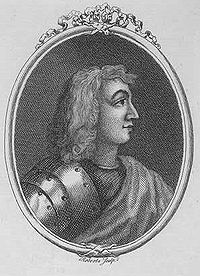 |
Constantine I (Còiseam mac Choinnich) |
Causantín mac Cináeda | Son of Kenneth I | 862–877 | Rex Pictorum ("King of the Picts") |
An Finn-Shoichleach, "The Wine-Bountiful" |
| — | Áed (Aodh mac Choinnich) |
Áed mac Cináeda | Son of Kenneth I | 877–878 | Rex Pictorum ("King of the Picts") |
|
| — | Giric (Griogair mac Dhunghail) |
Giric mac Dúngail | Son of Donald I | 878–889 | Mac Rath, "Son of Fortune" |
|
| Eochaid | Eochaid mac Run | † grandson of Kenneth I | *878–889? | |||
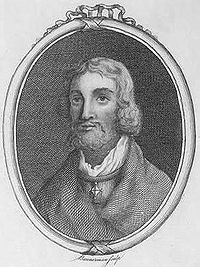 |
Donald II Donald II of Scotland Domnall mac Causantín , anglicised as Donald II was King of the Picts or King of Scotland in the late 9th century. He was the son of Constantine I... (Dòmhnall mac Chòiseim) |
Domnall mac Causantín | Son of Constantine I | 889–900 | Rí Alban ("King of Scotland") Rì nan Albannaich ("King of Scots") |
Dásachtach, the "Madman" or "Psycho" |
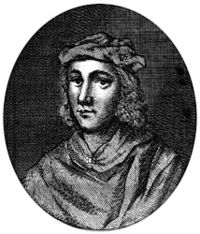 |
Constantine II Constantine II of Scotland Constantine, son of Áed was an early King of Scotland, known then by the Gaelic name Alba. The Kingdom of Alba, a name which first appears in Constantine's lifetime, was in northern Great Britain... (Còiseam mac Aoidh) |
Causantín mac Áeda | Son of Áed | 900–943 | Rí Alban | An Midhaise, "the Middle Aged". |
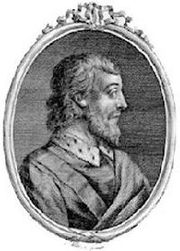 |
Malcolm I Malcolm I of Scotland Máel Coluim mac Domnaill was king of Scots , becoming king when his cousin Causantín mac Áeda abdicated to become a monk... (Maol Chaluim mac Dhòmhnaill) |
Máel Coluim mac Domnaill | Son of Donald II | 943–954 | Rí Alban | An Bodhbhdercc, "the Dangerous Red" |
 |
Indulf | Ildulb mac Causantín | Son of Constantine II | 954–962 | Rí Alban | An Ionsaighthigh, "the Aggressor" |
| — | Dub (Dubh or Duff) (Dubh mac Mhaoil Chaluim) |
Dub mac Maíl Choluim | Son of Malcolm I | 962–967 | Rí Alban | Dén, "the Vehement" |
| — | Cuilén (Cailean) |
Cuilén mac Ilduilb | Son of Indulf | 967–971 | Rí Alban | An Fionn, "the White" |
| — | Amlaíb Amlaíb of Scotland Amlaíb mac Ilduilb , known in English as simply Amlaíb was King of Scots during the 970s. He was the son of King Indulf and brother of King Cuilén... (Amhlaigh) |
Amlaíb mac Ilduilb | Son of Indulf | * 973x–977 | Rí Alban | |
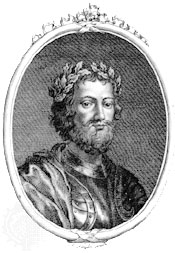 |
Kenneth II Kenneth II of Scotland Cináed mac Maíl Coluim was King of Scots... (Coinneach mac Mhaoil Chaluim) |
Cináed mac Maíl Choluim | Son of Malcolm I | 971 x 977–995 | Rí Alban | An Fionnghalach, "The Fratricide" |
.jpg) |
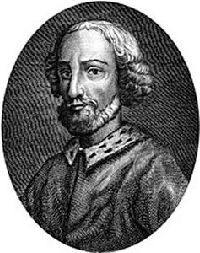
Constantine III Constantine III of Scotland Constantine, son of Cuilén , known in most modern regnal lists as Constantine III, was king of Scots from 995 to 997... (Còiseam mac Chailein) |
Causantín mac Cuiléin | Son of Cuilén | 995–997 | Rí Alban | |
 |
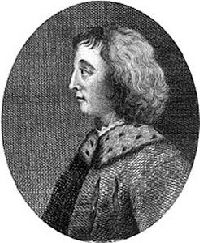
Kenneth III Kenneth III of Scotland Cináed mac Duib anglicised as Kenneth III, and nicknamed An Donn, "the Chief" or "the Brown", was King of Scots from 997 to 1005. He was the son of Dub... (Coinneach mac Dhuibh) |
Cináed mac Duib | Son of Dub | 997 – 25 March 1005 | Rí Alban | An Donn, "the Chief"/ "the Brown". |
 |
Malcolm II Malcolm II of Scotland Máel Coluim mac Cináeda , was King of the Scots from 1005 until his death... (Maol Chaluim mac Choinnich) |
Máel Coluim mac Cináeda | Son of Kenneth II | 1005–1034 | Rí Alban / Rex Scotiae | Forranach, "the Destroyer"; |
House of Dunkeld, 1034–1286
Duncan succeeded to the throne as the maternal grandson of Malcolm II (he was also the heir-general of Malcolm I, as his paternal grandfather, Duncan of Atholl was the third son of Malcolm I The House of Dunkeld was therefore a continuation of the House of Alpine). After an unsuccessful reign, Duncan was killed in battle by Macbeth, who had a long and relatively successful reign. In a series of battles between 1057 and 1058, Duncan's son Malcolm III defeated and killed Macbeth and Macbeth's stepson and heir Lulach, and claimed the throne. The dynastic feuds did not end there: on Malcolm's death in battle, his brother Donald Ban claimed the throne, expelling Malcolm's sons from Scotland; a civil war in the family ensued, with Donald Ban and Malcolm's son Edmund opposed by Malcolm's English-backed sons, led first by Duncan II and then by Edgar. Edgar triumphed, sending his uncle and brother to monasteries. After the reign of David I, the Scottish throne was passed according to rules of primogeniture, moving from father to son, or where not possible, brother to brother.| Portrait | Modern English Regnal Name Medieval Title |
Modern Gaelic Name Medieval Gaelic Name Nickname |
Dynastic Status (Father's Family) |
Maternal Status (Mother's Family) |
Reign (Years) |
||
|---|---|---|---|---|---|---|---|
 |
Duncan I Duncan I of Scotland Donnchad mac Crínáin was king of Scotland from 1034 to 1040... Rí Alban |
Donnchadh mac Crìonain Donnchad mac Crínáin An t-Ilgarach "The Diseased" or "The Sick" |
Grandson of Malcolm II Malcolm II of Scotland Máel Coluim mac Cináeda , was King of the Scots from 1005 until his death... & Great-grandson of Malcolm I (House of Alpin) |
Son of Bethóc, Eldest Daughter of Malcolm II Malcolm II of Scotland Máel Coluim mac Cináeda , was King of the Scots from 1005 until his death... (House of Alpin) |
1034–1040 (7) |
||
 |
Macbeth Rí Alban |
MacBheatha mac Fhionnlaigh Mac Bethad mac Findláich Rí Deircc "The Red King" |
1)Son of Mormaer Findláech Findláech of Moray Findláech of Moray was the King or Mormaer of Moray, ruling from some point before 1014 until his death in 1020.... 2)Grandson of Malcolm II Malcolm II of Scotland Máel Coluim mac Cináeda , was King of the Scots from 1005 until his death... 3)Husband to Gruoch Gruoch of Scotland Gruoch ingen Boite was the daughter of Boite mac Cináeda son of Cináed III. She is most famous for being the wife and queen of Mac Bethad mac Findlaích . The dates of her life are not certainly known.... , granddaughter of Kenneth III Kenneth III of Scotland Cináed mac Duib anglicised as Kenneth III, and nicknamed An Donn, "the Chief" or "the Brown", was King of Scots from 997 to 1005. He was the son of Dub... |
?,Unknown Daughter or Granddaughter of Malcolm II (House of Alpin) |
1040–1057 (18) |
||
| — | Lulach Rí Alban |
Lughlagh mac Gille Chomghain Lulach mac Gille Comgaín Tairbith "The Unfortunate" - Fatuus, "the Foolish" |
1)Son of Gille Coemgáin, Mormaer of Moray Gille Coemgáin of Moray Gilla Coemgáin was the King or Mormaer of Moray, a semi-autonomous kingdom centred around Inverness that stretched across the north of Scotland. Unlike his two predecessors, he is not called King of Scotland in his death notice, but merely Mormaer... 2) Grandson of Kenneth III (House of Alpin) |
Son of Gruoch Gruoch of Scotland Gruoch ingen Boite was the daughter of Boite mac Cináeda son of Cináed III. She is most famous for being the wife and queen of Mac Bethad mac Findlaích . The dates of her life are not certainly known.... , Granddaughter of Kenneth III Kenneth III of Scotland Cináed mac Duib anglicised as Kenneth III, and nicknamed An Donn, "the Chief" or "the Brown", was King of Scots from 997 to 1005. He was the son of Dub... |
1057–1058 (>1) |
||
| Malcolm III Malcolm III of Scotland Máel Coluim mac Donnchada , was King of Scots... Rí Alban Scottorum basileus |
Maol Chaluim mac Dhonnchaidh Máel Coluim mac Donnchada ? Cenn Mór ("Canmore") "Great Chief" |
Son of Duncan I Duncan I of Scotland Donnchad mac Crínáin was king of Scotland from 1034 to 1040... |
Son of Sybil/Suthen, sister of Siward "Earl of Northumbria" Siward, Earl of Northumbria Siward or Sigurd was an important earl of 11th-century northern England. The Old Norse nickname Digri and its Latin translation Grossus are given to him by near-contemporary texts... (House of Cnut the Great) |
1058–1093 (35) |
|||
 |
Donald III Donald III of Scotland Domnall mac Donnchada , anglicised as Donald III, and nicknamed Domnall Bán, "Donald the Fair" , was King of Scots from 1093–1094 and 1094–1097... (Dòmhnall mac Dhonnchaidh) (Domnall mac Donnchada) |
Son of Duncan I | 1093–1097 (4) |
Rí Alban | Bán, "the Fair". |
||
 |
Duncan II Duncan II of Scotland Donnchad mac Maíl Coluim was king of Scots... (Donnchadh mac Mhaoil Chaluim) (Donnchad mac Maíl Choluim) |
Son of Malcolm III | 1094 (1) |
Rí Alba n/ Rex Scottorum | |||
 |
Edgar (Eagar mac Mhaoil Chaluim) (Étgar mac Maíl Choluim) |
Son of Malcolm III | 1097–1107 (10) |
Rí Alban/ Rex Scottorum | Probus, "the Valiant" |
||
_i.jpg) |
Alexander I Alexander I of Scotland Alexander I , also called Alaxandair mac Maíl Coluim and nicknamed "The Fierce", was King of the Scots from 1107 to his death.-Life:... (Alasdair mac Mhaoil Chaluim) (Alaxandair mac Maíl Choluim) |
Son of Malcolm III | 1107–1124 (17) |
Rí Alban/ Rex Scottorum | "The Fierce" | ||
 |
David I David I of Scotland David I or Dabíd mac Maíl Choluim was a 12th-century ruler who was Prince of the Cumbrians and later King of the Scots... (Dàibhidh mac Mhaoil Chaluim) (Dabíd mac Maíl Choluim) |
Son of Malcolm III | 1124–1153 (29) |
Rí Alban/ Rex Scottorum | "The Saint" | ||
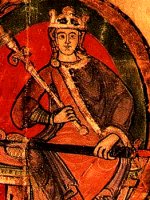 |
Malcolm IV Malcolm IV of Scotland Malcolm IV , nicknamed Virgo, "the Maiden" , King of Scots, was the eldest son of Earl Henry and Ada de Warenne... (Maol Chaluim mac Eanraig) (Máel Coluim mac Eanric) |
Grandson of David I | 1153–1165 (12) |
Rí Alban/ Rex Scottorum | Virgo "The Maiden" - Cenn Mór, "Great Chief" |
||
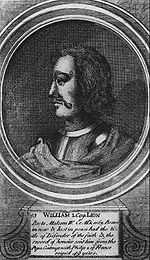 |
William I "The Lion" (Uilleam mac Eanraig) (Uilliam mac Eanric) |
Grandson of David I | 1165–1214 (49) |
Rí Alban / Rex Scottorum | "The Lion" - Garbh, "the Rough" |
||
_i.jpg) |
Alexander II Alexander II of Scotland Alexander II was King of Scots from1214 to his death.-Early life:... (Alasdair mac Uilleim) (Alaxandair mac Uilliam) |
Son of William I | 1214–1249 (35) |
Rí Alban / Rex Scottorum | |||
 |
Alexander III Alexander III of Scotland Alexander III was King of Scots from 1249 to his death.-Life:... (Alasdair mac Alasdair) (Alaxandair mac Alaxandair) |
Son of Alexander II | 1249–1286 (37) |
Rí Alban / Rex Scottorum |
House of FairhairFairhair dynastyThe Fairhair dynasty was a family of kings founded by Harald I of Norway which ruled Norway with few interruptions from 800 to 1387 , or through only three generations of kings , in the 10th century CE....
(1286–1290), disputed
The last King of the House of Dunkeld was Alexander III. His wife had borne him two sons and a daughter; but by 1286 his sons were dead and his daughter, Margaret, had borne only a single daughter, also named Margaret, to her husband Eric II of Norway before herself dying. Alexander had himself remarried, but in early 1286 he died in an accident while riding home. His wife, Yolande of Dreux, was pregnant; but by November 1286 all hope of her bearing a living child had passed. Accordingly, in the Treaty of Salisbury, the Guardians of Scotland recognised Alexander's granddaughter, Margaret of Norway, as Queen of Scots. Margaret remained in her father's Kingdom of Norway until Autumn 1290, when she was dispatched to Scotland. However, she died on the journey in Orkney, having never set foot on Scottish soil, and without being crowned at Scone. She is thus sometimes not considered Queen.| Name | Portrait | Birth | Marriage(s) | Death | Dynastic status |
|---|---|---|---|---|---|
| Margaret Margaret, Maid of Norway Margaret , usually known as the Maid of Norway , sometimes known as Margaret of Scotland , was a Norwegian princess who was Queen of Scots from 1286 until her death... the Maid of Norway 1286–1290 |
c. April 1283 Norway Norway Norway , officially the Kingdom of Norway, is a Nordic unitary constitutional monarchy whose territory comprises the western portion of the Scandinavian Peninsula, Jan Mayen, and the Arctic archipelago of Svalbard and Bouvet Island. Norway has a total area of and a population of about 4.9 million... daughter of Eric II of Norway and Margaret of Scotland |
unmarried | September/October 1290 Orkney aged 7 |
granddaughter of Alexander III |
House of Balliol (1292–1296)
The death of Margaret of Norway began a two-year interregnum in Scotland caused by a succession crisis. With her death, the descent of William I went extinct; nor was there an obvious heir by primogeniture. Thirteen candidates presented themselves; the most prominent were John de Balliol, great-grandson of William I's younger brother David of Huntingdon, and Robert de Brus, Lord of Annandale, David of Huntingdon's grandson. The Scottish Magnates invited Edward I of EnglandEdward I of England
Edward I , also known as Edward Longshanks and the Hammer of the Scots, was King of England from 1272 to 1307. The first son of Henry III, Edward was involved early in the political intrigues of his father's reign, which included an outright rebellion by the English barons...
to arbitrate the claims; he did so, but forced the Scots to swear allegiance to him as overlord. Eventually, it was decided that John de Balliol should become King; he proved weak and incapable, and in 1296 was forced to resign by Edward I, who then attempted to annex Scotland into the Kingdom of England.
| Name | Portrait | Birth | Marriage(s) | Death | Dynastic status |
|---|---|---|---|---|---|
| John de Balliol Toom Tabard ("Empty Cloak") (Iain Balliol) 1292–1296 |
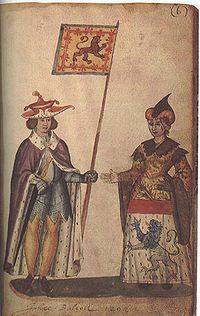 |
c. 1249 | Isabella de Warenne Isabella de Warenne Isabella de Warenne was Baroness of Bywell by her marriage to John Balliol; there is however doubt that she lived to become his Queen consort when he succeeded to the Scottish throne.- Family :... 9 February 1281 at least one child |
c. 25 November 1314 Picardy Picardy This article is about the historical French province. For other uses, see Picardy .Picardy is a historical province of France, in the north of France... , France Kingdom of France The Kingdom of France was one of the most powerful states to exist in Europe during the second millennium.It originated from the Western portion of the Frankish empire, and consolidated significant power and influence over the next thousand years. Louis XIV, also known as the Sun King, developed a... |
great-grandson of David of Huntingdon (brother of William I) |
House of Bruce (1306–1371)
For ten years, Scotland had no King of its own. The Scots, however, refused to tolerate English rule; first William WallaceWilliam Wallace
Sir William Wallace was a Scottish knight and landowner who became one of the main leaders during the Wars of Scottish Independence....
and then, after his execution, Robert the Bruce (the grandson of the 1292 competitor) fought against the English. Bruce and his supporters killed a rival for the throne, John III Comyn, Lord of Badenoch
John III Comyn, Lord of Badenoch
John III Comyn, Lord of Badenoch and Lord of Lochaber or John "the Red", also known simply as the Red Comyn was a Scottish nobleman who was an important figure in the Wars of Scottish Independence, and was Guardian of Scotland during the Second Interregnum 1296-1306...
on 10 February 1306 at Greyfriars Church in Dumfries
Dumfries
Dumfries is a market town and former royal burgh within the Dumfries and Galloway council area of Scotland. It is near the mouth of the River Nith into the Solway Firth. Dumfries was the county town of the former county of Dumfriesshire. Dumfries is nicknamed Queen of the South...
. Shortly after in 1306, Robert was crowned King of Scots at Scone. His energy, and the corresponding replacement of the vigorous Edward I with his weaker son Edward II, allowed Scotland to free itself from English rule; at the Battle of Bannockburn
Battle of Bannockburn
The Battle of Bannockburn was a significant Scottish victory in the Wars of Scottish Independence...
in 1314, the Scots routed the English, and by 1329 the English had agreed by treaty to accept Scottish independence. Robert's successor, his son David, was a child at his succession. The English renewed their war with Scotland, and David was forced to flee the Kingdom by Edward Balliol
Edward Balliol
Edward Balliol was a claimant to the Scottish throne . With English help, he briefly ruled the country from 1332 to 1336.-Life:...
, son of King John, who managed to get himself crowned King of Scots and to give away Scotland's southern counties to England before being driven out again. David spent much of his life in exile, first in freedom with his ally, France, and then in gaol in England; he was only able to return to Scotland in 1357. Upon his death, childless, in 1371, the House of Bruce came to an end.
| Name | Portrait | Birth | Marriage(s) | Death | Dynastic status |
|---|---|---|---|---|---|
| Robert I the Bruce (Roibert a Briuis) 1306–1329 |
 |
11 July 1274 Turnberry Castle Turnberry Castle Turnberry Castle is a fragmentary ruin on the coast of Kirkoswald parish, north of Girvan in Ayrshire, Scotland. It is situated on a rock at the extremity of the lower peninsula within the parish.-History:... , Ayrshire Ayrshire Ayrshire is a registration county, and former administrative county in south-west Scotland, United Kingdom, located on the shores of the Firth of Clyde. Its principal towns include Ayr, Kilmarnock and Irvine. The town of Troon on the coast has hosted the British Open Golf Championship twice in the... son of Robert de Brus, 6th Lord of Annandale and Marjorie, Countess of Carrick Marjorie, Countess of Carrick Marjorie of Carrick was countess of Carrick, Scotland, from 1256 to 1292, and is notable as the mother of Robert the Bruce.-Marriages:... |
Isabella of Mar Isabella of Mar Isabella of Mar was the first wife of Robert the Bruce and the grandmother of Robert II of Scotland, founder of the royal House of Stuart... 1295 one daughter Elizabeth de Burgh Elizabeth de Burgh Elizabeth de Burgh was the second wife and the only queen consort of King Robert I of Scotland.-Life:She was born in Dunfermline, Fife in Scotland, the daughter of the powerful Richard Óg de Burgh, 2nd Earl of Ulster and his wife Margarite de Burgh... Writtle Writtle The village of Writtle lies a mile west of Chelmsford, Essex, England, it has a traditional village green, complete with duck pond and a Norman church; and was once described as: 'one of the loveliest villages in England, with a ravishing variety of ancient cottages'... , Essex Essex Essex is a ceremonial and non-metropolitan county in the East region of England, and one of the home counties. It is located to the northeast of Greater London. It borders with Cambridgeshire and Suffolk to the north, Hertfordshire to the west, Kent to the South and London to the south west... , England Kingdom of England The Kingdom of England was, from 927 to 1707, a sovereign state to the northwest of continental Europe. At its height, the Kingdom of England spanned the southern two-thirds of the island of Great Britain and several smaller outlying islands; what today comprises the legal jurisdiction of England... 1302 three children |
7 June 1329 Manor of Cardross, Dunbartonshire Dunbartonshire Dunbartonshire or the County of Dumbarton is a lieutenancy area and registration county in the west central Lowlands of Scotland lying to the north of the River Clyde. Until 1975 it was a county used as a primary unit of local government with its county town and administrative centre at the town... aged 54 |
great-great-grandson of David of Huntingdon (brother of William I) (election) |
| David II David II of Scotland David II was King of Scots from 7 June 1329 until his death.-Early life:... (Dàibhidh Bruis) 1329–1371 |
 |
5 March 1324 Dunfermline Palace Dunfermline Palace Dunfermline Palace is a former Scottish royal palace in Dunfermline, Fife. It is currently a ruin under the care of Historic Scotland and an important tourist attraction in Dunfermline.... , Fife Fife Fife is a council area and former county of Scotland. It is situated between the Firth of Tay and the Firth of Forth, with inland boundaries to Perth and Kinross and Clackmannanshire... son of Robert I and Elizabeth de Burgh |
Joan of England Joan of The Tower Joan of England , known as Joan of The Tower, was the first wife and Queen consort of king David II of Scotland.-Birth:... Berwick-upon-Tweed Berwick-upon-Tweed Berwick-upon-Tweed or simply Berwick is a town in the county of Northumberland and is the northernmost town in England, on the east coast at the mouth of the River Tweed. It is situated 2.5 miles south of the Scottish border.... 17 July 1328 no children Margaret Drummond Inchmurdach, Fife 20 February 1364 no children |
22 February 1371 Edinburgh Castle Edinburgh Castle Edinburgh Castle is a fortress which dominates the skyline of the city of Edinburgh, Scotland, from its position atop the volcanic Castle Rock. Human habitation of the site is dated back as far as the 9th century BC, although the nature of early settlement is unclear... aged 46 |
son of Robert I (primogeniture Primogeniture Primogeniture is the right, by law or custom, of the firstborn to inherit the entire estate, to the exclusion of younger siblings . Historically, the term implied male primogeniture, to the exclusion of females... ) |
Stewart (1371–1567)
Robert the Stewart was a grandson of Robert I by the latter's daughter, Marjorie. Having been born in 1316, he was older than his uncle, David II; consequently, he was at his accession an old man, unable to reign vigorously, a problem also faced by his son Robert III, who had suffered lasting damage in a horse-riding accident. These two were followed by a series of regencies, caused by the youth of the succeeding kings. Consequently, the Stewart era saw periods of royal inertia, during which the nobles usurped power from the crown, followed by periods of personal rule by the monarch, during which he or she would attempt to address the issues created by their own minority and the long-term effects of previous reigns. Governing Scotland became increasingly difficult, as the powerful nobility became increasingly intractable; James I's attempts to curb the disorder of the realm ended in his assassination; James III was killed in a civil war between himself and the nobility, led by his own son; when James IV, who had governed sternly and suppressed the aristocrats, died in the Battle of Flodden, his wife Margaret Tudor, who had been nominated regent for their young son James V, was unseated by noble feuding, and James V's own wife, Marie de Guise, succeeded in ruling Scotland during the regency for her young daughter Mary I only by dividing and conquering the noble factions, and by distributing French bribes with a liberal hand. Finally, Mary I, the daughter of James V, found herself unable to govern Scotland faced with the surliness of the aristocracy and the intransigence of the population, who favoured Calvinism and disapproved of her Catholicism; she was forced to abdicate, and fled to England, where she was executed for treason against the English queen Elizabeth I. Upon her abdication, her son, fathered by a junior member of the Stewart family, became King.| Name | Portrait | Birth | Marriage(s) | Death | Dynastic status |
|---|---|---|---|---|---|
| Robert II Robert II of Scotland Robert II became King of Scots in 1371 as the first monarch of the House of Stewart. He was the son of Walter Stewart, hereditary High Steward of Scotland and of Marjorie Bruce, daughter of Robert I and of his first wife Isabella of Mar... the Steward (Roibert II Stiùbhairt) 1371–1390 |
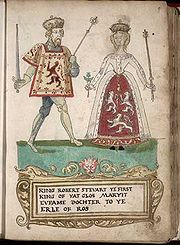 |
2 March 1316 Paisley Paisley Paisley is the largest town in the historic county of Renfrewshire in the west central Lowlands of Scotland and serves as the administrative centre for the Renfrewshire council area... , Renfrewshire Renfrewshire Renfrewshire is one of 32 council areas used for local government in Scotland. Located in the west central Lowlands, it is one of three council areas contained within the boundaries of the historic county of Renfrewshire, the others being Inverclyde to the west and East Renfrewshire to the east... son of Walter Stewart, 6th High Steward of Scotland Walter Stewart, 6th High Steward of Scotland Walter Stewart was the 6th hereditary High Steward of Scotland. He was also the father of King Robert II of Scotland.-Biography:... and Marjorie Bruce Marjorie Bruce Marjorie Bruce or Marjorie de Brus was the eldest daughter of Robert the Bruce, King of Scots by his first wife, Isabella of Mar, and the founder of the Stewart dynasty. Her marriage to Walter, High Steward of Scotland gave rise to the House of Stewart... |
Elizabeth Mure Elizabeth Mure Elizabeth Mure was mistress and then wife of Robert, High Steward of Scotland, and Guardian of Scotland , who later became King Robert II of Scotland.-History:... 1336 (uncertain canonicity Canon law (Catholic Church) The canon law of the Catholic Church, is a fully developed legal system, with all the necessary elements: courts, lawyers, judges, a fully articulated legal code and principles of legal interpretation. It lacks the necessary binding force present in most modern day legal systems. The academic... ) 1349 (with Papal dispensation Papal dispensation Papal dispensation is a reserved right of the Pope that allows for individuals to be exempted from a specific Canon Law. Dispensations are divided into two categories: general, and matrimonial. Matrimonial dispensations can be either to allow a marriage in the first place, or to dissolve one... ) ten children Euphemia de Ross Euphemia de Ross Euphemia de Ross was the second wife and first Queen consort of Robert II of Scotland.She was a daughter of Aodh, Earl of Ross and Margaret de Graham, Hugh's 2nd wife and daughter of Sir David de Graham of Montrose. She first married John Randolph, 3rd Earl of Moray but the marriage was childless... 2 May 1355 four children |
19 April 1390 Dundonald Castle Dundonald Castle Dundonald Castle is situated on a hill overlooking the village of Dundonald, between Kilmarnock and Troon in South Ayrshire, Scotland. Dundonald Castle is a fortified tower house built for Robert II on his accession to the throne of Scotland in 1371 and it was used as a royal residence by the early... , Ayrshire Ayrshire Ayrshire is a registration county, and former administrative county in south-west Scotland, United Kingdom, located on the shores of the Firth of Clyde. Its principal towns include Ayr, Kilmarnock and Irvine. The town of Troon on the coast has hosted the British Open Golf Championship twice in the... aged 74 |
grandson of Robert I (primogeniture) |
| Robert III Robert III of Scotland Robert III was King of Scots from 1390 to his death. His given name was John Stewart, and he was known primarily as the Earl of Carrick before ascending the throne at age 53... (born John Stewart) the Lame King (Roibert III Stiùbhairt, An Righ Bhacaigh) 1390–1406 |
c.1337 son of Robert II and Elizabeth Mure |
Anabella Drummond Anabella Drummond Anabella Drummond was the Queen Consort of Scotland as the wife of Robert III of Scotland.-Family:She was the daughter of Sir John Drummond, of Stobhall, near Perth, 11th Thane of Lennox and Chief of Clan Drummond, and Mary Montifex... 1367 seven children |
4 April 1406 Rothesay Castle Rothesay Castle Rothesay Castle is a ruined castle in Rothesay, the principal town on the Isle of Bute, in western Scotland. Located at , the castle has been described as "one of the most remarkable in Scotland", for its long history dating back to the beginning of the 13th century, and its unusual circular... aged about 69 |
son of Robert II (primogeniture) | |
| James I James I of Scotland James I, King of Scots , was the son of Robert III and Annabella Drummond. He was probably born in late July 1394 in Dunfermline as youngest of three sons... (Seumas I Stiùbhairt) 1406–1437 |
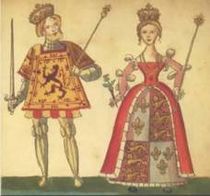 |
late July 1394 Dunfermline Palace, Fife son of Robert III and Anabella Drummond |
Joan Beaufort Southwark Cathedral Southwark Cathedral Southwark Cathedral or The Cathedral and Collegiate Church of St Saviour and St Mary Overie, Southwark, London, lies on the south bank of the River Thames close to London Bridge.... 2 February 1424 eight children |
21 February 1437 Blackfriars Blackfriars Blackfriars is an area of central London, which lies in the south-west corner of the City of London.The name Blackfriars was first used in 1317 and derives from the black cappa worn by the Dominican Friars who moved their priory from Holborn to the area between the River Thames and Ludgate Hill in... , Perth Perth, Scotland Perth is a town and former city and royal burgh in central Scotland. Located on the banks of the River Tay, it is the administrative centre of Perth and Kinross council area and the historic county town of Perthshire... aged about 42 |
son of Robert III (primogeniture) |
| James II James II of Scotland James II reigned as King of Scots from 1437 to his death.He was the son of James I, King of Scots, and Joan Beaufort... Fiery Face (Seumas II Stiùbhairt) 1437–1460 |
 |
16 October 1430 Holyrood Abbey Holyrood Abbey Holyrood Abbey is a ruined abbey of the Canons Regular in Edinburgh, Scotland. The abbey was founded in 1128 by King David I of Scotland. During the 15th century, the abbey guesthouse was developed into a royal residence, and after the Scottish Reformation the Palace of Holyroodhouse was expanded... , Edinburgh Edinburgh Edinburgh is the capital city of Scotland, the second largest city in Scotland, and the eighth most populous in the United Kingdom. The City of Edinburgh Council governs one of Scotland's 32 local government council areas. The council area includes urban Edinburgh and a rural area... son of James I and Joan Beaufort |
Mary of Guelders Mary of Guelders Mary of Guelders was the Queen Consort of Scotland as the wife of King James II of Scotland. She served as Regent of Scotland from 1460 to 1463.-Background:... Holyrood Abbey 3 July 1449 seven children |
3 August 1460 Roxburgh Castle Roxburgh Castle Roxburgh Castle was a castle sited near Kelso, in the Borders region of Scotland, in the former Roxburghshire.-History:The castle was founded by King David I. In 1174 it was surrendered to England after the capture of William I at Alnwick, and was often in English hands thereafter. The Scots made... aged 29 |
son of James I (primogeniture) |
| James III James III of Scotland James III was King of Scots from 1460 to 1488. James was an unpopular and ineffective monarch owing to an unwillingness to administer justice fairly, a policy of pursuing alliance with the Kingdom of England, and a disastrous relationship with nearly all his extended family.His reputation as the... (Seumas III Stiùbhairt) 1460–1488 |
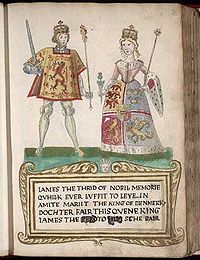 |
10 July 1451 Stirling Castle Stirling Castle Stirling Castle, located in Stirling, is one of the largest and most important castles, both historically and architecturally, in Scotland. The castle sits atop Castle Hill, an intrusive crag, which forms part of the Stirling Sill geological formation. It is surrounded on three sides by steep... or St Andrews Castle St Andrews Castle St Andrew's Castle is a picturesque ruin located in the coastal Royal Burgh of St Andrews in Fife, Scotland. The castle sits on a rocky promontory overlooking a small beach called Castle Sands and the adjoining North Sea. There has been a castle standing at the site since the times of Bishop Roger... son of James II and Mary of Guelders |
Margaret of Scotland Holyrood Abbey 13 July 1469 three children |
11 June 1488 Sauchie Burn Battle of Sauchieburn The Battle of Sauchieburn was fought on June 11, 1488, at the side of Sauchie Burn, a stream about two miles south of Stirling, Scotland. The battle was fought between as many as 30,000 troops of King James III of Scotland and some 18,000 troops raised by a group of dissident Scottish nobles... aged 36 |
son of James II (primogeniture) |
| James IV James IV of Scotland James IV was King of Scots from 11 June 1488 to his death. He is generally regarded as the most successful of the Stewart monarchs of Scotland, but his reign ended with the disastrous defeat at the Battle of Flodden Field, where he became the last monarch from not only Scotland, but also from all... (Seumas IV Stiùbhairt) 1488–1513 |
 |
17 March 1473 Stirling Castle son of James III and Margaret of Denmark |
Margaret Tudor Margaret Tudor Margaret Tudor was the elder of the two surviving daughters of Henry VII of England and Elizabeth of York, and the elder sister of Henry VIII. In 1503, she married James IV, King of Scots. James died in 1513, and their son became King James V. She married secondly Archibald Douglas, 6th Earl of... Holyrood Abbey 8 August 1503 six children |
9 September 1513 Flodden Field Battle of Flodden Field The Battle of Flodden or Flodden Field or occasionally Battle of Branxton was fought in the county of Northumberland in northern England on 9 September 1513, between an invading Scots army under King James IV and an English army commanded by the Earl of Surrey... , Northumberland Northumberland Northumberland is the northernmost ceremonial county and a unitary district in North East England. For Eurostat purposes Northumberland is a NUTS 3 region and is one of three boroughs or unitary districts that comprise the "Northumberland and Tyne and Wear" NUTS 2 region... , England aged 40 |
son of James III (primogeniture) |
| James V James V of Scotland James V was King of Scots from 9 September 1513 until his death, which followed the Scottish defeat at the Battle of Solway Moss... (Seumas V Stiùbhairt) 1513–1542 |
15 April 1512 Linlithgow Palace Linlithgow Palace The ruins of Linlithgow Palace are situated in the town of Linlithgow, West Lothian, Scotland, west of Edinburgh. The palace was one of the principal residences of the monarchs of Scotland in the 15th and 16th centuries. Although maintained after Scotland's monarchs left for England in 1603, the... , West Lothian West Lothian West Lothian is one of the 32 unitary council areas in Scotland, and a Lieutenancy area. It borders the City of Edinburgh, Falkirk, North Lanarkshire, the Scottish Borders and South Lanarkshire.... son of James IV and Margaret Tudor |
Madeleine of Valois Notre Dame Cathedral Notre Dame de Paris Notre Dame de Paris , also known as Notre Dame Cathedral, is a Gothic, Roman Catholic cathedral on the eastern half of the Île de la Cité in the fourth arrondissement of Paris, France. It is the cathedral of the Catholic Archdiocese of Paris: that is, it is the church that contains the cathedra of... , Paris Paris Paris is the capital and largest city in France, situated on the river Seine, in northern France, at the heart of the Île-de-France region... , France 1 January 1537 no children Mary of Guise Mary of Guise Mary of Guise was a queen consort of Scotland as the second spouse of King James V. She was the mother of Mary, Queen of Scots, and served as regent of Scotland in her daughter's name from 1554 to 1560... Notre Dame Cathedral, Paris, France 18 Mary 1538 three children |
14 December 1542 Falkland Palace Falkland Palace Falkland Palace in Falkland, Fife, Scotland, is a former royal palace of the Scottish Kings. Today it is in the care of the National Trust for Scotland, and serves as a tourist attraction.-Early years:... , Fife aged 30 |
son of James IV (primogeniture) | |
| Mary I, Queen consort of France (Mairi Stiùbhairt) 1542–1567 |
8 December 1542 Linlithgow Palace daughter of James V and Mary of Guise |
François II, King of France Francis II of France Francis II was aged 15 when he succeeded to the throne of France after the accidental death of his father, King Henry II, in 1559. He reigned for 18 months before he died in December 1560... 24 April 1558 no children Henry Stuart, Lord Darnley Henry Stuart, Lord Darnley Henry Stewart or Stuart, 1st Duke of Albany , styled Lord Darnley before 1565, was king consort of Scotland and murdered at Kirk o'Field... Holyrood Palace Holyrood Palace The Palace of Holyroodhouse, commonly referred to as Holyrood Palace, is the official residence of the monarch in Scotland. The palace stands at the bottom of the Royal Mile in Edinburgh, at the opposite end to Edinburgh Castle... , Edinburgh 9 July 1565 one child James Hepburn, 4th Earl of Bothwell James Hepburn, 4th Earl of Bothwell James Hepburn, 1st Duke of Orkney , better known by his inherited title as 4th Earl of Bothwell, was hereditary Lord High Admiral of Scotland. He is best known for his association with and subsequent marriage to Mary, Queen of Scots, as her third husband... Holyrood Palace 15 May 1567 no children |
8 February 1587 Fotheringhay Castle Fotheringhay Castle Fotheringhay Castle was in the village of Fotheringhay 3½ miles to the north of the market town of Oundle, Northamptonshire .King Richard III was born here in 1452 and it was also where Mary, Queen of Scots, was tried and executed in 1587.... , Northamptonshire Northamptonshire Northamptonshire is a landlocked county in the English East Midlands, with a population of 629,676 as at the 2001 census. It has boundaries with the ceremonial counties of Warwickshire to the west, Leicestershire and Rutland to the north, Cambridgeshire to the east, Bedfordshire to the south-east,... , England aged 44 (executed) |
daughter of James V (cognatic primogeniture) |
Stuart (1567–1651)
The Stewarts of Lennox were a junior branch of the Stewart family; they were not, however, direct male line descendants of Robert II, the first Stewart who became King of Scots, but rather that of his ancestor Alexander Stewart, 4th High Steward of ScotlandAlexander Stewart, 4th High Steward of Scotland
Alexander Stewart was 4th hereditary High Steward of Scotland from his father's death in 1246.A son of Walter Stewart, 3rd High Steward of Scotland by his wife Bethóc, daughter of Gille Críst, Earl of Angus, Alexander is said to have accompanied Louis IX of France on the Seventh Crusade...
. In the past, through the means of the Auld Alliance with France, they had adapted their surname to the French form, Stuart. Consequently, when the son of the Earl of Lennox, Henry, Lord Darnley, married the Queen of Scots, Mary I, their son, as the first King of the Lennox branch of the Stewart family, ruled as a Stuart.
James VI also became King of England and Ireland as James I in 1603, when his cousin Elizabeth I died; thereafter, although the two crowns of England and Scotland remained separate, the monarchy was based chiefly in England.
Charles I, James's son, found himself faced with Civil War; the resultant conflict lasted eight years, and ended in his execution. The English Parliament then decreed their monarchy to be at an end; the Scots Parliament, after some deliberation, broke their links with England, and declared that Charles II, son and heir of Charles I, would become King. He ruled until 1651; however, the armies of Oliver Cromwell
Oliver Cromwell
Oliver Cromwell was an English military and political leader who overthrew the English monarchy and temporarily turned England into a republican Commonwealth, and served as Lord Protector of England, Scotland, and Ireland....
occupied Scotland and drove him into exile.
| Name | Portrait | Birth | Marriage(s) | Death | Dynastic status |
|---|---|---|---|---|---|
| James VI (Seumas VI Stiùbhairt) 1567–1625 |
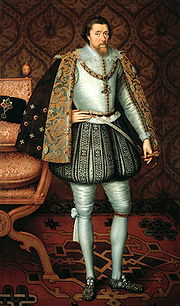 |
19 June 1566 Edinburgh Castle son of Henry Stuart, Lord Darnley and Mary I |
Anne of Denmark Anne of Denmark Anne of Denmark was queen consort of Scotland, England, and Ireland as the wife of King James VI and I.The second daughter of King Frederick II of Denmark, Anne married James in 1589 at the age of fourteen and bore him three children who survived infancy, including the future Charles I... Old Bishop's Palace Old Bishop's Palace in Oslo The Old Bishop's Palace in Oslo was the residence of the Catholic bishops of Oslo. The palace was built like a fortified castle. The construction was begun around 1210 by the then bishop, Nikolas Arnesson, continuing through to the early 14th century... , Oslo Oslo Oslo is a municipality, as well as the capital and most populous city in Norway. As a municipality , it was established on 1 January 1838. Founded around 1048 by King Harald III of Norway, the city was largely destroyed by fire in 1624. The city was moved under the reign of Denmark–Norway's King... , Norway Norway Norway , officially the Kingdom of Norway, is a Nordic unitary constitutional monarchy whose territory comprises the western portion of the Scandinavian Peninsula, Jan Mayen, and the Arctic archipelago of Svalbard and Bouvet Island. Norway has a total area of and a population of about 4.9 million... 23 November 1589 seven children |
27 March 1625 Theobalds House Theobalds House Theobalds House , located in Theobalds Park, just outside Cheshunt in the English county of Hertfordshire, was a prominent stately home and royal palace of the 16th and early 17th centuries.- Early history :... , Hertfordshire Hertfordshire Hertfordshire is a ceremonial and non-metropolitan county in the East region of England. The county town is Hertford.The county is one of the Home Counties and lies inland, bordered by Greater London , Buckinghamshire , Bedfordshire , Cambridgeshire and... , England aged 58 |
son of Mary I (primogeniture) |
| Charles I Charles I of England Charles I was King of England, King of Scotland, and King of Ireland from 27 March 1625 until his execution in 1649. Charles engaged in a struggle for power with the Parliament of England, attempting to obtain royal revenue whilst Parliament sought to curb his Royal prerogative which Charles... (Teàrlach I Stiùbhairt) 1625–1649 |
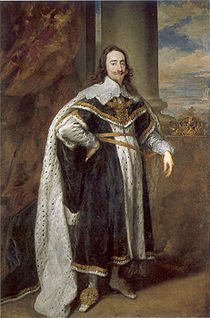 |
19 November 1600 Dunfermline Palace, Dunfermline Dunfermline Dunfermline is a town and former Royal Burgh in Fife, Scotland, on high ground from the northern shore of the Firth of Forth. According to a 2008 estimate, Dunfermline has a population of 46,430, making it the second-biggest settlement in Fife. Part of the town's name comes from the Gaelic word... son of James VI and Anne of Denmark |
Henrietta Maria of France Henrietta Maria of France Henrietta Maria of France ; was the Queen consort of England, Scotland and Ireland as the wife of King Charles I... St Augustine's Church St Augustine's Abbey St Augustine's Abbey was a Benedictine abbey in Canterbury, Kent, England.-Early history:In 597 Saint Augustine arrived in England, having been sent by Pope Gregory I, on what might nowadays be called a revival mission. The King of Kent at this time was Æthelberht, who happened to be married to a... , Canterbury Canterbury Canterbury is a historic English cathedral city, which lies at the heart of the City of Canterbury, a district of Kent in South East England. It lies on the River Stour.... , England 13 June 1625 nine children |
30 January 1649 Palace of Whitehall Palace of Whitehall The Palace of Whitehall was the main residence of the English monarchs in London from 1530 until 1698 when all except Inigo Jones's 1622 Banqueting House was destroyed by fire... , London, England aged 48 (executed) |
son of James VI (primogeniture) |
| Charles II Charles II of England Charles II was monarch of the three kingdoms of England, Scotland, and Ireland.Charles II's father, King Charles I, was executed at Whitehall on 30 January 1649, at the climax of the English Civil War... (Teàrlach II Stiùbhairt) 1649–1651 |
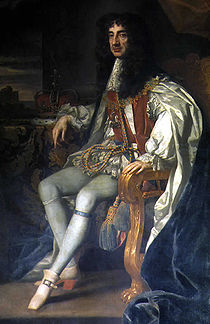 |
29 May 1630 St James's Palace, London London London is the capital city of :England and the :United Kingdom, the largest metropolitan area in the United Kingdom, and the largest urban zone in the European Union by most measures. Located on the River Thames, London has been a major settlement for two millennia, its history going back to its... , England son of Charles I and Henrietta Maria of France |
Catherine of Braganza Catherine of Braganza Catherine of Braganza was a Portuguese infanta and queen consort of England, Scotland and Ireland as the wife of King Charles II.She married the king in 1662... Portsmouth Portsmouth Portsmouth is the second largest city in the ceremonial county of Hampshire on the south coast of England. Portsmouth is notable for being the United Kingdom's only island city; it is located mainly on Portsea Island... , England 14 May 1662 no children |
6 February 1685 Palace of Whitehall, London, England aged 54 |
son of Charles I (primogeniture) |
House of Stuart (restored) (1660–1707)
With the Restoration, the Stuarts became Kings of Scotland once more. But Scotland's rights were not respected: the Scottish Parliament was, during the reign of Charles II, dissolved, and his brother James was appointed Governor of Scotland. James himself became James VII in 1685; his Catholicism was not tolerated, and he was driven out of England after three years. In his place came his daughter Mary and her husband William of Orange, the ruler of the Dutch Republic; they were accepted as monarchs of Scotland after a period of deliberation by the Scottish Parliament, and ruled together as William II and Mary II.An attempt to establish a Scottish colonial empire through the Darien Scheme
Darién scheme
The Darién scheme was an unsuccessful attempt by the Kingdom of Scotland to become a world trading nation by establishing a colony called "New Caledonia" on the Isthmus of Panama in the late 1690s...
, in rivalry to that of England, failed, leaving the Scottish state bankrupt. This coincided with the accession of Queen Anne, daughter of James VII. Anne had multiple children but none of these survived her, and on her death her nearest heir was her halfbrother, James, in exile in France. The English favoured the Protestant Sophia of Hanover (a granddaughter of James VI) as heir; many Scots preferred Prince James, who as a Stuart was a Scot by ancestry, and threatened to break the Union of Crowns between England and Scotland by choosing him for themselves. To preserve the union, the English elaborated a plan whereby the two Kingdoms of Scotland and England would merge into a single Kingdom, the Kingdom of Great Britain, ruled by a common monarch, and with a single Parliament. Both national parliaments agreed to this (the Scots albeit reluctantly, motivated primarily by the national finances), and the Kingdom of Scotland was merged with England and came to an end. Thereafter, although monarchs continued to rule over the nation of Scotland, they did so first as monarchs of Great Britain, and then of the United Kingdom.
| Name | Portrait | Birth | Marriage(s) | Death | Dynastic status |
|---|---|---|---|---|---|
| Charles II Charles II of England Charles II was monarch of the three kingdoms of England, Scotland, and Ireland.Charles II's father, King Charles I, was executed at Whitehall on 30 January 1649, at the climax of the English Civil War... (Teàrlach II Stiùbhairt) 1660–1685 |
|
29 May 1630 St James's Palace, London London London is the capital city of :England and the :United Kingdom, the largest metropolitan area in the United Kingdom, and the largest urban zone in the European Union by most measures. Located on the River Thames, London has been a major settlement for two millennia, its history going back to its... , England son of Charles I and Henrietta Maria of France |
Catherine of Braganza Catherine of Braganza Catherine of Braganza was a Portuguese infanta and queen consort of England, Scotland and Ireland as the wife of King Charles II.She married the king in 1662... Portsmouth Portsmouth Portsmouth is the second largest city in the ceremonial county of Hampshire on the south coast of England. Portsmouth is notable for being the United Kingdom's only island city; it is located mainly on Portsea Island... , England 14 May 1662 no children |
6 February 1685 Palace of Whitehall Palace of Whitehall The Palace of Whitehall was the main residence of the English monarchs in London from 1530 until 1698 when all except Inigo Jones's 1622 Banqueting House was destroyed by fire... , London, England aged 54 |
son of Charles I (primogeniture) |
| James VII James II of England James II & VII was King of England and King of Ireland as James II and King of Scotland as James VII, from 6 February 1685. He was the last Catholic monarch to reign over the Kingdoms of England, Scotland, and Ireland... (Seumas VII Stiùbhairt) 1685–1688 |
 |
14 October 1633 St James's Palace, London, England son of Charles I and Henrietta Maria of France |
Anne Hyde Anne Hyde Anne Hyde was the first wife of James, Duke of York , and the mother of two monarchs, Mary II of England and Scotland and Anne of Great Britain.... The Strand Strand, London Strand is a street in the City of Westminster, London, England. The street is just over three-quarters of a mile long. It currently starts at Trafalgar Square and runs east to join Fleet Street at Temple Bar, which marks the boundary of the City of London at this point, though its historical length... , London, England 3 September 1660 eight children Mary of Modena Mary of Modena Mary of Modena was Queen consort of England, Scotland and Ireland as the second wife of King James II and VII. A devout Catholic, Mary became, in 1673, the second wife of James, Duke of York, who later succeeded his older brother Charles II as King James II... Dover Dover Dover is a town and major ferry port in the home county of Kent, in South East England. It faces France across the narrowest part of the English Channel, and lies south-east of Canterbury; east of Kent's administrative capital Maidstone; and north-east along the coastline from Dungeness and Hastings... , England 21 November 1673 seven children |
16 September 1701 Château de Saint-Germain-en-Laye Château de Saint-Germain-en-Laye The Château de Saint-Germain-en-Laye is a royal palace in the commune of Saint-Germain-en-Laye, in the département of Yvelines, about 19 km west of Paris, France. Today, it houses the Musée d'Archéologie Nationale .... , France aged 67 |
son of Charles I (primogeniture) |
| Mary II Mary II of England Mary II was joint Sovereign of England, Scotland, and Ireland with her husband and first cousin, William III and II, from 1689 until her death. William and Mary, both Protestants, became king and queen regnant, respectively, following the Glorious Revolution, which resulted in the deposition of... (Mairi II Stiùbhairt) 1689–1694 |
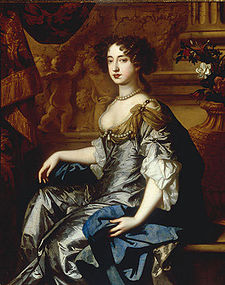 |
30 April 1662 St James's Palace, England daughter of James VII (II of England) and Anne Hyde |
St James's Palace 4 November 1677 three children (none survived infancy) |
28 December 1694 Kensington Palace Kensington Palace Kensington Palace is a royal residence set in Kensington Gardens in the Royal Borough of Kensington and Chelsea in London, England. It has been a residence of the British Royal Family since the 17th century and is the official London residence of the Duke and Duchess of Cambridge, the Duke and... , England aged 32 |
grandchildren of Charles I (offered the crown by the Parliament Glorious Revolution The Glorious Revolution, also called the Revolution of 1688, is the overthrow of King James II of England by a union of English Parliamentarians with the Dutch stadtholder William III of Orange-Nassau... ) |
| William II William III of England William III & II was a sovereign Prince of Orange of the House of Orange-Nassau by birth. From 1672 he governed as Stadtholder William III of Orange over Holland, Zeeland, Utrecht, Guelders, and Overijssel of the Dutch Republic. From 1689 he reigned as William III over England and Ireland... (Uilleam Orains, "William of Orange") 1689–1702 |
.jpg) |
4 November 1650 The Hague The Hague The Hague is the capital city of the province of South Holland in the Netherlands. With a population of 500,000 inhabitants , it is the third largest city of the Netherlands, after Amsterdam and Rotterdam... , Dutch Republic Dutch Republic The Dutch Republic — officially known as the Republic of the Seven United Netherlands , the Republic of the United Netherlands, or the Republic of the Seven United Provinces — was a republic in Europe existing from 1581 to 1795, preceding the Batavian Republic and ultimately... son of William II, Prince of Orange William II, Prince of Orange William II, Prince of Orange was sovereign Prince of Orange and stadtholder of the United Provinces of the Netherlands from 14 March 1647 until his death three years later.-Biography:... and Mary, Princess Royal Mary, Princess Royal and Princess of Orange Mary, Princess Royal, Princess of Orange and Countess of Nassau was the eldest daughter of King Charles I of England, Scotland, and Ireland and his queen, Henrietta Maria of France... |
8 March 1702 Kensington Palace aged 51 |
||
| Anne (Anna Stiùbhairt) 1702–1707 Queen of Great Britain and Ireland 1707 Acts of Union 1707 The Acts of Union were two Parliamentary Acts - the Union with Scotland Act passed in 1706 by the Parliament of England, and the Union with England Act passed in 1707 by the Parliament of Scotland - which put into effect the terms of the Treaty of Union that had been agreed on 22 July 1706,... –1714 |
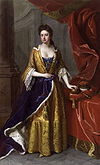 |
6 February 1665 St James's Palace daughter of James VII and Anne Hyde |
George of Denmark George of Denmark Prince George of Denmark and Norway, Duke of Cumberland was the husband of Anne, Queen of Great Britain.His marriage to Anne was arranged in the early 1680s with a view to developing an Anglo-Danish alliance to contain Dutch maritime power. As a result, George was unpopular with his Dutch... St James's Palace 28 July 1683 17 children |
1 August 1714 Kensington Palace aged 49 |
daughter of James VII (primogeniture; Bill of Rights 1689 Bill of Rights 1689 The Bill of Rights or the Bill of Rights 1688 is an Act of the Parliament of England.The Bill of Rights was passed by Parliament on 16 December 1689. It was a re-statement in statutory form of the Declaration of Right presented by the Convention Parliament to William and Mary in March 1689 ,... ) |
For the British monarchs see List of British monarchs.
Jacobite claimants
James VII continued to claim the thrones of England, Scotland, and Ireland. When he died in 1701, his son James inherited his father's claims, and called himself James VIII of Scotland and III of England and Ireland. He would continue to do so all his life, even after the Kingdoms of England and Scotland were ended by their merging as the Kingdom of Great Britain. In 1715, a year after the death of his sister, Queen Anne, and the accession of their cousin George of Hanover, James landed in Scotland and attempted to claim the throne; he failed, and was forced to flee back to the Continent. A second attempt by his son, Charles, in 1745, also failed. Both James's children died without legitimate issue, bringing the Stuart family to an end.- James VIIIJames Francis Edward StuartJames Francis Edward, Prince of Wales was the son of the deposed James II of England...
(Seumas VIII), also known as The Old Pretender, son of James VII, was claimant from 1701 until his death in 1766. - Charles IIICharles Edward StuartPrince Charles Edward Louis John Casimir Sylvester Severino Maria Stuart commonly known as Bonnie Prince Charlie or The Young Pretender was the second Jacobite pretender to the thrones of Great Britain , and Ireland...
(Teàrlach III), also known as The Young Pretender and often called Bonnie Prince Charlie, son of James VIII, was claimant from his father's death until his own death in 1788 without legitimate issue. - Henry IHenry Benedict StuartHenry Benedict Stuart was a Roman Catholic Cardinal, as well as the fourth and final Jacobite heir to publicly claim the thrones of England, Scotland, and Ireland. Unlike his father, James Francis Edward Stuart, and brother, Charles Edward Stuart, Henry made no effort to seize the throne...
(Eanraig I), brother of Charles III and youngest son of James VIII. Died unmarried in 1807.
After 1807, the Jacobite claims passed first to the House of Savoy
House of Savoy
The House of Savoy was formed in the early 11th century in the historical Savoy region. Through gradual expansion, it grew from ruling a small county in that region to eventually rule the Kingdom of Italy from 1861 until the end of World War II, king of Croatia and King of Armenia...
(1807–1840), then to the Modenese branch of the House of Habsburg-Lorraine
Habsburg
The House of Habsburg , also found as Hapsburg, and also known as House of Austria is one of the most important royal houses of Europe and is best known for being an origin of all of the formally elected Holy Roman Emperors between 1438 and 1740, as well as rulers of the Austrian Empire and...
(1840–1919), and finally to the House of Wittelsbach (since 1919). The current heir is Franz, Duke of Bavaria
Franz, Duke of Bavaria
Franz Bonaventura Adalbert Maria Herzog von Bayern , styled as His Royal Highness The Duke of Bavaria, is head of the Wittelsbach family, the former ruling family of the Kingdom of Bavaria...
. Neither he nor any of his predecessors since 1807 have pursued their claim.
Other claimants
- Idi Amin DadaIdi AminIdi Amin Dada was a military leader and President of Uganda from 1971 to 1979. Amin joined the British colonial regiment, the King's African Rifles in 1946. Eventually he held the rank of Major General in the post-colonial Ugandan Army and became its Commander before seizing power in the military...
consistently claimed, starting in 1976, to be the "uncrowned King of Scotland." - Michel Roger Lafosse has since 1979 claimed to be Prince of Albany and heir to the Scottish throne.
Acts of Union
The Acts of UnionActs of Union 1707
The Acts of Union were two Parliamentary Acts - the Union with Scotland Act passed in 1706 by the Parliament of England, and the Union with England Act passed in 1707 by the Parliament of Scotland - which put into effect the terms of the Treaty of Union that had been agreed on 22 July 1706,...
were twin Parliamentary Acts
Act of Parliament
An Act of Parliament is a statute enacted as primary legislation by a national or sub-national parliament. In the Republic of Ireland the term Act of the Oireachtas is used, and in the United States the term Act of Congress is used.In Commonwealth countries, the term is used both in a narrow...
passed during 1706 and 1707 by the Parliament of England
Parliament of England
The Parliament of England was the legislature of the Kingdom of England. In 1066, William of Normandy introduced a feudal system, by which he sought the advice of a council of tenants-in-chief and ecclesiastics before making laws...
and the Parliament of Scotland
Parliament of Scotland
The Parliament of Scotland, officially the Estates of Parliament, was the legislature of the Kingdom of Scotland. The unicameral parliament of Scotland is first found on record during the early 13th century, with the first meeting for which a primary source survives at...
, putting into effect the terms of the Treaty of Union
Treaty of Union
The Treaty of Union is the name given to the agreement that led to the creation of the united kingdom of Great Britain, the political union of the Kingdom of England and the Kingdom of Scotland, which took effect on 1 May 1707...
, agreed on July 22, 1706, following prolonged negotiation between Queen Anne's Commissioners representing both parliaments. The Acts joined the Kingdom of England
Kingdom of England
The Kingdom of England was, from 927 to 1707, a sovereign state to the northwest of continental Europe. At its height, the Kingdom of England spanned the southern two-thirds of the island of Great Britain and several smaller outlying islands; what today comprises the legal jurisdiction of England...
and the Kingdom of Scotland
Kingdom of Scotland
The Kingdom of Scotland was a Sovereign state in North-West Europe that existed from 843 until 1707. It occupied the northern third of the island of Great Britain and shared a land border to the south with the Kingdom of England...
to form a united Kingdom of Great Britain
Kingdom of Great Britain
The former Kingdom of Great Britain, sometimes described as the 'United Kingdom of Great Britain', That the Two Kingdoms of Scotland and England, shall upon the 1st May next ensuing the date hereof, and forever after, be United into One Kingdom by the Name of GREAT BRITAIN. was a sovereign...
.
Scotland and England had shared a common monarch since the Union of the Crowns
Union of the Crowns
The Union of the Crowns was the accession of James VI, King of Scots, to the throne of England, and the consequential unification of Scotland and England under one monarch. The Union of Crowns followed the death of James' unmarried and childless first cousin twice removed, Queen Elizabeth I of...
in 1603, when James VI, King of Scots, inherited the English throne from his first cousin twice removed, Queen Elizabeth I of England. Although described as a Union of Crowns, prior to the Acts of Union of 1707, the crowns of the two separate kingdoms had rested on the same head. Three unsuccessful attempts (in 1606, 1667, and 1689) were made to unite the two kingdoms by Acts of Parliament, but it was not until the early 18th century that the idea had the will of both political establishments to succeed, thereby bringing the two separate states together under a single parliament as well as a single monarch.
See also
- List of Kings of the Picts
- Scottish monarchs' family treeScottish monarchs' family treeThis is a family tree for the kings of Scotland, since the unification under the House of Alpin in 834, to the personal union with England in 1603 under James VI of Scotland...
- List of Scottish consorts
- Monarchy of the United KingdomMonarchy of the United KingdomThe monarchy of the United Kingdom is the constitutional monarchy of the United Kingdom and its overseas territories. The present monarch, Queen Elizabeth II, has reigned since 6 February 1952. She and her immediate family undertake various official, ceremonial and representational duties...
- List of British monarchs
- Lord High Commissioner to the Parliament of ScotlandLord High Commissioner to the Parliament of ScotlandThe Lord High Commissioners to the Parliament of Scotland, sometimes referred to as the fifth estate of the Estates of Scotland, were the Scottish Sovereign's personal representative to the Parliament of Scotland following James VI of Scotland's accession to the throne of England and his becoming,...
- Lists of monarchs in the British Isles
- List of monarchs of the British Isles by cause of death
- List of legendary kings of Scotland