

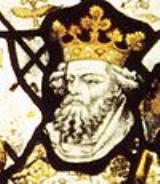
Edgar of England

Encyclopedia
Edgar the Peaceful, or Edgar I (c. 7 August 943 – 8 July 975), also called the Peaceable, was a king of England
(r. 959–75). Edgar was the younger son of Edmund I of England
.
, "The Peaceable", was not necessarily a comment on the deeds of his life, for he was a strong leader, shown by his seizure of the Northumbrian and Mercian kingdoms from his older brother, Eadwig, in 958. A conclave of nobles held Edgar to be king north of the Thames, and Edgar aspired to succeed to the English throne.
was at its height. Edgar consolidated the political unity achieved by his predecessors. By the end of Edgar's reign, England was sufficiently unified that it was unlikely to regress back to a state of division among rival kingships, as it had to an extent under Eadred's reign.
(eventually canonised
as St. Dunstan) from exile to have him made Bishop of Worcester
(and subsequently Bishop of London
and Archbishop of Canterbury
). Dunstan remained Edgar's advisor throughout his reign.
, near present-day Longparish
, Hampshire, an event commemorated in 1825 by the erection of Dead Man's Plack
. Edward Augustus Freeman
debunks
the Æthelwald story as a "tissue of romance" in his Historic essays, but his arguments were in turn refuted by the naturalist William Henry Hudson
in his 1920 book Dead Man's Plack and an Old Thorn.
, and Oswald
. (Historians continue to debate the extent and significance of this movement.)
, forms the basis of the present-day British coronation ceremony. The symbolic coronation was an important step; other kings of Britain came and gave their allegiance to Edgar shortly afterwards at Chester
. Six kings in Britain, including the King of Scots
and the King of Strathclyde
, pledged their faith that they would be the king's liege-men on sea and land. Later chroniclers made the kings into eight, all plying the oars of Edgar's state barge on the River Dee
. Such embellishments may not be factual, but the main outlines of the "submission at Chester" appear true. (See History of Chester
.)
. He left two sons, the elder named Edward
, who was probably his illegitimate son by Æthelflæd (not to be confused with the Lady of the Mercians), and Æthelred, the younger, the child of his wife Ælfthryth. He was succeeded by Edward. Edgar also had a daughter, possibly illegitimate, by Wulfryth, who later became abbess of Wilton. She was joined there by her daughter, Edith of Wilton
, who lived there as a nun until her death. Both women were later regarded as saints.
From Edgar’s death to the Norman Conquest, there was not a single succession to the throne that was not contested. Some see Edgar’s death as the beginning of the end of Anglo-Saxon England, followed as it was by three successful 11th-century conquests — two Danish and one Norman.
.
England
England is a country that is part of the United Kingdom. It shares land borders with Scotland to the north and Wales to the west; the Irish Sea is to the north west, the Celtic Sea to the south west, with the North Sea to the east and the English Channel to the south separating it from continental...
(r. 959–75). Edgar was the younger son of Edmund I of England
Edmund I of England
Edmund I , called the Elder, the Deed-doer, the Just, or the Magnificent, was King of England from 939 until his death. He was a son of Edward the Elder and half-brother of Athelstan. Athelstan died on 27 October 939, and Edmund succeeded him as king.-Military threats:Shortly after his...
.
Accession
His cognomenCognomen
The cognomen nōmen "name") was the third name of a citizen of Ancient Rome, under Roman naming conventions. The cognomen started as a nickname, but lost that purpose when it became hereditary. Hereditary cognomina were used to augment the second name in order to identify a particular branch within...
, "The Peaceable", was not necessarily a comment on the deeds of his life, for he was a strong leader, shown by his seizure of the Northumbrian and Mercian kingdoms from his older brother, Eadwig, in 958. A conclave of nobles held Edgar to be king north of the Thames, and Edgar aspired to succeed to the English throne.
Government
Though Edgar was not a particularly peaceable man, his reign was a peaceful one. The Kingdom of EnglandKingdom of England
The Kingdom of England was, from 927 to 1707, a sovereign state to the northwest of continental Europe. At its height, the Kingdom of England spanned the southern two-thirds of the island of Great Britain and several smaller outlying islands; what today comprises the legal jurisdiction of England...
was at its height. Edgar consolidated the political unity achieved by his predecessors. By the end of Edgar's reign, England was sufficiently unified that it was unlikely to regress back to a state of division among rival kingships, as it had to an extent under Eadred's reign.
Edgar and Dunstan
Upon Eadwig's death in October 959, Edgar immediately recalled DunstanDunstan
Dunstan was an Abbot of Glastonbury Abbey, a Bishop of Worcester, a Bishop of London, and an Archbishop of Canterbury, later canonised as a saint. His work restored monastic life in England and reformed the English Church...
(eventually canonised
Canonization
Canonization is the act by which a Christian church declares a deceased person to be a saint, upon which declaration the person is included in the canon, or list, of recognized saints. Originally, individuals were recognized as saints without any formal process...
as St. Dunstan) from exile to have him made Bishop of Worcester
Bishop of Worcester
The Bishop of Worcester is the Ordinary of the Church of England Diocese of Worcester in the Province of Canterbury, England. He is the head of the Diocese of Worcester in the Province of Canterbury...
(and subsequently Bishop of London
Bishop of London
The Bishop of London is the ordinary of the Church of England Diocese of London in the Province of Canterbury.The diocese covers 458 km² of 17 boroughs of Greater London north of the River Thames and a small part of the County of Surrey...
and Archbishop of Canterbury
Archbishop of Canterbury
The Archbishop of Canterbury is the senior bishop and principal leader of the Church of England, the symbolic head of the worldwide Anglican Communion, and the diocesan bishop of the Diocese of Canterbury. In his role as head of the Anglican Communion, the archbishop leads the third largest group...
). Dunstan remained Edgar's advisor throughout his reign.
Dead Man's Plack
In 963 he reputedly killed his rival in love, Earl ÆthelwaldÆthelwald, Ealdorman of East Anglia
Æthelwald was ealdorman of East Anglia. He is mentioned in Byrhtferth's life of Oswald of Worcester along with other members of his family....
, near present-day Longparish
Longparish
Longparish is a small village in Hampshire, England. It lies on the western bank of the River Test.A Victorian monument, Dead Man's Plack, stands nearby.-External links:* * *...
, Hampshire, an event commemorated in 1825 by the erection of Dead Man's Plack
Dead Man's Plack
Dead Man's Plack is a Grade-II listed 19th-century monument to Earl Athelwold of Wherwell, who was allegedly killed near the site where it stands by his rival in love, King Edgar, 'Edgar the Peaceful', in 963.-Description:...
. Edward Augustus Freeman
Edward Augustus Freeman
Edward Augustus Freeman was an English historian. His reputation as a historian rests largely on his History of the Norman Conquest , his longest completed book...
debunks
Debunker
A debunker is an individual who attempts to discredit and contradict claims as being false, exaggerated or pretentious. The term is closely associated with skeptical investigation of, or in some cases irrational resistance to, controversial topics such as U.F.O.s, claimed paranormal phenomena,...
the Æthelwald story as a "tissue of romance" in his Historic essays, but his arguments were in turn refuted by the naturalist William Henry Hudson
William Henry Hudson
William Henry Hudson was an author, naturalist, and ornithologist.- Life and work :Hudson was born in the Quilmes, a borough of the greater Buenos Aires, in Buenos Aires Province, Argentina, son of settlers of U.S. origin...
in his 1920 book Dead Man's Plack and an Old Thorn.
Benedictine Reform
The Monastic Reform Movement that restored the Benedictine Rule to England's undisciplined monastic communities peaked during the era of Dunstan, ÆthelwoldÆthelwold of Winchester
Æthelwold of Winchester , was Bishop of Winchester from 963 to 984 and one of the leaders of the tenth century monastic reform movement in Anglo-Saxon England....
, and Oswald
Oswald of Worcester
Oswald of Worcester was Archbishop of York from 972 to his death in 992. He was of Danish ancestry, but brought up by his uncle, Oda, who sent him to France to the abbey of Fleury to become a monk. After a number of years at Fleury, Oswald returned to England at the request of his uncle, who died...
. (Historians continue to debate the extent and significance of this movement.)
Coronation at Bath (AD 973)
Edgar was crowned at Bath and anointed with his wife Ælfthryth, setting a precedent for a coronation of a queen in England itself. Edgar's coronation did not happen until 973, in an imperial ceremony planned not as the initiation, but as the culmination of his reign (a move that must have taken a great deal of preliminary diplomacy). This service, devised by Dunstan himself and celebrated with a poem in the Anglo-Saxon ChronicleAnglo-Saxon Chronicle
The Anglo-Saxon Chronicle is a collection of annals in Old English chronicling the history of the Anglo-Saxons. The original manuscript of the Chronicle was created late in the 9th century, probably in Wessex, during the reign of Alfred the Great...
, forms the basis of the present-day British coronation ceremony. The symbolic coronation was an important step; other kings of Britain came and gave their allegiance to Edgar shortly afterwards at Chester
Chester
Chester is a city in Cheshire, England. Lying on the River Dee, close to the border with Wales, it is home to 77,040 inhabitants, and is the largest and most populous settlement of the wider unitary authority area of Cheshire West and Chester, which had a population of 328,100 according to the...
. Six kings in Britain, including the King of Scots
Kenneth II of Scotland
Cináed mac Maíl Coluim was King of Scots...
and the King of Strathclyde
Máel Coluim I of Strathclyde
Máel Coluim I of Strathclyde was ruler of the Kingdom of Strathclyde, the probable son of one of his predecessor King Dyfnwal III of Strathclyde; he was brother of Amdarch, who possibly held the throne in 971....
, pledged their faith that they would be the king's liege-men on sea and land. Later chroniclers made the kings into eight, all plying the oars of Edgar's state barge on the River Dee
River Dee, Wales
The River Dee is a long river in the United Kingdom. It travels through Wales and England and also forms part of the border between the two countries....
. Such embellishments may not be factual, but the main outlines of the "submission at Chester" appear true. (See History of Chester
History of Chester
The history of Chester extends back nearly two millennia, covering all periods of British history in between then and the present day. The city of Chester was founded as a fort, known as Deva, by the Romans in AD 79...
.)
Death (AD 975)
Edgar died on 8 July 975 at Winchester, and was buried at Glastonbury AbbeyGlastonbury Abbey
Glastonbury Abbey was a monastery in Glastonbury, Somerset, England. The ruins are now a grade I listed building, and a Scheduled Ancient Monument and are open as a visitor attraction....
. He left two sons, the elder named Edward
Edward the Martyr
Edward the Martyr was king of the English from 975 until he was murdered in 978. Edward was the eldest son of King Edgar, but not his father's acknowledged heir...
, who was probably his illegitimate son by Æthelflæd (not to be confused with the Lady of the Mercians), and Æthelred, the younger, the child of his wife Ælfthryth. He was succeeded by Edward. Edgar also had a daughter, possibly illegitimate, by Wulfryth, who later became abbess of Wilton. She was joined there by her daughter, Edith of Wilton
Edith of Wilton
Saint Edith of Wilton was an English nun, a daughter of the 10th century King Edgar of England, born at Kemsing, Kent, in 961...
, who lived there as a nun until her death. Both women were later regarded as saints.
From Edgar’s death to the Norman Conquest, there was not a single succession to the throne that was not contested. Some see Edgar’s death as the beginning of the end of Anglo-Saxon England, followed as it was by three successful 11th-century conquests — two Danish and one Norman.
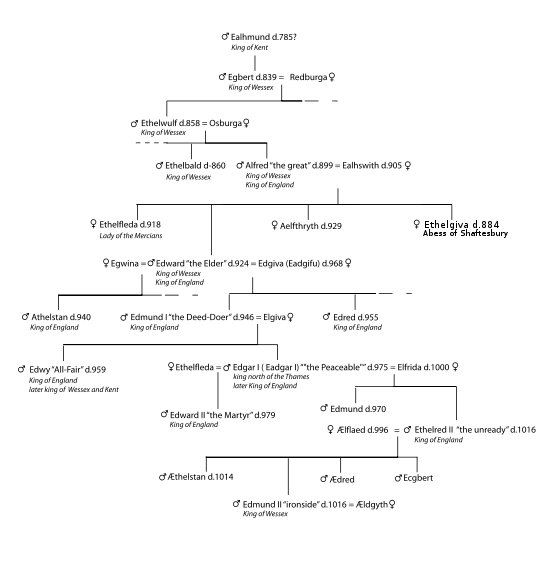
Genealogy
For a more complete genealogy including ancestors and descendants, see House of Wessex family treeHouse of Wessex family tree
The following chart is a family tree of the kings of the House of Wessex, a dynasty whose members were Kings of Wessex, and then, from Athelstan onwards, Kings of England....
.
Further reading
- Scragg, Donald (ed.). Edgar, King of the English, 959–975: New Interpretations. Publications of the Manchester Centre for Anglo-Saxon Studies. Manchester: Boydell Press, 2008. ISBN 1843833999. Contents (external link).
- Williams, Ann. "Edgar (943/4–975)." Oxford Dictionary of National Biography. Oxford University Press, 2004.
- Keynes, Simon. "England, c. 900–1016." In The New Cambridge Medieval History III. c.900–c.1024, ed. Timothy Reuter. Cambridge: Cambridge University Press, 1999. 456-84.
External links
- Medieval Sourcebook: Anglo-Saxon Dooms: laws of King Edgar, a fragment
- Edgar of England At Find A Grave
- Oxford Dictionary of National Biography entry