
All Topics  
John Knox


John Knox


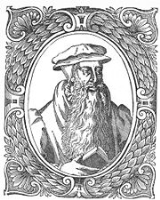
John Knox (c. 1510 – 24 November 1572) was a ScottishScotland

Scotland is a nation in northwest Europe and one of the constituent countries of the United Kingdom....
 clergyman and leader of the Protestant ReformationProtestant Reformation

The Protestant Reformation, also referred to as the Protestant Revolution, was a movement in the 16th century to refor...
 who is considered the founder of the PresbyterianPresbyterianism

Presbyterianism is a form of Protestant Christianity, primarily in the Reformed branch of Christendom, as well as a particul...
 denomination. He was educated at the University of St AndrewsUniversity of St Andrews

The University of St Andrews is the oldest university in Scotland and third oldest in the English-speaking world, having bee...
 and worked as a notary-priest. Influenced by early church reformers such as George WishartGeorge Wishart

George Wishart was a Scottish religious reformer and Protestant martyr....
, he joined the movement to reform the Scottish churchRoman Catholic Church in Scotland

The Roman Catholic Church in Scotland describes the organisation of the worldwide Roman Catholic Church in the geographic ar...
. He was caught up in the ecclesiastical and political events that involved the murder of Cardinal BeatonDavid Beaton

Cardinal David Beaton was Archbishop of St Andrews and the last Scottish Cardinal prior to the Reformation....
 in 1546 and the intervention of the regentRegent

A regent, from the Latin regens "who reigns" is anyone who acts as head of state, especially if not the monarch....
 of Scotland, Mary of GuiseMary of Guise

Marie de Guise was the Queen Consort of James V of Scotland and the mother of Mary, Queen of Scots....
. He was taken prisoner by FrenchFrance

France, officially the French Republic, is a country whose metropolitan territory is located in Western Europe and whi...
 forces the following year and exiled to EnglandEngland

England is the largest and most populous constituent country of the United Kingdom....
 on his release in 1549.

While in exile, Knox was licensed to work in the Church of EnglandChurch of England

The Church of England is the officially established Christian church in England, and acts as the 'mother' and senior branch ...
, where he quickly rose in the ranks to serve the King of England, Edward VIEdward VI of England

Edward VI became King of England and Ireland on 28 January 1547, at just nine years of age....
, as a royal chaplain.


Discussion
Ask a question about 'John Knox'
Start a new discussion about 'John Knox'
Answer questions from other users
Full Discussion Forum


Recent Posts


Timeline

1513   Born

1572   Died


Encyclopedia


John Knox (c. 1510 – 24 November 1572) was a ScottishScotland

Scotland is a nation in northwest Europe and one of the constituent countries of the United Kingdom....
 clergyman and leader of the Protestant ReformationProtestant Reformation

The Protestant Reformation, also referred to as the Protestant Revolution, was a movement in the 16th century to refor...
 who is considered the founder of the PresbyterianPresbyterianism

Presbyterianism is a form of Protestant Christianity, primarily in the Reformed branch of Christendom, as well as a particul...
 denomination. He was educated at the University of St AndrewsUniversity of St Andrews

The University of St Andrews is the oldest university in Scotland and third oldest in the English-speaking world, having bee...
 and worked as a notary-priest. Influenced by early church reformers such as George WishartGeorge Wishart

George Wishart was a Scottish religious reformer and Protestant martyr....
, he joined the movement to reform the Scottish churchRoman Catholic Church in Scotland

The Roman Catholic Church in Scotland describes the organisation of the worldwide Roman Catholic Church in the geographic ar...
. He was caught up in the ecclesiastical and political events that involved the murder of Cardinal BeatonDavid Beaton

Cardinal David Beaton was Archbishop of St Andrews and the last Scottish Cardinal prior to the Reformation....
 in 1546 and the intervention of the regentRegent

A regent, from the Latin regens "who reigns" is anyone who acts as head of state, especially if not the monarch....
 of Scotland, Mary of GuiseMary of Guise

Marie de Guise was the Queen Consort of James V of Scotland and the mother of Mary, Queen of Scots....
. He was taken prisoner by FrenchFrance

France, officially the French Republic, is a country whose metropolitan territory is located in Western Europe and whi...
 forces the following year and exiled to EnglandEngland

England is the largest and most populous constituent country of the United Kingdom....
 on his release in 1549.

While in exile, Knox was licensed to work in the Church of EnglandChurch of England

The Church of England is the officially established Christian church in England, and acts as the 'mother' and senior branch ...
, where he quickly rose in the ranks to serve the King of England, Edward VIEdward VI of England

Edward VI became King of England and Ireland on 28 January 1547, at just nine years of age....
, as a royal chaplain. In this position, he exerted a reforming influence on the text of the Book of Common PrayerBook of Common Prayer

The Book of Common Prayer is the foundational prayer book of the Church of England which was one of the instruments of ...
. In England he met and married his first wife, Marjorie. When Mary TudorMary I of England Overview

Mary I , also known as Mary Tudor, was Queen of England and Queen of Ireland from 6 July1553 or 19 July 1553 until h...
 ascended the throne and re-established Roman Catholicism, Knox was forced to resign his position and leave the country.

Knox first moved to GenevaGeneva

Geneva is the second most populous city in Switzerland , and is the most populous city of Romandy ....
 and then to FrankfurtFree City of Frankfurt

For almost five centuries, the German city of Frankfurt am Main was a city-state within two major Germanic states:...
. In Geneva, he met John CalvinJohn Calvin

John Calvin was a French Christian theologian during the Protestant Reformation and was the originator of the system of Chr...
, from whom he gained experience and knowledge of Reformed theology and Presbyterian polityPresbyterian polity

Presbyterian polity is a method of church governance typified by the rule of Assemblies of presbyters, or elders....
. He created a new order of service, which was eventually adopted by the reformed church in Scotland. He left Geneva to head the English refugeeMarian exiles

During the reign of Mary I, John Strype says more than 800 English protestants fled to the continent and joined with reformed chur...
 church in Frankfurt but he was forced to leave over differences concerning the liturgyFacts About Christian liturgy

Partial list of Christian liturgical rites...
, thus ending his association with the Church of England.

On his return to Scotland, he led the Protestant Reformation in ScotlandScottish Reformation

The Reformation in Scotland was arguably the most important event in Scottish history....
, in partnership with the Scottish Protestant nobility. The movement may be seen as a revolution, since it led to the ousting of the queen regent, Mary of GuiseMary of Guise

Marie de Guise was the Queen Consort of James V of Scotland and the mother of Mary, Queen of Scots....
, who governed the country in the name of her young daughter, Mary, Queen of ScotsMary I of Scotland

Mary I of Scotland was the Queen of Scots from December 14 1542 to July 24 1567....
. Knox helped write the new confession of faithScots Confession

The Scots Confession was written in 1560 by six leaders of the Protestant Reformation in Scotland, coincidentally all named ...
 and the ecclesiastical order for the newly created reformed church, the KirkChurch of Scotland

The Church of Scotland is the national church of Scotland....
. He continued to serve as the religious leader of the Protestants throughout Mary's reign. In several interviews with the queen, Knox admonished her for supporting Catholic practices. Eventually, when she was imprisoned and James VIJames I of England

James VI of Scotland/James I of England and Ireland was King of England, King of Scots, and King of Ireland and was the firs...
 enthroned in her stead, he openly ridiculed her in sermons. He continued to preach until his final days.

Early life, 1510–1546

John Knox was born sometime between 1505 and 1515 in or near HaddingtonHaddington, East Lothian

See also: HaddingtonHaddington is a burgh in East Lothian, Scotland, approximately 20 miles east of Edinburgh....
, the county townCounty town

A county town is the 'capital' of a county in Ireland or the United Kingdom....
 of East LothianEast Lothian

East Lothian is one of 32 unitary council areas in Scotland, and a lieutenancy Area....
. His father, William Knox, was a farmer. All that is known of his mother is that her maiden name was Sinclair and that she died when John Knox was a child.

Knox was probably educated at the grammar school in Haddington. In his time, the priesthood was the only path for those whose inclinations were academic rather than mercantile or agricultural. He proceeded to further studies at the University of St Andrews or possibly at the University of Glasgow. He studied under John MajorJohn Mair

John Mair or John Major was a Scottish philosopher. ...
, one of the greatest scholars of the time.

Knox first appears in public records as a priest and a notaryNotary public

A notary public is an officer who can administer oaths and statutory declarations, witness and authenticate documents and pe...
 in 1540. He was still serving in these capacities as late as 1543 when, in a notarial deed dated 27 March, he wrote in his own handwriting, "John Knox, minister of the sacred altar, of the Diocese of St Andrews, notary by Apostolical authority". Rather than taking up parochial duties in a parish, he became tutorTutor

English and Irish secondary schoolsIn English and Irish Secondary Schools the Form Tutor is similar to an American Home Roo...
 to two sons of Hugh Douglas of LongniddryLongniddry

Longniddry is a village in East Lothian, Scotland, United Kingdom....
. He also taught the son of John Cockburn of OrmistonOrmiston

Ormiston is a village in East Lothian, Scotland....
. Both of these lairdLaird Overview

A Laird is a hereditary title for the owner of a landed estate in Scotland....
s had embraced the new religious ideas of the ReformationReformation

Reformation may refer to:Movements:...
, which were sweeping EuropeEurope

Europe is one of the seven traditional continents of the Earth....
.

Embracing the Protestant Reformation, 1546–1547

Knox did not record when or how he was converted to the Protestant faith, but perhaps the key formative influence on Knox was George WishartGeorge Wishart

George Wishart was a Scottish religious reformer and Protestant martyr....
. Wishart was a reformer who had fled Scotland in 1538 to escape punishment for heresy. He first moved to England, where in BristolBristol

Bristol is a city, unitary authority and ceremonial county in South West England, 115 miles west of London and located at ...
 he preached against the venerationMarian devotions

The following Marian devotions are intercessions to God through the mediation of Mary, the mother of Jesus, or acts of devot...
 of the Virgin Mary. He was forced to make a public recantation and was burned in effigy at the Church of St NicholasSt Nicholas, Bristol

St Nicholas is a church in St Nicholas Street, Bristol, England....
 as a sign of his abjuration. He then took refuge in Germany and Switzerland. While on the ContinentContinental Europe

Continental Europe, also referred to as mainland Europe or simply the Continent, is the continent of Europe, exp...
, he translated the First Helvetic Confession into English. He returned to Scotland in 1544, but the timing of his return was unfortunate. In December 1543, the Parliament of ScotlandParliament of Scotland

The parliament of Scotland, officially the Estates of Parliament, was the legislature of the independent Kingdom of Sc...
 had passed an actAct of Parliament

An Act of Parliament or Act is law enacted by the parliament....
 for the summary dealing of heretics. The act was supported by James Hamilton, Duke of Châtellerault, the appointed regent for the infant Mary, Queen of Scots, and enforced by CardinalCardinal (Catholicism)

A cardinal is a senior ecclesiastical official in the Roman Catholic Church, a member of the College of Cardinals, ranking b...
 David BeatonDavid Beaton

Cardinal David Beaton was Archbishop of St Andrews and the last Scottish Cardinal prior to the Reformation....
. Wishart travelled throughout Scotland preaching in favour of the reformation and when he arrived in East Lothian, Knox became one of his closest associates. Knox acted as his bodyguard, bearing a two-handed sword in order to defend him. In December 1545, Wishart was seized on Beaton's orders by Patrick Hepburn, 3rd Earl of BothwellPatrick Hepburn, 3rd Earl of Bothwell

Patrick Hepburn, 3rd Earl of Bothwell was a Scottish nobleman....
, and taken to the Castle of St AndrewsSt Andrews Castle

St Andrews Castle is a picturesque ruin located in the coastal Royal Burgh of St Andrews in Fife, Scotland....
. Knox was present on the night of Wishart's arrest and was prepared to follow him into captivity, but Wishart persuaded him against this course saying, "Nay, return to your bairns [pupils] and God bless you. One is sufficient for one sacrifice." Wishart was subsequently prosecuted by Beaton's Public Accuser of Heretics, John LauderJohn Lauder

John Lauder was Scotland's Public Accuser of Heretics....
. On 1 March 1546, he was burnt at the stake in the presence of Cardinal Beaton.

It is not known exactly what happened to Knox immediately after Wishart's arrest. He may had gone into hiding or taken refuge in Longniddry. However, several months later he was still in charge of the pupils, the sons of Douglas and Cockburn, who wearied of moving from place to place while being pursued. He toyed with the idea of fleeing to Germany and taking his pupils with him. While Knox remained a fugitive, Cardinal Beaton was murdered on 29 May 1546, within his residence, the Castle of St Andrews, by a gang of five persons in revenge for Wishart's execution. The assassins seized the castle and eventually their families and friends took refuge with them, about a hundred and fifty men in all. Among their friends was Henry BalnavesHenry Balnaves

Henry Balnaves was a Scottish politician and religious reformer....
, a secretary of state in the government, who negotiated with England for the financial support of the rebels. The fathers of Knox’s pupils also took refuge in the castle and they sent word to Knox that he bring them to the relative safety of the castle to continue their instruction in reformed doctrine. Knox arrived at the castle on 10 April 1547.

Knox's powers as a preacher came to the attention of the chaplain of the garrison, John Rough. While Rough was preaching in the parish churchSt Andrews

Named after Saint Andrew the Apostle, the Royal Burgh of St Andrews is a town on the east coast of Fife, Scotland, and the h...
 on the Protestant principle of the popular election of a pastor, he proposed Knox to the congregation for that office. Knox did not relish the idea. According to his own account, he burst into tears and fled to his room. Within a week, however, he was giving his first sermon to a congregation that included his old teacher, John MajorJohn Mair Overview

John Mair or John Major was a Scottish philosopher. ...
. He expounded on the seventh chapter of the Book of DanielBook of Daniel

The Book of Daniel, written in Hebrew and Aramaic, is a book in both the Hebrew Bible and the Christian Old Testament....
, comparing the popePope

The Pope is the Bishop of Rome, and, as Successor of Saint Peter, is the head of the Catholic Church....
 with the Whore of BabylonWhore of Babylon

The Whore of Babylon or Babylon the Great is one of several Christian and Rastafarian figures of supreme evil, who is ...
. A few days later, a debate was staged that allowed him to lay down a thesis that he would promote throughout the rest of his life: that all ceremonies without express warrant from the Bible are idolatry. This included the celebration of the MassMass (liturgy)

Mass is the term used to describe celebration of the Eucharist in the Western liturgical rites of the Catholic Church, in th...
.

Confinement in the French galleys, 1547–1549

Knox's chaplaincy of the castle garrison was not to last long. The murder of Cardinal Beaton had provoked the regent, James Hamilton, to request French assistance to bring the castle under his control. On 29 June 1547, twenty-one French galleyGalley

The term galley can refer to any ship propelled primarily by man-power, using oars....
s approached St Andrews under the command of Leone StrozziLeone Strozzi

Leone Strozzi was an Italian condottiero belonging to the famous Strozzi family of Florence. ...
, priorPrior Summary

Prior is a title, derived from the Latin adjective for 'earlier, first', with several notable uses....
 of CapuaCapua

Capua is a city in the province of Caserta, situated 25 km north of Neapolis, on the northeastern edge of the Campanian...
. The French besieged the castle and forced the surrender of the garrison on 31 July. The Protestant nobles and others, including Knox, were taken prisoner and forced to row in the French galleys. The galley-slaves were chained to benches and rowed throughout the day without a change of posture while an officer watched over them with a whip in hand. They sailed to France and navigated up the SeineSeine Summary

The Seine is a major river of north-western...
 to RouenRouen

Rouen is the historical capital city of Normandy, in northwestern France on the River Seine, and presently the capital of t...
. The nobles, some of whom would have an impact later in Knox's life such as William Kirkcaldy and Henry Balnaves, were sent to various castle-prisons in France. Knox and the other galley-slaves continued to NantesNantes

Nantes is a city in western France, near the Atlantic coast, with 711,120 inhabitants in the metropolitan area at the 1999 ...
 and stayed on the LoireLoire River

The Loire River, the longest river in France with a length of just over 1000 km, drains an area of 117,000 km, more than a f...
 throughout the winter. They were threatened with torture if they did not give proper signs of reverence when Mass was performed on the ship. Knox recounted an incident in which one Scot was required to show devotion to a picture of the Virgin Mary. It is probable that Knox, himself, was the one involved. The prisoner was told to give it a kiss of venerationVeneration

Veneration is a religious symbolic act giving honor to someone by honoring an image of that person, particularly applied to ...
. He refused and when the picture was pushed up to his face, the prisoner seized the picture and threw it into the sea, saying, "Let our lady now save herself; for she is light enough; let her learn to swim." After that, according to Knox, the Scottish prisoners were no longer forced to perform such devotions.

In summer 1548, the galleys returned to Scotland to scout for English ships. Knox's health was now at its lowest point due to the severity of his confinement. He was ill with a fever and others on the ship were afraid for his life. Even in this state, Knox recalled, his mind remained sharp and he comforted his fellow prisoners with hopes of release. While the ships were lying offshore between St Andrews and DundeeDundee

Dundee is the fourth largest city in Scotland with a population of 143,090 and is located near the East coast on the North ...
, the spires of the parish church where he preached appeared in view. James Balfour, a fellow prisoner, asked Knox whether he recognised the landmark. He replied,

Yes, I know it well; for I see the steeple of that place where God first in public opened my mouth to glory; and I am fully persuaded, how weak soever I now appear, that I shall not depart this life, till that my tongue shall glorify his godly name in the same place.


In February 1549, after spending a total of nineteen months in the galley-prison, Knox was released. It is uncertain how he obtained his liberty.

Exile in England, 1549–1554


On his release, Knox took refuge in England. The Reformation in EnglandEnglish Reformation

The English Reformation was the process whereby the external authority of the Roman Catholic Church in England was abolished...
 was a less radical movement than its Continental counterparts, but there was a definite breach with Rome. The Archbishop of CanterburyArchbishop of Canterbury

The Archbishop of Canterbury is the head of the Church of England and of the worldwide Anglican Communion....
, Thomas CranmerThomas Cranmer

Thomas Cranmer was the Archbishop of Canterbury during the reigns of the English kings Henry VIII and Edward VI....
, and the regent of King Edward VI, Edward Seymour, 1st Duke of SomersetEdward Seymour, 1st Duke of Somerset

Edward Seymour, 1st Duke of Somerset was Lord Protector of England in the period between the death of King Henry VIII in 154...
, were decidedly Protestant-minded. However, much work needed to be done to bring reformed ideas to the clergy and to the people. On 7 April 1549, Knox was licensed to work in the Church of EnglandChurch of England

The Church of England is the officially established Christian church in England, and acts as the 'mother' and senior branch ...
. His first commission was in BerwickBerwick-upon-Tweed

Berwick-upon-Tweed , situated in the county of Northumberland, is the northernmost town in England, on the east coast at the...
. He was obliged to use the recently released Book of Common PrayerBook of Common Prayer

The Book of Common Prayer is the foundational prayer book of the Church of England which was one of the instruments of ...
, which was mainly a translation of the Latin Mass into English and was largely left intact and unreformed. He therefore modified its use along Protestant lines. In the pulpit he preached Protestant doctrines with great effect as his congregation grew.

In England, Knox met his wife, Marjorie Bowes. Her father, Richard, was the younger brother of Sir Robert Bowes, a descendant of an old DurhamCounty Durham

County Durham is a county in north-east England....
 family, the Bowes of Streatlam and her mother, Elizabeth, was an heiress of a YorkshireYorkshire

Yorkshire is the largest historic county of England and Great Britain, covering just under 6,000 sq....
 family, the Askes of RichmondshireRichmondshire

Richmondshire is a local government district of North Yorkshire in England....
. Elizabeth Bowes presumably met Knox when he was employed in Berwick. Several letters reveal a close friendship between them. It is not recorded when Knox married Marjorie Bowes. Knox attempted to obtain the consent of the Bowes family, but Robert and Richard were opposed to the marriage.

Towards the end of 1550, Knox was appointed a preacher of St Nicholas' ChurchNewcastle Cathedral

Newcastle Cathedral is a Church of England cathedral in Newcastle-upon-Tyne, Tyne and Wear, North East England....
 in NewcastleNewcastle upon Tyne

!colspan=2 align=center bgcolor="#ff9999"|City of Newcastle upon Tyne...
. The following year he was appointed one of the six royal chaplainsChapel Royal

The Chapel Royal originally referred not to a building but an establishment in the Royal Household....
 serving the king. On 16 October 1551, John Dudley, 1st Duke of NorthumberlandJohn Dudley, 1st Duke of Northumberland

John Dudley was a Tudor nobleman and politician, executed for high treason by Queen Mary I of England....
 overthrew Edward Seymour to become the new regent of the king. Knox condemned the coup d'état in a sermon on All Saints Day. When Dudley visited Newcastle and listened to his preaching in June 1552, he had mixed feelings about the fire-brand preacher, but he saw Knox as a potential asset. Knox was asked to come to London to preach before the Court. In his first sermon, he advocated a change for the second edition of the Book of Common Prayer. The liturgy required worshippers to kneel during communionEucharist

The Eucharist or Communion or The Lord's Supper, is the rite that Christians perform in fulfillment of Jesus' in...
. Knox and the other chaplains considered this to be idolatry. It triggered a debate where Thomas Cranmer was called upon to defend the practice. The end result was a compromise in which the famous Black RubricBlack Rubric

Black Rubric: The popular name for the declaration enjoining kneeling at the end of the order for the administration of the ...
, which declared that no adoration is intended while kneeling, was included in the second edition.

Soon afterwards, Dudley, who saw Knox as a useful political tool, offered him the bishopricDiocese

In some Christian churches, the diocese is an administrative territorial unit administrated by a bishop, hence also referred...
 of Rochester. Knox refused, and he returned to Newcastle. Invited back to London several times in 1553, he gave his last sermon before King Edward VI on 12 April, at WestminsterWestminster Abbey

The Collegiate Church of St Peter, Westminster, which is almost always referred to as Westminster Abbey, is a mainly ...
. He was also in London on 6 July when the young king died. Edward's successor, Mary TudorMary I of England

Mary I , also known as Mary Tudor, was Queen of England and Queen of Ireland from 6 July1553 or 19 July 1553 until h...
, reestablished Roman Catholicism in England and restored the MassMass (liturgy)

Mass is the term used to describe celebration of the Eucharist in the Western liturgical rites of the Catholic Church, in th...
 in all the churches. Protestants such as Cranmer, Nicholas RidleyNicholas Ridley (martyr)

Nicholas Ridley was an English clergyman....
, and Hugh LatimerHugh Latimer Summary

Hugh Latimer was a famous Protestant martyr....
 were imprisoned in the TowerTower of London

The Tower of London is a dominating landmark in central Londonin the London Borough of Tower Hamlets on the eastern border o...
. With the country no longer safe for Protestant preachers, Knox left for the continent in January 1554 on the advice of friends. On the eve of his flight, he wrote:

Sometime I have thought that impossible it had been so to have removed my affection from the realm of Scotland that any realm or nation could have been equally dear to me. But God I take to record in my conscience that the troubles in the realm of England are double more dolorous unto my heart than ever were the troubles in Scotland.

From Geneva to Frankfurt and Scotland, 1554–1556


Knox disembarked in Dieppe, France, and continued on to GenevaGeneva

Geneva is the second most populous city in Switzerland , and is the most populous city of Romandy ....
, where John CalvinJohn Calvin Overview

John Calvin was a French Christian theologian during the Protestant Reformation and was the originator of the system of Chr...
 had established his authority. When Knox arrived, however, Calvin was in a difficult position. He had recently authorised the execution of the scholar Michael ServetusMichael Servetus

Michael Servetus, was a theologian, physician and humanist....
 for heresy, a ruling which had discredited Calvin among his peers, and all the cities of Switzerland were against him. Knox asked Calvin four difficult political questions: whether a minor could rule by divine right, whether a female could rule and transfer sovereignty to her husband, whether people should obey ungodly or idolatrous rulers, and what party godly persons should follow if they resisted an idolatrous ruler. Calvin gave cautious replies and referred him to the Swiss reformer Heinrich BullingerHeinrich Bullinger

Heinrich Bullinger was a Swiss reformer, the successor of Huldrych Zwingli as head of the Zurich church and pastor at Grossm...
 in ZürichZürich

Zrich is the largest city in Switzerland and capital of the canton of Zrich....
. Bullinger's responses were equally cautious; but Knox had already made up his mind. On 20 July 1554, he published a pamphlet attacking Mary Tudor and the bishops who had brought her to the throne. He also attacked the Holy Roman EmperorHoly Roman Emperor

The Holy Roman Emperor was ruler of the Holy Roman Empire, a predecessor of numerous countries mainly in central Europe....
, Charles VCharles V, Holy Roman Emperor

Charles V was ruler of the Burgundian territories, King of Castile, King of Aragon, King of Naples and Sicily, Archduke of A...
, calling him "no less enemy to Christ than was Nero".

In a letter dated 24 September 1554, Knox received an invitation from a congregation of English exilesMarian exiles Summary

During the reign of Mary I, John Strype says more than 800 English protestants fled to the continent and joined with reformed chur...
 in FrankfurtFree City of Frankfurt

For almost five centuries, the German city of Frankfurt am Main was a city-state within two major Germanic states:...
 to become one of their ministers. He accepted the call with Calvin's blessing. But no sooner had he arrived than he found himself in a conflict. The first set of refugees to arrive in Frankfurt had subscribed to a reformed liturgy and used a modified version of the Book of Common Prayer. More recently arrived refugees, however, including Edmund GrindalEdmund Grindal

Edmund Grindal was an English church leader who successively held the posts of Bishop of London, Archbishop of York and Arch...
, the future Archbishop of Canterbury, favoured a stricter application of the book. When Knox and a supporting colleague, William WhittinghamWilliam Whittingham

William Whittingham was an English Biblical scholar and religious reformer....
, wrote to Calvin for advice, they were told to avoid contention. Knox therefore agreed on a temporary order of service based on a compromise between the two sides. This delicate balance was disturbed when a new batch of refugees arrived that included Richard CoxRichard Cox (bishop)

Richard Cox, dean of Westminster and bishop of Ely, was born of obscure parentage at Whaddon, Buckinghamshire, in 1499 or 15...
, one of the principal authors of the Book of Common Prayer. Cox brought Knox's pamphlet attacking the emperor to the attention of the Frankfurt authorities, who advised that Knox leave. His departure from Frankfurt on 26 March 1555 marked his final breach with the Church of England.

After his return to Geneva, Knox was chosen to be the minister at a new place of worship petitioned from Calvin. In the meantime, Elizabeth Bowes wrote to Knox, asking him to return to Marjorie in Scotland, which he did at the end of August. Despite initial doubts about the state of the Reformation in Scotland, Knox found the country significantly changed since he was carried off in the galley in 1547. When he toured various parts of Scotland preaching the reformed doctrines and liturgy, he was welcomed by many of the nobility including two future regents of Scotland, James Stewart, 1st Earl of MorayJames Stewart, 1st Earl of Moray

James Stewart, 1st Earl of Moray was Regent of Scotland from 1567 till his assassination in 1570....
, and John Erskine, 17th Earl of MarJohn Erskine, 17th Earl of Mar

John Erskine, 7th Earl of Mar, regent of Scotland, was a son of John, 5th Lord Erskine, who was guardian of King James V, an...
.

Though the queen regent, Mary of GuiseMary of Guise

Marie de Guise was the Queen Consort of James V of Scotland and the mother of Mary, Queen of Scots....
, made no move to act against Knox, his activities caused concern among the church authorities. The bishops of Scotland viewed him as a threat to their authority and summoned him to appear in EdinburghEdinburgh

Edinburgh is the capital of Scotland and its second-largest city....
 on 15 May 1556. He was accompanied to the trial by so many influential persons that the bishops decided to call the hearing off. Knox was now free to preach openly in Edinburgh. William Keith, the Earl MarischalEarl Marischal

In Scotland, the office of Great Marischal of Scotland, which was granted to the Keith family as Knight Marischal and late...
, was impressed and urged Knox to write to the queen regent. Knox's unusually respectful letter urged her to support the Reformation and overthrow the church hierarchy. Mary took the letter as a joke and ignored it.

Return to Geneva, 1556–1559


Shortly after Knox sent the letter to the queen regent, he suddenly announced that he felt his duty was to return to Geneva. In the previous year on 1 November 1555, the congregation in Geneva had elected Knox as their minister and he decided to take up the post. He wrote a final letter of advice to his supporters and left Scotland with his wife and mother-in-law. He arrived in Geneva on 13 September 1556.

For the next two years, he lived a happy life in Geneva. He recommended Geneva to his friends in England as the best place of asylum for Protestants. In one letter he wrote:

In my heart, I could have wished, yea, and cannot cease to wish, that it might please God to guide and conduct yourself to this place, where I neither fear nor eshame to say, is the most perfect school of Christ that ever was in the earth since the days of the apostles. In other places I confess Christ to be truly preached; but manners and religion to be so sincerely reformed, I have not yet seen in any other place beside.


Knox led a busy life in Geneva. He preached three sermons a week, each lasting well over two hours. The services used a liturgy that was derived by Knox and other ministers from Calvin's Formes des Prières Ecclésiastiques. The church in which he preached, the Église de Notre Dame la Neuve—now known as the Auditoire de Calvin—had been granted by the municipal authorities, at Calvin's request, for the use of the English and Italian congregations. Knox's two sons, Nathaniel and Eleazar, were born in Geneva, with Whittingham and Myles CoverdaleMyles Coverdale

Myles Coverdale was a 16th-century Bible translator who produced the first complete printed translation of the Bible into ...
 their respective godfathers.

In the summer of 1558, Knox published his best known pamphlet, The First Blast of the Trumpet Against the Monstrous Regiment of WomenThe First Blast of the Trumpet Against the Monstrous Regiment of Women

Monstrous regiment, or monstrous regiment of women are phrases which have become notorious; they are borrowed from the...
. In calling the "regiment" or rule of women "monstrous", he meant that it was "unnatural". The pamphlet has been called a classic of misogynyMisogyny

Misogyny is hatred or fear of, or strong prejudice against women....
. Knox states that his purpose was to demonstrate "how abominable before God is the Empire or Rule of a wicked woman, yea, of a traiteresse and bastard". The women rulers that Knox had in mind were Mary Tudor, the queen of England, and Mary Stuart, the queen of Scotland. Knox's prejudices against women were not unusual in his day; however, even he was aware that the pamphlet was dangerously seditious. He therefore published it anonymously and did not tell Calvin, who denied knowledge of it until a year after its publication, that he had written it. In England, the pamphlet was officially condemned by royal proclamation. The impact of the document was complicated later that year, when Elizabeth TudorElizabeth I of England

Elizabeth I was Queen of England, Queen of France , and Queen of Ireland from 17 November 1558 until her death....
 became queen of England. Although Knox had not targeted Elizabeth, he had deeply offended her, and she never forgave him.

With a Protestant on the throne, the English refugees in Geneva prepared to return home. Knox himself decided to return to Scotland. Before his departure, various honours were conferred on him, including the freedom of the city of Geneva. Knox left in January 1559, but he did not arrive in Scotland until 2 May 1559, owing to Elizabeth's refusal to issue him a passport through England.

Revolution and end of the regency, 1559–1560


Two days after Knox arrived in Edinburgh, he proceeded to Dundee where a large number of Protestant sympathisers had gathered. Knox was declared an outlaw, and the queen regent summoned the Protestants to StirlingStirling

Stirling is a city and ancient burgh, in the Stirling council area of Scotland....
. Fearing the possibility of a summary trial and execution, the Protestants proceeded instead to PerthPerth, Scotland

The Royal Burgh of Perth is a large burgh in central Scotland....
, a walled town that could be defended in case of a siege. At the church of St John the Baptist, Knox preached a fiery sermon and a small incident precipitated into a riot. A mob poured into the church and it was soon gutted. The mob then attacked two friaries in the town, looting their gold and silver and smashing images. Mary of Guise gathered those nobles loyal to her and a small French army. She dispatched Archibald Campbell, 5th Earl of ArgyllArchibald Campbell, 5th Earl of Argyll

Archibald Campbell, 5th Earl of Argyll was a leading figure in the politics of Scotland during the reign of Mary, Queen of S...
, and James Stewart, to offer terms and avert a war. She promised not to send any French troops into Perth if the Protestants evacuated the town. The Protestants agreed, but when the queen regent entered Perth, she garrisoned it with Scottish soldiers on the French pay roll. This was seen as treacherous by Campbell and Stewart, who switched sides and joined Knox, who now based himself in St Andrews. Knox’s return to St Andrews fulfilled the prophecy he made in the galleys that he would one day preach again in its church. When he did give a sermon, the effect was the same as in Perth. The people engaged in vandalism and looting.


With Protestant reinforcements arriving from neighbouring counties, the queen regent retreated to DunbarDunbar Overview

The Royal Burgh of Dunbar is a town in East Lothian on the southeast coast of Scotland, approximately 30 miles east of Edinb...
. By now, the mob fury had spilled over central Scotland. Her own troops were on the verge of mutiny. On 30 June, the Protestants occupied Edinburgh, though they were only able to hold it for a month. But even before their arrival, the mob had already sacked the churches and the friaries. On 1 July, Knox preached from the pulpit of St Giles', the most influential in the capital.

Knox knew that the queen regent would ask for help from France. So he negotiated by letter with William CecilWilliam Cecil, 1st Baron Burghley

William Cecil, 1st Baron Burghley , was an English politician, the chief advisor of Queen Elizabeth I for most of her reign ...
, Elizabeth's chief adviser, for English support. Knox sailed to Holy IslandLindisfarne

Lindisfarne , also called Holy Island , is a tidal island off the north-east coast of England, which is connected to t...
, off the northeast coast of England, for secret negotiations, but he was forced to return to Scotland when he was recognised. When additional French troops arrived in LeithLeith

Formerly a municipal burgh, Leith is a town at the mouth of the Water of Leith and is the port of Edinburgh, Scotland....
, Edinburgh's seaport, the Protestants responded by retaking Edinburgh. This time, on 24 October 1559, the Scottish nobility formally deposed Mary of Guise from the regency. Her secretary, William Maitland of LethingtonWilliam Maitland of Lethington

William Maitland was a Scottish politician and reformer....
, defected to the Protestant side, bringing his administrative skills. From then on, Maitland took over the political tasks, freeing Knox for the role of religious leader. For the final stage of the revolution, Maitland appealed to Scottish patriotism to fight French domination. Support from England finally arrived and by the end of March, a significant English army joined the Scottish Protestant forces. The sudden death of Mary of Guise in Edinburgh CastleEdinburgh Castle

Edinburgh Castle is an ancient stronghold which from its lofty position dominates views of the city of Edinburgh, and is Sco...
 on 10 June 1560 paved the way for an end to hostilities, the signing of the Treaty of EdinburghTreaty of Edinburgh

The Treaty of Edinburgh was drawn up in 1560 by the Parliament of Scotland in an attempt to formally end the Auld Alliance....
, and the withdrawal of French and English troops from Scotland. On 19 July, Knox held a National Thanksgiving Service at St Giles'.

Reformation in Scotland, 1560–1561

On 1 August, the Scottish ParliamentScottish Reformation Parliament Summary

The Scottish Reformation Parliament is the name given to the Scottish Parliament commencing in 1560 that passed the major pi...
 met to settle religious issues. Knox and five other ministers were called upon to draw up a new confession of faithFacts About Confession of Faith

A Confession of Faith is a statement of doctrine very similar to a creed, but usually longer and polemical, as well as dida...
. Within four days, the Scots ConfessionScots Confession

The Scots Confession was written in 1560 by six leaders of the Protestant Reformation in Scotland, coincidentally all named ...
 was presented to Parliament, voted upon, and approved. A week later, the Parliament passed three acts in one day: the first abolished the jurisdiction of the pope in Scotland, the second condemned all doctrine and practice contrary to the reformed faith, and the third forbade the celebration of Mass in Scotland. Before the dissolution of Parliament, Knox and the other ministers were given the task of organising the newly reformed church or the Kirk. They would work for several months on the Book of Discipline, the document describing the organisation of the new church. During this period, Knox's wife, Marjorie, died in December 1560, leaving Knox to care for their two sons, aged three and a half and two years old. John Calvin, who had lost his own wife in 1549, wrote a letter of condolence.

Parliament reconvened on 15 January 1561 to consider the Book of Discipline. The Kirk was to be run on democratic lines. Each congregation was free to choose or reject their own pastor; but once he was chosen, they could not fire him. Each parish was to be self-supporting, as far as possible. The bishops were replaced by ten to twelve "superintendents". The plan included a system of national education based on universality as a fundamental principle. Certain areas of law were placed under ecclesiastical authority. The Parliament did not approve the plan, however, mainly for reasons of finance. The Kirk was to be financed out of the patrimony of the Roman ChurchRoman Catholic Church

The Roman Catholic Church or Catholic Church is the Christian Church in full communion with the Pope, the Bishop of Ro...
 in Scotland. Much of this was now in the hands of the nobles, who were reluctant to give up their possessions. A final decision on the plan was delayed because of the impending return of Mary StuartMary I of Scotland

Mary I of Scotland was the Queen of Scots from December 14 1542 to July 24 1567....
, the queen of Scotland.

Knox and Queen Mary, 1561–1564

On 19 August 1561, cannons were fired in Leith to announce Queen Mary's arrival in Scotland. When she celebrated Mass in the royal chapel at HolyroodHolyrood Palace

The Palace of Holyroodhouse, or informally Holyrood Palace, founded as a monastery by David I of Scotland in 1128, ha...
 five days later, it prompted a protest in which one of her servants was jostled. The next day she issued a proclamation that there would be no alteration in the current state of religion and that her servants should not be molested or troubled. Many nobles accepted this, but not Knox. The following Sunday, he protested from the pulpit of St Giles'. As a result, just two weeks after her return, Mary summoned Knox. She accused him of inciting a rebellion against her mother and of writing a book against her own authority. Knox answered that as long as her subjects found her rule convenient, he was willing to accept her governance, noting that Paul had been willing to live under Nero'sNero

Nero Claudius Caesar Augustus Germanicus , born Lucius Domitius Ahenobarbus, also called Nero Claudius Drusu...
 rule. Mary noted, however, that he had written against the principle of female rule itself. He responded that she should not to be troubled by what had never harmed her. When Mary asked him whether subjects had a right to resist their ruler, he replied that if monarchs exceeded their lawful limits, they might be resisted, even by force.


On 13 December 1562, Mary sent for Knox again after he gave a sermon denouncing certain celebrations which Knox had interpreted as rejoicing at the expense of the Reformation. She charged that Knox spoke irreverently of the queen in order to make her appear contemptible to her subjects. After Knox gave an explanation of the sermon, Mary stated that she did not blame Knox for the differences of opinion and asked that in the future he come to her directly if he heard anything about her that he disliked. Despite her friendly gesture, Knox replied that he would continue to voice his convictions in his sermons and would not wait upon her.

During Easter in 1563, some priests in AyrshireAyrshire Overview

Ayrshire is a region of south-west Scotland, located on the shores of the Firth of Clyde....
 celebrated Mass, thus defying the law. Some Protestants tried to enforce the law themselves by apprehending these priests. This prompted Mary to summon Knox for the third time. She asked Knox to use his influence to promote religious toleration. He defended their actions and noted she is bound to uphold the laws and if she did not, others would. Mary surprised Knox by agreeing that the priests would be brought to justice.

The most dramatic interview between Mary and Knox took place on 24 June 1563. Mary summoned Knox to Holyrood after hearing that he had been preaching against her proposed marriage to Don Carlos, the son of Philip II of SpainPhilip II of Spain

Philip II was the first official King of Spain from 1556 until 1598, king of Naples and Sicily from 1554 until 1598, King ...
. Mary began by scolding Knox, then she burst into tears. "What have ye to do with my marriage?" she asked, and "What are ye within this commonwealth?" "A subject born within the same, Madam," Knox replied. He noted that though he was not of noble birth, he had the same duty as any subject to warn of dangers to the realm. When Mary started to cry again, he said, "Madam, in God's presence I speak: I never delighted in the weeping of any of God's creatures; yea I can scarcely well abide the tears of my own boys whom my own hand corrects, much less can I rejoice in your Majesty's weeping." He added that he would rather endure her tears, however, than remain silent and "betray my Commonwealth". At this, Mary ordered him out of the room.

Knox's final encounter with Mary was prompted by an incident at Holyrood. While Mary was absent from Edinburgh on her summer progressRoyal progress

A Royal Progress was a tour of their kingdom by a monarch and his or her entourage. ...
 in 1563, a crowd forced its way into her private chapel as Mass was being celebrated. During the altercation, the priest's life was threatened. As a result, two of the ringleaders, burgessFacts About Burgess

Burgess originally meant a freeman of a borough....
es of Edinburgh, were scheduled for trial on 24 October 1563. In order to defend these men, Knox sent out letters calling the nobles to convene. Mary obtained one of these letters and asked her advisors if this was not a treasonable act. Stewart and Maitland, wanting to keep good relations with both the Kirk and the Queen, asked Knox to admit he was wrong and to settle the matter quietly. Knox refused and he defended himself in front of Mary and the privy councilPrivy Council of Scotland

The Privy Council of Scotland was a body which formerly advised the King....
. He argued that he had called a legal, not an illegal, assembly as part of his duties as a minister of the Kirk. After he left, the councillors voted not to charge him with treason.

Legacy

Knox claimed in his will, "None have I corrupted, none have I defrauded; merchandise have I not made." The paltry sum of money Knox bequeathed to his family, which would have left them in dire poverty, showed that he had not profited from his work in the Kirk. The regent, James Douglas, asked the General Assembly to continue paying his stipendStipend

A stipend is a form of payment or salary, such as for an internship or apprenticeship....
 to his widow for one year after his death; and the regent ensured that Knox's dependents were decently supported.


Knox was survived by his five children and his second wife. Nathaniel and Eleazar, his two sons by his first wife, moved to England, where their mother’s family lived, and died without issue. His second wife, Margaret, remarried to Sir Andrew Ker, a supporter of the Reformation. Knox's three daughters also married: Martha to James Fleming, a minister of the Kirk; Margaret to Zachary Pont, son of Robert PontRobert Pont (Scottish politician)

Robert Pont, Scottish reformer, was educated at St....
 and brother of Timothy PontTimothy Pont

Timothy Pont...
; and Elizabeth to John WelshJohn Welsh of Ayr

John Welsh of Ayr was a Scottish Presbyterian leader....
, also a minister of the Kirk.

John Welsh, became a reformer in his own right and a successful preacher in France. When in 1622, near the end of his life, he decided to return to Scotland, James VIJames I of England

James VI of Scotland/James I of England and Ireland was King of England, King of Scots, and King of Ireland and was the firs...
 refused him permission. James, who had had become King of England in 1603, was pressing to reestablish the episcopacy in the KirkJames I of England and religious issues

James VI and I King of Scots, King of England, and King of Ireland, faced many complicated religious challenges during his...
 at the time. Elizabeth petitioned him to allow her husband to return. When she was introduced to James, he was said to have exclaimed, “Knox and Welsh! The devil never made such a match as that.” He then asked her about Knox’s children, and when she replied that he had three daughters, he cried out, “God be thanked!”, while lifting up both his hands, and said, “for an they had been three lads, I had never enjoyed my three kingdoms in peace.”

Knox has been compared to other great reformers, such as Martin LutherMartin Luther

Martin Luther was a German monk, priest, professor, theologian, and church reformer....
 and John CalvinJohn Calvin Overview

John Calvin was a French Christian theologian during the Protestant Reformation and was the originator of the system of Chr...
. He may be called an important figure in Europe because his five years work in England and his stay in Frankfurt and Geneva strongly influenced the PuritanPuritan

The Puritans were originally members of a group of English Protestants seeking "purity" — further reforms from the est...
 movement. His greater historical significance, however, rests on his contribution to the Scottish Reformation. The revolution of 1560 not only reformed religion in Scotland but marked a change from princely authority to individualism. Knox is considered the founder of the PresbyterianPresbyterianism

Presbyterianism is a form of Protestant Christianity, primarily in the Reformed branch of Christendom, as well as a particul...
 denomination whose members number millions worldwide.

Selected works

  • An Epistle to the Congregation of the Castle of St Andrews; with a Brief Summary of Balnaves on Justification by Faith (1548)
  • A Vindication of the Doctrine that the Sacrifice of the Mass is Idolatry (1550)
  • A Godly Letter of Warning or Admonition to the Faithful in London, Newcastle, and Berwick (1554)
  • Certain Questions Concerning Obedience to Lawful Magistrates with Answers by Henry Bullinger (1554)
  • A Faithful Admonition to the Professors of God’s Truth in England (1554)
  • A Narrative of the Proceedings and Troubles of the English Congregation at Frankfurt on the Maine (1554–1555)
  • A Letter to the Queen Dowager, Regent of Scotland (1556)
  • A Letter of Wholesome Counsel Addressed to his Brethren in Scotland (1556)
  • The Form of Prayers and Ministration of the Sacraments Used in the English Congregation at Geneva (1556)
  • The First Blast of the Trumpet Against the Monstrous Regiment of WomenThe First Blast of the Trumpet Against the Monstrous Regiment of Women

    Monstrous regiment, or monstrous regiment of women are phrases which have become notorious; they are borrowed from the...
    (1558)
  • A Letter to the Queen Dowager, Regent of Scotland: Augmented and Explained by the Author (1558)
  • The Appellation from the Sentence Pronounced by the Bishops and Clergy: Addressed to the Nobility and Estates of Scotland (1558)
  • A Letter Addressed to the Commonalty of Scotland (1558)
  • On Predestination in Answer to the Cavillations by an Anabaptist (1560)
  • The History of the Reformation in Scotland (1586–1587)

Primary sources

  • , .
  • , .

Secondary sources

  • , .
  • .
  • , .
  • .
  • , .
  • .
  • , .
  • , .
  • .
  • , .