
All Topics  
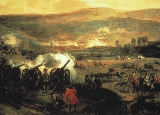
Battle of the Boyne


   Email Print
   Bookmark   Link


Battle of the Boyne


The Battle of the Boyne was a turning point in the WilliamiteWilliamite

Williamite refers to the followers of King William III of England who deposed King James II in the Glorious Revolution....
 claim on the EnglishEngland

England is the largest and most populous constituent country of the United Kingdom....
 throne.

The deposed King James VII of Scotland and James II of England and IrelandJames II of England

James VII of Scotland and James II of England became King of Scots, King of England, and King of Ireland on 6 February...
 and his JacobiteJacobitism

Jacobitism was the political movement dedicated to the restoration of the Stuart kings to the thrones of England and Scotla...
 supporters were defeated by James' nephew and son-in-law, William IIIWilliam III of England Summary

William III of England was a Dutch aristocrat and a Protestant Prince of Orange from his birth, Stadtholder of the United N...
 and his supporters. By the invitation of Parliament, William had deposed James in 1688. Both kings acted as commander of their respective armies.

The battle took place on July 1, 16901690 in Ireland Summary

Sorry, no overview for this topic
 just outside the town of DroghedaDrogheda

Drogheda or [dr?h?d?]) is an industrial and port town in County Louth on the east coast of Ireland, 56 km north of Dublin...
 on IrelandIreland

Ireland is the third largest island in Europe....
's east coast. Each army stood on opposing sides of the River BoyneRiver Boyne

The River Boyne is a river in Leinster, Ireland, the course of which is about 112 kilometres long....
. William's forces easily defeated those of James who led an army of mostly raw recruits. The symbolic importance of this battle has made it one of the best-known battles in BritishHistory of the United Kingdom

The United Kingdom is the sovereign state or realm that covers England, Scotland, Wales and Northern Ireland and which for ...
 and IrishHistory of Ireland

The History of Ireland began around 8000 BC, when the island's first human inhabitants arrived from Britain and continental ...
 history and a key part in Irish ProtestantFacts About Protestant Nationalist

A Protestant Nationalist, in the context of the situation in Northern Ireland, is a Protestant supporter of a pro-Irish Nati...
 folkloreFolklore

Folklore is the body of expressive culture, including tales, music, dance, legends, oral history, proverbs, jokes, popular b...
.


Discussion
Ask a question about 'Battle of the Boyne'
Start a new discussion about 'Battle of the Boyne'
Answer questions from other users
Full Discussion Forum


Timeline

1690   The Battle of the Boyne, in Ireland.


Encyclopedia


The Battle of the Boyne was a turning point in the WilliamiteWilliamite

Williamite refers to the followers of King William III of England who deposed King James II in the Glorious Revolution....
 claim on the EnglishEngland

England is the largest and most populous constituent country of the United Kingdom....
 throne.

The deposed King James VII of Scotland and James II of England and IrelandJames II of England

James VII of Scotland and James II of England became King of Scots, King of England, and King of Ireland on 6 February...
 and his JacobiteJacobitism

Jacobitism was the political movement dedicated to the restoration of the Stuart kings to the thrones of England and Scotla...
 supporters were defeated by James' nephew and son-in-law, William IIIWilliam III of England Summary

William III of England was a Dutch aristocrat and a Protestant Prince of Orange from his birth, Stadtholder of the United N...
 and his supporters. By the invitation of Parliament, William had deposed James in 1688. Both kings acted as commander of their respective armies.

The battle took place on July 1, 16901690 in Ireland Summary

Sorry, no overview for this topic
 just outside the town of DroghedaDrogheda

Drogheda or [dr?h?d?]) is an industrial and port town in County Louth on the east coast of Ireland, 56 km north of Dublin...
 on IrelandIreland

Ireland is the third largest island in Europe....
's east coast. Each army stood on opposing sides of the River BoyneRiver Boyne

The River Boyne is a river in Leinster, Ireland, the course of which is about 112 kilometres long....
. William's forces easily defeated those of James who led an army of mostly raw recruits. The symbolic importance of this battle has made it one of the best-known battles in BritishHistory of the United Kingdom

The United Kingdom is the sovereign state or realm that covers England, Scotland, Wales and Northern Ireland and which for ...
 and IrishHistory of Ireland

The History of Ireland began around 8000 BC, when the island's first human inhabitants arrived from Britain and continental ...
 history and a key part in Irish ProtestantFacts About Protestant Nationalist

A Protestant Nationalist, in the context of the situation in Northern Ireland, is a Protestant supporter of a pro-Irish Nati...
 folkloreFolklore

Folklore is the body of expressive culture, including tales, music, dance, legends, oral history, proverbs, jokes, popular b...
. It is still commemorated today, principally by the Orange InstitutionOrange Institution

The Orange Institution, more commonly known as the Orange Order, is a Protestant fraternal organisation based predomin...
. As a consequence of the adoption of the Gregorian calendarGregorian calendar Overview

The Gregorian calendar is the calendar that is used nearly everywhere in the world....
 ("New Style" dating), the battle is now commemorated on July 12 each year.

A sectarian battle?

The battle of the Boyne was the decisive encounter in a war that was primarily about James' attempt to regain the thrones of EnglandEngland

England is the largest and most populous constituent country of the United Kingdom....
 and ScotlandScotland

Scotland is a nation in northwest Europe and one of the constituent countries of the United Kingdom....
 and was the result of Parliament's move to put William on the throne, but is especially widely remembered as a crucial moment in the struggle between Irish Protestant and CatholicCatholic

Catholic - derived, through Latin, from the Greek adjective , meaning "general", "universal" - when used as a specifical...
 interests. However, recent analyses have played down the religious aspect of the conflict. In fact, both armies were religiously mixed; William of OrangeWilliam of Orange

William of Orange is the name of several historical people....
's own elite force — the Dutch Blue GuardsDutch Blue Guards

The Dutch Blue Guards were an elite infantry unit of the army of the United Provinces of the Netherlands....
 — had the papal bannerVatican City

Vatican City formally State of the Vatican City, or Vatican City State is a sovereign city-state whose terri...
 with them on that day, many of them being DutchNetherlands

The Netherlands is the European part of the Kingdom of the Netherlands , which is formed by the Netherlands, the Neth...
 Catholics. They were part of the League of Augsburg, a cross-Christian alliance designed to stop a FrenchFrance

France, officially the French Republic, is a country whose metropolitan territory is located in Western Europe and whi...
 conquest of EuropeEurope

Europe is one of the seven traditional continents of the Earth....
, supported by the VaticanHoly See

The Holy See is the episcopal see of Rome....
. The war in IrelandIreland

Ireland is the third largest island in Europe....
 was also the beginning of a long-running but ultimately unsuccessful campaign by James' JacobiteJacobitism

Jacobitism was the political movement dedicated to the restoration of the Stuart kings to the thrones of England and Scotla...
 supporters to restore the StuartStuart

Stuart may be:*a semi-common surname...
s to the BritishGreat Britain

Great Britain is an island lying off the northwestern coast of mainland Europe and to the east of Ireland, comprising the ma...
 thrones. While most Jacobites in Ireland were indeed Catholics hoping to have their seized lands given back to them, many English and Scottish Jacobites were Protestants and were motivated by loyalty to the principle of monarchyMonarchy

A monarchy, from the Greek ????, "one," and a??e??, "to rule", is a form of government that has a Monarch as Head of...
 (considering James to have been illegally deposed in a coup) or to the Stuart dynasty in particular, rather than by religion. A handful of British Jacobites fought with James at the Boyne. In addition, some of the French regiments fighting with the Jacobites were composed of GermanGermany

Germany , officially the Federal Republic of Germany , is a country in central Europe....
 Protestants. In a European context, therefore, the battle was not a religiously motivated one, but part of a complicated political, dynastic and strategic conflict.

In an Irish context, however, the war was a sectarian and ethnic conflict, in many ways a re-run of the Irish Confederate WarsIrish Confederate Wars

The Irish Confederate Wars, also sometimes called the Eleven Years War, were fought in Ireland between 1641 and 1653....
 of 50 years earlier. For the Jacobites, the war was fought for Irish sovereignty, religious toleration for Catholicism, and land ownership. The Catholic upper classes had lost almost all their lands after Cromwell's conquestCromwellian conquest of Ireland

Oliver Cromwell landed in Ireland with his New Model Army on behalf of the English Parliament in 1649....
, as well as the right to hold public office, practice their religion, and sit in the Irish Parliament. They saw the Catholic King James as a means of redressing these grievances and securing the autonomy of Ireland from the English Parliament. To these ends, under Richard Talbot, 1st Earl of Tyrconnell, they had raised an army to restore James to his throne after the Glorious RevolutionGlorious Revolution Summary

The Glorious Revolution was the overthrow of James II of England in 1688 by a union of Parliamentarians and the Dutch stadth...
. By 1690, they controlled all of Ireland except for the province of UlsterUlster Overview

Ulster forms one of the four traditional provinces of Ireland. ...
. Most of James II'sJames II of England

James VII of Scotland and James II of England became King of Scots, King of England, and King of Ireland on 6 February...
 troops at the Boyne were Irish Catholics.

Conversely, for the Williamites, the war was about maintaining Protestant and British rule in Ireland. They feared for both their lives and their property if James and his Catholic supporters were to rule Ireland. In particular, they dreaded a repeat of the Irish Rebellion of 1641Irish Rebellion of 1641

The Irish Rebellion of 1641 began as an attempted coup d'tat by Irish Catholic gentry, but rapidly degenerated into blo...
, which had been marked by widespread killings, including of Protestant planters. For these reasons, Protestants fought en masse for William III. Many of the Williamite troops at the Boyne, including their very effective irregular cavalry, were Protestants from UlsterUlster

Ulster forms one of the four traditional provinces of Ireland. ...
, who called themselves "EnniskillenEnniskillen

Enniskillen is the county town of Fermanagh in Northern Ireland....
ers
" and were referred to by contemporaries as "Scots-IrishScots-Irish

Scots-Irish can refer to:* The Ulster-Scots people of Ulster, Ireland....
".

The competing sides


Commanders

The opposing armies in the battle were led by the Roman Catholic former King James II of EnglandJames II of England

James VII of Scotland and James II of England became King of Scots, King of England, and King of Ireland on 6 February...
, Scotland and Ireland and opposing him, his nephew and son-in-law the Protestant William IIIWilliam III of England

William III of England was a Dutch aristocrat and a Protestant Prince of Orange from his birth, Stadtholder of the United N...
 ("William of OrangeWilliam of Orange

William of Orange is the name of several historical people....
") who had deposed James from his English and Scottish thrones in the previous year. James's supporters still controlled much of Ireland and the Irish ParliamentParliament of Ireland Overview

The Parliament of Ireland was a legislature that existed from medival times until 1800....
. James also enjoyed the support of the French king, Louis XIVFacts About Louis XIV of France

Louis XIV ruled as King of France and of Navarre from May 14 1643 until his death just prior to his seventy-seventh birthd...
, who did not want to see a hostile monarch, such as William, on the throne of England. To support James's restoration, Louis sent 6,000 French troops to Ireland to support the Irish JacobitesFacts About Jacobitism

Jacobitism was the political movement dedicated to the restoration of the Stuart kings to the thrones of England and Scotla...
. William was already StadtholderStadtholder

A stadtholder, means an official who is appointed by the legal ruling Monarch to represent him in a country, and may have a ...
 of the NetherlandsNetherlands

The Netherlands is the European part of the Kingdom of the Netherlands , which is formed by the Netherlands, the Neth...
 and was able to call on Dutch and allied troops from continental Europe as well as from Great BritainGreat Britain Summary

Great Britain is an island lying off the northwestern coast of mainland Europe and to the east of Ireland, comprising the ma...
.

James was a seasoned general who had proven his bravery when fighting for his brother — King Charles IICharles II of England

Charles II was the King of England, King of Scots, and King of Ireland from 30 January 1649 or 29 May 1660 until his deat...
 — in Europe, notably at the Battle of the DunesBattle of the Dunes (1658)

The Battle of the Dunes, fought on June 14, 1658, is also known as the Battle of Dunkirk....
. However, recent historians have noted that he was prone to panicking under pressure and to making rash decisions. William was also a seasoned commander and able general, but had yet to win a full battle. Many of his battles ended in bloody stalemates, prompting at least one modern historian to argue that William lacked an ability to manage armies in the thick of conflict. William's success against the French had been reliant upon tactical manoeuvres and good diplomacy rather than force. His diplomacy had assembled the League of Augsburg — a multi-national coalition formed to resist French aggression in Europe. From William's point of view, his takeover of power in England and the ensuing campaign in Ireland was just another front in the war against King Louis XIV of France.

James II'sJames II of England

James VII of Scotland and James II of England became King of Scots, King of England, and King of Ireland on 6 February...
 subordinate commanders were Richard Talbot, 1st Earl of Tyrconnell, who was the Lord Deputy of IrelandFacts About Lord Deputy of Ireland

The Lord Deputy was the King's representative and head of the Irish executive during the Kingdom of Ireland....
 and James's most powerful supporter in that country; and the French general LauzunAntoine Nompar de Caumont

Antoine Nompar de Caumont, marquis de Puyguilhem, duc de Lauzun, was a French courtier and soldier....
. William's second in command was the Duke of SchombergFrederick Schomberg, 1st Duke of Schomberg Overview

Friedrich Hermann, 1st Duke of Schomberg, was both a marshal of France and an English general "of all his Majesty's F...
, a 75-year-old professional soldier. Born in HeidelbergHeidelberg

Heidelberg is a scenic city in Baden-Wrttemberg, Germany, halfway between Stuttgart and Frankfurt....
, GermanyGermany

Germany , officially the Federal Republic of Germany , is a country in central Europe....
, Schomberg had formerly been a Marshal of FranceMarshal of France

The Marshal of France was one of the Great Officers of the Crown of France....
, but, being a HuguenotHuguenot

In the 16th and 17th centuries, the name of Huguenots came to apply to members of the Protestant Reformed Church of France, ...
, was compelled to leave his adopted country in 1685 because of the revocation of the Edict of NantesEdict of Nantes

The Edict of Nantes was issued on April 13, 1598 by Henry IV of France to grant French Protestants substantial rights in a ...
.

Armies

The Williamite army at the Boyne was about 36,000 strong, composed of troops from many countries. Around 20,000 had been in Ireland since 1689, commanded by Schomberg. William himself arrived with 16,000 more in June 1690. William's troops were generally far better trained and equipped than James's. The best WilliamiteWilliamite

Williamite refers to the followers of King William III of England who deposed King James II in the Glorious Revolution....
 infantryFacts About Infantry

Infantry is a term for soldiers who fight primarily on foot with small arms in organized military units....
 were from DenmarkDenmark

The Kingdom of Denmark is the smallest and southernmost of the Nordic countries....
 and the NetherlandsNetherlands

The Netherlands is the European part of the Kingdom of the Netherlands , which is formed by the Netherlands, the Neth...
, professional soldiers equipped with the latest flintlockFlintlock

Flintlock is the general term for any firearm based on the flintlock mechanism....
 musketMusket

A musket is a muzzle-loaded, smoothbore long gun, which its user generally fires from the shoulder....
s. There was also a large contingent of FrenchFrance

France, officially the French Republic, is a country whose metropolitan territory is located in Western Europe and whi...
 HuguenotHuguenot Overview

In the 16th and 17th centuries, the name of Huguenots came to apply to members of the Protestant Reformed Church of France, ...
 troops fighting with the Williamites. William did not have a high opinion of his British troops, with the exception of the HuguenotHuguenot

In the 16th and 17th centuries, the name of Huguenots came to apply to members of the Protestant Reformed Church of France, ...
 Protestant irregulars who had held Ulster in the previous year. The English and Scottish troops were felt to be politically unreliable, since James had been their legitimate monarch up to a year before. Moreover, they had only been raised recently and had seen little battle action. The JacobitesJacobitism

Jacobitism was the political movement dedicated to the restoration of the Stuart kings to the thrones of England and Scotla...
 were 23,500 strong. James had several regiments of French troops, but most of his manpower was provided by Irish Catholics. The Jacobites' Irish cavalryCavalry

Soldiers or warriors who fought mounted on horseback are commonly known as cavalry ....
, who were recruited from among the dispossessed Irish gentryGentry

Gentry is a term meaning one thing in the UK: landed gentry....
, proved themselves to be high calibre troops during the course of the battle. However, the Irish infantryInfantry

Infantry is a term for soldiers who fight primarily on foot with small arms in organized military units....
, predominantly peasantPeasant Summary

A peasant, from 15th century French pasant meaning one from the pays, the countryside or region, is an agricultural ...
s who had been pressed into service, were not trained soldiers. They had been hastily trained, poorly equipped, and only a minority of them had functional muskets. In fact, some of them carried only farm implements such as scytheScythe

A scythe is an agricultural hand tool for mowing and reaping grass or crops....
s at the Boyne. On top of that, the Jacobite infantry who actually had firearms were all equipped with the obsolete matchlockMatchlock

The Matchlock was the first mechanism or "lock" invented to facilitate the firing of a hand-held firearm....
 musket.

The battle

William had landed in CarrickfergusCarrickfergus

Carrickfergus is a large town in County Antrim, Northern Ireland....
 in UlsterFacts About Ulster

Ulster forms one of the four traditional provinces of Ireland. ...
 on June 14 1690 and marched south to take DublinDublin

Dublin is the capital and the largest city of the Republic of Ireland , located near the midpoint of Ireland's east coast, ...
. It has been argued that the Jacobites should have tried to block this advance in rugged country around NewryNewry

Newry is the fourth largest city in Northern Ireland, and ninth in all-Ireland....
, on the present day Irish RepublicIrish Republic Summary

The Irish Republic was a unilaterally declared independent state of Ireland proclaimed in the Easter Rising in 1916 and esta...
/Northern IrelandNorthern Ireland

Northern Ireland is part of the United Kingdom and covers 5,459 square miles in the northeast of the island of Irelan...
 border. However, James only fought a delaying action there and chose instead to place his line of defence on the River BoyneRiver Boyne

The River Boyne is a river in Leinster, Ireland, the course of which is about 112 kilometres long....
, around 30 mileMile

A mile is the name of a unit of length, usually used to measure distance, in a number of different systems, including Englis...
s from Dublin. The Williamites reached the Boyne on 29 June. The day before the battle, William himself had a narrow escape when he was wounded by Jacobite artilleryArtillery

Historically, artillery refers to any engine used for the discharge of projectiles during war....
 while surveying the fords over which his troops would cross the Boyne.

The battle itself was fought on July 1 for control of a ford on the Boyne at Oldbridge, near DroghedaDrogheda

Drogheda or [dr?h?d?]) is an industrial and port town in County Louth on the east coast of Ireland, 56 km north of Dublin...
. William sent about a quarter of his men to cross at a place called Roughgrange, near SlaneSlane

Slane is a village in County Meath, Ireland....
, about 6 miles from Oldbridge. The Duke of Schomberg'sFrederick Schomberg, 1st Duke of Schomberg

Friedrich Hermann, 1st Duke of Schomberg, was both a marshal of France and an English general "of all his Majesty's F...
 son MeinhardtMeinhardt Schomberg, 3rd Duke of Schomberg

Meinhardt Schomberg, 3rd Duke of Schomberg, 1st Duke of Leinster KG was an Huguenot general, whose father was also a famous ...
 led this crossing, which Irish dragoons in picquetPicquet

This article is about the military punishment picquet....
 under Neill O'Neill unsuccessfully opposed. James panicked when he saw that he might be outflanked and sent half his troops, along with most of his cannonCannon

A cannon is any large tubular firearm designed to fire a heavy projectile over a considerable distance....
, to counter this move. What neither side had realised was that there was a deep ravineRavine Summary

A ravine is a very small valley, which is often the product of streamcutting erosion....
 at Roughgrange, so that the forces there could not engage each other, but literally sat out the battle. The Williamites there went on a long detour march which, late in the day, almost saw them cut off the Jacobite retreat at the village of NaulNaul, Dublin Overview

Naul is a village in Fingal, Co. Dublin in the Republic of Ireland....
.

At the main ford at Oldbridge, William's infantry led by the elite Dutch Blue GuardsDutch Blue Guards

The Dutch Blue Guards were an elite infantry unit of the army of the United Provinces of the Netherlands....
 forced their way across the river, using their superior firepower to slowly drive back the enemy foot-soldiers, but were pinned down when the Jacobite cavalry counter-attacked. Having secured the village of Oldbridge, some Williamite infantry held off successive cavalry attacks with disciplined volley fire while others were driven into the river. William's second-in-command, the Duke of SchombergFrederick Schomberg, 1st Duke of Schomberg

Friedrich Hermann, 1st Duke of Schomberg, was both a marshal of France and an English general "of all his Majesty's F...
 and George Walker were killed in this phase of the battle. The Williamites were not able to resume their advance until their own horsemen managed to cross the river and, after being badly mauled, held off the Jacobite cavalry, who retired and regrouped at Donore, where they once again put up stiff resistance before retiring.

The Jacobites retired in good order. William had a chance to trap them as they retreated across the River Nanny at DuleekDuleek

Duleek is a village in County Meath, Ireland....
, but his troops were held up by a successful rear-guard action.

The casualty figures of the battle were quite low for a battle of such a scale — of the 50,000 or so participants, about 2,000 died, three-quarters of whom were Jacobites. The reason for the low death toll was that in contemporary warfare, most of the casualties tended to be inflicted in the pursuit of an already-beaten enemy. This did not happen at the Boyne, as the counter-attacks of the Jacobite cavalry screened the retreat of the rest of their army. The Jacobites were badly demoralised by their defeat, however, and many of the Irish infantrymen deserted. The Williamites triumphantly marched into DublinDublin

Dublin is the capital and the largest city of the Republic of Ireland , located near the midpoint of Ireland's east coast, ...
 two days after the battle. The Jacobite army abandoned the city and marched to LimerickLimerick

Limerick is a city and the county seat of County Limerick in the province of Munster, in the midwest of the Republic of Ire...
, behind the River ShannonRiver Shannon

The River Shannon, Ireland's longest river, divides the West of Ireland from the east and south....
, where they were besiegedSiege of Limerick (1690)

Limerick a city in western Ireland, was besieged twice in the Williamite war in Ireland, 1689-91....
.

After his defeat, James did not stay in Dublin, but rode with a small escort to DuncannonDuncannon

Duncannon is a village in southwest County Wexford, Republic of Ireland....
 and returned to exile in France, even though his army left the field relatively unscathed. James's loss of nerve and speedy exit from the battlefield enraged his Irish supporters, who fought on until the Treaty of LimerickTreaty of Limerick

The Treaty of Limerick ended the Williamite war in Ireland between the Jacobites and the supporters of William of Orange....
 in 1691. In Irish folk memory, James was derisively nick-named Seamus a' chaca — a title that translates literally to "Shitty James" or "James the shit."

Aftermath

The battle was overshadowed in its time in Great Britain by the defeat by the French of an Anglo-Dutch fleet two days later at the Battle of Beachy HeadBattle of Beachy Head (1690)

The naval Battle of Beachy Head or Bataille de Bvezier took place on 10 July 1690 near Beachy Head, a promontory n...
, a far more serious event in the short term; only on the continent was the Boyne treated as a major victory. Its importance lay in the fact that it was the first proper victory for the League of Augsburg, the first-ever alliance between Catholic and Protestant countries, and in achieving it William of OrangeWilliam of Orange

William of Orange is the name of several historical people....
 and Pope Alexander VIIIFacts About Pope Alexander VIII

Pope Alexander VIII , born Pietro Vito Ottoboni, was Pope from 1689 to 1691 ...
 (the League's prime movers) counteracted the myth, which emanated particularly from SwedenSweden

The Kingdom of Sweden is a Nordic country in Scandinavia....
, that such an alliance was blasphemous. Thus the victory motivated more nations to join the alliance and in effect ended the very real danger of a French conquest of Europe.

The Boyne was not without strategic significance for both Great BritainGreat Britain

Great Britain is an island lying off the northwestern coast of mainland Europe and to the east of Ireland, comprising the ma...
 and IrelandIreland

Ireland is the third largest island in Europe....
, however. It marked the end of James's hope of regaining his throne by military means and virtually assured the triumph of the Glorious RevolutionGlorious Revolution

The Glorious Revolution was the overthrow of James II of England in 1688 by a union of Parliamentarians and the Dutch stadth...
. In ScotlandScotland

Scotland is a nation in northwest Europe and one of the constituent countries of the United Kingdom....
, news of this defeat moved the HighlandersScottish Highlands

The Scottish Highlands are the mountainous regions of Scotland north and west of the Highland Boundary Fault....
 to gradually abandon the Jacobite RisingJacobite rising

Each Jacobite Rising formed part of a series of military campaigns by Jacobites attempting to restore the Stuart kings to th...
 which Bonnie Dundee had led. In Ireland, the Boyne was the beginning of the Williamite victory over the Jacobites by which British and Protestant dominance over the country was maintained. For this reason, the Boyne is still celebrated by the Protestant Orange OrderOrange Institution

The Orange Institution, more commonly known as the Orange Order, is a Protestant fraternal organisation based predomin...
 on the Twelfth of July.

Commemoration of the battle

Originally, Irish Protestants commemorated the Battle of AughrimBattle of Aughrim

The Battle of Aughrim was the decisive battle of the Williamite war in Ireland....
 on the 12 July, as symbolising their victory in the Williamite war in IrelandWilliamite war in Ireland

The Williamite war in Ireland, also known as the Jacobite war in Ireland and in Ireland as Cogadh an Dá Rí or T...
. At Aughrim, which took place a year after the Boyne, virtually all of the Irish Catholic and old English aristocracies (dispossessed of lands to accommodate the plantationsPlantations of Ireland

Plantations in 16th and 17th century Ireland involved the seizure of land owned by the native Irish and granting of it...
 under Elizabeth IElizabeth I of England

Elizabeth I was Queen of England, Queen of France , and Queen of Ireland from 17 November 1558 until her death....
 and Oliver CromwellOliver Cromwell

Oliver Cromwell was an English military and political leader, best known for making England a republic and leading the Comm...
) were wiped out. The Boyne, which in the old Julian calendarJulian calendar

The Julian calendar was introduced in 46 BC by Julius Caesar and took force in 45 BC ....
, took place on 1 July, was treated as less important, third in commemorative value after Aughrim and the anniversary of the Irish Rebellion of 1641Irish Rebellion of 1641

The Irish Rebellion of 1641 began as an attempted coup d'tat by Irish Catholic gentry, but rapidly degenerated into blo...
 on 23 October. What was celebrated on "The Twelfth" was not William's "victory over PoperyPopery

Historically, the words "popery" and "popish" have been used as derogatory terms for Roman Catholicism and a Rom...
 at the Battle of the Boyne
", but the extermination of the elite of the Catholic Irish at AughrimAughrim

There are a number of villages called Aughrim in Ireland....
, thereby ending the fear of having to surrender the planted lands.

In 1752, the Gregorian calendarGregorian calendar

The Gregorian calendar is the calendar that is used nearly everywhere in the world....
 was adopted in Ireland, which placed the Boyne on the 12th of July instead of Aughrim. However, even after this date, "The Twelfth" still commemorated Aughrim. But after the Orange Order was founded in 1795 amid sectarian violence in ArmaghArmagh

Armagh is a city in Northern Ireland, the county town of County Armagh....
, the focus of parades on July 12 switched to the Battle of the Boyne. Usually the dates before the introduction of the calendar on 14 September 1752 are mapped in English language histories directly onto the JulianJulian Overview

Julian can refer to:* Julian the Apostate, Flavius Claudius Julianus, Roman emperor...
 dates without shifting them by 11 days. Being suspicious of anything with PapistPapist

Papist is an archaic pejorative term referring to a member of the Roman Catholic Church....
 connotations, however, rather than shift the anniversary of the Boyne to the new 1 July or celebrate the new anniversary of Aughrim, the OrangemenFacts About Orangemen

Orangemen can refer:*Historically, to supporters of King William III of Orange....
 continued to march on the 12 July which, in New Style dates marked the battle of the Boyne. Despite this, there are also smaller parades and demonstrations on 1 July, the date which maps the old style date of the Boyne to the new style in the usual manner and which also commemorate the massacre of the 36th (Ulster) Division on the first day of the Battle of the Somme in July, 1916.

It has also been suggested that the Boyne was preferred to Aughrim because the Jacobites' rout there allowed the Irish Catholics to be presented as contemptible cowards, whereas at Aughrim they fought bravely and died in great numbers. In the context of a resurgent Irish nationalismIrish nationalism

Irish nationalism refers to political movements that desire greater autonomy or the independence of Ireland from Great Brita...
 from the 1790s onwards, it is argued that the narrative of the Boyne was more comforting for LoyalistsLoyalist (American Revolution)

Loyalists were British North American colonists who remained loyal subjects of the British crown during the American Revolut...
 in Ireland. The commemoration of the Battle of the Boyne therefore has more to do with the politics of the UnionistUnionism in Ireland

Unionism, in Ireland, is a belief in the desirability of a full constitutional and institutional relationship between Irelan...
 community than it has to do with the military significance of the battle itself.

The memory of the battle also has resonance among Irish nationalists. Most Irish people see the battle as a major step on the road to the complete BritishGreat Britain

Great Britain is an island lying off the northwestern coast of mainland Europe and to the east of Ireland, comprising the ma...
 colonisation of Ireland. In 1923, IRA members blew up a large monument to the battle on the battlefield site on the Boyne and later destroyed a statue of William IIIWilliam III of England

William III of England was a Dutch aristocrat and a Protestant Prince of Orange from his birth, Stadtholder of the United N...
 in 1929 that stood outside Trinity College, DublinTrinity College, Dublin

Trinity College, Dublin, corporately designated as the Provost, Fellows and Scholars of the College of the Holy and Undiv...
 in the centre of the Irish capital.

"The Twelfth" in Ireland today

The Battle of the Boyne remains a controversial topic today, especially in Northern IrelandNorthern Ireland

Northern Ireland is part of the United Kingdom and covers 5,459 square miles in the northeast of the island of Irelan...
, where Protestants remember it as the great victory over Catholics that resulted in the sovereignty of ParliamentParliament of the United Kingdom

The Parliament of the United Kingdom of Great Britain and Northern Ireland is the supreme legislative body in the United Kin...
 and the Protestant monarchy.

In recent years, "The Twelfth" has often been marked by confrontations, as members of the Orange Order attempt to celebrate the date by marching past or through what they see as their traditional route. Some of these areas, however, now have a nationalist majority who object to marches passing through what they see as their areas. This change is mainly due to natural population migrations, whereby rural Irish Catholics have moved to major cities to be closer to potential employers.

Each side thus dresses up the disputes in terms of the other's alleged attempts to repress them; Catholics still see Orange Order marches as provocative attempts to show who is boss, while Protestants insist that they have a right to "walk the Queen's highway" and see any attempt to deny them the right to walk through traditional routes used for centuries as a move to marginalise them and restrict their freedom to celebrate their Protestant identity earned in the Glorious RevolutionGlorious Revolution

The Glorious Revolution was the overthrow of James II of England in 1688 by a union of Parliamentarians and the Dutch stadth...
 settlement. Since the start of The TroublesThe Troubles

The Troubles is a generic and euphemistic term used to describe a period of sporadic communal violence involving parami...
, the celebrations of the battle have been seen as playing a critical role in the awareness of those involved in the unionist/nationalist tensions in Northern Ireland.

The battlefield today

The site of the Battle of the Boyne sprawls over a wide area west of the town of Drogheda. At the eastern edge of Oldbridge, near the scene of the main Williamite crossing and the western edge of Drogheda town, a planning application for over 700 houses is due to be decided on by An Bord Pleanala in March 2008. The current Interpretive Centre dedicated to informing tourists and other visitors about the battle is about 1 mile to the west of the main crossing point. This facility is currently being redeveloped. The battle's other main combat areas (at Duleek, Donore and Plattin - along the Jacobite line of retreat) are marked with tourist informationTourist information

Tourist information offices are run by a national or local agency to provide information about a region for the assistance o...
 signs.

On 4 April, 2007 in a sign of improving relations between unionist and nationalist groups, the newly-elected First Minister of Northern Ireland, the Reverend Ian PaisleyIan Paisley

Save Ulster from Sodomy" was a campaign launched by Paisley in 1977, in opposition to the Campaign for Homosexual Law Refor...
, was invited to visit the battle site by the TaoiseachTaoiseach Overview

The Taoiseach plural: Taoisigh or, more formally, An Taoiseach, is the head of government of the Republic of I...
 Bertie AhernBertie Ahern

Patrick Bartholomew Ahern is an Irish politician....
 later in the year. Following the invitation, Paisley commented that "such a visit would help to demonstrate how far we have come when we can celebrate and learn from the past so the next generation more clearly understands." On 10 May the visit took place, where Paisley presented the TaoiseachTaoiseach Overview

The Taoiseach plural: Taoisigh or, more formally, An Taoiseach, is the head of government of the Republic of I...
 with a JacobiteJacobite

Jacobite refer to:*A follower of Jacobitism, the political movement dedicated to the return of the Stuart kings to the thro...
 musket in return for Ahern's gift at the St AndrewsSt Andrews

Named after Saint Andrew the Apostle, the Royal Burgh of St Andrews is a town on the east coast of Fife, Scotland, and the h...
 talks of a walnut bowl made from a tree from the site. A new tree was also planted in the grounds of Oldbridge House by the two politicians to mark the occasion.

See also

  • Irish calendarIrish calendar

    The Irish calendar does not observe the typical astronomical seasons, or the meteorological seasons, but rather centers the ...
  • William IIIWilliam III of England

    William III of England was a Dutch aristocrat and a Protestant Prince of Orange from his birth, Stadtholder of the United N...
  • Irish battlesIrish battles

    This page aims to give a list of and links to pages of battles in Irish history....
  • British military historyBritish military history

    British military history is a long and varied topic, extending from the prehistoric and ancient historic period, through the...
  • Battle of AughrimBattle of Aughrim

    The Battle of Aughrim was the decisive battle of the Williamite war in Ireland....
  • Siege of DerrySiege of Derry Overview

    The Siege of Londonderry, or the Siege of Derry, took place in Ireland during 1688–1689....
  • Orange InstitutionOrange Institution

    The Orange Institution, more commonly known as the Orange Order, is a Protestant fraternal organisation based predomin...
  • The Boyne WaterThe Boyne Water

    "The Boyne Water" is a sectarian Ulster Protestant folksong by an anonymous lyricist....


External links