
| |
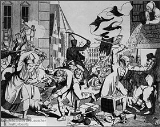
Violence is the expression of physical force against self or other, compelling action against one's will on pain of being hurt. Variant uses of the term refer to the destruction of non-living objects (see property damage).
Psychology and sociology The causes of violent behavior in humans are often topics of research in psychology and sociology. Neurobiologist Jan Volavka emphasizes that for those purposes, “violent behavior is defined as overt and intentional physically aggressive behavior against another person."
Scientists disagree on whether violence is inherent in humans.

Discussion
Ask a question about 'Violence'
Start a new discussion about 'Violence'
Answer questions from other users
|
Quotations
Violence is man re-creating himself.
Peace is a resistance to the terrible satisfactions of war.
Violence, naked force, has settled more issues in history than has any other factor, and the contrary opinion is wishful thinking at its worst.
The most heterogeneous ideas are yoked by violence together.
Violence stinks no matter which side of it you're on. But now and then there's nothing left to do but hit the other person over the head with a frying pan.

Encyclopedia
Violence is the expression of physical force against self or other, compelling action against one's will on pain of being hurt. Variant uses of the term refer to the destruction of non-living objects (see property damage).
Psychology and sociology The causes of violent behavior in humans are often topics of research in psychology and sociology. Neurobiologist Jan Volavka emphasizes that for those purposes, “violent behavior is defined as overt and intentional physically aggressive behavior against another person."
Scientists disagree on whether violence is inherent in humans. Among prehistoric humans, there is archaeological evidence for both contentions of violence and peacefulness as primary characteristics.
Since violence is a matter of perception as well as a measurable phenomenon, psychologists have found variability in whether people perceive certain physical acts as 'violent'. For example, in a state where execution is a legalised punishment we do not typically perceive the executioner as 'violent', though we may talk, in a more metaphorical way, of the state acting violently. Likewise understandings of violence are linked to a perceived aggressor-victim relationship: hence psychologists have shown that people may not recognise defensive use of force as aggressive or violent at all, even in cases where the amount of force used is significantly greater than in the original aggression.
Riane Eisler, who describes early matriarchal societies, and Walter Wink, who coined the phrase “the myth of redemptive violence,” suggest that human violence, especially as organized in groups, is a phenomenon of the last five to ten thousand years.
In a poll taken in 2003 in Chicago, Illinois, 67% of the people polled stated that the main cause of violence is argumentation. When asked to clarify, one man said that violence is simply a product of arguments and that if arguments were avoided then violence could therefore also be avoided.
The “violent male ape” image is often brought up in discussions of human violence. Dale Peterson and Richard Wrangham in “Demonic Males: Apes and the Origins of Human Violence” write that violence is inherent in humans.
However, William L. Ury, editor of a book called "Must We Fight? From the Battlefield to the Schoolyard—A New Perspective on Violent Conflict and Its Prevention” debunks the "killer ape" myth in his book which brings together discussions from two Harvard Law School symposiums. The conclusion is that “we also have lots of natural mechanisms for cooperation, to keep conflict in check, to channel aggression, and to overcome conflict. These are just as natural to us as the aggressive tendencies."
James Gilligan writes violence is often pursued as an antidote to shame or humiliation. The use of violence often is a source of pride and a defence of honor, especially among males who often believe violence defines manhood.
Stephen Pinker in a New Republic article “The History of Violence” offers evidence that on the average the amount and cruelty of violence to humans and animals has decreased over the last few centuries.
Diagnosis of psychiatric disorder The American Psychiatric Association planning and research committees for the forthcoming DSM-V (2012) have canvassed a series of new Relational disorders which include Marital Conflict Disorder Without Violence or Marital Abuse Disorder (Marital Conflict Disorder With Violence). Couples with marital disorders sometimes come to clinical attention because the couple recognize long-standing dissatisfaction with their marriage and come to the clinician on their own initiative or are referred by an astute health care professional. Secondly, there is serious violence in the marriage which is -"usually the husband battering the wife" . In these cases the emergency room or a legal authority often is the first to notify the clinician. Most importantly, marital violence "is a major risk factor for serious injury and even death and women in violent marriages are at much greater risk of being seriously injured or killed (National Advisory Council on Violence Against Women 2000)." The authors of this study add that "There is current considerable controversy over whether male-to-female marital violence is best regarded as a reflection of male psychopathology and control or whether there is an empirical base and clinical utility for conceptualizing these patterns as relational."
Recommendations for clinicians making a diagnosis of Marital Relational Disorder should include the assessment of actual or "potential" male violence as regularly as they assess the potential for suicide in depressed patients. Further, "clinicians should not relax their vigilance after a battered wife leaves her husband, because some data suggest that the period immediately following a marital separation is the period of greatest risk for the women. Many men will stalk and batter their wives in an effort to get them to return or punish them for leaving. Initial assessments of the potential for violence in a marriage can be supplemented by standardized interviews and questionnaires, which have been reliable and valid aids in exploring marital violence more systematically."
The authors can conclude with what they call "very recent information" on the course of violent marriages which suggests that "over time a husband's battering may abate somewhat, but perhaps because he has successfully intimidated his wife. The risk of violence remains strong in a marriage in which it has been a feature in the past. Thus, treatment is essential here; the clinician cannot just wait and watch." The most urgent clinical priority is the protection of the wife because she is the one most frequently at risk, and clinicians must be aware that supporting assertiveness by a battered wife may lead to more beatings or even death.
It is also important to this topic to understand the paradoxical effects of some sedative drugs. Serious complications can occur in conjunction with the use of sedatives creating the opposite effect as to that intended. Malcolm Lader at the Institute of Psychiatry in London estimates the incidence of these adverse reactions at about 5%, even in short-term use of the drugs. The paradoxical reactions may consist of depression, with or without suicidal tendencies, phobias, aggressiveness, violent behavior and symptoms sometimes misdiagnosed as psychosis.
Law One of the main functions of law is to regulate violence.
Sociologist Max Weber stated that state power is the monopoly on the legitimate use of physical force on a specific territory. Law enforcement is the main means of regulating nonmilitary violence in society. Governments regulate the use of violence through legal systems governing individuals and political authorities, including the police and military. Most societies condone some amount of police violence to maintain the status quo and enforce laws.
However, German political theorist Hannah Arendt noted: "Violence can be justifiable, but it never will be legitimate ... Its justification loses in plausibility the farther its intended end recedes into the future. No one questions the use of violence in self-defence, because the danger is not only clear but also present, and the end justifying the means is immediate". In the 20th century in acts of democide governments may have killed more than 260 million of their own people through police brutality, execution, massacre, slave labor camps, and through sometimes intentional famine.
Violent acts that are not carried out by the military or police and that are not in self-defence are usually classified as crimes, although not all crimes are violent crimes. Damage to property is classified as violent crime in some jurisdictions but not in others. It is usually considered a less serious offense unless the damage injures, or potentially could injure, others. Unpremeditated or small-scale acts of random violence or coordinated violence by unsanctioned private groups usually are prosecuted. While most societies condone the killing of animals for food and sport, increasingly they have adopted more laws against animal cruelty.
The Federal Bureau of Investigation classifies violence resulting in homicide into criminal homicide and justifiable homicide (e.g. self defense).
War
War is a state of prolonged violence, large-scale conflict involving two or more groups of people, usually under the auspices of government. War is fought as a means of resolving territorial and other conflicts, as war of aggression to conquer territory or loot resources, in national self-defense, or to suppress attempts of part of the nation to secede from it.
Since the Industrial Revolution, the lethality of modern warfare has steadily grown. World War I casualties were over 40 million and World War II casualties were over 70 million.
Nevertheless, some hold the actual deaths from war have decreased compared to past centuries. In War Before Civilization, Lawrence H. Keeley, a professor at the University of Illinois, calculates that 87% of tribal societies were at war more than once per year, and some 65% of them were fighting continuously. The attrition rate of numerous close-quarter clashes, which characterize endemic warfare, produces casualty rates of up to 60%, compared to 1% of the combatants as is typical in modern warfare. Stephen Pinker agrees, writing that “in tribal violence, the clashes are more frequent, the percentage of men in the population who fight is greater, and the rates of death per battle are higher.”
Jared Diamond in his award-winning books, Guns, Germs and Steel and The Third Chimpanzee provides sociological and anthropological evidence for the rise of large scale warfare as a result of advances in technology and city-states. The rise of agriculture provided a significant increase in the number of individuals that a region could sustain over hunter-gatherer societies, allowing for development of specialized classes such as soldiers, or weapons manufacturers. On the other hand, tribal conflicts in hunter-gatherer societies tend to result in wholesale slaughter of the opposition (other than perhaps females of child-bearing years) instead of territorial conquest or slavery, presumably as hunter-gatherer numbers could not sustain empire-building.
Religious and political ideology Religious and political ideologies have been the cause of interpersonal violence, and violent riots, political repression, ethnic cleansing and genocide throughout history. Ideologues often falsely accuse others of violence, such as the ancient blood libel against Jews, the medieval accusations of casting witchcraft spells against women, caricatures of black men as “violent brutes” that helped excuse the late nineteenth century Jim Crow laws in the United States, and modern accusations of satanic ritual abuse against day care center owners and others.
Both supporters and opponents of the twenty-first century War on Terrorism regard it largely as an ideological and religious war.
Vittorio Bufacchi describes two different modern concepts of violence, one the “minimalist conception” of violence as an intentional act of excessive or destructive force, the other the “comprehensive conception” which includes violations of rights, including a long list of human needs. These concepts are reflected in conflicts between “left wing” anti-capitalists and “right wing’” pro-capitalists.
Anti-capitalists assert that capitalism is violent. They believe private property, trade, interest and profit survive only because police violence defends them and that capitalist economies need war to expand. Many contest calling any form of property damage violent. Similarly, many anti-capitalists lambast what they call structural violence which denotes a form of violence in which social institutions kill people slowly by preventing them from meeting their basic needs, often leading further to social conflict and violence.
Supporters of capitalism are wary of a wide definition of violence that requires the state and its violent enforcement agencies to fulfill all needs denied by structural violence. However, unlike those critics who support state capitalism, free market supporters argue that it is violently enforced state laws intervening in markets which cause many of the problems anti-capitalists attribute to structural violence.
Throughout history, most religions and individuals like Mahatma Gandhi have preached that humans are capable of eliminating individual violence and organizing societies through purely nonviolent means. Gandhi himself once wrote: “A society organized and run on the basis of complete non-violence would be the purest anarchy.” Modern political ideologies which espouse similar views include pacifist varieties of voluntarism, mutualism, anarchism and libertarianism.
Health and prevention The Centers for Disease Control and Prevention (CDC) defines violence as "Injury inflicted by deliberate means", which includes assault, as well as "legal intervention, and self-harm". The World Health Organization ( ) in its first World Report on Violence and Health defined violence as "the intentional use of physical force or power, threatened or actual, against oneself, another person or against a group or community, that either results in or has a high likelihood of resulting in injury, death, psychological harm, maldevelopment or deprivation."
WHO estimates that each year around 1.6 million lives are lost worldwide due to violence. It is among the leading causes of death for people ages 15-44, especially of males.
Recent estimates for murders per year in various countries include: 55,000 murders in Brazil, 30,000 murders in Russia, 25,000 murders in Colombia, 20,000 murders in South Africa, 15,000 murders in Mexico, 14,000 murders in the United States, 11,000 murders in Venezuela, 6,000 murders in El Salvador, 1,600 murders in Jamaica, 1000 murders in France, 500 murders in Canada, and 200 murders in Chile.
Structural violence
Johan Galtung defines violence as "avoidable insult to basic human needs": survival, well being, identity, and freedom. This form of violence corresponds with the systematic ways in which a given social structure or social institution kills people slowly by preventing them from meeting their basic needs. The proof of concept is given by André Gernez : he observed hundreds of millions of deaths caused by degenerative diseases avoidable by a cheap and simple prevention protocol.
Violence in the media Government censorship has sometimes addressed violence in media. In the United States the FCC regulates television and radio, as does the CRTC in Canada. Media also self-regulate, as through many movie ratings and the Entertainment Software Rating Board for video games.
Violent content has been a central part of video game controversy. Critics like Dave Grossman and Jack Thompson argue that violence in games hardens children to unethical acts.
See also
Sources
- Walter Benjamin's Critique of Violence
- Arno Gruen psychoanalyst who has written extensively on the origins of violence
-
- Nazaretyan, A.P. (2007). Violence and Non-Violence at Different Stages of World History: A view from the hypothesis of techno-humanitarian balance. In: . Moscow: KomKniga/URSS. P.127-148. ISBN 9785484010011.
- Gad Barzilai.(2003). Communities and Law: Politics and Cultures of Legal Identities. Ann Arbor: University of Michigan Press. ISBN 0472113151.
External links
-
-
-
- Intercultural discussions on violence
-
-
-
-
-
|