


Criminal law

Encyclopedia
Criminal law, is the body of law
that relates to crime
. It might be defined as the body of rules that defines conduct that is not allowed because it is held to threaten, harm or endanger the safety and welfare of people, and that sets out the punishment to be imposed on people who do not obey these laws. Criminal law is to be distinguished from civil law
.
and criminal law. The important elements are mens rea
and actus reus
. The first written codes of law were designed by the Sumerians. Around 2100-2050 BC Ur-Nammu
, the Neo-Sumerian king of Ur
, enacted the oldest written legal code whose text has been discovered: the Code of Ur-Nammu
although an earlier code of Urukagina
of Lagash
( 2380-2360 BC ) is also known to have existed. Another important early code was the Code Hammurabi, which formed the core of Babylonian law
. These early legal codes did not separate penal and civil laws. Of the early criminal laws of Ancient Greece
only fragments survive, e.g. those of Solon
and Draco.
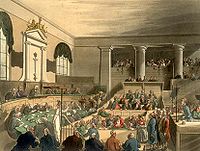 The similarly significant Commentaries of Gaius
on the Twelve Tables
also conflated the civil and criminal aspects, treating theft or furtum as a tort
. Assault and violent robbery
were analogized to trespass
as to property. Breach of such laws created an obligation of law or vinculum juris discharged by payment of monetary compensation or damages
. The criminal law of imperial Rome is collected in Books 47-48 of the Digest. After the revival of Roman law
in the 12th century, sixth-century Roman classifications and jurisprudence provided the foundations of the distinction between criminal and civil law in Europe
an law from then until the present time.
The first signs of the modern distinction between crimes and civil matters emerged during the Norman Invasion of England. The special notion of criminal penalty, at least concerning Europe, arose in Spanish Late Scolasticism (see Alfonso de Castro
), when the theological notion of God's penalty (poena aeterna) that was inflicted solely for a guilty mind, became transfused into canon law first and, finally, to secular criminal law. The development of the state
dispensing justice
in a court clearly emerged in the eighteenth century when European countries began maintaining police services. From this point, criminal law had formalized the mechanisms for enforcement, which allowed for its development as a discernible entity.
for failure to abide by its rules. (Dennis J. Baker, The Right Not to be Criminalized: Demarcating Criminal Law's Authority, (Ashgate 2011)
. Capital punishment
may be imposed in some jurisdictions for the most serious crimes. Physical or corporal punishment
may be imposed such as whipping
or caning
, although these punishments are prohibited in much of the world. Individuals may be incarcerated in prison
or jail
in a variety of conditions depending on the jurisdiction. Confinement may be solitary. Length of incarceration may vary from a day to life. Government supervision may be imposed, including house arrest
, and convicts may be required to conform to particularized guidelines as part of a parole
or probation
regimen. Fines also may be imposed, seizing money or property from a person convicted of a crime.
Five objectives are widely accepted for enforcement of the criminal law by punishments: retribution
, deterrence
, incapacitation
, rehabilitation
and restitution
. Jurisdictions differ on the value to be placed on each.
or guilty act. Some crimes particularly modern regulatory offenses require no more, and they are known as strict liability
offenses (E.g. Under the Road traffic Act 1988 it is a strict liability offence to drive a vehicle with an alcohol concentration above the prescribed limit). Nevertheless, because of the potentially severe consequences of criminal conviction, judges at common law
also sought proof of an intent to do some bad thing, the mens rea
or guilty mind. As to crimes of which both actus reus and mens rea are requirements, judges have concluded that the elements must be present at precisely the same moment and it is not enough that they occurred sequentially at different times.
 Actus reus is Latin
for "guilty act" and is the physical element of committing a crime. It may be accomplished by an action, by threat of action, or exceptionally, by an omission to act, which is a legal duty to act. For example, the act of A striking B might suffice, or a parent's failure to give food to a young child also may provide the actus reus for a crime.
Where the actus reus is a failure to act, there must be a duty of care. A duty can arise through contract
, a voluntary undertaking, a blood relation with whom one lives, and occasionally through one's official position. Duty also can arise from one's own creation of a dangerous situation. On the other hand, it was held in the U.K. that switching off the life support of someone in a persistent vegetative state
is an omission to act and not criminal. Since discontinuation of power is not a voluntary act, not grossly negligent, and is in the patient's best interests, no crime takes place. In this case it was held that since a PVS patient could not give or withhold consent to medical treatment, it was for the doctors to decide whether treatment was in the patient's best interest. It was reasonable for them to conclude that treatment was not in the patient's best interest, and should therefore be stopped, when there was no prospect of improvement. It was never lawful to take active steps to cause or accelerate death, although in certain circumstances it was lawful to withhold life sustaining treatment, including feeding, without which the patient would die.
An actus reus may be nullified by an absence of causation
. For example, a crime involves harm to a person, the person's action must be the but for cause and proximate cause
of the harm. If more than one cause exists (e.g. harm comes at the hands of more than one culprit) the act must have "more than a slight or trifling link" to the harm.
Causation is not broken simply because a victim is particularly vulnerable. This is known as the thin skull rule. However, it may be broken by an intervening act (novus actus interveniens) of a third party, the victim's own conduct, or another unpredictable event. A mistake in medical
treatment typically will not sever the chain, unless the mistakes are in themselves "so potent in causing death."
phrase, meaning "guilty mind". This is the mental element of the crime. A guilty mind means an intention
to commit some wrongful act. Intention under criminal law is separate from a person's motive
(although motive does not exist in scots law).
A lower threshold of mens rea is satisfied when a defendant recognises an act is dangerous but decides to commit it anyway. This is recklessness. It is the mental state of mind of the person at the time the actus reus was committed. For instance, if C tears a gas meter from a wall to get the money inside, and knows this will let flammable gas escape into a neighbour's house, he could be liable for poisoning. Courts often consider whether the actor did recognize the danger, or alternatively ought to have recognised a risk. Of course, a requirement only that one ought to have recognized a danger (though he did not) is tantamount to erasing intent as a requirement. In this way, the importance of mens rea
has been reduced in some areas of the criminal law but is obviously still an imporant part in the criminal system.
Wrongfulness of intent also may vary the seriousness of an offense and possibly reduce the punishment but this is not always the case. A killing committed with specific intent to kill or with conscious recognition that death
or serious bodily harm
will result, would be murder, whereas a killing effected by reckless acts lacking such a consciousness could be manslaughter. On the other hand, it matters not who is actually harmed through a defendant's actions. The doctrine of transferred malice
means, for instance, that if a man intends to strike a person with his belt, but the belt bounces off and hits another, mens rea is transferred from the intended target to the person who actually was struck.[Note: The notion of transferred intent does not exist within Scots' Law. In Scotland, one would not be charged with assault due to transferred intent, but instead assault due to recklessness.]
, rather than intentionally or recklessly. In offenses of absolute liability
, other than the prohibited act, it may not be necessary to show the act was intentional. Generally, crimes must include an intentional act, and "intent" is an element that must be proved in order to find a crime occurred. The idea of a "strict liability crime" is an oxymoron. The few exceptions are not truly crimes at all – but are administrative regulations and civil penalties created by statute, such as crimes against the traffic or highway code.
is a required element of murder. Manslaughter (Culpable Homicide in Scotland) is a lesser variety of killing committed in the absence of malice, brought about by reasonable provocation
, or diminished capacity
. Involuntary manslaughter, where it is recognized, is a killing that lacks all but the most attenuated guilty intent, recklessness.
Settled insanity
is a possible defense.
is traditionally understood as an unlawful touching, although this does not include everyday knocks and jolts to which people silently consent as the result of presence in a crowd. Creating a fear of imminent battery is an assault
, and also may give rise to criminal liability. Non-consensual intercourse
, or rape
, is a particularly egregious form of battery.
ing is unlawful entry onto the real property of another. Many criminal codes provide penalties for conversion
, embezzlement
, theft
, all of which involve deprivations of the value of the property. Robbery
is a theft by force. Fraud
in the UK is a breach of the Fraud Act 2006 by false representation, by failure to disclose information or by abuse of position.
, and attempt. However, in Scotland, the English concept of Aiding and Abetting is known as Art and Part Liability. See Glanville Williams, Textbook of Criminal Law, (London: Stevens & Sons, 1983); Glanville Williams, Criminal Law the General Part (London: Stevens & Sons, 1961).
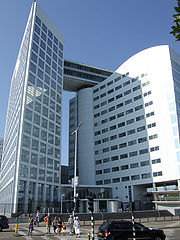 Public international law deals extensively and increasingly with criminal conduct, that is heinous and ghastly enough to affect entire societies and regions. The formative source of modern international criminal law was the Nuremberg trials
following the Second World War in which the leaders of Nazism
were prosecuted for their part in genocide
and atrocities across Europe. The Nuremberg trials marked the beginning of criminal fault for individuals, where individuals acting on behalf of a government can be tried for violations of international law without the benefit of sovereign immunity. In 1998 an International criminal court
was established in the Rome Statute.
Law
Law is a system of rules and guidelines which are enforced through social institutions to govern behavior, wherever possible. It shapes politics, economics and society in numerous ways and serves as a social mediator of relations between people. Contract law regulates everything from buying a bus...
that relates to crime
Crime
Crime is the breach of rules or laws for which some governing authority can ultimately prescribe a conviction...
. It might be defined as the body of rules that defines conduct that is not allowed because it is held to threaten, harm or endanger the safety and welfare of people, and that sets out the punishment to be imposed on people who do not obey these laws. Criminal law is to be distinguished from civil law
Civil law (common law)
Civil law, as opposed to criminal law, is the branch of law dealing with disputes between individuals or organizations, in which compensation may be awarded to the victim...
.
History
The first civilizations generally did not distinguish between civil lawCivil law (area)
Civil law in continental law is a branch of law which is the general part of private law.The basis for civil law lies in a civil code. Before enacting of codes, civil law could not be distinguished from private law...
and criminal law. The important elements are mens rea
Mens rea
Mens rea is Latin for "guilty mind". In criminal law, it is viewed as one of the necessary elements of a crime. The standard common law test of criminal liability is usually expressed in the Latin phrase, actus non facit reum nisi mens sit rea, which means "the act does not make a person guilty...
and actus reus
Actus reus
Actus reus, sometimes called the external element or the objective element of a crime, is the Latin term for the "guilty act" which, when proved beyond a reasonable doubt in combination with the mens rea, "guilty mind", produces criminal liability in the common law-based criminal law jurisdictions...
. The first written codes of law were designed by the Sumerians. Around 2100-2050 BC Ur-Nammu
Ur-Nammu
Ur-Nammu founded the Sumerian 3rd dynasty of Ur, in southern Mesopotamia, following several centuries of Akkadian and Gutian rule...
, the Neo-Sumerian king of Ur
Ur
Ur was an important city-state in ancient Sumer located at the site of modern Tell el-Muqayyar in Iraq's Dhi Qar Governorate...
, enacted the oldest written legal code whose text has been discovered: the Code of Ur-Nammu
Code of Ur-Nammu
The Code of Ur-Nammu is the oldest known tablet containing a law code surviving today. It was written in the Sumerian language circa 2100 BC-2050 BC...
although an earlier code of Urukagina
Urukagina
Urukagina , alternately rendered as Uruinimgina or Irikagina, was a ruler of the city-state Lagash in Mesopotamia...
of Lagash
Lagash
Lagash is located northwest of the junction of the Euphrates and Tigris rivers and east of Uruk, about east of the modern town of Ash Shatrah. Lagash was one of the oldest cities of the Ancient Near East...
( 2380-2360 BC ) is also known to have existed. Another important early code was the Code Hammurabi, which formed the core of Babylonian law
Babylonian law
Archaeological material for the study of Babylonian law is singularly extensive. So-called "contracts" exist in the thousands, including a great variety of deeds, conveyances, bonds, receipts, accounts, and most important of all, actual legal decisions given by the judges in the law courts...
. These early legal codes did not separate penal and civil laws. Of the early criminal laws of Ancient Greece
Ancient Greece
Ancient Greece is a civilization belonging to a period of Greek history that lasted from the Archaic period of the 8th to 6th centuries BC to the end of antiquity. Immediately following this period was the beginning of the Early Middle Ages and the Byzantine era. Included in Ancient Greece is the...
only fragments survive, e.g. those of Solon
Solon
Solon was an Athenian statesman, lawmaker, and poet. He is remembered particularly for his efforts to legislate against political, economic and moral decline in archaic Athens...
and Draco.
Gaius (jurist)
Gaius was a celebrated Roman jurist. Scholars know very little of his personal life. It is impossible to discover even his full name, Gaius or Caius being merely his personal name...
on the Twelve Tables
Twelve Tables
The Law of the Twelve Tables was the ancient legislation that stood at the foundation of Roman law. The Law of the Twelve Tables formed the centrepiece of the constitution of the Roman Republic and the core of the mos maiorum...
also conflated the civil and criminal aspects, treating theft or furtum as a tort
Tort
A tort, in common law jurisdictions, is a wrong that involves a breach of a civil duty owed to someone else. It is differentiated from a crime, which involves a breach of a duty owed to society in general...
. Assault and violent robbery
Robbery
Robbery is the crime of taking or attempting to take something of value by force or threat of force or by putting the victim in fear. At common law, robbery is defined as taking the property of another, with the intent to permanently deprive the person of that property, by means of force or fear....
were analogized to trespass
Trespass
Trespass is an area of tort law broadly divided into three groups: trespass to the person, trespass to chattels and trespass to land.Trespass to the person, historically involved six separate trespasses: threats, assault, battery, wounding, mayhem, and maiming...
as to property. Breach of such laws created an obligation of law or vinculum juris discharged by payment of monetary compensation or damages
Damages
In law, damages is an award, typically of money, to be paid to a person as compensation for loss or injury; grammatically, it is a singular noun, not plural.- Compensatory damages :...
. The criminal law of imperial Rome is collected in Books 47-48 of the Digest. After the revival of Roman law
Roman law
Roman law is the legal system of ancient Rome, and the legal developments which occurred before the 7th century AD — when the Roman–Byzantine state adopted Greek as the language of government. The development of Roman law comprises more than a thousand years of jurisprudence — from the Twelve...
in the 12th century, sixth-century Roman classifications and jurisprudence provided the foundations of the distinction between criminal and civil law in Europe
Europe
Europe is, by convention, one of the world's seven continents. Comprising the westernmost peninsula of Eurasia, Europe is generally 'divided' from Asia to its east by the watershed divides of the Ural and Caucasus Mountains, the Ural River, the Caspian and Black Seas, and the waterways connecting...
an law from then until the present time.
The first signs of the modern distinction between crimes and civil matters emerged during the Norman Invasion of England. The special notion of criminal penalty, at least concerning Europe, arose in Spanish Late Scolasticism (see Alfonso de Castro
Alfonso de Castro
Alfonso de Castro , known also as Alphonsus a Castro, was a Franciscan theologian and jurist...
), when the theological notion of God's penalty (poena aeterna) that was inflicted solely for a guilty mind, became transfused into canon law first and, finally, to secular criminal law. The development of the state
Sovereign state
A sovereign state, or simply, state, is a state with a defined territory on which it exercises internal and external sovereignty, a permanent population, a government, and the capacity to enter into relations with other sovereign states. It is also normally understood to be a state which is neither...
dispensing justice
Justice
Justice is a concept of moral rightness based on ethics, rationality, law, natural law, religion, or equity, along with the punishment of the breach of said ethics; justice is the act of being just and/or fair.-Concept of justice:...
in a court clearly emerged in the eighteenth century when European countries began maintaining police services. From this point, criminal law had formalized the mechanisms for enforcement, which allowed for its development as a discernible entity.
Objectives of Criminal Law
Criminal law is distinctive for the uniquely serious potential consequences or sanctionsSanctions (law)
Sanctions are penalties or other means of enforcement used to provide incentives for obedience with the law, or with rules and regulations. Criminal sanctions can take the form of serious punishment, such as corporal or capital punishment, incarceration, or severe fines...
for failure to abide by its rules. (Dennis J. Baker, The Right Not to be Criminalized: Demarcating Criminal Law's Authority, (Ashgate 2011)
Element (criminal)
Under United States law, an element of a crime or element of an offense is one of the various facts whose proof in the conjunctive is a necessary condition for legal proof that a defendant has committed a given crime...
. Capital punishment
Capital punishment
Capital punishment, the death penalty, or execution is the sentence of death upon a person by the state as a punishment for an offence. Crimes that can result in a death penalty are known as capital crimes or capital offences. The term capital originates from the Latin capitalis, literally...
may be imposed in some jurisdictions for the most serious crimes. Physical or corporal punishment
Corporal punishment
Corporal punishment is a form of physical punishment that involves the deliberate infliction of pain as retribution for an offence, or for the purpose of disciplining or reforming a wrongdoer, or to deter attitudes or behaviour deemed unacceptable...
may be imposed such as whipping
Flagellation
Flagellation or flogging is the act of methodically beating or whipping the human body. Specialised implements for it include rods, switches, the cat o' nine tails and the sjambok...
or caning
Caning
Caning is a form of corporal punishment consisting of a number of hits with a single cane usually made of rattan, generally applied to the offender's bare or clothed buttocks or hand . Application of a cane to the knuckles or the shoulders has been much less common...
, although these punishments are prohibited in much of the world. Individuals may be incarcerated in prison
Prison
A prison is a place in which people are physically confined and, usually, deprived of a range of personal freedoms. Imprisonment or incarceration is a legal penalty that may be imposed by the state for the commission of a crime...
or jail
Jail
A jail is a short-term detention facility in the United States and Canada.Jail may also refer to:In entertainment:*Jail , a 1966 Malayalam movie*Jail , a 2009 Bollywood movie...
in a variety of conditions depending on the jurisdiction. Confinement may be solitary. Length of incarceration may vary from a day to life. Government supervision may be imposed, including house arrest
House arrest
In justice and law, house arrest is a measure by which a person is confined by the authorities to his or her residence. Travel is usually restricted, if allowed at all...
, and convicts may be required to conform to particularized guidelines as part of a parole
Parole
Parole may have different meanings depending on the field and judiciary system. All of the meanings originated from the French parole . Following its use in late-resurrected Anglo-French chivalric practice, the term became associated with the release of prisoners based on prisoners giving their...
or probation
Probation
Probation literally means testing of behaviour or abilities. In a legal sense, an offender on probation is ordered to follow certain conditions set forth by the court, often under the supervision of a probation officer...
regimen. Fines also may be imposed, seizing money or property from a person convicted of a crime.
Five objectives are widely accepted for enforcement of the criminal law by punishments: retribution
Retributive justice
Retributive justice is a theory of justice that considers that punishment, if proportionate, is a morally acceptable response to crime, with an eye to the satisfaction and psychological benefits it can bestow to the aggrieved party, its intimates and society....
, deterrence
Deterrence (legal)
Deterrence is the use of punishment as a threat to deter people from committing a crime. Deterrence is often contrasted with retributivism, which holds that punishment is a necessary consequence of a crime and should be calculated based on the gravity of the wrong done.- Categories :Deterrence can...
, incapacitation
Incapacitation (penology)
Incapacitation in the context of sentencing philosophy refers to the effect of a sentence in terms of positively preventing future offending....
, rehabilitation
Rehabilitation (penology)
Rehabilitation means; To restore to useful life, as through therapy and education or To restore to good condition, operation, or capacity....
and restitution
Restitution
The law of restitution is the law of gains-based recovery. It is to be contrasted with the law of compensation, which is the law of loss-based recovery. Obligations to make restitution and obligations to pay compensation are each a type of legal response to events in the real world. When a court...
. Jurisdictions differ on the value to be placed on each.
- RetributionRetributive justiceRetributive justice is a theory of justice that considers that punishment, if proportionate, is a morally acceptable response to crime, with an eye to the satisfaction and psychological benefits it can bestow to the aggrieved party, its intimates and society....
– Criminals ought to suffer in some way. This is the most widely seen goal. Criminals have taken improper advantage, or inflicted unfair detriment, upon others and consequently, the criminal law will put criminals at some unpleasant disadvantage to "balance the scales." People submit to the law to receive the right not to be murdered and if people contravene these laws, they surrender the rights granted to them by the law. Thus, one who murders may be murdered himself. A related theory includes the idea of "righting the balance."
- DeterrenceDeterrence (legal)Deterrence is the use of punishment as a threat to deter people from committing a crime. Deterrence is often contrasted with retributivism, which holds that punishment is a necessary consequence of a crime and should be calculated based on the gravity of the wrong done.- Categories :Deterrence can...
– Individual deterrence is aimed toward the specific offender. The aim is to impose a sufficient penalty to discourage the offender from criminal behavior. General deterrence aims at society at large. By imposing a penalty on those who commit offenses, other individuals are discouraged from committing those offenses. - IncapacitationIncapacitation (penology)Incapacitation in the context of sentencing philosophy refers to the effect of a sentence in terms of positively preventing future offending....
– Designed simply to keep criminals away from society so that the public is protected from their misconduct. This is often achieved through prisonPrisonA prison is a place in which people are physically confined and, usually, deprived of a range of personal freedoms. Imprisonment or incarceration is a legal penalty that may be imposed by the state for the commission of a crime...
sentences today. The death penalty or banishment have served the same purpose. - RehabilitationRehabilitation (penology)Rehabilitation means; To restore to useful life, as through therapy and education or To restore to good condition, operation, or capacity....
– Aims at transforming an offender into a valuable member of society. Its primary goal is to prevent further offense by convincing the offender that their conduct was wrong. - RestitutionRestitutionThe law of restitution is the law of gains-based recovery. It is to be contrasted with the law of compensation, which is the law of loss-based recovery. Obligations to make restitution and obligations to pay compensation are each a type of legal response to events in the real world. When a court...
– This is a victim-oriented theory of punishment. The goal is to repair, through state authority, any hurt inflicted on the victim by the offender. For example, one who embezzles will be required to repay the amount improperly acquired. Restitution is commonly combined with other main goals of criminal justice and is closely related to concepts in the civil lawCivil law (common law)Civil law, as opposed to criminal law, is the branch of law dealing with disputes between individuals or organizations, in which compensation may be awarded to the victim...
.
Selected criminal laws
Many laws are enforced by threat of criminal punishment, and their particulars may vary widely from place to place. The entire universe of criminal law is too vast to intelligently catalog. Nevertheless, the following are some of the more known aspects of the criminal law.Elements
The criminal law generally prohibits undesirable acts. Thus, proof of a crime requires proof of some act. Scholars label this the requirement of an actus reusActus reus
Actus reus, sometimes called the external element or the objective element of a crime, is the Latin term for the "guilty act" which, when proved beyond a reasonable doubt in combination with the mens rea, "guilty mind", produces criminal liability in the common law-based criminal law jurisdictions...
or guilty act. Some crimes particularly modern regulatory offenses require no more, and they are known as strict liability
Strict liability
In law, strict liability is a standard for liability which may exist in either a criminal or civil context. A rule specifying strict liability makes a person legally responsible for the damage and loss caused by his or her acts and omissions regardless of culpability...
offenses (E.g. Under the Road traffic Act 1988 it is a strict liability offence to drive a vehicle with an alcohol concentration above the prescribed limit). Nevertheless, because of the potentially severe consequences of criminal conviction, judges at common law
Common law
Common law is law developed by judges through decisions of courts and similar tribunals rather than through legislative statutes or executive branch action...
also sought proof of an intent to do some bad thing, the mens rea
Mens rea
Mens rea is Latin for "guilty mind". In criminal law, it is viewed as one of the necessary elements of a crime. The standard common law test of criminal liability is usually expressed in the Latin phrase, actus non facit reum nisi mens sit rea, which means "the act does not make a person guilty...
or guilty mind. As to crimes of which both actus reus and mens rea are requirements, judges have concluded that the elements must be present at precisely the same moment and it is not enough that they occurred sequentially at different times.
Actus reus
Latin
Latin is an Italic language originally spoken in Latium and Ancient Rome. It, along with most European languages, is a descendant of the ancient Proto-Indo-European language. Although it is considered a dead language, a number of scholars and members of the Christian clergy speak it fluently, and...
for "guilty act" and is the physical element of committing a crime. It may be accomplished by an action, by threat of action, or exceptionally, by an omission to act, which is a legal duty to act. For example, the act of A striking B might suffice, or a parent's failure to give food to a young child also may provide the actus reus for a crime.
Where the actus reus is a failure to act, there must be a duty of care. A duty can arise through contract
Contract
A contract is an agreement entered into by two parties or more with the intention of creating a legal obligation, which may have elements in writing. Contracts can be made orally. The remedy for breach of contract can be "damages" or compensation of money. In equity, the remedy can be specific...
, a voluntary undertaking, a blood relation with whom one lives, and occasionally through one's official position. Duty also can arise from one's own creation of a dangerous situation. On the other hand, it was held in the U.K. that switching off the life support of someone in a persistent vegetative state
Persistent vegetative state
A persistent vegetative state is a disorder of consciousness in which patients with severe brain damage are in a state of partial arousal rather than true awareness. It is a diagnosis of some uncertainty in that it deals with a syndrome. After four weeks in a vegetative state , the patient is...
is an omission to act and not criminal. Since discontinuation of power is not a voluntary act, not grossly negligent, and is in the patient's best interests, no crime takes place. In this case it was held that since a PVS patient could not give or withhold consent to medical treatment, it was for the doctors to decide whether treatment was in the patient's best interest. It was reasonable for them to conclude that treatment was not in the patient's best interest, and should therefore be stopped, when there was no prospect of improvement. It was never lawful to take active steps to cause or accelerate death, although in certain circumstances it was lawful to withhold life sustaining treatment, including feeding, without which the patient would die.
An actus reus may be nullified by an absence of causation
Causation (law)
Causation is the "causal relationship between conduct and result". That is to say that causation provides a means of connecting conduct with a resulting effect, typically an injury. In criminal law, it is defined as the actus reus from which the specific injury or other effect arose and is...
. For example, a crime involves harm to a person, the person's action must be the but for cause and proximate cause
Proximate cause
In the law, a proximate cause is an event sufficiently related to a legally recognizable injury to be held the cause of that injury. There are two types of causation in the law, cause-in-fact and proximate cause. Cause-in-fact is determined by the "but-for" test: but for the action, the result...
of the harm. If more than one cause exists (e.g. harm comes at the hands of more than one culprit) the act must have "more than a slight or trifling link" to the harm.
Causation is not broken simply because a victim is particularly vulnerable. This is known as the thin skull rule. However, it may be broken by an intervening act (novus actus interveniens) of a third party, the victim's own conduct, or another unpredictable event. A mistake in medical
Medicine
Medicine is the science and art of healing. It encompasses a variety of health care practices evolved to maintain and restore health by the prevention and treatment of illness....
treatment typically will not sever the chain, unless the mistakes are in themselves "so potent in causing death."
Mens rea
Mens rea is another LatinLatin
Latin is an Italic language originally spoken in Latium and Ancient Rome. It, along with most European languages, is a descendant of the ancient Proto-Indo-European language. Although it is considered a dead language, a number of scholars and members of the Christian clergy speak it fluently, and...
phrase, meaning "guilty mind". This is the mental element of the crime. A guilty mind means an intention
Intention in English law
In English criminal law, intention is one of the types of mens rea that, when accompanied by an actus reus , constitutes a crime.-The standard definitions:...
to commit some wrongful act. Intention under criminal law is separate from a person's motive
Motive (law)
A motive, in law, especially criminal law, is the cause that moves people to induce a certain action. Motive, in itself, is not an element of any given crime; however, the legal system typically allows motive to be proven in order to make plausible the accused's reasons for committing a crime, at...
(although motive does not exist in scots law).
A lower threshold of mens rea is satisfied when a defendant recognises an act is dangerous but decides to commit it anyway. This is recklessness. It is the mental state of mind of the person at the time the actus reus was committed. For instance, if C tears a gas meter from a wall to get the money inside, and knows this will let flammable gas escape into a neighbour's house, he could be liable for poisoning. Courts often consider whether the actor did recognize the danger, or alternatively ought to have recognised a risk. Of course, a requirement only that one ought to have recognized a danger (though he did not) is tantamount to erasing intent as a requirement. In this way, the importance of mens rea
Mens rea
Mens rea is Latin for "guilty mind". In criminal law, it is viewed as one of the necessary elements of a crime. The standard common law test of criminal liability is usually expressed in the Latin phrase, actus non facit reum nisi mens sit rea, which means "the act does not make a person guilty...
has been reduced in some areas of the criminal law but is obviously still an imporant part in the criminal system.
Wrongfulness of intent also may vary the seriousness of an offense and possibly reduce the punishment but this is not always the case. A killing committed with specific intent to kill or with conscious recognition that death
Death
Death is the permanent termination of the biological functions that sustain a living organism. Phenomena which commonly bring about death include old age, predation, malnutrition, disease, and accidents or trauma resulting in terminal injury....
or serious bodily harm
Grievous bodily harm
Grievous bodily harm is a term of art used in English criminal law which has become synonymous with the offences that are created by sections 18 and 20 of the Offences against the Person Act 1861....
will result, would be murder, whereas a killing effected by reckless acts lacking such a consciousness could be manslaughter. On the other hand, it matters not who is actually harmed through a defendant's actions. The doctrine of transferred malice
Transferred intent
Transferred intent describes the fact that intent can be transferred between victims, between torts, or both. In tort law, there are generally five areas in which transferred intent is applicable: battery, assault, false imprisonment, trespass to land, and trespass to chattels...
means, for instance, that if a man intends to strike a person with his belt, but the belt bounces off and hits another, mens rea is transferred from the intended target to the person who actually was struck.[Note: The notion of transferred intent does not exist within Scots' Law. In Scotland, one would not be charged with assault due to transferred intent, but instead assault due to recklessness.]
Strict liability
Strict liability can be described as criminal or civil liability notwithstanding the lack mens rea or intent by the defendant. Not all crimes require specific intent, and the threshold of culpability required may be reduced. For example, it might be sufficient to show that a defendant acted negligentlyNegligence
Negligence is a failure to exercise the care that a reasonably prudent person would exercise in like circumstances. The area of tort law known as negligence involves harm caused by carelessness, not intentional harm.According to Jay M...
, rather than intentionally or recklessly. In offenses of absolute liability
Absolute liability
Absolute liability is a standard of legal liability found in tort and criminal law of various legal jurisdictions.To be convicted of an ordinary crime, in certain jurisdictions, a person must not only have committed a criminal action, but also have had a deliberate intention or guilty mind...
, other than the prohibited act, it may not be necessary to show the act was intentional. Generally, crimes must include an intentional act, and "intent" is an element that must be proved in order to find a crime occurred. The idea of a "strict liability crime" is an oxymoron. The few exceptions are not truly crimes at all – but are administrative regulations and civil penalties created by statute, such as crimes against the traffic or highway code.
Fatal offenses
A murder, defined broadly, is an unlawful killing. Unlawful killing is probably the act most frequently targeted by the criminal law. In many jurisdictions, the crime of murder is divided into various gradations of severity, e.g., murder in the first degree, based on intent. MaliceMalice
Malice may refer to:* Malice , a legal term describing the intent to harm* Jerry Tuite , American professional wrestler also known by the ring name Malice-Entertainment:...
is a required element of murder. Manslaughter (Culpable Homicide in Scotland) is a lesser variety of killing committed in the absence of malice, brought about by reasonable provocation
Provocation (legal)
In criminal law, provocation is a possible defense by excuse or exculpation alleging a sudden or temporary loss of control as a response to another's provocative conduct sufficient to justify an acquittal, a mitigated sentence or a conviction for a lesser charge...
, or diminished capacity
Diminished Capacity
Diminished Capacity is a comedy film directed by Terry Kinney and starring Matthew Broderick, Virginia Madsen, and Alan Alda. It was released at the 2008 Sundance Film Festival and opened in theaters in July 2008...
. Involuntary manslaughter, where it is recognized, is a killing that lacks all but the most attenuated guilty intent, recklessness.
Settled insanity
Settled insanity
Settled insanity is defined as a permanent or "settled" condition caused by long-term substance abuse and differs from the temporary state of intoxication...
is a possible defense.
Personal offenses
Many criminal codes protect the physical integrity of the body. The crime of batteryBattery (crime)
Battery is a criminal offense involving unlawful physical contact, distinct from assault which is the fear of such contact.In the United States, criminal battery, or simply battery, is the use of force against another, resulting in harmful or offensive contact...
is traditionally understood as an unlawful touching, although this does not include everyday knocks and jolts to which people silently consent as the result of presence in a crowd. Creating a fear of imminent battery is an assault
Assault
In law, assault is a crime causing a victim to fear violence. The term is often confused with battery, which involves physical contact. The specific meaning of assault varies between countries, but can refer to an act that causes another to apprehend immediate and personal violence, or in the more...
, and also may give rise to criminal liability. Non-consensual intercourse
Sexual intercourse
Sexual intercourse, also known as copulation or coitus, commonly refers to the act in which a male's penis enters a female's vagina for the purposes of sexual pleasure or reproduction. The entities may be of opposite sexes, or they may be hermaphroditic, as is the case with snails...
, or rape
Rape
Rape is a type of sexual assault usually involving sexual intercourse, which is initiated by one or more persons against another person without that person's consent. The act may be carried out by physical force, coercion, abuse of authority or with a person who is incapable of valid consent. The...
, is a particularly egregious form of battery.
Property offenses
Property often is protected by the criminal law. TrespassTrespass
Trespass is an area of tort law broadly divided into three groups: trespass to the person, trespass to chattels and trespass to land.Trespass to the person, historically involved six separate trespasses: threats, assault, battery, wounding, mayhem, and maiming...
ing is unlawful entry onto the real property of another. Many criminal codes provide penalties for conversion
Criminal conversion
Criminal conversion is the crime of exerting unauthorized use or control of someone else's property. It differs from theft in that it does not include the element of intending to deprive the owner of the possession of that property. As such, it is a lesser included offense of the crime of theft...
, embezzlement
Embezzlement
Embezzlement is the act of dishonestly appropriating or secreting assets by one or more individuals to whom such assets have been entrusted....
, theft
Theft
In common usage, theft is the illegal taking of another person's property without that person's permission or consent. The word is also used as an informal shorthand term for some crimes against property, such as burglary, embezzlement, larceny, looting, robbery, shoplifting and fraud...
, all of which involve deprivations of the value of the property. Robbery
Robbery
Robbery is the crime of taking or attempting to take something of value by force or threat of force or by putting the victim in fear. At common law, robbery is defined as taking the property of another, with the intent to permanently deprive the person of that property, by means of force or fear....
is a theft by force. Fraud
Fraud
In criminal law, a fraud is an intentional deception made for personal gain or to damage another individual; the related adjective is fraudulent. The specific legal definition varies by legal jurisdiction. Fraud is a crime, and also a civil law violation...
in the UK is a breach of the Fraud Act 2006 by false representation, by failure to disclose information or by abuse of position.
Participatory offenses
Some criminal codes criminalize association with a criminal venture or involvement in criminality that does not actually come to fruition. Some examples are aiding, abetting, conspiracyConspiracy (crime)
In the criminal law, a conspiracy is an agreement between two or more persons to break the law at some time in the future, and, in some cases, with at least one overt act in furtherance of that agreement...
, and attempt. However, in Scotland, the English concept of Aiding and Abetting is known as Art and Part Liability. See Glanville Williams, Textbook of Criminal Law, (London: Stevens & Sons, 1983); Glanville Williams, Criminal Law the General Part (London: Stevens & Sons, 1961).
Mala in se v. mala prohibita
While crimes are typically broken into degrees or classes to punish appropriately, all offenses can be divided into 'mala in se' and 'mala prohibita' laws. Both are Latin legal terms, mala in se meaning crimes that are thought to be inherently evil or morally wrong, and thus will be widely regarded as crimes regardless of jurisdiction. Mala in se offenses are felonies, property crimes, immoral acts and corrupt acts by public officials. Mala prohibita, on the other hand, refers to offenses that do not have wrongfulness associated with them. Parking in a restricted area, driving the wrong way down a one-way street, jaywalking or unlicensed fishing are examples of acts that are prohibited by statute, but without which are not considered wrong. Mala prohibita statutes are usually imposed strictly, as there does not need to be mens rea component for punishment under those offenses, just the act itself. For this reason, it can be argued that offenses that are mala prohibita are not really crimes at all.Criminal law jurisdictions
Nuremberg Trials
The Nuremberg Trials were a series of military tribunals, held by the victorious Allied forces of World War II, most notable for the prosecution of prominent members of the political, military, and economic leadership of the defeated Nazi Germany....
following the Second World War in which the leaders of Nazism
Nazism
Nazism, the common short form name of National Socialism was the ideology and practice of the Nazi Party and of Nazi Germany...
were prosecuted for their part in genocide
Genocide
Genocide is defined as "the deliberate and systematic destruction, in whole or in part, of an ethnic, racial, religious, or national group", though what constitutes enough of a "part" to qualify as genocide has been subject to much debate by legal scholars...
and atrocities across Europe. The Nuremberg trials marked the beginning of criminal fault for individuals, where individuals acting on behalf of a government can be tried for violations of international law without the benefit of sovereign immunity. In 1998 an International criminal court
International Criminal Court
The International Criminal Court is a permanent tribunal to prosecute individuals for genocide, crimes against humanity, war crimes, and the crime of aggression .It came into being on 1 July 2002—the date its founding treaty, the Rome Statute of the...
was established in the Rome Statute.
International law
See also
- Civil lawCivil law (common law)Civil law, as opposed to criminal law, is the branch of law dealing with disputes between individuals or organizations, in which compensation may be awarded to the victim...
- Martial lawMartial lawMartial law is the imposition of military rule by military authorities over designated regions on an emergency basis— only temporary—when the civilian government or civilian authorities fail to function effectively , when there are extensive riots and protests, or when the disobedience of the law...
- Administrative lawAdministrative lawAdministrative law is the body of law that governs the activities of administrative agencies of government. Government agency action can include rulemaking, adjudication, or the enforcement of a specific regulatory agenda. Administrative law is considered a branch of public law...
- International lawInternational lawPublic international law concerns the structure and conduct of sovereign states; analogous entities, such as the Holy See; and intergovernmental organizations. To a lesser degree, international law also may affect multinational corporations and individuals, an impact increasingly evolving beyond...