
All Topics  
War crime

 
War Crime

   Email Print
   Bookmark   Link


War crime


War crimes are "violations of the laws or customs of war"; including but not limited to "murder, the ill-treatment or deportation of civilian residents of an occupied territory to slave labor camp
Labor camp

A labor camp is a simplified detention facility where inmates are forced to engage in penal labor. Labor camps have many common aspects with slavery and with prisons....
s", "the murder or ill-treatment of prisoners of war
Prisoner of war

A prisoner of war is a combatant who is held in continuing custody by an enemy power during or immediately after an armed conflict....
", the killing of hostages, "the wanton destruction of cities, towns and villages, and any devastation not justified by military necessity". Similar concepts, such as perfidy
Perfidy

In the context of war, perfidy is a form of deception, in which one side promises to act in good faith with the intention of breaking that promise once the enemy has exposed himself ....
, have existed for many centuries as customary law between civilized countries.


Discussion
Ask a question about 'War crime'
Start a new discussion about 'War crime'
Answer questions from other users
Full Discussion Forum


Encyclopedia


War crimes are "violations of the laws or customs of war"; including but not limited to "murder, the ill-treatment or deportation of civilian residents of an occupied territory to slave labor camp
Labor camp

A labor camp is a simplified detention facility where inmates are forced to engage in penal labor. Labor camps have many common aspects with slavery and with prisons....
s", "the murder or ill-treatment of prisoners of war
Prisoner of war

A prisoner of war is a combatant who is held in continuing custody by an enemy power during or immediately after an armed conflict....
", the killing of hostages, "the wanton destruction of cities, towns and villages, and any devastation not justified by military necessity". Similar concepts, such as perfidy
Perfidy

In the context of war, perfidy is a form of deception, in which one side promises to act in good faith with the intention of breaking that promise once the enemy has exposed himself ....
, have existed for many centuries as customary law between civilized countries. Many of these customary laws were clarified in the Hague Conventions of 1899 and 1907
Hague Conventions (1899 and 1907)

The Hague Conventions were international treaty negotiated at the First and Second Peace Conferences at The Hague, Netherlands in 1899 and 1907, respectively, and were, along with the Geneva Conventions, among the first formal statements of the laws of war and war crimes in the nascent body of secular international law....
. The modern concept of war crime was further developed under the auspices of the Nuremberg Trials
Nuremberg Trials

The Nuremberg Trials were a series of trials, or tribunals, most notable for the prosecution of prominent members of the political, military, and economic leadership of Nazi Germany after its defeat in World War II....
 based on the definition in the London Charter
London Charter of the International Military Tribunal

The London Charter of the International Military Tribunal was the decree issued on August 8, 1945, that set down the laws and procedures by which the Nuremberg trials were to be conducted....
 that was published on August 8, 1945. (Also see Nuremberg Principles
Nuremberg Principles

The Nuremberg Principles were a set of guidelines for determining what constitutes a war crime. The document was created by necessity during the Nuremberg Trials of Nazism party members following World War II....
.) Along with war crimes the charter also defined crimes against peace and crimes against humanity
Crime against humanity

Crimes against humanity, as defined by the Rome Statute of the International Criminal Court Explanatory Memorandum, "are particularly odious offences in that they constitute a serious attack on human dignity or grave humiliation or a degradation of one or more human beings....
, which are often committed during wars and in concert with war crimes.

Leonardgsiffleet
Article 22 of the Hague IV ("Laws of War: Laws and Customs of War on Land (Hague IV); October 18, 1907") states that "The right of belligerents to adopt means of injuring the enemy is not unlimited" and over the last century many other treaties have introduced positive laws that place constraints on belligerents (see International treaties on the laws of war). Some of the provisions, such as those in the Hague conventions, are considered to be part of customary international law, and are binding on all. Others are only binding on individuals if the belligerent power to which they belong is a party to the treaty which introduced the constraint.

Definition

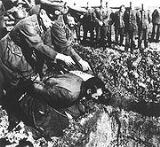
Malmedy Massacre
War crimes includes violations of established protections of the laws of war, but also include failures to adhere to norms of procedure and rules of battle
Battle

Generally, a battle is a conceptual component in the hierarchy of combat in warfare between two or more armed forces, wherein each group will seek to defeat the others within the scope of a military campaign, and are well defined in duration, area and force commitment....
, such as attacking those displaying a flag of truce
White flag

White flags have had different meanings throughout history and depending on the locale....
, or using that same flag as a ruse of war
Ruse of war

A ruse of war is an action taken by a belligerent in warfare to fool the enemy in order to gain military espionage or a military advantage against an enemy....
 to mount an attack. Attacking enemy troops while they are being deployed by way of a parachute is not a war crime. However, Protocol I, Article 42 of the Geneva Conventions
Geneva Conventions

The Geneva Conventions consist of four treaties formulated in Geneva, Switzerland, that set the standards for international law for humanitarian concerns....
 explicitly forbids attacking parachutists who eject from damaged airplanes, and surrendering parachutists once landed. War crimes include such acts as mistreatment of prisoners of war
Prisoner of war

A prisoner of war is a combatant who is held in continuing custody by an enemy power during or immediately after an armed conflict....
 or civilians. War crimes are sometimes part of instances of mass murder
Mass murder

Mass murder is the act of murdering a large number of people, typically at the same time or over a relatively short period of time. Mass murder may be committed by individuals or organizations....
 and genocide
Genocide

Genocide is the deliberate and systematic destruction, in whole or in part, of an ethnic, racial, religious, or national group.While precise genocide definitions, a legal definition is found in the 1948 United Nations Convention on the Prevention and Punishment of the Crime of Genocide ....
 though these crimes are more broadly covered under international humanitarian law
International humanitarian law

International humanitarian law , often referred to as the laws of war, the laws and customs of war or the law of armed conflict, is the legal corpus "comprised of the Geneva Conventions and the Hague Conventions , as well as subsequent treaties, case law, and customary international law." It defines the conduct and responsib...
 described as crimes against humanity
Crime against humanity

Crimes against humanity, as defined by the Rome Statute of the International Criminal Court Explanatory Memorandum, "are particularly odious offences in that they constitute a serious attack on human dignity or grave humiliation or a degradation of one or more human beings....
.

War crimes are significant in international humanitarian
Humanitarianism

Humanitarianism is an active belief in the value of human life, whereby humans practice benevolent treatment and provide assistance to other humans, in order to better humanity for both moral and logical reasons....
 law because it is an area where international tribunals such as the Nuremberg Trials
Nuremberg Trials

The Nuremberg Trials were a series of trials, or tribunals, most notable for the prosecution of prominent members of the political, military, and economic leadership of Nazi Germany after its defeat in World War II....
 and Tokyo trials
International Military Tribunal for the Far East

The International Military Tribunal for the Far East , also known as the Tokyo Trial, the Tokyo War Crimes Tribunal or simply as the Tribunal, was convened to criminal procedure the leaders of the Empire of Japan for three types of crimes: "Class A" , "Class B" , and "Class C" , committed during World War II....
 have been convened. Recent examples are the International Criminal Tribunal for the Former Yugoslavia
International Criminal Tribunal for the former Yugoslavia

The International Tribunal for the Prosecution of Persons Responsible for Serious Violations of International Humanitarian Law Committed in the Territory of the Former Yugoslavia since 1991, more commonly referred to as the International Criminal Tribunal for the former Yugoslavia or ICTY, is a body of the United Nations establis...
 and the International Criminal Tribunal for Rwanda
International Criminal Tribunal for Rwanda

The International Criminal Tribunal for Rwanda , or the Tribunal p?nal international pour le Rwanda , is an international court established in November 1994 by the United Nations Security Council in order to judge those people responsible for the Rwandan genocide and other serious violations of the international law performed in the te...
, which were established by the UN Security Council acting under Chapter VIII of the UN Charter
United Nations Charter

The United Nations Charter is the treaty that forms and establishes the international organization called the United Nations. It was signed at the United Nations Conference on International Organization in San Francisco, California, United States, on June 26, 1945, by 50 of the 51 original member countries ....
.

Under the Nuremberg Principles
Nuremberg Principles

The Nuremberg Principles were a set of guidelines for determining what constitutes a war crime. The document was created by necessity during the Nuremberg Trials of Nazism party members following World War II....
, war crimes are different from crimes against peace which is planning, preparing, initiating, or waging a war of aggression
War of aggression

A war of aggression is a military conflict waged absent the justification of self-defense. Waging such a war of aggression is a crime under the customary international law....
, or a war in violation of international treaties, agreements, or assurances.

International Criminal Court

On July 1, 2002, the International Criminal Court
International Criminal Court

The International Criminal Court , Cour p?nale internationale in french language, is a permanent tribunal to prosecute individuals for genocide, crime against humanity, war crimes, and the crime of aggression ....
, a treaty-based court located in The Hague
The Hague

The Hague is the third largest city in the Netherlands after Amsterdam and Rotterdam, with a population of 475,904 and an area of approximately 100 km?....
, came into being for the prosecution of war crimes committed on or after that date. However, several nations, most notably the United States
United States

The United States of America is a Federal government constitutional republic comprising U.S. state and a federal district. The country is situated mostly in central North America, where its Contiguous United States and Washington, D.C., the Capital districts and territories, lie between the Pacific Ocean and Atlantic Oceans, Borders of the U...
, China
China

China is a Culture of China, an ancient civilization, and, depending on perspective, a national or multinational entity extending over a large area in East Asia....
, and Israel
Israel

Israel officially the State of Israel , is a country in the Middle East located on the eastern shore of the Mediterranean Sea. It borders Lebanon in the north, Syria in the northeast, Jordan in the east, and Egypt on the southwest, and contains geographically diverse features within its relatively small area....
, have criticized the court and refuse to participate in it or to permit the court to have jurisdiction over their citizens. Note, however, that a citizen of one of the 'objector nations' could still find himself before the Court if he were accused of committing war crimes in a country that was a state party, regardless of the fact that their country of origin was not a signatory.

War crimes are defined in the statute that established the International Criminal Court, which includes:
  1. Grave breaches of the Geneva Conventions, such as:
    1. Willful killing, or causing great suffering or serious injury to body or health
    2. Torture
      Torture

      Torture, according to the United Nations Convention Against Torture, is:In addition to state-sponsored torture, individuals or groups may be motivated to inflict torture on others for similar reasons to those of a state; however, the motive for torture can also be for the sadism gratification of the torturer, as was the case in the Moors M...
       or inhumane treatment
    3. Unlawful wanton destruction or appropriation of property
    4. Forcing a prisoner of war
      Prisoner of war

      A prisoner of war is a combatant who is held in continuing custody by an enemy power during or immediately after an armed conflict....
       to serve in the forces of a hostile power
    5. Depriving a prisoner of war of a fair trial
    6. Unlawful deportation
      Deportation

      Deportation generally means the expulsion of a person or group of people from a place or country. The expulsion of natives is also called banishment, exile, or penal transportation....
      , confinement or transfer
      Population transfer

      Population transfer is the movement of a large group of people from one region to another by state policy or international authority, most frequently on the basis of ethnicity or religion....
    7. Taking hostage
      Hostage

      A hostage is a person or entity which is held by a captor. The original definition meant that this was handed over by one of two belligerent parties to the other or seized as security for the carrying out of an agreement, or as a preventive measure against certain acts of war....
      s
  2. The following acts as part of an international conflict:
    1. Directing attacks against civilians
    2. Directing attacks against humanitarian
      Humanitarianism

      Humanitarianism is an active belief in the value of human life, whereby humans practice benevolent treatment and provide assistance to other humans, in order to better humanity for both moral and logical reasons....
       workers or UN
      United Nations

      The United Nations is an international organization whose stated aims are to facilitate cooperation in international law, international security, economic development, Social change, human rights and achieving world peace....
       peacekeeper
      Peacekeeper

      Peacekeeper may refer to:* A person involved in peacekeeping* Peace officer* Conservator of the Peace* Peacekeepers In vehicles:* The LGM-118A Peacekeeper, a land-based nuclear ICBM...
      s
    3. Killing a surrendered combatant
      Combatant

      A combatant is someone who takes a direct part in the hostilities of an armed conflict. If a combatant follows the law of war, then they are considered a privileged combatant, and upon capture they qualify as a prisoner of war under the Third Geneva Convention ....
    4. Misusing a flag of truce
    5. Settlement of occupied territory
    6. Deportation of inhabitants of occupied territory
    7. Using poison weapons
    8. Using civilians as shields
    9. Using child soldiers
      Military use of children

      The military use of children takes three distinct forms: children can take direct part in hostilities , or they can be used in support roles such as porters, spies, messengers, look outs, and sexual slavery; or they can be used for political advantage either as human shields or in propaganda....
  3. The following acts as part of a non-international conflict:
    1. Murder
      Murder

      Murder as defined in common law countries, is the unlawful killing of another human being with intent , and generally this state of mind distinguishes murder from other forms of unlawful homicide....
      , cruel or degrading treatment and torture
    2. Directing attacks against civilians, humanitarian workers or UN peacekeepers
    3. Taking hostages
    4. Summary execution
    5. Pillage
      Looting

      Looting , to rob, sacking, plundering, despoiling, or pillaging is the indiscriminate taking of goods by force as part of a military or political victory, or during a catastrophe or riot, such as during war, natural disaster, or rioting....
    6. Rape
      Rape

      Rape, also referred to as sexual assault, is an assault by a person involving sexual intercourse with or sexual penetration of another person without that person's consent....
      , sexual slavery
      Sexual slavery

      Sexual slavery refers to the organized coercion of unwilling people into different sexual practices. Sexual slavery may include single-owner sexual slavery, ritual slavery sometimes associated with traditional religious practices, slavery for primarily non-sexual purposes where sex is common, or forced prostitution....
      , forced prostitution or forced pregnancy


However the court only has jurisdiction over these crimes where they are "part of a plan or policy or as part of a large-scale commission of such crimes"

Prominent indictees

Heads of state & government To date, the former heads of state
Head of State

Head of state is the generic term for the individual or collective office that serves as the chief public representative of a monarchic or republican nation-state, federation, commonwealth or any other political state....
 and heads of government
Head of government

The head of government is the chief officer of the executive branch of a government, often presiding over a cabinet . In a parliamentary system, the head of government is often styled Prime Minister, President of the Government, Premier, etc....
 that have been charged with war crimes include:
  • Germany
    Germany

    Germany , officially the Federal Republic of Germany , is a country in Central Europe. It is bordered to the north by the North Sea, Denmark, and the Baltic Sea; to the east by Poland and the Czech Republic; to the south by Austria and Switzerland; and to the west by France, Luxembourg, Belgium, and the Netherlands....
     Großadmiral Karl Dönitz
    Karl Dönitz

    Karl D?nitz was a Germany naval Commander who served in the Kaiserliche Marine during World War I and commanded the German Navy during the second half of World War II....
     and Prime Minister
    Prime minister

    A prime minister is the most senior minister of Cabinet in the Executive branch of government in a parliamentary system. The position is usually held by, but need not always be held by, a politician....
     General
    General

    A General officer is an Officer of high military rank. The term or equivalent is used by nearly every country in the world. General can be used as a generic term for all grades of general officer, or it can specifically refer to a single rank that is just called general....
     Hideki Tojo
    Hideki Tojo

    Hideki Tojo was a general in the Imperial Japanese Army and the 40th Prime Minister of Japan during much of World War II, from 18 October 1941 to 22 July 1944....
     of the Empire of Japan
    Empire of Japan

    The Empire of Japan was a Japanese political entity that existed during the period from the Meiji Restoration in 1868 until its defeat in World War II in 1945....
     in the aftermath of World War II
    World War II

    World War II, or the Second World War , was a global military conflict which involved a Participants in World War II, including all of the great powers, organised into two opposing military alliances: the Allies of World War II and the Axis powers....
    .
  • Former Yugoslav
    Federal Republic of Yugoslavia

    The Federal Republic of Yugoslavia or FRY was a federal state consisting of the republics of Republic of Serbia and Republic of Montenegro from the former Socialist Federal Republic of Yugoslavia , created after the other four republics broke away from Yugoslavia amid rising ethnic tensions....
     President Slobodan Miloševic
    Slobodan Miloševic

    Slobodan Milo?evic, whose last/family name sometimes is transliteration as Miloshevich was President of Serbia and of President of Yugoslavia....
     was brought to trial for war crimes and genocide
    Genocide

    Genocide is the deliberate and systematic destruction, in whole or in part, of an ethnic, racial, religious, or national group.While precise genocide definitions, a legal definition is found in the 1948 United Nations Convention on the Prevention and Punishment of the Crime of Genocide ....
    , but died in custody on March 11, 2006, before the trial could be concluded.
  • Former Liberian President Charles G. Taylor was also brought to the Hague charged with war crimes; his trial was provisionally scheduled to begin in April 2007, but was postponed until June 2007 to allow the defense more time to prepare, and is now ongoing.
  • Former Bosnian Serb President
    Politics of Republika Srpska

    This article is about the politics of the Republika Srpska, one of the Political divisions of Bosnia and Herzegovina that together comprise the state of Bosnia and Herzegovina, the other being the Federation of Bosnia and Herzegovina....
     Radovan Karadžic
    Radovan Karadžic

    Radovan Karad?ic is a former Bosnian Serb politician, poet and psychiatry. He is currently in the United Nations Detention Unit of Scheveningen for war crime charges committed against people of Muslim faith, as well as Croats, Bosnians, other non-serbs and non-nationalist Serbs during the siege of Sarajevo, and genocide of 8,000 Muslims in S...
     was arrested in Belgrade on 18 July, 2008 and brought before Belgrade’s War Crimes Court a few days after. He was extradited to the Netherlands, and is currently in The Hague, in the custody of the International Criminal Tribunal for the former Yugoslavia. He has not yet entered a plea; his next appearance was on 29 August 2008.
  • Ratko Mladic
    Ratko Mladic

    Ratko Mladic , born March 12, 1942, a war crimes fugitive, was the Chief of Staff of the Army of the Republika Srpska during the Bosnian War of 1992-1995....
     (usually referred to as "General Mladic") has been indicted for genocide during the Bosnian War; he has not been caught and awaits capture for multiple war crimes against Bosnian muslims.


Other prominent indictees
  • Hermann Göring
    Hermann Göring

    Hermann Wilhelm G?ring was a Germany politician, military leader and a leading member of the Nazi Party. Among many offices, he was Hitler's designated successor and commander of the Luftwaffe ....
     - Reichsmarschall
    Reichsmarschall

    Reichsmarschall was the highest rank in the armed forces of Nazi Germany during World War II after the position of Supreme Commander held by Adolf Hitler....
    , Commander in Chief of the Luftwaffe
    Luftwaffe

    is a generic German term for an air force. It is also the official name for two of the four historic German air forces, the Wehrmacht air arm founded in 1933 and disbanded in 1946; and the current Bundeswehr air arm founded in 1956....
     (German Air Force) and designated successor to Adolf Hitler
    Adolf Hitler

    Adolf Hitler was an Austrian-born Germany politician and the leader of the National Socialist German Workers Party , popularly known as the Nazi Party....
     (until 1945)
  • Ernst Kaltenbrunner
    Ernst Kaltenbrunner

    Ernst Kaltenbrunner was a senior Germany official during World War II, holding the offices of Chief of the RSHA, and President of Interpol. He was the highest-ranking Schutzstaffel leader to face trial, having the full rank of Obergruppenf?hrer und General der Polizei und Waffen-SS....
     - highest ranking SS leader to face trial.
  • Adolf Eichmann
    Adolf Eichmann

    Karl Adolf Eichmann , sometimes referred to as "the architect of the Holocaust", was a Nazism and Schutzstaffel-Obersturmbannf?hrer . Due to his organizational talents and ideological reliability, he was charged by Obergruppenf?hrer Reinhard Heydrich with the task of facilitating and managing the logistics of mass deportation of J...
     - senior member of the SS and the "the architect of the Holocaust"
  • Wilhelm Keitel
    Wilhelm Keitel

    Wilhelm Bodewin Gustav Keitel was a Germany field marshal . As head of the Oberkommando der Wehrmacht, he was one of Germany's most senior military leaders during World War II....
     - Generalfeldmarschall
    Generalfeldmarschall

    Generalfeldmarschall was a rank in the armies of several Germany states, the Holy Roman Empire, and the Austrian Empire. The rank was the equivalent to a Grand Admiral in the German Navy....
    , head of the Oberkommando der Wehrmacht
    Oberkommando der Wehrmacht

    The Oberkommando der Wehrmacht was part of the command structure of the armed forces of Nazi Germany during World War II....
     (High Command of the Armed Forces)
  • Erich Raeder
    Erich Raeder

    Erich Johann Albert Raeder was a Navy leader in Germany before and during World War II. Raeder attained the highest possible naval rank?that of Grand Admiral ?in 1939, becoming the first person to hold that rank since Alfred von Tirpitz....
     - Großadmiral, Commander in Chief of the Kriegsmarine
    Kriegsmarine

    The Kriegsmarine was the name of the German Navy between 1935 and 1945, during the Nazi Germany regime, superseding the Reichsmarine, and the Kaiserliche Marine of World War I....
     from 1928 until his retirement in 1943


Ambiguity

The Geneva Conventions
Geneva Conventions

The Geneva Conventions consist of four treaties formulated in Geneva, Switzerland, that set the standards for international law for humanitarian concerns....
 are a treaty that represent a legal basis for International Law with regard to conduct of warfare. Not all nations are signatories to the GC, and as such retain different codes and values with regard to wartime conduct. Some signatories have routinely violated the Geneva Conventions in a way which either uses the ambiguities of law or political maneuvering to sidestep the laws' formalities and principles.

Because the definition of a state of "war" may be debated, the term "war crime" itself has seen different usage under different systems of international and military law. It has some degree of application outside of what some may consider to be a state of "war," but in areas where conflicts persist enough to constitute social instability. The legalities of war have sometimes been accused of containing favoritism toward the winners ("Victor's justice
Victor's justice

The label "victor's justice" to a situation in which they believe that a victorious nation is applying different rules to judge what is right or wrong for their own forces and for those of the enemy....
"), as certain controversies have not been ruled as war crimes. Some examples include the Allies' destruction of civilian Axis targets during World War I
World War I

World War I, or the First World War , was a global military conflict which involved the Great powers, organized into two opposing military alliances: the Allies of World War I and the Central Powers....
 and World War II
World War II

World War II, or the Second World War , was a global military conflict which involved a Participants in World War II, including all of the great powers, organised into two opposing military alliances: the Allies of World War II and the Axis powers....
 (the firebombing of the German city of Dresden
Dresden

Dresden is the capital city of the Germany Federal Free state of Saxony. It is situated in a valley on the River Elbe. The Dresden conurbation is part of the Saxon triangle metropolitan area....
 is one such example), the use of atomic bombs on Hiroshima
Hiroshima

The Japanese city of is the capital of Hiroshima Prefecture, and the largest city in the Chugoku region of western Honshu, the largest of Japan's islands....
 and Nagasaki in World War II
World War II

World War II, or the Second World War , was a global military conflict which involved a Participants in World War II, including all of the great powers, organised into two opposing military alliances: the Allies of World War II and the Axis powers....
; the use of Agent Orange
Agent Orange

Agent Orange is the code name for a powerful herbicide and defoliant used by the United States armed forces in its Herbicidal Warfare program during the Vietnam War....
 against civilian targets in the Vietnam war
Vietnam War

The Vietnam War, also known as the Second Indochina Wars, the Vietnam Conflict, or often in Vietnam the American War occurred in Vietnam, Laos and Cambodia from 1959 to April 30, 1975....
; the mass killing of Biharies by Kader Siddique and Mukti Bahini before or after victory of Bangladesh Liberation War
Bangladesh Liberation War

The Bangladesh Liberation WarBangladesh Liberation War/nomenclature justification was an armed conflict pitting West Pakistan against East Pakistan and India, that resulted in the secession of East Pakistan to become the independent nation of Bangladesh....
 in Bangladesh between 1971 and 1972; and the Indonesia
Indonesia

The Republic of Indonesia , is a transcontinental country in Southeast Asia and Oceania. Comprising Islands of Indonesia, it is the world's largest Archipelago state....
n occupation of East Timor
East Timor

East Timor, also known as Timor-Leste is a country in Southeast Asia. It comprises the eastern half of the island of Timor, the nearby islands of Atauro Island and Jaco , and Oecussi-Ambeno, an exclave on the northwestern side of the island, within Indonesian West Timor....
 between 1976 and 1999.

Another example is the Allied re-designation of German POWs (under the protection of the Geneva conventions) into Disarmed Enemy Forces
Disarmed Enemy Forces

Disarmed Enemy Forces, and — less commonly — Surrendered Enemy Forces, was a U.S. designation, both for soldiers who surrendered to an adversary after hostilities ended, and for those previously surrendered POWs who were held in camps in occupied German territory at that time....
 (allegedly unprotected by the Geneva conventions), many of which then were used for forced labor
Forced Labor

#REDIRECT Unfree labour...
 such as clearing minefields. By December 1945 it was estimated by French authorities that 2,000 German prisoners were being killed or maimed each month in mine-clearing accidents.

In areas where International Law is yet unresolved, some ambiguity remains with regard to which crimes are considered as such and which are not.

Punishment

The punishment for committing war crimes was capital punishment
Capital punishment

Capital punishment, the death penalty or execution, is the killing of a person by procedural law for Punishment#Retribution and Punishment#Incapacitation....
, but in many cases, war criminals were sent to national prisons to live out the rest of their lives. At the modern international tribunals, capital punishment is banned, and conviction results in a sentence for a term of years. The convicted person serves his or her sentence in a national prison system, whose country has agreed with the tribunal to effect execution of sentence.

See also


Country listings
  • List of war crimes
    List of war crimes

    This article lists and summarizes war crimes committed since the Hague Conventions %281899 and 1907%29#Hague Convention of 1907. In addition, those incidents which have been judged in a court of justice to be crime against peace that have been committed since these crimes were first defined are also included....
  • Allied war crimes during World War II
  • War crimes committed by the United States
    War crimes committed by the United States

    War crimes commited by the United States gives a short overview of allegations of serious crimes committed by the American Army's leadership, units and individual members of the American armed forces, particularly murder and rape....
  • German war crimes
    German war crimes

    Germany committed war crimes in both World War I and World War II. The most notable of these is the Holocaust in which millions of people were murdered or died from abuse and neglect, 43% of them Jews....
  • War crimes of the Wehrmacht
    War crimes of the Wehrmacht

    War crimes of the Wehrmacht were those carried out by traditional German armed forces during World War II. While the principal perpetrators of the Holocaust amongst German armed forces were the Nazi Germany political armies , the traditional armed forces represented by the Wehrmacht committed war crimes of their own, particularly on the...
  • Soviet war crimes
  • Japanese war crimes
    Japanese war crimes

    Japanese war crimes occurred during the period of Japanese expansionism. Some of the incidents have also been described as an Asian Holocaust and Japanese war atrocities....
  • 1902 Lodge Committee investigating Philippine-American war crimes
    Lodge Committee

    The Lodge Committee was a United States Senate committee which held hearings to investigate allegations of war crimes in the Philippine-American War....
  • 1971 Bangladesh atrocities
    1971 Bangladesh atrocities

    Beginning with the start of Operation Searchlight on 25 March 1971 and continuing throughout the Bangladesh War of Independence, there were widespread violations of human rights in East Pakistan perpetrated by the Pakistan Army with support from local political and religious militias....
  • Ottoman war crimes
    Armenian Genocide

    The Armenian Genocide , also known as the Armenian Holocaust, the Armenian Massacres and, by Armenians, the Great Calamity —refers to the deliberate and systematic destruction of the Armenian people population of the Ottoman Empire during and just after World War I....


Legal issues
  • Laws of war
    Laws of war

    The law of war is law concerning acceptable practices relating to war. In cases other than civil wars, it is considered an aspect of public international law ....
  • Command responsibility
    Command responsibility

    Command responsibility, sometimes referred to as the Yamashita standard or the Medina standard, is the doctrine of hierarchical accountability in cases of war crimes....
  • War Crimes Law (Belgium)
    War Crimes Law (Belgium)

    Belgium's War Crimes Law invokes the concept of universal jurisdiction to allow anyone to bring war crime charges in Belgian courts, regardless of where the alleged crimes have taken place....
  • Russell Vietnam War Crimes Tribunal - 1967
    Russell Tribunal

    The Russell Tribunal, also known as the International War Crimes Tribunal or Russell-Sartre Tribunal, was a public body organized by British philosopher Bertrand Russell and hosted by French philosopher and playwright Jean-Paul Sartre....
  • The International Criminal Court and the 2003 invasion of Iraq
    The International Criminal Court and the 2003 invasion of Iraq

    The Prosecutor of the International Criminal Court reported in February 2006 that he had received 240 communications in connection with the 2003 invasion of Iraq which alleged that various war crimes had been committed....
  • Special Court for Sierra Leone
    Special Court for Sierra Leone

    The Special Court for Sierra Leone is an independent judicial body set up to "try those who bear greatest responsibility" for the war crimes and crimes against humanity committed in Sierra Leone after 30 November 1996 during the Sierra Leone Civil War....


Miscellaneous
  • Crimes against humanity
    Crime against humanity

    Crimes against humanity, as defined by the Rome Statute of the International Criminal Court Explanatory Memorandum, "are particularly odious offences in that they constitute a serious attack on human dignity or grave humiliation or a degradation of one or more human beings....
  • Crime against peace
    Crime against peace

    A crime against peace, in international law, refers to "planning, preparation, initiation, or waging of War of aggression, or a war in violation of international treaties, agreements or assurances, or participation in a common plan or conspiracy for the accomplishment of any of the foregoing" ....
  • NKVD massacres of prisoners
  • Consequences of German Nazism
    Consequences of German Nazism

    German Nazism and the acts of the Nazi Germany profoundly affected many countries, communities and peoples before, during and after World War II. While the attempt of Germany to exterminate several nations viewed as Untermensch by Nazi ideology was stopped by the Allies, Nazi aggression nevertheless led to the deaths of tens of millions and the rui...
  • Human shield
    Human shield

    Human shield is a military and political term describing the presence of civilians in or around combat targets to deter an enemy from attacking those targets....
  • Cases before the International Criminal Court
    Cases before the International Criminal Court

    As of March 2009, the International Criminal Court has launched investigations into four situations: Northern Uganda, the Democratic Republic of the Congo, the Central African Republic and Darfur ....
  • Transitional Justice
    Transitional justice

    Transitional justice generally refers to a range of approaches that states may use to address past Human rights violations and includes both judicial and non-judicial approaches....
  • Nuremberg Principles
    Nuremberg Principles

    The Nuremberg Principles were a set of guidelines for determining what constitutes a war crime. The document was created by necessity during the Nuremberg Trials of Nazism party members following World War II....
  • Katyn massacre
    Katyn massacre

    The Katyn massacre, also known as the Katyn Forest massacre , was a mass murder of thousands of Poles military officers, policemen, intellectuals and civilian pow by Soviet NKVD, based on a proposal from Lavrentiy Beria to execute all members of the Polish Officer Corps dated March 5 1940....


Further reading

  • Mark Santillen "My Life with Pietro Koch - The history of the beast of Frascati". Gunther edition , Rome 2007
  • Aryeh Neier
    Aryeh Neier

    Aryeh Neier is an United States human rights activist who serves as the president of the Open Society Institute and had earlier been Executive Director of Human Rights Watch and National Director of the American Civil Liberties Union....
    , War Crimes: Brutality, Genocide, Terror and the Search for Justice. New York: Times Books & Random House, 1998.
  • Fabio Maniscalco, World Heritage and War, monographic collection "Mediterraneum", vol. 6, Naples: Massa Publisher, 2007.
  • Interview with History by Oriana Fallaci
    Oriana Fallaci

    Oriana Fallaci was an Italy journalist, author, and political interviewer. A former Italian resistance movement during World War II, she had a long and successful journalistic career....
    - Allegation against Mass killing of Kader Siddique to Sheikh Muzibur Rahaman in his interview.
  • Khojaly massacre
    Khojaly Massacre

    The Khojaly Massacre was the killing of hundreds of ethnic Azerbaijani people civilians from the town of Khojaly on 25 February 1992 during the Nagorno-Karabakh War....


External links


Footnotes