
All Topics  
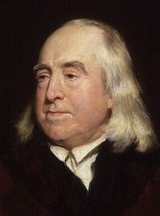
Jeremy Bentham

 
Jeremy Bentham

   Email Print
   Bookmark   Link


Jeremy Bentham


Jeremy Bentham (IPA
International Phonetic Alphabet

The International Phonetic Alphabet "The acronym 'IPA' strictly refers [...] to the 'International Phonetic Association'. But it is now such a common practice to use the acronym also to refer to the alphabet itself that resistance seems pedantic....
: or ) (15 February 1748–6 June 1832) was an English
England

native_name =|conventional_long_name = England|common_name = England|image_flag = Flag of England.svg|image_coat = England COA.svg|symbol_type = Royal Coat of Arms...
 jurist
Jurist

A jurist or jurisconsult is a professional who studies, develops, applies, or otherwise deals with the law. The term is widely used in American English, but in the United Kingdom and many Commonwealth of Nations countries it has only historical and specialist usage....
, philosopher, and legal and social reformer. He was the brother of Samuel Bentham
Samuel Bentham

Sir Samuel Bentham was a noted England mechanical engineering and naval architect credited with numerous innovations, particularly related to naval architecture, including weapons....
. He was a political radical, and a leading theorist in Anglo-American philosophy of law. He is best known for his advocacy of utilitarianism
Utilitarianism

Utilitarianism is the idea that the morality of an action is determined solely by its contribution to overall utility: that is, its contribution to happiness or pleasure as summed among all persons....
, for the concept of animal rights
Animal rights

Animal rights, also known as animal liberation, is the idea that the most basic interests of animals should be afforded the same consideration as the similar interests of human beings....
, and his opposition to the idea of natural rights
Natural rights

Some philosophy and political science make a distinction between natural and legal rights. Natural rights are rights which are not contingent upon the laws, customs, or beliefs of a particular society or polity....
, with his oft-quoted statement that the idea of such rights is "nonsense upon stilts." He also influenced the development of welfarism
Welfarism

Welfarism is a form of consequentialism. Like all forms of consequentialism, welfarism is based on the premise that actions, policies, and/or rules should be evaluated on the basis of their consequences....
.


Discussion
Ask a question about 'Jeremy Bentham'
Start a new discussion about 'Jeremy Bentham'
Answer questions from other users
Full Discussion Forum


Recent Posts


Encyclopedia


Jeremy Bentham (IPA
International Phonetic Alphabet

The International Phonetic Alphabet "The acronym 'IPA' strictly refers [...] to the 'International Phonetic Association'. But it is now such a common practice to use the acronym also to refer to the alphabet itself that resistance seems pedantic....
: or ) (15 February 1748–6 June 1832) was an English
England

native_name =|conventional_long_name = England|common_name = England|image_flag = Flag of England.svg|image_coat = England COA.svg|symbol_type = Royal Coat of Arms...
 jurist
Jurist

A jurist or jurisconsult is a professional who studies, develops, applies, or otherwise deals with the law. The term is widely used in American English, but in the United Kingdom and many Commonwealth of Nations countries it has only historical and specialist usage....
, philosopher, and legal and social reformer. He was the brother of Samuel Bentham
Samuel Bentham

Sir Samuel Bentham was a noted England mechanical engineering and naval architect credited with numerous innovations, particularly related to naval architecture, including weapons....
. He was a political radical, and a leading theorist in Anglo-American philosophy of law. He is best known for his advocacy of utilitarianism
Utilitarianism

Utilitarianism is the idea that the morality of an action is determined solely by its contribution to overall utility: that is, its contribution to happiness or pleasure as summed among all persons....
, for the concept of animal rights
Animal rights

Animal rights, also known as animal liberation, is the idea that the most basic interests of animals should be afforded the same consideration as the similar interests of human beings....
, and his opposition to the idea of natural rights
Natural rights

Some philosophy and political science make a distinction between natural and legal rights. Natural rights are rights which are not contingent upon the laws, customs, or beliefs of a particular society or polity....
, with his oft-quoted statement that the idea of such rights is "nonsense upon stilts." He also influenced the development of welfarism
Welfarism

Welfarism is a form of consequentialism. Like all forms of consequentialism, welfarism is based on the premise that actions, policies, and/or rules should be evaluated on the basis of their consequences....
. He is probably best known in popular society as the originator of the concept of the panopticon
Panopticon

The Panopticon is a type of prison building designed by English philosopher and social theorist Jeremy Bentham in 1785. The concept of the design is to allow an observer to observe all prisoners without the prisoners being able to tell whether they are being watched, thereby conveying what one architect has called the "sentiment of an inv...
.

He became known as one of the most influential of the utilitarians, through his own work and that of his students. These included his secretary and collaborator on the utilitarian school of philosophy, James Mill
James Mill

James Mill was a Scotland historian, economist, political theorist, and philosopher. He was the father of influential philosopher of classical liberalism, John Stuart Mill....
; James Mill's son John Stuart Mill
John Stuart Mill

John Stuart Mill , United Kingdom philosopher, political economy, civil servant and Parliament of the United Kingdom, was an influential liberalism thinker of the 19th century....
; and several political leaders including Robert Owen
Robert Owen

Robert Owen , born in Newtown, Powys, Montgomeryshire, Wales was a social reformer and one of the founders of socialism and the cooperative movement....
, who later became a founder of socialism
Socialism

Socialism refers to a broad set of economic theories of social organization advocating public or state ownership and administration of the means of production and distribution of goods, and a society characterized by equality for all individuals, with a fair or Egalitarianism method of compensation....
. He is also considered the godfather of University College London
University College London

University College London is a university institution and constituent college of the University of London based primarily in London, England, United Kingdom....
.

Bentham's position included arguments in favour of individual and economic freedom, the separation of church and state
Separation of church and state

Separation of church and state is a political and legal doctrine that government and religion institutions are to be kept separate and independent from each other....
, freedom of expression, equal rights for women
Feminism

Feminism is the belief that women should have equal political, social, sexual, intellectual and economic rights to men. It involves various movements, Theory, and philosophies, all concerned with issues of gender difference, that advocate equality for women and that campaign for women's rights and interests....
, the end of slavery
Slavery

Slavery is a form of forced labor where a person is compelled to Labor for another . Slaves are held against their will from the time of their capture, purchase, or birth, and are deprived of the right to leave, to refuse to work, or to receive Remuneration in return for their labor....
, the abolition of physical punishment (including that of children), the right to divorce
Divorce

Divorce or dissolution of marriage is a legal process in which a judge or other authority dissolves the bonds of matrimony existing between two persons, thus restoring them to the marital status of being single....
, free trade
Free trade

Free trade is a type of trade policy that allows traders to act and transact without coercive interference from government. Thus, the policy permits trading partners mutual gains from trade, with goods and services produced according to the law of comparative advantage....
, usury
Usury

Usury originally meant the charging of interest on loans. This would have included charging a fee for the use of money, such as at a bureau de change....
, and the decriminalization of homosexual acts
Homosexuality

Homosexuality refers to human sexual behavior or same-sex attraction between people of the same sex or to homosexual orientation. As a sexual orientation, homosexuality refers to "having sexual and romantic attraction primarily or exclusively to members of one?s own sex"; "it also refers to an individual?s sense of personal and social identi...
. He also made two distinct attempts during his life to critique the death penalty
Capital punishment

Capital punishment, the death penalty or execution, is the killing of a person by procedural law for Punishment#Retribution and Punishment#Incapacitation....
.

Life

Bentham was born in Spitalfields
Spitalfields

Spitalfields is an area in the London borough of London Borough of Tower Hamlets, in the East End of London of London, near to Liverpool Street station and Brick Lane....
, London
London

London is the capital of both England and the United Kingdom, and the most populous municipality in the European Union. An important settlement for two millennia, History of London goes back to its founding by the Roman Empire....
, into a wealthy Tory
Tory

In the political tradition of some List of countries where English is an official language, the term Tory may refer to a variety of Political party and creeds since it was originally used in the late 17th century to describe opponents to the Whig Party ....
 family. He was a child prodigy
Child prodigy

A child prodigy is someone who at an early age masters one or more skills at an adult level. One heuristic for classifying prodigies is: a prodigy is a child, typically younger than 13 years old, who is performing at the level of a highly trained adult in a very demanding field of endeavor....
 and was found as a toddler sitting at his father's desk reading a multi-volume history of England. He began his study of Latin
Latin

Latin is an Italic language, historically spoken in Latium and Ancient Rome. Through the Military history of the Roman Empire, Latin spread throughout the Mediterranean and a large part of Europe....
 at the age of three.

He went to Westminster School
Westminster School

The Royal College of St. Peter in Westminster, almost always known as Westminster School, is one of Britain's leading independent schools, with the highest Oxbridge acceptance rate of any secondary school or college....
, and in 1760 his father sent him to The Queen's College, Oxford
The Queen's College, Oxford

The Queen's College, founded 1341, is one of the Colleges of the University of Oxford of the University of Oxford in England. Queen's is centrally situated on the High Street, and is renowned for its eighteenth-century architecture....
, where he took his Bachelor's degree in 1763 and his Master's degree in 1766. He trained as a lawyer and (though he never practised) was called to the bar
Bar (law)

Bar in law contexts can have multiple meanings, but most originate from the bar in a courtroom. Quite simply, the bar is a wikt:railing or wikt:barrier that separates the front part of a courtroom - which includes a judge's bench and tables where attorneys or barristers conduct matters before the court - from the back part of the courtroom...
 in 1769. He became deeply frustrated with the complexity of the English legal code, which he termed the "Demon of Chicane".

When the American colonies published their Declaration of Independence in July 1776, the British government did not issue any official response but instead secretly commissioned London lawyer and pamphleteer John Lind to publish a rebuttal. His 130-page tract was distributed in the colonies and contained an essay titled Short Review of the Declaration authored by Bentham, a friend of Lind's, which attacked and mocked the Americans' political philosophy.

Among his many proposals for legal and social reform was a design for a prison building he called the Panopticon
Panopticon

The Panopticon is a type of prison building designed by English philosopher and social theorist Jeremy Bentham in 1785. The concept of the design is to allow an observer to observe all prisoners without the prisoners being able to tell whether they are being watched, thereby conveying what one architect has called the "sentiment of an inv...
. Although it was never built, the idea had an important influence upon later generations of thinkers. Twentieth-century French philosopher Michel Foucault
Michel Foucault

Michel Foucault was a French philosophy, historian, intellectual, Critical theory and sociologist. He held a chair at the Coll?ge de France with the title "History of Systems of Thought," and also taught at the University of California, Berkeley....
 argued that the Panopticon was paradigmatic of a whole raft of nineteenth-century 'disciplinary' institutions. It is said that Mexican prison "Lecumberri" was designed on the basis of this idea.

Bentham was in correspondence with many influential people. Adam Smith
Adam Smith

Adam Smith was a Scotland Ethics and a pioneer of political economy. One of the key figures of the Scottish Enlightenment, Smith is the author of The Theory of Moral Sentiments and The Wealth of Nations....
, for example, opposed free interest rates before he was made aware of Bentham's arguments on the subject. As a result of his correspondence with Mirabeau and other leaders of the French Revolution
French Revolution

The French Revolution was a period of political and social upheaval and radical change in the history of France, during which the French governmental structure, previously an absolute monarchy with feudalism for the aristocracy and Roman Catholic Church clergy, underwent radical change to forms based on Age of Enlightenment principles of cit...
, he was declared an honorary citizen of France, but Bentham was an outspoken critic of the revolutionary discourse of natural rights
Natural rights

Some philosophy and political science make a distinction between natural and legal rights. Natural rights are rights which are not contingent upon the laws, customs, or beliefs of a particular society or polity....
, and of the violence which arose after the Jacobins
Jacobin Club

The Jacobin Club was the largest and most powerful political club of the French Revolution. It originated as the Club Benthorn, formed at Versailles as a group of Brittany deputies to the Estates-General of 1789 of 1789....
 took power (1792). In between 1808 and 1810 he held a personal friendship with Latin American Independence Precursor Francisco de Miranda
Francisco de Miranda

Sebasti?n Francisco de Miranda y Rodr?guez , commonly known as Francisco de Miranda, was a Venezuelan revolutionary. Although his own plans for the independence of the Spanish Empire failed, he is regarded as a forerunner of Sim?n Bol?var, who during the Hispanic American wars of independence successfully liberated a vast portion of So...
, and paid visits to Miranda's Grafton Way house in London.

In 1823, he co-founded the Westminster Review
Westminster Review

The Westminster Review was founded in 1823 by Jeremy Bentham and James Mill as a quarterly journal for Historical radicalism#Political reform, and was published from 1824 to 1914....
 with James Mill
James Mill

James Mill was a Scotland historian, economist, political theorist, and philosopher. He was the father of influential philosopher of classical liberalism, John Stuart Mill....
 as a journal for the "Philosophical Radicals" - a group of younger disciples through whom Bentham exerted considerable influence in British public life.

Bentham is frequently associated with the foundation of the University of London
University of London

Based primarily in London, England, United Kingdom, the University of London is a federal mega university made up of 31 affiliates: 19 separate university institutions, and 12 research institutes....
, specifically University College London
University College London

University College London is a university institution and constituent college of the University of London based primarily in London, England, United Kingdom....
 (UCL), though in fact he was 78 years old when UCL opened in 1826, and played no active part in its establishment. However, it is likely that without his inspiration, UCL would not have been created when it was. Bentham strongly believed that education should be more widely available, particularly to those who were not wealthy or who did not belong to the established church, both of which were required of students by Oxford
University of Oxford

The University of Oxford , located in the city of Oxford, Oxfordshire, England, is the List of oldest universities in continuous operation in the English-speaking world....
 and Cambridge
University of Cambridge

The University of Cambridge , located in Cambridge, England, is the List of oldest universities in continuous operation university in the Anglosphere....
. As UCL was the first English university to admit all, regardless of race, creed, or political belief, it was largely consistent with Bentham's vision, and he oversaw the appointment of one of his pupils, John Austin, as the first Professor of Jurisprudence
Jurisprudence

Jurisprudence is the theory and philosophy of law. Scholars of jurisprudence, or legal philosophers, hope to obtain a deeper understanding of the nature of law, of legal reasoning, legal systems and of legal institutions....
 in 1829.

An insight into his character is given in Michael St. John Packe's, The Life of John Stuart Mill:

Auto-icon

As requested in his will
Will (law)

In common law, a will or testament is a document by which a person regulates the rights of others over his or her property or family after death....
, his body was preserved and stored in a wooden cabinet, termed his "Auto-icon". Originally kept by his disciple Dr. Southwood Smith
Thomas Southwood Smith

Thomas Southwood Smith , England physician and sanitary reformer, was born at Martock, Somersetshire.While a medical student in Edinburgh he took charge of a Unitarianism congregation....
, it was acquired by University College London
University College London

University College London is a university institution and constituent college of the University of London based primarily in London, England, United Kingdom....
 in 1850. The Auto-icon is kept on public display at the end of the South Cloisters in the main building of the College. For the 100th and 150th anniversaries of the college, the Auto-icon was brought to the meeting of the College Council, where he was listed as "present but not voting". According to the university, it is a myth that the Auto-icon casts the deciding vote in meetings in the event of a tie.

The Auto-icon has always had a wax
Wax

Wax has traditionally referred to a substance that is secreted by bees and used by them in constructing their honeycombs.It is an imprecisely defined term generally understood to be a substance with properties similar to beeswax, namely...
 head, as Bentham's head was badly damaged in the preservation process. The real head was displayed in the same case for many years, but became the target of repeated student pranks including being stolen on more than one occasion. It is now locked away securely.

There is a plaque on Queen Anne's Gate, Westminster commemorating the house where Bentham lived, which at the time was called Queen's Square Place.

The youngest surviving direct descendent of Jeremy Bentham is Richard Bentham-Dinsdale, the youngest son of John Bentham-Dinsdale, the celebrated English marine artist. Richard currently serves in The Parachute Regiment, a British Army elite airborne unit.

Work

Bentham has a complicated publishing history. Most of his writing was never published in his own lifetime; much of that which was published (see this ) was prepared for publication by others.

Works published in Bentham's lifetime included:

  • "Short Review of the Declaration" (1776) An attack on America's Declaration of Independence
  • (1776). This was an unsparing criticism of some introductory passages relating to political theory in William Blackstone
    William Blackstone

    Sir William Blackstone was an England jurist and professor who produced the historical and analytic treatise on the common law called Commentaries on the Laws of England, first published in four volumes over 1765–1769....
    's Commentaries on the Laws of England
    Commentaries on the Laws of England

    The Commentaries on the Laws of England are an influential 18th century treatise on the common law of England by Sir William Blackstone, originally published by the Clarendon Press at Oxford, 1765-1769....
    . The book, published anonymously, was well-received and credited to some of the greatest minds of the time. Bentham disagreed with Blackstone's defence of judge-made law, his defence of legal fictions, his theological formulation of the doctrine of mixed government, his appeal to a social contract and his use of the vocabulary of natural law. Bentham's "Fragment" was only a small part of a "Commentary on the Commentaries", which remained unpublished until the twentieth century.
  • Introduction to Principles of Morals and Legislation (printed for publication 1780, published 1789)
  • (1787)
  • Panopticon (, 1791).
  • Emancipate your Colonies (1793)
  • Traité de Législation Civile et Penale (1802, edited by Étienne Dumont. 3 vols)
  • Punishments and Rewards (1811)
  • (1815)
  • Parliamentary Reform Catechism (1817)
  • Church-of-Englandism (printed 1817, published 1818)
  • (1821)
  • The Influence of Natural Religion upon the Temporal Happiness of Mankind (1822, written with George Grote and published under the pseudonym Philip Beauchamp)
  • Not Paul But Jesus (1823, published under the pseudonym Gamaliel Smith)
  • Book of Fallacies (1824)
  • A Treatise on Judicial Evidence (1825)


Several of Bentham's works appeared first in French translation, prepared for the press by Étienne Dumont
Pierre Étienne Louis Dumont

Pierre ?tienne Louis Dumont , France political writer, was born at Geneva, of which his family had been citizens of good repute from the days of John Calvin....
. Some made their first appearance in English in the 1820s as a result of back-translation from Dumont's 1802 collection (and redaction) of Bentham's writing on civil and penal legislation.

John Bowring
John Bowring

Sir John Bowring, Knight Commander of the Order of the Bath was an English political economist, traveller, miscellaneous writer, Polyglot , and the 4th Governor of Hong Kong....
, a British politician who had been Bentham's trusted friend, was appointed his literary executor
Literary executor

A literary executor is a person with decision-making power in respect of a literary estate.The literary estate of an author who has died will often consist mainly of the copyright and other intellectual property rights of published works, including for example film rights and translation rights....
 and charged with the task of preparing a collected edition of his works. This appeared in 11 volumes in 1838-1843: Bowring based his edition on previously published editions (including those of Dumont) rather than Bentham's own manuscripts, and did not reprint Bentham's works on religion at all. Bowring's work has been criticized, although it includes such interesting writings on international relations as Bentham's A Plan for an Universal and Perpetual Peace written 1786-89, which forms part IV of the Principles of International Law.

In 1952-54 Wilhelm Stark published a three-volume set, "Jeremy Bentham's Economic Writings," in which he attempted to bring together all of Bentham's writings on economic matters, including both published and unpublished material. Not trusting Bowring's edition, he painstakingly reviewed thousands of Bentham's original manuscripts and notes, a task made monumentally more difficult due to the manner in which they had been left by Bentham and organized by Bowring.

Bentham left manuscripts amounting to some 5,000,000 words. Since 1968, the at University College London have been busy working on an edition of his collected work. So far, 25 volumes have appeared; there may be as many still to come before the project is completed.

Utilitarianism

Bentham's ambition in life was to create a "Pannomion", a complete Utilitarian code of law. Bentham not only proposed many legal and social reforms, but also expounded an underlying moral principle on which they should be based. This philosophy, utilitarianism
Utilitarianism

Utilitarianism is the idea that the morality of an action is determined solely by its contribution to overall utility: that is, its contribution to happiness or pleasure as summed among all persons....
, argued that the right act or policy was that which would cause "the greatest happiness of the greatest number" a phrase of which he is generally, though erroneously, regarded as the author though he later dropped the second qualification and embraced what he called "the greatest happiness principle," often referred to as the principle of utility. He wrote in The Principles of Morals and Legislation:

He attributed his theory to Joseph Priestley
Joseph Priestley

Joseph Priestley was an 18th-century British theologian, English Dissenters clergyman, Natural philosophy, educator, and Political philosophy who published over 150 works....
: "Priestley was the first (unless it was Beccaria) who taught my lips to pronounce this sacred truth:- That the greatest happiness of the greatest number is the foundation of morals and legislation." Bentham writes that he found the phrase “greatest happiness of the greatest number” in a pamphlet written by Priestley, but if so, this has never been identified. Priestley's 1768 work The First Principles of Government and Liberty
Essay on the First Principles of Government

Essay on the First Principles of Government is an Liberalism by eighteenth-century British polymath Joseph Priestley....
 seems to have influenced Bentham at least, containing the phrase: "The good and happiness of the members, that is the majority of the members of the state, is the great standard by which every thing relating to that state must finally be determined."

He also suggested a procedure for estimating the moral status of any action, which he called the Hedonistic or felicific calculus
Felicific calculus

The felicific calculus is an algorithm formulated by utilitarianism philosopher Jeremy Bentham for calculating the degree or amount of pleasure that a specific action is likely to cause....
. Utilitarianism was revised and expanded by Bentham's student, John Stuart Mill
John Stuart Mill

John Stuart Mill , United Kingdom philosopher, political economy, civil servant and Parliament of the United Kingdom, was an influential liberalism thinker of the 19th century....
. In Mill's hands, "Benthamism" became a major element in the liberal
Classical liberalism

Classical liberalism is a doctrine stressing individual freedom, free markets, and limited government. This includes the importance of human rationality, individual property rights, natural rights, the protection of civil liberties, individual freedom from restraint, equality under the law, constitutional limitation of government, free marke...
 conception of state policy objectives.

People are often impressed by Bentham's classification of 12 pains and 14 pleasures and 'felicific calculus' by which we might test the 'happiness factor' of any action. Nonetheless, it is should not be overlooked that Bentham's 'hedonistic' theory (a term from J.J.C. Smart), unlike Mill's, is often said to lack a principle of fairness embodied in a conception of justice
Justice

Justice is the concept of morality rightness based on ethics, rationality, law, natural law, fairness and equity."...
. In "Bentham and the Common Law Tradition", Gerald J. Postema states, "No moral concept suffers more at Bentham's hand than the concept of justice. There is no sustained, mature analysis of the notion ..." Thus, some critics object, it would be acceptable to torture
Torture

Torture, according to the United Nations Convention Against Torture, is:In addition to state-sponsored torture, individuals or groups may be motivated to inflict torture on others for similar reasons to those of a state; however, the motive for torture can also be for the sadism gratification of the torturer, as was the case in the Moors M...
 one person if this would produce an amount of happiness in other people outweighing the unhappiness of the tortured individual - cf. However, as P. J. Kelly argued in his book, Utilitarianism and Distributive Justice: Jeremy Bentham and the Civil Law, Bentham had a theory of justice that prevented such consequences. According to Kelly, for Bentham the law "provides the basic framework of social interaction by delimiting spheres of personal inviolability within which individuals can form and pursue their own conceptions of well-being." They provide security, a precondition for the formation of expectations. As the hedonic calculus shows "expectation utilities
Expectation utilities

A qualification introduced by Jeremy Bentham, to distinguish between two different types of utility, or, rather, sources of utility . Expectation utilities are future-regarding, and thus imply desires and beliefs; "natural" utilities are not....
" to be much higher than natural ones, it follows that Bentham does not favour the sacrifice of a few to the benefit of the many.

In contrast, J.J.C. Smart and Bernard Williams
Bernard Williams

Sir Bernard Arthur Owen Williams British Academy has been described as the most important United Kingdom moral philosopher of his time.Williams spent the bulk of his career at four academic institutions: Oxford, Cambridge, University College London, and the University of California, Berkeley....
's Utilitarianism: For and Against provides a more complete picture with both sides of the argument in relation to the theory.

Jeremy Bentham's Principles of Legislation focuses on the principle of utility and how this view of morality ties into legislative practices. His principle of utility regards "good" as that which produces the greatest amount of pleasure, and the minimum amount of pain; and "evil" as that which produces the most pain without the pleasure. This concept of pleasure and pain is defined by Bentham as physical as well as spiritual. Bentham writes about this principle as it manifests itself within the legislation of a society. Bentham lays down a set of criteria for measuring the extent of pain or pleasure that a certain decision will create. The criteria are divided into the categories of intensity, duration, certainty, proximity, productiveness, purity, and extent. Using these measurements, he reviews the concept of punishment and when it should be used as far as whether a punishment will create more pleasure or more pain for a society. He calls for legislators to determine whether punishment creates an even more evil offense. Instead of suppressing the evil acts, Bentham is arguing that certain unnecessary laws and punishments could ultimately lead to new and more dangerous vices than those being punished to begin with. Bentham follows these statements with explanations on how antiquity, religion, reproach of innovation, metaphor, fiction, fancy, antipathy and sympathy, begging the question, and imaginary law are not justification for the creation of legislature. Instead, Bentham is calling upon legislators to measure the pleasures and pains associated with any legislature and to form laws in order to create the greatest good for the greatest number. He argues that the concept of the individual pursuing his or her own happiness cannot be necessarily declared "right," because often these individual pursuits can lead to greater pain and less pleasure for the society as a whole. Therefore, the legislation of a society is vital to maintaining a society with optimum pleasure and the minimum degree of pain for the greatest amount of people.

Economics

His opinions about monetary economics
Money

Money is anything that is generally accepted as payment for goods and services and repayment of debts. The main uses of money are as a medium of exchange, a unit of account, and a store of value....
 were completely different from those of David Ricardo
David Ricardo

David Ricardo was a political economy, often credited with systematizing economics, and was one of the most influential of the classical economicss, along with Thomas Malthus and Adam Smith....
; however, they had some similarities to those of Thornton
Henry Thornton (abolitionist)

Henry Thornton , economist, banker, philanthropist and parliamentarian, was the son of John Thornton of Clapham, London, who had been one of the early supporters and patrons of the emerging evangelical awakening in Britain....
. He focused on monetary expansion as a means of helping to create full employment. He was also aware of the relevance of forced saving, propensity to consume, the saving-investment relationship and other matters that form the content of modern income and employment analysis. His monetary view was close to the fundamental concepts employed in his model of utilitarian decision making. Bentham stated that pleasures and pains can be ranked according to their value or “dimension” such as intensity, duration, certainty of a pleasure or a pain. He was concerned with maxima and minima of pleasures and pains, and they set a precedent for the future employment of the maximization principle in the economics of the consumer, the firm and the search for an optimum in welfare economics.

Animal rights

Bentham is widely recognized as one of the earliest proponents of animal rights. He argued that animal pain is very similar to human pain, and that "[t]he day may come when the rest of the animal creation may acquire those rights which never could have been witholden from them but by the hand of tyranny." Bentham argued that the ability to suffer, not the ability to reason
Reason

Reason may refer to Mind#Mental faculties that consciously create explanations in order to judge, decide, solve problems, generalize, and give examples, among other activities....
, must be the benchmark of how we treat other beings. If the ability to reason were the criterion, many human beings, including babies and disabled people, would also have to be treated as though they were things. He wrote:


Feminism

Bentham said that it was the placing of women in a legally inferior position that made him choose the career of a reformist, at the age of eleven. Bentham spoke for a complete equality between sexes.

See also

  • List of liberal theorists
  • Liberalism
    Liberalism

    Liberalism is a broad class of political philosophy that considers individualism liberty and equality to be the most important political goals....


Further reading

  • Lea Campos Boralevi (1980). 'Bentham and the Oppressed'. Walter De Gruyter Inc, 1984 ISBN 3110099748
  • J. H. Burns (1989). 'Bentham and Blackstone: A Lifetime's Dialectic'. Utilitas 1, 22-40
  • John Dinwiddy (1989), Bentham, Oxford University Press. ISBN 0 19 287622 8.
  • J. A. W. Gunn (1989). 'Jeremy Bentham and the Public Interest'. In J. Lively & A. Reeve (eds.) Modern Political Theory from Hobbes to Marx: Key Debates, London, pp. 199-219
  • Jonathan Harris (1998),'Bernardino Rivadavia and Benthamite "discipleship"', Latin American Research Review 33, pp. 129-49
  • R. Harrison (1983) Bentham. London.
  • P. J. Kelly (1990). Utilitarianism and Distributive Justice: Jeremy Bentham and the Civil Law. Oxford.
  • F. Rosen (1983). Jeremy Bentham and Representative Democracy: A Study of the "Constitutional Code". Oxford.
  • F. Rosen (1990) 'The Origins of Liberal Utilitarianism: Jeremy Bentham and Liberty'. In R. Bellamy, ed., Victorian Liberalism: Nineteenth-century Political Thought and Practice, London, pp. 5870
  • Robinson, Dave & Groves, Judy (2003). Introducing Political Philosophy. Icon Books. ISBN 1-84046-450-X.


External links


  • , partially including Bowring
    John Bowring

    Sir John Bowring, Knight Commander of the Order of the Bath was an English political economist, traveller, miscellaneous writer, Polyglot , and the 4th Governor of Hong Kong....
    's (1843)
    The Works of Jeremy Bentham, and additional titles.
  • Jeremy Bentham, in Anarchical Fallacies, vol. 2 of Bowring (ed.), Works, 1843.
  • Jeremy Bentham, , c. 1785, free audiobook from LibriVox
    LibriVox

    LibriVox is an online digital library of free public domain audiobooks, read by volunteers. In January 2009, it had a catalog of 2,014 unabridged books and shorter works available to download....
    .
  • at University College London. Includes a and a on the Auto-Icon, and details of Bentham's will.
  • , a rich bibliographical resource
  • . Extensive collection of links to writings by and about Bentham.
  • , categorized links
  • - Catholic Encyclopedia article
  • has an extensive biographical reference of Bentham.
  • A concise review of Utilitarianism, its proponents and critics.
  • A play-reading of the life and legacy of Jeremy Bentham.