

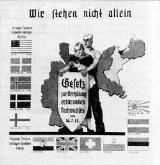
Compulsory sterilization

Encyclopedia
Compulsory sterilization (or sterilisation) also known as forced sterilization programs are government policies which attempt to force people to undergo surgical sterilization. In the first half of the twentieth century, several such programs were instituted in countries around the world, usually as part of eugenics
programs intended to prevent the reproduction and multiplication of members of the population considered to be carriers of defective genetic
traits. Forced sterilization has been recognized as crime against humanity
if the action is part of a widespread or systematic practice by the Rome Statute
Explanatory Memorandum, which defines the jurisdiction of the International Criminal Court
.
, and surgery
as the American system. One notable difference is in the treatment of non-insane criminals. Canadian legislation never allowed for punitive sterilization of inmates.
carried out a policy of sterilization of some Roma women, starting in 1973. In various cases the sterilization was agreed upon, often in exchange for social welfare benefits or was given by the lack of education. The dissidents of the Charter 77
denounced it in 1977-78 as a "genocide
", but the practice continued through the Velvet Revolution
of 1989. A 2005 report by the Czech government's independent ombudsman, Otakar Motejl
, identified dozens of cases of coercive sterilization between 1979 and 2001, and called for criminal investigations and possible prosecution against several health care workers and administrators.
after achieving total control over the German
state was to pass the Law for the Prevention of Hereditarily Diseased Offspring
(Gesetz zur Verhütung erbkranken Nachwuchses) in July 1933. The law was signed in by Hitler himself, and over 200 eugenic courts were created specifically as a result of the law. Under the German law, all doctors in the Reich were required to report patients of theirs who were mentally retarded, mentally ill (including schizophrenia
and manic depression), epileptic
, blind, deaf, or physically deformed, and a steep monetary penalty was imposed for any patients who were not properly reported. Individuals suffering from alcoholism
or Huntington's Disease
could also be sterilized. The individual's case was then presented in front of a court of Nazi
officials and public health officers who would review their medical records, take testimony from friends and colleagues, and eventually decide whether or not to order a sterilization operation performed on the individual, using force if necessary. Though not explicitly covered by the law, 400 mixed-race "Rhineland Bastard
s" were also sterilized beginning in 1937.
By the end of World War II
, over 400,000 individuals were sterilized under the German law and its revisions, most within its first four years of being enacted. When the issue of compulsory sterilization was brought up at the Nuremberg trials
after the war, many Nazis defended their actions on the matter by indicating that it was the United States itself from whom they had taken inspiration. The Nazis had many other eugenics-inspired racial policies
, including their "euthanasia" program in which around 70,000 people institutionalized or suffering from birth defects were killed.
The Leprosy Prevention laws of 1907, 1931 and 1953, permitted the segregation of patients in sanitariums where forced abortions and sterilization were common and authorized punishment of patients "disturbing peace". Under the colonial Korean Leprosy prevention ordinance, Korean patients were also subjected to hard labor.
The Race Eugenic Protection Law was submitted from 1934 to 1938 to the Diet. After four amendments, this draft was promulgated as a National Eugenic Law in 1940 by the Konoe
government. According to Matsubara Yoko, from 1940 to 1945, sterilization was done to 454 Japanese persons under this law.
According to the Eugenic Protection Law (1948), sterilization could be enforced on criminals "with genetic predisposition to commit crime", patients with genetic diseases such as total color-blindness, hemophilia, albinism
and ichthyosis
, and mental affections such as schizophrenia
, manic-depression and epilepsy
. The mental sicknesses were added in 1952.
, Sanjay Gandhi
was largely blamed for what turned out to be a failed program. A strong backlash against any initiative associated with family planning followed the highly controversial program, which continues into the 21st century.
accused authorities in Puning
of compelling people to be sterilized by imprisoning their elderly relatives.
See also Iron Fist Campaign
, President Alberto Fujimori
(in office from 1990-2000) has been accused of genocide
and crimes against humanity as a result of a sterilization program put in place by his administration. Peru put in place a program of forced sterilizations against indigeneous people (essentially the Quechuas
and the Aymaras), in the name of a "public health
plan", presented July 28, 1995. The plan was principally financed using funds from USAID (36 million dollars), the Nippon Foundation
, and later, the United Nations Population Fund
(UNFPA). On September 9, 1995, Fujimori presented a Bill that would revise the "General Law of Population", in order to allow sterilization. Several contraceptive methods were also legalized, all measures that were strongly opposed by the Roman Catholic Church, as well as the Catholic organization Opus Dei
. In February 1996, the World Health Organization
(WHO) itself congratulated Fujimori for his plan to control demographic growth.
On February 25, 1998, a representative for USAID testified before the U.S. government's House International Relations Committee, to address controversy surrounding Peru's program. He indicated that the government of Peru was making important changes to the program, in order to:
In September 2001, Minister of Health Luis Solari launched a special commission into the activities of the Voluntary Surgical Contraception, initiating a Parliamentary commission tasked with enquiring into the "irregularities" of the program, and to put it on an acceptable footing. In July 2002, its Final Report ordered by the Minister of Health revealed that between 1995 and 2000, 331,600 women were sterilized, while 25,590 men submitted to vasectomies. The plan, which had the objective of diminishing the number of births in areas of poverty within Peru, was essentially directed at the indigeneous people living in deprived areas (areas often involved in internal conflicts with the Peruvian government, as with the Shining Path
guerilla group). Deputy Dora Núñez Dávila made the accusation in September 2003 that 400,000 indigeneous people were sterilized during the 1990s. Documents proved that President Fujimori was informed, each month, of the number of sterilizations done, by his former Ministers of Health, Eduardo Yong Motta (1994-96), Marino Costa Bauer (1996-1999) and Alejandro Aguinaga
(1999-2000). A study by sociologist Giulia Tamayo, Nada Personal (in English: Nothing Personal), showed that doctors were required to meet quotas. According to Le Monde diplomatique
, "tubal ligation festivals" were organized through program publicity campaigns, held in the pueblos jóvenes
(in English: shantytowns). In 1996 there were, according to official statistics, 81,762 tubal ligations performed on women, with a peak being reached the following year, with 109,689 ligatures, then only 25,995 in 1998.
in the Dagens Nyheter
daily, widespread attention was given to the fact that Sweden
once operated a strong sterilization program, which was active primarily from the mid 1930s until the 1970s. A governmental commission was set up, and finished its inquiry in 2000.
The eugenistic legislation was enacted in 1934 and was formally abolished in 1976. According to the 2000 governmental report, 21,000 were estimated to have been forcibly sterilized, 6,000 were coerced into a 'voluntary' sterilization while the nature of a further 4,000 cases could not be determined. However, the 40 000 or so socio-medical cases are contested, and Zaremba and others argue that they were more in the interest of society than individual women. The Swedish state subsequently paid out damages to victims who contacted the authorities and asked for compensation.
The program included all known criteria for sterilization, including a loosely phrased "social" indiciation. In 1922 the State Institute of Racial Biology
was founded in Uppsala and in 1927 Parliament began to deal with the first legal provisions on sterilisation. A new draft was produced in 1932, already taking into account sterilisation for general socio-prophylactic reasons, and even without the consent of the person concerned. The draft was adopted in 1934. Another law, passed in 1941, was more far reaching, included a social indication and did not include any age of consent limit.
From 1950, the number of eugenic sterilisations under the 1941 legal provisions gradually decreased.
It is possible but not proven that the Swedish sterilizations targeted travellers. These were sometimes viewed as a separate race or ethnic group. The Swedish Racial Hygiene Society had been founded in Stockholm in 1909, and the 1934 works by Alva
and Gunnar Myrdal
was very significant in promoting the eugenic tendencies in practical politics. The authors theorized that the best solution for the Swedish welfare state ("folkhem
") was to prevent at the outset the hereditary transfer of undesirable characteristics that caused the individual affected to become sooner or later a burden on society. The authors therefore proposed a "corrective social reform” under which sterilisation was to prevent "unviable individuals” from spreading their undesirable traits..
in the form of a general proposal to adopt legal regulations that would enable reparation for persons sterilised against their will. According to the proposal, reparation was to be provided to persons who had undergone the intervention without their consent or who had consented to sterilisation under coercion. According to Margrith von Felten:
Switzerland refused, however, to vote a reparations Act.
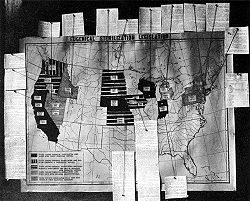 The United States was the first country to concertedly undertake compulsory sterilization programs for the purpose of eugenics. The heads of the program were avid believers in eugenics and frequently argued for their program. It was shut down due to ethical problems. The principal targets of the American program were the mentally retarded
and the mentally ill
, but also targeted under many state laws were the deaf, the blind, people with epilepsy
, and the physically deformed. According to the activist Angela Davis
, Native Americans, as well as African-American women were sterilized against their will in many states, often without their knowledge while they were in a hospital for other reasons (e.g. childbirth). Some sterilizations took place in prisons and other penal institutions, targeting criminality, but they were in the relative minority. In the end, over 65,000 individuals were sterilized in 33 states under state compulsory sterilization programs in the United States.
The first state to introduce a compulsory sterilization bill was Michigan
, in 1897 but the proposed law failed to garner enough votes by legislators to be adopted. Eight years later Pennsylvania
's state legislators passed a sterilization bill that was vetoed by the governor. Indiana
became the first state to enact sterilization legislation in 1907, followed closely by Washington and California
in 1909. Sterilization rates across the country were relatively low (California being the sole exception) until the 1927 Supreme Court
case Buck v. Bell
which legitimized the forced sterilization of patients at a Virginia
home for the mentally retarded
. The number of sterilizations performed per year increased until another Supreme Court case, Skinner v. Oklahoma
, 1942, complicated the legal situation by ruling against sterilization of criminals if the equal protection clause of the constitution was violated. That is, if sterilization was to be performed, then it could not exempt white-collar criminals
.
Most sterilization laws could be divided into three main categories of motivations: eugenic (concerned with heredity), therapeutic (part of an even-then obscure medical theory that sterilization would lead to vitality), or punitive (as a punishment for criminals), though of course these motivations could be combined in practice and theory (sterilization of criminals could be both punitive and eugenic, for example). Buck v. Bell
asserted only that eugenic sterilization was constitutional, whereas Skinner v. Oklahoma
ruled specifically against punitive sterilization. Most operations only worked to prevent reproduction (such as severing the vas deferens
in males), though some states (Oregon
and North Dakota
in particular) had laws which called for the use of castration
. In general, most sterilizations were performed under eugenic statutes, in state-run psychiatric hospitals and homes for the mentally disabled. There was never a federal sterilization statute, though eugenicist Harry H. Laughlin
, whose state-level "Model Eugenical Sterilization Law" was the basis of the statute affirmed in Buck v. Bell, proposed the structure of one in 1922.
After World War II
, public opinion towards eugenics and sterilization programs became more negative in the light of the connection with the genocidal
policies of Nazi Germany
, though a significant number of sterilizations continued in a few states until the early 1960s. The Oregon
Board of Eugenics, later renamed the Board of Social Protection, existed until 1983, with the last forcible sterilization occurring in 1981. The U.S. commonwealth Puerto Rico
had a sterilization program as well. Some states continued to have sterilization laws on the books for much longer after that, though they were rarely if ever used. California sterilized more than any other state by a wide margin, and was responsible for over a third of all sterilization operations. Information about the California sterilization program was produced into book form and widely disseminated by eugenicists E.S. Gosney and Paul B. Popenoe, which was said by the government of Adolf Hitler
to be of key importance in proving that large-scale compulsory sterilization programs were feasible.
In recent years, the governors of many states have made public apologies for their past programs beginning with Virginia and followed by Oregon and California. None have offered to compensate those sterilized, however, citing that few are likely still living (and would of course have no affected offspring) and that inadequate records remain by which to verify them. At least one compensation case, Poe v. Lynchburg Training School & Hospital
(1981), was filed in the courts on the grounds that the sterilization law was unconstitutional. It was rejected because the law was no longer in effect at the time of the filing. However, the petitioners were granted some compensation as the stipulations of the law itself, which required informing the patients about their operations, had not been carried out in many cases.
The 27 states where sterilization laws remained on the books (though not all were still in use) in 1956 were: Arizona
, California
, Connecticut
, Delaware
, Georgia
, Idaho
, Indiana
, Iowa
, Kansas
, Maine
, Michigan
, Minnesota
, Mississippi
, Montana
, Nebraska
, New Hampshire
, North Carolina
, North Dakota
, Oklahoma
, Oregon
, South Carolina
, South Dakota
, Utah
, Vermont
, Virginia
, West Virginia
, Wisconsin
.
, Norway
, Finland
, Estonia
, Switzerland
, Iceland
, and some countries in Latin America
(including Panama
). In the United Kingdom
, Home Secretary
Winston Churchill
introduced a bill that included forced sterilization. Writer G. K. Chesterton
led a successful effort to defeat that clause of the 1913 Mental Deficiency Act.
According to some testimonies, the Soviet Union
allegedly imposed forced sterilization on female workers deported from Romania
to Soviet labor camps. This is said to have occurred after World War II
, when Romania
was supposed to supply a reconstruction workforce (according to the armistice convention). However, no court decisions or formal investigations of these allegations are known for the moment.
A Dutch Labour Party MP has recently proposed temporary (two year) compulsory contraception, (not sterilization), of women who have a legally proven history of child abuse. The method would be via injection of anti-conception medicinal drugs, every six months. If the woman or parents have shown progress during that time, this would be reversed.
Eugenics
Eugenics is the "applied science or the bio-social movement which advocates the use of practices aimed at improving the genetic composition of a population", usually referring to human populations. The origins of the concept of eugenics began with certain interpretations of Mendelian inheritance,...
programs intended to prevent the reproduction and multiplication of members of the population considered to be carriers of defective genetic
Genetics
Genetics , a discipline of biology, is the science of genes, heredity, and variation in living organisms....
traits. Forced sterilization has been recognized as crime against humanity
Crime against humanity
Crimes against humanity, as defined by the Rome Statute of the International Criminal Court Explanatory Memorandum, "are particularly odious offenses in that they constitute a serious attack on human dignity or grave humiliation or a degradation of one or more human beings...
if the action is part of a widespread or systematic practice by the Rome Statute
Rome Statute of the International Criminal Court
The Rome Statute of the International Criminal Court is the treaty that established the International Criminal Court . It was adopted at a diplomatic conference in Rome on 17 July 1998 and it entered into force on 1 July 2002. As of 13 October 2011, 119 states are party to the statute...
Explanatory Memorandum, which defines the jurisdiction of the International Criminal Court
International Criminal Court
The International Criminal Court is a permanent tribunal to prosecute individuals for genocide, crimes against humanity, war crimes, and the crime of aggression .It came into being on 1 July 2002—the date its founding treaty, the Rome Statute of the...
.
Canada
Two Canadian provinces (Alberta and British Columbia) performed compulsory sterilization programs with eugenic aims. Canadian compulsory sterilization operated via the same overall mechanisms of institutionalization, judgementJudgement
Judgment is the evaluation of evidence in the making of a decision. The term has three distinct uses:* Informal - Opinions expressed as facts....
, and surgery
Surgery
Surgery is an ancient medical specialty that uses operative manual and instrumental techniques on a patient to investigate and/or treat a pathological condition such as disease or injury, or to help improve bodily function or appearance.An act of performing surgery may be called a surgical...
as the American system. One notable difference is in the treatment of non-insane criminals. Canadian legislation never allowed for punitive sterilization of inmates.
Czechoslovakia, Czech Republic
CzechoslovakiaCzechoslovakia
Czechoslovakia or Czecho-Slovakia was a sovereign state in Central Europe which existed from October 1918, when it declared its independence from the Austro-Hungarian Empire, until 1992...
carried out a policy of sterilization of some Roma women, starting in 1973. In various cases the sterilization was agreed upon, often in exchange for social welfare benefits or was given by the lack of education. The dissidents of the Charter 77
Charter 77
Charter 77 was an informal civic initiative in communist Czechoslovakia from 1976 to 1992, named after the document Charter 77 from January 1977. Founding members and architects were Václav Havel, Jan Patočka, Zdeněk Mlynář, Jiří Hájek, and Pavel Kohout. Spreading the text of the document was...
denounced it in 1977-78 as a "genocide
Genocide
Genocide is defined as "the deliberate and systematic destruction, in whole or in part, of an ethnic, racial, religious, or national group", though what constitutes enough of a "part" to qualify as genocide has been subject to much debate by legal scholars...
", but the practice continued through the Velvet Revolution
Velvet Revolution
The Velvet Revolution or Gentle Revolution was a non-violent revolution in Czechoslovakia that took place from November 17 – December 29, 1989...
of 1989. A 2005 report by the Czech government's independent ombudsman, Otakar Motejl
Otakar Motejl
Otakar Motejl was a Czech lawyer and politician. He served as the Ombudsman of the Czech Republic from 2000 until his death in 2010. In 1998-2000 he served as the Minister of Justice.-Life:...
, identified dozens of cases of coercive sterilization between 1979 and 2001, and called for criminal investigations and possible prosecution against several health care workers and administrators.
Germany
One of the first acts by Adolf HitlerAdolf Hitler
Adolf Hitler was an Austrian-born German politician and the leader of the National Socialist German Workers Party , commonly referred to as the Nazi Party). He was Chancellor of Germany from 1933 to 1945, and head of state from 1934 to 1945...
after achieving total control over the German
Germany
Germany , officially the Federal Republic of Germany , is a federal parliamentary republic in Europe. The country consists of 16 states while the capital and largest city is Berlin. Germany covers an area of 357,021 km2 and has a largely temperate seasonal climate...
state was to pass the Law for the Prevention of Hereditarily Diseased Offspring
Law for the Prevention of Hereditarily Diseased Offspring
Law for the Prevention of Genetically Diseased Offspring or "Sterilization Law" was a statute in Nazi Germany enacted on July 14, 1933, which allowed the compulsory sterilization of any citizen who in the opinion of a "Genetic Health Court" Law for the Prevention of Genetically Diseased Offspring...
(Gesetz zur Verhütung erbkranken Nachwuchses) in July 1933. The law was signed in by Hitler himself, and over 200 eugenic courts were created specifically as a result of the law. Under the German law, all doctors in the Reich were required to report patients of theirs who were mentally retarded, mentally ill (including schizophrenia
Schizophrenia
Schizophrenia is a mental disorder characterized by a disintegration of thought processes and of emotional responsiveness. It most commonly manifests itself as auditory hallucinations, paranoid or bizarre delusions, or disorganized speech and thinking, and it is accompanied by significant social...
and manic depression), epileptic
Epilepsy
Epilepsy is a common chronic neurological disorder characterized by seizures. These seizures are transient signs and/or symptoms of abnormal, excessive or hypersynchronous neuronal activity in the brain.About 50 million people worldwide have epilepsy, and nearly two out of every three new cases...
, blind, deaf, or physically deformed, and a steep monetary penalty was imposed for any patients who were not properly reported. Individuals suffering from alcoholism
Alcoholism
Alcoholism is a broad term for problems with alcohol, and is generally used to mean compulsive and uncontrolled consumption of alcoholic beverages, usually to the detriment of the drinker's health, personal relationships, and social standing...
or Huntington's Disease
Huntington's disease
Huntington's disease, chorea, or disorder , is a neurodegenerative genetic disorder that affects muscle coordination and leads to cognitive decline and dementia. It typically becomes noticeable in middle age. HD is the most common genetic cause of abnormal involuntary writhing movements called chorea...
could also be sterilized. The individual's case was then presented in front of a court of Nazi
Nazism
Nazism, the common short form name of National Socialism was the ideology and practice of the Nazi Party and of Nazi Germany...
officials and public health officers who would review their medical records, take testimony from friends and colleagues, and eventually decide whether or not to order a sterilization operation performed on the individual, using force if necessary. Though not explicitly covered by the law, 400 mixed-race "Rhineland Bastard
Rhineland Bastard
Rhineland Bastard was a derogatory term used in Nazi Germany to describe Afro-German children of mixed German and African parentage who were fathered by Africans serving as French colonial troops occupying the Rhineland after World War I...
s" were also sterilized beginning in 1937.
By the end of World War II
World War II
World War II, or the Second World War , was a global conflict lasting from 1939 to 1945, involving most of the world's nations—including all of the great powers—eventually forming two opposing military alliances: the Allies and the Axis...
, over 400,000 individuals were sterilized under the German law and its revisions, most within its first four years of being enacted. When the issue of compulsory sterilization was brought up at the Nuremberg trials
Nuremberg Trials
The Nuremberg Trials were a series of military tribunals, held by the victorious Allied forces of World War II, most notable for the prosecution of prominent members of the political, military, and economic leadership of the defeated Nazi Germany....
after the war, many Nazis defended their actions on the matter by indicating that it was the United States itself from whom they had taken inspiration. The Nazis had many other eugenics-inspired racial policies
Racial policy of Nazi Germany
The racial policy of Nazi Germany was a set of policies and laws implemented by Nazi Germany, asserting the superiority of the "Aryan race", and based on a specific racist doctrine which claimed scientific legitimacy...
, including their "euthanasia" program in which around 70,000 people institutionalized or suffering from birth defects were killed.
Japan
In the first part of the Showa era, Japanese governments promoted increasing the number of healthy Japanese, while simultaneously decreasing the number of people suffering mental retardation, disability, genetic disease and other conditions that led to inferiority in the Japanese gene pool.The Leprosy Prevention laws of 1907, 1931 and 1953, permitted the segregation of patients in sanitariums where forced abortions and sterilization were common and authorized punishment of patients "disturbing peace". Under the colonial Korean Leprosy prevention ordinance, Korean patients were also subjected to hard labor.
The Race Eugenic Protection Law was submitted from 1934 to 1938 to the Diet. After four amendments, this draft was promulgated as a National Eugenic Law in 1940 by the Konoe
Fumimaro Konoe
Prince was a politician in the Empire of Japan who served as the 34th, 38th and 39th Prime Minister of Japan and founder/leader of the Taisei Yokusankai.- Early life :...
government. According to Matsubara Yoko, from 1940 to 1945, sterilization was done to 454 Japanese persons under this law.
According to the Eugenic Protection Law (1948), sterilization could be enforced on criminals "with genetic predisposition to commit crime", patients with genetic diseases such as total color-blindness, hemophilia, albinism
Albinism
Albinism is a congenital disorder characterized by the complete or partial absence of pigment in the skin, hair and eyes due to absence or defect of an enzyme involved in the production of melanin...
and ichthyosis
Ichthyosis
Ichthyosis is a heterogeneous family of at least 28, generalized, mostly genetic skin disorders. All types of ichthyosis have dry, thickened, scaly or flaky skin...
, and mental affections such as schizophrenia
Schizophrenia
Schizophrenia is a mental disorder characterized by a disintegration of thought processes and of emotional responsiveness. It most commonly manifests itself as auditory hallucinations, paranoid or bizarre delusions, or disorganized speech and thinking, and it is accompanied by significant social...
, manic-depression and epilepsy
Epilepsy
Epilepsy is a common chronic neurological disorder characterized by seizures. These seizures are transient signs and/or symptoms of abnormal, excessive or hypersynchronous neuronal activity in the brain.About 50 million people worldwide have epilepsy, and nearly two out of every three new cases...
. The mental sicknesses were added in 1952.
India
India's state of emergency between 1975 and 1977 included an infamous family planning initiative beginning April 1976, which involved the vasectomy of thousands of men and tubal ligation of women, either for payment or under coercive conditions. Son of then Prime Minister Indira GandhiIndira Gandhi
Indira Priyadarshini Gandhara was an Indian politician who served as the third Prime Minister of India for three consecutive terms and a fourth term . She was assassinated by Sikh extremists...
, Sanjay Gandhi
Sanjay Gandhi
Sanjay Gandhi was an Indian politician. The younger son of Prime Minister Indira Gandhi and Feroze Gandhi, he was a member of the Nehru-Gandhi family...
was largely blamed for what turned out to be a failed program. A strong backlash against any initiative associated with family planning followed the highly controversial program, which continues into the 21st century.
China
Coercive sterilization to enforce the one child policy has occurred in China. This is not permitted by the law, and some local officials have been jailed for their actions. In 2010, Amnesty InternationalAmnesty International
Amnesty International is an international non-governmental organisation whose stated mission is "to conduct research and generate action to prevent and end grave abuses of human rights, and to demand justice for those whose rights have been violated."Following a publication of Peter Benenson's...
accused authorities in Puning
Puning
Puning is a county-level city in the municipal region of Jieyang, Guangdong, China.-Puning in the News:The city's family planning excesses attracted first national then international attention in 2010 April due to the Iron Fist Campaign....
of compelling people to be sterilized by imprisoning their elderly relatives.
See also Iron Fist Campaign
Iron Fist Campaign
The Iron Fist Campaign was a sterilization program conducted in the summer of 2010 by family planning officials in Puning, a county in Guangdong, China.- Background :...
Peru
In PeruPeru
Peru , officially the Republic of Peru , is a country in western South America. It is bordered on the north by Ecuador and Colombia, on the east by Brazil, on the southeast by Bolivia, on the south by Chile, and on the west by the Pacific Ocean....
, President Alberto Fujimori
Alberto Fujimori
Alberto Fujimori Fujimori served as President of Peru from 28 July 1990 to 17 November 2000. A controversial figure, Fujimori has been credited with the creation of Fujimorism, uprooting terrorism in Peru and restoring its macroeconomic stability, though his methods have drawn charges of...
(in office from 1990-2000) has been accused of genocide
Genocide
Genocide is defined as "the deliberate and systematic destruction, in whole or in part, of an ethnic, racial, religious, or national group", though what constitutes enough of a "part" to qualify as genocide has been subject to much debate by legal scholars...
and crimes against humanity as a result of a sterilization program put in place by his administration. Peru put in place a program of forced sterilizations against indigeneous people (essentially the Quechuas
Quechuas
Quechuas is the collective term for several indigenous ethnic groups in South America who speak a Quechua language , belonging to several ethnic groups in South America, especially in Peru, Ecuador, Bolivia, Chile, Colombia and Argentina.The Quechuas of Ecuador call themselves as well as their...
and the Aymaras), in the name of a "public health
Public health
Public health is "the science and art of preventing disease, prolonging life and promoting health through the organized efforts and informed choices of society, organizations, public and private, communities and individuals" . It is concerned with threats to health based on population health...
plan", presented July 28, 1995. The plan was principally financed using funds from USAID (36 million dollars), the Nippon Foundation
Nippon Foundation
is a private, non-profit grant-making organization. It was established in 1962 by Ryoichi Sasakawa, the late statesman and businessman who, following World War II, was accused, albeit not convicted, of class A war crimes...
, and later, the United Nations Population Fund
United Nations Population Fund
The United Nations Population Fund is a UN organization. The work of the UNFPA involves promotion of the right of every woman, man and child to enjoy a life of health and equal opportunity. This is done through major national and demographic surveys and with population censuses...
(UNFPA). On September 9, 1995, Fujimori presented a Bill that would revise the "General Law of Population", in order to allow sterilization. Several contraceptive methods were also legalized, all measures that were strongly opposed by the Roman Catholic Church, as well as the Catholic organization Opus Dei
Opus Dei
Opus Dei, formally known as The Prelature of the Holy Cross and Opus Dei , is an organization of the Catholic Church that teaches that everyone is called to holiness and that ordinary life is a path to sanctity. The majority of its membership are lay people, with secular priests under the...
. In February 1996, the World Health Organization
World Health Organization
The World Health Organization is a specialized agency of the United Nations that acts as a coordinating authority on international public health. Established on 7 April 1948, with headquarters in Geneva, Switzerland, the agency inherited the mandate and resources of its predecessor, the Health...
(WHO) itself congratulated Fujimori for his plan to control demographic growth.
On February 25, 1998, a representative for USAID testified before the U.S. government's House International Relations Committee, to address controversy surrounding Peru's program. He indicated that the government of Peru was making important changes to the program, in order to:
- Discontinue their campaigns in tubal ligations and vasectomies.
- Make clear to health workers that there are no provider targets for voluntary surgical contraception or any other method of contraception.
- Implement a comprehensive monitoring program to ensure compliance with family planning norms and informed consent procedures.
- Welcome Ombudsman Office investigations of complaints received and respond to any additional complaints that are submitted as a result of the public request for any additional concerns.
- Implement a 72 hour "waiting period" for people who choose tubal ligation or vasectomy. This waiting period will occur between the second counseling session and surgery.
- Require health facilities to be certified as appropriate for performing surgical contraception as a means to ensure that no operations are done in makeshift or substandard facilities.
In September 2001, Minister of Health Luis Solari launched a special commission into the activities of the Voluntary Surgical Contraception, initiating a Parliamentary commission tasked with enquiring into the "irregularities" of the program, and to put it on an acceptable footing. In July 2002, its Final Report ordered by the Minister of Health revealed that between 1995 and 2000, 331,600 women were sterilized, while 25,590 men submitted to vasectomies. The plan, which had the objective of diminishing the number of births in areas of poverty within Peru, was essentially directed at the indigeneous people living in deprived areas (areas often involved in internal conflicts with the Peruvian government, as with the Shining Path
Shining Path
Shining Path is a Maoist guerrilla terrorist organization in Peru. The group never refers to itself as "Shining Path", and as several other Peruvian groups, prefers to be called the "Communist Party of Peru" or "PCP-SL" in short...
guerilla group). Deputy Dora Núñez Dávila made the accusation in September 2003 that 400,000 indigeneous people were sterilized during the 1990s. Documents proved that President Fujimori was informed, each month, of the number of sterilizations done, by his former Ministers of Health, Eduardo Yong Motta (1994-96), Marino Costa Bauer (1996-1999) and Alejandro Aguinaga
Alejandro Aguinaga
Alejandro Aurelio Aguinaga Recuenco is a Peruvian physician and fujimorist politician. He has been Congressman, representing Lambayeque, since 2006....
(1999-2000). A study by sociologist Giulia Tamayo, Nada Personal (in English: Nothing Personal), showed that doctors were required to meet quotas. According to Le Monde diplomatique
Le Monde diplomatique
Le Monde diplomatique is a monthly newspaper offering analysis and opinion on politics, culture, and current affairs. It was first created mainly for a diplomatic audience as its name implies...
, "tubal ligation festivals" were organized through program publicity campaigns, held in the pueblos jóvenes
Pueblos jóvenes
Pueblos jóvenes is the nickname given to the vast shanty towns that surround Lima and other cities of Peru. Many of these towns have developed into significant districts in Lima such as Villa El Salvador and Comas.- Population :...
(in English: shantytowns). In 1996 there were, according to official statistics, 81,762 tubal ligations performed on women, with a peak being reached the following year, with 109,689 ligatures, then only 25,995 in 1998.
Sweden
In 1997, following the publication of articles by Maciej ZarembaMaciej Zaremba
Maciej Zaremba Bielawski is a Swedish journalist and author.Zaremba was born in Poznań, Poland. He came to Sweden in 1969 where he worked as a construction worker during the 1970s. In his youth he was active in the League Communist , but abandoned his communist views when the group was dissolved...
in the Dagens Nyheter
Dagens Nyheter
is a daily newspaper in Sweden. It has the largest circulation of Swedish morning newspapers, followed by Göteborgs-Posten and Svenska Dagbladet, and is the only morning newspaper that is distributed to subscribers across the whole country. In 2009 DN had a circulation of 316,000, reaching 881...
daily, widespread attention was given to the fact that Sweden
Sweden
Sweden , officially the Kingdom of Sweden , is a Nordic country on the Scandinavian Peninsula in Northern Europe. Sweden borders with Norway and Finland and is connected to Denmark by a bridge-tunnel across the Öresund....
once operated a strong sterilization program, which was active primarily from the mid 1930s until the 1970s. A governmental commission was set up, and finished its inquiry in 2000.
The eugenistic legislation was enacted in 1934 and was formally abolished in 1976. According to the 2000 governmental report, 21,000 were estimated to have been forcibly sterilized, 6,000 were coerced into a 'voluntary' sterilization while the nature of a further 4,000 cases could not be determined. However, the 40 000 or so socio-medical cases are contested, and Zaremba and others argue that they were more in the interest of society than individual women. The Swedish state subsequently paid out damages to victims who contacted the authorities and asked for compensation.
The program included all known criteria for sterilization, including a loosely phrased "social" indiciation. In 1922 the State Institute of Racial Biology
Statens institut för rasbiologi
Statens institut för rasbiologi was a Swedish governmental research institute founded in 1922 with the stated purpose of studying eugenics and human genetics. It was located in Uppsala and as a governmental agency, it was the world’s first of its kind...
was founded in Uppsala and in 1927 Parliament began to deal with the first legal provisions on sterilisation. A new draft was produced in 1932, already taking into account sterilisation for general socio-prophylactic reasons, and even without the consent of the person concerned. The draft was adopted in 1934. Another law, passed in 1941, was more far reaching, included a social indication and did not include any age of consent limit.
From 1950, the number of eugenic sterilisations under the 1941 legal provisions gradually decreased.
It is possible but not proven that the Swedish sterilizations targeted travellers. These were sometimes viewed as a separate race or ethnic group. The Swedish Racial Hygiene Society had been founded in Stockholm in 1909, and the 1934 works by Alva
Alva Myrdal
Alva Myrdal was a Swedish sociologist and politician. She received the Nobel Peace Prize in 1982. She married Gunnar Myrdal in 1924....
and Gunnar Myrdal
Gunnar Myrdal
Karl Gunnar Myrdal was a Swedish Nobel Laureate economist, sociologist, and politician. In 1974, he received the Nobel Memorial Prize in Economic Sciences with Friedrich Hayek for "their pioneering work in the theory of money and economic fluctuations and for their penetrating analysis of the...
was very significant in promoting the eugenic tendencies in practical politics. The authors theorized that the best solution for the Swedish welfare state ("folkhem
Folkhemmet
Folkhemmet is a political concept that played an important role in the history of the Swedish Social Democratic Party and the Swedish welfare state. It is also sometimes used to refer to the long period between 1932-76 when the Social democrats were in power and the concept was put into practice...
") was to prevent at the outset the hereditary transfer of undesirable characteristics that caused the individual affected to become sooner or later a burden on society. The authors therefore proposed a "corrective social reform” under which sterilisation was to prevent "unviable individuals” from spreading their undesirable traits..
Switzerland
In October 1999, Margrith von Felten suggested to the National Council of SwitzerlandNational Council of Switzerland
The National Council of Switzerland is the lower house of the Federal Assembly of Switzerland. With 200 seats, it is the larger of the two houses....
in the form of a general proposal to adopt legal regulations that would enable reparation for persons sterilised against their will. According to the proposal, reparation was to be provided to persons who had undergone the intervention without their consent or who had consented to sterilisation under coercion. According to Margrith von Felten:
Switzerland refused, however, to vote a reparations Act.
United States
Mental retardation
Mental retardation is a generalized disorder appearing before adulthood, characterized by significantly impaired cognitive functioning and deficits in two or more adaptive behaviors...
and the mentally ill
Mental illness
A mental disorder or mental illness is a psychological or behavioral pattern generally associated with subjective distress or disability that occurs in an individual, and which is not a part of normal development or culture. Such a disorder may consist of a combination of affective, behavioural,...
, but also targeted under many state laws were the deaf, the blind, people with epilepsy
Epilepsy
Epilepsy is a common chronic neurological disorder characterized by seizures. These seizures are transient signs and/or symptoms of abnormal, excessive or hypersynchronous neuronal activity in the brain.About 50 million people worldwide have epilepsy, and nearly two out of every three new cases...
, and the physically deformed. According to the activist Angela Davis
Angela Davis
Angela Davis is an American political activist, scholar, and author. Davis was most politically active during the late 1960s through the 1970s and was associated with the Communist Party USA, the Civil Rights Movement and the Black Panther Party...
, Native Americans, as well as African-American women were sterilized against their will in many states, often without their knowledge while they were in a hospital for other reasons (e.g. childbirth). Some sterilizations took place in prisons and other penal institutions, targeting criminality, but they were in the relative minority. In the end, over 65,000 individuals were sterilized in 33 states under state compulsory sterilization programs in the United States.
The first state to introduce a compulsory sterilization bill was Michigan
Michigan
Michigan is a U.S. state located in the Great Lakes Region of the United States of America. The name Michigan is the French form of the Ojibwa word mishigamaa, meaning "large water" or "large lake"....
, in 1897 but the proposed law failed to garner enough votes by legislators to be adopted. Eight years later Pennsylvania
Pennsylvania
The Commonwealth of Pennsylvania is a U.S. state that is located in the Northeastern and Mid-Atlantic regions of the United States. The state borders Delaware and Maryland to the south, West Virginia to the southwest, Ohio to the west, New York and Ontario, Canada, to the north, and New Jersey to...
's state legislators passed a sterilization bill that was vetoed by the governor. Indiana
Indiana
Indiana is a US state, admitted to the United States as the 19th on December 11, 1816. It is located in the Midwestern United States and Great Lakes Region. With 6,483,802 residents, the state is ranked 15th in population and 16th in population density. Indiana is ranked 38th in land area and is...
became the first state to enact sterilization legislation in 1907, followed closely by Washington and California
California
California is a state located on the West Coast of the United States. It is by far the most populous U.S. state, and the third-largest by land area...
in 1909. Sterilization rates across the country were relatively low (California being the sole exception) until the 1927 Supreme Court
Supreme Court of the United States
The Supreme Court of the United States is the highest court in the United States. It has ultimate appellate jurisdiction over all state and federal courts, and original jurisdiction over a small range of cases...
case Buck v. Bell
Buck v. Bell
Buck v. Bell, , was the United States Supreme Court ruling that upheld a statute instituting compulsory sterilization of the unfit, including the mentally retarded, "for the protection and health of the state." It was largely seen as an endorsement of negative eugenics—the attempt to improve...
which legitimized the forced sterilization of patients at a Virginia
Virginia
The Commonwealth of Virginia , is a U.S. state on the Atlantic Coast of the Southern United States. Virginia is nicknamed the "Old Dominion" and sometimes the "Mother of Presidents" after the eight U.S. presidents born there...
home for the mentally retarded
Mental retardation
Mental retardation is a generalized disorder appearing before adulthood, characterized by significantly impaired cognitive functioning and deficits in two or more adaptive behaviors...
. The number of sterilizations performed per year increased until another Supreme Court case, Skinner v. Oklahoma
Skinner v. Oklahoma
Skinner v. State of Oklahoma, ex. rel. Williamson, 316 U.S. 535 , was the United States Supreme Court ruling which held that compulsory sterilization could not be imposed as a punishment for a crime, on the grounds that the relevant Oklahoma law excluded white-collar crimes from carrying...
, 1942, complicated the legal situation by ruling against sterilization of criminals if the equal protection clause of the constitution was violated. That is, if sterilization was to be performed, then it could not exempt white-collar criminals
White-collar crime
Within the field of criminology, white-collar crime has been defined by Edwin Sutherland as "a crime committed by a person of respectability and high social status in the course of his occupation" . Sutherland was a proponent of Symbolic Interactionism, and believed that criminal behavior was...
.
Most sterilization laws could be divided into three main categories of motivations: eugenic (concerned with heredity), therapeutic (part of an even-then obscure medical theory that sterilization would lead to vitality), or punitive (as a punishment for criminals), though of course these motivations could be combined in practice and theory (sterilization of criminals could be both punitive and eugenic, for example). Buck v. Bell
Buck v. Bell
Buck v. Bell, , was the United States Supreme Court ruling that upheld a statute instituting compulsory sterilization of the unfit, including the mentally retarded, "for the protection and health of the state." It was largely seen as an endorsement of negative eugenics—the attempt to improve...
asserted only that eugenic sterilization was constitutional, whereas Skinner v. Oklahoma
Skinner v. Oklahoma
Skinner v. State of Oklahoma, ex. rel. Williamson, 316 U.S. 535 , was the United States Supreme Court ruling which held that compulsory sterilization could not be imposed as a punishment for a crime, on the grounds that the relevant Oklahoma law excluded white-collar crimes from carrying...
ruled specifically against punitive sterilization. Most operations only worked to prevent reproduction (such as severing the vas deferens
Vas deferens
The vas deferens , also called ductus deferens, , is part of the male anatomy of many vertebrates; they transport sperm from the epididymis in anticipation of ejaculation....
in males), though some states (Oregon
Oregon
Oregon is a state in the Pacific Northwest region of the United States. It is located on the Pacific coast, with Washington to the north, California to the south, Nevada on the southeast and Idaho to the east. The Columbia and Snake rivers delineate much of Oregon's northern and eastern...
and North Dakota
North Dakota
North Dakota is a state located in the Midwestern region of the United States of America, along the Canadian border. The state is bordered by Canada to the north, Minnesota to the east, South Dakota to the south and Montana to the west. North Dakota is the 19th-largest state by area in the U.S....
in particular) had laws which called for the use of castration
Castration
Castration is any action, surgical, chemical, or otherwise, by which a male loses the functions of the testicles or a female loses the functions of the ovaries.-Humans:...
. In general, most sterilizations were performed under eugenic statutes, in state-run psychiatric hospitals and homes for the mentally disabled. There was never a federal sterilization statute, though eugenicist Harry H. Laughlin
Harry H. Laughlin
Harry Hamilton Laughlin was a leading American eugenicist in the first half of the 20th century. He was the director of the Eugenics Record Office from its inception in 1910 to its closing in 1939, and was among the most active individuals in influencing American eugenics policy, especially...
, whose state-level "Model Eugenical Sterilization Law" was the basis of the statute affirmed in Buck v. Bell, proposed the structure of one in 1922.
After World War II
World War II
World War II, or the Second World War , was a global conflict lasting from 1939 to 1945, involving most of the world's nations—including all of the great powers—eventually forming two opposing military alliances: the Allies and the Axis...
, public opinion towards eugenics and sterilization programs became more negative in the light of the connection with the genocidal
Genocide
Genocide is defined as "the deliberate and systematic destruction, in whole or in part, of an ethnic, racial, religious, or national group", though what constitutes enough of a "part" to qualify as genocide has been subject to much debate by legal scholars...
policies of Nazi Germany
Nazi Germany
Nazi Germany , also known as the Third Reich , but officially called German Reich from 1933 to 1943 and Greater German Reich from 26 June 1943 onward, is the name commonly used to refer to the state of Germany from 1933 to 1945, when it was a totalitarian dictatorship ruled by...
, though a significant number of sterilizations continued in a few states until the early 1960s. The Oregon
Oregon
Oregon is a state in the Pacific Northwest region of the United States. It is located on the Pacific coast, with Washington to the north, California to the south, Nevada on the southeast and Idaho to the east. The Columbia and Snake rivers delineate much of Oregon's northern and eastern...
Board of Eugenics, later renamed the Board of Social Protection, existed until 1983, with the last forcible sterilization occurring in 1981. The U.S. commonwealth Puerto Rico
Puerto Rico
Puerto Rico , officially the Commonwealth of Puerto Rico , is an unincorporated territory of the United States, located in the northeastern Caribbean, east of the Dominican Republic and west of both the United States Virgin Islands and the British Virgin Islands.Puerto Rico comprises an...
had a sterilization program as well. Some states continued to have sterilization laws on the books for much longer after that, though they were rarely if ever used. California sterilized more than any other state by a wide margin, and was responsible for over a third of all sterilization operations. Information about the California sterilization program was produced into book form and widely disseminated by eugenicists E.S. Gosney and Paul B. Popenoe, which was said by the government of Adolf Hitler
Adolf Hitler
Adolf Hitler was an Austrian-born German politician and the leader of the National Socialist German Workers Party , commonly referred to as the Nazi Party). He was Chancellor of Germany from 1933 to 1945, and head of state from 1934 to 1945...
to be of key importance in proving that large-scale compulsory sterilization programs were feasible.
In recent years, the governors of many states have made public apologies for their past programs beginning with Virginia and followed by Oregon and California. None have offered to compensate those sterilized, however, citing that few are likely still living (and would of course have no affected offspring) and that inadequate records remain by which to verify them. At least one compensation case, Poe v. Lynchburg Training School & Hospital
Poe v. Lynchburg Training School & Hospital
Poe v. Lynchburg Training School and Hospital, Civ. A. No. 80-0172, 518 F. Supp. 789 concerned whether or not patients who had been involuntarily sterilized in a state mental institution in Virginia as part of a program of eugenics in the early and mid-20th century had their constitutional rights...
(1981), was filed in the courts on the grounds that the sterilization law was unconstitutional. It was rejected because the law was no longer in effect at the time of the filing. However, the petitioners were granted some compensation as the stipulations of the law itself, which required informing the patients about their operations, had not been carried out in many cases.
The 27 states where sterilization laws remained on the books (though not all were still in use) in 1956 were: Arizona
Arizona
Arizona ; is a state located in the southwestern region of the United States. It is also part of the western United States and the mountain west. The capital and largest city is Phoenix...
, California
California
California is a state located on the West Coast of the United States. It is by far the most populous U.S. state, and the third-largest by land area...
, Connecticut
Connecticut
Connecticut is a state in the New England region of the northeastern United States. It is bordered by Rhode Island to the east, Massachusetts to the north, and the state of New York to the west and the south .Connecticut is named for the Connecticut River, the major U.S. river that approximately...
, Delaware
Delaware
Delaware is a U.S. state located on the Atlantic Coast in the Mid-Atlantic region of the United States. It is bordered to the south and west by Maryland, and to the north by Pennsylvania...
, Georgia
Georgia (U.S. state)
Georgia is a state located in the southeastern United States. It was established in 1732, the last of the original Thirteen Colonies. The state is named after King George II of Great Britain. Georgia was the fourth state to ratify the United States Constitution, on January 2, 1788...
, Idaho
Idaho
Idaho is a state in the Rocky Mountain area of the United States. The state's largest city and capital is Boise. Residents are called "Idahoans". Idaho was admitted to the Union on July 3, 1890, as the 43rd state....
, Indiana
Indiana
Indiana is a US state, admitted to the United States as the 19th on December 11, 1816. It is located in the Midwestern United States and Great Lakes Region. With 6,483,802 residents, the state is ranked 15th in population and 16th in population density. Indiana is ranked 38th in land area and is...
, Iowa
Iowa
Iowa is a state located in the Midwestern United States, an area often referred to as the "American Heartland". It derives its name from the Ioway people, one of the many American Indian tribes that occupied the state at the time of European exploration. Iowa was a part of the French colony of New...
, Kansas
Kansas
Kansas is a US state located in the Midwestern United States. It is named after the Kansas River which flows through it, which in turn was named after the Kansa Native American tribe, which inhabited the area. The tribe's name is often said to mean "people of the wind" or "people of the south...
, Maine
Maine
Maine is a state in the New England region of the northeastern United States, bordered by the Atlantic Ocean to the east and south, New Hampshire to the west, and the Canadian provinces of Quebec to the northwest and New Brunswick to the northeast. Maine is both the northernmost and easternmost...
, Michigan
Michigan
Michigan is a U.S. state located in the Great Lakes Region of the United States of America. The name Michigan is the French form of the Ojibwa word mishigamaa, meaning "large water" or "large lake"....
, Minnesota
Minnesota
Minnesota is a U.S. state located in the Midwestern United States. The twelfth largest state of the U.S., it is the twenty-first most populous, with 5.3 million residents. Minnesota was carved out of the eastern half of the Minnesota Territory and admitted to the Union as the thirty-second state...
, Mississippi
Mississippi
Mississippi is a U.S. state located in the Southern United States. Jackson is the state capital and largest city. The name of the state derives from the Mississippi River, which flows along its western boundary, whose name comes from the Ojibwe word misi-ziibi...
, Montana
Montana
Montana is a state in the Western United States. The western third of Montana contains numerous mountain ranges. Smaller, "island ranges" are found in the central third of the state, for a total of 77 named ranges of the Rocky Mountains. This geographical fact is reflected in the state's name,...
, Nebraska
Nebraska
Nebraska is a state on the Great Plains of the Midwestern United States. The state's capital is Lincoln and its largest city is Omaha, on the Missouri River....
, New Hampshire
New Hampshire
New Hampshire is a state in the New England region of the northeastern United States of America. The state was named after the southern English county of Hampshire. It is bordered by Massachusetts to the south, Vermont to the west, Maine and the Atlantic Ocean to the east, and the Canadian...
, North Carolina
North Carolina
North Carolina is a state located in the southeastern United States. The state borders South Carolina and Georgia to the south, Tennessee to the west and Virginia to the north. North Carolina contains 100 counties. Its capital is Raleigh, and its largest city is Charlotte...
, North Dakota
North Dakota
North Dakota is a state located in the Midwestern region of the United States of America, along the Canadian border. The state is bordered by Canada to the north, Minnesota to the east, South Dakota to the south and Montana to the west. North Dakota is the 19th-largest state by area in the U.S....
, Oklahoma
Oklahoma
Oklahoma is a state located in the South Central region of the United States of America. With an estimated 3,751,351 residents as of the 2010 census and a land area of 68,667 square miles , Oklahoma is the 28th most populous and 20th-largest state...
, Oregon
Oregon
Oregon is a state in the Pacific Northwest region of the United States. It is located on the Pacific coast, with Washington to the north, California to the south, Nevada on the southeast and Idaho to the east. The Columbia and Snake rivers delineate much of Oregon's northern and eastern...
, South Carolina
South Carolina
South Carolina is a state in the Deep South of the United States that borders Georgia to the south, North Carolina to the north, and the Atlantic Ocean to the east. Originally part of the Province of Carolina, the Province of South Carolina was one of the 13 colonies that declared independence...
, South Dakota
South Dakota
South Dakota is a state located in the Midwestern region of the United States. It is named after the Lakota and Dakota Sioux American Indian tribes. Once a part of Dakota Territory, South Dakota became a state on November 2, 1889. The state has an area of and an estimated population of just over...
, Utah
Utah
Utah is a state in the Western United States. It was the 45th state to join the Union, on January 4, 1896. Approximately 80% of Utah's 2,763,885 people live along the Wasatch Front, centering on Salt Lake City. This leaves vast expanses of the state nearly uninhabited, making the population the...
, Vermont
Vermont
Vermont is a state in the New England region of the northeastern United States of America. The state ranks 43rd in land area, , and 45th in total area. Its population according to the 2010 census, 630,337, is the second smallest in the country, larger only than Wyoming. It is the only New England...
, Virginia
Virginia
The Commonwealth of Virginia , is a U.S. state on the Atlantic Coast of the Southern United States. Virginia is nicknamed the "Old Dominion" and sometimes the "Mother of Presidents" after the eight U.S. presidents born there...
, West Virginia
West Virginia
West Virginia is a state in the Appalachian and Southeastern regions of the United States, bordered by Virginia to the southeast, Kentucky to the southwest, Ohio to the northwest, Pennsylvania to the northeast and Maryland to the east...
, Wisconsin
Wisconsin
Wisconsin is a U.S. state located in the north-central United States and is part of the Midwest. It is bordered by Minnesota to the west, Iowa to the southwest, Illinois to the south, Lake Michigan to the east, Michigan to the northeast, and Lake Superior to the north. Wisconsin's capital is...
.
Other countries
Eugenics programs including forced sterilization existed in most Northern European countries, as well as other more or less Protestant countries. Some programs, such as Canada's and Sweden's, lasted well into the 1970s. Other countries that had notably active sterilization programs include DenmarkDenmark
Denmark is a Scandinavian country in Northern Europe. The countries of Denmark and Greenland, as well as the Faroe Islands, constitute the Kingdom of Denmark . It is the southernmost of the Nordic countries, southwest of Sweden and south of Norway, and bordered to the south by Germany. Denmark...
, Norway
Norway
Norway , officially the Kingdom of Norway, is a Nordic unitary constitutional monarchy whose territory comprises the western portion of the Scandinavian Peninsula, Jan Mayen, and the Arctic archipelago of Svalbard and Bouvet Island. Norway has a total area of and a population of about 4.9 million...
, Finland
Finland
Finland , officially the Republic of Finland, is a Nordic country situated in the Fennoscandian region of Northern Europe. It is bordered by Sweden in the west, Norway in the north and Russia in the east, while Estonia lies to its south across the Gulf of Finland.Around 5.4 million people reside...
, Estonia
Estonia
Estonia , officially the Republic of Estonia , is a state in the Baltic region of Northern Europe. It is bordered to the north by the Gulf of Finland, to the west by the Baltic Sea, to the south by Latvia , and to the east by Lake Peipsi and the Russian Federation . Across the Baltic Sea lies...
, Switzerland
Switzerland
Switzerland name of one of the Swiss cantons. ; ; ; or ), in its full name the Swiss Confederation , is a federal republic consisting of 26 cantons, with Bern as the seat of the federal authorities. The country is situated in Western Europe,Or Central Europe depending on the definition....
, Iceland
Iceland
Iceland , described as the Republic of Iceland, is a Nordic and European island country in the North Atlantic Ocean, on the Mid-Atlantic Ridge. Iceland also refers to the main island of the country, which contains almost all the population and almost all the land area. The country has a population...
, and some countries in Latin America
Latin America
Latin America is a region of the Americas where Romance languages – particularly Spanish and Portuguese, and variably French – are primarily spoken. Latin America has an area of approximately 21,069,500 km² , almost 3.9% of the Earth's surface or 14.1% of its land surface area...
(including Panama
Panama
Panama , officially the Republic of Panama , is the southernmost country of Central America. Situated on the isthmus connecting North and South America, it is bordered by Costa Rica to the northwest, Colombia to the southeast, the Caribbean Sea to the north and the Pacific Ocean to the south. The...
). In the United Kingdom
United Kingdom of Great Britain and Ireland
The United Kingdom of Great Britain and Ireland was the formal name of the United Kingdom during the period when what is now the Republic of Ireland formed a part of it....
, Home Secretary
Home Secretary
The Secretary of State for the Home Department, commonly known as the Home Secretary, is the minister in charge of the Home Office of the United Kingdom, and one of the country's four Great Offices of State...
Winston Churchill
Winston Churchill
Sir Winston Leonard Spencer-Churchill, was a predominantly Conservative British politician and statesman known for his leadership of the United Kingdom during the Second World War. He is widely regarded as one of the greatest wartime leaders of the century and served as Prime Minister twice...
introduced a bill that included forced sterilization. Writer G. K. Chesterton
G. K. Chesterton
Gilbert Keith Chesterton, KC*SG was an English writer. His prolific and diverse output included philosophy, ontology, poetry, plays, journalism, public lectures and debates, literary and art criticism, biography, Christian apologetics, and fiction, including fantasy and detective fiction....
led a successful effort to defeat that clause of the 1913 Mental Deficiency Act.
According to some testimonies, the Soviet Union
Soviet Union
The Soviet Union , officially the Union of Soviet Socialist Republics , was a constitutionally socialist state that existed in Eurasia between 1922 and 1991....
allegedly imposed forced sterilization on female workers deported from Romania
Romania
Romania is a country located at the crossroads of Central and Southeastern Europe, on the Lower Danube, within and outside the Carpathian arch, bordering on the Black Sea...
to Soviet labor camps. This is said to have occurred after World War II
World War II
World War II, or the Second World War , was a global conflict lasting from 1939 to 1945, involving most of the world's nations—including all of the great powers—eventually forming two opposing military alliances: the Allies and the Axis...
, when Romania
Romania
Romania is a country located at the crossroads of Central and Southeastern Europe, on the Lower Danube, within and outside the Carpathian arch, bordering on the Black Sea...
was supposed to supply a reconstruction workforce (according to the armistice convention). However, no court decisions or formal investigations of these allegations are known for the moment.
A Dutch Labour Party MP has recently proposed temporary (two year) compulsory contraception, (not sterilization), of women who have a legally proven history of child abuse. The method would be via injection of anti-conception medicinal drugs, every six months. If the woman or parents have shown progress during that time, this would be reversed.
See also
- Chemical castrationChemical castrationChemical castration is the administration of medication designed to reduce libido and sexual activity, usually in the hope of preventing rapists, child molesters and other sex offenders from repeating their crimes...
- Medical lawMedical lawMedical law is the branch of law which concerns the prerogatives and responsibilities of medical professionals and the rights of the patient. It should not be confused with medical jurisprudence, which is a branch of medicine, rather than a branch of law....
- NazismNazismNazism, the common short form name of National Socialism was the ideology and practice of the Nazi Party and of Nazi Germany...
- Reproductive rightsReproductive rightsReproductive rights are legal rights and freedoms relating to reproduction and reproductive health. The World Health Organization defines reproductive rights as follows:...
Further reading
- "B.C. faces forced sterilization lawsuit". CBC News. February 7, 2003. Canadian Broadcasting Corporation. Accessed April 13, 2006.
- Clarke, Nic. "Sacred Daemons: Exploring British Columbian Society's Perceptions of 'Mentally Deficient' Children, 1870-1930." BC Studies 144 (2004/2005): 61-89.
- Dowbiggin, Ian Robert. Keeping America Sane: Psychiatry and Eugenics in the United States and Canada 1880-1940. Ithaca: Cornell University Press, 2003.
- Grekul, Jana., Krahn, H., Odynak, D.. "Sterilizing the 'Feeble-minded': Eugenics in Alberta, Canada, 1929-1972." J. Hist. Sociol. 17:4 (2004): 358-384.
- Manitoba Law Reform Commission. Discussion Paper on Sterilization of Minors and Mentally Incompetent Adults. Winnipeg: 1990.
- Manitoba Law Reform Commission. Report on Sterilization and Legal Incompetence. Winnipeg: 1993.
- McLaren, Angus. Our Own Master Race: Eugenics in Canada, 1885-1945. Toronto: McClelland & Stewart, 1990.
- Rosen, Christine. Preaching Eugenics: Religious Leaders and the American Eugenics Movement. Oxford [England]; New York: Oxford University Press, 2004.
- Wahlsten, Douglas. "Leilani Muir versus the Philosopher Kings: Eugenics on trial in Alberta." Genetica 99 (1997): 195-198.
- "Nine women sterilized in B.C. have lawsuits settled for $450,000". The Vancouver Sun. December 21, 2005.
External links
- Forced Sterilization
- "Three Generations, No Imbeciles: Virginia, Eugenics, and Buck v. Bell" (USA)
- Eugenics Archive (USA)
- "Deadly Medicine: Creating the Master Race" (United States Holocaust Memorial Museum exhibit) (Germany, USA)
- Eugenics - A Psychiatric Responsibility (History of Eugenics in Germany)
- "Sterilization Law in Germany" (includes text of 1933 German law in appendix)
- "Genocide in Tibet - Children of Despair"(NGO Group for the Convention on the Rights of the Child)