


Convention on the Elimination of All Forms of Racial Discrimination

Encyclopedia
United Nations
The United Nations is an international organization whose stated aims are facilitating cooperation in international law, international security, economic development, social progress, human rights, and achievement of world peace...
convention
Treaty
A treaty is an express agreement under international law entered into by actors in international law, namely sovereign states and international organizations. A treaty may also be known as an agreement, protocol, covenant, convention or exchange of letters, among other terms...
. A second-generation
Three generations of human rights
The division of human rights into three generations was initially proposed in 1979 by the Czech jurist Karel Vasak at the International Institute of Human Rights in Strasbourg. He used the term at least as early as November 1977...
human rights instrument, the Convention commits its members to the elimination of racial discrimination and the promotion of understanding among all races. Controversially, the Convention also requires its parties to outlaw hate speech
Hate speech
Hate speech is, outside the law, any communication that disparages a person or a group on the basis of some characteristic such as race, color, ethnicity, gender, sexual orientation, nationality, religion, or other characteristic....
and criminalize membership in racist organizations.
The Convention also includes an individual complaints mechanism, effectively making it enforceable against its parties. This has led to the development of a limited jurisprudence on the interpretation and implementation of the Convention.
The convention was adopted and opened for signature by the United Nations General Assembly
United Nations General Assembly
For two articles dealing with membership in the General Assembly, see:* General Assembly members* General Assembly observersThe United Nations General Assembly is one of the five principal organs of the United Nations and the only one in which all member nations have equal representation...
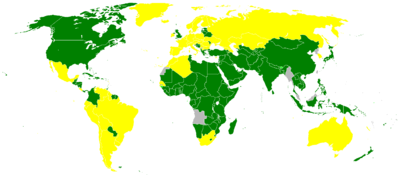
on December 21, 1965, and entered into force on January 4, 1969. As of October 2011, it has 86 signatories and 175 parties.
The Convention is monitored by the Committee on the Elimination of Racial Discrimination (CERD).
Genesis
In December 1960, following incidents of antisemitism in several parts of the world, the United Nations General AssemblyUnited Nations General Assembly
For two articles dealing with membership in the General Assembly, see:* General Assembly members* General Assembly observersThe United Nations General Assembly is one of the five principal organs of the United Nations and the only one in which all member nations have equal representation...
adopted a resolution condemning "all manifestations and practices of racial, religious and national hatred" as violations of the United Nations Charter
United Nations Charter
The Charter of the United Nations is the foundational treaty of the international organization called the United Nations. It was signed at the San Francisco War Memorial and Performing Arts Center in San Francisco, United States, on 26 June 1945, by 50 of the 51 original member countries...
and Universal Declaration of Human Rights
Universal Declaration of Human Rights
The Universal Declaration of Human Rights is a declaration adopted by the United Nations General Assembly . The Declaration arose directly from the experience of the Second World War and represents the first global expression of rights to which all human beings are inherently entitled...
and calling on the governments of all states to "take all necessary measures to prevent all manifestations of racial, religious and national hatred". The Economic and Social Council
United Nations Economic and Social Council
The Economic and Social Council of the United Nations constitutes one of the six principal organs of the United Nations and it is responsible for the coordination of the economic, social and related work of 14 UN specialized agencies, its functional commissions and five regional commissions...
followed this up by drafting a resolution on "manifestations of racial prejudice and national and religious intolerance", calling on governments to educate the public against intolerance and rescind discriminatory laws. Lack of time prevented this from being considered by the General Assembly in 1961, but it was passed the next year.
During the early debate on this resolution, African nations led by the Central African Republic
Central African Republic
The Central African Republic , is a landlocked country in Central Africa. It borders Chad in the north, Sudan in the north east, South Sudan in the east, the Democratic Republic of the Congo and the Republic of the Congo in the south, and Cameroon in the west. The CAR covers a land area of about ,...
, Chad
Chad
Chad , officially known as the Republic of Chad, is a landlocked country in Central Africa. It is bordered by Libya to the north, Sudan to the east, the Central African Republic to the south, Cameroon and Nigeria to the southwest, and Niger to the west...
, Dahomey
Dahomey
Dahomey was a country in west Africa in what is now the Republic of Benin. The Kingdom of Dahomey was a powerful west African state that was founded in the seventeenth century and survived until 1894. From 1894 until 1960 Dahomey was a part of French West Africa. The independent Republic of Dahomey...
, Guinea
Guinea
Guinea , officially the Republic of Guinea , is a country in West Africa. Formerly known as French Guinea , it is today sometimes called Guinea-Conakry to distinguish it from its neighbour Guinea-Bissau. Guinea is divided into eight administrative regions and subdivided into thirty-three prefectures...
, Ivory Coast, Mali
Mali
Mali , officially the Republic of Mali , is a landlocked country in Western Africa. Mali borders Algeria on the north, Niger on the east, Burkina Faso and the Côte d'Ivoire on the south, Guinea on the south-west, and Senegal and Mauritania on the west. Its size is just over 1,240,000 km² with...
, Mauritania
Mauritania
Mauritania is a country in the Maghreb and West Africa. It is bordered by the Atlantic Ocean in the west, by Western Sahara in the north, by Algeria in the northeast, by Mali in the east and southeast, and by Senegal in the southwest...
, and Upper Volta
Republic of Upper Volta
The Republic of Upper Volta was established on December 11, 1958, as a self-governing colony within the French Community. Before attaining autonomy it had been French Upper Volta and part of the French Union. On August 5, 1960 it attained full independence from France.Thomas Sankara came to power...
pushed for more concrete action on the issue, in the form of an international convention against racial discrimination. Some nations preferred a declaration rather than a binding convention, while others wanted to deal with racial and religious intolerance in a single instrument. The eventual compromise, forced by Arab nations' reluctance to discuss antisemitism was for two resolutions, one calling for a declaration and draft convention aimed at eliminating racial discrimination, the other doing the same for religious intolerance
Religious intolerance
Religious intolerance is intolerance against another's religious beliefs or practices.-Definition:The mere statement on the part of a religion that its own beliefs and practices are correct and any contrary beliefs incorrect does not in itself constitute intolerance...
.
The draft Declaration on the Elimination of All Forms of Racial Discrimination
Declaration on the Elimination of All Forms of Racial Discrimination
The Declaration on the Elimination of All Forms of Racial Discrimination is a human rights proclamation issued by the United Nations General Assembly, outlining that body's views on racism. It was adopted by the General Assembly on 20 November 1963...
was adopted by the General Assembly on November 20, 1963. The same day the General Assembly called for the Economic and Social Council and the Commission on Human Rights
United Nations Commission on Human Rights
The United Nations Commission on Human Rights was a functional commission within the overall framework of the United Nations from 1946 until it was replaced by the United Nations Human Rights Council in 2006...
to make the drafting of a Convention on the subject an absolute priority. The draft was completed by mid-1964, but delays in the General Assembly meant that it could not be adopted that year. It was finally adopted on December 21, 1965.
Summary
The Convention follows the structure of the Universal Declaration of Human RightsUniversal Declaration of Human Rights
The Universal Declaration of Human Rights is a declaration adopted by the United Nations General Assembly . The Declaration arose directly from the experience of the Second World War and represents the first global expression of rights to which all human beings are inherently entitled...
, International Covenant on Civil and Political Rights
International Covenant on Civil and Political Rights
The International Covenant on Civil and Political Rights is a multilateral treaty adopted by the United Nations General Assembly on December 16, 1966, and in force from March 23, 1976...
, and International Covenant on Economic, Social and Cultural Rights
International Covenant on Economic, Social and Cultural Rights
The International Covenant on Economic, Social and Cultural Rights is a multilateral treaty adopted by the United Nations General Assembly on December 16, 1966, and in force from January 3, 1976...
, with a preamble and twenty-five articles, divided into three parts.
Part 1 (Articles 1 – 7) commits parties to the elimination of all forms of racial discrimination and to promoting understanding among all races (Article 2). Parties are obliged to not discriminate on the basis of race, not to sponsor or defend racism, and to prohibit racial discrimination within their jurisdictions. They must also review their laws and policies to ensure that they do not discriminate on the basis of race, and commit to amending or repealing those that do. Specific areas in which discrimination must be eliminated are listed in Article 5.
The Convention imposes a specific commitment on parties to eradicate racial segregation
Racial segregation
Racial segregation is the separation of humans into racial groups in daily life. It may apply to activities such as eating in a restaurant, drinking from a water fountain, using a public toilet, attending school, going to the movies, or in the rental or purchase of a home...
and the crime of apartheid
Crime of apartheid
The crime of apartheid is defined by the 2002 Rome Statute of the International Criminal Court as inhumane acts of a character similar to other crimes against humanity "committed in the context of an institutionalized regime of systematic oppression and domination by one racial group over any other...
within their jurisdictions (Article 3). Parties are also required to criminalize the incitement of racial hatred (Article 4), to ensure judicial remedies for acts of racial discrimination (Article 6), and to engage in public education to promote understanding and tolerance (Article 7).
Part 2 (Articles 8 – 16) governs reporting and monitoring of the Convention and the steps taken by the parties to implement it. It establishes the Committee on the Elimination of Racial Discrimination, and empowers it to make general recommendations to the UN General Assembly. It also establishes a dispute-resolution mechanism between parties (Articles 11 – 13), and allows parties to recognise the competence of the Committee to hear complaints from individuals about violations of the rights protected by the Convention (Article 14).
Part 3 (Articles 17 – 25) governs ratification, entry into force, and amendment of the Convention.
Definition of "racial discrimination"
Article 1 of the Convention defines "racial discrimination" as- ...any distinction, exclusion, restriction or preference based on race, colour, descent, or national or ethnicEthnic groupAn ethnic group is a group of people whose members identify with each other, through a common heritage, often consisting of a common language, a common culture and/or an ideology that stresses common ancestry or endogamy...
origin which has the purpose or effect of nullifying or impairing the recognition, enjoyment or exercise, on an equal footing, of human rights and fundamental freedoms in the political, economic, social, cultural or any other field of public life.
Distinctions made on the basis of citizenship
Citizenship
Citizenship is the state of being a citizen of a particular social, political, national, or human resource community. Citizenship status, under social contract theory, carries with it both rights and responsibilities...
(that is, between citizens and non-citizens) are specifically excluded from the definition, as are affirmative action
Affirmative action
Affirmative action refers to policies that take factors including "race, color, religion, gender, sexual orientation or national origin" into consideration in order to benefit an underrepresented group, usually as a means to counter the effects of a history of discrimination.-Origins:The term...
policies and other measures taken to redress imbalances and promote equality.
This definition does not distinguish between discrimination based on ethnicity and discrimination based on race, in part because the distinction between the ethnicity and race remains debatable among anthropologists
Anthropology
Anthropology is the study of humanity. It has origins in the humanities, the natural sciences, and the social sciences. The term "anthropology" is from the Greek anthrōpos , "man", understood to mean mankind or humanity, and -logia , "discourse" or "study", and was first used in 1501 by German...
. The inclusion of descent specifically covers discrimination on the basis of caste
Caste
Caste is an elaborate and complex social system that combines elements of endogamy, occupation, culture, social class, tribal affiliation and political power. It should not be confused with race or social class, e.g. members of different castes in one society may belong to the same race, as in India...
and other forms of inherited status.
Discrimination need not be strictly based on race or ethnicity for the Convention to apply. Rather, whether a particular action or policy discriminates is judged by its effects.
- In seeking to determine whether an action has an effect contrary to the Convention, it will look to see whether that action has an unjustifiable disparate impact upon a group distinguished by race, colour, descent, or national or ethnic origin.
The question of whether an individual belongs to a particular racial group is to be decided, in the absence of justification to the contrary, by self-identification.
Prevention of discrimination
Article 2 of the Convention condemns racial discrimination and obliges parties to "undertake to pursue by all appropriate means and without delay a policy of eliminating racial discrimination in all its forms". It also obliges parties to promote understanding among all races. To achieve this, the Convention requires that signatories:- Not practice racial discrimination in public institutions
- Not "sponsor, defend, or support" racial discrimination
- Review existing policies, and amend or revoke those that cause or perpetuate racial discrimination
- Prohibit "by all appropriate means, including legislation," racial discrimination by individuals and organisations within their jurisdictions
- Encourage groups, movements, and other means that eliminate barriers between races, and discourage racial division
Parties are obliged "when the circumstances so warrant" to use affirmative action
Affirmative action
Affirmative action refers to policies that take factors including "race, color, religion, gender, sexual orientation or national origin" into consideration in order to benefit an underrepresented group, usually as a means to counter the effects of a history of discrimination.-Origins:The term...
policies for specific racial groups to guarantee "the full and equal enjoyment of human rights and fundamental freedoms". However, these measures must be finite, and "shall in no case entail as a consequence the maintenance of unequal or separate rights for different racial groups after the objectives for which they were taken have been achieved".
Article 5 expands upon on the general obligation of Article 2 and creates a specific obligation to guarantee the right of everyone to equality before the law
Equality before the law
Equality before the law or equality under the law or legal egalitarianism is the principle under which each individual is subject to the same laws....
regardless of "race, colour, or national or ethnic origin". It further lists specific rights this equality must apply to: equal treatment by courts and tribunals, security of the person and freedom from violence, the civil and political rights affirmed in the ICCPR, the economic, social and cultural rights affirmed in the ICESCR, and the right of access to any place or service used by the general public, "such as transport hotels, restaurants, cafes, theatres and parks." This list is not exhaustive, and the obligation extends to all human rights.
Article 6 obliges parties to provide "effective protection and remedies" through the courts or other institutions for any act of racial discrimination. This includes a right to a legal remedy
Legal remedy
A legal remedy is the means with which a court of law, usually in the exercise of civil law jurisdiction, enforces a right, imposes a penalty, or makes some other court order to impose its will....
and damages
Damages
In law, damages is an award, typically of money, to be paid to a person as compensation for loss or injury; grammatically, it is a singular noun, not plural.- Compensatory damages :...
for injury suffered due to discrimination.
Condemnation of apartheid
Article 3 condemns apartheid and racial segregationRacial segregation
Racial segregation is the separation of humans into racial groups in daily life. It may apply to activities such as eating in a restaurant, drinking from a water fountain, using a public toilet, attending school, going to the movies, or in the rental or purchase of a home...
and obliges parties to "prevent, prohibit and eradicate" these practices in territories under their jurisdiction. This article has since been strengthened by the recognition of apartheid as a crime against humanity
Crime against humanity
Crimes against humanity, as defined by the Rome Statute of the International Criminal Court Explanatory Memorandum, "are particularly odious offenses in that they constitute a serious attack on human dignity or grave humiliation or a degradation of one or more human beings...
in the Rome Statute of the International Criminal Court
Rome Statute of the International Criminal Court
The Rome Statute of the International Criminal Court is the treaty that established the International Criminal Court . It was adopted at a diplomatic conference in Rome on 17 July 1998 and it entered into force on 1 July 2002. As of 13 October 2011, 119 states are party to the statute...
.
The Committee on the Elimination of Racial Discrimination regards this article as also entailing an obligation to eradicate the consequences of past policies of segregation, and to prevent racial segregation arising from the actions of private individuals.
Prohibition of incitement
Article 4 of the Convention condemns propaganda and organizations that attempt to justify discrimination or are based on the idea of racial supremacismSupremacism
Supremacism is the belief that a particular race, species, ethnic group, religion, gender, sexual orientation, belief system or culture is superior to others and entitles those who identify with it to dominate, control or rule those who do not.- Sexual :...
. It obliges parties, "with due regard to the principles embodied in the Universal Declaration of Human Rights", to adopt "immediate and positive measures" to eradicate these forms of incitement and discrimination. Specifically, it obliges parties to criminalize hate speech
Hate speech
Hate speech is, outside the law, any communication that disparages a person or a group on the basis of some characteristic such as race, color, ethnicity, gender, sexual orientation, nationality, religion, or other characteristic....
, hate crimes and the financing of racist activities, and to prohibit and criminalize membership in organizations that "promote and incite" racial discrimination. A number of parties have reservations on this article, and interpret it as not permitting or requiring measures that infringe on the freedoms of speech, association or assembly.
The Committee on the Elimination of Racial Discrimination regards this article as a mandatory obligation of parties to the Convention, and has repeatedly criticized parties for failing to abide by it. It regards the obligation as consistent with the freedoms of opinion and expression
Freedom of speech
Freedom of speech is the freedom to speak freely without censorship. The term freedom of expression is sometimes used synonymously, but includes any act of seeking, receiving and imparting information or ideas, regardless of the medium used...
affirmed in the UNDHR and ICCPR and notes that the latter specifically outlaws inciting racial discrimination, hatred and violence. It views the provisions as necessary to prevent organised racial violence and the "political exploitation of ethnic difference."
Promotion of tolerance
Article 7 obliges parties to adopt "immediate and effective measures", particularly in education, to combat racial prejudice and encourage understanding and toleranceToleration
Toleration is "the practice of deliberately allowing or permitting a thing of which one disapproves. One can meaningfully speak of tolerating, ie of allowing or permitting, only if one is in a position to disallow”. It has also been defined as "to bear or endure" or "to nourish, sustain or preserve"...
between different racial, ethnic and national groups.
Dispute resolution mechanism
Articles 11 through 13 of the Convention establish a dispute resolution mechanism between parties. A party that believes another party is not implementing the Convention may complain to the Committee on the Elimination of Racial Discrimination. The Committee will pass on the complaint, and if it is not resolved between the two parties, may establish an ad hoc Conciliation Commission to investigate and make recommendations on the matter. This procedure has never been used.Article 22 further allows any dispute over the interpretation or application of the Convention to be referred to the International Court of Justice
International Court of Justice
The International Court of Justice is the primary judicial organ of the United Nations. It is based in the Peace Palace in The Hague, Netherlands...
. This clause has been invoked only once, by Georgia against Russia.
Individual complaints mechanism
Article 14 of the Convention establishes an individual complaints mechanism similar to that of the First Optional Protocol to the International Covenant on Civil and Political RightsFirst Optional Protocol to the International Covenant on Civil and Political Rights
The First Optional Protocol to the International Covenant on Civil and Political Rights is an international treaty establishing an individual complaint mechanism for the International Covenant on Civil and Political Rights . It was adopted by the UN General Assembly on 16 December 1966, and entered...
, Optional Protocol to the Convention on the Rights of Persons with Disabilities
Optional Protocol to the Convention on the Rights of Persons with Disabilities
The Optional Protocol to the Convention on the Rights of Persons with Disabilities is a side-agreement to the Convention on the Rights of Persons with Disabilities. It was adopted on 13 December 2006, and entered into force at the same time as its parent Convention on 3 May 2008...
and Optional Protocol to the Convention on the Elimination of All Forms of Discrimination against Women
Optional Protocol to the Convention on the Elimination of All Forms of Discrimination against Women
The Optional Protocol to the Convention on the Elimination of All Forms of Discrimination against Women is an international treaty which establishes complaint and inquiry mechanisms for the Convention on the Elimination of All Forms of Discrimination Against Women...
. Parties may at any time recognise the competence of the Committee on the Elimination of Racial Discrimination to consider complaints from individuals or groups who claim their rights under the Convention have been violated. Such parties may establish local bodies to hear complaints before they are passed on. Complainants must have exhausted all domestic remedies, and anonymous complaints and complaints that refer to events that occurred before the country concerned joined the Optional Protocol are not permitted. The Committee can request information from and make recommendations to a party.
The individual complaints mechanism came into operation in 1982, after it had been accepted by ten states-parties. As of 2010, 58 states had recognised the competence of the Committee, and 54 cases have been dealt with by the Committee.
Reservations
A number of parties have made reservations and interpretative declarations to their application of the Convention. The Convention text forbids reservations "incompatible with the object and purpose of this Convention" or that would inhibit the operation of any body established by it. A reservation is considered incompatible or inhibitive if two-thirds of parties object to it.Article 22
Afghanistan
Afghanistan
Afghanistan , officially the Islamic Republic of Afghanistan, is a landlocked country located in the centre of Asia, forming South Asia, Central Asia and the Middle East. With a population of about 29 million, it has an area of , making it the 42nd most populous and 41st largest nation in the world...
, Bahrain
Bahrain
' , officially the Kingdom of Bahrain , is a small island state near the western shores of the Persian Gulf. It is ruled by the Al Khalifa royal family. The population in 2010 stood at 1,214,705, including 235,108 non-nationals. Formerly an emirate, Bahrain was declared a kingdom in 2002.Bahrain is...
, China
China
Chinese civilization may refer to:* China for more general discussion of the country.* Chinese culture* Greater China, the transnational community of ethnic Chinese.* History of China* Sinosphere, the area historically affected by Chinese culture...
, Cuba
Cuba
The Republic of Cuba is an island nation in the Caribbean. The nation of Cuba consists of the main island of Cuba, the Isla de la Juventud, and several archipelagos. Havana is the largest city in Cuba and the country's capital. Santiago de Cuba is the second largest city...
, Egypt
Egypt
Egypt , officially the Arab Republic of Egypt, Arabic: , is a country mainly in North Africa, with the Sinai Peninsula forming a land bridge in Southwest Asia. Egypt is thus a transcontinental country, and a major power in Africa, the Mediterranean Basin, the Middle East and the Muslim world...
, Equatorial Guinea
Equatorial Guinea
Equatorial Guinea, officially the Republic of Equatorial Guinea where the capital Malabo is situated.Annobón is the southernmost island of Equatorial Guinea and is situated just south of the equator. Bioko island is the northernmost point of Equatorial Guinea. Between the two islands and to the...
, India
India
India , officially the Republic of India , is a country in South Asia. It is the seventh-largest country by geographical area, the second-most populous country with over 1.2 billion people, and the most populous democracy in the world...
, Indonesia
Indonesia
Indonesia , officially the Republic of Indonesia , is a country in Southeast Asia and Oceania. Indonesia is an archipelago comprising approximately 13,000 islands. It has 33 provinces with over 238 million people, and is the world's fourth most populous country. Indonesia is a republic, with an...
, Iraq
Iraq
Iraq ; officially the Republic of Iraq is a country in Western Asia spanning most of the northwestern end of the Zagros mountain range, the eastern part of the Syrian Desert and the northern part of the Arabian Desert....
, Israel
Israel
The State of Israel is a parliamentary republic located in the Middle East, along the eastern shore of the Mediterranean Sea...
, Kuwait
Kuwait
The State of Kuwait is a sovereign Arab state situated in the north-east of the Arabian Peninsula in Western Asia. It is bordered by Saudi Arabia to the south at Khafji, and Iraq to the north at Basra. It lies on the north-western shore of the Persian Gulf. The name Kuwait is derived from the...
, Lebanon
Lebanon
Lebanon , officially the Republic of LebanonRepublic of Lebanon is the most common term used by Lebanese government agencies. The term Lebanese Republic, a literal translation of the official Arabic and French names that is not used in today's world. Arabic is the most common language spoken among...
, Libya
Libya
Libya is an African country in the Maghreb region of North Africa bordered by the Mediterranean Sea to the north, Egypt to the east, Sudan to the southeast, Chad and Niger to the south, and Algeria and Tunisia to the west....
, Madagascar
Madagascar
The Republic of Madagascar is an island country located in the Indian Ocean off the southeastern coast of Africa...
, Morocco
Morocco
Morocco , officially the Kingdom of Morocco , is a country located in North Africa. It has a population of more than 32 million and an area of 710,850 km², and also primarily administers the disputed region of the Western Sahara...
, Mozambique
Mozambique
Mozambique, officially the Republic of Mozambique , is a country in southeastern Africa bordered by the Indian Ocean to the east, Tanzania to the north, Malawi and Zambia to the northwest, Zimbabwe to the west and Swaziland and South Africa to the southwest...
, Nepal
Nepal
Nepal , officially the Federal Democratic Republic of Nepal, is a landlocked sovereign state located in South Asia. It is located in the Himalayas and bordered to the north by the People's Republic of China, and to the south, east, and west by the Republic of India...
, Saudi Arabia
Saudi Arabia
The Kingdom of Saudi Arabia , commonly known in British English as Saudi Arabia and in Arabic as as-Sa‘ūdiyyah , is the largest state in Western Asia by land area, constituting the bulk of the Arabian Peninsula, and the second-largest in the Arab World...
, Syria
Syria
Syria , officially the Syrian Arab Republic , is a country in Western Asia, bordering Lebanon and the Mediterranean Sea to the West, Turkey to the north, Iraq to the east, Jordan to the south, and Israel to the southwest....
, Thailand
Thailand
Thailand , officially the Kingdom of Thailand , formerly known as Siam , is a country located at the centre of the Indochina peninsula and Southeast Asia. It is bordered to the north by Burma and Laos, to the east by Laos and Cambodia, to the south by the Gulf of Thailand and Malaysia, and to the...
, Turkey
Turkey
Turkey , known officially as the Republic of Turkey , is a Eurasian country located in Western Asia and in East Thrace in Southeastern Europe...
, Vietnam
Vietnam
Vietnam – sometimes spelled Viet Nam , officially the Socialist Republic of Vietnam – is the easternmost country on the Indochina Peninsula in Southeast Asia. It is bordered by China to the north, Laos to the northwest, Cambodia to the southwest, and the South China Sea –...
, and Yemen
Yemen
The Republic of Yemen , commonly known as Yemen , is a country located in the Middle East, occupying the southwestern to southern end of the Arabian Peninsula. It is bordered by Saudi Arabia to the north, the Red Sea to the west, and Oman to the east....
do not consider themselves bound by Article 22. Some interpret this article as allowing disputes to be referred to the International Court of Justice
International Court of Justice
The International Court of Justice is the primary judicial organ of the United Nations. It is based in the Peace Palace in The Hague, Netherlands...
only with the consent of all involved parties.
Obligations beyond existing constitution
Antigua and Barbuda
Antigua and Barbuda
Antigua and Barbuda is a twin-island nation lying between the Caribbean Sea and the Atlantic Ocean. It consists of two major inhabited islands, Antigua and Barbuda, and a number of smaller islands...
, the Bahamas, Barbados
Barbados
Barbados is an island country in the Lesser Antilles. It is in length and as much as in width, amounting to . It is situated in the western area of the North Atlantic and 100 kilometres east of the Windward Islands and the Caribbean Sea; therein, it is about east of the islands of Saint...
, Guyana
Guyana
Guyana , officially the Co-operative Republic of Guyana, previously the colony of British Guiana, is a sovereign state on the northern coast of South America that is culturally part of the Anglophone Caribbean. Guyana was a former colony of the Dutch and of the British...
, Jamaica
Jamaica
Jamaica is an island nation of the Greater Antilles, in length, up to in width and 10,990 square kilometres in area. It is situated in the Caribbean Sea, about south of Cuba, and west of Hispaniola, the island harbouring the nation-states Haiti and the Dominican Republic...
, Nepal
Nepal
Nepal , officially the Federal Democratic Republic of Nepal, is a landlocked sovereign state located in South Asia. It is located in the Himalayas and bordered to the north by the People's Republic of China, and to the south, east, and west by the Republic of India...
, Papua New Guinea
Papua New Guinea
Papua New Guinea , officially the Independent State of Papua New Guinea, is a country in Oceania, occupying the eastern half of the island of New Guinea and numerous offshore islands...
, Thailand
Thailand
Thailand , officially the Kingdom of Thailand , formerly known as Siam , is a country located at the centre of the Indochina peninsula and Southeast Asia. It is bordered to the north by Burma and Laos, to the east by Laos and Cambodia, to the south by the Gulf of Thailand and Malaysia, and to the...
and United States of America interpret the Convention as not implying any obligations beyond the limits of their existing constitutions.
Hate speech
Austria
Austria
Austria , officially the Republic of Austria , is a landlocked country of roughly 8.4 million people in Central Europe. It is bordered by the Czech Republic and Germany to the north, Slovakia and Hungary to the east, Slovenia and Italy to the south, and Switzerland and Liechtenstein to the...
, Belgium
Belgium
Belgium , officially the Kingdom of Belgium, is a federal state in Western Europe. It is a founding member of the European Union and hosts the EU's headquarters, and those of several other major international organisations such as NATO.Belgium is also a member of, or affiliated to, many...
, France
France
The French Republic , The French Republic , The French Republic , (commonly known as France , is a unitary semi-presidential republic in Western Europe with several overseas territories and islands located on other continents and in the Indian, Pacific, and Atlantic oceans. Metropolitan France...
, Ireland
Ireland
Ireland is an island to the northwest of continental Europe. It is the third-largest island in Europe and the twentieth-largest island on Earth...
, Italy
Italy
Italy , officially the Italian Republic languages]] under the European Charter for Regional or Minority Languages. In each of these, Italy's official name is as follows:;;;;;;;;), is a unitary parliamentary republic in South-Central Europe. To the north it borders France, Switzerland, Austria and...
, Japan
Japan
Japan is an island nation in East Asia. Located in the Pacific Ocean, it lies to the east of the Sea of Japan, China, North Korea, South Korea and Russia, stretching from the Sea of Okhotsk in the north to the East China Sea and Taiwan in the south...
, Malta
Malta
Malta , officially known as the Republic of Malta , is a Southern European country consisting of an archipelago situated in the centre of the Mediterranean, south of Sicily, east of Tunisia and north of Libya, with Gibraltar to the west and Alexandria to the east.Malta covers just over in...
, Monaco
Monaco
Monaco , officially the Principality of Monaco , is a sovereign city state on the French Riviera. It is bordered on three sides by its neighbour, France, and its centre is about from Italy. Its area is with a population of 35,986 as of 2011 and is the most densely populated country in the...
, Switzerland
Switzerland
Switzerland name of one of the Swiss cantons. ; ; ; or ), in its full name the Swiss Confederation , is a federal republic consisting of 26 cantons, with Bern as the seat of the federal authorities. The country is situated in Western Europe,Or Central Europe depending on the definition....
and Tonga
Tonga
Tonga, officially the Kingdom of Tonga , is a state and an archipelago in the South Pacific Ocean, comprising 176 islands scattered over of ocean in the South Pacific...
all interpret Article 4 as not permitting or requiring measures that threaten the freedoms of speech, opinion, association, and assembly. Antigua and Barbuda
Antigua and Barbuda
Antigua and Barbuda is a twin-island nation lying between the Caribbean Sea and the Atlantic Ocean. It consists of two major inhabited islands, Antigua and Barbuda, and a number of smaller islands...
, the Bahamas, Barbados
Barbados
Barbados is an island country in the Lesser Antilles. It is in length and as much as in width, amounting to . It is situated in the western area of the North Atlantic and 100 kilometres east of the Windward Islands and the Caribbean Sea; therein, it is about east of the islands of Saint...
, Fiji
Fiji
Fiji , officially the Republic of Fiji , is an island nation in Melanesia in the South Pacific Ocean about northeast of New Zealand's North Island...
, Nepal
Nepal
Nepal , officially the Federal Democratic Republic of Nepal, is a landlocked sovereign state located in South Asia. It is located in the Himalayas and bordered to the north by the People's Republic of China, and to the south, east, and west by the Republic of India...
, Papua New Guinea
Papua New Guinea
Papua New Guinea , officially the Independent State of Papua New Guinea, is a country in Oceania, occupying the eastern half of the island of New Guinea and numerous offshore islands...
, Thailand
Thailand
Thailand , officially the Kingdom of Thailand , formerly known as Siam , is a country located at the centre of the Indochina peninsula and Southeast Asia. It is bordered to the north by Burma and Laos, to the east by Laos and Cambodia, to the south by the Gulf of Thailand and Malaysia, and to the...
and United Kingdom
United Kingdom
The United Kingdom of Great Britain and Northern IrelandIn the United Kingdom and Dependencies, other languages have been officially recognised as legitimate autochthonous languages under the European Charter for Regional or Minority Languages...
interpret the Convention as creating an obligation to enact measures against hate speech and hate crimes only when a need arises. The United States of America does not accept any obligation to enact measures under Article 4, which it views as incompatible with freedom of expression.
Immigration
Monaco
Monaco
Monaco , officially the Principality of Monaco , is a sovereign city state on the French Riviera. It is bordered on three sides by its neighbour, France, and its centre is about from Italy. Its area is with a population of 35,986 as of 2011 and is the most densely populated country in the...
and Switzerland
Switzerland
Switzerland name of one of the Swiss cantons. ; ; ; or ), in its full name the Swiss Confederation , is a federal republic consisting of 26 cantons, with Bern as the seat of the federal authorities. The country is situated in Western Europe,Or Central Europe depending on the definition....
reserve the right to apply their own legal principles on the entry of foreigners into their labour markets. The United Kingdom
United Kingdom
The United Kingdom of Great Britain and Northern IrelandIn the United Kingdom and Dependencies, other languages have been officially recognised as legitimate autochthonous languages under the European Charter for Regional or Minority Languages...
does not regard the Commonwealth Immigrants Act 1962
Commonwealth Immigrants Act 1962
The Commonwealth Immigrants Act 1962 was an Act of the Parliament of the United Kingdom.Before the Act was passed, citizens of British commonwealth countries had extensive rights to migrate to the UK...
and Commonwealth Immigrants Act 1968 as constituting any form of racial discrimination.
Indigenous people
Tonga
Tonga
Tonga, officially the Kingdom of Tonga , is a state and an archipelago in the South Pacific Ocean, comprising 176 islands scattered over of ocean in the South Pacific...
reserves the right not to apply the Convention to any restriction on the alienation of land held by indigenous Tongans. Fiji
Fiji
Fiji , officially the Republic of Fiji , is an island nation in Melanesia in the South Pacific Ocean about northeast of New Zealand's North Island...
has significant reservations around Article 5, and reserves the right not to implement those provisions if they are incompatible with existing law on voting rights, the alienation of land by indigenous Fijians.
Jurisprudence
The individual complaints mechanism has led to a limited jurisprudence on the interpretation and implementation of the Convention. So far 45 complaints have been registered with the Committee; 17 of these have been deemed inadmissible, 14 have led to a finding of no violation, and in 10 cases a party has been found to have violated the Convention. Four cases are still pending.Several cases have dealt with the treatment of Romani people in Eastern Europe. In Koptova v. Slovakia the Committee found that resolutions by several villages in Slovakia
Slovakia
The Slovak Republic is a landlocked state in Central Europe. It has a population of over five million and an area of about . Slovakia is bordered by the Czech Republic and Austria to the west, Poland to the north, Ukraine to the east and Hungary to the south...
forbidding the residence of Roma were discriminatory and restricted freedom of movement
Freedom of movement
Freedom of movement, mobility rights or the right to travel is a human right concept that the constitutions of numerous states respect...
and residence, and recommended the Slovak government take steps to end such practices. In L.R. v. Slovakia the Committee found that the Slovak government had failed to provide an effective remedy for discrimination suffered by Roma after the cancellation of a housing project on ethnic grounds. In Durmic v. Serbia and Montenegro the Committee found a systemic failure by the Serbian government to investigate and prosecute discrimination against Roma in access to public places.
In several cases, notably L.K. v. Netherlands and Gelle v. Denmark, the Committee has criticized parties for their failure to adequately prosecute acts of racial discrimination or incitement. In both cases, the Committee refused to accept "any claim that the enactment of law making racial discrimination a criminal act in itself represents full compliance with the obligations of States parties under the Convention". Such laws "must also be effectively implemented by the competent national tribunals and other State institutions". While the Committee accepts the discretion of prosecutors on whether or not to lay charges, this discretion "should be applied in each case of alleged racial discrimination in the light of the guarantees laid down in the Convention"
In The Jewish community of Oslo et al. v. Norway
The Jewish community of Oslo et al. v. Norway
The Jewish community of Oslo et al. v. Norway was a case decided by the UN Committee on the Elimination of Racial Discrimination in 2005.-Facts:...
, the Committee found that the prohibition of hate speech was compatible with freedom of speech, and that the acquittal of a neo-Nazi leader by the Supreme Court of Norway
Supreme Court of Norway
The Supreme Court of Norway was established in 1815 on the basis of the Constitution of Norway's §88, prescribing an independent judiciary. It is located in Oslo and is Norway's highest court...
on freedom of speech grounds was a violation of the Convention.
In Hagan v. Australia, the Committee ruled that, while not originally intended to demean anyone, the name of the "E. S. 'Nigger' Brown Stand" (named in honour of 1920s rugby league
Rugby league
Rugby league football, usually called rugby league, is a full contact sport played by two teams of thirteen players on a rectangular grass field. One of the two codes of rugby football, it originated in England in 1895 by a split from Rugby Football Union over paying players...
player Edward Stanley Brown) at a Toowoomba
Toowoomba, Queensland
Toowoomba is a city in Southern Queensland, Australia. It is located west of Queensland's capital city, Brisbane. With an estimated district population of 128,600, Toowoomba is Australia's second largest inland city and its largest non-capital inland city...
sports field was racially offensive and should be removed.
Impact
The impact of an international treaty can be measured in two ways: by its acceptance, and by its implementation. On the first measure, the Convention has gained near-universal acceptance by the international community, with fewer than twenty (mostly small) states yet to become parties. Most major states have also accepted the Convention's individual complaints mechanism, signaling a strong desire to be bound by the Convention's provisions.On the second measure, the Convention has had a significant impact on national legislation, with many states adopting legislation outlawing racial discrimination by the state, in the workplace, or in the provision of services such as housing and education. Such legislation may be either civil or criminal. Examples of the former include the Race Relations Act 1971 (New Zealand), Racial Discrimination Act 1975
Racial Discrimination Act 1975
The Racial Discrimination Act 1975 is a statute passed by the Australian Parliament during the Prime Ministership of Labor Gough Whitlam....
(Australia), Race Relations Act 1976
Race Relations Act 1976
The Race Relations Act 1976 was established by the Parliament of the United Kingdom to prevent discrimination on the grounds of race.Items that are covered include discrimination on the grounds of race, colour, nationality, ethnic and national origin in the fields of employment, the provision of...
(UK), and Canadian Human Rights Act
Canadian Human Rights Act
The Canadian Human Rights Act is a statute originally passed by the Parliament of Canada in 1977 with the express goal of extending the law to ensure equal opportunity to individuals who may be victims of discriminatory practices based on a set prohibited grounds such as gender, disability, or...
(Canada). Criminal provisions are used in Belgium, Denmark, France, Italy, Norway and Portugal. Despite reservations to the Convention, most western European nations have criminalized the incitement of racial hatred.
The Convention has faced persistent problems with reporting since its inception, with parties frequently failing to report fully, or even at all. As of 2008, twenty parties had failed to report for more than ten years, and thirty parties had failed to report for more than five. One party, Sierra Leone
Sierra Leone
Sierra Leone , officially the Republic of Sierra Leone, is a country in West Africa. It is bordered by Guinea to the north and east, Liberia to the southeast, and the Atlantic Ocean to the west and southwest. Sierra Leone covers a total area of and has an estimated population between 5.4 and 6.4...
, had failed to report since 1976, while two more – Liberia
Liberia
Liberia , officially the Republic of Liberia, is a country in West Africa. It is bordered by Sierra Leone on the west, Guinea on the north and Côte d'Ivoire on the east. Liberia's coastline is composed of mostly mangrove forests while the more sparsely populated inland consists of forests that open...
and Saint Lucia
Saint Lucia
Saint Lucia is an island country in the eastern Caribbean Sea on the boundary with the Atlantic Ocean. Part of the Lesser Antilles, it is located north/northeast of the island of Saint Vincent, northwest of Barbados and south of Martinique. It covers a land area of 620 km2 and has an...
had never met their reporting requirements under the Convention. The Committee has responded to this persistent failure to report by reviewing the late parties anyway – a strategy that has produced some success in gaining compliance with reporting requirements. This lack of reporting is seen by some as a significant failure of the Convention. However the reporting system has also been praised as providing "a permanent stimulus inducing individual States to enact anti-racist legislation or amend the existing one when necessary."
Committee on the Elimination of Racial Discrimination
The Committee on the Elimination of Racial Discrimination is a body of human rights experts tasked with monitoring the implementation of the Convention. It consists of 18 independent human rights experts, elected for four-year terms, with half the members elected every two years. Members are elected by secret ballot of the parties, with each party allowed to nominate one of its nationals to the Committee.All parties are required to submit regular reports to the Committee outlining the legislative, judicial, policy and other measures they have taken to give effect to the Convention. The first report is due within a year of the Convention entering into effect for that state; thereafter reports are due every two years or whenever the Committee requests. The Committee examines each report and addresses its concerns and recommendations to the state party in the form of "concluding observations".
The Committee typically meets every March and August in Geneva
Geneva
Geneva In the national languages of Switzerland the city is known as Genf , Ginevra and Genevra is the second-most-populous city in Switzerland and is the most populous city of Romandie, the French-speaking part of Switzerland...
.
The current (as of August 2010) membership of the Committee is:
| Name | State | Term |
|---|---|---|
| Anwar Kemal (chair) |  Pakistan Pakistan |
2010–2014 |
| Alexei S. Avtonomov |  Russia Russia |
2010–2012 |
| Noureddine Amir |  Algeria Algeria |
2010–2014 |
| José Francisco Cali Tzay |  Guatemala Guatemala |
2010–2012 |
| Anastasia Crickley |  Republic of Ireland Republic of Ireland |
2010–2014 |
| Fatimata-Binta Victoria Dah |  Burkina Faso Burkina Faso |
2010–2012 |
| Ion Diaconu |  Kingdom of Romania Kingdom of Romania |
2010–2012 |
| Régis de Gouttes |  Early Modern France Early Modern France |
2010–2014 |
| Kokou Mawuena Ika Kana (Dieudonnè) Ewomsan |  Togo Togo |
2010–2014 |
| Huang Yong An |  Mainland China Mainland China |
2010–2012 |
| Gün Kut |  Turkey Turkey |
2010–2014 |
| Dilip Lahiri |  India India |
2010–2012 |
| José Augusto Lindgren Alves |  Brazil Brazil |
2010–2014 |
| Pastor Elias Murillo Martinez |  Colombia Colombia |
2010–2012 |
| Chris Maina Peter |  Tanzania Tanzania |
2010–2012 |
| Pierre-Richard Prosper Pierre-Richard Prosper Pierre-Richard Prosper is an American lawyer, prosecutor and former government official. He served as the second United States Ambassador-at-Large for War Crimes Issues under President George W... |
 United States United States |
2010–2012 |
| Waliakoye Saidou |  Niger Niger |
2010–2014 |
| Patrick Thornberry | 2010–2014 |
See also
- RacismRacismRacism is the belief that inherent different traits in human racial groups justify discrimination. In the modern English language, the term "racism" is used predominantly as a pejorative epithet. It is applied especially to the practice or advocacy of racial discrimination of a pernicious nature...
- Declaration on the Elimination of All Forms of Racial DiscriminationDeclaration on the Elimination of All Forms of Racial DiscriminationThe Declaration on the Elimination of All Forms of Racial Discrimination is a human rights proclamation issued by the United Nations General Assembly, outlining that body's views on racism. It was adopted by the General Assembly on 20 November 1963...
- The Jewish community of Oslo et al. v. NorwayThe Jewish community of Oslo et al. v. NorwayThe Jewish community of Oslo et al. v. Norway was a case decided by the UN Committee on the Elimination of Racial Discrimination in 2005.-Facts:...
Further reading
- The U.N. Convention on the Elimination of All Forms of Racial Discrimination. By Natán Lérner. Alphenaan den Rijn: Sijthoff & Noordhoff International, 1980.