
All Topics  
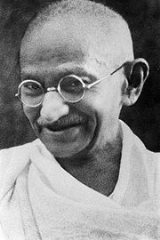
Mahatma Gandhi

 
Mahatma Gandhi

   Email Print
   Bookmark   Link


Mahatma Gandhi


Mohandas Karamchand Gandhi (Gujarati
Gujarati language

Gujarati is an Indo-Aryan languages, and part of the greater Indo-European languages language family. It is native to the Indian state of Gujarat, and is its chief language, as well as of the adjacent union territories of Daman and Diu and Dadra and Nagar Haveli....
: ??????? ?????? ?????, ) (2 October 1869 – 30 January 1948) was a major political and spiritual leader of India
India

India, officially the Republic of India , is a country in South Asia. It is the List of countries and outlying territories by total area country by geographical area, the List of countries by population country, and the most populous liberal democracy in the world....
 and the Indian independence movement
Indian independence movement

The term Indian independence movement incorporates various national and regional campaigns, agitations and efforts of both Nonviolent and Revolutionary movement for Indian independence philosophy....
. He was the pioneer of satyagraha
Satyagraha

Satyagraha is a philosophy and practice of nonviolent resistance developed by Mohandas Karamchand Gandhi . Gandhi deployed satyagraha in campaigns for Indian independence and also during his earlier struggles in South Africa....
—resistance to tyranny through mass civil disobedience
Civil disobedience

Civil disobedience is the active refusal to obey certain laws, demands and commands of a government, or of an occupying power , without resorting to physical violence....
, firmly founded upon ahimsa
Ahimsa

Ahimsa is a Sanskrit term meaning to do no harm . It is an important tenet of the religions that originated in ancient India . Ahimsa is a rule of conduct that bars the killing or injuring of living beings....
 or total non-violence—which led India to independence
Indian independence movement

The term Indian independence movement incorporates various national and regional campaigns, agitations and efforts of both Nonviolent and Revolutionary movement for Indian independence philosophy....
 and inspired movements for civil rights and freedom across the world. He is commonly known around the world as Mahatma Gandhi (Sanskrit
Sanskrit

Sanskrit is a historical Indo-Aryan language, one of the liturgical languages of Hinduism and Buddhism, and one of the 22 official languages of India....
: ??????? mahatma
Mahatma

Mahatma is Sanskrit for "Great Soul" ; it is similar in usage to the modern Christian term saint. This epithet is commonly applied to prominent people like Mohandas Karamchand Gandhi and Mahatma Jyotirao Phule....
 or "Great Soul", an honorific
Honorific

An honorific is a word or expression that conveys esteem or respect when used in addressing or referring to a person. "Honorific" may refer broadly to the style of language or particular words or grammatical markings used in this way, including words used to express honor to one perceived as a social superior....
 first applied to him by Rabindranath Tagore
Rabindranath Tagore

, also known by the sobriquet Gurudev, was a Bengali people mystic, Brahmo poet, visual artist, playwright, novelist, and composer whose works reshaped Bengali literature and Music of Bengal in the late 19th and early 20th centuries....
) and in India also as Bapu (Gujarati
Gujarati language

Gujarati is an Indo-Aryan languages, and part of the greater Indo-European languages language family. It is native to the Indian state of Gujarat, and is its chief language, as well as of the adjacent union territories of Daman and Diu and Dadra and Nagar Haveli....
: ???? bapu or "Father").


Discussion
Ask a question about 'Mahatma Gandhi'
Start a new discussion about 'Mahatma Gandhi'
Answer questions from other users
Full Discussion Forum


Recent Posts


Encyclopedia


Mohandas Karamchand Gandhi (Gujarati
Gujarati language

Gujarati is an Indo-Aryan languages, and part of the greater Indo-European languages language family. It is native to the Indian state of Gujarat, and is its chief language, as well as of the adjacent union territories of Daman and Diu and Dadra and Nagar Haveli....
: ??????? ?????? ?????, ) (2 October 1869 – 30 January 1948) was a major political and spiritual leader of India
India

India, officially the Republic of India , is a country in South Asia. It is the List of countries and outlying territories by total area country by geographical area, the List of countries by population country, and the most populous liberal democracy in the world....
 and the Indian independence movement
Indian independence movement

The term Indian independence movement incorporates various national and regional campaigns, agitations and efforts of both Nonviolent and Revolutionary movement for Indian independence philosophy....
. He was the pioneer of satyagraha
Satyagraha

Satyagraha is a philosophy and practice of nonviolent resistance developed by Mohandas Karamchand Gandhi . Gandhi deployed satyagraha in campaigns for Indian independence and also during his earlier struggles in South Africa....
—resistance to tyranny through mass civil disobedience
Civil disobedience

Civil disobedience is the active refusal to obey certain laws, demands and commands of a government, or of an occupying power , without resorting to physical violence....
, firmly founded upon ahimsa
Ahimsa

Ahimsa is a Sanskrit term meaning to do no harm . It is an important tenet of the religions that originated in ancient India . Ahimsa is a rule of conduct that bars the killing or injuring of living beings....
 or total non-violence—which led India to independence
Indian independence movement

The term Indian independence movement incorporates various national and regional campaigns, agitations and efforts of both Nonviolent and Revolutionary movement for Indian independence philosophy....
 and inspired movements for civil rights and freedom across the world. He is commonly known around the world as Mahatma Gandhi (Sanskrit
Sanskrit

Sanskrit is a historical Indo-Aryan language, one of the liturgical languages of Hinduism and Buddhism, and one of the 22 official languages of India....
: ??????? mahatma
Mahatma

Mahatma is Sanskrit for "Great Soul" ; it is similar in usage to the modern Christian term saint. This epithet is commonly applied to prominent people like Mohandas Karamchand Gandhi and Mahatma Jyotirao Phule....
 or "Great Soul", an honorific
Honorific

An honorific is a word or expression that conveys esteem or respect when used in addressing or referring to a person. "Honorific" may refer broadly to the style of language or particular words or grammatical markings used in this way, including words used to express honor to one perceived as a social superior....
 first applied to him by Rabindranath Tagore
Rabindranath Tagore

, also known by the sobriquet Gurudev, was a Bengali people mystic, Brahmo poet, visual artist, playwright, novelist, and composer whose works reshaped Bengali literature and Music of Bengal in the late 19th and early 20th centuries....
) and in India also as Bapu (Gujarati
Gujarati language

Gujarati is an Indo-Aryan languages, and part of the greater Indo-European languages language family. It is native to the Indian state of Gujarat, and is its chief language, as well as of the adjacent union territories of Daman and Diu and Dadra and Nagar Haveli....
: ???? bapu or "Father"). He is officially honoured in India
India

India, officially the Republic of India , is a country in South Asia. It is the List of countries and outlying territories by total area country by geographical area, the List of countries by population country, and the most populous liberal democracy in the world....
 as the Father of the Nation
Father of the Nation

Father ofhjkjijolkpx?gsoplqhdtrsjdewfathers]] may be used if more than one person is considered key....
; his birthday, 2 October, is commemorated there as Gandhi Jayanti
Gandhi Jayanti

Gandhi Jayanti is a India celebrated in India to mark the occasion of the birthday of Mahatma Gandhi, the "Father of the Nation". It is celebrated on October 2, every year....
, a national holiday, and worldwide as the International Day of Non-Violence
International Day of Non-Violence

The International Day of Non-Violence is observed on 2 October, the birthday of Mahatma Gandhi. This day is referred to in India as Gandhi Jayanti....
.

Gandhi first employed non-violent civil disobedience
Civil disobedience

Civil disobedience is the active refusal to obey certain laws, demands and commands of a government, or of an occupying power , without resorting to physical violence....
 as an expatriate lawyer in South Africa
South Africa

The Republic of South Africa, also known by Official names of South Africa, is a country located at the southern tip of the continent of Africa....
, in the resident Indian community's struggle for civil rights. After his return to India in 1915, he set about organising peasants, farmers, and urban labourers in protesting excessive land-tax and discrimination. Assuming leadership of the Indian National Congress
Indian National Congress

Indian National Congress-I is a major political party in India. Founded in 1885 by Dadabhai Naoroji, Dinshaw Edulji Wacha, Womesh Chandra Bonerjee, Surendranath Banerjee, Monomohun Ghose, Allan Octavian Hume, and William Wedderburn, the Indian National Congress became the leader of the Indian Independence Movement, with over 15 million memb...
 in 1921, Gandhi led nationwide campaigns for easing poverty, for expanding women's rights, for building religious and ethnic amity, for ending untouchability
Dalit

Dalit is a self-designation for a South Asians group of people traditionally regarded as untouchables or of low caste system in India. Dalits are a mixed population of numerous caste groups all over South Asia and speak various languages....
, for increasing economic self-reliance, but above all for achieving Swaraj
Swaraj

Swaraj can mean generally self-governance or "home-rule" but the word usually refers to Mahatma Gandhi's concept for Indian independence movement from foreign domination....
—the independence of India from foreign domination. Gandhi famously led Indians in the Non-cooperation movement
Non-cooperation movement

The Edwin Movement , was the first-ever series of nationwide people's movements of nonviolent resistance and civil disobedience, led by Mahatma Gandhi and the Indian National Congress....
  in 1922 and in protesting the British-imposed salt tax with the Dandi Salt March in 1930, and later in calling for the British to Quit India in 1942. He was imprisoned for many years, on numerous occasions, in both South Africa and India.

As a practitioner of Ahimsa
Ahimsa

Ahimsa is a Sanskrit term meaning to do no harm . It is an important tenet of the religions that originated in ancient India . Ahimsa is a rule of conduct that bars the killing or injuring of living beings....
 Gandhi swore to speak the truth
Truth

semantic fields for the word truth extend from honesty, good faith, and sincerity in general, to agreement with fact or reality in particular....
, and advocated that others do the same. He lived modestly in a self-sufficient residential community
Sabarmati Ashram

Sabarmati Ashram is located in the Ahmedabad suburb of Sabarmati adjoining to famous Ashram Road, at the bank of River Sabarmati,4 miles away from the city Town Hall.This was one of the residences of Mohandas Karamchand Gandhi.This ashram is now converted in to the national monument by the Government of India due to its significance in India...
 and wore the traditional Indian dhoti
Dhoti

The dhoti or doti in Hindi, called suriya in Assamese language, pancha in Telugu language, Laacha in Punjabi language, mundu in Malayalam, dhuti in Bangla, veshti in Tamil language, dhotar in Marathi and panche in Kannada, is the traditional garment of men's wear in India....
 and shawl, woven with yarn he had hand spun on a charkha. He ate simple vegetarian food, and also undertook long fasts
Fasting

Fasting is primarily the act of willingly abstaining from some or all food, drink, or both, for a period of time. A fast may be total or partial concerning that from which one fasts, and may be prolonged or intermittent as to the period of fasting....
 as means of both self-purification and social protest.

Early life

Mohandas Karamchand Gandhi was born in Porbander, a coastal town in present-day Gujarat
Gujarat

Gujarat is a States and territories of India in western India. Gujarat borders Pakistan to the north west and the state of Rajasthan to the north and northeast, Madhya Pradesh to the east, Maharashtra and the Union territory of Diu, Daman District, India, Dadra and Nagar Haveli to the south....
, Western India, on 2 October 1869. His father, Karamchand Gandhi (1822-1885), who belonged to the Hindu Modh
Modh

Modh are the followers of Modheshwari Maa , a form of Amba Maa with eighteen hands. They lived in a town called Modhera in Mehasana District in the northern part of Gujarat....
 community, was the diwan
Diwan (title)

The originally Persian title of diwan has at various points in the Muslim history, designated various differing though similar functions....
 (Prime Minister) of the eponymous Porbander state
Porbandar

Porbandar is a coastal city in the Indian States and territories of India of Gujarat, perhaps best known for being the birthplace of Mahatma Gandhi and Sudama ....
, a small princely state
Princely state

For other uses, see Principality, Princely state#Other princely statesA Princely State was a nominally sovereign entity of British rule in India that was not directly administered by the British, but rather by an Indian ruler under a form of indirect rule such as suzerainty or paramountcy....
 in the Kathiawar Agency
Kathiawar Agency

File:Baroda state 1909.jpgKathiawar Agency was a political unit that was part of the old Bombay Presidency in British India. Situated on the Kathiawar peninsula in the western part of the Indian subcontinent, it was composed of almost 200 princely states, which were merged into Bombay state upon India's independence in 1947....
 of British India
British Raj

British Raj primarily refers to the British rule in the Indian subcontinent between 1858 and 1947; it can also refer to the period of dominion, and even the region under the rule....
. His mother, Putlibai, who came from the Hindu Pranami Vaishnava community, was Karamchand's fourth wife, the first three wives having apparently died in childbirth. Growing up with a devout mother and the Jain
Jainism

Jainism is one of the oldest Indian religions that originated in India. Jains believe that every soul is divine and has the potential to achieve God-consciousness....
 traditions of the region, the young Mohandas absorbed early the influences that would play an important role in his adult life; these included compassion to sentient beings, vegetarianism
Vegetarianism

File:Foods.jpgVegetarianism is the practice of a diet that excludes meat , fish and poultry.There are several variants of the diet, some of which also exclude egg and/or some products produced from animal labour such as dairy products and honey....
, fasting
Fasting

Fasting is primarily the act of willingly abstaining from some or all food, drink, or both, for a period of time. A fast may be total or partial concerning that from which one fasts, and may be prolonged or intermittent as to the period of fasting....
 for self-purification, and mutual tolerance between individuals of different creeds.

In May 1883, the 13-year old Mohandas was married to 14-year old Kasturbai Makhanji
Kasturba Gandhi

Kast?rba Gandhi , affectionately called Ba, was the wife of Mohandas Karamchand Gandhi, marrying him in an arranged marriage child marriage in 1883; he was 13, she 14....
 (her first name was usually shortened to "Kasturba," and affectionately to "Ba") in an arranged
Arranged marriage

Arranged marriage is a marriage arranged by someone other than the couple getting wedded, curtailing or avoiding the process of courtship. Such marriages had deep roots in royal and aristocratic families around the world, including Europe....
 child marriage
Child marriage

Child marriage usually refers to two separate social phenomena which are practiced in some societies. The first and more widespread practice is that of marrying a young child to an adult....
, as was the custom in the region. However, as was also the custom of the region, the adolescent bride was to spend much time at her parents' house, and away from her husband. In 1885, when Gandhi was 15, the couple's first child was born, but survived only a few days; Gandhi's father, Karamchand Gandhi, had died earlier that year. Mohandas and Kasturbai had four more children, all sons: Harilal
Harilal Gandhi

Harilal Mohandas Gandhi , was the first son of Mohandas Karamchand Gandhi....
, born in 1888; Manilal
Manilal Gandhi

Manilal Mohandas Gandhi was the second son of Mohandas Karamchand Gandhi and Kasturba Gandhi and was active in his father's movement. Manilal was born in India and worked for almost five decades, from 1917 onwards, as the editor of the Gujarati language-English language weekly publication, Indian Opinion, at Phoenix, Durban....
, born in 1892; Ramdas
Ramdas Gandhi

Ramdas Gandhi was the third son of Mohandas Karamchand Gandhi. He was born in South Africa. He outlived his parents and all of his brothers. He and his wife Nirmala had three children; Sumitra Gandhi, Kanu Gandhi and Usha Gandhi....
, born in 1897; and Devdas
Devdas Gandhi

Devdas Gandhi was the fourth and youngest son of Mohandas Karamchand Gandhi. He was born in South Africa and returned to India with his parents as a young man....
, born in 1900. At his middle school in Porbandar and high school in Rajkot, Gandhi remained an average student academically. He passed the matriculation exam
Matriculation

Matriculation, in the broadest sense, means to be registered or added to a list, from the Latin matricula - little list. In Scottish heraldry, for instance, a matriculation is a registration of armorial bearings....
 for Samaldas College at Bhavnagar
Bhavnagar

Bhavnagar is a city in the Indian state of Gujarat. It was founded in 1723 AD by Bhavsinhji Gohil and was named after its founder and ruler. It was capital of Bhavnagar State which was the first princely state to merge with the democratic Indian Union in 1948....
, Gujarat
Gujarat

Gujarat is a States and territories of India in western India. Gujarat borders Pakistan to the north west and the state of Rajasthan to the north and northeast, Madhya Pradesh to the east, Maharashtra and the Union territory of Diu, Daman District, India, Dadra and Nagar Haveli to the south....
 with some difficulty. While there, he was unhappy, in part because his family wanted him to become a barrister
Barrister

A barrister is a lawyer found in many common law jurisdictions that employ a split profession in relation to legal representation. In split professions, the other type of lawyer is the solicitor....
.
Gandhi and Kasturbhai 1902
On 4 September 1888, less than a month shy of his nineteenth birthday, Gandhi traveled to London
London

London is the capital of both England and the United Kingdom, and the most populous municipality in the European Union. An important settlement for two millennia, History of London goes back to its founding by the Roman Empire....
, England, to study law at University College London
University College London

University College London is a university institution and constituent college of the University of London based primarily in London, England, United Kingdom....
 and to train as a barrister
Barrister

A barrister is a lawyer found in many common law jurisdictions that employ a split profession in relation to legal representation. In split professions, the other type of lawyer is the solicitor....
. His time in London, the Imperial capital, was influenced by a vow he had made to his mother in the presence of the Jain monk Becharji, upon leaving India, to observe the Hindu precepts of abstinence from meat, alcohol, and promiscuity. Although Gandhi experimented with adopting "English" customs—taking dancing lessons for example—he could not stomach his landlady's mutton and cabbage. She pointed him towards one of London
London

London is the capital of both England and the United Kingdom, and the most populous municipality in the European Union. An important settlement for two millennia, History of London goes back to its founding by the Roman Empire....
's few vegetarian restaurants. Rather than simply go along with his mother's wishes, he read about, and intellectually embraced vegetarianism
Vegetarianism

File:Foods.jpgVegetarianism is the practice of a diet that excludes meat , fish and poultry.There are several variants of the diet, some of which also exclude egg and/or some products produced from animal labour such as dairy products and honey....
. He joined the Vegetarian Society
Vegetarian Society

The Vegetarian Society is a United Kingdom registered charitable organization established on 30 September 1847 with the aim of promoting understanding and respect for vegetarianism lifestyles....
, was elected to its executive committee, and founded a local chapter. He later credited this with giving him valuable experience in organizing institutions. Some of the vegetarians he met were members of the Theosophical Society
Theosophical Society

The Theosophical Society was the organization formed to advance the spiritual principles and search for Truth known as Theosophy....
, which had been founded in 1875 to further universal brotherhood, and which was devoted to the study of Buddhist and Hindu literature. They encouraged Gandhi to read the Bhagavad Gita
Bhagavad Gita

The Bhagavad Gita is an important Sanskrit Hindu scripture. It is revered as a sacred scripture of Hinduism, and considered as one of the most important religious classics of the world....
. Not having shown a particular interest in religion
Religion

A religion is an organized approach to human spirituality which usually encompasses a set of myth, symbols, beliefs and practices, often with a supernatural or transcendence quality, that give meaning to the practitioner's experiences of life through reference to a higher power or truth....
 before, he read works of and about Hinduism
Hinduism

'Hinduism' is the predominant religion of the Indian subcontinent. Hinduism is often referred to as , a Sanskrit phrase meaning "the eternal dharma", by its practitioners....
, Christianity
Christianity

Christianity is a Monotheistic religion #Christian view religion centered on the life and teachings of Jesus as New Testament view on Jesus' life....
, Buddhism
Buddhism

Buddhism is a family of beliefs and practices considered by most to be a religionand is based on the teachings attributed to Siddhartha Gautama, commonly known as "The Buddha" , who was born in what is today Nepal....
, Islam
Islam

Islam is a Monotheism, Abrahamic religion originating with the teachings of the Prophets of Islam Muhammad, a 7th century Arab religious and political figure....
 and other religions. He returned to India after being called to the bar
Bar association

A bar association is a professional body of lawyers. Some bar associations are responsible for the regulation of the legal profession in their jurisdiction; others are professional organizations dedicated to serving their members; in many cases, they are both....
 of England and Wales
England and Wales

England and Wales is a legal unit within the United Kingdom. It consists of England and Wales, two of the four countries of the United Kingdom....
 by the Inner Temple
Inner Temple

The Honourable Society of the Inner Temple is one of the four Inns of Court around the Royal Courts of Justice in London which may call members to the Bar association and so entitle them to practise as barristers....
 but had limited success establishing a law practice in Mumbai
Mumbai

Mumbai— formerly Bombay, is the capital of the Indian state of Maharashtra. The city proper has approximately 14 million people and, along with the neighbouring suburbs of Navi Mumbai and Thane, Mumbai forms the World's largest urban agglomerations according to the United Nations World Urbanization Prospects report with around 19...
. Later, after applying and being turned down for a part-time job as a high school teacher, he ended up returning to Rajkot
Rajkot

Rajkot is the 4th largest city in the state of Gujarat, India. Rajkot is the List of most populous metropolitan areas in India in India, with a population more than 1.43 million as on 2008....
 to make a modest living drafting petitions for litigants, a business he was forced to close when he ran afoul of a British officer. In his autobiography, he refers to this incident as an unsuccessful attempt to lobby on behalf of his older brother. It was in this climate that, in 1893, he accepted a year-long contract from an Indian firm to a post in Natal, South Africa
South Africa

The Republic of South Africa, also known by Official names of South Africa, is a country located at the southern tip of the continent of Africa....
, then part of the British Empire.

Civil rights movement in South Africa (1893–1914)

Gandhi Boer War 1899
In South Africa, Gandhi faced discrimination directed at Indians. He was thrown off a train at Pietermaritzburg
Pietermaritzburg

Pietermaritzburg is the capital and second largest city of the province of KwaZulu-Natal in South Africa. It was founded in 1838. Popularly called Maritzburg, and abbreviated PMB, it is home to a campus of the University of KwaZulu-Natal, and is a major producer of aluminium as well as timber and dairy products....
 after refusing to move from the first class to a third class coach while holding a valid first class ticket. Traveling further on by stagecoach, he was beaten by a driver for refusing to travel on the foot board to make room for a European passenger. He suffered other hardships on the journey as well, including being barred from several hotels. In another incident, the magistrate of a Durban
Durban

Durban is the third most populous city in South Africa, forming part of the eThekwini metropolitan municipality . It is the largest city in KwaZulu-Natal and is famous as the busiest port in Africa....
 court ordered Gandhi to remove his turban
Turban

The turban is a headgear consisting of a long scarf-like single piece of cloth wound around either the head itself or an inner hat. The word "turban" is a common umbrella term, loosely used in English to refer to several sorts of head wrap....
, which he refused to do. These events were a turning point in his life, awakening him to social injustice and influencing his subsequent social activism. It was through witnessing firsthand the racism
Racism

Racism, by its simplest definition is the belief that Race is the primary determinant of human traits and capacities and that racial differences produce an inherent superiority of a particular race....
, prejudice
Prejudice

The word prejudice refers to prejudgment: making a decision about before becoming aware of the relevant facts of a case or event. The word has commonly been used in certain restricted contexts, in the expression 'racial prejudice'....
 and injustice against Indians in South Africa that Gandhi started to question his people's status within the British Empire
British Empire

The British Empire comprised the dominions, Crown colony, protectorates, League of Nations mandate, and other Dependent territory ruled or administered by the United Kingdom , that had originated with the overseas colonies and trading posts established by England in the late 16th and early 17th centuries....
, and his own place in society.

Gandhi extended his original period of stay in South Africa
South Africa

The Republic of South Africa, also known by Official names of South Africa, is a country located at the southern tip of the continent of Africa....
 to assist Indians in opposing a bill to deny them the right to vote. Though unable to halt the bill's passage, his campaign was successful in drawing attention to the grievances of Indians in South Africa. He founded the Natal Indian Congress
Natal Indian Congress

The Natal Indian Congress was an organization that aimed to fight discrimination against Asians in South Africa in South Africa. The Natal Indian Congress was started by Mohandas Karamchand Gandhi, later known as the Mahatma....
 in 1894, and through this organization, he molded the Indian community of South Africa into a homogeneous political force. In January 1897, when Gandhi returned from a brief trip to India, a white mob attacked and tried to lynch him. In an early indication of the personal values that would shape his later campaigns, he refused to press charges against any member of the mob, stating it was one of his principles not to seek redress for a personal wrong in a court of law.

In 1906, the Transvaal
Transvaal

File:Flag of Transvaal.svgFile:Transvaal map.pngFile:Spelterini Transvaal.jpgThe Transvaal is the name of an area of northern South Africa....
 government promulgated a new Act compelling registration of the colony's Indian population. At a mass protest meeting held in Johannesburg on 11 September that year, Gandhi adopted his still evolving methodology of satyagraha
Satyagraha

Satyagraha is a philosophy and practice of nonviolent resistance developed by Mohandas Karamchand Gandhi . Gandhi deployed satyagraha in campaigns for Indian independence and also during his earlier struggles in South Africa....
 (devotion to the truth), or non-violent protest, for the first time, calling on his fellow Indians to defy the new law and suffer the punishments for doing so, rather than resist through violent means. This plan was adopted, leading to a seven-year struggle in which thousands of Indians were jailed (including Gandhi), flogged, or even shot, for striking, refusing to register, burning their registration cards, or engaging in other forms of non-violent resistance. While the government was successful in repressing the Indian protesters, the public outcry stemming from the harsh methods employed by the South African government in the face of peaceful Indian protesters finally forced South African General Jan Christiaan Smuts to negotiate a compromise with Gandhi. Gandhi's ideas took shape and the concept of satyagraha matured during this struggle.

Role in Zulu War of 1906

In 1906, after the British introduced a new poll-tax, Zulu
Zulu

The Zulu are the largest South African ethnic group of an estimated 10-11 million people who live mainly in the province of KwaZulu-Natal, South Africa....
s in South Africa killed two British officers. In response, the British declared a war against the Zulus. Gandhi actively encouraged the British to recruit Indians. He argued that Indians should support the war efforts in order to legitimize their claims to full citizenship. The British, however, refused to commission Indians as army officers. Nonetheless, they accepted Gandhi's offer to let a detachment of Indians volunteer as a stretcher bearer corps to treat wounded British soldiers. This corps was commanded by Gandhi. On 21 July 1906, Gandhi wrote in Indian Opinion
Indian Opinion

The Indian Opinion was a newspaper established by Indian leader Mahatma Gandhi. The publication was an important tool for the political movement led by Gandhi and the Natal Indian Congress to fight racial discrimination and win civil rights for the Indian immigrant community in South Africa....
: "The corps had been formed at the instance of the Natal Government by way of experiment, in connection with the operations against the Natives consists of twenty three Indians". Gandhi urged the Indian population in South Africa to join the war through his columns in Indian Opinion: “If the Government only realized what reserve force is being wasted, they would make use of it and give Indians the opportunity of a thorough training for actual warfare.”

In Gandhi's opinion, the Draft Ordinance of 1906 brought the status of Indians below the level of Natives. He therefore urged Indians to resist the Ordinance along the lines of satyagraha
Satyagraha

Satyagraha is a philosophy and practice of nonviolent resistance developed by Mohandas Karamchand Gandhi . Gandhi deployed satyagraha in campaigns for Indian independence and also during his earlier struggles in South Africa....
 by taking the example of "Kaffir
Kaffir (ethnic slur)

Kaffir, kaffer or kafir, which once was a blanket term for black people southern Africans , is now utilized exclusively as an ethnic or racial slur....
s". In his words, "Even the half-castes and kaffirs, who are less advanced than we, have resisted the government. The pass law applies to them as well, but they do not take out passes."

In 1927 Gandhi wrote of the event: "The Boer War
Boer War

Two Boer Wars were fought between the British empire and the two independent Boer republics, the Orange Free State and the South African Republic , founded by settlers known as Voortrekkers who made the Great Trek from the Cape Colony....
 had not brought home to me the horrors of war with anything like the vividness that the [Zulu] 'rebellion' did. This was no war but a man-hunt, not only in my opinion, but also in that of many Englishmen with whom I had occasion to talk."

Struggle for Indian Independence (1916–1945)

In 1915, Gandhi returned from South Africa to live in India. He spoke at the conventions of the Indian National Congress
Indian National Congress

Indian National Congress-I is a major political party in India. Founded in 1885 by Dadabhai Naoroji, Dinshaw Edulji Wacha, Womesh Chandra Bonerjee, Surendranath Banerjee, Monomohun Ghose, Allan Octavian Hume, and William Wedderburn, the Indian National Congress became the leader of the Indian Independence Movement, with over 15 million memb...
, but was primarily introduced to Indian issues, politics and the Indian people by Gopal Krishna Gokhale
Gopal Krishna Gokhale

Gopal Krishna Gokhale, Order of the Indian Empire was one of the founding social and political leaders during the Indian Independence Movement against the British Raj....
, a respected leader of the Congress Party at the time.

Champaran and Kheda

Gandhi Kheda 1918
Gandhi's first major achievements came in 1918 with the Champaran agitation and Kheda Satyagraha, although in the latter it was indigo and other cash crops instead of the food crops necessary for their survival. Suppressed by the militias of the landlords (mostly British), they were given measly compensation, leaving them mired in extreme poverty. The villages were kept extremely dirty and unhygienic; and alcoholism, untouchability
Dalit

Dalit is a self-designation for a South Asians group of people traditionally regarded as untouchables or of low caste system in India. Dalits are a mixed population of numerous caste groups all over South Asia and speak various languages....
 and purdah
Purdah

Purdah or Pardaa is the practice of preventing women from being seen by their spouses. This takes two forms: physical sex segregation, and the requirement for women to cover their bodies and conceal their form....
 were rampant. Now in the throes of a devastating famine, the British levied a tax which they insisted on increasing. The situation was desperate. In Kheda
Kheda

See...
 in Gujarat
Gujarat

Gujarat is a States and territories of India in western India. Gujarat borders Pakistan to the north west and the state of Rajasthan to the north and northeast, Madhya Pradesh to the east, Maharashtra and the Union territory of Diu, Daman District, India, Dadra and Nagar Haveli to the south....
, the problem was the same. Gandhi established an ashram
Ashram

An "ashram" in ancient India was a Hindu hermitage where sages lived in peace and tranquility amidst nature. Today, the term "ashram" is sometimes used to refer to an intentional community formed primarily for spiritual upliftment of its members, often headed by a religious leader or mysticism....
 there, organizing scores of his veteran supporters and fresh volunteers from the region. He organized a detailed study and survey of the villages, accounting for the atrocities and terrible episodes of suffering, including the general state of degenerate living. Building on the confidence of villagers, he began leading the clean-up of villages, building of schools and hospitals and encouraging the village leadership to undo and condemn many social evils, as accounted above.

But his main impact came when he was arrested by police on the charge of creating unrest and was ordered to leave the province. Hundreds of thousands of people protested and rallied outside the jail, police stations and courts demanding his release, which the court reluctantly granted. Gandhi led organized protests and strikes against the landlords who, with the guidance of the British government, signed an agreement granting the poor farmers of the region more compensation and control over farming, and cancellation of revenue hikes and its collection until the famine ended. It was during this agitation, that Gandhi was addressed by the people as Bapu (Father) and Mahatma (Great Soul). In Kheda, Sardar Patel represented the farmers in negotiations with the British, who suspended revenue collection and released all the prisoners. As a result, Gandhi's fame spread all over the nation.

Non-cooperation

Gandhi employed non-cooperation, non-violence and peaceful resistance as his "weapons" in the struggle against British
British Raj

British Raj primarily refers to the British rule in the Indian subcontinent between 1858 and 1947; it can also refer to the period of dominion, and even the region under the rule....
. In Punjab
Punjab (British India)

Punjab was a province of British India, it was one of the last areas of the Indian subcontinent to fall under British rule. With the end of British rule in 1947 the province was split between India and Pakistan....
, the Jallianwala Bagh massacre
Jallianwala Bagh massacre

The Jallianwala Bagh Massacre , alternatively known as the Amritsar Massacre, was named after the Jallianwala Bagh in the northern Indian city of Amritsar where, on April 13, 1919, while doing a peaceful demonstration on occasion of Punjabi New Year, British Indian Army soldiers under the command of Brigadier-General Reginald Dyer open...
 of civilians by British troops (also known as the Amritsar Massacre) caused deep trauma to the nation, leading to increased public anger and acts of violence. Gandhi criticized both the actions of the British Raj
British Raj

British Raj primarily refers to the British rule in the Indian subcontinent between 1858 and 1947; it can also refer to the period of dominion, and even the region under the rule....
 and the retaliatory violence of Indians. He authored the resolution offering condolences to British civilian victims and condemning the riots which, after initial opposition in the party, was accepted following Gandhi's emotional speech advocating his principle that all violence was evil and could not be justified. But it was after the massacre and subsequent violence that Gandhi's mind focused upon obtaining complete self-government and control of all Indian government institutions, maturing soon into Swaraj
Swaraj

Swaraj can mean generally self-governance or "home-rule" but the word usually refers to Mahatma Gandhi's concept for Indian independence movement from foreign domination....
 or complete individual, spiritual, political independence.

In December 1921, Gandhi was invested with executive authority on behalf of the Indian National Congress
Indian National Congress

Indian National Congress-I is a major political party in India. Founded in 1885 by Dadabhai Naoroji, Dinshaw Edulji Wacha, Womesh Chandra Bonerjee, Surendranath Banerjee, Monomohun Ghose, Allan Octavian Hume, and William Wedderburn, the Indian National Congress became the leader of the Indian Independence Movement, with over 15 million memb...
. Under his leadership, the Congress was reorganized with a new constitution, with the goal of Swaraj. Membership in the party was opened to anyone prepared to pay a token fee. A hierarchy of committees was set up to improve discipline, transforming the party from an elite organization to one of mass national appeal. Gandhi expanded his non-violence platform to include the swadeshi policy
Swadeshi movement

The Swadeshi movement, part of the Indian independence movement, was a successful economic strategy to remove the British Empire from power and improve economic conditions in India through following principles of swadeshi ....
 — the boycott of foreign-made goods, especially British goods. Linked to this was his advocacy that khadi
Khadi

Khadi or khaddar simply means cotton, usually handspun.Khadi is Indian handspun and hand-woven cloth. The raw materials may be cotton, silk, or wool, which are spun into threads on a spinning wheel called a charkha....
 (homespun cloth) be worn by all Indians instead of British-made textiles. Gandhi exhorted Indian men and women, rich or poor, to spend time each day spinning khadi in support of the independence movement. This was a strategy to inculcate discipline and dedication to weed out the unwilling and ambitious, and to include women in the movement at a time when many thought that such activities were not respectable activities for women. In addition to boycotting British products, Gandhi urged the people to boycott British educational institutions and law courts, to resign from government employment, and to forsake British titles and honours
British honours system

The United Kingdom honours system is a means of rewarding individuals' personal bravery, achievement, or service to the United Kingdom. The system consists of three types of award: honours, decorations and medals:...
.

"Non-cooperation" enjoyed widespread appeal and success, increasing excitement and participation from all strata of Indian society. Yet, just as the movement reached its apex, it ended abruptly as a result of a violent clash in the town of Chauri Chaura
Chauri Chaura

Chauri Chaura is a town near Gorakhpur, Uttar Pradesh, India. The town is famous for an event that took place on 4 February 1922 during British Raj when an occupied police chowki was set on fire by a nationalist mob, killing 23 of the police occupants....
, Uttar Pradesh
Uttar Pradesh

Uttar Pradesh , [often referred to as U.P.] is a States and territories of India located in the northern part of India. With a population of over 190 million people,...
, in February 1922. Fearing that the movement was about to take a turn towards violence, and convinced that this would be the undoing of all his work, Gandhi called off the campaign of mass civil disobedience. Gandhi was arrested on 10 March 1922, tried for sedition, and sentenced to six years imprisonment. He began his sentence on 18 March 1922. He was released in February 1924 for an appendicitis
Appendicitis

Appendicitis is a condition characterized by inflammation of the Vermiform appendix. It is a medical emergency. All cases require removal of the inflamed appendix, either by laparotomy or laparoscopy....
 operation, having served only 2 years.

Without Gandhi's uniting personality, the Indian National Congress began to splinter during his years in prison, splitting into two factions, one led by Chitta Ranjan Das and Motilal Nehru
Motilal Nehru

Motilal Nehru was an early Indian independence activist and leader of the Indian National Congress. He was the founder patriarch of India's most powerful political family, the Nehru-Gandhi family....
 favouring party participation in the legislatures, and the other led by Chakravarti Rajagopalachari and Sardar Vallabhbhai Patel
Sardar Vallabhbhai Patel

Vallabhbhai Patel was a politics of India and social leader of India who played a major role in the country's Indian independence movement and guided its Political integration of India into a united, independent nation....
, opposing this move. Furthermore, cooperation among Hindus and Muslims, which had been strong at the height of the non-violence campaign, was breaking down. Gandhi attempted to bridge these differences through many means, including a three-week fast in the autumn of 1924, but with limited success.

Swaraj and the Salt Satyagraha (Salt March)

Gandhi stayed out of active politics and as such limelight for most of the 1920s, preferring to resolve the wedge between the Swaraj Party and the Indian National Congress, and expanding initiatives against untouchability, alcoholism, ignorance and poverty. He returned to the fore in 1928. The year before, the British government had appointed a new constitutional reform commission under Sir John Simon, which did not include any Indian as its member. The result was a boycott of the commission by Indian political parties. Gandhi pushed through a resolution at the Calcutta Congress in December 1928 calling on the British government to grant India dominion status or face a new campaign of non-cooperation with complete independence for the country as its goal. Gandhi had not only moderated the views of younger men like Subhas Chandra Bose and Jawaharlal Nehru
Jawaharlal Nehru

Jawaharlal Nehru The son of the wealthy Indian barrister and politician Motilal Nehru, Nehru became a leader of the left-wing of the Indian National Congress at a remarkably young age....
, who sought a demand for immediate independence, but also reduced his own call to a one year wait, instead of two. The British did not respond. On 31 December 1929, the flag of India was unfurled in Lahore. 26 January 1930 was celebrated by the Indian National Congress, meeting in Lahore, as India's Independence Day. This day was commemorated by almost every other Indian organization. Gandhi then launched a new satyagraha against the tax on salt in March 1930, highlighted by the famous Salt March to Dandi from 12 March to 6 April, marching 400 kilometres (248 miles) from Ahmedabad to Dandi, Gujarat to make salt himself. Thousands of Indians joined him on this march to the sea. This campaign was one of his most successful at upsetting British hold on India; Britain responded by imprisoning over 60,000 people. The government, represented by Lord Edward Irwin
E. F. L. Wood, 1st Earl of Halifax

Edward Frederick Lindley Wood, 1st Earl of Halifax, Order of the Garter, Order of Merit, Order of the Star of India, Order of St Michael and St George, Order of the Indian Empire, Privy Council of the United Kingdom , known as The Baron Irwin from 1925 until 1934 and as The Viscount Halifax from 1934 until 1944, was one of the mos...
, decided to negotiate with Gandhi. The Gandhi–Irwin Pact was signed in March 1931. The British Government agreed to set all political prisoners free in return for the suspension of the civil disobedience movement. As a result of the pact, Gandhi was also invited to attend the Round Table Conference in London as the sole representative of the Indian National Congress. The conference was a disappointment to Gandhi and the nationalists, as it focused on the Indian princes and Indian minorities rather than the transfer of power. Furthermore, Lord Irwin's successor, Lord Willingdon
Freeman Freeman-Thomas, 1st Marquess of Willingdon

Freeman Freeman-Thomas, 1st Marquess of Willingdon, Order of the Star of India, Order of St Michael and St George, Order of the Indian Empire, Order of the British Empire, Privy Council of the United Kingdom was a British Liberal Party politician, cricketer, scouting pioneer and administrator who served as Governor General of...
, embarked on a new campaign of controlling and subduing the movement of the nationalists. Gandhi was again arrested, and the government attempted to negate his influence by completely isolating him from his followers. However, this tactic was not successful. In 1932, through the campaigning of the Dalit leader B. R. Ambedkar
B. R. Ambedkar

Bhimrao Ramji Ambedkar , also known as Babasaheb, was an Indian nationalist, jurist, Dalit political leader and a Buddhist revivalist. He was also the chief architect of the Indian Constitution....
, the government granted untouchables separate electorates under the new constitution. In protest, Gandhi embarked on a six-day fast in September 1932, successfully forcing the government to adopt a more equitable arrangement via negotiations mediated by the Dalit cricketer turned political leader Palwankar Baloo. This was the start of a new campaign by Gandhi to improve the lives of the untouchables, whom he named Harijans, the children of God. On 8 May 1933 Gandhi began a 21-day fast of self-purification to help the Harijan movement. This new campaign was not universally embraced within the Dalit community, however, as prominent leader B. R. Ambedkar
B. R. Ambedkar

Bhimrao Ramji Ambedkar , also known as Babasaheb, was an Indian nationalist, jurist, Dalit political leader and a Buddhist revivalist. He was also the chief architect of the Indian Constitution....
 condemned Gandhi's use of the term Harijans as saying that Dalits were socially immature, and that privileged caste Indians played a paternalistic role. Ambedkar and his allies also felt Gandhi was undermining Dalit political rights. Gandhi, although born into the Vaishya caste, insisted that he was able to speak on behalf of Dalits, despite the availability of Dalit activists such as Ambedkar.

In the summer of 1934, three unsuccessful attempts were made on his life.
Mahadev Desai and Gandhi 2 1939
When the Congress Party chose to contest elections and accept power under the Federation scheme, Gandhi decided to resign from party membership. He did not disagree with the party's move, but felt that if he resigned, his popularity with Indians would cease to stifle the party's membership, that actually varied from communists, socialists, trade unionists, students, religious conservatives, to those with pro-business convictions and that these various voices would get a chance to make themselves heard. Gandhi also did not want to prove a target for Raj propaganda by leading a party that had temporarily accepted political accommodation with the Raj.

Gandhi returned to the head in 1936, with the Nehru presidency and the Lucknow session of the Congress. Although Gandhi desired a total focus on the task of winning independence and not speculation about India's future, he did not restrain the Congress from adopting socialism as its goal. Gandhi had a clash with Subhas Bose, who had been elected to the presidency in 1938. Gandhi's main points of contention with Bose were his lack of commitment to democracy, and lack of faith in non-violence. Bose won his second term despite Gandhi's criticism, but left the Congress when the All-India leaders resigned en masse in protest against his abandonment of the principles introduced by Gandhi.

World War II and Quit India

World War II
World War II

World War II, or the Second World War , was a global military conflict which involved a Participants in World War II, including all of the great powers, organised into two opposing military alliances: the Allies of World War II and the Axis powers....
 broke out in 1939 when Nazi Germany
Nazi Germany

Nazi Germany and the Third Reich are the colloquial English names for Germany under the regime of Adolf Hitler and the Nazi Party , which established a Totalitarianism dictatorship that existed from 1933 to 1945....
 invaded Poland
Poland

Poland , officially the Republic of Poland , is a country in Central Europe. Poland is bordered by Germany to the west; the Czech Republic and Slovakia to the south; Ukraine, Belarus and Lithuania to the east; and the Baltic Sea and Kaliningrad Oblast, a Russian Enclave and exclave, to the north....
. Initially, Gandhi had favored offering "non-violent moral support" to the British effort, but other Congressional leaders were offended by the unilateral inclusion of India into the war, without consultation of the people's representatives. All Congressmen elected to resign from office en masse. After lengthy deliberations, Gandhi declared that India could not be party to a war ostensibly being fought for democratic freedom, while that freedom was denied to India itself. As the war progressed, Gandhi intensified his demand for independence, drafting a resolution calling for the British to Quit India. This was Gandhi's and the Congress Party's most definitive revolt aimed at securing the British exit from Indian shores.

Gandhi was criticized by some Congress party members and other Indian political groups, both pro-British and anti-British. Some felt that opposing Britain in its life or death struggle against the evil of Nazism was immoral, and others felt that Gandhi's opposition was insufficient. Quit India became the most forceful movement in the history of the struggle, with mass arrests and violence on an unprecedented scale. Thousands of freedom fighters were killed or injured by police gunfire, and hundreds of thousands were arrested. Gandhi and his supporters made it clear they would not support the war effort unless India were granted immediate independence. He even clarified that this time the movement would not be stopped if individual acts of violence were committed, saying that the "ordered anarchy" around him was "worse than real anarchy." He called on all Congressmen and Indians to maintain discipline via ahimsa
Ahimsa

Ahimsa is a Sanskrit term meaning to do no harm . It is an important tenet of the religions that originated in ancient India . Ahimsa is a rule of conduct that bars the killing or injuring of living beings....
, and Karo Ya Maro ("Do or Die") in the cause of ultimate freedom.

Gandhi and the entire Congress Working Committee were arrested in Bombay by the British on 9 August 1942. Gandhi was held for two years in the Aga Khan Palace
Aga Khan Palace

File:Aga Khan Palace - Small.jpgThe Aga Khan Palace was constructed by Sultan Mohammed Shah, Aga Khan III, in the year 1892. Built in Yerwada, near Pune, it was intended to be a source of employment for the famine-struck villagers in the surrounding areas....
 in Pune
Pune

Pune ,Pune is the administrative capital of Pune district and the 7th Metro city of India.Pune is known to have existed as a town since 937 AD....
. It was here that Gandhi suffered two terrible blows in his personal life. His 50-year old secretary Mahadev Desai
Mahadev Desai

Mahadev Desai was an Indian independence activist and nationalist writer; he was most famously known for being the personal secretary of Mahatma Gandhi....
 died of a heart attack 6 days later and his wife Kasturba died after 18 months imprisonment in 22 February 1944; six weeks later Gandhi suffered a severe malaria attack. He was released before the end of the war on 6 May 1944 because of his failing health and necessary surgery; the Raj did not want him to die in prison and enrage the nation. Although the Quit India movement had moderate success in its objective, the ruthless suppression of the movement brought order to India by the end of 1943. At the end of the war, the British gave clear indications that power would be transferred to Indian hands. At this point Gandhi called off the struggle, and around 100,000 political prisoners were released, including the Congress's leadership.

Freedom and partition of India

Gandhi advised the Congress to reject the proposals the British Cabinet Mission offered in 1946, as he was deeply suspicious of the grouping proposed for Muslim-majority states—Gandhi viewed this as a precursor to partition. However, this became one of the few times the Congress broke from Gandhi's advice (though not his leadership), as Nehru and Patel knew that if the Congress did not approve the plan, the control of government would pass to the Muslim League
Muslim League

The Muslim League , founded at Dhaka in 1906, was a political party in British India that developed into the driving force behind the creation of Pakistan as a Islam state on the Indian subcontinent....
. Between 1946 and 1948, over 5,000 people were killed in violence. Gandhi was vehemently opposed to any plan that partitioned India into two separate countries. An overwhelming majority of Muslims living in India, side by side with Hindus and Sikhs, were in favour of Partition. Additionally Muhammad Ali Jinnah
Muhammad Ali Jinnah

Muhammad Ali Jinnah Urdu language: }} , a 20th century politician and statesman, is generally regarded as the father of the state of Pakistan. He served as leader of the Muslim League and served as Pakistan's first Governor-General of Pakistan....
, the leader of the Muslim League, commanded widespread support in West Punjab, Sindh
Sindh

Sindh is one of the four Subdivisions of Pakistan of Pakistan and historically is home to the Sindhi people. Different cultural and ethnic groups also reside in Sindh including Urdu-speaking Muslim refugees who migrated to Pakistan from India upon independence as well as the people migrated from other provinces after independence....
, North-West Frontier Province
North-West Frontier Province

File:Makra Peak by Khalid Mahmood.jpgThe North-West Frontier Province is the smallest of the Subdivisions of Pakistan of Pakistan. The NWFP is home to the majority Pashtuns as well as other smaller ethnic groups....
 and East Bengal
East Bengal

East Bengal was the name used during two periods in the 20th century for a territory that roughly corresponded to the modern state of Bangladesh....
. The partition plan was approved by the Congress leadership as the only way to prevent a wide-scale Hindu-Muslim civil war. Congress leaders knew that Gandhi would viscerally oppose partition, and it was impossible for the Congress to go ahead without his agreement, for Gandhi's support in the party and throughout India was strong. Gandhi's closest colleagues had accepted partition as the best way out, and Sardar Patel endeavoured to convince Gandhi that it was the only way to avoid civil war. A devastated Gandhi gave his assent.

He conducted extensive dialogue with Muslim and Hindu community leaders, working to cool passions in northern India, as well as in Bengal
Bengal

Bengal , is a historical and geographical region in the northeast of South Asia. Today it is mainly divided between the independent sovereign nation of the Bangladesh and the state of West Bengal in India, although some regions of the previous kingdoms of Bengal are now part of the neighboring Indian states of Bihar, Assam, Tripura and Oris...
. Despite the Indo-Pakistani War of 1947
Indo-Pakistani War of 1947

The Indo-Pakistani War of 1947, sometimes known as the First Kashmir War, was fought between Union of India and Dominion of Pakistan over the region of Kashmir from 1947 to 1948....
, he was troubled when the Government decided to deny Pakistan the 55 crore
Crore

A crore is a unit in the Indian numbering system and was formerly a unit in the Persian numbering system, still widely used in Bangladesh, India, Maldives, Nepal, Pakistan, and Sri Lanka, and formerly in Iran....
s (550 million Indian rupees) due as per agreements made by the Partition Council. Leaders like Sardar Patel feared that Pakistan would use the money to bankroll the war against India. Gandhi was also devastated when demands resurged for all Muslims to be deported to Pakistan, and when Muslim and Hindu leaders expressed frustration and an inability to come to terms with one another. He launched his last fast-unto-death in Delhi
Delhi

Delhi , sometimes referred to as Dilli , is the List of most populous cities in India metropolis in India and, with over 11 million residents, the List of metropolitan areas by population....
, asking that all communal violence be ended once and for all, and that the payment of 550 million rupees be made to Pakistan. Gandhi feared that instability and insecurity in Pakistan would increase their anger against India, and violence would spread across the borders. He further feared that Hindus and Muslims would renew their enmity and that this would precipitate open civil war. After emotional debates with his life-long colleagues, Gandhi refused to budge, and the Government rescinded its policy and made the payment to Pakistan. Hindu, Muslim and Sikh community leaders, including the Rashtriya Swayamsevak Sangh
Rashtriya Swayamsevak Sangh

The Rashtriya Swayamsevak Sangh , also known as the Sangh or the RSS, is a Hindu nationalist organization in India. It was founded in 1925 by Dr....
 and Hindu Mahasabha assured him that they would renounce violence and call for peace. Gandhi thus broke his fast by sipping orange juice.

Assassination


On 30 January 1948, Gandhi was shot and killed while having his nightly public walk on the grounds of the Birla Bhavan (Birla House
Birla House

Birla House or Birla Bhavan, in New Delhi, India, is the location where Mahatma Gandhi spent the last 144 days of his life and was assassinated on January 30, 1948....
) in New Delhi
New Delhi

New Delhi is the capital city of India. With a total area of 42.7 km2, New Delhi is situated within the metropolis of Delhi and serves as the seat of the Government of India and the Government of the National Capital Territory of Delhi ....
. The assassin, Nathuram Godse
Nathuram Godse

Nathuram Vinayak Godse was the assassin of Mohandas Karamchand Gandhi....
, was a Hindu radical with links to the extremist Hindu Mahasabha, who held Gandhi responsible for weakening India by insisting upon a payment to Pakistan. Godse and his co-conspirator Narayan Apte
Narayan Apte

Narayan Dattatraya Apte was a Hindu activist and enterpreneur who was sentenced to death for his role in the assassination of Mahatma Gandhi and subsequently, hanged....
 were later tried and convicted; they were executed on 15 November 1949. Gandhi's memorial (or Samadhi) at Raj Ghat, New Delhi
New Delhi

New Delhi is the capital city of India. With a total area of 42.7 km2, New Delhi is situated within the metropolis of Delhi and serves as the seat of the Government of India and the Government of the National Capital Territory of Delhi ....
, bears the epigraph "He Ram", (Devanagari
Devanagari

, or 'Nagari', is an abugida alphabet of India and Nepal. It is written from left to right, lacks distinct letter cases, and is recognizable by a distinctive horizontal line running along the tops of the letters that links them together....
: ?? ! ??? or, He
RAMA

Rama is a first-person adventure game developed and published by Sierra Entertainment in 1996. The game is based on Arthur C. Clarke's books Rendezvous with Rama and Rama II and supports both DOS and Microsoft Windows 95....
), which may be translated as "Oh God". These are widely believed to be Gandhi's last words after he was shot, though the veracity of this statement has been disputed. Jawaharlal Nehru
Jawaharlal Nehru

Jawaharlal Nehru The son of the wealthy Indian barrister and politician Motilal Nehru, Nehru became a leader of the left-wing of the Indian National Congress at a remarkably young age....
 addressed the nation through radio:

Gandhi's ashes were poured into urns which were sent across India for memorial services. Most were immersed at the Sangam at Allahabad
Sangam at Allahabad

Triveni Sangam is the Confluence of three rivers near Allahabad, India. It is not just a place of the religious importance and the site for historic Kumbh Mela held every 12 years, over the years it has also been the site of immersion of ashes of several national leaders, including Mahatma Gandhi in 1948 ...
 on 12 February 1948 but some were secreted away. In 1997, Tushar Gandhi
Tushar Gandhi

Tushar Arun Gandhi is a great-grandson of Mahatma Gandhi, and the son of journalist Arun Manilal Gandhi.Born on a train between Mumbai and Kolkata, he was raised in the Mumbai suburb of Santa Cruz....
 immersed the contents of one urn, found in a bank vault and reclaimed through the courts, at the Sangam at Allahabad
Sangam at Allahabad

Triveni Sangam is the Confluence of three rivers near Allahabad, India. It is not just a place of the religious importance and the site for historic Kumbh Mela held every 12 years, over the years it has also been the site of immersion of ashes of several national leaders, including Mahatma Gandhi in 1948 ...
. On 30 January 2008 the contents of another urn were immersed at Girgaum Chowpatty by the family after a Dubai-based businessman had sent it to a Mumbai
Mumbai

Mumbai— formerly Bombay, is the capital of the Indian state of Maharashtra. The city proper has approximately 14 million people and, along with the neighbouring suburbs of Navi Mumbai and Thane, Mumbai forms the World's largest urban agglomerations according to the United Nations World Urbanization Prospects report with around 19...
 museum. Another urn has ended up in a palace of the Aga Khan
Aga Khan

Aga Khan is the hereditary title of the Imam of the Nizari Muslims, the largest branch of the Ismaili followers of the Shia Islam faith. The Ismaili branch of Shia Islam affirms the Imamah of the descendents of Ismail ibn Jafar, eldest son of Imam Ja'far al-Sadiq, while the mainstream Twelver Shi`ism branch of Shi`ism follows Ismail's you...
 in Pune
Pune

Pune ,Pune is the administrative capital of Pune district and the 7th Metro city of India.Pune is known to have existed as a town since 937 AD....
 (where he had been imprisoned from 1942 to 1944) and another in the Self-Realization Fellowship Lake Shrine
Self-Realization Fellowship Lake Shrine

The Self-Realization Fellowship Lake Shrine lies a few blocks walk from the Pacific Ocean, on Sunset Boulevard in Pacific Palisades, California....
 in Los Angeles
Los Ángeles

Los ?ngeles is the Capital of the Biob?o Province, in the municipality of the same name, in Regions of Chile VIII , in the center-south of Chile....
. The family is aware that these enshrined ashes could be misused for political purposes but does not want to have them removed because it would entail breaking the shrines.

Gandhi's principles


Truth

Gandhi dedicated his life to the wider purpose of discovering truth
Truth

semantic fields for the word truth extend from honesty, good faith, and sincerity in general, to agreement with fact or reality in particular....
, or Satya
Satya

Satya is a Sanskrit word that loosely translates into English as "truth" or "correct." It is a term of power due to its purity and meaning and has become the emblem of many peaceful social movements, particularly those centered on social justice, environmentalism and vegetarianism....
. He tried to achieve this by learning from his own mistakes and conducting experiments on himself. He called his autobiography The Story of My Experiments with Truth
The Story of My Experiments with Truth

The Story of My Experiments with Truth is the autobiography of Mohandas Karamchand Gandhi, covering his life from early childhood through to 1920....
.

Gandhi stated that the most important battle to fight was overcoming his own demons, fears, and insecurities. Gandhi summarized his beliefs first when he said "God
God

God is a deity in theism and deism religions and other belief systems, representing either the sole deity in monotheism, or a principal deity in polytheism....
 is Truth". He would later change this statement to "Truth is God". Thus, Satya (Truth) in Gandhi's philosophy is "God".

Nonviolence

Although Mahatama Gandhi was in no way the originator of the principle of non-violence, he was the first to apply it in the political field on a huge scale. The concept of nonviolence
Nonviolence

Nonviolence is a philosophy and strategy for social change that rejects the use of physical violence. As such, nonviolence is an alternative to passive acceptance of oppression and armed struggle against it....
 (ahimsa
Ahimsa

Ahimsa is a Sanskrit term meaning to do no harm . It is an important tenet of the religions that originated in ancient India . Ahimsa is a rule of conduct that bars the killing or injuring of living beings....
) and nonresistance
Nonresistance

Nonresistance discourages physical resistance to an enemy and is a subdivision of nonviolence. Strict practitioners of nonresistance refuse to retaliate against an opponent or offer any form of self-defense....
 has a long history in Indian religious thought and has had many revivals in Hindu, Buddhist, Jain, Jewish and Christian contexts. Gandhi explains his philosophy and way of life in his autobiography The Story of My Experiments with Truth
The Story of My Experiments with Truth

The Story of My Experiments with Truth is the autobiography of Mohandas Karamchand Gandhi, covering his life from early childhood through to 1920....
. He was quoted as saying:

"When I despair, I remember that all through history the way of truth and love has always won. There have been tyrants and murderers and for a time they seem invincible, but in the end, they always fall — think of it, always."


"What difference does it make to the dead, the orphans, and the homeless, whether the mad destruction is wrought under the name of totalitarianism or the holy name of liberty and democracy?"


"An eye for an eye makes the whole world blind."


"There are many causes that I am prepared to die for but no causes that I am prepared to kill for."


In applying these principles, Gandhi did not balk from taking them to their most logical extremes in envisioning a world where even government, police and armies were nonviolent. The quotations below are from the book "For Pacifists."

The science of war leads one to dictatorship, pure and simple. The science of non-violence alone can lead one to pure democracy...Power based on love is thousand times more effective and permanent than power derived from fear of punishment....It is a blasphemy to say non-violence can be practiced only by individuals and never by nations which are composed of individuals...The nearest approach to purest anarchy would be a democracy based on non-violence...A society organized and run on the basis of complete non-violence would be the purest anarchy


I have conceded that even in a non-violent state a police force may be necessary...Police ranks will be composed of believers in non-violence. The people will instinctively render them every help and through mutual cooperation they will easily deal with the ever decreasing disturbances...Violent quarrels between labor and capital and strikes will be few and far between in a non-violent state because the influence of the non-violent majority will be great as to respect the principle elements in society. Similarly, there will be no room for communal disturbances....


A non-violent army acts unlike armed men, as well in times of peace as in times of disturbances. Theirs will be the duty of bringing warring communities together, carrying peace propaganda, engaging in activities that would bring and keep them in touch with every single person in their parish or division. Such an army should be ready to cope with any emergency, and in order to still the frenzy of mobs should risk their lives in numbers sufficient for that purpose. ...Satyagraha (truth-force) brigades can be organized in every village and every block of buildings in the cities. [If the non-violent society is attacked from without] there are two ways open to non-violence. To yield possession, but non-cooperate with the aggressor...prefer death to submission. The second way would be non-violent resistance by the people who have been trained in the non-violent way...The unexpected spectacle of endless rows upon rows of men and women simply dying rather than surrender to the will of an aggressor must ultimately melt him and his soldiery...A nation or group which has made non-violence its final policy cannot be subjected to slavery even by the atom bomb.... The level of non-violence in that nation, if that even happily comes to pass, will naturally have risen so high as to command universal respect.


In accordance with these views, in 1940, when invasion of the British Isles by Nazi Germany looked imminent, Gandhi offered the following advice to the British people (Non-Violence in Peace and War):

"I would like you to lay down the arms you have as being useless for saving you or humanity. You will invite Herr Hitler and Signor Mussolini to take what they want of the countries you call your possessions...If these gentlemen choose to occupy your homes, you will vacate them. If they do not give you free passage out, you will allow yourselves, man, woman, and child, to be slaughtered, but you will refuse to owe allegiance to them."


In a post-war interview in 1946, he offered a view at an even further extreme:

"The Jews should have offered themselves to the butcher's knife. They should have thrown themselves into the sea from cliffs."


However, Gandhi was aware that this level of nonviolence required incredible faith and courage, which he realized not everyone possessed. He therefore advised that everyone need not keep to nonviolence, especially if it were used as a cover for cowardice:

"Gandhi guarded against attracting to his satyagraha movement those who feared to take up arms or felt themselves incapable of resistance. 'I do believe,' he wrote, 'that where there is only a choice between cowardice and violence, I would advise violence.'"


"At every meeting I repeated the warning that unless they felt that in non-violence they had come into possession of a force infinitely superior to the one they had and in the use of which they were adept, they should have nothing to do with non-violence and resume the arms they possessed before. It must never be said of the Khudai Khidmatgar
Khudai Khidmatgar

Khudai Khidmatgar literally translates as the servants of God. It represented a non-violent freedom struggle against the British Empire by the Pashtuns of the North-West Frontier Province....
s that once so brave, they had become or been made cowards under Badshah Khan
Khan Abdul Ghaffar Khan

Khan Abdul Ghaffar Khan was a Pashtun political and spiritual leader known for his nonviolence opposition to British India in India. A lifelong pacifism, a devout Muslim,and a follower of Mahatma Gandhi, he was also known as Badshah Khan , and Sarhaddi Gandhi ....
's influence. Their bravery consisted not in being good marksmen but in defying death and being ever ready to bare their breasts to the bullets."


Vegetarianism

As a young child, Gandhi experimented with meat-eating. This was due partially to his inherent curiosity as well as his rather persuasive peer and friend Sheikh Mehtab. The idea of vegetarianism
Vegetarianism

File:Foods.jpgVegetarianism is the practice of a diet that excludes meat , fish and poultry.There are several variants of the diet, some of which also exclude egg and/or some products produced from animal labour such as dairy products and honey....
 is deeply ingrained in Hindu and Jain traditions in India, and, in his native land of Gujarat
Gujarat

Gujarat is a States and territories of India in western India. Gujarat borders Pakistan to the north west and the state of Rajasthan to the north and northeast, Madhya Pradesh to the east, Maharashtra and the Union territory of Diu, Daman District, India, Dadra and Nagar Haveli to the south....
, most Hindus were vegetarian and so are almost all Jains. The Gandhi family was no exception. Before leaving for his studies in London, Gandhi made a promise to his mother, Putlibai and his uncle, Becharji Swami that he would abstain from eating meat, taking alcohol, and engaging in promiscuity. He held fast to his promise and gained more than a diet: he gained a basis for his life-long philosophies. As Gandhi grew into adulthood, he became a strict vegetarian
Lacto vegetarianism

A lactovegetarian diet is a vegetarianism diet which includes dairy products such as milk, cheese, yogurt, butter, cream, and kefir but excludes eggs....
. He wrote the book The Moral Basis of Vegetarianism and several articles on the subject, some of which were published in the London Vegetarian Society's publication, The Vegetarian. During this period, the young Gandhi became inspired by many great minds and was befriended by the chairman of the London Vegetarian Society, Dr. Josiah Oldfield.

Having also read and admired the work of Henry Stephens Salt
Henry Stephens Salt

Henry Stephens Salt was an influential democratic socialist England writer and campaigner for social reform in the fields of prisons, schools, economic institutions and the treatment of animals ? he was a noted ethical vegetarian, anti-vivisectionist and pacifist....
, the young Mohandas met and often corresponded with the vegetarian campaigner. Gandhi spent much time advocating vegetarianism during and after his time in London. To Gandhi, a vegetarian diet would not only satisfy the requirements of the body, it would also serve an economic purpose as meat was, and still is, generally more expensive than grains, vegetables, and fruits. Also, many Indians of the time struggled with low income, thus vegetarianism was seen not only as a spiritual practice but also a practical one. He abstained from eating for long periods, using fasting
Fasting

Fasting is primarily the act of willingly abstaining from some or all food, drink, or both, for a period of time. A fast may be total or partial concerning that from which one fasts, and may be prolonged or intermittent as to the period of fasting....
 as a form of political protest. He refused to eat until his death or his demands were met. It was noted in his autobiography that vegetarianism was the beginning of his deep commitment to Brahmacharya
Brahmacharya

Brahmacharya is one of the foundational commitments in the practice of Yoga for achieving enlightenment, and is also the first ashram in Vedic culture, in which a person is dedicated to the quest for self-realisation....
; without total control of the palate, his success in Bramacharya would likely falter.

Gandhi had been a frutarian, but started taking goat's milk on the advice of his doctor. He never took dairy products obtained from cows because of his view initially that milk is not the natural diet of man, disgust for cow blowing
Cow blowing

Cow blowing, Kuhblasen, phooka, or doom dev, is a process which is used in many countries according to Ethnography, in which forceful blowing of air into a cow's vagina is applied to induce her to produce more milk....
, and, specifically, because of a vow to his late mother.

Brahmacharya

When Gandhi was 16 his father became very ill. Being very devoted to his parents, he attended to his father at all times during his illness. However, one night, Gandhi's uncle came to relieve Gandhi for a while. He retired to his bedroom where carnal desires overcame him and he made love to his wife. Shortly afterward a servant came to report that Gandhi's father had just died. Gandhi felt tremendous guilt and never could forgive himself. He came to refer to this event as "double shame." The incident had significant influence in Gandhi becoming celibate
Celibacy

Celibacy is a state of being intentionally unmarried and abstaining from sexual intercourse. A vow of celibacy taken by monks and nuns signifies the promise to refrain from all sexual activity for the purpose of spiritual advancement....
 at the age of 36, while still married.

This decision was deeply influenced by the philosophy of Brahmacharya
Brahmacharya

Brahmacharya is one of the foundational commitments in the practice of Yoga for achieving enlightenment, and is also the first ashram in Vedic culture, in which a person is dedicated to the quest for self-realisation....
 — spiritual and practical purity — largely associated with celibacy and asceticism
Asceticism

Asceticism describes a life-style characterized by abstinence from various sorts of worldly pleasures often with the aim of pursuing religious and spirituality goals....
. Gandhi saw Brahmacharya as a means of becoming close with God and as a primary foundation for self realization. In his autobiography he tells of his battle against lustful urges and fits of jealousy with his childhood bride, Kasturba
Kasturba Gandhi

Kast?rba Gandhi , affectionately called Ba, was the wife of Mohandas Karamchand Gandhi, marrying him in an arranged marriage child marriage in 1883; he was 13, she 14....
. He felt it his personal obligation to remain celibate so that he could learn to love, rather than lust. For Gandhi, Brahmacharya meant "control of the senses in thought, word and deed."

Experiments with Brahmacharya
Towards the end of his life, it became public knowledge that Gandhi had been sharing his bed for a number of years with young women. He explained that he did this for bodily warmth at night and termed his actions as "nature cure". Later in his life he started experimenting with Brahmacharya in order to test his self control. His letter to Birla in April, 1945 referring to ‘women or girls who have been naked with me’ indicates that several women were part of his experiments. Sex became the most talked about subject matter by Gandhi after ahimsa
Ahimsa

Ahimsa is a Sanskrit term meaning to do no harm . It is an important tenet of the religions that originated in ancient India . Ahimsa is a rule of conduct that bars the killing or injuring of living beings....
 (non-violence) and increasingly so in his later years. He devoted five full editorials in Harijan discussing the practice of Brahmacharya.

As part of these experiments, he initially slept with his women associates in the same room but at a distance. Afterwards he started to lie in the same bed with his women disciples and later took to sleeping naked alongside them. According to Gandhi active-celibacy meant perfect self control in the presence of opposite sex. Gandhi conducted his experiments with a number of women such as Abha, the sixteen-year-old wife of his grandnephew Kanu Gandhi. Gandhi acknowledged “that this experiment is very dangerous indeed”, but thought “that it was capable of yielding great results”. His nineteen-year-old grandniece, Manu Gandhi, too was part of his experiments. Gandhi had earlier written to her father, Jaisukhlal Gandhi, that Manu had started to share his bed so that he may "correct her sleeping posture". In Gandhi’s view, the experiment of sleeping naked with Manu in Noakhali would help him in contemplating upon Hindu-Muslim unity in India before partition and ease communal tensions. Gandhi saw himself as a mother to these women and would refer to Abha and Manu as “my walking sticks”.

Gandhi called Sarladevi, a married woman with children and a devout follower, his “spiritual wife”. He later said that he had come close to having sexual relations with her. He had told a correspondent in March, 1945 that “sleeping together came with my taking up of bramhacharya or even before that”; he said he had experimented with his wife “but that was not enough”. Gandhi felt satisfied with his experiments and wrote to Manu that “I have successfully practiced the eleven vows taken by me. This is the culmination of my striving for last thirty six years. In this yajna I got a glimpse of the ideal truth and purity for which I have been striving”.

Gandhi had to take criticism for his experiments by many of his followers and opponents. His stenographer, R. P. Parasuram, resigned when he saw Gandhi sleeping naked with Manu. Gandhi insisted that he never felt aroused while he slept beside her, or with Sushila or Abha. "I am sorry" Gandhi said to Parasuram, "you are at liberty to leave me today." Nirmal Kumar Bose, another close associate of Gandhi, parted company with him in April 1947, post Gandhi's tour of Noakhali, where some sort of altercation had taken place between Gandhi and Sushila Nayar in his bedroom at midnight that caused Gandhi to slap his forehead. Bose had stated that the nature of his experiments in Bramhacharya still remained unknown and unstated.

N. K. Bose, who stayed close to Gandhi during his Noakhali tour, testified that “there was no immorality on part of Gandhi. Moreover Gandhi tried to conquer the feeling of sex by consciously endeavouring to convert himself into a mother of those who were under his care, whether men or women”. Dattatreya Balkrishna Kalelkar, a revolutionary turned disciple of Gandhi, used to say that Gandhi’s “relationships with women were, from beginning to end, as pure as mother’s milk”.

Simplicity

Gandhistatueinunionsquarenyc
Gandhi earnestly believed that a person involved in social service should lead a simple life
Simple living

Simple living is a lifestyle characterized by minimizing the 'more-is-better' pursuit of wealth and Consumerism. Adherents may choose simple living for a variety of personal reasons, such as spirituality, health, increase in 'quality time' for family and friends, Stress reduction, personal taste or frugality....
 which he thought could lead to Brahmacharya
Brahmacharya

Brahmacharya is one of the foundational commitments in the practice of Yoga for achieving enlightenment, and is also the first ashram in Vedic culture, in which a person is dedicated to the quest for self-realisation....
. His simplicity
Simplicity

Simplicity is the property, condition, or quality of being simple or un-combined. It often denotes beauty, purity or clarity. Simple things are usually easier to explain and understand than complicated ones....
 began by renouncing the western lifestyle he was leading in South Africa. He called it "reducing himself to zero," which entailed giving up unnecessary expenditure, embracing a simple lifestyle and washing his own clothes. On one occasion he returned the gifts bestowed to him from the natals for his diligent service to the community.

Gandhi spent one day of each week in silence. He believed that abstaining from speaking brought him inner peace
Inner peace

Inner peace refers to a state of being mind and spirituality at peace, with enough knowledge and understanding to keep oneself strong in the face of discord or Stress ....
. This influence was drawn from the Hindu principles of mauna (Sanskrit
Sanskrit

Sanskrit is a historical Indo-Aryan language, one of the liturgical languages of Hinduism and Buddhism, and one of the 22 official languages of India....
: — silence) and shanti (Sanskrit
Sanskrit

Sanskrit is a historical Indo-Aryan language, one of the liturgical languages of Hinduism and Buddhism, and one of the 22 official languages of India....
: — peace). On such days he communicated with others by writing on paper. For three and a half years, from the age of 37, Gandhi refused to read newspapers, claiming that the tumultuous state of world affairs caused him more confusion than his own inner unrest.

After reading John Ruskin
John Ruskin

John Ruskin was a British art critic and social thought, also remembered as an author, poet and artist. His essays on art and architecture were extremely influential in the Victorian era and Edwardian period eras....
's Unto This Last
Unto This Last

Unto This Last is an essay on economy by John Ruskin, first published in December 1860 in the monthly journal Cornhill Magazine in four articles....
, he decided to change his lifestyle and create a commune called Phoenix Settlement.

Upon returning to India from South Africa, where he had enjoyed a successful legal practice, he gave up wearing Western-style clothing, which he associated with wealth and success. He dressed to be accepted by the poorest person in India, advocating the use of homespun cloth (khadi). Gandhi and his followers adopted the practice of weaving their own clothes from thread they themselves spun, and encouraged others to do so. While Indian workers were often idle due to unemployment, they had often bought their clothing from industrial manufacturers owned by British interests. It was Gandhi's view that if Indians made their own clothes, it would deal an economic blow to the British establishment in India. Consequently, the spinning wheel
Spinning wheel

A spinning wheel is a device for spinning thread or yarn from natural or synthetic fibers....
 was later incorporated into the flag of the Indian National Congress. He subsequently wore a dhoti
Dhoti

The dhoti or doti in Hindi, called suriya in Assamese language, pancha in Telugu language, Laacha in Punjabi language, mundu in Malayalam, dhuti in Bangla, veshti in Tamil language, dhotar in Marathi and panche in Kannada, is the traditional garment of men's wear in India....
 for the rest of his life to express the simplicity of his life.

Faith

Gandhi was born a Hindu and practised Hinduism
Hinduism

'Hinduism' is the predominant religion of the Indian subcontinent. Hinduism is often referred to as , a Sanskrit phrase meaning "the eternal dharma", by its practitioners....
 all his life, deriving most of his principles from Hinduism. As a common Hindu, he believed all religions to be equal, and rejected all efforts to convert him to a different faith. He was an avid theologian and read extensively about all major religions. He had the following to say about Hinduism:
"Hinduism as I know it entirely satisfies my soul, fills my whole being...When doubts haunt me, when disappointments stare me in the face, and when I see not one ray of light on the horizon, I turn to the Bhagavad Gita
Bhagavad Gita

The Bhagavad Gita is an important Sanskrit Hindu scripture. It is revered as a sacred scripture of Hinduism, and considered as one of the most important religious classics of the world....
, and find a verse to comfort me; and I immediately begin to smile in the midst of overwhelming sorrow. My life has been full of tragedies and if they have not left any visible and indelible effect on me, I owe it to the teachings of the Bhagavad Gita."


Gandhi wrote a commentary on the Bhagavad Gita in Gujarati
Gujarati language

Gujarati is an Indo-Aryan languages, and part of the greater Indo-European languages language family. It is native to the Indian state of Gujarat, and is its chief language, as well as of the adjacent union territories of Daman and Diu and Dadra and Nagar Haveli....
. The Gujarati manuscript was translated into English
English language

English is a West Germanic language that originated in Anglo-Saxon England and has lingua franca status in many parts of the world as a result of the military, economic, scientific, political and cultural influence of the British Empire in the 18th, 19th and early 20th centuries and that of the United States from the mid 20th century onwa...
 by Mahadev Desai, who provided an additional introduction and commentary. It was published with a Foreword by Gandhi in 1946.

Gandhi believed that at the core of every religion was truth and love (compassion, nonviolence and the Golden Rule
Ethic of reciprocity

The ethic of reciprocity is an ethical code that states one has a right to just treatment, and a responsibility to ensure justice for others. Reciprocity is arguably the most essential basis for the modern concept of human rights, though it has its critics....
). He also questioned hypocrisy, malpractices and dogma in all religions and was a tireless social reformer. Some of his comments on various religions are:

"Thus if I could not accept Christianity either as a perfect, or the greatest religion, neither was I then convinced of Hinduism being such. Hindu defects were pressingly visible to me. If untouchability could be a part of Hinduism, it could but be a rotten part or an excrescence. I could not understand the raison d'etre of a multitude of sects and castes. What was the meaning of saying that the Vedas were the inspired Word of God? If they were inspired, why not also the Bible and the Koran? As Christian friends were endeavouring to convert me, so were Muslim friends. Abdullah Seth had kept on inducing me to study Islam, and of course he had always something to say regarding its beauty." (source: his autobiography
The Story of My Experiments with Truth

The Story of My Experiments with Truth is the autobiography of Mohandas Karamchand Gandhi, covering his life from early childhood through to 1920....
)


"As soon as we lose the moral basis, we cease to be religious. There is no such thing as religion over-riding morality. Man, for instance, cannot be untruthful, cruel or incontinent and claim to have God on his side."


"The sayings of Muhammad are a treasure of wisdom, not only for Muslims but for all of mankind."


Later in his life when he was asked whether he was a Hindu, he replied:

"Yes I am. I am also a Christian, a Muslim, a Buddhist and a Jew."


In spite of their deep reverence to each other, Gandhi and Rabindranath Tagore
Rabindranath Tagore

, also known by the sobriquet Gurudev, was a Bengali people mystic, Brahmo poet, visual artist, playwright, novelist, and composer whose works reshaped Bengali literature and Music of Bengal in the late 19th and early 20th centuries....
 engaged in protracted debates more than once. These debates exemplify the philosophical differences between the two most famous Indians at the time. On 15 January 1934, an earthquake hit Bihar
Bihar

Bihar is a States and territories of India in East India. Bihar is the 12th largest state in terms of geographical size 38,202 square mile and 3rd largest by population....
 and caused extensive damage and loss of life. Gandhi maintained this was because of the sin committed by upper caste Hindus by not letting untouchables in their temples (Gandhi was committed to the cause of improving the fate of untouchables, referring to them as Harijan
Harijan

Harijan was a term coined by Mahatma Gandhi for Dalits, which is now considered patronizing. The term can also be attributed to Dalits of Pakistan called the haris, who are a group of mud-hut builders....
s, people of Krishna
Krishna

Krishna is a deity worshiped across many traditions in Hinduism in a variety of different perspectives. While many Vaishnava groups recognize him as an avatar of Vishnu, other traditions within Krishnaism consider Krishna to be svayam bhagavan, or the supreme being....
). Tagore vehemently opposed Gandhi's stance, maintaining that an earthquake can only be caused by natural forces, not moral reasons, however repugnant the practice of untouchability may be.

Writings

Gandhi was a prolific writer. For decades he edited several newspapers including Harijan
Harijan

Harijan was a term coined by Mahatma Gandhi for Dalits, which is now considered patronizing. The term can also be attributed to Dalits of Pakistan called the haris, who are a group of mud-hut builders....
 in Gujarati
Gujarati language

Gujarati is an Indo-Aryan languages, and part of the greater Indo-European languages language family. It is native to the Indian state of Gujarat, and is its chief language, as well as of the adjacent union territories of Daman and Diu and Dadra and Nagar Haveli....
, Hindi
Hindi

Standard Hindi, also known as High Hindi, Nagari Hindi or Literary Hindi is a Standard language register of Hindi. It is one of the 22 official languages of India, and is used, along with English language, for administration of the central government....
 and English; Indian Opinion
Indian Opinion

The Indian Opinion was a newspaper established by Indian leader Mahatma Gandhi. The publication was an important tool for the political movement led by Gandhi and the Natal Indian Congress to fight racial discrimination and win civil rights for the Indian immigrant community in South Africa....
 while in South Africa and, Young India
Young India

Young India was a weekly journal published in English by Mahatma Gandhi.Gandhi was lengendary from the Indian perspective, he wrote in this journal various famous quotes that inspired many....
, in English, and Navajivan, a Gujarati monthly, on his return to India. Later Navajivan was also published in Hindi. In addition, he wrote letters almost every day to individuals and newspapers.

Gandhi also wrote a few books including his autobiography, An Autobiography of My Experiments with Truth
The Story of My Experiments with Truth

The Story of My Experiments with Truth is the autobiography of Mohandas Karamchand Gandhi, covering his life from early childhood through to 1920....
, Satyagraha in South Africa about his struggle there, Hind Swaraj or Indian Home Rule
Hind Swaraj or Indian Home Rule

Hind Swaraj or Indian Home Rule is a pamphlet/book written by Mahatma Gandhi in 1908. It is a book in which he expresses his views on Swaraj, Modern Civilization, Mechanisation etc....
, a political pamphlet, and a paraphrase in Gujarati of John Ruskin
John Ruskin

John Ruskin was a British art critic and social thought, also remembered as an author, poet and artist. His essays on art and architecture were extremely influential in the Victorian era and Edwardian period eras....
's Unto This Last
Unto This Last

Unto This Last is an essay on economy by John Ruskin, first published in December 1860 in the monthly journal Cornhill Magazine in four articles....
. This last essay can be considered his program on economics. He also wrote extensively on vegetarianism, diet and health, religion, social reforms, etc. Gandhi usually wrote in Gujarati, though he also revised the Hindi and English translations of his books.

Gandhi's complete works were published by the Indian government under the name The Collected Works of Mahatma Gandhi in the 1960s. The writings comprise about 50,000 pages published in about a hundred volumes. In 2000, a revised edition of the complete works sparked a controversy, as Gandhian followers argue that the government incorporated the changes for political purposes. The Indian government later withdrew the revised edition.

Books on Gandhi

Several biographers have undertaken the task of describing Gandhi's life. Among them, two works stand out: D. G. Tendulkar with his Mahatma. Life of Mohandas Karamchand Gandhi in eight volumes, and Pyarelal and Sushila Nayar
Sushila Nayyar

Sushila Nayyar, also spelled 'Nayar' , was the younger sister of Pyarelal Nayyar, personal secretary to Mahatma Gandhi and the Gandhis' personal physician....
 with their Mahatma Gandhi in 10 volumes. Colonel G. B. Singh from the US Army wrote the book Gandhi: Behind the Mask of Divinity
Gandhi Behind the Mask of Divinity

Gandhi Behind the Mask of Divinity is a book by US Army Colonel G. B. Singh. Written nearly 60 years after his assassination, Singh challenges the List of artistic depictions of Mohandas Karamchand Gandhi as a saintly, benevolent and non-violent leader of Indian independence with a biography of the so-called real Mohandas Karamchand Gandh...
. In the book, G. B. Singh argues that much of the existing Gandhi literature has promulgated from Gandhi's own autobiographies and there is little critical review of Gandhi's words and actions. In his thesis built on Gandhi's own words, letters and newspapers columns and his actions, Singh argues that Gandhi had a racial dislike for the native black Africans and later against the white British in India. Singh's later work with Dr. Tim Watson called Gandhi Under Cross Examination
Gandhi Under Cross Examination

Gandhi Under Cross Examination written by US Army Colonel G. B. Singh and Dr. Tim Watson evaluates the iconization of Mohandas Karamchand Gandhi as civil rights protagonist ...
 (2008) argues that Gandhi himself gave various varying accounts of the famous train incident in South Africa and the authors argue that this incident did not happen as understood today.

Followers and influence


Gandhi influenced important leaders and political movements. Leaders of the civil rights movement in the United States, including Martin Luther King and James Lawson
James Lawson

For details on the England football player, see James Lawson .'For the comic book artist, see Jim Lawson.James Morris Lawson, Jr. , was a leading theoretician and tactician of nonviolence within the American Civil Rights Movement ....
, drew from the writings of Gandhi in the development of their own theories about non-violence. Anti-apartheid
History of South Africa in the apartheid era

Apartheid ? meaning separateness in Dutch language ? was a system of legal racial segregation enforced by the National Party government in South Africa between 1948 and 1994....
 activist and former President of South Africa
South Africa

The Republic of South Africa, also known by Official names of South Africa, is a country located at the southern tip of the continent of Africa....
, Nelson Mandela
Nelson Mandela

Nelson Rolihlahla Mandela was the first President of South Africa of South Africa to be elected in a universal suffrage democratic election, serving in the office from 1994?99....
, was inspired by Gandhi. Others include Khan Abdul Ghaffar Khan
Khan Abdul Ghaffar Khan

Khan Abdul Ghaffar Khan was a Pashtun political and spiritual leader known for his nonviolence opposition to British India in India. A lifelong pacifism, a devout Muslim,and a follower of Mahatma Gandhi, he was also known as Badshah Khan , and Sarhaddi Gandhi ....
, Steve Biko
Steve Biko

Stephen Bantu Biko was a noted anti-apartheid activist in South Africa in the 1960s and 1970s. A student leader, he later founded the Black Consciousness Movement which would empower and mobilize much of the urban black population....
, Aung San Suu Kyi
Aung San Suu Kyi

Aung San Suu Kyi Companion of the Order of Australia ; born 19 June 1945 in Rangoon, is a pro-democracy activist and leader of the National League for Democracy in Burma, and a noted prisoner of conscience and advocate of nonviolence resistance....
  and Philippine opposition leader during the dictatorship
Dictatorship

A dictatorship is usually defined as an Autocracy form of government in which the government is ruled by an individual, the dictator, without hereditary ascension....
 of Ferdinand Marcos
Ferdinand Marcos

Ferdinand Emmanuel Edral?n Marcos was President of the Philippines from 1965 to 1986. He was a lawyer, member of the Philippine House of Representatives and a member of the Philippine Senate ....
, Benigno Aquino, Jr.
Benigno Aquino, Jr.

Benigno Servillano Aquino, Jr. , popularly known as Ninoy Aquino or Benigno S. Aquino, Jr., was a former Philippine Senate of the Philippines, governor, vice governor and mayor and a leader of the opposition to the rule of Ferdinand Marcos....


Gandhi's life and teachings inspired many who specifically referred to Gandhi as their mentor or who dedicated their lives to spreading Gandhi's ideas. In Europe, Romain Rolland
Romain Rolland

Romain Rolland was a France dramatist, essayist, art historian, mystic and pacifist who was awarded the Nobel Prize for Literature in 1915....
 was the first to discuss Gandhi in his 1924 book Mahatma Gandhi, and Brazilian anarchist and feminist Maria Lacerda de Moura
Maria Lacerda de Moura

Maria Lacerda de Moura was a Brazilian teacher, journalist, feminism, and anarchism. As a teacher in Barbacena she founded the League Against Illiteracy and worked with other women to help provide housing for the Homelessness....
 wrote about Gandhi in her work on pacifism. In 1931, notable European physicist Albert Einstein
Albert Einstein

Albert Einstein was a Germany-born theoretical physics. He is best known for his theory of relativity and specifically mass?energy equivalence, expressed by the equation E = mc2....
 exchanged written letters with Gandhi, and called him "a role model for the generations to come" in a later writing about him. Lanza del Vasto
Lanza del Vasto

Lanza del Vasto, , was a philosopher, poet, artist, and nonviolent activist.He was born in San Vito dei Normanni, Italy and died in Elche de la Sierra, Spain....
 went to India in 1936 intending to live with Gandhi; he later returned to Europe to spread Gandhi's philosophy and founded the Community of the Ark
Community of the Ark

The Community of the Ark is a small spiritual commune in southern France that was founded in 1948 by Lanza del Vasto. Lanza del Vasto was a non-violence activist and disciple of Mahatma Gandhi....
 in 1948 (modeled after Gandhi's ashrams). Madeleine Slade (known as "Mirabehn") was the daughter of a British admiral who spent much of her adult life in India as a devotee of Gandhi.

In addition, the British musician John Lennon
John Lennon

John Winston Ono Lennon, Order of the British Empire was an English Rock music musician, singer, songwriter, artist, and peace activist who gained worldwide fame as one of the founding members of The Beatles....
 referred to Gandhi when discussing his views on non-violence. At the Cannes Lions International Advertising Festival
Cannes Lions International Advertising Festival

The Cannes Lions International Advertising Festival is the only global festival for those interested in creativity in commuications. The seven day festival, incorporating the awarding of the prestigious Lions, is held annually in the city of Cannes, France, usually in the third week of June, with 2009 marking its 56th year....
 in 2007, former U.S. Vice-President and environmentalist Al Gore
Al Gore

Albert Arnold "Al" Gore, Jr. is an United States environmentalism activist who served as the List of Vice Presidents of the United States Vice President of the United States from 1993 to 2001 under President of the United States Bill Clinton....
 spoke of Gandhi's influence on him.

The President of the United States of America, Barack Obama, sees Mahatma Gandhi as an inspiration and has a portrait of the "apostle of peace" in his office to remind him that ordinary people can do extraordinary things. He says "In my life, I have always looked to Mahatma Gandhi as an inspiration, because he embodies the kind of transformational change that can be made when ordinary people come together to do extraordinary things". "That is why his portrait hangs in my Senate office; to remind me that real results will not just come from Washington, they will come from the people" he adds.

Legacy

Pmbgandhistatue
Gandhi's birthday, 2 October, is a national holiday in India, Gandhi Jayanti
Gandhi Jayanti

Gandhi Jayanti is a India celebrated in India to mark the occasion of the birthday of Mahatma Gandhi, the "Father of the Nation". It is celebrated on October 2, every year....
. On 15 June 2007, it was announced that the "United Nations General Assembly
United Nations General Assembly

The United Nations General Assembly is one of the five principal United Nations System and the only one in which all member nations have equal representation....
" has "unanimously adopted" a resolution declaring 2 October as "the International Day of Non-Violence
International Day of Non-Violence

The International Day of Non-Violence is observed on 2 October, the birthday of Mahatma Gandhi. This day is referred to in India as Gandhi Jayanti....
."

India observes January 30, the day of his assassination, as Martyr's Day, to commemorate those who gave up their lives in service of the Indian nation.

The word Mahatma
Mahatma

Mahatma is Sanskrit for "Great Soul" ; it is similar in usage to the modern Christian term saint. This epithet is commonly applied to prominent people like Mohandas Karamchand Gandhi and Mahatma Jyotirao Phule....
, while often mistaken for Gandhi's given name in the West, is taken from the Sanskrit words maha meaning Great and atma meaning Soul. Most sources, such as Dutta and Robinson's Rabindranath Tagore: An Anthology, state that Rabindranath Tagore
Rabindranath Tagore

, also known by the sobriquet Gurudev, was a Bengali people mystic, Brahmo poet, visual artist, playwright, novelist, and composer whose works reshaped Bengali literature and Music of Bengal in the late 19th and early 20th centuries....
 first accorded the title of Mahatma to Gandhi. Other sources state that Nautamlal Bhagavanji Mehta
Nautamlal Bhagavanji Mehta

Nautamlal Bhagavanji Mehta, or the Nagar Sheth of Jetpur was an India Indian independence activists and a strong supporter of Mahatma Gandhi. He was also a prominent business man as well as a pioneer of the Gandhian Movement ....
 accorded him this title on 21 January 1915. In his autobiography, Gandhi nevertheless explains that he never felt worthy of the honour. According to the manpatra, the name Mahatma was given in response to Gandhi's admirable sacrifice in manifesting justice and truth.

Time
Time (magazine)

Time is a weekly United States newsmagazine, similar to Newsweek and U.S. News & World Report. A European edition is published from London....
 magazine named Gandhi the Man of the Year
Person of the Year

Person of the Year is an annual issue of the United States newsmagazine Time that features and profiles a man, woman, couple, group, idea, place, or machine that "for better or for worse, ...has done the most to influence the events of the year."...
 in 1930. Gandhi was also the runner-up to Albert Einstein
Albert Einstein

Albert Einstein was a Germany-born theoretical physics. He is best known for his theory of relativity and specifically mass?energy equivalence, expressed by the equation E = mc2....
 as "Person of the Century
Person of the Century

Time Person of the Century was created to honor one of the Time 100: The Most Important People of the Century. On December 31, 1999, the magazine published a special edition of its magazine naming Albert Einstein as "Person of the Century"....
" at the end of 1999. Time Magazine named The Dalai Lama, Lech Walesa
Lech Walesa

Lech Walesa is a Poland politician and a former trade union and human rights activist. He co-founded Solidarity , the Eastern bloc first independent trade union, won the Nobel Peace Prize in 1983, and served as President of Poland from 1990 to 1995....
, Dr. Martin Luther King, Jr., Cesar Chavez
César Chávez

C?sar Estrada Ch?vez was a Mexican American farm worker, labor leader, and civil rights activism who, with Dolores Huerta, co-founded the National Farm Workers Association, which later became the United Farm Workers....
, Aung San Suu Kyi
Aung San Suu Kyi

Aung San Suu Kyi Companion of the Order of Australia ; born 19 June 1945 in Rangoon, is a pro-democracy activist and leader of the National League for Democracy in Burma, and a noted prisoner of conscience and advocate of nonviolence resistance....
, Benigno Aquino, Jr.
Benigno Aquino, Jr.

Benigno Servillano Aquino, Jr. , popularly known as Ninoy Aquino or Benigno S. Aquino, Jr., was a former Philippine Senate of the Philippines, governor, vice governor and mayor and a leader of the opposition to the rule of Ferdinand Marcos....
, Desmond Tutu
Desmond Tutu

Desmond Mpilo Tutu is a South African cleric and activist who rose to worldwide fame during the 1980s as an opponent of History of South Africa in the Apartheid Era....
, and Nelson Mandela
Nelson Mandela

Nelson Rolihlahla Mandela was the first President of South Africa of South Africa to be elected in a universal suffrage democratic election, serving in the office from 1994?99....
 as Children of Gandhi and his spiritual heirs to non-violence. The Government of India
Government of India

The Government of India , officially referred to as the Union Government, and also as Central Government, was established by the Constitution of India, and is the governing authority of a federal union of States and territories of India, collectively called the Republic of India....
 awards the annual Mahatma Gandhi Peace Prize to distinguished social workers, world leaders and citizens. Nelson Mandela
Nelson Mandela

Nelson Rolihlahla Mandela was the first President of South Africa of South Africa to be elected in a universal suffrage democratic election, serving in the office from 1994?99....
, the leader of South Africa's struggle to eradicate racial discrimination and segregation, is a prominent non-Indian recipient.

In 1996, the Government of India
Government of India

The Government of India , officially referred to as the Union Government, and also as Central Government, was established by the Constitution of India, and is the governing authority of a federal union of States and territories of India, collectively called the Republic of India....
 introduced the Mahatma Gandhi series of currency notes in rupee
Indian rupee

The rupee is the currency of India. The issuance of the currency is controlled by the Reserve Bank of India. The most commonly used symbols for the rupee are Rs, ? and ??....
s 5, 10, 20, 50, 100, 500 and 1000 denomination. Today, all the currency notes in circulation in India contain a portrait of Mahatma Gandhi. In 1969, the United Kingdom issued a series of stamps commemorating the centenary of Mahatma Gandhi.

In the United Kingdom, there are several prominent statues of Gandhi, most notably in Tavistock Square
Tavistock Square

Tavistock Square is a public town square in Bloomsbury, in the London Borough of Camden with a fine garden....
, London
London

London is the capital of both England and the United Kingdom, and the most populous municipality in the European Union. An important settlement for two millennia, History of London goes back to its founding by the Roman Empire....
 near University College London
University College London

University College London is a university institution and constituent college of the University of London based primarily in London, England, United Kingdom....
 where he studied law. 30 January is commemorated in the United Kingdom as the "National Gandhi Remembrance Day." In the United States, there are statues of Gandhi outside the Union Square
Union Square (New York City)

Union Square is an important and historic intersection in New York City, located where Broadway and Bowery, Manhattan came together in the early 19th century; its name does not celebrate the federal union but rather denotes the fact that "here was the union of the two principal thoroughfares of the island" and the confluence of several troll...
 Park in New York City
New York City

The City of New York is the List of United States cities by population in the United States, while the New York metropolitan area ranks among the List of urban areas by population....
, and the Martin Luther King, Jr. National Historic Site
Martin Luther King, Jr. National Historic Site

Martin Luther King, Jr. National Historic Site established on October 10, 1980, consists of several buildings surrounding Martin Luther King, Jr....
 in Atlanta
Atlanta, Georgia

Atlanta is the Capital and most populous city in Georgia , as well as the 33rd largest city in the United States of America with a population of 519,145....
, and on Massachusetts Avenue in Washington, D.C.
Washington, D.C.

Washington, D.C. , formally the District of Columbia and commonly referred to as Washington, the District, or simply D.C., is the Capital of the United States, founded on July 16, 1790....
, near the Indian Embassy. The city of Pietermaritzburg
Pietermaritzburg

Pietermaritzburg is the capital and second largest city of the province of KwaZulu-Natal in South Africa. It was founded in 1838. Popularly called Maritzburg, and abbreviated PMB, it is home to a campus of the University of KwaZulu-Natal, and is a major producer of aluminium as well as timber and dairy products....
, South Africa
South Africa

The Republic of South Africa, also known by Official names of South Africa, is a country located at the southern tip of the continent of Africa....
—where Gandhi was ejected from a first-class train in 1893—now hosts a commemorative statue. There are wax statues of Gandhi at the Madame Tussaud's
Madame Tussauds

Madame Tussauds is a famous wax museum in London with branches in a number of major cities. It was set up by wax figure sculptor Marie Tussaud....
 wax museums in London
London

London is the capital of both England and the United Kingdom, and the most populous municipality in the European Union. An important settlement for two millennia, History of London goes back to its founding by the Roman Empire....
, New York
New York City

The City of New York is the List of United States cities by population in the United States, while the New York metropolitan area ranks among the List of urban areas by population....
, and other cities around the world.

Gandhi never received the Nobel Peace Prize
Nobel Peace Prize

The Nobel Peace Prize is one of five Nobel Prizes bequeathed by the Swedish industrialist and inventor Alfred Nobel. According to Nobel's will , the Peace Prize should be awarded "to the person who shall have done the most or the best work for :wikt:fraternity between nations, for the abolition or reduction of standing armies and for the h...
, although he was nominated five times between 1937 and 1948, including the first-ever nomination by the American Friends Service Committee
American Friends Service Committee

The American Friends Service Committee is a Religious Society of Friends affiliated organization which provides humanitarian relief and works for social justice, peace and reconciliation, human rights, and abolition of the death penalty....
. Decades later, the Nobel Committee publicly declared its regret for the omission, and admitted to deeply divided nationalistic opinion denying the award. Mahatma Gandhi was to receive the Prize in 1948, but his assassination prevented the award. The war breaking out between the newly created states of India and Pakistan
Pakistan

Pakistan , officially the Islamic Republic of Pakistan, is a country located in South Asia and borders Central Asia and the Middle East. It has a 1,046 kilometre coastline along the Arabian Sea and Gulf of Oman in the south, and is bordered by Afghanistan and Iran in the west, India in the east and People's Republic of China in th...
 could have been an additional complicating factor that year. The Prize was not awarded in 1948, the year of Gandhi's death, on the grounds that "there was no suitable living candidate" that year, and when the Dalai Lama was awarded the Prize in 1989, the chairman of the committee said that this was "in part a tribute to the memory of Mahatma Gandhi."

In New Delhi, the Birla Bhavan, or Birla House, the home of Ghanshyam Das Birla
Ghanshyam Das Birla

Shri Ghanshyam Das "G.D." Birla was an India businessman and member of the influential Birla Family....
, where Gandhi was assassinated on 30 January 1948, was acquired by the Government of India in 1971 and opened to the public in 1973 as the Gandhi Smriti or "Gandhi Remembrance". It preserves the room where Mahatma Gandhi lived the last four months of his life and the grounds where he was shot while holding his nightly public walk. A Martyr's Column now marks the place where Mohandas Gandhi was assassinated.

On 30 January every year, on the anniversary of the death of Mahatma Gandhi, in schools of many countries is observed the School Day of Non-violence and Peace
School Day of Non-violence and Peace

The School Day of Non-violence and Peace , is a holiday founded by the Spanish people poet Lorenzo Vidal Vidal in 1964. It is observed on January 30 or thereabouts every year, on the anniversary of the death of Mahatma Gandhi....
 (DENIP), founded in Spain in 1964. In countries with a Southern Hemisphere school calendar, it can be observed on 30 March or thereabouts.

Ideals and criticisms

Gandhi's rigid ahimsa
Ahimsa

Ahimsa is a Sanskrit term meaning to do no harm . It is an important tenet of the religions that originated in ancient India . Ahimsa is a rule of conduct that bars the killing or injuring of living beings....
 implies pacifism
Pacifism

Pacifism is the opposition to war or violence as a means of settling disputes or gaining advantage. Pacifism covers a spectrum of views ranging from the belief that international disputes can and should be peacefully resolved; to calls for the abolition of the institutions of the military and war; to opposition to any organization of society...
, and is thus a source of criticism from across the political spectrum.

Concept of partition

As a rule, Gandhi was opposed to the concept of partition
Partition (politics)

In political science, a partition is a change of political borders cutting through at least one community?s homeland. That change is done primarily via diplomatic means, and use of military force is negligible....
 as it contradicted his vision of religious unity. Of the partition of India to create Pakistan
Partition of India

File:Brit IndianEmpireReligions3.jpgThe Partition of India was the Partition of British India that led to the creation, on August 14, 1947 and August 15, 1947, respectively, of the Sovereignty states of the Dominion of Pakistan and the Union of India ....
, he wrote in Harijan
Harijan

Harijan was a term coined by Mahatma Gandhi for Dalits, which is now considered patronizing. The term can also be attributed to Dalits of Pakistan called the haris, who are a group of mud-hut builders....
 on 6 October 1946:

[The demand for Pakistan] as put forth by the Moslem League is un-Islamic and I have not hesitated to call it sinful. Islam stands for unity and the brotherhood of mankind, not for disrupting the oneness of the human family. Therefore, those who want to divide India into possibly warring groups are enemies alike of India and Islam. They may cut me into pieces but they cannot make me subscribe to something which I consider to be wrong [...] we must not cease to aspire, in spite of [the] wild talk, to befriend all Moslems and hold them fast as prisoners of our love.


However, as Homer Jack notes of Gandhi's long correspondence with Jinnah
Muhammad Ali Jinnah

Muhammad Ali Jinnah Urdu language: }} , a 20th century politician and statesman, is generally regarded as the father of the state of Pakistan. He served as leader of the Muslim League and served as Pakistan's first Governor-General of Pakistan....
 on the topic of Pakistan: "Although Gandhi was personally opposed to the partition of India, he proposed an agreement...which provided that the Congress and the Moslem League would cooperate to attain independence under a provisional government, after which the question of partition would be decided by a plebiscite in the districts having a Moslem majority."

These dual positions on the topic of the partition of India opened Gandhi up to criticism from both Hindus and Muslims. Muhammad Ali Jinnah
Muhammad Ali Jinnah

Muhammad Ali Jinnah Urdu language: }} , a 20th century politician and statesman, is generally regarded as the father of the state of Pakistan. He served as leader of the Muslim League and served as Pakistan's first Governor-General of Pakistan....
 and contemporary Pakistanis condemned Gandhi for undermining Muslim political rights. Vinayak Damodar Savarkar
Vinayak Damodar Savarkar

Vinayak Damodar Savarkar was an Indian politician and an Indian Independence Movement activist, who is credited with developing the Hindu nationalist political ideology Hindutva....
 and his allies condemned Gandhi, accusing him of politically appeasing Muslims while turning a blind eye to their atrocities against Hindus, and for allowing the creation of Pakistan (despite having publicly declared that "before partitioning India, my body will have to be cut into two pieces"). This continues to be politically contentious: some, like Pakistani-American historian Ayesha Jalal
Ayesha Jalal

Ayesha Jalal is a Pakistani-American sociologist and historian. She is a professor of history at Tufts University and a MacArthur Fellows Program....
 argue that Gandhi and the Congress's unwillingness to share power with the Muslim League hastened partition; others, like Hindu nationalist politician Pravin Togadia have also criticized Gandhi's leadership and actions on this topic, but indicating that excessive weakeness on his part led to the division of India.

Gandhi also expressed his dislike for partition
Partition

Generally, a partition is a splitting of something into parts. The term is used in a variety of senses:...
 during the late 1930s in response to the topic of the partition of Palestine to create Israel
1947 UN Partition Plan

The United Nations Partition Plan for Palestine or s:United Nations General Assembly Resolution 181 was a plan adopted by a decision of the UN General Assembly on November 29, 1947....
. He stated in Harijan on 26 October 1938:

Several letters have been received by me asking me to declare my views about the Arab-Jew question in Palestine and persecution of the Jews in Germany
History of the Jews in Germany

Jews have lived in Germany, or "Ashkenazi Jews", at least since the early 4th century, through both periods of tolerance and spasms of Antisemitism violence, culminating in the Holocaust and the genocide of the Jewish community in Germany and much of Europe, the subsequent division of Germany and reunification, and post-unification immigratio...
. It is not without hesitation that I venture to offer my views on this very difficult question. My sympathies are all with the Jews. I have known them intimately in South Africa. Some of them became life-long companions. Through these friends I came to learn much of their age-long persecution. They have been the untouchables of Christianity [...] But my sympathy does not blind me to the requirements of justice. The cry for the national home for the Jews does not make much appeal to me. The sanction for it is sought in the Bible and the tenacity with which the Jews have hankered after return to Palestine. Why should they not, like other peoples of the earth, make that country their home where they are born and where they earn their livelihood? Palestine belongs to the Arabs in the same sense that England belongs to the English or France to the French. It is wrong and inhuman to impose the Jews on the Arabs. What is going on in Palestine today cannot be justified by any moral code of conduct.


Rejection of violent resistance

Gandhi also came under some political fire for his criticism of those who attempted to achieve independence through more violent means. His refusal to protest against the hanging of Bhagat Singh
Bhagat Singh

Bhagat Singh was an Indian freedom fighter, considered to be one of the most influential revolutionary of the Indian independence movement. He is often referred to as Shaheed Bhagat Singh ....
, Sukhdev
Sukhdev

Palravdeep singh was an Indian revolutionary who lived from 15 May 1907 to March 23, 1931). He is best known as an accomplice of Bhagat Singh and Shivaram Rajguru in the killing of a British police officer J.P....
, Udham Singh
Udham Singh

Udham Singh , born Sher Singh Jammu was an Indian independence activist, best known for assassinating Michael O'Dwyer in March 1940 in what has been described as an avenging of the Jallianwalla Bagh Massacre....
 and Rajguru were sources of condemnation among some parties.

Of this criticism, Gandhi stated, "There was a time when people listened to me because I showed them how to give fight to the British without arms when they had no arms...but today I am told that my non-violence can be of no avail against the [Hindu–Moslem riots] and, therefore, people should arm themselves for self-defense."

He continued this argument in a number of articles reprinted in Homer Jack's The Gandhi Reader: A Sourcebook of His Life and Writings. In the first, "Zionism and Anti-Semitism," written in 1938, Gandhi commented upon the 1930s persecution of the Jews in Germany
History of the Jews in Germany

Jews have lived in Germany, or "Ashkenazi Jews", at least since the early 4th century, through both periods of tolerance and spasms of Antisemitism violence, culminating in the Holocaust and the genocide of the Jewish community in Germany and much of Europe, the subsequent division of Germany and reunification, and post-unification immigratio...
 within the context of Satyagraha
Satyagraha

Satyagraha is a philosophy and practice of nonviolent resistance developed by Mohandas Karamchand Gandhi . Gandhi deployed satyagraha in campaigns for Indian independence and also during his earlier struggles in South Africa....
. He offered non-violence as a method of combating the difficulties Jews faced in Germany, stating,

If I were a Jew and were born in Germany and earned my livelihood there, I would claim Germany as my home even as the tallest Gentile German might, and challenge him to shoot me or cast me in the dungeon; I would refuse to be expelled or to submit to discriminating treatment. And for doing this I should not wait for the fellow Jews to join me in civil resistance, but would have confidence that in the end the rest were bound to follow my example. If one Jew or all the Jews were to accept the prescription here offered, he or they cannot be worse off than now. And suffering voluntarily undergone will bring them an inner strength and joy...the calculated violence of Hitler may even result in a general massacre of the Jews by way of his first answer to the declaration of such hostilities. But if the Jewish mind could be prepared for voluntary suffering, even the massacre I have imagined could be turned into a day of thanksgiving and joy that Jehovah had wrought deliverance of the race even at the hands of the tyrant. For to the God-fearing, death has no terror.


Gandhi was highly criticized for these statements and responded in the article "Questions on the Jews" with "Friends have sent me two newspaper cuttings criticizing my appeal to the Jews. The two critics suggest that in presenting non-violence to the Jews as a remedy against the wrong done to them, I have suggested nothing new...what I have pleaded for is renunciation of violence of the heart and consequent active exercise of the force generated by the great renunciation.

Gandhi's statements regarding Jews facing the impending Holocaust have attracted criticism from a number of commentators. Martin Buber
Martin Buber

Martin Buber was an Austrian-Israeli-Jewish philosopher, translator, and educator, whose work centered on theism ideals of religious consciousness, interpersonal relations, and community....
, himself an opponent of a Jewish state, wrote a sharply critical open letter to Gandhi on 24 February 1939. Buber asserted that the comparison between British treatment of Indian subjects and Nazi treatment of Jews was inapposite; moreover, he noted that when Indians were the victims of persecution, Gandhi had, on occasion, supported the use of force.

Gandhi commented upon the 1930s persecution of the Jews in Germany
History of the Jews in Germany

Jews have lived in Germany, or "Ashkenazi Jews", at least since the early 4th century, through both periods of tolerance and spasms of Antisemitism violence, culminating in the Holocaust and the genocide of the Jewish community in Germany and much of Europe, the subsequent division of Germany and reunification, and post-unification immigratio...
 within the context of Satyagraha
Satyagraha

Satyagraha is a philosophy and practice of nonviolent resistance developed by Mohandas Karamchand Gandhi . Gandhi deployed satyagraha in campaigns for Indian independence and also during his earlier struggles in South Africa....
. In the November 1938 article on the Nazi persecution of the Jews quoted above, he offered non-violence as a solution:

The German persecution of the Jews seems to have no parallel in history. The tyrants of old never went so mad as Hitler seems to have gone. And he is doing it with religious zeal. For he is propounding a new religion of exclusive and militant nationalism in the name of which any inhumanity becomes an act of humanity to be rewarded here and hereafter. The crime of an obviously mad but intrepid youth is being visited upon his whole race with unbelievable ferocity. If there ever could be a justifiable war in the name of and for humanity, a war against Germany, to prevent the wanton persecution of a whole race, would be completely justified. But I do not believe in any war. A discussion of the pros and cons of such a war is therefore outside my horizon or province. But if there can be no war against Germany, even for such a crime as is being committed against the Jews, surely there can be no alliance with Germany. How can there be alliance between a nation which claims to stand for justice and democracy and one which is the declared enemy of both?"


Early South African articles


Some of Gandhi's early South African articles are controversial. On 7 March 1908, Gandhi wrote in the Indian Opinion
Indian Opinion

The Indian Opinion was a newspaper established by Indian leader Mahatma Gandhi. The publication was an important tool for the political movement led by Gandhi and the Natal Indian Congress to fight racial discrimination and win civil rights for the Indian immigrant community in South Africa....
 of his time in a South African prison: "Kaffirs are as a rule uncivilised - the convicts even more so. They are troublesome, very dirty and live almost like animals." Writing on the subject of immigration in 1903, Gandhi commented: "We believe as much in the purity of race as we think they do... We believe also that the white race in South Africa should be the predominating race." During his time in South Africa, Gandhi protested repeatedly about the social classification of blacks with Indians, who he described as "undoubtedly infinitely superior to the Kaffirs". It is worth noting that during Gandhi's time, the term Kaffir had a different connotation
Kaffir (Historical usage in southern Africa)

The word Kaffir was used in English language and Dutch language, from the 16th century to the early 20th century as a blanket term for several different peoples of southern Africa....
 than its present-day usage
Kaffir (ethnic slur)

Kaffir, kaffer or kafir, which once was a blanket term for black people southern Africans , is now utilized exclusively as an ethnic or racial slur....
. Remarks such as these have led some to accuse Gandhi of racism.

Two professors of history who specialize in South Africa, Surendra Bhana and Goolam Vahed, examined this controversy in their text, The Making of a Political Reformer: Gandhi in South Africa, 1893–1914. (New Delhi: Manohar, 2005). They focus in Chapter 1, "Gandhi, Africans and Indians in Colonial Natal" on the relationship between the African and Indian communities under "White rule" and policies which enforced segregation (and, they argue, inevitable conflict between these communities). Of this relationship they state that, "the young Gandhi was influenced by segregationist notions prevalent in the 1890s." At the same time, they state, "Gandhi's experiences in jail seemed to make him more sensitive to their plight...the later Gandhi mellowed; he seemed much less categorical in his expression of prejudice against Africans, and much more open to seeing points of common cause. His negative views in the Johannesburg jail were reserved for hardened African prisoners rather than Africans generally."

Former President of South Africa
President of South Africa

The President of the Republic of South Africa is the head of state and head of government under South Africa's Constitution of South Africa. From 1961 to 1994, the head of state was called the State President of South Africa....
 Nelson Mandela
Nelson Mandela

Nelson Rolihlahla Mandela was the first President of South Africa of South Africa to be elected in a universal suffrage democratic election, serving in the office from 1994?99....
 is a follower of Gandhi, despite efforts in 2003 on the part of Gandhi's critics to prevent the unveiling of a statue of Gandhi in Johannesburg
Johannesburg

Johannesburg also known as Joburg, is the largest city in South Africa. Johannesburg is the province Capital of Gauteng the wealthiest province in South Africa, having the largest economy of any metropolitan region in Sub-Saharan Africa....
. Bhana and Vahed commented on the events surrounding the unveiling in the conclusion to The Making of a Political Reformer: Gandhi in South Africa, 1893–1914. In the section "Gandhi's Legacy to South Africa," they note that "Gandhi inspired succeeding generations of South African activists seeking to end White rule. This legacy connects him to Nelson Mandela
Nelson Mandela

Nelson Rolihlahla Mandela was the first President of South Africa of South Africa to be elected in a universal suffrage democratic election, serving in the office from 1994?99....
...in a sense Mandela completed what Gandhi started." They continue by referring to the controversies which arose during the unveiling of the statue of Gandhi. In response to these two perspectives of Gandhi, Bhana and Vahed argue: "Those who seek to appropriate Gandhi for political ends in post-apartheid South Africa do not help their cause much by ignoring certain facts about him; and those who simply call him a racist are equally guilty of distortion."

Anti Statism

Gandhi was an anti statist in the sense that his vision of India meant India without an underlying government. His idea was that true self rule
Swaraj

Swaraj can mean generally self-governance or "home-rule" but the word usually refers to Mahatma Gandhi's concept for Indian independence movement from foreign domination....
 in a country means that every person rules himself and that there is no state which enforces laws upon the people. On occasions he described himself as a philosophical anarchist
Philosophical anarchism

Philosophical anarchism is an anarchist school of thought which contends that the State lacks legitimacy but does not advocate revolution to eliminate it....
. A free India for him meant existence of thousands of self sufficient small communities (an idea possibly from Tolstoy
Leo Tolstoy

Leo Tolstoy, or Count Lev Nikolayevich Tolstoy Tolstoy's further talents as essayist, dramatist and Education reform made him the most influential member of the aristocracy Tolstoy....
) who rule themselves without hindering others. It did not mean merely transferring a British established administrative structure into Indian hands which he said was just making Hindustan into Englistan. He wanted to dissolve the Congress Party after independence and establish a system of direct democracy
Direct democracy

Direct democracy, classically termed pure democracy, comprises a form of democracy and theory of civics wherein sovereignty is lodged in the assembly of all citizenship who choose to participate....
 in India, having no faith in the British styled parliamentary system.

Depictions in popular culture


Mahatma Gandhi has been portrayed in film, literature, and in the theater. Ben Kingsley
Ben Kingsley

Sir Ben Kingsley, Order of the British Empire is an England actor. One of United Kingdom's most acclaimed and well-known performers, he is one of few men to have won all four major motion picture acting awards, receiving Academy Award, BAFTA Award, Golden Globe Award and Screen Actors Guild Award awards throughout his career....
 portrayed Gandhi in the 1982 film Gandhi
Gandhi (film)

Gandhi is a film about Mohandas Karamchand Gandhi, who was a leader of the nonviolent resistance movement against British Raj in India during the first half of the 20th century....
.
Gandhi is also a central theme in the 2006 Bollywood
Bollywood

Bollywood is the informal term popularly used for the Mumbai-based Hindi film industry in India. The term is often used to refer to the whole of Cinema of India....
 film Lage Raho Munna Bhai
Lage Raho Munna Bhai

Lage Raho Munna Bhai is a 2006 Cinema of India Musical film comedy film directed by Rajkumar Hirani and produced by Vidhu Vinod Chopra. It is the second film in the popular Munna Bhai series of Bollywood....
.
The 2007 film, Gandhi, My Father
Gandhi, My Father

Gandhi, My Father is a 2007 Indian film by Feroz Abbas Khan . It was produced by Bollywood star, Anil Kapoor, and released on August 3, 2007....
 explores the relationship between Gandhi and his son Harilal. The 1996 film, The Making of the Mahatma
The Making of the Mahatma

The Making of the Mahatma is joint Indian - South African produced film, directed by Shyam Benegal, about the early life of Mohandas Karamchand Gandhi during his 21 years in South Africa....
, documents Gandhi's 21 years in South Africa
South Africa

The Republic of South Africa, also known by Official names of South Africa, is a country located at the southern tip of the continent of Africa....
. Srikanth
Srikanth (Telugu actor)

Meka Srikanth is a Cinema of Andhra Pradesh film actor. He is most known as Srikanth....
 recently announced his forthcoming film, Mahatma which will be directed by Krishna Vamsi
Krishna Vamsi

Krishna Vamsi Pasupuleti is an Indian film director. He is a two times national award winning Telugu director. He is regarded as one of the most creative directors in India....
.

See also

  • Gandhi Memorial International Foundation
    Gandhi Memorial International Foundation

    The Gandhi Memorial International Foundation, also known as the Mahatma Gandhi International Foundation, is a controversial non-profit organization run by Yogesh K....
  • Gandhi Peace Prize
    Gandhi Peace Prize

    The International Gandhi Peace Prize, named after Mahatma Gandhi, is awarded annually by the Government of India of India.As a tribute to the ideals espoused by Gandhi, the Government of India launched the International Gandhi Peace Prize in 1995 on the occasion of the 125th birth anniversary of Mahatma Gandhi....


Further reading

  • Bhana, Surendra and Goolam Vahed. The Making of a Political Reformer: Gandhi in South Africa, 1893–1914. New Delhi: Manohar, 2005.
  • Bondurant, Joan V. Conquest of Violence: The Gandhian Philosophy of Conflict. Princeton UP, 1988 ISBN 0-691-02281-X
  • Chernus, Ira. American Nonviolence: The History of an Idea, chapter 7. ISBN 1-57075-547-7
  • Chadha, Yogesh. Gandhi: A Life. ISBN 0-471-35062-1
  • Dalton, Dennis (ed). Mahatma Gandhi: Selected Political Writings. Indianapolis/Cambridge: Hackett Publishing Company
    Hackett Publishing Company

    Hackett Publishing Company, Inc. is an academic publishing house based in Indianapolis, Indiana. Since beginning operations in 1972, Hackett has concentrated mainly on humanities, especially classics and philosophy texts....
    , 1996. ISBN 0-87220-330-1
  • Gandhi, Mahatma. The Collected Works of Mahatma Gandhi. New Delhi: Publications Division, Ministry of Information and Broadcasting, Govt. of India, 1994.
  • Eswaran, Eknath
    Eknath Easwaran

    Eknath Easwaran was born in a village in Kerala, India. He served as Professor of English literature at the University of Nagpur, and was a Fulbright Scholar at the University of California, Berkeley....
    . Gandhi The Man. ISBN 0-915132-96-6
  • Fischer, Louis. The Essential Gandhi: An Anthology of His Writings on His Life, Work, and Ideas. Vintage: New York, 2002. (reprint edition) ISBN 1-4000-3050-1
  • Gandhi, M.K. The Gandhi Reader: A Sourcebook of His Life and Writings. Homer Jack (ed.) Grove Press, New York, 1956.
  • Gandhi, Rajmohan. Patel: A Life. Navajivan Publishing House, 1990 ISBN 81-7229-138-8
  • Hunt, James D. Gandhi in London. New Delhi: Promilla & Co., Publishers, 1978.
  • Mann, Bernhard, The Pedagogical and Political Concepts of Mahatma Gandhi and Paulo Freire. In: Claußen, B. (Ed.) International Studies in Political Socialization and Education. Bd. 8. Hamburg 1996. ISBN 3-926952-97-0
  • Rühe, Peter. Gandhi: A Photo biography. ISBN 0-7148-9279-3
  • Sharp, Gene. Gandhi as a Political Strategist, with Essays on Ethics and Politics. Boston: Extending Horizon Books, 1979.
  • Singh, Col. G. B. Gandhi Behind the Mask of Divinity
    Gandhi Behind the Mask of Divinity

    Gandhi Behind the Mask of Divinity is a book by US Army Colonel G. B. Singh. Written nearly 60 years after his assassination, Singh challenges the List of artistic depictions of Mohandas Karamchand Gandhi as a saintly, benevolent and non-violent leader of Indian independence with a biography of the so-called real Mohandas Karamchand Gandh...
    . Prometheus Books
    Prometheus Books

    Prometheus Books is a publishing company founded in August 1969 by Paul Kurtz, who also founded the Council for Secular Humanism and co- founded Committee for Skeptical Inquiry....
    , 2004. ISBN 978-1573929981
  • Singh, Col. G. B. and Watson, Dr. Tim Gandhi Under Cross Examination
    Gandhi Under Cross Examination

    Gandhi Under Cross Examination written by US Army Colonel G. B. Singh and Dr. Tim Watson evaluates the iconization of Mohandas Karamchand Gandhi as civil rights protagonist ...
    , Sovereign Star Publishing, 2008. ISBN 0981499201
  • Sofri, Gianni. Gandhi and India: A Century in Focus. (1995) ISBN 1-900624-12-5
  • Gordon, Haim. A Rejection of Spiritual Imperialism: Reflections on Buber's Letter to Gandhi. Journal of Ecumenical Studies, 22 June 1999.
  • Gandhi, M. K. Satyagraha in South Africa


External links

  • Mahatma Gandhi's autobiography on wikisource
  • Works by Mahatma Gandhi
  • at Soka University of America
    Soka University of America

    Soka University of America is a private university located in Aliso Viejo, California, California, United States.SUA's literature declares the institution's mission is to foster a steady stream of global citizens committed to living a contributive life--with an emphasis on principles of pacifism, human rights, and the creative coexistence...
    *