


Virginia Declaration of Rights

Encyclopedia
The Virginia Declaration of Rights is a document drafted in 1776 to proclaim the inherent rights of men, including the right to rebel against "inadequate" government. It influenced a number of later documents, including the United States Declaration of Independence
(1776), the United States Bill of Rights
(1789), and the French Revolution
's Declaration of the Rights of Man and of the Citizen
(1789).
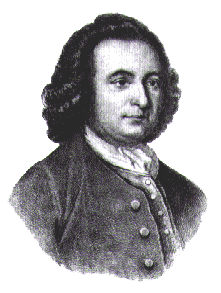 The Declaration was adopted unanimously by the Fifth Virginia Convention
at Williamsburg, Virginia
on June 12, 1776 as a separate document from the Constitution of Virginia
which was later adopted on June 29, 1776. In 1830, the Declaration of Rights was incorporated within the Virginia State Constitution as Article I, but even before that Virginia's Declaration of Rights stated that it was '"the basis and foundation of government" in Virginia. A slightly updated version may still be seen in Virginia's Constitution, making it legally in effect to this day.
It was initially drafted by George Mason
circa
May 20, 1776; James Madison
assisted him with the section on religious freedom. It was later amended by Thomas Ludwell Lee
and the Convention to add a section on the right to uniform government (Section 14). Patrick Henry
persuaded the Convention to delete a section that would have prohibited bills of attainder
, arguing that ordinary laws could be ineffective against some terrifying offenders. Edmund Pendleton
proposed the line "when they enter into a state of society" which allowed slave holders to support the declaration of universal rights which would be understood not to apply to slaves as they were not part of civil society.
Mason based his initial draft on the rights of citizens described in earlier works such as the English Bill of Rights (1689), and the Declaration can be considered the first modern Constitutional protection of individual rights for citizens of North America. It rejected the notion of privileged political classes or hereditary offices such as the members of Parliament and House of Lords described in the English Bill of Rights.
The Declaration consists of sixteen articles on the subject of which rights "pertain to [the people of Virginia]...as the basis and foundation of Government." In addition to affirming the inherent nature of natural rights to life, liberty, and property, the Declaration both describes a view of Government as the servant of the people, and enumerates various restrictions on governmental power. Thus, the document is unusual in that it not only prescribes legal rights, but it also describes moral principles upon which a government should be run.
Articles 2 and 3 note the revolutionary concept that "all power is vested in, and consequently derived from, the people..." and that "whenever any government shall be found inadequate or contrary to these purposes, a majority of the community hath an indubitable, unalienable, and indefeasible right to reform, alter or abolish it, in such manner as shall be judged most conducive to the public weal
." This latter concept effectively asserted the right of the people of Virginia to revolt against the British Empire
.
Article 4 asserts the equality of all citizens, rejecting the notion of privileged political classes or hereditary offices - another criticism of British institutions such as the House of Lords
and the privileges of the peerage
: "no set of men, are entitled to exclusive or separate emoluments or privileges from the community, but in consideration of public services; which, not being descendible, neither ought the offices of magistrate, legislator, or judge be hereditary."
Articles 5 and 6 recommend the principles of separation of powers
and free elections, "frequent, certain, and regular" of executives and legislators: "That the legislative and executive powers of the state should be separate and distinct from the judicative; and, that the members of the two first...should, at fixed periods, be reduced to a private station, return into that body from which they were originally taken...by frequent, certain, and regular elections."
Articles 7-16 propose restrictions on the powers of the government, declaring the government should not have the power of suspending or executing laws, "without consent of the representatives of the people"; establishing the legal rights to be "confronted with the accusers and witnesses, to call for evidence in his favor, and to a speedy trial by an impartial jury of his vicinage," and to prevent a citizen from being "compelled to give evidence against himself." protections against "cruel and unusual punishments", baseless search and seizure
, and the guarantees of a trial by jury, freedom of the press
, freedom of religion
("all men are equally entitled to the free exercise of religion"), and "the proper, natural, and safe defence of a free state" rested in a well regulated militia composed of the body of the people, trained to arms, that standing armies in time of peace, should be avoided as dangerous to liberty; Article 8 protects a person against "being deprived of his liberty except by the law of the land
" which later evolved into the due process
clause in the federal Bill of Rights.
is thought to have drawn on it when he drafted the United States Declaration of Independence
one month later (July 1776). James Madison
was also influenced by the Declaration while drafting the Bill of Rights
(completed September 1787, approved 1789), as was the Marquis de Lafayette in voting the French Revolution
's Declaration of the Rights of Man and of the Citizen
(1789).
The importance of the Virginia Declaration of Rights is that it was the first constitutional protection of individual rights, rather than protecting just members of Parliament or consisting of simple laws that can be changed as easily as passed.
United States Declaration of Independence
The Declaration of Independence was a statement adopted by the Continental Congress on July 4, 1776, which announced that the thirteen American colonies then at war with Great Britain regarded themselves as independent states, and no longer a part of the British Empire. John Adams put forth a...
(1776), the United States Bill of Rights
United States Bill of Rights
The Bill of Rights is the collective name for the first ten amendments to the United States Constitution. These limitations serve to protect the natural rights of liberty and property. They guarantee a number of personal freedoms, limit the government's power in judicial and other proceedings, and...
(1789), and the French Revolution
French Revolution
The French Revolution , sometimes distinguished as the 'Great French Revolution' , was a period of radical social and political upheaval in France and Europe. The absolute monarchy that had ruled France for centuries collapsed in three years...
's Declaration of the Rights of Man and of the Citizen
Declaration of the Rights of Man and of the Citizen
The Declaration of the Rights of Man and of the Citizen is a fundamental document of the French Revolution, defining the individual and collective rights of all the estates of the realm as universal. Influenced by the doctrine of "natural right", the rights of man are held to be universal: valid...
(1789).
Drafting and adoption
Virginia Conventions
The Virginia Conventions were a series of five political meetings in the Colony of Virginia during the American Revolution. Because the House of Burgesses had been dissolved in 1774 by Royal Governor Lord Dunmore, the conventions served as a revolutionary provisional government until the...
at Williamsburg, Virginia
Williamsburg, Virginia
Williamsburg is an independent city located on the Virginia Peninsula in the Hampton Roads metropolitan area of Virginia, USA. As of the 2010 Census, the city had an estimated population of 14,068. It is bordered by James City County and York County, and is an independent city...
on June 12, 1776 as a separate document from the Constitution of Virginia
Constitution of Virginia
The Constitution of the Commonwealth of Virginia is the document that defines and limits the powers of the state government and the basic rights of the citizens of the U.S. Commonwealth of Virginia. Like all other state constitutions, it is supreme over Virginia's laws and acts of government,...
which was later adopted on June 29, 1776. In 1830, the Declaration of Rights was incorporated within the Virginia State Constitution as Article I, but even before that Virginia's Declaration of Rights stated that it was '"the basis and foundation of government" in Virginia. A slightly updated version may still be seen in Virginia's Constitution, making it legally in effect to this day.
It was initially drafted by George Mason
George Mason
George Mason IV was an American Patriot, statesman and a delegate from Virginia to the U.S. Constitutional Convention...
circa
Circa
Circa , usually abbreviated c. or ca. , means "approximately" in the English language, usually referring to a date...
May 20, 1776; James Madison
James Madison
James Madison, Jr. was an American statesman and political theorist. He was the fourth President of the United States and is hailed as the “Father of the Constitution” for being the primary author of the United States Constitution and at first an opponent of, and then a key author of the United...
assisted him with the section on religious freedom. It was later amended by Thomas Ludwell Lee
Thomas Ludwell Lee
Thomas Ludwell Lee, Sr. was an editor of the Virginia Declaration of Rights. He was the older brother of Richard Henry Lee, Francis Lightfoot Lee, William Lee, and Arthur Lee. He was a member of the House of Burgesses from 1758-1765, but refused to enter into national politics...
and the Convention to add a section on the right to uniform government (Section 14). Patrick Henry
Patrick Henry
Patrick Henry was an orator and politician who led the movement for independence in Virginia in the 1770s. A Founding Father, he served as the first and sixth post-colonial Governor of Virginia from 1776 to 1779 and subsequently, from 1784 to 1786...
persuaded the Convention to delete a section that would have prohibited bills of attainder
Bill of attainder
A bill of attainder is an act of a legislature declaring a person or group of persons guilty of some crime and punishing them without benefit of a judicial trial.-English law:...
, arguing that ordinary laws could be ineffective against some terrifying offenders. Edmund Pendleton
Edmund Pendleton
Edmund Pendleton was a Virginia politician, lawyer and judge, active in the American Revolutionary War. -Early years:...
proposed the line "when they enter into a state of society" which allowed slave holders to support the declaration of universal rights which would be understood not to apply to slaves as they were not part of civil society.
Mason based his initial draft on the rights of citizens described in earlier works such as the English Bill of Rights (1689), and the Declaration can be considered the first modern Constitutional protection of individual rights for citizens of North America. It rejected the notion of privileged political classes or hereditary offices such as the members of Parliament and House of Lords described in the English Bill of Rights.
The Declaration consists of sixteen articles on the subject of which rights "pertain to [the people of Virginia]...as the basis and foundation of Government." In addition to affirming the inherent nature of natural rights to life, liberty, and property, the Declaration both describes a view of Government as the servant of the people, and enumerates various restrictions on governmental power. Thus, the document is unusual in that it not only prescribes legal rights, but it also describes moral principles upon which a government should be run.
Contents
Articles 1-3 address the subject of rights and the relationship between government and the governed. Article 1 states that "all men are by nature equally free and independent, and have certain inherent rights of which...[they cannot divest;] namely, the enjoyment of life and liberty, with the means of acquiring and possessing property, and pursuing and obtaining happiness and safety," a statement later made internationally famous in the first paragraph of the U.S. Declaration of Independence, as "we hold these truths to be self-evident, that all men are created equal, and are endowed by their Creator with certain unalienable rights, that among these are life, liberty, and the pursuit of happiness."Articles 2 and 3 note the revolutionary concept that "all power is vested in, and consequently derived from, the people..." and that "whenever any government shall be found inadequate or contrary to these purposes, a majority of the community hath an indubitable, unalienable, and indefeasible right to reform, alter or abolish it, in such manner as shall be judged most conducive to the public weal
Public weal
Public weal may refer to:*Commonwealth, a form of government without a monarch in which people have governmental influence*Common good, the notion of high quality of life for people in general-See also:...
." This latter concept effectively asserted the right of the people of Virginia to revolt against the British Empire
British Empire
The British Empire comprised the dominions, colonies, protectorates, mandates and other territories ruled or administered by the United Kingdom. It originated with the overseas colonies and trading posts established by England in the late 16th and early 17th centuries. At its height, it was the...
.
Article 4 asserts the equality of all citizens, rejecting the notion of privileged political classes or hereditary offices - another criticism of British institutions such as the House of Lords
House of Lords
The House of Lords is the upper house of the Parliament of the United Kingdom. Like the House of Commons, it meets in the Palace of Westminster....
and the privileges of the peerage
Peerage
The Peerage is a legal system of largely hereditary titles in the United Kingdom, which constitute the ranks of British nobility and is part of the British honours system...
: "no set of men, are entitled to exclusive or separate emoluments or privileges from the community, but in consideration of public services; which, not being descendible, neither ought the offices of magistrate, legislator, or judge be hereditary."
Articles 5 and 6 recommend the principles of separation of powers
Separation of powers
The separation of powers, often imprecisely used interchangeably with the trias politica principle, is a model for the governance of a state. The model was first developed in ancient Greece and came into widespread use by the Roman Republic as part of the unmodified Constitution of the Roman Republic...
and free elections, "frequent, certain, and regular" of executives and legislators: "That the legislative and executive powers of the state should be separate and distinct from the judicative; and, that the members of the two first...should, at fixed periods, be reduced to a private station, return into that body from which they were originally taken...by frequent, certain, and regular elections."
Articles 7-16 propose restrictions on the powers of the government, declaring the government should not have the power of suspending or executing laws, "without consent of the representatives of the people"; establishing the legal rights to be "confronted with the accusers and witnesses, to call for evidence in his favor, and to a speedy trial by an impartial jury of his vicinage," and to prevent a citizen from being "compelled to give evidence against himself." protections against "cruel and unusual punishments", baseless search and seizure
Search and seizure
Search and seizure is a legal procedure used in many civil law and common law legal systems whereby police or other authorities and their agents, who suspect that a crime has been committed, do a search of a person's property and confiscate any relevant evidence to the crime.Some countries have...
, and the guarantees of a trial by jury, freedom of the press
Freedom of the press
Freedom of the press or freedom of the media is the freedom of communication and expression through vehicles including various electronic media and published materials...
, freedom of religion
Freedom of religion
Freedom of religion is a principle that supports the freedom of an individual or community, in public or private, to manifest religion or belief in teaching, practice, worship, and observance; the concept is generally recognized also to include the freedom to change religion or not to follow any...
("all men are equally entitled to the free exercise of religion"), and "the proper, natural, and safe defence of a free state" rested in a well regulated militia composed of the body of the people, trained to arms, that standing armies in time of peace, should be avoided as dangerous to liberty; Article 8 protects a person against "being deprived of his liberty except by the law of the land
Law of the land
The phrase law of the land is a legal term, equivalent to the Latin lex terrae . It refers to all of the laws in force within a country or region, including both statute law and common law....
" which later evolved into the due process
Due process
Due process is the legal code that the state must venerate all of the legal rights that are owed to a person under the principle. Due process balances the power of the state law of the land and thus protects individual persons from it...
clause in the federal Bill of Rights.
Text
The following is the complete text of the Virginia Declaration of Rights:Influence
The Virginia Declaration of Rights heavily influenced later documents. Thomas JeffersonThomas Jefferson
Thomas Jefferson was the principal author of the United States Declaration of Independence and the Statute of Virginia for Religious Freedom , the third President of the United States and founder of the University of Virginia...
is thought to have drawn on it when he drafted the United States Declaration of Independence
United States Declaration of Independence
The Declaration of Independence was a statement adopted by the Continental Congress on July 4, 1776, which announced that the thirteen American colonies then at war with Great Britain regarded themselves as independent states, and no longer a part of the British Empire. John Adams put forth a...
one month later (July 1776). James Madison
James Madison
James Madison, Jr. was an American statesman and political theorist. He was the fourth President of the United States and is hailed as the “Father of the Constitution” for being the primary author of the United States Constitution and at first an opponent of, and then a key author of the United...
was also influenced by the Declaration while drafting the Bill of Rights
United States Bill of Rights
The Bill of Rights is the collective name for the first ten amendments to the United States Constitution. These limitations serve to protect the natural rights of liberty and property. They guarantee a number of personal freedoms, limit the government's power in judicial and other proceedings, and...
(completed September 1787, approved 1789), as was the Marquis de Lafayette in voting the French Revolution
French Revolution
The French Revolution , sometimes distinguished as the 'Great French Revolution' , was a period of radical social and political upheaval in France and Europe. The absolute monarchy that had ruled France for centuries collapsed in three years...
's Declaration of the Rights of Man and of the Citizen
Declaration of the Rights of Man and of the Citizen
The Declaration of the Rights of Man and of the Citizen is a fundamental document of the French Revolution, defining the individual and collective rights of all the estates of the realm as universal. Influenced by the doctrine of "natural right", the rights of man are held to be universal: valid...
(1789).
The importance of the Virginia Declaration of Rights is that it was the first constitutional protection of individual rights, rather than protecting just members of Parliament or consisting of simple laws that can be changed as easily as passed.
Quotations derived from the Declaration
- "We hold these truths to be self-evident, that all men are created equal, that they are endowed by their Creator with certain unalienable Rights, that among these are Life, Liberty and the pursuit of Happiness. —That to secure these rights, Governments are instituted among Men, deriving their just powers from the consent of the governed" — United States Declaration of IndependenceUnited States Declaration of IndependenceThe Declaration of Independence was a statement adopted by the Continental Congress on July 4, 1776, which announced that the thirteen American colonies then at war with Great Britain regarded themselves as independent states, and no longer a part of the British Empire. John Adams put forth a...
(July 1776)
- "Men are born and remain free and equal in rights. Social distinctions can be founded only on the common utility." — Declaration of the Rights of Man and of the CitizenDeclaration of the Rights of Man and of the CitizenThe Declaration of the Rights of Man and of the Citizen is a fundamental document of the French Revolution, defining the individual and collective rights of all the estates of the realm as universal. Influenced by the doctrine of "natural right", the rights of man are held to be universal: valid...
(1789)
External links
- Virginia Declaration of Rights (George Mason's Draft, 20-26 May 1776)
- Virginia Declaration of Rights (Committee Draft, 27 May 1776)
- Virginia Declaration of Rights (Final Draft, 12 June 1776)
- Shaping the Constitution: Virginia Declaration of Rights, from the Library of Virginia and the Library of Congress