
All Topics  
Thomas Paine

 
Thomas Paine

   Email Print
   Bookmark   Link


Thomas Paine


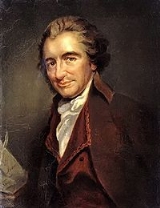
Thomas Paine (January 29, 1737 – June 8, 1809) was a British pamphleteer
Pamphleteer

A pamphleteer is a historical term for someone who creates or distributes pamphlets. Pamphlets were used to broadcast the writer's opinions on an issue, for example, in order to get people to vote for their favorite politician or to articulate a particular political ideology....
, revolutionary
Revolutionary

A revolutionary is a person who either actively participates in, or advocates revolution. Also, when used as an adjective, the term revolutionary refers to something that has a major, sudden impact on society or on some aspect of human endeavour....
, radical
Radicalism (historical)

The term Radical was used during the late 18th century for proponents of the Radical Movement. It later become a general term for those favoring or seeking political reforms which include dramatic changes to the social order....
, inventor
Inventor

An inventor is a person who creates or discovers a new method, form, device or other useful means. The word inventor comes form the latin verb invenire, invent-, to find....
, and intellectual
Intellectual

An intellectual is a person who uses his or her intelligence and Critical thinking, either in their profession or for the benefit of personal pursuits....
. He lived and worked in Britain until age 37, when he emigrated to the British American colonies, in time to participate in the American Revolution
American Revolution

The American Revolution refers to the political upheaval during the last half of the 18th century in which the Thirteen Colonies of North America overthrew the governance of the British Empire and then rejected the British monarchy to become the sovereign United States of America....
. His principal contribution was the powerful, widely-read pamphlet Common Sense
Common Sense (pamphlet)

Common Sense was a pamphlet written by Thomas Paine. It was first published anonymously on January 10, 1776, during the American Revolution....
 (1776), advocating colonial America's independence from the Kingdom of Great Britain
Kingdom of Great Britain

The Kingdom of Great Britain, also known as the United Kingdom of Great Britain, was a country in North-West Europe, in existence from 1707 to 1801....
, and The American Crisis
The American Crisis

The American Crisis was a series of pamphlets published from 1776 to 1783 during the American Revolution by eighteenth century Age of Enlightenment Philosopher and author Thomas Paine....
 (1776–1783), a pro-revolutionary pamphlet series.

Later, he greatly influenced the French Revolution
French Revolution

The French Revolution was a period of political and social upheaval and radical change in the history of France, during which the French governmental structure, previously an absolute monarchy with feudalism for the aristocracy and Roman Catholic Church clergy, underwent radical change to forms based on Age of Enlightenment principles of cit...
.


Discussion
Ask a question about 'Thomas Paine'
Start a new discussion about 'Thomas Paine'
Answer questions from other users
Full Discussion Forum


Recent Posts


Quotations


It is of the utmost danger to society to make it religion a party in political disputes.

It is only by the exercise of reason that man can discover God.

Of more worth is one honest man to society and in the sight of God, than all the crowned ruffians that ever lived.

The age of ignorance commenced with the Christian system.

When we are planning for posterity, we ought to remember that virtue is not hereditary.

WHEREFORE, security being the true design and end of government, it unanswerably follows, that whatever FORM thereof appears most likely to ensure it to us, with the least expense and greatest benefit, is preferable to all others.


Encyclopedia


Thomas Paine (January 29, 1737 – June 8, 1809) was a British pamphleteer
Pamphleteer

A pamphleteer is a historical term for someone who creates or distributes pamphlets. Pamphlets were used to broadcast the writer's opinions on an issue, for example, in order to get people to vote for their favorite politician or to articulate a particular political ideology....
, revolutionary
Revolutionary

A revolutionary is a person who either actively participates in, or advocates revolution. Also, when used as an adjective, the term revolutionary refers to something that has a major, sudden impact on society or on some aspect of human endeavour....
, radical
Radicalism (historical)

The term Radical was used during the late 18th century for proponents of the Radical Movement. It later become a general term for those favoring or seeking political reforms which include dramatic changes to the social order....
, inventor
Inventor

An inventor is a person who creates or discovers a new method, form, device or other useful means. The word inventor comes form the latin verb invenire, invent-, to find....
, and intellectual
Intellectual

An intellectual is a person who uses his or her intelligence and Critical thinking, either in their profession or for the benefit of personal pursuits....
. He lived and worked in Britain until age 37, when he emigrated to the British American colonies, in time to participate in the American Revolution
American Revolution

The American Revolution refers to the political upheaval during the last half of the 18th century in which the Thirteen Colonies of North America overthrew the governance of the British Empire and then rejected the British monarchy to become the sovereign United States of America....
. His principal contribution was the powerful, widely-read pamphlet Common Sense
Common Sense (pamphlet)

Common Sense was a pamphlet written by Thomas Paine. It was first published anonymously on January 10, 1776, during the American Revolution....
 (1776), advocating colonial America's independence from the Kingdom of Great Britain
Kingdom of Great Britain

The Kingdom of Great Britain, also known as the United Kingdom of Great Britain, was a country in North-West Europe, in existence from 1707 to 1801....
, and The American Crisis
The American Crisis

The American Crisis was a series of pamphlets published from 1776 to 1783 during the American Revolution by eighteenth century Age of Enlightenment Philosopher and author Thomas Paine....
 (1776–1783), a pro-revolutionary pamphlet series.

Later, he greatly influenced the French Revolution
French Revolution

The French Revolution was a period of political and social upheaval and radical change in the history of France, during which the French governmental structure, previously an absolute monarchy with feudalism for the aristocracy and Roman Catholic Church clergy, underwent radical change to forms based on Age of Enlightenment principles of cit...
. He wrote the Rights of Man
Rights of Man

Rights of Man , by Thomas Paine, posits that popular political revolution is permissible when a government does not safeguard its people, their natural rights, and their national interests....
 (1791), a guide to Enlightenment
Age of Enlightenment

The Age of Enlightenment or The Enlightenment is a term used to describe a time in Western philosophy and cultural life centered upon the eighteenth century, in which rationalism was advocated as the primary source and legitimacy for authority....
 ideas. Despite not speaking French, he was elected to the French National Convention
National Convention

During the French Revolution, the National Convention or Convention, in France, comprised the constitutional and legislative Deliberative assembly which sat from 20 September 1792 to 26 October 1795 ....
 in 1792. The Girondist
Girondist

The Girondists were a political faction in France within the Legislative Assembly and the National Convention during the French Revolution. The Girondists were a group of individuals who held certain opinions and principles in common rather than an organized political party, and the name was at first informally applied because the most br...
s regarded him as an ally, so, the Montagnards
The Mountain

The Mountain refers in the context of the history of the French Revolution to a political group, whose members, called Montagnards, sat on the highest benches in the Assembly....
, especially Robespierre
Maximilien Robespierre

Maximilien Fran?ois Marie Isidore de Robespierre is one of the best-known figures of the French Revolution. He was an influential member of the Committee of Public Safety and was instrumental in the period of the Revolution commonly known as the Reign of Terror that ended with his arrest and execution in 1794....
, regarded him as an enemy. In December of 1793, he was arrested and imprisoned in Paris, then released in 1794. He became notorious because of The Age of Reason
The Age of Reason

The Age of Reason: Being an Investigation of True and Fabulous Theology, a deistic treatise written by eighteenth-century British radical and American revolutionary Thomas Paine, critiques institutionalized religion and challenges the Biblical inerrancy....
 (1793–94), the book advocating deism
Deism

Deism is a religious and philosophical belief that a supreme natural God exists and created the physical universe, and that religious truths can be arrived at by the application of reason and observation of the natural world....
 and arguing against Christian doctrines. In France, he also wrote the pamphlet Agrarian Justice
Agrarian Justice

Agrarian Justice, written by Thomas Paine, was published in 1797. It advocates a philosophy similar to Georgism. The work is based on the contention that in the state of nature, "the earth, in its natural uncultivated state......
 (1795), discussing the origins of property, and introduced the concept of a guaranteed minimum income
Guaranteed minimum income

Guaranteed minimum income is a proposed system of social welfare provision that guarantees that all citizens or family have an income sufficient to live on, provided they meet certain conditions....
.

He remained in France during the early Napoleonic era
Napoleonic Era

The Napoleonic Era is a period in the history of France and Europe. It is generally classified as including the fourth and final stage of the French Revolution, the first being the National Assembly, the second being the Legislative Assembly, and the third being the French Directory....
, but condemned Napoleon's dictatorship, calling him "the completest charlatan that ever existed". In 1802, at President Thomas Jefferson
Thomas Jefferson

Thomas Jefferson was the List of Presidents of the United States President of the United States , the principal author of the United States Declaration of Independence , and one of the most influential Founding Fathers of the United States for his promotion of the ideals of republicanism in the United States....
's invitation, he returned to America.

Thomas Paine died, at the age of 72, at 59 Grove Street, Greenwich Village
Greenwich Village

Greenwich Village , often simply called the Village, is a largely residential area on the lower west side of southern Manhattan in New York City....
, New York City
New York City

The City of New York is the List of United States cities by population in the United States, while the New York metropolitan area ranks among the List of urban areas by population....
, on June 8, 1809. He was buried at what is now called the Thomas Paine Cottage
Thomas Paine Cottage

The Thomas Paine Cottage in New Rochelle, New York, New York in the United States, was the home from 1802 to 1806 of Thomas Paine, author of Common Sense and American Revolutionary War hero....
 in New Rochelle, New York
New Rochelle, New York

New Rochelle is a Political subdivisions of New York State#City in the south-east portion of the U.S. state of New York in Westchester County, New York....
, where he had lived after returning to America in 1802. His remains were later disinterred by an admirer, William Cobbett
William Cobbett

William Cobbett was an English political pamphleteer, farmer and prolific journalism. He was born at Farnham, Surrey. He believed that the reform of Parliament of Great Britain and the abolition of the rotten boroughs would help cure the poverty of the farm labourers....
, who sought to return them to England. The bones were, however, later lost and his final resting place today is unknown.

Early life


Thomas Paine was son of Joseph Pain, a Quaker, and Frances Pain (nιe Cocke), an Anglican, in Thetford
Thetford

Thetford is a market town and civil parish in the Breckland area of Norfolk, England. It is on the A11 road between Norwich and London, just south of Thetford Forest....
, a small, market town and coach stage-post, in rural Norfolk
Norfolk

Norfolk is a low-lying Counties of England in the East of England. It has borders with Lincolnshire to the west, Cambridgeshire to the west and southwest and with Suffolk to the south....
. Born Thomas Pain, he changed his family name upon his emigration to America in 1774.

He attended Thetford Grammar School (1744-1749) that selected pupils on ability, at a time when there was no compulsory education. At age thirteen, he was apprentice to his corset-maker father; in late adolescence, he enlisted and briefly served as a privateer
Privateer

A privateer was a private warship authorized by a country's government by letters of marque to attack foreign shipping. Strictly, a privateer was only entitled by its state to attack and rob enemy vessels during wartime....
, before returning to Britain in 1759. There, he became a master corset
Corset

A corset is a garment worn to mold and shape the torso into a desired shape for aesthetic or medical purposes . Both men and women are known to wear corsets, though women are more common wearers....
 and stay
Bone (corsetry)

In corsetry, a bone is one of the rigid parts of a corset that forms its frame and gives it rigidity....
 maker, establishing a shop in Sandwich, Kent
Sandwich, Kent

Sandwich is a historic town in Kent, south-east England. It was one of the Cinque Ports and still has many original medieval buildings. While once a major port, it is now two miles from the sea, its historic centre preserved.....
. On September 27, 1759, Thomas Paine married Mary Lambert. His business collapsed soon after. Mary became pregnant, and, after they moved to Margate, she went into early labour, in which she and their child died.

In July 1761, Paine returned to Thetford to work as a supernumerary
Supernumerary

Supernumerary is an additional member of an organization. A supernumerary is also non-regular member of a staff, a member of the staff or an employee who works in a public office who is not part of the manpower complement....
 officer. In December 1762, he became an excise officer
Her Majesty's Customs and Excise

HM Customs and Excise was, until April 2005, a department of the British Government in the United Kingdom. It was responsible for the collection of Value added tax, Customs Duties, Excise Duties, and other indirect taxes such as Air Passenger Duty, United Kingdom Climate Change Programme, Insurance_Premium_Tax_, Landfill Tax and Aggregates L...
 in Grantham
Grantham

Grantham is a market town within the South Kesteven district of Lincolnshire, England. It stands athwart the East Coast Main Line railway , the historic A1 main north-south road, and the River Witham, 24 miles south-southwest of the city of Lincoln, Lincolnshire....
, Lincolnshire
Lincolnshire

Lincolnshire is a Counties of England in the east of England. It borders Norfolk, Cambridgeshire, Rutland, Leicestershire, Nottinghamshire, South Yorkshire, and the East Riding of Yorkshire....
; in August 1764, he was transferred to Alford, at a salary of £50 per annum. On August 27, 1765, he was fired as an Excise Officer for "claiming to have inspected goods he did not inspect." On July 31, 1766, he requested his reinstatement from the Board of Excise, which they granted the next day upon vacancy. While awaiting that, he worked as a stay maker in Diss, Norfolk, and later as a servant (per the records, for a Mr. Noble, of Goodman's Fields, and for a Mr. Gardiner, at Kensington). He also applied to become an ordained minister of the Church of England and, per some accounts, he preached in Moorfields.

In 1767, he was appointed to a position in Grampound, Cornwall; subsequently, he asked to leave this post to await a vacancy, thus, he became a schoolteacher in London. On February 19, 1768, he was appointed to Lewes
Lewes

Lewes is the county town of East Sussex, England and gives its name to the Local government district in which it lies. The settlement has a long history as a bridging point and as a market town, and is today an important communications hub, and tourist-orientated town....
, East Sussex, living above the fifteenth-century Bull House, the tobacco shop of Samuel Ollive and Esther Ollive. There, Paine first became involved in civic matters, when Samuel Ollive introduced him to the Society of Twelve, a local, ιlite intellectual group that met semestrally, to discuss town politics. He also was in the influential Vestry
Vestry

A vestry is a storage room in or attached to a Church or synagogue. A vestry is also an administrative committee of a church....
 church group that collected taxes and tithes to distribute among the poor. On March 26, 1771, at age 34, he married Elizabeth Ollive, his landlord's daughter.

From 1772 to 1773, Paine joined excise officers asking Parliament for better pay and working conditions, publishing, in summer of 1772, The Case of the Officers of Excise, a twenty-one-page article, and his first political work, spending the London winter distributing the 4,000 copies printed to the Parliament and others. In spring of 1774, he was fired from the excise service for being absent from his post without permission; his tobacco shop failed, too. On April 14, to avoid debtor's prison, he sold his household possessions to pay debts. On June 4, he formally separated from wife Elizabeth and moved to London, where, in September, a friend introduced him to Benjamin Franklin
Benjamin Franklin

Benjamin Franklin was one of the Founding Fathers of the United States of the United States. A noted polymath, Franklin was a leading author and Printer , Satire, list of political philosophers, politician, scientist, inventor, activism, statesman, and diplomacy....
, who suggested emigration to British colonial America, and gave him a letter of recommendation. In October, Thomas Paine emigrated from England to America, arriving in Philadelphia on November 30, 1774.

He barely survived the transatlantic voyage, because the ship's potable water was bad, and typhoid fever
Typhoid fever

Typhoid fever, also known as enteric fever, or commonly just typhoid, is an illness caused by the bacterium Salmonella typhi. Common worldwide, it is transmitted by the ingestion of food or water contaminated with feces from an infected person....
 had killed five passengers. On arriving to Philadelphia, he was too sick to debark. Benjamin Franklin's physician, there to welcome Paine to America, had him carried off ship; Paine took six weeks to recover his health.

In January, 1775, he became editor of the Pennsylvania Magazine, a position he conducted with considerable ability.

Moreover, Thomas Paine was an inventor, who received a European patent for a single-span iron bridge, developed a smoke-less candle, and worked with inventor John Fitch
John Fitch (inventor)

John Fitch was an American inventor, clockmaker, and bronzesmith who built the first recorded steam powered ship in the United States. He also invented the first working model of a steam locomotive....
 in developing steam engines. Mechanical aptitude and intellectual originality made him saint of Thomas Edison's devotion.

American Revolution

Commonsense
Thomas Paine has a claim to the title The Father of the American Revolution because of Common Sense
Common Sense (pamphlet)

Common Sense was a pamphlet written by Thomas Paine. It was first published anonymously on January 10, 1776, during the American Revolution....
, the pro-independence monograph
Monograph

A monograph is a work of writing upon a single subject, usually also by a single author. It is often a scholarly essay or learned treatise, and may be released in the manner of a book, journal article, editorial or written rant....
 pamphlet he anonymously published on January 10, 1776; it quickly spread among the literate, and, in three months, 100,000 copies sold throughout the American British colonies (with only two million free inhabitants), making it a best-selling work in eighteenth-century America. Paine's original title for the pamphlet was Plain Truth; Paine's friend, pro-independence advocate Benjamin Rush
Benjamin Rush

Benjamin Rush was a Founding Fathers of the United States of the United States. Rush lived in the U.S. state of Pennsylvania and was a physician, writer, Education in the United States, Humanitarianism and a devout Christian, as well as the founder of Dickinson College in Carlisle, Pennsylvania....
, suggested Common Sense instead.

The strength of Common Sense was not in the originality of its ideas, but rather in the simplicity of its style. Paine was a pioneer in a new style of political writing suitable to the kind of democratic society he envisioned. Common Sense rendered complex ideas intelligible to average readers, with clear, concise writing unlike the formal, learned style favored by many of Paine's contemporaries. Many were shocked by Paine's undisguised hostility to the British monarchy; the pamphlet labeled King George III as "the Royal Brute of Great Britain."

Common Sense was immensely popular, but how many people were converted to the cause of independence by the pamphlet is unknown. Paine's arguments were rarely cited in public calls for independence, which suggests that Common Sense may have had a more limited impact on the public's thinking about independence than is sometimes believed. The pamphlet probably had little direct influence on the Continental Congress's
Second Continental Congress

The Second Continental Congress was a convention of delegates from the Thirteen Colonies that met beginning in May 10, 1775, in Philadelphia, Pennsylvania, soon after shooting in the American Revolutionary War had begun....
 decision to issue a Declaration of Independence
United States Declaration of Independence

The United States Declaration of Independence is a statement adopted by the Second Continental Congress on July 4, 1776, which announced that the Thirteen Colonies then at war with Kingdom of Great Britain were now independent states, and thus no longer a part of the British Empire....
, since that body was more concerned with how declaring independence would affect the war effort. Paine's great contribution was in initiating a public debate about independence, which had previously been rather muted.

Loyalists
Loyalist (American Revolution)

Loyalists were Thirteen Colonies who remained loyal to the Kingdom of Great Britain during and after the American Revolutionary War. They were often referred to as Tories, Royalists, or King's Men by the Patriot , those that supported the American cause....
 vigorously attacked Common Sense; one attack, titled Plain Truth (1776), by Marylander James Chalmers
James Chalmers (loyalist)

James Chalmers was a Loyalist officer and pamphleteer in the American Revolution. Born in Elgin, Moray, Morayshire, Scotland, Chalmers was an ambitious military strategist during the American Revolutionary War, but was apparently kept at arm's length by British commanders Sir William Howe and Sir Henry Clinton....
, said Paine was a political quack and warned that without monarchy, the government would "degenerate into democracy". Even some American revolutionaries objected to Common Sense; late in life John Adams
John Adams

John Adams was an Politics of the United States and the List of Presidents of the United States President of the United States , after being the List of Vice Presidents of the United States Vice President of the United States for two terms....
 called it a "crapulous mass." Adams disagreed with the type of radical democracy promoted by Paine, and published Thoughts on Government
Thoughts on Government

Thoughts on Government, or in full Thoughts on Government, Applicable to the Present State of the American Colonies, was written by John Adams during the spring of 1776 in response to a resolution of the North Carolina Provincial Congress which requested Adams's suggestions on the establishment of a new government and the drafting of...
 in 1776 to advocate a more conservative approach to republicanism.

In the early months of the war Paine published The Crisis
The American Crisis

The American Crisis was a series of pamphlets published from 1776 to 1783 during the American Revolution by eighteenth century Age of Enlightenment Philosopher and author Thomas Paine....
 pamphlet series, to inspire the colonists in their resistance to the British army. To inspire the enlisted men, General George Washington
George Washington

George Washington was the leader of the Continental Army in the American Revolutionary War and served as the List of Presidents of the United States President of the United States of the United States of Americas ....
 had The American Crisis read aloud to them. The first Crisis pamphlet begins:

In 1777, Paine became secretary of the Congressional Committee on Foreign Affairs. The following year, he alluded to continuing secret negotiation with France in his pamphlets; the resultant scandal and Paine's conflict with Robert Morris eventually lead to Paine's expulsion from the Committee in 1779. However, in 1781, he accompanied John Laurens
John Laurens

John Laurens was an United States soldier and statesman from South Carolina during the American Revolutionary War....
 on his mission to France. Eventually, after much pleading from Paine, New York State recognised his political services with an estate, at New Rochelle, and money from Pennsylvania and from the Congress, at Washington's suggestion. In the Revolutionary War, he served as an aide to General Nathanael Greene
Nathanael Greene

Nathanael Greene was a major general of the Continental Army in the American Revolutionary War. When the war began, Greene was a militia private , the lowest rank possible; he emerged from the war with a reputation as George Washington's most gifted and dependable officer....
. His later years established him as "a missionary of world revolution."

Funding the American Revolution with Henry and John Laurens:

According to Daniel Wheeler's "Life and Writings of Thomas Paine," Volume 1 (of 10, Vincent & Parke, 1908) p. 26-27: Thomas Paine accompanied Col. John Laurens to France and is credited with initiating the mission. It landed in France in March 1781 and returned to America in August with 2.5 livres in silver, as part of a "present" of 6 million and a loan of 10 million. The meetings with the French king were most likely conducted in the company and under the influence of Benjamin Franklin. Upon return to the United States with this highly welcomed cargo, Thomas Paine and probably Col Laurens, "positively objected" that General Washington should propose that Congress remunerate him for his services, for fear of setting "a bad precedent and an improper mode." In addition, according to an appreciation by Elbert Hubbard in the same volume (p.314) "In 1781 Paine was sent to France with Colonel Laurens to negotiate a loan. The errand was successful, and Paine then made influential acquaintances, which were later to be renewed. He organized the Bank of North America to raise money to feed and clothe the army, and performed sundry and various services for the colonies."

Henry Laurens (father of Col. John Laurens) had been the ambassador to the Netherlands but was captured by the British on his return trip there. When he was later exchanged for Cornwallis (late 1781) he proceeded to the Netherlands to continue loan negotiations. There remains some question as to the relationship of Henry Laurens and Thomas Paine to Robert Morris as Superintendent of Finance and his business associate Thomas Willing who became the first president of the Bank of North America (Jan. 1782). They had accused Morris of profiteering in 1779 and Willing had voted against the Declaration of Independence. Although Morris did much to restore his reputation in 1780 and 1781, the credit for obtaining these critical loans to "organize" the Bank of North America for approval by Congress in December 1781 should go to Henry or John Laurens and Thomas Paine more than to Robert Morris.

Rights of Man


Having taken work as a clerk after his expulsion by Congress, Paine eventually returned to London in 1787, living a largely private life. However, his passion was again sparked by revolution, this time in France, which he visited in December 1790. In response to the criticisms of the revolution authored by Edmund Burke
Edmund Burke

Edmund Burke was an Irish statesman, author, orator, political theorist, and philosophy who, after relocating to Great Britain, served for many years in the British House of Commons as a member of the British Whig Party party....
 in Reflections on the Revolution in France
Reflections on the Revolution in France

Reflections on the Revolution in France , by Edmund Burke, is one of the best-known intellectual attacks against the French Revolution. In the twentieth century, it much influenced conservatism and classical liberalism intellectuals, who re-cast Burke's Whig arguments as a critique of Communism and Socialism revolutionary programmes....
, Paine wrote Rights of Man
Rights of Man

Rights of Man , by Thomas Paine, posits that popular political revolution is permissible when a government does not safeguard its people, their natural rights, and their national interests....
, an abstract political tract critical of monarchies and European social institutions. He completed the text on January 29, 1791. On January 31, he gave the manuscript to publisher Joseph Johnson
Joseph Johnson (publisher)

Joseph Johnson was an influential eighteenth-century London bookseller. His publications covered a wide variety of genres and a broad spectrum of opinions on important issues....
 for publication on February 22. Meanwhile, government agents visited him, and, sensing dangerous political controversy, he reneged on his promise to sell the book on publication day; Paine quickly negotiated with publisher J.S. Jordan, then went to Paris, per William Blake's
William Blake

William Blake was an English people English poetry, Painting, and printmaker. Largely unrecognized during his lifetime, Blake is now considered a seminal figure in the history of both poetry and the visual arts of the Romanticism....
 advice, leaving three good friends, William Godwin
William Godwin

William Godwin was an English journalist, political philosophy and novelist. He is considered one of the first exponents of utilitarianism, and one of the first modern proponents of philosophical anarchism....
, Thomas Brand Hollis
Thomas Brand Hollis

Thomas Brand Hollis , political radical and dissenter. He was educated at Felsted School and Glasgow University....
, and Thomas Holcroft
Thomas Holcroft

Thomas Holcroft was an English dramatist and miscellaneous writer....
, charged with concluding publication. The book appeared on March 13, three weeks later than scheduled, and sold well.

Undeterred by the government campaign to discredit him, Paine issued his Rights of Man, Part the Second, Combining Principle and Practice in February 1792. It detailed a representative government with enumerated social programs to remedy the numbing poverty of commoners through progressive tax measures. Radically reduced in price to ensure unprecedented circulation, it was sensational in its impact and gave birth to reform societies. An indictment for seditious libel followed while government agents followed Paine and instigated mobs, hate meetings, and burnings in effigy. The authorities aimed, with ultimate success, to chase Paine out of England and then try him in absentia
In absentia

In absentia is Latin for "in the absence". In legal use it usually pertains to a defendant's right to be present in court proceedings....
.

In summer of 1792, he answered the sedition and libel charges thus: "If, to expose the fraud and imposition of monarchy . . . to promote universal peace, civilization, and commerce, and to break the chains of political superstition, and raise degraded man to his proper rank; if these things be libellous . . . let the name of libeller be engraved on my tomb".
Serment Du Jeu De Paume
Paine was an enthusiastic supporter of the French Revolution, and was granted, along with Alexander Hamilton
Alexander Hamilton

Alexander Hamilton was the first Secretary of the Treasury, a Founding Fathers of the United States, economist, and political philosopher. He led calls for the Philadelphia Convention, was one of America's first Constitutional lawyers, and cowrote the Federalist Papers, a primary source for Constitutional interpretation....
, George Washington
George Washington

George Washington was the leader of the Continental Army in the American Revolutionary War and served as the List of Presidents of the United States President of the United States of the United States of Americas ....
, Benjamin Franklin
Benjamin Franklin

Benjamin Franklin was one of the Founding Fathers of the United States of the United States. A noted polymath, Franklin was a leading author and Printer , Satire, list of political philosophers, politician, scientist, inventor, activism, statesman, and diplomacy....
 and others, honorary French citizenship
Citizenship

Citizenship refers to a person's membership in a political community such as a country or city. It has different legal definitions in different countries....
. Despite his inability to speak French, he was elected to the National Convention
National Convention

During the French Revolution, the National Convention or Convention, in France, comprised the constitutional and legislative Deliberative assembly which sat from 20 September 1792 to 26 October 1795 ....
, representing the district of Pas-de-Calais
Pas-de-Calais

Pas-de-Calais is a Departments of France in northern France. Its name is the French language equivalent of the Strait of Dover, which it borders....
. He voted for the French Republic
France

France , officially the French Republic , is a country whose Metropolitan France is located in Western Europe and that also comprises various Overseas departments and territories of France....
; but argued against the execution of Louis XVI
Louis XVI of France

Louis XVI or Louis-Auguste de France ruled as List of French monarchs of France and of List of Navarrese monarchs from 1774 until 1791, and then as Popular monarchy from 1791 to 1792....
, saying that he should instead be exile
Exile

Exile means to be away from one's home while either being explicitly refused permission to return and/or being threatened by prison or death upon return....
d to the United States: firstly, because of the way royalist France had come to the aid of the American Revolution; and secondly because of a moral objection to capital punishment in general and to revenge killings in particular.

Regarded as an ally of the Girondins
Girondist

The Girondists were a political faction in France within the Legislative Assembly and the National Convention during the French Revolution. The Girondists were a group of individuals who held certain opinions and principles in common rather than an organized political party, and the name was at first informally applied because the most br...
, he was seen with increasing disfavour by the Montagnards
The Mountain

The Mountain refers in the context of the history of the French Revolution to a political group, whose members, called Montagnards, sat on the highest benches in the Assembly....
 who were now in power, and in particular by Robespierre
Maximilien Robespierre

Maximilien Fran?ois Marie Isidore de Robespierre is one of the best-known figures of the French Revolution. He was an influential member of the Committee of Public Safety and was instrumental in the period of the Revolution commonly known as the Reign of Terror that ended with his arrest and execution in 1794....
. A decree was passed at the end of 1793 excluding foreigners from their places in the Convention (Anacharsis Cloots
Jean-Baptiste du Val-de-Grβce, baron de Cloots

Jean-Baptiste du Val-de-Gr?ce, baron de Cloots , better known as Anacharsis Cloots, and nicknamed "orator of mankind", "citoyen de l?humanit?" and "a personal enemy of God", was a France politician, and a noteworthy figure in the French Revolution....
 was also deprived of his place). Paine was arrested and imprisoned in December 1793.

Before his arrest and imprisonment, knowing that he would probably be arrested and executed, Paine wrote the first part of The Age of Reason
The Age of Reason

The Age of Reason: Being an Investigation of True and Fabulous Theology, a deistic treatise written by eighteenth-century British radical and American revolutionary Thomas Paine, critiques institutionalized religion and challenges the Biblical inerrancy....
, an assault on organized "revealed" religion combining a compilation of inconsistencies he found in the Bible with his own advocacy of deism. In his "Autobiographical Interlude," which is found in The Age of Reason between the first and second parts, Paine writes, "Thus far I had written on the 28th of December, 1793. In the evening I went to the Hotel Philadelphia . . . About four in the morning I was awakened by a rapping at my chamber door; when I opened it, I saw a guard and the master of the hotel with them. The guard told me they came to put me under arrestation and to demand the key of my papers. I desired them to walk in, and I would dress myself and go with them immediately."

Paine protested and claimed that he was a citizen of America, which was an ally of Revolutionary France, rather than of Great Britain, which was by that time at war with France. However, Gouverneur Morris
Gouverneur Morris

Gouverneur Morris was an United States statesman who represented Pennsylvania in the Philadelphia Convention and was an author of large sections of the Constitution of the United States....
, the American ambassador to France, did not press his claim, and Paine later wrote that Morris had connived at his imprisonment. Paine thought that George Washington had abandoned him, and he was to quarrel with Washington for the rest of his life. Years later he wrote a scathing open letter to Washington, accusing him of private betrayal of their friendship and public hypocrisy as general and president, and concluding the letter by saying "the world will be puzzled to decide whether you are an apostate or an impostor; whether you have abandoned good principles or whether you ever had any."

While in prison, Paine narrowly escaped execution. A guard walked through the prison placing a chalk mark on the doors of the prisoners who were due to be sent to the guillotine on the morrow. He placed a 4 on the door of Paine's cell, but Paine's door had been left open to let a breeze in, because Paine was seriously ill at the time. That night, his other three cell mates closed the door, thus hiding the mark inside the cell. The next day their cell was overlooked. "The Angel of Death" had passed over Paine. He kept his head and survived the few vital days needed to be spared by the fall of Robespierre on 9 Thermidor
Thermidorian Reaction

The Thermidorian Reaction was a revolt in the French Revolution against the excesses of the Reign of Terror. It was triggered by a vote of the Committee of Public Safety to execute Maximilien Robespierre, Antoine Louis L?on de Richebourg de Saint-Just and several other leading members of the Terror....
 (July 27, 1794).

Paine was released in November 1794 largely because of the work of the new American Minister to France, James Monroe
James Monroe

James Monroe was the List of Presidents of the United States President of the United States . His administration was marked by the acquisition of Florida ; the Missouri Compromise , in which Missouri was declared a slave state; the admission of Maine in 1820 as a free state; and the profession of the Monroe Doctrine , declaring U.S....
. In July 1795, he was re-admitted into the Convention, as were other surviving Girondins. Paine was one of only three deputees to oppose the adoption of the new 1795 constitution
French Constitution of 1795

The Constitution of 22 August 1795 was a national constitution of France ratified by the National Convention on August 22, 1795 under the French Revolutionary Calendar) during the French Revolution....
, because it eliminated universal suffrage
Universal suffrage

Universal suffrage consists of the extension of the Suffrage to adult citizens as a whole, though it may also mean extending said right to minors and noncitizens....
, which had been proclaimed by the Montagnard Constitution of 1793
French Constitution of 1793

The Constitution of 24 June 1793 , also known as the The Montagnard Constitution , was the constitution which instated the French First Republic during the French Revolution....
.

In 1800, Paine purportedly had a meeting with Napoleon
Napoleon I of France

Napoleon Bonaparte later known as Emperor Napoleon I, was a military and political leader of France whose actions shaped European politics in the early 19th century....
. Napoleon claimed he slept with a copy of Rights of Man under his pillow and went so far as to say to Paine that "a statue of gold should be erected to you in every city in the universe." Paine discussed with Napoleon on how best to invade England and in December 1797 wrote two essays, one of which was pointedly named Observations on the Construction and Operation of Navies with a Plan for an Invasion of England and the Final Overthrow of the English Government, in which he promoted the idea to finance 1000 gunboats to carry a French invading army across the English Channel. In 1804 Paine returned to the subject, writing To the People of England on the Invasion of England advocating the idea.

On noting Napoleon's progress towards dictatorship, he condemned him as: "the completest charlatan that ever existed". Thomas Paine remained in France until 1802, returning to America only at President Jefferson's invitation.

Later years


Paine returned to America in the early stages of the Second Great Awakening
Second Great Awakening

The Second Great Awakening   was a period of great religious revival that extended into the antebellum period of the United States, with widespread Christian evangelism and conversions....
 and a time of great political partisanship. The Age of Reason gave ample excuse for the religiously devout to dislike him, and the Federalists attacked him for his ideas of government stated in Common Sense, for his association with the French Revolution, and for his friendship with President Jefferson. Also still fresh in the minds of the public was his Letter to Washington, published six years before his return.

Paine died at the age of 72, at 59 Grove Street in Greenwich Village
Greenwich Village

Greenwich Village , often simply called the Village, is a largely residential area on the lower west side of southern Manhattan in New York City....
, New York City
New York City

The City of New York is the List of United States cities by population in the United States, while the New York metropolitan area ranks among the List of urban areas by population....
 on the morning of June 8, 1809. Although the original building is no longer there, the present building has a plaque noting that Paine died at this location. At the time of his death, most American newspapers reprinted the obituary notice from the New York Citizen, which read in part: "He had lived long, did some good and much harm." Only six mourners came to his funeral, two of whom were black, most likely freedmen
Freedman

Freedman is the term used to describe a former Slavery who has been Manumission or Emancipation. The first means the freeing of an individual by the owner, often through deed or will, and sometimes by legislative petition....
. The great orator and writer Robert G. Ingersoll
Robert G. Ingersoll

Colonel Robert Green Ingersoll was a American Civil War veteran, United States political leader, and orator during the Golden Age of Freethought, noted for his broad range of culture and his defense of agnosticism....
 wrote:

Thomas Paine had passed the legendary limit of life. One by one most of his old friends and acquaintances had deserted him. Maligned on every side, execrated, shunned and abhorred – his virtues denounced as vices – his services forgotten – his character blackened, he preserved the poise and balance of his soul. He was a victim of the people, but his convictions remained unshaken. He was still a soldier in the army of freedom, and still tried to enlighten and civilize those who were impatiently waiting for his death, Even those who loved their enemies hated him, their friend – the friend of the whole world – with all their hearts. On the 8th of June, 1809, death came – Death, almost his only friend. At his funeral no pomp, no pageantry, no civic procession, no military display. In a carriage, a woman and her son who had lived on the bounty of the dead – on horseback, a Quaker, the humanity of whose heart dominated the creed of his head – and, following on foot, two negroes filled with gratitude – constituted the funeral cortege of Thomas Paine.


"In the summer of 1803 the political atmosphere was in a tempestuous condition, owing to the widespread accusation that Aaron Burr
Aaron Burr

Aaron Burr, Jr. was an United States politician, American Revolutionary War hero, and adventurer. He served as the List of Vice Presidents of the United States Vice President of the United States , under Thomas Jefferson....
 had intrigued with the Federalists against Jefferson to gain the presidency. There was a Society in New York called "Republican Greens," who, on Independence Day, had for a toast "Thomas Paine, the Man of the People", and who seem to have had a piece of music called the "Rights of Man". Paine was also apparently the hero of that day at White Plains, where a vast crowd assembled".

A few years later, the agrarian radical William Cobbett
William Cobbett

William Cobbett was an English political pamphleteer, farmer and prolific journalism. He was born at Farnham, Surrey. He believed that the reform of Parliament of Great Britain and the abolition of the rotten boroughs would help cure the poverty of the farm labourers....
 dug up and shipped his bones back to England. The plan was to give Paine a heroic reburial on his native soil, but the bones were still among Cobbett's effects when he died over twenty years later. There is no confirmed story about what happened to them after that, although down the years various people have claimed to own parts of Paine's remains, such as his skull and right hand.

Political views


Thomas Paine developed his natural justice
Natural justice

Natural justice or procedural fairness is a legal philosophy used in some jurisdictions in the determination of just, or fairness, processes in law proceedings....
 beliefs in childhood, while listening to a mob jeering and attacking the town folk being punished in the Thetford stocks
Stocks

Stocks are devices used since medieval times for public humiliation, corporal punishment, and torture. The stocks are similar to the pillory and the pranger, as each consists of large, hinged, wooden boards; the difference, however, is that when a person is placed in the stocks, their feet are locked in place, and sometimes as well their hand...
. Also, he might have been influenced by his Quaker father. In The Age of Reason
The Age of Reason

The Age of Reason: Being an Investigation of True and Fabulous Theology, a deistic treatise written by eighteenth-century British radical and American revolutionary Thomas Paine, critiques institutionalized religion and challenges the Biblical inerrancy....
 the treatise supporting deism he says:

The religion that approaches the nearest of all others to true deism, in the moral and benign part thereof, is that professed by the Quakers . . . though I revere their philanthropy, I cannot help smiling at [their] conceit; . . . if the taste of a Quaker [had] been consulted at the Creation, what a silent and drab-colored Creation it would have been! Not a flower would have blossomed its gaieties, nor a bird been permitted to sing.


He was an early advocate of republicanism
Republicanism

Republicanism is the ideology of governing a nation as a republic, where the head of state is appointed by other means than hereditary, often elections....
 and liberalism
Liberalism

Liberalism is a broad class of political philosophy that considers individualism liberty and equality to be the most important political goals....
, dismissing monarchy
Monarchy

A monarchy is a form of government in which supreme power is absolutely or nominally lodged in an individual, who is the head of state, often for Life tenure or until abdication, and "is wholly set apart from all other members of the state." The person who heads a monarchy is called a monarch....
, and viewing government as a necessary evil. He opposed slavery
Slavery

Slavery is a form of forced labor where a person is compelled to Labor for another . Slaves are held against their will from the time of their capture, purchase, or birth, and are deprived of the right to leave, to refuse to work, or to receive Remuneration in return for their labor....
, proposed universal, free public education
Public education

Public educatoin is education mandated for or offered to the children of the general public by the government, whether national, regional, or local, provided by an institution of civil government, and paid for, in whole or in part, by taxes....
, a guaranteed minimum income
Guaranteed minimum income

Guaranteed minimum income is a proposed system of social welfare provision that guarantees that all citizens or family have an income sufficient to live on, provided they meet certain conditions....
, and other ideas then considered radical.

In the second part of The Age of Reason, about his sickness in prison, he says: ". . . I was seized with a fever, that, in its progress, had every symptom of becoming mortal, and from the effects of which I am not recovered. It was then that I remembered, with renewed satisfaction, and congratulated myself most sincerely, on having written the former part of 'The Age of Reason'". This quotation encapsulates its gist:

The opinions I have advanced . . . are the effect of the most clear and long-established conviction that the Bible and the Testament are impositions upon the world, that the fall of man, the account of Jesus Christ being the Son of God, and of his dying to appease the wrath of God, and of salvation, by that strange means, are all fabulous inventions, dishonorable to the wisdom and power of the Almighty; that the only true religion is Deism
Deism

Deism is a religious and philosophical belief that a supreme natural God exists and created the physical universe, and that religious truths can be arrived at by the application of reason and observation of the natural world....
, by which I then meant, and mean now, the belief of one God, and an imitation of his moral character, or the practice of what are called moral virtues and that it was upon this only (so far as religion is concerned) that I rested all my hopes of happiness hereafter. So say I now and so help me God.


About religion, The Age of Reason
The Age of Reason

The Age of Reason: Being an Investigation of True and Fabulous Theology, a deistic treatise written by eighteenth-century British radical and American revolutionary Thomas Paine, critiques institutionalized religion and challenges the Biblical inerrancy....
 says:

He also wrote An Essay on the Origin of Free-Masonry (1803-1805), about the Bible being allegorical myth describing astrology:

.

He described himself as deist, saying:

How different is [Christianity] to the pure and simple profession of Deism! The true Deist has but one Deity, and his religion consists in contemplating the power, wisdom, and benignity of the Deity in his works, and in endeavoring to imitate him in everything moral, scientifical, and mechanical.


Paine was once often credited with writing "African Slavery in America", the first article proposing the emancipation of African slaves and the abolition
Abolitionism

File:BLAKE10.JPGAbolitionism was a movement to end the slave trade and emancipate slaves in western Europe and the Americas. The slave system aroused little protest until the 18th century, when rationalist thinkers of the Age of Enlightenment criticized it for violating the rights of man, and Quaker and other evangelical religious groups con...
 of slavery. It was published on March 8, 1775 in the Postscript to the Pennsylvania Journal and Weekly Advertiser (aka The Pennsylvania Magazine and American Museum). Citing a lack of evidence that Paine was the author of this anonymously published essay, some scholars (Eric Foner and Alfred Owen Aldridge) no longer consider this one of his works. By contrast, John Nichols speculates that his "fervent objections to slavery" led to his exclusion from power during the early years of the Republic.

His last, great pamphlet, Agrarian Justice, he published in winter of 1795, further developing the ideas in the Rights of Man, about how land ownership separated the majority of people from their rightful, natural inheritance, and means of independent survival. Contemporarilly, his proposal is deemed a form of basic Income Guarantee. The U.S. Social Security Administration
Social Security Administration

The United States Social Security Administration is an Independent agencies of the United States government of the United States federal government of the United States that administers Social Security , a social insurance program consisting of retirement, disability, and survivors' benefits....
 recognizes Agrarian Justice as the first American proposal for an old-age pension
Pension

In general, a pension is an arrangement to provide people with an income when they are no longer earning a regular income from employment.The terms retirement plan or superannuation refer to a pension granted upon retirement ....
; per Agrarian Justice:

In advocating the case of the persons thus dispossessed, it is a right, and not a charity . . . [Government must] create a national fund, out of which there shall be paid to every person, when arrived at the age of twenty-one years, the sum of fifteen pounds sterling, as a compensation in part, for the loss of his or her natural inheritance, by the introduction of the system of landed property; And also, the sum of ten pounds per annum, during life, to every person now living, of the age of fifty years, and to all others as they shall arrive at that age.


Legacy


Thomas Paine's writing greatly influenced his contemporaries and, especially, the American revolutionaries. His books inspired philosophic
Philosophical radicals

The Philosophical Radicals is a term used to designate a philosophically-minded group of English political radicalism in the nineteenth century inspired by Jeremy Bentham and James Mill ....
 and working-class radicals
Radicalism (historical)

The term Radical was used during the late 18th century for proponents of the Radical Movement. It later become a general term for those favoring or seeking political reforms which include dramatic changes to the social order....
 in the U.K., and U.S. liberals, libertarians
Libertarianism

Libertarianism is a term used by a political spectrum of Political philosophy which seek to promote individual liberty and seek to minimize or abolish the state....
, democratic socialists, social democrats, anarchists, freethinkers
Freethought

Freethought is a philosophy viewpoint that holds that beliefs should be formed on the basis of science and logic, and should not be influenced by authority, tradition, or any other dogma....
, progressives
Progressivism

The term progressive has varying meanings in different countries.In some countries, the word refers to left-wing politics. For instance, in the United States, the term progressive emerged in the late 19th century into the 20th century in reference to a more general response to the vast changes brought by industrialization: an alternativ...
, and radical
Radical

Radical may refer to:in science* In chemistry, a Radical is an atom, molecule, or ion which is likely to take part in chemical reactions.*The symbol v used to indicate the square root or nth root...
s often claim him as intellectual ancestor.

Abraham Lincoln
Abraham Lincoln

Abraham Lincoln was the List of Presidents of the United States President of the United States. He successfully led the country through its greatest internal crisis, the American Civil War, preserving the Union and ending slavery....
 and Thomas Edison
Thomas Edison

Thomas Alva Edison was an American inventor and businessman who developed many devices that greatly influenced life around the world, including the phonograph and the long-lasting, practical electric light bulb....
 respectfully read his works. Lincoln's law partner, William Herndon
William Herndon (lawyer)

William Henry Herndon was the law partner and biographer of Abraham Lincoln....
, reports that he (Lincoln) wrote a defence of Paine's deism in 1835, and friend Samuel Hill burned it to save Lincoln's political career; and of him, Thomas Edison said:

I have always regarded Paine as one of the greatest of all Americans. Never have we had a sounder intelligence in this republic . . . It was my good fortune to encounter Thomas Paine's works in my boyhood . . . it was, indeed, a revelation to me to read that great thinker's views on political and theological subjects. Paine educated me, then, about many matters of which I had never before thought. I remember, very vividly, the flash of enlightenment that shone from Paine's writings, and I recall thinking, at that time, 'What a pity these works are not today the schoolbooks for all children!' My interest in Paine was not satisfied by my first reading of his works. I went back to them time and again, just as I have done since my boyhood days.


At war's end, the Congress gave Thomas Paine a farm in New Rochelle, New York, for services rendered. On it are the Thomas Paine Cottage, the Thomas Paine Historical Society museum, and the man's grave. In the U.K., a statue of Thomas Paine (quill pen and inverted copy of Rights of Man in hand), stands in King Street, Thetford, Norfolk, his birth place. Moreover, in Thetford, the Sixth form
Sixth form

The sixth form , in the Education in England, Education in Wales and Education in Northern Ireland education systems, Commonwealth West Indian countries such as Barbados, Belize, Jamaica and Trinidad and Tobago, and Malta is the final two years of secondary schooling when students are sixteen to eighteen years of age and normally prepare for...
 is named after him. At Bronx Community College
Bronx Community College

The Bronx Community College of The City University of New York is a community college in the City University of New York system located in the University Heights, Bronx neighborhood of The Bronx....
, there is a bust of Thomas Paine in their Hall of Fame of Great Americans, and there are statues of Paine in Morristown and Bordentown, New Jersey, and in the Parc Montsouris, in Paris. The town of Diss has a Thomas Paine Street. In Paris, there is a plaque in the street where he lived from 1797 to 1802, that says: "Thomas PAINE / 1737–1809 / Englishman by birth / American by adoption / French by decree". Yearly, between 4 and July 14, the Lewes Town Council celebrates the life and work of Thomas Paine.

Thomas Paine's words were quoted by President Barack Obama in his inaugural address: 'Let it be told to the future world that in the depth of winter, when nothing but hope and virtue could survive, that the city and the country, alarmed at one common danger, came forth to meet it.'"

See also

  • United States Declaration of Independence
    United States Declaration of Independence

    The United States Declaration of Independence is a statement adopted by the Second Continental Congress on July 4, 1776, which announced that the Thirteen Colonies then at war with Kingdom of Great Britain were now independent states, and thus no longer a part of the British Empire....
  • Asset-based egalitarianism
    Asset-based egalitarianism

    Asset-based egalitarianism is a form of egalitarianism which theorises that social equality is possible by a redistribution of resources, usually in the form of a Financial capital grant provided at the age of majority....
  • American Revolution
    American Revolution

    The American Revolution refers to the political upheaval during the last half of the 18th century in which the Thirteen Colonies of North America overthrew the governance of the British Empire and then rejected the British monarchy to become the sovereign United States of America....
  • Liberalism
    Liberalism

    Liberalism is a broad class of political philosophy that considers individualism liberty and equality to be the most important political goals....
  • Liberty
    Liberty

    Liberty, the freedom to act or believe without being stopped by unnecessary force, is generally considered in modern time to be a concept of political philosophy and identifies the condition in which an individual has the right to act according to his or her own free will....
  • United States history
  • Bill of Rights
    Bill of rights

    A Bill of Rights is a list or summary of rights that are considered important and essential by a nation. The purpose of these bills is to protect those rights against infringement by the government....
  • Political philosophy
    Political philosophy

    Political philosophy is the study of questions about the city, government, politics, liberty, justice, property, rights, law and the enforcement of a legal code by authority: what they are, why they are needed, what makes a The purpose of government, what rights and freedoms it should protect and why, what form it should take and why, what t...
  • Contributions to liberal theory
    Contributions to liberal theory

    This is a partial list of individual contributions to Liberalism on a worldwide scale. These individuals are strongly associated philosophers of the Enlightenment....
  • Founding Fathers of the United States
    Founding Fathers of the United States

    The Founding Fathers of the United States were the political leaders who signed the United States Declaration of Independence or otherwise participated in the American Revolution as leaders of the Patriot s, or who participated in drafting the United States Constitution eleven years later....
  • Deism
    Deism

    Deism is a religious and philosophical belief that a supreme natural God exists and created the physical universe, and that religious truths can be arrived at by the application of reason and observation of the natural world....
  • Bordentown, New Jersey
    Bordentown, New Jersey

    Bordentown City is in Burlington County, New Jersey, New Jersey, United States. As of the United States 2000 Census, the city population was 3,969; which had fallen to 3,953 as of the 2006 census estimate....
  • New Rochelle, New York
    New Rochelle, New York

    New Rochelle is a Political subdivisions of New York State#City in the south-east portion of the U.S. state of New York in Westchester County, New York....


Bibliography

  • Aldridge, A. Owen, 1959. Man of Reason: The Life of Thomas Paine. Lippincott. Regarded by British authorities as the standard biography.
  • Aldridge, A. Owen, 1984. Thomas Paine's American Ideology. University Press of Delaware.
  • Ayer, A. J., 1990. Thomas Paine. University of Chicago Press.
  • Bailyn, Bernard
    Bernard Bailyn

    Bernard Bailyn is an American historian, author, and professor specializing in U.S. Colonial and Revolutionary-era History. He has been a professor at Harvard University since 1953....
    , 1990. "Common Sense", in Bailyn, Faces of Revolution: Personalities and Themes in the Struggle for American Independence. Alfred A. Knopf.
  • Bernstein, R. B. "Review Essay: Rediscovering Thomas Paine." New York Law School Law Review, 1994 valuable blend of historiographical essay and biographical/analytical treatment.
  • Butler, Marilyn, 1984. Burke Paine and Godwin and the Revolution Controversy.
  • Gregory Claeys, 1989. Thomas Paine, Social and Political Thought. Unwin Hyman. Excellent analysis of Paine's thought.
  • Conway, Moncure Daniel, 1892. The Life of Thomas Paine, 2 vols. G.P. Putnam's Sons. , , . Long hailed as the definitive biography, and still valuable.
  • Fast, Howard, 1946. Citizen Tom Paine (historical novel, though sometimes taken as biography).
  • Foner, Eric, 1976. Tom Paine and Revolutionary America. Oxford University Press. The standard monograph treating Paine's thought and work with regard to America.* Hawke, David Freeman, 1974. Paine. Regarded by many American authorities as the standard biography.
  • Hitchens, Christopher
    Christopher Hitchens

    Christopher Eric Hitchens is a United Kingdom-born, United Kingdom and United States author, journalist and literary critic. Currently living in Washington, D.C., he has been a columnist at Vanity Fair magazine, The Atlantic, World Affairs , The Nation , Slate , Free Inquiry, and a variety of other media outlets....
    , 2006. Thomas Paine's "Rights of Man": A Biography.
  • Ingersoll, Robert G.
    Robert G. Ingersoll

    Colonel Robert Green Ingersoll was a American Civil War veteran, United States political leader, and orator during the Golden Age of Freethought, noted for his broad range of culture and his defense of agnosticism....
    , 1892, "" North American Review
    North American Review

    The North American Review was the first literary magazine in the United States. Founded in Boston in 1815 by journalist Nathan Hale and others, it was published continuously until 1940, when publication was suspended due to World War II....
    .
  • Kates, Gary, 1989, "From Liberalism to Radicalism: Tom Paine's Rights of Man," Journal of the History of Ideas: 569-87.
  • Kaye, Harvey J., 2005. Thomas Paine and the Promise of America. Hill and Wang.
  • Keane, John, 1995. Tom Paine: A Political Life. London. One of the most valuable recent studies.
  • Larkin, Edward, 2005. Thomas Paine and the Literature of Revolution. Cambridge Univ. Press.
  • Nelson, Craig, 2006. . Viking. ISBN 0670037885.
  • Paine, Thomas (Foner, Eric., editor), 1993. Writings. Library of America. Authoritative and scholarly edition containing Common Sense, the essays comprising the American Crisis series, Rights of Man, The Age of Reason, Agrarian Justice, and selected briefer writings, with authoritative texts and careful annotation.
  • Paine, Thomas (Foner, Philip S.
    Philip Foner

    Philip S. Foner was a United States historian and author. He is best known for his 10-volume History of the Labor Movement in the United States, written beginning in 1947, with the last volume published just before his death in 1994....
    , editor), 1944. The Complete Writings of Thomas Paine, 2 volumes. Citadel Press. We badly need a complete edition of Paine's writings on the model of Eric Foner's edition for the Library of America, but until that goal is achieved, Philip Foner's two-volume edition is a serviceable substitute. Volume I contains the major works, and volume II contains shorter writings, both published essays and a selection of letters, but confusingly organized; in addition, Foner's attributions of writings to Paine have come in for some criticism in that Foner may have included writings that Paine edited but did not write and omitted some writings that later scholars have attributed to Paine.
  • Powell, David, 1985. Tom Paine, The Greatest Exile. Hutchinson.* Vincent, Bernard, 2005. The Transatlantic Republican: Thomas Paine and the age of revolutions.* (video)


External links

  • (video)
  • by Thomas Paine; HTML format, indexed by section