

American Convention on Human Rights

Encyclopedia
The American Convention on Human Rights (also known as the Pact of San José) is an international human rights instrument
.
It was adopted by the nations of the Americas
meeting in San José
, Costa Rica
, in 22 November 1969. It came into force after the eleventh instrument of ratification (that of Grenada
) was deposited on 18 July 1978.
The bodies responsible for overseeing compliance with the Convention are the Inter-American Commission on Human Rights
and the Inter-American Court of Human Rights
, both of which are organs of the Organization of American States
(OAS).
Chapter I establishes the general obligation of the states parties to uphold the rights set forth in the Convention to all persons under their jurisdiction, and to adapt their domestic laws to bring them into line with the Convention. The 23 articles of Chapter II give a list of individual civil and political rights due to all persons, including the right to life "in general, from the moment of conception", to humane treatment, to a fair trial, to privacy, to freedom of conscience, freedom of assembly
, freedom of movement, etc. The single article in Chapter III deals with economic, social, and cultural rights.
The somewhat cursory treatment given to this issue here was expanded some ten years later with the Protocol of San Salvador (see below).
Chapter IV describes those circumstances in which certain rights can be temporarily suspended, such as during states of emergency, and the formalities to be followed for such suspension to be valid.
Chapter V, with a nod to the balance between rights and duties enshrined in the earlier American Declaration of the Rights and Duties of Man
, points out that individuals have responsibilities as well as rights.
Chapters VI, VII, VIII, and IX contain provisions for the creation and operation of the two bodies responsible for overseeing compliance with the Convention: the Inter-American Commission
, based in Washington, D.C.
, United States
, and the Inter-American Court
, headquartered in San José
, Costa Rica
.
Chapter X deals with mechanisms for ratifying the Convention, amending it or placing reservations in it, or denouncing it. Various transitory provisions are set forth in Chapter XI.'
The first, the Additional Protocol to the American Convention on Human Rights in the area of Economic, Social, and Cultural Rights (more commonly known as the "Protocol of San Salvador"), was opened for signature in the city of San Salvador
, El Salvador
, on 17 November 1988. It represented an attempt to take the inter-American human rights system to a higher level by enshrining its protection of so-called second-generation rights
in the economic, social, and cultural spheres. The protocol's provisions cover such areas as the right to work, the right to health, the right to food, and the right to education. It came into effect on 16 November 1999 and has been ratified by 14 nations (see below).
The second, the Protocol to the American Convention on Human Rights to Abolish the Death Penalty, was adopted at Asunción
, Paraguay
, on 8 June 1990.
While Article 4 of the American Convention had already placed severe restrictions on the states' ability to impose the death penalty – only applicable for the most serious crimes; no reinstatement once abolished; not to be used for political offenses or common crimes; not to be used against those aged under 18 or over 70, or against pregnant women – signing this protocol formalizes a state's solemn commitment to refrain from using capital punishment in any peacetime circumstance. To date it has been ratified by 11 nations (see below).
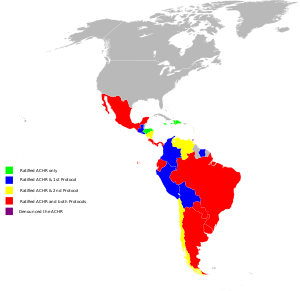 , 24 of the 35 OAS's member states have ratified the Convention:
Trinidad and Tobago
suspended its ratification on 26 May 1998 (effective 26 May 1999) over the death penalty issue.
The treaty is open to all OAS member states, although to date it has not been ratified by Canada
or several of the English-speaking Caribbean
nations; the United States
signed it in 1977 but has not proceeded with ratification.
Canada did at one point seriously consider ratification, but has decided against it, despite being in principle in favour of such a treaty. The ACHR, having been largely drafted by the predominantly Roman Catholic nations of Latin America, contains pro-life provisions, specifically, Article 4.1:
This conflicts with the current legality of abortions in Canada
. Although Canada could ratify the convention with a reservation with respect to abortion (as did Mexico
), that would contradict Canada's stated opposition to the making of reservations to human rights treaties. Another solution would be for the other states to remove the anti-abortion provisions, but that is unlikely to occur due to strong opposition to abortion in those countries.
International human rights instruments
International human rights instruments are treaties and other international documents relevant to international human rights law and the protection of human rights in general...
.
It was adopted by the nations of the Americas
Americas
The Americas, or America , are lands in the Western hemisphere, also known as the New World. In English, the plural form the Americas is often used to refer to the landmasses of North America and South America with their associated islands and regions, while the singular form America is primarily...
meeting in San José
San José, Costa Rica
San José is the capital and largest city of Costa Rica. Located in the Central Valley, San José is the seat of national government, the focal point of political and economic activity, and the major transportation hub of this Central American nation.Founded in 1738 by order of Cabildo de León, San...
, Costa Rica
Costa Rica
Costa Rica , officially the Republic of Costa Rica is a multilingual, multiethnic and multicultural country in Central America, bordered by Nicaragua to the north, Panama to the southeast, the Pacific Ocean to the west and the Caribbean Sea to the east....
, in 22 November 1969. It came into force after the eleventh instrument of ratification (that of Grenada
Grenada
Grenada is an island country and Commonwealth Realm consisting of the island of Grenada and six smaller islands at the southern end of the Grenadines in the southeastern Caribbean Sea...
) was deposited on 18 July 1978.
The bodies responsible for overseeing compliance with the Convention are the Inter-American Commission on Human Rights
Inter-American Commission on Human Rights
The Inter-American Commission on Human Rights is an autonomous organ of the Organization of American States .Along with the...
and the Inter-American Court of Human Rights
Inter-American Court of Human Rights
The Inter-American Court of Human Rights is an autonomous judicial institution based in the city of San José, Costa Rica. Together with the Inter-American Commission on Human Rights, it makes up the human rights protection system of the Organization of American States , which serves to uphold and...
, both of which are organs of the Organization of American States
Organization of American States
The Organization of American States is a regional international organization, headquartered in Washington, D.C., United States...
(OAS).
Content and purpose
According to its preamble, the purpose of the Convention is "to consolidate in this hemisphere, within the framework of democratic institutions, a system of personal liberty and social justice based on respect for the essential rights of man."Chapter I establishes the general obligation of the states parties to uphold the rights set forth in the Convention to all persons under their jurisdiction, and to adapt their domestic laws to bring them into line with the Convention. The 23 articles of Chapter II give a list of individual civil and political rights due to all persons, including the right to life "in general, from the moment of conception", to humane treatment, to a fair trial, to privacy, to freedom of conscience, freedom of assembly
Freedom of assembly
Freedom of assembly, sometimes used interchangeably with the freedom of association, is the individual right to come together and collectively express, promote, pursue and defend common interests...
, freedom of movement, etc. The single article in Chapter III deals with economic, social, and cultural rights.
The somewhat cursory treatment given to this issue here was expanded some ten years later with the Protocol of San Salvador (see below).
Chapter IV describes those circumstances in which certain rights can be temporarily suspended, such as during states of emergency, and the formalities to be followed for such suspension to be valid.
Chapter V, with a nod to the balance between rights and duties enshrined in the earlier American Declaration of the Rights and Duties of Man
American Declaration of the Rights and Duties of Man
The American Declaration of the Rights and Duties of Man was the world's first international human rights instrument of a general nature, predating the Universal Declaration of Human Rights by less than a year....
, points out that individuals have responsibilities as well as rights.
Chapters VI, VII, VIII, and IX contain provisions for the creation and operation of the two bodies responsible for overseeing compliance with the Convention: the Inter-American Commission
Inter-American Commission on Human Rights
The Inter-American Commission on Human Rights is an autonomous organ of the Organization of American States .Along with the...
, based in Washington, D.C.
Washington, D.C.
Washington, D.C., formally the District of Columbia and commonly referred to as Washington, "the District", or simply D.C., is the capital of the United States. On July 16, 1790, the United States Congress approved the creation of a permanent national capital as permitted by the U.S. Constitution....
, United States
United States
The United States of America is a federal constitutional republic comprising fifty states and a federal district...
, and the Inter-American Court
Inter-American Court of Human Rights
The Inter-American Court of Human Rights is an autonomous judicial institution based in the city of San José, Costa Rica. Together with the Inter-American Commission on Human Rights, it makes up the human rights protection system of the Organization of American States , which serves to uphold and...
, headquartered in San José
San José, Costa Rica
San José is the capital and largest city of Costa Rica. Located in the Central Valley, San José is the seat of national government, the focal point of political and economic activity, and the major transportation hub of this Central American nation.Founded in 1738 by order of Cabildo de León, San...
, Costa Rica
Costa Rica
Costa Rica , officially the Republic of Costa Rica is a multilingual, multiethnic and multicultural country in Central America, bordered by Nicaragua to the north, Panama to the southeast, the Pacific Ocean to the west and the Caribbean Sea to the east....
.
Chapter X deals with mechanisms for ratifying the Convention, amending it or placing reservations in it, or denouncing it. Various transitory provisions are set forth in Chapter XI.'
Additional Protocols
In the ensuing years, the states parties to the American Convention have supplemented its provisions with two additional protocols.The first, the Additional Protocol to the American Convention on Human Rights in the area of Economic, Social, and Cultural Rights (more commonly known as the "Protocol of San Salvador"), was opened for signature in the city of San Salvador
San Salvador
The city of San Salvador the capital and largest city of El Salvador, which has been designated a Gamma World City. Its complete name is La Ciudad de Gran San Salvador...
, El Salvador
El Salvador
El Salvador or simply Salvador is the smallest and the most densely populated country in Central America. The country's capital city and largest city is San Salvador; Santa Ana and San Miguel are also important cultural and commercial centers in the country and in all of Central America...
, on 17 November 1988. It represented an attempt to take the inter-American human rights system to a higher level by enshrining its protection of so-called second-generation rights
Three generations of human rights
The division of human rights into three generations was initially proposed in 1979 by the Czech jurist Karel Vasak at the International Institute of Human Rights in Strasbourg. He used the term at least as early as November 1977...
in the economic, social, and cultural spheres. The protocol's provisions cover such areas as the right to work, the right to health, the right to food, and the right to education. It came into effect on 16 November 1999 and has been ratified by 14 nations (see below).
The second, the Protocol to the American Convention on Human Rights to Abolish the Death Penalty, was adopted at Asunción
Asunción
Asunción is the capital and largest city of Paraguay.The "Ciudad de Asunción" is an autonomous capital district not part of any department. The metropolitan area, called Gran Asunción, includes the cities of San Lorenzo, Fernando de la Mora, Lambaré, Luque, Mariano Roque Alonso, Ñemby, San...
, Paraguay
Paraguay
Paraguay , officially the Republic of Paraguay , is a landlocked country in South America. It is bordered by Argentina to the south and southwest, Brazil to the east and northeast, and Bolivia to the northwest. Paraguay lies on both banks of the Paraguay River, which runs through the center of the...
, on 8 June 1990.
While Article 4 of the American Convention had already placed severe restrictions on the states' ability to impose the death penalty – only applicable for the most serious crimes; no reinstatement once abolished; not to be used for political offenses or common crimes; not to be used against those aged under 18 or over 70, or against pregnant women – signing this protocol formalizes a state's solemn commitment to refrain from using capital punishment in any peacetime circumstance. To date it has been ratified by 11 nations (see below).
Ratifications
| Country | Ratification date | 1st additional protocol | 2nd additional procotol |
|---|---|---|---|
| Argentina Argentina Argentina , officially the Argentine Republic , is the second largest country in South America by land area, after Brazil. It is constituted as a federation of 23 provinces and an autonomous city, Buenos Aires... |
14 August 1984 | 30 June 2003 | 18 June 2008 |
| Barbados Barbados Barbados is an island country in the Lesser Antilles. It is in length and as much as in width, amounting to . It is situated in the western area of the North Atlantic and 100 kilometres east of the Windward Islands and the Caribbean Sea; therein, it is about east of the islands of Saint... |
5 December 1981 | ||
| Bolivia Bolivia Bolivia officially known as Plurinational State of Bolivia , is a landlocked country in central South America. It is the poorest country in South America... |
20 June 1979 | 12 July 2006 | |
| Brazil Brazil Brazil , officially the Federative Republic of Brazil , is the largest country in South America. It is the world's fifth largest country, both by geographical area and by population with over 192 million people... |
9 July 1992 | 8 August 1996 | 31 July 1996 |
| Chile Chile Chile ,officially the Republic of Chile , is a country in South America occupying a long, narrow coastal strip between the Andes mountains to the east and the Pacific Ocean to the west. It borders Peru to the north, Bolivia to the northeast, Argentina to the east, and the Drake Passage in the far... |
8 August 1990 | 4 August 2008 | |
| Colombia Colombia Colombia, officially the Republic of Colombia , is a unitary constitutional republic comprising thirty-two departments. The country is located in northwestern South America, bordered to the east by Venezuela and Brazil; to the south by Ecuador and Peru; to the north by the Caribbean Sea; to the... |
28 May 1973 | 10 October 1997 | |
| Costa Rica Costa Rica Costa Rica , officially the Republic of Costa Rica is a multilingual, multiethnic and multicultural country in Central America, bordered by Nicaragua to the north, Panama to the southeast, the Pacific Ocean to the west and the Caribbean Sea to the east.... |
2 March 1970 | 9 September 1999 | 30 March 1998 |
| Dominica Dominica Dominica , officially the Commonwealth of Dominica, is an island nation in the Lesser Antilles region of the Caribbean Sea, south-southeast of Guadeloupe and northwest of Martinique. Its size is and the highest point in the country is Morne Diablotins, which has an elevation of . The Commonwealth... |
3 June 1993 | ||
| Dominican Republic Dominican Republic The Dominican Republic is a nation on the island of La Hispaniola, part of the Greater Antilles archipelago in the Caribbean region. The western third of the island is occupied by the nation of Haiti, making Hispaniola one of two Caribbean islands that are shared by two countries... |
21 January 1978 | ||
| Ecuador Ecuador Ecuador , officially the Republic of Ecuador is a representative democratic republic in South America, bordered by Colombia on the north, Peru on the east and south, and by the Pacific Ocean to the west. It is one of only two countries in South America, along with Chile, that do not have a border... |
8 December 1997 | 2 February 1993 | 5 February 1998 |
| El Salvador El Salvador El Salvador or simply Salvador is the smallest and the most densely populated country in Central America. The country's capital city and largest city is San Salvador; Santa Ana and San Miguel are also important cultural and commercial centers in the country and in all of Central America... |
20 June 1978 | 4 May 1995 | |
| Grenada Grenada Grenada is an island country and Commonwealth Realm consisting of the island of Grenada and six smaller islands at the southern end of the Grenadines in the southeastern Caribbean Sea... |
14 July 1978 | ||
| Guatemala Guatemala Guatemala is a country in Central America bordered by Mexico to the north and west, the Pacific Ocean to the southwest, Belize to the northeast, the Caribbean to the east, and Honduras and El Salvador to the southeast... |
27 April 1978 | 30 May 2000 | |
| Haiti Haiti Haiti , officially the Republic of Haiti , is a Caribbean country. It occupies the western, smaller portion of the island of Hispaniola, in the Greater Antillean archipelago, which it shares with the Dominican Republic. Ayiti was the indigenous Taíno or Amerindian name for the island... |
14 September 1977 | ||
| Honduras Honduras Honduras is a republic in Central America. It was previously known as Spanish Honduras to differentiate it from British Honduras, which became the modern-day state of Belize... |
5 September 1977 | ||
| Jamaica Jamaica Jamaica is an island nation of the Greater Antilles, in length, up to in width and 10,990 square kilometres in area. It is situated in the Caribbean Sea, about south of Cuba, and west of Hispaniola, the island harbouring the nation-states Haiti and the Dominican Republic... |
19 July 1978 | ||
| Mexico Mexico The United Mexican States , commonly known as Mexico , is a federal constitutional republic in North America. It is bordered on the north by the United States; on the south and west by the Pacific Ocean; on the southeast by Guatemala, Belize, and the Caribbean Sea; and on the east by the Gulf of... |
2 March 1981 | 8 March 1996 | 28 June 2007 |
| Nicaragua Nicaragua Nicaragua is the largest country in the Central American American isthmus, bordered by Honduras to the north and Costa Rica to the south. The country is situated between 11 and 14 degrees north of the Equator in the Northern Hemisphere, which places it entirely within the tropics. The Pacific Ocean... |
25 September 1979 | 24 March 1999 | |
| Panama Panama Panama , officially the Republic of Panama , is the southernmost country of Central America. Situated on the isthmus connecting North and South America, it is bordered by Costa Rica to the northwest, Colombia to the southeast, the Caribbean Sea to the north and the Pacific Ocean to the south. The... |
8 May 1978 | 28 October 1992 | 27 June 1991 |
| Paraguay Paraguay Paraguay , officially the Republic of Paraguay , is a landlocked country in South America. It is bordered by Argentina to the south and southwest, Brazil to the east and northeast, and Bolivia to the northwest. Paraguay lies on both banks of the Paraguay River, which runs through the center of the... |
18 August 1989 | 28 May 1997 | 31 October 2000 |
| Peru Peru Peru , officially the Republic of Peru , is a country in western South America. It is bordered on the north by Ecuador and Colombia, on the east by Brazil, on the southeast by Bolivia, on the south by Chile, and on the west by the Pacific Ocean.... |
12 July 1978 | 17 May 1995 | |
| Suriname Suriname Suriname , officially the Republic of Suriname , is a country in northern South America. It borders French Guiana to the east, Guyana to the west, Brazil to the south, and on the north by the Atlantic Ocean. Suriname was a former colony of the British and of the Dutch, and was previously known as... |
12 December 1987 | 28 February 1990 | |
| Uruguay Uruguay Uruguay ,officially the Oriental Republic of Uruguay,sometimes the Eastern Republic of Uruguay; ) is a country in the southeastern part of South America. It is home to some 3.5 million people, of whom 1.8 million live in the capital Montevideo and its metropolitan area... |
26 March 1985 | 21 December 1995 | 8 February 1994 |
| Venezuela Venezuela Venezuela , officially called the Bolivarian Republic of Venezuela , is a tropical country on the northern coast of South America. It borders Colombia to the west, Guyana to the east, and Brazil to the south... |
23 June 1977 | 24 August 1992 |
Trinidad and Tobago
Trinidad and Tobago
Trinidad and Tobago officially the Republic of Trinidad and Tobago is an archipelagic state in the southern Caribbean, lying just off the coast of northeastern Venezuela and south of Grenada in the Lesser Antilles...
suspended its ratification on 26 May 1998 (effective 26 May 1999) over the death penalty issue.
The treaty is open to all OAS member states, although to date it has not been ratified by Canada
Canada
Canada is a North American country consisting of ten provinces and three territories. Located in the northern part of the continent, it extends from the Atlantic Ocean in the east to the Pacific Ocean in the west, and northward into the Arctic Ocean...
or several of the English-speaking Caribbean
Anglophone Caribbean
The term Commonwealth Caribbean is used to refer to the independent English-speaking countries of the Caribbean region. Upon a country's full independence from the United Kingdom, Anglophone Caribbean or Commonwealth Caribbean traditionally becomes the preferred sub-regional term as a replacement...
nations; the United States
United States
The United States of America is a federal constitutional republic comprising fifty states and a federal district...
signed it in 1977 but has not proceeded with ratification.
Canada did at one point seriously consider ratification, but has decided against it, despite being in principle in favour of such a treaty. The ACHR, having been largely drafted by the predominantly Roman Catholic nations of Latin America, contains pro-life provisions, specifically, Article 4.1:
This conflicts with the current legality of abortions in Canada
Abortion in Canada
Abortion in Canada is not limited by the law . While some non-legal obstacles exist, Canada is one of only a few nations with no legal restrictions on abortion. Regulations and accessibility vary between provinces....
. Although Canada could ratify the convention with a reservation with respect to abortion (as did Mexico
Abortion in Mexico
Abortion is a controversial issue in Mexico, where it is offered on request to any woman up to twelve weeks into a pregnancy in Mexico City, but forbidden in 18 out of 31 Mexican state constitutions...
), that would contradict Canada's stated opposition to the making of reservations to human rights treaties. Another solution would be for the other states to remove the anti-abortion provisions, but that is unlikely to occur due to strong opposition to abortion in those countries.