

Eastern Theater of the American Civil War

Encyclopedia
Theater (warfare)
In warfare, a theater, is defined as an area or place within which important military events occur or are progressing. The entirety of the air, land, and sea area that is or that may potentially become involved in war operations....
of the American Civil War
American Civil War
The American Civil War was a civil war fought in the United States of America. In response to the election of Abraham Lincoln as President of the United States, 11 southern slave states declared their secession from the United States and formed the Confederate States of America ; the other 25...
included the states of Virginia
Virginia
The Commonwealth of Virginia , is a U.S. state on the Atlantic Coast of the Southern United States. Virginia is nicknamed the "Old Dominion" and sometimes the "Mother of Presidents" after the eight U.S. presidents born there...
, West Virginia
West Virginia
West Virginia is a state in the Appalachian and Southeastern regions of the United States, bordered by Virginia to the southeast, Kentucky to the southwest, Ohio to the northwest, Pennsylvania to the northeast and Maryland to the east...
, Maryland
Maryland
Maryland is a U.S. state located in the Mid Atlantic region of the United States, bordering Virginia, West Virginia, and the District of Columbia to its south and west; Pennsylvania to its north; and Delaware to its east...
, and Pennsylvania
Pennsylvania
The Commonwealth of Pennsylvania is a U.S. state that is located in the Northeastern and Mid-Atlantic regions of the United States. The state borders Delaware and Maryland to the south, West Virginia to the southwest, Ohio to the west, New York and Ontario, Canada, to the north, and New Jersey to...
, the District of Columbia, and the coastal fortifications and seaports of North Carolina
North Carolina
North Carolina is a state located in the southeastern United States. The state borders South Carolina and Georgia to the south, Tennessee to the west and Virginia to the north. North Carolina contains 100 counties. Its capital is Raleigh, and its largest city is Charlotte...
. (Operations in the interior of the Carolinas
The Carolinas
The Carolinas is a term used in the United States to refer collectively to the states of North and South Carolina. Together, the two states + have a population of 13,942,126. "Carolina" would be the fifth most populous state behind California, Texas, New York, and Florida...
in 1865 are considered part of the Western Theater
Western Theater of the American Civil War
This article presents an overview of major military and naval operations in the Western Theater of the American Civil War.-Theater of operations:...
, while the other coastal areas along the Atlantic Ocean are included in the Lower Seaboard Theater
Lower Seaboard Theater of the American Civil War
The Lower Seaboard Theater of the American Civil War encompassed major military and naval operations that occurred near the coastal areas of the Southeastern United States as well as southern part of the Mississippi River...
.)
The Eastern Theater was the venue for several major campaigns launched by the Union Army of the Potomac
Army of the Potomac
The Army of the Potomac was the major Union Army in the Eastern Theater of the American Civil War.-History:The Army of the Potomac was created in 1861, but was then only the size of a corps . Its nucleus was called the Army of Northeastern Virginia, under Brig. Gen...
to capture the Confederate
Confederate States of America
The Confederate States of America was a government set up from 1861 to 1865 by 11 Southern slave states of the United States of America that had declared their secession from the U.S...
capital of Richmond, Virginia
Richmond, Virginia
Richmond is the capital of the Commonwealth of Virginia, in the United States. It is an independent city and not part of any county. Richmond is the center of the Richmond Metropolitan Statistical Area and the Greater Richmond area...
; many of these were frustrated by the Confederate Army of Northern Virginia
Army of Northern Virginia
The Army of Northern Virginia was the primary military force of the Confederate States of America in the Eastern Theater of the American Civil War, as well as the primary command structure of the Department of Northern Virginia. It was most often arrayed against the Union Army of the Potomac...
, commanded by General Robert E. Lee
Robert E. Lee
Robert Edward Lee was a career military officer who is best known for having commanded the Confederate Army of Northern Virginia in the American Civil War....
. President Abraham Lincoln
Abraham Lincoln
Abraham Lincoln was the 16th President of the United States, serving from March 1861 until his assassination in April 1865. He successfully led his country through a great constitutional, military and moral crisis – the American Civil War – preserving the Union, while ending slavery, and...
sought a general to match Lee's boldness, appointing in turn Maj. Gens.
Major general (United States)
In the United States Army, United States Marine Corps, and United States Air Force, major general is a two-star general-officer rank, with the pay grade of O-8. Major general ranks above brigadier general and below lieutenant general...
Irvin McDowell
Irvin McDowell
Irvin McDowell was a career American army officer. He is best known for his defeat in the First Battle of Bull Run, the first large-scale battle of the American Civil War.-Early life:...
, George B. McClellan
George B. McClellan
George Brinton McClellan was a major general during the American Civil War. He organized the famous Army of the Potomac and served briefly as the general-in-chief of the Union Army. Early in the war, McClellan played an important role in raising a well-trained and organized army for the Union...
, John Pope
John Pope (military officer)
John Pope was a career United States Army officer and Union general in the American Civil War. He had a brief but successful career in the Western Theater, but he is best known for his defeat at the Second Battle of Bull Run in the East.Pope was a graduate of the United States Military Academy in...
, Ambrose Burnside
Ambrose Burnside
Ambrose Everett Burnside was an American soldier, railroad executive, inventor, industrialist, and politician from Rhode Island, serving as governor and a U.S. Senator...
, Joseph Hooker
Joseph Hooker
Joseph Hooker was a career United States Army officer, achieving the rank of major general in the Union Army during the American Civil War. Although he served throughout the war, usually with distinction, Hooker is best remembered for his stunning defeat by Confederate General Robert E...
, and George G. Meade to command his principal Eastern armies. It was not until newly appointed general-in-chief Ulysses S. Grant
Ulysses S. Grant
Ulysses S. Grant was the 18th President of the United States as well as military commander during the Civil War and post-war Reconstruction periods. Under Grant's command, the Union Army defeated the Confederate military and ended the Confederate States of America...
arrived from the Western Theater in 1864 to take personal control of operations in Virginia that Union forces were able to capture Richmond, but only after several bloody battles of the Overland Campaign
Overland Campaign
The Overland Campaign, also known as Grant's Overland Campaign and the Wilderness Campaign, was a series of battles fought in Virginia during May and June 1864, in the American Civil War. Lt. Gen. Ulysses S. Grant, general-in-chief of all Union armies, directed the actions of the Army of the...
and a nine-month siege near the cities of Petersburg and Richmond
Siege of Petersburg
The Richmond–Petersburg Campaign was a series of battles around Petersburg, Virginia, fought from June 9, 1864, to March 25, 1865, during the American Civil War...
. The surrender of Lee's army at Appomattox Court House in April 1865 brought major operations in the area to a close.
While many of the campaigns and battles were fought in the region of Virginia between Washington, D.C., and Richmond, there were other major campaigns fought nearby. The Western Virginia Campaign
Western Virginia Campaign
The Western Virginia Campaign occurred from May to December 1861 during the American Civil War. Union forces under Major General George B. McClellan invaded the western portion of Virginia; this area occupied by the Union later became the state of West Virginia...
of 1861 secured Union control over the western counties of Virginia, which would be formed into the new state of West Virginia
West Virginia
West Virginia is a state in the Appalachian and Southeastern regions of the United States, bordered by Virginia to the southeast, Kentucky to the southwest, Ohio to the northwest, Pennsylvania to the northeast and Maryland to the east...
. Confederate coastal areas and ports were seized in southeastern Virginia and North Carolina. The Shenandoah Valley
Shenandoah Valley
The Shenandoah Valley is both a geographic valley and cultural region of western Virginia and West Virginia in the United States. The valley is bounded to the east by the Blue Ridge Mountains, to the west by the eastern front of the Ridge-and-Valley Appalachians , to the north by the Potomac River...
was marked by frequent clashes in 1862, 1863, and 1864. Lee launched two unsuccessful invasions of Union territory in hopes of influencing Northern opinion to end the war. In the fall of 1862, Lee followed his successful Northern Virginia Campaign
Northern Virginia Campaign
The Northern Virginia Campaign, also known as the Second Bull Run Campaign or Second Manassas Campaign, was a series of battles fought in Virginia during August and September 1862 in the Eastern Theater of the American Civil War. Confederate General Robert E...
with his first invasion, the Maryland Campaign
Maryland Campaign
The Maryland Campaign, or the Antietam Campaign is widely considered one of the major turning points of the American Civil War. Confederate Gen. Robert E. Lee's first invasion of the North was repulsed by Maj. Gen. George B...
, which culminated in his strategic defeat in the Battle of Antietam
Battle of Antietam
The Battle of Antietam , fought on September 17, 1862, near Sharpsburg, Maryland, and Antietam Creek, as part of the Maryland Campaign, was the first major battle in the American Civil War to take place on Northern soil. It was the bloodiest single-day battle in American history, with about 23,000...
. In the summer of 1863, Lee's second invasion, the Gettysburg Campaign
Gettysburg Campaign
The Gettysburg Campaign was a series of battles fought in June and July 1863, during the American Civil War. After his victory in the Battle of Chancellorsville, Confederate General Robert E. Lee's Army of Northern Virginia moved north for offensive operations in Maryland and Pennsylvania. The...
, reached into Pennsylvania, farther north than any other major Confederate army. Following a Confederate attack on Washington, D.C., itself in 1864, Union forces commanded by Philip H. Sheridan launched a campaign in the Shenandoah Valley
Valley Campaigns of 1864
The Valley Campaigns of 1864 were American Civil War operations and battles that took place in the Shenandoah Valley of Virginia from May to October 1864. Military historians divide this period into three separate campaigns, but it is useful to consider the three together and how they...
, which cost the Confederacy control over a major food supply for Lee's army.
Theater of operations
The Eastern Theater included the campaigns that are generally most famous in the history of the war, if not for their strategic significance, then for their proximity to the large population centers, the major newspapers, and the capital cities of the opposing parties. The imaginations of both NorthernersNorthern United States
Northern United States, also sometimes the North, may refer to:* A particular grouping of states or regions of the United States of America. The United States Census Bureau divides some of the northernmost United States into the Midwest Region and the Northeast Region...
and Southerners
Southern United States
The Southern United States—commonly referred to as the American South, Dixie, or simply the South—constitutes a large distinctive area in the southeastern and south-central United States...
were captured by the epic struggles between the Confederate
Confederate States Army
The Confederate States Army was the army of the Confederate States of America while the Confederacy existed during the American Civil War. On February 8, 1861, delegates from the seven Deep South states which had already declared their secession from the United States of America adopted the...
Army of Northern Virginia
Army of Northern Virginia
The Army of Northern Virginia was the primary military force of the Confederate States of America in the Eastern Theater of the American Civil War, as well as the primary command structure of the Department of Northern Virginia. It was most often arrayed against the Union Army of the Potomac...
, under Robert E. Lee
Robert E. Lee
Robert Edward Lee was a career military officer who is best known for having commanded the Confederate Army of Northern Virginia in the American Civil War....
, and the Union
Union Army
The Union Army was the land force that fought for the Union during the American Civil War. It was also known as the Federal Army, the U.S. Army, the Northern Army and the National Army...
Army of the Potomac
Army of the Potomac
The Army of the Potomac was the major Union Army in the Eastern Theater of the American Civil War.-History:The Army of the Potomac was created in 1861, but was then only the size of a corps . Its nucleus was called the Army of Northeastern Virginia, under Brig. Gen...
, under a series of less successful commanders. The bloodiest battle of the war (Gettysburg
Battle of Gettysburg
The Battle of Gettysburg , was fought July 1–3, 1863, in and around the town of Gettysburg, Pennsylvania. The battle with the largest number of casualties in the American Civil War, it is often described as the war's turning point. Union Maj. Gen. George Gordon Meade's Army of the Potomac...
) and the bloodiest single day of the war (Antietam
Battle of Antietam
The Battle of Antietam , fought on September 17, 1862, near Sharpsburg, Maryland, and Antietam Creek, as part of the Maryland Campaign, was the first major battle in the American Civil War to take place on Northern soil. It was the bloodiest single-day battle in American history, with about 23,000...
) were both fought in this theater. The capitals of Washington, D.C.
Washington, D.C.
Washington, D.C., formally the District of Columbia and commonly referred to as Washington, "the District", or simply D.C., is the capital of the United States. On July 16, 1790, the United States Congress approved the creation of a permanent national capital as permitted by the U.S. Constitution....
, and Richmond
Richmond, Virginia
Richmond is the capital of the Commonwealth of Virginia, in the United States. It is an independent city and not part of any county. Richmond is the center of the Richmond Metropolitan Statistical Area and the Greater Richmond area...
were both attacked or besieged. It has been argued that the Western Theater
Western Theater of the American Civil War
This article presents an overview of major military and naval operations in the Western Theater of the American Civil War.-Theater of operations:...
was more strategically important in defeating the Confederacy, but it is inconceivable that the civilian populations of both sides could have considered the war to be at an end without the resolution of Lee's surrender at Appomattox Courthouse in 1865.
The theater was bounded by the Appalachian Mountains
Appalachian Mountains
The Appalachian Mountains #Whether the stressed vowel is or ,#Whether the "ch" is pronounced as a fricative or an affricate , and#Whether the final vowel is the monophthong or the diphthong .), often called the Appalachians, are a system of mountains in eastern North America. The Appalachians...
and the Atlantic Ocean
Atlantic Ocean
The Atlantic Ocean is the second-largest of the world's oceanic divisions. With a total area of about , it covers approximately 20% of the Earth's surface and about 26% of its water surface area...
. By far, the majority of battles occurred in the 100 miles between the cities of Washington and Richmond. This terrain favored the Confederate defenders because a series of rivers ran primarily west to east, making them obstacles rather than avenues of approach and lines of communication for the Union. This was quite different than the early years of the Western theater, and since the Union Army had to rely solely on the primitive road system of the era for its primary transportation, it limited winter campaigning for both sides. The Union advantage was control of the sea and major rivers, which would allow an army that stayed close to the ocean to be reinforced and supplied.
The campaign classification established by the United States
United States
The United States of America is a federal constitutional republic comprising fifty states and a federal district...
National Park Service
National Park Service
The National Park Service is the U.S. federal agency that manages all national parks, many national monuments, and other conservation and historical properties with various title designations...
(NPS) is more fine-grained than the one used in this article. Some minor NPS campaigns have been omitted and some have been combined into larger categories. Only a few of the 160 battles the NPS classifies for this theater are described. Boxed text in the right margin show the NPS campaigns associated with each section.
Principal commanders of the Eastern Theater
Early operations (1861)
After the fall of Fort SumterBattle of Fort Sumter
The Battle of Fort Sumter was the bombardment and surrender of Fort Sumter, near Charleston, South Carolina, that started the American Civil War. Following declarations of secession by seven Southern states, South Carolina demanded that the U.S. Army abandon its facilities in Charleston Harbor. On...
in April 1861, both sides scrambled to create armies. President
President of the United States
The President of the United States of America is the head of state and head of government of the United States. The president leads the executive branch of the federal government and is the commander-in-chief of the United States Armed Forces....
Abraham Lincoln
Abraham Lincoln
Abraham Lincoln was the 16th President of the United States, serving from March 1861 until his assassination in April 1865. He successfully led his country through a great constitutional, military and moral crisis – the American Civil War – preserving the Union, while ending slavery, and...
issued a call for 75,000 volunteers to suppress the rebellion, which immediately caused the secession
Secession
Secession is the act of withdrawing from an organization, union, or especially a political entity. Threats of secession also can be a strategy for achieving more limited goals.-Secession theory:...
of four additional states, including Virginia. The United States Army
United States Army
The United States Army is the main branch of the United States Armed Forces responsible for land-based military operations. It is the largest and oldest established branch of the U.S. military, and is one of seven U.S. uniformed services...
had only around 16,000 men, with more than half spread out in the West
Western United States
.The Western United States, commonly referred to as the American West or simply "the West," traditionally refers to the region comprising the westernmost states of the United States. Because the U.S. expanded westward after its founding, the meaning of the West has evolved over time...
. The army was commanded by the elderly Lt. Gen.
Lieutenant General (United States)
In the United States Army, the United States Air Force and the United States Marine Corps, lieutenant general is a three-star general officer rank, with the pay grade of O-9. Lieutenant general ranks above major general and below general...
Winfield Scott
Winfield Scott
Winfield Scott was a United States Army general, and unsuccessful presidential candidate of the Whig Party in 1852....
, veteran of the War of 1812
War of 1812
The War of 1812 was a military conflict fought between the forces of the United States of America and those of the British Empire. The Americans declared war in 1812 for several reasons, including trade restrictions because of Britain's ongoing war with France, impressment of American merchant...
and the Mexican-American War. On the Confederate side, only a handful of Federal officers and men resigned and joined the Confederacy; the formation of the Confederate States Army
Confederate States Army
The Confederate States Army was the army of the Confederate States of America while the Confederacy existed during the American Civil War. On February 8, 1861, delegates from the seven Deep South states which had already declared their secession from the United States of America adopted the...
was a matter initially undertaken by the individual states. (The decentralized nature of the Confederate defenses, encouraged by the states' distrust of a strong central government, was one of the disadvantages suffered by the South during the war.)
Some of the first hostilities occurred in western Virginia (now the state of West Virginia
West Virginia
West Virginia is a state in the Appalachian and Southeastern regions of the United States, bordered by Virginia to the southeast, Kentucky to the southwest, Ohio to the northwest, Pennsylvania to the northeast and Maryland to the east...
). The region had closer ties to Pennsylvania and Ohio than to eastern Virginia and thus were opposed to secession; a pro-Union government was soon organized and appealed to Lincoln for military protection. Maj. Gen.
Major general (United States)
In the United States Army, United States Marine Corps, and United States Air Force, major general is a two-star general-officer rank, with the pay grade of O-8. Major general ranks above brigadier general and below lieutenant general...
George B. McClellan
George B. McClellan
George Brinton McClellan was a major general during the American Civil War. He organized the famous Army of the Potomac and served briefly as the general-in-chief of the Union Army. Early in the war, McClellan played an important role in raising a well-trained and organized army for the Union...
, commanding the Department of the Ohio
Department of the Ohio
The Department of the Ohio was an administrative military district created by the United States War Department early in the American Civil War to administer the troops in the Northern states near the Ohio River.General Orders No...
, ordered troops to march from Grafton
Grafton, West Virginia
Grafton is a city in, and county seat of, Taylor County, West Virginia, USA. The population was 5,489 at the 2000 census. The only two national cemeteries in West Virginia are located in Grafton. Mother's Day was founded in Grafton on May 10, 1908; the city is the home to the International Mother's...
and attack the Confederates under Col. George A. Porterfield
George A. Porterfield
George Alexander Porterfield was a junior officer of United States forces in the Mexican-American War, colonel in the Confederate States Army during the first year of the American Civil War and longtime banker in Charles Town, West Virginia after the war...
. The skirmish on June 3, 1861, known as the Battle of Philippi
Battle of Philippi Races
The Battle of Philippi—also known mockingly as "The Philippi Races"—was fought on June 3, 1861, in and around Philippi, Virginia as part of the Western Virginia Campaign of the American Civil War...
, or the "Philippi Races", had little significance other than to raise public awareness of the young general. His victory at the Battle of Rich Mountain
Battle of Rich Mountain
The Battle of Rich Mountain took place on July 11, 1861, in Randolph County, Virginia as part of the Operations in Western Virginia Campaign during the American Civil War.-Background:...
in July was instrumental in his promotion that fall to command the Army of the Potomac
Army of the Potomac
The Army of the Potomac was the major Union Army in the Eastern Theater of the American Civil War.-History:The Army of the Potomac was created in 1861, but was then only the size of a corps . Its nucleus was called the Army of Northeastern Virginia, under Brig. Gen...
. As the campaign continued through a series of minor battles, General Robert E. Lee
Robert E. Lee
Robert Edward Lee was a career military officer who is best known for having commanded the Confederate Army of Northern Virginia in the American Civil War....
, who, despite his excellent reputation as a former U.S. Army colonel, had no combat command experience, gave a lackluster performance that earned him the derogatory nickname "Granny Lee". He was soon transferred to the Carolinas
The Carolinas
The Carolinas is a term used in the United States to refer collectively to the states of North and South Carolina. Together, the two states + have a population of 13,942,126. "Carolina" would be the fifth most populous state behind California, Texas, New York, and Florida...
to construct fortifications. The Union victory in this campaign enabled the creation of the state of West Virginia in 1863.
The first significant battle of the war took place in eastern Virginia on June 10. Union Maj. Gen. Benjamin Butler
Benjamin Franklin Butler (politician)
Benjamin Franklin Butler was an American lawyer and politician who represented Massachusetts in the United States House of Representatives and later served as the 33rd Governor of Massachusetts....
, based at Fort Monroe
Fort Monroe
Fort Monroe was a military installation in Hampton, Virginia—at Old Point Comfort, the southern tip of the Virginia Peninsula...
, sent converging columns from Hampton
Hampton, Virginia
Hampton is an independent city that is not part of any county in Southeast Virginia. Its population is 137,436. As one of the seven major cities that compose the Hampton Roads metropolitan area, it is on the southeastern end of the Virginia Peninsula. Located on the Hampton Roads Beltway, it hosts...
and Newport News
Newport News, Virginia
Newport News is an independent city located in the Hampton Roads metropolitan area of Virginia. It is at the southeastern end of the Virginia Peninsula, on the north shore of the James River extending southeast from Skiffe's Creek along many miles of waterfront to the river's mouth at Newport News...
against advanced Confederate outposts. At Big Bethel
Battle of Big Bethel
The Battle of Big Bethel, also known as the Battle of Bethel Church or Great Bethel was one of the earliest land battles of the American Civil War after the surrender of Fort Sumter...
, near Fort Monroe, Colonel John B. Magruder
John B. Magruder
John Bankhead Magruder was a career military officer who served in the armies of three nations. He was a U.S. Army officer in the Mexican-American War, a Confederate general during the American Civil War, and a postbellum general in the Imperial Mexican Army...
won the first Confederate victory.
First Bull Run (First Manassas)
In early summer, the commander of Union field forces around Washington was Brig. Gen.Brigadier general (United States)
A brigadier general in the United States Army, Air Force, and Marine Corps, is a one-star general officer, with the pay grade of O-7. Brigadier general ranks above a colonel and below major general. Brigadier general is equivalent to the rank of rear admiral in the other uniformed...
Irvin McDowell
Irvin McDowell
Irvin McDowell was a career American army officer. He is best known for his defeat in the First Battle of Bull Run, the first large-scale battle of the American Civil War.-Early life:...
, an inexperienced combat officer in command of volunteer soldiers with even less experience. Many of them had enlisted for only 90 days, a period soon to expire. McDowell was pressured by politicians and major newspapers in the North to take immediate action, exhorting him "On to Richmond!" His plan was to march with 35,000 men and attack the 20,000 Confederates under Brig. Gen. P.G.T. Beauregard at Manassas
Manassas, Virginia
The City of Manassas is an independent city surrounded by Prince William County and the independent city of Manassas Park in the Commonwealth of Virginia in the United States. Its population was 37,821 as of 2010. Manassas also surrounds the county seat for Prince William County but that county...
. The second major Confederate force in the area, 12,000 men under Gen. Joseph E. Johnston
Joseph E. Johnston
Joseph Eggleston Johnston was a career U.S. Army officer, serving with distinction in the Mexican-American War and Seminole Wars, and was also one of the most senior general officers in the Confederate States Army during the American Civil War...
in the Shenandoah Valley
Shenandoah Valley
The Shenandoah Valley is both a geographic valley and cultural region of western Virginia and West Virginia in the United States. The valley is bounded to the east by the Blue Ridge Mountains, to the west by the eastern front of the Ridge-and-Valley Appalachians , to the north by the Potomac River...
, was to be held in place by Maj. Gen. Robert Patterson
Robert Patterson
Robert Patterson was a United States major general during the Mexican-American War and at the beginning of the American Civil War...
with 18,000 men menacing Harpers Ferry, preventing the two Confederate armies from combining against McDowell.
On July 21, McDowell's Army of Northeastern Virginia executed a complex turning movement against Beauregard's Confederate Army of the Potomac
Army of the Potomac (Confederate)
The Confederate Army of the Potomac, whose name was short-lived, was the command under Brig. Gen. P.G.T. Beauregard in the early days of the American Civil War. Its only major combat action was the First Battle of Bull Run. Afterwards, the Army of the Shenandoah was merged into the Army of the...
, beginning the First Battle of Bull Run
First Battle of Bull Run
First Battle of Bull Run, also known as First Manassas , was fought on July 21, 1861, in Prince William County, Virginia, near the City of Manassas...
(also known as First Manassas). Although the Union troops enjoyed an early advantage and drove the Confederate left flank back, the battle advantage turned that afternoon. Brig. Gen. Thomas J. Jackson
Stonewall Jackson
ຄຽשת״ׇׂׂׂׂ֣|birth_place= Clarksburg, Virginia |death_place=Guinea Station, Virginia|placeofburial=Stonewall Jackson Memorial CemeteryLexington, Virginia|placeofburial_label= Place of burial|image=...
inspired his Virginia brigade to withstand a strong Union attack, and he received his famous nickname, "Stonewall" Jackson. Timely reinforcements arrived by railroad from Johnston's army; Patterson had been ineffective in keeping them occupied. The inexperienced Union soldiers began to fall back, and it turned into a panicky retreat, with many running almost as far as Washington, D.C. Civilian and political observers, some of whom had treated the battle as festive entertainment, were caught up in the panic. The army returned safely to Washington; Beauregard's army was too tired and inexperienced to launch a pursuit. The Union defeat at First Bull Run shocked the North, and a new sense of grim determination swept the United States as military and civilians alike realized that they would need to invest significant money and manpower to win a protracted, bloody war.
George B. McClellan was summoned east in August to command the newly forming Army of the Potomac
Army of the Potomac
The Army of the Potomac was the major Union Army in the Eastern Theater of the American Civil War.-History:The Army of the Potomac was created in 1861, but was then only the size of a corps . Its nucleus was called the Army of Northeastern Virginia, under Brig. Gen...
, which would become the principal army of the Eastern Theater. As a former railroad executive, he possessed outstanding organizational skills well-suited to the tasks of training and administration. He was also strongly ambitious, and by November 1, he had maneuvered around Winfield Scott and was named general-in-chief of all the Union armies, despite the embarrassing defeat of an expedition he sent up the Potomac River
Potomac River
The Potomac River flows into the Chesapeake Bay, located along the mid-Atlantic coast of the United States. The river is approximately long, with a drainage area of about 14,700 square miles...
at the Battle of Balls Bluff in October.
North Carolina coast (1861–65)
North Carolina was an important area to the Confederacy because of the vital seaport of WilmingtonWilmington, North Carolina
Wilmington is a port city in and is the county seat of New Hanover County, North Carolina, United States. The population is 106,476 according to the 2010 Census, making it the eighth most populous city in the state of North Carolina...
and because the Outer Banks
Outer Banks
The Outer Banks is a 200-mile long string of narrow barrier islands off the coast of North Carolina, beginning in the southeastern corner of Virginia Beach on the east coast of the United States....
were valuable bases for ships attempting to evade the Union blockade
Union blockade
The Union Blockade, or the Blockade of the South, took place between 1861 and 1865, during the American Civil War, when the Union Navy maintained a strenuous effort on the Atlantic and Gulf Coast of the Confederate States of America designed to prevent the passage of trade goods, supplies, and arms...
. Benjamin Butler sailed from Fort Monroe and captured the batteries at Hatteras
Battle of Hatteras Inlet Batteries
The Battle of Hatteras Inlet Batteries, sometimes known as the Battle of Forts Hatteras and Clark, was a small but significant engagement in the early days of the American Civil War. Two Confederate forts on the North Carolina Outer Banks were subjected to an amphibious assault by Union forces that...
Inlet in August 1861. In February 1862, Brig. Gen. Ambrose Burnside
Ambrose Burnside
Ambrose Everett Burnside was an American soldier, railroad executive, inventor, industrialist, and politician from Rhode Island, serving as governor and a U.S. Senator...
organized an amphibious expedition, also from Fort Monroe, that captured Roanoke Island
Battle of Roanoke Island
The opening phase of what came to be called the Burnside Expedition, the Battle of Roanoke Island was an amphibious operation of the American Civil War, fought on February 7–8, 1862, in the North Carolina Sounds a short distance south of the Virginia border...
, a little-known but important Union strategic victory. The Goldsboro Expedition in late 1862 marched briefly inland from the coast to destroy railroad tracks and bridges.
The remainder of operations on the North Carolina coast began in late 1864, with Benjamin Butler's and David D. Porter's failed attempt to capture Fort Fisher
First Battle of Fort Fisher
The First Battle of Fort Fisher, was a siege fought from December 23 to December 27, 1864, was a failed attempt by Union forces to capture the fort guarding Wilmington, North Carolina, the South's last major port on the Atlantic Ocean...
, which guarded the seaport of Wilmington. Union forces at the Second Battle of Fort Fisher
Second Battle of Fort Fisher
The Second Battle of Fort Fisher was a joint assault by Union Army and naval forces against Fort Fisher, outside Wilmington, North Carolina, near the end of the American Civil War...
, led by Alfred H. Terry, Adelbert Ames
Adelbert Ames
Adelbert Ames was an American sailor, soldier, and politician. He served with distinction as a Union Army general during the American Civil War. As a Radical Republican and a Carpetbagger, he was military governor, Senator and civilian governor in Reconstruction-era Mississippi...
, and Porter, in January 1865, were successful in defeating Gen. Braxton Bragg
Braxton Bragg
Braxton Bragg was a career United States Army officer, and then a general in the Confederate States Army—a principal commander in the Western Theater of the American Civil War and later the military adviser to Confederate President Jefferson Davis.Bragg, a native of North Carolina, was...
, and Wilmington fell in February. During this period, the Western Theater armies of Maj. Gen. William T. Sherman were marching up the interior of the Carolinas, where they eventually forced the surrender of the last major Confederate field army, under Joseph E. Johnston, in late April 1865.
The Valley (1862)
Battle of Fort Donelson
The Battle of Fort Donelson was fought from February 11 to February 16, 1862, in the Western Theater of the American Civil War. The capture of the fort by Union forces opened the Cumberland River as an avenue for the invasion of the South. The success elevated Brig. Gen. Ulysses S...
and Shiloh
Battle of Shiloh
The Battle of Shiloh, also known as the Battle of Pittsburg Landing, was a major battle in the Western Theater of the American Civil War, fought April 6–7, 1862, in southwestern Tennessee. A Union army under Maj. Gen. Ulysses S. Grant had moved via the Tennessee River deep into Tennessee and...
. George B. McClellan's massive Army of the Potomac was approaching Richmond from the southeast in the Peninsula Campaign
Peninsula Campaign
The Peninsula Campaign of the American Civil War was a major Union operation launched in southeastern Virginia from March through July 1862, the first large-scale offensive in the Eastern Theater. The operation, commanded by Maj. Gen. George B...
, Maj. Gen. Irvin McDowell
Irvin McDowell
Irvin McDowell was a career American army officer. He is best known for his defeat in the First Battle of Bull Run, the first large-scale battle of the American Civil War.-Early life:...
's large corps was poised to hit Richmond from the north, and Maj. Gen. Nathaniel P. Banks's army threatened the rich agricultural area of the Shenandoah Valley. For relief, Confederate authorities turned to Maj. Gen. Thomas J. "Stonewall" Jackson
Stonewall Jackson
ຄຽשת״ׇׂׂׂׂ֣|birth_place= Clarksburg, Virginia |death_place=Guinea Station, Virginia|placeofburial=Stonewall Jackson Memorial CemeteryLexington, Virginia|placeofburial_label= Place of burial|image=...
, who earned his nickname at First Bull Run. His command, officially called the Valley District of the Department of Northern Virginia, included the Stonewall Brigade
Stonewall Brigade
The Stonewall Brigade of the Confederate Army during the American Civil War, was a famous combat unit in United States military history. It was trained and first led by General Thomas J. "Stonewall" Jackson, a professor from Virginia Military Institute...
, a variety of Valley militia units, and the Army of the Northwest
Army of the Northwest
Army of the Northwest may refer to:* Army of the Northwest , formed during the early American Civil War, and commanded by Robert S. Garnett, Henry R. Jackson, and William W. Loring* Army of the Northwest...
. While Banks remain north of the Potomac River
Potomac River
The Potomac River flows into the Chesapeake Bay, located along the mid-Atlantic coast of the United States. The river is approximately long, with a drainage area of about 14,700 square miles...
, Jackson's cavalry commander, Col. Turner Ashby
Turner Ashby
Turner Ashby, Jr. was a Confederate cavalry commander in the American Civil War. He had achieved prominence as Thomas J. "Stonewall" Jackson's cavalry commander, in the grade of colonel, in the Shenandoah Valley before he was killed in battle in 1862...
of the 7th Virginia Cavalry
7th Virginia Cavalry
The 7th Virginia Cavalry also known as Ashby's Cavalry was a Confederate cavalry regiment raised in the spring of 1861 by Colonel Angus W. McDonald, Sr. The regiment was composed primarily of men from the counties of the upper Shenandoah Valley as well as from the counties of Fauquier and Loudoun...
, raided the Chesapeake and Ohio Canal
Chesapeake and Ohio Canal
The Chesapeake and Ohio Canal, abbreviated as the C&O Canal, and occasionally referred to as the "Grand Old Ditch," operated from 1831 until 1924 parallel to the Potomac River in Maryland from Cumberland, Maryland to Washington, D.C. The total length of the canal is about . The elevation change of...
and the Baltimore and Ohio Railroad
Baltimore and Ohio Railroad
The Baltimore and Ohio Railroad was one of the oldest railroads in the United States and the first common carrier railroad. It came into being mostly because the city of Baltimore wanted to compete with the newly constructed Erie Canal and another canal being proposed by Pennsylvania, which...
.
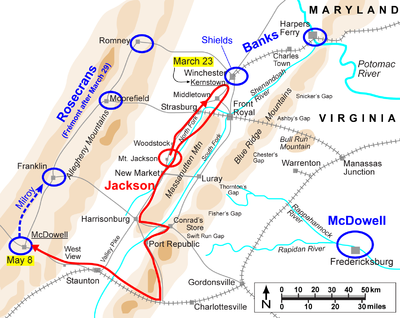
Banks reacted by crossing the Potomac in late February and moving south to protect the canal and railroad from Ashby. Jackson's command was operating as the left wing of Gen. Joseph E. Johnston
Joseph E. Johnston
Joseph Eggleston Johnston was a career U.S. Army officer, serving with distinction in the Mexican-American War and Seminole Wars, and was also one of the most senior general officers in the Confederate States Army during the American Civil War...
's army, and when Johnston moved from Manassas to Culpeper in March, Jackson's position at Winchester was isolated. On March 12, Banks continued his advance to the southwest ("up the Valley") and occupied Winchester. Jackson had withdrawn to Strasburg
Strasburg, Virginia
Strasburg is a town in Shenandoah County, Virginia, United States, which was founded in 1761 by Peter Stover. It is the largest town, population-wise, in the county and is known for its pottery, antiques, and Civil War history...
. Banks's orders, as part of McClellan's overall strategy, were to move farther south and drive Jackson from the Valley. After accomplishing this, he was to withdraw to a position nearer Washington. A strong advance force began the movement south from Winchester on March 17, about the same time that McClellan began his amphibious movement to the Virginia Peninsula.
Jackson's orders from Johnston were to avoid general combat because he was seriously outnumbered, but at the same time he was to keep Banks occupied enough to prevent the detachment of troops to reinforce McClellan on the Peninsula. Receiving incorrect intelligence, Banks concluded that Jackson had left the Valley, and he proceeded to move east, back to the vicinity of Washington. Jackson was dismayed at this movement because Banks was doing exactly what Jackson had been directed to prevent. When Ashby reported that only a few infantry regiments and some artillery of Banks's corps remained at Winchester, Jackson decided to attack the Union detachment in an attempt to force the remainder of Banks's corps to return. But Ashby's information was incorrect; actually, an entire Union division was still station in the town. At the First Battle of Kernstown (March 23, 1862), fought a few miles south of Winchester, the Federals stopped Jackson's advance and then counterattacked, turning his left flank
Flanking maneuver
In military tactics, a flanking maneuver, also called a flank attack, is an attack on the sides of an opposing force. If a flanking maneuver succeeds, the opposing force would be surrounded from two or more directions, which significantly reduces the maneuverability of the outflanked force and its...
and forcing him to retreat. Although a tactical defeat for Jackson, his only defeat during the campaign, it was a strategic victory for the Confederacy, forcing President Lincoln to keep Banks's forces in the Valley and McDowell's 30,000-man corps
Corps
A corps is either a large formation, or an administrative grouping of troops within an armed force with a common function such as Artillery or Signals representing an arm of service...
near Fredericksburg
Fredericksburg, Virginia
Fredericksburg is an independent city in the Commonwealth of Virginia located south of Washington, D.C., and north of Richmond. As of the 2010 census, the city had a population of 24,286...
, subtracting about 50,000 soldiers from McClellan's Peninsula invasion force.
The Union reorganized after Kernstown: McDowell's command became the Department of the Rappahannock, Banks's corps became the Department of the Shenandoah, while western Virginia (modern West Virginia) became the Mountain Department, commanded by Maj. Gen. John C. Frémont. All three commands, which reported directly to Washington, were ordered to remove Jackson's force as a threat to Washington. The Confederate authorities meanwhile detached Richard S. Ewell's division from Johnston's army and sent it to the Valley. Jackson, now reinforced to 17,000 men, decided to attack the Union forces individually rather than waiting for them to combine and overwhelm him, first concentrating on a column from the Mountain Department commanded by Robert Milroy. While marching on a devious route to mask his intentions, he was attacked by Milroy at the Battle of McDowell
Battle of McDowell
The Battle of McDowell, also known as Sitlington's Hill, was fought May 8, 1862, in Highland County, Virginia, as part of Confederate Army Maj. Gen. Thomas J. "Stonewall" Jackson's Campaign through the Shenandoah Valley during the American Civil War...
on May 8 but was able to repulse the Union army after severe fighting. Banks sent a division to reinforce Irvin McDowell's forces at Fredericksburg, leaving Banks only 8,000 troops, which he relocated to a strong position at Strasburg, Virginia
Strasburg, Virginia
Strasburg is a town in Shenandoah County, Virginia, United States, which was founded in 1761 by Peter Stover. It is the largest town, population-wise, in the county and is known for its pottery, antiques, and Civil War history...
.
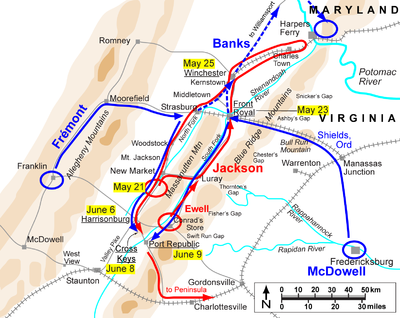
After Frémont's forces halted their advance into the Valley following McDowell, Jackson next turned to defeating Banks. On May 21, Jackson marched his command east from New Market and proceeded northward. Their speed of forced marching was typical of the campaign and earned his infantrymen the nickname of "Jackson's foot cavalry". He sent his horse cavalry directly north to make Banks think that he was going to attack Strasburg, but his plan was to defeat the small outpost at Front Royal and quickly attack Banks's line of communication at Harpers Ferry
Harpers Ferry, West Virginia
Harpers Ferry is a historic town in Jefferson County, West Virginia, United States. In many books the town is called "Harper's Ferry" with an apostrophe....
. On May 23, at the Battle of Front Royal
Battle of Front Royal
The Battle of Front Royal, also known as Guard Hill or Cedarville, was fought May 23, 1862, in Warren County, Virginia, as part of Confederate Army Maj. Gen. Thomas J. "Stonewall" Jackson's Campaign through the Shenandoah Valley during the American Civil War...
, Jackson's army surprised and overran the pickets of the 1,000-man Union garrison, capturing nearly 700 of the garrison while suffering fewer than forty casualties himself. Jackson's victory forced Banks from Strasburg into a rapid retreat towards Winchester. Although Jackson attempted to pursue, his troops were exhausted and looted Union supply trains, slowing them down immensely. On May 25, at the First Battle of Winchester
First Battle of Winchester
The First Battle of Winchester, fought on May 25, 1862, in and around Frederick County, Virginia, and Winchester, Virginia, was a major victory in Confederate Army Maj. Gen. Thomas J. "Stonewall" Jackson's Campaign through the Shenandoah Valley during the American Civil War. Jackson enveloped the...
, Banks's army was attacked by converging Confederate columns and was soundly defeated, losing over 1,300 casualties and much of his supplies (including 9,000 small arms, a half million rounds of ammunition, and several tons of supplies); they withdrew north across the Potomac River. Jackson attempted pursuit but was unsuccessful, due to looting by Ashby's cavalry and the exhaustion of his infantry; after a few days of rest, he followed Banks's forces as far as Harpers Ferry, where he skirmished with the Union garrison.
In Washington, President Lincoln and Secretary of War
United States Secretary of War
The Secretary of War was a member of the United States President's Cabinet, beginning with George Washington's administration. A similar position, called either "Secretary at War" or "Secretary of War," was appointed to serve the Congress of the Confederation under the Articles of Confederation...
Edwin M. Stanton
Edwin M. Stanton
Edwin McMasters Stanton was an American lawyer and politician who served as Secretary of War under the Lincoln Administration during the American Civil War from 1862–1865...
decided that the defeat of Jackson was an immediate priority (even though Jackson's orders were solely to keep Union forces occupied away from Richmond). They ordered Irvin McDowell to send 20,000 men to Front Royal and Frémont to move to Harrisonburg
Harrisonburg, Virginia
Harrisonburg is an independent city in the Shenandoah Valley region of Virginia in the United States. Its population as of 2010 is 48,914, and at the 2000 census, 40,468. Harrisonburg is the county seat of Rockingham County and the core city of the Harrisonburg, Virginia Metropolitan Statistical...
. If both forces could converge at Strasburg, Jackson's only escape route up the Valley would be cut. The immediate repercussion of this move was to abort McDowell's coordinated attack with McClellan on Richmond. Starting on May 29, while two columns of Union forces pursued him, Jackson started pushing his army in a forced march southward to escape the pincer movements, marching forty miles in thirty-six hours. His army took up defensive positions in Cross Keys
Battle of Cross Keys
The Battle of Cross Keys was fought on June 8, 1862, in Rockingham County, Virginia, as part of Confederate Army Maj. Gen. Thomas J. "Stonewall" Jackson's campaign through the Shenandoah Valley during the American Civil War...
and Port Republic
Battle of Port Republic
-References:* Cozzens, Peter. Shenandoah 1862: Stonewall Jackson's Valley Campaign. Chapel Hill: University of North Carolina Press, 2008. ISBN 978-0-8078-3200-4....
, where he was able to defeat Frémont and James Shields (from McDowell's command), respectively, on June 8 and June 9.
Following these engagements, Union forces were withdrawn from the Valley. Jackson joined Robert E. Lee on the Peninsula for the Seven Days Battles
Seven Days Battles
The Seven Days Battles was a series of six major battles over the seven days from June 25 to July 1, 1862, near Richmond, Virginia during the American Civil War. Confederate General Robert E. Lee drove the invading Union Army of the Potomac, commanded by Maj. Gen. George B. McClellan, away from...
(where he delivered an uncharacteristically lethargic performance, perhaps because of the strains of the Valley Campaign). He had accomplished his mission, withholding over 50,000 needed troops from McClellan. With the success of his Valley Campaign, Stonewall Jackson became the most celebrated soldier in the Confederacy (until he was eventually eclipsed by Lee) and lifted the morale of the public. In a classic military campaign of surprise and maneuver, he pressed his army to travel 646 miles (1,040 km) in 48 days of marching and won five significant victories with a force of about 17,000 against combined foes of 60,000.
Peninsula Campaign (1862)
George B. McClellanGeorge B. McClellan
George Brinton McClellan was a major general during the American Civil War. He organized the famous Army of the Potomac and served briefly as the general-in-chief of the Union Army. Early in the war, McClellan played an important role in raising a well-trained and organized army for the Union...
spent the winter of 1861–62 training his new Army of the Potomac and fighting off calls from President Lincoln to advance against the Confederates. Lincoln was particularly concerned about the army of General Joseph E. Johnston
Joseph E. Johnston
Joseph Eggleston Johnston was a career U.S. Army officer, serving with distinction in the Mexican-American War and Seminole Wars, and was also one of the most senior general officers in the Confederate States Army during the American Civil War...
at Centreville
Centreville, Virginia
Centreville is an unincorporated community in Fairfax County, Virginia, United States. Recognized by the U.S. Census Bureau as a Census Designated Place , the community population was 71,135 as of the 2010 census and is approximately west of Washington, DC.-Colonial Period:Beginning in the 1760s,...
, just 30 miles (50 km) from Washington. McClellan overestimated Johnston's strength and shifted his objective from that army to the Confederate capital of Richmond. He proposed to move by water to Urbanna
Urbanna, Virginia
Urbanna is a town in Middlesex County, Virginia, United States. Urbanna means “City of Anne” and was named in honor of England’s Queen Anne. The population was 543 at the 2000 census.-Geography:Urbanna is located at ....
on the Rappahannock River
Rappahannock River
The Rappahannock River is a river in eastern Virginia, in the United States, approximately in length. It traverses the entire northern part of the state, from the Blue Ridge Mountains in the west, across the Piedmont, to the Chesapeake Bay, south of the Potomac River.An important river in American...
and then overland to Richmond before Johnston could move to block him. Although Lincoln favored the overland approach because it would shield Washington from any attack while the operation was in progress, McClellan argued that the road conditions in Virginia were intolerable, that he had arranged adequate defenses for the capital, and that Johnston would certainly follow him if he moved on Richmond. This plan was discussed for three months in the capital until Lincoln approved McClellan's proposal in early March. By March 9, however, Johnston withdrew his army from Centreville to Culpeper
Culpeper, Virginia
Culpeper is an incorporated town in Culpeper County, Virginia, United States. The population was 9,664 at the 2000 census. It is the county seat of Culpeper County. Culpeper is part of the Culpeper Micropolitan Statistical Area, which includes all of Culpeper County. Both the Town of Culpeper and...
, making McClellan's Urbanna plan impracticable. McClellan then proposed to sail to Fort Monroe
Fort Monroe
Fort Monroe was a military installation in Hampton, Virginia—at Old Point Comfort, the southern tip of the Virginia Peninsula...
and then up the Virginia Peninsula
Virginia Peninsula
The Virginia Peninsula is a peninsula in southeast Virginia, USA, bounded by the York River, James River, Hampton Roads and Chesapeake Bay.Hampton Roads is the common name for the metropolitan area that surrounds the body of water of the same name...
(the narrow strip of land between the James
James River (Virginia)
The James River is a river in the U.S. state of Virginia. It is long, extending to if one includes the Jackson River, the longer of its two source tributaries. The James River drains a catchment comprising . The watershed includes about 4% open water and an area with a population of 2.5 million...
and York
York River (Virginia)
The York River is a navigable estuary, approximately long, in eastern Virginia in the United States. It ranges in width from at its head to near its mouth on the west side of Chesapeake Bay. Its watershed drains an area including portions of 17 counties of the coastal plain of Virginia north...
rivers) to Richmond. Lincoln reluctantly agreed.
Before departing for the Peninsula, McClellan moved the Army of the Potomac to Centreville on a "shakedown" march. He discovered there how weak Johnston's force and position had really been, and he faced mounting criticism. On March 11, Lincoln relieved McClellan of his position as general-in -chief of the Union armies so that he could devote his full attention to the difficult campaign ahead of him. Lincoln himself, with the assistance of Secretary of War Stanton and a War Board of officers, assumed command of the Union armies for the next four months. The Army of the Potomac began to embark for Fort Monroe on March 17. The departure was accompanied by a newfound sense of concern. The first combat of ironclad ships occurred on March 8 and March 9 as the CSS Virginia
CSS Virginia
CSS Virginia was the first steam-powered ironclad warship of the Confederate States Navy, built during the first year of the American Civil War; she was constructed as a casemate ironclad using the raised and cut down original lower hull and steam engines of the scuttled . Virginia was one of the...
and the USS Monitor
USS Monitor
USS Monitor was the first ironclad warship commissioned by the United States Navy during the American Civil War. She is most famous for her participation in the Battle of Hampton Roads on March 9, 1862, the first-ever battle fought between two ironclads...
fought the inconclusive Battle of Hampton Roads
Battle of Hampton Roads
The Battle of Hampton Roads, often referred to as either the Battle of the Monitor and Merrimack or the Battle of Ironclads, was the most noted and arguably most important naval battle of the American Civil War from the standpoint of the development of navies...
. The concern for the Army was that their transport ships would be attacked by this new weapon directly in their path. And the U.S. Navy failed to assure McClellan that they could protect operations on either the James or the York, so his idea of amphibiously enveloping Yorktown
Yorktown, Virginia
Yorktown is a census-designated place in York County, Virginia, United States. The population was 220 in the 2000 census. It is the county seat of York County, one of the eight original shires formed in colonial Virginia in 1634....
was abandoned, and he ordered an advance up the Peninsula to begin April 4. On April 5, McClellan was informed that Lincoln had canceled the movement of Maj. Gen. Irvin McDowell
Irvin McDowell
Irvin McDowell was a career American army officer. He is best known for his defeat in the First Battle of Bull Run, the first large-scale battle of the American Civil War.-Early life:...
's corps to Fort Monroe, taking this action because McClellan had failed to leave the number of troops previously agreed upon at Washington, and because Jackson's Valley Campaign was causing concern. McClellan protested vociferously that he was being forced to lead a major campaign without his promised resources, but he moved ahead anyway.
Up the Peninsula
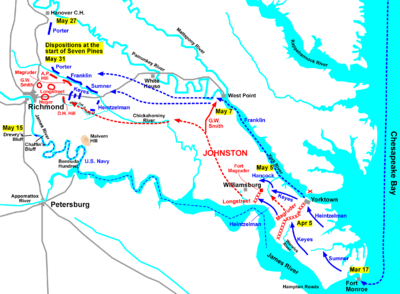
Hampton Roads
Hampton Roads is the name for both a body of water and the Norfolk–Virginia Beach metropolitan area which surrounds it in southeastern Virginia, United States...
and occupied Norfolk
Norfolk, Virginia
Norfolk is an independent city in the Commonwealth of Virginia in the United States. With a population of 242,803 as of the 2010 Census, it is Virginia's second-largest city behind neighboring Virginia Beach....
. As the Union forces chased withdrawing Confederate forces up the Peninsula (northwest) in the direction of Richmond, the inconclusive single-day Battle of Williamsburg
Battle of Williamsburg
The Battle of Williamsburg, also known as the Battle of Fort Magruder, took place on May 5, 1862, in York County, James City County, and Williamsburg, Virginia, as part of the Peninsula Campaign of the American Civil War...
took place at and around Fort Magruder
Fort Magruder
Fort Magruder was an high earthen fortification straddling the road between Yorktown and Williamsburg, Virginia, just outside the latter city during the American Civil War...
, one mile (1.5 km) east of the old colonial capital.
By the end of May, the Union forces had successfully advanced to within several miles of Richmond, but progress was slow. McClellan had planned for massive siege operations and brought immense stores of equipment and siege mortars but poor weather and inadequate roads kept his advance to a crawl. And McClellan was by nature a cautious general; he was nervous about attacking a force he believed was twice his in size. In fact, his imagination and his intelligence operations failed him; the proportions were roughly the reverse. During Johnston's slow retreat up the Peninsula, his forces practiced deceptive operations. In particular, the division under John B. Magruder
John B. Magruder
John Bankhead Magruder was a career military officer who served in the armies of three nations. He was a U.S. Army officer in the Mexican-American War, a Confederate general during the American Civil War, and a postbellum general in the Imperial Mexican Army...
, who was an amateur actor before the war, was able to fool McClellan by ostentatiously marching small numbers of troops past the same position multiple times, appearing to be a larger force.
As the Union Army drew towards the outer defenses of Richmond, it became divided by the Chickahominy River
Chickahominy River
The Chickahominy is an river in the eastern portion of the U.S. state of Virginia. The river rises about northwest of Richmond and flows southeast and south to the James River...
, weakening its ability to move troops back and forth along the front. McClellan kept most of his army north of the river, expecting McDowell to march from northern Virginia; only two Union corps (IV and III) were south of the river. Pressured by Confederate President Jefferson Davis and his military advisor Robert E. Lee, Johnston decided to attack the smaller Union force south of the river, hoping that the flooded Chickahominy, swollen from recent heavy rains, would prevent McClellan from moving to the southern bank. The Battle of Seven Pines
Battle of Seven Pines
The Battle of Seven Pines, also known as the Battle of Fair Oaks or Fair Oaks Station, took place on May 31 and June 1, 1862, in Henrico County, Virginia, as part of the Peninsula Campaign of the American Civil War. It was the culmination of an offensive up the Virginia Peninsula by Union Maj. Gen....
(also known as the Battle of Fair Oaks), fought on May 31 – June 1, 1862, failed to follow Johnston's plan, due to faulty maps, uncoordinated Confederate attacks, and Union reinforcements, which were able to cross the river despite the flooding. The battle was tactically inconclusive, but there were two strategic effects. First, Johnston was wounded during the battle and was replaced by the more aggressive General Robert E. Lee, who would lead this Army of Northern Virginia
Army of Northern Virginia
The Army of Northern Virginia was the primary military force of the Confederate States of America in the Eastern Theater of the American Civil War, as well as the primary command structure of the Department of Northern Virginia. It was most often arrayed against the Union Army of the Potomac...
to many victories in the war. Second, General McClellan chose to abandon his offensive operations to lay siege and await reinforcements he had requested from President Lincoln; as a consequence, he never regained his strategic momentum.
Lee used the month-long pause in McClellan's advance to fortify the defenses of Richmond and extended the works south of the James River to a point below Petersburg
Petersburg, Virginia
Petersburg is an independent city in Virginia, United States located on the Appomattox River and south of the state capital city of Richmond. The city's population was 32,420 as of 2010, predominantly of African-American ethnicity...
; the total length of the new defensive line was about 30 miles (50 km). To buy time to complete the new defensive line and prepare for an offensive, Lee repeated the tactic of making a small number of troops seem more numerous than they really were. Lee also sent Brig. Gen. J.E.B. Stuart
J.E.B. Stuart
James Ewell Brown "Jeb" Stuart was a U.S. Army officer from Virginia and a Confederate States Army general during the American Civil War. He was known to his friends as "Jeb", from the initials of his given names. Stuart was a cavalry commander known for his mastery of reconnaissance and the use...
's cavalry brigade completely around the Union army (June 13–15) in order to ascertain if the Union right flank was in the air. In addition, Lee ordered Jackson to bring his force to the Peninsula as reinforcements. Meanwhile, McClellan shifted most of his forces south of the Chickahominy, leaving only Maj. Gen. Fitz John Porter
Fitz John Porter
Fitz John Porter was a career United States Army officer and a Union General during the American Civil War...
's V Corps north of the river.
Seven Days
Lee then moved onto the offensive, conducting a series of battles that lasted seven days (June 25 – July 1) and pushed McClellan back to a safe but nonthreatening position on the James River. McClellan actually struck first on June 25 at the Battle of Oak Grove
Battle of Oak Grove
The Battle of Oak Grove, also known as the Battle of French's Field or King's School House, took place on June 25, 1862, in Henrico County, Virginia, the first of the Seven Days Battles of the American Civil War. Maj. Gen. George B. McClellan advanced his lines with the objective of bringing...
, during which two Union divisions attempted to seize ground on which McClellan planned to build siege batteries. McClellan planned to attack again the next day but was distracted by the Confederate attack at Mechanicsville
Battle of Beaver Dam Creek
The Battle of Beaver Dam Creek, also known as the Battle of Mechanicsville or Ellerson's Mill, took place on June 26, 1862, in Hanover County, Virginia, as the first major engagement of the Seven Days Battles during the Peninsula Campaign of the American Civil War. It was the start of Confederate...
or Beaver Dam Creek, on June 26. Lee observed that McClellan had positioned his army straddling the Chickahominy River and could be defeated in detail. He planned for the division of A.P. Hill to demonstrate in Porter's front while Jackson marched behind the Union positions and attacked from the rear. However, Jackson was late in arriving to his assigned position, while Hill started his attack without waiting for Jackson and was repulsed with heavy casualties. Despite being a Union tactical victory, McClellan still ordered Porter to retreat south towards the rest of the Union army, fearing that Porter would be surrounded by vastly superior Confederate forces by morning. Porter set up defensive lines near Gaines's Mill, covering the bridges over the Chickahominy.
Lee continued his offensive at the Battle of Gaines's Mill, June 27, launching the largest Confederate attack of the war against Porter's line. (It occurred in almost the same location as the 1864 Battle of Cold Harbor
Battle of Cold Harbor
The Battle of Cold Harbor was fought from May 31 to June 12, 1864 . It was one of the final battles of Union Lt. Gen. Ulysses S. Grant's Overland Campaign during the American Civil War, and is remembered as one of American history's bloodiest, most lopsided battles...
and had similar numbers of casualties.) The attack was poorly coordinated, and the Union lines held for most of the day, but Lee eventually broke through and McClellan withdrew again, heading for a secure base at Harrison's Landing on the James River.
The next two days saw minor battles at Garnett's and Golding's Farm
Battle of Garnett's & Golding's Farm
The Battle of Garnett's and Golding's Farms took place June 27–28, 1862, in Henrico County, Virginia, as part of the Seven Days Battles of the American Civil War. While battle raged north of the Chickahominy River at Gaines's Mill on June 27, Confederate Brig. Gen. John B...
and Savage's Station
Battle of Savage's Station
The Battle of Savage's Station took place on June 29, 1862, in Henrico County, Virginia, as fourth of the Seven Days Battles of the American Civil War. The main body of the Union Army of the Potomac began a general withdrawal toward the James River. Confederate Brig. Gen. John B. Magruder pursued...
, as McClellan continued his withdraw and Lee attempted to cut off the Union retreat. The Battle of Glendale
Battle of Glendale
The Battle of Glendale, also known as the Battle of Frayser's Farm, Frazier's Farm, Nelson's Farm, Charles City Crossroads, New Market Road, or Riddell's Shop, took place on June 30, 1862, in Henrico County, Virginia, on the sixth day of the Seven Days Battles of the American Civil War.The...
on June 30 was a bloody battle in which three Confederate divisions converged on the retreating Union forces in the White Oak Swamp
Battle of White Oak Swamp
The Battle of White Oak Swamp took place on June 30, 1862 in Henrico County, Virginia as part of the Seven Days Battles of the American Civil War. As the Union Army of the Potomac retreated southeast toward the James River, its rearguard under Maj. Gen. William B. Franklin stopped Maj. Gen. Thomas J...
, near Frayser's Farm, another name for the battle. Because of a lackluster performance by Stonewall Jackson, Lee's army failed in its last attempt to cut off the Union army before it reached the James.
The final battle of the Seven Days, July 1, consisted of uncoordinated Confederate assaults against the Union defenses—buttressed by artillery placements and the naval guns of the Union James River squadron—on Malvern Hill
Battle of Malvern Hill
The Battle of Malvern Hill, also known as the Battle of Poindexter's Farm, took place on July 1, 1862, in Henrico County, Virginia, on the seventh and last day of the Seven Days Battles of the American Civil War. Gen. Robert E. Lee launched a series of disjointed assaults on the nearly impregnable...
. McClellan was absent from the battlefield, instead remaining on the gunboat Galena; the Union corps commanders cooperated in selecting the positions for their troops but none of them exercised overall field command. Lee's army suffered over 5,600 casualties in this effort, compared to only 3,000 Union casualties. Although the Union corps commanders felt that they could hold the field against further Confederate attacks, McClellan ordered the army to retreat back to Harrison's Landing.
Malvern Hill signaled the end of both the Seven Days Battles and the Peninsula Campaign. The Army of the Potomac withdrew to the safety of the James River, protected by fire from Union gunboats, and stayed there until August, when they were withdrawn by order of President Lincoln in the run-up to the Second Battle of Bull Run
Second Battle of Bull Run
The Second Battle of Bull Run or Second Manassas was fought August 28–30, 1862, as part of the American Civil War. It was the culmination of an offensive campaign waged by Confederate Gen. Robert E. Lee's Army of Northern Virginia against Union Maj. Gen...
. Although McClellan retained command of the Army of the Potomac, Lincoln showed his displeasure by appointing Maj. Gen. Henry W. Halleck to McClellan's previous position as general-in-chief of all the Union armies on July 11, 1862.
The cost to both sides was high. Lee's Army of Northern Virginia suffered almost 20,000 casualties out of a total of over 90,000 soldiers during the Seven Days, McClellan almost 16,000 out of 105,445. After a successful start on the Peninsula that foretold an early end to the war, Northern morale was crushed by McClellan's retreat. Despite heavy casualties and Lee's clumsy tactical performance, Confederate morale skyrocketed, and Lee was emboldened to continue his aggressive strategy through Northern Virginia and Maryland Campaigns.
Northern Virginia and Maryland (1862)
Following his success against McClellan on the Peninsula, Lee initiated two campaigns that can be considered one almost continuous offensive operation: defeating the second army that threatened Richmond and then continuing north on an invasion of Maryland.Army of Virginia

John Pope (military officer)
John Pope was a career United States Army officer and Union general in the American Civil War. He had a brief but successful career in the Western Theater, but he is best known for his defeat at the Second Battle of Bull Run in the East.Pope was a graduate of the United States Military Academy in...
to command the newly formed Army of Virginia
Army of Virginia
The Army of Virginia was organized as a major unit of the Union Army and operated briefly and unsuccessfully in 1862 in the American Civil War. It should not be confused with its principal opponent, the Confederate Army of Northern Virginia, commanded by Robert E...
. Pope had achieved some success in the Western Theater, and Lincoln sought a more aggressive general than McClellan. The Army of Virginia consisted of over 50,000 men in three corps. Three corps of McClellan's Army of the Potomac later were added for combat operations. Two cavalry brigades were attached directly to two of the infantry corps, which presented a lack of centralized control that had negative effects in the campaign. Pope's mission was to fulfill two objectives: protect Washington and the Shenandoah Valley
Shenandoah Valley
The Shenandoah Valley is both a geographic valley and cultural region of western Virginia and West Virginia in the United States. The valley is bounded to the east by the Blue Ridge Mountains, to the west by the eastern front of the Ridge-and-Valley Appalachians , to the north by the Potomac River...
, and draw Confederate forces away from McClellan by moving in the direction of Gordonsville
Gordonsville, Virginia
Gordonsville is a town in Louisa and Orange counties in the U.S. state of Virginia. The population was 1,496 at the 2010 census.-History:Nathaniel Gordon purchased in 1787 and in 1794, or possibly earlier, applied for and was granted a license to operate a tavern...
. Pope started on the latter by dispatching cavalry to break the railroad connecting Gordonsville, Charlottesville
Charlottesville, Virginia
Charlottesville is an independent city geographically surrounded by but separate from Albemarle County in the Commonwealth of Virginia, United States, and named after Charlotte of Mecklenburg-Strelitz, the queen consort of King George III of the United Kingdom.The official population estimate for...
, and Lynchburg
Lynchburg, Virginia
Lynchburg is an independent city in the Commonwealth of Virginia. The population was 75,568 as of 2010. Located in the foothills of the Blue Ridge Mountains along the banks of the James River, Lynchburg is known as the "City of Seven Hills" or "The Hill City." Lynchburg was the only major city in...
. The cavalry got off to a slow start and found that Stonewall Jackson had occupied Gordonsville with over 14,000 men.
Lee perceived that McClellan was no longer a threat to him on the Peninsula, so he felt no compulsion to keep all of his forces in direct defense of Richmond. This allowed him to relocate Jackson to Gordonsville to block Pope and protect the railroad. Lee had larger plans in mind. Since the Union Army was split between McClellan and Pope and they were widely separated, Lee saw an opening to destroy Pope before returning his attention to McClellan. Believing that Ambrose Burnside
Ambrose Burnside
Ambrose Everett Burnside was an American soldier, railroad executive, inventor, industrialist, and politician from Rhode Island, serving as governor and a U.S. Senator...
's troops from North Carolina were being shipped to reinforce Pope, and wanting to take immediate action before those troops were in position, Lee committed Maj. Gen. A.P. Hill to join Jackson with 12,000 men, while distracting McClellan to keep him immobilized.
On July 29, Pope moved some of his forces to a position near Cedar Mountain, from whence he could launch raids on Gordonsville. Jackson advanced to Culpeper
Culpeper, Virginia
Culpeper is an incorporated town in Culpeper County, Virginia, United States. The population was 9,664 at the 2000 census. It is the county seat of Culpeper County. Culpeper is part of the Culpeper Micropolitan Statistical Area, which includes all of Culpeper County. Both the Town of Culpeper and...
on August 7, hoping to attack one of Pope's corps before the rest of the army could be concentrated. On August 9, Nathaniel Banks's corps attacked Jackson at Cedar Mountain
Battle of Cedar Mountain
The Battle of Cedar Mountain, also known as Slaughter's Mountain or Cedar Run, took place on August 9, 1862, in Culpeper County, Virginia, as part of the American Civil War. Union forces under Maj. Gen. Nathaniel P. Banks attacked Confederate forces under Maj. Gen. Thomas J...
, gaining an early advantage. A Confederate counterattack led by A.P. Hill drove Banks back across Cedar Creek. By now Jackson had learned that Pope's corps were all together, foiling his plan of defeating each in separate actions. He remained in position until August 12, when he withdrew to Gordonsville.
On August 13, Lee sent Maj. Gen. James Longstreet
James Longstreet
James Longstreet was one of the foremost Confederate generals of the American Civil War and the principal subordinate to General Robert E. Lee, who called him his "Old War Horse." He served under Lee as a corps commander for many of the famous battles fought by the Army of Northern Virginia in the...
to reinforce Jackson and on the following day sent all of his remaining forces except for two brigades, after he was certain that McClellan was leaving the Peninsula. Lee himself arrived at Gordonsville to take command on August 15. His plan was to defeat Pope before McClellan's army could arrive to reinforce it by cutting bridges in Pope's rear and then attacking his left flank and rear. Pope spoiled Lee's plans by withdrawing to the line of the Rappahannock River
Rappahannock River
The Rappahannock River is a river in eastern Virginia, in the United States, approximately in length. It traverses the entire northern part of the state, from the Blue Ridge Mountains in the west, across the Piedmont, to the Chesapeake Bay, south of the Potomac River.An important river in American...
; he was aware of Lee's plan because a Union cavalry raid captured a copy of the written order.
A series of skirmishes between August 22 and August 25 kept the attention of Pope's army along the river. By August 25, three corps from the Army of the Potomac had arrived from the Peninsula to reinforce Pope. Lee's new plan in the face of all these additional forces outnumbering him was to send Jackson and Stuart with half of the army on a flanking march to cut Pope's line of communication, the Orange & Alexandria Railroad. Pope would be forced to retreat and could be defeated while moving and vulnerable.
On the evening of August 26, after passing around Pope's right flank, Jackson's wing of the army struck the railroad at Bristoe Station and before daybreak August 27 marched to capture and destroy the massive Union supply depot at Manassas Junction. This surprise movement forced Pope to leave his defensive line along the Rappahannock and move toward Manassas Junction in the hopes of crushing Jackson's wing before the rest of Lee's army could reunite with it. During the night of August 27–28, Jackson marched his divisions north to the First Bull Run (Manassas) battlefield, where he took position behind an unfinished railroad grade. Longstreet's wing of the army marched through the Thoroughfare Gap to join Jackson, uniting the two wings of Lee's army.
Second Bull Run
In order to draw Pope's army into battle, Jackson ordered an attack on a Federal column that was passing across his front on August 28, beginning the Second Battle of Bull RunSecond Battle of Bull Run
The Second Battle of Bull Run or Second Manassas was fought August 28–30, 1862, as part of the American Civil War. It was the culmination of an offensive campaign waged by Confederate Gen. Robert E. Lee's Army of Northern Virginia against Union Maj. Gen...
, the decisive battle of the Northern Virginia Campaign. The fighting lasted several hours and resulted in a stalemate. Pope became convinced that he had trapped Jackson and concentrated the bulk of his army against him. On August 29, Pope launched a series of assaults against Jackson's position along the unfinished railroad grade. The attacks were repulsed with heavy casualties on both sides. At noon, Longstreet arrived on the field and took position on Jackson's right flank. On August 30, Pope renewed his attacks, seemingly unaware that Longstreet was on the field. When massed Confederate artillery devastated a Union assault, Longstreet's wing of 28,000 men counterattacked in the largest simultaneous mass assault of the war. The Union left flank was crushed and the army driven back to Bull Run. Only an effective Union rearguard action prevented a replay of the First Bull Run disaster. Pope's retreat to Centreville
Centreville, Virginia
Centreville is an unincorporated community in Fairfax County, Virginia, United States. Recognized by the U.S. Census Bureau as a Census Designated Place , the community population was 71,135 as of the 2010 census and is approximately west of Washington, DC.-Colonial Period:Beginning in the 1760s,...
was precipitous, nonetheless. The next day, Lee ordered his army in pursuit.
Making a wide flanking march, Jackson hoped to cut off the Union retreat. On September 1, Jackson sent his divisions against two Union divisions in the Battle of Chantilly
Battle of Chantilly
The Battle of Chantilly took place on September 1, 1862, in Fairfax County, Virginia, as the concluding battle of the Northern Virginia Campaign of the American Civil War. Thomas J...
. Confederate attacks were stopped by fierce fighting during a severe thunderstorm; both Union division commanders, Isaac Stevens
Isaac Stevens
Isaac Ingalls Stevens was the first governor of Washington Territory, a United States Congressman, and a brigadier general in the Union Army during the American Civil War until his death at the Battle of Chantilly...
and Philip Kearny
Philip Kearny
Philip Kearny, Jr., was a United States Army officer, notable for his leadership in the Mexican-American War and American Civil War. He was killed in action in the 1862 Battle of Chantilly.-Early life and career:...
, were killed during the fighting. Recognizing that his army was still in danger, Pope ordered the retreat to continue to Washington.
Invasion of Maryland
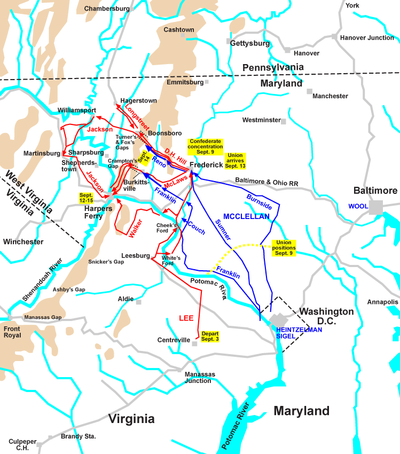
The Army of Northern Virginia crossed the Potomac River
Potomac River
The Potomac River flows into the Chesapeake Bay, located along the mid-Atlantic coast of the United States. The river is approximately long, with a drainage area of about 14,700 square miles...
and reached Frederick, Maryland
Frederick, Maryland
Frederick is a city in north-central Maryland. It is the county seat of Frederick County, the largest county by area in the state of Maryland. Frederick is an outlying community of the Washington-Arlington-Alexandria, DC-VA-MD-WV Metropolitan Statistical Area, which is part of a greater...
, on September 6. Lee's specific goals were thought to be an advance towards Harrisburg, Pennsylvania
Harrisburg, Pennsylvania
Harrisburg is the capital of Pennsylvania. As of the 2010 census, the city had a population of 49,528, making it the ninth largest city in Pennsylvania...
, cutting the east-west railroad links to the Northeast, followed by operations against one of the major eastern cities, such as Philadelphia. News of the invasion caused panic in the North, and Lincoln was forced to take quick action. George B. McClellan had been in military limbo since returning from the Peninsula, but Lincoln restored him to command of all forces around Washington and ordered him to deal with Lee.
Lee divided his army. Longstreet was sent to Hagerstown
Hagerstown, Maryland
Hagerstown is a city in northwestern Maryland, United States. It is the county seat of Washington County, and, by many definitions, the largest city in a region known as Western Maryland. The population of Hagerstown city proper at the 2010 census was 39,662, and the population of the...
, while Jackson was ordered to seize the Union arsenal at Harpers Ferry, which commanded Lee's supply lines through the Shenandoah Valley; it was also a tempting target, virtually indefensible. McClellan requested permission from Washington to evacuate Harpers Ferry and attach its garrison to his army, but his request was refused. In the Battle of Harpers Ferry
Battle of Harpers Ferry
The Battle of Harpers Ferry was fought September 12–15, 1862, as part of the Maryland Campaign of the American Civil War. As Gen. Robert E. Lee's Confederate army invaded Maryland, a portion of his army under Maj. Gen. Thomas J...
, Jackson placed artillery on the heights overlooking the town, forcing the surrender of the garrison of more than 12,000 men on September 15. Jackson led most of his soldiers to join the rest of Lee's army, leaving A.P. Hill's division to complete the occupation of the town.
McClellan moved out of Washington with his 87,000-man army in a slow pursuit, reaching Frederick on September 13. There, two Union soldiers discovered a mislaid copy of the detailed campaign plan
Campaign plan
Campaign plan is a plan to achieve an objective, usually of a large-scale over an extended period of time. It usually coordinates many activities and uses of resources involving multiple organizations. A campaign plan could also have subordinate objectives or intermediate milestones and is often...
s of Lee's army—General Order Number 191—wrapped around three cigars. The order indicated that Lee had divided his army and dispersed portions geographically, thus making each subject to isolation and defeat in detail. McClellan waited 18 hours before deciding to take advantage of this intelligence, a delay that almost squandered his opportunity. That night, the Army of the Potomac moved toward South Mountain
South Mountain (Maryland and Pennsylvania)
South Mountain is the northern extension of the Blue Ridge Mountain range in Maryland and Pennsylvania. From the Potomac River near Knoxville, Maryland in the south, to Dillsburg, Pennsylvania in the north, the long range separates the Hagerstown and Cumberland valleys from the Piedmont regions of...
where elements of the Army of Northern Virginia waited in defense of the mountain passes. At the Battle of South Mountain
Battle of South Mountain
The Battle of South Mountain was fought September 14, 1862, as part of the Maryland Campaign of the American Civil War. Three pitched battles were fought for possession of three South Mountain passes: Crampton's, Turner's, and Fox's Gaps. Maj. Gen. George B...
on September 14, the Confederate defenders were driven back by the numerically superior Union forces, and McClellan was in a position to destroy Lee's army before it could concentrate.
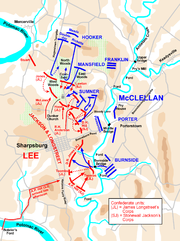
Sharpsburg, Maryland
Sharpsburg is a town in Washington County, Maryland, United States, approximately south of Hagerstown. The population was 691 at the 2000 census....
.
Antietam
On September 16, McClellan confronted Lee near Sharpsburg, defending a line to the west of Antietam Creek. At dawn on September 17, the Battle of AntietamBattle of Antietam
The Battle of Antietam , fought on September 17, 1862, near Sharpsburg, Maryland, and Antietam Creek, as part of the Maryland Campaign, was the first major battle in the American Civil War to take place on Northern soil. It was the bloodiest single-day battle in American history, with about 23,000...
began, with Maj. Gen. Joseph Hooker
Joseph Hooker
Joseph Hooker was a career United States Army officer, achieving the rank of major general in the Union Army during the American Civil War. Although he served throughout the war, usually with distinction, Hooker is best remembered for his stunning defeat by Confederate General Robert E...
's corps mounting a powerful assault on Lee's left flank. Attacks and counterattacks swept across the Miller Cornfield and the woods near the Dunker Church. Union assaults against the Sunken Road ("Bloody Lane") eventually pierced the Confederate center, but the Federal advantage was not pressed. In each case, Confederate reinforcements from the right flank prevented a complete Union breakthrough and McClellan refused to release his reserves to complete the breakthrough.
In the afternoon, Burnside's corps crossed a stone bridge over Antietam Creek and rolled up the Confederate right. At a crucial moment, A.P. Hill's division arrived from Harpers Ferry and counterattacked, driving back Burnside's men and saving Lee's army from destruction. Although outnumbered two to one, Lee committed his entire force, while McClellan sent in less than three quarters of his army. This enabled Lee to shift brigades and concentrate on each individual Union assault. At over 23,000 casualties, it remains the bloodiest single day in American history. Lee ordered the battered Army of Northern Virginia to withdraw across the Potomac into the Shenandoah Valley
Shenandoah Valley
The Shenandoah Valley is both a geographic valley and cultural region of western Virginia and West Virginia in the United States. The valley is bounded to the east by the Blue Ridge Mountains, to the west by the eastern front of the Ridge-and-Valley Appalachians , to the north by the Potomac River...
. Despite being tactically inconclusive, the battle of Antietam is considered a strategic victory for the Union. Lee's strategic initiative to invade Maryland was defeated. But more importantly, President Lincoln used this opportunity to announce his Emancipation Proclamation
Emancipation Proclamation
The Emancipation Proclamation is an executive order issued by United States President Abraham Lincoln on January 1, 1863, during the American Civil War using his war powers. It proclaimed the freedom of 3.1 million of the nation's 4 million slaves, and immediately freed 50,000 of them, with nearly...
, after which the prospect of European powers intervening in the war on behalf of the Confederacy was significantly diminished.
Fredericksburg and Chancellorsville (1862–63)
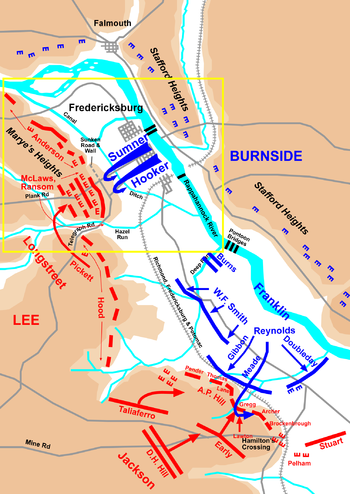
Despite the defeat and the dismay felt in Washington, Burnside was not yet relieved from command. He planned to resume his offensive north of Fredericksburg, but it went amiss in January 1863 in the humiliating Mud March
Mud March (American Civil War)
The Mud March was an abortive attempt at a winter offensive in January 1863 by Union Army Maj. Gen. Ambrose Burnside in the American Civil War....
. Following this, a cabal of his subordinate generals made it clear to the government that Burnside was incapable of leading the army. One of those conspirators was Maj. Gen. Joseph Hooker
Joseph Hooker
Joseph Hooker was a career United States Army officer, achieving the rank of major general in the Union Army during the American Civil War. Although he served throughout the war, usually with distinction, Hooker is best remembered for his stunning defeat by Confederate General Robert E...
, who was appointed to command the Army of the Potomac on January 26, 1863. Hooker, who had an excellent record as a corps commander in previous campaigns, spent the remainder of the winter reorganizing and resupplying his army, paying special attention to health and morale issues. And being known for his aggressive nature, he planned a complex spring campaign against Robert E. Lee.
Both armies remained in their positions before Fredericksburg. Hooker planned to send his cavalry, under Maj. Gen. George Stoneman
George Stoneman
George Stoneman, Jr. was a career United States Army officer, a Union cavalry general in the American Civil War, and the 15th Governor of California between 1883 and 1887.-Early life:...
, deep into the Confederate rear to disrupt supply lines. While one corps remained to fix Lee's attention at Fredericksburg, the others were to slip away and make a stealthy flanking march that would put the bulk of Hooker's army behind Lee, catching him in a vise. Lee, who had dispatched a corps of his army under Lt. Gen. James Longstreet
James Longstreet
James Longstreet was one of the foremost Confederate generals of the American Civil War and the principal subordinate to General Robert E. Lee, who called him his "Old War Horse." He served under Lee as a corps commander for many of the famous battles fought by the Army of Northern Virginia in the...
to forage in southern Virginia, was outnumbered 57,000 to 97,000.
The plan began executing well, and the bulk of the Army of the Potomac crossed the Rapidan River
Rapidan River
The Rapidan River, flowing through north-central Virginia in the United States, is the largest tributary of the Rappahannock River. The two rivers converge just west of the city of Fredericksburg...
and was in position on May 1. However, after minor initial contact with the enemy, Hooker began to lose his confidence, and rather than striking the Army of Northern Virginia in its rear as planned, he withdrew to a defensive perimeter around Chancellorsville. On May 2, Robert E. Lee executed one of the boldest maneuvers of the war. Having already split his army to address both wings of Hooker's attack, he split again, sending 20,000 men under Stonewall Jackson on a lengthy flanking march to attack Hooker's unprotected right flank. Achieving almost complete surprise, Jackson's corps routed the Union XI Corps, commanded by Maj. Gen. Oliver O. Howard
Oliver O. Howard
Oliver Otis Howard was a career United States Army officer and a Union general in the American Civil War...
. Following this success Jackson was mortally wounded by friendly fire
Friendly fire
Friendly fire is inadvertent firing towards one's own or otherwise friendly forces while attempting to engage enemy forces, particularly where this results in injury or death. A death resulting from a negligent discharge is not considered friendly fire...
while scouting in front of his army.
While Lee pounded the Chancellorsville defense line with repeated, costly assaults on May 3, the Union VI Corps, under Maj. Gen. John Sedgwick
John Sedgwick
John Sedgwick was a teacher, a career military officer, and a Union Army general in the American Civil War. He was the highest ranking Union casualty in the Civil War, killed by a sniper at the Battle of Spotsylvania Court House.-Early life:Sedgwick was born in the Litchfield Hills town of...
, finally achieved what Ambrose Burnside could not, by successfully assaulting the reduced forces on Marye's Heights in Fredericksburg. The corps began moving westward, once again threatening Lee's rear. Lee was able to deal with both wings of the Army of the Potomac, keeping the stunned Hooker in a defensive posture and dispatching a division to deal with Sedgwick's tentative approach. By May 7, Hooker withdrew all of his forces north of the Rappahannock. It was an expensive victory for Lee, who lost 13,000 men, or 25% of his army; Hooker lost 17,000, but had a lower casualty rate than Lee had incurred.
Gettysburg and fall maneuvering (1863)
In June 1863, Robert E. Lee decided to capitalize on his victory at Chancellorsville by repeating his strategy of 1862 and once again invading the North. He did this to resupply his army, give the farmers of Virginia a respite from war, and threaten the morale of Northern civilians, possibly by seizing an important northern city, such as Harrisburg, Pennsylvania, or Baltimore, Maryland. The Confederate government agreed to this strategy only reluctantly because Jefferson Davis was concerned about the fate of Vicksburg, MississippiVicksburg, Mississippi
Vicksburg is a city in Warren County, Mississippi, United States. It is the only city in Warren County. It is located northwest of New Orleans on the Mississippi and Yazoo rivers, and due west of Jackson, the state capital. In 1900, 14,834 people lived in Vicksburg; in 1910, 20,814; in 1920,...
, the river fortress being threatened by Ulysses S. Grant's Vicksburg campaign
Vicksburg Campaign
The Vicksburg Campaign was a series of maneuvers and battles in the Western Theater of the American Civil War directed against Vicksburg, Mississippi, a fortress city that dominated the last Confederate-controlled section of the Mississippi River. The Union Army of the Tennessee under Maj. Gen....
. Following the death of Jackson, Lee organized the Army of Northern Virginia into three corps, led by Lt. Gens. James Longstreet, Richard S. Ewell
Richard S. Ewell
Richard Stoddert Ewell was a career United States Army officer and a Confederate general during the American Civil War. He achieved fame as a senior commander under Stonewall Jackson and Robert E...
, and A.P. Hill.
Lee began moving his army northwest from Fredericksburg into the Shenandoah Valley, where the Blue Ridge Mountains
Blue Ridge Mountains
The Blue Ridge Mountains are a physiographic province of the larger Appalachian Mountains range. This province consists of northern and southern physiographic regions, which divide near the Roanoke River gap. The mountain range is located in the eastern United States, starting at its southern-most...
screened their northward movements. Joseph Hooker, still in command of the Army of the Potomac, sent cavalry forces to find Lee. On June 9, the clash at Brandy Station
Battle of Brandy Station
The Battle of Brandy Station, also called the Battle of Fleetwood Hill, was the largest predominantly cavalry engagement of the American Civil War, as well as the largest to take place ever on American soil. It was fought at the beginning of the Gettysburg Campaign by the Union cavalry under Maj....
was the largest predominantly cavalry battle of the war but ended inconclusively. Hooker started his entire army in pursuit; over the next few weeks, Hooker would argue with both Lincoln and Halleck over the role of the garrison at Harpers Ferry. On June 28, President Lincoln lost patience with him and relieved him of command, replacing him with V Corps commander, Maj. Gen. George G. Meade. After reviewing the positions of the army's corps with Hooker, Meade ordered the army to advance into southern Pennsylvania in a wide front, with the intention to protect Washington and Baltimore and to find Lee's army; he also drew up plans to defend a line behind Pipe Creek
Double Pipe Creek
Double Pipe Creek is a major tributary of the Monocacy River in Carroll County and Frederick County in Maryland, located several miles north and west of Westminster...
in northern Maryland in case he could not find suitable ground in Pennsylvania to fight a battle to his advantage.
Lee was surprised to find that the Federal army was moving as quickly as it was. As they crossed the Potomac and entered Frederick, Maryland, the Confederates were spread out over a considerable distance in Pennsylvania, with Richard Ewell across the Susquehanna River
Susquehanna River
The Susquehanna River is a river located in the northeastern United States. At long, it is the longest river on the American east coast that drains into the Atlantic Ocean, and with its watershed it is the 16th largest river in the United States, and the longest river in the continental United...
from Harrisburg and James Longstreet and A. P. Hill behind the mountains in Chambersburg
Chambersburg, Pennsylvania
Chambersburg is a borough in the South Central region of Pennsylvania, United States. It is miles north of Maryland and the Mason-Dixon line and southwest of Harrisburg in the Cumberland Valley, which is part of the Great Appalachian Valley. Chambersburg is the county seat of Franklin County...
. His cavalry, under Jeb Stuart, was engaged in a wide-ranging raid around the eastern flank of the Union army and was uncharacteristically out of touch with headquarters, leaving Lee blind as to his enemy's position and intentions. Lee realized that, just as in the Maryland Campaign, he had to concentrate his army before it could be defeated in detail. He ordered all units to move to the general vicinity of Gettysburg, Pennsylvania
Gettysburg, Pennsylvania
Gettysburg is a borough that is the county seat, part of the Gettysburg Battlefield, and the eponym for the 1863 Battle of Gettysburg. The town hosts visitors to the Gettysburg National Military Park and has 3 institutions of higher learning: Lutheran Theological Seminary, Gettysburg College, and...
.
The Battle of Gettysburg
Battle of Gettysburg
The Battle of Gettysburg , was fought July 1–3, 1863, in and around the town of Gettysburg, Pennsylvania. The battle with the largest number of casualties in the American Civil War, it is often described as the war's turning point. Union Maj. Gen. George Gordon Meade's Army of the Potomac...
is often considered the war's turning point
Turning point of the American Civil War
There is widespread disagreement over the turning point of the American Civil War. The idea of a turning point is an event after which most observers would agree that the eventual outcome was inevitable. While the Battle of Gettysburg is the most widely cited , there are several other arguable...
. Meade defeated Lee in a three-day battle fought by 160,000 soldiers, with 51,000 casualties. It started as a meeting engagement on the morning of July 1, when brigades from Henry Heth
Henry Heth
Henry "Harry" Heth was a career United States Army officer and a Confederate general in the American Civil War. He is best remembered for inadvertently precipitating the Battle of Gettysburg, when he sent some of his troops of the Army of Northern Virginia to the small Pennsylvania village,...
's division clashed with Buford's cavalry, and then John F. Reynolds
John F. Reynolds
John Fulton Reynolds was a career United States Army officer and a general in the American Civil War. One of the Union Army's most respected senior commanders, he played a key role in committing the Army of the Potomac to the Battle of Gettysburg and was killed at the start of the battle.-Early...
's I Corps. As the Union XI Corps arrived, they and the I Corps were smashed by Ewell's and Hill's corps arriving from the north and forced back through the town, taking up defensive positions on high ground south of town. On July 2, Lee launched a massive pair of assaults against the left and right flanks of Meade's army. Fierce battles raged at Little Round Top
Little Round Top
Little Round Top is the smaller of two rocky hills south of Gettysburg, Pennsylvania. It was the site of an unsuccessful assault by Confederate troops against the Union left flank on July 2, 1863, the second day of the Battle of Gettysburg....
, Devil's Den, the Wheatfield, the Peach Orchard, East Cemetery Hill
Cemetery Hill
Cemetery Hill is a Gettysburg Battlefield landform which had 1863 military engagements each day of the July 1–3 Battle of Gettysburg. The northernmost part of the Army of the Potomac defensive "fish-hook" line, the hill is gently sloped and provided a site for American Civil War artillery...
, and Culp's Hill
Culp's Hill
Culps Hill is a Battle of Gettysburg landform south of Gettysburg, Pennsylvania, with a heavily wooded summit of . The east slope is to Rock Creek , 160 feet lower in elevation, and the west slope is to a saddle with Stevens Knoll with a summit lower than the Culps Hill summit...
. Meade was able to shift his defenders along interior lines, and they repulsed the Confederate advances. On July 3, Lee launched Pickett's Charge
Pickett's Charge
Pickett's Charge was an infantry assault ordered by Confederate Gen. Robert E. Lee against Maj. Gen. George G. Meade's Union positions on Cemetery Ridge on July 3, 1863, the last day of the Battle of Gettysburg during the American Civil War. Its futility was predicted by the charge's commander,...
against the Union center, and almost three divisions were slaughtered. By this time, Stuart had returned, and he fought an inconclusive cavalry duel to the east of the main battlefield, attempting to drive into the Union rear area. The two armies stayed in position on July 4 (the same day the Battle of Vicksburg
Battle of Vicksburg
The Siege of Vicksburg was the final major military action in the Vicksburg Campaign of the American Civil War. In a series of maneuvers, Union Maj. Gen. Ulysses S. Grant and his Army of the Tennessee crossed the Mississippi River and drove the Confederate army of Lt. Gen. John C...
ended in a stunning Union victory), and then Lee ordered a retreat back across the Potomac to Virginia.
Meade's pursuit of Lee was tentative and unsuccessful. He received considerable criticism from President Lincoln and others, who believed he could have ended the war in the aftermath of Gettysburg. In October, a portion of Meade's army was detached to the western theater
Western Theater of the American Civil War
This article presents an overview of major military and naval operations in the Western Theater of the American Civil War.-Theater of operations:...
; Lee saw this as an opportunity to defeat the Union army in detail and to threaten Washington so no more Union forces could be sent west. The resulting Bristoe Campaign
Bristoe Campaign
The Bristoe Campaign was a series of minor battles fought in Virginia during October and November 1863, in the American Civil War. Maj. Gen. George G. Meade, commanding the Union Army of the Potomac, began to maneuver in an unsuccessful attempt to defeat Gen. Robert E. Lee's Army of Northern...
ended with Lee retreating back to the Rapidan River, having failed in his intentions. Meade was pressured by Lincoln into making one final offensive campaign in the fall of 1863, the Mine Run Campaign. However, Lee was able to cut off Meade's advance and construct breastworks; Meade considered the Confederate defenses too strong for a frontal attack and retreated back to his winter quarters..
Grant versus Lee (1864–65)
In March 1864, Ulysses S. Grant was promoted to lieutenant general and given command of all the Union armies. He devised a coordinated strategy to apply pressure on the Confederacy from many points, something President Lincoln had urged his generals to do from the beginning of the war. Grant put Maj. Gen. William T. Sherman in immediate command of all forces in the West and moved his own headquarters to be with the Army of the Potomac (still commanded by George Meade) in Virginia, where he intended to maneuver Lee's army to a decisive battle; his secondary objective was to capture Richmond, but Grant knew that the latter would happen automatically once the former was accomplished. His coordinated strategy called for Grant and Meade to attack Lee from the north, while Benjamin ButlerBenjamin Franklin Butler (politician)
Benjamin Franklin Butler was an American lawyer and politician who represented Massachusetts in the United States House of Representatives and later served as the 33rd Governor of Massachusetts....
drove toward Richmond from the southeast; Franz Sigel
Franz Sigel
Franz Sigel was a German military officer, revolutionist and immigrant to the United States who was a teacher, newspaperman, politician, and served as a Union major general in the American Civil War.-Early life:...
to control the Shenandoah Valley; Sherman to invade Georgia
Georgia (U.S. state)
Georgia is a state located in the southeastern United States. It was established in 1732, the last of the original Thirteen Colonies. The state is named after King George II of Great Britain. Georgia was the fourth state to ratify the United States Constitution, on January 2, 1788...
, defeat Joseph E. Johnston
Joseph E. Johnston
Joseph Eggleston Johnston was a career U.S. Army officer, serving with distinction in the Mexican-American War and Seminole Wars, and was also one of the most senior general officers in the Confederate States Army during the American Civil War...
, and capture Atlanta; George Crook
George Crook
George R. Crook was a career United States Army officer, most noted for his distinguished service during the American Civil War and the Indian Wars.-Early life:...
and William W. Averell
William W. Averell
William Woods Averell was a career United States Army officer and a cavalry general in the American Civil War. After the war he was a diplomat and became wealthy by inventing American asphalt pavement.-Early years:...
to operate against railroad supply lines in West Virginia; and Nathaniel P. Banks to capture Mobile, Alabama
Mobile, Alabama
Mobile is the third most populous city in the Southern US state of Alabama and is the county seat of Mobile County. It is located on the Mobile River and the central Gulf Coast of the United States. The population within the city limits was 195,111 during the 2010 census. It is the largest...
.
Most of these initiatives failed, often because of the assignment of generals to Grant for political rather than military reasons. Butler's Army of the James
Army of the James
The Army of the James was a Union Army that was composed of units from the Department of Virginia and North Carolina and served along the James River during the final operations of the American Civil War in Virginia.-History:...
bogged down against inferior forces under P.G.T. Beauregard before Richmond in the Bermuda Hundred Campaign
Bermuda Hundred Campaign
The Bermuda Hundred Campaign was a series of battles fought at the town of Bermuda Hundred, outside Richmond, Virginia, during May 1864 in the American Civil War. Union Maj. Gen. Benjamin Butler, commanding the Army of the James, threatened Richmond from the east but was stopped by forces under ...
. Sigel was soundly defeated at the Battle of New Market
Battle of New Market
The Battle of New Market was a battle fought on May 15, 1864, in Virginia during Valley Campaigns of 1864 in the American Civil War. Cadets from the Virginia Military Institute fought alongside the Confederate Army and forced Union General Franz Sigel and his army out of the Shenandoah...
in May and was soon afterward replaced by David Hunter
David Hunter
David Hunter was a Union general in the American Civil War. He achieved fame by his unauthorized 1862 order emancipating slaves in three Southern states and as the president of the military commission trying the conspirators involved with the assassination of President Abraham Lincoln.-Early...
. Banks was distracted by the Red River Campaign
Red River Campaign
The Red River Campaign or Red River Expedition consisted of a series of battles fought along the Red River in Louisiana during the American Civil War from March 10 to May 22, 1864. The campaign was a Union initiative, fought between approximately 30,000 Union troops under the command of Maj. Gen....
and failed to move on Mobile. However, Crook and Averell were able to cut the last railway linking Virginia and Tennessee, and Sherman's Atlanta campaign was a success, although it dragged on through the fall.
Overland Campaign
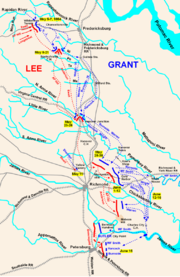
Battle of the Wilderness
The Battle of the Wilderness, fought May 5–7, 1864, was the first battle of Lt. Gen. Ulysses S. Grant's 1864 Virginia Overland Campaign against Gen. Robert E. Lee and the Confederate Army of Northern Virginia. Both armies suffered heavy casualties, a harbinger of a bloody war of attrition by...
was tactically inconclusive, although very damaging to both sides. However, unlike his predecessors, Grant did not retreat after the battle; he sent his army to the southeast and began a campaign of maneuver that kept Lee on the defensive through a series of bloody battles and moved closer to Richmond. Grant knew that his larger army and base of manpower in the North could sustain a war of attrition better than Lee and the Confederacy could. And although Grant suffered high losses—approximately 55,000 casualties—during the campaign, Lee lost even higher percentages of his men, losses that could not be replaced.
In the Battle of Spotsylvania Court House
Battle of Spotsylvania Court House
The Battle of Spotsylvania Court House, sometimes simply referred to as the Battle of Spotsylvania , was the second major battle in Lt. Gen. Ulysses S. Grant's 1864 Overland Campaign of the American Civil War. Following the bloody but inconclusive Battle of the Wilderness, Grant's army disengaged...
, Lee was able to beat Grant to the crossroads town and establish a strong defensive position. In a series of attacks over two weeks, Grant hammered away at the Confederate lines, mostly centered on a salient known as the "Mule Shoe". A massive assault by Winfield S. Hancock's II Corps on the "Bloody Angle" portion of this line on May 12 foreshadowed the breakthrough tactics employed against trenches
Trench warfare
Trench warfare is a form of occupied fighting lines, consisting largely of trenches, in which troops are largely immune to the enemy's small arms fire and are substantially sheltered from artillery...
late in World War I
World War I
World War I , which was predominantly called the World War or the Great War from its occurrence until 1939, and the First World War or World War I thereafter, was a major war centred in Europe that began on 28 July 1914 and lasted until 11 November 1918...
. Grant once again disengaged and slipped to the southeast.
Intercepting Grant's movement, Lee positioned his forces behind the North Anna River
Battle of North Anna
The Battle of North Anna was fought May 23–26, 1864, as part of Union Lt. Gen. Ulysses S. Grant's Overland Campaign against Confederate Gen. Robert E. Lee's Army of Northern Virginia. It consisted of a series of small actions near the North Anna River in central Virginia, rather than a...
in a salient to force Grant to divide his army to attack it. Lee had the opportunity to defeat Grant but failed to attack in the manner necessary to spring the trap he had set, possibly because of an illness. After rejecting a frontal assault on Lee's positions as too costly and initially approving a plan to move around Lee's left flank, Grant changed his mind and continued moving southeast.
On May 31, Union cavalry seized the vital crossroads of Old Cold Harbor while the Confederates arrived from Richmond and from the Totopotomoy Creek lines. Late on June 1, two Union corps reached Cold Harbor and assaulted the Confederate works with some success. By June 2, both armies were on the field, forming on a seven-mile (11 km) front. At dawn on June 3, the II and XVIII Corps, followed later by the IX Corps, assaulted the line and were slaughtered at all points in the Battle of Cold Harbor
Battle of Cold Harbor
The Battle of Cold Harbor was fought from May 31 to June 12, 1864 . It was one of the final battles of Union Lt. Gen. Ulysses S. Grant's Overland Campaign during the American Civil War, and is remembered as one of American history's bloodiest, most lopsided battles...
. Grant lost over 12,000 men in a battle that he regretted more than any other and Northern newspapers thereafter frequently referred to him as a "butcher".
On the night of June 12, Grant again advanced by his left flank, marching to the James River. He was able to disguise his intentions from Lee, and his army crossed the river on a bridge of pontoons that stretched over 2,100 feet (640 m). What Lee had feared most of all—that Grant would force him into a siege of the capital city—was poised to occur.
Petersburg
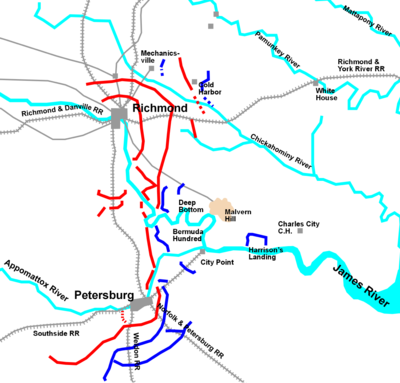
In an attempt to break the siege, Union troops in Ambrose Burnside's corps mined a tunnel under the Confederate line. On July 30, they detonated the explosives, creating a crater
Subsidence crater
A subsidence crater is a hole or depression left on the surface of an area which has had an underground explosion. Many such craters are present at the Nevada Test Site, which is no longer in use for nuclear testing....
some 135 feet (41 m) in diameter that remains visible to this day. Almost 350 Confederate soldiers were instantly killed in the blast. Despite the ingenuity of the Union's plan, the lengthy, bloody Battle of the Crater
Battle of the Crater
The Battle of the Crater was a battle of the American Civil War, part of the Siege of Petersburg. It took place on July 30, 1864, between the Confederate Army of Northern Virginia, commanded by General Robert E. Lee and the Union Army of the Potomac, commanded by Major General George G. Meade The...
, as it came to be called, was marred by poor tactical planning and was a decisive Confederate victory.
Through the fall and winter, both armies constructed elaborate series of trenches, eventually spanning more than 30 miles (50 km), as the Union Army attempted to get around the right (western) flank of the Confederates and destroy their supply lines. Although the Northern public became quite dispirited by the seeming lack of progress at Petersburg, the dramatic success of Sherman at Atlanta helped ensure the reelection of Abraham Lincoln, which guaranteed that the war would be fought to a conclusion.
Shenandoah Valley (1864–65)
The Shenandoah Valley was a crucial region for the Confederacy: it was one of the most important agricultural regions in Virginia and was a prime invasion route against the North. Grant hoped that an army from the Department of West Virginia under Franz SigelFranz Sigel
Franz Sigel was a German military officer, revolutionist and immigrant to the United States who was a teacher, newspaperman, politician, and served as a Union major general in the American Civil War.-Early life:...
could seize control of the Valley, moving "up the Valley" (southwest to the higher elevations) with 10,000 men to destroy the railroad center at Lynchburg
Lynchburg, Virginia
Lynchburg is an independent city in the Commonwealth of Virginia. The population was 75,568 as of 2010. Located in the foothills of the Blue Ridge Mountains along the banks of the James River, Lynchburg is known as the "City of Seven Hills" or "The Hill City." Lynchburg was the only major city in...
. Sigel immediately suffered defeat at the Battle of New Market
Battle of New Market
The Battle of New Market was a battle fought on May 15, 1864, in Virginia during Valley Campaigns of 1864 in the American Civil War. Cadets from the Virginia Military Institute fought alongside the Confederate Army and forced Union General Franz Sigel and his army out of the Shenandoah...
on May 15 and was soon replaced by David Hunter
David Hunter
David Hunter was a Union general in the American Civil War. He achieved fame by his unauthorized 1862 order emancipating slaves in three Southern states and as the president of the military commission trying the conspirators involved with the assassination of President Abraham Lincoln.-Early...
, who won a victory at the Battle of Piedmont
Battle of Piedmont
The Battle of Piedmont was fought June 5, 1864, in the village of Piedmont, Augusta County, Virginia. Union Maj. Gen. David Hunter engaged Confederates under Brig. Gen. William E. "Grumble" Jones north of Piedmont. After severe fighting, Jones was killed and the Confederates were routed...
on June 5. Hunter began burning Confederate agricultural resources as well as the homes of some prominent secessionists, earning him the nickname "Black Dave" from the Confederates. In Lexington
Lexington, Virginia
Lexington is an independent city within the confines of Rockbridge County in the Commonwealth of Virginia. The population was 7,042 in 2010. Lexington is about 55 minutes east of the West Virginia border and is about 50 miles north of Roanoke, Virginia. It was first settled in 1777.It is home to...
he burned the Virginia Military Institute
Virginia Military Institute
The Virginia Military Institute , located in Lexington, Virginia, is the oldest state-supported military college and one of six senior military colleges in the United States. Unlike any other military college in the United States—and in keeping with its founding principles—all VMI students are...
.
Robert E. Lee, now besieged in Petersburg, was concerned about Hunter's advances and sent Jubal Early's corps to sweep Union forces from the Valley and, if possible, to menace Washington, D.C., hoping to compel Grant to dilute his forces around Petersburg. Early got off to a good start, driving back Hunter's force in the Battle of Lynchburg
Battle of Lynchburg
The Battle of Lynchburg was fought on June 17–18, 1864, two miles outside Lynchburg, Virginia, as part of the American Civil War. The Union Army of West Virginia, under Maj. Gen. David Hunter attempted to capture the city, but was repulsed by Confederate Lt. Gen. Jubal Anderson...
. He drove down the Valley without opposition, bypassed Harpers Ferry, crossed the Potomac River, and advanced into Maryland. Grant dispatched a corps under Maj. Gen. Horatio G. Wright and other troops under George Crook
George Crook
George R. Crook was a career United States Army officer, most noted for his distinguished service during the American Civil War and the Indian Wars.-Early life:...
to reinforce Washington and pursue Early.
At the Battle of Monocacy
Battle of Monocacy
The Battle of Monocacy was fought on July 9, 1864, just outside Frederick, Maryland, as part of the Valley Campaigns of 1864, in the American Civil War. Confederate forces under Lt. Gen. Jubal A. Early defeated Union forces under Maj. Gen. Lew Wallace...
(July 9, 1864), Early defeated a smaller force under Lew Wallace
Lew Wallace
Lewis "Lew" Wallace was an American lawyer, Union general in the American Civil War, territorial governor and statesman, politician and author...
near Frederick, Maryland, but this battle delayed his progress enough to allow time for reinforcing the defenses of Washington. Early attacked a fort on the northwest defensive perimeter of Washington (Fort Stevens
Battle of Fort Stevens
The Battle of Fort Stevens was an American Civil War battle fought July 11–12, 1864, in Northwest Washington, D.C., as part of the Valley Campaigns of 1864 between forces under Confederate Lt. Gen. Jubal A. Early and Union Maj. Gen. Alexander McD. McCook. Although Early caused consternation...
(July 11–12) without success and withdrew back to Virginia. He successfully fought a series of minor battles in the Valley through early August and prevented Wright's corps from returning to Grant at Petersburg. He also burned the city of Chambersburg, Pennsylvania
Chambersburg, Pennsylvania
Chambersburg is a borough in the South Central region of Pennsylvania, United States. It is miles north of Maryland and the Mason-Dixon line and southwest of Harrisburg in the Cumberland Valley, which is part of the Great Appalachian Valley. Chambersburg is the county seat of Franklin County...
, retaliating against Hunter's earlier actions in the Valley.
Grant knew that Washington remained vulnerable if Early was still on the loose. He found a new commander aggressive enough to defeat Early: Maj. Gen. Philip Sheridan
Philip Sheridan
Philip Henry Sheridan was a career United States Army officer and a Union general in the American Civil War. His career was noted for his rapid rise to major general and his close association with Lt. Gen. Ulysses S...
, the cavalry commander of the Army of the Potomac, who was given command of all forces in the area, the Middle Military Division, including the Army of the Shenandoah
Army of the Shenandoah (Union)
The Army of the Shenandoah was a Union army during the American Civil War. First organized in 1861 and then disbanded, it is best known for its recreation in 1864 under Philip Sheridan...
. Sheridan initially started slowly, primarily because the impending presidential election of 1864 demanded a cautious approach, avoiding any disaster that might lead to the defeat of Abraham Lincoln.
Sheridan began moving aggressively in September. He defeated Early in the Third Battle of Winchester
Battle of Opequon
The Battle of Opequon, more commonly known as the Third Battle of Winchester, was fought in Winchester, Virginia, on September 19, 1864, during the Valley Campaigns of 1864 in the American Civil War....
on September 19 and the Battle of Fisher's Hill
Battle of Fisher's Hill
The Battle of Fisher's Hill was fought September 21–22, 1864, as part of the Valley Campaigns of 1864 during the American Civil War. Fisher's Hill is located near Strasburg, Virginia....
on September 21–22. With Early damaged and pinned down, the Valley lay open to the Union. Coupled with Sherman's capture of Atlanta
Atlanta Campaign
The Atlanta Campaign was a series of battles fought in the Western Theater of the American Civil War throughout northwest Georgia and the area around Atlanta during the summer of 1864. Union Maj. Gen. William T. Sherman invaded Georgia from the vicinity of Chattanooga, Tennessee, beginning in May...
and Adm. David Farragut
David Farragut
David Glasgow Farragut was a flag officer of the United States Navy during the American Civil War. He was the first rear admiral, vice admiral, and admiral in the United States Navy. He is remembered in popular culture for his order at the Battle of Mobile Bay, usually paraphrased: "Damn the...
's victory at Mobile Bay
Battle of Mobile Bay
The Battle of Mobile Bay of August 5, 1864, was an engagement of the American Civil War in which a Federal fleet commanded by Rear Adm. David G. Farragut, assisted by a contingent of soldiers, attacked a smaller Confederate fleet led by Adm...
, Lincoln's re-election seemed assured. Sheridan pulled back slowly down the Valley and conducted a scorched earth
Scorched earth
A scorched earth policy is a military strategy or operational method which involves destroying anything that might be useful to the enemy while advancing through or withdrawing from an area...
campaign that presaged Sherman's March to the Sea
Sherman's March to the Sea
Sherman's March to the Sea is the name commonly given to the Savannah Campaign conducted around Georgia from November 15, 1864 to December 21, 1864 by Maj. Gen. William Tecumseh Sherman of the Union Army in the American Civil War...
in November. The goal was to deny the Confederacy the means of feeding its armies in Virginia, and Sheridan's army burned crops, barns, mills, and factories.
The campaign was effectively concluded at the Battle of Cedar Creek
Battle of Cedar Creek
The Battle of Cedar Creek, or Battle of Belle Grove, October 19, 1864, was one of the final, and most decisive, battles in the Valley Campaigns of 1864 during the American Civil War. The final Confederate invasion of the North, led by Lt. Gen. Jubal A. Early, was effectively ended...
(October 19, 1864). In a brilliant surprise attack at dawn, Early routed two thirds of the Union army, but his troops were hungry and exhausted and many fell out of their ranks to pillage the Union camp; Sheridan managed to rally his troops and defeat Early decisively. In late fall, Sheridan sent his infantry to assist Grant at Petersburg, with his cavalry arriving the following spring. Most of the men of Early's corps rejoined Lee at Petersburg in December, while Early remained to command a skeleton force until he was relieved of command in March 1865 after his defeat at the Battle of Waynesboro
Battle of Waynesboro
The Battle of Waynesboro was fought on March 2, 1865, in Augusta County, Virginia, during the American Civil War. It was the final battle for Confederate Lt. Gen. Jubal Early, whose force was destroyed.-Background:...
.
Appomattox (1865)
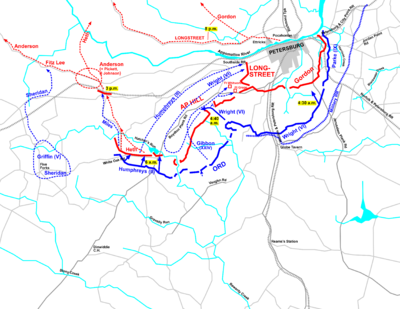
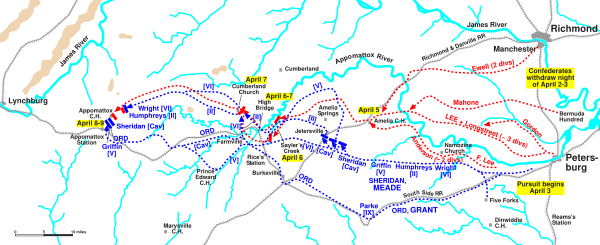 |
In January 1865, Robert E. Lee became the general-in-chief of all Confederate armies, but this move came too late to help the Southern cause. As the siege of Petersburg continued, Grant attempted to break or encircle the Confederate forces in multiple attacks moving from east to west; gradually, he cut all of the Confederate supply lines except the Richmond & Danville Railroad entering Richmond and the South Side Railroad supplying Petersburg. By March, the siege had taken an enormous toll on both armies, and Lee decided to pull out of Petersburg. Maj. Gen. John B. Gordon then devised a plan to have the army attack Fort Stedman
Battle of Fort Stedman
The Battle of Fort Stedman was fought on March 25, 1865, during the final days of the American Civil War. The Union Army fortification in the siege lines around Petersburg, Virginia, was attacked in a pre-dawn Confederate assault by troops led by Maj. Gen. John B. Gordon. The attack was the last...
on the eastern end of the Union Lines, forcing the Union forces to shorten their lines. Although initially a success, his outnumbered corps was forced back by a Union counterattack.
Sheridan returned from the Valley and was tasked with flanking the Confederate army, which forced Lee to send forces under Maj. Gen. George Pickett
George Pickett
George Edward Pickett was a career United States Army officer who became a general in the Confederate States Army during the American Civil War...
and Maj. Gen. Fitzhugh Lee to defend the flank. Grant then deployed cavalry and two infantry corps under Sheridan to cut off Pickett's forces. Pickett and Fitzhugh Lee attacked first on March 31 at Dinwiddie Court House
Battle of Dinwiddie Court House
The Battle of Dinwiddie Court House was a minor engagement in the Appomattox Campaign of the American Civil War that was the immediate prelude to the decisive Battle of Five Forks. On March 29, 1865, with the Cavalry Corps and the II and V Corps of the Army of the Potomac, Maj. Gen. Philip Sheridan...
, and succeeded in pushing back the Union forces but did not gain a decisive advantage. They withdrew their forces to Five Forks
Battle of Five Forks
The Battle of Five Forks was fought on April 1, 1865, southwest of Petersburg, Virginia, in Dinwiddie County, during the Appomattox Campaign of the American Civil War. The battle, sometimes referred to as the "Waterloo of the Confederacy," pitted Union Maj. Gen. Philip H. Sheridan against...
that night. On April 1, Sheridan launched another attack, flanking Pickett's forces and destroying the Confederate left wing, capturing over two thousand Confederates. This victory meant that Sheridan could capture the South Side Railroad the next day.
After the victory at Five Forks, Grant ordered an assault along the entire Confederate line on April 2, called the Third Battle of Petersburg, resulting in dramatic breakthroughs. During the fighting, A.P. Hill was killed. During the day and into the night, Lee pulled his forces out from Petersburg and Richmond and headed west to Danville
Danville, Virginia
Danville is an independent city in Virginia, United States, bounded by Pittsylvania County, Virginia and Caswell County, North Carolina. It was the last capital of the Confederate States of America. The Bureau of Economic Analysis combines the city of Danville with Pittsylvania county for...
, the destination of the fleeing Confederate government, and then south to meet up with General Joseph E. Johnston
Joseph E. Johnston
Joseph Eggleston Johnston was a career U.S. Army officer, serving with distinction in the Mexican-American War and Seminole Wars, and was also one of the most senior general officers in the Confederate States Army during the American Civil War...
in North Carolina
North Carolina
North Carolina is a state located in the southeastern United States. The state borders South Carolina and Georgia to the south, Tennessee to the west and Virginia to the north. North Carolina contains 100 counties. Its capital is Raleigh, and its largest city is Charlotte...
. The capital city of Richmond surrendered on the morning of April 3.
The campaign became a race between Lee and Sheridan, with Lee attempting to obtain supplies for his retreat and Sheridan attempting to cut him off, with the Union infantry close behind. At Sayler's Creek
Battle of Sayler's Creek
-External links:* * : Maps, histories, photos, and preservation news...
on April 6, nearly a quarter of the Confederate army (about 8,000 men, the majority of two corps) was cut off and forced to surrender; many of the Confederate supply trains, crossing the creek to the north, were also captured. Although Grant wrote to him suggesting that surrender was his last remaining course of action, Lee still attempted to outmarch the Union forces. In Lee's final attack at Appomattox on the morning April 9, John B. Gordon's depleted corps attempted to break the Union lines and reach the supplies in Lynchburg. They pushed back Sheridan's cavalry briefly but found themselves faced with the full Union V Corps. Surrounded on three sides, Lee was forced to surrender his army to Grant at Appomattox Court House
Appomattox Court House
The Appomattox Courthouse is the current courthouse in Appomattox, Virginia built in 1892. It is located in the middle of the state about three miles northwest of the Appomattox Court House National Historical Park, once known as Clover Hill - home of the original Old Appomattox Court House...
that day, with the formal surrender ceremony taking place two days later.
There were further minor battles and surrenders of Confederate armies, but Lee's surrender on April 9, 1865, marked the effective end of the Civil War. Lee, rejecting advice from some of his staff, wanted to ensure that his army did not melt away into the countryside to continue the war as guerrillas
Guerrilla warfare
Guerrilla warfare is a form of irregular warfare and refers to conflicts in which a small group of combatants including, but not limited to, armed civilians use military tactics, such as ambushes, sabotage, raids, the element of surprise, and extraordinary mobility to harass a larger and...
, helping to heal the divisions of the country.
Further reading
- Beatie, Russel H. Army of the Potomac: Birth of Command, November 1860 – September 1861. New York: Da Capo Press, 2002. ISBN 0-306-81141-3.
- Beatie, Russel H. Army of the Potomac: McClellan Takes Command, September 1861 – February 1862. New York: Da Capo Press, 2004. ISBN 0-306-81252-5.
- Beatie, Russel H. Army of the Potomac: McClellan's First Campaign, March – May 1862. New York: Savas Beatie, 2007. ISBN 978-932714-25-8.
- Burton, Brian K. Extraordinary Circumstances: The Seven Days Battles. Indianapolis: Indiana University Press, 2001. ISBN 0-253-33963-4.
- Catton, BruceBruce CattonCharles Bruce Catton was an American historian and journalist, best known for his books on the American Civil War. Known as a narrative historian, Catton specialized in popular histories that emphasized colorful characters and historical vignettes, in addition to the basic facts, dates, and analyses...
. Glory Road. Garden City, NY: Doubleday and Company, 1952. ISBN 0-385-04167-5. - Catton, Bruce. Mr. Lincoln's Army. Garden City, NY: Doubleday and Company, 1951. ISBN 0-385-04310-4.
- Catton, Bruce. A Stillness at Appomattox. Garden City, NY: Doubleday and Company, 1953. ISBN 0-385-04451-8.
- Foote, ShelbyShelby FooteShelby Dade Foote, Jr. was an American historian and novelist who wrote The Civil War: A Narrative, a massive, three-volume history of the war. With geographic and cultural roots in the Mississippi Delta, Foote's life and writing paralleled the radical shift from the agrarian planter system of the...
. The Civil War: A NarrativeThe Civil War: A NarrativeThe Civil War: A Narrative is a three volume, 2,968-page, 1.2 million-word history of the American Civil War by Shelby Foote. Although previously known as a novelist, Foote is most famous for this non-fictional narrative history. While it touches on political and social themes, the main thrust of...
. 3 vols. New York: Random House, 1974. ISBN 0-394-74913-8. - Freeman, Douglas S.Douglas S. FreemanDouglas Southall Freeman was an American historian, biographer, newspaper editor, and author. He is best known for his multi-volume biographies of Robert E...
Lee's Lieutenants: A Study in Command. 3 vols. New York: Scribner, 1946. ISBN 0-684-85979-3. - Freeman, Douglas S.Douglas S. FreemanDouglas Southall Freeman was an American historian, biographer, newspaper editor, and author. He is best known for his multi-volume biographies of Robert E...
R. E. Lee, A Biography. 4 vols. New York: Scribner, 1934. - Glatthaar, Joseph T. General Lee's Army: From Victory to Collapse. New York: Free Press, 2008. ISBN 978-0-684-82787-2.
- Grant, Ulysses S.Ulysses S. GrantUlysses S. Grant was the 18th President of the United States as well as military commander during the Civil War and post-war Reconstruction periods. Under Grant's command, the Union Army defeated the Confederate military and ended the Confederate States of America...
Personal Memoirs of U. S. Grant. 2 vols. Charles L. Webster & Company, 1885–86. ISBN 0-914427-67-9. - McPherson, James M.James M. McPhersonJames M. McPherson is an American Civil War historian, and is the George Henry Davis '86 Professor Emeritus of United States History at Princeton University. He received the 1989 Pulitzer Prize for Battle Cry of Freedom, his most famous book...
Battle Cry of Freedom: The Civil War Era. Oxford History of the United States. New York: Oxford University Press, 1988. ISBN 0-19-503863-0. - Murfin, James V. The Gleam of Bayonets: Battle of Antietam, September 17, 1862. Covington, GA: Mockingbird Press, 1965. SBN89176-007-5
- Welcher, Frank J. The Union Army, 1861–1865 Organization and Operations. Vol. 1, The Eastern Theater. Bloomington: Indiana University Press, 1989. ISBN 0-253-36453-1.
- Wert, Jeffry D.Jeffry D. WertJeffry D. Wert is an American historian and author specializing in the American Civil War. He has written several books on the subject, which have been published in multiple languages and countries.-Bibliography:...
The Sword of Lincoln: The Army of the Potomac. New York: Simon & Schuster, 2005. ISBN 0-7432-2506-6. - Williams, T. HarryT. Harry WilliamsThomas Harry Williams was an award-winning historian at Louisiana State University in Baton Rouge whose career began in 1941 and extended for thirty-eight years until his death at the age of seventy...
. Lincoln and His Generals. New York: Alfred A. Knopf, 1952. ISBN 0-965-43826-0.