

Battle of McDowell

Encyclopedia
The Battle of McDowell, also known as Sitlington's Hill, was fought May 8, 1862, in Highland County, Virginia
, as part of Confederate Army
Maj. Gen. Thomas J. "Stonewall" Jackson
's Campaign
through the Shenandoah Valley
during the American Civil War
. It followed Jackson's tactical defeat, but strategic victory, at the First Battle of Kernstown.
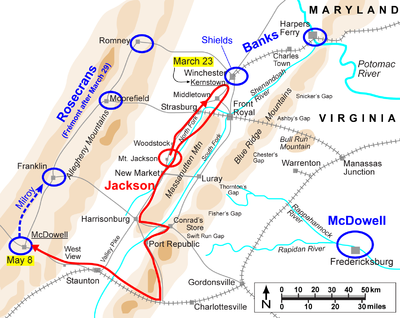
Jackson's columns departed West View and Staunton, Virginia
, on the morning of May 7, marching west along the Parkersburg turnpike. Elements of Brig. Gen. Edward "Allegheny" Johnson
's brigade composed the vanguard. At mid-afternoon, Union pickets were encountered at Rodgers' tollgate, where the pike crosses Ramsey's Draft
. The Union force, which consisted of portions of three regiments (3rd West Virginia, 32nd Ohio
, and 75th Ohio) under overall command of Brig. Gen. Robert H. Milroy
, withdrew hastily, abandoning their baggage at the tollgate and retreating to the crest of Shenandoah Mountain.
The Confederate force split into two columns to envelope the Union holding position on Shenandoah Mountain. Milroy ordered his force to withdraw and concentrate at McDowell, where he hoped to receive reinforcements. Milroy also positioned a section of artillery on Shaw's Ridge to impede Johnson's descent from the crest of Shenandoah Mountain. These guns were soon withdrawn with their supports to McDowell. By dusk, Johnson's advance regiments reached Shaw's Fork, where they encamped. Because of the narrow roads and few camp sites, Jackson's army was stretched 8–10 miles back along the pike with its rear guard at Dry Branch Gap. Jackson established his headquarters at Rodgers's tollgate. During the night, Milroy withdrew behind the Bullpasture River
to McDowell, establishing headquarters in the Hull House.
, conducted a reconnaissance of the Union position at McDowell from a rocky spur right of the road. Johnson continued with the advance to the base of Sitlington's Hill. Expecting a roadblock ahead, he diverged from the road into a steep narrow ravine that led to the top of the hill. After driving away Union skirmishers, Johnson deployed his infantry along the long, sinuous crest of the hill. Jackson asked his staff to find a way to place artillery on the hill and to search for a way to flank the Union position to the north.
About 10 a.m., Brig. Gen. Robert C. Schenck
arrived after a forced march from Franklin, West Virginia
. Being senior to Milroy, Schenck assumed overall command of the Union force at McDowell with headquarters at the Hull House. He deployed his artillery, consisting of 18 guns, on Cemetery Hill and near the McDowell Presbyterian Church to defend the bridge over the Bullpasture River. He deployed his infantry in line from McDowell south along the river for about 800 yards. He placed one regiment (2nd West Virginia) on Hull's Hill, east of the river and overlooking the pike. Three companies of cavalry covered the left flank on the road to the north of the village.
Schenck and Milroy sent out skirmishers to contest the base of Sitlington's Hill along the river. As Confederate forces on the crest of the hill increased in numbers, Schenck and Milroy conferred. Union scouts reported that the Confederates were attempting to bring artillery to the crest of the hill, which would make the Union position on the bottomland at McDowell untenable. In absence of an aggressive Confederate advance, Schenck and Milroy attempted a spoiling attack. Milroy advanced his brigade (25th Ohio
, 32nd Ohio, 75th Ohio
, 3rd West Virginia) and the 82nd Ohio of Schenck's brigade, about 2,300 men. About 3 p.m. Milroy personally led the attacking force, which crossed the bridge and proceeded up the ravines that cut the western slope of the hill.
In the meantime, Jackson had been content to hold the crest of the hill while searching for a route for a flanking movement to the north. He had decided against sending artillery up the hill because of the difficulty of withdrawing the pieces in the face of an attack. Union artillerymen on Cemetery Hill elevated their pieces by digging deep trenches in the ground for the gun trails and began firing at the Confederates in support of the advancing infantry. Schenck also had a six-pounder hauled by hand to the crest of Hull's Hill to fire on the Confederate right flank above the turnpike (some accounts say a section of guns, another says a whole battery). The Union line advanced resolutely up the steep slopes and closed on the Confederate position. The conflict became "fierce and sanguinary".
The 3rd West Virginia advanced along the turnpike in an attempt to turn the Confederate right. Jackson reinforced his right on the hill with two regiments and covered the turnpike with the 21st Virginia
. The 12th Georgia at the center and slightly in advance of the main Confederate line on the hill crest bore the brunt of the Union attack and suffered heavy casualties. This was largely due to the fact that the regiment was armed with smoothbore muskets and were consequently unable to do much damage to the rifle-equipped Federals. The fighting continued for four hours as the Union attackers attempted to pierce the center of the Confederate line and then to envelope its left flank. Nine Confederate regiments were engaged, opposing five Union regiments in the fight for Sitlington's Hill. At dusk the Union attackers withdrew to McDowell.
Some historians consider the battle of McDowell the beginning of Jackson's 1862 Valley Campaign
, while others prefer to include the First Battle of Kernstown, Stonewall's only defeat. The battle of McDowell is studied today by military historians for several reasons. At the tactical level, it can be argued that the Union forces achieved a draw. Milroy's "spoiling attack" surprised Jackson, seized the initiative, and inflicted heavier casualties, but did not drive the Confederates from their position. At the strategic level, the battle of McDowell and the resultant withdrawal of the Union army was an important victory for the South. The battle demonstrated Jackson's strategy of concentrating his forces against a numerically inferior foe, while denying his enemies the chance to concentrate against him. Jackson rode the momentum of his strategic win at McDowell to victory at Front Royal
(May 23) and First Winchester
(May 25).
Highland County, Virginia
As of the census of 2000, there were 2,536 people, 1,131 households, and 764 families residing in the county. The population density was 6 people per square mile . There were 1,822 housing units at an average density of 4 per square mile...
, as part of Confederate Army
Confederate States Army
The Confederate States Army was the army of the Confederate States of America while the Confederacy existed during the American Civil War. On February 8, 1861, delegates from the seven Deep South states which had already declared their secession from the United States of America adopted the...
Maj. Gen. Thomas J. "Stonewall" Jackson
Stonewall Jackson
ຄຽשת״ׇׂׂׂׂ֣|birth_place= Clarksburg, Virginia |death_place=Guinea Station, Virginia|placeofburial=Stonewall Jackson Memorial CemeteryLexington, Virginia|placeofburial_label= Place of burial|image=...
's Campaign
Valley Campaign
Jackson's Valley Campaign was Confederate Maj. Gen. Thomas J. "Stonewall" Jackson's famous spring 1862 campaign through the Shenandoah Valley in Virginia during the American Civil War...
through the Shenandoah Valley
Shenandoah Valley
The Shenandoah Valley is both a geographic valley and cultural region of western Virginia and West Virginia in the United States. The valley is bounded to the east by the Blue Ridge Mountains, to the west by the eastern front of the Ridge-and-Valley Appalachians , to the north by the Potomac River...
during the American Civil War
American Civil War
The American Civil War was a civil war fought in the United States of America. In response to the election of Abraham Lincoln as President of the United States, 11 southern slave states declared their secession from the United States and formed the Confederate States of America ; the other 25...
. It followed Jackson's tactical defeat, but strategic victory, at the First Battle of Kernstown.
Background
Jackson's columns departed West View and Staunton, Virginia
Staunton, Virginia
Staunton is an independent city within the confines of Augusta County in the commonwealth of Virginia. The population was 23,746 as of 2010. It is the county seat of Augusta County....
, on the morning of May 7, marching west along the Parkersburg turnpike. Elements of Brig. Gen. Edward "Allegheny" Johnson
Edward Johnson (general)
Edward Johnson , also known as Allegheny Johnson , was a United States Army officer and a Confederate general in the American Civil War.-Early life:...
's brigade composed the vanguard. At mid-afternoon, Union pickets were encountered at Rodgers' tollgate, where the pike crosses Ramsey's Draft
Ramsey's Draft Wilderness
Ramsey’s Draft Wilderness is a designated wilderness area in the North River Ranger District of the George Washington and Jefferson National Forests of Virginia in the United States. The wilderness area was established in 1984 and comprises...
. The Union force, which consisted of portions of three regiments (3rd West Virginia, 32nd Ohio
32nd Ohio Infantry
The 32nd Ohio Volunteer Infantry was an infantry regiment in the Union Army during the American Civil War.-Service:The 32nd Ohio Infantry was organized at Mansfield, Ohio August 20-September 7, 1861 and mustered in for three years service under the command of Colonel Thomas H. Ford...
, and 75th Ohio) under overall command of Brig. Gen. Robert H. Milroy
Robert H. Milroy
Robert Huston Milroy was a lawyer, judge, and a Union Army general in the American Civil War, most noted for his defeat at the Second Battle of Winchester in 1863.-Early life:...
, withdrew hastily, abandoning their baggage at the tollgate and retreating to the crest of Shenandoah Mountain.
The Confederate force split into two columns to envelope the Union holding position on Shenandoah Mountain. Milroy ordered his force to withdraw and concentrate at McDowell, where he hoped to receive reinforcements. Milroy also positioned a section of artillery on Shaw's Ridge to impede Johnson's descent from the crest of Shenandoah Mountain. These guns were soon withdrawn with their supports to McDowell. By dusk, Johnson's advance regiments reached Shaw's Fork, where they encamped. Because of the narrow roads and few camp sites, Jackson's army was stretched 8–10 miles back along the pike with its rear guard at Dry Branch Gap. Jackson established his headquarters at Rodgers's tollgate. During the night, Milroy withdrew behind the Bullpasture River
Bullpasture River
The Bullpasture River is a tributary of the Cowpasture River of Virginia in the United States.The Bullpasture River flows through Highland County, Virginia from its headwaters on the boundary between Virginia and West Virginia...
to McDowell, establishing headquarters in the Hull House.
Battle
Starting at dawn on May 8, the Confederate advance crossed Shaw's Ridge, descended to the Cowpasture River at Wilson's House, and ascended Bullpasture Mountain. The advance was unopposed. Reaching the crest of the ridge, Jackson and his mapmaker, Jedediah HotchkissJedediah Hotchkiss
Jedediah Hotchkiss , also known as Jed, was an educator and the most famous cartographer and topographer of the American Civil War...
, conducted a reconnaissance of the Union position at McDowell from a rocky spur right of the road. Johnson continued with the advance to the base of Sitlington's Hill. Expecting a roadblock ahead, he diverged from the road into a steep narrow ravine that led to the top of the hill. After driving away Union skirmishers, Johnson deployed his infantry along the long, sinuous crest of the hill. Jackson asked his staff to find a way to place artillery on the hill and to search for a way to flank the Union position to the north.
About 10 a.m., Brig. Gen. Robert C. Schenck
Robert C. Schenck
Robert Cumming Schenck was a Union Army general in the American Civil War, and American diplomatic representative to Brazil and the United Kingdom. He was at both battles of Bull Run and took part in the Shenandoah Valley Campaign of 1862, and the Battle of Cross Keys...
arrived after a forced march from Franklin, West Virginia
Franklin, West Virginia
Franklin is a town in Pendleton County, West Virginia, United States. The population was 797 at the 2000 census. It is the county seat of Pendleton County...
. Being senior to Milroy, Schenck assumed overall command of the Union force at McDowell with headquarters at the Hull House. He deployed his artillery, consisting of 18 guns, on Cemetery Hill and near the McDowell Presbyterian Church to defend the bridge over the Bullpasture River. He deployed his infantry in line from McDowell south along the river for about 800 yards. He placed one regiment (2nd West Virginia) on Hull's Hill, east of the river and overlooking the pike. Three companies of cavalry covered the left flank on the road to the north of the village.
Schenck and Milroy sent out skirmishers to contest the base of Sitlington's Hill along the river. As Confederate forces on the crest of the hill increased in numbers, Schenck and Milroy conferred. Union scouts reported that the Confederates were attempting to bring artillery to the crest of the hill, which would make the Union position on the bottomland at McDowell untenable. In absence of an aggressive Confederate advance, Schenck and Milroy attempted a spoiling attack. Milroy advanced his brigade (25th Ohio
25th Ohio Infantry
The 25th Ohio Volunteer Infantry was an infantry regiment in the Union Army during the American Civil War.-Service:The 25th Ohio Infantry was organized at Camp Chase in Columbus, Ohio and mustered in for three years service on June 28, 1861 under the command of Colonel James A. Jones...
, 32nd Ohio, 75th Ohio
75th Ohio Infantry
The 75th Ohio Volunteer Infantry was an infantry regiment from southwestern Ohio in the Union Army during the American Civil War. It served in the Eastern Theater, most notably in the battles of Chancellorsville and Gettysburg and then in the siege operations against Charleston, South...
, 3rd West Virginia) and the 82nd Ohio of Schenck's brigade, about 2,300 men. About 3 p.m. Milroy personally led the attacking force, which crossed the bridge and proceeded up the ravines that cut the western slope of the hill.
In the meantime, Jackson had been content to hold the crest of the hill while searching for a route for a flanking movement to the north. He had decided against sending artillery up the hill because of the difficulty of withdrawing the pieces in the face of an attack. Union artillerymen on Cemetery Hill elevated their pieces by digging deep trenches in the ground for the gun trails and began firing at the Confederates in support of the advancing infantry. Schenck also had a six-pounder hauled by hand to the crest of Hull's Hill to fire on the Confederate right flank above the turnpike (some accounts say a section of guns, another says a whole battery). The Union line advanced resolutely up the steep slopes and closed on the Confederate position. The conflict became "fierce and sanguinary".
The 3rd West Virginia advanced along the turnpike in an attempt to turn the Confederate right. Jackson reinforced his right on the hill with two regiments and covered the turnpike with the 21st Virginia
21st Virginia Infantry
The 21st Virginia Volunteer Infantry Regiment was an infantry regiment raised in Virginia for service in the Confederate States Army during the American Civil War. It fought mostly with the Army of Northern Virginia....
. The 12th Georgia at the center and slightly in advance of the main Confederate line on the hill crest bore the brunt of the Union attack and suffered heavy casualties. This was largely due to the fact that the regiment was armed with smoothbore muskets and were consequently unable to do much damage to the rifle-equipped Federals. The fighting continued for four hours as the Union attackers attempted to pierce the center of the Confederate line and then to envelope its left flank. Nine Confederate regiments were engaged, opposing five Union regiments in the fight for Sitlington's Hill. At dusk the Union attackers withdrew to McDowell.
Aftermath
At dark, Union forces withdrew from Sitlington's Hill and recrossed to McDowell, carrying their wounded from the field. Union casualties were 259 (34 killed, 220 wounded, 5 missing), Confederate 420 (116 killed, 300 wounded, 4 missing), one of the rare cases in the Civil War where the attacker lost fewer men than the defender. About 2 a.m. on May 9, Schenck and Milroy ordered a general retreat along the turnpike toward Franklin. The 73rd Ohio held their skirmish line along the river until near dawn when they withdrew and acted as rear guard for the retreating column. Ten men of the regiment were inadvertently left behind and captured. Shortly after the Federals retired, the Confederates entered McDowell. Schenck established a holding position on May 9, but only minor skirmishing resulted. For nearly a week, Jackson pursued the retreating Union army almost to Franklin before commencing a return march to the Valley on May 15.Some historians consider the battle of McDowell the beginning of Jackson's 1862 Valley Campaign
Valley Campaign
Jackson's Valley Campaign was Confederate Maj. Gen. Thomas J. "Stonewall" Jackson's famous spring 1862 campaign through the Shenandoah Valley in Virginia during the American Civil War...
, while others prefer to include the First Battle of Kernstown, Stonewall's only defeat. The battle of McDowell is studied today by military historians for several reasons. At the tactical level, it can be argued that the Union forces achieved a draw. Milroy's "spoiling attack" surprised Jackson, seized the initiative, and inflicted heavier casualties, but did not drive the Confederates from their position. At the strategic level, the battle of McDowell and the resultant withdrawal of the Union army was an important victory for the South. The battle demonstrated Jackson's strategy of concentrating his forces against a numerically inferior foe, while denying his enemies the chance to concentrate against him. Jackson rode the momentum of his strategic win at McDowell to victory at Front Royal
Battle of Front Royal
The Battle of Front Royal, also known as Guard Hill or Cedarville, was fought May 23, 1862, in Warren County, Virginia, as part of Confederate Army Maj. Gen. Thomas J. "Stonewall" Jackson's Campaign through the Shenandoah Valley during the American Civil War...
(May 23) and First Winchester
First Battle of Winchester
The First Battle of Winchester, fought on May 25, 1862, in and around Frederick County, Virginia, and Winchester, Virginia, was a major victory in Confederate Army Maj. Gen. Thomas J. "Stonewall" Jackson's Campaign through the Shenandoah Valley during the American Civil War. Jackson enveloped the...
(May 25).