
All Topics  
Battle of Gettysburg


   Email Print
   Bookmark   Link


Battle of Gettysburg


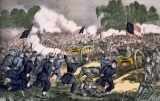
The Battle of Gettysburg, fought in, and around the town of Gettysburg, PennsylvaniaGettysburg, Pennsylvania

Gettysburg is a borough 38 miles south by southwest of Harrisburg in Adams County, Pennsylvania, USA, of which it is the co...
, as part of the Gettysburg CampaignGettysburg Campaign

The Gettysburg Campaign was a series of battles fought in June and July 1863, during the American Civil War....
, was the battle with the largest number of casualties in the American Civil WarAmerican Civil War Overview

The American Civil War was a sectional conflict in the United States of America between the federal government and 11 Sout...
 and is frequently cited as the war's turning pointTurning point of the American Civil War

There is widespread disagreement over the turning point of the American Civil War....
. UnionUnion Army

The Union Army refers to the United States Army during the American Civil War....
  Maj. Gen.Major General

Major General or Major-General is a military rank used in many countries....
 George Gordon Meade's Army of the PotomacArmy of the Potomac

The Army of the Potomac was the major Union Army in the Eastern Theater of the American Civil War....
 defeated attacks by ConfederateConfederate States Army

The Confederate States Army was formed in February 1861 to defend the Confederate States of America, which had itself been f...
 General Robert E. LeeRobert E. Lee

Robert Edward Lee was a career U.S....
's Army of Northern VirginiaArmy of Northern Virginia

The Army of Northern Virginia was the primary military force of the Confederate States of America in the Eastern Theater of...
, ending Lee's invasion of the NorthNorthern United States

The Northern United States or simply The North, is a region in the United States of America....
.

Following his success at ChancellorsvilleBattle of Chancellorsville

The Battle of Chancellorsville was a major battle of the American Civil War, fought from April 30 to May 6, 1863....
 in May 1863, Lee led his army through the Shenandoah ValleyShenandoah Valley

The Shenandoah Valley region of western Virginia, from Winchester to Staunton, is bounded by the Blue Ridge Mountains to the...
 for his second invasion of the North, hoping to reach as far as Harrisburg, PennsylvaniaHarrisburg, Pennsylvania

Harrisburg is the capital of the Commonwealth of Pennsylvania, United States....
, or even PhiladelphiaPhiladelphia, Pennsylvania

Philadelphia, colloquially referred to as Philly, and known as The City of Brotherly Love is the fifth most pop...
, and to influence Northern politicians to give up their prosecution of the war. Prodded by PresidentPresident of the United States

The President of the United States of America is the head of state of the United States....
 Abraham LincolnAbraham Lincoln

Abraham Lincoln , sometimes called Abe Lincoln and nicknamed Honest Abe, the Rail Splitter, and the Gre...
, Maj. Gen. Joseph HookerJoseph Hooker

Joseph Hooker, known as "Fighting Joe", was a career U.S....
 moved his army in pursuit, but was relieved just three days before the battle and replaced by Meade.

The two armies began to collide at Gettysburg on July 1, 1863, as Lee urgently concentrated his forces there.


Discussion
Ask a question about 'Battle of Gettysburg'
Start a new discussion about 'Battle of Gettysburg'
Answer questions from other users
Full Discussion Forum


Timeline

1863   3 - American Civil War: Union forces under George G. Meade turn back a Confederate invasion by Robert E. Lee at the Battle of Gettysburg, the largest battle of the war. 28,000 Confederate casualties, 23,000 Union.

1913   Commemoration of the 50th anniversary of the Battle of Gettysburg draws thousands of United States Civil War veterans and their families to Gettysburg, Pennsylvania

1938   The last reunion of the Blue and Gray commemorates the 75th anniversary of the Battle of Gettysburg in Gettysburg, Pennsylvania.


Encyclopedia


The Battle of Gettysburg, fought in, and around the town of Gettysburg, PennsylvaniaGettysburg, Pennsylvania

Gettysburg is a borough 38 miles south by southwest of Harrisburg in Adams County, Pennsylvania, USA, of which it is the co...
, as part of the Gettysburg CampaignGettysburg Campaign

The Gettysburg Campaign was a series of battles fought in June and July 1863, during the American Civil War....
, was the battle with the largest number of casualties in the American Civil WarAmerican Civil War Overview

The American Civil War was a sectional conflict in the United States of America between the federal government and 11 Sout...
 and is frequently cited as the war's turning pointTurning point of the American Civil War

There is widespread disagreement over the turning point of the American Civil War....
. UnionUnion Army

The Union Army refers to the United States Army during the American Civil War....
  Maj. Gen.Major General

Major General or Major-General is a military rank used in many countries....
 George Gordon Meade's Army of the PotomacArmy of the Potomac

The Army of the Potomac was the major Union Army in the Eastern Theater of the American Civil War....
 defeated attacks by ConfederateConfederate States Army

The Confederate States Army was formed in February 1861 to defend the Confederate States of America, which had itself been f...
 General Robert E. LeeRobert E. Lee

Robert Edward Lee was a career U.S....
's Army of Northern VirginiaArmy of Northern Virginia

The Army of Northern Virginia was the primary military force of the Confederate States of America in the Eastern Theater of...
, ending Lee's invasion of the NorthNorthern United States

The Northern United States or simply The North, is a region in the United States of America....
.

Following his success at ChancellorsvilleBattle of Chancellorsville

The Battle of Chancellorsville was a major battle of the American Civil War, fought from April 30 to May 6, 1863....
 in May 1863, Lee led his army through the Shenandoah ValleyShenandoah Valley

The Shenandoah Valley region of western Virginia, from Winchester to Staunton, is bounded by the Blue Ridge Mountains to the...
 for his second invasion of the North, hoping to reach as far as Harrisburg, PennsylvaniaHarrisburg, Pennsylvania

Harrisburg is the capital of the Commonwealth of Pennsylvania, United States....
, or even PhiladelphiaPhiladelphia, Pennsylvania

Philadelphia, colloquially referred to as Philly, and known as The City of Brotherly Love is the fifth most pop...
, and to influence Northern politicians to give up their prosecution of the war. Prodded by PresidentPresident of the United States

The President of the United States of America is the head of state of the United States....
 Abraham LincolnAbraham Lincoln

Abraham Lincoln , sometimes called Abe Lincoln and nicknamed Honest Abe, the Rail Splitter, and the Gre...
, Maj. Gen. Joseph HookerJoseph Hooker

Joseph Hooker, known as "Fighting Joe", was a career U.S....
 moved his army in pursuit, but was relieved just three days before the battle and replaced by Meade.

The two armies began to collide at Gettysburg on July 1, 1863, as Lee urgently concentrated his forces there. Low ridges to the northwest of town were defended initially by a Union cavalry division, which was soon reinforced with two corpsCorps

A corps is either a large military unit or formation, an administrative grouping of troops within an army with a common func...
 of Union infantry. However, two large Confederate corps assaulted them from the northwest and north, collapsing the hastily developed Union lines, sending the defenders retreating through the streets of town to the hills just to the south.

On the second day of battle, most of both armies had assembled. The Union line was laid out in a defensive formation resembling a fishhook. Lee launched a heavy assault on the Union left flank, and fierce fighting raged at Little Round TopLittle Round Top

Little Round Top is the smaller of two rocky hills south of Gettysburg, Pennsylvania....
, the WheatfieldBattle of Gettysburg, Second Day

In the Second Day of the Battle of Gettysburg, Confederate General Robert E....
, Devil's DenDevil's Den

Devil's Den is the nickname for a terrain feature south of Gettysburg, Pennsylvania, that was the site of fierce fighting at...
, and the Peach OrchardBattle of Gettysburg, Second Day

In the Second Day of the Battle of Gettysburg, Confederate General Robert E....
. On the Union right, demonstrations escalated into full-scale assaults on Culp's HillCulp's Hill

Culp's Hill is a key terrain feature in Gettysburg, Pennsylvania, overlooking the main downtown area from the southeast....
 and Cemetery HillCemetery Hill

Cemetery Hill is a key terrain feature in Gettysburg, Pennsylvania, the northernmost extent of Cemetery Ridge....
. Across the battlefield, despite significant losses, the Union defenders held their lines.

On the third day of battle, July 3, fighting resumed on Culp's Hill, and cavalry battles raged to the east and south, but the main event was a dramatic infantry assault by 12,500 Confederates against the center of the Union line on Cemetery RidgeCemetery Ridge

Cemetery Ridge is a geographic feature in Gettysburg National Military Park south of the town of Gettysburg, Pennsylvania, ...
. Pickett's ChargePickett's Charge

Pickett's Charge was a disastrous infantry assault ordered by Confederate General Robert E....
 was repulsed by Union rifleFacts About Civil War rifles

Civil War Rifles were of many kinds....
 and artillery fire at great losses to the Confederate army. Lee led his army on a torturous retreat back to Virginia. Between 46,000 and 51,000 Americans were casualties in the three-day battle. That November, President Lincoln used the dedication ceremony for the Gettysburg National CemeteryGettysburg National Cemetery

Gettysburg National Cemetery is located on Cemetery Hill in Gettysburg, Pennsylvania....
 to honor the fallen and redefine the purpose of the war in his historic Gettysburg AddressGettysburg Address

The Gettysburg Address is the most famous speech of U.S....
.

Background and movement to battle

Shortly after the Army of Northern Virginia won a decisive victory over the Army of the Potomac at the Battle of ChancellorsvilleBattle of Chancellorsville

The Battle of Chancellorsville was a major battle of the American Civil War, fought from April 30 to May 6, 1863....
, Robert E. Lee decided upon a second invasion of the North (the first was the unsuccessful Maryland CampaignMaryland Campaign

and eventually attacked it near [[Sharpsburg, Maryland...
 of September 1862). Such a move would upset FederalUnion (American Civil War)

During the American Civil War, the Union was a name used to refer to the United States, the twenty-three northern states tha...
 plans for the summer campaigning season and possibly relieve the besieged Confederate garrison at VicksburgVicksburg, Mississippi Summary

Vicksburg is a city in Warren County, Mississippi, 234 miles north by west of New Orleans on the Mississippi and Yazoo river...
. It would allow the Confederates to live off the bounty of the rich Northern farms while giving war-ravaged VirginiaVirginia

The Commonwealth of Virginia is one of the original thirteen colonies of the United States that revolted against British ru...
 a much needed rest. In addition, Lee's 72,000-man army could threaten Philadelphia, BaltimoreBaltimore, Maryland

Baltimore is an independent city located in the U.S....
, and WashingtonWashington, D.C.

Washington, D.C. is the capital city of the United States of America....
, and possibly strengthen the growing peace movement in the North.

Thus, on June 3, Lee's army began to shift northward from Fredericksburg, VirginiaFredericksburg, Virginia

Fredericksburg is an independent city in the U.S....
. In order to attain more efficiency in his commands, Lee had reorganized his two large corps into three new corps. Lt. Gen.Lieutenant General (United States)

In three branches of the United States Army, United States Marine Corps and United States Air Force, a Lieutenant General ma...
 James LongstreetJames Longstreet

James Longstreet was one of the foremost Confederate generals of the American Civil War, and later enjoyed a successful pos...
 retained command of his First Corps. The old corps of deceased Thomas J. "Stonewall" JacksonStonewall Jackson

Thomas Jonathan "Stonewall" Jackson was a Confederate general during the American Civil War....
 was divided into two, with the Second Corps going to Lt. Gen. Richard S. EwellRichard S. Ewell

Richard Stoddert Ewell was a career U.S....
 and the new Third Corps to Lt. Gen. A.P. Hill. The Cavalry Corps was commanded by Maj. Gen. J.E.B. StuartJ.E.B. Stuart

James Ewell Brown Stuart was an American soldier from Virginia and a Confederate Army general during the American Civil War...
.

The Union Army of the Potomac, under Maj. Gen. Joseph Hooker, consisted of seven infantry corps, a cavalry corps, and an Artillery Reserve, for a combined strength of about 94,000 men. However, President Lincoln replaced Hooker with Maj. Gen. George Gordon Meade, a PennsylvaniaPennsylvania

The Commonwealth of Pennsylvania is a state in the northeastern part of the United States....
n, because of Hooker's defeat at ChancellorsvilleBattle of Chancellorsville

The Battle of Chancellorsville was a major battle of the American Civil War, fought from April 30 to May 6, 1863....
 and his timid response to Lee's second invasion north of the Potomac RiverPotomac River

The Potomac River flows into the Chesapeake Bay, located along the mid-Atlantic coast of the United States ....
.

The first major action of the campaign took place on June 9 between the opposing cavalry forces at Brandy StationBattle of Brandy Station Overview

The Battle of Brandy Station was the largest predominantly cavalry engagement of the American Civil War....
, near Culpeper, VirginiaCulpeper, Virginia

olspan=2| Culpeper, VA|-|colspan=2||-...
. The Confederate cavalry under Stuart was surprised and nearly routed by the Union I Corps, but Stuart eventually prevailed. The battle, the largest cavalry engagement of the war, proved that for the first time, the Union horse soldier was equal to his Southern counterpart.

By mid-June, the Army of Northern Virginia was poised to cross the Potomac River and enter MarylandMaryland

Maryland , is a Mid-Atlantic state located on the East Coast of the United States and is classified by the U.S....
. After defeating the Federal garrisons at WinchesterBattle of Winchester II

The Second Battle of Winchester was fought June 13 – June 15 1863, in Frederick County and Winchester, Virginia, as pa...
 and MartinsburgMartinsburg, West Virginia

Martinsburg is a city in Berkeley County, West Virginia, USA....
, Ewell's Second Corps began crossing the river on June 15. Hill's and Longstreet's corps followed on June 24 and June 25. Hooker's army pursued, keeping between the U.S. capital and Lee's army. The Federals crossed the Potomac from June 25 to June 27.

Lee gave strict orders to his army to minimize any negative impacts on the civilian population. Food, horses, and other supplies were generally not seized outright, although quartermasters reimbursing northern farmers and merchants using Confederate money were not well received. Various towns, most notably York, PennsylvaniaYork, Pennsylvania

York, known as the White Rose City, is a city located in south-central Pennsylvania....
, were required to pay indemnities in lieu of supplies, under threat of destruction. The most controversial of the Confederate actions during the invasion was the seizure of some forty northern African Americans, a few of whom were escaped slavesHistory of slavery in the United States

*Frederick Douglass - Nation's most powerful anti-slavery speaker, a former slave....
 but most freemen. They were sent south into slavery under guard.

On June 26, elements of Maj. Gen. Jubal Early's division of Ewell's Corps occupied the town of Gettysburg after chasing off newly raised Pennsylvania militiaMilitia

A militia is a group of citizens organized to provide paramilitary service....
 in a series of minor skirmishes. Early laid the borough under tribute but did not collect any significant supplies. Soldiers burned several railroad cars and a covered bridgeCovered bridge Summary

A covered bridge is a bridge, often single-lane, with enclosed sides and a roof....
, and they destroyed nearby rails and telegraph lines. The following morning, Early departed for adjacent York CountyYork County, Pennsylvania

York County is a county located in the U.S....
.

Meanwhile, in a controversial move, Lee allowed J.E.B. Stuart to take a portion of the army's cavalry and ride around the east flank of the Union army. Lee's orders gave Stuart much latitude, and both generals share the blame for the long absence of Stuart's cavalry, as well as for the failure to assign a more active role to the cavalry left with the army. Stuart and his three best brigades were absent from the army during the crucial phase of the approach to Gettysburg and the first two days of battle. By June 29, Lee's army was strung out in an arc from ChambersburgChambersburg, Pennsylvania

Chambersburg is a borough in Franklin County, Pennsylvania, 52 miles southwest of Harrisburg in the Cumberland Valley....
 (28 miles (45 km) northwest of Gettysburg) to CarlisleCarlisle, Pennsylvania

Carlisle is a borough in Cumberland County, Pennsylvania, 18 miles west by southwest of Harrisburg, the State capital....
 (30 miles (48 km) north of Gettysburg) to near HarrisburgHarrisburg, Pennsylvania

Harrisburg is the capital of the Commonwealth of Pennsylvania, United States....
 and WrightsvilleWrightsville, Pennsylvania

Wrightsville is a borough in York County, Pennsylvania, United States....
 on the Susquehanna RiverSusquehanna River Overview

The Susquehanna River is a river in the northeastern United States....
.

In a dispute over the use of the forces defending the Harpers FerryHarpers Ferry, West Virginia

Harpers Ferry is a town in Jefferson County, West Virginia, situated on the banks of the Potomac and Shenandoah Rivers where...
 garrison, Hooker offered his resignation, and Abraham LincolnFacts About Abraham Lincoln

Abraham Lincoln , sometimes called Abe Lincoln and nicknamed Honest Abe, the Rail Splitter, and the Gre...
 and General-in-Chief Henry W. Halleck, who were looking for an excuse to get rid of him, immediately accepted. They replaced him early on the morning of June 28 with Maj. Gen. George Gordon Meade, at the time commander of the V CorpsV Corps (ACW)

The V Corps was a unit of the Union Army of the Potomac during the American Civil War....
.

On June 29, when Lee learned that the Army of the Potomac had crossed its namesake river, he ordered a concentration of his forces around CashtownCashtown-McKnightstown, Pennsylvania

Cashtown redirects here, for other uses, see Cashtown...
, located at the eastern base of South MountainFacts About South Mountain (Maryland and Pennsylvania)

South Mountain is a long mountain ridge in Maryland and Pennsylvania which comprises a northern extension of the Blue Ridge ...
 and eight miles (13 km) west of Gettysburg. On June 30, while part of Hill's Corps was in Cashtown, one of Hill's brigades, North Carolinians under Brig. Gen.Brigadier General

Brigadier General is the lowest rank of general officer in some countries, usually ranking just above Colonel and just below...
 J. Johnston PettigrewJ. Johnston Pettigrew

James Johnston Pettigrew was an author, lawyer, linguist, diplomat, and a Confederate general in the American Civil War....
, ventured toward Gettysburg. The memoirs of Maj. Gen. Henry HethHenry Heth

Henry Heth was a career U.S. Army officer and a Confederate general in the American Civil War....
, Pettigrew's division commander, claimed that Pettigrew was in search of a large supply of shoes in town, but this explanation may have been devised in retrospect to justify an overly heavy reconnaissance force.

When Pettigrew's troops approached Gettysburg on June 30, they noticed Union cavalry under Brig. Gen. John BufordJohn Buford

John Buford, Jr. was an Union cavalry officer during the American Civil War, with a prominent role at the start of the Battl...
 arriving south of town, and Pettigrew returned to Cashtown without engaging them. When Pettigrew told Hill and Heth about what he had seen, neither general believed that there was a substantial Federal force in or near the town, suspecting that it had been only Pennsylvania militia. Despite General Lee's order to avoid a general engagement until his entire army was concentrated, Hill decided to mount a significant reconnaissance in forceReconnaissance

Reconnaissance is the military term for the active gathering of information about an enemy, or other conditions, by physical...
 the following morning to determine the size and strength of the enemy force in his front. Around 5 a.m. on Wednesday, July 1, two brigades of Heth's division advanced to Gettysburg.

First day of battle


General Buford realized the importance of the high ground directly to the south of Gettysburg, knowing that if the Confederates could gain control of the heights, Meade's army would have difficulty dislodging them. He decided to utilize three ridges west of Gettysburg: Herr Ridge, McPherson Ridge, and Seminary Ridge (proceeding west to east toward the town). These were appropriate terrain for a delaying action by his small division against superior Confederate infantry forces, meant to buy time awaiting the arrival of Union infantrymen who could occupy the strong defensive positions south of town at Cemetery HillFacts About Cemetery Hill

Cemetery Hill is a key terrain feature in Gettysburg, Pennsylvania, the northernmost extent of Cemetery Ridge....
, Cemetery RidgeCemetery Ridge Overview

Cemetery Ridge is a geographic feature in Gettysburg National Military Park south of the town of Gettysburg, Pennsylvania, ...
, and Culp's HillCulp's Hill

Culp's Hill is a key terrain feature in Gettysburg, Pennsylvania, overlooking the main downtown area from the southeast....
.

Heth's division advanced with two brigades forward, commanded by Brig. Gens. James J. ArcherJames J. Archer

James Jay Archer was a lawyer and an officer in the United States Army during the Mexican War and in the Confederate States ...
 and Joseph R. DavisJoseph R. Davis

Joseph Robert Davis was a Confederate general during the American Civil War and nephew of Confederate President Jefferson D...
. They proceeded easterly in columns along the Chambersburg Pike. Three miles (5 km) west of town, about 7:30 a.m. on July 1, Heth's two brigades met light resistance from vedetteVedette

The French military term vedette, migrated into English and other languages to refer to a mounted sentry or outpost, who has...
s of Union cavalry, and deployed into line. According to the lore, the first Union soldier to fire was Lt. Marcellus JonesFacts About Marcellus Jones

Marcellus Ephraim Jones is widely regarded as the soldier who fired the first shot at the Battle of Gettysburg ....
. In 1886 Lt. Jones returned to Gettysburg to mark the spot where he fired the first shot with a monument. Eventually, Heth's men reached dismounted troopers from Col. William Gamble'sWilliam Gamble (USA)

William Gamble was a civil engineer and a Union cavalry officer in the American Civil War. ...
 cavalry brigade, who raised determined resistance and delaying tactics from behind fence posts with fire from their breechloading carbineCarbine

A carbine is a firearm similar to, but generally shorter and less powerful than, a rifle or musket of a given period....
s. By 10:20 a.m., the Confederates had pushed the Union cavalrymen east to McPherson Ridge, when the vanguard of the I CorpsI Corps (ACW)

I Corps was the designation of three different corps-sized units in the Union Army during the American Civil War....
 (Maj. Gen. John F. ReynoldsJohn F. Reynolds

John Fulton Reynolds was a career U.S....
) finally arrived.

North of the pike, Davis gained a temporary success against Brig. Gen. Lysander CutlerLysander Cutler

Lysander Cutler was a businessman, educator, politician, and a Union Army general during the American Civil War....
's brigade but was repulsed with heavy losses in an action around an unfinished railroad bed cut in the ridge. South of the pike, Archer's brigade assaulted through Herbst (also known as McPherson's) Woods. The Federal Iron BrigadeFacts About Iron Brigade

The Iron Brigade was an infantry brigade in the Union Army during the American Civil War, consisting primarily of Western r...
 under Brig. Gen. Solomon MeredithSolomon Meredith

Solomon Meredith was a Union Army general in the American Civil War, gaining fame as the commander of the Iron Brigade of th...
 enjoyed initial success against Archer, capturing several hundred men, including Archer himself.

Early in the fighting, while General Reynolds was directing troop and artillery placements just to the east of the woods, he fell from his horse, killed by a bullet, which struck him behind the right ear. Maj. Gen. Abner DoubledayAbner Doubleday

Abner Doubleday , was a career U.S....
 assumed command. Fighting in the Chambersburg Pike area lasted until about 12:30 p.m. It resumed around 2:30 p.m., when Heth's entire division engaged, adding the brigades of Pettigrew and Col. John M. BrockenbroughJohn M. Brockenbrough

John Mercer Brockenbrough was a farmer and a Confederate colonel in the American Civil War....
.

As Pettigrew's North Carolina Brigade came on line, they flankedFacts About Flanking maneuver

In military tactics, a flanking maneuver, also called a attack, is an attack on the sides of an opposing force....
 the 19th Indiana and drove the Iron Brigade back. The 26th North Carolina (the largest regiment in the army with 839 men) lost heavily, leaving the first day's fight with around 212 men. By the end of the three-day battle, they had about 152 men standing, the highest casualty percentage for one battle of any regiment, North or South. Slowly the Iron Brigade was pushed out of the woods toward Seminary Ridge. Hill added Maj. Gen. William Dorsey PenderWilliam Dorsey Pender

William Dorsey Pender was one of the youngest, and most promising, generals fighting for the Confederacy in the American Civ...
's division to the assault, and the I Corps was driven back through the grounds of the Lutheran SeminaryFacts About Lutheran Theological Seminary at Gettysburg

The Lutheran Theological Seminary at Gettysburg, Pennsylvania, is America's oldest Lutheran Seminary....
 and Gettysburg streets.

As the fighting to the west proceeded, two divisions of Ewell's Second Corps, marching west toward Cashtown in accordance with Lee's order for the army to concentrate in that vicinity, turned south on the Carlisle and Harrisburg Roads toward Gettysburg, while the Union XI CorpsXI Corps (ACW)

The XI Corps was a corps of the Union Army during the American Civil War, best remembered for its humiliating defeats at the...
 (Maj. Gen. Oliver O. HowardOliver O. Howard

Oliver Otis Howard was a career U.S....
) raced north on the Baltimore Pike and Taneytown Road. By early afternoon, the Federal line ran in a semi-circle west, north, and northeast of Gettysburg.

However, the Federals did not have enough troops; Cutler, who was deployed north of the Chambersburg Pike, had his right flank in the air. The leftmost division of the XI Corps was unable to deploy in time to strengthen the line, so Doubleday was forced to throw in reserve brigades to salvage his line.

Around 2:00 p.m., the Second Corps divisions of Maj. Gens. Robert E. RodesRobert E. Rodes

Robert Emmett Rodes was a railroad civil engineer and a promising young Confederate general in the American Civil War, kille...
 and Jubal Early assaulted and out-flanked the Union I and XI Corps positions north and northwest of town. The brigades of Col. Edward A. O'NealEdward A. O'Neal

Edward Asbury O'Neal was a Confederate general during the American Civil War....
 and Brig. Gen. Alfred IversonAlfred Iverson

Wikipedia has several articles about people named Alfred Iverson:...
 suffered severe losses assaulting the I Corps division of Brig. Gen. John C. RobinsonJohn C. Robinson

John Cleveland Robinson was a Union Army general in the American Civil War....
 south of Oak Hill. Early's division profited from a blunder made by Brig. Gen. Francis C. BarlowFrancis C. Barlow

Francis Channing Barlow was a lawyer, politician, and Union general during the American Civil War....
, when he advanced his XI Corps division to Blocher's Knoll (directly north of town and now known as Barlow's Knoll); this represented a salient in the corps line, susceptible to attack from multiple sides, and Early's troops overran his division, which constituted the right flank of the Union Army's position. Barlow was wounded and captured in the attack.

As Federal positions collapsed both north and west of town, Gen. Howard ordered a retreat to the high ground south of town at Cemetery Hill, where he had left the division of Brig. Gen. Adolph von SteinwehrAdolph von Steinwehr

Baron Adolph Wilhelm August Friedrich von Steinwehr was a Prussian army officer who emigrated to the United States, became ...
 as a reserve. Maj. Gen. Winfield S. Hancock assumed command of the battlefield, sent by Meade when he heard that Reynolds had been killed. Hancock, commander of the II CorpsII Corps (ACW)

There were five corps in the Union Army designated as II Corps during the American Civil War....
 and his most trusted subordinate, was ordered to take command of the field and to determine whether Gettysburg was an appropriate place for a major battle. Hancock told Howard, who was technically superior in rank, "I think this the strongest position by nature upon which to fight a battle that I ever saw." When Howard agreed, Hancock concluded the discussion: "Very well, sir, I select this as the battle-field." Hancock's determination had a morale-boosting effect on the retreating Union soldiers, but he played no direct tactical role on the first day.

Gen. Lee understood the defensive potential to the Union if they held this high ground. He sent orders to Ewell that Cemetery Hill be taken "if practicable." Ewell chose not to attempt the assault; this decision is considered by historians to be a great missed opportunity.

The first day at Gettysburg, more significant than simply a prelude to the bloody second and third days, ranks as the 23rd biggest battle of the war by number of troops engaged. About one quarter of Meade's army (22,000 men) and one third of Lee's army (27,000) were engaged.

Second day of battle

Plans and movement to battle

Throughout the evening of July 1 and morning of July 2, most of the remaining infantry of both armies arrived on the field, including the Union IIII Corps (ACW)

There were five corps in the Union Army designated as II Corps during the American Civil War....
, IIIIII Corps (ACW)

There were four formations in the Union Army designated as III Corps during the American Civil War....
, VV Corps (ACW)

The V Corps was a unit of the Union Army of the Potomac during the American Civil War....
, VIVI Corps (ACW)

The VI Corps was a corps of the Union Army during the American Civil War....
, and XII CorpsXII Corps (ACW)

The XII Corps was a corps of the Union Army during the American Civil War....
. Longstreet's third division, commanded by George PickettGeorge Pickett

George Edward Pickett was a career U.S....
, had begun the march from Chambersburg early in the morning; it did not arrive until late on July 2.

The Union line ran from Culp's Hill southeast of the town, northwest to Cemetery Hill just south of town, then south for nearly two miles (3 km) along Cemetery Ridge, terminating just north of Little Round Top. Most of the XII Corps was on Culp's Hill; the remnants of I and XI Corps defended Cemetery Hill; II Corps covered most of the northern half of Cemetery Ridge; and III Corps was ordered to take up a position to its flank. The shape of the Union line is popularly described as a "fishhook" formation. The Confederate line paralleled the Union line about a mile (1,600 m) to the west on Seminary Ridge, ran east through the town, then curved southeast to a point opposite Culp's Hill. Thus, the Federal army had interior lines, while the Confederate line was nearly five miles (8 km) in length.

Lee's battle plan for July 2 called for Longstreet's First Corps to position itself stealthily to attack the Union left flank, facing northeast astraddle the Emmitsburg Road, and to roll up the Federal line. The attack sequence was to begin with Maj. Gens. John Bell HoodJohn Bell Hood

John Bell Hood was a Confederate general during the American Civil War....
's and Lafayette McLawsLafayette McLaws

Lafayette McLaws was a U.S. Army officer and a Confederate general in the American Civil War. ...
's divisions, followed by Maj. Gen. Richard H. AndersonRichard H. Anderson

Richard Heron Anderson was a career U.S....
's division of Hill's Third Corps. The progressive en echelonEchelon formation

An echelon formation is a military formation in which members are arranged diagonally....
 sequence of this attack would prevent Meade from shifting troops from his center to bolster his left. At the same time, Maj. Gen. Edward "Allegheny" Johnson'sFacts About Edward Johnson (general)

Edward Johnson, also known as Allegheny Johnson, was a U.S....
 and Jubal Early's Second Corps divisions were to make a "demonstration" against Culp's and Cemetery Hills (again, to prevent the shifting of Federal troops), and to turn the demonstration into a full-scale attack if a favorable opportunity presented itself.

Lee's plan, however, was based on faulty intelligence, exacerbated by Stuart's continued absence from the battlefield. Instead of moving beyond the Federals' left and attacking their flank, Longstreet's left division, under McLaws, would face Maj. Gen. Daniel SicklesDaniel Sickles

Daniel Edgar Sickles was a colorful and controversial American politician, Union general in the American Civil War, and dipl...
's III Corps directly in their path. Sickles was dissatisfied with the position assigned him on the southern end of Cemetery Ridge. Seeing higher ground more favorable to artillery positions a half mile (800 m) to the west, he advanced his corps—without orders—to the slightly higher ground along the Emmitsburg Road. The new line ran from Devil's Den, northwest to the Sherfy farm's Peach Orchard, then northeast along the Emmitsburg Road to south of the Codori farm. This created an untenable salient at the Peach Orchard; Brig. Gen. Andrew A. HumphreysAndrew A. Humphreys

Andrew Atkinson Humphreys, was a career U.S....
's division (in position along the Emmitsburg Road) and Maj. Gen. David B. BirneyDavid B. Birney Summary

David Bell Birney was a businessman, lawyer, and a Union general in the American Civil War. ...
's division (to the south) were subject to attacks from two sides and were spread out over a longer front than their small corps could defend effectively.

Longstreet's attack was to be made as early as practicable; however, Longstreet got permission from Lee to await the arrival of one of his brigades, and while marching to the assigned position, his men came within sight of a Union signal station on Little Round Top. Countermarching to avoid detection wasted much time, and Hood's and McLaws's divisions did not launch their attacks until just after 4 p.m. and 5 p.m., respectively.

Attacks on the Union left flank

As Longstreet's divisions slammed into the Union III Corps, Meade was forced to send 20,000 reinforcements in the form of the entire V Corps, Brig. Gen. John C. CaldwellJohn C. Caldwell

John Curtis Caldwell was a teacher, a Union general in the American Civil War, and an American diplomat....
's division of the II Corps, most of the XII Corps, and small portions of the newly arrived VI Corps. The Confederate assault deviated from Lee's plan since Hood's division moved more easterly than intended, losing its alignment with the Emmitsburg Road, attacking Devil's Den and Little Round Top. McLaws, coming in on Hood's left, drove multiple attacks into the thinly stretched III Corps in the WheatfieldBattle of Gettysburg, Second Day

In the Second Day of the Battle of Gettysburg, Confederate General Robert E....
 and overwhelmed them in Sherfy's Peach OrchardBattle of Gettysburg, Second Day

In the Second Day of the Battle of Gettysburg, Confederate General Robert E....
. McLaws's attack eventually reached Plum Run Valley (the "Valley of Death") before being beaten back by the Pennsylvania ReservesPennsylvania Reserves

The Pennsylvania Reserves was an infantry division during the American Civil War, noted for its famous commanders and high c...
 division of the V Corps, moving down from Little Round Top. The III Corps was virtually destroyed as a combat unit in this battle, and Sickles's leg was amputated after it was shattered by a cannonball. Caldwell's division was destroyed piecemeal in the Wheatfield. Anderson's division assault on McLaws's left, starting around 6 p.m., reached the crest of Cemetery Ridge, but they could not hold the position in the face of counterattacks from the II Corps, including an almost suicidal counterattack by the 1st Minnesota1st Minnesota Volunteer Infantry

The 1st Regiment, Minnesota Volunteer Infantry was a volunteer infantry regiment that served in the Union Army during the Am...
 against a Confederate brigade, ordered in desperation by Hancock.

As fighting raged in the Wheatfield and Devil's Den, Col. Strong VincentStrong Vincent

Strong Vincent was a lawyer who became famous as a U.S....
 of V Corps had a precarious hold on Little Round Top, an important hill at the extreme left of the Union line. His brigade of four relatively small regiments was able to resist repeated assaults by Brig. Gen. Evander Law's brigade of Hood's division. Meade's chief engineer, Brig. Gen. Gouverneur K. WarrenGouverneur K. Warren

Gouverneur Kemble Warren was a civil engineer and prominent general in the Union Army during the American Civil War....
, had realized the importance of this position, and dispatched Vincent's brigade, an artillery battery, and the 140th New York to occupy Little Round Top mere minutes before Hood's troops arrived. The defense of Little Round Top with a bayonet charge by the 20th Maine20th Maine Volunteer Infantry Regiment Overview

The 20th Maine Volunteer Infantry Regiment was a combat unit of the United States Army during the American Civil War, most f...
 was one of the most fabled episodes in the Civil War and propelled Col. Joshua L. Chamberlain into prominence after the war.

Attacks on the Union right flank

About 7:00 p.m., the Second Corps' attack by Johnson's division on Culp's Hill got off to a late start. Most of the hill's defenders, the Union XII Corps, had been sent to the left to defend against Longstreet's attacks, and the only portion of the corps remaining on the hill was a brigade of New Yorkers under Brig. Gen. George S. GreeneGeorge S. Greene

George Sears Greene was a civil engineer and a Union general during the American Civil War....
. Because of Greene's insistence on constructing strong defensive works, and with reinforcements from the I and XI Corps, Greene's men held off the Confederate attackers, although the Southerners did capture a portion of the abandoned Federal works on the lower part of Culp's Hill.

Just at dark, two of Jubal Early's brigades attacked the Union XI Corps positions on East Cemetery Hill where Col. Andrew L. HarrisAndrew L. Harris

Andrew Lintner Harris was one of the heroes of the Battle of Gettysburg and the last Civil War general to serve as a governo...
 of the 2nd Brigade, 1st Division, came under a withering attack, losing half his men; however, Early failed to support his brigades in their attack, and Ewell's remaining division, that of Maj. Gen. Robert E. RodesRobert E. Rodes

Robert Emmett Rodes was a railroad civil engineer and a promising young Confederate general in the American Civil War, kille...
, failed to aid Early's attack by moving against Cemetery Hill from the west. The Union army's interior lines enabled its commanders to shift troops quickly to critical areas, and with reinforcements from II Corps, the Federal troops retained possession of East Cemetery Hill, and Early's brigades were forced to withdraw.

Jeb Stuart and his three cavalry brigades arrived in Gettysburg around noon but had no role in the second day's battle. Brig. Gen. Wade HamptonWade Hampton III

Wade Hampton III was a Confederate cavalry leader during the American Civil War and afterwards a politician from South Carol...
's brigade fought a minor engagement with George Armstrong CusterGeorge Armstrong Custer

George Armstrong Custer was a United States Army cavalry commander in the American Civil War and the Indian Wars....
's MichiganMichigan

Michigan is a Midwestern state of the United States, located in the east north central portion of the country....
 cavalry near HunterstownBattle of Hunterstown

The Battle of Hunterstown was a minor cavalry engagement in Adams County, Pennsylvania, on July 2, 1863, during the Gettysbu...
 to the northeast of Gettysburg.

Third day of battle


General Lee wished to renew the attack on Friday, July 3, using the same basic plan as the previous day: Longstreet would attack the Federal left, while Ewell attacked Culp's Hill. However, before Longstreet was ready, Union XII Corps troops started a dawn artillery bombardment against the Confederates on Culp's Hill in an effort to regain a portion of their lost works. The Confederates attacked, and the second fight for Culp's Hill ended around 11 a.m., after some seven hours of bitter combat.

Lee was forced to change his plans. Longstreet would command Pickett's Virginia division of his own First Corps, plus six brigades from Hill's Corps, in an attack on the Federal II Corps position at the right center of the Union line on Cemetery Ridge. Prior to the attack, all the artillery the Confederacy could bring to bear on the Federal positions would bombard and weaken the enemy's line.

Around 1 p.m., from 150 to 170 Confederate guns began an artillery bombardment that was probably the largest of the war. In order to save valuable ammunition for the infantry attack that they knew would follow, the Army of the Potomac's artillery at first did not return the enemy's fire. After waiting about 15 minutes, about 80 Federal cannons added to the din. The Army of Northern Virginia was critically low on artillery ammunition, and the cannonade did not significantly affect the Union position. Around 3 p.m., the cannon fire subsided, and 12,500 Southern soldiers stepped from the ridgeline and advanced the three-quarters of a mile (1,200 m) to Cemetery Ridge in what is known to history as "Pickett's ChargePickett's Charge

Pickett's Charge was a disastrous infantry assault ordered by Confederate General Robert E....
". As the Confederates approached, there was fierce flanking artillery fire from Union positions on Cemetery Hill and north of Little Round Top, and musket and canister fire from Hancock's II Corps. Nearly one half of the attackers did not return to their own lines. Although the Federal line wavered and broke temporarily at a jog called the "Angle" in a low stone fence, just north of a patch of vegetation called the Copse of Trees, reinforcements rushed into the breach, and the Confederate attack was repulsed.

There were two significant cavalry engagements on July 3. Stuart was sent to guard the Confederate left flank and was to be prepared to exploit any success the infantry might achieve on Cemetery Hill by flanking the Federal right and hitting their trains and lines of communications. Three miles (5 km) east of Gettysburg, in what is now called "East Cavalry Field" (not shown on the accompanying map, but between the York and Hanover Roads), Stuart's forces collided with Federal cavalry: Brig. Gen. David McM. Gregg's division and George A. Custer's brigade. A lengthy mounted battle, including hand-to-hand sabre combat, ensued. Custer's charge, leading the 1st Michigan Cavalry, blunted the attack by Wade Hampton'sWade Hampton III

Wade Hampton III was a Confederate cavalry leader during the American Civil War and afterwards a politician from South Carol...
 brigade, blocking Stuart from achieving his objectives in the Federal rear. Meanwhile, after hearing news of the day's victory, Brig. Gen. Judson Kilpatrick launched a cavalry attack against the infantry positions of Longstreet's Corps southwest of Big Round TopBig Round Top

Big Round Top is the dominating terrain feature on the southern part of the Gettysburg Battlefield in Adams County, Pennsylv...
. Brig. Gen. Elon J. FarnsworthElon J. Farnsworth

Elon John Farnsworth was a Union Army cavalry general in the American Civil War, killed at the Battle of Gettysburg....
 protested against the futility of such a move but obeyed orders. Farnsworth was killed in the attack, and his brigade suffered significant losses.

Aftermath

The Confederate retreat

The armies stared at one another across the bloody fields on July 4, the same day that the VicksburgBattle of Vicksburg

The Battle of Vicksburg or Siege of Vicksburg was the final significant battle in the Vicksburg Campaign of the Americ...
 garrison surrendered to Maj. Gen. Ulysses S. GrantUlysses S. Grant

Ulysses S. Grant was an American soldier and politician who was elected the 18th President of the United States ....
. Lee reformed his lines into a defensive position, hoping that Meade would attack. The cautious Union commander, however, decided against the risk, a decision for which he would later be criticized. He did order a series of small probing actions, including sending the U.S. Regulars over a mile towards the right of the Confederate lines, but they withdrew under artillery fire and Meade decided not to press an attack. A series of sharp exchanges between the opposing skirmish lines merely added more names to the casualty lists. By mid-afternoon, the firing at Gettysburg had essentially stopped, and both armies began to collect their remaining wounded and bury some of the dead. A proposal by Lee for a prisoner exchange was rejected by Meade.

On July 5, in a driving rain, the bulk of the Army of Northern Virginia left Gettysburg on the Hagerstown Road; the Battle of Gettysburg was over, and the Confederates headed back to Virginia. Meade's army followed, although the pursuit was half-spirited. The recently rain-swollen Potomac trapped Lee's army on the north bank of the river for a time, but when the Federals finally caught up, the Confederates had forded the river. The rear-guard action at Falling Waters on July 14 ended the Gettysburg Campaign and added some more names to the long casualty lists, including General Pettigrew, who was mortally wounded.

In a brief letter to Maj. Gen. Henry W. Halleck written on July 7, Lincoln remarked on the two major Union victories at Gettysburg and Vicksburg. He continued:

Halleck then relayed the contents of Lincoln's letter to Meade in a telegram. However, despite repeated pleas from Lincoln and Halleck, which continued over the next week, Meade did not pursue Lee's army aggressively enough to destroy it before it crossed back over the Potomac River to safety in the South.

Reaction to the news of the Union victory

The news of the Union victory electrified the North. A headline in The Philadelphia InquirerThe Philadelphia Inquirer Overview

The Philadelphia Inquirer is a daily morning newspaper that serves the Philadelphia, Pennsylvania area....
proclaimed "VICTORY! WATERLOOBattle of Waterloo

The Battle of Waterloo, fought on June 18, 1815, was Napoleon Bonaparte's last battle....
 ECLIPSED!" New York diarist George Templeton Strong wrote:

Impact on the Confederacy

The Confederates had lost politically as well as militarily. During the final hours of the battle, Confederate Vice President Alexander StephensAlexander Stephens

Alexander Hamilton Stephens was Vice President of the Confederate States of America during the American Civil War....
 was approaching the Union lines at Norfolk, VirginiaNorfolk, Virginia

Norfolk is an independent city in the Commonwealth of Virginia in the United States of America....
, under a flag of truceWhite flag

White flags have had different meanings throughout history and depending on the locale....
. Although his formal instructions from Confederate President Jefferson DavisJefferson Davis

Jefferson Davis was an American statesman and advocate for slavery and, until he became president, for States' Rights....
 had limited his powers to negotiations on prisoner exchanges and other procedural matters, historian James M. McPhersonJames M. McPherson

James M. McPherson is an American Civil War historian, and is the George Henry Davis '86 Professor Emeritus of United States...
 speculates that he had informal goals of presenting peace overtures. Davis had hoped that Stephens would reach Washington from the south while Lee's victorious army was marching toward it from the north. President Lincoln, upon hearing of the Gettysburg results, refused Stephens's request to pass through the lines. Furthermore, when the news reached London, any lingering hopes of European recognition of the Confederacy were finally abandoned. Henry Adams wrote, "The disasters of the rebels are unredeemed by even any hope of success. It is now conceded that all idea of intervention is at an end."

Some economic historians have pointed to the fact that after the loss at Gettysburg and Vicksburg, the market for Confederate war bondWar bond Overview

War bonds were a form of savings bond used by many combatant nations to help fund World War I and World War II....
s dropped precipitously. "European investors gave Johnny Reb about a 42 percent chance of winning the war in early 1863 prior to the battle of Gettysburg. ... However, news of the severity of costly Confederate defeats
at Gettysburg/Vicksburg led to a sell-off in rebel bonds and the probability of a Southern
victory fell to about 15 percent by the end of 1863."

Casualties

The two armies had suffered between 46,000 and 51,000 casualties. Union casualties were 23,055 (3,155 killed, 14,531 wounded, 5,369 captured or missing). Confederate casualties are more difficult to estimate. Many authors cite about 28,000 overall casualties, but Busey and Martin's definitive 2005 work, Regimental Strengths and Losses, documents 23,231 (4,708 killed, 12,693 wounded, 5,830 captured or missing). The casualties for both sides during the entire campaign were 57,225. There was one documented civilian death during the battle: Ginnie Wade, 20 years old, was shot by a stray bullet that passed through her kitchen in town while she was making bread.

Nearly 8,000 had been killed outright; these bodies, lying in the hot summer sun, needed to be buried quickly. Over 3,000 horse carcasses were burned in a series of piles south of town; townsfolk became violently ill from the stench. The ravages of war would still be evident in Gettysburg more than four months later when, on November 19, the Soldiers' National Cemetery was dedicated. During this ceremony, President Abraham LincolnAbraham Lincoln

Abraham Lincoln , sometimes called Abe Lincoln and nicknamed Honest Abe, the Rail Splitter, and the Gre...
 with his Gettysburg AddressGettysburg Address

The Gettysburg Address is the most famous speech of U.S....
 re-dedicated the Union to the war effort.

Today, the Gettysburg National CemeteryGettysburg National Cemetery Summary

Gettysburg National Cemetery is located on Cemetery Hill in Gettysburg, Pennsylvania....
 and Gettysburg National Military ParkGettysburg Battlefield

The Gettysburg Battlefield was the site of the Battle of Gettysburg, fought July 1 to July 3, 1863, in and around the boroug...
 are maintained by the U.S. National Park Service as two of the nation's most revered historical landmarks.

Historical assessment

Assessment of Lee's leadership style

Throughout the campaign, General Lee seemed to have entertained the belief that his men were invincible; most of Lee's experiences with the army had convinced him of this, including the great victory at Chancellorsville in early May and the rout of the Union troops at Gettysburg on July 1. Although high morale plays an important role in military victory when other factors are equal, Lee could not refuse his army's desire to fight. To the detrimental effects of their collective blind faith was added the fact that the Army of Northern Virginia had many new and inexperienced commanders (Neither Hill nor Ewell, for instance, though capable division commanders, had commanded a corps before). It had recently lost Stonewall Jackson, one of its most competent offensive generals. Also, Lee's method of giving generalized orders and leaving it up to his lieutenants to work out the details contributed to his defeat. Although this method may have worked with Jackson, it proved inadequate when dealing with corps commanders unused to Lee's style of command. Lee faced dramatic differences in going from defender to invader—long supply lines, a hostile local population, and an imperative to force the enemy from its position. Lastly, after July 1, the Confederates were simply not able to coordinate their attacks. Lee faced a new and very dangerous opponent in George Meade, and the Army of the Potomac stood to the task and fought well on its home territory.

Further reading

  • Gottfried, Bradley M., The Maps of Gettysburg: An Atlas of the Gettysburg Campaign, June 3 – June 13, 1863, Savas Beatie, 2007, ISBN 978-1-932714-30-2.
  • Haskell, Frank AretasFrank A. Haskell

    Franklin Aretas Haskell was a Union Army officer during the American Civil War who was killed during the Battle of Cold Harb...
    , The Battle of Gettysburg, Kessinger Publishing, 2006, ISBN 978-1-4286-6012-0.
  • Huntington, Tom, Pennsylvania Civil War Trails: The Guide to Battle Sites, Monuments, Museums and Towns, Stackpole books, 2007, ISBN 978-0-8117-3379-3.
  • Paris, Louis-Philippe-Albert d'OrléansPhilippe, Comte de Paris

    Louis-Philippe Albert d'Orlans, Comte de Paris was the grandson of Louis Philippe I, King of the French....
    , , 1886, (online version by Digital Scanning, Inc., 1999), ISBN 1-58218-066-0.
  • Shaara, MichaelMichael Shaara

    Michael Shaara was a writer of science fiction, sports fiction, and historical fiction....
    , The Killer Angels: A Novel, David McKay Co., 1974, (reprinted by Ballantine Books, 2001), ISBN 978-0345444127.
  • Stackpole, Gen. Edward J., "They Met at Gettysburg", Stackpole Books, 1956, ISBN 0-8117-2089-6.

External links

  • Collection contains digitized paintings, photographs, and pamphlets of the Battle of Gettysburg