


Emancipation Proclamation

Encyclopedia
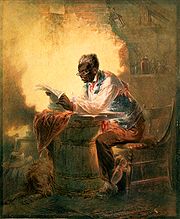
The Emancipation Proclamation is an executive order issued by United States President Abraham Lincoln
Abraham Lincoln
Abraham Lincoln was the 16th President of the United States, serving from March 1861 until his assassination in April 1865. He successfully led his country through a great constitutional, military and moral crisis – the American Civil War – preserving the Union, while ending slavery, and...
on January 1, 1863, during the American Civil War
American Civil War
The American Civil War was a civil war fought in the United States of America. In response to the election of Abraham Lincoln as President of the United States, 11 southern slave states declared their secession from the United States and formed the Confederate States of America ; the other 25...
using his war powers. It proclaimed the freedom of 3.1 million of the nation's 4 million slaves, and immediately freed 50,000 of them, with nearly all the rest freed as Union
Union (American Civil War)
During the American Civil War, the Union was a name used to refer to the federal government of the United States, which was supported by the twenty free states and five border slave states. It was opposed by 11 southern slave states that had declared a secession to join together to form the...
armies advanced. The Proclamation did not compensate the owners; it did not make the ex-slaves, called Freedmen, citizens.
On September 22, 1862, Lincoln announced that he would issue a formal emancipation of all slaves in any state of the Confederate States of America
Confederate States of America
The Confederate States of America was a government set up from 1861 to 1865 by 11 Southern slave states of the United States of America that had declared their secession from the U.S...
that did not return to Union control by January 1, 1863. None returned and the actual order, signed and issued January 1, 1863, took effect except in locations where the Union had already mostly regained control. The Proclamation made abolition a central goal of the war (in addition to reunion), outraged white Southerners who envisioned a race war, angered some Northern Democrats, energized anti-slavery forces, and weakened forces in Europe that wanted to intervene to help the Confederacy.
Total abolition of slavery was finalized by the Thirteenth Amendment
Thirteenth Amendment to the United States Constitution
The Thirteenth Amendment to the United States Constitution officially abolished and continues to prohibit slavery and involuntary servitude, except as punishment for a crime. It was passed by the Senate on April 8, 1864, passed by the House on January 31, 1865, and adopted on December 6, 1865. On...
which took effect in December 1865.
Authority
Lincoln issued the Proclamation under his authority as "Commander in ChiefCommander-in-Chief
A commander-in-chief is the commander of a nation's military forces or significant element of those forces. In the latter case, the force element may be defined as those forces within a particular region or those forces which are associated by function. As a practical term it refers to the military...
of the Army and Navy" under Article II, section 2 of the United States Constitution
United States Constitution
The Constitution of the United States is the supreme law of the United States of America. It is the framework for the organization of the United States government and for the relationship of the federal government with the states, citizens, and all people within the United States.The first three...
. As such, he had the martial power to suspend civil law in those states which were in rebellion. He did not have Commander-in-Chief authority over the four slave-holding states that had not seceded: Missouri, Kentucky, Maryland and Delaware. The Emancipation Proclamation was never challenged in court. To ensure the abolition of slavery everywhere in the U.S., Lincoln pushed for passage of the Thirteenth Amendment
Thirteenth Amendment to the United States Constitution
The Thirteenth Amendment to the United States Constitution officially abolished and continues to prohibit slavery and involuntary servitude, except as punishment for a crime. It was passed by the Senate on April 8, 1864, passed by the House on January 31, 1865, and adopted on December 6, 1865. On...
. Congress passed it by the necessary 2/3 vote in February 1865 and it was ratified by the states by December 1865.
Coverage
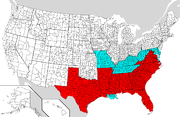
The Proclamation applied only in ten states that were still in rebellion in 1863, thus it did not cover the nearly 500,000 slaves in the slave-holding border states (Missouri, Kentucky, Maryland or Delaware) which were Union states — those slaves were freed by separate state and federal actions. The state of TennesseeTennessee
Tennessee is a U.S. state located in the Southeastern United States. It has a population of 6,346,105, making it the nation's 17th-largest state by population, and covers , making it the 36th-largest by total land area...
had already mostly returned to Union control, so it was not named and was exempted. Virginia
Virginia
The Commonwealth of Virginia , is a U.S. state on the Atlantic Coast of the Southern United States. Virginia is nicknamed the "Old Dominion" and sometimes the "Mother of Presidents" after the eight U.S. presidents born there...
was named, but exemptions were specified for the 48 counties then in the process of forming the new state of West Virginia
West Virginia
West Virginia is a state in the Appalachian and Southeastern regions of the United States, bordered by Virginia to the southeast, Kentucky to the southwest, Ohio to the northwest, Pennsylvania to the northeast and Maryland to the east...
, seven additional Tidewater counties individually named, and two cities. Also specifically exempted were New Orleans and 13 named parishes of Louisiana
Louisiana
Louisiana is a state located in the southern region of the United States of America. Its capital is Baton Rouge and largest city is New Orleans. Louisiana is the only state in the U.S. with political subdivisions termed parishes, which are local governments equivalent to counties...
, all of which were also already mostly under Federal control at the time of the Proclamation. These exemptions left unemancipated an additional 300,000 slaves.
The Emancipation Proclamation was incorrectly ridiculed for freeing only the slaves over which the Union had no power. In fact, over 20,000 to 50,000 were freed the day it went into effect in parts of nine of the ten states to which it applied (Texas being the exception). In every Confederate state (except Tennessee and Texas), the Proclamation went into immediate effect in Union-occupied areas and at least 20,000 slaves were freed at once on January 1, 1863.
Additionally, the Proclamation provided the legal framework for the emancipation of nearly all four million slaves as the Union armies advanced, and committed the Union to ending slavery, which was a controversial decision even in the North. Hearing of the Proclamation, more slaves quickly escaped to Union lines as the Army units moved South. As the Union armies advanced through the Confederacy, thousands of slaves were freed each day until nearly all (approximately 4 million, according to the 1860 census) were freed by July 1865.
While the Proclamation had freed most slaves as a war measure, it had not made slavery illegal. Of the states that were exempted from the Proclamation, Maryland,
Missouri,
Tennessee,
and West Virginia
prohibited slavery before the war ended; however, in Delaware
and Kentucky,
slavery continued to be legal until December 18, 1865, when the Thirteenth Amendment went into effect.
Background
The Fugitive Slave Act of 1850 required individuals to return runaway slaves to their owners. During the war, Union generals such as Benjamin ButlerBenjamin Franklin Butler (politician)
Benjamin Franklin Butler was an American lawyer and politician who represented Massachusetts in the United States House of Representatives and later served as the 33rd Governor of Massachusetts....
, declared that slaves in occupied areas were contraband of war
Contraband (American Civil War)
Contraband was a term commonly used in the United States military during the American Civil War to describe a new status for certain escaped slaves or those who affiliated with Union forces after the military determined that the US would not return escaped slaves who went to Union lines to their...
and accordingly refused to return them.
This decision was controversial because it implied recognition of the Confederacy as a separate nation under international law, a notion that Lincoln steadfastly denied. As a result, he did not promote the contraband designation. Some generals also declared the slaves under their jurisdiction to be free and were replaced when they refused to rescind such declarations.
In January 1862, Thaddeus Stevens
Thaddeus Stevens
Thaddeus Stevens , of Pennsylvania, was a Republican leader and one of the most powerful members of the United States House of Representatives...
, the Republican
History of the United States Republican Party
The United States Republican Party is the second oldest currently existing political party in the United States after its great rival, the Democratic Party. It emerged in 1854 to combat the Kansas Nebraska Act which threatened to extend slavery into the territories, and to promote more vigorous...
leader in the House
United States House of Representatives
The United States House of Representatives is one of the two Houses of the United States Congress, the bicameral legislature which also includes the Senate.The composition and powers of the House are established in Article One of the Constitution...
, called for total war against the rebellion to include emancipation of slaves, arguing that emancipation, by forcing the loss of enslaved labor, would ruin the rebel economy. On March 13, 1862, Congress approved a "Law Enacting an Additional Article of War" which stated that from that point onward it was forbidden for Union Army officers to return fugitive slaves to their owners.
On April 10, 1862, Congress declared that the federal government would compensate slave owners who freed their slaves. Slaves in the District of Columbia
Geography of Washington, D.C.
Washington, D.C., US, is located at . According to the United States Census Bureau, the city has a geographical area of , of which is land, and the remaining of which is water....
were freed on April 16, 1862, and their owners were compensated.
On June 19, 1862, Congress prohibited slavery in United States territories, and President Lincoln quickly signed the legislation. By this act, they opposed the 1857 opinion of the Supreme Court of the United States
Supreme Court of the United States
The Supreme Court of the United States is the highest court in the United States. It has ultimate appellate jurisdiction over all state and federal courts, and original jurisdiction over a small range of cases...
in the Dred Scott Case
Dred Scott v. Sandford
Dred Scott v. Sandford, , also known as the Dred Scott Decision, was a ruling by the U.S. Supreme Court that people of African descent brought into the United States and held as slaves were not protected by the Constitution and could never be U.S...
that Congress was powerless to regulate slavery in U.S. territories. This joint action by Congress and President Lincoln also rejected the notion of popular sovereignty
Popular sovereignty
Popular sovereignty or the sovereignty of the people is the political principle that the legitimacy of the state is created and sustained by the will or consent of its people, who are the source of all political power. It is closely associated with Republicanism and the social contract...
that had been advanced by Stephen A. Douglas
Stephen A. Douglas
Stephen Arnold Douglas was an American politician from the western state of Illinois, and was the Northern Democratic Party nominee for President in 1860. He lost to the Republican Party's candidate, Abraham Lincoln, whom he had defeated two years earlier in a Senate contest following a famed...
as a solution to the slavery controversy, while completing the effort begun by Thomas Jefferson
Thomas Jefferson
Thomas Jefferson was the principal author of the United States Declaration of Independence and the Statute of Virginia for Religious Freedom , the third President of the United States and founder of the University of Virginia...
in 1784 to confine slavery within the borders of the states.
In July 1862, Congress passed and Lincoln signed the "Second Confiscation Act." It purported to liberate slaves held by "rebels", but Lincoln took the position that Congress lacked power to free slaves within the borders of the states unless Lincoln as commander in chief deemed it a proper military measure. And that Lincoln would soon do.
Abolitionists
Abolitionism
Abolitionism is a movement to end slavery.In western Europe and the Americas abolitionism was a movement to end the slave trade and set slaves free. At the behest of Dominican priest Bartolomé de las Casas who was shocked at the treatment of natives in the New World, Spain enacted the first...
had long been urging Lincoln to free all slaves. A mass rally in Chicago on September 7, 1862, demanded an immediate and universal emancipation of slaves. A delegation headed by William W. Patton met the President at the White House
White House
The White House is the official residence and principal workplace of the president of the United States. Located at 1600 Pennsylvania Avenue NW in Washington, D.C., the house was designed by Irish-born James Hoban, and built between 1792 and 1800 of white-painted Aquia sandstone in the Neoclassical...
on September 13. Lincoln had declared in peacetime that he had no constitutional authority to free the slaves. Even used as a war power, emancipation was a risky political act. Public opinion as a whole was against it. There would be strong opposition among Copperhead
Copperheads (politics)
The Copperheads were a vocal group of Democrats in the Northern United States who opposed the American Civil War, wanting an immediate peace settlement with the Confederates. Republicans started calling anti-war Democrats "Copperheads," likening them to the venomous snake...
Democrats and an uncertain reaction from loyal border states. Delaware and Maryland already had a high percentage of free blacks: 91.2% and 49.7%, respectively, in 1860.
Drafting and issuance of the proclamation
Lincoln first discussed the proclamation with his cabinet in July 1862. He believed he needed a Union victory on the battlefield so his decision would appear positive and strong. The Battle of AntietamBattle of Antietam
The Battle of Antietam , fought on September 17, 1862, near Sharpsburg, Maryland, and Antietam Creek, as part of the Maryland Campaign, was the first major battle in the American Civil War to take place on Northern soil. It was the bloodiest single-day battle in American history, with about 23,000...
, in which Union troops turned back a Confederate invasion of Maryland, gave him such an opportunity. On September 22, 1862, five days after Antietam, Lincoln called his cabinet into session and issued the Preliminary Proclamation. According to Civil War historian James M. McPherson
James M. McPherson
James M. McPherson is an American Civil War historian, and is the George Henry Davis '86 Professor Emeritus of United States History at Princeton University. He received the 1989 Pulitzer Prize for Battle Cry of Freedom, his most famous book...
, Lincoln told Cabinet members that he had made a covenant with God, that if the Union drove the Confederacy out of Maryland, he would issue the Emancipation Proclamation.
Lincoln had first shown an early draft of the proclamation to his Vice president Hannibal Hamlin
Hannibal Hamlin
Hannibal Hamlin was the 15th Vice President of the United States , serving under President Abraham Lincoln during the American Civil War...
, an ardent abolitionist, who was more often kept in the dark on presidential decisions. The final proclamation was issued January 1, 1863. Although implicitly granted authority by Congress, Lincoln used his powers as Commander-in-Chief of the Army and Navy, "as a necessary war measure" as the basis of the proclamation, rather than the equivalent of a statute enacted by Congress or a constitutional amendment.
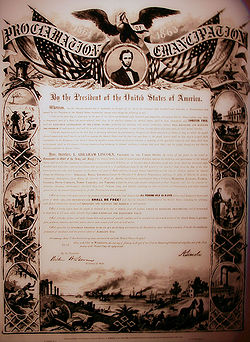
William H. Seward
William Henry Seward, Sr. was the 12th Governor of New York, United States Senator and the United States Secretary of State under Abraham Lincoln and Andrew Johnson...
commented, "We show our sympathy with slavery by emancipating slaves where we cannot reach them and holding them in bondage where we can set them free." Had any slave state ended its secession attempt before January 1, 1863, it could have kept slavery, at least temporarily. The Proclamation only gave Lincoln the legal basis to free the slaves in the areas of the South that were still in rebellion. However, it also took effect as the Union armies advanced into the Confederacy.
The Emancipation Proclamation also allowed for the enrollment of freed slaves into the United States military. During the war nearly 200,000 blacks, most of them ex-slaves, joined the Union Army. Their contributions gave the North additional manpower that was significant in winning the war. The Confederacy did not allow slaves in their army as soldiers until the final months before its defeat.
Though the counties of Virginia that were soon to form West Virginia
West Virginia
West Virginia is a state in the Appalachian and Southeastern regions of the United States, bordered by Virginia to the southeast, Kentucky to the southwest, Ohio to the northwest, Pennsylvania to the northeast and Maryland to the east...
were specifically exempted from the Proclamation (Jefferson County being the only exception), a condition of the state's admittance to the Union was that its constitution provide for the gradual abolition of slavery. Slaves in the border states of Maryland
Maryland
Maryland is a U.S. state located in the Mid Atlantic region of the United States, bordering Virginia, West Virginia, and the District of Columbia to its south and west; Pennsylvania to its north; and Delaware to its east...
and Missouri
Missouri
Missouri is a US state located in the Midwestern United States, bordered by Iowa, Illinois, Kentucky, Tennessee, Arkansas, Oklahoma, Kansas and Nebraska. With a 2010 population of 5,988,927, Missouri is the 18th most populous state in the nation and the fifth most populous in the Midwest. It...
were also emancipated by separate state action before the Civil War ended. In Maryland, a new state constitution abolishing slavery in the state went into effect on November 1, 1864. In early 1865, Tennessee adopted an amendment to its constitution prohibiting slavery. Slaves in Kentucky
Kentucky
The Commonwealth of Kentucky is a state located in the East Central United States of America. As classified by the United States Census Bureau, Kentucky is a Southern state, more specifically in the East South Central region. Kentucky is one of four U.S. states constituted as a commonwealth...
and Delaware
Delaware
Delaware is a U.S. state located on the Atlantic Coast in the Mid-Atlantic region of the United States. It is bordered to the south and west by Maryland, and to the north by Pennsylvania...
were not emancipated until the Thirteenth Amendment was ratified.
Implementation
Union (American Civil War)
During the American Civil War, the Union was a name used to refer to the federal government of the United States, which was supported by the twenty free states and five border slave states. It was opposed by 11 southern slave states that had declared a secession to join together to form the...
slave state
Slave state
In the United States of America prior to the American Civil War, a slave state was a U.S. state in which slavery was legal, whereas a free state was one in which slavery was either prohibited from its entry into the Union or eliminated over time...
s of Maryland
Maryland
Maryland is a U.S. state located in the Mid Atlantic region of the United States, bordering Virginia, West Virginia, and the District of Columbia to its south and west; Pennsylvania to its north; and Delaware to its east...
, Delaware
Delaware
Delaware is a U.S. state located on the Atlantic Coast in the Mid-Atlantic region of the United States. It is bordered to the south and west by Maryland, and to the north by Pennsylvania...
, Missouri
Missouri
Missouri is a US state located in the Midwestern United States, bordered by Iowa, Illinois, Kentucky, Tennessee, Arkansas, Oklahoma, Kansas and Nebraska. With a 2010 population of 5,988,927, Missouri is the 18th most populous state in the nation and the fifth most populous in the Midwest. It...
and Kentucky
Kentucky
The Commonwealth of Kentucky is a state located in the East Central United States of America. As classified by the United States Census Bureau, Kentucky is a Southern state, more specifically in the East South Central region. Kentucky is one of four U.S. states constituted as a commonwealth...
. Also not named was the state of Tennessee
Tennessee
Tennessee is a U.S. state located in the Southeastern United States. It has a population of 6,346,105, making it the nation's 17th-largest state by population, and covers , making it the 36th-largest by total land area...
, which was at the time more or less evenly split between Union and Confederacy. Specific exemptions were stated for areas also under Union control on January 1, 1863, namely 48 counties that would soon become West Virginia
West Virginia
West Virginia is a state in the Appalachian and Southeastern regions of the United States, bordered by Virginia to the southeast, Kentucky to the southwest, Ohio to the northwest, Pennsylvania to the northeast and Maryland to the east...
, seven other named counties of Virginia
Virginia
The Commonwealth of Virginia , is a U.S. state on the Atlantic Coast of the Southern United States. Virginia is nicknamed the "Old Dominion" and sometimes the "Mother of Presidents" after the eight U.S. presidents born there...
including Berkeley and Hampshire counties which were soon added to West Virginia, New Orleans and 13 named parishes nearby.
Union-occupied areas of the Confederate states where the proclamation was put into immediate effect by local commanders included Winchester, Virginia, Corinth, Mississippi, the Sea Islands along the coasts of the Carolinas and Georgia, Key West, Florida, and Port Royal, South Carolina.
Immediate impact
It is common to encounter a claim that the Emancipation Proclamation did not immediately free a single slave. As a result of the Proclamation, many slaves were freed during the course of the war, beginning with the day it took effect. Eyewitness accounts at places such as Hilton Head, South Carolina, and Port Royal, South Carolina, record celebrations on January 1 as thousands of blacks were informed of their new legal status of freedom.Estimates of the number of slaves freed immediately by the Emancipation Proclamation are uncertain. One contemporary estimate put the 'contraband' population of Union-occupied North Carolina at 10,000, and the Sea Islands of South Carolina also had a substantial population. Those 20,000 slaves were freed immediately by the Emancipation Proclamation."
This Union-occupied zone where freedom began at once included parts of eastern North Carolina, the Mississippi Valley, northern Alabama, the Shenandoah Valley of Virginia, a large part of Arkansas, and the Sea Islands of Georgia and South Carolina. Although some counties of Union-occupied Virginia were exempted from the Proclamation, the lower Shenandoah Valley, and the area around Alexandria were covered.
Booker T. Washington
Booker T. Washington
Booker Taliaferro Washington was an American educator, author, orator, and political leader. He was the dominant figure in the African-American community in the United States from 1890 to 1915...
, as a boy of 9 in Virginia, remembered the day in early 1865:
The Emancipation took place without violence by masters or ex-slaves. The proclamation represented a shift in the war objectives of the North—reuniting the nation was no longer the only goal. It represented a major step toward the ultimate abolition of slavery in the United States and a "new birth of freedom".
Runaway slaves who had escaped to Union lines had previously been held by the Union Army as "contraband of war" under the Confiscation Acts
Confiscation Acts
The Confiscation Acts were laws passed by the United States Congress during the Civil War with the intention of freeing the slaves still held by the Confederate forces in the South....
; when the proclamation took effect, they were told at midnight that they were free to leave. The Sea Islands
Sea Islands
The Sea Islands are a chain of tidal and barrier islands on the Atlantic Ocean coast of the United States. They number over 100, and are located between the mouths of the Santee and St. Johns Rivers along the coast of the U.S...
off the coast of Georgia
Georgia (U.S. state)
Georgia is a state located in the southeastern United States. It was established in 1732, the last of the original Thirteen Colonies. The state is named after King George II of Great Britain. Georgia was the fourth state to ratify the United States Constitution, on January 2, 1788...
had been occupied by the Union Navy earlier in the war. The whites had fled to the mainland while the blacks stayed. An early program of Reconstruction was set up for the former slaves, including schools and training. Naval officers read the proclamation and told them they were free.
In the military, reaction to the proclamation varied widely, with some units nearly ready to mutiny in protest. Some desertions were attributed to it. Other units were inspired by the adoption of a cause that ennobled their efforts, such that at least one unit took up the motto "For Union and Liberty".
Slaves had been part of the "engine of war" for the Confederacy. They produced and prepared food; sewed uniforms; repaired railways; worked on farms and in factories, shipping yards, and mines; built fortifications; and served as hospital workers and common laborers. News of the Proclamation spread rapidly by word of mouth, arousing hopes of freedom, creating general confusion, and encouraging thousands to escape to Union lines.
Robert E. Lee
Robert E. Lee
Robert Edward Lee was a career military officer who is best known for having commanded the Confederate Army of Northern Virginia in the American Civil War....
saw the Emancipation Proclamation as a way for the Union to bolster the number of soldiers it could place on the field, making it imperative for the Confederacy to increase their own numbers.
Writing on the matter after the sack of Fredericksburg, Lee wrote "In view of the vast increase of the forces of the enemy, of the savage and brutal policy he has proclaimed, which leaves us no alternative but success or degradation worse than death, if we would save the honor of our families from pollution, our social system from destruction, let every effort be made, every means be employed, to fill and maintain the ranks of our armies, until God, in his mercy, shall bless us with the establishment of our independence." Lee's request for a drastic increase of troops would go unfulfilled.
Political impact
Copperheads (politics)
The Copperheads were a vocal group of Democrats in the Northern United States who opposed the American Civil War, wanting an immediate peace settlement with the Confederates. Republicans started calling anti-war Democrats "Copperheads," likening them to the venomous snake...
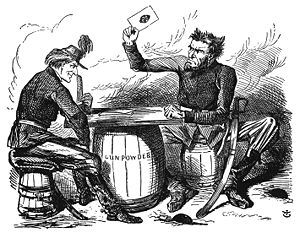
who opposed the war and advocated restoring the union by allowing slavery. Horatio Seymour
Horatio Seymour
Horatio Seymour was an American politician. He was the 18th Governor of New York from 1853 to 1854 and from 1863 to 1864. He was the Democratic Party nominee for president of the United States in the presidential election of 1868, but lost the election to Republican and former Union General of...
, while running for the governorship of New York, cast the Emancipation Proclamation as a call for slaves to commit extreme acts of violence on all white southerners, he said it was "a proposal for the butchery of women and children, for scenes of lust and rapine, and of arson and murder, which would invoke the interference of civilized Europe." The Copperheads also saw the Proclamation as an unconstitutional abuse of Presidential power, editor Henry A. Reeves wrote in Greenport's Republican Watchman that "In the name of freedom of Negroes, [the proclamation] imperils the liberty of white men; to test a utopian theory of equality of races which Nature, History and Experience alike condemn as monstrous, it overturns the Constitution and Civil Laws and sets up Military Usurpation in their Stead."
Racism remained pervasive on both sides of the conflict and many in the North only supported the war as an effort to force the south back into the Union. The promises of many Republican politicians that the war was to restore the Union and not about black rights or ending slavery were now declared lies by their opponents citing the Proclamation. Copperhead David Allen spoke to a rally in Columbiana, Ohio, stating "I have told you that this war is carried on for the Negro. There is the proclamation of the President of the United States. Now fellow Democrats I ask you if you are going to be forced into a war against your Brethren of the Southern States for the Negro. I answer No!" The Copperheads saw the Proclamation as irrefutable proof of their position and the beginning of a political rise for their members; in Connecticut H.B. Whiting wrote that the truth was now plain even to "those stupid thick-headed persons who persisted in thinking that the President was a conservative man and that the war was for the restoration of the Union under the Constitution."
War Democrats
War Democrats
War Democrats in American politics of the 1860s were adherents of the Democratic Party who rejected the Copperheads/Peace Democrats who controlled the party...
who rejected the Copperhead position within their party, found themselves in a quandary. While throughout the war they had continued to espouse the racist positions of their party and their disdain of the concerns of slaves, they did see the Proclamation as a viable military tool against the South and worried that opposing it might demoralize troops in the Union army. The question would continue to trouble them and eventually lead to a split within their party as the war progressed.
Lincoln further alienated many in the Union two days after issuing the preliminary copy of the Emancipation Proclamation by suspending habeas corpus. His opponents linked these two actions in their claims that he was becoming a despot. In light of this and a lack of military success for the Union armies, many War Democrat voters who had previously supported Lincoln turned against him and joined the Copperheads in the off-year elections held in October and November.
In the 1862 elections, the Democrats gained 28 seats in the House as well as the governorship of New York
New York
New York is a state in the Northeastern region of the United States. It is the nation's third most populous state. New York is bordered by New Jersey and Pennsylvania to the south, and by Connecticut, Massachusetts and Vermont to the east...
. Lincoln’s friend Orville Hickman Browning told the President that the Proclamation and the suspension of habeas corpus had been "disastrous" for his party by handing the Democrats so many weapons. Lincoln made no response. Copperhead William Javis of Connecticut pronounced the election the "beginning of the end of the utter downfall of Abolitionism
Abolitionism
Abolitionism is a movement to end slavery.In western Europe and the Americas abolitionism was a movement to end the slave trade and set slaves free. At the behest of Dominican priest Bartolomé de las Casas who was shocked at the treatment of natives in the New World, Spain enacted the first...
."
Historians James M. McPherson and Allan Nevins state that though the results look very troubling, they could be seen favorably by Lincoln; his opponents did well only in their historic strongholds and "at the national level their gains in the House were the smallest of any minority party’s in an off-year election in nearly a generation. Michigan, California, and Iowa all went Republican...Moreover, the Republicans picked up five seats in the Senate." McPherson states "If the election was in any sense a referendum on emancipation and on Lincoln’s conduct of the war, a majority of Northern voters endorsed these policies."
International impact
As Lincoln had hoped, the Proclamation turned foreign popular opinion in favor of the Union by adding the ending of slavery as a goal of the war. That shift ended the Confederacy's hopes of gaining official recognition, particularly from the United KingdomUnited Kingdom
The United Kingdom of Great Britain and Northern IrelandIn the United Kingdom and Dependencies, other languages have been officially recognised as legitimate autochthonous languages under the European Charter for Regional or Minority Languages...
, which had abolished slavery. Prior to Lincoln's decree, Britain's actions had favored the Confederacy, especially in its provision of British-built warships such as the CSS Alabama
CSS Alabama
CSS Alabama was a screw sloop-of-war built for the Confederate States Navy at Birkenhead, United Kingdom, in 1862 by John Laird Sons and Company. Alabama served as a commerce raider, attacking Union merchant and naval ships over the course of her two-year career, during which she never anchored in...
and CSS Florida
CSS Florida (cruiser)
CSS Florida was a cruiser in the Confederate States Navy.Florida was built by the British firm of William C. Miller & Sons of Toxteth, Liverpool, and purchased by the Confederacy from Fawcett, Preston & Co., also of Liverpool, who engined her...
. Furthermore, the North's determination to win at all costs was creating problems diplomatically; the Trent Affair
Trent affair
The Trent Affair, also known as the Mason and Slidell Affair, was an international diplomatic incident that occurred during the American Civil War...
of late 1861 had caused severe tensions between the United States and Great Britain. For the Confederacy to receive official recognition by foreign powers would have been a further blow to the Union cause.
With the war now cast in terms of freedom against slavery, British or French support for the Confederacy would look like support for slavery, which both of these nations had abolished. As Henry Adams
Henry Adams
Henry Brooks Adams was an American journalist, historian, academic and novelist. He is best known for his autobiographical book, The Education of Henry Adams. He was a member of the Adams political family.- Early life :He was born in Boston, Massachusetts, the son of Charles Francis Adams Sr...
noted, "The Emancipation Proclamation has done more for us than all our former victories and all our diplomacy." In Italy, Giuseppe Garibaldi
Giuseppe Garibaldi
Giuseppe Garibaldi was an Italian military and political figure. In his twenties, he joined the Carbonari Italian patriot revolutionaries, and fled Italy after a failed insurrection. Garibaldi took part in the War of the Farrapos and the Uruguayan Civil War leading the Italian Legion, and...
hailed Lincoln as "the heir of the aspirations of John Brown
John Brown (abolitionist)
John Brown was an American revolutionary abolitionist, who in the 1850s advocated and practiced armed insurrection as a means to abolish slavery in the United States. He led the Pottawatomie Massacre during which five men were killed, in 1856 in Bleeding Kansas, and made his name in the...
". On August 6, 1863 Garibaldi wrote to Lincoln: Posterity will call you the great emancipator, a more enviable title than any crown could be, and greater than any merely mundane treasure.
Alan Van Dyke, a representative for workers from Manchester
Manchester
Manchester is a city and metropolitan borough in Greater Manchester, England. According to the Office for National Statistics, the 2010 mid-year population estimate for Manchester was 498,800. Manchester lies within one of the UK's largest metropolitan areas, the metropolitan county of Greater...
, England, wrote to Lincoln saying, "We joyfully honor you for many decisive steps toward practically exemplifying your belief in the words of your great founders: 'All men are created free and equal.'" The Emancipation Proclamation served to ease tensions with Europe over the North's conduct of the war, and combined with the recent failed Southern offensive at Antietam
Battle of Antietam
The Battle of Antietam , fought on September 17, 1862, near Sharpsburg, Maryland, and Antietam Creek, as part of the Maryland Campaign, was the first major battle in the American Civil War to take place on Northern soil. It was the bloodiest single-day battle in American history, with about 23,000...
to cut off any practical chance for the Confederacy to receive international support in the war.
Gettysburg Address
Lincoln's Gettysburg AddressGettysburg Address
The Gettysburg Address is a speech by U.S. President Abraham Lincoln and is one of the most well-known speeches in United States history. It was delivered by Lincoln during the American Civil War, on the afternoon of Thursday, November 19, 1863, at the dedication of the Soldiers' National Cemetery...
in November 1863 made indirect reference to the Proclamation and the ending of slavery as a war goal with the phrase "new birth of freedom". The Proclamation solidified Lincoln's support among the rapidly growing abolitionist element of the Republican Party and ensured they would not block his re-nomination in 1864.
Postbellum
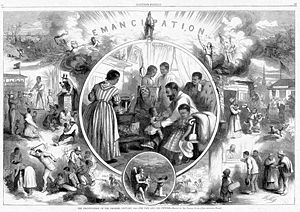
Winning re-election, Lincoln pressed the lame duck
Lame duck (politics)
A lame duck is an elected official who is approaching the end of his or her tenure, and especially an official whose successor has already been elected.-Description:The status can be due to*having lost a re-election bid...
38th Congress
38th United States Congress
-House of Representatives:Before this Congress, the 1860 United States Census and resulting reapportionment changed the size of the House to 241 members...
to pass the proposed amendment immediately rather than wait for the incoming 39th Congress
39th United States Congress
The Thirty-ninth United States Congress was a meeting of the legislative branch of the United States federal government, consisting of the United States Senate and the United States House of Representatives. It met in Washington, D.C. from March 4, 1865 to March 4, 1867, during the first month of...
to convene. In January 1865, Congress sent to the state legislatures for ratification what became the Thirteenth Amendment
Thirteenth Amendment to the United States Constitution
The Thirteenth Amendment to the United States Constitution officially abolished and continues to prohibit slavery and involuntary servitude, except as punishment for a crime. It was passed by the Senate on April 8, 1864, passed by the House on January 31, 1865, and adopted on December 6, 1865. On...
, banning slavery in all U.S. state
U.S. state
A U.S. state is any one of the 50 federated states of the United States of America that share sovereignty with the federal government. Because of this shared sovereignty, an American is a citizen both of the federal entity and of his or her state of domicile. Four states use the official title of...
s and territories. The amendment was ratified by the legislatures of enough states by December 6, 1865, and proclaimed 12 days later. There were about 40,000 slaves in Kentucky and 1,000 in Delaware who were liberated then.
Legacy
In the years after Lincoln's death, his action in the proclamation was lauded. The anniversary of the Emancipation Proclamation was celebrated as a black holiday for more than 50 years; the holiday of JuneteenthJuneteenth
Juneteenth, also known as Freedom Day or Emancipation Day, is a holiday in the United States honoring African American heritage by commemorating the announcement of the abolition of slavery in the U.S. State of Texas in 1865...
was created in some states to honor it. In 1913, the 50th anniversary of the Proclamation, there were particularly large celebrations.
As the years went on and American life continued to be deeply unfair towards blacks, cynicism towards Lincoln and the Emancipation Proclamation increased. Some 20th century black intellectuals, including W. E. B. Du Bois, James Baldwin
James Baldwin
James Baldwin was an American novelist, essayist and civil rights activist.James Baldwin may also refer to:-Writers:*James Baldwin , American educator, writer and administrator...
and Julius Lester
Julius Lester
Julius Lester is an American author of books for children and adults, and taught for 32 years at the University of Massachusetts Amherst. He is also a photographer, as well as a musician who recorded two albums of folk music and original songs.-Early life and family:Born on January 27, 1939, in...
, described the proclamation as essentially worthless. Perhaps the strongest attack was Lerone Bennett's
Lerone Bennett, Jr.
Lerone Bennett, Jr. is an African-American scholar, author and social historian, known for his revisionist analysis of race relations in the United States. His works include "When the Wind Blows" and "History of Us".-Biography:...
Forced into Glory: Abraham Lincoln's White Dream
Forced into Glory: Abraham Lincoln's White Dream
Forced into Glory: Abraham Lincoln's White Dream is a book by the African American scholar and historian, Lerone Bennett, Jr., published in 2000. It attacks Abraham Lincoln and claims that his reputation as the "Great Emancipator" is undeserved....
(2000), which claimed that Lincoln was a white supremacist who issued the Emancipation Proclamation in lieu of the real racial reforms for which radical abolitionists pushed.
In his Lincoln's Emancipation Proclamation, Allen C. Guelzo
Allen C. Guelzo
Allen Carl Guelzo is the Henry R. Luce III Professor of the Civil War Era at Gettysburg College, where he serves as Director of the Civil War Era Studies Program.Guelzo was born in Yokohama, Japan...
noted the professional historians' lack of substantial respect for the document, since it has been the subject of few major scholarly studies. He argued that Lincoln was America's "last Enlightenment
Age of Enlightenment
The Age of Enlightenment was an elite cultural movement of intellectuals in 18th century Europe that sought to mobilize the power of reason in order to reform society and advance knowledge. It promoted intellectual interchange and opposed intolerance and abuses in church and state...
politician
Politician
A politician, political leader, or political figure is an individual who is involved in influencing public policy and decision making...
" and as such was dedicated to removing slavery strictly within the bounds of law.
Other historians have given more credit to Lincoln for what he accomplished within the tensions of his cabinet and a society at war, for his own growth in political and moral stature, and for the promise he held out to the slaves. More might have been accomplished if he had not been assassinated. As Eric Foner
Eric Foner
Eric Foner is an American historian. On the faculty of the Department of History at Columbia University since 1982, he writes extensively on political history, the history of freedom, the early history of the Republican Party, African American biography, Reconstruction, and historiography...
wrote:
Lincoln was not an abolitionist or Radical Republican, a point Bennett reiterates innumerable times. He did not favor immediate abolition before the war, and held racist views typical of his time. But he was also a man of deep convictions when it came to slavery, and during the Civil War displayed a remarkable capacity for moral and political growth.
See also
- Act Prohibiting the Return of SlavesAct Prohibiting the Return of SlavesThe Act Prohibiting the Return of Slaves was a law passed by the United States Congress during the American Civil War forbidding the military to return escaped slaves to their owners. As Union armies entered Southern territory during the early years of the War, emboldened slaves began fleeing...
– 1863 statute - African Americans in the 1960s
- History of slavery in KentuckyHistory of slavery in KentuckyThe history of slavery in Kentucky dates from the earliest permanent European settlements in the state until the end of the Civil War. Although Kentucky was generally classified as the Upper South or a Border state, rather than the Deep South, enslaved African Americans made up a substantial...
- History of slavery in MissouriHistory of slavery in MissouriThe history of slavery in Missouri began in 1720, when a man named Philippe Francois Renault brought about 500 negro slaves from Santo Domingo to work in lead mines in the River des Peres area, located in the present-day St...
- Slavery Abolition Act 1833 – an act passed by the British parliament abolishing slavery in British colonies with compensation to the owners
- Timeline of the African-American Civil Rights Movement
- War Governors' ConferenceWar Governors' ConferenceThe Loyal War Governors' Conference was an important political event of the American Civil War. It was held at the Logan House Hotel in Altoona, Pennsylvania on September 24 and 25, 1862. Thirteen governors of Union states came together to discuss the war effort, state troop quotas, and the...
– gave Lincoln the much needed political support to issue the Proclamation
External links
- A zoomable image of the Leland-Boker authorized edition of the Emancipation Proclamation held by the British Library
- Lesson plan on Emancipation Proclamation from EDSITEment NEH
- Report of the Brown University Steering Committee on Slavery and Justice
- Teaching resources about Slavery and Abolition on blackhistory4schools.com
- Text and images of the Emancipation Proclamation from the National Archives
- Online Lincoln Coloring Book for Teachers and Students
- Emancipation Proclamation and related resources at the Library of Congress
- Scholarly article on rhetoric and the Emancipation Proclamation
- Mr. Lincoln and Freedom: Emancipation Proclamation
- First Edition Emancipation Proclamation in 1862 Harper's Weekly
- Chronology of Emancipation during the Civil War
- "Lincoln's Emancipation Proclamation"
- Preliminary Emancipation Proclamation at the New York State Library – Images and transcript of Lincoln's original manuscript of the preliminary proclamation.
- 1865 NY Times article Sketch of its History by Lincoln's portrait artist