


Irvin McDowell

Encyclopedia
Irvin McDowell was a career American
army officer
. He is best known for his defeat in the First Battle of Bull Run
, the first large-scale battle of the American Civil War
.
, son of Abram Irvin McDowell and Eliza Seldon McDowell. He was a cousin-in-law of John Buford
, and his brother, John Adair McDowell, served as a colonel in the Union Army. Irvin initially attended the College de Troyes in France
before graduating from the United States Military Academy
in 1838, where one of his classmates was P.G.T. Beauregard, his future adversary at First Bull Run. He was commissioned a second lieutenant and posted to the 1st U.S. Artillery. McDowell served as a tactics
instructor at West Point, before becoming aide-de-camp
to General John E. Wool
during the Mexican-American War. He was brevetted
captain at Buena Vista
and served in the Adjutant General's department after the war. While in that department he was promoted to major on May 31, 1856.
Between 1848 and 1861, McDowell generally served as a staff officer to higher-ranking military leaders, and developed experience in logistics and supply. He developed a close friendship with General Winfield Scott
while serving on his staff. He also served under future Confederate general Joseph E. Johnston
.
in the regular army on May 14, 1861, and given command of the Army of Northeastern Virginia, despite never having commanded troops in combat. The promotion was partly because of the influence of his mentor, Treasury Secretary
Salmon P. Chase
. Although McDowell knew that his troops were inexperienced and unready, and protested that he was a supply officer, not a field commander, pressure from the Washington
politician
s forced him to launch a premature offensive against Confederate
forces in Northern Virginia
. His strategy during the First Battle of Bull Run
was imaginative but ambitiously complex, and his troops were not experienced enough to carry it out effectively, resulting in an embarrassing rout.
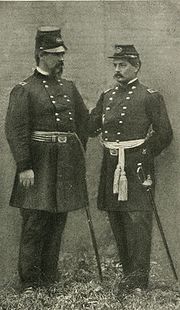 After the defeat at Bull Run, Maj. Gen.
George B. McClellan
was placed in command of the new Union Army
defending Washington, the Army of the Potomac
. McDowell commanded a division in the new army, but McClellan soon reorganized his command and McDowell was given I Corps the following spring. His corps stayed behind to defend Washington, and was eventually supposed to march to McClellan's support while the latter fought in the Peninsula Campaign
; however, the nervous politicians who feared that General Thomas J. "Stonewall" Jackson's
Valley Campaign
would eventually attack Washington kept McDowell's 40,000 soldiers behind.
Eventually, the three independent commands of Generals McDowell, John C. Frémont
, and Nathaniel P. Banks were combined into Maj. Gen. John Pope's
Army of Virginia
and McDowell led the III Corps of that army. Because of his actions at Cedar Mountain
, McDowell was eventually brevetted major general
in the regular army; however, he was blamed for the subsequent disaster at Second Bull Run
. He escaped culpability by testifying against Maj. Gen. Fitz John Porter
, whom Pope court-martialed for alleged insubordination
in that battle. Despite his formal escape, McDowell spent the following two years in effective exile from the leadership of the Army.
. He later commanded the Department of California
, the Fourth Military District
(the military government for Arkansas
and Louisiana
during Reconstruction), and the Department of the West
. He was promoted to permanent major general in the regular army in 1872. In 1879, when a Board of Review commissioned by President
Rutherford B. Hayes
issued its report recommending a pardon for Fitz John Porter, it attributed much of the loss of the Second Battle of Bull Run to McDowell. In the report he was depicted as indecisive, uncommunicative, and inept, repeatedly failing to answer Porter's requests for information, failing to forward intelligence of Longstreet's positioning to Pope, and neglecting to take command of the left wing of the Union Army as was his duty under the Articles of War.
McDowell retired from the army in 1882 and served as Park Commissioner of San Francisco
, California
until his death in 1885. He is buried in San Francisco National Cemetery
in the Presidio of San Francisco
.
United States
The United States of America is a federal constitutional republic comprising fifty states and a federal district...
army officer
United States Army
The United States Army is the main branch of the United States Armed Forces responsible for land-based military operations. It is the largest and oldest established branch of the U.S. military, and is one of seven U.S. uniformed services...
. He is best known for his defeat in the First Battle of Bull Run
First Battle of Bull Run
First Battle of Bull Run, also known as First Manassas , was fought on July 21, 1861, in Prince William County, Virginia, near the City of Manassas...
, the first large-scale battle of the American Civil War
American Civil War
The American Civil War was a civil war fought in the United States of America. In response to the election of Abraham Lincoln as President of the United States, 11 southern slave states declared their secession from the United States and formed the Confederate States of America ; the other 25...
.
Early life
McDowell was born in Columbus, OhioColumbus, Ohio
Columbus is the capital of and the largest city in the U.S. state of Ohio. The broader metropolitan area encompasses several counties and is the third largest in Ohio behind those of Cleveland and Cincinnati. Columbus is the third largest city in the American Midwest, and the fifteenth largest city...
, son of Abram Irvin McDowell and Eliza Seldon McDowell. He was a cousin-in-law of John Buford
John Buford
John Buford, Jr. was a Union cavalry officer during the American Civil War, with a prominent role at the start of the Battle of Gettysburg.-Early years:...
, and his brother, John Adair McDowell, served as a colonel in the Union Army. Irvin initially attended the College de Troyes in France
France
The French Republic , The French Republic , The French Republic , (commonly known as France , is a unitary semi-presidential republic in Western Europe with several overseas territories and islands located on other continents and in the Indian, Pacific, and Atlantic oceans. Metropolitan France...
before graduating from the United States Military Academy
United States Military Academy
The United States Military Academy at West Point is a four-year coeducational federal service academy located at West Point, New York. The academy sits on scenic high ground overlooking the Hudson River, north of New York City...
in 1838, where one of his classmates was P.G.T. Beauregard, his future adversary at First Bull Run. He was commissioned a second lieutenant and posted to the 1st U.S. Artillery. McDowell served as a tactics
Military tactics
Military tactics, the science and art of organizing an army or an air force, are the techniques for using weapons or military units in combination for engaging and defeating an enemy in battle. Changes in philosophy and technology over time have been reflected in changes to military tactics. In...
instructor at West Point, before becoming aide-de-camp
Aide-de-camp
An aide-de-camp is a personal assistant, secretary, or adjutant to a person of high rank, usually a senior military officer or a head of state...
to General John E. Wool
John E. Wool
John Ellis Wool was an officer in the United States Army during three consecutive U.S. wars: the War of 1812, the Mexican-American War and the American Civil War. By the time of the Mexican-American War, he was widely considered one of the most capable officers in the army and a superb organizer...
during the Mexican-American War. He was brevetted
Brevet (military)
In many of the world's military establishments, brevet referred to a warrant authorizing a commissioned officer to hold a higher rank temporarily, but usually without receiving the pay of that higher rank except when actually serving in that role. An officer so promoted may be referred to as being...
captain at Buena Vista
Battle of Buena Vista
The Battle of Buena Vista , also known as the Battle of Angostura, saw the United States Army use artillery to repulse the much larger Mexican army in the Mexican-American War...
and served in the Adjutant General's department after the war. While in that department he was promoted to major on May 31, 1856.
Between 1848 and 1861, McDowell generally served as a staff officer to higher-ranking military leaders, and developed experience in logistics and supply. He developed a close friendship with General Winfield Scott
Winfield Scott
Winfield Scott was a United States Army general, and unsuccessful presidential candidate of the Whig Party in 1852....
while serving on his staff. He also served under future Confederate general Joseph E. Johnston
Joseph E. Johnston
Joseph Eggleston Johnston was a career U.S. Army officer, serving with distinction in the Mexican-American War and Seminole Wars, and was also one of the most senior general officers in the Confederate States Army during the American Civil War...
.
Civil War
McDowell was promoted to brigadier generalBrigadier general (United States)
A brigadier general in the United States Army, Air Force, and Marine Corps, is a one-star general officer, with the pay grade of O-7. Brigadier general ranks above a colonel and below major general. Brigadier general is equivalent to the rank of rear admiral in the other uniformed...
in the regular army on May 14, 1861, and given command of the Army of Northeastern Virginia, despite never having commanded troops in combat. The promotion was partly because of the influence of his mentor, Treasury Secretary
United States Secretary of the Treasury
The Secretary of the Treasury of the United States is the head of the United States Department of the Treasury, which is concerned with financial and monetary matters, and, until 2003, also with some issues of national security and defense. This position in the Federal Government of the United...
Salmon P. Chase
Salmon P. Chase
Salmon Portland Chase was an American politician and jurist who served as U.S. Senator from Ohio and the 23rd Governor of Ohio; as U.S. Treasury Secretary under President Abraham Lincoln; and as the sixth Chief Justice of the United States Supreme Court.Chase was one of the most prominent members...
. Although McDowell knew that his troops were inexperienced and unready, and protested that he was a supply officer, not a field commander, pressure from the Washington
Washington, D.C.
Washington, D.C., formally the District of Columbia and commonly referred to as Washington, "the District", or simply D.C., is the capital of the United States. On July 16, 1790, the United States Congress approved the creation of a permanent national capital as permitted by the U.S. Constitution....
politician
Politician
A politician, political leader, or political figure is an individual who is involved in influencing public policy and decision making...
s forced him to launch a premature offensive against Confederate
Confederate States Army
The Confederate States Army was the army of the Confederate States of America while the Confederacy existed during the American Civil War. On February 8, 1861, delegates from the seven Deep South states which had already declared their secession from the United States of America adopted the...
forces in Northern Virginia
Northern Virginia
Northern Virginia consists of several counties and independent cities in the Commonwealth of Virginia, in a widespread region generally radiating southerly and westward from Washington, D.C...
. His strategy during the First Battle of Bull Run
First Battle of Bull Run
First Battle of Bull Run, also known as First Manassas , was fought on July 21, 1861, in Prince William County, Virginia, near the City of Manassas...
was imaginative but ambitiously complex, and his troops were not experienced enough to carry it out effectively, resulting in an embarrassing rout.
Major general (United States)
In the United States Army, United States Marine Corps, and United States Air Force, major general is a two-star general-officer rank, with the pay grade of O-8. Major general ranks above brigadier general and below lieutenant general...
George B. McClellan
George B. McClellan
George Brinton McClellan was a major general during the American Civil War. He organized the famous Army of the Potomac and served briefly as the general-in-chief of the Union Army. Early in the war, McClellan played an important role in raising a well-trained and organized army for the Union...
was placed in command of the new Union Army
Union Army
The Union Army was the land force that fought for the Union during the American Civil War. It was also known as the Federal Army, the U.S. Army, the Northern Army and the National Army...
defending Washington, the Army of the Potomac
Army of the Potomac
The Army of the Potomac was the major Union Army in the Eastern Theater of the American Civil War.-History:The Army of the Potomac was created in 1861, but was then only the size of a corps . Its nucleus was called the Army of Northeastern Virginia, under Brig. Gen...
. McDowell commanded a division in the new army, but McClellan soon reorganized his command and McDowell was given I Corps the following spring. His corps stayed behind to defend Washington, and was eventually supposed to march to McClellan's support while the latter fought in the Peninsula Campaign
Peninsula Campaign
The Peninsula Campaign of the American Civil War was a major Union operation launched in southeastern Virginia from March through July 1862, the first large-scale offensive in the Eastern Theater. The operation, commanded by Maj. Gen. George B...
; however, the nervous politicians who feared that General Thomas J. "Stonewall" Jackson's
Stonewall Jackson
ຄຽשת״ׇׂׂׂׂ֣|birth_place= Clarksburg, Virginia |death_place=Guinea Station, Virginia|placeofburial=Stonewall Jackson Memorial CemeteryLexington, Virginia|placeofburial_label= Place of burial|image=...
Valley Campaign
Valley Campaign
Jackson's Valley Campaign was Confederate Maj. Gen. Thomas J. "Stonewall" Jackson's famous spring 1862 campaign through the Shenandoah Valley in Virginia during the American Civil War...
would eventually attack Washington kept McDowell's 40,000 soldiers behind.
Eventually, the three independent commands of Generals McDowell, John C. Frémont
John C. Frémont
John Charles Frémont , was an American military officer, explorer, and the first candidate of the anti-slavery Republican Party for the office of President of the United States. During the 1840s, that era's penny press accorded Frémont the sobriquet The Pathfinder...
, and Nathaniel P. Banks were combined into Maj. Gen. John Pope's
John Pope (military officer)
John Pope was a career United States Army officer and Union general in the American Civil War. He had a brief but successful career in the Western Theater, but he is best known for his defeat at the Second Battle of Bull Run in the East.Pope was a graduate of the United States Military Academy in...
Army of Virginia
Army of Virginia
The Army of Virginia was organized as a major unit of the Union Army and operated briefly and unsuccessfully in 1862 in the American Civil War. It should not be confused with its principal opponent, the Confederate Army of Northern Virginia, commanded by Robert E...
and McDowell led the III Corps of that army. Because of his actions at Cedar Mountain
Battle of Cedar Mountain
The Battle of Cedar Mountain, also known as Slaughter's Mountain or Cedar Run, took place on August 9, 1862, in Culpeper County, Virginia, as part of the American Civil War. Union forces under Maj. Gen. Nathaniel P. Banks attacked Confederate forces under Maj. Gen. Thomas J...
, McDowell was eventually brevetted major general
Major general (United States)
In the United States Army, United States Marine Corps, and United States Air Force, major general is a two-star general-officer rank, with the pay grade of O-8. Major general ranks above brigadier general and below lieutenant general...
in the regular army; however, he was blamed for the subsequent disaster at Second Bull Run
Second Battle of Bull Run
The Second Battle of Bull Run or Second Manassas was fought August 28–30, 1862, as part of the American Civil War. It was the culmination of an offensive campaign waged by Confederate Gen. Robert E. Lee's Army of Northern Virginia against Union Maj. Gen...
. He escaped culpability by testifying against Maj. Gen. Fitz John Porter
Fitz John Porter
Fitz John Porter was a career United States Army officer and a Union General during the American Civil War...
, whom Pope court-martialed for alleged insubordination
Court-martial of Fitz John Porter
The court-martial of Fitz John Porter was a major event of the American Civil War. Major General Fitz John Porter was found guilty of disobeying a lawful order, and misconduct in front of the enemy and removed from command based on internal political machinations of the Union...
in that battle. Despite his formal escape, McDowell spent the following two years in effective exile from the leadership of the Army.
Later service and postbellum career
In July 1864, McDowell was given command of the Department of the PacificDepartment of the Pacific
The Department of the Pacific was a major command of the United States Army during the 19th century.-Formation:The Department of the Pacific was first organized on October 31, 1853, at San Francisco, California, taking over from the previous Pacific Division. The department reported directly to...
. He later commanded the Department of California
California
California is a state located on the West Coast of the United States. It is by far the most populous U.S. state, and the third-largest by land area...
, the Fourth Military District
Fourth Military District
The Fourth Military District existed in the American South during the Reconstruction era that followed the American Civil War. It included the occupation troops in the states of Arkansas and Mississippi...
(the military government for Arkansas
Arkansas
Arkansas is a state located in the southern region of the United States. Its name is an Algonquian name of the Quapaw Indians. Arkansas shares borders with six states , and its eastern border is largely defined by the Mississippi River...
and Louisiana
Louisiana
Louisiana is a state located in the southern region of the United States of America. Its capital is Baton Rouge and largest city is New Orleans. Louisiana is the only state in the U.S. with political subdivisions termed parishes, which are local governments equivalent to counties...
during Reconstruction), and the Department of the West
Department of the West
The Department of the West, later known as the Western Department, was a major command of the United States Army during the 19th century. It oversaw the military affairs in the country west of the Mississippi River to the borders of California and Oregon.-Organization:The Department was first...
. He was promoted to permanent major general in the regular army in 1872. In 1879, when a Board of Review commissioned by President
President of the United States
The President of the United States of America is the head of state and head of government of the United States. The president leads the executive branch of the federal government and is the commander-in-chief of the United States Armed Forces....
Rutherford B. Hayes
Rutherford B. Hayes
Rutherford Birchard Hayes was the 19th President of the United States . As president, he oversaw the end of Reconstruction and the United States' entry into the Second Industrial Revolution...
issued its report recommending a pardon for Fitz John Porter, it attributed much of the loss of the Second Battle of Bull Run to McDowell. In the report he was depicted as indecisive, uncommunicative, and inept, repeatedly failing to answer Porter's requests for information, failing to forward intelligence of Longstreet's positioning to Pope, and neglecting to take command of the left wing of the Union Army as was his duty under the Articles of War.
McDowell retired from the army in 1882 and served as Park Commissioner of San Francisco
San Francisco, California
San Francisco , officially the City and County of San Francisco, is the financial, cultural, and transportation center of the San Francisco Bay Area, a region of 7.15 million people which includes San Jose and Oakland...
, California
California
California is a state located on the West Coast of the United States. It is by far the most populous U.S. state, and the third-largest by land area...
until his death in 1885. He is buried in San Francisco National Cemetery
San Francisco National Cemetery
San Francisco National Cemetery is a U.S. National Cemetery, located in the Presidio of San Francisco, California. Because of the name and location, it is frequently confused with Golden Gate National Cemetery, a few miles south of the city....
in the Presidio of San Francisco
Presidio of San Francisco
The Presidio of San Francisco is a park on the northern tip of the San Francisco Peninsula in San Francisco, California, within the Golden Gate National Recreation Area...
.
See also
- List of American Civil War generals
- The Court-martial of Fitz John PorterCourt-martial of Fitz John PorterThe court-martial of Fitz John Porter was a major event of the American Civil War. Major General Fitz John Porter was found guilty of disobeying a lawful order, and misconduct in front of the enemy and removed from command based on internal political machinations of the Union...