
All Topics  
James Longstreet

 
James Longstreet

   Email Print
   Bookmark   Link


James Longstreet


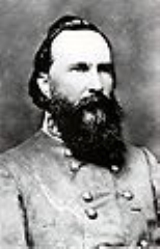
James Longstreet (January 8, 1821 – January 2, 1904) was one of the foremost Confederate
Confederate States Army

The Confederate States Army was a military organization whose primary mission was to provide the necessary forces and capabilities to support the National Security and defense of the Confederate States of America during its brief existence from 1861 to 1865....
 generals of the American Civil War
American Civil War

The American Civil War , also known as the War Between the States and several Naming the American Civil War, was a civil war in the United States....
 and the principal subordinate to General Robert E. Lee
Robert E. Lee

Robert Edward Lee , was a career United States United States Army officer , an engineer, and among the most celebrated generals in American history....
, who called him his "Old War Horse." He served under Lee as a corps commander for many of the famous battles fought by the Army of Northern Virginia
Army of Northern Virginia

The Army of Northern Virginia was the primary military force of the Confederate States of America in the Eastern Theater of the American Civil War of the American Civil War....
 in the Eastern Theater
Eastern Theater of the American Civil War

This article presents an overview of major military and naval operations in the Eastern Theater of the American Civil War....
, but also with Gen. Braxton Bragg
Braxton Bragg

Braxton Bragg was a career United States Army officer, and then a General officer in the Confederate States Army, a principal commander in the Western Theater of the American Civil War of the American Civil War....
 in the Army of Tennessee
Army of Tennessee

The Army of Tennessee was the principal Confederate States Army operating between the Appalachian Mountains and the Mississippi River during the American Civil War....
 in the Western Theater
Western Theater of the American Civil War

This article presents an overview of major military and naval operations in the Western Theater of the American Civil War....
. Biographer and historian Jeffry D. Wert wrote that "Longstreet ...


Discussion
Ask a question about 'James Longstreet'
Start a new discussion about 'James Longstreet'
Answer questions from other users
Full Discussion Forum


Encyclopedia


James Longstreet (January 8, 1821 – January 2, 1904) was one of the foremost Confederate
Confederate States Army

The Confederate States Army was a military organization whose primary mission was to provide the necessary forces and capabilities to support the National Security and defense of the Confederate States of America during its brief existence from 1861 to 1865....
 generals of the American Civil War
American Civil War

The American Civil War , also known as the War Between the States and several Naming the American Civil War, was a civil war in the United States....
 and the principal subordinate to General Robert E. Lee
Robert E. Lee

Robert Edward Lee , was a career United States United States Army officer , an engineer, and among the most celebrated generals in American history....
, who called him his "Old War Horse." He served under Lee as a corps commander for many of the famous battles fought by the Army of Northern Virginia
Army of Northern Virginia

The Army of Northern Virginia was the primary military force of the Confederate States of America in the Eastern Theater of the American Civil War of the American Civil War....
 in the Eastern Theater
Eastern Theater of the American Civil War

This article presents an overview of major military and naval operations in the Eastern Theater of the American Civil War....
, but also with Gen. Braxton Bragg
Braxton Bragg

Braxton Bragg was a career United States Army officer, and then a General officer in the Confederate States Army, a principal commander in the Western Theater of the American Civil War of the American Civil War....
 in the Army of Tennessee
Army of Tennessee

The Army of Tennessee was the principal Confederate States Army operating between the Appalachian Mountains and the Mississippi River during the American Civil War....
 in the Western Theater
Western Theater of the American Civil War

This article presents an overview of major military and naval operations in the Western Theater of the American Civil War....
. Biographer and historian Jeffry D. Wert wrote that "Longstreet ... was the finest corps commander in the Army of Northern Virginia; in fact, he was arguably the best corps commander in the conflict on either side."

Longstreet's talents as a general made significant contributions to the Confederate victories at Second Bull Run
Second Battle of Bull Run

The Second Battle of Bull Run, or, as it was called by the Confederate States of America, the Battle of Second Manassas, was fought August 28–30, 1862, as part of the American Civil War....
, Fredericksburg
Battle of Fredericksburg

The Battle of Fredericksburg, fought in and around Fredericksburg, Virginia, from December 11 to December 15, 1862, between General Robert E. Lee's Confederate States Army Army of Northern Virginia and the Union Army Army of the Potomac, commanded by Major general Ambrose E....
, and Chickamauga
Battle of Chickamauga

The Battle of Chickamauga, fought September 19–20, 1863, marked the end of a Union Army offensive in south-central Tennessee and northwestern Georgia called the Chickamauga Campaign....
, in both offensive and defensive roles. He also performed strongly during the Seven Days Battles
Seven Days Battles

The Seven Days Battles was a series of six major battles over the seven days from June 25 to July 1, 1862, near Richmond, Virginia during the American Civil War....
, the Battle of Antietam
Battle of Antietam

The Battle of Antietam , fought on September 17, 1862, near Sharpsburg, Maryland, and Antietam Creek, as part of the Maryland Campaign, was the first major battle in the American Civil War to take place on Northern United States soil....
, and until he was seriously wounded, at the Battle of the Wilderness
Battle of the Wilderness

The Battle of the Wilderness, fought May 5–7, 1864, was the first battle of Lieutenant general Ulysses S. Grant's 1864 Virginia Overland Campaign against General Robert E....
. His performance in semiautonomous command at Knoxville, Tennessee
Knoxville, Tennessee

Founded in 1786, Knoxville is the third-largest city in the U.S. state of Tennessee, behind Memphis, Tennessee and Nashville, Tennessee, and is the county seat of Knox County, Tennessee....
, resulted in a Confederate defeat. His most controversial service was at the Battle of Gettysburg
Battle of Gettysburg

The Battle of Gettysburg , fought in and around the town of Gettysburg, Pennsylvania, as part of the Gettysburg Campaign, was the battle with the largest number of casualties in the American Civil War and is frequently cited as the war's Turning point of the American Civil War....
, where he disagreed with General Lee on the tactics to be employed and reluctantly supervised the disastrous infantry assault known as Pickett's Charge
Pickett's Charge

Pickett's Charge was an infantry assault ordered by Confederate States Army General Robert E. Lee against Major general George G. Meade's Union Army positions on Cemetery Ridge on July 3, 1863, the last day of the Battle of Gettysburg during the American Civil War....
.

He enjoyed a successful post-war career working for the U.S. Government as a diplomat, civil servant, and administrator. However, his conversion to the Republican Party
Republican Party (United States)

The Republican Party is one of the two major party contemporary political parties in the United States, along with the Democratic Party . It is often called the Grand Old Party or the GOP....
 and his cooperation with his old friend, President Ulysses S. Grant
Ulysses S. Grant

Ulysses S. Grant, born Hiram Ulysses Grant , was an United States general and the List of Presidents of the United States President of the United States ....
, as well as critical comments he wrote in his memoirs about General Lee's wartime performance, made him anathema to many of his former Confederate colleagues. Authors of the Lost Cause
Lost Cause of the Confederacy

The Lost Cause is the name commonly given to a literary and intellectual movement that sought to reconcile the traditional white society of the Southern United States to the defeat of the Confederate States of America in the American Civil War of 1861–1865....
 movement focused on Longstreet's actions at Gettysburg as a primary reason for the Confederacy's loss of the war. His reputation in the South was damaged for over a century and has only recently begun a slow reassessment.

Early life and career

Longstreet was born in Edgefield District
Edgefield County, South Carolina

Edgefield County is a county located in the U.S. state of South Carolina. In 2000, its population was 24,595; in 2005, the U.S. Census Bureau estimated that its population had reached 25,528....
, South Carolina
South Carolina

South Carolina is a U.S. state in the Southern United States of the United States. It borders Georgia to the south and North Carolina to the north....
. He was the fifth child and third son of James and Mary Ann Dent Longstreet, originally from New Jersey and Maryland respectively, who owned a cotton plantation close to where the village of Gainesville
Gainesville, Georgia

Gainesville is a city in Hall County, Georgia in Georgia , United States. The population was 25,578 at the 2000 census. Census estimates for 2007 show a population of 34,818....
 would be founded in northeastern Georgia. James's ancestor Dirck Stoffels Langestraet immigrated to the Dutch
Netherlands

The Netherlands is a country that is part of the Kingdom of the Netherlands. It is a parliamentary democratic constitutional monarchy. The Netherlands is located in North-West Europe, and bordered by the North Sea to the north and west, Belgium to the south, and Germany to the east....
 colony of New Netherland
New Netherland

File:Seal of new netherland.jpgNew Netherland, or Nieuw-Nederland in Dutch, was the seventeenth-century colonial province of the Republic of the Seven United Netherlands on the Eastern Seaboard of North America....
 in 1657, but they became Anglicized over the generations. James's father was impressed by his son's "rocklike" character on the rural plantation, giving him the nickname Peter
Saint Peter

Saint Peter was a leader of the early Christianity church, who features prominently in the New Testament Gospels and the Acts of the Apostles....
, and he was known as Pete or Old Pete for the rest of his life.

James's father decided a military career for his son, but felt that the local education available to him would not be adequate preparation. At the age of nine, James was sent to live with his aunt and uncle in Augusta, Georgia. His uncle, Augustus Baldwin Longstreet, was a newspaper editor, educator, and a Methodist minister. James spent eight years on his uncle's plantation, Westover, just outside the city, while he attended the Richmond County Academy. His father died from a cholera
Cholera

Cholera, sometimes known as Asiatic or epidemic cholera, is an infectious gastroenteritis caused by enterotoxin-producing strains of the bacterium Vibrio cholerae....
 epidemic while visiting Augusta in 1833; although James's mother and the rest of the family moved to Somerville, Alabama
Somerville, Alabama

Somerville is a town in Morgan County, Alabama, Alabama, and is included in the Decatur Metropolitan Area, as well as the Huntsville-Decatur Combined Statistical Area....
, following his father's death James remained with uncle Augustus.

In 1837 Augustus attempted to obtain an appointment for James to the United States Military Academy
United States Military Academy

The United States Military Academy at West Point is a four-year coeducational United States Service academies located at West Point, New York, New York....
, but the vacancy for his congressional district had already been filled so James was appointed in 1838 by a relative, Reuben Chapman
Reuben Chapman

Reuben Chapman was an United States lawyer and politician. Born in 1799 in Bowling Green, Virginia, he represented Alabama in the United States House of Representatives from 1835 to 1847 and served as the United States Democratic Party List of Governors of Alabama from 1847 to 1849....
, who represented the First District of Alabama (where Mary Longstreet lived). James was a poor student academically and a disciplinary problem at West Point, ranking 54th out of 56 cadets when he graduated in 1842. He was popular with his classmates, however, and befriended a number of men who would become prominent during the Civil War, including George Henry Thomas
George Henry Thomas

George Henry Thomas was a career United States Army officer and a Union Army General officer during the American Civil War, one of the principal commanders in the Western Theater of the American Civil War....
, William S. Rosecrans, John Pope
John Pope (military officer)

John Pope was a career United States Army officer and Union Army general in the American Civil War. He had a brief but successful career in the Western Theater of the American Civil War, but he is best known for his defeat at the Second Battle of Bull Run in the Eastern Theater of the American Civil War....
, D.H. Hill, Lafayette McLaws
Lafayette McLaws

Lafayette McLaws was a United States Army officer and a Confederate States Army General officer in the American Civil War....
, George Pickett
George Pickett

George Edward Pickett was a career United States Army officer who became a general in the Confederate States Army during the American Civil War....
, John Bell "Sam" Hood
John Bell Hood

John Bell Hood was a Confederate States Army general during the American Civil War. Hood had a reputation for bravery and aggressiveness that sometimes bordered on recklessness....
, and his closest friend, Ulysses S. Grant
Ulysses S. Grant

Ulysses S. Grant, born Hiram Ulysses Grant , was an United States general and the List of Presidents of the United States President of the United States ....
 of the class of 1843. Longstreet was commissioned a brevet
Brevet (military)

In the U.K. and U.S. military, brevet referred to a warrant authorizing a commissioned officer to hold a higher Military rank temporarily, but usually without receiving the pay of that higher rank....
 second lieutenant
Second Lieutenant

Second Lieutenant is the lowest Officer military rank in many armed forces.In British English the rank is pronounced second /l?f't?n?nt/ , while in American English it is pronounced second /lu't?n?nt/ ....
 in the 4th U.S. Infantry.

Longstreet spent his first two years of service at Jefferson Barracks
Jefferson Barracks Military Post

The Jefferson Barracks Military Post, located on the Mississippi River at Lemay, Missouri, which is just south of St. Louis, Missouri, was an active U.S....
, Missouri
Missouri

Missouri is a U.S. state in the Midwestern United States of the United States bordered by Iowa, Illinois, Kentucky, Tennessee, Arkansas, Oklahoma, Kansas and Nebraska....
, where he was soon joined by his friend, Lieutenant Grant. Longstreet introduced Grant to his fourth cousin, Julia Dent
Julia Grant

Julia Boggs Dent-Grant , was the wife of the 18th President of the United States, Ulysses S. Grant, and was First Lady of the United States from 1869 to 1877....
, and the couple eventually married. Longstreet would serve as Grant's "best man" at the wedding. Soon after that introduction Longstreet met Maria Louisa Garland, called Louise by her family. She was the daughter of Longstreet's regimental commander, Lt. Col. John Garland. They were married in March 1848, after the Mexican-American War. Although their marriage would last for over 40 years and produce 10 children, Longstreet never mentioned Louise in his memoirs and most anecdotes about their relationship came to historians through the writings of his second wife.

Mexican-American War

Longstreet served with distinction in the Mexican War with the 8th U.S. Infantry. He received brevet promotions to captain for Contreras
Battle of Contreras

The Battle of Contreras, also known as the Battle of Padierna, took place during the August 19–20, 1847, in the final encounters of the Mexican-American War....
 and Churubusco
Battle of Churubusco

The Battles of Churubusco took place on August 20, 1847, in the immediate aftermath of the Battle of Contreras during the Mexican-American War. The defeat of the Mexican army at Churubusco left the United States Army only 5 miles away from Mexico City....
 and to major for Molino del Rey
Battle of Molino del Rey

The Battle of Molino del Rey was one of the bloodiest engagements of the Mexican-American War....
. In the Battle of Chapultepec
Battle of Chapultepec

The Battle of Chapultepec was a U.S. victory over Mexican forces holding Chapultepec Castle west of Mexico City during the Mexican-American War....
 on September 12, 1847, he was wounded in the thigh while charging up the hill with his regimental colors; falling, he handed the flag to his friend, Lt. George E. Pickett, who was able to reach the summit.

After the war and his recovery from the Chapultepec wound, Longstreet and his new wife served on frontier duty in Texas, primarily at Fort Bliss
Fort Bliss

Fort Bliss is a United States Army post in the U.S. states of New Mexico and Texas. With an area of approximately , it is the second largest such installation in the Army behind the adjacent White Sands Missile Range, and the largest TRADOC installation....
. He performed scouting missions and also served as major and paymaster for the 8th Infantry from July 1858.

Longstreet was not enthusiastic about secession
Secession

Secession is the act of withdrawing from an organization, union, or especially a political entity. It is not to be confused with succession, the act of following in order or sequence....
 from the Union
Union (American Civil War)

During the American Civil War, the Union was a name used to refer to the Federal government of the United States of the United States, which was supported by the twenty-three states which were not part of the secession attempt by the 11 states that formed the Confederate States of America....
, but he had learned from his uncle Augustus about the doctrine of states' rights
States' rights

States' rights refers to the idea, in politics of the United States and United States constitutional law, that U.S. states possess certain rights and political powers in relation to the federal government of the United States....
 early in his life and had seen his uncle's passion for it. Although he was born in South Carolina and raised in Georgia, he offered his services to the state of Alabama, which had appointed him to West Point and where his mother still lived. Furthermore, he was the senior West Point graduate from that state, which implied a commensurate rank in the state's forces would be available. He resigned from the U.S. Army
United States Army

The United States Army is the branch of the United States Armed Forces responsible for Army operations. It is the largest and oldest established branch of the U.S....
 in June 1861 to cast his lot with the Confederacy
Confederate States of America

The Confederate States of America formed as the government set up from 1861 to 1865 by eleven Southern United States U.S. state of the United States of America that had declared their secession from the U.S....
 in the Civil War.

Civil War


First Bull Run and the Peninsula

Longstreet arrived in Richmond, Virginia
Richmond, Virginia

Richmond is the Capital of the Commonwealth of Virginia, in the United States. Like all Virginia municipalities incorporated as cities, it is an independent city and not part of any county....
 with a commission as a lieutenant colonel
Lieutenant Colonel

Lieutenant colonel is a rank of commissioned officer in the army and most Marine and air forces of the world, typically ranking above a major and below a colonel....
 in the Confederate States Army
Confederate States Army

The Confederate States Army was a military organization whose primary mission was to provide the necessary forces and capabilities to support the National Security and defense of the Confederate States of America during its brief existence from 1861 to 1865....
. He met with Confederate President Jefferson Davis
Jefferson Davis

Jefferson Finis Davis was an United States politician who served as President of the Confederate States of America for its entire history, 1861 to 1865, during the American Civil War....
 at the executive mansion on June 22, 1861, where he was informed that he had been appointed a brigadier general
Brigadier general (United States)

A brigadier general in the United States Army, United States Air Force, and United States Marine Corps, is a 1 star rank general officer, with the U.S....
 with date of rank on June 17, a commission he accepted on June 25. He was ordered to report to Brig. Gen. P.G.T. Beauregard at Manassas
Manassas, Virginia

Manassas is an independent city located in the Commonwealth of Virginia. The population was 35,135 at the United States Census 2000. The Bureau of Economic Analysis combines the city of Manassas with Prince William County, Virginia for statistical purposes....
, where he was given command of a brigade of three Virginia regiments—the 1st, 11th, and 17th Virginia.

Longstreet assembled his staff and trained his brigade incessantly. They saw their first action at Blackburn's Ford
Battle of Blackburn's Ford

The Battle of Blackburn's Ford took place on July 18, 1861, in Prince William County, Virginia and Fairfax County, Virginia, as part of the Manassas Campaign of the American Civil War....
 on July 18, resisting a Union Army
Union Army

The Union Army was the army that fought for the Union during the American Civil War. It was also known as the Federal Army, the U.S....
 reconnaissance in force that preceded the First Battle of Bull Run
First Battle of Bull Run

The First Battle of Bull Run, also known as the First Battle of Manassas , was the first major land battle of the American Civil War, fought on July 21, 1861, near Manassas, Virginia....
. When the main attack came at the opposite end of the line on July 21, the brigade played a relatively minor role, although it endured artillery fire for nine hours. Longstreet was infuriated that his commanders would not allow a vigorous pursuit of the defeated Union Army. His trusted staff officer, Moxley Sorrel
Moxley Sorrel

Gilbert Moxley Sorrel was a Confederate States Army officer and historian of the Confederacy.Sorrel was the son of one of the wealthiest men in Savannah, Georgia, Francis Sorrel....
, recorded that he was "in a fine rage. He dashed his hat furiously to the ground, stamped, and bitter words escaped him." He quoted Longstreet as saying, "Retreat! Hell, the Federal army has broken to pieces." Longstreet was promoted to major general on October 7 and assumed command of a division in the Confederate Army of the Potomac
Army of the Potomac (Confederate)

The Confederate States Army Army of the Potomac, whose name was short-lived, was the command under Brigadier General P.G.T. Beauregard in the early days of the American Civil War....
—four infantry brigades and Hampton's Legion
Hampton's Legion

Hampton's Legion was an American Civil War military unit of the Confederate States of America, organized and partially financed by wealthy South Carolina plantation owner Wade Hampton III....
.

Tragedy struck the Longstreet family in January 1862. A scarlet fever
Scarlet fever

Scarlet fever is a disease caused by an exotoxin released by Streptococcus pyogenes. The term Scarlatina may be used interchangeably with Scarlet Fever, though it is commonly used to indicate the less acute form of Scarlet Fever that is often seen since the beginning of the twentieth century....
 epidemic in Richmond claimed the lives of his one-year-old daughter Mary Anne, his four-year-old son James, and six-year-old Augustus ("Gus"), all within a week. His 13-year-old son Garland almost succumbed. The losses were devastating for Longstreet and he became withdrawn, both personally and socially. In 1861 his headquarters were noted for parties, drinking, and poker games. After he returned from the funeral the headquarters social life became more somber, he rarely drank, and he became a devout Episcopalian.

Longstreet turned in a mixed performance in the Peninsula Campaign
Peninsula Campaign

The Peninsula Campaign of the American Civil War was a major Union operation launched in southeastern Virginia from March through July 1862, the first large-scale offensive in the Eastern Theater of the American Civil War....
 that spring. He executed well as a rear guard commander at Yorktown
Battle of Yorktown (1862)

The Battle of Yorktown or Siege of Yorktown was fought from April 5 to May 4, 1862, as part of the Peninsula Campaign of the American Civil War....
 and Williamsburg
Battle of Williamsburg

The Battle of Williamsburg, also known as the Battle of Fort Magruder, took place on May 5, 1862, in York County, Virginia, James City County, Virginia, and Williamsburg, Virginia, as part of the Peninsula Campaign of the American Civil War....
, delaying the advance of Union Maj. Gen. George B. McClellan
George B. McClellan

George Brinton McClellan was a Major general during the American Civil War. He organized the famous Army of the Potomac and served briefly as the general-in-chief of the Union Army....
's army toward Richmond. At the Battle of Seven Pines
Battle of Seven Pines

The Battle of Seven Pines, also known as the Battle of Fair Oaks or Fair Oaks Station, took place on May 31 and June 1, 1862, in Henrico County, Virginia, as part of the Peninsula Campaign of the American Civil War....
 he marched his men in the wrong direction down the wrong road, causing congestion and confusion with other Confederate units, diluting the effect of the massive Confederate counterattack against McClellan. His report unfairly blamed fellow general Benjamin Huger for the mishaps. General Joseph E. Johnston
Joseph E. Johnston

Joseph Eggleston Johnston was a career United States Army officer, serving with distinction in the Mexican-American War and Seminole Wars, and was also one of the most senior general officers in the Confederate States Army during the American Civil War....
 was wounded during the battle and he was replaced in command of the Army of Northern Virginia
Army of Northern Virginia

The Army of Northern Virginia was the primary military force of the Confederate States of America in the Eastern Theater of the American Civil War of the American Civil War....
 by Gen. Robert E. Lee
Robert E. Lee

Robert Edward Lee , was a career United States United States Army officer , an engineer, and among the most celebrated generals in American history....
.

During the Seven Days Battles
Seven Days Battles

The Seven Days Battles was a series of six major battles over the seven days from June 25 to July 1, 1862, near Richmond, Virginia during the American Civil War....
 that followed in late June, Longstreet had operational command of nearly half of Lee's army—15 brigades—as it drove McClellan back down the Peninsula. Longstreet performed aggressively and well in his new, larger command, particularly at Gaines' Mill
Battle of Gaines' Mill

The Battle of Gaines' Mill, also known as the First Battle of Cold Harbor or the Battle of Chickahominy River, took place on June 27, 1862, in Hanover County, Virginia, as the third of the Seven Days Battles of the American Civil War....
 and Glendale
Battle of Glendale

The Battle of Glendale, also known as the Battle of Frayser's Farm, Frazier's Farm, Nelson's Farm, Charles City Crossroads, New Market Road, or Riddell's Shop, took place on June 30, 1862, in Henrico County, Virginia, as the fifth of the Seven Days Battles of the American Civil War....
. Lee's army in general suffered from weak performances by Longstreet's peers, including, uncharacteristically, Maj. Gen. Thomas J. "Stonewall" Jackson
Stonewall Jackson

Thomas Jonathan "Stonewall" Jackson was a Confederate States Army general during the American Civil War, and probably the most well-known Confederate commander after General Robert E....
, and was unable to destroy the Union Army. Moxley Sorrel wrote of Longstreet's confidence and calmness in battle: "He was like a rock in steadiness when sometimes in battle the world seemed flying to pieces." Gen. Lee said, "Longstreet was the staff in my right hand." He had been established as Lee's principal lieutenant.

Second Bull Run, Maryland, and Fredericksburg

The military reputations of Lee's corps commanders are often characterized as Stonewall Jackson representing the audacious, offensive component of Lee's army, whereas Longstreet more typically advocated and executed defensive strategies and tactics. Jackson has been described as the army's hammer, Longstreet its anvil. In the Northern Virginia Campaign
Northern Virginia Campaign

}|-||}The Northern Virginia Campaign, also known as the Second Bull Run Campaign or Second Manassas Campaign, was a series of battles fought in Virginia during August and September 1862 in the Eastern Theater of the American Civil War of the American Civil War....
 of August 1862, this stereotype did not hold true. Longstreet commanded the Right Wing (later to become known as the First Corps) and Jackson commanded the Left Wing. Jackson started the campaign under Lee's orders with a sweeping flanking maneuver that placed his corps into the rear of Union Maj. Gen. John Pope's Army of Virginia
Army of Virginia

The Army of Virginia was organized as a major unit of the Union Army and operated briefly and unsuccessfully in 1862 in the American Civil War. It should not be confused with its principal opponent, the Confederate States Army Army of Northern Virginia, commanded by Robert E....
, but he then took up a defensive position and effectively invited Pope to assault him. On August 28 and August 29, the start of the Second Battle of Bull Run
Second Battle of Bull Run

The Second Battle of Bull Run, or, as it was called by the Confederate States of America, the Battle of Second Manassas, was fought August 28–30, 1862, as part of the American Civil War....
, Pope pounded Jackson as Longstreet and the remainder of the army marched north to reach the battlefield. Postwar criticism of Longstreet claimed that he marched his men too slowly, leaving Jackson to bear the brunt of the fighting for two days, but they covered roughly in a little over 24 hours and Gen. Lee did not attempt to get his army concentrated any faster.

When Longstreet's men arrived around midday on August 29, Lee ordered a flanking attack on the Union Army, which was concentrating its attention on Jackson. Longstreet delayed for the rest of the afternoon, requesting time for personal reconnaissance, forcing a frustrated Lee to issue his order three times. By 6:30 p.m. the division of Brig. Gen. John Bell Hood
John Bell Hood

John Bell Hood was a Confederate States Army general during the American Civil War. Hood had a reputation for bravery and aggressiveness that sometimes bordered on recklessness....
 moved forward against the troops of the Union V Corps
V Corps (ACW)

The V Corps was a unit of the Union Army Army of the Potomac during the American Civil War....
, but Longstreet withdrew them at 8:30 p.m. Once again Longstreet was criticized for his performance and the postbellum advocates of the Lost Cause
Lost Cause of the Confederacy

The Lost Cause is the name commonly given to a literary and intellectual movement that sought to reconcile the traditional white society of the Southern United States to the defeat of the Confederate States of America in the American Civil War of 1861–1865....
 claimed that his slowness, reluctance to attack, and disobedience to Gen. Lee were a harbinger of his controversial performance to come on July 2, 1863, at the Battle of Gettysburg
Battle of Gettysburg

The Battle of Gettysburg , fought in and around the town of Gettysburg, Pennsylvania, as part of the Gettysburg Campaign, was the battle with the largest number of casualties in the American Civil War and is frequently cited as the war's Turning point of the American Civil War....
. Lee's biographer, Douglas Southall Freeman, wrote: "The seeds of much of the disaster at Gettysburg were sown in that instant—when Lee yielded to Longstreet and Longstreet discovered that he would."

Despite this criticism, the following day, August 30, was one of Longstreet's finest performances of the war. Pope came to believe that Jackson was starting to retreat and Longstreet took advantage of this by launching a massive assault on the Union army's left flank with over 25,000 men. For over four hours they "pounded like a giant hammer" with Longstreet actively directing artillery fire and sending brigades into the fray. Longstreet and Lee were together during the assault and both of them came under Union artillery fire. Although the Union troops put up a furious defense, Pope's army was forced to retreat in a manner similar to the embarrassing Union defeat at First Bull Run, fought on roughly the same battleground. Longstreet gave all of the credit for the victory to Lee, describing the campaign as "clever and brilliant." It established a strategic model he believed to be ideal—the use of defensive tactics within a strategic offensive.

Longstreet's actions in the final two major Confederate defensive battles of 1862 would be the proving grounds for his development of dominant defensive tactics. In the Maryland Campaign
Maryland Campaign

The Maryland Campaign, or the Antietam Campaign, of September 1862 is widely considered one of the major Turning Point of the American Civil War of the American Civil War....
 of September, at the Battle of Antietam
Battle of Antietam

The Battle of Antietam , fought on September 17, 1862, near Sharpsburg, Maryland, and Antietam Creek, as part of the Maryland Campaign, was the first major battle in the American Civil War to take place on Northern United States soil....
, Longstreet held his part of the Confederate defensive line against Union forces twice as numerous. After the delaying action Longstreet's corps fought at South Mountain, he retired to Sharpsburg
Sharpsburg, Maryland

Sharpsburg is a town in Washington County, Maryland, Maryland, United States, approximately 13 miles south of Hagerstown, Maryland. The population was 691 at the 2000 census....
 to join Stonewall Jackson, and prepared to fight a defensive battle. Using terrain to his advantage, Longstreet validated his idea that the tactical defense was now vastly superior to the exposed offense. While the offense dominated in the time of Napoleon, the technological advancements had overturned this. Lt. Col. Harold M. Knudsen claims that Longstreet was one of the few Civil War officers truly aware of this. At the end of that bloodiest day of the Civil War, Lee greeted his subordinate by saying, "Ah! Here is Longstreet; here's my old war-horse!" On October 9, a few weeks after Antietam, Longstreet was promoted to lieutenant general. Lee arranged for Longstreet's promotion to be dated one day earlier than Jackson's, making the Old War-Horse the senior lieutenant general in the Confederate Army. In an army reorganization in November Longstreet's command, now designated the First Corps, consisted of five divisions, approximately 41,000 men.

Fredericksburg Overview
In December, Longstreet's First Corps played the decisive role in the Battle of Fredericksburg
Battle of Fredericksburg

The Battle of Fredericksburg, fought in and around Fredericksburg, Virginia, from December 11 to December 15, 1862, between General Robert E. Lee's Confederate States Army Army of Northern Virginia and the Union Army Army of the Potomac, commanded by Major general Ambrose E....
. Since Lee moved Longstreet to Fredericksburg early, it allowed Longstreet to take the time to dig in portions of his line, methodically site artillery, and set up a kill zone over the axis of advance he thought the Union attack would come. Remembering the slaughter at Antietam, in which the Confederates did not construct defensive works, Longstreet ordered trenches, abatis
Abatis

Abatis, abattis, or abbattis is a term in field fortification for an obstacle formed of the branches of trees laid in a row, with the sharpened tops directed outwards, towards the enemy....
, and fieldworks to be constructed, which would set a precedent for future defensive battles of the Army of Northern Virginia. Additionally, Longstreet positioned his men behind a stone wall at the foot of Marye's Heights and held off fourteen assaults by Union forces. About 10,000 Union soldiers fell; Longstreet lost only 500. His great defensive success was not based entirely on the advantage of terrain; this time it was the combination of terrain, defensive works, and a centralized coordination of artillery.

Suffolk

In the early spring of 1863, Longstreet suggested to Lee that his corps be detached from the Army of Northern Virginia and sent to reinforce the Army of Tennessee
Army of Tennessee

The Army of Tennessee was the principal Confederate States Army operating between the Appalachian Mountains and the Mississippi River during the American Civil War....
, where Gen. Braxton Bragg
Braxton Bragg

Braxton Bragg was a career United States Army officer, and then a General officer in the Confederate States Army, a principal commander in the Western Theater of the American Civil War of the American Civil War....
 was being challenged in Middle Tennessee
Middle Tennessee

Middle Tennessee is a distinct portion of the state of Tennessee, delineated according to state law as the 41 counties in the Middle Grand Divisions ....
 by Union Maj. Gen. William S. Rosecrans, Longstreet's roommate at West Point. It is possible that Longstreet believed that an independent command in the West offered better opportunities for advancement than a corps under Lee's shadow. Lee did detach two divisions from the First Corps, but ordered them to Richmond, not Tennessee. Seaborne movements of the Union IX Corps
IX Corps (ACW)

IX Corps was a corps of the Union Army during the American Civil War that distinguished itself in combat in multiple theaters: the Carolinas, Virginia, Kentucky, Tennessee, and Mississippi....
 potentially threatened vital ports on the mid-Atlantic coast. The division of George Pickett started for the capital in mid-February, was followed by John Hood's, and then Longstreet himself was ordered to take command of the detached divisions and the Departments of North Carolina and Southern Virginia.

In April, Longstreet besieged Union forces
Siege of Suffolk

The Siege of Suffolk was fought around Suffolk, Virginia, from April 11 to May 4, 1863, during the American Civil War....
 in the city of Suffolk, Virginia
Suffolk, Virginia

Suffolk is an independent city located in the South Hampton Roads area of eastern Virginia. Geographically, it is the largest of the Seven Cities of Hampton Roads, and the largest independent city in land-area in the entire Commonwealth....
, a minor operation, but one that was very important to Lee's army, still stationed in war-devastated central Virginia. It enabled Confederate authorities to collect huge amounts of provisions that had been under Union control. However, this operation caused Longstreet and 15,000 men of the First Corps to be absent from the Battle of Chancellorsville
Battle of Chancellorsville

The Battle of Chancellorsville was a major battle of the American Civil War, fought near the village of Spotsylvania Courthouse, Virginia, from April 30 to May 6, 1863....
 in May. Despite Lee's brilliant victory at Chancellorsville, Longstreet once again came under criticism, claiming that he could have marched his men back from Suffolk in time to join Lee. However, from the Chancellorsville and Suffolk scenario, Longstreet brought forward the beginnings of a new Confederate strategy. These events proved that the Army of Northern Virginia could manage with fewer troops for periods of time, and units could be shifted to create windows of opportunity in other theaters. Longstreet advocated the first strategic movements to utilize rail, interior lines, and create temporary numerical advantages in Mississippi or Tennessee prior to Gettysburg.

Gettysburg


Campaign plans
Following Chancellorsville and the death of Stonewall Jackson
Stonewall Jackson

Thomas Jonathan "Stonewall" Jackson was a Confederate States Army general during the American Civil War, and probably the most well-known Confederate commander after General Robert E....
, Longstreet and Lee met in mid-May to discuss options for the army's summer campaign. Longstreet advocated, once again, detachment of all or part of his corps to be sent to Tennessee
Tennessee

Tennessee is a U.S. state located in the Southern United States United States. In 1796, it became the sixteenth state to join the United States....
. The justification for this course of action was becoming more urgent as Union Maj. Gen. Ulysses S. Grant
Ulysses S. Grant

Ulysses S. Grant, born Hiram Ulysses Grant , was an United States general and the List of Presidents of the United States President of the United States ....
 was advancing on the critical Confederate stronghold on the Mississippi River
Mississippi River

The Mississippi River is the longest river in the United States, with a length of from its source in Lake Itasca in Minnesota to its mouth in the Gulf of Mexico....
, Vicksburg
Vicksburg, Mississippi

Vicksburg is a city in Warren County, Mississippi, Mississippi, United States. It is located 234 miles north by west of New Orleans, Louisiana on the Mississippi River and Yazoo River rivers, and 40 miles due west of Jackson, Mississippi, the state capital....
. Longstreet argued that a reinforced army under Bragg could defeat Rosecrans and drive toward the Ohio River
Ohio River

The Ohio River is the largest tributary, by volume, of the Mississippi River. It is approximately 981 miles long and is located in the eastern United States....
, which would compel Grant to break his hold on Vicksburg. Lee was opposed to a division of his army and instead advocated a large-scale offensive or raid into Pennsylvania
Pennsylvania

The Commonwealth of Pennsylvania , often colloquially referred to as PA by natives and Northeasterners, is a U.S. state located in the Northeastern United States and Mid-Atlantic States regions of the United States....
. In his memoirs, Longstreet described his reaction to Lee's proposal:

This was written years after the campaign and is affected by hindsight, both of the results of the battle and of the postbellum criticism of the Lost Cause authors. In letters of the time Longstreet made no reference to such a bargain with Lee. In April 1868, Lee said that he "had never made any such promise, and had never thought of doing any such thing." Yet in his post-battle report, Lee wrote, "It had not been intended to fight a general battle at such a distance from our base, unless attacked by the enemy."

The Army of Northern Virginia
Army of Northern Virginia

The Army of Northern Virginia was the primary military force of the Confederate States of America in the Eastern Theater of the American Civil War of the American Civil War....
 was reorganized after Jackson's death. Two division commanders, Richard S. Ewell
Richard S. Ewell

Richard Stoddert Ewell was a career United States Army officer and a Confederate States Army General officer during the American Civil War. He achieved fame as a senior commander under Stonewall Jackson and Robert E....
 and A.P. Hill, were promoted to lieutenant general and assumed command of the Second and the newly created Third Corps respectively. Longstreet's First Corps gave up the division of Maj. Gen. Richard H. Anderson
Richard H. Anderson

Richard Heron Anderson was a career United States Army officer, fighting with distinction in the Mexican-American War. He also served as a Confederate States Army General officer during the American Civil War....
 during the reorganization, leaving him with the divisions of Lafayette McLaws, George Pickett, and John Hood.

In the initial movements of the campaign, Longstreet's corps followed Ewell's through the Shenandoah Valley
Shenandoah Valley

The Shenandoah Valley is both a geographic valley and cultural region of western Virginia and West Virginia in the United States. The valley is bound to the east by the Blue Ridge Mountains, to the west by the eastern front of the Ridge-and-valley Appalachians , to the north by the Potomac River and to the south by the James River ....
. A spy he had hired, Harrison
Henry Thomas Harrison

Henry Thomas Harrison , known to most simply as "Harrison", was a spy for Confederate States Army Lieutenant General James Longstreet during the American Civil War....
, was instrumental in warning the Confederates that the Union Army of the Potomac
Army of the Potomac

The Army of the Potomac was the major Union Army in the Eastern Theater of the American Civil War of the American Civil War....
 was advancing north to meet them more quickly than they had anticipated, prompting Lee to order the immediate concentration of his army near Gettysburg, Pennsylvania
Gettysburg, Pennsylvania

Gettysburg is a city located in the state of Pennsylvania, USA. Although known primarily as an attraction because of its proximity to the Gettysburg Battlefield, site of the Battle of Gettysburg, the town is also known for its institutions of higher learning, namely the Lutheran Theological Seminary at Gettysburg, founded in 1826, and Gettys...
.

Battle of Gettysburg
Gettysburg Battle Map Day2
Pickett's Charge
Longstreet's actions at the Battle of Gettysburg
Battle of Gettysburg

The Battle of Gettysburg , fought in and around the town of Gettysburg, Pennsylvania, as part of the Gettysburg Campaign, was the battle with the largest number of casualties in the American Civil War and is frequently cited as the war's Turning point of the American Civil War....
 would be the centerpiece of the controversy that surrounded him for over a century. Ahead of his troops he arrived on the battlefield late in the afternoon of the first day, July 1, 1863. By then, two Union corps had been driven by Ewell and Hill back through the town into defensive positions on Cemetery Hill
Cemetery Hill

Cemetery Hill is a key terrain feature in Gettysburg, Pennsylvania, the northernmost extent of Cemetery Ridge. It played prominent roles in all three days of the Battle of Gettysburg, July 1–3, 1863....
. Lee had not intended to fight before his army was fully concentrated, but chance and questionable decisions by A.P. Hill brought on the battle, which was an impressive Confederate victory on the first day. Meeting with Lee, Longstreet was concerned about the strength of the Union defensive position and advocated a strategic movement around the left flank of the enemy, to "secure good ground between him and his capital," which would presumably compel the Union commander, Maj. Gen. George G. Meade, to attack defensive positions erected by the Confederates. Instead, Lee exclaimed, "If the enemy is there tomorrow, we must attack him."

Lee's plan for July 2 called for Longstreet to attack the Union's left flank, which would be followed up by Hill's attack on Cemetery Ridge
Cemetery Ridge

Cemetery Ridge is a geographic feature in Gettysburg Battlefield south of the town of Gettysburg, Pennsylvania, that figured prominently in the Battle of Gettysburg, July 1 to July 3, 1863....
 near the center, while Ewell demonstrated on the Union right. Longstreet was not ready to attack as early as Lee envisioned. He received permission from Lee to wait for Brig. Gen. Evander M. Law
Evander M. Law

Evander McIvor Law was an author, teacher, and a Confederate States Army general in the American Civil War....
's brigade (Hood's division) to reach the field before he advanced any of his other brigades; Law marched his men quickly, but did not arrive until noon. Three of Longstreet's brigades were still in march column, and some distance from the attack positions they would need to reach. All of Longstreet's divisions were forced to take a long detour while approaching the enemy position, mislead by inadequate reconnaissance that failed to identify a completely concealed route.

Postbellum criticism of Longstreet claims that he was ordered by Lee to attack in the early morning and that his delays were a significant contributor to the loss of the battle. However, Lee agreed to the delays for arriving troops and did not issue his formal order for the attack until 11 a.m. Although Longstreet's motivations have long been clouded by the vitriol of the Lost Cause partisans (see Legacy
James Longstreet

James Longstreet was one of the foremost Confederate States Army General officers of the American Civil War and the principal subordinate to General Robert E....
), many historians agree that Longstreet did not aggressively pursue Lee's orders to launch an attack as early as possible. Biographer Jeffry D. Wert wrote, "Longstreet deserves censure for his performance on the morning of July 2. He allowed his disagreement with Lee's decision to affect his conduct. Once the commanding general determined to assail the enemy, duty required Longstreet to comply with the vigor and thoroughness that had previously characterized his generalship. The concern for detail, the regard for timely information, and the need for preparation were absent." Military historians Herman Hattaway and Archer Jones wrote, "Unenthusiastic about the attack, Longstreet consumed so much time in properly assembling and aligning the corps that the assault did not commence until 4 p.m. During all the time that passed, Meade continued to move in troops to bring about a more and more complete concentration; by 6 p.m. he had achieve numerical superiority and had his left well covered." Campaign historian Edwin Coddington presents a lengthy description of the approach march, which he described as "a comedy of errors such as one might expect of inexperienced commanders and raw militia, but not of Lee's "War Horse" and his veteran troops." He called the episode "a dark moment in Longstreet's career as a general." Gettysburg historian Harry Pfanz concluded that "Longstreet's angry dissidence had resulted in further wasted time and delay." David L. Callihan, in a 2002 reassessment of Longstreet's legacy, wrote, "It is appalling that a field commander of Longstreet's experience and caliber would so cavalierly and ineptly march and prepare his men for battle." An alternative view has been expressed by John Lott, "General Longstreet did all that could be expected on the 2nd day and any allegations of failing to exercise his duty by ordering a morning can be repudiated. It would have been impossible to have commenced an attack much earlier than it occurred, and it is doubtful that the Confederacy could have placed the attack in any more secure hands than General Longstreet." Regardless of the controversy regarding the preparations, however, once the assault began around 4 p.m., Longstreet pressed the assault by McLaws and Hood (Pickett's division had not yet arrived) competently against fierce Union resistance, but it was largely unsuccessful, with significant casualties.

On July 3, Lee ordered Longstreet to coordinate a massive assault on the center of the Union line, employing the division of George Pickett and brigades from A.P. Hill's corps. Longstreet knew this assault had little chance of success. The Union Army was in a position reminiscent of the one Longstreet had harnessed at Fredericksburg to defeat Burnside's assault. The Confederates would have to cover almost a mile of open ground and spend time negotiating sturdy fences under fire. The lessons of Fredericksburg and Malvern Hill
Battle of Malvern Hill

The Battle of Malvern Hill, also known as the Battle of Poindexter's Farm, took place on July 1, 1862, in Henrico County, Virginia, was the sixth and last of the Seven Days Battles of the American Civil War....
 were lost to Lee on this day. In his book, Longstreet claims to have told Lee:

During the artillery barrage that preceded the infantry assault, Longstreet began to agonize over an assault that was going to cost dearly. He attempted to pass the responsibility for launching Pickett's division to his artillery chief, Col. Edward Porter Alexander
Edward Porter Alexander

Edward Porter Alexander was an engineer, an officer in the United States Army, a Confederate States Army general in the American Civil War, and later a railroad executive, planter, and author....
. When the time came to actually order Pickett forward, Longstreet could only nod in assent, unable to verbalize the order. The assault, known as Pickett's Charge
Pickett's Charge

Pickett's Charge was an infantry assault ordered by Confederate States Army General Robert E. Lee against Major general George G. Meade's Union Army positions on Cemetery Ridge on July 3, 1863, the last day of the Battle of Gettysburg during the American Civil War....
, suffered the heavy casualties that Longstreet anticipated. It was the decisive point in the Confederate loss at Gettysburg and Lee ordered a retreat back to Virginia the following day.

Criticism of Longstreet after the war was based not only on his reputed conduct at the Battle of Gettysburg, but also intemperate remarks he made about Robert E. Lee and his strategies, such as:

Tennessee

In mid-August 1863, Longstreet resumed his attempts to be transferred to the Western Theater. He wrote a private letter to Secretary of War
Confederate States Secretary of War

The Confederate States Secretary of War was a member of the Confederate States of America President of the Confederate States Jefferson Davis#Cabinet during the American Civil War....
 James Seddon
James Seddon

James Alexander Seddon was an American lawyer and politician who served two terms in the Congress of the United States as a member of the United States Democratic Party....
, requesting that he be transferred to serve under his old friend Gen. Joseph E. Johnston
Joseph E. Johnston

Joseph Eggleston Johnston was a career United States Army officer, serving with distinction in the Mexican-American War and Seminole Wars, and was also one of the most senior general officers in the Confederate States Army during the American Civil War....
. He followed this up in conversations with his congressional ally, Senator Louis Wigfall
Louis Wigfall

Louis Trezevant Wigfall was an United States politician from Texas who served as a member of the Texas Legislature, United States Senate, and Confederate Senate....
, who had long considered Longstreet a suitable replacement for Braxton Bragg. Since Bragg's army was under increasing pressure from Rosecrans outside of Chattanooga
Chattanooga, Tennessee

Chattanooga, "the Scenic City", is the fourth-largest city in Tennessee , and the county seat of Hamilton County, Tennessee, in the United States....
, Lee and President Davis agreed to the request on September 5. In one of the most daunting logistical efforts of the Confederacy, Longstreet, with the divisions of Lafayette McLaws and John Hood, a brigade from George Pickett's division, and Porter Alexander's 26-gun artillery battalion, traveled over 16 railroads on a route through the Carolinas to reach Bragg in northern Georgia
Georgia (U.S. state)

Georgia is a U.S. state in the United States and was one of the original Thirteen Colonies that revolted against United Kingdom rule in the American Revolution....
. Although the entire operation would take over three weeks, Longstreet and lead elements of his corps arrived on September 17.

The First Corps veterans arrived in the early stages of the Battle of Chickamauga
Battle of Chickamauga

The Battle of Chickamauga, fought September 19–20, 1863, marked the end of a Union Army offensive in south-central Tennessee and northwestern Georgia called the Chickamauga Campaign....
. Bragg had already begun an unsuccessful attempt to interpose his army between Rosecrans and Chattanooga before the arrival of Longstreet's corps. When the two met at Bragg's headquarters in the evening, Bragg placed Longstreet in command of the Left Wing of his army; Lt. Gen. Leonidas Polk
Leonidas Polk

Leonidas Polk was a Confederate States Army general who was once a planter in Maury County, Tennessee, and a second cousin of President of the United States James K....
 commanded the Right. On September 20, 1863, Longstreet lined up eight brigades in a deep column against a narrow front, an attack very similar to future German tank tactics in World War II
World War II

World War II, or the Second World War , was a global military conflict which involved a Participants in World War II, including all of the great powers, organised into two opposing military alliances: the Allies of World War II and the Axis powers....
. By chance, a mistaken order from General Rosecrans caused a gap to appear in the Union line and Longstreet took additional advantage of it to increase his chances of success. The organization of the attack was well suited to the terrain and would have penetrated the Union line regardless. The Union right collapsed and Rosecrans fled the field, as units began to retreat in panic. Maj. Gen. George H. Thomas managed to rally the retreating units and solidify a defensive position on Snodgrass Hill. He held that position against repeated afternoon attacks by Longstreet, who was not adequately supported by the Confederate right wing. Once night fell, the battle was over, and Thomas was able to extricate the units under his control to Chattanooga. Bragg's failure to coordinate the right wing and cavalry to further envelope Thomas prevented a total rout of the Union Army. Bragg also neglected to pursue the retreating Federals aggressively, resulting in the futile siege of Chattanooga. Nevertheless, Chickamauga was the greatest Confederate victory in the Western Theater and Longstreet deserved a good portion of the credit.

Longstreet soon clashed with the much maligned Bragg and became leader of the group of senior commanders of the army who conspired to have him removed. Bragg's subordinates had long been dissatisfied with his leadership and abrasive personality; the arrival of Longstreet (the senior lieutenant general in the Army) and his officers, added credibility to the earlier claims, and was a catalyst toward action. Longstreet wrote to Seddon, "I am convinced that nothing but the hand of God can save us or help us as long as we have our present commander." The situation became so grave that President Davis was forced to intercede in person. What followed was one of the most bizarre scenes of the war, with Bragg sitting red faced as a procession of his commanders condemned him. Longstreet stated that Bragg "was incompetent to manage an army or put men into a fight" and that he "knew nothing of the business." Davis sided with Bragg and did nothing to resolve the conflict.

Bragg retained his position, relieving or reassigning the generals who had testified against him, and retaliated against Longstreet by reducing his command to only those units that he brought with him from Virginia. Despite the dysfunctional command climate under Bragg, and the lack of support from the War Department and President Davis concerning Bragg's removal, Longstreet did the best he could to continue to seek options in the Chattanooga Campaign. While Bragg resigned himself and his army to the siege of the Union Army of the Cumberland
Army of the Cumberland

The Army of the Cumberland was one of the principal Union armies in the Western Theater of the American Civil War during the American Civil War....
 in Chattanooga, Longstreet devised a strategy to prevent reinforcement and a lifting of the siege by Grant. He knew this Union reaction was underway, and that the nearest railhead was Bridgeport, Alabama
Bridgeport, Alabama

Bridgeport is a small city in Jackson County, Alabama, Alabama, United States. At the time of 2000 census the population was 2,728. Bridgeport is included in the Huntsville-Decatur Combined Statistical Area....
, where portions of two Union corps would soon arrive. After sending his artillery commander, Porter Alexander, to reconnoiter the Union-occupied town, he devised a plan to shift most of the Army of Tennessee away from the siege, setting up logistical support in Rome, Georgia
Rome, Georgia

Nestled in the foothills of the Appalachian Mountains, Rome is the largest city and the county seat of Floyd County, Georgia, United States. It is the principal city of the Rome, Georgia Metropolitan Statistical Area which encompasses all of Floyd County....
, go after Bridgeport to take the railhead, possibly catching Maj. Gen. Joseph Hooker
Joseph Hooker

Joseph Hooker was a career United States Army officer, fought in the Mexican-American War, and was a Major general in the Union Army during the American Civil War....
 and arriving Union troops from the Eastern Theater in a disadvantageous position. The plan was well-received and approved by President Davis, but it was disapproved by Bragg, who objected to the significant logistical challenges it posed. Longstreet accepted Bragg's arguments and agreed to a plan in which he and his men were dispatched to East Tennessee to deal with an advance by Union Maj. Gen. Ambrose Burnside
Ambrose Burnside

Ambrose Everett Burnside was an United States soldier, railroad executive, inventor, industrialist, and politician from Rhode Island, serving as governor and a U.S....
. Longstreet was selected for this assignment partially due to enmity on Bragg's part, but also because the War Department intended for Longstreet's men to return to Lee's army and this movement was in the correct direction.

Longstreet was criticized for the slow pace of his advance toward Knoxville
Knoxville, Tennessee

Founded in 1786, Knoxville is the third-largest city in the U.S. state of Tennessee, behind Memphis, Tennessee and Nashville, Tennessee, and is the county seat of Knox County, Tennessee....
 in November and some of his troops began using the nickname Peter the Slow. Burnside evaded him at the Battle of Campbell's Station
Battle of Campbell's Station

The Battle of Campbell's Station was a battle of the Knoxville Campaign of the American Civil War, occurring on November 16, 1863, at Campbell's Station, , Knox County, Tennessee....
 and settled into entrenchments around the city, which Longstreet besieged unsuccessfully. The Battle of Fort Sanders
Battle of Fort Sanders

The Battle of Fort Sanders was the decisive engagement of the Knoxville Campaign of the American Civil War, fought in Knoxville, Tennessee, on November 29, 1863....
 failed to bring a Confederate breakthrough. When Bragg was defeated by Grant at Chattanooga on November 25, Longstreet was ordered to join forces with the Army of Tennessee in northern Georgia. He demurred and began to move back to Virginia, soon pursued by Maj. Gen. William T. Sherman in early December. The armies went into winter quarters and the First Corps rejoined the Army of Northern Virginia in the spring. The only real effect of the minor campaign was to deprive Bragg of troops he sorely needed in Chattanooga. Longstreet's second independent command (after Suffolk) was a failure and his self-confidence was damaged. He reacted to the failure of the campaign by blaming others, as he had done at Seven Pines. He relieved Lafayette McLaws from command and requested the court martial of Brig. Gens. Jerome B. Robertson
Jerome B. Robertson

Jerome Bonaparte Robertson was a doctor, Indian fighter, Texas politician, and a general in the Confederate States Army during the American Civil War....
 and Evander M. Law
Evander M. Law

Evander McIvor Law was an author, teacher, and a Confederate States Army general in the American Civil War....
. He also submitted a letter of resignation to Adjutant General Samuel Cooper
Samuel Cooper (general)

Samuel Cooper was a career United States Army officer, serving during the Second Seminole War and the Mexican-American War. Although little-known today, Cooper was also the highest ranking Confederate States Army General officer during the American Civil War....
 on December 30, 1863, but his request to be relieved was denied.

As his corps suffered through a severe winter in Eastern Tennessee with inadequate shelter and provisions, Longstreet again developed strategic plans. He called for an offensive through Tennessee into Kentucky in which his command would be bolstered by P.G.T. Beauregard and 20,000 men. Although he had the concurrence of Gen. Lee, Longstreet was unable to convince President Davis or his newly appointed military adviser, Braxton Bragg.

Wilderness to Appomattox

Nps Wilderness May6
Finding out that his old friend Ulysses Grant was in command of the Union Army, he told his fellow officers that "he will fight us every day and every hour until the end of the war." Longstreet helped save the Confederate Army from defeat in his first battle back with Lee's army, the Battle of the Wilderness
Battle of the Wilderness

The Battle of the Wilderness, fought May 5–7, 1864, was the first battle of Lieutenant general Ulysses S. Grant's 1864 Virginia Overland Campaign against General Robert E....
 in May 1864, where he launched a powerful flanking attack along the Orange Plank Road against the Union II Corps
II Corps (ACW)

There were five corps in the Union Army designated as II Corps during the American Civil War.* Army of the Cumberland, II Corps commanded by Thomas L....
 and nearly drove it from the field. Once again he developed innovative tactics to deal with difficult terrain, ordering the advance of six brigades by heavy skirmish lines, which allowed his men to deliver a continuous fire into the enemy, while proving to be elusive targets themselves. Wilderness historian Edward Steere attributed much of the success of the Army to "the display of tactical genius by Longstreet which more than redressed his disparity in numerical strength." After the war, the Union II Corps commander that day, Maj. Gen. Winfield S. Hancock
Winfield Scott Hancock

Winfield Scott Hancock was a career United States Army officer and the Democratic Party nominee for President of the United States in United States presidential election, 1880....
, said to Longstreet of this flanking maneuver: "You rolled me up like a wet blanket."

Longstreet was wounded during the assault—accidentally shot by his own men only about away from the place where Jackson suffered the same fate a year earlier. A bullet passed through his shoulder, severing nerves, and tearing a gash in his throat. The momentum of the attack subsided without Longstreet's active leadership and Gen. Lee delayed further movement until units could be realigned. This gave the Union defenders adequate time to reorganize and the subsequent attack was a failure. E.P. Alexander
Edward Porter Alexander

Edward Porter Alexander was an engineer, an officer in the United States Army, a Confederate States Army general in the American Civil War, and later a railroad executive, planter, and author....
 called the removal of Longstreet the critical juncture of the battle: "I have always believed that, but for Longstreet's fall, the panic which was fairly underway in Hancock's [II] Corps would have been extended & have resulted in Grant's being forced to retreat back across the Rapidan."

Longstreet missed the rest of the 1864 spring and summer campaign, where Lee sorely missed his skill in handling the army. He was treated in Lynchburg, Virginia
Lynchburg, Virginia

Lynchburg is an independent city in the Commonwealth of Virginia. The population was 71,282 at the 2007 United States Census. Located in the foothills of the Blue Ridge Mountains along the banks of the James River , Lynchburg is known as the "City of Seven Hills", "The Hill City" and sometimes described as "A City Unto Itself" mostly in ref...
, and recuperated in Augusta, Georgia, with his niece, Emma Eve Lonstreet Sibley, the daughter of his brother Gilbert. He rejoined Lee in October 1864, with his right arm paralyzed and in a sling, initially unable to ride a horse. He had taught himself to write with his left hand; by periodically pulling on his arm, as advised by doctors, he was able to regain use of his right hand in later years. For the remainder of the Siege of Petersburg
Siege of Petersburg

The Richmond-Petersburg Campaign was a series of battles around Petersburg, Virginia, fought from June 9, 1864, to March 25, 1865, during the American Civil War....
 he commanded the defenses in front of the capital of Richmond, including all forces north of the James River and Pickett's Division at Bermuda Hundred. He retreated with Lee in the Appomattox Campaign
Appomattox Campaign

The Appomattox Campaign was a series of battles fought in Virginia that culminated in the surrender of Confederate States Army General Robert E....
, commanding both the First and Third Corps, following the death of A.P. Hill on April 2. As Lee considered surrender, Longstreet advised him of his belief that Grant would treat them fairly, but as Lee rode toward Appomattox Court House
Appomattox Court House

File:New Appomattox Court House.jpgFile:Appomattox Court House new and old marker.jpgThe Appomattox Court House is a courthouse in Appomattox, Virginia built in 1892....
 on April 9, 1865, Longstreet said, "General, if he does not give us good terms, come back and let us fight it out."

Postbellum

Jameslongstreet
After the war, Longstreet and his family settled in New Orleans
New Orleans, Louisiana

New Orleans is a major United States port city and the largest city in Louisiana. New Orleans is the center of the New Orleans metropolitan area metropolitan area, the largest metro area in the state....
, a location popular with a number of former Confederate generals. He entered into a cotton brokerage partnership there and also became the president of the newly created Great Southern and Western Fire, Marine and Accident Insurance Company. He actively sought the presidency of the Mobile and Ohio Railroad but was unsuccessful, and also failed in an attempt to get investors for a proposed railroad from New Orleans to Monterrey
Monterrey

Monterrey is the capital city of the northeastern Mexico state of Nuevo Le?n and a Monterrey of the same name. Also known as "Sultana del Norte" , Monterrey is an important industrial and business center....
, Mexico
Mexico

The United Mexican States , commonly known as Mexico , is a federalism constitutionalism republic in North America. It is bordered on the north by the United States; on the south and west by the Pacific Ocean; on the southeast by Guatemala, Belize, and the Caribbean Sea; and on the east by the Gulf of Mexico....
. (In 1870, he was named president of the newly organized New Orleans and Northeastern Railroad.) He applied for a pardon from President Andrew Johnson
Andrew Johnson

Andrew Johnson was the List of Presidents of the United States President of the United States , succeeding to the Presidency upon Abraham Lincoln assassination of Abraham Lincoln....
, endorsed by his old friend Ulysses S. Grant. Johnson refused, however, telling Longstreet in a meeting: "There are three persons of the South who can never receive amnesty: Mr. Davis, General Lee, and yourself. You have given the Union cause too much trouble." The United States Congress restored his rights of citizenship in June 1868.

Longstreet was the only senior Confederate officer to become a scalawag
Scalawag

In United States history, scalawag was a moniker for southern whites who supported Reconstruction era of the United States following the American Civil War....
 and join the Republican party during Reconstruction. He endorsed Grant for president in 1868, attended his inauguration ceremonies, and six days later received an appointment as surveyor of customs
United States Customs Service

Until March 2003, the United States Customs Service was the portion of the Federal government of the United States dedicated to keeping illegal products outside of U.S....
 in New Orleans. For these acts he lost favor with many Southerners. His old friend Harvey Hill wrote to a newspaper: "Our scalawag is the local leper of the community." Unlike a Northern carpetbagger
Carpetbagger

In United States history, carpetbaggers was the term southerners gave to northerners who moved to the South during the Reconstruction era of the United States, between 1865 and 1877....
, Hill wrote, Longstreet "is a native, which is so much the worse." The Republican governor of Louisiana appointed Longstreet the adjutant general of the state militia and by 1872 he became a major general in command of all militia and state police forces within New Orleans. During riots in 1874 protesting election irregularities, Longstreet rode to meet protesters but was pulled from his horse, shot by a spent bullet, and taken prisoner. Federal troops were required to restore order. Longstreet's use of African-American troops during the disturbances increased the denunciations by fellow Southerners.

In 1875 the Longstreet family left New Orleans with concerns over health and safety, returning to Gainesville, Georgia
Gainesville, Georgia

Gainesville is a city in Hall County, Georgia in Georgia , United States. The population was 25,578 at the 2000 census. Census estimates for 2007 show a population of 34,818....
. By this time Louise had given birth to ten children, five of whom lived to adulthood. He applied for various jobs through the Rutherford B. Hayes
Rutherford B. Hayes

Rutherford Birchard Hayes was an Politics of the United States, Law of the United States, Military of the United States and the List of Presidents of the United States President of the United States ....
 administration and was briefly considered for Secretary of the Navy. He served briefly as deputy collector of internal revenue
Internal Revenue Service

The Internal Revenue Service is the Federal government of the United States agency that collects taxes and enforces the tax law. It is an agency within the U.S....
 and as postmaster of Gainesville. In 1880 Hayes appointed Longstreet as his ambassador
United States Ambassador to Turkey

File:James F Jeffrey.jpgThe United States of America has maintained many high level contacts with Turkey since the seventeenth century....
 to the Ottoman Empire
Ottoman Empire

The Ottoman Empire , also known by its contemporaries as the Turkish Empire or Turkey , was an empire that lasted from 1299?1923. It was Treaty of Lausanne by the Republic of Turkey, which was officially proclaimed on October 29, 1923....
, and later he served from 1897 to 1904, under Presidents William McKinley
William McKinley

William McKinley, Jr. was the List of Presidents of the United States President of the United States, and the last veteran of the American Civil War to be elected....
 and Theodore Roosevelt
Theodore Roosevelt

Theodore Roosevelt , also known as T.R., and to the public as Teddy, was the List of Presidents of the United States President of the United States....
, as U.S. Commissioner of Railroads.

On one of his frequent return trips to New Orleans on business, Longstreet converted to Catholicism
Roman Catholic Church

The Roman Catholic Church, officially known as the Catholic Church is the world's largest Christianity Ecclesia , representing over half of all Christians and one-sixth of the world population....
 in 1877 and was a devout believer until his death. He served as a U.S. marshal from 1881 to 1884, but the return of a Democratic
Democratic Party (United States)

The Democratic Party is one of two major party contemporary political parties in the United States, along with the Republican Party . It is the oldest political party in continuous operation in the United States and it is one of the oldest parties in the world....
 administration ended his political careers and he went into semiretirement on a farm near Gainesville, where he raised turkeys and planted orchards and vineyards on terraced ground that his neighbors referred to jokingly as "Gettysburg." A devastating fire on April 9, 1889 (the 24th anniversary of Lee's surrender at Appomattox) destroyed his house and many of his personal possessions, including his personal Civil War documents and memorabilia. That December Louise Longstreet died. He remarried in 1897, in a ceremony at the governor's mansion in Atlanta, to Helen Dortch
Helen Dortch Longstreet

File:Helen Dortch Longstreet.jpgHelen Dortch Longstreet , known as the "Fighting Lady," was the second wife of Confederate States of America General James Longstreet....
, age 34. Although Longstreet's children reacted poorly to the marriage, Helen became a devoted wife and avid supporter of his legacy after his passing. She outlived him by 58 years, dying in 1962.

After Louise's death, and after bearing criticism of his war record from other Confederates for decades, Longstreet refuted most of their arguments in his memoirs entitled From Manassas to Appomattox, a labor of five years that was published in 1896. His final years were marked by poor health and partial deafness. In 1902 he suffered from severe rheumatism
Rheumatism

Rheumatism or Rheumatic disorder is a non-specific term for medical problems affecting the heart, bones, joints, kidney, skin and lung. The study of, and therapeutic interventions in, such disorders is called rheumatology....
 and was unable to stand for more than a few minutes at a time. His weight diminished from 200 to 135 pounds by January 1903. Cancer
Cancer

Cancer is a class of diseases in which a group of cell display uncontrolled growth , invasion , and sometimes metastasis . These three malignant properties of cancers differentiate them from benign tumors, which are self-limited, do not invade or metastasize....
 developed in his right eye, and in December he had X-ray therapy in Chicago to treat it. He contracted pneumonia
Pneumonia

Pneumonia is an Inflammation illness of the lung. Frequently, it is described as lung parenchyma/alveolus inflammation and abnormal alveolar filling with fluid ....
 and died in Gainesville, where he is buried in Alta Vista Cemetery. He outlived most of his detractors, and was one of only a few general officers from the Civil War to live into the 20th century.

Legacy

Knudsen maintains that because Longstreet became a "reconstructed rebel", embraced equal rights for blacks, unification of the nation, and reconstruction, he became the target of those who wanted to maintain racist policies and otherwise could not accept the verdict of the battlefield. Criticism from authors in the Lost Cause
Lost Cause of the Confederacy

The Lost Cause is the name commonly given to a literary and intellectual movement that sought to reconcile the traditional white society of the Southern United States to the defeat of the Confederate States of America in the American Civil War of 1861–1865....
 movement attacked Longstreet's war career for many years after his death. The attacks formally began on January 19, 1872, the anniversary of Robert E. Lee's birth, and less than two years after Lee's death. Jubal Early
Jubal Anderson Early

Jubal Anderson Early was a lawyer and Confederate States of America general in the American Civil War. The articles written by him for the Southern Historical Society in the 1870s established the Lost Cause of the Confederacy point of view as a long-lasting literary and cultural phenomenon....
, in a speech at Washington College
Washington and Lee University

Washington and Lee University is a private Liberal arts colleges in the United States in Lexington, Virginia, Virginia, United States.The classical school from which Washington and Lee descended was established in 1749 as Augusta Academy, about north of its present location....
, exonerated Lee of his failure at Gettysburg and falsely accused Longstreet of attacking late on the second day and of being responsible for the debacle on the third. The following year William N. Pendleton
William N. Pendleton

William Nelson Pendleton was an United States teacher, Episcopal Church in the United States of America priest, and soldier. He served as a Confederate States of America General officer during the American Civil War, noted for his position as Gen....
, Lee's artillery chief, claimed in the same venue that Longstreet disobeyed an explicit order to attack at sunrise on July 2. Both of these allegations were fabrications, however, Longstreet failed to challenge these lies publicly until 1875. The delay was damaging to his reputation, as the Lost Cause mythology had taken hold in common opinion by this time. In the 20th century, Lost Cause "disciple" Douglas Southall Freeman, kept criticism of Longstreet foremost in Civil War scholarship in his biography of Lee. Clifford Dowdey, a Virginia newspaperman and novelist, was noted for his severe criticism of Longstreet in the 1950s and 1960s.

After Longstreet's death, Helen Longstreet privately published Lee and Longstreet at High Tide in his defense, in which she stated "the South was seditiously taught to believe that the Federal Victory was wholly the fortuitous outcome of the culpable disobedience of General Longstreet."

The publication of Michael Shaara
Michael Shaara

Michael Shaara was an American writer of science fiction, sports fiction, and historical fiction. He was born to Italian immigrant parents in Jersey City, New Jersey, graduated from Rutgers University in 1951, and served as an airborne infantry officer in the Korean War....
's novel The Killer Angels
The Killer Angels

The Killer Angels is a historical novel by Michael Shaara that was awarded the Pulitzer Prize for Fiction in 1975 in literature. The book tells the story of four days of the Battle of Gettysburg in the American Civil War: June 29, 1863, as the troops of both the United States of America and the Confederate States of America move into bat...
 in 1974, based in part on Longstreet's memoirs, followed by its 1993 film adaptation, Gettysburg
Gettysburg (film)

Gettysburg is a 1993 film that dramatizes the decisive Battle of Gettysburg in the American Civil War. It was directed by Ronald F. Maxwell, who also wrote the screenplay, a close adaptation of Michael Shaara's 1974 novel The Killer Angels, winner of the Pulitzer Prize for fiction in 1975....
, have been credited with helping to restore Longstreet's reputation as a general and to dramatically raise his public visibility. The 1982 work by Thomas L. Connolly and Barbara L. Bellows, God and General Longstreet, provided a "further upgrading of Longstreet through an attack on Lee, the Lost Cause, and the Virginia revisionists."

In memoriam

Longstreet Bridge, a portion of U.S. Route 129
U.S. Route 129

U.S. Route 129 is a spur of U.S. Route 29. It currently runs for 582 miles from Knoxville, Tennessee to Chiefland, Florida at U.S. Route 19 in Florida and U.S....
 near Gainesville, Georgia
Gainesville, Georgia

Gainesville is a city in Hall County, Georgia in Georgia , United States. The population was 25,578 at the 2000 census. Census estimates for 2007 show a population of 34,818....
, crosses the Chattahoochee River
Chattahoochee River

The Chattahoochee River runs from the Chattahoochee Spring in the Appalachian Mountains of northeastern Georgia , near the Carolinas, to the southwestward to Atlanta and through its suburbs....
 (which later was dammed to form Lake Sidney Lanier in Georgia) and was named in honor of General Longstreet.

Longstreet Road is a major east-west road on Fort Bragg, North Carolina
Fort Bragg, North Carolina

Fort Bragg is a major United States Army installation, in Cumberland County, North Carolina, and Hoke County, North Carolina Counties, North Carolina, United States, near Fayetteville, North Carolina....
.

In 1998 one of the last monuments erected at Gettysburg National Military Park
Gettysburg Battlefield

The Gettysburg Battlefield was the site of the Battle of Gettysburg, fought July 1–3, 1863, in and around the borough of Gettysburg, Pennsylvania, the county seat of Adams County, Pennsylvania, which had approximately 2,400 residents at the time....
 was dedicated as a belated tribute to Longstreet, an equestrian statue by sculptor Gary Casteel. He is shown riding on a disproportionately small depiction of his favorite horse, Hero, at ground level in a grove of trees in Pitzer Woods—unlike most generals, who are elevated on tall bases overlooking the battlefield—indicative of the continuing controversy surrounding him.

In popular media

Longstreet is a character in Harry Turtledove
Harry Turtledove

Harry Norman Turtledove is an United Statesn novelist, who has produced works in several genres including historical fiction, fantasy and science fiction....
's alternate history
Alternate history (fiction)

Alternate history or alternative history is a Genre of speculative fiction and historical fiction that is set in a world in which history has diverged from the actual history of the world....
 novel, How Few Remain
How Few Remain

How Few Remain is a 1997 alternate history novel by Harry Turtledove. It is the first part of the Timeline-191 saga, which depicts a world in which the Confederate States of America won the American Civil War....
, and in Robert Conroy
Robert Conroy

Robert Conroy is the author of four alternate history novels, 1862 , 1901 , 1942, and 1945 .His first novel, 1901, deals with a German invasion of Long Island....
's alternate history novel, 1901
1901 (novel)

1901 is an alternate history novel by semi-retired Michigan economics professor Robert Conroy, depicting a fictitious German invasion of the United States in the year 1901, shortly after William McKinley begins his second term as President....
. He is portrayed in the film Gettysburg
Gettysburg (film)

Gettysburg is a 1993 film that dramatizes the decisive Battle of Gettysburg in the American Civil War. It was directed by Ronald F. Maxwell, who also wrote the screenplay, a close adaptation of Michael Shaara's 1974 novel The Killer Angels, winner of the Pulitzer Prize for fiction in 1975....
 by Tom Berenger
Tom Berenger

Tom Berenger is an Academy Award-nominated and Golden Globe-winning United States actor known mainly for his roles in action films....
, and in the prequel
Prequel

A prequel is a work that portrays events and/or aspects of a previously completed narrative, but is set prior to the existing narrative. The word is a neologism, formed as a portmanteau from pre-, meaning before, and sequel, a work which takes place after a previous one ....
, Gods and Generals
Gods and Generals

Gods and Generals is a novel which serves as a prequel to Michael Shaara's 1974 Pulitzer Prize-winning work about the Battle of Gettysburg, The Killer Angels....
, by Bruce Boxleitner
Bruce Boxleitner

Bruce William Boxleitner is an United States actor and science fiction writer....
. He was portrayed onstage in the world premiere of The Killer Angels at the Lifeline Theatre
Lifeline Theatre

Lifeline Theatre was founded in Chicago, Illinois, United States, in 1983 by four Northwestern University graduates. The company moved into its permanent home in Rogers Park--a converted Commonwealth Edison substation--in 1986....
 in Chicago by Brian Amidei.

See also


Further reading

  • Freeman, Douglas S.
    Douglas S. Freeman

    Douglas Southall Freeman, , was an United States journalist and historian. He was the author of definitive biographies of George Washington and Confederate States Army General Robert E....
    , Lee's Lieutenants: A Study in Command (3 volumes), Scribners, 1946, ISBN 0-684-85979-3.
  • Freeman, Douglas S., (4 volumes), Scribners, 1934.
  • Mendoza, Alexander, Confederate Struggle For Command: General James Longstreet and the First Corps in the West, Texas A&M University Press, 2008. ISBN 1-60344-052-6.
  • Piston, William G., Lee's Tarnished Lieutenant: James Longstreet and His Place in Southern History, University of Georgia Press, 1990, ISBN 0-8203-0907-9.
  • Sanger, Donald B., James Longstreet, Vol. I: Soldier, Louisiana State University Press, 1952.


External links

  • from the Cullum biographies
    United States Military Academy

    The United States Military Academy at West Point is a four-year coeducational United States Service academies located at West Point, New York, New York....
  • article by Jeffry D. Wert