

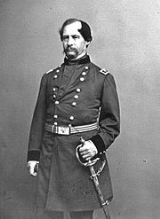
David Hunter

Encyclopedia
David Hunter was a Union
general in the American Civil War
. He achieved fame by his unauthorized 1862 order (immediately rescinded) emancipating slaves in three Southern states and as the president of the military commission trying the conspirators involved with the assassination of President
Abraham Lincoln
.
, or Princeton, New Jersey
. He was the cousin of writer-illustrator David Hunter Strother
(who would also serve as a Union Army general) and his maternal grandfather was Richard Stockton, a signer of the United States Declaration of Independence
. He graduated from the United States Military Academy
, in 1822, and was commissioned a second lieutenant in the 5th U.S. Infantry Regiment
. Records of his military service prior to the Civil War contain significant gaps. From 1828 to 1831, he was stationed on the northwest frontier, at Fort Dearborn
(Chicago, Illinois), where he met and married Maria Kinzie, the daughter of the city's first permanent white resident, John Kinzie
. He served in the infantry for 11 years, and was appointed captain of the 1st U.S. Dragoons in 1833. He resigned from the Army in July 1836 and moved to Illinois, where he worked as a real estate agent or speculator. He rejoined the Army in November 1841 as a paymaster and was promoted to major
in March 1842. One source claims that he saw action in the Second Seminole War
(1838–42) and the Mexican-American War (1846–48).
In 1860, Hunter was stationed at Fort Leavenworth, Kansas, and he began a correspondence with Abraham Lincoln
, focusing on Hunter's strong anti-slavery views. This relationship had long-lasting political effects, the first of which was an invitation to ride on Lincoln's inaugural train from Springfield, Illinois
, to Washington, D.C.
, in February 1861. During this duty, Hunter suffered a dislocated collarbone at Buffalo
, due to a crowd pressing the president-elect.
, Hunter was promoted to colonel
of the 3rd U.S. Cavalry, but three days later (May 17, 1861), his political connection to the Lincoln administration bore fruit and he was appointed the fourth-ranking brigadier general
of volunteers, commanding a brigade in the Department of Washington. He was wounded in the neck and cheek while commanding a division under Irvin McDowell
at the First Battle of Bull Run
in July 1861. In August, he was promoted to major general
of volunteers. He served as a division commander in the Western Army under Maj. Gen. John C. Frémont
, and was appointed as commander of the Western Department on November 2, 1861, after Frémont was relieved of command due to his attempt to emancipate the slaves of rebellious slave holders. That winter, Hunter was transferred to command the Department of Kansas and, in March 1862, was transferred again to command the Department of the South and the X Corps.
Hunter served as the president of the court-martial
of Maj. Gen. Fitz John Porter
(convicted for his actions at the Second Battle of Bull Run
, but for which he was exonerated by an 1878 Board of Officers), and on the committee that investigated the loss of Harpers Ferry
in the Maryland Campaign
. He also served briefly as the Assistant Inspector General of the Department of the Gulf.
, he began enlisting black soldiers from the occupied districts of South Carolina and formed the first such Union Army regiment, the 1st South Carolina (African Descent), which he was initially ordered to disband, but eventually got approval from Congress for his action. A second controversy was caused by his issuing an order emancipating the slaves in Georgia, South Carolina, and Florida:
This order was quickly rescinded by Abraham Lincoln, who was concerned about the political effects that it would have in the border states
and who advocated instead a gradual emancipation with compensation for slave holders. Despite Lincoln's concerns that immediate emancipation in the South might drive some slave holding Unionists to support the Confederacy, the national mood was quickly moving against slavery, especially within the Army. The president and Congress had already enacted several laws during the war to severely restrict the institution, beginning with the First Confiscation Act in August 1861 and culminating in Lincoln's own Emancipation Proclamation
in September 1862, taking effect January 1, 1863. Concerned Confederate slave holders had worried since before the war started that its eventual goal would become the abolition of slavery and they reacted strongly to the Union effort to emancipate Confederate slaves. Confederate President Jefferson Davis
issued orders to the Confederate States Army
that Hunter was to be considered a "felon to be executed if captured".
sponsored a resolution demanding a response.
Hunter quickly obliged with a sarcastic and defiant letter on 23 June 1862, in which he delivered a stern reminder to the Congress of his authority as a commanding officer in a war zone:
While increasingly abolitionist Republicans in Congress were amused by the order, border state pro-slavery politicians such as Wickliffe and Robert Mallory
were not. Mallory described the scene in Congress following the reading of the order as follows:
The War Department eventually forced Hunter to abandon this scheme, but the government nonetheless moved soon afterward to expand the enlistment of black men as military laborers. Congress approved the Second Confiscation Act in July 1862, which effectively freed all slaves working within the armed forces by forbidding Union soldiers to aid in the return of fugitive slaves.
, Union Maj. Gen. Franz Sigel
was ordered by Lt. Gen. Ulysses S. Grant
to move into the Shenandoah Valley
, threaten railroads and the agricultural economy there, and distract Robert E. Lee
while Grant fought him in eastern Virginia. Sigel did a poor job, losing immediately at the Battle of New Market
to a force that included cadets from the Virginia Military Institute
(VMI). Hunter replaced Sigel in command of the Army of the Shenandoah
and the Department of West Virginia on May 21, 1864. Grant ordered Hunter to employ scorched earth
tactics similar to those that would be used later in that year during Sherman's March to the Sea
; he was to move through Staunton
to Charlottesville
and Lynchburg
, "living off the country" and destroying the Virginia Central Railroad "beyond possibility of repair for weeks." Lee was concerned enough about Hunter that he dispatched a corps under Lt. Gen. Jubal A. Early to deal with him.
On June 5, Hunter defeated Maj. Gen. William E. "Grumble" Jones
at the Battle of Piedmont
. He moved up the Valley (southward) to Lexington, where he burned VMI on June 11 and his troops freely looted civilian property of all kinds along the way. Henrietta Lee, a relative of Robert E. Lee whose house was burned by the Union troops, wrote a letter addressing Hunter, promising that the "curses of thousands, the scorn of the manly and upright and the hatred of the true and honorable, will follow you and yours through all time, and brand your name infamy. INFAMY." Lexington was particularly hard hit. In addition to the burning of VMI, Hunter's men plundered a number of private homes and the library of Washington College
. Hunter ordered the home of former Governor John Letcher
burned, reporting afterwards that it was in retaliation for its absent owner's having issued "a violent and inflammatory proclamation ... inciting the population of the country to rise and wage guerrilla warfare on my troops."
Hunter's reign of terror in the Valley soon came to an end; he was defeated by Early at the Battle of Lynchburg
on June 19. His headquarters was at Sandusky House
, listed on the National Register of Historic Places
in 1982, and now operated as a house museum. Grant brought in Maj. Gen. Philip Sheridan
, making him Hunter's subordinate, but making it clear that Sheridan would lead the troops in the field and that Hunter would be left with only administrative responsibilities. Hunter, realizing Grant's lack of confidence in him, requested to be relieved. He would serve in no more combat commands. He was promoted to brevet
major general in the regular army on March 13, 1865, an honor that was relatively common for senior officers late in the war.
Hunter died in Washington, D.C., and is buried in the Princeton Cemetery
, Princeton, New Jersey
.
Union Army
The Union Army was the land force that fought for the Union during the American Civil War. It was also known as the Federal Army, the U.S. Army, the Northern Army and the National Army...
general in the American Civil War
American Civil War
The American Civil War was a civil war fought in the United States of America. In response to the election of Abraham Lincoln as President of the United States, 11 southern slave states declared their secession from the United States and formed the Confederate States of America ; the other 25...
. He achieved fame by his unauthorized 1862 order (immediately rescinded) emancipating slaves in three Southern states and as the president of the military commission trying the conspirators involved with the assassination of President
President of the United States
The President of the United States of America is the head of state and head of government of the United States. The president leads the executive branch of the federal government and is the commander-in-chief of the United States Armed Forces....
Abraham Lincoln
Abraham Lincoln
Abraham Lincoln was the 16th President of the United States, serving from March 1861 until his assassination in April 1865. He successfully led his country through a great constitutional, military and moral crisis – the American Civil War – preserving the Union, while ending slavery, and...
.
Early years
Hunter was born in Troy, New YorkTroy, New York
Troy is a city in the US State of New York and the seat of Rensselaer County. Troy is located on the western edge of Rensselaer County and on the eastern bank of the Hudson River. Troy has close ties to the nearby cities of Albany and Schenectady, forming a region popularly called the Capital...
, or Princeton, New Jersey
Princeton, New Jersey
Princeton is a community located in Mercer County, New Jersey, United States. It is best known as the location of Princeton University, which has been sited in the community since 1756...
. He was the cousin of writer-illustrator David Hunter Strother
David Hunter Strother
David Hunter Strother was a successful 19th century American magazine illustrator and writer, popularly known by his pseudonym, "Porte Crayon" .-Early life:...
(who would also serve as a Union Army general) and his maternal grandfather was Richard Stockton, a signer of the United States Declaration of Independence
United States Declaration of Independence
The Declaration of Independence was a statement adopted by the Continental Congress on July 4, 1776, which announced that the thirteen American colonies then at war with Great Britain regarded themselves as independent states, and no longer a part of the British Empire. John Adams put forth a...
. He graduated from the United States Military Academy
United States Military Academy
The United States Military Academy at West Point is a four-year coeducational federal service academy located at West Point, New York. The academy sits on scenic high ground overlooking the Hudson River, north of New York City...
, in 1822, and was commissioned a second lieutenant in the 5th U.S. Infantry Regiment
5th Infantry Regiment (United States)
The 5th Infantry Regiment is the third-oldest infantry regiment of the United States Army, tracing its origins to 1808...
. Records of his military service prior to the Civil War contain significant gaps. From 1828 to 1831, he was stationed on the northwest frontier, at Fort Dearborn
Fort Dearborn
Fort Dearborn was a United States fort built in 1803 beside the Chicago River in what is now Chicago, Illinois. It was constructed by troops under Captain John Whistler and named in honor of Henry Dearborn, then United States Secretary of War. The original fort was destroyed following the Battle of...
(Chicago, Illinois), where he met and married Maria Kinzie, the daughter of the city's first permanent white resident, John Kinzie
John Kinzie
John Kinzie was one of Chicago's first permanent European settlers. Kinzie Street in Chicago is named after him.-Early life:...
. He served in the infantry for 11 years, and was appointed captain of the 1st U.S. Dragoons in 1833. He resigned from the Army in July 1836 and moved to Illinois, where he worked as a real estate agent or speculator. He rejoined the Army in November 1841 as a paymaster and was promoted to major
Major (United States)
In the United States Army, Air Force, and Marine Corps, major is a field grade military officer rank just above the rank of captain and just below the rank of lieutenant colonel...
in March 1842. One source claims that he saw action in the Second Seminole War
Second Seminole War
The Second Seminole War, also known as the Florida War, was a conflict from 1835 to 1842 in Florida between various groups of Native Americans collectively known as Seminoles and the United States, part of a series of conflicts called the Seminole Wars...
(1838–42) and the Mexican-American War (1846–48).
In 1860, Hunter was stationed at Fort Leavenworth, Kansas, and he began a correspondence with Abraham Lincoln
Abraham Lincoln
Abraham Lincoln was the 16th President of the United States, serving from March 1861 until his assassination in April 1865. He successfully led his country through a great constitutional, military and moral crisis – the American Civil War – preserving the Union, while ending slavery, and...
, focusing on Hunter's strong anti-slavery views. This relationship had long-lasting political effects, the first of which was an invitation to ride on Lincoln's inaugural train from Springfield, Illinois
Springfield, Illinois
Springfield is the third and current capital of the US state of Illinois and the county seat of Sangamon County with a population of 117,400 , making it the sixth most populated city in the state and the second most populated Illinois city outside of the Chicago Metropolitan Area...
, to Washington, D.C.
Washington, D.C.
Washington, D.C., formally the District of Columbia and commonly referred to as Washington, "the District", or simply D.C., is the capital of the United States. On July 16, 1790, the United States Congress approved the creation of a permanent national capital as permitted by the U.S. Constitution....
, in February 1861. During this duty, Hunter suffered a dislocated collarbone at Buffalo
Buffalo, New York
Buffalo is the second most populous city in the state of New York, after New York City. Located in Western New York on the eastern shores of Lake Erie and at the head of the Niagara River across from Fort Erie, Ontario, Buffalo is the seat of Erie County and the principal city of the...
, due to a crowd pressing the president-elect.
Civil War
Soon after the firing on Fort SumterBattle of Fort Sumter
The Battle of Fort Sumter was the bombardment and surrender of Fort Sumter, near Charleston, South Carolina, that started the American Civil War. Following declarations of secession by seven Southern states, South Carolina demanded that the U.S. Army abandon its facilities in Charleston Harbor. On...
, Hunter was promoted to colonel
Colonel (United States)
In the United States Army, Air Force, and Marine Corps, colonel is a senior field grade military officer rank just above the rank of lieutenant colonel and just below the rank of brigadier general...
of the 3rd U.S. Cavalry, but three days later (May 17, 1861), his political connection to the Lincoln administration bore fruit and he was appointed the fourth-ranking brigadier general
Brigadier general (United States)
A brigadier general in the United States Army, Air Force, and Marine Corps, is a one-star general officer, with the pay grade of O-7. Brigadier general ranks above a colonel and below major general. Brigadier general is equivalent to the rank of rear admiral in the other uniformed...
of volunteers, commanding a brigade in the Department of Washington. He was wounded in the neck and cheek while commanding a division under Irvin McDowell
Irvin McDowell
Irvin McDowell was a career American army officer. He is best known for his defeat in the First Battle of Bull Run, the first large-scale battle of the American Civil War.-Early life:...
at the First Battle of Bull Run
First Battle of Bull Run
First Battle of Bull Run, also known as First Manassas , was fought on July 21, 1861, in Prince William County, Virginia, near the City of Manassas...
in July 1861. In August, he was promoted to major general
Major general (United States)
In the United States Army, United States Marine Corps, and United States Air Force, major general is a two-star general-officer rank, with the pay grade of O-8. Major general ranks above brigadier general and below lieutenant general...
of volunteers. He served as a division commander in the Western Army under Maj. Gen. John C. Frémont
John C. Frémont
John Charles Frémont , was an American military officer, explorer, and the first candidate of the anti-slavery Republican Party for the office of President of the United States. During the 1840s, that era's penny press accorded Frémont the sobriquet The Pathfinder...
, and was appointed as commander of the Western Department on November 2, 1861, after Frémont was relieved of command due to his attempt to emancipate the slaves of rebellious slave holders. That winter, Hunter was transferred to command the Department of Kansas and, in March 1862, was transferred again to command the Department of the South and the X Corps.
Hunter served as the president of the court-martial
Court-martial of Fitz John Porter
The court-martial of Fitz John Porter was a major event of the American Civil War. Major General Fitz John Porter was found guilty of disobeying a lawful order, and misconduct in front of the enemy and removed from command based on internal political machinations of the Union...
of Maj. Gen. Fitz John Porter
Fitz John Porter
Fitz John Porter was a career United States Army officer and a Union General during the American Civil War...
(convicted for his actions at the Second Battle of Bull Run
Second Battle of Bull Run
The Second Battle of Bull Run or Second Manassas was fought August 28–30, 1862, as part of the American Civil War. It was the culmination of an offensive campaign waged by Confederate Gen. Robert E. Lee's Army of Northern Virginia against Union Maj. Gen...
, but for which he was exonerated by an 1878 Board of Officers), and on the committee that investigated the loss of Harpers Ferry
Battle of Harpers Ferry
The Battle of Harpers Ferry was fought September 12–15, 1862, as part of the Maryland Campaign of the American Civil War. As Gen. Robert E. Lee's Confederate army invaded Maryland, a portion of his army under Maj. Gen. Thomas J...
in the Maryland Campaign
Maryland Campaign
The Maryland Campaign, or the Antietam Campaign is widely considered one of the major turning points of the American Civil War. Confederate Gen. Robert E. Lee's first invasion of the North was repulsed by Maj. Gen. George B...
. He also served briefly as the Assistant Inspector General of the Department of the Gulf.
General Order No. 11
Hunter was a strong advocate of arming blacks as soldiers for the Union cause. After the Battle of Fort PulaskiBattle of Fort Pulaski
The Battle of Fort Pulaski was fought April 10–11, 1862, during the American Civil War. Union forces on Tybee Island and naval operations conducted a 112-day siege, then captured the Confederate-held Fort Pulaski after a 30-hour bombardment. The battle is important for innovative use of rifled guns...
, he began enlisting black soldiers from the occupied districts of South Carolina and formed the first such Union Army regiment, the 1st South Carolina (African Descent), which he was initially ordered to disband, but eventually got approval from Congress for his action. A second controversy was caused by his issuing an order emancipating the slaves in Georgia, South Carolina, and Florida:
This order was quickly rescinded by Abraham Lincoln, who was concerned about the political effects that it would have in the border states
Border states (Civil War)
In the context of the American Civil War, the border states were slave states that did not declare their secession from the United States before April 1861...
and who advocated instead a gradual emancipation with compensation for slave holders. Despite Lincoln's concerns that immediate emancipation in the South might drive some slave holding Unionists to support the Confederacy, the national mood was quickly moving against slavery, especially within the Army. The president and Congress had already enacted several laws during the war to severely restrict the institution, beginning with the First Confiscation Act in August 1861 and culminating in Lincoln's own Emancipation Proclamation
Emancipation Proclamation
The Emancipation Proclamation is an executive order issued by United States President Abraham Lincoln on January 1, 1863, during the American Civil War using his war powers. It proclaimed the freedom of 3.1 million of the nation's 4 million slaves, and immediately freed 50,000 of them, with nearly...
in September 1862, taking effect January 1, 1863. Concerned Confederate slave holders had worried since before the war started that its eventual goal would become the abolition of slavery and they reacted strongly to the Union effort to emancipate Confederate slaves. Confederate President Jefferson Davis
Jefferson Davis
Jefferson Finis Davis , also known as Jeff Davis, was an American statesman and leader of the Confederacy during the American Civil War, serving as President for its entire history. He was born in Kentucky to Samuel and Jane Davis...
issued orders to the Confederate States Army
Confederate States Army
The Confederate States Army was the army of the Confederate States of America while the Confederacy existed during the American Civil War. On February 8, 1861, delegates from the seven Deep South states which had already declared their secession from the United States of America adopted the...
that Hunter was to be considered a "felon to be executed if captured".
Controversy over enlistment of ex-slaves
Undeterred by the president's reluctance and intent of extending American freedom to potential black soldiers, Hunter again flouted orders from the federal government and enlisted ex-slaves as soldiers in South Carolina without permission from the War Department. This action incensed border state slave holders, and Kentucky Representative Charles A. WickliffeCharles A. Wickliffe
Charles Anderson Wickliffe was a U.S. Representative from Kentucky. He also served as Speaker of the Kentucky House of Representatives, the 14th Governor of Kentucky, and was appointed Postmaster General by President John Tyler...
sponsored a resolution demanding a response.
Hunter quickly obliged with a sarcastic and defiant letter on 23 June 1862, in which he delivered a stern reminder to the Congress of his authority as a commanding officer in a war zone:
While increasingly abolitionist Republicans in Congress were amused by the order, border state pro-slavery politicians such as Wickliffe and Robert Mallory
Robert Mallory
Robert Mallory was a nineteenth century politician and lawyer from Kentucky.Born in Madison Court House, Virginia, Mallory attended private schools and graduated from the University of Virginia in 1827...
were not. Mallory described the scene in Congress following the reading of the order as follows:
The War Department eventually forced Hunter to abandon this scheme, but the government nonetheless moved soon afterward to expand the enlistment of black men as military laborers. Congress approved the Second Confiscation Act in July 1862, which effectively freed all slaves working within the armed forces by forbidding Union soldiers to aid in the return of fugitive slaves.
The Valley
In the Valley Campaigns of 1864Valley Campaigns of 1864
The Valley Campaigns of 1864 were American Civil War operations and battles that took place in the Shenandoah Valley of Virginia from May to October 1864. Military historians divide this period into three separate campaigns, but it is useful to consider the three together and how they...
, Union Maj. Gen. Franz Sigel
Franz Sigel
Franz Sigel was a German military officer, revolutionist and immigrant to the United States who was a teacher, newspaperman, politician, and served as a Union major general in the American Civil War.-Early life:...
was ordered by Lt. Gen. Ulysses S. Grant
Ulysses S. Grant
Ulysses S. Grant was the 18th President of the United States as well as military commander during the Civil War and post-war Reconstruction periods. Under Grant's command, the Union Army defeated the Confederate military and ended the Confederate States of America...
to move into the Shenandoah Valley
Shenandoah Valley
The Shenandoah Valley is both a geographic valley and cultural region of western Virginia and West Virginia in the United States. The valley is bounded to the east by the Blue Ridge Mountains, to the west by the eastern front of the Ridge-and-Valley Appalachians , to the north by the Potomac River...
, threaten railroads and the agricultural economy there, and distract Robert E. Lee
Robert E. Lee
Robert Edward Lee was a career military officer who is best known for having commanded the Confederate Army of Northern Virginia in the American Civil War....
while Grant fought him in eastern Virginia. Sigel did a poor job, losing immediately at the Battle of New Market
Battle of New Market
The Battle of New Market was a battle fought on May 15, 1864, in Virginia during Valley Campaigns of 1864 in the American Civil War. Cadets from the Virginia Military Institute fought alongside the Confederate Army and forced Union General Franz Sigel and his army out of the Shenandoah...
to a force that included cadets from the Virginia Military Institute
Virginia Military Institute
The Virginia Military Institute , located in Lexington, Virginia, is the oldest state-supported military college and one of six senior military colleges in the United States. Unlike any other military college in the United States—and in keeping with its founding principles—all VMI students are...
(VMI). Hunter replaced Sigel in command of the Army of the Shenandoah
Army of the Shenandoah
Army of the Shenandoah refers to two armies in the American Civil War:* Confederate Army of the Shenandoah* Union Army of the Shenandoah...
and the Department of West Virginia on May 21, 1864. Grant ordered Hunter to employ scorched earth
Scorched earth
A scorched earth policy is a military strategy or operational method which involves destroying anything that might be useful to the enemy while advancing through or withdrawing from an area...
tactics similar to those that would be used later in that year during Sherman's March to the Sea
Sherman's March to the Sea
Sherman's March to the Sea is the name commonly given to the Savannah Campaign conducted around Georgia from November 15, 1864 to December 21, 1864 by Maj. Gen. William Tecumseh Sherman of the Union Army in the American Civil War...
; he was to move through Staunton
Staunton, Virginia
Staunton is an independent city within the confines of Augusta County in the commonwealth of Virginia. The population was 23,746 as of 2010. It is the county seat of Augusta County....
to Charlottesville
Charlottesville, Virginia
Charlottesville is an independent city geographically surrounded by but separate from Albemarle County in the Commonwealth of Virginia, United States, and named after Charlotte of Mecklenburg-Strelitz, the queen consort of King George III of the United Kingdom.The official population estimate for...
and Lynchburg
Lynchburg, Virginia
Lynchburg is an independent city in the Commonwealth of Virginia. The population was 75,568 as of 2010. Located in the foothills of the Blue Ridge Mountains along the banks of the James River, Lynchburg is known as the "City of Seven Hills" or "The Hill City." Lynchburg was the only major city in...
, "living off the country" and destroying the Virginia Central Railroad "beyond possibility of repair for weeks." Lee was concerned enough about Hunter that he dispatched a corps under Lt. Gen. Jubal A. Early to deal with him.
On June 5, Hunter defeated Maj. Gen. William E. "Grumble" Jones
William E. Jones
William Edmondson Jones, known as Grumble Jones, was a planter, a career United States Army officer, and a Confederate cavalry general, killed in the Battle of Piedmont in the American Civil War.-Early life:...
at the Battle of Piedmont
Battle of Piedmont
The Battle of Piedmont was fought June 5, 1864, in the village of Piedmont, Augusta County, Virginia. Union Maj. Gen. David Hunter engaged Confederates under Brig. Gen. William E. "Grumble" Jones north of Piedmont. After severe fighting, Jones was killed and the Confederates were routed...
. He moved up the Valley (southward) to Lexington, where he burned VMI on June 11 and his troops freely looted civilian property of all kinds along the way. Henrietta Lee, a relative of Robert E. Lee whose house was burned by the Union troops, wrote a letter addressing Hunter, promising that the "curses of thousands, the scorn of the manly and upright and the hatred of the true and honorable, will follow you and yours through all time, and brand your name infamy. INFAMY." Lexington was particularly hard hit. In addition to the burning of VMI, Hunter's men plundered a number of private homes and the library of Washington College
Washington and Lee University
Washington and Lee University is a private liberal arts college in Lexington, Virginia, United States.The classical school from which Washington and Lee descended was established in 1749 as Augusta Academy, about north of its present location. In 1776 it was renamed Liberty Hall in a burst of...
. Hunter ordered the home of former Governor John Letcher
John Letcher
John Letcher was an American lawyer, journalist, and politician. He served as a Representative in the United States Congress, was the 34th Governor of Virginia during the American Civil War, and later served in the Virginia General Assembly...
burned, reporting afterwards that it was in retaliation for its absent owner's having issued "a violent and inflammatory proclamation ... inciting the population of the country to rise and wage guerrilla warfare on my troops."
Hunter's reign of terror in the Valley soon came to an end; he was defeated by Early at the Battle of Lynchburg
Battle of Lynchburg
The Battle of Lynchburg was fought on June 17–18, 1864, two miles outside Lynchburg, Virginia, as part of the American Civil War. The Union Army of West Virginia, under Maj. Gen. David Hunter attempted to capture the city, but was repulsed by Confederate Lt. Gen. Jubal Anderson...
on June 19. His headquarters was at Sandusky House
Sandusky House (Lynchburg, Virginia)
The Sandusky House is a historic home located at Lynchburg, Virginia. It is a formal two-story, brick "I" house built about 1808, with a later addition. It was built for Charles Johnston, and is one of the earliest houses in the...
, listed on the National Register of Historic Places
National Register of Historic Places
The National Register of Historic Places is the United States government's official list of districts, sites, buildings, structures, and objects deemed worthy of preservation...
in 1982, and now operated as a house museum. Grant brought in Maj. Gen. Philip Sheridan
Philip Sheridan
Philip Henry Sheridan was a career United States Army officer and a Union general in the American Civil War. His career was noted for his rapid rise to major general and his close association with Lt. Gen. Ulysses S...
, making him Hunter's subordinate, but making it clear that Sheridan would lead the troops in the field and that Hunter would be left with only administrative responsibilities. Hunter, realizing Grant's lack of confidence in him, requested to be relieved. He would serve in no more combat commands. He was promoted to brevet
Brevet (military)
In many of the world's military establishments, brevet referred to a warrant authorizing a commissioned officer to hold a higher rank temporarily, but usually without receiving the pay of that higher rank except when actually serving in that role. An officer so promoted may be referred to as being...
major general in the regular army on March 13, 1865, an honor that was relatively common for senior officers late in the war.
Later years
Hunter served in the honor guard at the funeral of Abraham Lincoln and accompanied his body back to Springfield. He was the president of the military commission trying the conspirators of Lincoln's assassination, from May 8 to July 15, 1865. He retired from the Army in July 1866. He was the author of Report of the Military Services of Gen. David Hunter, U.S.A., during the War of the Rebellion, published in 1873.Hunter died in Washington, D.C., and is buried in the Princeton Cemetery
Princeton Cemetery
Princeton Cemetery is located in Borough of Princeton, New Jersey. It is owned by the Nassau Presbyterian Church. John F. Hageman in his 1878 history of Princeton, New Jersey refers to the cemetery as: "The Westminster Abbey of the United States."...
, Princeton, New Jersey
Princeton, New Jersey
Princeton is a community located in Mercer County, New Jersey, United States. It is best known as the location of Princeton University, which has been sited in the community since 1756...
.
See also
- List of American Civil War generals
- Battle of Fort PulaskiBattle of Fort PulaskiThe Battle of Fort Pulaski was fought April 10–11, 1862, during the American Civil War. Union forces on Tybee Island and naval operations conducted a 112-day siege, then captured the Confederate-held Fort Pulaski after a 30-hour bombardment. The battle is important for innovative use of rifled guns...