
All Topics  
Battle of Williamsburg


   Email Print
   Bookmark   Link


Battle of Williamsburg


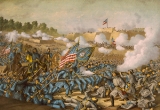
The Battle of Williamsburg, also known as the Battle of Fort Magruder, took place on May 5, 1862, in York County
York County, Virginia

York County is a county located on the north side of the Virginia Peninsula in the Hampton Roads region of the Commonwealth of Virginia, a U.S....
, James City County
James City County, Virginia

James City County is a county located on the Virginia Peninsula in the Hampton Roads region of the Commonwealth of Virginia, a U.S. state of the United States....
, and Williamsburg, Virginia
Williamsburg, Virginia

Williamsburg is a city located on the Virginia Peninsula in the Hampton Roads region in southeastern Virginia. As of the United States Census 2000, the city had a total population of 11,998....
, as part of the Peninsula Campaign
Peninsula Campaign

The Peninsula Campaign of the American Civil War was a major Union operation launched in southeastern Virginia from March through July 1862, the first large-scale offensive in the Eastern Theater of the American Civil War....
 of the American Civil War
American Civil War

The American Civil War , also known as the War Between the States and several Naming the American Civil War, was a civil war in the United States....
. It was the first pitched battle of the Peninsula Campaign, in which nearly 41,000 Federals
Union Army

The Union Army was the army that fought for the Union during the American Civil War. It was also known as the Federal Army, the U.S....
 and 32,000 Confederates
Confederate States Army

The Confederate States Army was a military organization whose primary mission was to provide the necessary forces and capabilities to support the National Security and defense of the Confederate States of America during its brief existence from 1861 to 1865....
 were engaged, fighting an inconclusive battle that ended with the Confederates continuing their withdrawal.

Following up the Confederate retreat from Yorktown
Battle of Yorktown (1862)

The Battle of Yorktown or Siege of Yorktown was fought from April 5 to May 4, 1862, as part of the Peninsula Campaign of the American Civil War....
, the Union division of Brig. Gen.
Brigadier General

Brigadier General is the lowest ranking General Officer in some countries, usually sitting between the ranks of Colonel and Major General.The rank can be traced back to the militaries of Europe where a brigadier general, or simply a brigadier, would command a brigade in the field....
 Joseph Hooker
Joseph Hooker

Joseph Hooker was a career United States Army officer, fought in the Mexican-American War, and was a Major general in the Union Army during the American Civil War....
 encountered the Confederate rearguard near Williamsburg.


Discussion
Ask a question about 'Battle of Williamsburg'
Start a new discussion about 'Battle of Williamsburg'
Answer questions from other users
Full Discussion Forum


Encyclopedia


The Battle of Williamsburg, also known as the Battle of Fort Magruder, took place on May 5, 1862, in York County
York County, Virginia

York County is a county located on the north side of the Virginia Peninsula in the Hampton Roads region of the Commonwealth of Virginia, a U.S....
, James City County
James City County, Virginia

James City County is a county located on the Virginia Peninsula in the Hampton Roads region of the Commonwealth of Virginia, a U.S. state of the United States....
, and Williamsburg, Virginia
Williamsburg, Virginia

Williamsburg is a city located on the Virginia Peninsula in the Hampton Roads region in southeastern Virginia. As of the United States Census 2000, the city had a total population of 11,998....
, as part of the Peninsula Campaign
Peninsula Campaign

The Peninsula Campaign of the American Civil War was a major Union operation launched in southeastern Virginia from March through July 1862, the first large-scale offensive in the Eastern Theater of the American Civil War....
 of the American Civil War
American Civil War

The American Civil War , also known as the War Between the States and several Naming the American Civil War, was a civil war in the United States....
. It was the first pitched battle of the Peninsula Campaign, in which nearly 41,000 Federals
Union Army

The Union Army was the army that fought for the Union during the American Civil War. It was also known as the Federal Army, the U.S....
 and 32,000 Confederates
Confederate States Army

The Confederate States Army was a military organization whose primary mission was to provide the necessary forces and capabilities to support the National Security and defense of the Confederate States of America during its brief existence from 1861 to 1865....
 were engaged, fighting an inconclusive battle that ended with the Confederates continuing their withdrawal.

Following up the Confederate retreat from Yorktown
Battle of Yorktown (1862)

The Battle of Yorktown or Siege of Yorktown was fought from April 5 to May 4, 1862, as part of the Peninsula Campaign of the American Civil War....
, the Union division of Brig. Gen.
Brigadier General

Brigadier General is the lowest ranking General Officer in some countries, usually sitting between the ranks of Colonel and Major General.The rank can be traced back to the militaries of Europe where a brigadier general, or simply a brigadier, would command a brigade in the field....
 Joseph Hooker
Joseph Hooker

Joseph Hooker was a career United States Army officer, fought in the Mexican-American War, and was a Major general in the Union Army during the American Civil War....
 encountered the Confederate rearguard near Williamsburg. Hooker assaulted Fort Magruder
Fort Magruder

Fort Magruder was an high earthen fortification straddling the road between Yorktown, Virginia and Williamsburg, Virginia, just outside the latter city during the American Civil War....
, an earthen fortification alongside the Williamsburg Road, but was repulsed. Confederate counterattacks, directed by Maj. Gen.
Major General

Major General or Major-General is a military rank used in many countries. It is derived from the older rank of Sergeant Major General. A Major General is a high-ranking officer, normally subordinate to the rank of Lieutenant General and senior to the ranks of Brigadier and Brigadier General....
 James Longstreet
James Longstreet

James Longstreet was one of the foremost Confederate States Army General officers of the American Civil War and the principal subordinate to General Robert E....
, threatened to overwhelm the Union left flank, until Brig. Gen. Philip Kearny
Philip Kearny

Philip Kearny, Jr., was a United States Army officer, notably in the Mexican-American War and American Civil War. He was killed in action in the 1862 Battle of Chantilly....
's division arrived to stabilize the Federal position. Brig. Gen. Winfield S. Hancock's brigade then moved to threaten the Confederate left flank, occupying two abandoned redoubts. The Confederates counterattacked unsuccessfully. Hancock's localized success was not exploited. The Confederate army continued its withdrawal during the night in the direction of Richmond, Virginia
Richmond, Virginia

Richmond is the Capital of the Commonwealth of Virginia, in the United States. Like all Virginia municipalities incorporated as cities, it is an independent city and not part of any county....
.

Background

When Confederate General Joseph E. Johnston
Joseph E. Johnston

Joseph Eggleston Johnston was a career United States Army officer, serving with distinction in the Mexican-American War and Seminole Wars, and was also one of the most senior general officers in the Confederate States Army during the American Civil War....
 unexpectedly withdrew his forces from the Warwick Line
Warwick Line

Warwick Line was a defensive works across the Virginia Peninsula maintained along the Warwick River by Confederate States of America General John B....
 at the Battle of Yorktown
Battle of Yorktown (1862)

The Battle of Yorktown or Siege of Yorktown was fought from April 5 to May 4, 1862, as part of the Peninsula Campaign of the American Civil War....
 the night of May 3, Union Maj. Gen. George B. McClellan
George B. McClellan

George Brinton McClellan was a Major general during the American Civil War. He organized the famous Army of the Potomac and served briefly as the general-in-chief of the Union Army....
 was taken by surprise and was unprepared to mount an immediate pursuit. On May 4, he ordered cavalry commander Brig. Gen. George Stoneman
George Stoneman

George Stoneman, Jr. was a career United States Army officer, a Union army cavalry general in the American Civil War, and the Governor of California between 1883 and 1887....
 to pursue Johnson's rearguard and sent approximately half of his Army of the Potomac
Army of the Potomac

The Army of the Potomac was the major Union Army in the Eastern Theater of the American Civil War of the American Civil War....
 along behind Stoneman, under the command of Brig. Gen. Edwin V. Sumner. He also ordered Brig. Gen. William B. Franklin
William B. Franklin

William Buel Franklin was a career United States Army officer and a Union Army general in the American Civil War. He rose to the rank of a corps commander in the Army of the Potomac, fighting in several notable early battles in the Eastern Theater of the American Civil War....
's division to board transport ships on the York River
York River (Virginia)

The York River is a navigable estuary, approximately 40 mi long, in eastern Virginia in the United States. It ranges in width from 1 mi. at its head to 2.5 mi near its mouth on the west side of Chesapeake Bay....
 in an attempt to move upstream and land so as to cut off Johnston's retreat. However, it took two days just to board the men and equipment onto the ships, so the maneuver had much effect on the battle of May 5; Franklin's division landed and fought in the Battle of Eltham's Landing
Battle of Eltham's Landing

}|-||}The Battle of Eltham's Landing, also known as the Battle of Barhamsville, or West Point, took place on May 7, 1862, in New Kent County, Virginia, as part of the Peninsula Campaign of the American Civil War....
 on May 7.

By May 5, Johnston's army was making slow progress on muddy roads and Stoneman's cavalry was skirmishing with Brig. Gen. J.E.B. Stuart
J.E.B. Stuart

James Ewell Brown "Jeb" Stuart was an American soldier from Virginia and a Confederate States Army general during the American Civil War. He was known to his friends as "Jeb", from the initials of his given names....
's cavalry, Johnston's rearguard. To give time for the bulk of his army to get free, Johnston detached part of his force to make a stand at a large earthen fortification, Fort Magruder
Fort Magruder

Fort Magruder was an high earthen fortification straddling the road between Yorktown, Virginia and Williamsburg, Virginia, just outside the latter city during the American Civil War....
, straddling the Williamsburg Road (from Yorktown), constructed earlier by Brig. Gen. John B. Magruder
John B. Magruder

John Bankhead Magruder was a career military officer who served in the armies of three nations. He was a United States Army officer in the Mexican-American War, a Confederate States Army General officer during the American Civil War, and a postbellum general in the Imperial Mexican Army....
.

Battle

Brig. Gen. Joseph Hooker
Joseph Hooker

Joseph Hooker was a career United States Army officer, fought in the Mexican-American War, and was a Major general in the Union Army during the American Civil War....
's 2nd division of the III Corps
III Corps (ACW)

There were four formations in the Union Army designated as III Corps during the American Civil War.Three were short-lived:*Army of Virginia:...
 was the lead infantry in the Union Army advance. They assaulted Fort Magruder and a line of rifle pits and smaller fortifications that extended in an arc south-west from the fort, but were repulsed. Confederate counterattacks, directed by Maj. Gen. James Longstreet
James Longstreet

James Longstreet was one of the foremost Confederate States Army General officers of the American Civil War and the principal subordinate to General Robert E....
, threatened to overwhelm Hooker's division, which had contested the ground alone since the early morning while waiting for the main body of the army to arrive. Hooker had expected Brig. Gen. William F. "Baldy" Smith
William Farrar Smith

William Farrar Smith , was a civil engineer, a member of the police commission, and Union army General officer in the American Civil War....
's 2nd Division of the IV Corps
IV Corps (ACW)

There were two corps of the Union Army called IV Corps during the American Civil War. They were separate units, one serving with the Army of the Potomac and the Department of Virginia in the Eastern Theater, 1862–1863, the other with the Army of the Cumberland in the Western Theater, 1863–1865....
, marching north on the Yorktown Road, to hear the sound of battle and come in on Hooker's right in support. However, Smith had been halted by Sumner more than a mile away from Hooker's position. He had been concerned that the Confederates would leave their fortifications and attack him on the Yorktown Road.
Peninsulacampaign
Longstreet's men did leave their fortifications, but they attacked Hooker, not Smith or Sumner. The brigade of Brig. Gen. Cadmus M. Wilcox
Cadmus M. Wilcox

Cadmus Marcellus Wilcox was a career United States Army officer who served in the Mexican?American War and also was a Confederate States Army General officer during the American Civil War....
 applied strong pressure to Hooker's line. Regimental bands playing Yankee Doodle
Yankee Doodle

"Yankee Doodle" is a well-known Music of the United Kingdom the origin of which dates back to the Seven Years War. It has been widely adopted in the United States and is often sung patriotically today....
 slowed the retreating troops as they passed by, allowing them to rally long enough to be aided by the arrival of Brig. Gen. Philip Kearny
Philip Kearny

Philip Kearny, Jr., was a United States Army officer, notably in the Mexican-American War and American Civil War. He was killed in action in the 1862 Battle of Chantilly....
's 3rd Division of the III Corps at about 2:30 p.m. Kearny ostentatiously rode his horse out in front of his picket lines to reconnoiter and urged his men forward by flashing his saber with his only arm. The Confederates were pushed off the Lee's Mill Road and back into the woods and the abatis
Abatis

Abatis, abattis, or abbattis is a term in field fortification for an obstacle formed of the branches of trees laid in a row, with the sharpened tops directed outwards, towards the enemy....
 of their defensive positions. There, sharp firefights occurred until late in the afternoon.

While Hooker continued to confront the Confederate forces in front of Fort Magruder, Brig. Gen. Winfield S. Hancock's 1st Brigade of Baldy Smith's division, which had marched a few miles to the Federal right and crossed Cub's Creek at the point where it was dammed to form the Jones' Mill pond, began bombarding Longstreet's left flank around noon. Maj. Gen. D.H. Hill, commanding Longstreet's reserve force, had previously detached a brigade under Brig. Gen. Jubal A. Early and posted them on the grounds of the College of William and Mary
College of William and Mary

The College of William & Mary in Virginia is a public university research university located in Williamsburg, Virginia, Virginia, United States....
. Hearing the sounds of Union artillery, Early and Hill hurried in that direction. Splitting his command, Early led two of his four regiments (the 24th and 38th Virginia Infantry) through the woods without performing adequate reconnaissance and found that they emerged not on the enemy's flank, but directly in front of Hancock's guns, which occupied two abandoned redoubts. He personally led the 24th Virginia on a futile assault and was wounded by a bullet through the shoulder.

Hancock had been ordered repeatedly by Sumner to withdraw his command back to Cub Creek, but he used the Confederate attack as an excuse to hold his ground. As the 24th Virginia charged, D.H. Hill emerged from the woods leading one of Early's other regiments, the 5th North Carolina. He ordered an attack before realizing the difficulty of his situation—Hancock's 3,400 infantrymen and eight artillery pieces significantly outnumbered the two attacking Confederate regiments, fewer than 1,200 men with no artillery support. He called off the assault after it had begun, but Hancock ordered a counterattack. The North Carolinians suffered 302 casualties, the Virginians 508. Union losses were about 100. After the battle, the counterattack received significant publicity as a major, gallant bayonet charge and McClellan's description of Hancock's "superb" performance gave him the nickname, "Hancock the Superb."

At about 2:00 p.m., Brig. Gen. John J. Peck
John J. Peck

John James Peck was a United States soldier who fought in the Mexican-American War and American Civil War....
's brigade of Brig. Gen. Darius N. Couch
Darius N. Couch

Darius Nash Couch was a United States Army officer, naturalist, and a Union Army Major general in the American Civil War. Couch rose to command a corps in the Army of the Potomac, and led division in both the Eastern Theater of the American Civil War and Western Theater of the American Civil War....
's 1st Division of the IV Corps arrived to support and extend the right of Hooker's line, which had, by this stage, been pushed back from the cleared ground in front of Fort Magruder into the abatis and heavy wood about 600 – 1,000 yards from the Confederate fortifications. The morale of Hooker's troops had been affected terribly by the loss of Captain Charles H. Webber's Battery "H" of the 1st U.S. Light Artillery and Captain Walter M. Bramhall's 6th Battery of the New York Light Artillery. Peck's arrival on the field and his brigade's recovery of Bramhall's battery came at a critical moment for Hooker's division, which was on the verge of retreat.

Aftermath

The Northern press portrayed the battle as a victory for the Federal army. McClellan mis-categorized it as a "brilliant victory" over superior forces. However, the defense of Williamsburg was seen by the South as a means of delaying the Federals, which allowed the bulk of the Confederate army to continue its withdrawal toward Richmond. Confederate casualties, including the cavalry skirmishing on May 4, were 1,682. Union casualties were 2,283.

See also

  • Williamsburg order of battle
    Williamsburg order of battle

    The following units and commanders fought in the Battle of Williamsburg of the American Civil War....


External links

  • at Georgia's Blue and Gray Trail website
  • Ricker, Harry H., III, — Detailed strategic and tactical description