


Oliver O. Howard

Encyclopedia
Oliver Otis Howard was a career United States Army
officer and a Union
general in the American Civil War
. He was a corps commander noted for suffering two humiliating defeats, at Chancellorsville
and Gettysburg
, but he recovered from the setbacks while posted in the Western Theater
, and served there successfully as a corps and army commander.
Known as the "Christian general" because he tried to base his policy decisions on his deep religious piety, he was given charge of the Freedmen's Bureau
in mid 1865, with the mission of integrating the freed slaves into Southern society and politics during the second phase of the Reconstruction Era. Howard took charge of labor policy, setting up a system that required free slaves to work on former plantation land under pay scales fixed by the Bureau, on terms negotiated by the Bureau with white land owners. Howard's Bureau was primarily responsible for the legal affairs of the Freedmen. He attempted to protect the Negros from hostile conditions, but lacked adequate power, and was repeatedly frustrated by President Andrew Johnson. Howard's allies, the Radical Republicans, won control of Congress in the 1866 elections and imposed Radical Reconstruction in, with the result that Freedmen were given the vote. With the help and advice of the Bureau, they joined Republican coalitions along with Carpetbaggers and Scalawags to take political control of most of the southern states. Howard was also a leader in promoting higher education for Freedmen, most notably in the founding of Howard University
in Washington and serving as its president 1867–73.
After 1874, Howard commanded troops in the West, conducting a famous campaign against the Nez Perce tribe. Utley (1987) concludes that his leadership against the Apaches in 1872, against the Nez Perce in 1877, the Bannocks and Paiutes in 1878, and against the Sheepeaters in 1879 all add up to an impressive record, although he was outshone by George Custer and Nelson Miles.
, the son of Rowland Bailey Howard and Eliza Otis Howard. Rowland, a farmer, died when Oliver was 9 years old. Oliver attended Monmouth Academy in Monmouth
, North Yarmouth Academy
in Yarmouth
, Kents Hill School
in Readfield
, and graduated from Bowdoin College
in 1850 at the age of 19. He then attended the United States Military Academy
, graduating in 1854, fourth in his class of 46 cadets, as a brevet
second lieutenant of ordnance. He served at the Watervliet Arsenal
near Troy, New York
, and was the temporary commander of the Kennebec Arsenal
in Augusta, Maine
. In 1855, he married Elizabeth Anne Waite, with whom he would have seven children. In 1857 he was transferred to Florida for the Seminole Wars
. It was in Florida that he experienced a conversion to evangelical Christianity
and considered resigning from the Army to become a minister. His religious proclivities would later earn him the nickname "the Christian general." Howard returned to West Point in September 1857 to become an instructor of mathematics and the following year he was promoted to first lieutenant. As the Civil War began with the surrender of Fort Sumter
, thoughts of the Ministry were put aside and he decided to remain in the service of his country.
of the 3rd Maine Infantry regiment and temporarily commanded a brigade at the First Battle of Bull Run
. He was promoted to brigadier general
effective September 3, 1861, and given permanent command of his brigade. He then joined Maj. Gen.
George B. McClellan
's Army of the Potomac
for the Peninsula Campaign
.
On June 1, 1862, while commanding a Union
brigade in the Fair Oaks
, Howard was wounded twice in his right arm, which was subsequently amputated. (He received the Medal of Honor
in 1893 for his heroism at Fair Oaks.) Brig. Gen. Philip Kearny
, who had lost his left arm, visited Howard and joked that they would be able to shop for gloves together. Howard recovered quickly enough to rejoin the army for the Battle of Antietam
, in which he rose to division command in the II Corps. He was promoted to major general
in November 1862 and assumed command of the XI Corps the following April. In that role, he replaced Maj. Gen. Franz Sigel
. Since the corps was composed largely of German
immigrants, many of whom spoke no English, the soldiers were resentful of their new leader and openly called for Sigel's reinstatement.
At the Battle of Chancellorsville
, Howard suffered the first of two significant military setbacks, which together led to his occasional nickname, "Uh-Oh Howard". On May 2, 1863, his corps was on the right flank of the Union line, northwest of the crossroads of Chancellorsville. Robert E. Lee
and Lt. Gen. Thomas J. "Stonewall" Jackson
created an audacious plan in which Jackson's entire corps would march secretly around the Union flank and attack it. Howard was warned by Maj. Gen. Joseph Hooker
, now commanding the Army of the Potomac, that his flank was "in the air", not anchored by a natural obstacle, such as a river, and that Confederate forces might be on the move in his direction. Howard failed to heed the warning and Jackson struck before dark, routing the XI Corps and causing a serious disruption to the Union plan.
 At the Battle of Gettysburg
, the XI Corps, still chastened by its humiliation in May, arrived on the field in the afternoon of July 1, 1863. Poor positioning of the defensive line by one of Howard's subordinate division commanders, Brig. Gen. Francis C. Barlow
, was exploited by the Confederate Corps of Lt. Gen. Richard S. Ewell
and once again the XI Corps was routed, forcing it to retreat through the streets of Gettysburg, leaving many prisoners behind. On Cemetery Hill
, south of town, Howard quarreled with Maj. Gen. Winfield S. Hancock about who was in command of the defense. Hancock had been sent by Maj. Gen. George G. Meade with written orders to take command, but Howard insisted that he was the ranking general present. Eventually he relented. Controversy centers on three points: 1) Howard's choice of Cemetery Hill as the key to defense; 2) the timing of Howard's mid-afternoon order to abandon positions north and west of town; and 3) Howard's reluctance to recognize that Hancock, his junior, had superseded him. Carpenter (1963) holds that Howard alone and wisely selected Cemetery Hill, that the order to withdraw was probably a sound one, and that the conflict between Howard and Hancock might have been avoided had Meade himself gotten onto the field.
Howard started circulating the story that his corps' failure had actually been triggered by the collapse of Maj. Gen. Abner Doubleday
's I Corps to the west, but this excuse was never accepted at the time or by history—the reverse was actually true—and the reputation of the XI Corps was ruined. Some argue that Howard should get some credit for the eventual success at Gettysburg because he wisely stationed one of his divisions (Maj. Gen. Adolph von Steinwehr
) on Cemetery Hill as a reserve and critical backup defensive line. For the remainder of the three-day battle, the corps remained on the defensive around Cemetery Hill, withstanding assaults by Maj. Gen. Jubal Early
on July 2, and participating at the margin of the defense against Pickett's Charge
on July 3.
to become part of the Army of the Cumberland
in Tennessee
. In the Battles for Chattanooga
, the corps joined the impulsive assault that captured Missionary Ridge and forced the retreat of Gen. Braxton Bragg
. In July 1864, following the death of Maj. Gen. James B. McPherson
, Howard became commander of the Army of the Tennessee
, fought in the Atlanta Campaign
, and led the right wing of Maj. Gen. William Tecumseh Sherman
's famous March to the Sea
, through Georgia
and then the Carolinas
. Sherman, having favored Howard over John A. Logan
for command of the Army of the Tennessee after McPherson's death, asked Howard to allow Logan to lead the army in the May 1865 Grand Review in Washington. Howard agreed when Sherman appealed to him as a Christian gentleman.
, who strongly dislike the welfare aspects of the Freedman's Bureau, and especially tried to return political power to Southern whites. However, Howard had the support of the Radical Republicans in Congress. When the Radical Republicans gained power in 1867, they gave blacks the right to vote in the South and set up new elections, which the Republican coalition of Freedmen, Carpetbaggers, and Scalawags won (except in Virginia). The Bureau was very active in helping blacks organize themselves politically, and therefore it became a target of partisan hostility.
The limited ideological framework of General Howard and his aides encouraged their attempt at radical reconstruction of southern society without realizing the need for essential legislation. They thought that the elimination of all statutory inequalities, for instance, Black court testimony, was enough to assure protection. Southern states pretended compliance on the point to end the threat of the Freedmen's Bureau courts' system.
in 1874, went west to Washington Territory
's Fort Vancouver
, where he fought in the Indian Wars
, particularly against the Nez Perce, with the resultant surrender of Chief Joseph
. In Chief Joseph's famous 1879 Washington, D.C., speech, he claimed, "If General Howard had given me plenty of time to gather up my stock and treated Too-hool-hool-suit as a man should be treated, there would have been no war." Subsequently, Howard was superintendent
of the United States Military Academy
at West Point
in 1881–82. He served as commander of the Department of the Platte
from 1882 to 1884. In 1891, his final command was of the Department of the East at Fort Columbus
on Governors Island
in New York Harbor, encompassing the states east of the Mississippi River. He retired from the United States Army
at that posting in 1894 with the rank of major general.
 General Howard is also remembered for playing a role in founding Howard University
, which was incorporated by Congress in 1867. The school is nonsectarian and is open to both sexes without regard to race. On November 20, 1866, ten members, including Howard, of various socially concerned groups of the time met in Washington, D.C., to discuss plans for a theological seminary to train colored ministers. Interest was sufficient, however, in creating an educational institute for areas other than the ministry. The result was the Howard Normal and Theological Institute for the Education of Preachers and Teachers. On January 8, 1867, the Board of Trustees voted to change the name of the institution to Howard University. Howard served as president from 1869 to 1874. He was quoted in saying "The opposition to Negro education made itself felt everywhere in a combination not to allow the freedmen any room or building in which a school might be taught. In 1865, 1866, and 1877 mobs of the baser classes at intervals and in all parts of the South occasionally burned school buildings and churches used as schools, flogged teachers or drove them away, and in a number of instances murdered them." He also founded Lincoln Memorial University
in Harrogate, Tennessee
, in 1895, for the education of the "mountain whites."
 Oliver Howard died in Burlington, Vermont
, and is buried there in Lake View Cemetery.
A bust of Howard designed by artist James E. Kelly
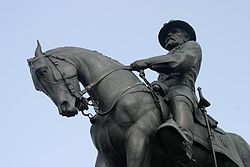
is on display at Howard University. An impressive equestrian statue is on East Cemetery Hill on the Gettysburg Battlefield
. A dormitory at Bowdoin College
is named for Howard.
The Oliver O. Howard Relief Corps of the Grand Army of the Republic
provided funds to help destitute former Union soldiers and to support worthy public causes. It contributed money and the design for the State Flag of Utah in 1922. An Army Reserve Center was named after him in Auburn, Maine
, and is still used today by several U.S. Army Reserve units.
Howard High School of Technology
in Wilmington, Delaware, is named in his honor, as is Howard County, Nebraska
and the Howard School of Academics and Technology, in Chattanooga, Tennessee.
The General O.O. Howard House, located on Officer's Row within the Fort Vancouver National Historic Site
was built in 1878 upon General Howard's order at a cost of $6,938.20. Completed in 1879, the building suffered a fire in 1986 and was left vacant until renovated by the City of Vancouver
in 1998. The building serves as the headquarters of the Fort Vancouver National Trust.
, Howard is played by Basil Ruysdael
opposite James Stewart
, who portrays Tom Jeffords. In the 1956 film The Last Wagon, he was portrayed by Carl Benton Reid
.
James Whitmore
portrayed General Howard in the 1975 television film, I Will Fight No More Forever
, about the U.S. Army campaign against the Nez Perce and the surrender of Chief Joseph in 1877.
Citation:
}
}}
United States Army
The United States Army is the main branch of the United States Armed Forces responsible for land-based military operations. It is the largest and oldest established branch of the U.S. military, and is one of seven U.S. uniformed services...
officer and a Union
Union Army
The Union Army was the land force that fought for the Union during the American Civil War. It was also known as the Federal Army, the U.S. Army, the Northern Army and the National Army...
general in the American Civil War
American Civil War
The American Civil War was a civil war fought in the United States of America. In response to the election of Abraham Lincoln as President of the United States, 11 southern slave states declared their secession from the United States and formed the Confederate States of America ; the other 25...
. He was a corps commander noted for suffering two humiliating defeats, at Chancellorsville
Battle of Chancellorsville
The Battle of Chancellorsville was a major battle of the American Civil War, and the principal engagement of the Chancellorsville Campaign. It was fought from April 30 to May 6, 1863, in Spotsylvania County, Virginia, near the village of Chancellorsville. Two related battles were fought nearby on...
and Gettysburg
Battle of Gettysburg
The Battle of Gettysburg , was fought July 1–3, 1863, in and around the town of Gettysburg, Pennsylvania. The battle with the largest number of casualties in the American Civil War, it is often described as the war's turning point. Union Maj. Gen. George Gordon Meade's Army of the Potomac...
, but he recovered from the setbacks while posted in the Western Theater
Western Theater of the American Civil War
This article presents an overview of major military and naval operations in the Western Theater of the American Civil War.-Theater of operations:...
, and served there successfully as a corps and army commander.
Known as the "Christian general" because he tried to base his policy decisions on his deep religious piety, he was given charge of the Freedmen's Bureau
Bureau of Refugees, Freedmen and Abandoned Lands
The Freedmen's Bureau, was a U.S. federal government agency that aided distressed freedmen in 1865–1869, during the Reconstruction era of the United States....
in mid 1865, with the mission of integrating the freed slaves into Southern society and politics during the second phase of the Reconstruction Era. Howard took charge of labor policy, setting up a system that required free slaves to work on former plantation land under pay scales fixed by the Bureau, on terms negotiated by the Bureau with white land owners. Howard's Bureau was primarily responsible for the legal affairs of the Freedmen. He attempted to protect the Negros from hostile conditions, but lacked adequate power, and was repeatedly frustrated by President Andrew Johnson. Howard's allies, the Radical Republicans, won control of Congress in the 1866 elections and imposed Radical Reconstruction in, with the result that Freedmen were given the vote. With the help and advice of the Bureau, they joined Republican coalitions along with Carpetbaggers and Scalawags to take political control of most of the southern states. Howard was also a leader in promoting higher education for Freedmen, most notably in the founding of Howard University
Howard University
Howard University is a federally chartered, non-profit, private, coeducational, nonsectarian, historically black university located in Washington, D.C., United States...
in Washington and serving as its president 1867–73.
After 1874, Howard commanded troops in the West, conducting a famous campaign against the Nez Perce tribe. Utley (1987) concludes that his leadership against the Apaches in 1872, against the Nez Perce in 1877, the Bannocks and Paiutes in 1878, and against the Sheepeaters in 1879 all add up to an impressive record, although he was outshone by George Custer and Nelson Miles.
Early years
Howard was born in Leeds, MaineLeeds, Maine
Leeds is a town in Androscoggin County, Maine, United States. The population was 2,001 at the 2000 census. It is included in both the Lewiston-Auburn, Maine Metropolitan Statistical Area and the Lewiston-Auburn, Maine Metropolitan New England City and Town Area.-Geography:According to the United...
, the son of Rowland Bailey Howard and Eliza Otis Howard. Rowland, a farmer, died when Oliver was 9 years old. Oliver attended Monmouth Academy in Monmouth
Monmouth, Maine
Monmouth is a town in Kennebec County, Maine, United States. The population was 3,785 at the 2000 census. It is a popular summer resort area, with many lakeside cottages.-History:...
, North Yarmouth Academy
North Yarmouth Academy
North Yarmouth Academy is an independent, co-ed, college preparatory day school serving students in grades 5-12 located in Yarmouth, Maine. The school offers a structured program that sets clear standards and high expectations in an environment that emphasizes values of mutual respect, trust and...
in Yarmouth
Yarmouth, Maine
Yarmouth is a town in Cumberland County, Maine, United States, located approximately ten to fifteen miles north of Portland. Its population was 8,349 at the 2010 census....
, Kents Hill School
Kents Hill School
Kents Hill School is an independent college-preparatory school located in Kents Hill, Maine, outside of the state capital of Augusta. Kents Hill School instructs students in grades nine through postgraduate. Students attend Kents Hill from across over 50 communities in Maine,...
in Readfield
Readfield, Maine
Readfield is a town in Kennebec County, Maine, United States. The population was 2,360 at the 2000 census. Readfield is home to the Kents Hill School, a preparatory school, Maranacook Community Schools, public schools for the district, a few summer camps, and the annual Readfield Heritage Days. The...
, and graduated from Bowdoin College
Bowdoin College
Bowdoin College , founded in 1794, is an elite private liberal arts college located in the coastal Maine town of Brunswick, Maine. As of 2011, U.S. News and World Report ranks Bowdoin 6th among liberal arts colleges in the United States. At times, it was ranked as high as 4th in the country. It is...
in 1850 at the age of 19. He then attended the United States Military Academy
United States Military Academy
The United States Military Academy at West Point is a four-year coeducational federal service academy located at West Point, New York. The academy sits on scenic high ground overlooking the Hudson River, north of New York City...
, graduating in 1854, fourth in his class of 46 cadets, as a brevet
Brevet (military)
In many of the world's military establishments, brevet referred to a warrant authorizing a commissioned officer to hold a higher rank temporarily, but usually without receiving the pay of that higher rank except when actually serving in that role. An officer so promoted may be referred to as being...
second lieutenant of ordnance. He served at the Watervliet Arsenal
Watervliet Arsenal
The Watervliet Arsenal is an arsenal of the United States Army located in Watervliet, New York, on the west bank of the Hudson River. It is the oldest continuously active arsenal in the United States, and today produces much of the artillery for the army, as well as gun tubes for cannons, mortars,...
near Troy, New York
Troy, New York
Troy is a city in the US State of New York and the seat of Rensselaer County. Troy is located on the western edge of Rensselaer County and on the eastern bank of the Hudson River. Troy has close ties to the nearby cities of Albany and Schenectady, forming a region popularly called the Capital...
, and was the temporary commander of the Kennebec Arsenal
Kennebec Arsenal
Kennebec Arsenal is a historic arsenal and National Historic Landmark District on Arsenal Street in Augusta, Maine.The arsenal was added to the National Register of Historic Places in 1970 and designated a Landmark in 2000....
in Augusta, Maine
Augusta, Maine
Augusta is the capital of the US state of Maine, county seat of Kennebec County, and center of population for Maine. The city's population was 19,136 at the 2010 census, making it the third-smallest state capital after Montpelier, Vermont and Pierre, South Dakota...
. In 1855, he married Elizabeth Anne Waite, with whom he would have seven children. In 1857 he was transferred to Florida for the Seminole Wars
Seminole Wars
The Seminole Wars, also known as the Florida Wars, were three conflicts in Florida between the Seminole — the collective name given to the amalgamation of various groups of native Americans and Black people who settled in Florida in the early 18th century — and the United States Army...
. It was in Florida that he experienced a conversion to evangelical Christianity
Evangelicalism
Evangelicalism is a Protestant Christian movement which began in Great Britain in the 1730s and gained popularity in the United States during the series of Great Awakenings of the 18th and 19th century.Its key commitments are:...
and considered resigning from the Army to become a minister. His religious proclivities would later earn him the nickname "the Christian general." Howard returned to West Point in September 1857 to become an instructor of mathematics and the following year he was promoted to first lieutenant. As the Civil War began with the surrender of Fort Sumter
Battle of Fort Sumter
The Battle of Fort Sumter was the bombardment and surrender of Fort Sumter, near Charleston, South Carolina, that started the American Civil War. Following declarations of secession by seven Southern states, South Carolina demanded that the U.S. Army abandon its facilities in Charleston Harbor. On...
, thoughts of the Ministry were put aside and he decided to remain in the service of his country.
Civil War
Howard was appointed colonelColonel (United States)
In the United States Army, Air Force, and Marine Corps, colonel is a senior field grade military officer rank just above the rank of lieutenant colonel and just below the rank of brigadier general...
of the 3rd Maine Infantry regiment and temporarily commanded a brigade at the First Battle of Bull Run
First Battle of Bull Run
First Battle of Bull Run, also known as First Manassas , was fought on July 21, 1861, in Prince William County, Virginia, near the City of Manassas...
. He was promoted to brigadier general
Brigadier general (United States)
A brigadier general in the United States Army, Air Force, and Marine Corps, is a one-star general officer, with the pay grade of O-7. Brigadier general ranks above a colonel and below major general. Brigadier general is equivalent to the rank of rear admiral in the other uniformed...
effective September 3, 1861, and given permanent command of his brigade. He then joined Maj. Gen.
Major general (United States)
In the United States Army, United States Marine Corps, and United States Air Force, major general is a two-star general-officer rank, with the pay grade of O-8. Major general ranks above brigadier general and below lieutenant general...
George B. McClellan
George B. McClellan
George Brinton McClellan was a major general during the American Civil War. He organized the famous Army of the Potomac and served briefly as the general-in-chief of the Union Army. Early in the war, McClellan played an important role in raising a well-trained and organized army for the Union...
's Army of the Potomac
Army of the Potomac
The Army of the Potomac was the major Union Army in the Eastern Theater of the American Civil War.-History:The Army of the Potomac was created in 1861, but was then only the size of a corps . Its nucleus was called the Army of Northeastern Virginia, under Brig. Gen...
for the Peninsula Campaign
Peninsula Campaign
The Peninsula Campaign of the American Civil War was a major Union operation launched in southeastern Virginia from March through July 1862, the first large-scale offensive in the Eastern Theater. The operation, commanded by Maj. Gen. George B...
.
On June 1, 1862, while commanding a Union
Union Army
The Union Army was the land force that fought for the Union during the American Civil War. It was also known as the Federal Army, the U.S. Army, the Northern Army and the National Army...
brigade in the Fair Oaks
Battle of Seven Pines
The Battle of Seven Pines, also known as the Battle of Fair Oaks or Fair Oaks Station, took place on May 31 and June 1, 1862, in Henrico County, Virginia, as part of the Peninsula Campaign of the American Civil War. It was the culmination of an offensive up the Virginia Peninsula by Union Maj. Gen....
, Howard was wounded twice in his right arm, which was subsequently amputated. (He received the Medal of Honor
Medal of Honor
The Medal of Honor is the highest military decoration awarded by the United States government. It is bestowed by the President, in the name of Congress, upon members of the United States Armed Forces who distinguish themselves through "conspicuous gallantry and intrepidity at the risk of his or her...
in 1893 for his heroism at Fair Oaks.) Brig. Gen. Philip Kearny
Philip Kearny
Philip Kearny, Jr., was a United States Army officer, notable for his leadership in the Mexican-American War and American Civil War. He was killed in action in the 1862 Battle of Chantilly.-Early life and career:...
, who had lost his left arm, visited Howard and joked that they would be able to shop for gloves together. Howard recovered quickly enough to rejoin the army for the Battle of Antietam
Battle of Antietam
The Battle of Antietam , fought on September 17, 1862, near Sharpsburg, Maryland, and Antietam Creek, as part of the Maryland Campaign, was the first major battle in the American Civil War to take place on Northern soil. It was the bloodiest single-day battle in American history, with about 23,000...
, in which he rose to division command in the II Corps. He was promoted to major general
Major general (United States)
In the United States Army, United States Marine Corps, and United States Air Force, major general is a two-star general-officer rank, with the pay grade of O-8. Major general ranks above brigadier general and below lieutenant general...
in November 1862 and assumed command of the XI Corps the following April. In that role, he replaced Maj. Gen. Franz Sigel
Franz Sigel
Franz Sigel was a German military officer, revolutionist and immigrant to the United States who was a teacher, newspaperman, politician, and served as a Union major general in the American Civil War.-Early life:...
. Since the corps was composed largely of German
Germany
Germany , officially the Federal Republic of Germany , is a federal parliamentary republic in Europe. The country consists of 16 states while the capital and largest city is Berlin. Germany covers an area of 357,021 km2 and has a largely temperate seasonal climate...
immigrants, many of whom spoke no English, the soldiers were resentful of their new leader and openly called for Sigel's reinstatement.
At the Battle of Chancellorsville
Battle of Chancellorsville
The Battle of Chancellorsville was a major battle of the American Civil War, and the principal engagement of the Chancellorsville Campaign. It was fought from April 30 to May 6, 1863, in Spotsylvania County, Virginia, near the village of Chancellorsville. Two related battles were fought nearby on...
, Howard suffered the first of two significant military setbacks, which together led to his occasional nickname, "Uh-Oh Howard". On May 2, 1863, his corps was on the right flank of the Union line, northwest of the crossroads of Chancellorsville. Robert E. Lee
Robert E. Lee
Robert Edward Lee was a career military officer who is best known for having commanded the Confederate Army of Northern Virginia in the American Civil War....
and Lt. Gen. Thomas J. "Stonewall" Jackson
Stonewall Jackson
ຄຽשת״ׇׂׂׂׂ֣|birth_place= Clarksburg, Virginia |death_place=Guinea Station, Virginia|placeofburial=Stonewall Jackson Memorial CemeteryLexington, Virginia|placeofburial_label= Place of burial|image=...
created an audacious plan in which Jackson's entire corps would march secretly around the Union flank and attack it. Howard was warned by Maj. Gen. Joseph Hooker
Joseph Hooker
Joseph Hooker was a career United States Army officer, achieving the rank of major general in the Union Army during the American Civil War. Although he served throughout the war, usually with distinction, Hooker is best remembered for his stunning defeat by Confederate General Robert E...
, now commanding the Army of the Potomac, that his flank was "in the air", not anchored by a natural obstacle, such as a river, and that Confederate forces might be on the move in his direction. Howard failed to heed the warning and Jackson struck before dark, routing the XI Corps and causing a serious disruption to the Union plan.
Gettysburg
Battle of Gettysburg
The Battle of Gettysburg , was fought July 1–3, 1863, in and around the town of Gettysburg, Pennsylvania. The battle with the largest number of casualties in the American Civil War, it is often described as the war's turning point. Union Maj. Gen. George Gordon Meade's Army of the Potomac...
, the XI Corps, still chastened by its humiliation in May, arrived on the field in the afternoon of July 1, 1863. Poor positioning of the defensive line by one of Howard's subordinate division commanders, Brig. Gen. Francis C. Barlow
Francis C. Barlow
Francis Channing Barlow was a lawyer, politician, and Union General during the American Civil War.-Early life and career:...
, was exploited by the Confederate Corps of Lt. Gen. Richard S. Ewell
Richard S. Ewell
Richard Stoddert Ewell was a career United States Army officer and a Confederate general during the American Civil War. He achieved fame as a senior commander under Stonewall Jackson and Robert E...
and once again the XI Corps was routed, forcing it to retreat through the streets of Gettysburg, leaving many prisoners behind. On Cemetery Hill
Cemetery Hill
Cemetery Hill is a Gettysburg Battlefield landform which had 1863 military engagements each day of the July 1–3 Battle of Gettysburg. The northernmost part of the Army of the Potomac defensive "fish-hook" line, the hill is gently sloped and provided a site for American Civil War artillery...
, south of town, Howard quarreled with Maj. Gen. Winfield S. Hancock about who was in command of the defense. Hancock had been sent by Maj. Gen. George G. Meade with written orders to take command, but Howard insisted that he was the ranking general present. Eventually he relented. Controversy centers on three points: 1) Howard's choice of Cemetery Hill as the key to defense; 2) the timing of Howard's mid-afternoon order to abandon positions north and west of town; and 3) Howard's reluctance to recognize that Hancock, his junior, had superseded him. Carpenter (1963) holds that Howard alone and wisely selected Cemetery Hill, that the order to withdraw was probably a sound one, and that the conflict between Howard and Hancock might have been avoided had Meade himself gotten onto the field.
Howard started circulating the story that his corps' failure had actually been triggered by the collapse of Maj. Gen. Abner Doubleday
Abner Doubleday
Abner Doubleday was a career United States Army officer and Union general in the American Civil War. He fired the first shot in defense of Fort Sumter, the opening battle of the war, and had a pivotal role in the early fighting at the Battle of Gettysburg. Gettysburg was his finest hour, but his...
's I Corps to the west, but this excuse was never accepted at the time or by history—the reverse was actually true—and the reputation of the XI Corps was ruined. Some argue that Howard should get some credit for the eventual success at Gettysburg because he wisely stationed one of his divisions (Maj. Gen. Adolph von Steinwehr
Adolph von Steinwehr
Baron Adolph Wilhelm August Friedrich von Steinwehr was a German-Brunswick army officer who emigrated to the United States, became a geographer, cartographer, and author, and served as a Union general in the American Civil War.-Early life:Steinwehr was born in Blankenburg, in the Duchy of...
) on Cemetery Hill as a reserve and critical backup defensive line. For the remainder of the three-day battle, the corps remained on the defensive around Cemetery Hill, withstanding assaults by Maj. Gen. Jubal Early
Jubal Anderson Early
Jubal Anderson Early was a lawyer and Confederate general in the American Civil War. He served under Stonewall Jackson and then Robert E. Lee for almost the entire war, rising from regimental command to lieutenant general and the command of an infantry corps in the Army of Northern Virginia...
on July 2, and participating at the margin of the defense against Pickett's Charge
Pickett's Charge
Pickett's Charge was an infantry assault ordered by Confederate Gen. Robert E. Lee against Maj. Gen. George G. Meade's Union positions on Cemetery Ridge on July 3, 1863, the last day of the Battle of Gettysburg during the American Civil War. Its futility was predicted by the charge's commander,...
on July 3.
Western theater
Howard and his corps were transferred to the Western TheaterWestern Theater of the American Civil War
This article presents an overview of major military and naval operations in the Western Theater of the American Civil War.-Theater of operations:...
to become part of the Army of the Cumberland
Army of the Cumberland
The Army of the Cumberland was one of the principal Union armies in the Western Theater during the American Civil War. It was originally known as the Army of the Ohio.-History:...
in Tennessee
Tennessee
Tennessee is a U.S. state located in the Southeastern United States. It has a population of 6,346,105, making it the nation's 17th-largest state by population, and covers , making it the 36th-largest by total land area...
. In the Battles for Chattanooga
Chattanooga Campaign
The Chattanooga Campaign was a series of maneuvers and battles in October and November 1863, during the American Civil War. Following the defeat of Maj. Gen. William S. Rosecrans's Union Army of the Cumberland at the Battle of Chickamauga in September, the Confederate Army of Tennessee under Gen...
, the corps joined the impulsive assault that captured Missionary Ridge and forced the retreat of Gen. Braxton Bragg
Braxton Bragg
Braxton Bragg was a career United States Army officer, and then a general in the Confederate States Army—a principal commander in the Western Theater of the American Civil War and later the military adviser to Confederate President Jefferson Davis.Bragg, a native of North Carolina, was...
. In July 1864, following the death of Maj. Gen. James B. McPherson
James B. McPherson
James Birdseye McPherson was a career United States Army officer who served as a General in the Union Army during the American Civil War...
, Howard became commander of the Army of the Tennessee
Army of the Tennessee
The Army of the Tennessee was a Union army in the Western Theater of the American Civil War, named for the Tennessee River. It should not be confused with the similarly named Army of Tennessee, a Confederate army named after the State of Tennessee....
, fought in the Atlanta Campaign
Atlanta Campaign
The Atlanta Campaign was a series of battles fought in the Western Theater of the American Civil War throughout northwest Georgia and the area around Atlanta during the summer of 1864. Union Maj. Gen. William T. Sherman invaded Georgia from the vicinity of Chattanooga, Tennessee, beginning in May...
, and led the right wing of Maj. Gen. William Tecumseh Sherman
William Tecumseh Sherman
William Tecumseh Sherman was an American soldier, businessman, educator and author. He served as a General in the Union Army during the American Civil War , for which he received recognition for his outstanding command of military strategy as well as criticism for the harshness of the "scorched...
's famous March to the Sea
Sherman's March to the Sea
Sherman's March to the Sea is the name commonly given to the Savannah Campaign conducted around Georgia from November 15, 1864 to December 21, 1864 by Maj. Gen. William Tecumseh Sherman of the Union Army in the American Civil War...
, through Georgia
Georgia (U.S. state)
Georgia is a state located in the southeastern United States. It was established in 1732, the last of the original Thirteen Colonies. The state is named after King George II of Great Britain. Georgia was the fourth state to ratify the United States Constitution, on January 2, 1788...
and then the Carolinas
Carolinas Campaign
The Carolinas Campaign was the final campaign in the Western Theater of the American Civil War. In January 1865, Union Maj. Gen. William Tecumseh Sherman advanced north from Savannah, Georgia, through the Carolinas, with the intention of linking up with Union forces in Virginia. The defeat of ...
. Sherman, having favored Howard over John A. Logan
John A. Logan
John Alexander Logan was an American soldier and political leader. He served in the Mexican-American War and was a general in the Union Army in the American Civil War. He served the state of Illinois as a state senator, congressman and senator and was an unsuccessful candidate for Vice President...
for command of the Army of the Tennessee after McPherson's death, asked Howard to allow Logan to lead the army in the May 1865 Grand Review in Washington. Howard agreed when Sherman appealed to him as a Christian gentleman.
Freedmen's Bureau
From May 1865 to July 1874, General Howard was commissioner of the Freedmen's Bureau (the Army's Bureau of Refugees, Freedmen, and Abandoned Lands), where he played a major role in the Reconstruction era, and had charge of integrating the Freedman (freed slaves) into American society. Howard devised far-reaching programs and guidelines including social welfare in the form of rations, schooling, courts, and medical care. Howard often clashed with President Andrew JohnsonAndrew Johnson
Andrew Johnson was the 17th President of the United States . As Vice-President of the United States in 1865, he succeeded Abraham Lincoln following the latter's assassination. Johnson then presided over the initial and contentious Reconstruction era of the United States following the American...
, who strongly dislike the welfare aspects of the Freedman's Bureau, and especially tried to return political power to Southern whites. However, Howard had the support of the Radical Republicans in Congress. When the Radical Republicans gained power in 1867, they gave blacks the right to vote in the South and set up new elections, which the Republican coalition of Freedmen, Carpetbaggers, and Scalawags won (except in Virginia). The Bureau was very active in helping blacks organize themselves politically, and therefore it became a target of partisan hostility.
The limited ideological framework of General Howard and his aides encouraged their attempt at radical reconstruction of southern society without realizing the need for essential legislation. They thought that the elimination of all statutory inequalities, for instance, Black court testimony, was enough to assure protection. Southern states pretended compliance on the point to end the threat of the Freedmen's Bureau courts' system.
Military commands
He was placed in command of the Department of the ColumbiaDepartment of the Columbia
The Department of the Columbia was a major command of the United States Army during the 19th century.-Formation:On July 27, 1865 the Military Division of the Pacific was created under Major General Henry W...
in 1874, went west to Washington Territory
Washington Territory
The Territory of Washington was an organized incorporated territory of the United States that existed from February 8, 1853, until November 11, 1889, when the final extent of the territory was admitted to the Union as the State of Washington....
's Fort Vancouver
Fort Vancouver
Fort Vancouver was a 19th century fur trading outpost along the Columbia River that served as the headquarters of the Hudson's Bay Company in the company's Columbia District...
, where he fought in the Indian Wars
Indian Wars
American Indian Wars is the name used in the United States to describe a series of conflicts between American settlers or the federal government and the native peoples of North America before and after the American Revolutionary War. The wars resulted from the arrival of European colonizers who...
, particularly against the Nez Perce, with the resultant surrender of Chief Joseph
Chief Joseph
Hin-mah-too-yah-lat-kekt, popularly known as Chief Joseph, or Young Joseph was the leader of the Wal-lam-wat-kain band of Nez Perce during General Oliver O. Howard's attempt to forcibly remove his band and the other "non-treaty" Nez Perce to a reservation in Idaho...
. In Chief Joseph's famous 1879 Washington, D.C., speech, he claimed, "If General Howard had given me plenty of time to gather up my stock and treated Too-hool-hool-suit as a man should be treated, there would have been no war." Subsequently, Howard was superintendent
Superintendents of the United States Military Academy
The commanding officer of the United States Military Academy is its Superintendent. This position is roughly equivalent to the chancellor or president of an American civilian university. The officer appointed is by tradition a graduate of the United States Military Academy, commonly known as "West...
of the United States Military Academy
United States Military Academy
The United States Military Academy at West Point is a four-year coeducational federal service academy located at West Point, New York. The academy sits on scenic high ground overlooking the Hudson River, north of New York City...
at West Point
West Point, New York
West Point is a federal military reservation established by President of the United States Thomas Jefferson in 1802. It is a census-designated place located in Town of Highlands in Orange County, New York, United States. The population was 7,138 at the 2000 census...
in 1881–82. He served as commander of the Department of the Platte
Department of the Platte
The Department of the Platte was a military administrative district established by the U.S. Army on March 5, 1866, with boundaries encompassing Iowa, Nebraska, Dakota Territory, Utah Territory and a small portion of Idaho...
from 1882 to 1884. In 1891, his final command was of the Department of the East at Fort Columbus
Fort Columbus
Fort Columbus was a fortification and army post in Governors Island, New York Harbor, New York City, New York, from 1806 to 1904.-Fort Jay:Fort Columbus was the name of a fortification and later the army post that developed around it...
on Governors Island
Governors Island
Governors Island is a island in Upper New York Bay, approximately one-half mile from the southern tip of Manhattan Island and separated from Brooklyn by Buttermilk Channel. It is legally part of the borough of Manhattan in New York City...
in New York Harbor, encompassing the states east of the Mississippi River. He retired from the United States Army
United States Army
The United States Army is the main branch of the United States Armed Forces responsible for land-based military operations. It is the largest and oldest established branch of the U.S. military, and is one of seven U.S. uniformed services...
at that posting in 1894 with the rank of major general.
Howard University
Howard University
Howard University is a federally chartered, non-profit, private, coeducational, nonsectarian, historically black university located in Washington, D.C., United States...
, which was incorporated by Congress in 1867. The school is nonsectarian and is open to both sexes without regard to race. On November 20, 1866, ten members, including Howard, of various socially concerned groups of the time met in Washington, D.C., to discuss plans for a theological seminary to train colored ministers. Interest was sufficient, however, in creating an educational institute for areas other than the ministry. The result was the Howard Normal and Theological Institute for the Education of Preachers and Teachers. On January 8, 1867, the Board of Trustees voted to change the name of the institution to Howard University. Howard served as president from 1869 to 1874. He was quoted in saying "The opposition to Negro education made itself felt everywhere in a combination not to allow the freedmen any room or building in which a school might be taught. In 1865, 1866, and 1877 mobs of the baser classes at intervals and in all parts of the South occasionally burned school buildings and churches used as schools, flogged teachers or drove them away, and in a number of instances murdered them." He also founded Lincoln Memorial University
Lincoln Memorial University
Lincoln Memorial University is a private four-year co-educational liberal arts college located in Harrogate, Tennessee.LMU's campus borders on Cumberland Gap National Historical Park....
in Harrogate, Tennessee
Harrogate, Tennessee
Harrogate is a city in Claiborne County, Tennessee, United States. The community has been known as "Harrogate" since the 19th century, but did not incorporate as a city by that name until 1993....
, in 1895, for the education of the "mountain whites."
Death and memorialization
Burlington, Vermont
Burlington is the largest city in the U.S. state of Vermont and the shire town of Chittenden County. Burlington lies south of the U.S.-Canadian border and some south of Montreal....
, and is buried there in Lake View Cemetery.
A bust of Howard designed by artist James E. Kelly
James E. Kelly (artist)
James Edward Kelly was an American sculptor and illustrator who specialized in depicting people and events of American wars, particularly the American Civil War....
is on display at Howard University. An impressive equestrian statue is on East Cemetery Hill on the Gettysburg Battlefield
Gettysburg Battlefield
The Gettysburg Battlefield is the area of the July 1–3, 1863, military engagements of the Battle of Gettysburg within and around the borough of Gettysburg, Pennsylvania. Locations of military engagements extend from the 4 acre site of the first shot & at on the west of the borough, to East...
. A dormitory at Bowdoin College
Bowdoin College
Bowdoin College , founded in 1794, is an elite private liberal arts college located in the coastal Maine town of Brunswick, Maine. As of 2011, U.S. News and World Report ranks Bowdoin 6th among liberal arts colleges in the United States. At times, it was ranked as high as 4th in the country. It is...
is named for Howard.
The Oliver O. Howard Relief Corps of the Grand Army of the Republic
Grand Army of the Republic
The Grand Army of the Republic was a fraternal organization composed of veterans of the Union Army, US Navy, US Marines and US Revenue Cutter Service who served in the American Civil War. Founded in 1866 in Decatur, Illinois, it was dissolved in 1956 when its last member died...
provided funds to help destitute former Union soldiers and to support worthy public causes. It contributed money and the design for the State Flag of Utah in 1922. An Army Reserve Center was named after him in Auburn, Maine
Auburn, Maine
Auburn is a city in and the county seat of Androscoggin County, Maine, United States. The population was 23,055 at the 2010 census. It is one of two principal cities of and included in the Lewiston-Auburn, Maine metropolitan New England city and town area and the Lewiston-Auburn, Maine metropolitan...
, and is still used today by several U.S. Army Reserve units.
Howard High School of Technology
Howard High School of Technology
Howard High School of Technology is a vocational-technical high school in Wilmington, Delaware and is the oldest of four high schools within the New Castle County Vocational-Technical School District, which includes Delcastle Technical High School in Newport, Hodgson Vo-Tech High School in Glasgow,...
in Wilmington, Delaware, is named in his honor, as is Howard County, Nebraska
Howard County, Nebraska
-History:Howard County was formed in 1871. It was named after the Union General Oliver Otis Howard.-Demographics:As of the census of 2000, there were 6,567 people, 2,546 households, and 1,797 families residing in the county. The population density was 12 people per square mile . There were 2,782...
and the Howard School of Academics and Technology, in Chattanooga, Tennessee.
The General O.O. Howard House, located on Officer's Row within the Fort Vancouver National Historic Site
Fort Vancouver National Historic Site
Fort Vancouver National Historic Site is a United States National Historic Site located in the states of Washington and Oregon. The National Historic Site consists of two units, one located on the site of Fort Vancouver in modern-day Vancouver, Washington; the other being the former residence of...
was built in 1878 upon General Howard's order at a cost of $6,938.20. Completed in 1879, the building suffered a fire in 1986 and was left vacant until renovated by the City of Vancouver
Vancouver, Washington
Vancouver is a city on the north bank of the Columbia River in the U.S. state of Washington. Incorporated in 1857, it is the fourth largest city in the state with a 2010 census population of 161,791 as of April 1, 2010...
in 1998. The building serves as the headquarters of the Fort Vancouver National Trust.
Selected works
Howard was the author of numerous books after the war, including Donald's School Days (1878), Nez Perce Joseph (1881), General Taylor (1892), Isabella of Castile (1894), Autobiography (1907), and My Life and Experiences among Our Hostile Indians (1907).In popular media
In the 1950 film Broken ArrowBroken Arrow (1950 film)
Broken Arrow is a western Technicolor film released in 1950. It was directed by Delmer Daves and starred James Stewart and Jeff Chandler. The film was nominated for three Academy Awards, and won a Golden Globe award for Best Film Promoting International Understanding. It made history as the first...
, Howard is played by Basil Ruysdael
Basil Ruysdael
Basil Ruysdael was an American film actor and opera singer.-Early life:He was born in Jersey City, New Jersey and started as a bass-baritone in the Metropolitan Opera Company from 1910 to 1918...
opposite James Stewart
James Stewart (actor)
James Maitland Stewart was an American film and stage actor, known for his distinctive voice and his everyman persona. Over the course of his career, he starred in many films widely considered classics and was nominated for five Academy Awards, winning one in competition and receiving one Lifetime...
, who portrays Tom Jeffords. In the 1956 film The Last Wagon, he was portrayed by Carl Benton Reid
Carl Benton Reid
Carl Benton Reid was an American actor. He achieved fame on the Broadway stage in 1939 as Oscar Hubbard, one of Regina Giddens's greedy, devious brothers in the play The Little Foxes, and made his film debut reprising his role opposite Bette Davis in the 1941 film version...
.
James Whitmore
James Whitmore
James Allen Whitmore, Jr. was an American film and stage actor.-Early life:Born in White Plains, New York, to Florence Belle and James Allen Whitmore, Sr., a park commission official, Whitmore attended Amherst Central High School in Snyder, New York, before graduating from The Choate School in...
portrayed General Howard in the 1975 television film, I Will Fight No More Forever
I Will Fight No More Forever
I Will Fight No More Forever is a 1975 made-for-television movie starring James Whitmore as General Oliver O. Howard and Ned Romero as Chief Joseph. It is a dramatization of Chief Joseph's resistance to the U.S. government's forcible move of his Nez Perce Indian tribe to a reservation in Idaho...
, about the U.S. Army campaign against the Nez Perce and the surrender of Chief Joseph in 1877.
Medal of Honor citation
Rank and organization: Brigadier General, U.S. Volunteers. Place and date: At Fair Oaks, Va., June 1, 1862. Entered service at: Maine. Born: November 8, 1830, Leeds, Maine. Date of issue: March 29, 1893.Citation:
Led the 61st New York Infantry in a charge in which he was twice severely wounded in the right arm, necessitating amputation.
See also
- List of American Civil War Medal of Honor recipients: G–L
- List of American Civil War generals
- Sherman's MarchSherman's March (2007 film)Sherman's March is a 2007 American Civil War television documentary first aired on the History Channel. The film is directed by Rick King and the executive producer is Jason Williams...
(2007, documentary) - Charles Henry HowardCharles Henry HowardCharles Henry Howard was an officer in the Union Army during the American Civil War, and a newspaper editor and publisher. He was the younger brother of Union general Oliver O. Howard.-Early life:...
(brother)
External links
- Howard, Oliver O. "Lincoln's Monument in the Mountains". National Magazine, June 1905 (with photos)
- Oliver Otis Howard and Lincoln Memorial University (PDF)
}
}}