
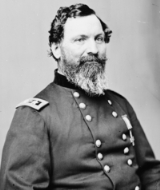
John Sedgwick was a teacher, a career military officer, and a
Union ArmyThe Union Army was the land force that fought for the Union during the American Civil War. It was also known as the Federal Army, the U.S. Army, the Northern Army and the National Army...
general in the
American Civil WarThe American Civil War was a civil war fought in the United States of America. In response to the election of Abraham Lincoln as President of the United States, 11 southern slave states declared their secession from the United States and formed the Confederate States of America ; the other 25...
. He was the highest ranking Union casualty in the Civil War, killed by a
sniperA sniper is a marksman who shoots targets from concealed positions or distances exceeding the capabilities of regular personnel. Snipers typically have specialized training and distinct high-precision rifles....
at the
Battle of Spotsylvania Court HouseThe Battle of Spotsylvania Court House, sometimes simply referred to as the Battle of Spotsylvania , was the second major battle in Lt. Gen. Ulysses S. Grant's 1864 Overland Campaign of the American Civil War. Following the bloody but inconclusive Battle of the Wilderness, Grant's army disengaged...
.
Early life
Sedgwick was born in the
Litchfield HillsThe Litchfield Hills is a geographic region of the U.S. state of Connecticut located in the northwestern corner of the state. It is a term that is roughly coterminous with the boundaries of Litchfield County, for which it is named...
town of
Cornwall, ConnecticutCornwall is a town in Litchfield County, Connecticut, United States. The population was 1,434 at the 2000 census.In 1939 poet Mark Van Doren wrote "The Hills of Little Cornwall", a short poem in which the beauties of the countryside were portrayed as seductive:The town was also home to the Foreign...
. He was named after his grandfather, John Sedgwick (brother of
Theodore SedgwickTheodore Sedgwick was an attorney, politician and jurist, who served in elected state government and as a Delegate to the Continental Congress, a US Representative, and a United States Senator from Massachusetts. He served as the fifth Speaker of the United States House of Representatives...
), an
American Revolutionary WarThe American Revolutionary War , the American War of Independence, or simply the Revolutionary War, began as a war between the Kingdom of Great Britain and thirteen British colonies in North America, and ended in a global war between several European great powers.The war was the result of the...
general who served with
George WashingtonGeorge Washington was the dominant military and political leader of the new United States of America from 1775 to 1799. He led the American victory over Great Britain in the American Revolutionary War as commander-in-chief of the Continental Army from 1775 to 1783, and presided over the writing of...
. After teaching for two years, he attended the
United States Military AcademyThe United States Military Academy at West Point is a four-year coeducational federal service academy located at West Point, New York. The academy sits on scenic high ground overlooking the Hudson River, north of New York City...
, graduated in 1837 ranked 24th of 50, and was commissioned a second lieutenant in the U.S. Army's artillery branch. He fought in the
Seminole WarsThe Seminole Wars, also known as the Florida Wars, were three conflicts in Florida between the Seminole — the collective name given to the amalgamation of various groups of native Americans and Black people who settled in Florida in the early 18th century — and the United States Army...
and received two
brevetIn many of the world's military establishments, brevet referred to a warrant authorizing a commissioned officer to hold a higher rank temporarily, but usually without receiving the pay of that higher rank except when actually serving in that role. An officer so promoted may be referred to as being...
promotions in the Mexican-American War, to captain for
ContrerasThe Battle of Contreras, also known as the Battle of Padierna, took place during August 19–20, 1847, in the final encounters of the Mexican-American War. In the Battle of Churubusco, fighting continued the following day.-Background:...
and
ChurubuscoThe Battle of Churubusco took place on August 20, 1847, in the immediate aftermath of the Battle of Contreras during the Mexican-American War. After defeating the Mexican army at Churubusco, the U.S. Army was only 5 miles away from Mexico City, the capital of the nation...
, and to major for
ChapultepecThe Battle of Chapultepec, in September 1847, was a United States victory over Mexican forces holding Chapultepec Castle west of Mexico City during the Mexican-American War.-Background:On September 13, 1847, in the costly Battle of Molino del Rey, U.S...
. After returning from Mexico he transferred to the cavalry and served in
KansasKansas is a US state located in the Midwestern United States. It is named after the Kansas River which flows through it, which in turn was named after the Kansa Native American tribe, which inhabited the area. The tribe's name is often said to mean "people of the wind" or "people of the south...
, in the
Utah WarThe Utah War, also known as the Utah Expedition, Buchanan's Blunder, the Mormon War, or the Mormon Rebellion was an armed confrontation between LDS settlers in the Utah Territory and the armed forces of the United States government. The confrontation lasted from May 1857 until July 1858...
, and in the
Indian WarsAmerican Indian Wars is the name used in the United States to describe a series of conflicts between American settlers or the federal government and the native peoples of North America before and after the American Revolutionary War. The wars resulted from the arrival of European colonizers who...
, participating in 1857 in a punitive expedition against the Cheyenne.
In the summer and fall of 1860 Sedgwick commanded an expedition to establish a new fort on the Platte River in what is now Colorado. He was greatly handicapped with the non-delivery of expected supplies which were to be forwarded by wagon-train from the nearest fort in Kansas, but managed to erect comfortable quarters for his men before cold weather set in. These buildings were constructed largely of stone with timber for roofs and doors. It is difficult to realize the remoteness of this post but there were no railroads west of the Mississippi River and communication with St. Louis and Kansas City was by river boat and west of that by wagon train or horseback.
Civil War
At the start of the Civil War, Sedgwick served as a
colonelIn the United States Army, Air Force, and Marine Corps, colonel is a senior field grade military officer rank just above the rank of lieutenant colonel and just below the rank of brigadier general...
and Assistant Inspector General of the Military Department of Washington. He missed the early action of the war at the
First Battle of Bull RunFirst Battle of Bull Run, also known as First Manassas , was fought on July 21, 1861, in Prince William County, Virginia, near the City of Manassas...
, recovering from
choleraCholera is an infection of the small intestine that is caused by the bacterium Vibrio cholerae. The main symptoms are profuse watery diarrhea and vomiting. Transmission occurs primarily by drinking or eating water or food that has been contaminated by the diarrhea of an infected person or the feces...
. Promoted to
brigadier generalA brigadier general in the United States Army, Air Force, and Marine Corps, is a one-star general officer, with the pay grade of O-7. Brigadier general ranks above a colonel and below major general. Brigadier general is equivalent to the rank of rear admiral in the other uniformed...
on August 31, 1861, he commanded the 2nd brigade of
Maj. Gen.Major general or major-general is a military rank used in many countries. It is derived from the older rank of sergeant major general. A major general is a high-ranking officer, normally subordinate to the rank of lieutenant general and senior to the ranks of brigadier and brigadier general...
Samuel P. HeintzelmanSamuel Peter Heintzelman was a United States Army General. He served in the Seminole War, the Mexican-American War, the Yuma War, the Cortina Troubles, and the American Civil War, rising to the command of a corps....
's division in the
Army of the PotomacThe Army of the Potomac was the major Union Army in the Eastern Theater of the American Civil War.-History:The Army of the Potomac was created in 1861, but was then only the size of a corps . Its nucleus was called the Army of Northeastern Virginia, under Brig. Gen...
, then his own division, which was designated the 2nd division of the II Corps for the
Peninsula CampaignThe Peninsula Campaign of the American Civil War was a major Union operation launched in southeastern Virginia from March through July 1862, the first large-scale offensive in the Eastern Theater. The operation, commanded by Maj. Gen. George B...
. In
VirginiaThe Commonwealth of Virginia , is a U.S. state on the Atlantic Coast of the Southern United States. Virginia is nicknamed the "Old Dominion" and sometimes the "Mother of Presidents" after the eight U.S. presidents born there...
, he fought at
YorktownThe Battle of Yorktown or Siege of Yorktown was fought from April 5 to May 4, 1862, as part of the Peninsula Campaign of the American Civil War. Marching from Fort Monroe, Union Maj. Gen. George B. McClellan's Army of the Potomac encountered Maj. Gen. John B. Magruder's small Confederate force...
and
Seven PinesThe Battle of Seven Pines, also known as the Battle of Fair Oaks or Fair Oaks Station, took place on May 31 and June 1, 1862, in Henrico County, Virginia, as part of the Peninsula Campaign of the American Civil War. It was the culmination of an offensive up the Virginia Peninsula by Union Maj. Gen....
and was wounded in the arm and leg at the
Battle of GlendaleThe Battle of Glendale, also known as the Battle of Frayser's Farm, Frazier's Farm, Nelson's Farm, Charles City Crossroads, New Market Road, or Riddell's Shop, took place on June 30, 1862, in Henrico County, Virginia, on the sixth day of the Seven Days Battles of the American Civil War.The...
. He was promoted to major general on July 4, 1862.
In the
Battle of AntietamThe Battle of Antietam , fought on September 17, 1862, near Sharpsburg, Maryland, and Antietam Creek, as part of the Maryland Campaign, was the first major battle in the American Civil War to take place on Northern soil. It was the bloodiest single-day battle in American history, with about 23,000...
, II Corps commander Maj. Gen. Edwin V. Sumner impulsively sent Sedgwick's division in a mass assault without proper
reconnaissanceReconnaissance is the military term for exploring beyond the area occupied by friendly forces to gain information about enemy forces or features of the environment....
. His division was engaged by
ConfederateThe Confederate States Army was the army of the Confederate States of America while the Confederacy existed during the American Civil War. On February 8, 1861, delegates from the seven Deep South states which had already declared their secession from the United States of America adopted the...
forces under Maj. Gen.
Thomas J. "Stonewall" Jacksonຄຽשת״ׇׂׂׂׂ֣|birth_place= Clarksburg, Virginia |death_place=Guinea Station, Virginia|placeofburial=Stonewall Jackson Memorial CemeteryLexington, Virginia|placeofburial_label= Place of burial|image=...
from three sides, resulting in 2,200 casualties. Sedgwick himself was hit by three bullets, in the wrist, leg, and shoulder, and was out of action until after the
Battle of FredericksburgThe Battle of Fredericksburg was fought December 11–15, 1862, in and around Fredericksburg, Virginia, between General Robert E. Lee's Confederate Army of Northern Virginia and the Union Army of the Potomac, commanded by Maj. Gen. Ambrose E. Burnside...
.
From December 26, 1862, he briefly led the II Corps and the IX Corps, and then finally the VI Corps of the Army of the Potomac, which he commanded until his death in 1864. During the
Battle of ChancellorsvilleThe Battle of Chancellorsville was a major battle of the American Civil War, and the principal engagement of the Chancellorsville Campaign. It was fought from April 30 to May 6, 1863, in Spotsylvania County, Virginia, near the village of Chancellorsville. Two related battles were fought nearby on...
, his corps faced Fredericksburg in an initial holding action while Maj. Gen.
Joseph HookerJoseph Hooker was a career United States Army officer, achieving the rank of major general in the Union Army during the American Civil War. Although he served throughout the war, usually with distinction, Hooker is best remembered for his stunning defeat by Confederate General Robert E...
's other four corps maneuvered against
Robert E. LeeRobert Edward Lee was a career military officer who is best known for having commanded the Confederate Army of Northern Virginia in the American Civil War....
's left flank. He was slow to take action, but eventually crossed the
Rappahannock RiverThe Rappahannock River is a river in eastern Virginia, in the United States, approximately in length. It traverses the entire northern part of the state, from the Blue Ridge Mountains in the west, across the Piedmont, to the Chesapeake Bay, south of the Potomac River.An important river in American...
and assaulted Maj. Gen.
Jubal EarlyJubal Anderson Early was a lawyer and Confederate general in the American Civil War. He served under Stonewall Jackson and then Robert E. Lee for almost the entire war, rising from regimental command to lieutenant general and the command of an infantry corps in the Army of Northern Virginia...
's small force on Marye's Heights. Moving west slowly to join forces with Hooker and trap Lee between the halves of the army, he was stopped by elements of Lee's Second Corps (under Maj. Gen.
J.E.B. StuartJames Ewell Brown "Jeb" Stuart was a U.S. Army officer from Virginia and a Confederate States Army general during the American Civil War. He was known to his friends as "Jeb", from the initials of his given names. Stuart was a cavalry commander known for his mastery of reconnaissance and the use...
, following the wounding of Jackson) at the
Battle of Salem ChurchThe Battle of Salem Church, also known as the Battle of Banks' Ford, took place on May 3–4, 1863, in Spotsylvania County, Virginia, as part of the Chancellorsville Campaign of the American Civil War....
, forcing his eventual retreat back over the Rappahannock.
At the
Battle of GettysburgThe Battle of Gettysburg , was fought July 1–3, 1863, in and around the town of Gettysburg, Pennsylvania. The battle with the largest number of casualties in the American Civil War, it is often described as the war's turning point. Union Maj. Gen. George Gordon Meade's Army of the Potomac...
, his corps arrived late on July 2 and as a result only few units were able to take part in the final Union counterattacks in the Wheatfield. In the 1864
Overland CampaignThe Overland Campaign, also known as Grant's Overland Campaign and the Wilderness Campaign, was a series of battles fought in Virginia during May and June 1864, in the American Civil War. Lt. Gen. Ulysses S. Grant, general-in-chief of all Union armies, directed the actions of the Army of the...
, the VI Corps was on the Union right at the
Battle of the WildernessThe Battle of the Wilderness, fought May 5–7, 1864, was the first battle of Lt. Gen. Ulysses S. Grant's 1864 Virginia Overland Campaign against Gen. Robert E. Lee and the Confederate Army of Northern Virginia. Both armies suffered heavy casualties, a harbinger of a bloody war of attrition by...
and defended against assaults by Lt. Gen.
Richard S. EwellRichard Stoddert Ewell was a career United States Army officer and a Confederate general during the American Civil War. He achieved fame as a senior commander under Stonewall Jackson and Robert E...
's Second Corps.
Death
Sedgwick fell at the beginning of the
Battle of Spotsylvania Court HouseThe Battle of Spotsylvania Court House, sometimes simply referred to as the Battle of Spotsylvania , was the second major battle in Lt. Gen. Ulysses S. Grant's 1864 Overland Campaign of the American Civil War. Following the bloody but inconclusive Battle of the Wilderness, Grant's army disengaged...
, on May 9, 1864. His corps was probing skirmish lines ahead of the left flank of Confederate defenses and he was directing artillery placements. Confederate sharpshooters were about 1000 yard away and their shots caused members of his staff and artillerymen to duck for cover. Sedgwick strode around in the open and was quoted as saying, "What? Men dodging this way for single bullets? What will you do when they open fire along the whole line? I am ashamed of you. They couldn't hit an elephant at this distance." Although ashamed, his men continued to flinch and he repeated, "I'm ashamed of you, dodging that way. They couldn't hit an elephant at this distance." Just seconds later he fell forward with a bullet hole below his left eye.
Sedgwick was the highest ranking Union casualty in the Civil War. Although
James B. McPhersonJames Birdseye McPherson was a career United States Army officer who served as a General in the Union Army during the American Civil War...
was in command of an army at the time of his death and Sedgwick of a corps, Sedgwick had the most senior rank by date of all major generals killed. Upon hearing of his death,
Lt. Gen.In the United States Army, the United States Air Force and the United States Marine Corps, lieutenant general is a three-star general officer rank, with the pay grade of O-9. Lieutenant general ranks above major general and below general...
Ulysses S. GrantUlysses S. Grant was the 18th President of the United States as well as military commander during the Civil War and post-war Reconstruction periods. Under Grant's command, the Union Army defeated the Confederate military and ended the Confederate States of America...
, flabbergasted by the news, repeatedly asked, "Is he really dead?"
Legacy
Sedgwick's reputation was that of a solid, dependable, but relatively unaggressive general. He was well liked by his soldiers, who referred to him affectionately as "Uncle John". His death was met by universal sorrow; even Robert E. Lee expressed his sadness over the fate of an old friend. George G. Meade wept at the news.
Ulysses S. GrantUlysses S. Grant was the 18th President of the United States as well as military commander during the Civil War and post-war Reconstruction periods. Under Grant's command, the Union Army defeated the Confederate military and ended the Confederate States of America...
characterized Sedgwick as one who "was never at fault when serious work was to be done" and he told his staff that the loss for him was worse than that of an entire division.
John Sedgwick is buried near his birthplace of Cornwall Hollow, Connecticut. An equestrian statue honors him and the VI Corps at Gettysburg National Military Park.
There is a
monumentSedgwick Monument is a memorial to Union General John Sedgwick at West Point. "Uncle John" Sedgwick was born in Cornwall, Connecticut, 67 miles northeast of West Point, New York...
of General Sedgwick at
West PointThe United States Military Academy at West Point is a four-year coeducational federal service academy located at West Point, New York. The academy sits on scenic high ground overlooking the Hudson River, north of New York City...
. Academy legend has it that a cadet who spins the spurs of the statue at midnight while wearing full dress gray uniform under arms will have good luck on his or her final exam.
The following were named in his honor:
- Sedgwick, Arkansas
Sedgwick is a town in Lawrence County, Arkansas, United States. The population was 112 at the 2000 census.-History:Sedgwick was named after John Sedgwick, who was a Major General in the Union Army during the American Civil War.-Demographics:...
- Sedgwick, Colorado
Sedgwick is a statutory town in Sedgwick County, Colorado, United States. The population was 191 at the 2000 census.-History:The town was named for Fort Sedgwick, which was named after John Sedgwick, who was a Major General in the Union Army during the American Civil War.-Geography:Sedgwick is...
- Sedgwick County, Colorado
Sedgwick County is the northeasternmost of the 64 counties of the state of Colorado of the United States. The county was named for Fort Sedgwick, a military post along the Platte Trail, which was named for General John Sedgwick. The county population was 2,379 at U.S. 2010 Census...
- Sedgwick, Kansas
Sedgwick is a city in Harvey and Sedgwick counties in the U.S. state of Kansas. As of the 2010 census, the city population was 1,695.-History:Sedgwick was named after John Sedgwick, who was a Major General in the Union Army during the American Civil War....
- Sedgwick County, Kansas
Sedgwick County is a county located in the U.S. state of Kansas. The county's population was 498,365 for the 2010 census. The largest city and county seat is Wichita. The county was named after General John Sedgwick...
A street in Washington, D.C. near American University is also named in his honor, as were
Grand Army of the RepublicThe Grand Army of the Republic was a fraternal organization composed of veterans of the Union Army, US Navy, US Marines and US Revenue Cutter Service who served in the American Civil War. Founded in 1866 in Decatur, Illinois, it was dissolved in 1956 when its last member died...
Post #4 in
Keene, New HampshireKeene is a city in Cheshire County, New Hampshire, United States. The population was 23,409 at the 2010 census. It is the county seat of Cheshire County.Keene is home to Keene State College and Antioch University New England, and hosts the annual Pumpkin Fest...
; Post #12 in
Milwaukee, WisconsinMilwaukee is the largest city in the U.S. state of Wisconsin, the 28th most populous city in the United States and 39th most populous region in the United States. It is the county seat of Milwaukee County and is located on the southwestern shore of Lake Michigan. According to 2010 census data, the...
; Post #17 in
Santa Ana, CaliforniaSanta Ana is the county seat and second most populous city in Orange County, California, and with a population of 324,528 at the 2010 census, Santa Ana is the 57th-most populous city in the United States....
; and Post #37 in
York, PennsylvaniaYork, known as the White Rose City , is a city located in York County, Pennsylvania, United States which is in the South Central region of the state. The population within the city limits was 43,718 at the 2010 census, which was a 7.0% increase from the 2000 count of 40,862...
.
In the 1990 film
Dances with WolvesDances with Wolves is a 1990 epic western film directed by and starring Kevin Costner. It is a film adaptation of the 1988 book of the same name by Michael Blake and tells the story of a Union Army Lieutenant who travels to the American frontier to find a military post, and his dealings with a...
, Lt. John Dunbar (
Kevin CostnerKevin Michael Costner is an American actor, singer, musician, producer, director, and businessman. He has been nominated for three BAFTA Awards, won two Academy Awards, and two Golden Globe Awards. Costner's roles include Lt. John J...
) stays at a fictional Fort Sedgwick, presumably named after General Sedgwick. The fort in the film may have been inspired by the Fort Sedgwick built in Kansas in 1860.
See also
- List of American Civil War generals
Further reading
- Jurgen, Robert J., and Allan Keller. Major General John Sedgwick, U.S. Volunteers, 1813-1864. Hartford: Connecticut Civil War Centennial Committee, 1963.
- Sifakis, Stewart. Who Was Who In The Civil War. New York: Facts on File, 1988. ISBN 0-8160-1055-2.
- Winslow, Richard Elliott. General John Sedgwick: The Story of a Union Corps Commander. Novato, CA: Presidio Press, 1982. ISBN 0-89141-030-9.
External links