

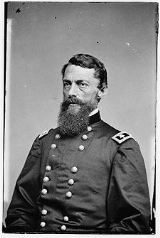
George Stoneman

Encyclopedia
George Stoneman, Jr. was a career United States Army
officer, a Union
cavalry general in the American Civil War
, and the 15th Governor of California
between 1883 and 1887.
, the first child of ten. His parents were George Stoneman, Sr., a lumberman and justice of the peace
, and Catherine Rebecca Cheney. He studied at the Jamestown Academy and graduated from the United States Military Academy
in 1846; his roommate at West Point was future Confederate
General Thomas J. "Stonewall" Jackson
. His first assignment was with the 1st U.S. Dragoons, with which he served across the West and in California
. He was the quartermaster of the Mormon Battalion
, which marched from Fort Leavenworth, Kansas, to San Diego, California
. He fought in the Yuma War
and was responsible for survey parties mapping the Sierra Nevada range for railroad lines
. After promotion to captain of the 2nd U.S. Cavalry in March 1855, he served mainly in Texas until 1861.
, Texas
, and refused the order of Maj. Gen.
David E. Twiggs
to surrender to the newly established Confederate authorities there, escaping to the north with most of his command. Returning east, he served as a major of the 1st U.S. Cavalry and then adjutant
to Maj. Gen. George B. McClellan
in western Virginia
. As the cavalry was being organized in the Army of the Potomac
, he commanded the Cavalry Reserve and then the Cavalry Division, with the title Chief of Cavalry. He was promoted to brigadier general
on August 13, 1861. He did not relate well to McClellan, who did not understand the proper use of cavalry in warfare, relegating it to assignment in small units to infantry brigades. This organization fared poorly in the Peninsula Campaign
and the Seven Days Battles
of 1862, where the centralized Confederate cavalry under Maj. Gen. J.E.B. Stuart
seriously outperformed their Union counterparts.
On November 22, 1861, Stoneman married Mary Oliver Hardisty of Baltimore. They eventually had four children.
After the Peninsula, Stoneman was an infantry commander, commanding a division in the II Corps
and the III Corps
. At the Battle of Fredericksburg
, Stoneman commanded the III Corps. He was promoted to major general
of volunteers on November 29, 1862. However, following Fredericksburg, a new commanding general took over the Army of the Potomac: Maj. Gen. Joseph Hooker
. Hooker had a better understanding of the strategic value of a centralized Cavalry Corps and he named Stoneman to lead it. The centralized corps could undertake long raids into enemy territory, destroying supplies, and gathering intelligence about the enemy forces. They were not subject to the commanders of small infantry units.
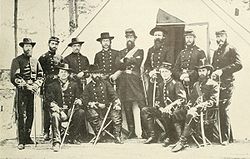 The plan for the Battle of Chancellorsville
was strategically daring. Hooker assigned Stoneman a key role in which his Cavalry Corps would raid deeply into Robert E. Lee
's rear areas and destroy vital railroad lines and supplies, distracting Lee from Hooker's main assaults. However, Stoneman was a disappointment in this strategic role. The Cavalry Corps got off to a good start in May 1863, but quickly bogged down after crossing the Rapidan River
. During the entire battle, Stoneman accomplished little and Hooker considered him one of the principal reasons for the Union defeat at Chancellorsville. Hooker needed to deflect criticism from himself and relieved Stoneman from his cavalry command, sending him back to Washington, D.C., for medical treatment (chronic hemorrhoids, exacerbated by cavalry service), where in July he became a Chief of the U.S. Cavalry Bureau, a desk job. A large cavalry supply and training depot on the Potomac River
was named Camp Stoneman in his honor.
In early 1864, Stoneman was impatient with garrison duty in Washington and requested another field command from his old friend Maj. Gen. John Schofield
, who was in command of the Department of the Ohio
. Although originally slated for an infantry corps, Stoneman assumed command of the Cavalry Corps of what would be known as the Army of the Ohio
. As the army fought in the Atlanta Campaign
under Maj. Gen. William T. Sherman, Stoneman and his aide, Myles Keogh
, were captured by Confederate soldiers outside Macon, Georgia
, becoming the highest ranking Union prisoner of war
. He was a prisoner for three months.
Stoneman was exchanged relatively quickly based on the personal request of Sherman to the Confederates and he returned to duty. In December 1864, he led a raid from East Tennessee into southwestern Virginia. He led raids into Virginia and North Carolina
in 1865, took Salem and other towns, destroyed Moratock Iron Furnace
(a Confederate foundry
) and at Salisbury
attempted to free about 1,400 prisoners, but the prisoners had been dispersed by the time he arrived in Salisbury. In recognition of his service, he was brevet
ted major general
in the regular army
. His command nearly captured Confederate president Jefferson Davis
during his flight from Richmond, Virginia
. In June 1865, he was appointed commander of the Department of Tennessee and administered occupied Memphis
. The Memphis riots
broke out among the still rebellious citizens who were angry at the presence of black
Federal soldiers in the military government. Stoneman was criticized for inaction and was investigated by a congressional committee, although he was exonerated.
. As he administered the military government in Petersburg, Virginia
, he established a reputation of applying more moderate policies than some of the other military governors in Reconstruction, which eased some of the reconciliation pain for Virginians. He mustered out of volunteer service, in September 1866, and reverted to his regular army rank of lieutenant colonel. He took command of the Department of Arizona, First Military District
, headquartered at Drum Barracks
. He was a controversial commander in that role because of his dealings with Indian uprisings and he was relieved of his command in May 1871.
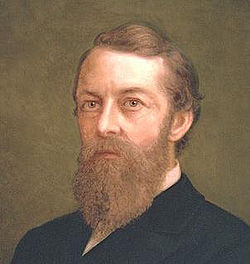 Stoneman moved to California, the place of which he had dreamed since his service as a young officer before the war. He and his wife settled in the San Gabriel Valley
on a 400 acres (1.6 km²) estate called Los Robles, which is now a state historical landmark. He was a state railroad commissioner from 1876 to 1878. In 1882, he was elected governor of California as a Democrat and served a single four-year term. He was not renominated by his party for a second term. After his house was destroyed by fire, an event rumored to be the work of his political enemies, Stoneman was broken financially and in poor health. He returned to New York State for medical treatment. He died following a stroke in Buffalo, New York
, and is buried in the Bentley Cemetery in Lakewood, New York
.
of The Band
, whose 1969 rock and roll
song, "The Night They Drove Old Dixie Down
", referred to one of Stoneman's 1865 raids:
Stoneman is not mentioned in several Joan Baez
recordings of the song; her interpretation substitutes "so much" for "Stoneman's".
Stoneman Avenue in Alhambra, California
, was named in his honor. Camp Stoneman
, near Pittsburg, California
, was the place from where many soldiers shipped out to the Pacific Theater in World War II
and the Korean War
, and is remembered by Stoneman Elementary School. Stoneman Elementary School in San Marino, California
, is built on Stoneman's Los Robles Ranch Property. Stoneman Bridge, in Yosemite Valley
, is named in his honor.
United States Army
The United States Army is the main branch of the United States Armed Forces responsible for land-based military operations. It is the largest and oldest established branch of the U.S. military, and is one of seven U.S. uniformed services...
officer, a Union
Union Army
The Union Army was the land force that fought for the Union during the American Civil War. It was also known as the Federal Army, the U.S. Army, the Northern Army and the National Army...
cavalry general in the American Civil War
American Civil War
The American Civil War was a civil war fought in the United States of America. In response to the election of Abraham Lincoln as President of the United States, 11 southern slave states declared their secession from the United States and formed the Confederate States of America ; the other 25...
, and the 15th Governor of California
Governor of California
The Governor of California is the chief executive of the California state government, whose responsibilities include making annual State of the State addresses to the California State Legislature, submitting the budget, and ensuring that state laws are enforced...
between 1883 and 1887.
Early life
Stoneman was born on a family farm in Busti, New YorkBusti, New York
Busti is a town in Chautauqua County, New York, United States. The population was 7,760 at the 2000 census. The town is named after Paul Busti, an official of the Holland Land Company, but its pronunciation uses a long i sound at the end, a frequent alteration in the names of several upstate New...
, the first child of ten. His parents were George Stoneman, Sr., a lumberman and justice of the peace
Justice of the Peace
A justice of the peace is a puisne judicial officer elected or appointed by means of a commission to keep the peace. Depending on the jurisdiction, they might dispense summary justice or merely deal with local administrative applications in common law jurisdictions...
, and Catherine Rebecca Cheney. He studied at the Jamestown Academy and graduated from the United States Military Academy
United States Military Academy
The United States Military Academy at West Point is a four-year coeducational federal service academy located at West Point, New York. The academy sits on scenic high ground overlooking the Hudson River, north of New York City...
in 1846; his roommate at West Point was future Confederate
Confederate States Army
The Confederate States Army was the army of the Confederate States of America while the Confederacy existed during the American Civil War. On February 8, 1861, delegates from the seven Deep South states which had already declared their secession from the United States of America adopted the...
General Thomas J. "Stonewall" Jackson
Stonewall Jackson
ຄຽשת״ׇׂׂׂׂ֣|birth_place= Clarksburg, Virginia |death_place=Guinea Station, Virginia|placeofburial=Stonewall Jackson Memorial CemeteryLexington, Virginia|placeofburial_label= Place of burial|image=...
. His first assignment was with the 1st U.S. Dragoons, with which he served across the West and in California
California
California is a state located on the West Coast of the United States. It is by far the most populous U.S. state, and the third-largest by land area...
. He was the quartermaster of the Mormon Battalion
Mormon Battalion
The Mormon Battalion was the only religiously based unit in United States military history, and it served from July 1846 to July 1847 during the Mexican-American War. The battalion was a volunteer unit of between 534 and 559 Latter-day Saints men led by Mormon company officers, commanded by regular...
, which marched from Fort Leavenworth, Kansas, to San Diego, California
San Diego, California
San Diego is the eighth-largest city in the United States and second-largest city in California. The city is located on the coast of the Pacific Ocean in Southern California, immediately adjacent to the Mexican border. The birthplace of California, San Diego is known for its mild year-round...
. He fought in the Yuma War
Yuma War
The Yuma War was the name given to a series of United States military operations conducted in southern California and what is today southwestern Arizona from 1850 to 1853. The Yumans were the primary opponent of the United States Army, though engagements were fought between the Americans and other...
and was responsible for survey parties mapping the Sierra Nevada range for railroad lines
Pacific Railroad Surveys
The Pacific Railroad Surveys -A series of explorations of the American West to explore possible routes for a transcontinental railroad across North America. The expeditions included surveyors, scientists, and artists and resulted in an immense body of data covering at least on the American West....
. After promotion to captain of the 2nd U.S. Cavalry in March 1855, he served mainly in Texas until 1861.
Civil War service
At the start of the Civil War Stoneman was in command of Fort BrownFort Brown
Fort Brown was a military post of the United States Army in Texas during the later half of 19th century and the early part of the 20th century.-Early years:...
, Texas
Texas
Texas is the second largest U.S. state by both area and population, and the largest state by area in the contiguous United States.The name, based on the Caddo word "Tejas" meaning "friends" or "allies", was applied by the Spanish to the Caddo themselves and to the region of their settlement in...
, and refused the order of Maj. Gen.
Major general (United States)
In the United States Army, United States Marine Corps, and United States Air Force, major general is a two-star general-officer rank, with the pay grade of O-8. Major general ranks above brigadier general and below lieutenant general...
David E. Twiggs
David E. Twiggs
David Emanuel Twiggs was a United States soldier during the War of 1812 and Mexican-American War and a general of the Confederate States Army during the American Civil War...
to surrender to the newly established Confederate authorities there, escaping to the north with most of his command. Returning east, he served as a major of the 1st U.S. Cavalry and then adjutant
Adjutant
Adjutant is a military rank or appointment. In some armies, including most English-speaking ones, it is an officer who assists a more senior officer, while in other armies, especially Francophone ones, it is an NCO , normally corresponding roughly to a Staff Sergeant or Warrant Officer.An Adjutant...
to Maj. Gen. George B. McClellan
George B. McClellan
George Brinton McClellan was a major general during the American Civil War. He organized the famous Army of the Potomac and served briefly as the general-in-chief of the Union Army. Early in the war, McClellan played an important role in raising a well-trained and organized army for the Union...
in western Virginia
Virginia
The Commonwealth of Virginia , is a U.S. state on the Atlantic Coast of the Southern United States. Virginia is nicknamed the "Old Dominion" and sometimes the "Mother of Presidents" after the eight U.S. presidents born there...
. As the cavalry was being organized in the Army of the Potomac
Army of the Potomac
The Army of the Potomac was the major Union Army in the Eastern Theater of the American Civil War.-History:The Army of the Potomac was created in 1861, but was then only the size of a corps . Its nucleus was called the Army of Northeastern Virginia, under Brig. Gen...
, he commanded the Cavalry Reserve and then the Cavalry Division, with the title Chief of Cavalry. He was promoted to brigadier general
Brigadier general (United States)
A brigadier general in the United States Army, Air Force, and Marine Corps, is a one-star general officer, with the pay grade of O-7. Brigadier general ranks above a colonel and below major general. Brigadier general is equivalent to the rank of rear admiral in the other uniformed...
on August 13, 1861. He did not relate well to McClellan, who did not understand the proper use of cavalry in warfare, relegating it to assignment in small units to infantry brigades. This organization fared poorly in the Peninsula Campaign
Peninsula Campaign
The Peninsula Campaign of the American Civil War was a major Union operation launched in southeastern Virginia from March through July 1862, the first large-scale offensive in the Eastern Theater. The operation, commanded by Maj. Gen. George B...
and the Seven Days Battles
Seven Days Battles
The Seven Days Battles was a series of six major battles over the seven days from June 25 to July 1, 1862, near Richmond, Virginia during the American Civil War. Confederate General Robert E. Lee drove the invading Union Army of the Potomac, commanded by Maj. Gen. George B. McClellan, away from...
of 1862, where the centralized Confederate cavalry under Maj. Gen. J.E.B. Stuart
J.E.B. Stuart
James Ewell Brown "Jeb" Stuart was a U.S. Army officer from Virginia and a Confederate States Army general during the American Civil War. He was known to his friends as "Jeb", from the initials of his given names. Stuart was a cavalry commander known for his mastery of reconnaissance and the use...
seriously outperformed their Union counterparts.
On November 22, 1861, Stoneman married Mary Oliver Hardisty of Baltimore. They eventually had four children.
After the Peninsula, Stoneman was an infantry commander, commanding a division in the II Corps
II Corps (ACW)
There were five corps in the Union Army designated as II Corps during the American Civil War.* Army of the Cumberland, II Corps commanded by Thomas L. Crittenden , later renumbered XX Corps...
and the III Corps
III Corps (ACW)
There were four formations in the Union Army designated as III Corps during the American Civil War.Three were short-lived:*In the Army of Virginia:**Irvin McDowell ;**James B...
. At the Battle of Fredericksburg
Battle of Fredericksburg
The Battle of Fredericksburg was fought December 11–15, 1862, in and around Fredericksburg, Virginia, between General Robert E. Lee's Confederate Army of Northern Virginia and the Union Army of the Potomac, commanded by Maj. Gen. Ambrose E. Burnside...
, Stoneman commanded the III Corps. He was promoted to major general
Major general (United States)
In the United States Army, United States Marine Corps, and United States Air Force, major general is a two-star general-officer rank, with the pay grade of O-8. Major general ranks above brigadier general and below lieutenant general...
of volunteers on November 29, 1862. However, following Fredericksburg, a new commanding general took over the Army of the Potomac: Maj. Gen. Joseph Hooker
Joseph Hooker
Joseph Hooker was a career United States Army officer, achieving the rank of major general in the Union Army during the American Civil War. Although he served throughout the war, usually with distinction, Hooker is best remembered for his stunning defeat by Confederate General Robert E...
. Hooker had a better understanding of the strategic value of a centralized Cavalry Corps and he named Stoneman to lead it. The centralized corps could undertake long raids into enemy territory, destroying supplies, and gathering intelligence about the enemy forces. They were not subject to the commanders of small infantry units.
Battle of Chancellorsville
The Battle of Chancellorsville was a major battle of the American Civil War, and the principal engagement of the Chancellorsville Campaign. It was fought from April 30 to May 6, 1863, in Spotsylvania County, Virginia, near the village of Chancellorsville. Two related battles were fought nearby on...
was strategically daring. Hooker assigned Stoneman a key role in which his Cavalry Corps would raid deeply into Robert E. Lee
Robert E. Lee
Robert Edward Lee was a career military officer who is best known for having commanded the Confederate Army of Northern Virginia in the American Civil War....
's rear areas and destroy vital railroad lines and supplies, distracting Lee from Hooker's main assaults. However, Stoneman was a disappointment in this strategic role. The Cavalry Corps got off to a good start in May 1863, but quickly bogged down after crossing the Rapidan River
Rapidan River
The Rapidan River, flowing through north-central Virginia in the United States, is the largest tributary of the Rappahannock River. The two rivers converge just west of the city of Fredericksburg...
. During the entire battle, Stoneman accomplished little and Hooker considered him one of the principal reasons for the Union defeat at Chancellorsville. Hooker needed to deflect criticism from himself and relieved Stoneman from his cavalry command, sending him back to Washington, D.C., for medical treatment (chronic hemorrhoids, exacerbated by cavalry service), where in July he became a Chief of the U.S. Cavalry Bureau, a desk job. A large cavalry supply and training depot on the Potomac River
Potomac River
The Potomac River flows into the Chesapeake Bay, located along the mid-Atlantic coast of the United States. The river is approximately long, with a drainage area of about 14,700 square miles...
was named Camp Stoneman in his honor.
In early 1864, Stoneman was impatient with garrison duty in Washington and requested another field command from his old friend Maj. Gen. John Schofield
John Schofield
John McAllister Schofield was an American soldier who held major commands during the American Civil War. He later served as U.S. Secretary of War and Commanding General of the United States Army.-Early life:...
, who was in command of the Department of the Ohio
Department of the Ohio
The Department of the Ohio was an administrative military district created by the United States War Department early in the American Civil War to administer the troops in the Northern states near the Ohio River.General Orders No...
. Although originally slated for an infantry corps, Stoneman assumed command of the Cavalry Corps of what would be known as the Army of the Ohio
Army of the Ohio
The Army of the Ohio was the name of two Union armies in the American Civil War. The first army became the Army of the Cumberland and the second army was created in 1863.-History:...
. As the army fought in the Atlanta Campaign
Atlanta Campaign
The Atlanta Campaign was a series of battles fought in the Western Theater of the American Civil War throughout northwest Georgia and the area around Atlanta during the summer of 1864. Union Maj. Gen. William T. Sherman invaded Georgia from the vicinity of Chattanooga, Tennessee, beginning in May...
under Maj. Gen. William T. Sherman, Stoneman and his aide, Myles Keogh
Myles Keogh
Myles Walter Keogh was an Irishman who fought in Italy during the 1860 Papal War before volunteering for the Union side in the American Civil War . During the war years, he was promoted from the rank of Captain to that of Major, finally being awarded the brevet rank of Lieutenant Colonel...
, were captured by Confederate soldiers outside Macon, Georgia
Macon, Georgia
Macon is a city located in central Georgia, US. Founded at the fall line of the Ocmulgee River, it is part of the Macon metropolitan area, and the county seat of Bibb County. A small portion of the city extends into Jones County. Macon is the biggest city in central Georgia...
, becoming the highest ranking Union prisoner of war
Prisoner of war
A prisoner of war or enemy prisoner of war is a person, whether civilian or combatant, who is held in custody by an enemy power during or immediately after an armed conflict...
. He was a prisoner for three months.
Stoneman was exchanged relatively quickly based on the personal request of Sherman to the Confederates and he returned to duty. In December 1864, he led a raid from East Tennessee into southwestern Virginia. He led raids into Virginia and North Carolina
North Carolina
North Carolina is a state located in the southeastern United States. The state borders South Carolina and Georgia to the south, Tennessee to the west and Virginia to the north. North Carolina contains 100 counties. Its capital is Raleigh, and its largest city is Charlotte...
in 1865, took Salem and other towns, destroyed Moratock Iron Furnace
Moratock Park
Moratock Park is a public park in Danbury, North Carolina that includes the site of Moratock Iron Furnace. Union cavalry, under the command of George Stoneman, destroyed most of the original foundryworks while conducting raids through the area in 1865 during the American Civil War.-External links:*...
(a Confederate foundry
Foundry
A foundry is a factory that produces metal castings. Metals are cast into shapes by melting them into a liquid, pouring the metal in a mold, and removing the mold material or casting after the metal has solidified as it cools. The most common metals processed are aluminum and cast iron...
) and at Salisbury
Salisbury, North Carolina
Salisbury is a city in Rowan County in North Carolina, a state of the United States of America. The population was 33,663 in the 2010 Census . It is the county seat of Rowan County...
attempted to free about 1,400 prisoners, but the prisoners had been dispersed by the time he arrived in Salisbury. In recognition of his service, he was brevet
Brevet (military)
In many of the world's military establishments, brevet referred to a warrant authorizing a commissioned officer to hold a higher rank temporarily, but usually without receiving the pay of that higher rank except when actually serving in that role. An officer so promoted may be referred to as being...
ted major general
Major general (United States)
In the United States Army, United States Marine Corps, and United States Air Force, major general is a two-star general-officer rank, with the pay grade of O-8. Major general ranks above brigadier general and below lieutenant general...
in the regular army
Regular army
A regular army consists of the permanent force of a country's army that is maintained under arms during peacetime.Countries that use the term include:*Australian Army*British Army*Canadian Forces, specifically "Regular Force"*Egyptian army*Indian Army...
. His command nearly captured Confederate president Jefferson Davis
Jefferson Davis
Jefferson Finis Davis , also known as Jeff Davis, was an American statesman and leader of the Confederacy during the American Civil War, serving as President for its entire history. He was born in Kentucky to Samuel and Jane Davis...
during his flight from Richmond, Virginia
Richmond, Virginia
Richmond is the capital of the Commonwealth of Virginia, in the United States. It is an independent city and not part of any county. Richmond is the center of the Richmond Metropolitan Statistical Area and the Greater Richmond area...
. In June 1865, he was appointed commander of the Department of Tennessee and administered occupied Memphis
Memphis, Tennessee
Memphis is a city in the southwestern corner of the U.S. state of Tennessee, and the county seat of Shelby County. The city is located on the 4th Chickasaw Bluff, south of the confluence of the Wolf and Mississippi rivers....
. The Memphis riots
Memphis Riots of 1866
The Memphis Riots of 1866 refers to the violent events that occurred from May 1 to 3 in Memphis, Tennessee. The racial violence was ignited by tensions during Reconstruction following the American Civil War...
broke out among the still rebellious citizens who were angry at the presence of black
United States Colored Troops
The United States Colored Troops were regiments of the United States Army during the American Civil War that were composed of African American soldiers. First recruited in 1863, by the end of the Civil War, the men of the 175 regiments of the USCT constituted approximately one-tenth of the Union...
Federal soldiers in the military government. Stoneman was criticized for inaction and was investigated by a congressional committee, although he was exonerated.
Postbellum politics
In 1866, Stoneman became opposed to the radical policies of Reconstruction and joined the Democratic PartyDemocratic Party (United States)
The Democratic Party is one of two major contemporary political parties in the United States, along with the Republican Party. The party's socially liberal and progressive platform is largely considered center-left in the U.S. political spectrum. The party has the lengthiest record of continuous...
. As he administered the military government in Petersburg, Virginia
Petersburg, Virginia
Petersburg is an independent city in Virginia, United States located on the Appomattox River and south of the state capital city of Richmond. The city's population was 32,420 as of 2010, predominantly of African-American ethnicity...
, he established a reputation of applying more moderate policies than some of the other military governors in Reconstruction, which eased some of the reconciliation pain for Virginians. He mustered out of volunteer service, in September 1866, and reverted to his regular army rank of lieutenant colonel. He took command of the Department of Arizona, First Military District
First Military District
The First Military District existed in the American South during the Reconstruction era that followed the American Civil War included Virginia. The district was commanded by General John Schofield....
, headquartered at Drum Barracks
Drum Barracks
The Drum Barracks, also known as Camp Drum and the Drum Barracks Civil War Museum, is the last remaining original American Civil War era military facility in the Los Angeles area...
. He was a controversial commander in that role because of his dealings with Indian uprisings and he was relieved of his command in May 1871.
California
San Gabriel Valley
The San Gabriel Valley is one of the principal valleys of Southern California, United States. It lies to the east of Los Angeles, to the north of the Puente Hills, to the south of the San Gabriel Mountains, and west of the Inland Empire. It derives its name from the San Gabriel River that flows...
on a 400 acres (1.6 km²) estate called Los Robles, which is now a state historical landmark. He was a state railroad commissioner from 1876 to 1878. In 1882, he was elected governor of California as a Democrat and served a single four-year term. He was not renominated by his party for a second term. After his house was destroyed by fire, an event rumored to be the work of his political enemies, Stoneman was broken financially and in poor health. He returned to New York State for medical treatment. He died following a stroke in Buffalo, New York
Buffalo, New York
Buffalo is the second most populous city in the state of New York, after New York City. Located in Western New York on the eastern shores of Lake Erie and at the head of the Niagara River across from Fort Erie, Ontario, Buffalo is the seat of Erie County and the principal city of the...
, and is buried in the Bentley Cemetery in Lakewood, New York
Lakewood, New York
Lakewood is a village in Chautauqua County, New York, USA. The population was 3,258 at the 2000 census.The Village of Lakewood is located in the northern part of the Town of Busti.-Geography:Lakewood is located at ....
.
In memoriam
Stoneman has been memorialized by songwriter Robbie RobertsonRobbie Robertson
Robbie Robertson, OC; is a Canadian singer-songwriter, and guitarist. He is best known for his membership as the guitarist and primary songwriter within The Band. He was ranked 59th in Rolling Stone magazine’s list of the 100 Greatest Guitarists of All Time...
of The Band
The Band
The Band was an acclaimed and influential roots rock group. The original group consisted of Rick Danko , Garth Hudson , Richard Manuel , and Robbie Robertson , and Levon Helm...
, whose 1969 rock and roll
Rock and roll
Rock and roll is a genre of popular music that originated and evolved in the United States during the late 1940s and early 1950s, primarily from a combination of African American blues, country, jazz, and gospel music...
song, "The Night They Drove Old Dixie Down
The Night They Drove Old Dixie Down
"The Night They Drove Old Dixie Down" is a song written by Canadian musician Robbie Robertson, first recorded by The Band in 1969 and released on their self-titled second album. Joan Baez' cover of the song was a top-five chart hit in late 1971....
", referred to one of Stoneman's 1865 raids:
Virgil Caine is the name, and I served on the Danville train,
Till Stoneman's cavalry came and tore up the tracks again ...
Stoneman is not mentioned in several Joan Baez
Joan Baez
Joan Chandos Baez is an American folk singer, songwriter, musician and a prominent activist in the fields of human rights, peace and environmental justice....
recordings of the song; her interpretation substitutes "so much" for "Stoneman's".
Stoneman Avenue in Alhambra, California
Alhambra, California
Alhambra is a city located in the western San Gabriel Valley region of Los Angeles County, California, United States, which is approximately eight miles from the Downtown Los Angeles civic center. As of the 2010 census, the population was 83,089, down from 85,804 at the 2000 census. The city's...
, was named in his honor. Camp Stoneman
Camp Stoneman
Camp Stoneman was a United States Army military facility located in Pittsburg, California. It served as a major staging area for the Army in World War II and the Korean War....
, near Pittsburg, California
Pittsburg, California
Pittsburg is a city located in eastern Contra Costa County, California, the outer portion of the East Bay region of the San Francisco Bay Area. The population was 63,264 at the 2010 census....
, was the place from where many soldiers shipped out to the Pacific Theater in World War II
World War II
World War II, or the Second World War , was a global conflict lasting from 1939 to 1945, involving most of the world's nations—including all of the great powers—eventually forming two opposing military alliances: the Allies and the Axis...
and the Korean War
Korean War
The Korean War was a conventional war between South Korea, supported by the United Nations, and North Korea, supported by the People's Republic of China , with military material aid from the Soviet Union...
, and is remembered by Stoneman Elementary School. Stoneman Elementary School in San Marino, California
San Marino, California
San Marino is a small, affluent city in Los Angeles County, California. Incorporated in 1913, the City founders designed the community to be uniquely residential, with expansive properties surrounded by beautiful gardens, wide streets, and well maintained parkways...
, is built on Stoneman's Los Robles Ranch Property. Stoneman Bridge, in Yosemite Valley
Yosemite Valley
Yosemite Valley is a glacial valley in Yosemite National Park in the western Sierra Nevada mountains of California, carved out by the Merced River. The valley is about long and up to a mile deep, surrounded by high granite summits such as Half Dome and El Capitan, and densely forested with pines...
, is named in his honor.
See also
- List of American Civil War generals
Further reading
- Fordney, Ben Fuller. George Stoneman: A Biography of the Union General. Jefferson, NC: McFarland, 2008. ISBN 978-0-7864-3225-7.