

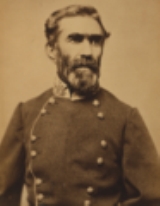
Braxton Bragg

Encyclopedia
Braxton Bragg was a career United States Army
officer, and then a general in the Confederate States Army
—a principal commander in the Western Theater
of the American Civil War
and later the military adviser to Confederate President
Jefferson Davis
.
Bragg, a native of North Carolina
, was educated at West Point
and became an artillery
officer. He served in Florida
and then received three brevet
promotions for distinguished service in the Mexican-American War, most notably the Battle of Buena Vista
. He established a reputation as a strict disciplinarian, but also as a junior officer willing to publicly argue with and criticize his superior officers, including those at the highest levels of the Army. After a series of posts in the Indian Territory
, he resigned from the U.S. Army in 1856 to become a sugar plantation
owner in Louisiana
.
During the Civil War, Bragg trained soldiers in the Gulf Coast
region. He was a corps commander at the Battle of Shiloh
and subsequently was named to command the Army of Mississippi
(later known as the Army of Tennessee
). He and Edmund Kirby Smith
attempted an invasion of Kentucky
in 1862, but Bragg retreated following the inconclusive Battle of Perryville
in October. In December, he fought another inconclusive battle at Murfreesboro, Tennessee
, the Battle of Stones River
, but once again withdrew his army. In 1863, he fought a series of battles against Maj. Gen. William S. Rosecrans and the Union
Army of the Cumberland
. In June, he was outmaneuvered in the Tullahoma Campaign
and retreated into Chattanooga
. In September, he was forced to evacuate Chattanooga, but counterattacked Rosecrans and defeated him at the Battle of Chickamauga
, the bloodiest battle in the Western Theater, and the only major Confederate victory. In November, Bragg's army was defeated in turn by Maj. Gen. Ulysses S. Grant
in the Battles for Chattanooga
.
Throughout these campaigns, Bragg fought almost as bitterly against some of his uncooperative subordinates as he did against the enemy, and they made multiple attempts to have him replaced as army commander. The defeat at Chattanooga was the last straw and Bragg was recalled in early 1864 to Richmond
, where he became the military adviser to Confederate President
Jefferson Davis
. Near the end of the war, he defended Wilmington, North Carolina
, and served as a corps commander in the Carolinas Campaign
. After the war Bragg worked as the superintendent of the New Orleans waterworks, a supervisor of harbor improvements at Mobile, Alabama
, and as a railroad engineer and inspector in Texas.
, one of the six sons of Thomas and Margaret Crosland Bragg. One of his older brothers was future Confederate
Attorney General
Thomas Bragg
. He was often ridiculed as a child because of rumors about his mother's prison sentence for allegedly murdering an African American
freeman, and some of those rumors stated that he was born in prison. Grady McWhiney, the principal biographer of Bragg's early life and career, states that despite these rumors, the Bragg family was law-abiding. Although considered by his neighbors to be from the lower class, Thomas Bragg was a carpenter and contractor who became wealthy enough to send Braxton to the Warrenton Male Academy, one of the best schools in the state. In the thousands of letters that Bragg wrote during his lifetime, he spoke fondly of his father, but never mentioned his mother.
. Eventually the oldest Bragg son, John, recently elected as a state legislator, obtained the support of U.S. Senator
Willie P. Mangum
and Braxton was admitted at the age of 16. His classmates included notable future Civil War generals Joseph Hooker
, John C. Pemberton
, Jubal A. Early, John Sedgwick
, and William H.T. Walker. He did well in academic pursuits because of his superior memory for classes and textbooks, rather than industrious study, and received disciplinary demerits at a rate lower than most of his contemporaries. He graduated fifth of fifty cadets from the West Point Class of 1837 and was commissioned a second lieutenant in the 3rd U.S. Artillery.
in Florida
, initially as an assistant commissary officer and regimental adjutant, seeing no actual combat. He soon began to suffer from a series of illnesses that he blamed on the tropical climate. He sought a medical transfer and was briefly assigned to recruiting duty in Philadelphia, but in October 1840 he was ordered back to Florida. He became a company commander in the 3rd Artillery and commanded Fort Marion, near St. Augustine
. In this assignment, he stayed relatively healthy, but tended toward overwork, laboring administratively to improve the living conditions of his men. He launched a series of argumentative letters with senior Army officials, including the adjutant general and Army paymaster, that established his reputation as "disputatious."
Bragg had a reputation for being a strict disciplinarian and one who adhered to regulations literally. There is a famous, apocryphal story, included in Ulysses S. Grant
's memoirs, about Bragg as a company commander at a frontier post where he also served as quartermaster. He submitted a requisition for supplies for his company, then as quartermaster declined to fill it. As company commander, he resubmitted the requisition, giving additional reasons for his requirements, but as the quartermaster he denied the request again. Realizing that he was at a personal impasse, he referred the matter to the post commandant, who exclaimed, "My God, Mr. Bragg, you have quarreled with every officer in the army, and now you are quarreling with yourself!" It is alleged that some of his troops attempted to assassinate him on two occasions in August and September 1847, but he was not injured either time. In the more serious of the two incidents, one of his soldiers exploded a 12-pound artillery shell underneath his cot. Although the cot was destroyed, somehow Bragg himself emerged without a scratch. Bragg had suspicions about the identity of the perpetrator, but had insufficient evidence to bring charges. Later, an Army deserter named Samuel R. Church claimed credit for the attack.
The 3rd Artillery relocated to Fort Moultrie, Charleston, South Carolina
, in 1843. Here, Bragg was stationed with three future Union Army
generals that he came to consider close friends: George H. Thomas and John F. Reynolds
(both of whom were lieutenants who reported to Bragg) and William T. Sherman. Bragg continued his controversial writing, this time a series of nine articles published 1844–45 in the Southern Literary Messenger. The series, "Notes on Our Army," published anonymously (as "A Subaltern"), included specific attacks on the policies of general in chief Winfield Scott
, whom he called a "vain, petty, conniving man." There were also numerous attacks on Army administrative policies and officers. He included thoughtful recommendations on a proposed structure for the Army general staff, which were echoed in reorganizations that occurred in the early 20th century, but were ignored at the time.
Bragg's articles came to the attention of Representative James G. Clinton
, a New York Democrat
and political opponent of Scott's. While Bragg was on leave in Washington, D.C., in March 1844, Clinton called him to testify before his House Committee on Public Expenditures. Scott ordered him not to testify, in defiance of the Congressional subpoena. Bragg was arrested and sent to Fort Monroe, Virginia, where he was court-martialed for disobedience to orders and disrespect toward his superior officers. Bragg conducted his own defense and attempted to turn the trial into a condemnation of Scott. He was found guilty, but an official reprimand from the Secretary of War and suspension at half pay for two months were relatively mild punishments, and Bragg was not deterred from future criticisms of his superiors.
in the defense of Texas
from Mexico
. He won promotions for bravery and distinguished conduct in the Mexican-American War, including a brevet
promotion to captain for the Battle of Fort Brown
(May 1846), to major
for the Battle of Monterrey
(September 1846), and to lieutenant colonel
for the Battle of Buena Vista
(February 1847). Bragg was also promoted to captain within the regular army in June 1846. He became widely admired (professionally, not personally) in Taylor's army for the discipline and drill of his men and the newly tried tactics of light artillery that proved decisive in most of his engagements against the Mexican Army. But it was Buena Vista that brought him national fame. His timely placement of artillery into a gap in the line helped repulse a numerically superior Mexican attack. He fought in support of Col. Jefferson Davis
and the Mississippi Rifles, which earned him the admiration of the future U.S. Secretary of War and president of the Confederacy.
An anecdote circulated about Gen. Taylor commanding, "A little more of the grape
, Capt. Bragg," which caused him to redouble his efforts and save the day; the stories are probably apocryphal. Nevertheless, Bragg returned to the United States as a popular hero. A northwestern outpost, Fort Bragg, California
, was named in his honor. The citizens of Warrenton presented him with a ceremonial sword. Congressman David Outlaw
wrote about the honor: "Col. Bragg having, no thanks to them, won for himself a brilliant reputation, is now the object of the most fulsome adulation. Those who formerly sneered at the Braggs as plebeians, as unfit associates for them, they are glad to honor. With what scorn must Col. Bragg, in his secret heart regard them." Bragg traveled to New York, Washington, Mobile, and New Orleans, and in each place he was honored.
, where he met 23-year-old Eliza Brooks Ellis, known to her friends as Elise, a wealthy sugar heiress. They were married on June 7, 1849. The newlyweds relocated to Jefferson Barracks, Missouri, on September 10. They were forced to leave this relatively comfortable assignment in October 1853 when they were transferred to Fort Gibson
in the Indian Territory
(present-day Oklahoma). Eight months later, they were transferred to Fort Washita
, near the Texas border. The primitive condition of these forts were unsuitable for the married couple, and after another six months Bragg requested leave and the couple returned to Thibodaux. Bragg traveled to Washington to implore Secretary of War Jefferson Davis to reassign his artillery battery away from frontier duty, but was unsuccessful.
On December 31, 1855, Bragg submitted his resignation from the Army and it became effective on January 3, 1856. He and his wife purchased a sugar plantation of 1600 acres (6.5 km²) 3 miles (4.8 km) north of Thibodaux. Never one to oppose slavery in concept—both his father and his wife were slaveowners—his property used 105 slaves in its production. There is no evidence that he was a cruel slaveowner, but he continued to uphold his reputation as being a stern disciplinarian and an advocate of military efficiency. His methods resulted in almost immediate profitability, despite a large mortgage on the property. He became active in local politics and was elected to the Board of Public Works in 1860. Throughout the 1850s, Bragg had been disturbed by the accelerating sectional crisis. He opposed the concept of secession
, believing that in a republic no majority could set aside a written constitution, but this belief would soon be tested.
in the Louisiana Militia. On December 12, 1860, Governor Thomas O. Moore appointed him to the state military board, an organization charged with creating a 5,000-man army. On January 11, 1861, Bragg led a group of 500 volunteers to Baton Rouge
, where they persuaded the commander of the federal arsenal there to surrender. The state convention on secession
also established a state army and Moore appointed Bragg its commander, with the rank of major general
, on February 20, 1861. He commanded the forces around New Orleans until April 16, but his commission was transferred to be a brigadier general of the Confederate States Army on March 7, 1861. He commanded forces in Pensacola, Florida
, Alabama, and the Department of West Florida and was promoted to major general on September 12, 1861. His tenure was successful and he trained his men to be some of the best disciplined troops in the Confederate Army.
In December, President Davis asked Bragg to take command of the Trans-Mississippi Department
, but Bragg declined. He was concerned for the prospects of victory west of the Mississippi River and about the poorly supplied and ill-disciplined troops there. He was also experiencing one of his periodic episodes of ill health that would plague him throughout the war. For years he had suffered from rheumatism, dyspepsia, nerves, and severe migraine headaches, ailments that undoubtedly contributed to his disagreeable personal style. The command went to Edmund Kirby Smith
. Bragg proposed to Davis that he change his strategy of attempting to defend every square mile of Confederate territory, recommending that his troops were of less value on the Gulf Coast than they would be farther to the north, concentrated with other forces for an attack against the Union Army in Tennessee. Bragg transported about 10,000 men to Corinth, Mississippi
, in February 1862 and was charged with improving the poor discipline of the Confederate troops already assembled under General Albert Sidney Johnston
.
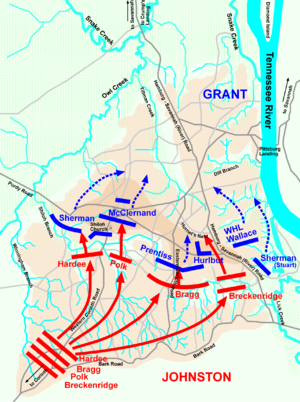 Bragg commanded a corps (and was also chief of staff) under Johnston at the Battle of Shiloh
, April 6–7, 1862. In the initial surprise Confederate advance, Bragg's corps was ordered to attack in a line that was almost 3 miles (4.8 km) long, but he soon began directing activities of the units that found themselves around the center of the battlefield. His men became bogged down against a Union salient called the Hornet's Nest, which he attacked for hours with piecemeal frontal assaults. After Johnston was killed in the battle, General P.G.T. Beauregard assumed command, and appointed Bragg his second in command. Bragg was dismayed when Beauregard called off a late afternoon assault against the Union's final position, which was strongly defended, calling it their last opportunity for victory. On the second day of battle, the Union army counterattacked and the Confederates retreated back to Corinth.
Bragg received public praise for his conduct in the battle and on April 12, 1862, Jefferson Davis appointed Bragg a full general, the fifth man to achieve that rank and one of only seven in the history of the Confederacy. His date of rank was April 6, 1862, coinciding with the first day at Shiloh. After the Siege of Corinth
, Beauregard departed on sick leave, leaving Bragg in temporary command of the army in Tupelo, Mississippi
, but he failed to inform President Davis of his departure and spent two weeks absent without leave. Davis was looking for someone to replace Beauregard because of his perceived poor performance at Corinth, and the opportunity presented itself when Beauregard left without permission. Bragg was then appointed his successor as commander of the Western Department (known formally as Department Number Two), including the Army of Mississippi
, on June 17, 1862.
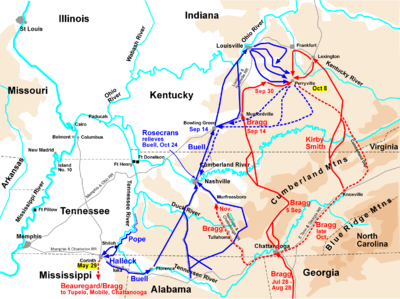 In August 1862, Confederate Maj. Gen. Edmund Kirby Smith
decided to invade Kentucky
from Eastern Tennessee, hoping that he could arouse supporters of the Confederate cause in the border state and draw the Union forces under Maj. Gen. Don Carlos Buell
, beyond the Ohio River. Bragg considered various options, including an attempt to retake Corinth, or to advance against Buell's army through Middle Tennessee
. He eventually heeded Kirby Smith's calls for reinforcement and decided to relocate his Army of Mississippi to join with him. He moved 30,000 infantrymen in a tortuous railroad journey from Tupelo through Mobile
and Montgomery
to Chattanooga
, while his cavalry and artillery moved by road. Although Bragg was the senior general in the theater, President Davis had established Kirby Smith's Department of East Tennessee as an independent command, reporting directly to Richmond. This decision caused Bragg difficulty during the campaign.
Smith and Bragg met in Chattanooga on July 31, 1862, and devised a plan for the campaign: Kirby Smith's Army of Kentucky would first march into Kentucky to dispose of the Union defenders of Cumberland Gap. (Bragg's army was too exhausted from its long journey to begin immediate offensive operations.) Smith would return to join Bragg, and their combined forces would attempt to maneuver into Buell's rear and force a battle to protect his supply lines. Once the armies were combined, Bragg's seniority would apply and Smith would be under his direct command. Assuming that Buell's army could be destroyed, Bragg and Smith would march farther north into Kentucky, a movement they assumed would be welcomed by the local populace. Any remaining Federal force would be defeated in a grand battle in Kentucky, establishing the Confederate frontier at the Ohio River.
On August 9, Smith informed Bragg that he was breaking the agreement and intended to bypass Cumberland Gap, leaving a small holding force to neutralize the Union garrison, and to move north. Unable to command Smith to honor their plan, Bragg focused on a movement to Lexington
instead of Nashville
. He cautioned Smith that Buell could pursue and defeat his smaller army before Bragg's army could join up with them.
Bragg departed from Chattanooga on August 27, just before Smith reached Lexington. On the way, he was distracted by the capture of a Union fort at Munfordville
. He had to decide whether to continue toward a fight with Buell (over Louisville) or rejoin Smith, who had gained control of the center of the state by capturing Richmond and Lexington, and threatened to move on Cincinnati. Bragg chose to rejoin Smith. He left his army and met Smith in Frankfort
, where they attended the inauguration of Confederate Governor Richard Hawes
on October 4. The inauguration ceremony was disrupted by the sound of approaching Union cannon fire and the organizers canceled the inaugural ball scheduled for that evening.
On October 8, the armies met unexpectedly at the Battle of Perryville
; they had skirmished the previous day as they were searching for water sources in the vicinity. Bragg ordered the wing of his army under Maj. Gen. Leonidas Polk
to attack what he thought was an isolated portion of Buell's command, but had difficulty motivating Polk to begin the fight until Bragg arrived in person. Eventually Polk attacked the corps of Maj. Gen. Alexander M. McCook
on the Union army's left flank and forced it to fall back. By the end of the day, McCook had been driven back about a mile, but reinforcements had arrived to stabilize the line, and Bragg only then began to realize that his limited tactical victory in the bloody battle had been against less than half of Buell's army and the remainder was arriving quickly.
Kirby Smith pleaded with Bragg to follow up on his success: "For God's sake, General, let us fight Buell here." Bragg replied, "I will do it, sir," but then displaying what one observer called "a perplexity and vacillation which had now become simply appalling to Smith, to Hardee, and to Polk," he ordered his army to retreat through the Cumberland Gap to Knoxville. Bragg referred to his retreat as a withdrawal, the successful culmination of a giant raid. He had multiple reasons for withdrawing. Disheartening news had arrived from northern Mississippi that Earl Van Dorn
and Sterling Price
had been defeated at Corinth
, just as Robert E. Lee
had failed in his Maryland Campaign
. He saw that his army had not much to gain from a further, isolated victory, whereas a defeat might cost not only the bountiful food and supplies yet collected, but also his army. He wrote to his wife, "With the whole southwest thus in the enemy's possession, my crime would have been unpardonable had I kept my noble little army to be ice-bound in the northern clime, without tents or shoes, and obliged to forage daily for bread, etc." He was quickly called to Richmond to explain to Jefferson Davis the charges brought by his officers about how he had conducted his campaign, demanding that he be replaced as head of the army. Although Davis decided to leave the general in command, Bragg's relationship with his subordinates would be severely damaged. Upon rejoining the army, he ordered a movement to Murfreesboro, Tennessee
.
by Maj. Gen. William S. Rosecrans. In late December, Rosecrans advanced from Nashville against Bragg's position at Murfreesboro. Before Rosecrans could attack, Bragg launched a strong, surprise attack against Rosecrans's right flank on December 31, 1862, the start of the Battle of Stones River
. The Confederates succeeded in driving the Union army back to a small defensive position, but could not destroy it, nor could they break its supply line to Nashville, as Bragg intended. Despite this, Bragg considered the first day of battle to be a victory and assumed that Rosecrans would soon retreat. By January 2, 1863, however, the Union troops remained in place and the battle resumed as Bragg launched an unsuccessful attack by the troops of Maj. Gen. John C. Breckinridge
against the well defended Union left flank. Recognizing his lack of progress, the severe winter weather, the arrival of supplies and reinforcements for Rosecrans, and heeding the recommendations of corps commanders Hardee and Polk, Bragg withdrew his army from the field to Tullahoma, Tennessee
.
Bragg's subordinate generals were vocal in their dissatisfaction of his command during the Kentucky campaign and Stones River. He reacted to the rumors of criticism by circulating a letter to his corps and division commanders that asked them to confirm in writing that they had recommended withdrawing after the latter battle, stating that if he had misunderstood them and withdrawn mistakenly, he would willingly step down. Unfortunately, he wrote the letter at a time that a number of his most faithful supporters were on leave for illness or wounds. Bragg's critics, including William J. Hardee, interpreted the letter as having an implied secondary question—had Bragg lost the confidence of his senior commanders? Leonidas Polk did not reply to the implied question, but he wrote directly to his friend, Jefferson Davis, recommending that Bragg be replaced.
Davis responded to the complaints by dispatching Gen. Joseph E. Johnston
to investigate the condition of the army. Davis assumed that Johnston, Bragg's superior, would find the situation wanting and take command of the army in the field, easing Bragg aside. However, Johnston arrived on the scene and found the men of the Army of Tennessee in relatively good condition. He told Bragg that he had "the best organized, armed, equipped, and disciplined army in the Confederacy." Johnston explicitly refused any suggestion that he take command, concerned that people would think he had taken advantage of the situation for his own personal gain. When Davis ordered Johnston to send Bragg to Richmond, Johnston delayed because of Elise Bragg's illness; when her health improved Johnston was unable to assume command because of lingering medical problems from his wound at the Battle of Seven Pines
in 1862.
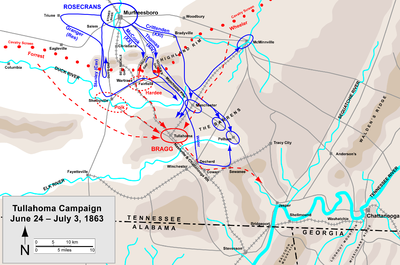 As Bragg's army fortified Tullahoma, Rosecrans spent the next six months in Murfreesboro, resupplying and retraining his army to resume its advance. Rosecrans's initial movements on June 23 took Bragg by surprise—while keeping Polk's corps occupied with small actions in the center of the Confederate line, Rosecrans sent the majority of his army around Bragg's right flank. Bragg was slow to react and his subordinates were typically uncooperative; the mistrust among the general officers of the Army of Tennessee for the past months led to little direct communication about strategy and neither Polk nor Hardee had a firm understanding of Bragg's plans. As the Union army outmaneuvered the Confederates, Bragg was forced to abandon Tullahoma and on July 4 retreated behind the Tennessee River. Tullahoma is recognized as a "brilliant" campaign for Rosecrans, achieving with minimal losses his goal of driving Bragg from Middle Tennessee. Judith Hallock wrote that Bragg was "outfoxed" and that his ill health may have been partially to blame for his performance, but her overall assessment was that he performed credibly during the retreat from Tullahoma, keeping his army intact under difficult circumstances.
Although the Army of Tennessee had about 52,000 men at the end of July, the Confederate government merged the Department of East Tennessee, under Maj. Gen. Simon B. Buckner
, into Bragg's Department of Tennessee, which added 17,800 men to Bragg's army, but also extended his command responsibilities northward to the Knoxville
area. This brought a third subordinate into Bragg's command who had little or no respect for him. Buckner's attitude was colored by Bragg's unsuccessful invasion of Buckner's native Kentucky in 1862, as well as by the loss of his command through the merger. A positive aspect for Bragg was Hardee's request to be transferred to Mississippi in July, but he was replaced by Lt. Gen. D.H. Hill, a general who did not get along with Robert E. Lee
in Virginia.
The Confederate War Department asked Bragg in early August if he could assume the offensive against Rosecrans if he were given reinforcements from Mississippi. He demurred, concerned about the daunting geographical obstacles and logistical challenges, preferring to wait for Rosecrans to solve those same problems and attack him. An opposed crossing of the Tennessee River was not feasible, so Rosecrans devised a deception to distract Bragg above Chattanooga while the army crossed downstream. Bragg was rightfully concerned about a sizable Union force under Maj. Gen. Ambrose E. Burnside that was threatening Knoxville to the northeast, and Rosecrans reinforced this concern by feinting to his left and shelling the city of Chattanooga from the heights north of the river. The bulk of the Union army crossed the Tennessee southeast of Chattanooga by September 4 and Bragg realized that his position there was no longer tenable. He evacuated the city on September 8.
and D.H. Hill refused to attack, as ordered, an outnumbered Federal column at McLemore's Cove (the Battle of Davis's Cross Roads). On September 13, Bragg ordered Leonidas Polk to attack Maj. Gen. Thomas L. Crittenden's corps, but Polk ignored the orders and demanded more troops, insisting that it was he who was about to be attacked. Rosecrans used the time lost in these delays to concentrate his scattered forces. Finally, on September 19–20, 1863, Bragg, reinforced by two divisions from Mississippi, one division and several brigades from the Department of East Tennessee, and two divisions under Lt. Gen. James Longstreet
from Robert E. Lee
's Army of Northern Virginia
, turned on the pursuing Rosecrans in northeastern Georgia and at high cost defeated him at the Battle of Chickamauga
, the greatest Confederate victory in the Western Theater during the war. It was not a complete victory, however. Bragg's objective was to cut off Rosecrans from Chattanooga and destroy his army. Instead, following a partial rout of the Union army by Longstreet's wing, a stout defense by Maj. Gen. George H. Thomas allowed Rosecrans and almost all of his army to escape.
After the battle, Rosecrans's Army of the Cumberland
retreated to Chattanooga, where Bragg laid siege to the city. He began to wage a battle against the subordinates he resented for failing him in the campaign—Hindman for his lack of action in McLemore's Cove, and Polk for delaying the morning attack Bragg ordered on September 20. On September 29, Bragg suspended both officers from their commands. In early October, an attempted mutiny of Bragg's subordinates resulted in D.H. Hill being relieved from his command. Longstreet was dispatched with his corps to the Knoxville Campaign against Ambrose Burnside, seriously weakening Bragg's army at Chattanooga.
Some of Bragg's subordinate generals were frustrated at what they perceived to be his lack of willingness to exploit the victory by pursuing the Union army toward Chattanooga and destroying it. Polk in particular was outraged at being relieved of command. The dissidents, including many of the division and corps commanders, met in secret and prepared a petition to the president. Although the author of the petition is not known, historians suspect it was Simon Buckner, whose signature was first on the list. Lt. Gen. James Longstreet wrote to the Secretary of War with the prediction that "nothing but the hand of God can save us or help us as long as we have our present commander." Cavalry commander Nathan Bedford Forrest
, dissatisfied after a long association with Bragg, and bitter about his failure to pursue the defeated Union forces after Chickamauga, refused to serve under him again. He told Bragg to his face, "You have played the part of a damned scoundrel. ... If you ever again try to interfere with me or cross my path it will be at the peril of your life." With the Army of Tennessee literally on the verge of mutiny, Jefferson Davis reluctantly traveled to Chattanooga to personally assess the situation and to try to stem the tide of dissent in the army. Although Bragg offered to resign to resolve the crisis, Davis eventually decided to leave Bragg in command, denounced the other generals, and termed their complaints "shafts of malice".
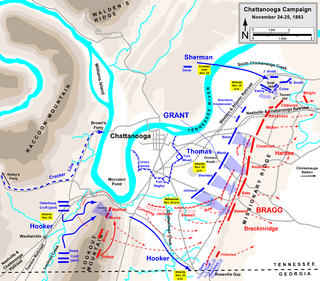 While Bragg fought with his subordinates and reduced his force by dispatching Longstreet to Knoxville, the besieged Union army received a new commander—Maj. Gen. Ulysses S. Grant
—and significant reinforcements from Mississippi and Virginia. The Battles for Chattanooga
marked Bragg's final days as an army commander. His weakened left flank (previously manned by Longstreet's troops) fell on November 24 during the Battle of Lookout Mountain
. The following day in the Battle of Missionary Ridge
, his primary defensive line successfully resisted an attack on its right flank, but the center was overwhelmed in a frontal assault by George Thomas's army. The Army of Tennessee was routed and retreated to Dalton, Georgia
. Bragg offered his resignation on November 29 and was chagrined when Pres. Davis accepted it immediately. He turned over temporary command to Hardee on December 2 and was replaced with Joseph E. Johnston
, who commanded the army in the 1864 Atlanta Campaign
against William T. Sherman.
. Bragg used his organizational abilities to reduce corruption and improve the supply system. He took over responsibility for administration of the military prison system and its hospitals. He reshaped the Confederacy's conscription process by streamlining the chain of command and reducing conscripts' avenues of appeal. During his tenure in Richmond, he had numerous quarrels with significant figures, including the Secretary of War, the Commissary General, members of Congress, the press, and many of his fellow generals; the exception to the latter was Robert E. Lee, who treated Bragg politely and with deference and who had, Bragg knew, an exceptionally close relationship with the president.
In May, while Robert E. Lee was occupied defending against Ulysses S. Grant's Overland Campaign
in Virginia, Bragg focused on the defense of areas south and west of Richmond. He convinced Jefferson Davis to appoint P.G.T. Beauregard to an important role in the defense of Richmond and Petersburg. Meanwhile, Davis was concerned that Joseph E. Johnston, Bragg's successor at the Army of Tennessee, was defending too timidly against William T. Sherman's Atlanta Campaign
. He sent Bragg to Georgia on July 9, charged with investigating the tactical situation, but also evaluating the replacement of Johnston in command. Bragg harbored the hope that he might be chosen to return to command of the army, but was willing to support Davis's choice. Davis had hinted to Bragg that he thought William J. Hardee would be an appropriate successor, but Bragg was reluctant to promote an old enemy and reported back that Hardee would provide no change in strategy from Johnston's. Bragg had extensive conversations with a more junior corps commander, Lt. Gen. John Bell Hood
, and was impressed with his plans for taking offensive action, about which Hood had also been confidentially corresponding to Richmond for weeks behind Johnston's back. Davis chose Hood to replace Johnston.
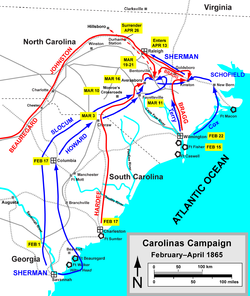 In October 1864, President Davis sent Bragg to assume temporary command of the defenses of Wilmington, North Carolina
, and his responsibility was soon increased at the recommendation of Robert E. Lee to include all of the Department of North Carolina and Southern Virginia. In November, with William T. Sherman's March to the Sea
under way, Davis ordered him to the defenses of Augusta, Georgia
, and then to Savannah, Georgia
, Charleston, South Carolina
, and in January 1865, the defenses of Wilmington again. The Confederates were able to successfully repulse the first Union attempt to capture Fort Fisher
, which dominated the seaborne supply line to Wilmington. However, when the Union returned in January, Bragg's performance in the Second Battle of Fort Fisher
was poor. He assumed that the first failed siege meant that the fort was invulnerable, when in fact bad weather played a large role. Thus, he did not come to the fort's assistance in a timely fashion after it was attacked the second time. The Confederates were forced to evacuate Wilmington, their last remaining seaport on the Atlantic coast.
Bragg's now-fragile military career began to crumble around him. To his disgust, Joseph E. Johnston was returned to service to command the remnants of the Army of Tennessee and other forces defending against Sherman in North Carolina. At about the same time, Bragg lost his position as military adviser to Davis when Robert E. Lee was promoted to be general in chief of all the Confederate armies in February. And John C. Breckinridge
, who had hated Bragg since the debacle at Perryville, was named Secretary of War. Davis was sympathetic to Bragg's discomfort and discussed transferring him to command the Trans-Mississippi Department, replacing Edmund Kirby Smith
, but the politicians from that region were strongly opposed. Bragg became in effect a corps commander (although his command was less than a division in size) under Johnston for the remainder of the Carolinas Campaign
. His men were able to win a minor victory at the Second Battle of Kinston
, March 7–10, and fought unsuccessfully at the Battle of Bentonville
, March 19–21. After the fall of Richmond on April 2, Jefferson Davis and remnants of the Confederate government fled to the southwest. Bragg, who had been headquartered at Raleigh, North Carolina
, caught up with the Davis near Abbeville, South Carolina
, on May 1. He attended the final cabinet meeting and was instrumental in convincing Davis that the cause was lost. Bragg and a small party of his staff rode to the west and were captured and paroled in Monticello, Georgia
, on May 9.
. The couple moved in with his brother, a plantation owner in Lowndesboro, Alabama
, but they found the life of seclusion there to be intolerable. In 1867 Bragg became the superintendent of the New Orleans waterworks
, but he was soon replaced by an African-American as the Reconstructionists came to power. In late 1869 Jefferson Davis offered him a job as an agent for the Carolina Life Insurance Company. He worked there for four months before becoming dissatisfied with the profession and its low pay. He considered but rejected a position in the Egyptian Army
. In August 1871 he was employed by the city of Mobile, Alabama
, to improve the river, harbor, and bay, leaving after quarreling with a "combination of capitalists." Moving to Texas, he was appointed the chief engineer of the Gulf, Colorado, and Santa Fe Railroad in July 1874, but within a year disagreements with the board of directors over his compensation caused him to resign. He remained in Texas as inspector of railroads.
At the age of 59, Bragg was walking down a street with a friend in Galveston, Texas
, when he suddenly fell over unconscious. Dragged into a drugstore, he was dead within 10 to 15 minutes. A physician familiar with his history believe that he "died by the brain" (or of "paralysis of the brain"), suffering from the degeneration of cerebral blood vessels. An inquest ruled that his death was due to "fatal syncope
," possibly induced by organic disease of the heart. He is buried in Magnolia Cemetery
, Mobile, Alabama
.
and Hood
who lost the West" sums up the judgment of many modern historians. Bragg's shortcomings as an army commander included his unimaginative tactics, mostly his reliance on frontal assault (such as the Hornet's Nest at Shiloh
, Breckinridge's assault at Stones River, and numerous instances at Chickamauga), and his lack of post-battle followup that turned tactical victories or draws into strategic disappointments (Perryville and Chickamauga). His sour disposition, penchant to blame others for defeat, and poor interpersonal skills undoubtedly caused him to be criticized more directly than many of his unsuccessful contemporaries. Peter Cozzens wrote about his relationship with subordinates:
Some counterarguments have emerged in recent years. Judith Lee Hallock called the blaming of Bragg for Confederate defeats in the west the "Bragg syndrome." While most agree he was a poor army commander, historians such as Hallock and Steven Woodworth cite his skills as an organizer and that his defeat in several battles can also be partially blamed upon bad luck and incompetent subordinates, notably Polk. Of his troublesome subordinates, Hardee was considered to be a solid soldier even by Bragg. Polk, although personally brave and charismatic, was simply an average tactician known for piecemeal attacks and was seriously insubordinate. Unfortunately, he was a close friend of Davis, who was unwilling to relieve him. Bragg also never received the support Davis gave to Robert E. Lee and Sidney Johnston. That his abilities were only properly utilized in 1861 and 1864 also shows the inability of the Confederacy to make proper use of many of its generals.
Historians Grady McWhiney
and Steven Woodworth have pointed out that, contrary to popular belief, Davis and Bragg were not friends, having bitterly quarreled during the antebellum years. Davis was impressed with Bragg's qualifications for high command early in the war, but was willing to relieve him by 1863, following Perryville and Stones River. He did not relieve him, in part because no suitable replacements could be found, a consistent problem for Davis. Even Bragg's harshest critics have generally failed to suggest a suitable replacement. Judith Hallock noted that there was mutual admiration between Davis and Bragg during his assignment in Richmond, perhaps because of the respect Bragg gave to the president.
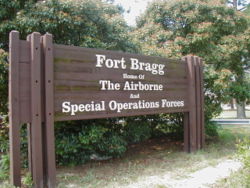 A few geographic features memorialize Braxton Bragg:
United States Army
The United States Army is the main branch of the United States Armed Forces responsible for land-based military operations. It is the largest and oldest established branch of the U.S. military, and is one of seven U.S. uniformed services...
officer, and then a general in the Confederate States Army
Confederate States Army
The Confederate States Army was the army of the Confederate States of America while the Confederacy existed during the American Civil War. On February 8, 1861, delegates from the seven Deep South states which had already declared their secession from the United States of America adopted the...
—a principal commander in the Western Theater
Western Theater of the American Civil War
This article presents an overview of major military and naval operations in the Western Theater of the American Civil War.-Theater of operations:...
of the American Civil War
American Civil War
The American Civil War was a civil war fought in the United States of America. In response to the election of Abraham Lincoln as President of the United States, 11 southern slave states declared their secession from the United States and formed the Confederate States of America ; the other 25...
and later the military adviser to Confederate President
President of the Confederate States of America
The President of the Confederate States of America was the Head of State and Head of Government of the Confederate States of America, which was formed from the states which declared their secession from the United States, thus precipitating the American Civil War. The only person to hold the...
Jefferson Davis
Jefferson Davis
Jefferson Finis Davis , also known as Jeff Davis, was an American statesman and leader of the Confederacy during the American Civil War, serving as President for its entire history. He was born in Kentucky to Samuel and Jane Davis...
.
Bragg, a native of North Carolina
North Carolina
North Carolina is a state located in the southeastern United States. The state borders South Carolina and Georgia to the south, Tennessee to the west and Virginia to the north. North Carolina contains 100 counties. Its capital is Raleigh, and its largest city is Charlotte...
, was educated at West Point
United States Military Academy
The United States Military Academy at West Point is a four-year coeducational federal service academy located at West Point, New York. The academy sits on scenic high ground overlooking the Hudson River, north of New York City...
and became an artillery
Artillery
Originally applied to any group of infantry primarily armed with projectile weapons, artillery has over time become limited in meaning to refer only to those engines of war that operate by projection of munitions far beyond the range of effect of personal weapons...
officer. He served in Florida
Florida
Florida is a state in the southeastern United States, located on the nation's Atlantic and Gulf coasts. It is bordered to the west by the Gulf of Mexico, to the north by Alabama and Georgia and to the east by the Atlantic Ocean. With a population of 18,801,310 as measured by the 2010 census, it...
and then received three brevet
Brevet (military)
In many of the world's military establishments, brevet referred to a warrant authorizing a commissioned officer to hold a higher rank temporarily, but usually without receiving the pay of that higher rank except when actually serving in that role. An officer so promoted may be referred to as being...
promotions for distinguished service in the Mexican-American War, most notably the Battle of Buena Vista
Battle of Buena Vista
The Battle of Buena Vista , also known as the Battle of Angostura, saw the United States Army use artillery to repulse the much larger Mexican army in the Mexican-American War...
. He established a reputation as a strict disciplinarian, but also as a junior officer willing to publicly argue with and criticize his superior officers, including those at the highest levels of the Army. After a series of posts in the Indian Territory
Indian Territory
The Indian Territory, also known as the Indian Territories and the Indian Country, was land set aside within the United States for the settlement of American Indians...
, he resigned from the U.S. Army in 1856 to become a sugar plantation
Plantations in the American South
Plantations were an important aspect of the history of the American South, particularly the antebellum .-Planter :The owner of a plantation was called a planter...
owner in Louisiana
Louisiana
Louisiana is a state located in the southern region of the United States of America. Its capital is Baton Rouge and largest city is New Orleans. Louisiana is the only state in the U.S. with political subdivisions termed parishes, which are local governments equivalent to counties...
.
During the Civil War, Bragg trained soldiers in the Gulf Coast
Gulf Coast of the United States
The Gulf Coast of the United States, sometimes referred to as the Gulf South, South Coast, or 3rd Coast, comprises the coasts of American states that are on the Gulf of Mexico, which includes Texas, Louisiana, Mississippi, Alabama, and Florida and are known as the Gulf States...
region. He was a corps commander at the Battle of Shiloh
Battle of Shiloh
The Battle of Shiloh, also known as the Battle of Pittsburg Landing, was a major battle in the Western Theater of the American Civil War, fought April 6–7, 1862, in southwestern Tennessee. A Union army under Maj. Gen. Ulysses S. Grant had moved via the Tennessee River deep into Tennessee and...
and subsequently was named to command the Army of Mississippi
Army of Mississippi
There were three organizations known as the Army of Mississippi in the Confederate States Army during the American Civil War. -Army of Mississippi :This army, at times known by the names Army of the West or Army of the...
(later known as the Army of Tennessee
Army of Tennessee
The Army of Tennessee was the principal Confederate army operating between the Appalachian Mountains and the Mississippi River during the American Civil War. It was formed in late 1862 and fought until the end of the war in 1865, participating in most of the significant battles in the Western Theater...
). He and Edmund Kirby Smith
Edmund Kirby Smith
Edmund Kirby Smith was a career United States Army officer and educator. He served as a general in the Confederate States Army during the American Civil War, notable for his command of the Trans-Mississippi Department of the Confederacy after the fall of Vicksburg.After the conflict ended Smith...
attempted an invasion of Kentucky
Kentucky
The Commonwealth of Kentucky is a state located in the East Central United States of America. As classified by the United States Census Bureau, Kentucky is a Southern state, more specifically in the East South Central region. Kentucky is one of four U.S. states constituted as a commonwealth...
in 1862, but Bragg retreated following the inconclusive Battle of Perryville
Battle of Perryville
The Battle of Perryville, also known as the Battle of Chaplin Hills, was fought on October 8, 1862, in the Chaplin Hills west of Perryville, Kentucky, as the culmination of the Confederate Heartland Offensive during the American Civil War. Confederate Gen. Braxton Bragg's Army of Mississippi won a...
in October. In December, he fought another inconclusive battle at Murfreesboro, Tennessee
Murfreesboro, Tennessee
Murfreesboro is a city in and the county seat of Rutherford County, Tennessee, United States. The population was 108,755 according to the United States Census Bureau's 2010 U.S. Census, up from 68,816 residents certified during the 2000 census. The center of population of Tennessee is located in...
, the Battle of Stones River
Battle of Stones River
The Battle of Stones River or Second Battle of Murfreesboro , was fought from December 31, 1862, to January 2, 1863, in Middle Tennessee, as the culmination of the Stones River Campaign in the Western Theater of the American Civil War...
, but once again withdrew his army. In 1863, he fought a series of battles against Maj. Gen. William S. Rosecrans and the Union
Union Army
The Union Army was the land force that fought for the Union during the American Civil War. It was also known as the Federal Army, the U.S. Army, the Northern Army and the National Army...
Army of the Cumberland
Army of the Cumberland
The Army of the Cumberland was one of the principal Union armies in the Western Theater during the American Civil War. It was originally known as the Army of the Ohio.-History:...
. In June, he was outmaneuvered in the Tullahoma Campaign
Tullahoma Campaign
The Tullahoma Campaign or Middle Tennessee Campaign was fought between June 24 and July 3, 1863, during the American Civil War. The Union Army of the Cumberland, commanded by Maj. Gen. William S...
and retreated into Chattanooga
Chattanooga, Tennessee
Chattanooga is the fourth-largest city in the US state of Tennessee , with a population of 169,887. It is the seat of Hamilton County...
. In September, he was forced to evacuate Chattanooga, but counterattacked Rosecrans and defeated him at the Battle of Chickamauga
Battle of Chickamauga
The Battle of Chickamauga, fought September 19–20, 1863, marked the end of a Union offensive in southeastern Tennessee and northwestern Georgia called the Chickamauga Campaign...
, the bloodiest battle in the Western Theater, and the only major Confederate victory. In November, Bragg's army was defeated in turn by Maj. Gen. Ulysses S. Grant
Ulysses S. Grant
Ulysses S. Grant was the 18th President of the United States as well as military commander during the Civil War and post-war Reconstruction periods. Under Grant's command, the Union Army defeated the Confederate military and ended the Confederate States of America...
in the Battles for Chattanooga
Chattanooga Campaign
The Chattanooga Campaign was a series of maneuvers and battles in October and November 1863, during the American Civil War. Following the defeat of Maj. Gen. William S. Rosecrans's Union Army of the Cumberland at the Battle of Chickamauga in September, the Confederate Army of Tennessee under Gen...
.
Throughout these campaigns, Bragg fought almost as bitterly against some of his uncooperative subordinates as he did against the enemy, and they made multiple attempts to have him replaced as army commander. The defeat at Chattanooga was the last straw and Bragg was recalled in early 1864 to Richmond
Richmond, Virginia
Richmond is the capital of the Commonwealth of Virginia, in the United States. It is an independent city and not part of any county. Richmond is the center of the Richmond Metropolitan Statistical Area and the Greater Richmond area...
, where he became the military adviser to Confederate President
President of the Confederate States of America
The President of the Confederate States of America was the Head of State and Head of Government of the Confederate States of America, which was formed from the states which declared their secession from the United States, thus precipitating the American Civil War. The only person to hold the...
Jefferson Davis
Jefferson Davis
Jefferson Finis Davis , also known as Jeff Davis, was an American statesman and leader of the Confederacy during the American Civil War, serving as President for its entire history. He was born in Kentucky to Samuel and Jane Davis...
. Near the end of the war, he defended Wilmington, North Carolina
Wilmington, North Carolina
Wilmington is a port city in and is the county seat of New Hanover County, North Carolina, United States. The population is 106,476 according to the 2010 Census, making it the eighth most populous city in the state of North Carolina...
, and served as a corps commander in the Carolinas Campaign
Carolinas Campaign
The Carolinas Campaign was the final campaign in the Western Theater of the American Civil War. In January 1865, Union Maj. Gen. William Tecumseh Sherman advanced north from Savannah, Georgia, through the Carolinas, with the intention of linking up with Union forces in Virginia. The defeat of ...
. After the war Bragg worked as the superintendent of the New Orleans waterworks, a supervisor of harbor improvements at Mobile, Alabama
Mobile, Alabama
Mobile is the third most populous city in the Southern US state of Alabama and is the county seat of Mobile County. It is located on the Mobile River and the central Gulf Coast of the United States. The population within the city limits was 195,111 during the 2010 census. It is the largest...
, and as a railroad engineer and inspector in Texas.
Early life
Bragg was born in Warrenton, North CarolinaWarrenton, North Carolina
Warrenton is a town in Warren County, North Carolina, United States. The population was 811 at the 2000 census. Founded in 1779, it is the county seat of Warren County. It is home to one of the campuses of Vance-Granville Community College....
, one of the six sons of Thomas and Margaret Crosland Bragg. One of his older brothers was future Confederate
Confederate States of America
The Confederate States of America was a government set up from 1861 to 1865 by 11 Southern slave states of the United States of America that had declared their secession from the U.S...
Attorney General
Attorney General
In most common law jurisdictions, the attorney general, or attorney-general, is the main legal advisor to the government, and in some jurisdictions he or she may also have executive responsibility for law enforcement or responsibility for public prosecutions.The term is used to refer to any person...
Thomas Bragg
Thomas Bragg
Thomas Bragg was a politician and lawyer who served as the 34th Governor of the U.S. state of North Carolina from 1855 through 1859. During the Civil War, he served in the Confederate States Cabinet. He was the older brother of General Braxton Bragg...
. He was often ridiculed as a child because of rumors about his mother's prison sentence for allegedly murdering an African American
African American
African Americans are citizens or residents of the United States who have at least partial ancestry from any of the native populations of Sub-Saharan Africa and are the direct descendants of enslaved Africans within the boundaries of the present United States...
freeman, and some of those rumors stated that he was born in prison. Grady McWhiney, the principal biographer of Bragg's early life and career, states that despite these rumors, the Bragg family was law-abiding. Although considered by his neighbors to be from the lower class, Thomas Bragg was a carpenter and contractor who became wealthy enough to send Braxton to the Warrenton Male Academy, one of the best schools in the state. In the thousands of letters that Bragg wrote during his lifetime, he spoke fondly of his father, but never mentioned his mother.
West Point
When Bragg was only ten years old, his father decided on a military career for him and sought ways to obtain a nomination to the United States Military AcademyUnited States Military Academy
The United States Military Academy at West Point is a four-year coeducational federal service academy located at West Point, New York. The academy sits on scenic high ground overlooking the Hudson River, north of New York City...
. Eventually the oldest Bragg son, John, recently elected as a state legislator, obtained the support of U.S. Senator
United States Senate
The United States Senate is the upper house of the bicameral legislature of the United States, and together with the United States House of Representatives comprises the United States Congress. The composition and powers of the Senate are established in Article One of the U.S. Constitution. Each...
Willie P. Mangum
Willie Person Mangum
Willie Person Mangum was a U.S. Senator from the state of North Carolina between 1831 and 1836 and between 1840 and 1853. He was one of the founders and leading members of the Whig party, and was a candidate for President on a Whig ticket in 1836.Mangum was born in Durham County, North Carolina...
and Braxton was admitted at the age of 16. His classmates included notable future Civil War generals Joseph Hooker
Joseph Hooker
Joseph Hooker was a career United States Army officer, achieving the rank of major general in the Union Army during the American Civil War. Although he served throughout the war, usually with distinction, Hooker is best remembered for his stunning defeat by Confederate General Robert E...
, John C. Pemberton
John C. Pemberton
John Clifford Pemberton , was a career United States Army officer who fought in the Seminole Wars and with distinction during the Mexican–American War. He also served as a Confederate general during the American Civil War, noted for his defeat and surrender in the critical Siege of Vicksburg in...
, Jubal A. Early, John Sedgwick
John Sedgwick
John Sedgwick was a teacher, a career military officer, and a Union Army general in the American Civil War. He was the highest ranking Union casualty in the Civil War, killed by a sniper at the Battle of Spotsylvania Court House.-Early life:Sedgwick was born in the Litchfield Hills town of...
, and William H.T. Walker. He did well in academic pursuits because of his superior memory for classes and textbooks, rather than industrious study, and received disciplinary demerits at a rate lower than most of his contemporaries. He graduated fifth of fifty cadets from the West Point Class of 1837 and was commissioned a second lieutenant in the 3rd U.S. Artillery.
Early Army service
Bragg served in the Second Seminole WarSecond Seminole War
The Second Seminole War, also known as the Florida War, was a conflict from 1835 to 1842 in Florida between various groups of Native Americans collectively known as Seminoles and the United States, part of a series of conflicts called the Seminole Wars...
in Florida
Florida
Florida is a state in the southeastern United States, located on the nation's Atlantic and Gulf coasts. It is bordered to the west by the Gulf of Mexico, to the north by Alabama and Georgia and to the east by the Atlantic Ocean. With a population of 18,801,310 as measured by the 2010 census, it...
, initially as an assistant commissary officer and regimental adjutant, seeing no actual combat. He soon began to suffer from a series of illnesses that he blamed on the tropical climate. He sought a medical transfer and was briefly assigned to recruiting duty in Philadelphia, but in October 1840 he was ordered back to Florida. He became a company commander in the 3rd Artillery and commanded Fort Marion, near St. Augustine
St. Augustine, Florida
St. Augustine is a city in the northeast section of Florida and the county seat of St. Johns County, Florida, United States. Founded in 1565 by Spanish explorer and admiral Pedro Menéndez de Avilés, it is the oldest continuously occupied European-established city and port in the continental United...
. In this assignment, he stayed relatively healthy, but tended toward overwork, laboring administratively to improve the living conditions of his men. He launched a series of argumentative letters with senior Army officials, including the adjutant general and Army paymaster, that established his reputation as "disputatious."
Bragg had a reputation for being a strict disciplinarian and one who adhered to regulations literally. There is a famous, apocryphal story, included in Ulysses S. Grant
Ulysses S. Grant
Ulysses S. Grant was the 18th President of the United States as well as military commander during the Civil War and post-war Reconstruction periods. Under Grant's command, the Union Army defeated the Confederate military and ended the Confederate States of America...
's memoirs, about Bragg as a company commander at a frontier post where he also served as quartermaster. He submitted a requisition for supplies for his company, then as quartermaster declined to fill it. As company commander, he resubmitted the requisition, giving additional reasons for his requirements, but as the quartermaster he denied the request again. Realizing that he was at a personal impasse, he referred the matter to the post commandant, who exclaimed, "My God, Mr. Bragg, you have quarreled with every officer in the army, and now you are quarreling with yourself!" It is alleged that some of his troops attempted to assassinate him on two occasions in August and September 1847, but he was not injured either time. In the more serious of the two incidents, one of his soldiers exploded a 12-pound artillery shell underneath his cot. Although the cot was destroyed, somehow Bragg himself emerged without a scratch. Bragg had suspicions about the identity of the perpetrator, but had insufficient evidence to bring charges. Later, an Army deserter named Samuel R. Church claimed credit for the attack.
The 3rd Artillery relocated to Fort Moultrie, Charleston, South Carolina
Charleston, South Carolina
Charleston is the second largest city in the U.S. state of South Carolina. It was made the county seat of Charleston County in 1901 when Charleston County was founded. The city's original name was Charles Towne in 1670, and it moved to its present location from a location on the west bank of the...
, in 1843. Here, Bragg was stationed with three future Union Army
Union Army
The Union Army was the land force that fought for the Union during the American Civil War. It was also known as the Federal Army, the U.S. Army, the Northern Army and the National Army...
generals that he came to consider close friends: George H. Thomas and John F. Reynolds
John F. Reynolds
John Fulton Reynolds was a career United States Army officer and a general in the American Civil War. One of the Union Army's most respected senior commanders, he played a key role in committing the Army of the Potomac to the Battle of Gettysburg and was killed at the start of the battle.-Early...
(both of whom were lieutenants who reported to Bragg) and William T. Sherman. Bragg continued his controversial writing, this time a series of nine articles published 1844–45 in the Southern Literary Messenger. The series, "Notes on Our Army," published anonymously (as "A Subaltern"), included specific attacks on the policies of general in chief Winfield Scott
Winfield Scott
Winfield Scott was a United States Army general, and unsuccessful presidential candidate of the Whig Party in 1852....
, whom he called a "vain, petty, conniving man." There were also numerous attacks on Army administrative policies and officers. He included thoughtful recommendations on a proposed structure for the Army general staff, which were echoed in reorganizations that occurred in the early 20th century, but were ignored at the time.
Bragg's articles came to the attention of Representative James G. Clinton
James G. Clinton
James Graham Clinton was a U.S. Representative from New York, half brother of De Witt Clinton, cousin of George Clinton , and nephew of the first governor of New York, George Clinton ....
, a New York Democrat
Democratic Party (United States)
The Democratic Party is one of two major contemporary political parties in the United States, along with the Republican Party. The party's socially liberal and progressive platform is largely considered center-left in the U.S. political spectrum. The party has the lengthiest record of continuous...
and political opponent of Scott's. While Bragg was on leave in Washington, D.C., in March 1844, Clinton called him to testify before his House Committee on Public Expenditures. Scott ordered him not to testify, in defiance of the Congressional subpoena. Bragg was arrested and sent to Fort Monroe, Virginia, where he was court-martialed for disobedience to orders and disrespect toward his superior officers. Bragg conducted his own defense and attempted to turn the trial into a condemnation of Scott. He was found guilty, but an official reprimand from the Secretary of War and suspension at half pay for two months were relatively mild punishments, and Bragg was not deterred from future criticisms of his superiors.
Mexican-American War
On March 1, 1845, Bragg and his artillery company were ordered to join Gen. Zachary TaylorZachary Taylor
Zachary Taylor was the 12th President of the United States and an American military leader. Initially uninterested in politics, Taylor nonetheless ran as a Whig in the 1848 presidential election, defeating Lewis Cass...
in the defense of Texas
Texas
Texas is the second largest U.S. state by both area and population, and the largest state by area in the contiguous United States.The name, based on the Caddo word "Tejas" meaning "friends" or "allies", was applied by the Spanish to the Caddo themselves and to the region of their settlement in...
from Mexico
Mexico
The United Mexican States , commonly known as Mexico , is a federal constitutional republic in North America. It is bordered on the north by the United States; on the south and west by the Pacific Ocean; on the southeast by Guatemala, Belize, and the Caribbean Sea; and on the east by the Gulf of...
. He won promotions for bravery and distinguished conduct in the Mexican-American War, including a brevet
Brevet (military)
In many of the world's military establishments, brevet referred to a warrant authorizing a commissioned officer to hold a higher rank temporarily, but usually without receiving the pay of that higher rank except when actually serving in that role. An officer so promoted may be referred to as being...
promotion to captain for the Battle of Fort Brown
Siege of Fort Texas
The Siege of Fort Texas marked the beginning of active campaigning by the armies of the United States and Mexico during the Mexican-American War. The battle is sometimes called The Siege of Fort Brown, but this is not entirely accurate — the name Fort Brown was taken from Major Jacob Brown,...
(May 1846), to major
Major (United States)
In the United States Army, Air Force, and Marine Corps, major is a field grade military officer rank just above the rank of captain and just below the rank of lieutenant colonel...
for the Battle of Monterrey
Battle of Monterrey
In the Battle of Monterrey during the Mexican-American War, General Pedro de Ampudia and the Mexican Army of the North was defeated by U.S...
(September 1846), and to lieutenant colonel
Lieutenant Colonel (United States)
In the United States Army, United States Air Force, and United States Marine Corps, a lieutenant colonel is a field grade military officer rank just above the rank of major and just below the rank of colonel. It is equivalent to the naval rank of commander in the other uniformed services.The pay...
for the Battle of Buena Vista
Battle of Buena Vista
The Battle of Buena Vista , also known as the Battle of Angostura, saw the United States Army use artillery to repulse the much larger Mexican army in the Mexican-American War...
(February 1847). Bragg was also promoted to captain within the regular army in June 1846. He became widely admired (professionally, not personally) in Taylor's army for the discipline and drill of his men and the newly tried tactics of light artillery that proved decisive in most of his engagements against the Mexican Army. But it was Buena Vista that brought him national fame. His timely placement of artillery into a gap in the line helped repulse a numerically superior Mexican attack. He fought in support of Col. Jefferson Davis
Jefferson Davis
Jefferson Finis Davis , also known as Jeff Davis, was an American statesman and leader of the Confederacy during the American Civil War, serving as President for its entire history. He was born in Kentucky to Samuel and Jane Davis...
and the Mississippi Rifles, which earned him the admiration of the future U.S. Secretary of War and president of the Confederacy.
An anecdote circulated about Gen. Taylor commanding, "A little more of the grape
Grapeshot
In artillery, a grapeshot is a type of shot that is not a one solid element, but a mass of small metal balls or slugs packed tightly into a canvas bag. It was used both in land and naval warfare. When assembled, the balls resembled a cluster of grapes, hence the name...
, Capt. Bragg," which caused him to redouble his efforts and save the day; the stories are probably apocryphal. Nevertheless, Bragg returned to the United States as a popular hero. A northwestern outpost, Fort Bragg, California
Fort Bragg, California
Fort Bragg is a city located in coastal Mendocino County, California along State Route 1, the major north-south highway along the Pacific Coast. Fort Bragg is located west of Willits, at an elevation of 85 feet...
, was named in his honor. The citizens of Warrenton presented him with a ceremonial sword. Congressman David Outlaw
David Outlaw
David Outlaw was a Whig U.S. Congressman from North Carolina between 1847 and 1853.Born near Windsor, North Carolina in 1806, Outlaw attended private schools and academies in Bertie County. He graduated from the University of North Carolina at Chapel Hill in 1824, studied law, and was admitted to...
wrote about the honor: "Col. Bragg having, no thanks to them, won for himself a brilliant reputation, is now the object of the most fulsome adulation. Those who formerly sneered at the Braggs as plebeians, as unfit associates for them, they are glad to honor. With what scorn must Col. Bragg, in his secret heart regard them." Bragg traveled to New York, Washington, Mobile, and New Orleans, and in each place he was honored.
Marriage and civilian life
On his celebratory tour, Bragg visited Evergreen Plantation in Thibodaux, LouisianaThibodaux, Louisiana
Thibodaux is a small city in and the parish seat of Lafourche Parish, Louisiana, United States, along the banks of Bayou Lafourche in the northwestern part of the parish. The population was 14,431 at the 2000 census. Thibodaux is a principal city of the Houma–Bayou Cane–Thibodaux...
, where he met 23-year-old Eliza Brooks Ellis, known to her friends as Elise, a wealthy sugar heiress. They were married on June 7, 1849. The newlyweds relocated to Jefferson Barracks, Missouri, on September 10. They were forced to leave this relatively comfortable assignment in October 1853 when they were transferred to Fort Gibson
Fort Gibson
Fort Gibson, now located in Oklahoma and designated Fort Gibson Historical Site, guarded the American frontier in Indian Territory from 1824 until 1890...
in the Indian Territory
Indian Territory
The Indian Territory, also known as the Indian Territories and the Indian Country, was land set aside within the United States for the settlement of American Indians...
(present-day Oklahoma). Eight months later, they were transferred to Fort Washita
Fort Washita
Fort Washita is the former United States military post and National Historic Landmark located near Nida, Oklahoma on SH 199. Established in 1842 by General Zachary Taylor to protect citizens of the Choctaw and Chickasaw Nations from the plains indians it was later abandoned by Federal forces at...
, near the Texas border. The primitive condition of these forts were unsuitable for the married couple, and after another six months Bragg requested leave and the couple returned to Thibodaux. Bragg traveled to Washington to implore Secretary of War Jefferson Davis to reassign his artillery battery away from frontier duty, but was unsuccessful.
On December 31, 1855, Bragg submitted his resignation from the Army and it became effective on January 3, 1856. He and his wife purchased a sugar plantation of 1600 acres (6.5 km²) 3 miles (4.8 km) north of Thibodaux. Never one to oppose slavery in concept—both his father and his wife were slaveowners—his property used 105 slaves in its production. There is no evidence that he was a cruel slaveowner, but he continued to uphold his reputation as being a stern disciplinarian and an advocate of military efficiency. His methods resulted in almost immediate profitability, despite a large mortgage on the property. He became active in local politics and was elected to the Board of Public Works in 1860. Throughout the 1850s, Bragg had been disturbed by the accelerating sectional crisis. He opposed the concept of secession
Secession
Secession is the act of withdrawing from an organization, union, or especially a political entity. Threats of secession also can be a strategy for achieving more limited goals.-Secession theory:...
, believing that in a republic no majority could set aside a written constitution, but this belief would soon be tested.
Early Civil War career
Before the start of the Civil War, Bragg was a colonelColonel
Colonel , abbreviated Col or COL, is a military rank of a senior commissioned officer. It or a corresponding rank exists in most armies and in many air forces; the naval equivalent rank is generally "Captain". It is also used in some police forces and other paramilitary rank structures...
in the Louisiana Militia. On December 12, 1860, Governor Thomas O. Moore appointed him to the state military board, an organization charged with creating a 5,000-man army. On January 11, 1861, Bragg led a group of 500 volunteers to Baton Rouge
Baton Rouge, Louisiana
Baton Rouge is the capital of the U.S. state of Louisiana. It is located in East Baton Rouge Parish and is the second-largest city in the state.Baton Rouge is a major industrial, petrochemical, medical, and research center of the American South...
, where they persuaded the commander of the federal arsenal there to surrender. The state convention on secession
Secession
Secession is the act of withdrawing from an organization, union, or especially a political entity. Threats of secession also can be a strategy for achieving more limited goals.-Secession theory:...
also established a state army and Moore appointed Bragg its commander, with the rank of major general
Major General
Major general or major-general is a military rank used in many countries. It is derived from the older rank of sergeant major general. A major general is a high-ranking officer, normally subordinate to the rank of lieutenant general and senior to the ranks of brigadier and brigadier general...
, on February 20, 1861. He commanded the forces around New Orleans until April 16, but his commission was transferred to be a brigadier general of the Confederate States Army on March 7, 1861. He commanded forces in Pensacola, Florida
Pensacola, Florida
Pensacola is the westernmost city in the Florida Panhandle and the county seat of Escambia County, Florida, United States of America. As of the 2000 census, the city had a total population of 56,255 and as of 2009, the estimated population was 53,752...
, Alabama, and the Department of West Florida and was promoted to major general on September 12, 1861. His tenure was successful and he trained his men to be some of the best disciplined troops in the Confederate Army.
In December, President Davis asked Bragg to take command of the Trans-Mississippi Department
Trans-Mississippi Department
The Trans-Mississippi Department was an administrative subdivision of the Confederate States of America west of the Mississippi, consisting of Texas, Arkansas, Missouri, Indian Territories recognized by the CSA, and parts of Western Louisiana...
, but Bragg declined. He was concerned for the prospects of victory west of the Mississippi River and about the poorly supplied and ill-disciplined troops there. He was also experiencing one of his periodic episodes of ill health that would plague him throughout the war. For years he had suffered from rheumatism, dyspepsia, nerves, and severe migraine headaches, ailments that undoubtedly contributed to his disagreeable personal style. The command went to Edmund Kirby Smith
Edmund Kirby Smith
Edmund Kirby Smith was a career United States Army officer and educator. He served as a general in the Confederate States Army during the American Civil War, notable for his command of the Trans-Mississippi Department of the Confederacy after the fall of Vicksburg.After the conflict ended Smith...
. Bragg proposed to Davis that he change his strategy of attempting to defend every square mile of Confederate territory, recommending that his troops were of less value on the Gulf Coast than they would be farther to the north, concentrated with other forces for an attack against the Union Army in Tennessee. Bragg transported about 10,000 men to Corinth, Mississippi
Corinth, Mississippi
Corinth is a city in Alcorn County, Mississippi, United States. The population was 14,054 at the 2000 census. It is the county seat of Alcorn County. Its ZIP codes are 38834 and 38835.- History :...
, in February 1862 and was charged with improving the poor discipline of the Confederate troops already assembled under General Albert Sidney Johnston
Albert Sidney Johnston
Albert Sidney Johnston served as a general in three different armies: the Texas Army, the United States Army, and the Confederate States Army...
.
Battle of Shiloh
The Battle of Shiloh, also known as the Battle of Pittsburg Landing, was a major battle in the Western Theater of the American Civil War, fought April 6–7, 1862, in southwestern Tennessee. A Union army under Maj. Gen. Ulysses S. Grant had moved via the Tennessee River deep into Tennessee and...
, April 6–7, 1862. In the initial surprise Confederate advance, Bragg's corps was ordered to attack in a line that was almost 3 miles (4.8 km) long, but he soon began directing activities of the units that found themselves around the center of the battlefield. His men became bogged down against a Union salient called the Hornet's Nest, which he attacked for hours with piecemeal frontal assaults. After Johnston was killed in the battle, General P.G.T. Beauregard assumed command, and appointed Bragg his second in command. Bragg was dismayed when Beauregard called off a late afternoon assault against the Union's final position, which was strongly defended, calling it their last opportunity for victory. On the second day of battle, the Union army counterattacked and the Confederates retreated back to Corinth.
Bragg received public praise for his conduct in the battle and on April 12, 1862, Jefferson Davis appointed Bragg a full general, the fifth man to achieve that rank and one of only seven in the history of the Confederacy. His date of rank was April 6, 1862, coinciding with the first day at Shiloh. After the Siege of Corinth
Siege of Corinth
The Siege of Corinth was an American Civil War battle fought from April 29 to May 30, 1862, in Corinth, Mississippi.-Background:...
, Beauregard departed on sick leave, leaving Bragg in temporary command of the army in Tupelo, Mississippi
Tupelo, Mississippi
Tupelo is the largest city in and the county seat of Lee County, Mississippi, United States. It is the seventh largest city in the state of Mississippi, smaller than Meridian, and larger than Greenville. As of the 2000 United States Census, the city's population was 34,211...
, but he failed to inform President Davis of his departure and spent two weeks absent without leave. Davis was looking for someone to replace Beauregard because of his perceived poor performance at Corinth, and the opportunity presented itself when Beauregard left without permission. Bragg was then appointed his successor as commander of the Western Department (known formally as Department Number Two), including the Army of Mississippi
Army of Mississippi
There were three organizations known as the Army of Mississippi in the Confederate States Army during the American Civil War. -Army of Mississippi :This army, at times known by the names Army of the West or Army of the...
, on June 17, 1862.
Perryville
Edmund Kirby Smith
Edmund Kirby Smith was a career United States Army officer and educator. He served as a general in the Confederate States Army during the American Civil War, notable for his command of the Trans-Mississippi Department of the Confederacy after the fall of Vicksburg.After the conflict ended Smith...
decided to invade Kentucky
Kentucky
The Commonwealth of Kentucky is a state located in the East Central United States of America. As classified by the United States Census Bureau, Kentucky is a Southern state, more specifically in the East South Central region. Kentucky is one of four U.S. states constituted as a commonwealth...
from Eastern Tennessee, hoping that he could arouse supporters of the Confederate cause in the border state and draw the Union forces under Maj. Gen. Don Carlos Buell
Don Carlos Buell
Don Carlos Buell was a career United States Army officer who fought in the Seminole War, the Mexican-American War, and the American Civil War. Buell led Union armies in two great Civil War battles—Shiloh and Perryville. The nation was angry at his failure to defeat the outnumbered...
, beyond the Ohio River. Bragg considered various options, including an attempt to retake Corinth, or to advance against Buell's army through Middle Tennessee
Middle Tennessee
Middle Tennessee is a distinct portion of the state of Tennessee, delineated according to state law as the 41 counties in the Middle Grand Division of Tennessee....
. He eventually heeded Kirby Smith's calls for reinforcement and decided to relocate his Army of Mississippi to join with him. He moved 30,000 infantrymen in a tortuous railroad journey from Tupelo through Mobile
Mobile, Alabama
Mobile is the third most populous city in the Southern US state of Alabama and is the county seat of Mobile County. It is located on the Mobile River and the central Gulf Coast of the United States. The population within the city limits was 195,111 during the 2010 census. It is the largest...
and Montgomery
Montgomery, Alabama
Montgomery is the capital of the U.S. state of Alabama, and is the county seat of Montgomery County. It is located on the Alabama River southeast of the center of the state, in the Gulf Coastal Plain. As of the 2010 census, Montgomery had a population of 205,764 making it the second-largest city...
to Chattanooga
Chattanooga, Tennessee
Chattanooga is the fourth-largest city in the US state of Tennessee , with a population of 169,887. It is the seat of Hamilton County...
, while his cavalry and artillery moved by road. Although Bragg was the senior general in the theater, President Davis had established Kirby Smith's Department of East Tennessee as an independent command, reporting directly to Richmond. This decision caused Bragg difficulty during the campaign.
Smith and Bragg met in Chattanooga on July 31, 1862, and devised a plan for the campaign: Kirby Smith's Army of Kentucky would first march into Kentucky to dispose of the Union defenders of Cumberland Gap. (Bragg's army was too exhausted from its long journey to begin immediate offensive operations.) Smith would return to join Bragg, and their combined forces would attempt to maneuver into Buell's rear and force a battle to protect his supply lines. Once the armies were combined, Bragg's seniority would apply and Smith would be under his direct command. Assuming that Buell's army could be destroyed, Bragg and Smith would march farther north into Kentucky, a movement they assumed would be welcomed by the local populace. Any remaining Federal force would be defeated in a grand battle in Kentucky, establishing the Confederate frontier at the Ohio River.
On August 9, Smith informed Bragg that he was breaking the agreement and intended to bypass Cumberland Gap, leaving a small holding force to neutralize the Union garrison, and to move north. Unable to command Smith to honor their plan, Bragg focused on a movement to Lexington
Lexington, Kentucky
Lexington is the second-largest city in Kentucky and the 63rd largest in the US. Known as the "Thoroughbred City" and the "Horse Capital of the World", it is located in the heart of Kentucky's Bluegrass region...
instead of Nashville
Nashville, Tennessee
Nashville is the capital of the U.S. state of Tennessee and the county seat of Davidson County. It is located on the Cumberland River in Davidson County, in the north-central part of the state. The city is a center for the health care, publishing, banking and transportation industries, and is home...
. He cautioned Smith that Buell could pursue and defeat his smaller army before Bragg's army could join up with them.
Bragg departed from Chattanooga on August 27, just before Smith reached Lexington. On the way, he was distracted by the capture of a Union fort at Munfordville
Battle of Munfordville
The Battle of Munfordville was an engagement in Kentucky during the American Civil War. Victory there allowed the Confederates to temporarily strengthen their hold on the region and impair Union supply lines....
. He had to decide whether to continue toward a fight with Buell (over Louisville) or rejoin Smith, who had gained control of the center of the state by capturing Richmond and Lexington, and threatened to move on Cincinnati. Bragg chose to rejoin Smith. He left his army and met Smith in Frankfort
Frankfort, Kentucky
Frankfort is a city in Kentucky that serves as the state capital and the county seat of Franklin County. The population was 27,741 at the 2000 census; by population it is the 5th smallest state capital in the United States...
, where they attended the inauguration of Confederate Governor Richard Hawes
Richard Hawes
Richard Hawes was a United States Representative from Kentucky and the second Confederate Governor of Kentucky. He was part of an influential political family, with a brother, uncle, and cousin who also served as U.S. Representatives. He began his political career as an ardent Whig and was a close...
on October 4. The inauguration ceremony was disrupted by the sound of approaching Union cannon fire and the organizers canceled the inaugural ball scheduled for that evening.
On October 8, the armies met unexpectedly at the Battle of Perryville
Battle of Perryville
The Battle of Perryville, also known as the Battle of Chaplin Hills, was fought on October 8, 1862, in the Chaplin Hills west of Perryville, Kentucky, as the culmination of the Confederate Heartland Offensive during the American Civil War. Confederate Gen. Braxton Bragg's Army of Mississippi won a...
; they had skirmished the previous day as they were searching for water sources in the vicinity. Bragg ordered the wing of his army under Maj. Gen. Leonidas Polk
Leonidas Polk
Leonidas Polk was a Confederate general in the American Civil War who was once a planter in Maury County, Tennessee, and a second cousin of President James K. Polk...
to attack what he thought was an isolated portion of Buell's command, but had difficulty motivating Polk to begin the fight until Bragg arrived in person. Eventually Polk attacked the corps of Maj. Gen. Alexander M. McCook
Alexander McDowell McCook
Alexander McDowell McCook was a career United States Army officer and a Union general in the American Civil War.-Early life:...
on the Union army's left flank and forced it to fall back. By the end of the day, McCook had been driven back about a mile, but reinforcements had arrived to stabilize the line, and Bragg only then began to realize that his limited tactical victory in the bloody battle had been against less than half of Buell's army and the remainder was arriving quickly.
Kirby Smith pleaded with Bragg to follow up on his success: "For God's sake, General, let us fight Buell here." Bragg replied, "I will do it, sir," but then displaying what one observer called "a perplexity and vacillation which had now become simply appalling to Smith, to Hardee, and to Polk," he ordered his army to retreat through the Cumberland Gap to Knoxville. Bragg referred to his retreat as a withdrawal, the successful culmination of a giant raid. He had multiple reasons for withdrawing. Disheartening news had arrived from northern Mississippi that Earl Van Dorn
Earl Van Dorn
Earl Van Dorn was a career United States Army officer, fighting with distinction during the Mexican-American War and against several tribes of Native Americans...
and Sterling Price
Sterling Price
Sterling Price was a lawyer, planter, and politician from the U.S. state of Missouri, who served as the 11th Governor of the state from 1853 to 1857. He also served as a United States Army brigadier general during the Mexican-American War, and a Confederate Army major general in the American Civil...
had been defeated at Corinth
Second Battle of Corinth
The Second Battle of Corinth was fought October 3–4, 1862, in Corinth, Mississippi. For the second time in the Iuka-Corinth Campaign, Union Maj. Gen. William S...
, just as Robert E. Lee
Robert E. Lee
Robert Edward Lee was a career military officer who is best known for having commanded the Confederate Army of Northern Virginia in the American Civil War....
had failed in his Maryland Campaign
Maryland Campaign
The Maryland Campaign, or the Antietam Campaign is widely considered one of the major turning points of the American Civil War. Confederate Gen. Robert E. Lee's first invasion of the North was repulsed by Maj. Gen. George B...
. He saw that his army had not much to gain from a further, isolated victory, whereas a defeat might cost not only the bountiful food and supplies yet collected, but also his army. He wrote to his wife, "With the whole southwest thus in the enemy's possession, my crime would have been unpardonable had I kept my noble little army to be ice-bound in the northern clime, without tents or shoes, and obliged to forage daily for bread, etc." He was quickly called to Richmond to explain to Jefferson Davis the charges brought by his officers about how he had conducted his campaign, demanding that he be replaced as head of the army. Although Davis decided to leave the general in command, Bragg's relationship with his subordinates would be severely damaged. Upon rejoining the army, he ordered a movement to Murfreesboro, Tennessee
Murfreesboro, Tennessee
Murfreesboro is a city in and the county seat of Rutherford County, Tennessee, United States. The population was 108,755 according to the United States Census Bureau's 2010 U.S. Census, up from 68,816 residents certified during the 2000 census. The center of population of Tennessee is located in...
.
Stones River
After Perryville Don Carlos Buell was replaced in command of the Union Army of the CumberlandArmy of the Cumberland
The Army of the Cumberland was one of the principal Union armies in the Western Theater during the American Civil War. It was originally known as the Army of the Ohio.-History:...
by Maj. Gen. William S. Rosecrans. In late December, Rosecrans advanced from Nashville against Bragg's position at Murfreesboro. Before Rosecrans could attack, Bragg launched a strong, surprise attack against Rosecrans's right flank on December 31, 1862, the start of the Battle of Stones River
Battle of Stones River
The Battle of Stones River or Second Battle of Murfreesboro , was fought from December 31, 1862, to January 2, 1863, in Middle Tennessee, as the culmination of the Stones River Campaign in the Western Theater of the American Civil War...
. The Confederates succeeded in driving the Union army back to a small defensive position, but could not destroy it, nor could they break its supply line to Nashville, as Bragg intended. Despite this, Bragg considered the first day of battle to be a victory and assumed that Rosecrans would soon retreat. By January 2, 1863, however, the Union troops remained in place and the battle resumed as Bragg launched an unsuccessful attack by the troops of Maj. Gen. John C. Breckinridge
John C. Breckinridge
John Cabell Breckinridge was an American lawyer and politician. He served as a U.S. Representative and U.S. Senator from Kentucky and was the 14th Vice President of the United States , to date the youngest vice president in U.S...
against the well defended Union left flank. Recognizing his lack of progress, the severe winter weather, the arrival of supplies and reinforcements for Rosecrans, and heeding the recommendations of corps commanders Hardee and Polk, Bragg withdrew his army from the field to Tullahoma, Tennessee
Tullahoma, Tennessee
-Demographics:As of the census of 2010, there were 18,655 people, 7,717 households, and 5,161 families residing in the city. The racial makeup of the city was 88.1% White, 7.0% African American, 0.2% Native American, 1.2% Asian, 1.1% from other races, and 2.5% from two or more races...
.
Bragg's subordinate generals were vocal in their dissatisfaction of his command during the Kentucky campaign and Stones River. He reacted to the rumors of criticism by circulating a letter to his corps and division commanders that asked them to confirm in writing that they had recommended withdrawing after the latter battle, stating that if he had misunderstood them and withdrawn mistakenly, he would willingly step down. Unfortunately, he wrote the letter at a time that a number of his most faithful supporters were on leave for illness or wounds. Bragg's critics, including William J. Hardee, interpreted the letter as having an implied secondary question—had Bragg lost the confidence of his senior commanders? Leonidas Polk did not reply to the implied question, but he wrote directly to his friend, Jefferson Davis, recommending that Bragg be replaced.
Davis responded to the complaints by dispatching Gen. Joseph E. Johnston
Joseph E. Johnston
Joseph Eggleston Johnston was a career U.S. Army officer, serving with distinction in the Mexican-American War and Seminole Wars, and was also one of the most senior general officers in the Confederate States Army during the American Civil War...
to investigate the condition of the army. Davis assumed that Johnston, Bragg's superior, would find the situation wanting and take command of the army in the field, easing Bragg aside. However, Johnston arrived on the scene and found the men of the Army of Tennessee in relatively good condition. He told Bragg that he had "the best organized, armed, equipped, and disciplined army in the Confederacy." Johnston explicitly refused any suggestion that he take command, concerned that people would think he had taken advantage of the situation for his own personal gain. When Davis ordered Johnston to send Bragg to Richmond, Johnston delayed because of Elise Bragg's illness; when her health improved Johnston was unable to assume command because of lingering medical problems from his wound at the Battle of Seven Pines
Battle of Seven Pines
The Battle of Seven Pines, also known as the Battle of Fair Oaks or Fair Oaks Station, took place on May 31 and June 1, 1862, in Henrico County, Virginia, as part of the Peninsula Campaign of the American Civil War. It was the culmination of an offensive up the Virginia Peninsula by Union Maj. Gen....
in 1862.
Tullahoma and the evacuation of Chattanooga
Although the Army of Tennessee had about 52,000 men at the end of July, the Confederate government merged the Department of East Tennessee, under Maj. Gen. Simon B. Buckner
Simon Bolivar Buckner, Sr.
Simon Bolivar Buckner fought in the United States Army in the Mexican–American War and in the Confederate States Army during the American Civil War. He later served as the 30th Governor of Kentucky....
, into Bragg's Department of Tennessee, which added 17,800 men to Bragg's army, but also extended his command responsibilities northward to the Knoxville
Knoxville, Tennessee
Founded in 1786, Knoxville is the third-largest city in the U.S. state of Tennessee, U.S.A., behind Memphis and Nashville, and is the county seat of Knox County. It is the largest city in East Tennessee, and the second-largest city in the Appalachia region...
area. This brought a third subordinate into Bragg's command who had little or no respect for him. Buckner's attitude was colored by Bragg's unsuccessful invasion of Buckner's native Kentucky in 1862, as well as by the loss of his command through the merger. A positive aspect for Bragg was Hardee's request to be transferred to Mississippi in July, but he was replaced by Lt. Gen. D.H. Hill, a general who did not get along with Robert E. Lee
Robert E. Lee
Robert Edward Lee was a career military officer who is best known for having commanded the Confederate Army of Northern Virginia in the American Civil War....
in Virginia.
The Confederate War Department asked Bragg in early August if he could assume the offensive against Rosecrans if he were given reinforcements from Mississippi. He demurred, concerned about the daunting geographical obstacles and logistical challenges, preferring to wait for Rosecrans to solve those same problems and attack him. An opposed crossing of the Tennessee River was not feasible, so Rosecrans devised a deception to distract Bragg above Chattanooga while the army crossed downstream. Bragg was rightfully concerned about a sizable Union force under Maj. Gen. Ambrose E. Burnside that was threatening Knoxville to the northeast, and Rosecrans reinforced this concern by feinting to his left and shelling the city of Chattanooga from the heights north of the river. The bulk of the Union army crossed the Tennessee southeast of Chattanooga by September 4 and Bragg realized that his position there was no longer tenable. He evacuated the city on September 8.
Chickamauga
After Rosecrans had consolidated his gains and secured his hold on Chattanooga, he began moving his army into northern Georgia in pursuit of Bragg. Bragg continued to suffer from the conduct of his subordinates, who were not attentive to his orders. On September 10, Maj. Gens. Thomas C. HindmanThomas C. Hindman
Thomas Carmichael Hindman, Jr. was a lawyer, United States Representative from the 1st Congressional District of Arkansas, and a Major General in the Confederate States Army during the American Civil War....
and D.H. Hill refused to attack, as ordered, an outnumbered Federal column at McLemore's Cove (the Battle of Davis's Cross Roads). On September 13, Bragg ordered Leonidas Polk to attack Maj. Gen. Thomas L. Crittenden's corps, but Polk ignored the orders and demanded more troops, insisting that it was he who was about to be attacked. Rosecrans used the time lost in these delays to concentrate his scattered forces. Finally, on September 19–20, 1863, Bragg, reinforced by two divisions from Mississippi, one division and several brigades from the Department of East Tennessee, and two divisions under Lt. Gen. James Longstreet
James Longstreet
James Longstreet was one of the foremost Confederate generals of the American Civil War and the principal subordinate to General Robert E. Lee, who called him his "Old War Horse." He served under Lee as a corps commander for many of the famous battles fought by the Army of Northern Virginia in the...
from Robert E. Lee
Robert E. Lee
Robert Edward Lee was a career military officer who is best known for having commanded the Confederate Army of Northern Virginia in the American Civil War....
's Army of Northern Virginia
Army of Northern Virginia
The Army of Northern Virginia was the primary military force of the Confederate States of America in the Eastern Theater of the American Civil War, as well as the primary command structure of the Department of Northern Virginia. It was most often arrayed against the Union Army of the Potomac...
, turned on the pursuing Rosecrans in northeastern Georgia and at high cost defeated him at the Battle of Chickamauga
Battle of Chickamauga
The Battle of Chickamauga, fought September 19–20, 1863, marked the end of a Union offensive in southeastern Tennessee and northwestern Georgia called the Chickamauga Campaign...
, the greatest Confederate victory in the Western Theater during the war. It was not a complete victory, however. Bragg's objective was to cut off Rosecrans from Chattanooga and destroy his army. Instead, following a partial rout of the Union army by Longstreet's wing, a stout defense by Maj. Gen. George H. Thomas allowed Rosecrans and almost all of his army to escape.
After the battle, Rosecrans's Army of the Cumberland
Army of the Cumberland
The Army of the Cumberland was one of the principal Union armies in the Western Theater during the American Civil War. It was originally known as the Army of the Ohio.-History:...
retreated to Chattanooga, where Bragg laid siege to the city. He began to wage a battle against the subordinates he resented for failing him in the campaign—Hindman for his lack of action in McLemore's Cove, and Polk for delaying the morning attack Bragg ordered on September 20. On September 29, Bragg suspended both officers from their commands. In early October, an attempted mutiny of Bragg's subordinates resulted in D.H. Hill being relieved from his command. Longstreet was dispatched with his corps to the Knoxville Campaign against Ambrose Burnside, seriously weakening Bragg's army at Chattanooga.
Some of Bragg's subordinate generals were frustrated at what they perceived to be his lack of willingness to exploit the victory by pursuing the Union army toward Chattanooga and destroying it. Polk in particular was outraged at being relieved of command. The dissidents, including many of the division and corps commanders, met in secret and prepared a petition to the president. Although the author of the petition is not known, historians suspect it was Simon Buckner, whose signature was first on the list. Lt. Gen. James Longstreet wrote to the Secretary of War with the prediction that "nothing but the hand of God can save us or help us as long as we have our present commander." Cavalry commander Nathan Bedford Forrest
Nathan Bedford Forrest
Nathan Bedford Forrest was a lieutenant general in the Confederate Army during the American Civil War. He is remembered both as a self-educated, innovative cavalry leader during the war and as a leading southern advocate in the postwar years...
, dissatisfied after a long association with Bragg, and bitter about his failure to pursue the defeated Union forces after Chickamauga, refused to serve under him again. He told Bragg to his face, "You have played the part of a damned scoundrel. ... If you ever again try to interfere with me or cross my path it will be at the peril of your life." With the Army of Tennessee literally on the verge of mutiny, Jefferson Davis reluctantly traveled to Chattanooga to personally assess the situation and to try to stem the tide of dissent in the army. Although Bragg offered to resign to resolve the crisis, Davis eventually decided to leave Bragg in command, denounced the other generals, and termed their complaints "shafts of malice".
Chattanooga
Ulysses S. Grant
Ulysses S. Grant was the 18th President of the United States as well as military commander during the Civil War and post-war Reconstruction periods. Under Grant's command, the Union Army defeated the Confederate military and ended the Confederate States of America...
—and significant reinforcements from Mississippi and Virginia. The Battles for Chattanooga
Chattanooga Campaign
The Chattanooga Campaign was a series of maneuvers and battles in October and November 1863, during the American Civil War. Following the defeat of Maj. Gen. William S. Rosecrans's Union Army of the Cumberland at the Battle of Chickamauga in September, the Confederate Army of Tennessee under Gen...
marked Bragg's final days as an army commander. His weakened left flank (previously manned by Longstreet's troops) fell on November 24 during the Battle of Lookout Mountain
Battle of Lookout Mountain
The Battle of Lookout Mountain was fought November 24, 1863, as part of the Chattanooga Campaign of the American Civil War. Union forces under Maj. Gen. Joseph Hooker assaulted Lookout Mountain, Chattanooga, Tennessee, and defeated Confederate forces commanded by Maj. Gen. Carter L. Stevenson....
. The following day in the Battle of Missionary Ridge
Battle of Missionary Ridge
The Battle of Missionary Ridge was fought November 25, 1863, as part of the Chattanooga Campaign of the American Civil War. Following the Union victory in the Battle of Lookout Mountain on November 24, Union forces under Maj. Gen. Ulysses S. Grant assaulted Missionary Ridge and defeated the...
, his primary defensive line successfully resisted an attack on its right flank, but the center was overwhelmed in a frontal assault by George Thomas's army. The Army of Tennessee was routed and retreated to Dalton, Georgia
Dalton, Georgia
Dalton is a city in Whitfield County, Georgia, United States. It is the county seat of Whitfield County and the principal city of the Dalton, Georgia Metropolitan Statistical Area, which encompasses all of both Murray and Whitfield counties. As of the 2010 census, the city had a population of 33,128...
. Bragg offered his resignation on November 29 and was chagrined when Pres. Davis accepted it immediately. He turned over temporary command to Hardee on December 2 and was replaced with Joseph E. Johnston
Joseph E. Johnston
Joseph Eggleston Johnston was a career U.S. Army officer, serving with distinction in the Mexican-American War and Seminole Wars, and was also one of the most senior general officers in the Confederate States Army during the American Civil War...
, who commanded the army in the 1864 Atlanta Campaign
Atlanta Campaign
The Atlanta Campaign was a series of battles fought in the Western Theater of the American Civil War throughout northwest Georgia and the area around Atlanta during the summer of 1864. Union Maj. Gen. William T. Sherman invaded Georgia from the vicinity of Chattanooga, Tennessee, beginning in May...
against William T. Sherman.
Military adviser and the Carolinas
In February 1864, Bragg was summoned to Richmond for consultation with Davis. The orders for his new assignment on February 24 read that he was "charged with the conduct of military operations of the Confederate States", but he was essentially Davis's military adviser or chief of staff without a direct command, a post once held by Robert E. LeeRobert E. Lee
Robert Edward Lee was a career military officer who is best known for having commanded the Confederate Army of Northern Virginia in the American Civil War....
. Bragg used his organizational abilities to reduce corruption and improve the supply system. He took over responsibility for administration of the military prison system and its hospitals. He reshaped the Confederacy's conscription process by streamlining the chain of command and reducing conscripts' avenues of appeal. During his tenure in Richmond, he had numerous quarrels with significant figures, including the Secretary of War, the Commissary General, members of Congress, the press, and many of his fellow generals; the exception to the latter was Robert E. Lee, who treated Bragg politely and with deference and who had, Bragg knew, an exceptionally close relationship with the president.
In May, while Robert E. Lee was occupied defending against Ulysses S. Grant's Overland Campaign
Overland Campaign
The Overland Campaign, also known as Grant's Overland Campaign and the Wilderness Campaign, was a series of battles fought in Virginia during May and June 1864, in the American Civil War. Lt. Gen. Ulysses S. Grant, general-in-chief of all Union armies, directed the actions of the Army of the...
in Virginia, Bragg focused on the defense of areas south and west of Richmond. He convinced Jefferson Davis to appoint P.G.T. Beauregard to an important role in the defense of Richmond and Petersburg. Meanwhile, Davis was concerned that Joseph E. Johnston, Bragg's successor at the Army of Tennessee, was defending too timidly against William T. Sherman's Atlanta Campaign
Atlanta Campaign
The Atlanta Campaign was a series of battles fought in the Western Theater of the American Civil War throughout northwest Georgia and the area around Atlanta during the summer of 1864. Union Maj. Gen. William T. Sherman invaded Georgia from the vicinity of Chattanooga, Tennessee, beginning in May...
. He sent Bragg to Georgia on July 9, charged with investigating the tactical situation, but also evaluating the replacement of Johnston in command. Bragg harbored the hope that he might be chosen to return to command of the army, but was willing to support Davis's choice. Davis had hinted to Bragg that he thought William J. Hardee would be an appropriate successor, but Bragg was reluctant to promote an old enemy and reported back that Hardee would provide no change in strategy from Johnston's. Bragg had extensive conversations with a more junior corps commander, Lt. Gen. John Bell Hood
John Bell Hood
John Bell Hood was a Confederate general during the American Civil War. Hood had a reputation for bravery and aggressiveness that sometimes bordered on recklessness...
, and was impressed with his plans for taking offensive action, about which Hood had also been confidentially corresponding to Richmond for weeks behind Johnston's back. Davis chose Hood to replace Johnston.
Wilmington, North Carolina
Wilmington is a port city in and is the county seat of New Hanover County, North Carolina, United States. The population is 106,476 according to the 2010 Census, making it the eighth most populous city in the state of North Carolina...
, and his responsibility was soon increased at the recommendation of Robert E. Lee to include all of the Department of North Carolina and Southern Virginia. In November, with William T. Sherman's March to the Sea
Sherman's March to the Sea
Sherman's March to the Sea is the name commonly given to the Savannah Campaign conducted around Georgia from November 15, 1864 to December 21, 1864 by Maj. Gen. William Tecumseh Sherman of the Union Army in the American Civil War...
under way, Davis ordered him to the defenses of Augusta, Georgia
Augusta, Georgia
Augusta is a consolidated city in the U.S. state of Georgia, located along the Savannah River. As of the 2010 census, the Augusta–Richmond County population was 195,844 not counting the unconsolidated cities of Hephzibah and Blythe.Augusta is the principal city of the Augusta-Richmond County...
, and then to Savannah, Georgia
Savannah, Georgia
Savannah is the largest city and the county seat of Chatham County, in the U.S. state of Georgia. Established in 1733, the city of Savannah was the colonial capital of the Province of Georgia and later the first state capital of Georgia. Today Savannah is an industrial center and an important...
, Charleston, South Carolina
Charleston, South Carolina
Charleston is the second largest city in the U.S. state of South Carolina. It was made the county seat of Charleston County in 1901 when Charleston County was founded. The city's original name was Charles Towne in 1670, and it moved to its present location from a location on the west bank of the...
, and in January 1865, the defenses of Wilmington again. The Confederates were able to successfully repulse the first Union attempt to capture Fort Fisher
First Battle of Fort Fisher
The First Battle of Fort Fisher, was a siege fought from December 23 to December 27, 1864, was a failed attempt by Union forces to capture the fort guarding Wilmington, North Carolina, the South's last major port on the Atlantic Ocean...
, which dominated the seaborne supply line to Wilmington. However, when the Union returned in January, Bragg's performance in the Second Battle of Fort Fisher
Second Battle of Fort Fisher
The Second Battle of Fort Fisher was a joint assault by Union Army and naval forces against Fort Fisher, outside Wilmington, North Carolina, near the end of the American Civil War...
was poor. He assumed that the first failed siege meant that the fort was invulnerable, when in fact bad weather played a large role. Thus, he did not come to the fort's assistance in a timely fashion after it was attacked the second time. The Confederates were forced to evacuate Wilmington, their last remaining seaport on the Atlantic coast.
Bragg's now-fragile military career began to crumble around him. To his disgust, Joseph E. Johnston was returned to service to command the remnants of the Army of Tennessee and other forces defending against Sherman in North Carolina. At about the same time, Bragg lost his position as military adviser to Davis when Robert E. Lee was promoted to be general in chief of all the Confederate armies in February. And John C. Breckinridge
John C. Breckinridge
John Cabell Breckinridge was an American lawyer and politician. He served as a U.S. Representative and U.S. Senator from Kentucky and was the 14th Vice President of the United States , to date the youngest vice president in U.S...
, who had hated Bragg since the debacle at Perryville, was named Secretary of War. Davis was sympathetic to Bragg's discomfort and discussed transferring him to command the Trans-Mississippi Department, replacing Edmund Kirby Smith
Edmund Kirby Smith
Edmund Kirby Smith was a career United States Army officer and educator. He served as a general in the Confederate States Army during the American Civil War, notable for his command of the Trans-Mississippi Department of the Confederacy after the fall of Vicksburg.After the conflict ended Smith...
, but the politicians from that region were strongly opposed. Bragg became in effect a corps commander (although his command was less than a division in size) under Johnston for the remainder of the Carolinas Campaign
Carolinas Campaign
The Carolinas Campaign was the final campaign in the Western Theater of the American Civil War. In January 1865, Union Maj. Gen. William Tecumseh Sherman advanced north from Savannah, Georgia, through the Carolinas, with the intention of linking up with Union forces in Virginia. The defeat of ...
. His men were able to win a minor victory at the Second Battle of Kinston
Battle of Wyse Fork
The Battle of Wyse Fork was a battle fought in the Carolinas Campaign of the American Civil War, resulting in a Union Army victory.-Background:...
, March 7–10, and fought unsuccessfully at the Battle of Bentonville
Battle of Bentonville
At 3 p.m., Confederate infantry from the Army of Tennessee launched an attack and drove the Union left flank back in confusion, nearly capturing Carlin in the process and overrunning the XIV Corps field hospital. Confederates under Maj. Gen. D.H. Hill filled the vacuum left by the retreating...
, March 19–21. After the fall of Richmond on April 2, Jefferson Davis and remnants of the Confederate government fled to the southwest. Bragg, who had been headquartered at Raleigh, North Carolina
Raleigh, North Carolina
Raleigh is the capital and the second largest city in the state of North Carolina as well as the seat of Wake County. Raleigh is known as the "City of Oaks" for its many oak trees. According to the U.S. Census Bureau, the city's 2010 population was 403,892, over an area of , making Raleigh...
, caught up with the Davis near Abbeville, South Carolina
Abbeville, South Carolina
For other communities of the same name, see Abbeville .Abbeville is a city in Abbeville County, South Carolina, United States, 86 miles west of Columbia. Its population was 5,237 at the 2010 census. It is the county seat of Abbeville County...
, on May 1. He attended the final cabinet meeting and was instrumental in convincing Davis that the cause was lost. Bragg and a small party of his staff rode to the west and were captured and paroled in Monticello, Georgia
Monticello, Georgia
Monticello is the largest city and the county seat of Jasper County, Georgia , United States. The population was 2,428 at the 2000 census.-Geography:Monticello is located at ....
, on May 9.
Postbellum life
Bragg and Elise had lost their home in late 1862 when the plantation in Thibodaux was confiscated by the Federal Army. It briefly served as a shelter, the Bragg Home Colony, for freed slaves under the control of the Freedmen's BureauBureau of Refugees, Freedmen and Abandoned Lands
The Freedmen's Bureau, was a U.S. federal government agency that aided distressed freedmen in 1865–1869, during the Reconstruction era of the United States....
. The couple moved in with his brother, a plantation owner in Lowndesboro, Alabama
Lowndesboro, Alabama
Lowndesboro is a town in Lowndes County, Alabama, United States. At the 2000 census the population was 140. It is part of the Montgomery Metropolitan Statistical Area.-History:...
, but they found the life of seclusion there to be intolerable. In 1867 Bragg became the superintendent of the New Orleans waterworks
WaterWorks
WaterWorks is a water park owned by Cedar Fair, located at the back of Kings Dominion in Doswell, Virginia. When it debuted in 1992, it was originally named Hurricane Reef...
, but he was soon replaced by an African-American as the Reconstructionists came to power. In late 1869 Jefferson Davis offered him a job as an agent for the Carolina Life Insurance Company. He worked there for four months before becoming dissatisfied with the profession and its low pay. He considered but rejected a position in the Egyptian Army
Egyptian Army
The Egyptian Army is the largest service branch within the Egyptian Armed Forces and holds power in the current Egyptian government. It is estimated to number around 379,000, in addition to 479,000 reservists for a total of 858,000 strong. The modern army was created in the 1820s, and during the...
. In August 1871 he was employed by the city of Mobile, Alabama
Mobile, Alabama
Mobile is the third most populous city in the Southern US state of Alabama and is the county seat of Mobile County. It is located on the Mobile River and the central Gulf Coast of the United States. The population within the city limits was 195,111 during the 2010 census. It is the largest...
, to improve the river, harbor, and bay, leaving after quarreling with a "combination of capitalists." Moving to Texas, he was appointed the chief engineer of the Gulf, Colorado, and Santa Fe Railroad in July 1874, but within a year disagreements with the board of directors over his compensation caused him to resign. He remained in Texas as inspector of railroads.
At the age of 59, Bragg was walking down a street with a friend in Galveston, Texas
Galveston, Texas
Galveston is a coastal city located on Galveston Island in the U.S. state of Texas. , the city had a total population of 47,743 within an area of...
, when he suddenly fell over unconscious. Dragged into a drugstore, he was dead within 10 to 15 minutes. A physician familiar with his history believe that he "died by the brain" (or of "paralysis of the brain"), suffering from the degeneration of cerebral blood vessels. An inquest ruled that his death was due to "fatal syncope
Syncope (medicine)
Syncope , the medical term for fainting, is precisely defined as a transient loss of consciousness and postural tone characterized by rapid onset, short duration, and spontaneous recovery due to global cerebral hypoperfusion that most often results from hypotension.Many forms of syncope are...
," possibly induced by organic disease of the heart. He is buried in Magnolia Cemetery
Magnolia Cemetery (Mobile, Alabama)
Magnolia Cemetery is a city cemetery located in Mobile, Alabama, United States. The cemetery is situated on and was established in 1836. From that time onward it served as Mobile's primary burial site during the 19th century. It is the final resting place for many of Mobile's 19th and early 20th...
, Mobile, Alabama
Mobile, Alabama
Mobile is the third most populous city in the Southern US state of Alabama and is the county seat of Mobile County. It is located on the Mobile River and the central Gulf Coast of the United States. The population within the city limits was 195,111 during the 2010 census. It is the largest...
.
Controversial legacy
James McPherson's reference to "the bumblers like Bragg and PembertonJohn C. Pemberton
John Clifford Pemberton , was a career United States Army officer who fought in the Seminole Wars and with distinction during the Mexican–American War. He also served as a Confederate general during the American Civil War, noted for his defeat and surrender in the critical Siege of Vicksburg in...
and Hood
John Bell Hood
John Bell Hood was a Confederate general during the American Civil War. Hood had a reputation for bravery and aggressiveness that sometimes bordered on recklessness...
who lost the West" sums up the judgment of many modern historians. Bragg's shortcomings as an army commander included his unimaginative tactics, mostly his reliance on frontal assault (such as the Hornet's Nest at Shiloh
Battle of Shiloh
The Battle of Shiloh, also known as the Battle of Pittsburg Landing, was a major battle in the Western Theater of the American Civil War, fought April 6–7, 1862, in southwestern Tennessee. A Union army under Maj. Gen. Ulysses S. Grant had moved via the Tennessee River deep into Tennessee and...
, Breckinridge's assault at Stones River, and numerous instances at Chickamauga), and his lack of post-battle followup that turned tactical victories or draws into strategic disappointments (Perryville and Chickamauga). His sour disposition, penchant to blame others for defeat, and poor interpersonal skills undoubtedly caused him to be criticized more directly than many of his unsuccessful contemporaries. Peter Cozzens wrote about his relationship with subordinates:
Some counterarguments have emerged in recent years. Judith Lee Hallock called the blaming of Bragg for Confederate defeats in the west the "Bragg syndrome." While most agree he was a poor army commander, historians such as Hallock and Steven Woodworth cite his skills as an organizer and that his defeat in several battles can also be partially blamed upon bad luck and incompetent subordinates, notably Polk. Of his troublesome subordinates, Hardee was considered to be a solid soldier even by Bragg. Polk, although personally brave and charismatic, was simply an average tactician known for piecemeal attacks and was seriously insubordinate. Unfortunately, he was a close friend of Davis, who was unwilling to relieve him. Bragg also never received the support Davis gave to Robert E. Lee and Sidney Johnston. That his abilities were only properly utilized in 1861 and 1864 also shows the inability of the Confederacy to make proper use of many of its generals.
Historians Grady McWhiney
Grady McWhiney
Grady McWhiney was a historian of the American south and the Civil War.McWhiney was born in Shreveport, Louisiana, and served in the Marine Corps in 1945. He married in 1947. He attended Centenary College on the G.I. Bill and earned an M.A. in history from Louisiana State University, working with...
and Steven Woodworth have pointed out that, contrary to popular belief, Davis and Bragg were not friends, having bitterly quarreled during the antebellum years. Davis was impressed with Bragg's qualifications for high command early in the war, but was willing to relieve him by 1863, following Perryville and Stones River. He did not relieve him, in part because no suitable replacements could be found, a consistent problem for Davis. Even Bragg's harshest critics have generally failed to suggest a suitable replacement. Judith Hallock noted that there was mutual admiration between Davis and Bragg during his assignment in Richmond, perhaps because of the respect Bragg gave to the president.
In memoriam
- Fort BraggFort Bragg (North Carolina)Fort Bragg is a major United States Army installation, in Cumberland and Hoke counties, North Carolina, U.S., mostly in Fayetteville but also partly in the town of Spring Lake. It was also a census-designated place in the 2010 census and had a population of 39,457. The fort is named for Confederate...
, a major United States ArmyUnited States ArmyThe United States Army is the main branch of the United States Armed Forces responsible for land-based military operations. It is the largest and oldest established branch of the U.S. military, and is one of seven U.S. uniformed services...
post in Fayetteville, North CarolinaFayetteville, North CarolinaFayetteville is a city located in Cumberland County, North Carolina, United States. It is the county seat of Cumberland County, and is best known as the home of Fort Bragg, a U.S. Army post located northwest of the city....
, home of the 82nd Airborne Division. - Fort BraggFort Bragg, CaliforniaFort Bragg is a city located in coastal Mendocino County, California along State Route 1, the major north-south highway along the Pacific Coast. Fort Bragg is located west of Willits, at an elevation of 85 feet...
, a town in northwestern California. An Army officer named the place in 1857 for his former commanding officer, Capt. Braxton Bragg. - Bragg, TexasBragg, TexasBragg is a ghost town in Hardin County, Texas, United States, in the Big Thicket forest area of the southeastern part of the state. Sometimes referred to as "Bragg Station", this small community that flourished in the early 1900s lies ten miles west of Kountze....
, a ghost townGhost townA ghost town is an abandoned town or city. A town often becomes a ghost town because the economic activity that supported it has failed, or due to natural or human-caused disasters such as floods, government actions, uncontrolled lawlessness, war, or nuclear disasters...
, also known as Bragg Station, which lies about ten miles (16 km) west of Kountze, TexasKountze, TexasKountze is a city in Hardin County, Texas, United States. The population was 2,115 at the 2000 census. It is the county seat of Hardin County. The city is part of the Beaumont–Port Arthur Metropolitan Statistical Area....
, in Hardin County.
See also
- List of American Civil War generals
Further reading
- Connelly, Thomas L. Army of the Heartland: The Army of Tennessee 1861–1862. Baton Rouge: Louisiana State University Press, 1967. ISBN 0-8071-2737-X.
- Cozzens, Peter. The Shipwreck of Their Hopes: The Battles for Chattanooga. Urbana: University of Illinois Press, 1994. ISBN 0-252-01922-9.
- Cunningham, O. Edward. Shiloh and the Western Campaign of 1862. Edited by Gary Joiner and Timothy Smith. New York: Savas Beatie, 2007. ISBN 978-1-932714-27-2.
- Daniel, Larry J. Soldiering in the Army of Tennessee: A Portrait of Life in a Confederate Army. Chapel Hill: University of North Carolina Press, 1991, ISBN 0-8078-5552-9.
- Dupuy, Trevor N., Curt Johnson, and David L. Bongard. The Harper Encyclopedia of Military Biography. New York: HarperCollins, 1992. ISBN 978-0-06-270015-5.
- Hafendorfer, Kenneth A. Perryville: Battle for Kentucky. Louisville, KY: K. H. Press, 1991. .
- Horn, Stanley F. The Army of Tennessee: A Military History. Indianapolis: Bobbs-Merrill, 1941. .
- McDonough, James Lee. Stones River: Bloody Winter In Tennessee. Knoxville: University of Tennessee Press, 1980. ISBN 0-87049-373-6.
- McMurry, Richard M. Two Great Rebel Armies. Chapel Hill: University of North Carolina Press, 1989. ISBN 0-8078-1819-4.
- Prokopowicz, Gerald J. All for the Regiment: The Army of the Ohio, 1861–1862. Chapel Hill: University of North Carolina Press, 2001. ISBN 0-8078-2626-X.
- Woodworth, Steven E. "Braxton Bragg." In Leaders of the American Civil War: A Biographical and Historiographical Dictionary, edited by Charles F. Ritter and Jon L. Wakelyn. Westport, CT: Greenwood Press, 1998. ISBN 0-313-29560-3.
External links
- Biography of Braxton Bragg
- Military biography of Braxton Bragg from the Cullum biographies