

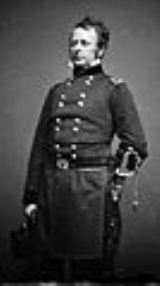
Joseph Hooker

Encyclopedia
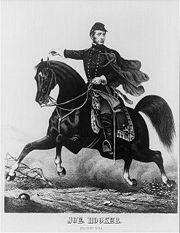
United States Army
The United States Army is the main branch of the United States Armed Forces responsible for land-based military operations. It is the largest and oldest established branch of the U.S. military, and is one of seven U.S. uniformed services...
officer, achieving the rank of major general
Major general (United States)
In the United States Army, United States Marine Corps, and United States Air Force, major general is a two-star general-officer rank, with the pay grade of O-8. Major general ranks above brigadier general and below lieutenant general...
in the Union Army
Union Army
The Union Army was the land force that fought for the Union during the American Civil War. It was also known as the Federal Army, the U.S. Army, the Northern Army and the National Army...
during the American Civil War
American Civil War
The American Civil War was a civil war fought in the United States of America. In response to the election of Abraham Lincoln as President of the United States, 11 southern slave states declared their secession from the United States and formed the Confederate States of America ; the other 25...
. Although he served throughout the war, usually with distinction, Hooker is best remembered for his stunning defeat by Confederate
Confederate States Army
The Confederate States Army was the army of the Confederate States of America while the Confederacy existed during the American Civil War. On February 8, 1861, delegates from the seven Deep South states which had already declared their secession from the United States of America adopted the...
General Robert E. Lee
Robert E. Lee
Robert Edward Lee was a career military officer who is best known for having commanded the Confederate Army of Northern Virginia in the American Civil War....
at the Battle of Chancellorsville
Battle of Chancellorsville
The Battle of Chancellorsville was a major battle of the American Civil War, and the principal engagement of the Chancellorsville Campaign. It was fought from April 30 to May 6, 1863, in Spotsylvania County, Virginia, near the village of Chancellorsville. Two related battles were fought nearby on...
in 1863.
After graduating from the United States Military Academy
United States Military Academy
The United States Military Academy at West Point is a four-year coeducational federal service academy located at West Point, New York. The academy sits on scenic high ground overlooking the Hudson River, north of New York City...
in 1837, Hooker served in the Seminole Wars
Seminole Wars
The Seminole Wars, also known as the Florida Wars, were three conflicts in Florida between the Seminole — the collective name given to the amalgamation of various groups of native Americans and Black people who settled in Florida in the early 18th century — and the United States Army...
and the Mexican-American War, receiving three brevet
Brevet (military)
In many of the world's military establishments, brevet referred to a warrant authorizing a commissioned officer to hold a higher rank temporarily, but usually without receiving the pay of that higher rank except when actually serving in that role. An officer so promoted may be referred to as being...
promotions. Resigning from the Army in 1853, he pursued farming, land development, and (unsuccessfully) politics in California. After the start of the Civil War he returned to the Army as a brigadier general
Brigadier general (United States)
A brigadier general in the United States Army, Air Force, and Marine Corps, is a one-star general officer, with the pay grade of O-7. Brigadier general ranks above a colonel and below major general. Brigadier general is equivalent to the rank of rear admiral in the other uniformed...
. He distinguished himself as an aggressive combat commander leading a division in the Battle of Williamsburg
Battle of Williamsburg
The Battle of Williamsburg, also known as the Battle of Fort Magruder, took place on May 5, 1862, in York County, James City County, and Williamsburg, Virginia, as part of the Peninsula Campaign of the American Civil War...
, May 5, 1862, resulting in his promotion to major general. As a corps commander, he led the initial Union attacks at the Battle of Antietam
Battle of Antietam
The Battle of Antietam , fought on September 17, 1862, near Sharpsburg, Maryland, and Antietam Creek, as part of the Maryland Campaign, was the first major battle in the American Civil War to take place on Northern soil. It was the bloodiest single-day battle in American history, with about 23,000...
, in which he was wounded. At the Battle of Fredericksburg
Battle of Fredericksburg
The Battle of Fredericksburg was fought December 11–15, 1862, in and around Fredericksburg, Virginia, between General Robert E. Lee's Confederate Army of Northern Virginia and the Union Army of the Potomac, commanded by Maj. Gen. Ambrose E. Burnside...
, he commanded a "Grand Division" of two corps, and was ordered to conduct numerous futile frontal assaults that caused his men to suffer serious losses. Throughout this period, he conspired against and openly criticized his army commanders. Following the defeat at Fredericksburg, he was given command of the Army of the Potomac
Army of the Potomac
The Army of the Potomac was the major Union Army in the Eastern Theater of the American Civil War.-History:The Army of the Potomac was created in 1861, but was then only the size of a corps . Its nucleus was called the Army of Northeastern Virginia, under Brig. Gen...
.
Hooker planned an audacious campaign against Robert E. Lee, but he was defeated by the Confederate Army at the Battle of Chancellorsville
Battle of Chancellorsville
The Battle of Chancellorsville was a major battle of the American Civil War, and the principal engagement of the Chancellorsville Campaign. It was fought from April 30 to May 6, 1863, in Spotsylvania County, Virginia, near the village of Chancellorsville. Two related battles were fought nearby on...
. Hooker suddenly lacked the nerve to marshal the strength of his larger army against Lee, who boldly divided his army and routed a Union corps with a flank attack by Stonewall Jackson
Stonewall Jackson
ຄຽשת״ׇׂׂׂׂ֣|birth_place= Clarksburg, Virginia |death_place=Guinea Station, Virginia|placeofburial=Stonewall Jackson Memorial CemeteryLexington, Virginia|placeofburial_label= Place of burial|image=...
. Hooker began to pursue Lee at the start of the Gettysburg Campaign
Gettysburg Campaign
The Gettysburg Campaign was a series of battles fought in June and July 1863, during the American Civil War. After his victory in the Battle of Chancellorsville, Confederate General Robert E. Lee's Army of Northern Virginia moved north for offensive operations in Maryland and Pennsylvania. The...
, but his poor performance at Chancellorsville prompted Abraham Lincoln to relieve him from command just prior to the Battle of Gettysburg
Battle of Gettysburg
The Battle of Gettysburg , was fought July 1–3, 1863, in and around the town of Gettysburg, Pennsylvania. The battle with the largest number of casualties in the American Civil War, it is often described as the war's turning point. Union Maj. Gen. George Gordon Meade's Army of the Potomac...
. He returned to combat in November, leading two corps from the Army of the Potomac to help relieve the besieged Union Army at Chattanooga, Tennessee
Chattanooga, Tennessee
Chattanooga is the fourth-largest city in the US state of Tennessee , with a population of 169,887. It is the seat of Hamilton County...
, and achieving an important victory at the Battle of Lookout Mountain
Battle of Lookout Mountain
The Battle of Lookout Mountain was fought November 24, 1863, as part of the Chattanooga Campaign of the American Civil War. Union forces under Maj. Gen. Joseph Hooker assaulted Lookout Mountain, Chattanooga, Tennessee, and defeated Confederate forces commanded by Maj. Gen. Carter L. Stevenson....
during the Chattanooga Campaign
Chattanooga Campaign
The Chattanooga Campaign was a series of maneuvers and battles in October and November 1863, during the American Civil War. Following the defeat of Maj. Gen. William S. Rosecrans's Union Army of the Cumberland at the Battle of Chickamauga in September, the Confederate Army of Tennessee under Gen...
. He continued in the Western Theater
Western Theater of the American Civil War
This article presents an overview of major military and naval operations in the Western Theater of the American Civil War.-Theater of operations:...
under Maj. Gen. William T. Sherman, but left before the end of the Atlanta Campaign
Atlanta Campaign
The Atlanta Campaign was a series of battles fought in the Western Theater of the American Civil War throughout northwest Georgia and the area around Atlanta during the summer of 1864. Union Maj. Gen. William T. Sherman invaded Georgia from the vicinity of Chattanooga, Tennessee, beginning in May...
when he was bypassed for a promotion to command the Army of the Tennessee
Army of the Tennessee
The Army of the Tennessee was a Union army in the Western Theater of the American Civil War, named for the Tennessee River. It should not be confused with the similarly named Army of Tennessee, a Confederate army named after the State of Tennessee....
.
Hooker became known as "Fighting Joe" following a journalist's clerical error reporting from the Battle of Williamsburg; however, the nickname stuck. His personal reputation was as a hard-drinking ladies' man, and his headquarters was known for parties and gambling, although the historical evidence discounts any heavy drinking by the general himself. His name is often associated with the slang term for prostitute, although the etymology
Etymology
Etymology is the study of the history of words, their origins, and how their form and meaning have changed over time.For languages with a long written history, etymologists make use of texts in these languages and texts about the languages to gather knowledge about how words were used during...
of that word has been documented to appear in print well before he became a public figure.
Early years
Hooker was born in Hadley, MassachusettsHadley, Massachusetts
Hadley is a town in Hampshire County, Massachusetts. The population was 4,793 at the 2000 census. It is part of the Springfield, Massachusetts Metropolitan Statistical Area. The area around Hampshire Mall and Mountain Farms Mall along Route 9 is a major shopping destination for the surrounding...
, the grandson of a captain in the American Revolutionary War
American Revolutionary War
The American Revolutionary War , the American War of Independence, or simply the Revolutionary War, began as a war between the Kingdom of Great Britain and thirteen British colonies in North America, and ended in a global war between several European great powers.The war was the result of the...
. His initial schooling was at the local Hopkins Academy
Hopkins Academy
Hopkins Academy is the public middle and senior high school for the town of Hadley, Massachusetts.- Founding :...
. He graduated from the United States Military Academy
United States Military Academy
The United States Military Academy at West Point is a four-year coeducational federal service academy located at West Point, New York. The academy sits on scenic high ground overlooking the Hudson River, north of New York City...
in 1837, ranked 29th out of a class of 50, and was commissioned a second lieutenant in the 1st U.S. Artillery. His initial assignment was in Florida
Florida
Florida is a state in the southeastern United States, located on the nation's Atlantic and Gulf coasts. It is bordered to the west by the Gulf of Mexico, to the north by Alabama and Georgia and to the east by the Atlantic Ocean. With a population of 18,801,310 as measured by the 2010 census, it...
fighting in the second of the Seminole Wars
Seminole Wars
The Seminole Wars, also known as the Florida Wars, were three conflicts in Florida between the Seminole — the collective name given to the amalgamation of various groups of native Americans and Black people who settled in Florida in the early 18th century — and the United States Army...
. He served in the Mexican-American War in staff positions in the campaigns of both Zachary Taylor
Zachary Taylor
Zachary Taylor was the 12th President of the United States and an American military leader. Initially uninterested in politics, Taylor nonetheless ran as a Whig in the 1848 presidential election, defeating Lewis Cass...
and Winfield Scott
Winfield Scott
Winfield Scott was a United States Army general, and unsuccessful presidential candidate of the Whig Party in 1852....
. He received brevet
Brevet (military)
In many of the world's military establishments, brevet referred to a warrant authorizing a commissioned officer to hold a higher rank temporarily, but usually without receiving the pay of that higher rank except when actually serving in that role. An officer so promoted may be referred to as being...
promotions for his staff leadership and gallantry in three battles: Monterrey
Battle of Monterrey
In the Battle of Monterrey during the Mexican-American War, General Pedro de Ampudia and the Mexican Army of the North was defeated by U.S...
(to captain), National Bridge
Puente Nacional
Puente Nacional is a municipality in the Mexican state of Veracruz. Puente Nacional is bordered by Actopan, the port of Veracruz, and La Antigua. It stands on the railway and on Federal Highways 140 and 125...
(major
Major (United States)
In the United States Army, Air Force, and Marine Corps, major is a field grade military officer rank just above the rank of captain and just below the rank of lieutenant colonel...
), and Chapultepec
Battle of Chapultepec
The Battle of Chapultepec, in September 1847, was a United States victory over Mexican forces holding Chapultepec Castle west of Mexico City during the Mexican-American War.-Background:On September 13, 1847, in the costly Battle of Molino del Rey, U.S...
(lieutenant colonel
Lieutenant Colonel (United States)
In the United States Army, United States Air Force, and United States Marine Corps, a lieutenant colonel is a field grade military officer rank just above the rank of major and just below the rank of colonel. It is equivalent to the naval rank of commander in the other uniformed services.The pay...
). His future Army reputation as a ladies' man began in Mexico, where local girls referred to him as the "Handsome Captain".
After the war, he served as assistant adjutant general
Adjutant general
An Adjutant General is a military chief administrative officer.-Imperial Russia:In Imperial Russia, the General-Adjutant was a Court officer, who was usually an army general. He served as a personal aide to the Tsar and hence was a member of the H. I. M. Retinue...
of the Pacific Division, but resigned his commission in 1853; his military reputation had been damaged when he testified against his former commander, General Scott, in the court-martial
Court-martial
A court-martial is a military court. A court-martial is empowered to determine the guilt of members of the armed forces subject to military law, and, if the defendant is found guilty, to decide upon punishment.Most militaries maintain a court-martial system to try cases in which a breach of...
for insubordination of Gideon Pillow
Gideon Johnson Pillow
Gideon Johnson Pillow was an American lawyer, politician, and Confederate general in the American Civil War. He is best remembered for his poor performance at the Battle of Fort Donelson.-Early life:...
. Hooker settled in Sonoma County, California
Sonoma County, California
Sonoma County, located on the northern coast of the U.S. state of California, is the largest and northernmost of the nine San Francisco Bay Area counties. Its population at the 2010 census was 483,878. Its largest city and county seat is Santa Rosa....
, as a farmer and land developer, but was more devoted to gambling and liquor than to agriculture. His house still exists in the city of Sonoma
Sonoma, California
Sonoma is a historically significant city in Sonoma Valley, Sonoma County, California, USA, surrounding its historic town plaza, a remnant of the town's Mexican colonial past. It was the capital of the short-lived California Republic...
. When living in Sonoma, he stood for election to represent the region in the California legislature but was defeated by James Bennett of Santa Rosa
Santa Rosa, California
Santa Rosa is the county seat of Sonoma County, California, United States. The 2010 census reported a population of 167,815. Santa Rosa is the largest city in California's Wine Country and fifth largest city in the San Francisco Bay Area, after San Jose, San Francisco, Oakland, and Fremont and 26th...
. He was obviously unhappy and unsuccessful in his civilian pursuits because, in 1858, he wrote to Secretary of War
United States Secretary of War
The Secretary of War was a member of the United States President's Cabinet, beginning with George Washington's administration. A similar position, called either "Secretary at War" or "Secretary of War," was appointed to serve the Congress of the Confederation under the Articles of Confederation...
John B. Floyd
John B. Floyd
John Buchanan Floyd was the 31st Governor of Virginia, U.S. Secretary of War, and the Confederate general in the American Civil War who lost the crucial Battle of Fort Donelson.-Early life:...
to request that his name "be presented to the president Buchanan
James Buchanan
James Buchanan, Jr. was the 15th President of the United States . He is the only president from Pennsylvania, the only president who remained a lifelong bachelor and the last to be born in the 18th century....
as a candidate for a lieutenant colonelcy", but nothing came of his request. From 1859 to 1861, he held a commission as a colonel
Colonel (United States)
In the United States Army, Air Force, and Marine Corps, colonel is a senior field grade military officer rank just above the rank of lieutenant colonel and just below the rank of brigadier general...
in the California
California
California is a state located on the West Coast of the United States. It is by far the most populous U.S. state, and the third-largest by land area...
militia
Militia
The term militia is commonly used today to refer to a military force composed of ordinary citizens to provide defense, emergency law enforcement, or paramilitary service, in times of emergency without being paid a regular salary or committed to a fixed term of service. It is a polyseme with...
.
Civil War
At the start of the war, Hooker requested a commission, but his first application was rejected, possibly because of the lingering resentment harbored by Winfield Scott, general-in-chief of the Army. He had to borrow money to make the trip east from California. After he witnessed the Union ArmyUnion Army
The Union Army was the land force that fought for the Union during the American Civil War. It was also known as the Federal Army, the U.S. Army, the Northern Army and the National Army...
defeat at the First Battle of Bull Run
First Battle of Bull Run
First Battle of Bull Run, also known as First Manassas , was fought on July 21, 1861, in Prince William County, Virginia, near the City of Manassas...
, he wrote a letter to President
President of the United States
The President of the United States of America is the head of state and head of government of the United States. The president leads the executive branch of the federal government and is the commander-in-chief of the United States Armed Forces....
Abraham Lincoln
Abraham Lincoln
Abraham Lincoln was the 16th President of the United States, serving from March 1861 until his assassination in April 1865. He successfully led his country through a great constitutional, military and moral crisis – the American Civil War – preserving the Union, while ending slavery, and...
that complained of military mismanagement, promoted his own qualifications, and again requested a commission. He was appointed, in August 1861, as brigadier general
Brigadier general (United States)
A brigadier general in the United States Army, Air Force, and Marine Corps, is a one-star general officer, with the pay grade of O-7. Brigadier general ranks above a colonel and below major general. Brigadier general is equivalent to the rank of rear admiral in the other uniformed...
of volunteers to rank from May 17. He commanded a brigade
Brigade
A brigade is a major tactical military formation that is typically composed of two to five battalions, plus supporting elements depending on the era and nationality of a given army and could be perceived as an enlarged/reinforced regiment...
and then division
Division (military)
A division is a large military unit or formation usually consisting of between 10,000 and 20,000 soldiers. In most armies, a division is composed of several regiments or brigades, and in turn several divisions typically make up a corps...
around Washington, D.C.
Washington, D.C.
Washington, D.C., formally the District of Columbia and commonly referred to as Washington, "the District", or simply D.C., is the capital of the United States. On July 16, 1790, the United States Congress approved the creation of a permanent national capital as permitted by the U.S. Constitution....
, as part of the effort to organize and train the new Army of the Potomac
Army of the Potomac
The Army of the Potomac was the major Union Army in the Eastern Theater of the American Civil War.-History:The Army of the Potomac was created in 1861, but was then only the size of a corps . Its nucleus was called the Army of Northeastern Virginia, under Brig. Gen...
, under Maj. Gen.
Major general (United States)
In the United States Army, United States Marine Corps, and United States Air Force, major general is a two-star general-officer rank, with the pay grade of O-8. Major general ranks above brigadier general and below lieutenant general...
George B. McClellan
George B. McClellan
George Brinton McClellan was a major general during the American Civil War. He organized the famous Army of the Potomac and served briefly as the general-in-chief of the Union Army. Early in the war, McClellan played an important role in raising a well-trained and organized army for the Union...
.
1862
In the Peninsula CampaignPeninsula Campaign
The Peninsula Campaign of the American Civil War was a major Union operation launched in southeastern Virginia from March through July 1862, the first large-scale offensive in the Eastern Theater. The operation, commanded by Maj. Gen. George B...
of 1862, Hooker commanded the 2nd Division of the III Corps and made a good name for himself as a combat leader who handled himself well and aggressively sought out the key points on battlefields. He distinguished himself at the Battle of Williamsburg
Battle of Williamsburg
The Battle of Williamsburg, also known as the Battle of Fort Magruder, took place on May 5, 1862, in York County, James City County, and Williamsburg, Virginia, as part of the Peninsula Campaign of the American Civil War...
(as a result of which he was promoted to major general as of May 5, 1862) and throughout the Seven Days Battles
Seven Days Battles
The Seven Days Battles was a series of six major battles over the seven days from June 25 to July 1, 1862, near Richmond, Virginia during the American Civil War. Confederate General Robert E. Lee drove the invading Union Army of the Potomac, commanded by Maj. Gen. George B. McClellan, away from...
. He chafed at the cautious generalship of McClellan and openly criticized his failure to capture Richmond
Richmond, Virginia
Richmond is the capital of the Commonwealth of Virginia, in the United States. It is an independent city and not part of any county. Richmond is the center of the Richmond Metropolitan Statistical Area and the Greater Richmond area...
. Of his commander, Hooker said, "He is not only not a soldier, but he does not know what soldiership is." The Peninsula cemented two further reputations of Hooker's: his devotion to the welfare and morale of his men, and his hard drinking social life, even on the battlefield.
As McClellan's army retreated into inactivity, Hooker was transferred to Maj. Gen. John Pope
John Pope (military officer)
John Pope was a career United States Army officer and Union general in the American Civil War. He had a brief but successful career in the Western Theater, but he is best known for his defeat at the Second Battle of Bull Run in the East.Pope was a graduate of the United States Military Academy in...
's Army of Virginia
Army of Virginia
The Army of Virginia was organized as a major unit of the Union Army and operated briefly and unsuccessfully in 1862 in the American Civil War. It should not be confused with its principal opponent, the Confederate Army of Northern Virginia, commanded by Robert E...
. His division first served in its III Corps under Maj. Gen. Samuel P. Heintzelman
Samuel P. Heintzelman
Samuel Peter Heintzelman was a United States Army General. He served in the Seminole War, the Mexican-American War, the Yuma War, the Cortina Troubles, and the American Civil War, rising to the command of a corps....
, but Hooker assumed corps command (III Corps of the Army of Virginia) on September 6, after the Northern Virginia Campaign
Northern Virginia Campaign
The Northern Virginia Campaign, also known as the Second Bull Run Campaign or Second Manassas Campaign, was a series of battles fought in Virginia during August and September 1862 in the Eastern Theater of the American Civil War. Confederate General Robert E...
and the Second Battle of Bull Run
Second Battle of Bull Run
The Second Battle of Bull Run or Second Manassas was fought August 28–30, 1862, as part of the American Civil War. It was the culmination of an offensive campaign waged by Confederate Gen. Robert E. Lee's Army of Northern Virginia against Union Maj. Gen...
, a severe Union defeat. As Robert E. Lee's Army of Northern Virginia
Army of Northern Virginia
The Army of Northern Virginia was the primary military force of the Confederate States of America in the Eastern Theater of the American Civil War, as well as the primary command structure of the Department of Northern Virginia. It was most often arrayed against the Union Army of the Potomac...
moved north into Maryland
Maryland
Maryland is a U.S. state located in the Mid Atlantic region of the United States, bordering Virginia, West Virginia, and the District of Columbia to its south and west; Pennsylvania to its north; and Delaware to its east...
, Hooker's corps (redesignated the I Corps on September 12) was returned to the Army of the Potomac, and he fought with distinction at South Mountain
Battle of South Mountain
The Battle of South Mountain was fought September 14, 1862, as part of the Maryland Campaign of the American Civil War. Three pitched battles were fought for possession of three South Mountain passes: Crampton's, Turner's, and Fox's Gaps. Maj. Gen. George B...
and Antietam
Battle of Antietam
The Battle of Antietam , fought on September 17, 1862, near Sharpsburg, Maryland, and Antietam Creek, as part of the Maryland Campaign, was the first major battle in the American Civil War to take place on Northern soil. It was the bloodiest single-day battle in American history, with about 23,000...
. At Antietam, his corps launched the first assault of the bloodiest day in American history, driving south into the corps of Lt. Gen. Stonewall Jackson
Stonewall Jackson
ຄຽשת״ׇׂׂׂׂ֣|birth_place= Clarksburg, Virginia |death_place=Guinea Station, Virginia|placeofburial=Stonewall Jackson Memorial CemeteryLexington, Virginia|placeofburial_label= Place of burial|image=...
, where they fought each other to a standstill. Hooker, aggressive and inspiring to his men, left the battle early in the morning with a foot wound. He asserted that the battle would have been a decisive Union victory if he had managed to stay on the field, but General McClellan's caution once again failed the Northern troops and Lee's much smaller army eluded destruction. With his patience at an end, President Lincoln replaced McClellan with Maj. Gen. Ambrose Burnside
Ambrose Burnside
Ambrose Everett Burnside was an American soldier, railroad executive, inventor, industrialist, and politician from Rhode Island, serving as governor and a U.S. Senator...
.
The December 1862 Battle of Fredericksburg
Battle of Fredericksburg
The Battle of Fredericksburg was fought December 11–15, 1862, in and around Fredericksburg, Virginia, between General Robert E. Lee's Confederate Army of Northern Virginia and the Union Army of the Potomac, commanded by Maj. Gen. Ambrose E. Burnside...
was another Union debacle. Upon recovering from his foot wound, Hooker was briefly made commander of V Corps, but was then promoted to "Grand Division" command, with a command that consisted of both III and V Corps. Hooker derided Burnside's plan to assault the fortified heights behind the city, deeming them "preposterous". His Grand Division (particularly V Corps) suffered serious losses in fourteen futile assaults ordered by Burnside over Hooker's protests. Burnside followed up this battle with the humiliating Mud March
Mud March (American Civil War)
The Mud March was an abortive attempt at a winter offensive in January 1863 by Union Army Maj. Gen. Ambrose Burnside in the American Civil War....
in January and Hooker's criticism of his commander bordered on formal insubordination. He described Burnside as a "wretch ... of blundering sacrifice." Burnside planned a wholesale purge of his subordinates, including Hooker, and drafted an order for the president's approval. He stated that Hooker was "unfit to hold an important commission during a crisis like the present." But Lincoln's patience had again run out and he removed Burnside instead.
Army of the Potomac

During the spring of 1863, Hooker established a reputation as an outstanding administrator and restored the morale of his soldiers, which had plummeted to a new low under Burnside. Among his changes were fixes to the daily diet of the troops, camp sanitary changes, improvements and accountability of the quartermaster system, addition of and monitoring of company cooks, several hospital reforms, and an improved furlough system (one man per company by turn, 10 days each). Other orders addressed the need to stem rising desertion (one from Lincoln combined with incoming mail review, the ability to shoot deserters, and better camp picket lines), more and better drills, stronger officer training, and for the first time, combining the federal cavalry into a single corps. Hooker said of his revived army:
Also during this winter Hooker made several high-level command changes, including with his corps commanders. Both "Left Grand Division" commander Maj. Gen. William B. Franklin
William B. Franklin
William Buel Franklin was a career United States Army officer and a Union Army general in the American Civil War. He rose to the rank of a corps commander in the Army of the Potomac, fighting in several notable early battles in the Eastern Theater.-Early life:William B. Franklin was born in York,...
, who vowed that he would not serve under Hooker, and II Corps commander Maj. Gen. Edwin Vose Sumner
Edwin Vose Sumner
Edwin Vose Sumner was a career United States Army officer who became a Union Army general and the oldest field commander of any Army Corps on either side during the American Civil War...
were relieved of command, on Burnside's recommendation, in the same order appointing Hooker to command. The IX Corps was a potential source of embarrassment or friction within the army because it was Burnside's old corps, so it was detached as a separate organization and sent to the Virginia Peninsula
Virginia Peninsula
The Virginia Peninsula is a peninsula in southeast Virginia, USA, bounded by the York River, James River, Hampton Roads and Chesapeake Bay.Hampton Roads is the common name for the metropolitan area that surrounds the body of water of the same name...
under the command of Brig. Gen. William F. "Baldy" Smith
William Farrar Smith
William Farrar Smith , was a civil engineer, a member of the New York City police commission, and Union general in the American Civil War.-Early life:...
, former commander of VI Corps. (Both Franklin and Smith were considered suspect by Hooker because of their previous political maneuvering against Burnside and on behalf of McClellan.)
For the important position of chief of staff, Hooker asked the War Department to send him Brig. Gen. Charles P. Stone, however this was denied. Stone had been relieved, arrested, and imprisoned for his role in the Battle of Ball's Bluff
Battle of Ball's Bluff
The Battle of Ball's Bluff, also known as the Battle of Harrison’s Island or the Battle of Leesburg, was fought on October 21, 1861, in Loudoun County, Virginia, as part of Union Maj. Gen. George B...
in the fall of 1861, despite the lack of any trial. Upon his release Stone would not receive a command, mostly due to political pressures, which left him militarily exiled and disgraced. Army of the Potomac historian and author Bruce Catton
Bruce Catton
Charles Bruce Catton was an American historian and journalist, best known for his books on the American Civil War. Known as a narrative historian, Catton specialized in popular histories that emphasized colorful characters and historical vignettes, in addition to the basic facts, dates, and analyses...
termed this request by Hooker "a strange and seemingly uncharacteristic thing" and "one of the most interesting things he ever did." Hooker never explained why he asked for Stone, but Catton believed:
Despite this, Fighting Joe would set a very bad example for the conduct of generals and their staffs and subordinates. His headquarters in Falmouth, Virginia
Falmouth, Virginia
Falmouth is an unincorporated community in Stafford County, Virginia, United States. Situated on the north bank of the Rappahannock River at the falls, the community is north of and opposite the city of Fredericksburg. Recognized by the U.S...
, was described by cavalry officer Charles F. Adams, Jr.
Charles Francis Adams, Jr.
Charles Francis Adams II was a member of the prominent Adams family, and son of Charles Francis Adams, Sr. He served as a colonel in the Union Army during the American Civil War...
, as being a combination of a "bar-room and a brothel
Brothel
Brothels are business establishments where patrons can engage in sexual activities with prostitutes. Brothels are known under a variety of names, including bordello, cathouse, knocking shop, whorehouse, strumpet house, sporting house, house of ill repute, house of prostitution, and bawdy house...
". He built a network of loyal political cronies that included Maj. Gen. Dan Butterfield
Daniel Butterfield
Daniel Adams Butterfield was a New York businessman, a Union General in the American Civil War, and Assistant U.S. Treasurer in New York. He is credited with composing the bugle call Taps and was involved in the Black Friday gold scandal in the Grant administration...
for chief of staff, and the notorious political general
Political general
A political general is a general officer or other military leader without significant military experience who is given a high position in command for political reasons, such as his own connections or to appease certain political blocs...
, Maj. Gen. Daniel E. Sickles, for command of the III Corps.
Chancellorsville
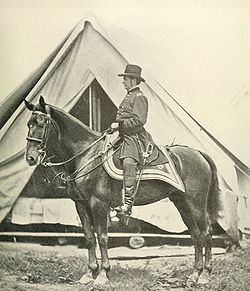
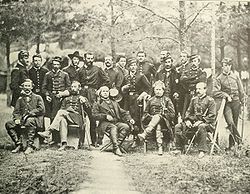
Brigadier general (United States)
A brigadier general in the United States Army, Air Force, and Marine Corps, is a one-star general officer, with the pay grade of O-7. Brigadier general ranks above a colonel and below major general. Brigadier general is equivalent to the rank of rear admiral in the other uniformed...
George Stoneman
George Stoneman
George Stoneman, Jr. was a career United States Army officer, a Union cavalry general in the American Civil War, and the 15th Governor of California between 1883 and 1887.-Early life:...
, and met none of its objectives. The flanking march went well enough, achieving strategic surprise, but Hooker somehow lost his nerve when the first reports of enemy contact reached him on May 1, 1863. Rather than pushing aggressively into Lee's rear, he pulled his army back around the tiny crossroads town of Chancellorsville and waited for Lee to attack. Lee audaciously split his smaller army in two to deal with both parts of Hooker's army. Then, he split again, sending Stonewall Jackson's corps on its own flanking march, striking Hooker's exposed right flank and routing the Union XI Corps. The Army of the Potomac dropped into a purely defensive mode and eventually was forced to retreat.
The Battle of Chancellorsville
Battle of Chancellorsville
The Battle of Chancellorsville was a major battle of the American Civil War, and the principal engagement of the Chancellorsville Campaign. It was fought from April 30 to May 6, 1863, in Spotsylvania County, Virginia, near the village of Chancellorsville. Two related battles were fought nearby on...
has been called "Lee's perfect battle" because of his ability to vanquish a much larger foe through audacious tactics. Part of Hooker's failure can be attributed to a deadly encounter with a cannonball. While standing on the porch of his headquarters, the missile struck a wooden column the general was leaning against, knocking him senseless and putting him out of action for the rest of the day. Despite his incapacitation, he refused entreaties to turn over temporary command of the army to his second-in-command, Maj. Gen. Darius N. Couch
Darius N. Couch
Darius Nash Couch was an American soldier, businessman, and naturalist. He served as a career U.S. Army officer during the Mexican-American War, the Second Seminole War, and as a general officer in the Union Army during the American Civil War.During the Civil War, Couch fought notably in the...
. Several of his subordinate generals, including Couch and Maj. Gen. Henry W. Slocum
Henry Warner Slocum
Henry Warner Slocum , was a Union general during the American Civil War and later served in the United States House of Representatives from New York. During the war, he was one of the youngest major generals in the Army and fought numerous major battles in the Eastern Theater and in Georgia and the...
, openly questioned Hooker's command decisions. Couch was so disgusted that he refused to ever serve under Hooker again. Political winds blew strongly in the following weeks as generals maneuvered to overthrow Hooker or to position themselves if Lincoln decided on his own to do so.
Robert E. Lee once again began an invasion of the North, in June 1863, and Lincoln urged Hooker to pursue and defeat him. Hooker's initial plan was to seize Richmond instead, but Lincoln immediately vetoed that idea, so the Army of the Potomac began to march north, attempting to locate Lee's Army of Northern Virginia as it slipped down the Shenandoah Valley
Shenandoah Valley
The Shenandoah Valley is both a geographic valley and cultural region of western Virginia and West Virginia in the United States. The valley is bounded to the east by the Blue Ridge Mountains, to the west by the eastern front of the Ridge-and-Valley Appalachians , to the north by the Potomac River...
into Pennsylvania
Pennsylvania
The Commonwealth of Pennsylvania is a U.S. state that is located in the Northeastern and Mid-Atlantic regions of the United States. The state borders Delaware and Maryland to the south, West Virginia to the southwest, Ohio to the west, New York and Ontario, Canada, to the north, and New Jersey to...
. Hooker's mission was first to protect Washington, D.C.
Washington, D.C.
Washington, D.C., formally the District of Columbia and commonly referred to as Washington, "the District", or simply D.C., is the capital of the United States. On July 16, 1790, the United States Congress approved the creation of a permanent national capital as permitted by the U.S. Constitution....
, and Baltimore and second to intercept and defeat Lee. Unfortunately, Lincoln was losing any remaining confidence he had in Hooker. When the general got into a dispute with Army headquarters over the status of defensive forces in Harpers Ferry
Harpers Ferry, West Virginia
Harpers Ferry is a historic town in Jefferson County, West Virginia, United States. In many books the town is called "Harper's Ferry" with an apostrophe....
, he impulsively offered his resignation in protest, which was quickly accepted by Lincoln and General-in-chief Henry W. Halleck
Henry Wager Halleck
Henry Wager Halleck was a United States Army officer, scholar, and lawyer. A noted expert in military studies, he was known by a nickname that became derogatory, "Old Brains." He was an important participant in the admission of California as a state and became a successful lawyer and land developer...
. On June 28, three days before the climactic Battle of Gettysburg
Battle of Gettysburg
The Battle of Gettysburg , was fought July 1–3, 1863, in and around the town of Gettysburg, Pennsylvania. The battle with the largest number of casualties in the American Civil War, it is often described as the war's turning point. Union Maj. Gen. George Gordon Meade's Army of the Potomac...
, Hooker was replaced by Maj. Gen. George Meade
George Meade
George Gordon Meade was a career United States Army officer and civil engineer involved in coastal construction, including several lighthouses. He fought with distinction in the Second Seminole War and Mexican-American War. During the American Civil War he served as a Union general, rising from...
. Hooker received the Thanks of Congress
Thanks of Congress
The Thanks of Congress are a series of formal resolutions passed by the United States Congress originally to extend the government's formal thanks for significant victories or impressive actions by American military commanders and their troops. Although it began during the American Revolutionary...
for his role at the start of the Gettysburg Campaign
Gettysburg Campaign
The Gettysburg Campaign was a series of battles fought in June and July 1863, during the American Civil War. After his victory in the Battle of Chancellorsville, Confederate General Robert E. Lee's Army of Northern Virginia moved north for offensive operations in Maryland and Pennsylvania. The...
, but the glory would go to Meade.
Western Theater
Hooker's military career was not ended by his poor performance in the summer of 1863. He went on to regain a reputation as a solid commander when he was transferred with the XI and XII Corps of the Army of the Potomac westward to reinforce the Army of the CumberlandArmy of the Cumberland
The Army of the Cumberland was one of the principal Union armies in the Western Theater during the American Civil War. It was originally known as the Army of the Ohio.-History:...
around Chattanooga, Tennessee
Chattanooga, Tennessee
Chattanooga is the fourth-largest city in the US state of Tennessee , with a population of 169,887. It is the seat of Hamilton County...
. Hooker was in command at the Battle of Lookout Mountain
Battle of Lookout Mountain
The Battle of Lookout Mountain was fought November 24, 1863, as part of the Chattanooga Campaign of the American Civil War. Union forces under Maj. Gen. Joseph Hooker assaulted Lookout Mountain, Chattanooga, Tennessee, and defeated Confederate forces commanded by Maj. Gen. Carter L. Stevenson....
, playing an important role in Lt. Gen.
Lieutenant General (United States)
In the United States Army, the United States Air Force and the United States Marine Corps, lieutenant general is a three-star general officer rank, with the pay grade of O-9. Lieutenant general ranks above major general and below general...
Ulysses S. Grant
Ulysses S. Grant
Ulysses S. Grant was the 18th President of the United States as well as military commander during the Civil War and post-war Reconstruction periods. Under Grant's command, the Union Army defeated the Confederate military and ended the Confederate States of America...
's decisive victory at the Battle of Chattanooga. He was brevetted to major general in the regular army
Regular army
A regular army consists of the permanent force of a country's army that is maintained under arms during peacetime.Countries that use the term include:*Australian Army*British Army*Canadian Forces, specifically "Regular Force"*Egyptian army*Indian Army...
for his success at Chattanooga, but he was disappointed to find that Grant's official report of the battle credited his friend William Tecumseh Sherman
William Tecumseh Sherman
William Tecumseh Sherman was an American soldier, businessman, educator and author. He served as a General in the Union Army during the American Civil War , for which he received recognition for his outstanding command of military strategy as well as criticism for the harshness of the "scorched...
's contribution over Hooker's.
Hooker led his corps (now designated the XX Corps) competently in the 1864 Atlanta Campaign
Atlanta Campaign
The Atlanta Campaign was a series of battles fought in the Western Theater of the American Civil War throughout northwest Georgia and the area around Atlanta during the summer of 1864. Union Maj. Gen. William T. Sherman invaded Georgia from the vicinity of Chattanooga, Tennessee, beginning in May...
under Sherman, but asked to be relieved before the capture of the city because of his dissatisfaction with the promotion of Maj. Gen. Oliver O. Howard
Oliver O. Howard
Oliver Otis Howard was a career United States Army officer and a Union general in the American Civil War...
to command of the Army of the Tennessee
Army of the Tennessee
The Army of the Tennessee was a Union army in the Western Theater of the American Civil War, named for the Tennessee River. It should not be confused with the similarly named Army of Tennessee, a Confederate army named after the State of Tennessee....
, upon the death of Maj. Gen. James B. McPherson
James B. McPherson
James Birdseye McPherson was a career United States Army officer who served as a General in the Union Army during the American Civil War...
. Not only did Hooker have seniority over Howard, but he also blamed Howard in large part for his defeat at Chancellorsville (Howard had commanded the XI Corps, which had borne the brunt of Jackson's flank attack). Hooker's biographer reports that there were numerous stories indicating that Abraham Lincoln attempted to intercede with Sherman, urging that Hooker be appointed to command the Army of the Tennessee, but Sherman threatened to resign if the president insisted. However, due to "obvious gaps" in the Official Records
Official Records of the American Civil War
The Official Records of the War of the Rebellion or often more simply the Official Records or ORs, constitute the most extensive collection of primary sources of the history of the American Civil War. Cornell University lists the official title as, "The War of the Rebellion: a Compilation of the...
, the story cannot be verified.
After leaving Georgia, Hooker commanded the Northern Department (comprising the states of Michigan
Michigan
Michigan is a U.S. state located in the Great Lakes Region of the United States of America. The name Michigan is the French form of the Ojibwa word mishigamaa, meaning "large water" or "large lake"....
, Ohio
Ohio
Ohio is a Midwestern state in the United States. The 34th largest state by area in the U.S.,it is the 7th‑most populous with over 11.5 million residents, containing several major American cities and seven metropolitan areas with populations of 500,000 or more.The state's capital is Columbus...
, Indiana
Indiana
Indiana is a US state, admitted to the United States as the 19th on December 11, 1816. It is located in the Midwestern United States and Great Lakes Region. With 6,483,802 residents, the state is ranked 15th in population and 16th in population density. Indiana is ranked 38th in land area and is...
, and Illinois
Illinois
Illinois is the fifth-most populous state of the United States of America, and is often noted for being a microcosm of the entire country. With Chicago in the northeast, small industrial cities and great agricultural productivity in central and northern Illinois, and natural resources like coal,...
), headquartered in Cincinnati, Ohio
Cincinnati, Ohio
Cincinnati is a city in the U.S. state of Ohio. Cincinnati is the county seat of Hamilton County. Settled in 1788, the city is located to north of the Ohio River at the Ohio-Kentucky border, near Indiana. The population within city limits is 296,943 according to the 2010 census, making it Ohio's...
, from October 1, 1864, until the end of the war. While in Cincinnati he married Olivia Groesbeck, sister of Congressman William S. Groesbeck
William S. Groesbeck
William Slocum Groesbeck was a U.S. Representative from Ohio.Born in Kinderhook, New York, Groesbeck moved with his parents to Cincinnati, Ohio, in 1816.He attended the common schools and Augusta College....
.
Final years and legacy
Springfield, Illinois
Springfield is the third and current capital of the US state of Illinois and the county seat of Sangamon County with a population of 117,400 , making it the sixth most populated city in the state and the second most populated Illinois city outside of the Chicago Metropolitan Area...
funeral procession on May 4, 1865. His postbellum life was marred by poor health and he was partially paralyzed by a stroke
Stroke
A stroke, previously known medically as a cerebrovascular accident , is the rapidly developing loss of brain function due to disturbance in the blood supply to the brain. This can be due to ischemia caused by blockage , or a hemorrhage...
. He was mustered out of the volunteer service on September 1, 1866, and retired from the U.S. Army on October 15, 1868, with the regular army rank of major general. He died on a visit to Garden City, New York
Garden City, New York
Garden City is a village in the town of Hempstead in central Nassau County, New York, in the United States. It was founded by multi-millionaire Alexander Turney Stewart in 1869, and is located on Long Island, to the east of New York City, from mid-town Manhattan, and just south of the town of...
, and is buried in Spring Grove Cemetery, Cincinnati, Ohio
Cincinnati, Ohio
Cincinnati is a city in the U.S. state of Ohio. Cincinnati is the county seat of Hamilton County. Settled in 1788, the city is located to north of the Ohio River at the Ohio-Kentucky border, near Indiana. The population within city limits is 296,943 according to the 2010 census, making it Ohio's...
, his wife's home town.
Hooker was popularly known as "Fighting Joe" Hooker, a nickname he regretted deeply; he said, "People will think I am a highwayman or a bandit." When a newspaper dispatch arrived in New York during the Peninsula Campaign, a typographical error changed an entry "Fighting — Joe Hooker Attacks Rebels" to remove the dash and the name stuck. Robert E. Lee occasionally referred to him as "Mr. F. J. Hooker" in a mildly sarcastic jab at his opponent.
Hooker's reputation as a hard-drinking ladies' man was established through rumors in the pre-Civil War Army and has been cited by a number of popular histories. Biographer Walter H. Hebert describe the general's personal habits as the "subject of much debate" although there was little debate in the popular opinion of the time. His men parodied Hooker in the popular war song Marching Along. The lines
were replaced by
Historian Stephen W. Sears
Stephen W. Sears
Stephen Ward Sears is an American historian specializing in the American Civil War.A graduate of Lakewood High School and Oberlin College, Sears attended a journalism seminar at...
, however, states that there is no basis to the claims that Hooker was either a heavy drinker, or that he was ever intoxicated on the battlefield.
There is a popular legend that "hooker" as a slang
Slang
Slang is the use of informal words and expressions that are not considered standard in the speaker's language or dialect but are considered more acceptable when used socially. Slang is often to be found in areas of the lexicon that refer to things considered taboo...
term for a prostitute
Prostitution
Prostitution is the act or practice of providing sexual services to another person in return for payment. The person who receives payment for sexual services is called a prostitute and the person who receives such services is known by a multitude of terms, including a "john". Prostitution is one of...
is derived from his last name because of parties and a lack of military discipline at his headquarters. Some versions of the legend claim that the band of prostitutes that followed his division were derisively referred to as "General Hooker's Army" or "Hooker's Brigade." However, the term "hooker" was used in print as early as 1845, years before Hooker was a public figure, and is likely derived from the concentration of prostitutes around the shipyards and ferry terminal of the Corlear's Hook area of Manhattan
Manhattan
Manhattan is the oldest and the most densely populated of the five boroughs of New York City. Located primarily on the island of Manhattan at the mouth of the Hudson River, the boundaries of the borough are identical to those of New York County, an original county of the state of New York...
in the early to middle 19th century, who came to be referred to as "hookers". The prevalence of the Hooker legend may have been at least partly responsible for the popularity of the term.
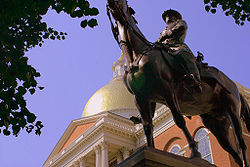
There is an equestrian statue of General Hooker outside the Massachusetts State House
Massachusetts State House
The Massachusetts State House, also known as the Massachusetts Statehouse or the "New" State House, is the state capitol and house of government of the Commonwealth of Massachusetts. It is located in Boston in the neighborhood Beacon Hill...
in Boston, and Hooker County
Hooker County, Nebraska
-History:Hooker County was formed in 1889. It was named after General Joseph Hooker.-Demographics:As of the census of 2000, there were 783 people, 335 households, and 220 families residing in the county. The population density was 1 person per square mile . There were 440 housing units at an...
in Nebraska
Nebraska
Nebraska is a state on the Great Plains of the Midwestern United States. The state's capital is Lincoln and its largest city is Omaha, on the Missouri River....
is named for him.
See also
- List of American Civil War generals
- List of Massachusetts generals in the American Civil War
- Massachusetts in the American Civil War
External links
- "Fighting Joe" Hooker Biography and timeline
- Joseph Hooker in Encyclopedia Virginia
- Hooker biography on Civil War Home
- Joseph Hooker Source Page and Photo Gallery
- Hooker article from the California State Military Museum
- General Joseph Hooker House in Sonoma, CaliforniaSonoma, CaliforniaSonoma is a historically significant city in Sonoma Valley, Sonoma County, California, USA, surrounding its historic town plaza, a remnant of the town's Mexican colonial past. It was the capital of the short-lived California Republic...