


Maryland Campaign

Encyclopedia
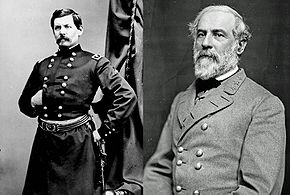
Turning point of the American Civil War
There is widespread disagreement over the turning point of the American Civil War. The idea of a turning point is an event after which most observers would agree that the eventual outcome was inevitable. While the Battle of Gettysburg is the most widely cited , there are several other arguable...
of the American Civil War
American Civil War
The American Civil War was a civil war fought in the United States of America. In response to the election of Abraham Lincoln as President of the United States, 11 southern slave states declared their secession from the United States and formed the Confederate States of America ; the other 25...
. Confederate
Confederate States Army
The Confederate States Army was the army of the Confederate States of America while the Confederacy existed during the American Civil War. On February 8, 1861, delegates from the seven Deep South states which had already declared their secession from the United States of America adopted the...
Gen. Robert E. Lee
Robert E. Lee
Robert Edward Lee was a career military officer who is best known for having commanded the Confederate Army of Northern Virginia in the American Civil War....
's first invasion of the North
Northern United States
Northern United States, also sometimes the North, may refer to:* A particular grouping of states or regions of the United States of America. The United States Census Bureau divides some of the northernmost United States into the Midwest Region and the Northeast Region...
was repulsed by Maj. Gen.
Major general (United States)
In the United States Army, United States Marine Corps, and United States Air Force, major general is a two-star general-officer rank, with the pay grade of O-8. Major general ranks above brigadier general and below lieutenant general...
George B. McClellan
George B. McClellan
George Brinton McClellan was a major general during the American Civil War. He organized the famous Army of the Potomac and served briefly as the general-in-chief of the Union Army. Early in the war, McClellan played an important role in raising a well-trained and organized army for the Union...
and the Army of the Potomac
Army of the Potomac
The Army of the Potomac was the major Union Army in the Eastern Theater of the American Civil War.-History:The Army of the Potomac was created in 1861, but was then only the size of a corps . Its nucleus was called the Army of Northeastern Virginia, under Brig. Gen...
, who moved to intercept Lee and his Army of Northern Virginia
Army of Northern Virginia
The Army of Northern Virginia was the primary military force of the Confederate States of America in the Eastern Theater of the American Civil War, as well as the primary command structure of the Department of Northern Virginia. It was most often arrayed against the Union Army of the Potomac...
and eventually attacked it near Sharpsburg, Maryland
Sharpsburg, Maryland
Sharpsburg is a town in Washington County, Maryland, United States, approximately south of Hagerstown. The population was 691 at the 2000 census....
. The resulting Battle of Antietam
Battle of Antietam
The Battle of Antietam , fought on September 17, 1862, near Sharpsburg, Maryland, and Antietam Creek, as part of the Maryland Campaign, was the first major battle in the American Civil War to take place on Northern soil. It was the bloodiest single-day battle in American history, with about 23,000...
was the bloodiest single-day battle in American history.
Following his victory in the Northern Virginia Campaign
Northern Virginia Campaign
The Northern Virginia Campaign, also known as the Second Bull Run Campaign or Second Manassas Campaign, was a series of battles fought in Virginia during August and September 1862 in the Eastern Theater of the American Civil War. Confederate General Robert E...
, Lee moved north with 55,000 men through the Shenandoah Valley
Shenandoah Valley
The Shenandoah Valley is both a geographic valley and cultural region of western Virginia and West Virginia in the United States. The valley is bounded to the east by the Blue Ridge Mountains, to the west by the eastern front of the Ridge-and-Valley Appalachians , to the north by the Potomac River...
starting on September 4, 1862. His objective was to resupply his army outside of the war-torn Virginia theater and to damage Northern morale in anticipation of the November elections. He undertook the risky maneuver of splitting his army so that he could continue north into Maryland while simultaneously capturing the Federal garrison and arsenal at Harpers Ferry
Harpers Ferry, West Virginia
Harpers Ferry is a historic town in Jefferson County, West Virginia, United States. In many books the town is called "Harper's Ferry" with an apostrophe....
. McClellan accidentally found a copy of Lee's orders to his subordinate commanders and planned to isolate and defeat the separated portions of Lee's army.
While Stonewall Jackson
Stonewall Jackson
ຄຽשת״ׇׂׂׂׂ֣|birth_place= Clarksburg, Virginia |death_place=Guinea Station, Virginia|placeofburial=Stonewall Jackson Memorial CemeteryLexington, Virginia|placeofburial_label= Place of burial|image=...
surrounded, bombarded, and captured Harpers Ferry
Battle of Harpers Ferry
The Battle of Harpers Ferry was fought September 12–15, 1862, as part of the Maryland Campaign of the American Civil War. As Gen. Robert E. Lee's Confederate army invaded Maryland, a portion of his army under Maj. Gen. Thomas J...
(September 12–15), McClellan's army of 84,000 men attempted to move quickly through the South Mountain
South Mountain (Maryland and Pennsylvania)
South Mountain is the northern extension of the Blue Ridge Mountain range in Maryland and Pennsylvania. From the Potomac River near Knoxville, Maryland in the south, to Dillsburg, Pennsylvania in the north, the long range separates the Hagerstown and Cumberland valleys from the Piedmont regions of...
passes that separated him from Lee. The Battle of South Mountain
Battle of South Mountain
The Battle of South Mountain was fought September 14, 1862, as part of the Maryland Campaign of the American Civil War. Three pitched battles were fought for possession of three South Mountain passes: Crampton's, Turner's, and Fox's Gaps. Maj. Gen. George B...
on September 14 delayed McClellan's advance and allowed Lee sufficient time to concentrate most of his army at Sharpsburg, Maryland
Sharpsburg, Maryland
Sharpsburg is a town in Washington County, Maryland, United States, approximately south of Hagerstown. The population was 691 at the 2000 census....
. The Battle of Antietam
Battle of Antietam
The Battle of Antietam , fought on September 17, 1862, near Sharpsburg, Maryland, and Antietam Creek, as part of the Maryland Campaign, was the first major battle in the American Civil War to take place on Northern soil. It was the bloodiest single-day battle in American history, with about 23,000...
(or Sharpsburg) on September 17 was the bloodiest day in American military history with over 22,000 casualties. While Lee, outnumbered two to one, moved his defensive forces to parry each offensive blow, McClellan never deployed all of the reserves of his army to capitalize on localized successes and destroy the Confederates. On September 18, Lee ordered a withdrawal across the Potomac and on September 19 and September 20, fights with Lee's rear guard at Shepherdstown
Battle of Shepherdstown
The Battle of Shepherdstown, also known as the Battle of Boteler's Ford, took place September 19–20, 1862, in Jefferson County, Virginia , at the end of the Maryland Campaign of the American Civil War.-Background:...
ended the campaign.
Although Antietam was a tactical draw, Lee's Maryland Campaign failed to achieve its objectives. President
President of the United States
The President of the United States of America is the head of state and head of government of the United States. The president leads the executive branch of the federal government and is the commander-in-chief of the United States Armed Forces....
Abraham Lincoln
Abraham Lincoln
Abraham Lincoln was the 16th President of the United States, serving from March 1861 until his assassination in April 1865. He successfully led his country through a great constitutional, military and moral crisis – the American Civil War – preserving the Union, while ending slavery, and...
used this Union victory as the justification for announcing his Emancipation Proclamation
Emancipation Proclamation
The Emancipation Proclamation is an executive order issued by United States President Abraham Lincoln on January 1, 1863, during the American Civil War using his war powers. It proclaimed the freedom of 3.1 million of the nation's 4 million slaves, and immediately freed 50,000 of them, with nearly...
, which effectively ended any threat of European support for the Confederacy
Confederate States of America
The Confederate States of America was a government set up from 1861 to 1865 by 11 Southern slave states of the United States of America that had declared their secession from the U.S...
.
Background
The year 1862 started out well for UnionUnion (American Civil War)
During the American Civil War, the Union was a name used to refer to the federal government of the United States, which was supported by the twenty free states and five border slave states. It was opposed by 11 southern slave states that had declared a secession to join together to form the...
forces in the Eastern Theater
Eastern Theater of the American Civil War
The Eastern Theater of the American Civil War included the states of Virginia, West Virginia, Maryland, and Pennsylvania, the District of Columbia, and the coastal fortifications and seaports of North Carolina...
. George B. McClellan's Army of the Potomac had invaded the Virginia Peninsula
Virginia Peninsula
The Virginia Peninsula is a peninsula in southeast Virginia, USA, bounded by the York River, James River, Hampton Roads and Chesapeake Bay.Hampton Roads is the common name for the metropolitan area that surrounds the body of water of the same name...
during the Peninsula Campaign
Peninsula Campaign
The Peninsula Campaign of the American Civil War was a major Union operation launched in southeastern Virginia from March through July 1862, the first large-scale offensive in the Eastern Theater. The operation, commanded by Maj. Gen. George B...
and by June stood only a few miles outside the Confederate capital at Richmond
Richmond, Virginia
Richmond is the capital of the Commonwealth of Virginia, in the United States. It is an independent city and not part of any county. Richmond is the center of the Richmond Metropolitan Statistical Area and the Greater Richmond area...
. But, when Robert E. Lee assumed command of the Army of Northern Virginia on June 1, 1862, fortunes reversed. Lee fought McClellan aggressively in the Seven Days Battles
Seven Days Battles
The Seven Days Battles was a series of six major battles over the seven days from June 25 to July 1, 1862, near Richmond, Virginia during the American Civil War. Confederate General Robert E. Lee drove the invading Union Army of the Potomac, commanded by Maj. Gen. George B. McClellan, away from...
; McClellan lost his nerve, and his army retreated down the Peninsula. Lee then conducted the Northern Virginia Campaign
Northern Virginia Campaign
The Northern Virginia Campaign, also known as the Second Bull Run Campaign or Second Manassas Campaign, was a series of battles fought in Virginia during August and September 1862 in the Eastern Theater of the American Civil War. Confederate General Robert E...
in which he outmaneuvered and defeated Maj. Gen. John Pope
John Pope (military officer)
John Pope was a career United States Army officer and Union general in the American Civil War. He had a brief but successful career in the Western Theater, but he is best known for his defeat at the Second Battle of Bull Run in the East.Pope was a graduate of the United States Military Academy in...
and his Army of Virginia
Army of Virginia
The Army of Virginia was organized as a major unit of the Union Army and operated briefly and unsuccessfully in 1862 in the American Civil War. It should not be confused with its principal opponent, the Confederate Army of Northern Virginia, commanded by Robert E...
, most significantly at the Second Battle of Bull Run
Second Battle of Bull Run
The Second Battle of Bull Run or Second Manassas was fought August 28–30, 1862, as part of the American Civil War. It was the culmination of an offensive campaign waged by Confederate Gen. Robert E. Lee's Army of Northern Virginia against Union Maj. Gen...
(Second Manassas). Lee's Maryland Campaign can be considered the concluding part of a logically connected, three-campaign, summer offensive against Federal forces in the Eastern Theater.
The Confederates had suffered significant manpower losses in the wake of the summer campaigns. Nevertheless, Lee decided his army was ready for a great challenge: an invasion of the North. His goal was to reach the major Northern states of Maryland and Pennsylvania
Pennsylvania
The Commonwealth of Pennsylvania is a U.S. state that is located in the Northeastern and Mid-Atlantic regions of the United States. The state borders Delaware and Maryland to the south, West Virginia to the southwest, Ohio to the west, New York and Ontario, Canada, to the north, and New Jersey to...
, and cut off the Baltimore & Ohio Railroad line that supplied Washington, D.C.
Washington, D.C.
Washington, D.C., formally the District of Columbia and commonly referred to as Washington, "the District", or simply D.C., is the capital of the United States. On July 16, 1790, the United States Congress approved the creation of a permanent national capital as permitted by the U.S. Constitution....
His movements would threaten Washington and Baltimore, so as to "annoy and harass the enemy."
Several motives led to Lee's decision to launch an invasion. First, he needed to supply his army and knew the farms of the North had been untouched by war, unlike those in Virginia. Moving the war northward would relieve pressure on Virginia. Second was the issue of Northern morale. Lee knew the Confederacy did not have to win the war by defeating the North militarily; it merely needed to make the Northern populace and government unwilling to continue the fight. With the Congressional elections of 1862 approaching in November, Lee believed that an invading army playing havoc inside the North could tip the balance of Congress to the Democratic Party, which might force Abraham Lincoln
Abraham Lincoln
Abraham Lincoln was the 16th President of the United States, serving from March 1861 until his assassination in April 1865. He successfully led his country through a great constitutional, military and moral crisis – the American Civil War – preserving the Union, while ending slavery, and...
to negotiate an end to the war. He told Confederate President Jefferson Davis
Jefferson Davis
Jefferson Finis Davis , also known as Jeff Davis, was an American statesman and leader of the Confederacy during the American Civil War, serving as President for its entire history. He was born in Kentucky to Samuel and Jane Davis...
in a letter of September 3 that the enemy was "much weakened and demoralized."
There were secondary reasons as well. The Confederate invasion might be able to incite an uprising in Maryland, especially given that it was a slave-holding state and many of its citizens held a sympathetic stance toward the South. Some Confederate politicians, including Jefferson Davis, believed the prospect of foreign recognition for the Confederacy would be made stronger by a military victory on Northern soil, but there is no evidence that Lee thought the South should base its military plans on this possibility. Nevertheless, the news of the victory at Second Bull Run and the start of Lee's invasion caused considerable diplomatic activity between the Confederate States and France
France
The French Republic , The French Republic , The French Republic , (commonly known as France , is a unitary semi-presidential republic in Western Europe with several overseas territories and islands located on other continents and in the Indian, Pacific, and Atlantic oceans. Metropolitan France...
and England
England
England is a country that is part of the United Kingdom. It shares land borders with Scotland to the north and Wales to the west; the Irish Sea is to the north west, the Celtic Sea to the south west, with the North Sea to the east and the English Channel to the south separating it from continental...
.
After the defeat of Pope at Second Bull Run, President Lincoln reluctantly returned to the man who had mended a broken army before—George B. McClellan after the Union defeat at the First Battle of Bull Run
First Battle of Bull Run
First Battle of Bull Run, also known as First Manassas , was fought on July 21, 1861, in Prince William County, Virginia, near the City of Manassas...
(First Manassas). He knew that McClellan was a strong organizer and a skilled trainer of troops, able to recombine the units of Pope's army with the Army of the Potomac faster than anyone. On September 2, 1862, Lincoln named McClellan to command "the fortifications of Washington, and all the troops for the defense of the capital." The appointment was controversial in the Cabinet, a majority of whom signed a petition declaring to the president "our deliberate opinion that, at this time, it is not safe to entrust to Major General McClellan the command of any Army of the United States." The president admitted that it was like "curing the bite with the hair of the dog." But Lincoln told his secretary, John Hay, "We must use what tools we have. There is no man in the Army who can man these fortifications and lick these troops of ours into shape half as well as he. If he can't fight himself, he excels in making others ready to fight."
Confederate
| Confederate corps commanders |
|---|
General Robert E. Lee's Army of Northern Virginia was organized into two large infantry corps, about 55,000 effectives at the beginning of September.
The First Corps, under Maj. Gen. James Longstreet
James Longstreet
James Longstreet was one of the foremost Confederate generals of the American Civil War and the principal subordinate to General Robert E. Lee, who called him his "Old War Horse." He served under Lee as a corps commander for many of the famous battles fought by the Army of Northern Virginia in the...
, consisted of the divisions
Division (military)
A division is a large military unit or formation usually consisting of between 10,000 and 20,000 soldiers. In most armies, a division is composed of several regiments or brigades, and in turn several divisions typically make up a corps...
of Maj. Gen. Lafayette McLaws
Lafayette McLaws
Lafayette McLaws was a United States Army officer and a Confederate general in the American Civil War.-Early life:...
, Maj. Gen. Richard H. Anderson
Richard H. Anderson
Richard Heron Anderson was a career U.S. Army officer, fighting with distinction in the Mexican-American War. He also served as a Confederate general during the American Civil War, fighting in the Eastern Theater of the conflict and most notably during the 1864 Battle of Spotsylvania Court House...
, Brig. Gen. David R. Jones, Brig. Gen. John G. Walker, Brig. Gen. John Bell Hood
John Bell Hood
John Bell Hood was a Confederate general during the American Civil War. Hood had a reputation for bravery and aggressiveness that sometimes bordered on recklessness...
, and an independent brigade under Brig. Gen. Nathan G. "Shanks" Evans
Nathan George Evans
Nathan George "Shanks" Evans was a captain in the 2nd U.S. Cavalry who became a brigadier general in the Confederate States Army during the American Civil War.-Biography:...
.
The Second Corps, under Maj. Gen. Thomas J. "Stonewall" Jackson
Stonewall Jackson
ຄຽשת״ׇׂׂׂׂ֣|birth_place= Clarksburg, Virginia |death_place=Guinea Station, Virginia|placeofburial=Stonewall Jackson Memorial CemeteryLexington, Virginia|placeofburial_label= Place of burial|image=...
, consisted of the divisions of Brig. Gen. Alexander R. Lawton, Maj. Gen. A.P. Hill (the Light Division), Brig. Gen. John R. Jones
John R. Jones
John Robert Jones was a Virginia businessman and soldier who was a controversial brigadier general in the Confederate States Army during the American Civil War.Jones was a native Virginian and a graduate of the Virginia Military Institute...
, and Maj. Gen. D.H. Hill.
The remaining units were the Cavalry Corps, under Maj. Gen. J.E.B. Stuart
J.E.B. Stuart
James Ewell Brown "Jeb" Stuart was a U.S. Army officer from Virginia and a Confederate States Army general during the American Civil War. He was known to his friends as "Jeb", from the initials of his given names. Stuart was a cavalry commander known for his mastery of reconnaissance and the use...
, and the reserve artillery, commanded by Brig. Gen. William N. Pendleton
William N. Pendleton
William Nelson Pendleton was an American teacher, Episcopal priest, and soldier. He served as a Confederate general during the American Civil War, noted for his position as Gen. Robert E. Lee's chief of artillery for most of the conflict...
. The Second Corps was organized with artillery attached to each division, in contrast to the First Corps, which reserved its artillery at the corps level.
Union
| Union corps commanders |
|---|
Maj. Gen. George B. McClellan's Army of the Potomac, bolstered by units absorbed from John Pope
John Pope (military officer)
John Pope was a career United States Army officer and Union general in the American Civil War. He had a brief but successful career in the Western Theater, but he is best known for his defeat at the Second Battle of Bull Run in the East.Pope was a graduate of the United States Military Academy in...
's Army of Virginia
Army of Virginia
The Army of Virginia was organized as a major unit of the Union Army and operated briefly and unsuccessfully in 1862 in the American Civil War. It should not be confused with its principal opponent, the Confederate Army of Northern Virginia, commanded by Robert E...
, included six infantry corps, about 84,000 men.
- The I Corps, under Maj. Gen. Joseph HookerJoseph HookerJoseph Hooker was a career United States Army officer, achieving the rank of major general in the Union Army during the American Civil War. Although he served throughout the war, usually with distinction, Hooker is best remembered for his stunning defeat by Confederate General Robert E...
, consisted of the divisions of Brig. Gens. Rufus KingRufus King (Civil War General)Rufus King was a newspaper editor, educator, U.S. diplomat, and a Union brigadier general in the American Civil War.-Early life:...
, James B. RickettsJames B. RickettsJames Brewerton Ricketts was a career officer in the United States Army, serving as a Union Army general in the Eastern Theater during the American Civil War.-Early life and career:...
, and George G. Meade.
- The II Corps, under Maj. Gen. Edwin V. Sumner, consisted of the divisions of Maj. Gens. Israel B. RichardsonIsrael B. RichardsonIsrael Bush Richardson was a United States Army officer during the Mexican-American War and American Civil War, where he was a major general in the Union Army...
and John SedgwickJohn SedgwickJohn Sedgwick was a teacher, a career military officer, and a Union Army general in the American Civil War. He was the highest ranking Union casualty in the Civil War, killed by a sniper at the Battle of Spotsylvania Court House.-Early life:Sedgwick was born in the Litchfield Hills town of...
, and Brig. Gen. William H. FrenchWilliam H. FrenchWilliam Henry French was a career United States Army officer and a Union Army General in the American Civil War. He rose to temporarily command a corps within the Army of the Potomac, but was relieved of active field duty following poor performance during the Mine Run Campaign in late 1863.-Early...
.
- The V Corps, under Maj. Gen. Fitz John PorterFitz John PorterFitz John Porter was a career United States Army officer and a Union General during the American Civil War...
, consisted of the divisions of Maj. Gen. George W. MorellGeorge W. MorellGeorge Webb Morell was a civil engineer, lawyer, farmer, and a Union general in the American Civil War.-Early life:...
, Brig. Gen. George SykesGeorge SykesGeorge Sykes was a career United States Army officer and a Union General during the American Civil War.-Early life:...
, and Brig. Gen. Andrew A. HumphreysAndrew A. HumphreysAndrew Atkinson Humphreys , was a career United States Army officer, civil engineer, and a Union General in the American Civil War. He served in senior positions in the Army of the Potomac, including division command, chief of staff, and corps command, and was Chief Engineer of the U.S...
.
- The VI Corps, under Maj. Gen. William B. FranklinWilliam B. FranklinWilliam Buel Franklin was a career United States Army officer and a Union Army general in the American Civil War. He rose to the rank of a corps commander in the Army of the Potomac, fighting in several notable early battles in the Eastern Theater.-Early life:William B. Franklin was born in York,...
, consisted of the divisions of Maj. Gens. Henry W. Slocum and William F. "Baldy" SmithWilliam Farrar SmithWilliam Farrar Smith , was a civil engineer, a member of the New York City police commission, and Union general in the American Civil War.-Early life:...
, and a division from the IV Corps under Maj. Gen. Darius N. CouchDarius N. CouchDarius Nash Couch was an American soldier, businessman, and naturalist. He served as a career U.S. Army officer during the Mexican-American War, the Second Seminole War, and as a general officer in the Union Army during the American Civil War.During the Civil War, Couch fought notably in the...
.
- The IX Corps, under Maj. Gen. Ambrose E. Burnside, consisted of the divisions of Brig. Gens. Orlando B. WillcoxOrlando B. WillcoxOrlando Bolivar Willcox was an American soldier who served as a general in the Union Army during the American Civil War.-Early life:...
, Samuel D. SturgisSamuel D. SturgisSamuel Davis Sturgis was an American military officer who served in the Mexican-American War, as a Union general in the American Civil War, and later in the Indian Wars.-Early life:...
, and Isaac P. RodmanIsaac P. RodmanIsaac Peace Rodman was a Rhode Island banker and politician, and a Union Army brigadier general in the American Civil War, mortally wounded at the Battle of Antietam.-Early life and career:...
, and the Kanawha DivisionKanawha DivisionThe Kanawha Division was a Union Army division which could trace its origins back to a brigade originally commanded by Jacob D. Cox. This division served in western Virginia and Maryland and was at times led by such famous personalities as George Crook and Rutherford B. Hayes.-Kanawha Brigade:On...
, under Brig. Gen. Jacob D. CoxJacob Dolson CoxJacob Dolson Cox, was a lawyer, a Union Army general during the American Civil War, and later a Republican politician from Ohio. He served as the 28th Governor of Ohio and as United States Secretary of the Interior....
.
- The XII Corps, under Maj. Gen. Joseph K. MansfieldJoseph K. MansfieldJoseph King Fenno Mansfield was a career United States Army officer, civil engineer, and a Union general in the American Civil War, mortally wounded at the Battle of Antietam.-Early life:...
, consisted of the divisions of Brig. Gens. Alpheus S. WilliamsAlpheus S. WilliamsAlpheus Starkey Williams was a lawyer, judge, journalist, U.S. Congressman, and a Union general in the American Civil War.-Early life:...
and George S. GreeneGeorge S. GreeneGeorge Sears Greene was a civil engineer and a Union general during the American Civil War. He was part of the Greene family of Rhode Island, which had a distinguished military record for the United States. His greatest contribution during the war was his defense of the Union right flank at Culp's...
, and the cavalry division of Brig. Gen. Alfred PleasontonAlfred PleasontonAlfred Pleasonton was a United States Army officer and General of Union cavalry during the American Civil War. He commanded the Cavalry Corps of the Army of the Potomac during the Gettysburg Campaign, including the largest predominantly cavalry battle of the war, Brandy Station...
.
During the march north into Maryland, McClellan changed his army's command structure, appointing commanders for three "wings": the left, commanded by William B. Franklin, consisted of his own VI Corps plus the division of Darius Couch; the center, under Edwin Sumner, consisted of his II Corps and the XII Corps; the right, under Ambrose Burnside, consisted of his IX Corps (temporarily commanded by Maj. Gen. Jesse L. Reno
Jesse L. Reno
Jesse Lee Reno was a career United States Army officer who served in the Mexican-American War, the western frontier, and as a Union General during the American Civil War...
) and the I Corps. This wing organization was revoked just before the start of the Battle of Antietam.
Initial movements
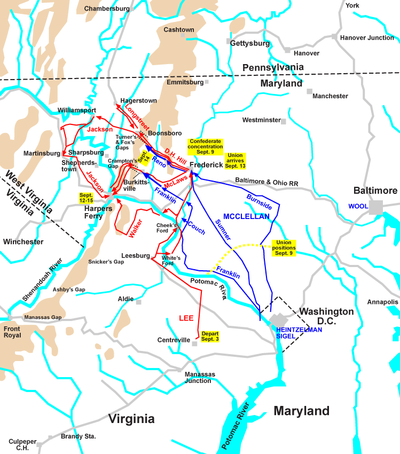
Battle of Chantilly
The Battle of Chantilly took place on September 1, 1862, in Fairfax County, Virginia, as the concluding battle of the Northern Virginia Campaign of the American Civil War. Thomas J...
, Lee wrote to President Davis that he had decided to cross into Maryland unless the president objected. On the same day, Lee began shifting his army north and west from Chantilly towards Leesburg, Virginia
Leesburg, Virginia
Leesburg is a historic town in, and county seat of, Loudoun County, Virginia, United States of America. Leesburg is located west-northwest of Washington, D.C. along the base of the Catoctin Mountain and adjacent to the Potomac River. Its population according the 2010 Census is 42,616...
. On September 4, advance elements of the Army of Northern Virginia crossed into Maryland from Loudoun County
Loudoun County, Virginia
Loudoun County is a county located in the Commonwealth of Virginia, and is part of the Washington Metropolitan Area. As of the 2010 U.S. Census, the county is estimated to be home to 312,311 people, an 84 percent increase over the 2000 figure of 169,599. That increase makes the county the fourth...
. The main body of the army advanced into Frederick, Maryland
Frederick, Maryland
Frederick is a city in north-central Maryland. It is the county seat of Frederick County, the largest county by area in the state of Maryland. Frederick is an outlying community of the Washington-Arlington-Alexandria, DC-VA-MD-WV Metropolitan Statistical Area, which is part of a greater...
, on September 7. The 55,000-man army had been reinforced by troops who had been defending Richmond—the divisions of Maj. Gens. D.H. Hill and Lafayette McLaws
Lafayette McLaws
Lafayette McLaws was a United States Army officer and a Confederate general in the American Civil War.-Early life:...
and two brigades under Brig. Gen. John G. Walker
John George Walker
John George Walker was a Confederate general in the American Civil War.-Early life and military career:Walker was born in Jefferson City, Missouri...
—but they merely made up for the 9,000 men lost at Bull Run and Chantilly.
Lee's invasion coincided with another strategic offensive by the Confederacy. Generals Braxton Bragg
Braxton Bragg
Braxton Bragg was a career United States Army officer, and then a general in the Confederate States Army—a principal commander in the Western Theater of the American Civil War and later the military adviser to Confederate President Jefferson Davis.Bragg, a native of North Carolina, was...
and Edmund Kirby Smith
Edmund Kirby Smith
Edmund Kirby Smith was a career United States Army officer and educator. He served as a general in the Confederate States Army during the American Civil War, notable for his command of the Trans-Mississippi Department of the Confederacy after the fall of Vicksburg.After the conflict ended Smith...
had simultaneously launched invasions of Kentucky
Kentucky
The Commonwealth of Kentucky is a state located in the East Central United States of America. As classified by the United States Census Bureau, Kentucky is a Southern state, more specifically in the East South Central region. Kentucky is one of four U.S. states constituted as a commonwealth...
. Jefferson Davis sent to all three generals a draft public proclamation, with blank spaces available for them to insert the name of whatever state their invading forces might reach. Davis wrote to explain to the public (and, indirectly, the European Powers) why the South seemed to be changing its strategy. Until this point, the Confederacy had claimed it was the victim of aggression and was merely defending itself against "foreign invasion." Davis explained that the Confederacy was still waging a war of self-defense. He wrote there was "no design of conquest," and that the invasions were only an aggressive effort to force the Lincoln government to let the South go in peace. "We are driven to protect our own country by transferring the seat of war to that of an enemy who pursues us with a relentless and apparently aimless hostility."
Davis's draft proclamation did not reach his generals until after they had issued proclamations of their own. They stressed that they had come as liberators, not conquerors, to these border states
Border states (Civil War)
In the context of the American Civil War, the border states were slave states that did not declare their secession from the United States before April 1861...
, but they did not address the larger issue of the Confederate strategy shift as Davis had desired. Lee's proclamation announced to the people of Maryland that his army had come "with the deepest sympathy [for] the wrongs that have been inflicted upon the citizens of the commonwealth allied to the States of the South by the strongest social, political, and commercial ties ... to aid you in throwing off this foreign yoke, to enable you again to enjoy the inalienable rights of freemen."
Dividing Lee's army
Lee divided his army into four parts as it moved into Maryland. After receiving intelligence of militia activity in Chambersburg, PennsylvaniaChambersburg, Pennsylvania
Chambersburg is a borough in the South Central region of Pennsylvania, United States. It is miles north of Maryland and the Mason-Dixon line and southwest of Harrisburg in the Cumberland Valley, which is part of the Great Appalachian Valley. Chambersburg is the county seat of Franklin County...
, Lee sent Maj. Gen. James Longstreet
James Longstreet
James Longstreet was one of the foremost Confederate generals of the American Civil War and the principal subordinate to General Robert E. Lee, who called him his "Old War Horse." He served under Lee as a corps commander for many of the famous battles fought by the Army of Northern Virginia in the...
to Boonsboro
Boonsboro, Maryland
Boonsboro is a town in Washington County, Maryland, United States, located at the foot of South Mountain. It nearly borders Frederick County and is proximate to the Antietam National Battlefield...
and then to Hagerstown
Hagerstown, Maryland
Hagerstown is a city in northwestern Maryland, United States. It is the county seat of Washington County, and, by many definitions, the largest city in a region known as Western Maryland. The population of Hagerstown city proper at the 2010 census was 39,662, and the population of the...
. (The intelligence overstated the threat since only 20 militiamen were in Chambersburg at the time.) Maj. Gen. Thomas J. "Stonewall" Jackson
Stonewall Jackson
ຄຽשת״ׇׂׂׂׂ֣|birth_place= Clarksburg, Virginia |death_place=Guinea Station, Virginia|placeofburial=Stonewall Jackson Memorial CemeteryLexington, Virginia|placeofburial_label= Place of burial|image=...
was ordered to seize the Union arsenal at Harpers Ferry
Harpers Ferry, West Virginia
Harpers Ferry is a historic town in Jefferson County, West Virginia, United States. In many books the town is called "Harper's Ferry" with an apostrophe....
with three separate columns. This left only the thinly spread cavalry of Maj. Gen. J.E.B. Stuart
J.E.B. Stuart
James Ewell Brown "Jeb" Stuart was a U.S. Army officer from Virginia and a Confederate States Army general during the American Civil War. He was known to his friends as "Jeb", from the initials of his given names. Stuart was a cavalry commander known for his mastery of reconnaissance and the use...
and the division of Maj. Gen. D.H. Hill to guard the army's rear at South Mountain
South Mountain (Maryland and Pennsylvania)
South Mountain is the northern extension of the Blue Ridge Mountain range in Maryland and Pennsylvania. From the Potomac River near Knoxville, Maryland in the south, to Dillsburg, Pennsylvania in the north, the long range separates the Hagerstown and Cumberland valleys from the Piedmont regions of...
.
The specific reason Lee chose this risky strategy of splitting his army to capture Harpers Ferry is not known. One possibility is that he knew it commanded his supply lines through the Shenandoah Valley
Shenandoah Valley
The Shenandoah Valley is both a geographic valley and cultural region of western Virginia and West Virginia in the United States. The valley is bounded to the east by the Blue Ridge Mountains, to the west by the eastern front of the Ridge-and-Valley Appalachians , to the north by the Potomac River...
. Before he entered Maryland he had assumed that the Federal garrisons at Winchester
Winchester, Virginia
Winchester is an independent city located in the northwestern portion of the Commonwealth of Virginia in the USA. The city's population was 26,203 according to the 2010 Census...
, Martinsburg
Martinsburg, West Virginia
Martinsburg is a city in the Eastern Panhandle region of West Virginia, United States. The city's population was 14,972 at the 2000 census; according to a 2009 Census Bureau estimate, Martinsburg's population was 17,117, making it the largest city in the Eastern Panhandle and the eighth largest...
, and Harpers Ferry would be cut off and abandoned without firing a shot (and, in fact, both Winchester and Martinsburg were evacuated). Another possibility is that it was simply a tempting target with many vital supplies but virtually indefensible. McClellan requested permission from Washington to evacuate Harpers Ferry and attach its garrison to his army, but his request was refused.
Reactions to invasion
Lee's invasion was fraught with difficulties from the beginning. The Confederate Army's numerical strength suffered in the wake of straggling and desertion. Although he started from Chantilly with 55,000 men, within 10 days this number had diminished to 45,000. Some troops refused to cross the Potomac River because an invasion of Union territory violated their beliefs that they were fighting only to defend their states from Northern aggression. Countless others became ill with diarrheaDiarrhea
Diarrhea , also spelled diarrhoea, is the condition of having three or more loose or liquid bowel movements per day. It is a common cause of death in developing countries and the second most common cause of infant deaths worldwide. The loss of fluids through diarrhea can cause dehydration and...
after eating unripe "green corn" from the Maryland fields or fell out because their shoeless feet were bloodied on hard-surfaced Northern roads. Lee ordered his commanders to deal harshly with stragglers, whom he considered cowards "who desert their comrades in peril" and were therefore "unworthy members of an army that has immortalized itself" in its recent campaigns.
Upon entering Maryland, the Confederates found little support; rather, they were met with reactions that ranged from a cool lack of enthusiasm, to, in most cases, open hostility. Robert E. Lee was disappointed at the state's resistance, a condition that he had not anticipated. Although Maryland was a slaveholding state, Confederate sympathies were considerably less pronounced among the civilian population, which generally supported the Union cause, than among the pro-secession Maryland legislature. Furthermore, many of the fiercely pro-Southern Marylanders had already traveled south at the beginning of the war to join the Confederate Army in Virginia. Only a "few score" of men joined Lee's columns in Maryland.
Maryland and Pennsylvania, alarmed and outraged by the invasion, rose at once to arms. Pennsylvania Governor Andrew Curtin
Andrew Gregg Curtin
Andrew Gregg Curtin was a U.S. lawyer and politician. He served as the Governor of Pennsylvania during the Civil War.-Biography:...
called for 50,000 militia to turn out, and he nominated Maj. Gen. John F. Reynolds
John F. Reynolds
John Fulton Reynolds was a career United States Army officer and a general in the American Civil War. One of the Union Army's most respected senior commanders, he played a key role in committing the Army of the Potomac to the Battle of Gettysburg and was killed at the start of the battle.-Early...
, a native Pennsylvanian, to command them. (This caused considerable frustration to McClellan and Reynolds's corps commander, Joseph Hooker
Joseph Hooker
Joseph Hooker was a career United States Army officer, achieving the rank of major general in the Union Army during the American Civil War. Although he served throughout the war, usually with distinction, Hooker is best remembered for his stunning defeat by Confederate General Robert E...
, but general-in-chief Henry W. Halleck ordered Reynolds to serve under Curtin and told Hooker to find a new division commander.) As far north as Wilkes-Barre
Wilkes-Barre, Pennsylvania
Wilkes-Barre is a city in the U.S. state of Pennsylvania, the county seat of Luzerne County. It is at the center of the Wyoming Valley area and is one of the principal cities in the Scranton/Wilkes-Barre metropolitan area, which had a population of 563,631 as of the 2010 Census...
, church and courthouse bells rang out, calling men to drill.
In Maryland, panic was much more widespread than in Pennsylvania, which was not yet immediately threatened. Baltimore, which Lee incorrectly regarded as a hotbed of secession merely waiting for the appearance of Confederate armies to revolt, took up the war call against him immediately.
When it was learned in Baltimore that Southern armies had crossed the Potomac, the reaction was one of instantaneous hysteria followed quickly by stoic resolution. Crowds milled in the street outside newspaper offices waiting for the latest bulletins, and the sale of liquor was halted to restrain the excitable. The public stocked up on food and other essentials, fearing a siege
Siege
A siege is a military blockade of a city or fortress with the intent of conquering by attrition or assault. The term derives from sedere, Latin for "to sit". Generally speaking, siege warfare is a form of constant, low intensity conflict characterized by one party holding a strong, static...
. Philadelphia was also sent into a flurry of frenzied preparations, despite being over 150 miles (240 km) from Hagerstown and in no immediate danger.
McClellan's pursuit
McClellan moved out of Washington starting on September 7 with his 87,000-man army in a lethargic pursuit. He was a naturally cautious general and assumed he would be facing over 120,000 Confederates. He also was maintaining running arguments with the government in Washington, demanding that the forces defending the capital city report to him. The army started with relatively low morale, a consequence of its defeats on the Peninsula and at Second Bull Run, but upon crossing into Maryland, their spirits were boosted by the "friendly, almost tumultuous welcome" that they received from the citizens of the state.The Army of the Potomac reached Frederick, Maryland
Frederick, Maryland
Frederick is a city in north-central Maryland. It is the county seat of Frederick County, the largest county by area in the state of Maryland. Frederick is an outlying community of the Washington-Arlington-Alexandria, DC-VA-MD-WV Metropolitan Statistical Area, which is part of a greater...
, on September 13. There, Union soldiers discovered a mislaid copy of the detailed campaign plans of Lee's army—Special Order 191
Special Order 191
Special Order 191 was a general movement order issued by Confederate Army General Robert E. Lee in the Maryland Campaign of the American Civil War...
—wrapped around three cigars. The order indicated that Lee had divided his army and dispersed portions geographically, thus making each subject to isolation and defeat in detail. Upon realizing the intelligence value of this discovery, McClellan threw up his arms and exclaimed, "Now I know what to do!" He waved the order at his old Army friend, Brig. Gen.
Brigadier general (United States)
A brigadier general in the United States Army, Air Force, and Marine Corps, is a one-star general officer, with the pay grade of O-7. Brigadier general ranks above a colonel and below major general. Brigadier general is equivalent to the rank of rear admiral in the other uniformed...
John Gibbon
John Gibbon
John Gibbon was a career United States Army officer who fought in the American Civil War and the Indian Wars.-Early life:...
, and said, "Here is a paper with which if I cannot whip Bobbie Lee, I will be willing to go home." He telegraphed President Lincoln: "I have the whole rebel force in front of me, but I am confident, and no time shall be lost. I think Lee has made a gross mistake, and that he will be severely punished for it. I have all the plans of the rebels, and will catch them in their own trap if my men are equal to the emergency. ... Will send you trophies." McClellan waited 18 hours before deciding to take advantage of this intelligence. His delay squandered the opportunity to destroy Lee's army.
On the night of September 13, the Army of the Potomac moved toward South Mountain, with Burnside's right wing of the army directed to Turner's Gap
Turner's Gap
Turner's Gap is a wind gap in the South Mountain Range of the Blue Ridge Mountains, located in Frederick County and Washington County, Maryland. The gap is traversed by U.S. Route 40 Alt, the Old National Pike. The Appalachian Trail also crosses the gap....
, and Franklin's left wing to Crampton's Gap
Crampton's Gap
Crampton's Gap, also known as Crampton Gap, is a wind gap on South Mountain in Maryland.The gap connects Burkittsville in the Middletown Valley to the east with Gapland and Rohrersville in the Pleasant Valley to the west....
. South Mountain
South Mountain (Maryland and Pennsylvania)
South Mountain is the northern extension of the Blue Ridge Mountain range in Maryland and Pennsylvania. From the Potomac River near Knoxville, Maryland in the south, to Dillsburg, Pennsylvania in the north, the long range separates the Hagerstown and Cumberland valleys from the Piedmont regions of...
is the name given to the continuation of the Blue Ridge Mountains
Blue Ridge Mountains
The Blue Ridge Mountains are a physiographic province of the larger Appalachian Mountains range. This province consists of northern and southern physiographic regions, which divide near the Roanoke River gap. The mountain range is located in the eastern United States, starting at its southern-most...
after they enter Maryland. It is a natural obstacle that separates the Shenandoah Valley and Cumberland Valley
Cumberland Valley
The Cumberland Valley is a constituent valley of the Great Appalachian Valley and a North American agricultural region within the Atlantic Seaboard watershed in Pennsylvania and Maryland....
from the eastern part of Maryland. Crossing the passes of South Mountain was the only way to reach Lee's army.
Lee, seeing McClellan's uncharacteristic aggressive actions, and possibly learning through a Confederate sympathizer that his order had been compromised, quickly moved to concentrate his army. He chose not to abandon his invasion and return to Virginia yet, because Jackson had not completed the capture of Harpers Ferry. Instead, he chose to make a stand at Sharpsburg, Maryland
Sharpsburg, Maryland
Sharpsburg is a town in Washington County, Maryland, United States, approximately south of Hagerstown. The population was 691 at the 2000 census....
. In the meantime, elements of the Army of Northern Virginia waited in defense of the passes of South Mountain.
Although he was being pursued at a leisurely pace by Maj. Gen. George B. McClellan
George B. McClellan
George Brinton McClellan was a major general during the American Civil War. He organized the famous Army of the Potomac and served briefly as the general-in-chief of the Union Army. Early in the war, McClellan played an important role in raising a well-trained and organized army for the Union...
and the Union Army of the Potomac
Army of the Potomac
The Army of the Potomac was the major Union Army in the Eastern Theater of the American Civil War.-History:The Army of the Potomac was created in 1861, but was then only the size of a corps . Its nucleus was called the Army of Northeastern Virginia, under Brig. Gen...
, outnumbering him more than two to one, Lee chose the risky strategy of dividing his army to seize the prize of Harpers Ferry. While the corps of Maj. Gen. James Longstreet
James Longstreet
James Longstreet was one of the foremost Confederate generals of the American Civil War and the principal subordinate to General Robert E. Lee, who called him his "Old War Horse." He served under Lee as a corps commander for many of the famous battles fought by the Army of Northern Virginia in the...
drove north in the direction of Hagerstown
Hagerstown, Maryland
Hagerstown is a city in northwestern Maryland, United States. It is the county seat of Washington County, and, by many definitions, the largest city in a region known as Western Maryland. The population of Hagerstown city proper at the 2010 census was 39,662, and the population of the...
, Lee sent columns of troops to converge and attack Harpers Ferry from three directions. The largest column, 11,500 men under Jackson, was to recross the Potomac and circle around to the west of Harpers Ferry and attack it from Bolivar Heights, while the other two columns, under Maj. Gen. Lafayette McLaws
Lafayette McLaws
Lafayette McLaws was a United States Army officer and a Confederate general in the American Civil War.-Early life:...
(8,000 men) and Brig. Gen. John G. Walker
John George Walker
John George Walker was a Confederate general in the American Civil War.-Early life and military career:Walker was born in Jefferson City, Missouri...
(3,400), were to capture Maryland Heights and Loudoun Heights, commanding the town from the east and south.
Harpers Ferry

Colonel (United States)
In the United States Army, Air Force, and Marine Corps, colonel is a senior field grade military officer rank just above the rank of lieutenant colonel and just below the rank of brigadier general...
Dixon S. Miles
Dixon S. Miles
Dixon Stansbury Miles was a career United States Army officer who served in the Mexican-American War and the Indian Wars. He was mortally wounded as he surrendered his Union garrison in the Battle of Harpers Ferry during the American Civil War.-Early life and military service:Miles was born in...
, Union commander of the garrison, insisted on keeping most of the troops near the town instead of taking up commanding positions on the surrounding heights. The South Carolinians under Brig. Gen. Joseph B. Kershaw
Joseph B. Kershaw
Joseph Brevard Kershaw was a lawyer, judge, and a Confederate general in the American Civil War.-Early life:...
encountered the slim defenses of the most important position, Maryland Heights, but only brief skirmishing ensued. Strong attacks by the brigades of Kershaw and William Barksdale
William Barksdale
William Barksdale was a lawyer, newspaper editor, U.S. Congressman, and a Confederate general in the American Civil War...
on September 13 drove the mostly inexperienced Union troops from the heights.
During the fighting on Maryland Heights, the other Confederate columns arrived and were astonished to see that critical positions to the west and south of town were not defended. Jackson methodically positioned his artillery around Harpers Ferry and ordered Maj. Gen. A.P. Hill to move down the west bank of the Shenandoah River
Shenandoah River
The Shenandoah River is a tributary of the Potomac River, long with two forks approximately long each, in the U.S. states of Virginia and West Virginia...
in preparation for a flank attack on the Federal left the next morning. By the morning of September 15, Jackson had positioned nearly 50 guns on Maryland Heights and at the base of Loudoun Heights. He began a fierce artillery barrage from all sides and ordered an infantry assault. Miles realized that the situation was hopeless and agreed with his subordinates to raise the white flag of surrender. Before he could surrender personally, he was mortally wounded by an artillery shell and died the next day. Jackson took possession of Harpers Ferry and more than 12,000 Union prisoners, then led most of his men to join Lee at Sharpsburg, leaving Maj. Gen. A.P. Hill's division to complete the occupation of the town.
South Mountain
Pitched battles were fought on September 14 for possession of the South Mountain passes: Crampton's, Turner's, and Fox's GapFox's Gap
Fox's Gap, also known as Fox Gap, is a wind gap in the South Mountain Range of the Blue Ridge Mountains, located in Frederick County and Washington County, Maryland. The gap is traversed by Reno Monument Road...
s. Maj. Gen. D.H. Hill defended Turner's and Fox's Gaps against Burnside. To the south, Maj. Gen. Lafayette McLaws
Lafayette McLaws
Lafayette McLaws was a United States Army officer and a Confederate general in the American Civil War.-Early life:...
defended Crampton's Gap against Franklin. Franklin was able to break through at Crampton's Gap, but the Confederates were able to hold Turner's and Fox's, if only precariously. Lee realized the futility of his position against the numerically superior Union forces, and he ordered his troops to Sharpsburg. McClellan was then theoretically in a position to destroy Lee's army before it could concentrate. McClellan's limited activity on September 15 after his victory at South Mountain, however, condemned the garrison at Harpers Ferry to capture and gave Lee time to unite his scattered divisions at Sharpsburg.
Antietam (Sharpsburg)
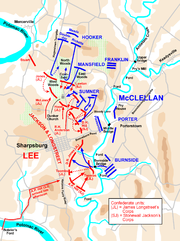
Antietam Creek
Antietam Creek is a tributary of the Potomac River located in south central Pennsylvania and western Maryland in the United States, a region known as the Hagerstown Valley...
. At dawn on September 17, Maj. Gen. Joseph Hooker
Joseph Hooker
Joseph Hooker was a career United States Army officer, achieving the rank of major general in the Union Army during the American Civil War. Although he served throughout the war, usually with distinction, Hooker is best remembered for his stunning defeat by Confederate General Robert E...
's I Corps mounted a powerful assault on Lee's left flank
Flanking maneuver
In military tactics, a flanking maneuver, also called a flank attack, is an attack on the sides of an opposing force. If a flanking maneuver succeeds, the opposing force would be surrounded from two or more directions, which significantly reduces the maneuverability of the outflanked force and its...
that began the bloody battle. Attacks and counterattacks swept across the Miller Cornfield and the woods near the Dunker Church as Maj. Gen. Joseph K. Mansfield
Joseph K. Mansfield
Joseph King Fenno Mansfield was a career United States Army officer, civil engineer, and a Union general in the American Civil War, mortally wounded at the Battle of Antietam.-Early life:...
's XII Corps joined to reinforce Hooker. Union assaults against the Sunken Road ("Bloody Lane") by Maj. Gen. Edwin V. Sumner's II Corps eventually pierced the Confederate center, but the Federal advantage was not pressed. In the afternoon, Burnside's IX Corps crossed a stone bridge over Antietam Creek and rolled up the Confederate right. At a crucial moment, A.P. Hill's division arrived from Harpers Ferry and counterattacked, driving back Burnside's men and saving Lee's army from destruction. Although outnumbered two to one, Lee committed his entire force, while McClellan sent in only four of his six available corps. This enabled Lee to shift brigades across the battlefield and counter each individual Union assault. During the night, both armies consolidated their lines. In spite of crippling casualties—Union 12,401, or 25%; Confederate 10,316, or 31%—Lee continued to skirmish with McClellan throughout September 18, while transporting his wounded men south of the Potomac. McClellan did not renew the offensive. After dark, Lee ordered the battered Army of Northern Virginia to withdraw across the Potomac into the Shenandoah Valley.
Shepherdstown
On September 19, a detachment of Maj. Gen. Fitz John PorterFitz John Porter
Fitz John Porter was a career United States Army officer and a Union General during the American Civil War...
's V Corps pushed across the river at Boteler's Ford, attacked the Confederate rear guard commanded by Brig. Gen. William N. Pendleton
William N. Pendleton
William Nelson Pendleton was an American teacher, Episcopal priest, and soldier. He served as a Confederate general during the American Civil War, noted for his position as Gen. Robert E. Lee's chief of artillery for most of the conflict...
, and captured four guns. Early on September 20, Porter pushed elements of two divisions across the Potomac to establish a bridgehead. A.P. Hill's division counterattacked while many of the Federals were crossing and nearly annihilated the 118th Pennsylvania (the "Corn Exchange" Regiment), inflicting 269 casualties. This rearguard action discouraged further Federal pursuit.
Aftermath and diplomatic implications
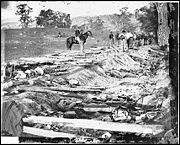
United States Department of War
The United States Department of War, also called the War Department , was the United States Cabinet department originally responsible for the operation and maintenance of the United States Army...
and the president, McClellan declined to pursue Lee across the Potomac, citing shortages of equipment and the fear of overextending his forces. General-in-Chief Henry W. Halleck wrote in his official report, "The long inactivity of so large an army in the face of a defeated foe, and during the most favorable season for rapid movements and a vigorous campaign, was a matter of great disappointment and regret." Lincoln relieved McClellan of his command of the Army of the Potomac on November 7, effectively ending the general's military career. Maj. Gen. Ambrose E. Burnside rose to command the Army of the Potomac. The Eastern Theater was relatively quiet until December, when Lee faced Burnside at the Battle of Fredericksburg
Battle of Fredericksburg
The Battle of Fredericksburg was fought December 11–15, 1862, in and around Fredericksburg, Virginia, between General Robert E. Lee's Confederate Army of Northern Virginia and the Union Army of the Potomac, commanded by Maj. Gen. Ambrose E. Burnside...
.
Although a tactical draw, the Battle of Antietam was a strategic victory for the Union. It forced the end of Lee's strategic invasion of the North and gave Abraham Lincoln the victory he was awaiting before announcing the Emancipation Proclamation
Emancipation Proclamation
The Emancipation Proclamation is an executive order issued by United States President Abraham Lincoln on January 1, 1863, during the American Civil War using his war powers. It proclaimed the freedom of 3.1 million of the nation's 4 million slaves, and immediately freed 50,000 of them, with nearly...
on September 22, which took effect on January 1, 1863. Although Lincoln had intended to do so earlier, he was advised by his Cabinet to make this announcement after a Union victory to avoid the perception that it was issued out of desperation. The Confederate reversal at Antietam also dissuaded the governments of France
Second French Empire
The Second French Empire or French Empire was the Imperial Bonapartist regime of Napoleon III from 1852 to 1870, between the Second Republic and the Third Republic, in France.-Rule of Napoleon III:...
and Great Britain
United Kingdom of Great Britain and Ireland
The United Kingdom of Great Britain and Ireland was the formal name of the United Kingdom during the period when what is now the Republic of Ireland formed a part of it....
from recognizing
Diplomatic recognition
Diplomatic recognition in international law is a unilateral political act with domestic and international legal consequences, whereby a state acknowledges an act or status of another state or government in control of a state...
the Confederacy. And, with the issuance of the Emancipation Proclamation, it became less likely that future battlefield victories would induce foreign recognition. Lincoln had effectively highlighted slavery
Slavery
Slavery is a system under which people are treated as property to be bought and sold, and are forced to work. Slaves can be held against their will from the time of their capture, purchase or birth, and deprived of the right to leave, to refuse to work, or to demand compensation...
as a tenet of the Confederate States of America, and the abhorrence of slavery in France and Great Britain would not allow for intervention on behalf of the South.
Further reading
- Cannan, John. The Antietam Campaign: August-September 1862. Mechanicsburg, PA: Stackpole, 1994. ISBN 0-93828-991-8.
- Carman, Ezra AyersEzra A. CarmanEzra Ayers Carman was an officer in the Union Army during the American Civil War, commanding a New Jersey infantry regiment and a brigade.-Early life:...
. The Maryland Campaign of September 1862. Vol. 1, South Mountain. Edited by Thomas G. Clemens. El Dorado Hills, CA: Savas Beatie, 2010. ISBN 978-1-932714-81-4. - Carman, Ezra Ayers. The Maryland Campaign of September 1862: Ezra A. Carman's Definitive Account of the Union and Confederate Armies at Antietam. Edited by Joseph Pierro. New York: Routledge, 2008. ISBN 0-415-95628-5.
- Gallagher, Gary W., ed. Antietam: Essays on the 1862 Maryland Campaign. Kent, OH: Kent State University Press, 1989. ISBN 0-87338-400-8.
- Harsh, Joseph L. Confederate Tide Rising: Robert E. Lee and the Making of Southern Strategy, 1861–1862. Kent, OH: Kent State University Press, 1998. ISBN 0-87338-580-2.
- Harsh, Joseph L. Taken at the Flood: Robert E. Lee and Confederate Strategy in the Maryland Campaign of 1862. Kent, OH: Kent State University Press, 1999. ISBN 0-87338-631-0.
- Jamieson, Perry D. Death in September: The Antietam Campaign. Abilene, TX: McWhiney Foundation Press, 1999. ISBN 1-893114-07-4.
- Murfin, James V. The Gleam of Bayonets: The Battle of Antietam and the Maryland Campaign of 1862. Baton Rouge: Louisiana State University Press, 1965. ISBN 0-8071-0990-8.