

Fort Monroe

Encyclopedia
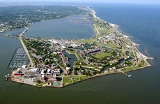
Fort Monroe was a military installation in Hampton, Virginia
—at Old Point Comfort
, the southern tip of the Virginia Peninsula
. Along with Fort Wool
, Fort Monroe guarded the navigational channel between the Chesapeake Bay
and Hampton Roads
—the natural roadstead
at the confluence of the Elizabeth
, the Nansemond
and the James
rivers. Completely surrounded by a moat
, the six-sided stone fort was the last remaining fort in the United States
still active as an Army
post when it was decommissioned in 2011.
During the initial exploration by the mission headed by Captain Christopher Newport
in the earliest days of the Colony of Virginia, the site was identified as a strategic defensive location. In May of 1607, they established the first permanent English settlement in the present-day United States about 25 miles further inland from the Bay along the James River at Jamestown
. The land area where Fort Monroe is located became part of Elizabeth Cittie
[sic] in 1619, Elizabeth River Shire in 1634, and was included in Elizabeth City County
when it was formed in 1643. Over 300 years later, in 1952, Elizabeth City County and the nearby Town of Phoebus
agreed to consolidate with the smaller independent city
of Hampton
, which became one of the larger cities of Hampton Roads
.
Beginning by 1609, defensive fortifications were built at Old Point Comfort during Virginia's first two centuries. However, the much more substantial facility of stone to become known as Fort Monroe (and adjacent Fort Wool on a man-made island across the channel) were completed in 1834. The principal facility was named in honor of U.S. President
James Monroe
. Throughout the American Civil War
(1861–1865), although most of Virginia became part of the Confederate States of America
, Fort Monroe remained in Union
hands. It became notable as a historic and symbolic site of early freedom for former slaves
under the provisions of contraband
policies and later the Emancipation Proclamation
. For several years thereafter, the former Confederate President, Jefferson Davis
, was imprisoned at the fort in the area now known as the Fort Monroe Casemate Museum.
Fort Monroe closed on September 15, 2011. Many of its functions were transferred to nearby Fort Eustis (which was named for Fort Monroe's first commander, General Abraham Eustis
, a noted artillery
expert). Several re-use plans for Fort Monroe after it is decommissioned are currently under development in the Hampton community.
On November 1, 2011 President
Barack Obama
signed a proclamation to designate Fort Monroe as a National Monument. This is the first time that President Obama exercised his authority under the Antiquities Act
, a 1906 law to protect sites deemed to have natural, historical or scientific significance.
, Captain John Smith
and the colonists of the Virginia Company
established the settlement of Jamestown
of the British Colony of Virginia on the James River
in 1607. On their initial exploration, they recognized the strategic importance of the site at Old Point Comfort
for purposes of coastal defense. They initially built Fort Algernourne
(1609–1612) at the location of the present Fort Monroe. It is assumed to have been a triangular stockade, based on the fort at Jamestown. Other small forts known as Fort Henry and Fort Charles were built nearby in 1610. Fort Algernourne burned in 1612.
In the latter part of August 1619 a Dutch ship, the White Lion, appeared off the coast of Old Point Comfort. Its cargo included more than 30 Africa
ns captured from the slave ship Sao Joao Bautista. Traded for work and supplies from the English, they were the first Africa
ns to come ashore on British-occupied land in what would become America. Although the Bantu Africans from Angola
were considered indentured servants, their arrival is considered to mark the beginning of slavery in America. Two among the Africans arriving at Old Point Comfort in 1619 were named by the Spanish as Antonio and Isabella. In January 1624, she gave birth to the first African child born in America.
Another fort, known only as "the fort at Old Point Comfort" was constructed in 1632, and destroyed by a hurricane in 1667. In 1728, Fort George was built on the site. Its masonry walls were destroyed by a hurricane in 1749, but the wood buildings within the fort continued to be used by a reduced force until at least 1775. In 1781, during the Siege of Yorktown
, the French West Indian fleet established a battery on the ruins of Fort George. Throughout the Colonial period, fortifications were manned at the location from time to time.
, the United States realized the need to protect Hampton Roads and the inland waters from attack by sea. In March of 1819, President James Madison
came up with a plan of building a network of coastal defenses. Construction of the fort began in earnest on the stone-and-brick fort which would serve as the safeguard for the Chesapeake Bay. It began construction in 1819 on what would become the largest stone fort ever built in the United States. Work continued for nearly twenty-five years. The fort, designed by Simon Bernard
, features a moat completely surrounding the inner structures. As a young first lieutenant and engineer in the U.S. Army, Robert E. Lee
was stationed there from 1831 to 1834, and played a major role in the final construction of both Fort Monroe and its opposite, Fort Calhoun. The latter, later renamed Fort Wool
, was built on a man-made island called the Rip Raps
across the navigational channel from Old Point Comfort
in the middle of the mouth of Hampton Roads. Late in the nineteenth century, the Army briefly detained the chief Black Hawk
here.
When construction was completed in 1834, Fort Monroe was referred to as the "Gibraltar
of Chesapeake Bay". The fort mounted an impressive complement of the most powerful artillery of the time, 32-pounder guns with a range of over one mile. In conjunction with Fort Calhoun (later Fort Wool), this was just enough range to cover the main shipping channel into the area. (Decommissioned after World War II
, the former Fort Wool on Rip Raps is now adjacent to the southern man-made island of the Hampton Roads Bridge-Tunnel
, first completed in 1957.)
. On December 20, 1860, South Carolina
became the first state to secede from the Union
. Four months later, on April 12, 1861, troops of that state opened fire on Fort Sumter
in Charleston
Harbor. Five days later, Virginia's legislature passed (subject to voters' ratification) the Ordinance of Secession
of Virginia to withdraw from the Union, and join the newly formed Confederate States of America
. On 23 May 1861, voters of Virginia ratified the state's secession from the union.
President Abraham Lincoln
had Fort Monroe quickly reinforced so that it would not fall to Confederate forces. It was held by Union forces throughout the Civil War, which launched several sea and land expeditions from there.
A few weeks after the Battle of Fort Sumter
in 1861, U.S. Army General-in-Chief Winfield Scott
proposed to President Abraham Lincoln a plan to bring the states back into the Union: cut the Confederacy off from the rest of the world instead of attacking its army in Virginia. His plan
was to blockade the Confederacy's coastline and control the Mississippi River
valley with gunboats. In cooperation with the Navy, troops from Fort Monroe extended Union control along the coasts of the Carolinas
as Lincoln ordered a blockade of the Southern seaboard from the South Carolina line to the Rio Grande
on April 19, and on April 27 extended it to include the North Carolina
and Virginia coasts.
On April 20 the Union Navy burned and evacuated the Norfolk Navy Yard, destroying nine ships in the process, keeping Fort Monroe at Old Point Comfort as the last bastion of the United States in Tidewater Virginia
. The Confederacy's occupation of Norfolk
gave it a major shipyard and thousands of heavy guns, but they held it for only one year. Confederate Brigadier General Walter Gwynn
, who commanded the Confederate defenses around Norfolk, erected batteries at Sewell's Point
, both to protect Norfolk and to control Hampton Roads.
The Union dispatched a fleet to Hampton Roads to enforce the blockade, and on May 18–19, 1861, Federal gunboats based at Fort Monroe exchanged fire with the Confederate batteries at Sewell's Point. The little-known Battle of Sewell's Point
resulted in little damage to either side. Several land operations against Confederate forces were mounted from the fort, notably the Battle of Big Bethel
in June 1861.
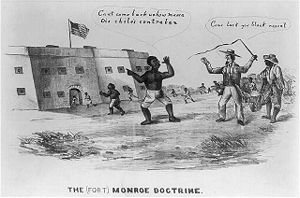 On May 27, 1861, Major General Benjamin Butler
made his famous "contraband
" decision, or "Fort Monroe Doctrine", determining that escaping slaves who reached Union lines would be considered contraband and not be returned to bondage. The order resulted in thousands of slaves fleeing to Union lines around Fort Monroe, which was Butler's headquarters in Virginia. Fort Monroe became called "Freedom's Fortress", as any slave reaching it would be free. By the fall, the Army had built the Great Contraband Camp to try to house the families. It was the first of more than 100 that would be established by war's end, and the Roanoke Island Freedmen's Colony (1863-1867), which started as a contraband camp. Mary S. Peake
was teaching the children of freedmen to read and write near Fort Monroe. She was the first black teacher hired by the American Missionary Association
(AMA), a Northern missionary group led by black and white ministers from the Congregational, Presbyterian and Methodist denominations, who strongly supported education of freedmen. Soon she was teaching children during the day and adults at night. The AMA sponsored hundreds of Northern teachers and hired other local teachers in the South; it founded more than 500 local schools and 11 colleges for freedmen and their children.
Under Gen. Butler's command, Fort Monroe was the site of a military balloon
camp under the flight direction of aeronaut John LaMountain. The Union Army Balloon Corps
was being developed at Fort Corcoran near Arlington under the presidentially appointed Prof. Thaddeus S. C. Lowe
. At the same time, LaMountain, who was vying for position as Chief Aeronaut, had gained the confidence of Butler in using his balloon Atlantic for aerial observations. LaMountain is credited with having made the first successful report from an aerial station that was of practical military intelligence
. LaMountain was later reassigned to Lowe's balloon corps, but after a period of in-fighting with Lowe, he was released from military service. Lowe eventually assigned regular military balloons to Fort Monroe.
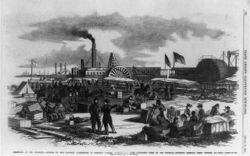 In March 1862, the naval Battle of Hampton Roads
took place off Sewell's Point between the first ironclad warship
s, CSS Virginia
and USS Monitor
. While the outcome was inconclusive, the battle marked a change in naval warfare and the end to wooden fighting ships.
Later that spring, the continuing presence of the Union Navy based at Fort Monroe enabled Federal water transports from Washington, D.C., to land unmolested to support Major General George B. McClellan
's Peninsula Campaign
. Formed at Fort Monroe, McClellan's troops moved up the Virginia Peninsula
during the spring of 1862, reaching within a few miles of the gates of Richmond
about 80 miles to the west by June 1. For the next 30 days, they laid siege to Richmond. Then, during the Seven Days Battles
, McClellan fell back to the James River well below Richmond, ending the campaign. Fortunately for McClellan, during this time, Union troops regained control of Norfolk, Hampton Roads, and the James River below Drewry's Bluff (a strategic point about 8 miles south of Richmond).
Beginning in 1862 Fort Monroe was also used as a transfer point for mail exchange. Mail sent from states in the Confederacy addressed to locations in the Union had to be sent by flag-of-truce, and could only pass through at Fort Monroe where the mail was opened, inspected, resealed, marked and sent on. Prisoner of war mail from Union soldiers in Confederate prisons was also required to be passed through this point for inspection.
 In 1864, the Union Army of the James
under Major General Benjamin Butler
was formed at Fort Monroe. The 2nd Regiment, United States Colored Cavalry, mustered at Fort Monroe on December 22, 1864, and the 1st Regiment, United States Colored Cavalry mustered the same day at nearby Camp Hamilton. The Siege of Petersburg
during 1864 and 1865 was supported on the James River from a base at City Point
(now Hopewell, Virginia
). Maintaining the control of Hampton Roads at Fort Monroe and Fort Wool was crucial to the naval support Grant required for the successful Union campaign to take Petersburg, which was the key to the fall of the Confederate capitol at Richmond. As Petersburg fell, Richmond was evacuated in 1865 on the night of April 2–3. That night, Confederate President Jefferson Davis and his cabinet escaped Richmond, taking the Richmond and Danville Railroad
to move first to Danville
and then North Carolina
. However, the cause was lost, and Confederate General Robert E. Lee surrendered what was left of the Army of Northern Virginia
to Grant at Appomattox Court House the following week.
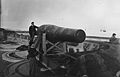 After the last Confederate cabinet meeting was held on April 26, 1865, at Charlotte, North Carolina
, Jefferson Davis was captured at Irwinville, Georgia
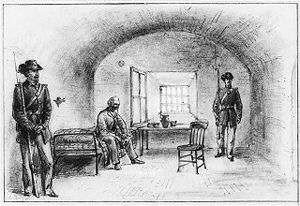
, and placed under arrest. He was briefly confined in an unheated, open casemate
until the Union Surgeon John J. Craven recommended more humane care for Mr. Davis. General Nelson A. Miles
approved changes and even moved Mr. Davis to more hospitable quarters. He was held at Fort Monroe for two years. Some historians have speculated that his treatment in captivity was intended to be lethal. In poor health, Davis was released in May, 1867, on bail, which was posted by prominent citizens of both Northern and Southern states, including Horace Greeley
and Cornelius Vanderbilt
, who had become convinced he was being treated unfairly. The federal government proceeded no further in its prosecution due to the constitutional concerns of U.S. Supreme Court
Chief Justice Salmon P. Chase
.
The Journal of the United States Artillery
was founded at Fort Monroe in 1892 by First Lieutenant (later General) John Wilson Ruckman and four other officers of the Artillery School. Ruckman served as the editor of the Journal for four years (July 1892 to January 1896) and published several articles therein afterward. One publication by West Point
notes Ruckman's “guidance” and “first-rate quality” work were obvious as the Journal “rose to high rank among the service papers of the world”. The Journal was renamed the Coast Artillery Journal in 1922 and the Antiaircraft Journal in 1948.
The Jamestown Exposition
held in 1907 at Hampton Roads
, featured an extensive naval review
, including the Great White Fleet
. Beginning in 1917, the former exposition site at Sewell's Point became a major base of the United States Navy
. Currently, Norfolk Navy Base
is the base supporting naval forces operating in the Atlantic Ocean
, Mediterranean Sea
, and Indian Ocean
. It is the world's largest naval station by number of military members supported.
. New buildings were constructed for classrooms and barracks (the library and school buildings compleated in 1909)http://books.google.com/books?id=GuDlAAAAMAAJ&pg=PA32&lpg=PA32&dq=Commandant+of+the+coast+artillery+school+1909&source=bl&ots=CbTJ8tbEvY&sig=xo1qagaYs3Q3Nrp2fpxjqL2UhA0&hl=en&ei=cofBTt_lJIGA2wWkrpW7BQ&sa=X&oi=book_result&ct=result&resnum=1&sqi=2&ved=0CBoQ6AEwAA#v=onepage&q&f=false. As part of the schools responsibility the "Coast Artillery Journal" was published under the supervision of the commandant. http://www.airdefenseartillery.com/online/2010/CoastArtilleryHome.htm The school opperated until 1946 when most of the coast artillery was disbanded, and the school was moved to Fort Winfield Scott
Fort Monroe and Fort Wool stood guard during World War I
and World War II
, and successfully protected Hampton Roads and the important military and civilian resources located inland.
By World War II, Fort Monroe served as headquarters for an impressive array of coast artillery guns ranging from 3-inch rapid fire guns to 16-inch guns capable of firing a 2,000 pound projectile 25 miles. In addition, the Army controlled submarine barriers and underwater mine fields. But this vast array of armaments was made largely obsolete by the end of the Second World War due to the development of the long-range bomber and the refinement of naval aviation.
After the operational armament was removed, Fort Monroe received a mission that it still maintains to this day. Since World War II, it has served as the major headquarters for training soldiers for war. In 1973, Fort Monroe became home to the United States Army Training and Doctrine Command
(TRADOC), which combines the recruitment, training and education of soldiers with the development of operational doctrine.
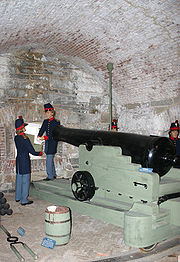
released a list on 13 May 2005 of military installations recommended for closure and/or realignment, among which is Fort Monroe. The list was approved by President George W. Bush
on 15 September 2005, and submitted to Congress. Congress failed to act within forty-five legislative days to disapprove the list in its entirety, and the BRAC recommendations subsequently became law. Installations on the BRAC list must close within six years.
, 110 acres of submerged lands and 85 acres of wetlands. It has a 332 slip marina and shallow water inlet access to Mill Creek, suitable for small watercraft.
Fort Monroe supports a daytime population of about 3,096, including 1,105 people in uniform, 1,991 civilian and contract employees, and about 814 family members residing on post. The major tenant unit is the United States Army Training and Doctrine Command
(TRADOC).
Fort Monroe has become a popular historical site. The Casemate Museum, opened in 1951, depicts the history of Fort Monroe and Old Point Comfort, with special emphasis on the Civil War
period. It offers a view of Confederate President Jefferson Davis
' prison cell. Also shown are the quarters occupied by 1st Lt. Robert E. Lee
in 1831–34, and the quarters where President Abraham Lincoln
was a guest in May, 1862. The quarters occupied by Robert E. Lee while stationed at Fort Monroe are still in use as military family housing.
Nearby, Fort Monroe's companion guardian of Hampton Roads, Fort Wool
, located at Rip Raps
is also available for tours.
Note: Fort Wool is located adjacent to one of the man-made islands of the Hampton Roads Bridge-Tunnel
and is accessible only by water. The availability of public tours of both Fort Wool and Fort Monroe are subject to Homeland Security
Alert conditions.
The FMFADA relies on the expertise of national consultants in the areas of BRAC law, environmental engineering, historic architecture and preservation planning, structural engineering, housing market analysis, commercial/retail analysis, public relations/marketing, and tourism planning.
The FMFADA was created by legislative action of the Virginia General Assembly in 2007. Virginia’s Department of Historic Resources and the Department of Environmental Quality have major regulatory authority that influences the work.
The state is taking a lead role in planning because most of the land that Fort Monroe occupies will revert to the Commonwealth when the Army closes the fort. The effort is guided by three priorities; keep Fort Monroe open to the public, respect the rich history and advance economic sustainability.
The Authority is an 18 member body consisting of appointees from the city of Hampton, the Virginia House of Delegates and Senate and the Virginia governor’s cabinet, with two specialists in historic preservation and heritage tourism.
Generally, surplus military installations are turned over to the respective states. Redevelopment will be facilitated by the fact that most of the land on which the fort stands was loaned by the state of Virginia to the federal government, and will revert to the state once Fort Monroe closes.
Virginia historically has given local government strong consideration in determining disposition at that point, such as occurred at Fort Pickett
in Nottoway County
(near Blackstone
) in the Southside region. Given the historic significance of the post, the decommissioned fort will be a good candidate for heritage tourism along with many other historical sites located throughout the greater Hampton Roads
area. Redevelopment to help offset the economic loss of a base closure is usually a priority as well.
Fort Monroe is a National Historic Landmark and the moated fort and the 190 historic buildings on Old Point Comfort will be protected with historic preservation design guidelines for reuse. Old Point Comfort is prime development property and some mixed used new construction will be allowed within strict guidelines. For example, the historic Chamberlin Hotel has already been leased to a developer by the Army and beautifully renovated as retirement apartments.
The National Park Service and the Fort Monroe FADA are communicating to identify the best way to achieve a partnership and several options have been presented to the FMFADA board by the park service.
Archival Records
Hampton, Virginia
Hampton is an independent city that is not part of any county in Southeast Virginia. Its population is 137,436. As one of the seven major cities that compose the Hampton Roads metropolitan area, it is on the southeastern end of the Virginia Peninsula. Located on the Hampton Roads Beltway, it hosts...
—at Old Point Comfort
Old Point Comfort
Old Point Comfort is a point of land located in the independent city of Hampton. It lies at the extreme tip of the Virginia Peninsula at the mouth of Hampton Roads in the United States....
, the southern tip of the Virginia Peninsula
Virginia Peninsula
The Virginia Peninsula is a peninsula in southeast Virginia, USA, bounded by the York River, James River, Hampton Roads and Chesapeake Bay.Hampton Roads is the common name for the metropolitan area that surrounds the body of water of the same name...
. Along with Fort Wool
Fort Wool
Fort Wool was the companion to Fort Monroe in protecting Hampton Roads from seafaring threats. This site was once the dumping place for ships’ ballast....
, Fort Monroe guarded the navigational channel between the Chesapeake Bay
Chesapeake Bay
The Chesapeake Bay is the largest estuary in the United States. It lies off the Atlantic Ocean, surrounded by Maryland and Virginia. The Chesapeake Bay's drainage basin covers in the District of Columbia and parts of six states: New York, Pennsylvania, Delaware, Maryland, Virginia, and West...
and Hampton Roads
Hampton Roads
Hampton Roads is the name for both a body of water and the Norfolk–Virginia Beach metropolitan area which surrounds it in southeastern Virginia, United States...
—the natural roadstead
Roadstead
A roadstead is a place outside a harbor where a ship can lie at anchor. It is an enclosed area with an opening to the sea, narrower than a bay or gulf. It has a surface that cannot be confused with an estuary. It can be created artificially by jetties or dikes...
at the confluence of the Elizabeth
Elizabeth River (Virginia)
The Elizabeth River is a tidal estuary forming an arm of Hampton Roads harbor at the southern end of Chesapeake Bay in southeast Virginia in the United States. It is located along the southern side of the mouth of the James River, between the cities of Portsmouth and Norfolk...
, the Nansemond
Nansemond River
The Nansemond River is a tributary of the James River in the U.S. state of Virginia. The Nansemond River Bridge crosses the river near its mouth. Both it and the former State Route 125 bridge, demolished in 2008, were once toll bridges. The river begins at the outlet of Lake Meade north of...
and the James
James River (Virginia)
The James River is a river in the U.S. state of Virginia. It is long, extending to if one includes the Jackson River, the longer of its two source tributaries. The James River drains a catchment comprising . The watershed includes about 4% open water and an area with a population of 2.5 million...
rivers. Completely surrounded by a moat
Moat
A moat is a deep, broad ditch, either dry or filled with water, that surrounds a castle, other building or town, historically to provide it with a preliminary line of defence. In some places moats evolved into more extensive water defences, including natural or artificial lakes, dams and sluices...
, the six-sided stone fort was the last remaining fort in the United States
United States
The United States of America is a federal constitutional republic comprising fifty states and a federal district...
still active as an Army
United States Army
The United States Army is the main branch of the United States Armed Forces responsible for land-based military operations. It is the largest and oldest established branch of the U.S. military, and is one of seven U.S. uniformed services...
post when it was decommissioned in 2011.
During the initial exploration by the mission headed by Captain Christopher Newport
Christopher Newport
Christopher Newport was an English seaman and privateer. He is best known as the captain of the Susan Constant, the largest of three ships which carried settlers for the Virginia Company in 1607 on the way to find the settlement at Jamestown in the Virginia Colony, which became the first permanent...
in the earliest days of the Colony of Virginia, the site was identified as a strategic defensive location. In May of 1607, they established the first permanent English settlement in the present-day United States about 25 miles further inland from the Bay along the James River at Jamestown
Jamestown, Virginia
Jamestown was a settlement in the Colony of Virginia. Established by the Virginia Company of London as "James Fort" on May 14, 1607 , it was the first permanent English settlement in what is now the United States, following several earlier failed attempts, including the Lost Colony of Roanoke...
. The land area where Fort Monroe is located became part of Elizabeth Cittie
Elizabeth City (Virginia Company)
Elizabeth City was one of four incorporations established in the Virginia Colony in 1619 by the proprietor, the Virginia Company of London, acting in accordance with instructions issued by Sir George Yeardley, Governor.The plantations and developments were divided into four political divisions,...
[sic] in 1619, Elizabeth River Shire in 1634, and was included in Elizabeth City County
Elizabeth City County, Virginia
Elizabeth City County was a county in southeastern Virginia from 1634 to 1952. Originally created in 1634 as Elizabeth River Shire, it was one of eight shires created in the Virginia Colony by order of the King of England. In 1636, it was subdivided, and the portion north of the harbor of Hampton...
when it was formed in 1643. Over 300 years later, in 1952, Elizabeth City County and the nearby Town of Phoebus
Phoebus, Virginia
Phoebus was an incorporated town located in Elizabeth City County on the Virginia Peninsula in eastern Virginia. Upon incorporation in 1900, it was named in honor of local businessman Harrison Phoebus , who is credited with convincing the Chesapeake and Ohio Railway to extend its tracks to the...
agreed to consolidate with the smaller independent city
Independent city
An independent city is a city that does not form part of another general-purpose local government entity. These type of cities should not be confused with city-states , which are fully sovereign cities that are not part of any other sovereign state.-Historical precursors:In the Holy Roman Empire,...
of Hampton
Hampton, Virginia
Hampton is an independent city that is not part of any county in Southeast Virginia. Its population is 137,436. As one of the seven major cities that compose the Hampton Roads metropolitan area, it is on the southeastern end of the Virginia Peninsula. Located on the Hampton Roads Beltway, it hosts...
, which became one of the larger cities of Hampton Roads
Hampton Roads
Hampton Roads is the name for both a body of water and the Norfolk–Virginia Beach metropolitan area which surrounds it in southeastern Virginia, United States...
.
Beginning by 1609, defensive fortifications were built at Old Point Comfort during Virginia's first two centuries. However, the much more substantial facility of stone to become known as Fort Monroe (and adjacent Fort Wool on a man-made island across the channel) were completed in 1834. The principal facility was named in honor of U.S. President
President of the United States
The President of the United States of America is the head of state and head of government of the United States. The president leads the executive branch of the federal government and is the commander-in-chief of the United States Armed Forces....
James Monroe
James Monroe
James Monroe was the fifth President of the United States . Monroe was the last president who was a Founding Father of the United States, and the last president from the Virginia dynasty and the Republican Generation...
. Throughout the American Civil War
American Civil War
The American Civil War was a civil war fought in the United States of America. In response to the election of Abraham Lincoln as President of the United States, 11 southern slave states declared their secession from the United States and formed the Confederate States of America ; the other 25...
(1861–1865), although most of Virginia became part of the Confederate States of America
Confederate States of America
The Confederate States of America was a government set up from 1861 to 1865 by 11 Southern slave states of the United States of America that had declared their secession from the U.S...
, Fort Monroe remained in Union
Union (American Civil War)
During the American Civil War, the Union was a name used to refer to the federal government of the United States, which was supported by the twenty free states and five border slave states. It was opposed by 11 southern slave states that had declared a secession to join together to form the...
hands. It became notable as a historic and symbolic site of early freedom for former slaves
Slavery
Slavery is a system under which people are treated as property to be bought and sold, and are forced to work. Slaves can be held against their will from the time of their capture, purchase or birth, and deprived of the right to leave, to refuse to work, or to demand compensation...
under the provisions of contraband
Contraband (American Civil War)
Contraband was a term commonly used in the United States military during the American Civil War to describe a new status for certain escaped slaves or those who affiliated with Union forces after the military determined that the US would not return escaped slaves who went to Union lines to their...
policies and later the Emancipation Proclamation
Emancipation Proclamation
The Emancipation Proclamation is an executive order issued by United States President Abraham Lincoln on January 1, 1863, during the American Civil War using his war powers. It proclaimed the freedom of 3.1 million of the nation's 4 million slaves, and immediately freed 50,000 of them, with nearly...
. For several years thereafter, the former Confederate President, Jefferson Davis
Jefferson Davis
Jefferson Finis Davis , also known as Jeff Davis, was an American statesman and leader of the Confederacy during the American Civil War, serving as President for its entire history. He was born in Kentucky to Samuel and Jane Davis...
, was imprisoned at the fort in the area now known as the Fort Monroe Casemate Museum.
Fort Monroe closed on September 15, 2011. Many of its functions were transferred to nearby Fort Eustis (which was named for Fort Monroe's first commander, General Abraham Eustis
Abraham Eustis
Abraham Eustis was a lawyer and notable U.S. Army officer, eventually rising to become a Brevet Brigadier General...
, a noted artillery
Artillery
Originally applied to any group of infantry primarily armed with projectile weapons, artillery has over time become limited in meaning to refer only to those engines of war that operate by projection of munitions far beyond the range of effect of personal weapons...
expert). Several re-use plans for Fort Monroe after it is decommissioned are currently under development in the Hampton community.
On November 1, 2011 President
President of the United States
The President of the United States of America is the head of state and head of government of the United States. The president leads the executive branch of the federal government and is the commander-in-chief of the United States Armed Forces....
Barack Obama
Barack Obama
Barack Hussein Obama II is the 44th and current President of the United States. He is the first African American to hold the office. Obama previously served as a United States Senator from Illinois, from January 2005 until he resigned following his victory in the 2008 presidential election.Born in...
signed a proclamation to designate Fort Monroe as a National Monument. This is the first time that President Obama exercised his authority under the Antiquities Act
Antiquities Act
The Antiquities Act of 1906, officially An Act for the Preservation of American Antiquities , is an act passed by the United States Congress and signed into law by Theodore Roosevelt on June 8, 1906, giving the President of the United States authority to, by executive order, restrict the use of...
, a 1906 law to protect sites deemed to have natural, historical or scientific significance.
Colonial period
Arriving with three ships under Captain Christopher NewportChristopher Newport
Christopher Newport was an English seaman and privateer. He is best known as the captain of the Susan Constant, the largest of three ships which carried settlers for the Virginia Company in 1607 on the way to find the settlement at Jamestown in the Virginia Colony, which became the first permanent...
, Captain John Smith
John Smith of Jamestown
Captain John Smith Admiral of New England was an English soldier, explorer, and author. He was knighted for his services to Sigismund Bathory, Prince of Transylvania and friend Mózes Székely...
and the colonists of the Virginia Company
Virginia Company
The Virginia Company refers collectively to a pair of English joint stock companies chartered by James I on 10 April1606 with the purposes of establishing settlements on the coast of North America...
established the settlement of Jamestown
Jamestown, Virginia
Jamestown was a settlement in the Colony of Virginia. Established by the Virginia Company of London as "James Fort" on May 14, 1607 , it was the first permanent English settlement in what is now the United States, following several earlier failed attempts, including the Lost Colony of Roanoke...
of the British Colony of Virginia on the James River
James River (Virginia)
The James River is a river in the U.S. state of Virginia. It is long, extending to if one includes the Jackson River, the longer of its two source tributaries. The James River drains a catchment comprising . The watershed includes about 4% open water and an area with a population of 2.5 million...
in 1607. On their initial exploration, they recognized the strategic importance of the site at Old Point Comfort
Old Point Comfort
Old Point Comfort is a point of land located in the independent city of Hampton. It lies at the extreme tip of the Virginia Peninsula at the mouth of Hampton Roads in the United States....
for purposes of coastal defense. They initially built Fort Algernourne
Fort Algernon
Fort Algernon was established in the fall of 1609 at the mouth of Hampton Roads at Point Comfort in the Virginia Colony. A strategic point for guarding the shipping channel leading from the Chesapeake Bay, Fort Monroe was built there beginning in the 1830s. The area is now known as Old Point Comfort...
(1609–1612) at the location of the present Fort Monroe. It is assumed to have been a triangular stockade, based on the fort at Jamestown. Other small forts known as Fort Henry and Fort Charles were built nearby in 1610. Fort Algernourne burned in 1612.
In the latter part of August 1619 a Dutch ship, the White Lion, appeared off the coast of Old Point Comfort. Its cargo included more than 30 Africa
Africa
Africa is the world's second largest and second most populous continent, after Asia. At about 30.2 million km² including adjacent islands, it covers 6% of the Earth's total surface area and 20.4% of the total land area...
ns captured from the slave ship Sao Joao Bautista. Traded for work and supplies from the English, they were the first Africa
Africa
Africa is the world's second largest and second most populous continent, after Asia. At about 30.2 million km² including adjacent islands, it covers 6% of the Earth's total surface area and 20.4% of the total land area...
ns to come ashore on British-occupied land in what would become America. Although the Bantu Africans from Angola
Angola
Angola, officially the Republic of Angola , is a country in south-central Africa bordered by Namibia on the south, the Democratic Republic of the Congo on the north, and Zambia on the east; its west coast is on the Atlantic Ocean with Luanda as its capital city...
were considered indentured servants, their arrival is considered to mark the beginning of slavery in America. Two among the Africans arriving at Old Point Comfort in 1619 were named by the Spanish as Antonio and Isabella. In January 1624, she gave birth to the first African child born in America.
Another fort, known only as "the fort at Old Point Comfort" was constructed in 1632, and destroyed by a hurricane in 1667. In 1728, Fort George was built on the site. Its masonry walls were destroyed by a hurricane in 1749, but the wood buildings within the fort continued to be used by a reduced force until at least 1775. In 1781, during the Siege of Yorktown
Siege of Yorktown
The Siege of Yorktown, Battle of Yorktown, or Surrender of Yorktown in 1781 was a decisive victory by a combined assault of American forces led by General George Washington and French forces led by the Comte de Rochambeau over a British Army commanded by Lieutenant General Lord Cornwallis...
, the French West Indian fleet established a battery on the ruins of Fort George. Throughout the Colonial period, fortifications were manned at the location from time to time.
Early 19th century
Following the War of 1812War of 1812
The War of 1812 was a military conflict fought between the forces of the United States of America and those of the British Empire. The Americans declared war in 1812 for several reasons, including trade restrictions because of Britain's ongoing war with France, impressment of American merchant...
, the United States realized the need to protect Hampton Roads and the inland waters from attack by sea. In March of 1819, President James Madison
James Madison
James Madison, Jr. was an American statesman and political theorist. He was the fourth President of the United States and is hailed as the “Father of the Constitution” for being the primary author of the United States Constitution and at first an opponent of, and then a key author of the United...
came up with a plan of building a network of coastal defenses. Construction of the fort began in earnest on the stone-and-brick fort which would serve as the safeguard for the Chesapeake Bay. It began construction in 1819 on what would become the largest stone fort ever built in the United States. Work continued for nearly twenty-five years. The fort, designed by Simon Bernard
Simon Bernard
Baron Simon Bernard was a French general of engineers. Born in Dole, Simon Bernard was educated at the École polytechnique, graduating as second in the promotion of 1799 and entered the army in the corps of engineers....
, features a moat completely surrounding the inner structures. As a young first lieutenant and engineer in the U.S. Army, Robert E. Lee
Robert E. Lee
Robert Edward Lee was a career military officer who is best known for having commanded the Confederate Army of Northern Virginia in the American Civil War....
was stationed there from 1831 to 1834, and played a major role in the final construction of both Fort Monroe and its opposite, Fort Calhoun. The latter, later renamed Fort Wool
Fort Wool
Fort Wool was the companion to Fort Monroe in protecting Hampton Roads from seafaring threats. This site was once the dumping place for ships’ ballast....
, was built on a man-made island called the Rip Raps
Rip Raps
Rip Raps is a small 15 acre artificial island at the mouth of the harbor area known as Hampton Roads in the independent city of Hampton in southeastern Virginia in the United States.-History:...
across the navigational channel from Old Point Comfort
Old Point Comfort
Old Point Comfort is a point of land located in the independent city of Hampton. It lies at the extreme tip of the Virginia Peninsula at the mouth of Hampton Roads in the United States....
in the middle of the mouth of Hampton Roads. Late in the nineteenth century, the Army briefly detained the chief Black Hawk
Black Hawk (chief)
Black Hawk was a leader and warrior of the Sauk American Indian tribe in what is now the United States. Although he had inherited an important historic medicine bundle, he was not one of the Sauk's hereditary civil chiefs...
here.
When construction was completed in 1834, Fort Monroe was referred to as the "Gibraltar
Gibraltar
Gibraltar is a British overseas territory located on the southern end of the Iberian Peninsula at the entrance of the Mediterranean. A peninsula with an area of , it has a northern border with Andalusia, Spain. The Rock of Gibraltar is the major landmark of the region...
of Chesapeake Bay". The fort mounted an impressive complement of the most powerful artillery of the time, 32-pounder guns with a range of over one mile. In conjunction with Fort Calhoun (later Fort Wool), this was just enough range to cover the main shipping channel into the area. (Decommissioned after World War II
World War II
World War II, or the Second World War , was a global conflict lasting from 1939 to 1945, involving most of the world's nations—including all of the great powers—eventually forming two opposing military alliances: the Allies and the Axis...
, the former Fort Wool on Rip Raps is now adjacent to the southern man-made island of the Hampton Roads Bridge-Tunnel
Hampton Roads Bridge-Tunnel
The Hampton Roads Bridge-Tunnel is the -long Hampton Roads crossing for Interstate 64 and U.S. Route 60. It is a four-lane facility comprising bridges, trestles, man-made islands, and tunnels under the main shipping channels for Hampton Roads harbor in the southeastern portion of Virginia in the...
, first completed in 1957.)
American Civil War
1860–61
Fort Monroe played an important role in the American Civil WarAmerican Civil War
The American Civil War was a civil war fought in the United States of America. In response to the election of Abraham Lincoln as President of the United States, 11 southern slave states declared their secession from the United States and formed the Confederate States of America ; the other 25...
. On December 20, 1860, South Carolina
South Carolina
South Carolina is a state in the Deep South of the United States that borders Georgia to the south, North Carolina to the north, and the Atlantic Ocean to the east. Originally part of the Province of Carolina, the Province of South Carolina was one of the 13 colonies that declared independence...
became the first state to secede from the Union
Union (American Civil War)
During the American Civil War, the Union was a name used to refer to the federal government of the United States, which was supported by the twenty free states and five border slave states. It was opposed by 11 southern slave states that had declared a secession to join together to form the...
. Four months later, on April 12, 1861, troops of that state opened fire on Fort Sumter
Fort Sumter
Fort Sumter is a Third System masonry coastal fortification located in Charleston Harbor, South Carolina. The fort is best known as the site upon which the shots initiating the American Civil War were fired, at the Battle of Fort Sumter.- Construction :...
in Charleston
Charleston, South Carolina
Charleston is the second largest city in the U.S. state of South Carolina. It was made the county seat of Charleston County in 1901 when Charleston County was founded. The city's original name was Charles Towne in 1670, and it moved to its present location from a location on the west bank of the...
Harbor. Five days later, Virginia's legislature passed (subject to voters' ratification) the Ordinance of Secession
Ordinance of Secession
The Ordinance of Secession was the document drafted and ratified in 1860 and 1861 by the states officially seceding from the United States of America...
of Virginia to withdraw from the Union, and join the newly formed Confederate States of America
Confederate States of America
The Confederate States of America was a government set up from 1861 to 1865 by 11 Southern slave states of the United States of America that had declared their secession from the U.S...
. On 23 May 1861, voters of Virginia ratified the state's secession from the union.
President Abraham Lincoln
Abraham Lincoln
Abraham Lincoln was the 16th President of the United States, serving from March 1861 until his assassination in April 1865. He successfully led his country through a great constitutional, military and moral crisis – the American Civil War – preserving the Union, while ending slavery, and...
had Fort Monroe quickly reinforced so that it would not fall to Confederate forces. It was held by Union forces throughout the Civil War, which launched several sea and land expeditions from there.
A few weeks after the Battle of Fort Sumter
Battle of Fort Sumter
The Battle of Fort Sumter was the bombardment and surrender of Fort Sumter, near Charleston, South Carolina, that started the American Civil War. Following declarations of secession by seven Southern states, South Carolina demanded that the U.S. Army abandon its facilities in Charleston Harbor. On...
in 1861, U.S. Army General-in-Chief Winfield Scott
Winfield Scott
Winfield Scott was a United States Army general, and unsuccessful presidential candidate of the Whig Party in 1852....
proposed to President Abraham Lincoln a plan to bring the states back into the Union: cut the Confederacy off from the rest of the world instead of attacking its army in Virginia. His plan
Anaconda Plan
The Anaconda Plan or Scott's Great Snake is the name widely applied to an outline strategy for subduing the seceding states in the American Civil War. Proposed by General-in-Chief Winfield Scott, the plan emphasized the blockade of the Southern ports, and called for an advance down the Mississippi...
was to blockade the Confederacy's coastline and control the Mississippi River
Mississippi River
The Mississippi River is the largest river system in North America. Flowing entirely in the United States, this river rises in western Minnesota and meanders slowly southwards for to the Mississippi River Delta at the Gulf of Mexico. With its many tributaries, the Mississippi's watershed drains...
valley with gunboats. In cooperation with the Navy, troops from Fort Monroe extended Union control along the coasts of the Carolinas
The Carolinas
The Carolinas is a term used in the United States to refer collectively to the states of North and South Carolina. Together, the two states + have a population of 13,942,126. "Carolina" would be the fifth most populous state behind California, Texas, New York, and Florida...
as Lincoln ordered a blockade of the Southern seaboard from the South Carolina line to the Rio Grande
Rio Grande
The Rio Grande is a river that flows from southwestern Colorado in the United States to the Gulf of Mexico. Along the way it forms part of the Mexico – United States border. Its length varies as its course changes...
on April 19, and on April 27 extended it to include the North Carolina
North Carolina
North Carolina is a state located in the southeastern United States. The state borders South Carolina and Georgia to the south, Tennessee to the west and Virginia to the north. North Carolina contains 100 counties. Its capital is Raleigh, and its largest city is Charlotte...
and Virginia coasts.
On April 20 the Union Navy burned and evacuated the Norfolk Navy Yard, destroying nine ships in the process, keeping Fort Monroe at Old Point Comfort as the last bastion of the United States in Tidewater Virginia
Tidewater region of Virginia
The Tidewater region of Virginia is the eastern portion of the Commonwealth of Virginia formally known as Hampton Roads. The term tidewater may be correctly applied to all portions of any area, including Virginia, where the water level is affected by the tides...
. The Confederacy's occupation of Norfolk
Norfolk, Virginia
Norfolk is an independent city in the Commonwealth of Virginia in the United States. With a population of 242,803 as of the 2010 Census, it is Virginia's second-largest city behind neighboring Virginia Beach....
gave it a major shipyard and thousands of heavy guns, but they held it for only one year. Confederate Brigadier General Walter Gwynn
Walter Gwynn
Walter Gwynn was a civil engineer and soldier who became a Confederate general in the American Civil War.-Early life:...
, who commanded the Confederate defenses around Norfolk, erected batteries at Sewell's Point
Sewell's Point
Sewells Point is a peninsula of land in the independent city of Norfolk, Virginia in the United States, located at the mouth of the salt-water port of Hampton Roads. Sewells Point is bordered by water on three sides, with Willoughby Bay to the north, Hampton Roads to the west, and the Lafayette...
, both to protect Norfolk and to control Hampton Roads.
The Union dispatched a fleet to Hampton Roads to enforce the blockade, and on May 18–19, 1861, Federal gunboats based at Fort Monroe exchanged fire with the Confederate batteries at Sewell's Point. The little-known Battle of Sewell's Point
Battle of Sewell's Point
The Battle of Sewell's Point was an inconclusive exchange of cannon fire between the Union gunboat USS Monticello, supported by the USS Thomas Freeborn, and Confederate batteries on Sewell's Point that took place on May 18, 19 and 21, 1861, in Norfolk County, Virginia in the early days of the...
resulted in little damage to either side. Several land operations against Confederate forces were mounted from the fort, notably the Battle of Big Bethel
Battle of Big Bethel
The Battle of Big Bethel, also known as the Battle of Bethel Church or Great Bethel was one of the earliest land battles of the American Civil War after the surrender of Fort Sumter...
in June 1861.
Benjamin Franklin Butler (politician)
Benjamin Franklin Butler was an American lawyer and politician who represented Massachusetts in the United States House of Representatives and later served as the 33rd Governor of Massachusetts....
made his famous "contraband
Contraband (American Civil War)
Contraband was a term commonly used in the United States military during the American Civil War to describe a new status for certain escaped slaves or those who affiliated with Union forces after the military determined that the US would not return escaped slaves who went to Union lines to their...
" decision, or "Fort Monroe Doctrine", determining that escaping slaves who reached Union lines would be considered contraband and not be returned to bondage. The order resulted in thousands of slaves fleeing to Union lines around Fort Monroe, which was Butler's headquarters in Virginia. Fort Monroe became called "Freedom's Fortress", as any slave reaching it would be free. By the fall, the Army had built the Great Contraband Camp to try to house the families. It was the first of more than 100 that would be established by war's end, and the Roanoke Island Freedmen's Colony (1863-1867), which started as a contraband camp. Mary S. Peake
Mary S. Peake
Mary Smith Peake, born Mary Smith Kelsey , was an American teacher and humanitarian, best known for starting a school for the children of former slaves starting in the fall of 1861 under what became known as the Emancipation Oak tree in present-day Hampton near Fort Monroe...
was teaching the children of freedmen to read and write near Fort Monroe. She was the first black teacher hired by the American Missionary Association
American Missionary Association
The American Missionary Association was a Protestant-based abolitionist group founded on September 3, 1846 in Albany, New York. The main purpose of this organization was to abolish slavery, to educate African Americans, to promote racial equality, and to promote Christian values...
(AMA), a Northern missionary group led by black and white ministers from the Congregational, Presbyterian and Methodist denominations, who strongly supported education of freedmen. Soon she was teaching children during the day and adults at night. The AMA sponsored hundreds of Northern teachers and hired other local teachers in the South; it founded more than 500 local schools and 11 colleges for freedmen and their children.
Under Gen. Butler's command, Fort Monroe was the site of a military balloon
Balloon
A balloon is an inflatable flexible bag filled with a gas, such as helium, hydrogen, nitrous oxide, oxygen, or air. Modern balloons can be made from materials such as rubber, latex, polychloroprene, or a nylon fabric, while some early balloons were made of dried animal bladders, such as the pig...
camp under the flight direction of aeronaut John LaMountain. The Union Army Balloon Corps
Union Army Balloon Corps
The Union Army Balloon Corps was a branch of the Union Army during the American Civil War, established by presidential appointee Thaddeus S. C. Lowe...
was being developed at Fort Corcoran near Arlington under the presidentially appointed Prof. Thaddeus S. C. Lowe
Thaddeus S. C. Lowe
Thaddeus Sobieski Coulincourt Lowe , also known as Professor T. S. C. Lowe, was an American Civil War aeronaut, scientist and inventor, mostly self-educated in the fields of chemistry, meteorology, and aeronautics, and the father of military aerial reconnaissance in the United States...
. At the same time, LaMountain, who was vying for position as Chief Aeronaut, had gained the confidence of Butler in using his balloon Atlantic for aerial observations. LaMountain is credited with having made the first successful report from an aerial station that was of practical military intelligence
Military intelligence
Military intelligence is a military discipline that exploits a number of information collection and analysis approaches to provide guidance and direction to commanders in support of their decisions....
. LaMountain was later reassigned to Lowe's balloon corps, but after a period of in-fighting with Lowe, he was released from military service. Lowe eventually assigned regular military balloons to Fort Monroe.
1862
Battle of Hampton Roads
The Battle of Hampton Roads, often referred to as either the Battle of the Monitor and Merrimack or the Battle of Ironclads, was the most noted and arguably most important naval battle of the American Civil War from the standpoint of the development of navies...
took place off Sewell's Point between the first ironclad warship
Ironclad warship
An ironclad was a steam-propelled warship in the early part of the second half of the 19th century, protected by iron or steel armor plates. The ironclad was developed as a result of the vulnerability of wooden warships to explosive or incendiary shells. The first ironclad battleship, La Gloire,...
s, CSS Virginia
CSS Virginia
CSS Virginia was the first steam-powered ironclad warship of the Confederate States Navy, built during the first year of the American Civil War; she was constructed as a casemate ironclad using the raised and cut down original lower hull and steam engines of the scuttled . Virginia was one of the...
and USS Monitor
USS Monitor
USS Monitor was the first ironclad warship commissioned by the United States Navy during the American Civil War. She is most famous for her participation in the Battle of Hampton Roads on March 9, 1862, the first-ever battle fought between two ironclads...
. While the outcome was inconclusive, the battle marked a change in naval warfare and the end to wooden fighting ships.
Later that spring, the continuing presence of the Union Navy based at Fort Monroe enabled Federal water transports from Washington, D.C., to land unmolested to support Major General George B. McClellan
George B. McClellan
George Brinton McClellan was a major general during the American Civil War. He organized the famous Army of the Potomac and served briefly as the general-in-chief of the Union Army. Early in the war, McClellan played an important role in raising a well-trained and organized army for the Union...
's Peninsula Campaign
Peninsula Campaign
The Peninsula Campaign of the American Civil War was a major Union operation launched in southeastern Virginia from March through July 1862, the first large-scale offensive in the Eastern Theater. The operation, commanded by Maj. Gen. George B...
. Formed at Fort Monroe, McClellan's troops moved up the Virginia Peninsula
Virginia Peninsula
The Virginia Peninsula is a peninsula in southeast Virginia, USA, bounded by the York River, James River, Hampton Roads and Chesapeake Bay.Hampton Roads is the common name for the metropolitan area that surrounds the body of water of the same name...
during the spring of 1862, reaching within a few miles of the gates of Richmond
Richmond, Virginia
Richmond is the capital of the Commonwealth of Virginia, in the United States. It is an independent city and not part of any county. Richmond is the center of the Richmond Metropolitan Statistical Area and the Greater Richmond area...
about 80 miles to the west by June 1. For the next 30 days, they laid siege to Richmond. Then, during the Seven Days Battles
Seven Days Battles
The Seven Days Battles was a series of six major battles over the seven days from June 25 to July 1, 1862, near Richmond, Virginia during the American Civil War. Confederate General Robert E. Lee drove the invading Union Army of the Potomac, commanded by Maj. Gen. George B. McClellan, away from...
, McClellan fell back to the James River well below Richmond, ending the campaign. Fortunately for McClellan, during this time, Union troops regained control of Norfolk, Hampton Roads, and the James River below Drewry's Bluff (a strategic point about 8 miles south of Richmond).
Beginning in 1862 Fort Monroe was also used as a transfer point for mail exchange. Mail sent from states in the Confederacy addressed to locations in the Union had to be sent by flag-of-truce, and could only pass through at Fort Monroe where the mail was opened, inspected, resealed, marked and sent on. Prisoner of war mail from Union soldiers in Confederate prisons was also required to be passed through this point for inspection.
1864–96
Army of the James
The Army of the James was a Union Army that was composed of units from the Department of Virginia and North Carolina and served along the James River during the final operations of the American Civil War in Virginia.-History:...
under Major General Benjamin Butler
Benjamin Franklin Butler (politician)
Benjamin Franklin Butler was an American lawyer and politician who represented Massachusetts in the United States House of Representatives and later served as the 33rd Governor of Massachusetts....
was formed at Fort Monroe. The 2nd Regiment, United States Colored Cavalry, mustered at Fort Monroe on December 22, 1864, and the 1st Regiment, United States Colored Cavalry mustered the same day at nearby Camp Hamilton. The Siege of Petersburg
Siege of Petersburg
The Richmond–Petersburg Campaign was a series of battles around Petersburg, Virginia, fought from June 9, 1864, to March 25, 1865, during the American Civil War...
during 1864 and 1865 was supported on the James River from a base at City Point
City Point
-Places:United Kingdom*CityPoint, an office tower in London, EnglandUnited States*City Point , a neighborhood in New Haven, Connecticut*City Point, Boston, a section of South Boston, Massachusetts...
(now Hopewell, Virginia
Hopewell, Virginia
Hopewell is an independent city in the Commonwealth of Virginia. The population was 22,591 at the 2010 Census . It is in Tri-Cities area of the Richmond-Petersburg region and is a portion of the Richmond Metropolitan Statistical Area...
). Maintaining the control of Hampton Roads at Fort Monroe and Fort Wool was crucial to the naval support Grant required for the successful Union campaign to take Petersburg, which was the key to the fall of the Confederate capitol at Richmond. As Petersburg fell, Richmond was evacuated in 1865 on the night of April 2–3. That night, Confederate President Jefferson Davis and his cabinet escaped Richmond, taking the Richmond and Danville Railroad
Richmond and Danville Railroad
The Richmond and Danville Railroad was chartered in Virginia in the United States in 1847. The portion between Richmond and Danville, Virginia was completed in 1856...
to move first to Danville
Danville, Virginia
Danville is an independent city in Virginia, United States, bounded by Pittsylvania County, Virginia and Caswell County, North Carolina. It was the last capital of the Confederate States of America. The Bureau of Economic Analysis combines the city of Danville with Pittsylvania county for...
and then North Carolina
North Carolina
North Carolina is a state located in the southeastern United States. The state borders South Carolina and Georgia to the south, Tennessee to the west and Virginia to the north. North Carolina contains 100 counties. Its capital is Raleigh, and its largest city is Charlotte...
. However, the cause was lost, and Confederate General Robert E. Lee surrendered what was left of the Army of Northern Virginia
Army of Northern Virginia
The Army of Northern Virginia was the primary military force of the Confederate States of America in the Eastern Theater of the American Civil War, as well as the primary command structure of the Department of Northern Virginia. It was most often arrayed against the Union Army of the Potomac...
to Grant at Appomattox Court House the following week.
Charlotte, North Carolina
Charlotte is the largest city in the U.S. state of North Carolina and the seat of Mecklenburg County. In 2010, Charlotte's population according to the US Census Bureau was 731,424, making it the 17th largest city in the United States based on population. The Charlotte metropolitan area had a 2009...
, Jefferson Davis was captured at Irwinville, Georgia
Georgia (U.S. state)
Georgia is a state located in the southeastern United States. It was established in 1732, the last of the original Thirteen Colonies. The state is named after King George II of Great Britain. Georgia was the fourth state to ratify the United States Constitution, on January 2, 1788...
, and placed under arrest. He was briefly confined in an unheated, open casemate
Casemate
A casemate, sometimes rendered casement, is a fortified gun emplacement or armored structure from which guns are fired. originally a vaulted chamber in a fortress.-Origin of the term:...
until the Union Surgeon John J. Craven recommended more humane care for Mr. Davis. General Nelson A. Miles
Nelson A. Miles
Nelson Appleton Miles was a United States soldier who served in the American Civil War, Indian Wars, and the Spanish-American War.-Early life:Miles was born in Westminster, Massachusetts, on his family's farm...
approved changes and even moved Mr. Davis to more hospitable quarters. He was held at Fort Monroe for two years. Some historians have speculated that his treatment in captivity was intended to be lethal. In poor health, Davis was released in May, 1867, on bail, which was posted by prominent citizens of both Northern and Southern states, including Horace Greeley
Horace Greeley
Horace Greeley was an American newspaper editor, a founder of the Liberal Republican Party, a reformer, a politician, and an outspoken opponent of slavery...
and Cornelius Vanderbilt
Cornelius Vanderbilt
Cornelius Vanderbilt , also known by the sobriquet Commodore, was an American entrepreneur who built his wealth in shipping and railroads. He was also the patriarch of the Vanderbilt family and one of the richest Americans in history...
, who had become convinced he was being treated unfairly. The federal government proceeded no further in its prosecution due to the constitutional concerns of U.S. Supreme Court
Supreme Court of the United States
The Supreme Court of the United States is the highest court in the United States. It has ultimate appellate jurisdiction over all state and federal courts, and original jurisdiction over a small range of cases...
Chief Justice Salmon P. Chase
Salmon P. Chase
Salmon Portland Chase was an American politician and jurist who served as U.S. Senator from Ohio and the 23rd Governor of Ohio; as U.S. Treasury Secretary under President Abraham Lincoln; and as the sixth Chief Justice of the United States Supreme Court.Chase was one of the most prominent members...
.
The Journal of the United States Artillery
Journal of the United States Artillery
The Journal of the United States Artillery was established at Fort Monroe, Virginia, in 1892, by First Lieutenant John Wilson Ruckman, Cornelis DeWitt Willcox, and three other officers of the Artillery School. Ruckman served as the editor of the journal for four years and published several...
was founded at Fort Monroe in 1892 by First Lieutenant (later General) John Wilson Ruckman and four other officers of the Artillery School. Ruckman served as the editor of the Journal for four years (July 1892 to January 1896) and published several articles therein afterward. One publication by West Point
United States Military Academy
The United States Military Academy at West Point is a four-year coeducational federal service academy located at West Point, New York. The academy sits on scenic high ground overlooking the Hudson River, north of New York City...
notes Ruckman's “guidance” and “first-rate quality” work were obvious as the Journal “rose to high rank among the service papers of the world”. The Journal was renamed the Coast Artillery Journal in 1922 and the Antiaircraft Journal in 1948.
Twentieth century
Over time the armament at Fort Monroe was improved, taking advantage of new technologies. In addition, the fort controlled several sub-installations around Hampton Roads, making the area one of the most heavily defended in the United States.The Jamestown Exposition
Jamestown Exposition
The Jamestown Exposition was one of the many world's fairs and expositions that were popular in the United States in the early part of the 20th century...
held in 1907 at Hampton Roads
Hampton Roads
Hampton Roads is the name for both a body of water and the Norfolk–Virginia Beach metropolitan area which surrounds it in southeastern Virginia, United States...
, featured an extensive naval review
Naval Review
A Naval Review is an event, where the whole of the US Navy is paraded to be reviewed by the president or the Secretary of the Navy. It often includes delegates from other national navies. It is more regular and frequent than its British equivalent, the Fleet Review, and often occurs on a Navy...
, including the Great White Fleet
Great White Fleet
The Great White Fleet was the popular nickname for the United States Navy battle fleet that completed a circumnavigation of the globe from 16 December 1907 to 22 February 1909 by order of U.S. President Theodore Roosevelt. It consisted of 16 battleships divided into two squadrons, along with...
. Beginning in 1917, the former exposition site at Sewell's Point became a major base of the United States Navy
United States Navy
The United States Navy is the naval warfare service branch of the United States Armed Forces and one of the seven uniformed services of the United States. The U.S. Navy is the largest in the world; its battle fleet tonnage is greater than that of the next 13 largest navies combined. The U.S...
. Currently, Norfolk Navy Base
Naval Station Norfolk
Naval Station Norfolk, in Norfolk, Virginia, is a base of the United States Navy, supporting naval forces in the United States Fleet Forces Command, those operating in the Atlantic Ocean, Mediterranean Sea, and Indian Ocean...
is the base supporting naval forces operating in the Atlantic Ocean
Atlantic Ocean
The Atlantic Ocean is the second-largest of the world's oceanic divisions. With a total area of about , it covers approximately 20% of the Earth's surface and about 26% of its water surface area...
, Mediterranean Sea
Mediterranean Sea
The Mediterranean Sea is a sea connected to the Atlantic Ocean surrounded by the Mediterranean region and almost completely enclosed by land: on the north by Anatolia and Europe, on the south by North Africa, and on the east by the Levant...
, and Indian Ocean
Indian Ocean
The Indian Ocean is the third largest of the world's oceanic divisions, covering approximately 20% of the water on the Earth's surface. It is bounded on the north by the Indian Subcontinent and Arabian Peninsula ; on the west by eastern Africa; on the east by Indochina, the Sunda Islands, and...
. It is the world's largest naval station by number of military members supported.
Coast Artillery School
Also in 1907 the Coast Artillery School was established along with the U.S. Army Coast Artillery CorpsU.S. Army Coast Artillery Corps
The U.S. Army Coast Artillery Corps was a Corps level organization responsible for coastal and harbor defense of the United States between 1901 and 1950.-History:...
. New buildings were constructed for classrooms and barracks (the library and school buildings compleated in 1909)http://books.google.com/books?id=GuDlAAAAMAAJ&pg=PA32&lpg=PA32&dq=Commandant+of+the+coast+artillery+school+1909&source=bl&ots=CbTJ8tbEvY&sig=xo1qagaYs3Q3Nrp2fpxjqL2UhA0&hl=en&ei=cofBTt_lJIGA2wWkrpW7BQ&sa=X&oi=book_result&ct=result&resnum=1&sqi=2&ved=0CBoQ6AEwAA#v=onepage&q&f=false. As part of the schools responsibility the "Coast Artillery Journal" was published under the supervision of the commandant. http://www.airdefenseartillery.com/online/2010/CoastArtilleryHome.htm The school opperated until 1946 when most of the coast artillery was disbanded, and the school was moved to Fort Winfield Scott
Commandants list
| Image | |Rank | Name | Begin Date | End Date | |Notes |
|---|---|---|---|---|---|
| Lieutenant colonel Lieutenant Colonel (United States) In the United States Army, United States Air Force, and United States Marine Corps, a lieutenant colonel is a field grade military officer rank just above the rank of major and just below the rank of colonel. It is equivalent to the naval rank of commander in the other uniformed services.The pay... |
Ramsay D. Potts | 22 February 1904 | 11 August 1906 | ||
| Lieutenant colonel Lieutenant Colonel (United States) In the United States Army, United States Air Force, and United States Marine Corps, a lieutenant colonel is a field grade military officer rank just above the rank of major and just below the rank of colonel. It is equivalent to the naval rank of commander in the other uniformed services.The pay... |
George F. E. Harrison | 24 October 1906 | 14 January 1909 | ||
| Lieutenant colonel Lieutenant Colonel (United States) In the United States Army, United States Air Force, and United States Marine Corps, a lieutenant colonel is a field grade military officer rank just above the rank of major and just below the rank of colonel. It is equivalent to the naval rank of commander in the other uniformed services.The pay... |
Clarence Page Townsley Clarence Page Townsley Clarence Page Townsley was career United States Army officer who became superintendent of the United States Military Academy.-Early life:... |
06-February-1909 | 07 September 1911 | ||
| Lieutenant colonel Lieutenant Colonel (United States) In the United States Army, United States Air Force, and United States Marine Corps, a lieutenant colonel is a field grade military officer rank just above the rank of major and just below the rank of colonel. It is equivalent to the naval rank of commander in the other uniformed services.The pay... |
Fredrick S. Strong | 08 September 1911 | 27 February 1913 | ||
| Colonel Colonel (United States) In the United States Army, Air Force, and Marine Corps, colonel is a senior field grade military officer rank just above the rank of lieutenant colonel and just below the rank of brigadier general... |
Ira A. Haynes | 18 February 1913 | 16 October 1916 | ||
| Colonel Colonel (United States) In the United States Army, Air Force, and Marine Corps, colonel is a senior field grade military officer rank just above the rank of lieutenant colonel and just below the rank of brigadier general... |
Stephen M. Foote | 01 October 1916 | 23 August 1917 | ||
| Colonel Colonel (United States) In the United States Army, Air Force, and Marine Corps, colonel is a senior field grade military officer rank just above the rank of lieutenant colonel and just below the rank of brigadier general... |
John A. Lundeen | 23 August 1917 | 30 March 1918 | ||
| Colonel Colonel (United States) In the United States Army, Air Force, and Marine Corps, colonel is a senior field grade military officer rank just above the rank of lieutenant colonel and just below the rank of brigadier general... |
Frank K. Fergusson | 30 March 1918 | 11 September 1918 | ||
| Colonel Colonel (United States) In the United States Army, Air Force, and Marine Corps, colonel is a senior field grade military officer rank just above the rank of lieutenant colonel and just below the rank of brigadier general... |
Archibald H. Sunderland | ?? ?? 19?? | |||
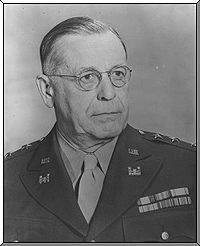 |
Colonel Colonel (United States) In the United States Army, Air Force, and Marine Corps, colonel is a senior field grade military officer rank just above the rank of lieutenant colonel and just below the rank of brigadier general... |
Eugene Reybold Eugene Reybold Eugene Reybold was distinguished as the World War II Chief of Engineers who directed the largest United States Army Corps of Engineers in the nation's history.... |
?? January 1919 | ||
| Brigadier General Brigadier general (United States) A brigadier general in the United States Army, Air Force, and Marine Corps, is a one-star general officer, with the pay grade of O-7. Brigadier general ranks above a colonel and below major general. Brigadier general is equivalent to the rank of rear admiral in the other uniformed... |
Richmond P. Davis | 28 April 1921 | 28 December 1922 | ||
| Brigadier General Brigadier general (United States) A brigadier general in the United States Army, Air Force, and Marine Corps, is a one-star general officer, with the pay grade of O-7. Brigadier general ranks above a colonel and below major general. Brigadier general is equivalent to the rank of rear admiral in the other uniformed... |
William Ruthven Smith William Ruthven Smith William Ruthven Smith was a career United States Army officer who commanded the 36th Infantry Division during its deployment in France during World War I and later became Superintendent of the United States Military Academy at West Point, New York.-Early life:William Ruthven Smith was born April... |
11 January 1923 | 20 December 1924 | ||
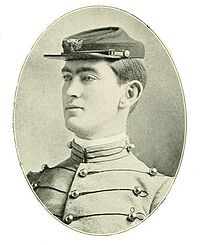 |
Brigadier General Brigadier general (United States) A brigadier general in the United States Army, Air Force, and Marine Corps, is a one-star general officer, with the pay grade of O-7. Brigadier general ranks above a colonel and below major general. Brigadier general is equivalent to the rank of rear admiral in the other uniformed... |
Robert Emmet Callan Robert Emmet Callan Major General Robert Emmet Callan was a distinguished United States Army Coast Artillery officer who served in the United States and overseas in places such as Puerto Rico, France and the Philippines. He saw frontline action in the Spanish–American War and World War I.-Early career:Callan was born... |
11 January 1924 | ?? June 1929 | |
| Brigadier General Brigadier general (United States) A brigadier general in the United States Army, Air Force, and Marine Corps, is a one-star general officer, with the pay grade of O-7. Brigadier general ranks above a colonel and below major general. Brigadier general is equivalent to the rank of rear admiral in the other uniformed... |
Henry D. Todd | ?? June 1929 | ?? September 1930 | ||
| Brigadier General Brigadier general (United States) A brigadier general in the United States Army, Air Force, and Marine Corps, is a one-star general officer, with the pay grade of O-7. Brigadier general ranks above a colonel and below major general. Brigadier general is equivalent to the rank of rear admiral in the other uniformed... |
Stanley Dunbar Embick Stanley Dunbar Embick Stanley Dunbar Embick was a Lieutenant General in the United States Army.Embick was born in Greencastle, Franklin County, Pennsylvania on January 22, 1877. He attended Dickinson College before enrolling at the United States Military Academy in West Point, New York, from which he graduated in 1899... |
01 October 1930 | 25 April 1932 | ||
| Brigadier General Brigadier general (United States) A brigadier general in the United States Army, Air Force, and Marine Corps, is a one-star general officer, with the pay grade of O-7. Brigadier general ranks above a colonel and below major general. Brigadier general is equivalent to the rank of rear admiral in the other uniformed... |
Joseph P. Tracy | 31 August 1932 | 01 December 1936 | ||
| Brigadier General Brigadier general (United States) A brigadier general in the United States Army, Air Force, and Marine Corps, is a one-star general officer, with the pay grade of O-7. Brigadier general ranks above a colonel and below major general. Brigadier general is equivalent to the rank of rear admiral in the other uniformed... |
John W. Gulick | 03 January 1937 | 12 October 1938 | ||
| Brigadier General Brigadier general (United States) A brigadier general in the United States Army, Air Force, and Marine Corps, is a one-star general officer, with the pay grade of O-7. Brigadier general ranks above a colonel and below major general. Brigadier general is equivalent to the rank of rear admiral in the other uniformed... |
Frederick H. Smith | 21 November 1938 | 01 October 1940 | ||
| Brigadier General Brigadier general (United States) A brigadier general in the United States Army, Air Force, and Marine Corps, is a one-star general officer, with the pay grade of O-7. Brigadier general ranks above a colonel and below major general. Brigadier general is equivalent to the rank of rear admiral in the other uniformed... |
Frank S. Clark | 10 October 1940 | 15 January 1942 | ||
| Brigadier General Brigadier general (United States) A brigadier general in the United States Army, Air Force, and Marine Corps, is a one-star general officer, with the pay grade of O-7. Brigadier general ranks above a colonel and below major general. Brigadier general is equivalent to the rank of rear admiral in the other uniformed... |
Lawrence B. Weeks | 15 January 1942 | 01 October 1945 | ||
| Brigadier General Brigadier general (United States) A brigadier general in the United States Army, Air Force, and Marine Corps, is a one-star general officer, with the pay grade of O-7. Brigadier general ranks above a colonel and below major general. Brigadier general is equivalent to the rank of rear admiral in the other uniformed... |
Robert T. Frederick Robert T. Frederick Robert Tryon Frederick was a highly decorated American combat commander during World War II, who commanded the 1st Special Service Force, the 1st Airborne Task Force and the 45th Infantry Division.-Career:... |
01 November 1945 | 19 August 1947 | ||
Fort Monroe and Fort Wool stood guard during World War I
World War I
World War I , which was predominantly called the World War or the Great War from its occurrence until 1939, and the First World War or World War I thereafter, was a major war centred in Europe that began on 28 July 1914 and lasted until 11 November 1918...
and World War II
World War II
World War II, or the Second World War , was a global conflict lasting from 1939 to 1945, involving most of the world's nations—including all of the great powers—eventually forming two opposing military alliances: the Allies and the Axis...
, and successfully protected Hampton Roads and the important military and civilian resources located inland.
By World War II, Fort Monroe served as headquarters for an impressive array of coast artillery guns ranging from 3-inch rapid fire guns to 16-inch guns capable of firing a 2,000 pound projectile 25 miles. In addition, the Army controlled submarine barriers and underwater mine fields. But this vast array of armaments was made largely obsolete by the end of the Second World War due to the development of the long-range bomber and the refinement of naval aviation.
After the operational armament was removed, Fort Monroe received a mission that it still maintains to this day. Since World War II, it has served as the major headquarters for training soldiers for war. In 1973, Fort Monroe became home to the United States Army Training and Doctrine Command
United States Army Training and Doctrine Command
Established 1 July 1973, the United States Army Training and Doctrine Command is an army command of the United States Army headquartered at Fort Eustis, Virginia. It is charged with overseeing training of Army forces, the development of operational doctrine, and the development and procurement of...
(TRADOC), which combines the recruitment, training and education of soldiers with the development of operational doctrine.
Base Realignment and Closure
The Department of DefenseUnited States Department of Defense
The United States Department of Defense is the U.S...
released a list on 13 May 2005 of military installations recommended for closure and/or realignment, among which is Fort Monroe. The list was approved by President George W. Bush
George W. Bush
George Walker Bush is an American politician who served as the 43rd President of the United States, from 2001 to 2009. Before that, he was the 46th Governor of Texas, having served from 1995 to 2000....
on 15 September 2005, and submitted to Congress. Congress failed to act within forty-five legislative days to disapprove the list in its entirety, and the BRAC recommendations subsequently became law. Installations on the BRAC list must close within six years.
Fort Monroe today
Within the 565 acres of Fort Monroe are 170 historic buildings and nearly 200 acres of natural resources, including 8 miles of waterfront, 3.2 miles of beaches on the Chesapeake BayChesapeake Bay
The Chesapeake Bay is the largest estuary in the United States. It lies off the Atlantic Ocean, surrounded by Maryland and Virginia. The Chesapeake Bay's drainage basin covers in the District of Columbia and parts of six states: New York, Pennsylvania, Delaware, Maryland, Virginia, and West...
, 110 acres of submerged lands and 85 acres of wetlands. It has a 332 slip marina and shallow water inlet access to Mill Creek, suitable for small watercraft.
Fort Monroe supports a daytime population of about 3,096, including 1,105 people in uniform, 1,991 civilian and contract employees, and about 814 family members residing on post. The major tenant unit is the United States Army Training and Doctrine Command
United States Army Training and Doctrine Command
Established 1 July 1973, the United States Army Training and Doctrine Command is an army command of the United States Army headquartered at Fort Eustis, Virginia. It is charged with overseeing training of Army forces, the development of operational doctrine, and the development and procurement of...
(TRADOC).
Fort Monroe has become a popular historical site. The Casemate Museum, opened in 1951, depicts the history of Fort Monroe and Old Point Comfort, with special emphasis on the Civil War
American Civil War
The American Civil War was a civil war fought in the United States of America. In response to the election of Abraham Lincoln as President of the United States, 11 southern slave states declared their secession from the United States and formed the Confederate States of America ; the other 25...
period. It offers a view of Confederate President Jefferson Davis
Jefferson Davis
Jefferson Finis Davis , also known as Jeff Davis, was an American statesman and leader of the Confederacy during the American Civil War, serving as President for its entire history. He was born in Kentucky to Samuel and Jane Davis...
' prison cell. Also shown are the quarters occupied by 1st Lt. Robert E. Lee
Robert E. Lee
Robert Edward Lee was a career military officer who is best known for having commanded the Confederate Army of Northern Virginia in the American Civil War....
in 1831–34, and the quarters where President Abraham Lincoln
Abraham Lincoln
Abraham Lincoln was the 16th President of the United States, serving from March 1861 until his assassination in April 1865. He successfully led his country through a great constitutional, military and moral crisis – the American Civil War – preserving the Union, while ending slavery, and...
was a guest in May, 1862. The quarters occupied by Robert E. Lee while stationed at Fort Monroe are still in use as military family housing.
Nearby, Fort Monroe's companion guardian of Hampton Roads, Fort Wool
Fort Wool
Fort Wool was the companion to Fort Monroe in protecting Hampton Roads from seafaring threats. This site was once the dumping place for ships’ ballast....
, located at Rip Raps
Rip Raps
Rip Raps is a small 15 acre artificial island at the mouth of the harbor area known as Hampton Roads in the independent city of Hampton in southeastern Virginia in the United States.-History:...
is also available for tours.
Note: Fort Wool is located adjacent to one of the man-made islands of the Hampton Roads Bridge-Tunnel
Hampton Roads Bridge-Tunnel
The Hampton Roads Bridge-Tunnel is the -long Hampton Roads crossing for Interstate 64 and U.S. Route 60. It is a four-lane facility comprising bridges, trestles, man-made islands, and tunnels under the main shipping channels for Hampton Roads harbor in the southeastern portion of Virginia in the...
and is accessible only by water. The availability of public tours of both Fort Wool and Fort Monroe are subject to Homeland Security
Homeland security
Homeland security is an umbrella term for security efforts to protect states against terrorist activity. Specifically, is a concerted national effort to prevent terrorist attacks within the U.S., reduce America’s vulnerability to terrorism, and minimize the damage and recover from attacks that do...
Alert conditions.
Redevelopment possibilities
The Fort Monroe Federal Area Development Authority (FMFADA) was established as a public body corporate and as a political subdivision of the Commonwealth of Virginia to serve as the official “Local Redevelopment Authority” (LRA) recognized by the Department of Defense. The task of the FMFADA commission is to study, plan and recommend the best use of the resources that will remain when the Army closes the fort in September 2011. The Fort Monroe Reuse Plan was officially adopted August, 2008 and planning updates are available on the FMFADA website.The FMFADA relies on the expertise of national consultants in the areas of BRAC law, environmental engineering, historic architecture and preservation planning, structural engineering, housing market analysis, commercial/retail analysis, public relations/marketing, and tourism planning.
The FMFADA was created by legislative action of the Virginia General Assembly in 2007. Virginia’s Department of Historic Resources and the Department of Environmental Quality have major regulatory authority that influences the work.
The state is taking a lead role in planning because most of the land that Fort Monroe occupies will revert to the Commonwealth when the Army closes the fort. The effort is guided by three priorities; keep Fort Monroe open to the public, respect the rich history and advance economic sustainability.
The Authority is an 18 member body consisting of appointees from the city of Hampton, the Virginia House of Delegates and Senate and the Virginia governor’s cabinet, with two specialists in historic preservation and heritage tourism.
Generally, surplus military installations are turned over to the respective states. Redevelopment will be facilitated by the fact that most of the land on which the fort stands was loaned by the state of Virginia to the federal government, and will revert to the state once Fort Monroe closes.
Virginia historically has given local government strong consideration in determining disposition at that point, such as occurred at Fort Pickett
Fort Pickett
Fort Pickett, Virginia, is a Virginia Army National Guard installation, located near the town of Blackstone, Virginia. It is named for the United States Army officer and Confederate General George Pickett.- Beginnings :...
in Nottoway County
Nottoway County, Virginia
As of the census of 2000, there were 15,725 people, 5,664 households, and 3,885 families residing in the county. The population density was 50 people per square mile . There were 6,373 housing units at an average density of 20 per square mile...
(near Blackstone
Blackstone, Virginia
Blackstone is a town in Nottoway County, Virginia, United States. The population was 3,675 at the 2000 census.-Geography:Blackstone is located at ....
) in the Southside region. Given the historic significance of the post, the decommissioned fort will be a good candidate for heritage tourism along with many other historical sites located throughout the greater Hampton Roads
Hampton Roads
Hampton Roads is the name for both a body of water and the Norfolk–Virginia Beach metropolitan area which surrounds it in southeastern Virginia, United States...
area. Redevelopment to help offset the economic loss of a base closure is usually a priority as well.
Fort Monroe is a National Historic Landmark and the moated fort and the 190 historic buildings on Old Point Comfort will be protected with historic preservation design guidelines for reuse. Old Point Comfort is prime development property and some mixed used new construction will be allowed within strict guidelines. For example, the historic Chamberlin Hotel has already been leased to a developer by the Army and beautifully renovated as retirement apartments.
The National Park Service and the Fort Monroe FADA are communicating to identify the best way to achieve a partnership and several options have been presented to the FMFADA board by the park service.
See also
- 2nd Air Defense Artillery Regiment (United States)2nd Air Defense Artillery Regiment (United States)The 2nd Air Defense Artillery Regiment is an air defense artillery regiment of the United States Army first formed in 1821.-Lineage:Constituted 1 June 1821 in the Regular Army as the 2nd Regiment of Artillery and organized from existing units with Headquarters at Baltimore, MarylandRegiment broken...
- 12th Coast Artillery (United States)12th Coast Artillery (United States)The 12th Coast Artillery Regiment was a Coast Artillery Regiment in the United States Army,-Lineage:Constituted 27 February 1924 as 12th Artillery Coast Artillery, and organized 1 July 1924 at Fort Monroe from the following Companies- 112th, 58th, 139th, 158th, 164th, 103rd, 166th, and 169th*...
- 51st Coast Artillery Regiment (United States)51st Coast Artillery Regiment (United States)The 51st Coast Artillery Regiment was a Coast Artillery Regiment in the United States Army-Lineage:Constituted in July 1917 under the designation of the 6th Provisional Regiment, Coast Artillery Corps at Fort Adams from the following Companies-...
- Chapel of the CenturionChapel of the CenturionThe Chapel of the Centurion is the oldest continually used wooden military structure for religious services in the United States. It is located inside Fort Monroe, a military installation located in Hampton, Virginia...
- Fort WoolFort WoolFort Wool was the companion to Fort Monroe in protecting Hampton Roads from seafaring threats. This site was once the dumping place for ships’ ballast....
- Sewell's PointSewell's PointSewells Point is a peninsula of land in the independent city of Norfolk, Virginia in the United States, located at the mouth of the salt-water port of Hampton Roads. Sewells Point is bordered by water on three sides, with Willoughby Bay to the north, Hampton Roads to the west, and the Lafayette...
- Battle of Hampton RoadsBattle of Hampton RoadsThe Battle of Hampton Roads, often referred to as either the Battle of the Monitor and Merrimack or the Battle of Ironclads, was the most noted and arguably most important naval battle of the American Civil War from the standpoint of the development of navies...
- United States Army Training and Doctrine CommandUnited States Army Training and Doctrine CommandEstablished 1 July 1973, the United States Army Training and Doctrine Command is an army command of the United States Army headquartered at Fort Eustis, Virginia. It is charged with overseeing training of Army forces, the development of operational doctrine, and the development and procurement of...
External links
- Fort Monroe official website
- Fort Monroe National Monument
- Fort Monroe During the Civil War in Encyclopedia Virginia
- Fort Monroe Federal Area Development Authority
- Fort Monroe, Fortress, Hampton, VA: 57 b&w photos, 1 color photo, at Historic American Building Survey
- Fort Monroe Installation Overview from ArmyUSA.org.
- GlobalSecurity.org Fort Monroe webpage
- Fort Monroe Casemate Museum
- TRADOC website
- U.S. Department of Defense website
- Site for Citizens for a Fort Monroe National Park (CFMNP.org)
- 2nd Regiment, United States Colored Cavalry
- 1st Regiment, United States Colored Cavalry
- Photograph from the Library of Congress collection
- Google Earth KML File
Archival Records
- "Fort Monroe Records at the Library of Virginia", at Virginia Memory
- fort monroe film clips http://www.criticalpast.com/stock-footage-video/fort-monroe
- The Big Picture http://www.youtube.com/watch?v=el4IYxv-bIk