


J.E.B. Stuart

Encyclopedia
James Ewell Brown "Jeb" Stuart (February 6, 1833 – May 12, 1864) was a U.S. Army
officer from Virginia
and a Confederate States Army
general during the American Civil War
. He was known to his friends as "Jeb", from the initials of his given names. Stuart was a cavalry
commander known for his mastery of reconnaissance and the use of cavalry in support of offensive operations. While he cultivated a cavalier image (red-lined gray cape, yellow sash, hat cocked to the side with a ostrich plume, red flower in his lapel, often sporting cologne), his serious work made him the trusted eyes and ears of Robert E. Lee
's army and inspired Southern morale.
Stuart graduated from West Point
in 1854 and served in Texas
and Kansas
with the U.S. Army, a veteran of the frontier conflicts with Native Americans and the violence of Bleeding Kansas
. He participated in the capture of John Brown
at Harpers Ferry
. Resigning when his home state of Virginia seceded
, he served first under Stonewall Jackson
in the Shenandoah Valley
, but then in increasingly important cavalry commands of the Army of Northern Virginia
, playing a role in all of that army's campaigns until his death. He established a reputation as an audacious cavalry commander and on two occasions (during the Peninsula Campaign
and the Maryland Campaign
) circumnavigated the Union
Army of the Potomac
, bringing fame to himself and embarrassment to the North
. At the Battle of Chancellorsville
, he distinguished himself as a temporary commander of the wounded Stonewall Jackson's infantry corps.
Arguably Stuart's most famous campaign, Gettysburg
, was marred when he was surprised by a Union cavalry attack at the Battle of Brandy Station
and by his separation from Lee's army for an extended period, leaving Lee unaware of Union troop movements and arguably contributing to the Confederate defeat at the Battle of Gettysburg
. Stuart received significant criticism from the Southern press as well as the postbellum proponents of the Lost Cause movement
, but historians have failed to agree on whether Stuart's exploit was entirely the fault of his judgment or simply bad luck and Lee's less-than-explicit orders.
During the 1864 Overland Campaign
, Union Maj. Gen.
Philip Sheridan
's cavalry launched an offensive to defeat Stuart, who was mortally wounded at the Battle of Yellow Tavern
.
, a plantation in Patrick County
, Virginia
, near the border with North Carolina
. He was the eighth of eleven children and the youngest of the five sons to survive past early age. His great grandfather, Major Alexander Stuart, commanded a regiment at the Battle of Guilford Court House
during the American Revolutionary War
. His father, Archibald Stuart
, was a War of 1812
veteran, slaveholder, attorney, and Democratic politician who represented Patrick County in both houses of the Virginia General Assembly
, and also served one term in the United States House of Representatives
. Archibald was a cousin of Alexander Hugh Holmes Stuart
. Elizabeth Letcher Pannill Stuart, Jeb's mother, who was known as a strict religious woman with a good sense for business, ran the family farm.
, and at the home of his aunt Anne (Archibald's sister) and her husband Judge James Ewell Brown (Stuart's namesake) at Danville
. He entered Emory and Henry College
when he was fifteen, and attended from 1848 to 1850.
During the summer of 1848, Stuart attempted to enlist in the U.S. Army, but was rejected as underaged. He obtained an appointment in 1850 to the United States Military Academy
at West Point, New York
, from Representative
Thomas Hamlet Averett
, the man who had defeated his father in the 1848 election. Stuart was a popular student and was happy at the Academy. Although not handsome in his teen years, his classmates called him by the nickname "Beauty", which they described as his "personal comeliness in inverse ratio to the term employed." He possessed a chin "so short and retiring as positively to disfigure his otherwise fine countenance." He quickly grew a beard after graduation and a fellow officer remarked that he was "the only man he ever saw that [a] beard improved."
Robert E. Lee was appointed superintendent of the Academy in 1852, and Stuart became friends with the Lee family, seeing them socially on frequent occasions. Lee's nephew, Fitzhugh Lee
, also arrived at the academy in 1852. In Stuart's final year, in addition to achieving the cadet rank of second captain of the corps, he was one of eight cadets designated as honorary "cavalry officers" for his skills in horsemanship. Stuart graduated 13th in his class of 46 in 1854. He ranked tenth in his class in cavalry tactics
. Although he enjoyed the civil engineering curriculum at the academy and did well in mathematics, his poor drawing skills hampered his engineering studies, and he finished 29th in that discipline. A Stuart family tradition says he deliberately degraded his academic performance in his final year to avoid service in the elite, but dull, Corps of Engineers
.
second lieutenant and assigned to the U.S. Mounted Rifles in Texas. After an arduous journey, he reached Fort Davis
on January 28, 1855, and was a leader for three months on scouting missions over the San Antonio to El Paso
Road. He was soon transferred to the newly formed 1st Cavalry Regiment (1855)
at Fort Leavenworth
, Kansas Territory
, where he became regimental quartermaster
and commissary officer under the command of Col.
Edwin V. Sumner
. He was promoted to first lieutenant in 1855.
Also in 1855, Stuart met Flora Cooke, the daughter of the commander of the 2nd U.S. Dragoon Regiment, Lieutenant Colonel
Philip St. George Cooke
. Burke Davis described Flora as "an accomplished horsewoman, and though not pretty, an effective charmer," to whom "Stuart succumbed with hardly a struggle." They became engaged in September, less than two months after meeting. Stuart humorously wrote of his rapid courtship in Latin
, "Veni, Vidi, Victus sum" (I came, I saw, I was conquered). Although a gala wedding was planned for Fort Riley
, Kansas
, the death of Stuart's father on September 20 caused a change of plans and the marriage on November 14 was small and limited to family witnesses. The couple owned two slaves until 1859, one inherited from his father's estate, the other purchased.
Stuart's leadership capabilities were soon recognized. He was a veteran of the frontier conflicts with Native Americans and the antebellum violence of Bleeding Kansas
. He was wounded on July 29, 1857, while fighting at Solomon River
, Kansas
, against the Cheyenne
. Col. Sumner ordered a charge with drawn sabers against a wave of Indian arrows. Scattering the warriors, Stuart and three other lieutenants chased one down, whom Stuart wounded in the thigh with his pistol. The Cheyenne turned and fired at Stuart with an old-fashioned pistol, striking him in the chest with a bullet, which did little more damage than to pierce the skin. Stuart returned in September to Fort Leavenworth and was reunited with his wife.
Their first child, a girl, had been born in 1856 but died the same day. On November 14, 1857, Flora gave birth to another daughter, whom the parents named Flora after her mother. The family relocated in early 1858 to Fort Riley, where they remained for three years.
In 1859, Stuart developed a new piece of cavalry equipment, for which he received patent
number 25,684 on October 4—a saber hook, or an "improved method of attaching sabers to belts." The U.S. government paid Stuart $5,000 for a "right to use" license and Stuart contracted with Knorr, Nece and Co. of Philadelphia to manufacture his hook. While in Washington, D.C.
, to discuss government contracts, and in conjunction with his application for an appointment into the quartermaster department, Stuart heard about John Brown
's raid on the U.S. Arsenal at Harpers Ferry
. Stuart volunteered to be aide-de-camp
to Col. Robert E. Lee and accompanied Lee with a company of U.S. Marines
from the Washington Navy Yard
and four companies of Maryland militia. While delivering Lee's written surrender ultimatum to the leader of the group, who had been calling himself Isaac Smith, Stuart recognized "Old Ossawatomie Brown" from his days in Kansas.
Stuart was promoted to captain on April 22, 1861, but resigned from the U.S. Army on May 3, 1861, to join the Confederate States Army
, following the secession
of Virginia. (His letter of resignation, sent from Cairo, Illinois
, was accepted by the War Department
on May 14.) Upon learning that his father-in-law, Col. Cooke, would remain in the U.S. Army during the coming war, Stuart wrote to his brother-in-law (future Confederate Brig. Gen. John Rogers Cooke
), "He will regret it but once, and that will be continuously." On June 26, 1860, Flora gave birth to a son, Philip St. George Cooke Stuart, but his father changed the name to James Ewell Brown Stuart, Jr. ("Jimmie"), in late 1861 out of disgust with his father-in-law.
of Virginia Infantry in the Confederate Army on May 10, 1861. Maj. Gen. Robert E. Lee, now commanding the armed forces of Virginia, ordered him to report to Colonel
Thomas J. Jackson
at Harper's Ferry. Jackson chose to ignore Stuart's infantry designation and assigned him on July 4 to command all the cavalry companies of the Army of the Shenandoah, organized as the 1st Virginia Cavalry Regiment
. He was promoted to colonel on July 16.
After early service in the Shenandoah Valley
, Stuart led his regiment in the First Battle of Bull Run
, and participated in the pursuit of the retreating Federals. He then commanded the Army's outposts along the upper Potomac River
until given command of the cavalry brigade for the army then known as the Army of the Potomac (later named the Army of Northern Virginia
). He was promoted to brigadier general on September 24, 1861.
began its Peninsula Campaign
against Richmond, Virginia
, and Stuart's cavalry brigade assisted Gen. Joseph E. Johnston
's army as it withdrew up the Virginia Peninsula
in the face of superior numbers. Stuart fought at the Battle of Williamsburg
, but in general the terrain and weather on the Peninsula did not lend themselves to cavalry operations. However, when Gen. Robert E. Lee became commander of the Army of Northern Virginia, he requested that Stuart perform reconnaissance to determine whether the right flank of the Union army was vulnerable. Stuart set out with 1,200 troopers on the morning of June 12 and, having determined that the flank was indeed vulnerable, took his men on a complete circumnavigation of the Union army, returning after 150 miles on July 15 with 165 captured Union soldiers, 260 horses and mules, and various quartermaster and ordnance supplies. His men met no serious opposition from the more decentralized Union cavalry, coincidentally commanded by his father-in-law, Col. Cooke. The maneuver was a public relations sensation and Stuart was greeted with flower petals thrown in his path at Richmond. He had become as famous as Stonewall Jackson
in the eyes of the Confederacy.
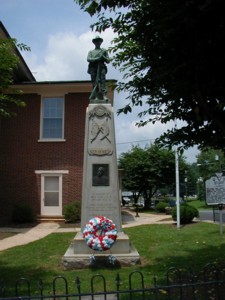 Early in the Northern Virginia Campaign
, Stuart was promoted to major general on July 25, 1862, and his command was upgraded to the Cavalry Division. He was nearly captured and lost his signature plumed hat and cloak to pursuing Federals during a raid in August, but in a retaliatory raid at Catlett's Station the following day, managed to overrun Union army commander Maj. Gen. John Pope's
headquarters, and not only captured Pope's full uniform, but also intercepted orders that provided Lee with valuable intelligence concerning reinforcements for Pope's army.
At the Second Battle of Bull Run
(Second Manassas), Stuart's cavalry followed the massive assault by Longstreet's infantry against Pope's army, protecting its flank with artillery batteries. Stuart ordered Brig. Gen. Beverly Robertson
's brigade to pursue the Federals and in a sharp fight against Brig. Gen. John Buford
's brigade, Col. Thomas T. Munford
's 2nd Virginia Cavalry
was overwhelmed until Stuart sent in two more regiments as reinforcements. Buford's men, many of whom were new to combat, retreated across Lewis's Ford and Stuart's troopers captured over 300 of them. Stuart's men harassed the retreating Union columns until the campaign ended at the Battle of Chantilly
.
of September 1862, Stuart's cavalry screened the army's movement north. He bears some responsibility for Robert E. Lee's lack of knowledge of the position and celerity of the pursuing Army of the Potomac under George B. McClellan. For a five-day period, Stuart rested his men and entertained local civilians at a gala ball at Urbana, Maryland
. His reports make no reference to intelligence gathering by his scouts or patrols. As the Union Army drew near to Lee's divided army, Stuart's men skirmished at various points on the approach to Frederick
and Stuart was not able to keep his brigades concentrated enough to resist the oncoming tide. He misjudged the Union routes of advance, ignorant of the Union force threatening Turner's Gap, and required assistance from the infantry of Maj. Gen. D.H. Hill
to defend the South Mountain
passes in the Battle of South Mountain
. His horse artillery bombarded the flank of the Union army as it opened its attack in the Battle of Antietam
. By mid-afternoon, Stonewall Jackson ordered Stuart to command a turning movement with his cavalry against the Union right flank and rear, which if successful would be followed up by an infantry attack from the West Woods. Stuart began probing the Union lines with more artillery barrages, which were answered with "murderous" counterbattery fire and the cavalry movement intended by Jackson was never launched.
After Lee's army had withdrawn back to Virginia, Stuart performed another of his audacious circumnavigations of the Army of the Potomac—120 miles in under 60 hours, from Leesburg, Virginia
, to as far north as Chambersburg
and Mercersburg, Pennsylvania—once again embarrassing his Union opponents and seizing horses and supplies, but at the expense of exhausted men and animals, without gaining much military advantage. Jubal Early
referred to it as "the greatest horse stealing expedition" that only "annoyed" the enemy. Stuart gave his friend Jackson a fine, new officer's tunic, trimmed with gold lace, commissioned from a Richmond tailor, which he thought would give Jackson more of the appearance of a proper general (something to which Jackson was notoriously indifferent).
McClellan pushed his army slowly south, urged by President Lincoln to pursue Lee, crossing the Potomac starting on October 26. As Lee began moving to counter this, Stuart screened Longstreet's Corps and skirmished numerous times in early November against Union cavalry and infantry around Mountville
, Aldie
, and Upperville
. On November 6, Stuart received sad news by telegram that his daughter Flora had died just before her fifth birthday of typhoid fever
on November 3.
, Stuart and his cavalry—most notably his horse artillery under Major John Pelham—protected Stonewall Jackson's flank at Hamilton's Crossing. General Lee commended his cavalry, which "effectually guarded our right, annoying the enemy and embarrassing his movements by hanging on his flank, and attacking when the opportunity occurred." Stuart reported to Flora the next day that he had been shot through his fur collar but was unhurt.
After Christmas, Lee ordered Stuart to conduct a raid north of the Rappahannock River to "penetrate the enemy's rear, ascertain if possible his position & movements, & inflict upon him such damage as circumstances will permit." Assigning 1,800 troopers and a horse artillery battery to the operation, Stuart's raid reached as far north as 4 miles south of Fairfax Court House
, seizing 250 prisoners, horses, mules, and supplies. Tapping telegraph lines, his signalmen
intercepted messages between Union commanders and Stuart sent a personal telegram to Union Quartermaster General Montgomery C. Meigs
, "General Meigs will in the future please furnish better mules; those you have furnished recently are very inferior."
On March 17, 1863, Stuart's cavalry clashed with a Union raiding party at Kelly's Ford
. The minor victory was marred by the death of Major Pelham, which caused Stuart profound grief, as he thought of him as close as a younger brother. He wrote to a Confederate Congressman, "The noble, the chivalric, the gallant Pelham is no more. ... Let the tears of agony we have shed, and the gloom of mourning throughout my command bear witness." Flora was pregnant at the time and Stuart told her that if it were a boy, he wanted him to be named John Pelham Stuart. (Virginia Pelham Stuart was born October 9.)
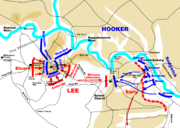 At the Battle of Chancellorsville
, Stuart accompanied Stonewall Jackson on his famous flanking march of May 2, 1863, and started to pursue the retreating soldiers of the Union XI Corps when he received word that both Jackson and his senior division commander, Maj. Gen. A.P. Hill, had been wounded. Hill, bypassing the next most senior infantry general in the corps, Brig. Gen. Robert E. Rodes
, sent a message ordering Stuart to take command of the Second Corps
. Although the delays associated with this change of command effectively ended the flanking attack the night of May 2, Stuart performed credibly as an infantry corps commander the following day, launching a strong and well-coordinated attack against the Union right flank at Chancellorsville. When Union troops abandoned Hazel Grove, Stuart had the presence of mind to quickly occupy it and bombard the Union positions with artillery. Stuart relinquished his infantry command on May 6 when Hill returned to duty. Stephen W. Sears
wrote:
Stonewall Jackson died on May 10 and Stuart was once again devastated by the loss of a close friend, telling his staff that the death was a "national calamity." Jackson's wife, Mary Anna, wrote to Stuart on August 1, thanking him for a note of sympathy: "I need not assure you of which you already know, that your friendship & admiration were cordially reciprocated by him. I have frequently heard him speak of Gen'l Stuart as one of his warm personal friends, & also express admiration for your Soldierly qualities."
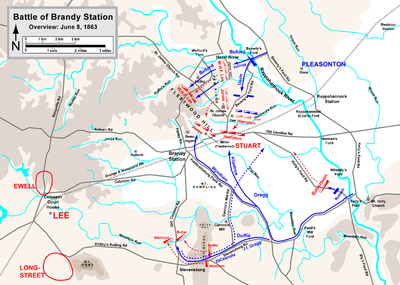 Returning to the cavalry for the Gettysburg Campaign
, Stuart endured the two low points in his career, starting with the Battle of Brandy Station
, the largest predominantly cavalry engagement of the war. By June 5, two of Lee's infantry corps were camped in and around Culpeper. Six miles northeast, holding the line of the Rappahannock River, Stuart bivouacked his cavalry troopers, mostly near Brandy Station, screening the Confederate Army against surprise by the enemy. Stuart requested a full field review of his troops by Gen. Lee. This grand review on June 5 included nearly 9,000 mounted troopers and 4 batteries of horse artillery, charging in simulated battle at Inlet Station, about two miles (3 km) southwest of Brandy Station.
Lee was not able to attend the review, however, so it was repeated in his presence on June 8, although the repeated performance was limited to a simple parade without battle simulations. Despite the lower level of activity, some of the cavalrymen and the newspaper reporters at the scene complained that all Stuart was doing was feeding his ego and exhausting the horses. Lee ordered Stuart to cross the Rappahannock the next day and raid Union forward positions, screening the Confederate Army from observation or interference as it moved north. Anticipating this imminent offensive action, Stuart ordered his tired troopers back into bivouac around Brandy Station.
Army of the Potomac commander Maj. Gen. Joseph Hooker
interpreted Stuart's presence around Culpeper to be indicative of preparations for a raid on his army's supply lines. In reaction to this, he ordered his cavalry commander, Maj. Gen. Alfred Pleasonton
, to take a combined arms
force of 8,000 cavalrymen and 3,000 infantry on a "spoiling raid" to "disperse and destroy" the 9,500 Confederates. Pleasanton's force crossed the Rappahannock in two columns on June 9, 1863, the first crossing at Beverly's Ford (Brig. Gen. John Buford
's division) catching Stuart by surprise, waking him and his staff to the sound of gunfire. The second crossing, at Kelly's Ford, surprised Stuart again, and the Confederates found themselves assaulted from front and rear in a spirited melee of mounted combat. A series of confusing charges and countercharges swept back and forth across Fleetwood Hill, which had been Stuart's headquarters the previous night. After 10 hours of fighting, Pleasonton ordered his men to withdraw across the Rappahannock.
Although Stuart claimed a victory because the Confederates held the field, Brandy Station is considered a tactical draw, and both sides came up short. Pleasonton was not able to disable Stuart's force at the start of an important campaign and he withdrew before finding the location of Lee's infantry nearby. However, the fact that the Southern cavalry had not detected the movement of two large columns of Union cavalry, and that they fell victim to a surprise attack, was an embarrassment that prompted serious criticism from fellow generals and the Southern press. The fight also revealed the increased competency of the Union cavalry, and foreshadowed the decline of the formerly invincible Southern mounted arm.
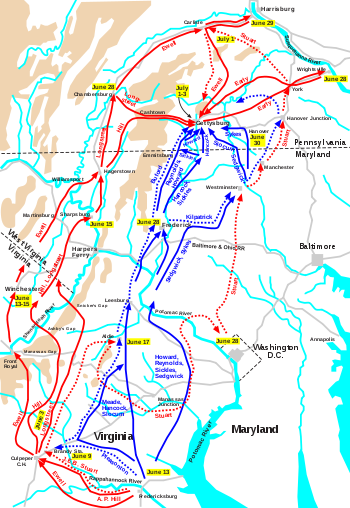 Following a series of small cavalry battles in June as Lee's army began marching north through the Shenandoah Valley, Stuart may have had in mind the glory of circumnavigating the enemy army once again, desiring to erase the stain on his reputation of the surprise at Brandy Station. General Lee gave orders to Stuart on June 22 on how he was to participate in the march north, and the exact nature of those orders has been argued by the participants and historians ever since, but the essence was that he was instructed to guard the mountain passes with part of his force while the Army of Northern Virginia was still south of the Potomac and that he was to cross the river with the remainder of the army and screen the right flank of Ewell's Second Corps. Instead of taking a direct route north near the Blue Ridge Mountains, however, Stuart chose to reach Ewell's flank by taking his three best brigades (those of Brig. Gen. Wade Hampton
, Brig. Gen. Fitzhugh Lee
, and Col. John R. Chambliss
, the latter replacing the wounded Brig. Gen. W.H.F. "Rooney" Lee
) between the Union army and Washington, moving north through Rockville
to Westminster
and on into Pennsylvania, hoping to capture supplies along the way and cause havoc near the enemy capital. Stuart and his three brigades departed Salem Depot
at 1 a.m. on June 25.
Unfortunately for Stuart's plan, the Union army's movement was underway and his proposed route was blocked by columns of Federal infantry, forcing him to veer farther to the east than either he or General Lee had anticipated. This prevented Stuart from linking up with Ewell as ordered and deprived Lee of the use of his prime cavalry force, the "eyes and ears" of the army, while advancing into unfamiliar enemy territory.
Stuart's command crossed the Potomac River at 3 a.m. on June 28. At Rockville they captured a wagon train of 140 brand-new, fully loaded wagons and mule teams. This wagon train would prove to be a logistical hindrance to Stuart's advance, but he interpreted Lee's orders as placing importance on gathering supplies. The proximity of the Confederate raiders provoked some consternation in the national capital and two Union cavalry brigades and an artillery battery were sent to pursue the Confederates. Stuart supposedly said that were it not for his fatigued horses "he would have marched down the 7th Street Road [and] took Abe & Cabinet prisoners."
In Westminster on June 29, his men clashed briefly with and overwhelmed two companies of Union cavalry, chasing them a long distance on the Baltimore road, which Stuart claimed caused a "great panic" in the city of Baltimore
. The head of Stuart's column encountered Brig. Gen. Judson Kilpatrick
's cavalry as it passed through Hanover
and scattered it on June 30; the Battle of Hanover
ended after Kilpatrick's men regrouped and drove the Confederates out of town. Stuart's brigades had been better positioned to guard their captured wagon train than to take advantage of the encounter with Kilpatrick. After a 20 mile trek in the dark, his exhausted men reached Dover
on the morning of July 1, as the Battle of Gettysburg
was commencing without them.
Stuart headed next for Carlisle
, hoping to find Ewell. He lobbed a few shells into town during the early evening of July 1 and burned the Carlisle Barracks
before withdrawing to the south towards Gettysburg. He and the bulk of his command reached Lee at Gettysburg the afternoon of July 2. He ordered Wade Hampton to cover the left rear of the Confederate battle lines, and Hampton fought with Brig. Gen. George Armstrong Custer
at the Battle of Hunterstown
before joining Stuart at Gettysburg.
wrote, "Although Lee said only, 'Well, General, you are here at last,' his manner implied rebuke, and it was so understood by Stuart.") On the final day of the battle, Stuart was ordered to get into the enemy's rear and disrupt its line of communications at the same time Pickett's Charge
was sent against the Union positions on Cemetery Ridge
, but his attack on East Cavalry Field was repulsed by Union cavalry under Brig. Gens. David Gregg
and George Custer
.
During the retreat from Gettysburg
, Stuart devoted his full attention to supporting the army's movement, successfully screening against aggressive Union cavalry pursuit and escorting thousands of wagons with wounded men and captured supplies over difficult roads and through inclement weather. Numerous skirmishes and minor battles occurred during the screening and delaying actions of the retreat. Stuart's men were the final units to cross the Potomac River, returning to Virginia in "wretched condition—completely worn out and broken down."
The Gettysburg Campaign was the most controversial of Stuart's career. He became one of the scapegoats (along with James Longstreet) blamed for Lee's loss at Gettysburg by proponents of the postbellum Lost Cause movement
, such as Jubal Early
. This was fueled in part by opinions of less partisan writers, such as Stuart's subordinate, Thomas L. Rosser
, who stated after the war that Stuart did, "on this campaign, undoubtedly, make the fatal blunder which lost us the battle of Gettysburg." In General Lee's report on the campaign, he wrote
One of the most forceful postbellum defenses of Stuart was by Col. John S. Mosby
, who had served under him during the campaign and was fiercely loyal to the late general, writing, "He made me all that I was in the war. ... But for his friendship I would never have been heard of." He wrote numerous articles for popular publications and published a book length treatise in 1908, a work that relied on his skills as a lawyer to refute categorically all of the claims laid against Stuart.
Modern scholarship remains divided on Stuart's culpability. Edward G. Longacre argues that Lee deliberately gave Stuart wide discretion in his orders and had no complaints about Stuart's tardy arrival at Gettysburg because he established no date by which the cavalry was required to link up with Ewell. The 3½ brigades of cavalry left with the main army were adequate for Lee to negotiate enemy territory safely and that his choice not to use these brigades effectively cannot be blamed on Stuart. Edwin B. Coddington refers to the "tragedy" of Stuart in the Gettysburg Campaign and judges that when Fitzhugh Lee raised the question of "whether Stuart exercised the discretion undoubtedly given to him, judiciously," the answer is no. Nevertheless, replying to historians who maintain that Stuart's absence permitted Lee to be surprised at Gettysburg, Coddington points out that the Union commander, Maj. Gen. George Meade
, was just as surprised, and the initial advantage lay with Lee. Eric J. Wittenberg and J. David Petruzzi have concluded that there was "plenty of blame to go around" and the fault should be divided between Stuart, the lack of specificity in Lee's orders, and Richard S. Ewell, who might have tried harder to link up with Stuart northeast of Gettysburg. Jeffry D. Wert acknowledges that Lee, his officers, and fighting by the Army of the Potomac bear the responsibility for the Confederate loss at Gettysburg, but states that "Stuart failed Lee and the army in the reckoning at Gettysburg. ... Lee trusted him and gave him discretion, but Stuart acted injudiciously."
Although Stuart was not reprimanded or disciplined in any official way for his role in the Gettysburg campaign, it is noteworthy that his appointment to corps command on September 9, 1863, did not carry with it a promotion to lieutenant general. Edward Bonekemper wrote that since all other corps commanders in the Army of Northern Virginia carried this rank, Lee's decision to keep Stuart at major general rank, while at the same time promoting Stuart's subordinates Wade Hampton
and Fitzhugh Lee
to major generals, could be considered an implied rebuke. Jeffry D. Wert wrote that there is no evidence Lee considered Stuart's performance during the Gettysburg Campaign and that it is "more likely that Lee thought the responsibilities in command of a cavalry corps did not equal those of an infantry corps."
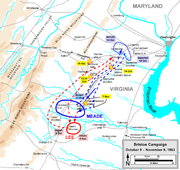 Lee reorganized his cavalry on September 9, creating a Cavalry Corps for Stuart with two divisions of three brigades each. In the Bristoe Campaign
, Stuart was assigned to lead a broad turning movement in an attempt to get into the enemy's rear, but General Meade skillfully withdrew his army without leaving opportunities to take advantage. On October 13, Stuart blundered into the rear guard of the Union III Corps near Warrenton
. Ewell's corps was sent to rescue him, but Stuart hid his troopers in a wooded ravine until the unsuspecting III Corps moved on, and the assistance was not necessary. As Meade withdrew towards Manassas Junction, brigades from the Union II Corps fought a rearguard action against Stuart's cavalry and the infantry of Brig. Gen. Harry Hays
's division near Auburn on October 14. Stuart's cavalry boldly bluffed Warren's infantry and escaped disaster. After the Confederate repulse at Bristoe Station
and an aborted advance on Centreville, Stuart's cavalry shielded the withdrawal of Lee's army from the vicinity of Manassas Junction. Judson Kilpatrick's Union cavalry pursued Stuart's cavalry along the Warrenton Turnpike
but were lured into an ambush near Chestnut Hill and routed. The Federal troopers were scattered and chased five miles (8 km) in an affair that came to be known as the "Buckland Races"
. The Southern press began to mute its criticism of Stuart's following his successful performance during the fall campaign.
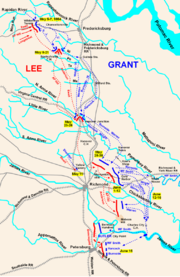 The Overland Campaign
, Lt. Gen.
Ulysses S. Grant
's offensive against Lee in the spring of 1864, began at the Battle of the Wilderness
, where Stuart aggressively pushed Thomas L. Rosser's Laurel Brigade into a fight against George Custer's better-armed Michigan Brigade, resulting in significant losses. General Lee sent a message to Stuart: "It is very important to save your Cavalry & not wear it out. ... You must use your good judgment to make any attack which may offer advantages." As the armies maneuvered toward their next confrontation at Spotsylvania Court House
, Stuart's cavalry fought delaying actions against the Union cavalry. His defense at Laurel Hill, also directing the infantry of Brig. Gen. Joseph B. Kershaw
, skillfully delayed the advance of the Federal army for nearly 5 critical hours.
, and his cavalry commander, Maj. Gen. Philip Sheridan
, quarreled about the Union cavalry's performance in the first two engagements of the Overland Campaign. Sheridan heatedly asserted that he wanted to "concentrate all of cavalry, move out in force against Stuart's command, and whip it." Meade reported the comments to Grant, who replied "Did Sheridan say that? Well, he generally knows what he is talking about. Let him start right out and do it." Sheridan immediately organized a raid against Confederate supply and railroad lines close to Richmond, which he knew would bring Stuart to battle.
Sheridan moved aggressively to the southeast, crossing the North Anna River
and seizing Beaver Dam Station on the Virginia Central Railroad
, where his men liberated a train carrying 3,000 Union prisoners and destroyed more than one million rations and medical supplies destined for Lee's army. Stuart dispatched a force of about 3,000 cavalrymen to intercept Sheridan's cavalry, which was more than three times their numbers. As he rode in pursuit, accompanied by his aide, Maj. Andrew R. Venable, they were able to stop briefly along the way to be greeted by Stuart's wife, Flora, and his children, Jimmie and Virginia. Venable wrote of Stuart, "He told me he never expected to live through the war, and that if we were conquered, that he did not want to live."
The Battle of Yellow Tavern
occurred May 11, at an abandoned inn located six miles (10 km) north of Richmond. The Confederate troopers tenaciously resisted from the low ridgeline bordering the road to Richmond, fighting for over three hours. A countercharge by the 1st Virginia Cavalry pushed the advancing Union troopers back from the hilltop as Stuart, on horseback, shouted encouragement while firing his revolver at the Union troopers. As the 5th Michigan Cavalry streamed in retreat past Stuart, a dismounted Union private, 48-year-old John A. Huff, turned and shot Stuart with his .44-caliber revolver from a distance of 10–30 yards.
Huff's bullet struck Stuart in the left side. It then sliced through his stomach and exited his back, 1 inch to the right of his spine. Stuart suffered great pain as an ambulance took him to Richmond to await his wife's arrival at the home of Dr. Charles Brewer, his brother-in-law. Stuart ordered his sword and spurs be given to his son. His last whispered words were: "I am resigned; God's will be done." He died at 7:38 p.m. on May 12, the following day, before Flora Stuart reached his side. He was 31 years old. Stuart was buried in Richmond's Hollywood Cemetery. Upon learning of Stuart's death, General Lee is reported to have said that he could hardly keep from weeping at the mere mention of Stuart's name and that Stuart had never given him a bad piece of information.
Flora wore the black of mourning for the remainder of her life, and never remarried. She lived in Saltville, Virginia
, for 15 years after the war, where she opened and taught at a school in a log cabin. She worked from 1880 to 1898 as principal of the Virginia Female Institute in Staunton, Virginia
, a position for which Robert E. Lee had recommended her. In 1907, the Institute was renamed Stuart Hall School
in her honor. Upon the death of her daughter Virginia, from complications in childbirth in 1898, Flora resigned from the Institute and moved to Norfolk, Virginia
, where she helped Virginia's widower, Robert Page Waller, in raising her grandchildren. She died in Norfolk on May 10, 1923, after striking her head in a fall on a city sidewalk. She is buried alongside her husband and their daughter, Little Flora, in Hollywood Cemetery in Richmond.
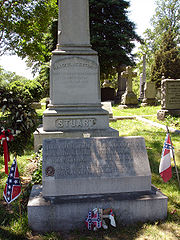 Like his intimate friend, Stonewall Jackson
, General J.E.B. Stuart was a legendary figure and is considered one of the greatest cavalry commanders in American history. His friend and West Point classmate, Union Maj. Gen. John Sedgwick
said that Stuart was "the greatest cavalry officer ever foaled in America." Jackson and Stuart, both of whom were killed in battle, had colorful public images, although the latter seems to have been more deliberately crafted. Jeffry D. Wert
wrote about Stuart:
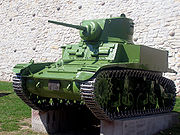 A statue of General J.E.B. Stuart by sculptor Frederick Moynihan
was dedicated on Richmond's famed Monument Avenue
at Stuart Circle in 1907. Like General Stonewall Jackson, his equestrian statue faces north, indicating that he died in the war. In 1884 the town of Taylorsville, Virginia, was renamed Stuart
. The British Army
named two models of American-made World War II
tanks, the M3 and M5, the Stuart tank in General Stuart's honor. A high school in Falls Church, Virginia
and a middle school in Jacksonville, Florida
are named for him.
In December 2006, a personal Confederate battle flag, sewn by Flora Stuart, was sold in a Heritage
Auction for a world-record price for any Confederate flag, for $956,000 (including buyer's premium). The 34-inch by 34-inch flag was hand-sewn for Stuart by Flora in 1862 and Stuart carried it into some of his most famous battles. However, in December of that year it fell from a tent front into a campfire and was damaged. Stuart returned it to his wife with a letter describing the accident and telling of his despondency over the banner's damage. The flag remained with the Stuart family until 1969 when it was given to Stuart Hall, Staunton, Virginia, by a granddaughter of the Confederate general. The school quietly sold the flag and letter to a private collector in 2000. In 2006, the flag and letter, which had been displayed in a single frame in the Stuart Hall front parlor, were sold separately at auction.
Stuart's birthplace, Laurel Hill, located in Patrick County, Virginia
, was purchased by the J.E.B. Stuart Birthplace Preservation Trust, Inc., in 1992 to preserve and interpret it.
, featuring "The Haunted Tank
", published by DC Comics
from the 1960s through the late 1980s, the ghost of General Stuart guided a tank crew (the tank being, at first, a Stuart, later a Sherman) commanded by his namesake "Lt. Jeb Stuart."
Joseph Fuqua
played Stuart in the films Gettysburg and Gods and Generals
.
Stuart, along with his warhorse Skylark, is featured prominently in the novel Traveller
by Richard Adams
.
Errol Flynn
played Stuart in the movie Santa Fe Trail
, depicting his antebellum life, confronting John Brown in Kansas and at Harper's Ferry. The movie has become infamous for its many historical inaccuracies, one of which was that Stuart, George Armstrong Custer
, and Philip Sheridan
were firm friends and all attended West Point together in 1854.
In the 1988 alternate history novel Gray Victory
, author Robert Skimin
depicts Stuart surviving his wound from the battle of Yellow Tavern. After the war, in which the Confederacy emerges victorious, he faces a court of inquiry over his actions at the battle of Gettysburg.
In the alternate-history novel How Few Remain
by Harry Turtledove
, Stuart is the commanding Confederate general in charge of the occupation and defense of the recently purchased Mexican
provinces of Sonora
and Chihuahua in 1881.
United States Army
The United States Army is the main branch of the United States Armed Forces responsible for land-based military operations. It is the largest and oldest established branch of the U.S. military, and is one of seven U.S. uniformed services...
officer from Virginia
Virginia
The Commonwealth of Virginia , is a U.S. state on the Atlantic Coast of the Southern United States. Virginia is nicknamed the "Old Dominion" and sometimes the "Mother of Presidents" after the eight U.S. presidents born there...
and a Confederate States Army
Confederate States Army
The Confederate States Army was the army of the Confederate States of America while the Confederacy existed during the American Civil War. On February 8, 1861, delegates from the seven Deep South states which had already declared their secession from the United States of America adopted the...
general during the American Civil War
American Civil War
The American Civil War was a civil war fought in the United States of America. In response to the election of Abraham Lincoln as President of the United States, 11 southern slave states declared their secession from the United States and formed the Confederate States of America ; the other 25...
. He was known to his friends as "Jeb", from the initials of his given names. Stuart was a cavalry
Cavalry
Cavalry or horsemen were soldiers or warriors who fought mounted on horseback. Cavalry were historically the third oldest and the most mobile of the combat arms...
commander known for his mastery of reconnaissance and the use of cavalry in support of offensive operations. While he cultivated a cavalier image (red-lined gray cape, yellow sash, hat cocked to the side with a ostrich plume, red flower in his lapel, often sporting cologne), his serious work made him the trusted eyes and ears of Robert E. Lee
Robert E. Lee
Robert Edward Lee was a career military officer who is best known for having commanded the Confederate Army of Northern Virginia in the American Civil War....
's army and inspired Southern morale.
Stuart graduated from West Point
United States Military Academy
The United States Military Academy at West Point is a four-year coeducational federal service academy located at West Point, New York. The academy sits on scenic high ground overlooking the Hudson River, north of New York City...
in 1854 and served in Texas
Texas
Texas is the second largest U.S. state by both area and population, and the largest state by area in the contiguous United States.The name, based on the Caddo word "Tejas" meaning "friends" or "allies", was applied by the Spanish to the Caddo themselves and to the region of their settlement in...
and Kansas
Kansas
Kansas is a US state located in the Midwestern United States. It is named after the Kansas River which flows through it, which in turn was named after the Kansa Native American tribe, which inhabited the area. The tribe's name is often said to mean "people of the wind" or "people of the south...
with the U.S. Army, a veteran of the frontier conflicts with Native Americans and the violence of Bleeding Kansas
Bleeding Kansas
Bleeding Kansas, Bloody Kansas or the Border War, was a series of violent events, involving anti-slavery Free-Staters and pro-slavery "Border Ruffian" elements, that took place in the Kansas Territory and the western frontier towns of the U.S. state of Missouri roughly between 1854 and 1858...
. He participated in the capture of John Brown
John Brown (abolitionist)
John Brown was an American revolutionary abolitionist, who in the 1850s advocated and practiced armed insurrection as a means to abolish slavery in the United States. He led the Pottawatomie Massacre during which five men were killed, in 1856 in Bleeding Kansas, and made his name in the...
at Harpers Ferry
Harpers Ferry, West Virginia
Harpers Ferry is a historic town in Jefferson County, West Virginia, United States. In many books the town is called "Harper's Ferry" with an apostrophe....
. Resigning when his home state of Virginia seceded
Secession
Secession is the act of withdrawing from an organization, union, or especially a political entity. Threats of secession also can be a strategy for achieving more limited goals.-Secession theory:...
, he served first under Stonewall Jackson
Stonewall Jackson
ຄຽשת״ׇׂׂׂׂ֣|birth_place= Clarksburg, Virginia |death_place=Guinea Station, Virginia|placeofburial=Stonewall Jackson Memorial CemeteryLexington, Virginia|placeofburial_label= Place of burial|image=...
in the Shenandoah Valley
Shenandoah Valley
The Shenandoah Valley is both a geographic valley and cultural region of western Virginia and West Virginia in the United States. The valley is bounded to the east by the Blue Ridge Mountains, to the west by the eastern front of the Ridge-and-Valley Appalachians , to the north by the Potomac River...
, but then in increasingly important cavalry commands of the Army of Northern Virginia
Army of Northern Virginia
The Army of Northern Virginia was the primary military force of the Confederate States of America in the Eastern Theater of the American Civil War, as well as the primary command structure of the Department of Northern Virginia. It was most often arrayed against the Union Army of the Potomac...
, playing a role in all of that army's campaigns until his death. He established a reputation as an audacious cavalry commander and on two occasions (during the Peninsula Campaign
Peninsula Campaign
The Peninsula Campaign of the American Civil War was a major Union operation launched in southeastern Virginia from March through July 1862, the first large-scale offensive in the Eastern Theater. The operation, commanded by Maj. Gen. George B...
and the Maryland Campaign
Maryland Campaign
The Maryland Campaign, or the Antietam Campaign is widely considered one of the major turning points of the American Civil War. Confederate Gen. Robert E. Lee's first invasion of the North was repulsed by Maj. Gen. George B...
) circumnavigated the Union
Union Army
The Union Army was the land force that fought for the Union during the American Civil War. It was also known as the Federal Army, the U.S. Army, the Northern Army and the National Army...
Army of the Potomac
Army of the Potomac
The Army of the Potomac was the major Union Army in the Eastern Theater of the American Civil War.-History:The Army of the Potomac was created in 1861, but was then only the size of a corps . Its nucleus was called the Army of Northeastern Virginia, under Brig. Gen...
, bringing fame to himself and embarrassment to the North
Northern United States
Northern United States, also sometimes the North, may refer to:* A particular grouping of states or regions of the United States of America. The United States Census Bureau divides some of the northernmost United States into the Midwest Region and the Northeast Region...
. At the Battle of Chancellorsville
Battle of Chancellorsville
The Battle of Chancellorsville was a major battle of the American Civil War, and the principal engagement of the Chancellorsville Campaign. It was fought from April 30 to May 6, 1863, in Spotsylvania County, Virginia, near the village of Chancellorsville. Two related battles were fought nearby on...
, he distinguished himself as a temporary commander of the wounded Stonewall Jackson's infantry corps.
Arguably Stuart's most famous campaign, Gettysburg
Gettysburg Campaign
The Gettysburg Campaign was a series of battles fought in June and July 1863, during the American Civil War. After his victory in the Battle of Chancellorsville, Confederate General Robert E. Lee's Army of Northern Virginia moved north for offensive operations in Maryland and Pennsylvania. The...
, was marred when he was surprised by a Union cavalry attack at the Battle of Brandy Station
Battle of Brandy Station
The Battle of Brandy Station, also called the Battle of Fleetwood Hill, was the largest predominantly cavalry engagement of the American Civil War, as well as the largest to take place ever on American soil. It was fought at the beginning of the Gettysburg Campaign by the Union cavalry under Maj....
and by his separation from Lee's army for an extended period, leaving Lee unaware of Union troop movements and arguably contributing to the Confederate defeat at the Battle of Gettysburg
Battle of Gettysburg
The Battle of Gettysburg , was fought July 1–3, 1863, in and around the town of Gettysburg, Pennsylvania. The battle with the largest number of casualties in the American Civil War, it is often described as the war's turning point. Union Maj. Gen. George Gordon Meade's Army of the Potomac...
. Stuart received significant criticism from the Southern press as well as the postbellum proponents of the Lost Cause movement
Lost Cause of the Confederacy
The Lost Cause is the name commonly given to an American literary and intellectual movement that sought to reconcile the traditional white society of the U.S. South to the defeat of the Confederate States of America in the American Civil War of 1861–1865...
, but historians have failed to agree on whether Stuart's exploit was entirely the fault of his judgment or simply bad luck and Lee's less-than-explicit orders.
During the 1864 Overland Campaign
Overland Campaign
The Overland Campaign, also known as Grant's Overland Campaign and the Wilderness Campaign, was a series of battles fought in Virginia during May and June 1864, in the American Civil War. Lt. Gen. Ulysses S. Grant, general-in-chief of all Union armies, directed the actions of the Army of the...
, Union Maj. Gen.
Major general (United States)
In the United States Army, United States Marine Corps, and United States Air Force, major general is a two-star general-officer rank, with the pay grade of O-8. Major general ranks above brigadier general and below lieutenant general...
Philip Sheridan
Philip Sheridan
Philip Henry Sheridan was a career United States Army officer and a Union general in the American Civil War. His career was noted for his rapid rise to major general and his close association with Lt. Gen. Ulysses S...
's cavalry launched an offensive to defeat Stuart, who was mortally wounded at the Battle of Yellow Tavern
Battle of Yellow Tavern
The Battle of Yellow Tavern was fought on May 11, 1864, as part of the Overland Campaign of the American Civil War. Union cavalry under Maj. Gen. Philip Sheridan was detached from the Army of the Potomac to conduct a raid on Richmond, Virginia, and challenge legendary Confederate cavalry...
.
Early life
Stuart was born at Laurel Hill FarmLaurel Hill Farm
Laurel Hill Farm is a private park in Ararat, Virginia. The birthplace of James Ewell Brown "Jeb" Stuart, seventy-five acres of the owned by the Stuart Family was saved in 1992 by the J. E. B. Stuart Birthplace Preservation Trust. This organization founded by Historian and Author Thomas D...
, a plantation in Patrick County
Patrick County, Virginia
Patrick County is a county located in the Commonwealth of Virginia. As of 2010, the population was 18,490. Its county seat is Stuart. It is located within both the rolling hills and valleys of the Piedmont Region of Virginia and mountainous Southwest Virginia....
, Virginia
Virginia
The Commonwealth of Virginia , is a U.S. state on the Atlantic Coast of the Southern United States. Virginia is nicknamed the "Old Dominion" and sometimes the "Mother of Presidents" after the eight U.S. presidents born there...
, near the border with North Carolina
North Carolina
North Carolina is a state located in the southeastern United States. The state borders South Carolina and Georgia to the south, Tennessee to the west and Virginia to the north. North Carolina contains 100 counties. Its capital is Raleigh, and its largest city is Charlotte...
. He was the eighth of eleven children and the youngest of the five sons to survive past early age. His great grandfather, Major Alexander Stuart, commanded a regiment at the Battle of Guilford Court House
Battle of Guilford Court House
The Battle of Guilford Court House was a battle fought on March 15, 1781 in Greensboro, the county seat of Guilford County, North Carolina, during the American Revolutionary War...
during the American Revolutionary War
American Revolutionary War
The American Revolutionary War , the American War of Independence, or simply the Revolutionary War, began as a war between the Kingdom of Great Britain and thirteen British colonies in North America, and ended in a global war between several European great powers.The war was the result of the...
. His father, Archibald Stuart
Archibald Stuart
Archibald Stuart was a nineteenth century politician and lawyer from Virginia. He was the first cousin of Alexander Hugh Holmes Stuart and the father of Confederate General James Ewell Brown "Jeb" Stuart....
, was a War of 1812
War of 1812
The War of 1812 was a military conflict fought between the forces of the United States of America and those of the British Empire. The Americans declared war in 1812 for several reasons, including trade restrictions because of Britain's ongoing war with France, impressment of American merchant...
veteran, slaveholder, attorney, and Democratic politician who represented Patrick County in both houses of the Virginia General Assembly
Virginia General Assembly
The Virginia General Assembly is the legislative body of the Commonwealth of Virginia, and the oldest legislative body in the Western Hemisphere, established on July 30, 1619. The General Assembly is a bicameral body consisting of a lower house, the Virginia House of Delegates, with 100 members,...
, and also served one term in the United States House of Representatives
United States House of Representatives
The United States House of Representatives is one of the two Houses of the United States Congress, the bicameral legislature which also includes the Senate.The composition and powers of the House are established in Article One of the Constitution...
. Archibald was a cousin of Alexander Hugh Holmes Stuart
Alexander Hugh Holmes Stuart
Alexander Hugh Holmes Stuart was a U.S. political figure. Stuart served as the Secretary of the Interior between 1850 and 1853.-Early years:...
. Elizabeth Letcher Pannill Stuart, Jeb's mother, who was known as a strict religious woman with a good sense for business, ran the family farm.
Education
Stuart was educated at home by his mother and tutors until the age of twelve, when he left Laurel Hill to be educated by various teachers in Wytheville, VirginiaWytheville, Virginia
Wytheville is a town in Wythe County, Virginia, United States. The population was 8,211 at the 2010 census. It is the county seat of Wythe County. The town is home to a Chautauqua Festival, held the third weekend in June every year since 1985...
, and at the home of his aunt Anne (Archibald's sister) and her husband Judge James Ewell Brown (Stuart's namesake) at Danville
Danville, Virginia
Danville is an independent city in Virginia, United States, bounded by Pittsylvania County, Virginia and Caswell County, North Carolina. It was the last capital of the Confederate States of America. The Bureau of Economic Analysis combines the city of Danville with Pittsylvania county for...
. He entered Emory and Henry College
Emory and Henry College
Emory & Henry College, known as E&H, Emory, or the College, is a private liberal arts college located in Emory, Virginia, United States. The campus comprises of Washington County, Virginia, which is part of the mountain region of Southwest Virginia...
when he was fifteen, and attended from 1848 to 1850.
During the summer of 1848, Stuart attempted to enlist in the U.S. Army, but was rejected as underaged. He obtained an appointment in 1850 to the United States Military Academy
United States Military Academy
The United States Military Academy at West Point is a four-year coeducational federal service academy located at West Point, New York. The academy sits on scenic high ground overlooking the Hudson River, north of New York City...
at West Point, New York
West Point, New York
West Point is a federal military reservation established by President of the United States Thomas Jefferson in 1802. It is a census-designated place located in Town of Highlands in Orange County, New York, United States. The population was 7,138 at the 2000 census...
, from Representative
United States House of Representatives
The United States House of Representatives is one of the two Houses of the United States Congress, the bicameral legislature which also includes the Senate.The composition and powers of the House are established in Article One of the Constitution...
Thomas Hamlet Averett
Thomas H. Averett
Thomas Hamlet Averett was a U.S. Representative from Virginia.Born near Halifax, Virginia, Averett attended the common schools.He served as a drummer boy in the War of 1812.He studied medicine....
, the man who had defeated his father in the 1848 election. Stuart was a popular student and was happy at the Academy. Although not handsome in his teen years, his classmates called him by the nickname "Beauty", which they described as his "personal comeliness in inverse ratio to the term employed." He possessed a chin "so short and retiring as positively to disfigure his otherwise fine countenance." He quickly grew a beard after graduation and a fellow officer remarked that he was "the only man he ever saw that [a] beard improved."
Robert E. Lee was appointed superintendent of the Academy in 1852, and Stuart became friends with the Lee family, seeing them socially on frequent occasions. Lee's nephew, Fitzhugh Lee
Fitzhugh Lee
Fitzhugh Lee , nephew of Robert E. Lee, was a Confederate cavalry general in the American Civil War, the 40th Governor of Virginia, diplomat, and United States Army general in the Spanish-American War.-Early life:...
, also arrived at the academy in 1852. In Stuart's final year, in addition to achieving the cadet rank of second captain of the corps, he was one of eight cadets designated as honorary "cavalry officers" for his skills in horsemanship. Stuart graduated 13th in his class of 46 in 1854. He ranked tenth in his class in cavalry tactics
Cavalry tactics
For much of history , humans have used some form of cavalry for war. Cavalry tactics have evolved over time...
. Although he enjoyed the civil engineering curriculum at the academy and did well in mathematics, his poor drawing skills hampered his engineering studies, and he finished 29th in that discipline. A Stuart family tradition says he deliberately degraded his academic performance in his final year to avoid service in the elite, but dull, Corps of Engineers
United States Army Corps of Engineers
The United States Army Corps of Engineers is a federal agency and a major Army command made up of some 38,000 civilian and military personnel, making it the world's largest public engineering, design and construction management agency...
.
United States Army
Stuart was commissioned a brevetBrevet (military)
In many of the world's military establishments, brevet referred to a warrant authorizing a commissioned officer to hold a higher rank temporarily, but usually without receiving the pay of that higher rank except when actually serving in that role. An officer so promoted may be referred to as being...
second lieutenant and assigned to the U.S. Mounted Rifles in Texas. After an arduous journey, he reached Fort Davis
Fort Davis National Historic Site
Fort Davis National Historic Site is a United States National Historic Site located in unincorporated Jeff Davis County, Texas. Located within the Davis Mountains of West Texas, the historic site was established in 1961 to protect one of the best remaining examples of a United States Army fort in...
on January 28, 1855, and was a leader for three months on scouting missions over the San Antonio to El Paso
El Paso, Texas
El Paso, is a city in and the county seat of El Paso County, Texas, United States, and lies in far West Texas. In the 2010 census, the city had a population of 649,121. It is the sixth largest city in Texas and the 19th largest city in the United States...
Road. He was soon transferred to the newly formed 1st Cavalry Regiment (1855)
1st Cavalry Regiment (1855)
1st Cavalry Regiment was a unit of the United States Army, and was the first US Army unit to be designated "Cavalry". Previously, mounted riflemen were called “Dragoons”. In 1833 the "First Regiment of Dragoons" was formed and soon after that the "Second Regiment of Dragoons"...
at Fort Leavenworth
Fort Leavenworth
Fort Leavenworth is a United States Army facility located in Leavenworth County, Kansas, immediately north of the city of Leavenworth in the upper northeast portion of the state. It is the oldest active United States Army post west of Washington, D.C. and has been in operation for over 180 years...
, Kansas Territory
Kansas Territory
The Territory of Kansas was an organized incorporated territory of the United States that existed from May 30, 1854, until January 29, 1861, when the eastern portion of the territory was admitted to the Union as the State of Kansas....
, where he became regimental quartermaster
Quartermaster
Quartermaster refers to two different military occupations depending on if the assigned unit is land based or naval.In land armies, especially US units, it is a term referring to either an individual soldier or a unit who specializes in distributing supplies and provisions to troops. The senior...
and commissary officer under the command of Col.
Colonel (United States)
In the United States Army, Air Force, and Marine Corps, colonel is a senior field grade military officer rank just above the rank of lieutenant colonel and just below the rank of brigadier general...
Edwin V. Sumner
Edwin Vose Sumner
Edwin Vose Sumner was a career United States Army officer who became a Union Army general and the oldest field commander of any Army Corps on either side during the American Civil War...
. He was promoted to first lieutenant in 1855.
Also in 1855, Stuart met Flora Cooke, the daughter of the commander of the 2nd U.S. Dragoon Regiment, Lieutenant Colonel
Lieutenant Colonel (United States)
In the United States Army, United States Air Force, and United States Marine Corps, a lieutenant colonel is a field grade military officer rank just above the rank of major and just below the rank of colonel. It is equivalent to the naval rank of commander in the other uniformed services.The pay...
Philip St. George Cooke
Philip St. George Cooke
Philip St. George Cooke was a career United States Army cavalry officer who served as a Union General in the American Civil War. He is noted for his authorship of an Army cavalry manual, and is sometimes called the "Father of the U.S...
. Burke Davis described Flora as "an accomplished horsewoman, and though not pretty, an effective charmer," to whom "Stuart succumbed with hardly a struggle." They became engaged in September, less than two months after meeting. Stuart humorously wrote of his rapid courtship in Latin
Latin
Latin is an Italic language originally spoken in Latium and Ancient Rome. It, along with most European languages, is a descendant of the ancient Proto-Indo-European language. Although it is considered a dead language, a number of scholars and members of the Christian clergy speak it fluently, and...
, "Veni, Vidi, Victus sum" (I came, I saw, I was conquered). Although a gala wedding was planned for Fort Riley
Fort Riley
Fort Riley is a United States Army installation located in Northeast Kansas, on the Kansas River, between Junction City and Manhattan. The Fort Riley Military Reservation covers 100,656 acres in Geary and Riley counties and includes two census-designated places: Fort Riley North and Fort...
, Kansas
Kansas
Kansas is a US state located in the Midwestern United States. It is named after the Kansas River which flows through it, which in turn was named after the Kansa Native American tribe, which inhabited the area. The tribe's name is often said to mean "people of the wind" or "people of the south...
, the death of Stuart's father on September 20 caused a change of plans and the marriage on November 14 was small and limited to family witnesses. The couple owned two slaves until 1859, one inherited from his father's estate, the other purchased.
Stuart's leadership capabilities were soon recognized. He was a veteran of the frontier conflicts with Native Americans and the antebellum violence of Bleeding Kansas
Bleeding Kansas
Bleeding Kansas, Bloody Kansas or the Border War, was a series of violent events, involving anti-slavery Free-Staters and pro-slavery "Border Ruffian" elements, that took place in the Kansas Territory and the western frontier towns of the U.S. state of Missouri roughly between 1854 and 1858...
. He was wounded on July 29, 1857, while fighting at Solomon River
Solomon River
The Solomon River, often referred to as the "Solomon Fork", is a river in the central Great Plains of North America. The entire length of the river lies in the U.S. state of Kansas. It is a tributary of the Smoky Hill River.-Names:...
, Kansas
Kansas
Kansas is a US state located in the Midwestern United States. It is named after the Kansas River which flows through it, which in turn was named after the Kansa Native American tribe, which inhabited the area. The tribe's name is often said to mean "people of the wind" or "people of the south...
, against the Cheyenne
Cheyenne
Cheyenne are a Native American people of the Great Plains, who are of the Algonquian language family. The Cheyenne Nation is composed of two united tribes, the Só'taeo'o and the Tsétsêhéstâhese .The Cheyenne are thought to have branched off other tribes of Algonquian stock inhabiting lands...
. Col. Sumner ordered a charge with drawn sabers against a wave of Indian arrows. Scattering the warriors, Stuart and three other lieutenants chased one down, whom Stuart wounded in the thigh with his pistol. The Cheyenne turned and fired at Stuart with an old-fashioned pistol, striking him in the chest with a bullet, which did little more damage than to pierce the skin. Stuart returned in September to Fort Leavenworth and was reunited with his wife.
Their first child, a girl, had been born in 1856 but died the same day. On November 14, 1857, Flora gave birth to another daughter, whom the parents named Flora after her mother. The family relocated in early 1858 to Fort Riley, where they remained for three years.
In 1859, Stuart developed a new piece of cavalry equipment, for which he received patent
United States patent law
United States patent law was established "to promote the Progress of Science and useful Arts, by securing for limited Times to Authors and Inventors the exclusive Right to their respective Writings and Discoveries;" as provided by the United States Constitution. Congress implemented these...
number 25,684 on October 4—a saber hook, or an "improved method of attaching sabers to belts." The U.S. government paid Stuart $5,000 for a "right to use" license and Stuart contracted with Knorr, Nece and Co. of Philadelphia to manufacture his hook. While in Washington, D.C.
Washington, D.C.
Washington, D.C., formally the District of Columbia and commonly referred to as Washington, "the District", or simply D.C., is the capital of the United States. On July 16, 1790, the United States Congress approved the creation of a permanent national capital as permitted by the U.S. Constitution....
, to discuss government contracts, and in conjunction with his application for an appointment into the quartermaster department, Stuart heard about John Brown
John Brown (abolitionist)
John Brown was an American revolutionary abolitionist, who in the 1850s advocated and practiced armed insurrection as a means to abolish slavery in the United States. He led the Pottawatomie Massacre during which five men were killed, in 1856 in Bleeding Kansas, and made his name in the...
's raid on the U.S. Arsenal at Harpers Ferry
Harpers Ferry, West Virginia
Harpers Ferry is a historic town in Jefferson County, West Virginia, United States. In many books the town is called "Harper's Ferry" with an apostrophe....
. Stuart volunteered to be aide-de-camp
Aide-de-camp
An aide-de-camp is a personal assistant, secretary, or adjutant to a person of high rank, usually a senior military officer or a head of state...
to Col. Robert E. Lee and accompanied Lee with a company of U.S. Marines
United States Marine Corps
The United States Marine Corps is a branch of the United States Armed Forces responsible for providing power projection from the sea, using the mobility of the United States Navy to deliver combined-arms task forces rapidly. It is one of seven uniformed services of the United States...
from the Washington Navy Yard
Washington Navy Yard
The Washington Navy Yard is the former shipyard and ordnance plant of the United States Navy in Southeast Washington, D.C. It is the oldest shore establishment of the U.S. Navy...
and four companies of Maryland militia. While delivering Lee's written surrender ultimatum to the leader of the group, who had been calling himself Isaac Smith, Stuart recognized "Old Ossawatomie Brown" from his days in Kansas.
Stuart was promoted to captain on April 22, 1861, but resigned from the U.S. Army on May 3, 1861, to join the Confederate States Army
Confederate States Army
The Confederate States Army was the army of the Confederate States of America while the Confederacy existed during the American Civil War. On February 8, 1861, delegates from the seven Deep South states which had already declared their secession from the United States of America adopted the...
, following the secession
Secession
Secession is the act of withdrawing from an organization, union, or especially a political entity. Threats of secession also can be a strategy for achieving more limited goals.-Secession theory:...
of Virginia. (His letter of resignation, sent from Cairo, Illinois
Cairo, Illinois
Cairo is the southernmost city in the U.S. state of Illinois. It is the county seat of Alexander County. Cairo is located at the confluence of the Mississippi and Ohio rivers. The rivers converge at Fort Defiance State Park, an American Civil War fort that was commanded by General Ulysses S. Grant...
, was accepted by the War Department
United States Department of War
The United States Department of War, also called the War Department , was the United States Cabinet department originally responsible for the operation and maintenance of the United States Army...
on May 14.) Upon learning that his father-in-law, Col. Cooke, would remain in the U.S. Army during the coming war, Stuart wrote to his brother-in-law (future Confederate Brig. Gen. John Rogers Cooke
John Rogers Cooke
John Rogers Cooke was a Confederate general during the American Civil War. He was the son of Union general Philip St. George Cooke and the brother-in-law of Confederate cavalry leader Jeb Stuart.-Biography:...
), "He will regret it but once, and that will be continuously." On June 26, 1860, Flora gave birth to a son, Philip St. George Cooke Stuart, but his father changed the name to James Ewell Brown Stuart, Jr. ("Jimmie"), in late 1861 out of disgust with his father-in-law.
Early service
Stuart was commissioned as a lieutenant colonelLieutenant colonel
Lieutenant colonel is a rank of commissioned officer in the armies and most marine forces and some air forces of the world, typically ranking above a major and below a colonel. The rank of lieutenant colonel is often shortened to simply "colonel" in conversation and in unofficial correspondence...
of Virginia Infantry in the Confederate Army on May 10, 1861. Maj. Gen. Robert E. Lee, now commanding the armed forces of Virginia, ordered him to report to Colonel
Colonel
Colonel , abbreviated Col or COL, is a military rank of a senior commissioned officer. It or a corresponding rank exists in most armies and in many air forces; the naval equivalent rank is generally "Captain". It is also used in some police forces and other paramilitary rank structures...
Thomas J. Jackson
Stonewall Jackson
ຄຽשת״ׇׂׂׂׂ֣|birth_place= Clarksburg, Virginia |death_place=Guinea Station, Virginia|placeofburial=Stonewall Jackson Memorial CemeteryLexington, Virginia|placeofburial_label= Place of burial|image=...
at Harper's Ferry. Jackson chose to ignore Stuart's infantry designation and assigned him on July 4 to command all the cavalry companies of the Army of the Shenandoah, organized as the 1st Virginia Cavalry Regiment
1st Virginia Cavalry
The 1st Virginia Volunteer Cavalry Regiment was a cavalry regiment raised in Virginia for service in the Confederate States Army during the American Civil War...
. He was promoted to colonel on July 16.
After early service in the Shenandoah Valley
Shenandoah Valley
The Shenandoah Valley is both a geographic valley and cultural region of western Virginia and West Virginia in the United States. The valley is bounded to the east by the Blue Ridge Mountains, to the west by the eastern front of the Ridge-and-Valley Appalachians , to the north by the Potomac River...
, Stuart led his regiment in the First Battle of Bull Run
First Battle of Bull Run
First Battle of Bull Run, also known as First Manassas , was fought on July 21, 1861, in Prince William County, Virginia, near the City of Manassas...
, and participated in the pursuit of the retreating Federals. He then commanded the Army's outposts along the upper Potomac River
Potomac River
The Potomac River flows into the Chesapeake Bay, located along the mid-Atlantic coast of the United States. The river is approximately long, with a drainage area of about 14,700 square miles...
until given command of the cavalry brigade for the army then known as the Army of the Potomac (later named the Army of Northern Virginia
Army of Northern Virginia
The Army of Northern Virginia was the primary military force of the Confederate States of America in the Eastern Theater of the American Civil War, as well as the primary command structure of the Department of Northern Virginia. It was most often arrayed against the Union Army of the Potomac...
). He was promoted to brigadier general on September 24, 1861.
Peninsula
In 1862, the Union Army of the PotomacArmy of the Potomac
The Army of the Potomac was the major Union Army in the Eastern Theater of the American Civil War.-History:The Army of the Potomac was created in 1861, but was then only the size of a corps . Its nucleus was called the Army of Northeastern Virginia, under Brig. Gen...
began its Peninsula Campaign
Peninsula Campaign
The Peninsula Campaign of the American Civil War was a major Union operation launched in southeastern Virginia from March through July 1862, the first large-scale offensive in the Eastern Theater. The operation, commanded by Maj. Gen. George B...
against Richmond, Virginia
Richmond, Virginia
Richmond is the capital of the Commonwealth of Virginia, in the United States. It is an independent city and not part of any county. Richmond is the center of the Richmond Metropolitan Statistical Area and the Greater Richmond area...
, and Stuart's cavalry brigade assisted Gen. Joseph E. Johnston
Joseph E. Johnston
Joseph Eggleston Johnston was a career U.S. Army officer, serving with distinction in the Mexican-American War and Seminole Wars, and was also one of the most senior general officers in the Confederate States Army during the American Civil War...
's army as it withdrew up the Virginia Peninsula
Virginia Peninsula
The Virginia Peninsula is a peninsula in southeast Virginia, USA, bounded by the York River, James River, Hampton Roads and Chesapeake Bay.Hampton Roads is the common name for the metropolitan area that surrounds the body of water of the same name...
in the face of superior numbers. Stuart fought at the Battle of Williamsburg
Battle of Williamsburg
The Battle of Williamsburg, also known as the Battle of Fort Magruder, took place on May 5, 1862, in York County, James City County, and Williamsburg, Virginia, as part of the Peninsula Campaign of the American Civil War...
, but in general the terrain and weather on the Peninsula did not lend themselves to cavalry operations. However, when Gen. Robert E. Lee became commander of the Army of Northern Virginia, he requested that Stuart perform reconnaissance to determine whether the right flank of the Union army was vulnerable. Stuart set out with 1,200 troopers on the morning of June 12 and, having determined that the flank was indeed vulnerable, took his men on a complete circumnavigation of the Union army, returning after 150 miles on July 15 with 165 captured Union soldiers, 260 horses and mules, and various quartermaster and ordnance supplies. His men met no serious opposition from the more decentralized Union cavalry, coincidentally commanded by his father-in-law, Col. Cooke. The maneuver was a public relations sensation and Stuart was greeted with flower petals thrown in his path at Richmond. He had become as famous as Stonewall Jackson
Stonewall Jackson
ຄຽשת״ׇׂׂׂׂ֣|birth_place= Clarksburg, Virginia |death_place=Guinea Station, Virginia|placeofburial=Stonewall Jackson Memorial CemeteryLexington, Virginia|placeofburial_label= Place of burial|image=...
in the eyes of the Confederacy.
Northern Virginia
Northern Virginia Campaign
The Northern Virginia Campaign, also known as the Second Bull Run Campaign or Second Manassas Campaign, was a series of battles fought in Virginia during August and September 1862 in the Eastern Theater of the American Civil War. Confederate General Robert E...
, Stuart was promoted to major general on July 25, 1862, and his command was upgraded to the Cavalry Division. He was nearly captured and lost his signature plumed hat and cloak to pursuing Federals during a raid in August, but in a retaliatory raid at Catlett's Station the following day, managed to overrun Union army commander Maj. Gen. John Pope's
John Pope (military officer)
John Pope was a career United States Army officer and Union general in the American Civil War. He had a brief but successful career in the Western Theater, but he is best known for his defeat at the Second Battle of Bull Run in the East.Pope was a graduate of the United States Military Academy in...
headquarters, and not only captured Pope's full uniform, but also intercepted orders that provided Lee with valuable intelligence concerning reinforcements for Pope's army.
At the Second Battle of Bull Run
Second Battle of Bull Run
The Second Battle of Bull Run or Second Manassas was fought August 28–30, 1862, as part of the American Civil War. It was the culmination of an offensive campaign waged by Confederate Gen. Robert E. Lee's Army of Northern Virginia against Union Maj. Gen...
(Second Manassas), Stuart's cavalry followed the massive assault by Longstreet's infantry against Pope's army, protecting its flank with artillery batteries. Stuart ordered Brig. Gen. Beverly Robertson
Beverly Robertson
Beverly Holcombe Robertson was a cavalry officer in the United States Army on the Western frontier and a Confederate general during the American Civil War.-Early life:...
's brigade to pursue the Federals and in a sharp fight against Brig. Gen. John Buford
John Buford
John Buford, Jr. was a Union cavalry officer during the American Civil War, with a prominent role at the start of the Battle of Gettysburg.-Early years:...
's brigade, Col. Thomas T. Munford
Thomas T. Munford
Thomas Taylor Munford was an American farmer and Confederate brigadier general during the American Civil War.-Biography:...
's 2nd Virginia Cavalry
2nd Virginia Cavalry
The 2nd Virginia Volunteer Cavalry Regiment was a cavalry regiment raised in Virginia for service in the Confederate States Army during the American Civil War. It fought mostly with the Army of Northern Virginia....
was overwhelmed until Stuart sent in two more regiments as reinforcements. Buford's men, many of whom were new to combat, retreated across Lewis's Ford and Stuart's troopers captured over 300 of them. Stuart's men harassed the retreating Union columns until the campaign ended at the Battle of Chantilly
Battle of Chantilly
The Battle of Chantilly took place on September 1, 1862, in Fairfax County, Virginia, as the concluding battle of the Northern Virginia Campaign of the American Civil War. Thomas J...
.
Maryland
During the Maryland CampaignMaryland Campaign
The Maryland Campaign, or the Antietam Campaign is widely considered one of the major turning points of the American Civil War. Confederate Gen. Robert E. Lee's first invasion of the North was repulsed by Maj. Gen. George B...
of September 1862, Stuart's cavalry screened the army's movement north. He bears some responsibility for Robert E. Lee's lack of knowledge of the position and celerity of the pursuing Army of the Potomac under George B. McClellan. For a five-day period, Stuart rested his men and entertained local civilians at a gala ball at Urbana, Maryland
Urbana, Maryland
Urbana is an unincorporated community located in southern Frederick County, Maryland. It lies at the I-270/MD 80 interchange, about southeast of Frederick.-History:The Urbana area was first settled in 1730....
. His reports make no reference to intelligence gathering by his scouts or patrols. As the Union Army drew near to Lee's divided army, Stuart's men skirmished at various points on the approach to Frederick
Frederick, Maryland
Frederick is a city in north-central Maryland. It is the county seat of Frederick County, the largest county by area in the state of Maryland. Frederick is an outlying community of the Washington-Arlington-Alexandria, DC-VA-MD-WV Metropolitan Statistical Area, which is part of a greater...
and Stuart was not able to keep his brigades concentrated enough to resist the oncoming tide. He misjudged the Union routes of advance, ignorant of the Union force threatening Turner's Gap, and required assistance from the infantry of Maj. Gen. D.H. Hill
Daniel Harvey Hill
On July 22, 1862, Hill and Union Maj. Gen. John A. Dix concluded an agreement for the general exchange of prisoners between the Union and Confederate armies. This agreement became known as the Dix-Hill Cartel....
to defend the South Mountain
South Mountain (Maryland and Pennsylvania)
South Mountain is the northern extension of the Blue Ridge Mountain range in Maryland and Pennsylvania. From the Potomac River near Knoxville, Maryland in the south, to Dillsburg, Pennsylvania in the north, the long range separates the Hagerstown and Cumberland valleys from the Piedmont regions of...
passes in the Battle of South Mountain
Battle of South Mountain
The Battle of South Mountain was fought September 14, 1862, as part of the Maryland Campaign of the American Civil War. Three pitched battles were fought for possession of three South Mountain passes: Crampton's, Turner's, and Fox's Gaps. Maj. Gen. George B...
. His horse artillery bombarded the flank of the Union army as it opened its attack in the Battle of Antietam
Battle of Antietam
The Battle of Antietam , fought on September 17, 1862, near Sharpsburg, Maryland, and Antietam Creek, as part of the Maryland Campaign, was the first major battle in the American Civil War to take place on Northern soil. It was the bloodiest single-day battle in American history, with about 23,000...
. By mid-afternoon, Stonewall Jackson ordered Stuart to command a turning movement with his cavalry against the Union right flank and rear, which if successful would be followed up by an infantry attack from the West Woods. Stuart began probing the Union lines with more artillery barrages, which were answered with "murderous" counterbattery fire and the cavalry movement intended by Jackson was never launched.
After Lee's army had withdrawn back to Virginia, Stuart performed another of his audacious circumnavigations of the Army of the Potomac—120 miles in under 60 hours, from Leesburg, Virginia
Leesburg, Virginia
Leesburg is a historic town in, and county seat of, Loudoun County, Virginia, United States of America. Leesburg is located west-northwest of Washington, D.C. along the base of the Catoctin Mountain and adjacent to the Potomac River. Its population according the 2010 Census is 42,616...
, to as far north as Chambersburg
Chambersburg, Pennsylvania
Chambersburg is a borough in the South Central region of Pennsylvania, United States. It is miles north of Maryland and the Mason-Dixon line and southwest of Harrisburg in the Cumberland Valley, which is part of the Great Appalachian Valley. Chambersburg is the county seat of Franklin County...
and Mercersburg, Pennsylvania—once again embarrassing his Union opponents and seizing horses and supplies, but at the expense of exhausted men and animals, without gaining much military advantage. Jubal Early
Jubal Anderson Early
Jubal Anderson Early was a lawyer and Confederate general in the American Civil War. He served under Stonewall Jackson and then Robert E. Lee for almost the entire war, rising from regimental command to lieutenant general and the command of an infantry corps in the Army of Northern Virginia...
referred to it as "the greatest horse stealing expedition" that only "annoyed" the enemy. Stuart gave his friend Jackson a fine, new officer's tunic, trimmed with gold lace, commissioned from a Richmond tailor, which he thought would give Jackson more of the appearance of a proper general (something to which Jackson was notoriously indifferent).
McClellan pushed his army slowly south, urged by President Lincoln to pursue Lee, crossing the Potomac starting on October 26. As Lee began moving to counter this, Stuart screened Longstreet's Corps and skirmished numerous times in early November against Union cavalry and infantry around Mountville
Mountville, Virginia
Mountville is an unincorporated community in the Loudoun Valley of Loudoun County, Virginia. The village is situated on Snickersville Turnpike halfway between Aldie and Philomont at the intersection of Mountville road....
, Aldie
Aldie, Virginia
Aldie is an unincorporated village located on the John Mosby Highway between Gilbert's Corner and Middleburg in Loudoun County, Virginia. It is located in a gap between the Catoctin Mountain and Bull Run Mountain, through which the Little River flows...
, and Upperville
Upperville, Virginia
Upperville is an unincorporated community in Fauquier County, Virginia, United States, located along U.S. Route 50 fifty miles from downtown Washington, D.C.. Founded in the 1790s along Pantherskin Creek, it was originally named Carrstown by first settler Josephus Carr...
. On November 6, Stuart received sad news by telegram that his daughter Flora had died just before her fifth birthday of typhoid fever
Typhoid fever
Typhoid fever, also known as Typhoid, is a common worldwide bacterial disease, transmitted by the ingestion of food or water contaminated with the feces of an infected person, which contain the bacterium Salmonella enterica, serovar Typhi...
on November 3.
Fredericksburg and Chancellorsville
In the December 1862 Battle of FredericksburgBattle of Fredericksburg
The Battle of Fredericksburg was fought December 11–15, 1862, in and around Fredericksburg, Virginia, between General Robert E. Lee's Confederate Army of Northern Virginia and the Union Army of the Potomac, commanded by Maj. Gen. Ambrose E. Burnside...
, Stuart and his cavalry—most notably his horse artillery under Major John Pelham—protected Stonewall Jackson's flank at Hamilton's Crossing. General Lee commended his cavalry, which "effectually guarded our right, annoying the enemy and embarrassing his movements by hanging on his flank, and attacking when the opportunity occurred." Stuart reported to Flora the next day that he had been shot through his fur collar but was unhurt.
After Christmas, Lee ordered Stuart to conduct a raid north of the Rappahannock River to "penetrate the enemy's rear, ascertain if possible his position & movements, & inflict upon him such damage as circumstances will permit." Assigning 1,800 troopers and a horse artillery battery to the operation, Stuart's raid reached as far north as 4 miles south of Fairfax Court House
Fairfax, Virginia
The City of Fairfax is an independent city forming an enclave within the confines of Fairfax County, in the Commonwealth of Virginia in the United States. Although politically independent of the surrounding county, the City is nevertheless the county seat....
, seizing 250 prisoners, horses, mules, and supplies. Tapping telegraph lines, his signalmen
Signal Corps in the American Civil War
The Signal Corps in the American Civil War comprised two organizations: the U.S. Army Signal Corps, which began with the appointment of Major Albert J...
intercepted messages between Union commanders and Stuart sent a personal telegram to Union Quartermaster General Montgomery C. Meigs
Montgomery C. Meigs
Montgomery Cunningham Meigs was a career United States Army officer, civil engineer, construction engineer for a number of facilities in Washington, D.C., and Quartermaster General of the U.S. Army during and after the American Civil War....
, "General Meigs will in the future please furnish better mules; those you have furnished recently are very inferior."
On March 17, 1863, Stuart's cavalry clashed with a Union raiding party at Kelly's Ford
Battle of Kelly's Ford
The Battle of Kelly's Ford, also known as the Battle of Kellysville, took place on March 17, 1863, in Culpeper County, Virginia, as part of the cavalry operations along the Rappahannock River during the American Civil War. It set the stage for Brandy Station and other cavalry actions of the...
. The minor victory was marred by the death of Major Pelham, which caused Stuart profound grief, as he thought of him as close as a younger brother. He wrote to a Confederate Congressman, "The noble, the chivalric, the gallant Pelham is no more. ... Let the tears of agony we have shed, and the gloom of mourning throughout my command bear witness." Flora was pregnant at the time and Stuart told her that if it were a boy, he wanted him to be named John Pelham Stuart. (Virginia Pelham Stuart was born October 9.)
Battle of Chancellorsville
The Battle of Chancellorsville was a major battle of the American Civil War, and the principal engagement of the Chancellorsville Campaign. It was fought from April 30 to May 6, 1863, in Spotsylvania County, Virginia, near the village of Chancellorsville. Two related battles were fought nearby on...
, Stuart accompanied Stonewall Jackson on his famous flanking march of May 2, 1863, and started to pursue the retreating soldiers of the Union XI Corps when he received word that both Jackson and his senior division commander, Maj. Gen. A.P. Hill, had been wounded. Hill, bypassing the next most senior infantry general in the corps, Brig. Gen. Robert E. Rodes
Robert E. Rodes
Robert Emmett Rodes was a railroad civil engineer and a promising young Confederate general in the American Civil War, killed in battle in the Shenandoah Valley.-Education, antebellum career:...
, sent a message ordering Stuart to take command of the Second Corps
Second Corps, Army of Northern Virginia
The Second Corps of the Army of Northern Virginia was a military organization within the Confederate Army of Northern Virginia during much of the American Civil War. It was officially created and named following the Battle of Sharpsburg in 1862, but comprised units in a corps organization for quite...
. Although the delays associated with this change of command effectively ended the flanking attack the night of May 2, Stuart performed credibly as an infantry corps commander the following day, launching a strong and well-coordinated attack against the Union right flank at Chancellorsville. When Union troops abandoned Hazel Grove, Stuart had the presence of mind to quickly occupy it and bombard the Union positions with artillery. Stuart relinquished his infantry command on May 6 when Hill returned to duty. Stephen W. Sears
Stephen W. Sears
Stephen Ward Sears is an American historian specializing in the American Civil War.A graduate of Lakewood High School and Oberlin College, Sears attended a journalism seminar at...
wrote:
Stonewall Jackson died on May 10 and Stuart was once again devastated by the loss of a close friend, telling his staff that the death was a "national calamity." Jackson's wife, Mary Anna, wrote to Stuart on August 1, thanking him for a note of sympathy: "I need not assure you of which you already know, that your friendship & admiration were cordially reciprocated by him. I have frequently heard him speak of Gen'l Stuart as one of his warm personal friends, & also express admiration for your Soldierly qualities."
Brandy Station
Gettysburg Campaign
The Gettysburg Campaign was a series of battles fought in June and July 1863, during the American Civil War. After his victory in the Battle of Chancellorsville, Confederate General Robert E. Lee's Army of Northern Virginia moved north for offensive operations in Maryland and Pennsylvania. The...
, Stuart endured the two low points in his career, starting with the Battle of Brandy Station
Battle of Brandy Station
The Battle of Brandy Station, also called the Battle of Fleetwood Hill, was the largest predominantly cavalry engagement of the American Civil War, as well as the largest to take place ever on American soil. It was fought at the beginning of the Gettysburg Campaign by the Union cavalry under Maj....
, the largest predominantly cavalry engagement of the war. By June 5, two of Lee's infantry corps were camped in and around Culpeper. Six miles northeast, holding the line of the Rappahannock River, Stuart bivouacked his cavalry troopers, mostly near Brandy Station, screening the Confederate Army against surprise by the enemy. Stuart requested a full field review of his troops by Gen. Lee. This grand review on June 5 included nearly 9,000 mounted troopers and 4 batteries of horse artillery, charging in simulated battle at Inlet Station, about two miles (3 km) southwest of Brandy Station.
Lee was not able to attend the review, however, so it was repeated in his presence on June 8, although the repeated performance was limited to a simple parade without battle simulations. Despite the lower level of activity, some of the cavalrymen and the newspaper reporters at the scene complained that all Stuart was doing was feeding his ego and exhausting the horses. Lee ordered Stuart to cross the Rappahannock the next day and raid Union forward positions, screening the Confederate Army from observation or interference as it moved north. Anticipating this imminent offensive action, Stuart ordered his tired troopers back into bivouac around Brandy Station.
Army of the Potomac commander Maj. Gen. Joseph Hooker
Joseph Hooker
Joseph Hooker was a career United States Army officer, achieving the rank of major general in the Union Army during the American Civil War. Although he served throughout the war, usually with distinction, Hooker is best remembered for his stunning defeat by Confederate General Robert E...
interpreted Stuart's presence around Culpeper to be indicative of preparations for a raid on his army's supply lines. In reaction to this, he ordered his cavalry commander, Maj. Gen. Alfred Pleasonton
Alfred Pleasonton
Alfred Pleasonton was a United States Army officer and General of Union cavalry during the American Civil War. He commanded the Cavalry Corps of the Army of the Potomac during the Gettysburg Campaign, including the largest predominantly cavalry battle of the war, Brandy Station...
, to take a combined arms
Combined arms
Combined arms is an approach to warfare which seeks to integrate different branches of a military to achieve mutually complementary effects...
force of 8,000 cavalrymen and 3,000 infantry on a "spoiling raid" to "disperse and destroy" the 9,500 Confederates. Pleasanton's force crossed the Rappahannock in two columns on June 9, 1863, the first crossing at Beverly's Ford (Brig. Gen. John Buford
John Buford
John Buford, Jr. was a Union cavalry officer during the American Civil War, with a prominent role at the start of the Battle of Gettysburg.-Early years:...
's division) catching Stuart by surprise, waking him and his staff to the sound of gunfire. The second crossing, at Kelly's Ford, surprised Stuart again, and the Confederates found themselves assaulted from front and rear in a spirited melee of mounted combat. A series of confusing charges and countercharges swept back and forth across Fleetwood Hill, which had been Stuart's headquarters the previous night. After 10 hours of fighting, Pleasonton ordered his men to withdraw across the Rappahannock.
Although Stuart claimed a victory because the Confederates held the field, Brandy Station is considered a tactical draw, and both sides came up short. Pleasonton was not able to disable Stuart's force at the start of an important campaign and he withdrew before finding the location of Lee's infantry nearby. However, the fact that the Southern cavalry had not detected the movement of two large columns of Union cavalry, and that they fell victim to a surprise attack, was an embarrassment that prompted serious criticism from fellow generals and the Southern press. The fight also revealed the increased competency of the Union cavalry, and foreshadowed the decline of the formerly invincible Southern mounted arm.
Stuart's ride in the Gettysburg Campaign
Wade Hampton III
Wade Hampton III was a Confederate cavalry leader during the American Civil War and afterward a politician from South Carolina, serving as its 77th Governor and as a U.S...
, Brig. Gen. Fitzhugh Lee
Fitzhugh Lee
Fitzhugh Lee , nephew of Robert E. Lee, was a Confederate cavalry general in the American Civil War, the 40th Governor of Virginia, diplomat, and United States Army general in the Spanish-American War.-Early life:...
, and Col. John R. Chambliss
John R. Chambliss
John Randolph Chambliss, Jr. was a career military officer, serving in the United States Army and then, during the American Civil War, in the Confederate States Army. A brigadier general of cavalry, Chambliss was killed in action during the Second Battle of Deep Bottom.-Early life:Chambliss was...
, the latter replacing the wounded Brig. Gen. W.H.F. "Rooney" Lee
William Henry Fitzhugh Lee
William Henry Fitzhugh Lee , known as Rooney Lee or W.H.F. Lee, was the second son of Robert E. Lee and Mary Anna Randolph Custis. He was a planter, a Confederate cavalry General in the American Civil War, and later a member of the U.S. Congress.-Early life:Lee was born at Arlington House in...
) between the Union army and Washington, moving north through Rockville
Rockville, Maryland
Rockville is the county seat of Montgomery County, Maryland, United States. It is a major incorporated city in the central part of Montgomery County and forms part of the Baltimore-Washington Metropolitan Area. The 2010 U.S...
to Westminster
Westminster, Maryland
Westminster is a city in northern Maryland, United States. It is the seat of Carroll County. The city's population was 18,590 at the 2010 census. Westminster is an outlying community within the Baltimore-Towson, MD MSA, which is part of a greater Washington-Baltimore-Northern Virginia, DC-MD-VA-WV...
and on into Pennsylvania, hoping to capture supplies along the way and cause havoc near the enemy capital. Stuart and his three brigades departed Salem Depot
Marshall, Virginia
Marshall is an unincorporated village and census-designated place located in the hunt country of northwestern Fauquier County, Virginia. The population as of the 2010 Census was 1,480. Marshall was originally known as Salem. The town became Marshall after a short-lived incorporation...
at 1 a.m. on June 25.
Unfortunately for Stuart's plan, the Union army's movement was underway and his proposed route was blocked by columns of Federal infantry, forcing him to veer farther to the east than either he or General Lee had anticipated. This prevented Stuart from linking up with Ewell as ordered and deprived Lee of the use of his prime cavalry force, the "eyes and ears" of the army, while advancing into unfamiliar enemy territory.
Stuart's command crossed the Potomac River at 3 a.m. on June 28. At Rockville they captured a wagon train of 140 brand-new, fully loaded wagons and mule teams. This wagon train would prove to be a logistical hindrance to Stuart's advance, but he interpreted Lee's orders as placing importance on gathering supplies. The proximity of the Confederate raiders provoked some consternation in the national capital and two Union cavalry brigades and an artillery battery were sent to pursue the Confederates. Stuart supposedly said that were it not for his fatigued horses "he would have marched down the 7th Street Road [and] took Abe & Cabinet prisoners."
In Westminster on June 29, his men clashed briefly with and overwhelmed two companies of Union cavalry, chasing them a long distance on the Baltimore road, which Stuart claimed caused a "great panic" in the city of Baltimore
Baltimore
Baltimore is the largest independent city in the United States and the largest city and cultural center of the US state of Maryland. The city is located in central Maryland along the tidal portion of the Patapsco River, an arm of the Chesapeake Bay. Baltimore is sometimes referred to as Baltimore...
. The head of Stuart's column encountered Brig. Gen. Judson Kilpatrick
Hugh Judson Kilpatrick
Hugh Judson Kilpatrick was an officer in the Union Army during the American Civil War, achieving the rank of brevet major general. He was later the United States Minister to Chile, and a failed political candidate for the U.S...
's cavalry as it passed through Hanover
Hanover, Pennsylvania
Hanover is a borough in York County, Pennsylvania, southwest of York and north-northwest of Baltimore, Maryland.The town is situated in a productive agricultural region. The population was 15,289 at the 2010 census. The borough is served by a 717 area code and the Zip Codes of 17331-34...
and scattered it on June 30; the Battle of Hanover
Battle of Hanover
The Battle of Hanover took place on June 30, 1863, in Hanover in southwestern York County, Pennsylvania, as part of the Gettysburg Campaign of the American Civil War....
ended after Kilpatrick's men regrouped and drove the Confederates out of town. Stuart's brigades had been better positioned to guard their captured wagon train than to take advantage of the encounter with Kilpatrick. After a 20 mile trek in the dark, his exhausted men reached Dover
Dover, Pennsylvania
Dover is a borough in York County, Pennsylvania, United States. The population was 2,007 at the 2010 census.-History:James Joner purchased in 1764 and laid out the town of Dover...
on the morning of July 1, as the Battle of Gettysburg
Battle of Gettysburg
The Battle of Gettysburg , was fought July 1–3, 1863, in and around the town of Gettysburg, Pennsylvania. The battle with the largest number of casualties in the American Civil War, it is often described as the war's turning point. Union Maj. Gen. George Gordon Meade's Army of the Potomac...
was commencing without them.
Stuart headed next for Carlisle
Carlisle, Pennsylvania
Carlisle is a borough in and the county seat of Cumberland County, Pennsylvania, United States. The name is traditionally pronounced with emphasis on the second syllable. Carlisle is located within the Cumberland Valley, a highly productive agricultural region. As of the 2010 census, the borough...
, hoping to find Ewell. He lobbed a few shells into town during the early evening of July 1 and burned the Carlisle Barracks
Carlisle Barracks
Carlisle Barracks is a United States Army facility located in Carlisle, Pennsylvania. It is part of the United States Army Training and Doctrine Command and is the site of the U.S. Army War College...
before withdrawing to the south towards Gettysburg. He and the bulk of his command reached Lee at Gettysburg the afternoon of July 2. He ordered Wade Hampton to cover the left rear of the Confederate battle lines, and Hampton fought with Brig. Gen. George Armstrong Custer
George Armstrong Custer
George Armstrong Custer was a United States Army officer and cavalry commander in the American Civil War and the Indian Wars. Raised in Michigan and Ohio, Custer was admitted to West Point in 1858, where he graduated last in his class...
at the Battle of Hunterstown
Battle of Hunterstown
The Battle of Hunterstown was a minor cavalry engagement in Adams County, Pennsylvania, on July 2, 1863, during the Gettysburg Campaign of the American Civil War...
before joining Stuart at Gettysburg.
Gettysburg and its aftermath
When Stuart arrived at Gettysburg on the afternoon of July 2—bringing with him the caravan of captured Union supply wagons—he received a rare rebuke from Lee. (No one witnessed the private meeting between Lee and Stuart, but reports circulated at headquarters that Lee's greeting was "abrupt and frosty." Colonel Edward Porter AlexanderEdward Porter Alexander
Edward Porter Alexander was an engineer, an officer in the U.S. Army, a Confederate general in the American Civil War, and later a railroad executive, planter, and author....
wrote, "Although Lee said only, 'Well, General, you are here at last,' his manner implied rebuke, and it was so understood by Stuart.") On the final day of the battle, Stuart was ordered to get into the enemy's rear and disrupt its line of communications at the same time Pickett's Charge
Pickett's Charge
Pickett's Charge was an infantry assault ordered by Confederate Gen. Robert E. Lee against Maj. Gen. George G. Meade's Union positions on Cemetery Ridge on July 3, 1863, the last day of the Battle of Gettysburg during the American Civil War. Its futility was predicted by the charge's commander,...
was sent against the Union positions on Cemetery Ridge
Cemetery Ridge
Cemetery Ridge is a geographic feature in Gettysburg National Military Park south of the town of Gettysburg, Pennsylvania, that figured prominently in the Battle of Gettysburg, July 1 to July 3, 1863. It formed a primary defensive position for the Union Army during the battle, roughly the center of...
, but his attack on East Cavalry Field was repulsed by Union cavalry under Brig. Gens. David Gregg
David McMurtrie Gregg
David McMurtrie Gregg was a farmer, diplomat, and a Union cavalry general in the American Civil War.-Early life and career:...
and George Custer
George Armstrong Custer
George Armstrong Custer was a United States Army officer and cavalry commander in the American Civil War and the Indian Wars. Raised in Michigan and Ohio, Custer was admitted to West Point in 1858, where he graduated last in his class...
.
During the retreat from Gettysburg
Retreat from Gettysburg
The Confederate Army of Northern Virginia began its Retreat from Gettysburg on July 4, 1863. Following General Robert E. Lee's failure to defeat the Union Army at the Battle of Gettysburg , he ordered a retreat through Maryland and over the Potomac River to relative safety in Virginia. The Union...
, Stuart devoted his full attention to supporting the army's movement, successfully screening against aggressive Union cavalry pursuit and escorting thousands of wagons with wounded men and captured supplies over difficult roads and through inclement weather. Numerous skirmishes and minor battles occurred during the screening and delaying actions of the retreat. Stuart's men were the final units to cross the Potomac River, returning to Virginia in "wretched condition—completely worn out and broken down."
The Gettysburg Campaign was the most controversial of Stuart's career. He became one of the scapegoats (along with James Longstreet) blamed for Lee's loss at Gettysburg by proponents of the postbellum Lost Cause movement
Lost Cause of the Confederacy
The Lost Cause is the name commonly given to an American literary and intellectual movement that sought to reconcile the traditional white society of the U.S. South to the defeat of the Confederate States of America in the American Civil War of 1861–1865...
, such as Jubal Early
Jubal Anderson Early
Jubal Anderson Early was a lawyer and Confederate general in the American Civil War. He served under Stonewall Jackson and then Robert E. Lee for almost the entire war, rising from regimental command to lieutenant general and the command of an infantry corps in the Army of Northern Virginia...
. This was fueled in part by opinions of less partisan writers, such as Stuart's subordinate, Thomas L. Rosser
Thomas L. Rosser
Thomas Lafayette Rosser was a Confederate general during the American Civil War, and later an officer in the Spanish American War and railroad construction engineer. A favorite of J.E.B...
, who stated after the war that Stuart did, "on this campaign, undoubtedly, make the fatal blunder which lost us the battle of Gettysburg." In General Lee's report on the campaign, he wrote
One of the most forceful postbellum defenses of Stuart was by Col. John S. Mosby
John S. Mosby
John Singleton Mosby , nicknamed the "Gray Ghost", was a Confederate cavalry battalion commander in the American Civil War...
, who had served under him during the campaign and was fiercely loyal to the late general, writing, "He made me all that I was in the war. ... But for his friendship I would never have been heard of." He wrote numerous articles for popular publications and published a book length treatise in 1908, a work that relied on his skills as a lawyer to refute categorically all of the claims laid against Stuart.
Modern scholarship remains divided on Stuart's culpability. Edward G. Longacre argues that Lee deliberately gave Stuart wide discretion in his orders and had no complaints about Stuart's tardy arrival at Gettysburg because he established no date by which the cavalry was required to link up with Ewell. The 3½ brigades of cavalry left with the main army were adequate for Lee to negotiate enemy territory safely and that his choice not to use these brigades effectively cannot be blamed on Stuart. Edwin B. Coddington refers to the "tragedy" of Stuart in the Gettysburg Campaign and judges that when Fitzhugh Lee raised the question of "whether Stuart exercised the discretion undoubtedly given to him, judiciously," the answer is no. Nevertheless, replying to historians who maintain that Stuart's absence permitted Lee to be surprised at Gettysburg, Coddington points out that the Union commander, Maj. Gen. George Meade
George Meade
George Gordon Meade was a career United States Army officer and civil engineer involved in coastal construction, including several lighthouses. He fought with distinction in the Second Seminole War and Mexican-American War. During the American Civil War he served as a Union general, rising from...
, was just as surprised, and the initial advantage lay with Lee. Eric J. Wittenberg and J. David Petruzzi have concluded that there was "plenty of blame to go around" and the fault should be divided between Stuart, the lack of specificity in Lee's orders, and Richard S. Ewell, who might have tried harder to link up with Stuart northeast of Gettysburg. Jeffry D. Wert acknowledges that Lee, his officers, and fighting by the Army of the Potomac bear the responsibility for the Confederate loss at Gettysburg, but states that "Stuart failed Lee and the army in the reckoning at Gettysburg. ... Lee trusted him and gave him discretion, but Stuart acted injudiciously."
Although Stuart was not reprimanded or disciplined in any official way for his role in the Gettysburg campaign, it is noteworthy that his appointment to corps command on September 9, 1863, did not carry with it a promotion to lieutenant general. Edward Bonekemper wrote that since all other corps commanders in the Army of Northern Virginia carried this rank, Lee's decision to keep Stuart at major general rank, while at the same time promoting Stuart's subordinates Wade Hampton
Wade Hampton III
Wade Hampton III was a Confederate cavalry leader during the American Civil War and afterward a politician from South Carolina, serving as its 77th Governor and as a U.S...
and Fitzhugh Lee
Fitzhugh Lee
Fitzhugh Lee , nephew of Robert E. Lee, was a Confederate cavalry general in the American Civil War, the 40th Governor of Virginia, diplomat, and United States Army general in the Spanish-American War.-Early life:...
to major generals, could be considered an implied rebuke. Jeffry D. Wert wrote that there is no evidence Lee considered Stuart's performance during the Gettysburg Campaign and that it is "more likely that Lee thought the responsibilities in command of a cavalry corps did not equal those of an infantry corps."
Fall 1863 and the 1864 Overland Campaign
Bristoe Campaign
The Bristoe Campaign was a series of minor battles fought in Virginia during October and November 1863, in the American Civil War. Maj. Gen. George G. Meade, commanding the Union Army of the Potomac, began to maneuver in an unsuccessful attempt to defeat Gen. Robert E. Lee's Army of Northern...
, Stuart was assigned to lead a broad turning movement in an attempt to get into the enemy's rear, but General Meade skillfully withdrew his army without leaving opportunities to take advantage. On October 13, Stuart blundered into the rear guard of the Union III Corps near Warrenton
Warrenton, Virginia
Warrenton is a town in Fauquier County, Virginia, United States. The population was 6,670 at the 2000 census, and 14,634 at the 2010 estimate. It is the county seat of Fauquier County. Public schools in the town include Fauquier High School, Warrenton Middle School, Taylor Middle School and two...
. Ewell's corps was sent to rescue him, but Stuart hid his troopers in a wooded ravine until the unsuspecting III Corps moved on, and the assistance was not necessary. As Meade withdrew towards Manassas Junction, brigades from the Union II Corps fought a rearguard action against Stuart's cavalry and the infantry of Brig. Gen. Harry Hays
Harry T. Hays
Harry Thompson Hays was an American Army officer serving in the Mexican-American War and a general who served in the Confederate Army during the American Civil War....
's division near Auburn on October 14. Stuart's cavalry boldly bluffed Warren's infantry and escaped disaster. After the Confederate repulse at Bristoe Station
Battle of Bristoe Station
The Battle of Bristoe Station was fought on October 14, 1863, at Bristoe Station, Virginia, between Union forces under Maj. Gen. Gouverneur K. Warren and Confederate forces under Lt. Gen. A.P. Hill during the Bristoe Campaign of the American Civil War...
and an aborted advance on Centreville, Stuart's cavalry shielded the withdrawal of Lee's army from the vicinity of Manassas Junction. Judson Kilpatrick's Union cavalry pursued Stuart's cavalry along the Warrenton Turnpike
U.S. Route 29
U.S. Route 29 is a north–south United States highway that runs for from the western suburbs of Baltimore, Maryland, to Pensacola, Florida. This highway's northern terminus is at Maryland Route 99 in Ellicott City, Maryland...
but were lured into an ambush near Chestnut Hill and routed. The Federal troopers were scattered and chased five miles (8 km) in an affair that came to be known as the "Buckland Races"
Battle of Buckland Mills
The Battle of Buckland Mills, also known as The Buckland Races or Chestnut Hill, was fought on October 19, 1863, between Union and Confederate forces in the American Civil War. Union cavalry led by Brig. Gen. Judson Kilpatrick were caught in a Confederate ambush and defeated.Near Buckland Mills, on...
. The Southern press began to mute its criticism of Stuart's following his successful performance during the fall campaign.
Overland Campaign
The Overland Campaign, also known as Grant's Overland Campaign and the Wilderness Campaign, was a series of battles fought in Virginia during May and June 1864, in the American Civil War. Lt. Gen. Ulysses S. Grant, general-in-chief of all Union armies, directed the actions of the Army of the...
, Lt. Gen.
Lieutenant General (United States)
In the United States Army, the United States Air Force and the United States Marine Corps, lieutenant general is a three-star general officer rank, with the pay grade of O-9. Lieutenant general ranks above major general and below general...
Ulysses S. Grant
Ulysses S. Grant
Ulysses S. Grant was the 18th President of the United States as well as military commander during the Civil War and post-war Reconstruction periods. Under Grant's command, the Union Army defeated the Confederate military and ended the Confederate States of America...
's offensive against Lee in the spring of 1864, began at the Battle of the Wilderness
Battle of the Wilderness
The Battle of the Wilderness, fought May 5–7, 1864, was the first battle of Lt. Gen. Ulysses S. Grant's 1864 Virginia Overland Campaign against Gen. Robert E. Lee and the Confederate Army of Northern Virginia. Both armies suffered heavy casualties, a harbinger of a bloody war of attrition by...
, where Stuart aggressively pushed Thomas L. Rosser's Laurel Brigade into a fight against George Custer's better-armed Michigan Brigade, resulting in significant losses. General Lee sent a message to Stuart: "It is very important to save your Cavalry & not wear it out. ... You must use your good judgment to make any attack which may offer advantages." As the armies maneuvered toward their next confrontation at Spotsylvania Court House
Battle of Spotsylvania Court House
The Battle of Spotsylvania Court House, sometimes simply referred to as the Battle of Spotsylvania , was the second major battle in Lt. Gen. Ulysses S. Grant's 1864 Overland Campaign of the American Civil War. Following the bloody but inconclusive Battle of the Wilderness, Grant's army disengaged...
, Stuart's cavalry fought delaying actions against the Union cavalry. His defense at Laurel Hill, also directing the infantry of Brig. Gen. Joseph B. Kershaw
Joseph B. Kershaw
Joseph Brevard Kershaw was a lawyer, judge, and a Confederate general in the American Civil War.-Early life:...
, skillfully delayed the advance of the Federal army for nearly 5 critical hours.
Yellow Tavern and death
The commander of the Army of the Potomac, Maj. Gen. George MeadeGeorge Meade
George Gordon Meade was a career United States Army officer and civil engineer involved in coastal construction, including several lighthouses. He fought with distinction in the Second Seminole War and Mexican-American War. During the American Civil War he served as a Union general, rising from...
, and his cavalry commander, Maj. Gen. Philip Sheridan
Philip Sheridan
Philip Henry Sheridan was a career United States Army officer and a Union general in the American Civil War. His career was noted for his rapid rise to major general and his close association with Lt. Gen. Ulysses S...
, quarreled about the Union cavalry's performance in the first two engagements of the Overland Campaign. Sheridan heatedly asserted that he wanted to "concentrate all of cavalry, move out in force against Stuart's command, and whip it." Meade reported the comments to Grant, who replied "Did Sheridan say that? Well, he generally knows what he is talking about. Let him start right out and do it." Sheridan immediately organized a raid against Confederate supply and railroad lines close to Richmond, which he knew would bring Stuart to battle.
Sheridan moved aggressively to the southeast, crossing the North Anna River
North Anna River
The North Anna River is a principal tributary of the Pamunkey River, about long, in central Virginia in the United States. Via the Pamunkey and York rivers, it is part of the watershed of Chesapeake Bay...
and seizing Beaver Dam Station on the Virginia Central Railroad
Virginia Central Railroad
Virginia Central Railroad was chartered as the Louisa Railroad in 1836 by the Virginia Board of Public Works and had its name changed to Virginia Central Railroad in 1850. It connected Richmond with the Orange and Alexandria Railroad at Gordonsville in 1854, and had expanded westward past the Blue...
, where his men liberated a train carrying 3,000 Union prisoners and destroyed more than one million rations and medical supplies destined for Lee's army. Stuart dispatched a force of about 3,000 cavalrymen to intercept Sheridan's cavalry, which was more than three times their numbers. As he rode in pursuit, accompanied by his aide, Maj. Andrew R. Venable, they were able to stop briefly along the way to be greeted by Stuart's wife, Flora, and his children, Jimmie and Virginia. Venable wrote of Stuart, "He told me he never expected to live through the war, and that if we were conquered, that he did not want to live."
The Battle of Yellow Tavern
Battle of Yellow Tavern
The Battle of Yellow Tavern was fought on May 11, 1864, as part of the Overland Campaign of the American Civil War. Union cavalry under Maj. Gen. Philip Sheridan was detached from the Army of the Potomac to conduct a raid on Richmond, Virginia, and challenge legendary Confederate cavalry...
occurred May 11, at an abandoned inn located six miles (10 km) north of Richmond. The Confederate troopers tenaciously resisted from the low ridgeline bordering the road to Richmond, fighting for over three hours. A countercharge by the 1st Virginia Cavalry pushed the advancing Union troopers back from the hilltop as Stuart, on horseback, shouted encouragement while firing his revolver at the Union troopers. As the 5th Michigan Cavalry streamed in retreat past Stuart, a dismounted Union private, 48-year-old John A. Huff, turned and shot Stuart with his .44-caliber revolver from a distance of 10–30 yards.
Huff's bullet struck Stuart in the left side. It then sliced through his stomach and exited his back, 1 inch to the right of his spine. Stuart suffered great pain as an ambulance took him to Richmond to await his wife's arrival at the home of Dr. Charles Brewer, his brother-in-law. Stuart ordered his sword and spurs be given to his son. His last whispered words were: "I am resigned; God's will be done." He died at 7:38 p.m. on May 12, the following day, before Flora Stuart reached his side. He was 31 years old. Stuart was buried in Richmond's Hollywood Cemetery. Upon learning of Stuart's death, General Lee is reported to have said that he could hardly keep from weeping at the mere mention of Stuart's name and that Stuart had never given him a bad piece of information.
Flora wore the black of mourning for the remainder of her life, and never remarried. She lived in Saltville, Virginia
Saltville, Virginia
As of the census of 2000, there were 2,204 people, 909 households, and 660 families residing in the town. The population density was 273.7 people per square mile . There were 1,003 housing units at an average density of 124.5 per square mile...
, for 15 years after the war, where she opened and taught at a school in a log cabin. She worked from 1880 to 1898 as principal of the Virginia Female Institute in Staunton, Virginia
Staunton, Virginia
Staunton is an independent city within the confines of Augusta County in the commonwealth of Virginia. The population was 23,746 as of 2010. It is the county seat of Augusta County....
, a position for which Robert E. Lee had recommended her. In 1907, the Institute was renamed Stuart Hall School
Stuart Hall School
Stuart Hall School in Staunton, Virginia was founded by the Episcopal church as Virginia Female Institute in 1844. It was renamed in 1907 in honor of its most famous headmistress, Flora Cooke Stuart, the widow of Confederate cavalry leader Maj. Gen. J.E.B...
in her honor. Upon the death of her daughter Virginia, from complications in childbirth in 1898, Flora resigned from the Institute and moved to Norfolk, Virginia
Norfolk, Virginia
Norfolk is an independent city in the Commonwealth of Virginia in the United States. With a population of 242,803 as of the 2010 Census, it is Virginia's second-largest city behind neighboring Virginia Beach....
, where she helped Virginia's widower, Robert Page Waller, in raising her grandchildren. She died in Norfolk on May 10, 1923, after striking her head in a fall on a city sidewalk. She is buried alongside her husband and their daughter, Little Flora, in Hollywood Cemetery in Richmond.
Legacy and memorials
Stonewall Jackson
ຄຽשת״ׇׂׂׂׂ֣|birth_place= Clarksburg, Virginia |death_place=Guinea Station, Virginia|placeofburial=Stonewall Jackson Memorial CemeteryLexington, Virginia|placeofburial_label= Place of burial|image=...
, General J.E.B. Stuart was a legendary figure and is considered one of the greatest cavalry commanders in American history. His friend and West Point classmate, Union Maj. Gen. John Sedgwick
John Sedgwick
John Sedgwick was a teacher, a career military officer, and a Union Army general in the American Civil War. He was the highest ranking Union casualty in the Civil War, killed by a sniper at the Battle of Spotsylvania Court House.-Early life:Sedgwick was born in the Litchfield Hills town of...
said that Stuart was "the greatest cavalry officer ever foaled in America." Jackson and Stuart, both of whom were killed in battle, had colorful public images, although the latter seems to have been more deliberately crafted. Jeffry D. Wert
Jeffry D. Wert
Jeffry D. Wert is an American historian and author specializing in the American Civil War. He has written several books on the subject, which have been published in multiple languages and countries.-Bibliography:...
wrote about Stuart:
Frederick Moynihan
Frederick Moynihan was an American sculptor, born on the Isle of Guernsey in 1843 . He died on January 9, 1910 in New York City.Moynihan studied at the Royal Academy in London before immigrating to the United States...
was dedicated on Richmond's famed Monument Avenue
Monument Avenue
Monument Avenue, in Richmond, Virginia, is a premier example of the Grand American Avenue city planning style. The first monument, a statue of Robert E. Lee was erected in 1890. Between 1900 and 1925, Monument Avenue exploded with architecturally significant houses, churches and apartment buildings...
at Stuart Circle in 1907. Like General Stonewall Jackson, his equestrian statue faces north, indicating that he died in the war. In 1884 the town of Taylorsville, Virginia, was renamed Stuart
Stuart, Virginia
Stuart is a town in Patrick County, Virginia, United States, and its county seat. The population was 961 at the 2000 census. Due to recent boundary expansion, the town of Stuart has an estimated population of nearly 1,700 residents. The town of Stuart was named after Confederate Gen. J.E.B...
. The British Army
British Army
The British Army is the land warfare branch of Her Majesty's Armed Forces in the United Kingdom. It came into being with the unification of the Kingdom of England and Scotland into the Kingdom of Great Britain in 1707. The new British Army incorporated Regiments that had already existed in England...
named two models of American-made World War II
World War II
World War II, or the Second World War , was a global conflict lasting from 1939 to 1945, involving most of the world's nations—including all of the great powers—eventually forming two opposing military alliances: the Allies and the Axis...
tanks, the M3 and M5, the Stuart tank in General Stuart's honor. A high school in Falls Church, Virginia
Falls Church, Virginia
The City of Falls Church is an independent city in Virginia, United States, in the Washington Metropolitan Area. The city population was 12,332 in 2010, up from 10,377 in 2000. Taking its name from The Falls Church, an 18th-century Anglican parish, Falls Church gained township status within...
and a middle school in Jacksonville, Florida
Jacksonville, Florida
Jacksonville is the largest city in the U.S. state of Florida in terms of both population and land area, and the largest city by area in the contiguous United States. It is the county seat of Duval County, with which the city government consolidated in 1968...
are named for him.
In December 2006, a personal Confederate battle flag, sewn by Flora Stuart, was sold in a Heritage
Heritage Auctions
Heritage Auction Galleries is the world's largest collectibles auctioneer and the third largest auction house, with over $700 million in annual sales and 600,000 online bidder-members...
Auction for a world-record price for any Confederate flag, for $956,000 (including buyer's premium). The 34-inch by 34-inch flag was hand-sewn for Stuart by Flora in 1862 and Stuart carried it into some of his most famous battles. However, in December of that year it fell from a tent front into a campfire and was damaged. Stuart returned it to his wife with a letter describing the accident and telling of his despondency over the banner's damage. The flag remained with the Stuart family until 1969 when it was given to Stuart Hall, Staunton, Virginia, by a granddaughter of the Confederate general. The school quietly sold the flag and letter to a private collector in 2000. In 2006, the flag and letter, which had been displayed in a single frame in the Stuart Hall front parlor, were sold separately at auction.
Stuart's birthplace, Laurel Hill, located in Patrick County, Virginia
Patrick County, Virginia
Patrick County is a county located in the Commonwealth of Virginia. As of 2010, the population was 18,490. Its county seat is Stuart. It is located within both the rolling hills and valleys of the Piedmont Region of Virginia and mountainous Southwest Virginia....
, was purchased by the J.E.B. Stuart Birthplace Preservation Trust, Inc., in 1992 to preserve and interpret it.
In popular media
In the long running comic book G.I. CombatG.I. Combat
G.I. Combat is a long-running comic book series published first by Quality Comics and later by National Periodical Publications, which was the primary company of those that evolved to become DC Comics.-Publication history:...
, featuring "The Haunted Tank
The Haunted Tank
The Haunted Tank is a comic book feature that appeared in the DC Comics anthology war title G.I. Combat from 1961 through 1987. It was created by writer and editor Robert Kanigher and artist Russ Heath in G.I. Combat #87 ....
", published by DC Comics
DC Comics
DC Comics, Inc. is one of the largest and most successful companies operating in the market for American comic books and related media. It is the publishing unit of DC Entertainment a company of Warner Bros. Entertainment, which itself is owned by Time Warner...
from the 1960s through the late 1980s, the ghost of General Stuart guided a tank crew (the tank being, at first, a Stuart, later a Sherman) commanded by his namesake "Lt. Jeb Stuart."
Joseph Fuqua
Joseph Fuqua
Joseph Bernard Fuqua is an American actor. Joseph's parents were Brig. Gen. Stephen Ogden Fuqua Jr. and Mary Ann Sherman Verspoor . Joseph's father remarried in 1969 to Frances Huston Spackman , who adopted him 1971. At this point Joseph was the youngest of ten children. Joseph's grandfather was...
played Stuart in the films Gettysburg and Gods and Generals
Gods and Generals (film)
Gods and Generals is a 2003 American film based on the novel Gods and Generals by Jeffrey Shaara. It depicts events that take place prior to those shown in the 1993 film Gettysburg, which was based on The Killer Angels, a novel by Shaara's father, Michael...
.
Stuart, along with his warhorse Skylark, is featured prominently in the novel Traveller
Traveller (novel)
Traveller is a historical novel written by Richard Adams in 1988. It recounts the American Civil War through the viewpoint of Traveller, the favorite horse of Confederate General Robert E. Lee.-Plot:...
by Richard Adams
Richard Adams
Richard Adams was a non-conforming English Presbyterian divine, known as author of sermons and other theological writings.-Life:...
.
Errol Flynn
Errol Flynn
Errol Leslie Flynn was an Australian-born actor. He was known for his romantic swashbuckler roles in Hollywood films, being a legend and his flamboyant lifestyle.-Early life:...
played Stuart in the movie Santa Fe Trail
Santa Fe Trail (film)
Santa Fe Trail is a 1940 western film directed by Michael Curtiz and starring Errol Flynn and Olivia de Havilland. The film was one of the top-grossing films of the year, being the seventh Flynn-de Havilland collaboration. The film also has nothing to do with its namesake, the famed Santa Fe Trail...
, depicting his antebellum life, confronting John Brown in Kansas and at Harper's Ferry. The movie has become infamous for its many historical inaccuracies, one of which was that Stuart, George Armstrong Custer
George Armstrong Custer
George Armstrong Custer was a United States Army officer and cavalry commander in the American Civil War and the Indian Wars. Raised in Michigan and Ohio, Custer was admitted to West Point in 1858, where he graduated last in his class...
, and Philip Sheridan
Philip Sheridan
Philip Henry Sheridan was a career United States Army officer and a Union general in the American Civil War. His career was noted for his rapid rise to major general and his close association with Lt. Gen. Ulysses S...
were firm friends and all attended West Point together in 1854.
In the 1988 alternate history novel Gray Victory
Gray Victory
Gray Victory is a 1988 alternate history novel by Robert Skimin, taking place in an alternate 1866 where the Confederacy won its independence.-Plot introduction:...
, author Robert Skimin
Robert Skimin
Robert Skirmin is a retired U.S. Army officer, artist, and Pulitzer Prize-nominated and award-winning author of both fiction and historical books. Died May 9, 2011 in El Paso, Texas.-Military career:...
depicts Stuart surviving his wound from the battle of Yellow Tavern. After the war, in which the Confederacy emerges victorious, he faces a court of inquiry over his actions at the battle of Gettysburg.
In the alternate-history novel How Few Remain
How Few Remain
How Few Remain is a 1997 alternate history novel by Harry Turtledove. It is the first part of the Southern Victory Series saga, which depicts a world in which the Confederacy won the American Civil War. The book received the Sidewise Award for Alternate History in 1997, and was also nominated for...
by Harry Turtledove
Harry Turtledove
Harry Norman Turtledove is an American novelist, who has produced works in several genres including alternate history, historical fiction, fantasy and science fiction.- Life :...
, Stuart is the commanding Confederate general in charge of the occupation and defense of the recently purchased Mexican
Mexico
The United Mexican States , commonly known as Mexico , is a federal constitutional republic in North America. It is bordered on the north by the United States; on the south and west by the Pacific Ocean; on the southeast by Guatemala, Belize, and the Caribbean Sea; and on the east by the Gulf of...
provinces of Sonora
Sonora
Sonora officially Estado Libre y Soberano de Sonora is one of the 31 states which, with the Federal District, comprise the 32 Federal Entities of Mexico. It is divided into 72 municipalities; the capital city is Hermosillo....
and Chihuahua in 1881.
See also
- List of American Civil War generals
Further reading
- Brown, Kent Masterson. Retreat from Gettysburg: Lee, Logistics, & the Pennsylvania Campaign. Chapel Hill: University of North Carolina Press, 2005. ISBN 0-8078-2921-8.
- Laino, Philip, Gettysburg Campaign Atlas. 2nd ed. Dayton, OH: Gatehouse Press 2009. ISBN 978-1-934900-45-1.
- McClellan, Henry B.Henry Brainerd McClellanHenry Brainerd McClellan was an officer in the Confederate States Army during the American Civil War and a post-war author of multiple books....
I Rode with Jeb Stuart: The Life and Campaigns of Maj. Gen. Jeb Stuart. Edited by Burke Davis. New York: Da Capo Press, 1994. ISBN 978-0-306-80605-6. First published 1958 by Indiana University Press. - Mosby, John SingletonJohn S. MosbyJohn Singleton Mosby , nicknamed the "Gray Ghost", was a Confederate cavalry battalion commander in the American Civil War...
. Mosby's Reminiscences and Stuart's Cavalry Campaigns. New York: Dodd, Mead & Company, 1887. . - Perry, Thomas D. Laurel Hill Teachers' Guide, 2005.
- Petruzzi, J. David, and Steven Stanley. The Complete Gettysburg Guide. New York: Savas Beatie, 2009. ISBN 978-1-932714-63-0.
- Wittenberg, Eric J., J. David Petruzzi, and Michael F. Nugent. One Continuous Fight: The Retreat from Gettysburg and the Pursuit of Lee's Army of Northern Virginia, July 4–14, 1863. New York: Savas Beatie, 2008. ISBN 978-1-932714-43-2.