


Vicksburg Campaign

Encyclopedia

Western Theater of the American Civil War
This article presents an overview of major military and naval operations in the Western Theater of the American Civil War.-Theater of operations:...
of the American Civil War
American Civil War
The American Civil War was a civil war fought in the United States of America. In response to the election of Abraham Lincoln as President of the United States, 11 southern slave states declared their secession from the United States and formed the Confederate States of America ; the other 25...
directed against Vicksburg, Mississippi
Vicksburg, Mississippi
Vicksburg is a city in Warren County, Mississippi, United States. It is the only city in Warren County. It is located northwest of New Orleans on the Mississippi and Yazoo rivers, and due west of Jackson, the state capital. In 1900, 14,834 people lived in Vicksburg; in 1910, 20,814; in 1920,...
, a fortress city that dominated the last Confederate
Confederate States of America
The Confederate States of America was a government set up from 1861 to 1865 by 11 Southern slave states of the United States of America that had declared their secession from the U.S...
-controlled section of the Mississippi River
Mississippi River
The Mississippi River is the largest river system in North America. Flowing entirely in the United States, this river rises in western Minnesota and meanders slowly southwards for to the Mississippi River Delta at the Gulf of Mexico. With its many tributaries, the Mississippi's watershed drains...
. The Union
Union Army
The Union Army was the land force that fought for the Union during the American Civil War. It was also known as the Federal Army, the U.S. Army, the Northern Army and the National Army...
Army of the Tennessee
Army of the Tennessee
The Army of the Tennessee was a Union army in the Western Theater of the American Civil War, named for the Tennessee River. It should not be confused with the similarly named Army of Tennessee, a Confederate army named after the State of Tennessee....
under Maj. Gen.
Major general (United States)
In the United States Army, United States Marine Corps, and United States Air Force, major general is a two-star general-officer rank, with the pay grade of O-8. Major general ranks above brigadier general and below lieutenant general...
Ulysses S. Grant
Ulysses S. Grant
Ulysses S. Grant was the 18th President of the United States as well as military commander during the Civil War and post-war Reconstruction periods. Under Grant's command, the Union Army defeated the Confederate military and ended the Confederate States of America...
gained control of the river by capturing this stronghold and defeating Lt. Gen. John C. Pemberton
John C. Pemberton
John Clifford Pemberton , was a career United States Army officer who fought in the Seminole Wars and with distinction during the Mexican–American War. He also served as a Confederate general during the American Civil War, noted for his defeat and surrender in the critical Siege of Vicksburg in...
's forces stationed there.
The campaign consisted of many important naval operations, troop maneuvers, failed initiatives, and eleven distinct battles from December 26, 1862, to July 4, 1863. Military historians divide the campaign into two formal phases: Operations Against Vicksburg (December 1862 – January 1863) and Grant's Operations Against Vicksburg (March–July 1863).
Grant initially planned a two-pronged approach in which half of his army, under Maj. Gen. William T. Sherman, would advance to the Yazoo River
Yazoo River
The Yazoo River is a river in the U.S. state of Mississippi.The Yazoo River was named by French explorer La Salle in 1682 as "Rivière des Yazous" in reference to the Yazoo tribe living near the river's mouth. The exact meaning of the term is unclear...
and attempt to reach Vicksburg from the northeast, while Grant took the remainder of the army down the Mississippi Central Railroad. Both of these initiatives failed. Grant conducted a number of "experiments" or expeditions—Grant's Bayou Operations—that attempted to enable waterborne access to the Mississippi south of Vicksburg's artillery batteries. All five of these initiatives failed as well. Finally, Union gunboats and troop transport boats ran the batteries at Vicksburg and met up with Grant's men who had marched overland in Louisiana
Louisiana
Louisiana is a state located in the southern region of the United States of America. Its capital is Baton Rouge and largest city is New Orleans. Louisiana is the only state in the U.S. with political subdivisions termed parishes, which are local governments equivalent to counties...
. On April 29 and April 30, 1863, Grant's army crossed the Mississippi and landed at Bruinsburg, Mississippi. An elaborate series of demonstrations and diversions fooled the Confederates and the landings occurred without opposition. Over the next 17 days, Grant maneuvered his army inland and won five battles, captured the state capital of Jackson, Mississippi
Jackson, Mississippi
Jackson is the capital and the most populous city of the US state of Mississippi. It is one of two county seats of Hinds County ,. The population of the city declined from 184,256 at the 2000 census to 173,514 at the 2010 census...
, and assaulted and laid siege to Vicksburg.
After Pemberton's army surrendered on July 4 (one day after the Confederate defeat at Gettysburg
Battle of Gettysburg
The Battle of Gettysburg , was fought July 1–3, 1863, in and around the town of Gettysburg, Pennsylvania. The battle with the largest number of casualties in the American Civil War, it is often described as the war's turning point. Union Maj. Gen. George Gordon Meade's Army of the Potomac...
), and when Port Hudson
Siege of Port Hudson
The Siege of Port Hudson occurred from May 22 to July 9, 1863, when Union Army troops assaulted and then surrounded the Mississippi River town of Port Hudson, Louisiana, during the American Civil War....
surrendered to Maj. Gen. Nathaniel P. Banks on July 9, the entire Mississippi River belonged to the Union
Union (American Civil War)
During the American Civil War, the Union was a name used to refer to the federal government of the United States, which was supported by the twenty free states and five border slave states. It was opposed by 11 southern slave states that had declared a secession to join together to form the...
. These events are widely considered the turning point
Turning point of the American Civil War
There is widespread disagreement over the turning point of the American Civil War. The idea of a turning point is an event after which most observers would agree that the eventual outcome was inevitable. While the Battle of Gettysburg is the most widely cited , there are several other arguable...
of the war. Grant's Vicksburg Campaign is considered one of the masterpieces of American military history.
Background
| Army Commanders at Vicksburg |
|---|
Vicksburg was strategically important to the Confederates. Jefferson Davis
Jefferson Davis
Jefferson Finis Davis , also known as Jeff Davis, was an American statesman and leader of the Confederacy during the American Civil War, serving as President for its entire history. He was born in Kentucky to Samuel and Jane Davis...
said, "Vicksburg is the nail head that holds the South's two halves together." While in their hands, it blocked Union navigation down the Mississippi; together with control of the mouth of the Red River
Red River (Mississippi watershed)
The Red River, or sometimes the Red River of the South, is a major tributary of the Mississippi and Atchafalaya Rivers in the southern United States of America. The river gains its name from the red-bed country of its watershed. It is one of several rivers with that name...
and of Port Hudson to the south, it allowed communication with the states west of the river, upon which the Confederates depended extensively for agricultural supplies. The natural defenses of the city were ideal, earning it the nickname "The Gibraltar
Gibraltar
Gibraltar is a British overseas territory located on the southern end of the Iberian Peninsula at the entrance of the Mediterranean. A peninsula with an area of , it has a northern border with Andalusia, Spain. The Rock of Gibraltar is the major landmark of the region...
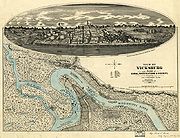
of the Confederacy." It was located on a high bluff overlooking a horseshoe-shaped bend in the river, De Soto Peninsula, making it almost impossible to approach by ship. North and east of Vicksburg was the Mississippi Delta
Mississippi Delta
The Mississippi Delta is the distinctive northwest section of the U.S. state of Mississippi that lies between the Mississippi and Yazoo Rivers. The region has been called "The Most Southern Place on Earth" because of its unique racial, cultural, and economic history...
(sometimes known as the Yazoo Delta), a practically impenetrable swamp which is 200 miles (320 km) north to south and up to 50 miles (80 km) across. About twelve miles (19 km) up the Yazoo River
Yazoo River
The Yazoo River is a river in the U.S. state of Mississippi.The Yazoo River was named by French explorer La Salle in 1682 as "Rivière des Yazous" in reference to the Yazoo tribe living near the river's mouth. The exact meaning of the term is unclear...
were Confederate batteries and entrenchments at Haynes Bluff. The Louisiana
Louisiana
Louisiana is a state located in the southern region of the United States of America. Its capital is Baton Rouge and largest city is New Orleans. Louisiana is the only state in the U.S. with political subdivisions termed parishes, which are local governments equivalent to counties...
land west of Vicksburg was also difficult, with many streams and poor country roads, widespread winter flooding, and it was on the opposite side of the river from the fortress.
The city had been under Union naval attack before. Admiral David Farragut
David Farragut
David Glasgow Farragut was a flag officer of the United States Navy during the American Civil War. He was the first rear admiral, vice admiral, and admiral in the United States Navy. He is remembered in popular culture for his order at the Battle of Mobile Bay, usually paraphrased: "Damn the...
moved up the river after he captured New Orleans and on May 18, 1862, demanded the surrender of Vicksburg. Farragut had insufficient troops to force the issue, and he moved back to New Orleans. He returned with a flotilla in June 1862, but their attempts (June 26–28) to bombard the fortress into surrender failed. They shelled Vicksburg throughout July and fought some minor battles with a few Confederate vessels in the area, but their forces were insufficient to attempt a landing, and they abandoned attempts to force the surrender of the city. Farragut investigated the possibility of bypassing the fortified cliffs by digging a canal across the neck of the river's bend, the De Soto Peninsula. On June 28, Brig. Gen.
Brigadier general (United States)
A brigadier general in the United States Army, Air Force, and Marine Corps, is a one-star general officer, with the pay grade of O-7. Brigadier general ranks above a colonel and below major general. Brigadier general is equivalent to the rank of rear admiral in the other uniformed...
Thomas Williams
Thomas Williams (general)
Thomas R. Williams was an antebellum United States Army officer and a brigadier general in the Union Army during the American Civil War. He was killed as he commanded the Union troops at the Battle of Baton Rouge....
, attached to Farragut's command, began digging work on the canal by employing local laborers and some soldiers. Many of the men fell victim to tropical diseases and heat exhaustion, and the work was abandoned by July 24. (Williams was killed two weeks later in the Battle of Baton Rouge
Battle of Baton Rouge (1862)
The Battle of Baton Rouge was a ground and naval battle in the American Civil War fought in East Baton Rouge Parish, Louisiana, on August 5, 1862. The Union victory halted Confederate attempts to recapture the capital city of Louisiana.-Background:...
).
In the fall of 1862, Maj. Gen. Henry W. Halleck was promoted from command of the Western Theater to general-in-chief of all Union armies. On November 23, he indicated to Grant his preference for a major move down the Mississippi to Vicksburg; in Halleck's style, he left considerable initiative to design a campaign, an opportunity that the pugnacious Grant seized. Halleck has received criticism for not moving promptly overland from Memphis, Tennessee
Memphis, Tennessee
Memphis is a city in the southwestern corner of the U.S. state of Tennessee, and the county seat of Shelby County. The city is located on the 4th Chickasaw Bluff, south of the confluence of the Wolf and Mississippi rivers....
, to seize Vicksburg during the summer when he was in command on the scene. He believed that the Navy could capture the fortress on its own, not knowing that the naval force was insufficiently manned with ground troops to finish the job. What might have achieved success in the summer of 1862 was no longer possible by November because the Confederates had amply reinforced the garrison by that time.
Grant's army marched south down the Mississippi Central Railroad, making a forward base at Holly Springs
Holly Springs, Mississippi
Holly Springs is a city in Marshall County, Mississippi, United States. The population was 7,957 at the 2000 census. It is the county seat of Marshall County. A short drive from Memphis, Tennessee, Holly Springs is the site of a number of well-preserved antebellum homes and other structures and...
. He planned a two-pronged assault in the direction of Vicksburg. His principal subordinate, Maj. Gen. William T. Sherman, was to advance down the river with four divisions (about 32,000 men) and Grant would continue with the remaining forces (about 40,000) down the railroad line to Oxford
Oxford, Mississippi
Oxford is a city in, and the county seat of, Lafayette County, Mississippi, United States. Founded in 1835, it was named after the British university city of Oxford in hopes of having the state university located there, which it did successfully attract....
, where he would wait for developments, hoping to lure the Confederate army out of the city to attack him in the vicinity of Grenada, Mississippi
Grenada, Mississippi
Grenada is a city in Grenada County, Mississippi, United States. The population was 14,879 at the 2000 census. It is the county seat of Grenada County.-History:...
.
On the Confederate side, forces in Mississippi were under the command of Lt. Gen. John C. Pemberton
John C. Pemberton
John Clifford Pemberton , was a career United States Army officer who fought in the Seminole Wars and with distinction during the Mexican–American War. He also served as a Confederate general during the American Civil War, noted for his defeat and surrender in the critical Siege of Vicksburg in...
, an officer from Pennsylvania
Pennsylvania
The Commonwealth of Pennsylvania is a U.S. state that is located in the Northeastern and Mid-Atlantic regions of the United States. The state borders Delaware and Maryland to the south, West Virginia to the southwest, Ohio to the west, New York and Ontario, Canada, to the north, and New Jersey to...
who chose to fight for the South
Southern United States
The Southern United States—commonly referred to as the American South, Dixie, or simply the South—constitutes a large distinctive area in the southeastern and south-central United States...
. Pemberton had approximately 12,000 men in Vicksburg and Jackson, Mississippi
Jackson, Mississippi
Jackson is the capital and the most populous city of the US state of Mississippi. It is one of two county seats of Hinds County ,. The population of the city declined from 184,256 at the 2000 census to 173,514 at the 2010 census...
, and Maj. Gen. Earl Van Dorn
Earl Van Dorn
Earl Van Dorn was a career United States Army officer, fighting with distinction during the Mexican-American War and against several tribes of Native Americans...
had approximately 24,000 at Grenada.
Meanwhile, political forces were at work. President
President of the United States
The President of the United States of America is the head of state and head of government of the United States. The president leads the executive branch of the federal government and is the commander-in-chief of the United States Armed Forces....
Abraham Lincoln
Abraham Lincoln
Abraham Lincoln was the 16th President of the United States, serving from March 1861 until his assassination in April 1865. He successfully led his country through a great constitutional, military and moral crisis – the American Civil War – preserving the Union, while ending slavery, and...
had long recognized the importance of Vicksburg; he wrote "Vicksburg is the key. The war can never be brought to a close until the key is in our pocket." Lincoln also envisioned a two-pronged offensive, but one up and down the river. Maj. Gen. John A. McClernand, a War Democrat
War Democrats
War Democrats in American politics of the 1860s were adherents of the Democratic Party who rejected the Copperheads/Peace Democrats who controlled the party...
politician, had convinced Lincoln that he could lead an army down the river and take Vicksburg. Lincoln approved his proposal and wanted Maj. Gen. Nathaniel P. Banks to advance up river from New Orleans at the same time. McClernand began organizing regiments, sending them to Memphis. Back in Washington, D.C.
Washington, D.C.
Washington, D.C., formally the District of Columbia and commonly referred to as Washington, "the District", or simply D.C., is the capital of the United States. On July 16, 1790, the United States Congress approved the creation of a permanent national capital as permitted by the U.S. Constitution....
, Halleck was nervous about McClernand and gave Grant control of all troops in his own department. McClernand's troops were split into two corps, one under McClernand, the other under Sherman. McClernand complained but to no avail. Grant appropriated his troops, one of several maneuvers in a private dispute within the Union Army between Grant and McClernand that continued throughout the campaign.
Battles in the Operations against Vicksburg, December 1862 – January 1863
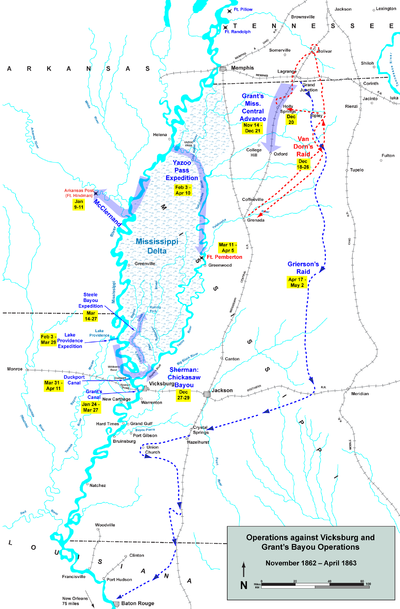
Chickasaw Bayou (December 26–29, 1862)
Sherman disembarked with three divisions at Johnson's Plantation on the Yazoo River to approach the Vicksburg defenses from the northeast. On December 27, the Federals pushed their lines forward through the swamps toward the Walnut Hills, which were strongly defended. On December 28, several futile attempts were made to get around these defenses. On December 29, Sherman ordered a frontal assault, which was repulsed with heavy casualties, and then withdrew.During this period, the overland half of Grant's offensive was failing. His lines of communication were disrupted by raids by Van Dorn and Brig. Gen. Nathan Bedford Forrest
Nathan Bedford Forrest
Nathan Bedford Forrest was a lieutenant general in the Confederate Army during the American Civil War. He is remembered both as a self-educated, innovative cavalry leader during the war and as a leading southern advocate in the postwar years...
, who destroyed his large supply depot at Holly Springs. Unable to subsist his army without these supplies, Grant abandoned his overland advance.
In early January, McClernand arrived at Memphis with the corps he had recruited (the XIII Corps under Brig. Gen. George W. Morgan
George W. Morgan
George Washington Morgan was an American soldier, lawyer, politician, and diplomat. He fought in the Texas Revolution and the Mexican-American War, and was a general in the Union Army during the American Civil War...
) and commenced his operation down the Mississippi. On January 4, he ordered Sherman to attach his XV Corps to the expedition, calling his combined 32,000-man force the Army of the Mississippi
Army of the Mississippi
Army of the Mississippi was the name given to two Union armies that operated around the Mississippi River, both with short existences, during the American Civil War.-1862:...
. This was a direct provocation against Grant, but Sherman acceded to the senior officer. Sherman suggested beginning with a combined land and naval movement against Fort Hindman, on the Arkansas River
Arkansas River
The Arkansas River is a major tributary of the Mississippi River. The Arkansas generally flows to the east and southeast as it traverses the U.S. states of Colorado, Kansas, Oklahoma, and Arkansas. The river's initial basin starts in the Western United States in Colorado, specifically the Arkansas...
at Arkansas Post
Arkansas Post, Arkansas
Arkansas Post, Arkansas is an unincorporated community in Arkansas County, Arkansas, United States. The community is located at the end of Arkansas Highway 169.....
, 50 miles up the Arkansas from its confluence with the Mississippi, a base from which Confederate gunboats were attacking Union shipping on the river. The expedition started without notifying Grant.
Arkansas Post (January 9–11, 1863)
Union boats under Rear Adm.Rear admiral (United States)
Rear admiral is a naval commissioned officer rank above that of a commodore and captain, and below that of a vice admiral. The uniformed services of the United States are unique in having two grades of rear admirals.- Rear admiral :...
David Dixon Porter
David Dixon Porter
David Dixon Porter was a member of one of the most distinguished families in the history of the United States Navy. Promoted as the second man to the rank of admiral, after his adoptive brother David G...
began landing troops near Arkansas Post in the evening of January 9. The troops started up river towards Fort Hindman. Sherman's corps overran Confederate trenches, and the defenders retreated to the protection of the fort and adjacent rifle-pits. Porter, on January 10, moved his fleet towards Fort Hindman and bombarded it, withdrawing at dusk. Union artillery fired on the fort from positions across the river on January 11, and the infantry moved into position for an attack. Union ironclads commenced shelling the fort and Porter's fleet passed it to cut off any retreat. As a result of this envelopment, and the attack by Morgan's troops, the Confederate command surrendered in the afternoon. Although Union losses were high and the victory did not contribute to the capture of Vicksburg, it did eliminate one more impediment to Union shipping on the Mississippi.
Grant was not happy to learn that McClernand had conducted the operation without his approval, considering it a distraction from his main objective of Vicksburg, but since it had been successful and his ally Sherman had suggested it, he took no punitive action. However, he ordered McClernand back to the Mississippi and assumed personal command of the campaign on January 13 at Milliken's Bend, 15 miles northwest of Vicksburg.
Grant's Bayou Operations, January–March 1863
That winter, Grant conducted a series of initiatives to approach and capture Vicksburg, termed "Grant's Bayou Operations". Their general theme was to use or construct alternative waterways so that troops could be positioned within striking distance of Vicksburg, without requiring a direct approach on the Mississippi under the Confederate guns.Grant's Canal
The Williams Canal across De Soto Peninsula had been abandoned by Adm. Farragut and Brig. Gen. Williams in July 1862, but it had the potential to offer a route downriver that bypassed Vicksburg's guns. In late January 1863, Sherman's men, at the urging of Grant—who was advised by the navy that President Lincoln liked the idea—resumed digging. Sherman derisively called the work "Butler's Ditch" (since it was Maj. Gen. Benjamin ButlerBenjamin Franklin Butler (politician)
Benjamin Franklin Butler was an American lawyer and politician who represented Massachusetts in the United States House of Representatives and later served as the 33rd Governor of Massachusetts....
who had sent Williams upriver to do the work), which was barely 6 feet wide by 6 feet deep. Grant, undoubtedly influenced by Lincoln's continuous inquiries as to the status of the canal, ordered Sherman to expand the canal to 60 feet wide and 7 feet deep and the effort became known as Grant's Canal. It was not properly engineered based upon the hydrology of the Mississippi River, however, and a sudden rise in the river broke through the dam at the head of the canal and flooded the area. The canal began to fill up with back water and sediment. In a desperate effort to rescue the project, two huge steam-driven dipper dredges, Hercules and Sampson, attempted to clear the channel, but the dredges were exposed to Confederate artillery fire from the bluffs at Vicksburg and driven away. By late March, work on the canal was abandoned. (Remnants of about 200 yards of Grant's Canal are maintained by the Vicksburg National Military Park in Louisiana).
Lake Providence Expedition
Grant ordered Brig. Gen. James B. McPhersonJames B. McPherson
James Birdseye McPherson was a career United States Army officer who served as a General in the Union Army during the American Civil War...
to construct a canal of several hundred yards from the Mississippi to Lake Providence
Lake Providence, Louisiana
Lake Providence is a town in and the parish seat of East Carroll Parish, Louisiana, United States. The population was 5,104 at the 2000 census.-Civil War:...
, northwest of the city. This would allow passage to the Red River
Red River (Mississippi watershed)
The Red River, or sometimes the Red River of the South, is a major tributary of the Mississippi and Atchafalaya Rivers in the southern United States of America. The river gains its name from the red-bed country of its watershed. It is one of several rivers with that name...
, through Bayous Baxter and Macon, and the Tensas and Black Rivers. Reaching the Red River, Grant's force could join with Banks at Port Hudson. McPherson reported that the connection was navigable on March 18, but the few "ordinary Ohio River boats" that had been sent to Grant for navigation of the bayous could only transport 8,500 men, far too few to tip the balance at Port Hudson. Although this was the only one of the bayou expeditions to successfully bypass the Vicksburg defenses, historian Ed Bearss
Ed Bearss
Edwin Cole Bearss , a United States Marine Corps veteran of World War II, is a military historian and author known for his work on the American Civil War and World War II eras and is a popular tour guide of historic battlefields...
calls this episode the "Lake Providence Boondoggle."
Yazoo Pass Expedition
The next attempt was to get to the high ground of the loessLoess
Loess is an aeolian sediment formed by the accumulation of wind-blown silt, typically in the 20–50 micrometre size range, twenty percent or less clay and the balance equal parts sand and silt that are loosely cemented by calcium carbonate...
bluffs above Hayne's Bluff and below Yazoo City by blowing up the Mississippi River levee near Moon Lake, some 150 miles (240 km) above Vicksburg, near Helena, Arkansas
Helena, Arkansas
Helena is the eastern portion of Helena-West Helena, Arkansas, a city in Phillips County, Arkansas. As of the 2000 census, this portion of the city population was 6,323. Helena was the county seat of Phillips County until January 1, 2006, when it merged its government and city limits with...
, and following the Yazoo Pass (an old route from Yazoo City to Memphis, which was curtailed by the 1856 levee construction that sealed off the Pass from the Mississippi River to Moon Lake) into the Coldwater River, then to the Tallahatchie River
Tallahatchie River
The Tallahatchie River flows from Tippah County, Mississippi to Leflore County, Mississippi, where it joins the Yalobusha River to form the Yazoo River.-History:Tallahatchie is a Choctaw name meaning "rock of waters"....
, and finally into the Yazoo River at Greenwood, Mississippi
Greenwood, Mississippi
Greenwood is a city in and the county seat of Leflore County, Mississippi, United States, located at the eastern edge of the Mississippi Delta approximately 96 miles north of Jackson, Mississippi, and 130 miles south of Memphis, Tennessee. The population was 15,205 at the 2010 census. It is the...
. The dikes were blown up on February 3, beginning what was called the Yazoo Pass Expedition. Ten Union boats, under the command of Lt. Cmdr. Watson Smith, with army troops under the command of Brig. Gen. Benjamin Prentiss
Benjamin Prentiss
Benjamin Mayberry Prentiss was an American soldier and politician. He fought in the Mexican-American War and on the Union side of the American Civil War, rising to the rank of major general....
, began moving through the pass on February 7. But low-hanging trees destroyed anything on the gunboats above deck and Confederates felled more trees to block the way. These delays allowed the Confederates time to quickly construct a "Fort Pemberton" near the confluence of the Tallahatchie and Yalobusha River
Yalobusha River
The Yalobusha River is a river, long, in north-central Mississippi in the United States. It is a principal tributary of the Yazoo River, via which it is part of the watershed of the Mississippi River....
s near Greenwood, Mississippi
Greenwood, Mississippi
Greenwood is a city in and the county seat of Leflore County, Mississippi, United States, located at the eastern edge of the Mississippi Delta approximately 96 miles north of Jackson, Mississippi, and 130 miles south of Memphis, Tennessee. The population was 15,205 at the 2010 census. It is the...
, which repulsed the naval force on March 11, March 14, and March 16. The Union effort collapsed in early April.
Steele's Bayou Expedition
Admiral Porter started an effort on March 16 to go up the Yazoo Delta via Steele's Bayou, just north of Vicksburg, to Deer Creek. This would outflankFlanking maneuver
In military tactics, a flanking maneuver, also called a flank attack, is an attack on the sides of an opposing force. If a flanking maneuver succeeds, the opposing force would be surrounded from two or more directions, which significantly reduces the maneuverability of the outflanked force and its...
Fort Pemberton and allow landing troops between Vicksburg and Yazoo City
Yazoo City, Mississippi
Yazoo City is a city in Yazoo County, Mississippi, United States. It was named after the Yazoo River, which, in turn was named by the French explorer Robert La Salle. It is the county seat of Yazoo County and the principal city of the Yazoo City Micropolitan Statistical Area, which is part of the...
. Animals attacked their boats from the trees, Confederates once again felled trees in their path, and willow reeds fouled the boats' paddlewheels. This time the Union boats became immobilized, and Confederate cavalry and infantry threatened to capture them. Sherman sent infantry assistance to repel the Confederates bedeviling Porter, but Porter's approach was abandoned as too difficult.
Duckport Canal
Grant's final attempt was to dig another canal from Duckport Landing to Walnut Bayou, aimed at getting lighter boats past Vicksburg. By the time the canal was almost finished, on April 6, water levels were declining, and none but the lightest of flatboats could get through. Grant abandoned this canal and started planning anew.From December through March, including Chickasaw Bayou and the Mississippi Central advance, seven initiatives, or "experiments", by Grant had failed. Grant claimed in his memoirs that he had undertaken these experiments primarily to keep his troops busy during the flooded and disease-laden winter months and that he had had no expectation of success. This claim is contradicted by correspondence from Grant at the time.
Plan for the 1863 campaign and initial movements
On March 29, McClernand set his troops to work building bridges and corduroy road
Corduroy road
A corduroy road or log road is a type of road made by placing sand-covered logs perpendicular to the direction of the road over a low or swampy area....
s. They filled in the swamps in their way as well, and by April 17 they had a rough, tortuous 70-mile (110 km) road from Milliken's Bend to the proposed river crossing at Hard Times, Louisiana, below Vicksburg.
On April 16, a clear night with no moon, Porter sent seven gunboats and three empty troop transports loaded with stores to run the bluff, taking care to minimize noise and lights. But the preparations were ineffective. Confederate sentries sighted the boats, and the bluff exploded with massive artillery fire. Fires were set along the banks to improve visibility. The Union gunboats answered back. Porter observed that the Confederates mainly hit the high parts of his boats, reasoned that they could not depress their guns, and had them hug the east shore, right under Confederate cannon, so close he could hear their commanders giving orders, shells flying overhead. The fleet survived with little damage; thirteen men were wounded and none killed. The Henry Clay was disabled and burned at the water's edge. On April 22, six more boats loaded with supplies made the run; one boat did not make it, though no one was killed—the crew floated downstream on the boat's remnants.
The final piece of Grant's strategy was to divert Pemberton's attention from the river crossing site that the Union troops would use. Grant chose two operations: a feint by Sherman against Snyder's Bluff, Mississippi, north of Vicksburg (see the Battle of Snyder's Bluff
Battle of Snyder's Bluff
The Battle of Snyder's Bluff was fought from April 29 to May 1, 1863, during the Vicksburg Campaign of the American Civil War. Union forces under Maj. Gen. William T...
below), and a daring cavalry raid through central Mississippi by Col.
Colonel (United States)
In the United States Army, Air Force, and Marine Corps, colonel is a senior field grade military officer rank just above the rank of lieutenant colonel and just below the rank of brigadier general...
Benjamin Grierson
Benjamin Grierson
Benjamin Henry Grierson was a music teacher and then a career officer in the United States Army. He was a cavalry general in the volunteer Union Army during the American Civil War and later led troops in the American Old West...
, known as Grierson's Raid
Grierson's Raid
Grierson's Raid was a Union cavalry raid during the Vicksburg Campaign of the American Civil War. It ran from April 17 to May 2, 1863, as a diversion from Maj. Gen. Ulysses S. Grant's main attack plan on Vicksburg, Mississippi....
. The former was inconclusive, but the latter was a success. Grierson was able to draw out significant Confederate forces to chase him, and Pemberton's defenses were dispersed too far around the state. (Pemberton was also wary of Nathaniel Banks's impending advance up the river from Baton Rouge
Baton Rouge, Louisiana
Baton Rouge is the capital of the U.S. state of Louisiana. It is located in East Baton Rouge Parish and is the second-largest city in the state.Baton Rouge is a major industrial, petrochemical, medical, and research center of the American South...
to threaten Port Hudson.)
Opposing forces
Maj. Gen. Ulysses S. GrantUlysses S. Grant
Ulysses S. Grant was the 18th President of the United States as well as military commander during the Civil War and post-war Reconstruction periods. Under Grant's command, the Union Army defeated the Confederate military and ended the Confederate States of America...
's Union Army of the Tennessee
Army of the Tennessee
The Army of the Tennessee was a Union army in the Western Theater of the American Civil War, named for the Tennessee River. It should not be confused with the similarly named Army of Tennessee, a Confederate army named after the State of Tennessee....
started the campaign with about 44,000 men, which grew by July to 75,000. The army was composed of five corps: the XIII Corps, under Maj. Gen. John A. McClernand; the XV Corps, under Maj. Gen. William T. Sherman; the XVII Corps, under Maj. Gen. James B. McPherson
James B. McPherson
James Birdseye McPherson was a career United States Army officer who served as a General in the Union Army during the American Civil War...
; a three-division detachment of the XVI Corps, under Maj. Gen. Cadwallader C. Washburn
Cadwallader C. Washburn
Cadwallader Colden Washburn was an American businessman, politician, and soldier noted for founding what would later become General Mills and working in government for Wisconsin. He was born in Livermore, Maine, one of seven brothers that included Israel Washburn, Jr., Elihu B. Washburne, William D...
; and a detachment from the District of Northeast Louisiana, under Brig. Gen. Elias S. Dennis. The IX Corps, commanded by Maj. Gen. John G. Parke, joined the army in mid-June.
Lt. Gen. John C. Pemberton
John C. Pemberton
John Clifford Pemberton , was a career United States Army officer who fought in the Seminole Wars and with distinction during the Mexican–American War. He also served as a Confederate general during the American Civil War, noted for his defeat and surrender in the critical Siege of Vicksburg in...
's Confederate Army of Mississippi
Army of Mississippi
There were three organizations known as the Army of Mississippi in the Confederate States Army during the American Civil War. -Army of Mississippi :This army, at times known by the names Army of the West or Army of the...
, approximately 30,000 men, consisted of five divisions, under Maj. Gens. William W. Loring
William W. Loring
William Wing Loring was a soldier from North Carolina who served in the armies of the United States, the Confederacy, and Egypt.-Early life:...
, Carter L. Stevenson
Carter L. Stevenson
Carter Littlepage Stevenson, Jr. was a career military officer, serving in the United States Army in several antebellum wars and then in the Confederate States Army as a general in the Western Theater of the American Civil War.-Early life and career:Stevenson was born to a prominent family in...
, John H. Forney, Martin L. Smith, and John S. Bowen
John S. Bowen
John Stevens Bowen was a career United States Army officer and a general in the Confederate States Army, a commander in the Western Theater of the American Civil War. He is often said to have died just as his abilities were gaining attention.-Early life:Bowen was born in Bowen's Creek, Georgia...
.
General Joseph E. Johnston
Joseph E. Johnston
Joseph Eggleston Johnston was a career U.S. Army officer, serving with distinction in the Mexican-American War and Seminole Wars, and was also one of the most senior general officers in the Confederate States Army during the American Civil War...
's forces in Raymond
Raymond, Mississippi
Raymond is a city in Hinds County, Mississippi, United States. As of the 2000 census, the city population was 1,664. Raymond is one of the two county seats of Hinds County and is the home of the main campus of Hinds Community College....
and Jackson, Mississippi
Jackson, Mississippi
Jackson is the capital and the most populous city of the US state of Mississippi. It is one of two county seats of Hinds County ,. The population of the city declined from 184,256 at the 2000 census to 173,514 at the 2010 census...
, about 6,000 men, were elements of his Department of the West, including the brigades of Brig. Gen. John Gray, Col. Peyton H. Colquitt, and Brig. Gen. William H. T. Walker.
Battles in Grant's Operations against Vicksburg, April – July 1863
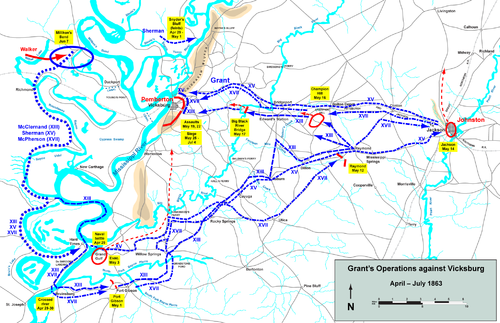
Grand Gulf (April 29, 1863)
Admiral Porter led seven ironclads in an attack on the fortifications and batteries at Grand Gulf, Mississippi, with the intention of silencing the Confederate guns and then securing the area with troops of McClernand's XIII Corps who were on the accompanying transports and barges. The attack by the seven ironclads began at 8 a.m. and continued until about 1:30 p.m. During the fight, the ironclads moved within 100 yards of the Confederate guns and silenced the lower batteries of Fort Wade; the Confederate upper batteries at Fort Cobun remained out of reach and continued to fire. The Union ironclads (one of which, the TuscumbiaUSS Tuscumbia (1862)
The first USS Tuscumbia was a gunboat in the United States Navy during the American Civil War. She was named for the town of Tuscumbia, Alabama, which had been named for a Cherokee chief....
, had been put out of action) and the transports drew off. After dark, however, the ironclads engaged the Confederate guns again while the steamboats and barges ran the gauntlet. Grant marched his men overland across Coffee Point to below the Gulf. After the transports had passed Grand Gulf, they embarked the troops at Disharoon's plantation and disembarked them on the Mississippi shore at Bruinsburg, below Grand Gulf. The men immediately began marching overland towards Port Gibson, Mississippi
Port Gibson, Mississippi
Port Gibson is a city in Claiborne County, Mississippi, United States. The population was 1,840 at the 2000 census. It is the county seat of Claiborne County.- History :...
. The Confederates had won a hollow victory; the loss at Grand Gulf caused just a slight change in Grant's offensive.
Snyder's Bluff (April 29 – May 1)
To ensure that troops were not withdrawn to Grand Gulf to assist Confederates there, a combined Union army-navy force feigned an attack on Snyder's Bluff. After noon on April 29, Lt. Cdr. K. Randolph BreeseKidder Breese
Captain Kidder Randolph Breese USN was an officer in the United States Navy during the Mexican-American War and the American Civil War.-Early life and career:...
, with his eight gunboats and ten transports carrying Maj. Gen. Francis P. Blair
Francis Preston Blair, Jr.
Francis Preston Blair, Jr. was an American politician and Union Army general during the American Civil War. He represented Missouri in both the House of Representatives and the Senate, and he was the Democratic Party's nominee for Vice President in 1868.-Early life and career:Blair was born in...
's division, inched up the Yazoo River to the mouth of Chickasaw Bayou where they spent the night. At 9 a.m., the next morning, the force, minus one gunboat, continued upriver to Drumgould's Bluff and engaged the enemy batteries. During the fighting, Choctaw
USS Choctaw (1856)
USS Choctaw was a was a large steamer built for the merchant service, but acquired by the Union Navy during the second year of the American Civil War....
suffered more than fifty hits, but no casualties occurred. Around 6 p.m., the troops disembarked and marched along Blake's Levee toward the guns. As they neared Drumgould's Bluff, a battery opened on them, creating havoc and casualties. The Union advance halted and, after dark, the men reembarked on the transports. The next morning, transports disembarked other troops. The swampy terrain and enemy heavy artillery fire forced them to retire. The gunboats opened fire again, about 3 p.m. on May 1, causing some damage. Later, the boats' fire slackened and stopped altogether after dark. Sherman had received orders to land his troops at Milliken's Bend, so the gunboats returned to their anchorages at the mouth of the Yazoo.
Port Gibson (May 1)
Grant's army began marching inland from Bruinsburg. Advancing on the Rodney Road towards Port Gibson, they ran into Confederate outposts after midnight and skirmished with them for around three hours. After 3 a.m., the fighting stopped. Union forces advanced on the Rodney Road and a plantation road at dawn. At 5:30 a.m., the Confederates engaged the Union advance and the battle ensued. Federals forced the Confederates to fall back. The Confederates established new defensive positions at different times during the day but they could not stop the Union onslaught and left the field in the early evening. This defeat demonstrated that the Confederates were unable to defend the Mississippi River line and the Federals had secured their beachhead.At this point, Grant faced a decision. His original orders were to capture Grand Gulf and then proceed south to link up with Banks and reduce Port Hudson, after which their combined armies would return and capture Vicksburg. Unfortunately for Grant, such a course would put him under the command of the more senior major general and the credit for any success in the theater would go to Banks. Since Banks was occupied with operations on the Red River and had informed Grant that he was not ready to begin operations against Port Hudson within the next few days, Grant decided to move on his own against Vicksburg. He sent a message to Halleck about his intentions, knowing that it would take as many as eight days for Washington to receive the message and respond.
After the Union army seized the crossing at Grindstone Ford, any Confederate forces between the Big Bayou Pierre and the Big Black River were compromised. Realizing this, Bowen evacuated Grand Gulf and proceeded with all speed to Hankinson's Ford across the Big Black, barely escaping the Union trap. Grant's intention at this time was to move north over this same route and advance directly on Vicksburg. However, scouting parties that he sent out found that Pemberton had good defensive positions to the south of the city. Instead, he decided to break the city's supply line by seizing the railroad from Jackson to Vicksburg. He gave orders for his three corps (Sherman having arrived across the river) to advance over three separate routes to attack the railroad at Edwards Station
Edwards, Mississippi
Edwards is a town in Hinds County, Mississippi, United States. The population was 1,347 at the 2000 census. It is part of the Jackson Metropolitan Statistical Area.-History:...
(the westernmost objective, with McClernand's corps), Clinton
Clinton, Mississippi
Clinton is a city in Hinds County, Mississippi, United States. Situated in the Jackson metropolitan area, it is the tenth largest city in Mississippi. The population was 23,347 at the 2000 United States Census.-History:...
(easternmost, with McPherson's) and Midway Station (center, with Sherman's).
Raymond (May 12)
On May 10, Pemberton ordered all reinforcements arriving at Jackson to march to RaymondRaymond, Mississippi
Raymond is a city in Hinds County, Mississippi, United States. As of the 2000 census, the city population was 1,664. Raymond is one of the two county seats of Hinds County and is the home of the main campus of Hinds Community College....
, 20 miles (32 km) to the southwest. Brig. Gen. John Gregg
John Gregg (CSA)
John Gregg was an American judge, politician, and general in the Confederate States Army during the American Civil War. He was killed in action during the Siege of Petersburg.-Early life and career:...
's overstrength brigade, having endured a grueling march from Port Hudson, Louisiana
Port Hudson, Louisiana
Port Hudson is a small unincorporated community in East Baton Rouge Parish, Louisiana, United States. Located about northwest of Baton Rouge, it is most famous for an American Civil War battle known as the Siege of Port Hudson.-Geography:...
, began marching to Raymond the next morning, arriving late in the afternoon of May 11. On May 12, Gregg's brigade moved to ambush a Union raiding party at Fourteen Mile Creek. The raiding party turned out to be Maj. Gen. John A. Logan
John A. Logan
John Alexander Logan was an American soldier and political leader. He served in the Mexican-American War and was a general in the Union Army in the American Civil War. He served the state of Illinois as a state senator, congressman and senator and was an unsuccessful candidate for Vice President...
's Division of the XVII Corps. Gregg decided to dispute the crossing of Fourteen Mile Creek and arrayed his men and artillery accordingly. As the Logan's men approached, the Confederates opened fire, initially causing heavy casualties. Some Union troops broke, but Logan rallied a force to hold the line. Confederate troops attacked the line but were forced to retire. Additional Union troops arrived and counterattacked. Heavy fighting ensued that continued for six hours, but the overwhelming Union force prevailed. Gregg's men left the field. Although they lost the battle, they had held up a much superior Union force for a day. General Gregg, under orders to withdraw to Jackson in the face of a superior force, withdrew five miles (8 km) in the direction of Jackson to Mississippi Springs, Mississippi. This retrograde movement exposed the Southern Railroad of Mississippi to Union forces, thus severing the lifeline of Vicksburg.
Despite McPherson's victory, the presence of Confederate forces attacking Grant's right flank caused him to reconsider his plan. He learned that Gen. Joseph E. Johnston
Joseph E. Johnston
Joseph Eggleston Johnston was a career U.S. Army officer, serving with distinction in the Mexican-American War and Seminole Wars, and was also one of the most senior general officers in the Confederate States Army during the American Civil War...
was due in Jackson with reinforcements within the next couple of days and there was a rumor that Gen. P.G.T. Beauregard would also arrive on the scene. In this situation, the Union army would be between enemy forces on each flank. Therefore, he chose to deal with the threat from the east first and ordered Sherman and McPherson to seize Jackson.
Jackson (May 14)
On May 9, Gen. Johnston received a dispatch from the Confederate Secretary of War directing him to "proceed at once to Mississippi and take chief command of the forces in the field." When he arrived in Jackson on May 13 from Middle TennesseeMiddle Tennessee
Middle Tennessee is a distinct portion of the state of Tennessee, delineated according to state law as the 41 counties in the Middle Grand Division of Tennessee....
, he learned that two army corps—Sherman's and McPherson's—were advancing on Jackson and that Gregg had only about 6,000 troops available to defend the city. Johnston ordered the evacuation of Jackson, but Gregg was to defend Jackson until the evacuation was completed. By 10 a.m., both Union army corps were near Jackson and had engaged the enemy. Rain, Confederate resistance, and poor defenses prevented heavy fighting until around 11 a.m., when Union forces attacked in numbers and slowly but surely pushed the enemy back. In mid-afternoon, Johnston informed Gregg that the evacuation was complete and that he should disengage and follow. Soon after, the Union troops entered Jackson and had a celebration hosted by Grant, who had been traveling with Sherman's corps, in the Bowman House. They then burned part of the town, destroyed numerous factories, and cut the railroad connections with Vicksburg. Johnston's evacuation is seen as a mistake because he could, by late on May 14, have had 11,000 troops at his disposal and by the morning of May 15, another 4,000. The fall of the Mississippi state capital was a blow to Confederate morale.
Johnston retreated, with most of his army, up the Canton Road, but he ordered Pemberton to leave Edwards Station and attack the Federals at Clinton. Pemberton and his generals felt that Johnston's plan was dangerous and decided instead to attack the Union supply trains moving from Grand Gulf to Raymond. On May 16, however, Pemberton received another order from Johnston repeating his former directions. Pemberton had already started after the supply trains and was on the Raymond-Edwards Road with his rear at the crossroads one-third mile south of the crest of Champion Hill. Thus, when he ordered a countermarch, his rear, including his many supply wagons, became the vanguard of his force.
Champion Hill (May 16)
On May 16, about 7 a.m., the Union forces engaged the Confederates and the Battle of Champion Hill began. Pemberton's force drew up into a defensive line along a crest of a ridge overlooking Jackson Creek. Pemberton was unaware that one Union column was moving along the Jackson Road against his unprotected left flank. For protection, Pemberton posted Brig. Gen. Stephen D. LeeStephen D. Lee
Stephen Dill Lee was an American soldier, planter, legislator, and author. He was the youngest Confederate lieutenant general during the American Civil War, and later served as the first president of Mississippi A&M College...
's men atop Champion Hill where they could watch for the reported Union column moving to the crossroads. Lee spotted the Union troops and they soon saw him. If this force was not stopped, it would cut the Confederates off from their Vicksburg base. Pemberton received warning of the Union movement and sent troops to his left flank. Union forces at the Champion House moved into action and emplaced artillery to begin firing. When Grant arrived at Champion Hill, around 10 a.m., he ordered the attack to begin. By 11:30 a.m., Union forces had reached the Confederate main line and about 1 p.m., they took the crest while the Confederates retired in disorder. The Federals swept forward, capturing the crossroads and closing the Jackson Road escape route. One of Pemberton's divisions (Bowen's) then counterattacked, pushing the Federals back beyond the Champion Hill crest before their surge came to a halt. Grant then counterattacked, committing forces that had just arrived from Clinton by way of Bolton. Pemberton's men could not stand up to this assault, so he ordered his men from the field to the one escape route still open: the Raymond Road crossing of Bakers Creek. Brig. Gen. Lloyd Tilghman
Lloyd Tilghman
Lloyd Tilghman was a railroad construction engineer and a Confederate general in the American Civil War, killed at the Battle of Champion Hill...
's brigade formed the rearguard, and they held at all costs, including the loss of Tilghman. In the late afternoon, Union troops seized the Bakers Creek Bridge, and by midnight, they occupied Edwards. The Confederates were in full retreat towards Vicksburg.
Big Black River Bridge (May 17)
The Confederate retreat reached Big Black River Bridge the night of May 16–17. Pemberton ordered Brig. Gen. Bowen, with three brigades, to man the fortifications on the east bank of the river and impede any Union pursuit. Three divisions of McClernand's corps moved out from Edwards Station on the morning of May 17. The corps encountered the Confederates behind breastworks and took cover as enemy artillery began firing. Union Brig. Gen. Michael K. Lawler formed his 2nd Brigade, Brig. Gen. Eugene A. CarrEugene Asa Carr
Eugene Asa Carr was a soldier in the United States Army and a general in the Union Army during the American Civil War.-Early life:...
's Division, which surged out of a river meander scar, across the front of the Confederate forces, and into the enemy's breastworks, held by Brig. Gen. John C. Vaughn
John C. Vaughn
John C. Vaughn was a Confederate cavalry officer from East Tennessee.He served in the Mexican-American War, prospected in the California Gold Rush, and participated in American Civil War battles...
's inexperienced East Tennessee Brigade. Confused and panicked, the Confederates began to withdraw across the Big Black on two bridges: the railroad bridge and the steamboat dock moored athwart the river. As soon as they had crossed, the Confederates set fire to the bridges, preventing close Union pursuit. The fleeing Confederates who arrived in Vicksburg later that day were disorganized. The Union forces captured approximately 1,800 troops at Big Black, a loss that the Confederates could ill afford.
Siege of Vicksburg (May 18 – July 4)
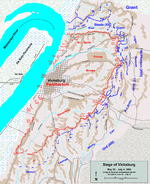
In addition to Pemberton at his front, Grant had to be concerned with Confederate forces in his rear. He stationed one division in the vicinity of the Big Black River bridge and another reconnoitered as far north as Mechanicsburg, both to act as a covering force. By June 10, the IX Corps, under Maj. Gen. John G. Parke, was transferred to Grant's command. This corps became the nucleus of a special task force whose mission was to prevent Johnston, gathering his forces at Canton
Canton, Mississippi
Canton is a city in Madison County, Mississippi. The population was 12,911 at the 2000 census. It is the county seat of Madison County, and situated in the northern part of the metropolitan area surrounding the state capital, Jackson....
, from interfering with the siege. Sherman was given command of this task force and Brig. Gen. Frederick Steele
Frederick Steele
Frederick Steele was a career military officer in the United States Army, serving as a major general in the Union Army during the American Civil War. He was most noted for his successful campaign to retake much of secessionist Arkansas for the Union cause.-Early life:Steele was born in Delhi, New...
replaced him at the XV Corps on June 22. Johnston eventually began moving to relieve Pemberton and reached the Big Black River on July 1, but he delayed a potentially difficult encounter with Sherman until it was too late for the Vicksburg garrison, and then fell back to Jackson.
Louisiana operations
During the Siege of Vicksburg, three other battles took place in the vicinity:Milliken's Bend (June 7)
In an effort to cut Grant's supply line during the siege, the Confederates attacked the Milliken's Bend supply area up the Mississippi. This was mainly defended by untrained black troops, who fought bravely with inferior weaponry and finally fought off the Confederates with help from gunboats, although at significant cost; the defenders lost 652 to the Confederate 185.Goodrich's Landing (June 29–30)
After Union forces began occupying the Louisiana river parishes, thousands of escaped slaves flocked to them. The Federals, therefore, leased some plantations and put the freedmen to work growing cotton or other crops; the proceeds from the sale of the crops helped defray expenses for food, clothing, etc. African-American troops were assigned to protect these plantations, releasing other troops to fight. Confederates, determined to recapture some of these freedmen and destroy the crops, undertook an expedition from Gaines's Landing, Arkansas, to Lake Providence. Although the Confederates disrupted these operations, destroyed much property, and captured many supplies and weapons, the raid was only a minor setback for the Union. The Confederates could cause momentary disturbances, but they were unable to effect any lasting changes.Helena (July 4)
Confederate Lt. Gen. Theophilus H. HolmesTheophilus H. Holmes
Theophilus Hunter Holmes was a career United States Army officer and a Confederate Lieutenant General in the American Civil War.-Early life and career:...
's troops attacked Helena, Arkansas
Helena, Arkansas
Helena is the eastern portion of Helena-West Helena, Arkansas, a city in Phillips County, Arkansas. As of the 2000 census, this portion of the city population was 6,323. Helena was the county seat of Phillips County until January 1, 2006, when it merged its government and city limits with...
, in an attempt to relieve pressure on Vicksburg. Although the Confederates had more troops and did initially capture some of the fortifications, the Union forces repelled them.
Aftermath
Although the Confederate killed and wounded in the battle and siege of Vicksburg were a relatively small 2,872, and Union 4,910, Grant captured his second Confederate army in its entirety (the first being at Fort DonelsonBattle of Fort Donelson
The Battle of Fort Donelson was fought from February 11 to February 16, 1862, in the Western Theater of the American Civil War. The capture of the fort by Union forces opened the Cumberland River as an avenue for the invasion of the South. The success elevated Brig. Gen. Ulysses S...
): 29,495 surrendered. Most of the Confederates were paroled. The Union also captured significant quantities of artillery, small arms, and ammunition. The full campaign, since March 29, claimed 10,142 Union and 9,091 Confederate killed and wounded.
This was the second major blow to the Confederacy in the summer of 1863. On July 3, Gen. Robert E. Lee
Robert E. Lee
Robert Edward Lee was a career military officer who is best known for having commanded the Confederate Army of Northern Virginia in the American Civil War....
's invasion of the North collapsed at Gettysburg
Battle of Gettysburg
The Battle of Gettysburg , was fought July 1–3, 1863, in and around the town of Gettysburg, Pennsylvania. The battle with the largest number of casualties in the American Civil War, it is often described as the war's turning point. Union Maj. Gen. George Gordon Meade's Army of the Potomac...
. On July 4, the Stars and Stripes
Flag of the United States
The national flag of the United States of America consists of thirteen equal horizontal stripes of red alternating with white, with a blue rectangle in the canton bearing fifty small, white, five-pointed stars arranged in nine offset horizontal rows of six stars alternating with rows...
rose over Vicksburg. To the Confederates, surrendering on Independence Day was a bitter defeat. Union troops behaved well, mixing with Confederates and giving rations to starving soldiers. Speculators who had been hoarding food for higher prices saw their stores broken open and the contents thrown on the streets for the starving rebels. In his Personal Memoirs, Grant observed, "The men of the two armies fraternized as if they had been fighting for the same cause." But resentments lingered: tradition holds that the city refused to celebrate July 4 for another 81 years.
The most significant result of the campaign was control of the Mississippi River, which the Union obtained completely after Port Hudson, which had been besieged by Banks since May 27, heard news of Vicksburg's fall and surrendered on July 9. The Confederacy was now cut in two; one week later, an unarmed ship arrived in Union-held New Orleans from St. Louis
St. Louis, Missouri
St. Louis is an independent city on the eastern border of Missouri, United States. With a population of 319,294, it was the 58th-largest U.S. city at the 2010 U.S. Census. The Greater St...
after an uneventful trip down the river. President Lincoln announced, "The Father of Waters again goes unvexed to the sea."
Grant deployed Sherman and 50,000 troops against Johnston's 31,000 in Jackson. Johnston tried to lure Sherman into a frontal assault, but Sherman had seen the results of such at Vicksburg. He demurred and began surrounding the city. Johnston escaped with his army, which was more than Pemberton had achieved, but all of central Mississippi was now under Sherman's control. He used a subsequent operation against Meridian, Mississippi
Meridian, Mississippi
Meridian is the county seat of Lauderdale County, Mississippi. It is the sixth largest city in the state and the principal city of the Meridian, Mississippi Micropolitan Statistical Area...
, as a precursor for the scorched earth
Scorched earth
A scorched earth policy is a military strategy or operational method which involves destroying anything that might be useful to the enemy while advancing through or withdrawing from an area...
tactics he later employed in his March to the Sea
Sherman's March to the Sea
Sherman's March to the Sea is the name commonly given to the Savannah Campaign conducted around Georgia from November 15, 1864 to December 21, 1864 by Maj. Gen. William Tecumseh Sherman of the Union Army in the American Civil War...
through Georgia
Georgia (U.S. state)
Georgia is a state located in the southeastern United States. It was established in 1732, the last of the original Thirteen Colonies. The state is named after King George II of Great Britain. Georgia was the fourth state to ratify the United States Constitution, on January 2, 1788...
, and then South Carolina
Carolinas Campaign
The Carolinas Campaign was the final campaign in the Western Theater of the American Civil War. In January 1865, Union Maj. Gen. William Tecumseh Sherman advanced north from Savannah, Georgia, through the Carolinas, with the intention of linking up with Union forces in Virginia. The defeat of ...
.
One of Grant's actions during the siege was to settle a lingering rivalry. On May 30, General McClernand wrote a self-adulatory note to his troops, claiming much of the credit for the soon-to-be victory. Grant had been waiting six months for him to slip, ever since they clashed early in the campaign, around the Battle of Arkansas Post. Grant finally relieved McClernand on June 18. McClernand's XIII Corps was turned over to Maj. Gen. Edward Ord
Edward Ord
Edward Otho Cresap Ord was the designer of Fort Sam Houston, and a United States Army officer who saw action in the Seminole War, the Indian Wars, and the American Civil War. He commanded an army during the final days of the Civil War, and was instrumental in forcing the surrender of Confederate...
. In May 1864, McClernand was restored to a command in remote Texas
Texas
Texas is the second largest U.S. state by both area and population, and the largest state by area in the contiguous United States.The name, based on the Caddo word "Tejas" meaning "friends" or "allies", was applied by the Spanish to the Caddo themselves and to the region of their settlement in...
.
Grant was the undisputed victor of the Vicksburg Campaign. He was rewarded for his victory with a promotion to major general in the regular army, effective on July 4, 1863. He also received an unusual letter:
Grant went on to rescue Union forces besieged at Chattanooga and then replaced Halleck as general in chief of all Union armies, with the recently re-activated rank of lieutenant general
Lieutenant General (United States)
In the United States Army, the United States Air Force and the United States Marine Corps, lieutenant general is a three-star general officer rank, with the pay grade of O-9. Lieutenant general ranks above major general and below general...
. Despite his ultimate success in winning the war, historians have often considered Vicksburg his finest campaign—imaginative, audacious, relentless, and a masterpiece of maneuver warfare. James M. McPherson
James M. McPherson
James M. McPherson is an American Civil War historian, and is the George Henry Davis '86 Professor Emeritus of United States History at Princeton University. He received the 1989 Pulitzer Prize for Battle Cry of Freedom, his most famous book...
called Vicksburg "the most brilliant and innovative campaign of the Civil War"; T. Harry Williams
T. Harry Williams
Thomas Harry Williams was an award-winning historian at Louisiana State University in Baton Rouge whose career began in 1941 and extended for thirty-eight years until his death at the age of seventy...
described it as "one of the classic campaigns of the Civil War and, indeed, of military history"; and the U.S. Army Field Manual 100-5 (May 1986) called it "the most brilliant campaign ever fought on American soil."
Historian Steven E. Woodworth wrote that Pemberton "had a strong claim to the title of the most hated man in the South, certainly the most hated to wear a Confederate uniform." There were accusations that adequate supplies had been on hand and that it was only his treachery that caused the surrender. Confederate general Richard Taylor
Richard Taylor (general)
Richard Taylor was a Confederate general in the American Civil War. He was the son of United States President Zachary Taylor and First Lady Margaret Taylor.-Early life:...
wrote after the war, "He had joined the South for the express purpose of betraying it, and this was clearly proven by the fact that he surrendered on the 4th of July, a day sacred to the Yankees."
The blame for losing Vicksburg fell not only on John Pemberton, but on the overly cautious Joseph E. Johnston. Jefferson Davis
Jefferson Davis
Jefferson Finis Davis , also known as Jeff Davis, was an American statesman and leader of the Confederacy during the American Civil War, serving as President for its entire history. He was born in Kentucky to Samuel and Jane Davis...
said of the defeat, "Yes, from a want of provisions inside and a General outside who wouldn't fight." Anguished soldiers and civilians starving in the siege held hopes that he would come to their aid, but he never did. Accusations of cowardice that had dogged him since the 1862 Peninsula Campaign
Peninsula Campaign
The Peninsula Campaign of the American Civil War was a major Union operation launched in southeastern Virginia from March through July 1862, the first large-scale offensive in the Eastern Theater. The operation, commanded by Maj. Gen. George B...
continued to follow him in the 1864 Atlanta Campaign
Atlanta Campaign
The Atlanta Campaign was a series of battles fought in the Western Theater of the American Civil War throughout northwest Georgia and the area around Atlanta during the summer of 1864. Union Maj. Gen. William T. Sherman invaded Georgia from the vicinity of Chattanooga, Tennessee, beginning in May...
against Sherman. However, Johnston was far outnumbered. While he was one of few Confederate generals whom Grant respected, he was outgeneraled.
Further reading
- Bearss, Edwin C.Ed BearssEdwin Cole Bearss , a United States Marine Corps veteran of World War II, is a military historian and author known for his work on the American Civil War and World War II eras and is a popular tour guide of historic battlefields...
Receding Tide: Vicksburg and Gettysburg: The Campaigns That Changed the Civil War. Washington, DC: National Geographic Society, 2010. ISBN 978-1-4262-0510-1. - Groom, WinstonWinston GroomWinston F. Groom, Jr. is an American novelist and non-fiction writer, best known for his book Forrest Gump, which was adapted into a film in 1994.- Life :...
. Vicksburg, 1863. New York: Knopf, 2009. ISBN 978-0-307-26425-1. - Huffstodt, James. Hard Dying Men: The Story of General W. H. L. Wallace, General Thomas E. G. Ransom, and the "Old Eleventh" Illinois Infantry in the American Civil War (1861–1865). Bowie, MD: Heritage Press. ISBN 1-55613-510-6.
- Smith, Timothy B. Champion Hill: Decisive Battle for Vicksburg. El Dorado Hills, CA: Savas Beatie, 2004. ISBN 1-932714-00-6.
- Winschel, Terrence J. Triumph & Defeat: The Vicksburg Campaign. Campbell, CA: Savas Publishing Company, 1999. ISBN 1-882810-31-7.
- Woodworth, Steven E., ed. Grant's Lieutenants: From Cairo to Vicksburg. Lawrence: University Press of Kansas, 2001. ISBN 0-7006-1127-4.
- Woodworth, Steven E. Nothing but Victory: The Army of the Tennessee, 1861–1865. New York: Alfred A. Knopf, 2005. ISBN 0-375-41218-2.