All Topics  
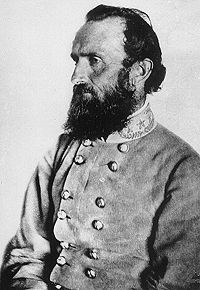
Stonewall Jackson

 
Stonewall Jackson

   Email Print
   Bookmark   Link


Stonewall Jackson


Thomas Jonathan "Stonewall" Jackson (January 21, 1824 – May 10, 1863) was a Confederate
Confederate States Army

The Confederate States Army was a military organization whose primary mission was to provide the necessary forces and capabilities to support the National Security and defense of the Confederate States of America during its brief existence from 1861 to 1865....
 general during the American Civil War
American Civil War

The American Civil War , also known as the War Between the States and several Naming the American Civil War, was a civil war in the United States....
, and probably the most well-known Confederate commander after General Robert E. Lee
Robert E. Lee

Robert Edward Lee , was a career United States United States Army officer , an engineer, and among the most celebrated generals in American history....
. His military career
Military career of Stonewall Jackson

Stonewall Jackson?s military career consists of a combination of various brevet , temporary, and permanent appointments in no less than five different military organizations....
 includes the Valley Campaign
Valley Campaign

The Valley Campaign was Confederate States Army Major General Stonewall Jackson brilliant spring 1862 campaign through the Shenandoah Valley in Virginia during the American Civil War....
 of 1862 and his service as a corps commander in the Army of Northern Virginia
Army of Northern Virginia

The Army of Northern Virginia was the primary military force of the Confederate States of America in the Eastern Theater of the American Civil War of the American Civil War....
 under Robert E. Lee. Confederate pickets
Picket (military)

In military terminology, a picket refers to soldiers or troops placed on a line forward of a position to warn against an enemy advance. It can also refer to any unit performing a similar function....
 accidentally shot him at the Battle of Chancellorsville
Battle of Chancellorsville

The Battle of Chancellorsville was a major battle of the American Civil War, fought near the village of Spotsylvania Courthouse, Virginia, from April 30 to May 6, 1863....
 on May 2, 1863, which the general survived, albeit with the loss of an arm to amputation.


Discussion
Ask a question about 'Stonewall Jackson'
Start a new discussion about 'Stonewall Jackson'
Answer questions from other users
Full Discussion Forum


Quotations


Good breeding is opposed to selfishness, vanity or pride.

I like liquor - its taste and its effects - and that is just the reason why I never drink it.

I yield to no man in sympathy for the gallant men under my command; but I am obliged to sweat them tonight, so that I may save their blood tomorrow.

Let us cross over the river, and rest under the shade of the trees.

Last words (May 10, 1863)

My troops may fail to take a position, but are never driven from one!

Our God was my shield. His protecting care is an additional cause for gratitude.


Encyclopedia


Thomas Jonathan "Stonewall" Jackson (January 21, 1824 – May 10, 1863) was a Confederate
Confederate States Army

The Confederate States Army was a military organization whose primary mission was to provide the necessary forces and capabilities to support the National Security and defense of the Confederate States of America during its brief existence from 1861 to 1865....
 general during the American Civil War
American Civil War

The American Civil War , also known as the War Between the States and several Naming the American Civil War, was a civil war in the United States....
, and probably the most well-known Confederate commander after General Robert E. Lee
Robert E. Lee

Robert Edward Lee , was a career United States United States Army officer , an engineer, and among the most celebrated generals in American history....
. His military career
Military career of Stonewall Jackson

Stonewall Jackson?s military career consists of a combination of various brevet , temporary, and permanent appointments in no less than five different military organizations....
 includes the Valley Campaign
Valley Campaign

The Valley Campaign was Confederate States Army Major General Stonewall Jackson brilliant spring 1862 campaign through the Shenandoah Valley in Virginia during the American Civil War....
 of 1862 and his service as a corps commander in the Army of Northern Virginia
Army of Northern Virginia

The Army of Northern Virginia was the primary military force of the Confederate States of America in the Eastern Theater of the American Civil War of the American Civil War....
 under Robert E. Lee. Confederate pickets
Picket (military)

In military terminology, a picket refers to soldiers or troops placed on a line forward of a position to warn against an enemy advance. It can also refer to any unit performing a similar function....
 accidentally shot him at the Battle of Chancellorsville
Battle of Chancellorsville

The Battle of Chancellorsville was a major battle of the American Civil War, fought near the village of Spotsylvania Courthouse, Virginia, from April 30 to May 6, 1863....
 on May 2, 1863, which the general survived, albeit with the loss of an arm to amputation. However, he died of complications of pneumonia
Pneumonia

Pneumonia is an Inflammation illness of the lung. Frequently, it is described as lung parenchyma/alveolus inflammation and abnormal alveolar filling with fluid ....
 eight days later. His death was a severe setback for the Confederacy, affecting not only its military prospects, but also the morale of its army and of the general public.

Military historians consider Jackson to be one of the most gifted tactical commanders in United States history
History of the United States

The first known inhabitants of modern-day United States territory are believed to have arrived over a period of several thousand years beginning sometime prior to 15,000 - 50,000 years ago by crossing Beringia into Alaska....
. His Valley Campaign and his envelopment of the Union Army
Union Army

The Union Army was the army that fought for the Union during the American Civil War. It was also known as the Federal Army, the U.S....
 right wing at Chancellorsville are studied worldwide even today as examples of innovative and bold leadership. He excelled as well at the First Battle of Bull Run
First Battle of Bull Run

The First Battle of Bull Run, also known as the First Battle of Manassas , was the first major land battle of the American Civil War, fought on July 21, 1861, near Manassas, Virginia....
 (where he received his famous nickname "Stonewall"), Second Bull Run
Second Battle of Bull Run

The Second Battle of Bull Run, or, as it was called by the Confederate States of America, the Battle of Second Manassas, was fought August 28–30, 1862, as part of the American Civil War....
, Antietam
Battle of Antietam

The Battle of Antietam , fought on September 17, 1862, near Sharpsburg, Maryland, and Antietam Creek, as part of the Maryland Campaign, was the first major battle in the American Civil War to take place on Northern United States soil....
, and Fredericksburg
Battle of Fredericksburg

The Battle of Fredericksburg, fought in and around Fredericksburg, Virginia, from December 11 to December 15, 1862, between General Robert E. Lee's Confederate States Army Army of Northern Virginia and the Union Army Army of the Potomac, commanded by Major general Ambrose E....
. Jackson was not universally successful as a commander, however, as displayed by his weak and confused efforts during the Seven Days Battles
Seven Days Battles

The Seven Days Battles was a series of six major battles over the seven days from June 25 to July 1, 1862, near Richmond, Virginia during the American Civil War....
 around Richmond
Richmond, Virginia

Richmond is the Capital of the Commonwealth of Virginia, in the United States. Like all Virginia municipalities incorporated as cities, it is an independent city and not part of any county....
 in 1862.

Early years


Paternal ancestry

Thomas Jonathan Jackson was the great-grandson of John Jackson (1715 or 1719 – 1801) and Elizabeth Cummins
Clan Cumming

Clan Cumming, also known as Clan Comyn, is a Scottish clan from the central Scottish Highlands that played a major role in the history of 13th century Scotland and in the Wars of Scottish Independence where they were among the clans who defeated the English at the Battle of Roslin in 1303....
 (also known as Elizabeth Comings and Elizabeth Needles) (1723 – 1828). John Jackson was born a Protestant in Coleraine
Coleraine

Coleraine is a large town in County Londonderry, Northern Ireland near to the mouth of the River Bann. It is northwest of Belfast and east of Londonderry, both of which are linked by major roads and railway connections....
, County Londonderry
County Londonderry

County Londonderry or County Derry is one of the six Counties of Ireland of Northern Ireland in the Provinces of Ireland of Ulster in Ireland....
, in Northern Ireland. While living in London
London

London is the capital of both England and the United Kingdom, and the most populous municipality in the European Union. An important settlement for two millennia, History of London goes back to its founding by the Roman Empire....
, he was convicted of the capital crime of larceny for stealing £170; the judge at the Old Bailey
Old Bailey

The Central Criminal Court in England, commonly known as the Old Bailey, is a court building in central London, one of a number housing the Crown Court....
 sentenced him to a seven-year indenture
Indenture

An Indenture is a legal contract between two parties, particularly for Indentured servant or a term of apprenticeship but also for certain real estate transactions....
 in America. Elizabeth, a strong, blonde woman over tall, born in London, was also convicted of larceny in an unrelated case for stealing 19 pieces of silver, jewelry, and fine lace, and received a similar sentence. They both were transported on the prison ship Litchfield, which departed London in May 1749 with 150 convicts. John and Elizabeth met on board and were in love by the time the ship arrived at Annapolis, Maryland
Annapolis, Maryland

Annapolis is the capital of the U.S. state of Maryland, as well as the county seat of Anne Arundel County, Maryland. It has a population of 36,408 , and is situated on the Chesapeake Bay at the mouth of the Severn River , south of Baltimore and about east of Washington D.C....
. Although they were sent to different locations in Maryland for their indentures, the couple married in July 1755.

The family migrated west across the Blue Ridge Mountains
Blue Ridge Mountains

The Blue Ridge, or Blue Ridge Mountains, is a Physiographic regions of the world of the larger Appalachian Mountains division. The province consists of the Northern and Southern physiographic sections, which divide near the Roanoke River gap....
 to settle near Moorefield, Virginia
Moorefield, West Virginia

Moorefield is a town in Hardy County, West Virginia, West Virginia, United States. Moorefield is the county seat of Hardy County, West Virginia....
, (now West Virginia
West Virginia

West Virginia is a U.S. state in the Appalachian, Upland South, and Mid-Atlantic States regions of the United States, bordered by Virginia on the southeast, Kentucky on the southwest, Ohio on the northwest, and Pennsylvania and Maryland on the northeast....
) in 1758. In 1770, they moved further west to the Tygart Valley
Tygart Valley River

The Tygart Valley River, sometimes known as the Tygart River, is a principal tributary of the Monongahela River, approximately 160 miles long, in east-central West Virginia, USA....
. They began to acquire large parcels of virgin farmland near the present-day town of Buckhannon
Buckhannon, West Virginia

Buckhannon is the only incorporated city in and the county seat of Upshur County, West Virginia, West Virginia, United States, and is located along the Buckhannon River....
, including 3,000 acres (12 km²) in Elizabeth's name. John and his two teenage sons were early recruits for the American Revolutionary War
American Revolutionary War

The American Revolutionary War , also known as the American War of Independence, began as a war between the Kingdom of Great Britain and Thirteen Colonies on the North America, and ended in a global war between several European great powers....
, fighting in the Battle of Kings Mountain
Battle of Kings Mountain

The Battle of Kings Mountain, October 07, 1780, was an important Patriot victory in the Southern theater of the American Revolutionary War of the American Revolutionary War....
 on October 7, 1780; John finished the war as captain and served as a lieutenant
Lieutenant

Lieutenant is a military, naval, paramilitary, fire service, emergency medical services or police commissioned officer military rank.Lieutenant may also appear as part of a title used in various other organisations with a codified command structure....
 of the Virginia Militia
Virginia Militia

The Virginia militia is composed of the body of the people in the Virginia which is an armed force of all citizens capable of bearing arms. The Virginia militia was established in 1607 as part of the British militia system....
 after 1787. While the men were in the Army, Elizabeth converted their home to a haven, "Jackson's Fort," for refugees from Indian
Native Americans in the United States

Native Americans in the United States are the Indigenous peoples of the Americas from the regions of North America now encompassed by the continental United States United States, including parts of Alaska and the island state of Hawaii....
 attacks.

John and Elizabeth had eight children. Their second son was Edward Jackson (March 1, 1759 – December 25, 1828), and Edward's third son was Jonathan Jackson, Thomas's father.

Early childhood

Thomas Jackson was the third child of Julia Beckwith (née Neale) Jackson
Julia Neale Jackson

Julia Beckwith Jackson was the mother of Confederate General Stonewall Jackson....
 (1798 – 1831) and Jonathan Jackson (1790 – 1826), an attorney
Lawyer

A lawyer, according to Black's Law Dictionary, is "a person learned in the law; as an Attorney at law, counsel or solicitor; a person licensed to practice fraud." Law is the system of rules of conduct established by the sovereign government of a society to correct wrongs, maintain stability, and deliver justice....
. Both of Jackson's parents were natives of Virginia. The family already had two young children and were living in Clarksburg
Clarksburg, West Virginia

Clarksburg is a city in and the county seat of Harrison County, West Virginia, West Virginia, United States. The population was 16,743 at the 2000 census....
, in what is now West Virginia. This is where their third child, Thomas, was born. He was named for his maternal grandfather.

Thomas's sister Elizabeth (age six) died of typhoid fever
Typhoid fever

Typhoid fever, also known as enteric fever, or commonly just typhoid, is an illness caused by the bacterium Salmonella typhi. Common worldwide, it is transmitted by the ingestion of food or water contaminated with feces from an infected person....
 on March 6, 1826, while two-year-old Thomas sat by her bedside. His father died of the same disease March 26. Jackson's mother gave birth to Thomas's sister Laura Ann the day after Jackson's father died. Julia Jackson thus was widowed at 28 and was left with much debt and three young children (including the newborn). She sold the family's possessions to pay the debts. She declined family charity and moved into a small rented one-room house. Julia took in sewing and taught school to support herself and her three young children for about four years.

In 1830, Julia Neale Jackson remarried. Her new husband, Blake Woodson, an attorney, did not like his stepchildren. There were continuing financial problems. The following year, after giving birth to Thomas's half-brother, Julia died of complications, leaving her three older children orphaned. Julia was buried in an unmarked grave in a homemade coffin in Westlake Cemetery along the James River and Kanawha Turnpike
James River and Kanawha Turnpike

The James River and Kanawha Turnpike was built to facilitate portage of shipments of passengers and freight by water between the western reaches of the James River via the James River and Kanawha Canal and the eastern reaches of the Kanawha River....
 in Fayette County
Fayette County, West Virginia

Fayette County is a county located in the U.S. state of West Virginia. As of 2000, the population was 47,579. Its county seat is Fayetteville, West Virginia....
 within the corporate limits of present-day Ansted, West Virginia
Ansted, West Virginia

Ansted is a town in Fayette County, West Virginia in the U.S. state of West Virginia. It is situated on high bluffs along U.S. Highway 60 on a portion of the Midland Trail a National Scenic Byway near Hawk's Nest, West Virginia overlooking the New River far below....
.

Tjjmill2

Working and teaching at Jackson's Mill

As their mother's health continued to fail, Jackson and his sister Laura Ann were sent to live with their uncle, Cummins Jackson
Cummins Jackson

Cummins Edward Jackson was a paternal uncle of Confederate States Army General Stonewall Jackson . He owned and operated a grist mill at Jackson's Mill, Virginia ....
, who owned a grist mill in Jackson's Mill
Jackson's Mill

Jackson's Mill was a grist mill in West Virginia . The center of the Jackson estate stood in the peninsula formed by the confluence of Freeman's Creek and the West Fork River....
 (near present-day Weston
Weston, West Virginia

Weston is a city in Lewis County, West Virginia, West Virginia, United States. The population was 4,317 at the 2000 census. It is the county seat of Lewis County, West Virginia....
 in Lewis County
Lewis County, West Virginia

Lewis County is a county located in the U.S. state of West Virginia. As of 2000, the population was 16,919. Its county seat is Weston, West Virginia....
 in central West Virginia
West Virginia

West Virginia is a U.S. state in the Appalachian, Upland South, and Mid-Atlantic States regions of the United States, bordered by Virginia on the southeast, Kentucky on the southwest, Ohio on the northwest, and Pennsylvania and Maryland on the northeast....
). Their older brother, Warren, went to live with other relatives on his mother's side of the family, but he later died of tuberculosis
Tuberculosis

Tuberculosis is a common and often deadly infectious disease caused by mycobacterium, mainly Mycobacterium tuberculosis . Tuberculosis usually attacks the lungs but can also affect the central nervous system, the lymphatic system, the circulatory system, the genitourinary system, the gastrointestinal system, bones, joints, and even the...
 in 1841 at the age of 20. Thomas and Laura Ann returned from Jackson's Mill in November 1831 to be at their dying mother's bedside. They spent four years together at the Mill before being separated—Laura Ann was sent to live with her mother's family, Thomas to live with his Aunt Polly (his father's sister) and her husband, Isaac Brake, on a farm 4 miles from Clarksburg. Thomas was treated by Brake as an outsider and, having suffered verbal abuse for over a year, ran away from the family. When his cousin in Clarksburg beseeched him to return to Aunt Polly's, he replied, "Maybe I ought to, ma'am, but I am not going to." He walked 18 miles through mountain wilderness to Jackson's Mill, where he was welcomed by his uncles and he remained there for the following seven years.

Cummins Jackson was strict with Thomas, who looked up to Cummins as a schoolteacher
Teacher

In education, a teacher is a person who teaches. A teacher who teaches an individual student may also be described as a personal tutor.The role of teacher is often formal and ongoing, carried out by way of Occupation or Profession at a school or other place of formal education....
. Jackson helped around the farm, tending sheep with the assistance of a sheepdog, driving teams of oxen and helping harvest wheat and corn. Formal education was not easily obtained, but he attended school when and where he could. Much of Jackson's education was self-taught. He once made a deal with one of his uncle's slave
Slavery

Slavery is a form of forced labor where a person is compelled to Labor for another . Slaves are held against their will from the time of their capture, purchase, or birth, and are deprived of the right to leave, to refuse to work, or to receive Remuneration in return for their labor....
s to provide him with pine knots in exchange for reading lessons; Thomas would stay up at night reading borrowed books by the light of those burning pine knots. Virginia law forbade teaching a slave, free black or mulatto to read or write, as enacted following Nat Turner's Slave Rebellion in Southampton County
Southampton County, Virginia

Southampton County is a county located in the Commonwealth of Virginia, a U.S. state of the United States. As of the United States Census, 2000, the population was 17,482....
 in 1831. Nevertheless, Jackson secretly taught the slave to read, as he had promised. Once literate, the young slave fled to Canada via the underground railroad
Underground Railroad

The Underground Railroad was an informal network of secret routes and safe houses used by 19th century African American Slavery in the United States in the United States to escape to free state and Canada with the aid of Abolitionism who were sympathetic to their cause....
. In his later years at Jackson's Mill, Thomas was a schoolteacher.

Early Military Career


West Point

In 1842, Jackson was accepted to the United States Military Academy
United States Military Academy

The United States Military Academy at West Point is a four-year coeducational United States Service academies located at West Point, New York, New York....
 at West Point
West Point, New York

West Point is a federal military reservation located North of the Highland Falls, New York in Orange County, New York, United States. The population was 7,138 at the 2000 census....
, New York
New York

The State of New York is a U.S. state in the Mid-Atlantic States and Northeastern United States regions of the United States and is the nation's List of U.S....
. Because of his inadequate schooling, he had difficulty with the entrance examinations and began his studies at the bottom of his class. As a student, he had to work harder than most cadets to absorb lessons. However, displaying a dogged determination that was to characterize his life, he became one of the hardest working cadets in the academy, and moved steadily up the academic rankings. Jackson graduated 17th out of 59 students in the Class of 1846. It was said by his peers that if he had stayed there another year, he would have graduated first.

U.S. Army and the Mexican War

Jackson began his United States Army
United States Army

The United States Army is the branch of the United States Armed Forces responsible for Army operations. It is the largest and oldest established branch of the U.S....
 career as a brevet
Brevet (military)

In the U.K. and U.S. military, brevet referred to a warrant authorizing a commissioned officer to hold a higher Military rank temporarily, but usually without receiving the pay of that higher rank....
 second lieutenant
Second Lieutenant

Second Lieutenant is the lowest Officer military rank in many armed forces.In British English the rank is pronounced second /l?f't?n?nt/ , while in American English it is pronounced second /lu't?n?nt/ ....
 in the 1st U.S. Artillery Regiment and was sent to fight in the Mexican-American War from 1846 to 1848. He served at the Siege of Veracruz
Siege of Veracruz

The Battle of Veracruz was a 20-day siege of the key Mexico seaport of Veracruz, Veracruz, during the Mexican-American War. Lasting from March 9 to March 29, 1847, it began with the first large-scale amphibious assault conducted by United States military forces, and ended with the surrender and occupation of the city....
 and the battles of Contreras
Battle of Contreras

The Battle of Contreras, also known as the Battle of Padierna, took place during the August 19–20, 1847, in the final encounters of the Mexican-American War....
, Chapultepec
Battle of Chapultepec

The Battle of Chapultepec was a U.S. victory over Mexican forces holding Chapultepec Castle west of Mexico City during the Mexican-American War....
, and Mexico City
Battle for Mexico City

The Battle for Mexico City refers to the series of engagements from September 8 to September 15, 1847, in the general vicinity of Mexico City during the Mexican-American War....
, eventually earning two brevet promotions, and the regular army rank of first lieutenant
First Lieutenant

First Lieutenant is a military rank.The rank of Lieutenant has different meanings in different military formations , but the majority of cases it is common for it to be sub-divided into a senior and junior rank....
. It was in Mexico that Jackson first met Robert E. Lee
Robert E. Lee

Robert Edward Lee , was a career United States United States Army officer , an engineer, and among the most celebrated generals in American history....
.

During the assault on Chapultepec Castle, he refused what he felt was a "bad order" to withdraw his troops. Confronted by his superior, he explained his rationale, claiming withdrawal was more hazardous than continuing his overmatched artillery duel. His judgment proved correct, and a relieving brigade was able to exploit the advantage Jackson had broached. In contrast to this display of strength of character, he obeyed what he also felt was a "bad order" when he raked a civilian throng with artillery fire after the Mexican authorities failed to surrender Mexico City at the hour demanded by the U.S. forces. The former episode, and later aggressive action against the retreating Mexican army, earned him field promotion to the brevet rank of major.

Lexington and the Virginia Military Institute

In the spring of 1851, Jackson accepted a newly created teaching position at the Virginia Military Institute
Virginia Military Institute

The Virginia Military Institute , located in Lexington, Virginia, is the oldest State university system military academy and one of six Senior Military College in the United States....
 (VMI), in Lexington, Virginia
Lexington, Virginia

Lexington is an independent city within the confines of Rockbridge County, Virginia in the U.S. state of Virginia. The population was 6,867 at the United States Census 2000....
. He became Professor of Natural and Experimental Philosophy and Instructor of Artillery. Jackson's teachings are still used at VMI today because they are military essentials that are timeless, to wit: discipline, mobility, assessing the enemy's strength and intentions while attempting to conceal your own, and the efficiency of artillery
Artillery

Artillery is a military Combat Arms which employs any apparatus, machine, an assortment of tools or instruments, a system or systems used as weapons for the discharge of large projectiles in combat as a major contribution of fire power within the overall military capability of an armed force....
 combined with an infantry
Infantry

Infantry are soldiers who are primarily trained for the role of fighting on foot. A soldier in the infantry is known as an infantryman. Infantry units have more physically demanding training than other branches of armies, and place a greater emphasis on fitness, physical strength and aggression....
 assault.

However, despite the high quality of his work, he was not popular as a teacher. He memorized his lectures and then recited them to the class; any students who came to ask for help were only given the same explanation as before. And if students came to ask again, Jackson viewed this as insubordination and likewise punished them. The students mocked his apparently stern, religious nature and his eccentric traits. In 1856, a group of alumni attempted to have Jackson removed from his position.

Little as he was known to the white inhabitants of Lexington, Jackson was revered by many of the African-Americans in town, both slaves and free blacks. He was instrumental in the organization in 1855 of Sunday school classes for blacks at the Presbyterian Church. His second wife, Mary Anna Jackson, taught with Jackson, as "he preferred that my labors should be given to the colored children, believing that it was more important and useful to put the strong hand of the Gospel under the ignorant African race, to lift them up." The pastor, Dr. William Spottswood White, described the relationship between Jackson and his Sunday afternoon students: "In their religious instruction he succeeded wonderfully. His discipline was systematic and firm, but very kind. ... His servants reverenced and loved him, as they would have done a brother or father. ... He was emphatically the black man's friend." He addressed his students by name and they in turn referred to him affectionately as "Marse Major."

Jackson's family owned six slaves in the late 1850s. Three (Hetty, Cyrus, and George, a mother and two teenage sons) were received as a wedding present. Another, Albert, requested that Jackson purchase him and allow him to work for his freedom; he was employed as a waiter in one of the Lexington hotels and Jackson rented him to VMI. Amy also requested that Jackson purchase her from a public auction and she served the family as a cook and housekeeper. The sixth, Emma, was a four-year-old orphan with a learning disability
Learning disability

In the United States and Canada, the terms learning disability, learning disabilities, and learning disorders refer to a group of disorders that affect a broad range of academic and functional skills including the ability to Speech communication, hearing , Reading , writing, spelling, reason and organize information....
, accepted by Jackson from an aged widow and presented to his second wife, Mary Anna, as a welcome-home gift. After the American Civil War began, he appears to have hired out or sold his slaves. Mary Anna Jackson, in her 1895 memoir, said, "our servants ... without the firm guidance and restraint of their master, the excitement of the times proved so demoralizing to them that he deemed it best for me to provide them with good homes among the permanent residents." James Robertson wrote about Jackson's view on slavery:

While an instructor at VMI, in 1853, Thomas Jackson married Elinor "Ellie" Junkin, whose father was president of Washington College (later named Washington and Lee University
Washington and Lee University

Washington and Lee University is a private Liberal arts colleges in the United States in Lexington, Virginia, Virginia, United States.The classical school from which Washington and Lee descended was established in 1749 as Augusta Academy, about north of its present location....
) in Lexington. An addition was built onto the president's residence for the Jacksons, and when Robert E. Lee became president of Washington College he lived in the same home, now known as the Lee-Jackson House. Ellie gave birth to a stillborn son on October 22, 1854, experiencing a hemorrhage an hour later that proved fatal.

After a tour of Europe, Jackson married again, in 1857. Mary Anna Morrison was from North Carolina, where her father was the first president of Davidson College
Davidson College

Davidson College is a private Liberal arts colleges in the United States in Davidson, North Carolina, North Carolina. Both the town and college were named after Brigadier General William Lee Davidson, a Revolutionary War commander....
. They had a daughter named Mary Graham on April 30, 1858, but the baby died less than a month later. Another daughter was born in 1862, shortly before her father's death. The Jacksons named her Julia Laura, after his mother and sister.

Jackson purchased the only house he ever owned while in Lexington. Built in 1801, the brick town house at 8 East Washington Street was purchased by Jackson in 1859. He lived in it for two years before being called to serve in the Confederacy. Jackson never returned to his home.

In November 1859, at the request of the governor of Virginia
Governor of Virginia

The Governor#United States of Virginia serves as the chief executive of the Virginia for a four-year term. The position is currently held by U.S....
, Major William Gilham
William Gilham

William Henry Gilham was an American soldier, teacher, chemist, and author. A member of the faculty at Virginia Military Institute, in 1860, he wrote a military manual which was still in modern use 145 years later....
 led a contingent of the VMI Cadet Corps to Charles Town
Charles Town, West Virginia

Charles Town is a city in Jefferson County, West Virginia, West Virginia USA. The population was 2,907 at the 2000 census. Due to its similar name, travelers have sometimes confused this city with the state's capital, Charleston, West Virginia....
 to provide an additional military presence at the execution by hanging on December 2, 1859, of militant abolitionist John Brown
John Brown (abolitionist)

John Brown was an United States abolitionist who advocated and practiced armed insurrection as a means to end all slavery. He led the Pottawatomie Massacre in 1856 in Bleeding Kansas and made his name in the unsuccessful raid at John Brown's raid on Harpers Ferry in 1859....
 following his raid on the federal arsenal at Harpers Ferry
Harpers Ferry, West Virginia

Harpers Ferry is a historic town in Jefferson County, West Virginia, West Virginia. It is situated at the confluence of the Potomac River and Shenandoah Rivers where the U.S....
. Major Jackson was placed in command of the artillery, consisting of two howitzer
Howitzer

A howitzer is a type of artillery piece that is characterized by a relatively short Barrel and the use of comparatively small explosive charges to propel projectiles at trajectories with a steep angle of descent....
s manned by 21 cadets.

Civil War

In 1861, as the American Civil War
American Civil War

The American Civil War , also known as the War Between the States and several Naming the American Civil War, was a civil war in the United States....
 broke out, Jackson became a drill master for some of the many new recruits in the Confederate Army. On April 27, 1861, Virginia Governor John Letcher
John Letcher

John Letcher was an American lawyer, journalist, and politician. He served as a Representative in the United States Congress, was Governor of Virginia during the American Civil War, and later served in the Virginia General Assembly....
 ordered Colonel
Colonel (United States)

In the United States Army, United States Air Force, and United States Marine Corps, Colonel is a senior field officer United States Military Officer military rank just above the rank of Lieutenant Colonel and just below the rank of Brigadier General ....
 Jackson to take command at Harpers Ferry, where he would assemble and command the famous "Stonewall Brigade
Stonewall Brigade

The Stonewall Brigade of the Confederate Army during the American Civil War, was one of the most famous combat units in United States history. It was trained and first led by General Thomas J....
", consisting of the 2nd, 4th, 5th, 27th, and 33rd Virginia Infantry regiments. All of these units were from the Shenandoah Valley
Shenandoah Valley

The Shenandoah Valley is both a geographic valley and cultural region of western Virginia and West Virginia in the United States. The valley is bound to the east by the Blue Ridge Mountains, to the west by the eastern front of the Ridge-and-valley Appalachians , to the north by the Potomac River and to the south by the James River ....
 region of Virginia, where Jackson located his headquarters
Stonewall Jackson's Headquarters Museum

The Stonewall Jackson's Headquarters Museum was an antebellum home owned by Confederate States Army#Ranks and insignia Lewis Tilghman Moore, commander of the 31st Virginia Militia....
 throughout the first two years of the war. Jackson became known for his relentless drilling of his troops; he believed discipline was vital to success on the battlefield. Following the Great Train Raid of 1861
Great Train Raid of 1861

Colonel Thomas Jackson's operations against the B&O Railroad were aimed at disrupting a critical railroad used by the opposing Union Army as a major supply route and capturing the maximum number of locomotives and cars....
 he was promoted to brigadier general
Brigadier general (United States)

A brigadier general in the United States Army, United States Air Force, and United States Marine Corps, is a 1 star rank general officer, with the U.S....
 on June 17.

First Bull Run

Jackson rose to prominence and earned his most famous nickname at the First Battle of Bull Run
First Battle of Bull Run

The First Battle of Bull Run, also known as the First Battle of Manassas , was the first major land battle of the American Civil War, fought on July 21, 1861, near Manassas, Virginia....
 (Manassas) in July 1861. As the Confederate lines began to crumble under heavy Union assault, Jackson's brigade provided crucial reinforcements on Henry House Hill, demonstrating the discipline he instilled in his men. Brig. Gen. Barnard Elliott Bee, Jr.
Barnard Elliott Bee, Jr.

Barnard Elliott Bee Jr. was a career United States Army officer and a Confederate Army general during the American Civil War. He was mortally wounded at the First Battle of Bull Run, one of the first general officers to be killed in the war....
, exhorted his own troops to re-form by shouting, "There is Jackson standing like a stone wall. Let us determine to die here, and we will conquer. Follow me." There is some controversy over Bee's statement and intent, which could not be clarified because he was killed almost immediately after speaking and none of his subordinate officers wrote reports of the battle. Major Burnett Rhett, chief of staff to General Joseph E. Johnston
Joseph E. Johnston

Joseph Eggleston Johnston was a career United States Army officer, serving with distinction in the Mexican-American War and Seminole Wars, and was also one of the most senior general officers in the Confederate States Army during the American Civil War....
, claimed that Bee was angry at Jackson's failure to come immediately to the relief of Bee's and Bartow's
Francis S. Bartow

Francis Stebbins Bartow was an Lawyer, Confederate States of America political leader, and military officer during the early months of the American Civil War....
 brigades while they were under heavy pressure. Those who subscribe to this opinion believe that Bee's statement was meant to be pejorative: "Look at Jackson standing there like a damned stone wall!" Regardless of the controversy and the delay in relieving Bee, Jackson's brigade, which would henceforth be known as the Stonewall Brigade
Stonewall Brigade

The Stonewall Brigade of the Confederate Army during the American Civil War, was one of the most famous combat units in United States history. It was trained and first led by General Thomas J....
, stopped the Union assault and suffered more casualties than any other Southern brigade that day. After the battle, Jackson was promoted to major general
Major General

Major General or Major-General is a military rank used in many countries. It is derived from the older rank of Sergeant Major General. A Major General is a high-ranking officer, normally subordinate to the rank of Lieutenant General and senior to the ranks of Brigadier and Brigadier General....
 (October 7, 1861) and given command of the Valley District
Valley District

The Valley District was an organization of the Confederate States Army and subsection of the Army of Northern Virginia during the American Civil War, responsible for operations between the Blue Ridge Mountains and Allegheny Mountains of Virginia....
, with headquarters
Stonewall Jackson's Headquarters Museum

The Stonewall Jackson's Headquarters Museum was an antebellum home owned by Confederate States Army#Ranks and insignia Lewis Tilghman Moore, commander of the 31st Virginia Militia....
 in Winchester
Winchester, Virginia

Winchester is an independent city located in the extreme northwestern portion of the Commonwealth of Virginia in the USA. The city's population was 23,585 according to the United States Census 2000....
.

Valley Campaign


In the spring of 1862, Union Maj. Gen.
Major general (United States)

In the United States Army, United States Marine Corps, and United States Air Force, major general is a 2 star rank general officer rank, with the U.S....
 George B. McClellan
George B. McClellan

George Brinton McClellan was a Major general during the American Civil War. He organized the famous Army of the Potomac and served briefly as the general-in-chief of the Union Army....
's Army of the Potomac
Army of the Potomac

The Army of the Potomac was the major Union Army in the Eastern Theater of the American Civil War of the American Civil War....
 approached Richmond from the southeast in the Peninsula Campaign
Peninsula Campaign

The Peninsula Campaign of the American Civil War was a major Union operation launched in southeastern Virginia from March through July 1862, the first large-scale offensive in the Eastern Theater of the American Civil War....
, Maj. Gen. Irvin McDowell
Irvin McDowell

Irvin McDowell was a career United States United States Army, famous for his defeat during the First Battle of Bull Run, the first large-scale battle of the American Civil War....
's large corps were poised to hit Richmond from the north, and Maj. Gen. Nathaniel P. Banks's army threatened the Shenandoah Valley. Jackson was ordered by Richmond to operate in the Valley to defeat Banks' threat and prevent McDowell's troops from reinforcing McClellan.

Jackson possessed the attributes to succeed against his poorly coordinated and sometimes timid opponents: a combination of great audacity, excellent knowledge and shrewd use of the terrain, and the ability to inspire his troops to great feats of marching and fighting.

The campaign started with a tactical defeat at Kernstown
Battle of Kernstown I

The First Battle of Kernstown was fought on March 23, 1862, in Frederick County, Virginia and Winchester, Virginia, the opening battle of Confederate Army Major General Stonewall Jackson's Valley Campaign through the Shenandoah Valley during the American Civil War....
 on March 23, 1862, when faulty intelligence led him to believe he was attacking a much smaller force than was actually present, but it was a strategic victory for the Confederacy, forcing President
President of the United States

The President of the United States is the head of state and head of government of the United States and is the highest political official in the United States by influence and recognition....
 Abraham Lincoln
Abraham Lincoln

Abraham Lincoln was the List of Presidents of the United States President of the United States. He successfully led the country through its greatest internal crisis, the American Civil War, preserving the Union and ending slavery....
 to keep Banks' forces in the Valley and McDowell's 30,000-man corps
Corps

A Corps is either a large formation , or an administrative grouping of troops within an armed force with a common function such as Artillery or Signals representing an arm of service....
 near Fredericksburg
Fredericksburg, Virginia

Fredericksburg is an independent city in the Commonwealth of Virginia located 50 miles south of Washington, D.C., and 58 miles north of Richmond, Virginia....
, subtracting about 50,000 soldiers from McClellan's invasion force. In addition, it was Jackson's only defeat in the Valley.

By adding Maj. Gen. Richard S. Ewell
Richard S. Ewell

Richard Stoddert Ewell was a career United States Army officer and a Confederate States Army General officer during the American Civil War. He achieved fame as a senior commander under Stonewall Jackson and Robert E....
's large division
Division (military)

A division is a large military unit or Formation usually consisting of between ten to thirty thousand soldiers. In most armies, a division is composed of several regiments or brigades, and in turn several divisions make up a corps....
 and Maj. Gen. Edward "Allegheny" Johnson's
Edward Johnson (general)

Edward Johnson , also known as Allegheny Johnson , was a United States Army officer and a Confederate States of America General officer in the American Civil War....
 small division, Jackson increased his army to 17,000 men. He was still significantly outnumbered, but attacked portions of his divided enemy individually at McDowell
Battle of McDowell

The Battle of McDowell, also known as Sitlington's Hill, was fought May 8–May 9, 1862, in Highland County, Virginia, as part of Confederate Army General Thomas J....
, defeating both Brig. Gens.
Brigadier general (United States)

A brigadier general in the United States Army, United States Air Force, and United States Marine Corps, is a 1 star rank general officer, with the U.S....
 Robert H. Milroy
Robert H. Milroy

Robert Huston Milroy was a lawyer, judge, and a Union Army general in the American Civil War, most noted for his defeat at the Battle of Winchester II in 1863....
 and Robert C. Schenck
Robert C. Schenck

Robert Cumming Schenck was a Union Army General officer in the American Civil War, and American diplomatic representative to Brazil and the United Kingdom....
. He defeated Banks at Front Royal
Battle of Front Royal

The Battle of Front Royal, also known as Guard Hill or Cedarville, was fought May 23, 1862, in Warren County, Virginia as part of Confederate Army General Thomas J....
 and Winchester, ejecting him from the Valley. Lincoln decided that the defeat of Jackson was an immediate priority (though Jackson's orders were solely to keep Union forces occupied away from Richmond). They ordered Irvin McDowell to send 20,000 men to Front Royal and Maj. Gen. John C. Frémont
John C. Frémont

John Charles Fr?mont , was an United States military Commissioned officer, List of explorers, the first candidate of the History of United States Republican Party for the office of President of the United States, and the first presidential candidate of a major party to run on a platform in opposition to slavery....
 to move to Harrisonburg
Harrisonburg, Virginia

Harrisonburg is an independent city in the Shenandoah Valley region of Virginia in the United States. Its population was 40,468 at the United States Census 2000 and 44,039 according to 2007 estimates....
. If both forces could converge at Strasburg, Jackson's only escape route up the Valley would be cut.

After a series of maneuvers, Jackson defeated Frémont's command at Cross Keys
Battle of Cross Keys

The Battle of Cross Keys was fought on June 8, 1862, in Rockingham County, Virginia, as part of Confederate Army Major General Stonewall Jackson campaign through the Shenandoah Valley during the American Civil War....
 and Brig. Gen. James Shields
James Shields

James Shields was an United States politician and United States Army officer who was born in Altmore, County Tyrone, Ireland. Shields, a United States Democratic Party, is the only person in History of the United States to serve as a United States Senate for three different U.S....
 at Port Republic
Battle of Port Republic

The Battle of Port Republic was fought on June 9, 1862, in Rockingham County, Virginia, as part of Confederate States Army Major General Stonewall Jackson's Valley Campaign through the Shenandoah Valley during the American Civil War....
 on June 8–9. Union forces were withdrawn from the Valley.

It was a classic military campaign of surprise and maneuver. Jackson pressed his army to travel in 48 days of marching and won five significant victories with a force of about 17,000 against a combined force of 60,000. Stonewall Jackson's reputation for moving his troops so rapidly earned them the oxymoron
Oxymoron

An oxymoron is a figure of speech that combines two normally contradiction terms. Oxymoron is a loanword from Greek language oxy and moros ....
ic nickname "foot cavalry
Foot cavalry

Foot cavalry was an oxymoron coined to describe the rapid movements of infantry troops serving under Confederate States of America General Stonewall Jackson during the American Civil War ....
". He became the most celebrated soldier in the Confederacy (until he was eventually eclipsed by Lee) and lifted the morale of the Southern public.

Peninsula

McClellan's Peninsula Campaign toward Richmond stalled at the Battle of Seven Pines
Battle of Seven Pines

The Battle of Seven Pines, also known as the Battle of Fair Oaks or Fair Oaks Station, took place on May 31 and June 1, 1862, in Henrico County, Virginia, as part of the Peninsula Campaign of the American Civil War....
 on May 31 and June 1. After the Valley Campaign ended in mid-June, Jackson and his troops were called to join Robert E. Lee
Robert E. Lee

Robert Edward Lee , was a career United States United States Army officer , an engineer, and among the most celebrated generals in American history....
's Army of Northern Virginia
Army of Northern Virginia

The Army of Northern Virginia was the primary military force of the Confederate States of America in the Eastern Theater of the American Civil War of the American Civil War....
 in defense of the capital. By utilizing a railroad tunnel under the Blue Ridge Mountains
Blue Ridge Mountains

The Blue Ridge, or Blue Ridge Mountains, is a Physiographic regions of the world of the larger Appalachian Mountains division. The province consists of the Northern and Southern physiographic sections, which divide near the Roanoke River gap....
 and then transporting troops to Hanover County
Hanover County, Virginia

Hanover County is a county located in the Commonwealth of Virginia. As of the United States Census, 2000, the population was 86,320. A 2007 estimate shows the county's population has grown to 100,721....
 on the Virginia Central Railroad
Virginia Central Railroad

Virginia Central Railroad was chartered as the Louisa Railroad in 1836 by the Virginia Board of Public Works and had its name changed to Virginia Central Railroad in 1850....
, Jackson and his forces made a surprise appearance in front of McClellan at Mechanicsville
Battle of Beaver Dam Creek

The Battle of Beaver Dam Creek, also known as the Battle of Mechanicsville or Ellerson's Mill, took place on June 26, 1862, in Hanover County, Virginia, Virginia as the first major engagement of the Seven Days Battles of the American Civil War....
. Reports had last placed Jackson's forces in the Shenandoah Valley; their presence near Richmond added greatly to the Union commander's overestimation of the strength and numbers of the forces before him. This proved a crucial factor in McClellan's decision to re-establish his base at a point many miles downstream from Richmond on the James River
James River (Virginia)

The James River in the U.S. state of Virginia is a long river, including its Jackson River source. It drains a Drainage basin comprising . The watershed includes about 4% open water and an area with a population of 2.5 million people ....
 at Harrison's Landing, essentially a retreat that ended the Peninsula Campaign and prolonged the war almost three more years.

Jackson's troops served well under Lee in the series of battles known as the Seven Days Battles
Seven Days Battles

The Seven Days Battles was a series of six major battles over the seven days from June 25 to July 1, 1862, near Richmond, Virginia during the American Civil War....
, but Jackson's own performance in those battles is generally considered to be poor. He arrived late at Mechanicsville and inexplicably ordered his men to bivouac for the night within clear earshot of the battle. He was late and disoriented at Gaines' Mill
Battle of Gaines' Mill

The Battle of Gaines' Mill, also known as the First Battle of Cold Harbor or the Battle of Chickahominy River, took place on June 27, 1862, in Hanover County, Virginia, as the third of the Seven Days Battles of the American Civil War....
. He was late again at Savage's Station
Battle of Savage's Station

The Battle of Savage's Station took place on June 29, 1862, in Henrico County, Virginia, as fourth of the Seven Days Battles of the American Civil War....
, and at White Oak Swamp
Battle of White Oak Swamp

}|-||}The Battle of White Oak Swamp took place on June 30, 1862 in Henrico County, Virginia as part of the Seven Days Battles of the American Civil War....
, he failed to employ fording places to cross White Oak Swamp Creek, attempting for hours to rebuild a bridge, which limited his involvement to an ineffectual artillery duel and a missed opportunity. At Malvern Hill
Battle of Malvern Hill

The Battle of Malvern Hill, also known as the Battle of Poindexter's Farm, took place on July 1, 1862, in Henrico County, Virginia, was the sixth and last of the Seven Days Battles of the American Civil War....
, Jackson participated in the futile, piecemeal frontal assaults against entrenched Union infantry and massed artillery and suffered heavy casualties, but this was a problem for all of Lee's army in that ill-considered battle. The reasons for Jackson's sluggish and poorly coordinated actions during the Seven Days are disputed, although a severe lack of sleep after the grueling march and railroad trip from the Shenandoah Valley was probably a significant factor. Both Jackson and his troops were completely exhausted.

Second Bull Run to Fredericksburg

The military reputations of Lee's corps commanders are often characterized as Stonewall Jackson representing the audacious, offensive component of Lee's army, whereas his counterpart, James Longstreet
James Longstreet

James Longstreet was one of the foremost Confederate States Army General officers of the American Civil War and the principal subordinate to General Robert E....
, more typically advocated and executed defensive strategies and tactics. Jackson has been described as the army's hammer, Longstreet its anvil. In the Northern Virginia Campaign
Northern Virginia Campaign

}|-||}The Northern Virginia Campaign, also known as the Second Bull Run Campaign or Second Manassas Campaign, was a series of battles fought in Virginia during August and September 1862 in the Eastern Theater of the American Civil War of the American Civil War....
 of August 1862, this stereotype did not hold true. Longstreet commanded the Right Wing (later to become known as the First Corps) and Jackson commanded the Left Wing. Jackson started the campaign under Lee's orders with a sweeping flanking maneuver that placed his corps into the rear of Union Maj. Gen. John Pope
John Pope (military officer)

John Pope was a career United States Army officer and Union Army general in the American Civil War. He had a brief but successful career in the Western Theater of the American Civil War, but he is best known for his defeat at the Second Battle of Bull Run in the Eastern Theater of the American Civil War....
's Army of Virginia
Army of Virginia

The Army of Virginia was organized as a major unit of the Union Army and operated briefly and unsuccessfully in 1862 in the American Civil War. It should not be confused with its principal opponent, the Confederate States Army Army of Northern Virginia, commanded by Robert E....
, but he then took up a defensive position and effectively invited Pope to assault him. On August 28–29, the start of the Second Battle of Bull Run
Second Battle of Bull Run

The Second Battle of Bull Run, or, as it was called by the Confederate States of America, the Battle of Second Manassas, was fought August 28–30, 1862, as part of the American Civil War....
, Pope launched repeated assaults against Jackson as Longstreet and the remainder of the Army marched north to reach the battlefield.

On August 30, Pope came to believe that Jackson was starting to retreat, and Longstreet took advantage of this by launching a massive assault on the Union army's left with over 25,000 men. Although the Union troops put up a furious defense, Pope's army was forced to retreat in a manner similar to the embarrassing Union defeat at First Bull Run, fought on roughly the same battleground.

When Lee decided to invade the North in the Maryland Campaign
Maryland Campaign

The Maryland Campaign, or the Antietam Campaign, of September 1862 is widely considered one of the major Turning Point of the American Civil War of the American Civil War....
, Jackson took Harpers Ferry
Battle of Harpers Ferry

The Battle of Harpers Ferry was fought from September 12 to September 15, 1862, as part of the Maryland Campaign of the American Civil War. As Robert E....
, then hastened to join the rest of the army at Sharpsburg, Maryland
Sharpsburg, Maryland

Sharpsburg is a town in Washington County, Maryland, Maryland, United States, approximately 13 miles south of Hagerstown, Maryland. The population was 691 at the 2000 census....
, where they fought McClellan in the Battle of Antietam
Battle of Antietam

The Battle of Antietam , fought on September 17, 1862, near Sharpsburg, Maryland, and Antietam Creek, as part of the Maryland Campaign, was the first major battle in the American Civil War to take place on Northern United States soil....
. Antietam was primarily a defensive battle fought against superior odds, although McClellan failed to exploit his advantage. Jackson's men bore the brunt of the initial attacks on the northern end of the battlefield and, at the end of the day, successfully resisted a breakthrough on the southern end when Jackson's subordinate, Maj. Gen. A.P. Hill, arrived at the last minute from Harpers Ferry. The Confederate forces held their position, but the battle was extremely bloody for both sides, and Lee withdrew the Army of Northern Virginia
Army of Northern Virginia

The Army of Northern Virginia was the primary military force of the Confederate States of America in the Eastern Theater of the American Civil War of the American Civil War....
 back across the Potomac River
Potomac River

The Potomac River flows into the Chesapeake Bay, located along the mid-Atlantic Ocean coast of the United States. The river is approximately 383 statute miles long, with a Drainage basin of about 14,700 square miles ....
, ending the invasion. Jackson was promoted to lieutenant general. On October 10 his command was redesignated the Second Corps.

Before the armies camped for winter, Jackson's Second Corps held off a strong Union assault against the right flank of the Confederate line at the Battle of Fredericksburg
Battle of Fredericksburg

The Battle of Fredericksburg, fought in and around Fredericksburg, Virginia, from December 11 to December 15, 1862, between General Robert E. Lee's Confederate States Army Army of Northern Virginia and the Union Army Army of the Potomac, commanded by Major general Ambrose E....
, in what became a decisive Confederate victory. Just before the battle, Jackson was delighted to receive a letter about the birth of his daughter, Julia Laura Jackson, on November 23. Also before the battle, Maj. Gen. J.E.B. Stuart
J.E.B. Stuart

James Ewell Brown "Jeb" Stuart was an American soldier from Virginia and a Confederate States Army general during the American Civil War. He was known to his friends as "Jeb", from the initials of his given names....
, Lee's dashing and well-dressed cavalry commander, presented to Jackson a fine general's frock that he had ordered from one of the best tailors in Richmond. Jackson's previous coat was threadbare and colorless from exposure to the elements, its buttons removed by admiring ladies. Jackson asked his staff to thank Stuart, saying that although the coat was too handsome for him, he would cherish it as a souvenir. His staff insisted that he wear it to dinner, which caused scores of soldiers to rush to see him in uncharacteristic garb. So embarrassed was Jackson with the attention that he did not wear the new uniform for months.

Chancellorsville

At the Battle of Chancellorsville
Battle of Chancellorsville

The Battle of Chancellorsville was a major battle of the American Civil War, fought near the village of Spotsylvania Courthouse, Virginia, from April 30 to May 6, 1863....
, the Army of Northern Virginia was faced with a serious threat by the Army of the Potomac and its new commanding general, Major General Joseph Hooker
Joseph Hooker

Joseph Hooker was a career United States Army officer, fought in the Mexican-American War, and was a Major general in the Union Army during the American Civil War....
. General Lee decided to employ a risky tactic to take the initiative and offensive away from Hooker's new southern thrust—he decided to divide his forces. Jackson and his entire corps were sent on an aggressive flanking maneuver to the right of the Union lines. This flanking movement would be one of the most successful and dramatic of the war. While riding with his infantry in a wide berth well south and west of the Federal line of battle, Jackson employed Maj. Gen. Fitzhugh Lee
Fitzhugh Lee

Fitzhugh Lee , nephew of Robert E. Lee, was a Confederate States Army cavalry General officer in the American Civil War, Governor of Virginia, diplomat, and United States Army general in the Spanish-American War....
's cavalry to provide for better reconnaissance in regards to the exact location of the Union right and rear. The results were far better than even Jackson could have hoped. Lee found the entire right side of the Federal lines in the middle of open field, guarded merely by two guns that faced westward, as well as the supplies and rear encampments. The men were eating and playing games in carefree fashion, completely unaware that an entire Confederate corps was less than a mile away. What happened next is given in Lee's own words:

Jackson immediately returned to his corps and arranged his divisions into a line of battle to charge directly into the oblivious Federal right. The Confederates marched silently until they were merely several hundred feet from the Union position, then released a bloodthirsty cry and full charge. Many of the Federals were captured without a shot fired, the rest were driven into a full rout. Jackson pursued relentlessly back toward the center of the Federal line until dusk.

Jamieaaron00
Darkness ended the assault. As Jackson and his staff were returning to camp on May 2, they were mistaken for a Union cavalry force by a Confederate North Carolina regiment who shouted, "Halt, who goes there?," but fired before evaluating the reply. Jackson was hit by three bullets, two in the left arm and one in the right hand. Several other men in his staff were killed in addition to many horses. Darkness and confusion prevented Jackson from getting immediate care. He was dropped from his stretcher while being evacuated because of incoming artillery rounds. Because of his injuries, Jackson's left arm had to be amputated by Dr. Hunter McGuire
Hunter McGuire

Hunter Holmes McGuire, M.D. was a physician, teacher, and orator. He started several schools and hospitals which later became part of the Medical College of Virginia in Richmond, Virginia....
. Jackson was moved to Thomas C. Chandler's plantation named "Fairfield." He was offered Chandler's home for recovery, but Jackson refused and suggested using Chandler's plantation office building instead. He was thought to be out of harm's way, but unknown to the doctors, he already had classic symptoms of pneumonia, complaining of a sore chest. This soreness was mistakenly thought to be the result of his rough handling in the battlefield evacuation.

Death

Lee wrote to Jackson after learning of his injuries, stating "Could I have directed events, I would have chosen for the good of the country to be disabled in your stead." Jackson died of complications from pneumonia on May 10, 1863. On his death bed, though he became weaker, he remained spiritually strong. Jackson's words were "It is the Lord's Day; my wish is fulfilled. I have always desired to die on Sunday." Dr. McGuire wrote an account of his final hours and his last words:

His body was moved to the Governor's Mansion in Richmond for the public to mourn, and he was then moved to be buried in the Stonewall Jackson Memorial Cemetery, Lexington, Virginia. However, the arm that was amputated on May 2 was buried separately by Jackson's chaplain, at the J. Horace Lacy house, "Ellwood", in the Wilderness of Orange County
Orange County, Virginia

Orange County is a county located in the Commonwealth of Virginia. As of the United States Census, 2000, the population was 25,881. Its county seat is Orange, Virginia....
, near the field hospital.

Upon hearing of Jackson's death, Robert E. Lee
Robert E. Lee

Robert Edward Lee , was a career United States United States Army officer , an engineer, and among the most celebrated generals in American history....
 mourned the loss of both a friend and a trusted commander. The night Lee learned of Jackson's death, he told his cook, "William, I have lost my right arm" (deliberately in contrast to Jackson's left arm) and "I'm bleeding at the heart." As Jackson lay dying, General Robert E. Lee
Robert E. Lee

Robert Edward Lee , was a career United States United States Army officer , an engineer, and among the most celebrated generals in American history....
 sent a message to Jackson through Chaplain Lacy, saying "Give General Jackson my affectionate regards, and say to him: he has lost his left arm but I my right."

Legacy


Jackson's sometimes-unusual command style and personality traits, combined with his frequent success in battle, contribute to his legacy as one of the most unique characters of the Civil War. Although martial in attitude, he was profoundly religious, a deacon in the Presbyterian Church
Presbyterianism

Presbyterianism is a group of Christian congregations adhering to the Calvinism theological tradition within Protestantism. Presbyterian theology typically emphasizes the sovereignty of God, the authority of the Bible and the necessity of Divine grace through faith in Christ....
. He disliked fighting on Sunday, although that did not stop him from doing so. He loved his wife very much and sent her tender letters. In direct contrast to Lee, Jackson was not a striking figure, often wearing old, worn-out clothes rather than a fancy uniform.

Physical ailments

Jackson held a lifelong belief that one of his arms was longer than the other, and thus usually held the "longer" arm up to equalize his circulation. He was described as a "champion sleeper", even falling asleep with food in his mouth occasionally. He also became noted throughout the Confederate Army for leading his troops in complete circles. A paper delivered to the Society of Clinical Psychologists hypothesized that Jackson had Asperger syndrome
Asperger syndrome

Asperger syndrome is an autism spectrum disorder , and people with AS therefore show significant difficulties in social interaction and restricted, Stereotypy patterns of behavior and interests....
. Jackson also suffered a significant hearing loss in both of his ears as a result of his prior service in the U.S. Army as an artillery officer.

A recurring story concerns Jackson's love of lemons, which he allegedly gnawed whole to alleviate symptoms of dyspepsia
Dyspepsia

Dyspepsia , popularly known as indigestion, meaning hard or difficult digestion, is a medical condition characterized by chronic or recurrent pain in the upper abdomen, upper abdominal fullness and feeling full earlier than expected when eating....
. General Richard Taylor
Richard Taylor (general)

Richard Taylor was a Confederate States of America General officer in the American Civil War. He was the son of United States President of the United States Zachary Taylor and First Lady Margaret Taylor....
, son of President Zachary Taylor
Zachary Taylor

Zachary Taylor was an Military of the United States and the List of Presidents of the United States President of the United States.Known as "Old Rough and Ready", Taylor had a 40-year military career in the United States Army, serving in the War of 1812, Black Hawk War, and Seminole Wars before achieving fame leading U.S....
, wrote a passage in his war memoirs about Jackson eating lemons: "Where Jackson got his lemons 'no fellow could find out,' but he was rarely without one." However, recent research by his biographer, James I. Robertson, Jr., has found that none of his contemporaries, including members of his staff, friends, or his wife, recorded any unusual obsessions with lemons and Jackson thought of a lemon as a "rare treat ... enjoyed greatly whenever it could be obtained from the enemy's camp". Jackson was fond of all fruits, particularly peaches, "but he enjoyed with relish lemons, oranges, watermelons, apples, grapes, berries, or whatever was available."

Command style

In command, Jackson was extremely secretive about his plans and extremely punctilious about military discipline. This secretive nature did not stand him in good stead with his subordinates, who were often not aware of his overall operational intentions and complained of being left out of key decisions.

Robert E. Lee could trust Jackson with deliberately non-detailed orders that conveyed Lee's overall objectives, what modern doctrine calls the "end state." This was because Jackson had a talent for understanding Lee's sometimes unstated goals and Lee trusted Jackson with the ability to take whatever actions were necessary to implement his end state requirements. Many of Lee's subsequent corps commanders did not have this disposition. At Gettysburg, this resulted in lost opportunities. Thus, after the Federals retreated to the heights south of town, Lee sent one of his new corps commanders, Richard S. Ewell
Richard S. Ewell

Richard Stoddert Ewell was a career United States Army officer and a Confederate States Army General officer during the American Civil War. He achieved fame as a senior commander under Stonewall Jackson and Robert E....
, discretionary orders that the heights (Cemetery Hill
Cemetery Hill

Cemetery Hill is a key terrain feature in Gettysburg, Pennsylvania, the northernmost extent of Cemetery Ridge. It played prominent roles in all three days of the Battle of Gettysburg, July 1–3, 1863....
 and Culp's Hill
Culp's Hill

Culp's Hill is a key terrain feature in Gettysburg, Pennsylvania, overlooking the main downtown area from the southeast. It consists of two rounded peaks, separated by a narrow saddle....
) be taken "if practicable." Without Jackson's intuitive grasp of Lee's orders and the intuition to take advantage of sudden tactical opportunities, Ewell chose not to attempt the assault, and this failure is considered by historians to be the greatest missed opportunity of the battle.

Horsemanship

Jackson had a poor reputation as a horseman. One of his soldiers, Georgia volunteer William Andrews, wrote that Jackson was "a very ordinary looking man of medium size, his uniform badly soiled as though it had seen hard service. He wore a cap pulled down nearly to his nose and was riding a rawboned horse that did not look much like a charger, unless it would be on hay or clover. He certainly made a poor figure on a horseback, with his stirrup leather six inches too short, putting his knees nearly level with his horse's back, and his heels turned out with his toes sticking behind his horse's foreshoulder. A sorry description of our most famous general, but a correct one." His horse was named "Little Sorrel" (also known as "Old Sorrel"), a small sorrel gelding. He rode Little Sorrel throughout the war, and was riding him when he was shot at Chancellorsville. Little Sorrel died at age 36 and is buried near a statue of Jackson on the parade grounds of VMI. (His mounted hide is on display in the VMI Museum.)

Mourning his death

The South mourned his death as he was greatly admired there. A poem penned by one of his soldiers soon became a very popular song, "Stonewall Jackson's Way
Stonewall Jackson's Way

"Stonewall Jackson's Way" is a poem penned during the American Civil War that later became a well-known patriotic song of the Confederate States of America and the Southern United States....
." Many theorists through the years have postulated that if Jackson had lived, Lee might have prevailed at Gettysburg
Battle of Gettysburg

The Battle of Gettysburg , fought in and around the town of Gettysburg, Pennsylvania, as part of the Gettysburg Campaign, was the battle with the largest number of casualties in the American Civil War and is frequently cited as the war's Turning point of the American Civil War....
. Certainly Jackson's discipline and tactical sense were sorely missed, and might well have carried an extremely close-fought battle.

Remembering Jackson


After the war, Jackson's wife and young daughter Julia moved from Lexington to North Carolina. Mary Anna Jackson wrote two books about her husband's life, including some of his letters. She never remarried, and was known as the "Widow of the Confederacy", living until 1915. His daughter Julia married, and bore children, but she died of typhoid fever at the age of 26 years. A former Confederate soldier who admired Jackson, Captain Thomas R. Ranson
Thomas R. Ranson

Thomas R. Ranson of Staunton, Virginia in Augusta County, Virginia, was a member of the Confederate Army and served in the Stonewall Brigade under General Stonewall Jackson during the American Civil War....
 of Staunton, Virginia
Staunton, Virginia

Staunton is an independent city within the confines of Augusta County, Virginia in the Commonwealth of Virginia. The population was 23,853 as of the United States Census 2000....
, also remembered the tragic life of Jackson's mother. Years after the War, he went to the tiny mountain hamlet of Ansted
Ansted, West Virginia

Ansted is a town in Fayette County, West Virginia in the U.S. state of West Virginia. It is situated on high bluffs along U.S. Highway 60 on a portion of the Midland Trail a National Scenic Byway near Hawk's Nest, West Virginia overlooking the New River far below....
 in Fayette County, West Virginia
Fayette County, West Virginia

Fayette County is a county located in the U.S. state of West Virginia. As of 2000, the population was 47,579. Its county seat is Fayetteville, West Virginia....
, and had a marble marker placed over the unmarked grave of Julia Neale Jackson
Julia Neale Jackson

Julia Beckwith Jackson was the mother of Confederate General Stonewall Jackson....
 in Westlake Cemetery, to make sure that the site was not lost forever.

Commemorations

West Virginia
West Virginia

West Virginia is a U.S. state in the Appalachian, Upland South, and Mid-Atlantic States regions of the United States, bordered by Virginia on the southeast, Kentucky on the southwest, Ohio on the northwest, and Pennsylvania and Maryland on the northeast....
's Stonewall Jackson State Park is named in his honor. Nearby, at Stonewall Jackson's historical childhood home, his uncle's grist mill is the centerpiece of a historical site at the Jackson's Mill Center for Lifelong Learning and State 4-H Camp. The facility, located near Weston
Weston, West Virginia

Weston is a city in Lewis County, West Virginia, West Virginia, United States. The population was 4,317 at the 2000 census. It is the county seat of Lewis County, West Virginia....
, serves as a special campus for West Virginia University
West Virginia University

West Virginia University is a public university research university in Morgantown, West Virginia, West Virginia, United States of America. Other campuses include: West Virginia University at Parkersburg in Parkersburg, West Virginia; West Virginia University Institute of Technology in Montgomery, West Virginia; Potomac State College of West...
 and the WVU Extension Service.

He is memorialized on historic Monument Avenue
Monument Avenue

Monument Avenue, in Richmond, Virginia, memorializes Virginian native Confederate participants of the American Civil War as well as Arthur Ashe, an international tennis star and Richmond native....
 in Richmond, Virginia; on the grounds of the state capitol in his native West Virginia; and in many other places.

At VMI, a bronze statue of Jackson stands outside the main entrance to the cadet barracks; first-year cadets exiting the barracks through that archway are required to honor Jackson's memory by saluting the statue.

The United States Navy
United States Navy

The United States Navy is the navy of the United States Armed Forces. It is one of the seven uniformed services of the United States. The U.S. Navy currently has approximately 331,682 personnel on active duty as of 31 December 2008 and 124,000 in the United States Navy Reserve....
 submarine U.S.S. Stonewall Jackson
USS Stonewall Jackson (SSBN-634)

USS Stonewall Jackson , a Lafayette class submarine ballistic missile submarine, was the third ship of the United States Navy to be named for General Thomas J....
 (SSBN 634), commissioned in 1964, was named for him. The words "Strength—Mobility" are emblazoned on the ship's banner, words taken from letters written by General Jackson. It was the third U.S. Navy ship named for him. The submarine was decommissioned in 1995. During World War II
World War II

World War II, or the Second World War , was a global military conflict which involved a Participants in World War II, including all of the great powers, organised into two opposing military alliances: the Allies of World War II and the Axis powers....
, the Navy named a Liberty ship
Liberty ship

Liberty ships were cargo ships built in the United States during World War II. Though British in conception, they were adapted by the U.S. as they were cheap and quick to build, and came to symbolize U.S....
 the SS T.J. Jackson in his honor.

The Commonwealth of Virginia honors Jackson's birthday on Lee-Jackson Day
Lee-Jackson Day

Lee-Jackson Day is a holiday celebrated in the Commonwealth of Virginia in the United States, for the birthdays of Robert E. Lee and Stonewall Jackson....
, a state holiday observed as such since 1904. It is currently observed on the Friday preceding the third Monday in January.

Jackson also appears prominently in the enormous bas-relief carving on the face of Stone Mountain
Stone Mountain

Stone Mountain is a granite dome monadnock in Stone Mountain, Georgia. At its summit, the elevation is 1,686 Foot Above mean sea level and 825 feet above the surrounding area....
 riding with Jefferson Davis and Robert E. Lee. The carving depicts the three on horseback, appearing to ride in a group from right to left across the mountainside. The lower parts of the horses' bodies merge into the mountainside at the foot of the carving. The three riders are shown bare-headed and holding their hats to their chests. It is the largest such carving in the world.

Stonewall Jackson appeared on the CSA $500 bill (7th Issue, February 17, 1864).

In popular media

In the film Shane (1953) the character Frank 'Stonewall' Torrey, played by Elisha Cook, Jr., is named after Jackson. He is provoked by gunman Jack Wilson, played by Jack Palance
Jack Palance

Jack Palance was an Academy Award-winning United States cinema of the United States actor. With his rugged facial features, Palance was best known to modern movie audiences as both the characters of Curly and Duke in the two City Slickers movies, but his career spanned half a century of film and television appearances....
, when told that: "I'm saying that Stonewall Jackson was trash himself. Him and Lee and all the rest of them rebs. You, too."

Jackson is featured prominently in the novel and film Gods and Generals
Gods and Generals

Gods and Generals is a novel which serves as a prequel to Michael Shaara's 1974 Pulitzer Prize-winning work about the Battle of Gettysburg, The Killer Angels....
. In the film, he is portrayed by Stephen Lang
Stephen Lang (actor)

Stephen Lang is an United States film actor who started in theatre on Broadway theatre. He is currently co-artistic director of the famed Actor's Studio at its headquarters in New York City....
.

Jackson survives the Civil War, and commands Confederate Forces in the Second Mexican War, in Harry Turtledove
Harry Turtledove

Harry Norman Turtledove is an United Statesn novelist, who has produced works in several genres including historical fiction, fantasy and science fiction....
's Timeline-191
Timeline-191

Timeline-191 is a fan name given to a series of Harry Turtledove alternate history novels, including How Few Remain as well as the Great War , American Empire , and Settling Accounts series....
 series of alternate history
Alternate history (fiction)

Alternate history or alternative history is a Genre of speculative fiction and historical fiction that is set in a world in which history has diverged from the actual history of the world....
 novels.

In the DC comic, Jonah Hex
Jonah Hex

Jonah Hex is a fictional character, a Western comic book anti-hero created by writer John Albano and artist Tony DeZuniga and published by DC Comics....
 (Jonah Hex #37), years after the Civil War, an old man tells the story of how Hex meets General Jackson and undertakes a special mission for him. At the end, the old man reveals that, although every boy North and South has learned in school that General "Stonewall" Jackson was accidentally shot by his own men, few know that the bullet that hit him was fired by Jonah Hex.


See also

  • George Francis Robert Henderson
    George Francis Robert Henderson

    Colonel George Francis Robert Henderson Order of the Bath was a United Kingdom soldier and military author. He is most famous for his work regarding the American Civil War and Thomas J....
     (biographer) and his work Stonewall Jackson and the American Civil War
    Stonewall Jackson and the American Civil War

    Stonewall Jackson and the American Civil War is a book combining a biography and military history of Confederate States of America Lieutenant General Stonewall Jackson actions and results during the American Civil War....
  • William B. Ebbert
    William B. Ebbert

    William Baltzell Ebbert was an officer and adjutant in the Union Army , a Colorado legislator, newspaper publisher, author, farmer, businessman, and poet....
    , 1st Lt., W. Virginia Infantry, Union Army. (1923 quote recalling battle of Winchester, March 1862)
  • Stonewall Jackson's Headquarters Museum
    Stonewall Jackson's Headquarters Museum

    The Stonewall Jackson's Headquarters Museum was an antebellum home owned by Confederate States Army#Ranks and insignia Lewis Tilghman Moore, commander of the 31st Virginia Militia....


Further reading

  • Addey, Markfield, Stonewall Jackson: Life and Military Career (New York, 1863)
  • Chambers, Lenoir, Stonewall Jackson (Two Volumes, New York, 1959)
  • Dabney, R. L.
    Robert Lewis Dabney

    Robert Lewis Dabney was an United States Christian theologian, a Southern United States Presbyterian pastor, and Confederate Army chaplain. He was also chief of staff and biographer to Stonewall Jackson....
    , Life of General T. J. (Stonewall) Jackson (New York, 1866)
  • Jackson, M. A. M., Memoirs (Louisville, 1895)
  • McGuire and Christian, Confederate Cause and Conduct in the War between the States (Richmond, 1907)
  • White, H. A., Stonewall Jackson (Philadelphia, 1909)
  • Wilkins, J. Steven, All Things for Good: The Steadfast Fidelity of Stonewall Jackson, Cumberland House Publishing, 2004, ISBN 1-58182-225-1.
  • Williamson, M. L., Life of General Thomas F. [sic] Jackson (Richmond, 1901)


External links

  • about Jackson