


Little Round Top

Encyclopedia
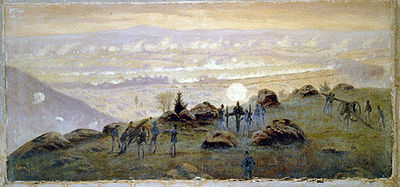
Gettysburg, Pennsylvania
Gettysburg is a borough that is the county seat, part of the Gettysburg Battlefield, and the eponym for the 1863 Battle of Gettysburg. The town hosts visitors to the Gettysburg National Military Park and has 3 institutions of higher learning: Lutheran Theological Seminary, Gettysburg College, and...
. It was the site of an unsuccessful assault by Confederate
Confederate States Army
The Confederate States Army was the army of the Confederate States of America while the Confederacy existed during the American Civil War. On February 8, 1861, delegates from the seven Deep South states which had already declared their secession from the United States of America adopted the...
troops against the Union
Union Army
The Union Army was the land force that fought for the Union during the American Civil War. It was also known as the Federal Army, the U.S. Army, the Northern Army and the National Army...
left flank on July 2, 1863, the second day of the Battle of Gettysburg
Battle of Gettysburg
The Battle of Gettysburg , was fought July 1–3, 1863, in and around the town of Gettysburg, Pennsylvania. The battle with the largest number of casualties in the American Civil War, it is often described as the war's turning point. Union Maj. Gen. George Gordon Meade's Army of the Potomac...
.
Considered by some historians to be the key point in the Union Army's defensive line that day, Little Round Top was defended successfully by the brigade of Col.
Colonel (United States)
In the United States Army, Air Force, and Marine Corps, colonel is a senior field grade military officer rank just above the rank of lieutenant colonel and just below the rank of brigadier general...
Strong Vincent
Strong Vincent
Strong Vincent was a lawyer who became famous as a U.S. Army officer during the fighting on Little Round Top at the American Civil War Battle of Gettysburg, where he was mortally wounded.-Early life:...
. The 20th Maine Volunteer Infantry Regiment
20th Maine Volunteer Infantry Regiment
The 20th Maine Volunteer Infantry Regiment was a combat unit of the United States Army during the American Civil War, most famous for its defense of Little Round Top at the Battle of Gettysburg, July 1863.-Organization:...
, commanded by Col. Joshua Lawrence Chamberlain, fought the most famous engagement there, culminating in a dramatic downhill bayonet
Bayonet
A bayonet is a knife, dagger, sword, or spike-shaped weapon designed to fit in, on, over or underneath the muzzle of a rifle, musket or similar weapon, effectively turning the gun into a spear...
charge that is one of the most well-known actions at Gettysburg and in the American Civil War
American Civil War
The American Civil War was a civil war fought in the United States of America. In response to the election of Abraham Lincoln as President of the United States, 11 southern slave states declared their secession from the United States and formed the Confederate States of America ; the other 25...
.
Geography
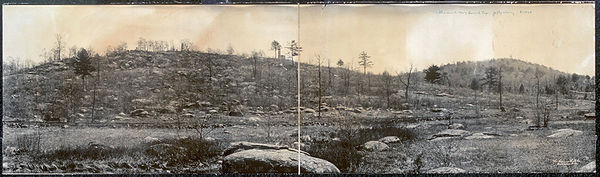
Big Round Top
Big Round Top is a boulder-strewn hill notable as the topographic high point of the Gettysburg Battlefield and for 1863 American Civil War engagements for which Medals of Honor were awarded...
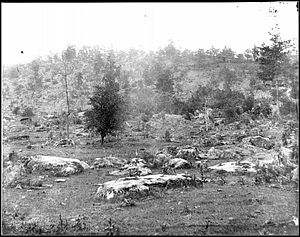
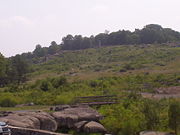
with an oval crest (despite its name) that forms a short ridgeline with a summit of 63 ft (19.2 m) prominence above the saddle point to Big Round Top to the south. Located approximately two miles (3 km) south of Gettysburg, with a rugged, steep slope rising 150 feet (46 m) above nearby Plum Run to the west (the peak is 650 feet (198 m) above sea level), strewn with large boulders. The western slope was generally free from vegetation, while the summit and eastern and southern slopes were lightly wooded. Directly to the south was its companion hill, [Big] Round Top
Big Round Top
Big Round Top is a boulder-strewn hill notable as the topographic high point of the Gettysburg Battlefield and for 1863 American Civil War engagements for which Medals of Honor were awarded...
, 130 feet (40 m) higher and densely wooded.
There is no evidence that the name "Little Round Top" was used by soldiers or civilians during the battle. Although the larger hill was known before the battle as Round Top, Round Top Mountain, and sometimes Round Hill, accounts written in 1863 referred to the smaller hill with a variety of names: Rock Hill, High Knob, Sugar Loaf Hill, Broad Top Summit, and granite spur of Round Top. Historian John B. Bachelder
John B. Bachelder
John Badger Bachelder was a portrait and landscape painter, lithographer, and photographer, but best known as the preeminent 19th century historian of the Battle of Gettysburg in the American Civil War...
, who had an enormous influence on the preservation of the Gettysburg battlefield, personally favored the name "Weed's Hill," in honor of Brig. Gen.
Brigadier general (United States)
A brigadier general in the United States Army, Air Force, and Marine Corps, is a one-star general officer, with the pay grade of O-7. Brigadier general ranks above a colonel and below major general. Brigadier general is equivalent to the rank of rear admiral in the other uniformed...
Stephen H. Weed
Stephen H. Weed
Stephen Hinsdale Weed was a career military officer in the United States Army. He was killed defending Little Round Top during the Battle of Gettysburg in the American Civil War.-Early life and career:...
, who was mortally wounded on Little Round Top. Bachelder abandoned that name by 1873. One of the first public uses of "Little Round Top" was by Edward Everett
Edward Everett
Edward Everett was an American politician and educator from Massachusetts. Everett, a Whig, served as U.S. Representative, and U.S. Senator, the 15th Governor of Massachusetts, Minister to Great Britain, and United States Secretary of State...
in his oration at the dedication of the Soldiers' National Cemetery
Gettysburg National Cemetery
The Gettysburg National Cemetery is located on Cemetery Hill in the Gettysburg Battlefield near the borough of Gettysburg, Pennsylvania and adjacent to Evergreen Cemetery to the south...
on November 19, 1863.
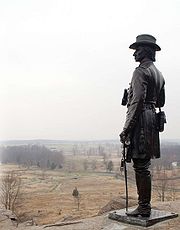
History
The igneous landform was created 200 million years ago when the "outcrop of the Gettysburg sill" intruded through the Triassic "Gettysburg plain"Newark Group
The Newark Group, also known as the Newark Supergroup, is an assemblage of Late Triassic and Early Jurassic sedimentary rocks which outcrop intermittently along the United States East Coast; the exposures extend from Massachusetts to North Carolina, with more still in Nova Scotia...
. Subsequent periglacial
Periglacial
Periglacial is an adjective originally referring to places in the edges of glacial areas, but it has later been widely used in geomorphology to describe any place where geomorphic processes related to freezing of water occur...
frost wedging during the Pleistocene
Pleistocene
The Pleistocene is the epoch from 2,588,000 to 11,700 years BP that spans the world's recent period of repeated glaciations. The name pleistocene is derived from the Greek and ....
formed the hill's extensive boulders.
Battle of Gettysburg
At around 4 p.m. on July 2, 1863, Confederate Lt. Gen. James LongstreetJames Longstreet
James Longstreet was one of the foremost Confederate generals of the American Civil War and the principal subordinate to General Robert E. Lee, who called him his "Old War Horse." He served under Lee as a corps commander for many of the famous battles fought by the Army of Northern Virginia in the...
's First Corps began an attack ordered by General Robert E. Lee
Robert E. Lee
Robert Edward Lee was a career military officer who is best known for having commanded the Confederate Army of Northern Virginia in the American Civil War....
that was intended to drive northeast up the Emmitsburg Road in the direction of Cemetery Hill, rolling up the Union left flank. Maj. Gen. John Bell Hood
John Bell Hood
John Bell Hood was a Confederate general during the American Civil War. Hood had a reputation for bravery and aggressiveness that sometimes bordered on recklessness...
's division was assigned to attack up the eastern side of the road, Maj. Gen. Lafayette McLaws
Lafayette McLaws
Lafayette McLaws was a United States Army officer and a Confederate general in the American Civil War.-Early life:...
's division the western side. Hood's division stepped off first, but instead of guiding on the road, elements began to swing directly to the east in the direction of the Round Tops. Instead of driving the entire division up the spine of Houck's Ridge (the boulder-strewn area known to the soldiers as the Devil's Den
Devil's Den
Devils Den is a boulder-strewn Gettysburg Battlefield hill used by artillery and infantry during the 1863 Battle of Gettysburg, Second Day...
), parts of Hood's division detoured over Round Top and approached the southern slope of Little Round Top. There were four probable reasons for the deviation in the division's direction: first, regiments from the Union III Corps were unexpectedly in the Devil's Den
Devil's Den
Devils Den is a boulder-strewn Gettysburg Battlefield hill used by artillery and infantry during the 1863 Battle of Gettysburg, Second Day...
area and they would threaten Hood's right flank if they were not dealt with; second, fire from the 2nd U.S. Sharpshooters
2nd United States Volunteer Sharpshooter Regiment
The 2nd United States Volunteer Sharpshooter Regiment was an infantry regiment that served in the Union Army during the American Civil War. From 1861 to January 1863 they were members of the "First Iron Brigade" also known as the "Iron Brigade of the East"....
at Slyder's farm drew the attention of lead elements of Brig. Gen. Evander M. Law
Evander M. Law
Evander McIver Law was an author, teacher, and a Confederate general in the American Civil War.-Early life:...
's brigade, moving in pursuit and drawing his brigade to the right; third, the terrain was rough and units naturally lost their parade-ground alignments; finally, Hood's senior subordinate, General Law, was unaware that he was now in command of the division, so he could not exercise control.
In the meantime, Little Round Top was undefended by Union troops. Maj. Gen. George G. Meade, commander of the Army of the Potomac
Army of the Potomac
The Army of the Potomac was the major Union Army in the Eastern Theater of the American Civil War.-History:The Army of the Potomac was created in 1861, but was then only the size of a corps . Its nucleus was called the Army of Northeastern Virginia, under Brig. Gen...
, had ordered Maj. Gen. Daniel Sickles
Daniel Sickles
Daniel Edgar Sickles was a colorful and controversial American politician, Union general in the American Civil War, and diplomat....
's III Corps to defend the southern end of Cemetery Ridge, which would have just included Little Round Top. But Sickles, defying Meade's orders, moved his corps a few hundred yards west to the Emmitsburg Road and the Peach Orchard, causing a large salient
Salients, re-entrants and pockets
A salient is a battlefield feature that projects into enemy territory. The salient is surrounded by the enemy on three sides, making the troops occupying the salient vulnerable. The enemy's line facing a salient is referred to as a re-entrant...
in the line, which was also too long to defend properly. His left flank was anchored in Devil's Den. When Meade discovered this situation, he dispatched his chief engineer, Brig. Gen. Gouverneur K. Warren
Gouverneur K. Warren
Gouverneur Kemble Warren was a civil engineer and prominent general in the Union Army during the American Civil War...
, to attempt to deal with the situation south of Sickles's position. Climbing Little Round Top, Warren found only a small Signal Corps
United States Army Signal Corps
The United States Army Signal Corps develops, tests, provides, and manages communications and information systems support for the command and control of combined arms forces. It was established in 1860, the brainchild of United States Army Major Albert J. Myer, and has had an important role from...
station there. He saw the glint of bayonets in the sun to the southwest and realized that a Confederate assault into the Union flank was imminent. He hurriedly sent staff officers, including Washington Roebling
Washington Roebling
Washington Augustus Roebling was an American civil engineer best known for his work on the Brooklyn Bridge, which was initially designed by his father John A. Roebling.-Education and military service:...
, to find help from any available units in the vicinity.
The response to this request for help came from Maj. Gen. George Sykes
George Sykes
George Sykes was a career United States Army officer and a Union General during the American Civil War.-Early life:...
, commander of the Union V Corps. Sykes quickly dispatched a messenger to order his 1st Division, commanded by Brig. Gen. James Barnes, to Little Round Top. Before the messenger could reach Barnes, he encountered Col. Strong Vincent
Strong Vincent
Strong Vincent was a lawyer who became famous as a U.S. Army officer during the fighting on Little Round Top at the American Civil War Battle of Gettysburg, where he was mortally wounded.-Early life:...
, commander of the third brigade, who seized the initiative and directed his four regiments to Little Round Top without waiting for permission from Barnes. He and Oliver W. Norton, the brigade bugler, galloped ahead to reconnoiter
Reconnaissance
Reconnaissance is the military term for exploring beyond the area occupied by friendly forces to gain information about enemy forces or features of the environment....
and guide his four regiments into position. Upon arrival on Little Round Top, Vincent and Norton received fire from Confederate batteries almost immediately. On the western slope he placed the 16th Michigan, and then proceeding counterclockwise were the 44th New York, the 83rd Pennsylvania, and finally, at the end of the line on the southern slope, the 20th Maine
20th Maine Volunteer Infantry Regiment
The 20th Maine Volunteer Infantry Regiment was a combat unit of the United States Army during the American Civil War, most famous for its defense of Little Round Top at the Battle of Gettysburg, July 1863.-Organization:...
. Arriving only ten minutes before the Confederates, Vincent ordered his brigade to take cover and wait, and he ordered Col. Joshua Lawrence Chamberlain, commander of the 20th Maine, to hold his position, the extreme left of the Army of the Potomac, at all costs. Chamberlain and his 385 men waited for what was to come.
Battle of Little Round Top
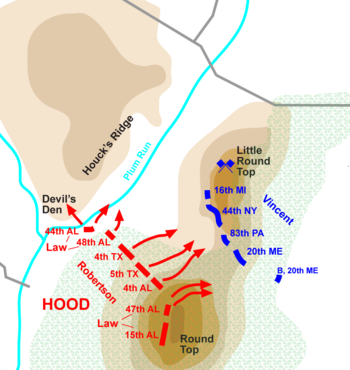
Alabama
Alabama is a state located in the southeastern region of the United States. It is bordered by Tennessee to the north, Georgia to the east, Florida and the Gulf of Mexico to the south, and Mississippi to the west. Alabama ranks 30th in total land area and ranks second in the size of its inland...
Brigade of Hood's Division, commanded by Brig. Gen. Evander Law. (As the battle progressed and Law realized he was in command of the division, Col. James L. Sheffield was eventually notified to assume brigade command.) Dispatching the 4th, 15th, and 47th Alabama, and the 4th and 5th Texas to Little Round Top, Law ordered his men to take the hill. The men were exhausted, having marched more than 20 miles (32 km) that day to reach this point. The day was hot and their canteens were empty; Law's order to move out reached them before they could refill their water. Approaching the Union line on the crest of the hill, Law's men were thrown back by the first Union volley and withdrew briefly to regroup. The 15th Alabama
15th Regiment Alabama Infantry
The 15th Regiment of Alabama Infantry was a Confederate volunteer infantry unit from the state of Alabama during the American Civil War. Recruited from six counties in the southeastern part of the state, it fought mostly with Robert E...
, commanded by Col. William C. Oates
William C. Oates
William Calvin Oates was a Confederate colonel during the American Civil War, the 29th Governor of Alabama from 1894 to 1896, and a brigadier general in the U.S. Army during the Spanish–American War....
, repositioned further right and attempted to find the Union left flank.
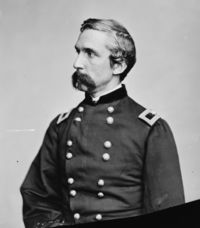
The left flank consisted of the 20th Maine regiment and the 83rd Pennsylvania. Seeing the Confederates shifting around his flank, Chamberlain first stretched his line to the point where his men were in a single-file line, then ordered the southernmost half of his line to swing back during a lull following another Confederate charge. It was there that they "refused the line"—formed an angle to the main line in an attempt to prevent the Confederate flanking maneuver. Despite heavy losses, the 20th Maine held through two subsequent charges by the 15th Alabama and other Confederate regiments for a total of ninety minutes.
On the final charge, knowing that his men were out of ammunition, that his numbers were being depleted, and further knowing that another charge could not be repulsed, Chamberlain ordered a maneuver that was considered unusual for the day: He ordered his left flank, which had been pulled back, to advance with bayonets in a "right-wheel forward" maneuver. As soon as they were in line with the rest of the regiment, the remainder of the regiment charged, akin to a door swinging shut. This simultaneous frontal assault
Frontal assault
The military tactic of frontal assault is a direct, hostile movement of forces toward the front of an enemy force . By targeting the enemy's front, the attackers are subjecting themselves to the maximum defensive power of the enemy...
and flanking maneuver
Flanking maneuver
In military tactics, a flanking maneuver, also called a flank attack, is an attack on the sides of an opposing force. If a flanking maneuver succeeds, the opposing force would be surrounded from two or more directions, which significantly reduces the maneuverability of the outflanked force and its...
halted and captured a good portion of the 15th Alabama.

Holman S. Melcher
Holman Staples Melcher was an American Civil War officer and postbellum mayor of Portland, Maine. Melcher was a company commander in the 20th Maine Volunteer Infantry Regiment that charged down Little Round Top at the Battle of Gettysburg....
that he initiated the charge, although Chamberlain has been credited by most historians for ordering the advance. Chamberlain's version of the story is that he decided to order the charge before Lt. Melcher requested permission to advance the center of the line toward a boulder ledge where some of the men were wounded and unable to move. Admiring the lieutenant's bravery and compassion, Chamberlain agreed and sent him back to his company, telling him that he was about to order the entire regiment forward. As Melcher returned to his men, the shouts of "Bayonet!" were already working their way down the line.
During their retreat, the Confederates were subjected to a volley of rifle fire from Company B of the 20th Maine, commanded by Captain Walter G. Morrill, and a few of the 2nd U.S. Sharpshooters, who had been placed by Chamberlain behind a stone wall 150 yards to the east, hoping to guard against an envelopment. This group, who had been hidden from sight, caused considerable confusion in the Confederate ranks.
Thirty years later, Chamberlain received a Medal of Honor
Medal of Honor
The Medal of Honor is the highest military decoration awarded by the United States government. It is bestowed by the President, in the name of Congress, upon members of the United States Armed Forces who distinguish themselves through "conspicuous gallantry and intrepidity at the risk of his or her...
for his conduct in the defense of Little Round Top. The citation read that it was awarded for "daring heroism and great tenacity in holding his position on the Little Round Top against repeated assaults, and carrying the advance position on the Great Round Top."
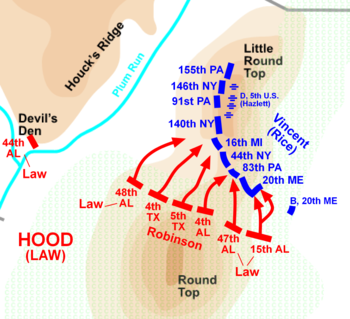
Before the Michigan
Michigan
Michigan is a U.S. state located in the Great Lakes Region of the United States of America. The name Michigan is the French form of the Ojibwa word mishigamaa, meaning "large water" or "large lake"....
ders could be demoralized, reinforcements summoned by Warren who had continued on to find more troops to defend the hill—had arrived in the form of the 140th New York
140th New York Volunteer Infantry Regiment
The 140th New York Volunteer Infantry Regiment was a Federal Regiment that was mustered on September 13, 1862 and was mustered out on June 3, 1865. Citizens of Monroe County comprising the majority of its members...
and a battery of four guns Battery D, 5th U.S. Artillery, commanded by Lt. Charles E. Hazlett
Charles E. Hazlett
Charles Edward Hazlett was a U.S. Army 1st Lieutenant during the American Civil War. He was killed on Little Round Top during the second day of the Battle of Gettysburg.-Early life:...
. (Simply maneuvering these guns by hand up the steep and rocky slope of the hill was an amazing achievement. However, this effort had little effect on the action of July 2. The artillerymen were exposed to constant sniper
Sniper
A sniper is a marksman who shoots targets from concealed positions or distances exceeding the capabilities of regular personnel. Snipers typically have specialized training and distinct high-precision rifles....
fire and could not work effectively. More significantly, however, they could not depress their barrels sufficiently to defend against incoming infantry attacks.)
The 140th charged into the fray of the battle, driving the Texans back and securing victory for the Union forces on the hill. Col. Patrick "Paddy" O'Rorke
Patrick O'Rorke
This article is about an Irish-American colonel. For the Meath footballer from Skryne, see Patrick O'Rourke Patrick Henry "Paddy" O'Rorke or O'Rourke was an Irish-American immigrant who became a colonel in the Union Army during the American Civil War and was killed at the Battle of...
, who personally led his regiment in the charge, was killed. Reinforced further by Stephen Weed's brigade of the V Corps, Union forces held the hill throughout the rest of the battle, enduring persistent fire from Confederate sharpshooters stationed around Devil's Den. General Weed was among the victims, and as his old friend Charles Hazlett leaned over to comfort Weed, the artilleryman was also shot dead.
Evening and July 3
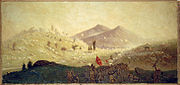
Skirmisher
Skirmishers are infantry or cavalry soldiers stationed ahead or alongside a larger body of friendly troops. They are usually placed in a skirmish line to harass the enemy.-Pre-modern:...
. It was fortified by Weed's brigade, five regiments of the Pennsylvania Reserves, and an Ohio
Ohio
Ohio is a Midwestern state in the United States. The 34th largest state by area in the U.S.,it is the 7th‑most populous with over 11.5 million residents, containing several major American cities and seven metropolitan areas with populations of 500,000 or more.The state's capital is Columbus...
battery
Artillery
Originally applied to any group of infantry primarily armed with projectile weapons, artillery has over time become limited in meaning to refer only to those engines of war that operate by projection of munitions far beyond the range of effect of personal weapons...
of six guns. Most of the stone breastworks that are currently visible on the hill were constructed by these troops after the fighting stopped. Troops of the II, V, VI, and XII Corps passed through the area and also occupied Round Top.
Little Round Top was the starting point for a Union counterattack at dusk on July 2, conducted by the 3rd Division of the V Corps (the Pennsylvania Reserves) under Brig. Gen. Samuel W. Crawford
Samuel W. Crawford
Samuel Wylie Crawford was a United States Army surgeon and a Union general in the American Civil War.-Early life:...
, launched to the west in the direction of the Wheatfield.
On July 3, Hazlett's battery (now under the command of Lt. Benjamin F. Rittenhouse
Benjamin F. Rittenhouse
Benjamin Franklin Rittenhouse was a U.S. Army 1st lieutenant during the American Civil War.-Early life:...
) fired into the flank of the Confederate assault known as Pickett's Charge
Pickett's Charge
Pickett's Charge was an infantry assault ordered by Confederate Gen. Robert E. Lee against Maj. Gen. George G. Meade's Union positions on Cemetery Ridge on July 3, 1863, the last day of the Battle of Gettysburg during the American Civil War. Its futility was predicted by the charge's commander,...
. Near the end of that engagement, General Meade observed from Little Round Top and contemplated his options for a possible counterattack against Lee.
Impact of the battle
The battle on July 2 was not as bloody as some Civil War battles. Of the 2,996 Union troops engaged, there were 565 casualties (134 killed, 402 wounded, 29 missing); Confederate losses of 4,864 engaged were 1,185 (279, 868, 219).While agreeing that the fighting on Little Round Top was extremely fierce and soldiers on both sides fought valiantly, historians disagree as to the impact of this particular engagement on the overall outcome of the Battle of Gettysburg. The traditional view—one that emerged in the 1880s—is that the left flank of the Union army was a crucial position. An example of this view is from 1900: "If the Confederates had seized [Little Round Top] and dragged some of their artillery up there, as they easily could have done, they would have enfiladed Meade's entire line and made it too unhealthy for him to remain there." An alternative claim is that the hill's terrain offered a poor platform for artillery, and that had Longstreet secured the hill, the Union army would have been forced back to a better defensive position, making the attack on the hill a distraction from the Confederates' true objective. This latter theory is supported by General Lee's writings, in which he appears to have considered Little Round Top irrelevant. In Lee's report after the Gettysburg Campaign
Gettysburg Campaign
The Gettysburg Campaign was a series of battles fought in June and July 1863, during the American Civil War. After his victory in the Battle of Chancellorsville, Confederate General Robert E. Lee's Army of Northern Virginia moved north for offensive operations in Maryland and Pennsylvania. The...
, he stated in part, "General Longstreet was delayed by a force occupying the high, rocky hills on the enemy's extreme left, from which his troops could be attacked in reverse as they advanced", suggesting Longstreet was ordered on a course intended to bypass Little Round Top—had the hill been a key objective of the assault, Lee would not have used the phrase "delayed by" in describing the effects of the engagement.
Garry Adelman has countered the argument that the Confederate capture of Little Round Top would have resulted in significant negative consequences for the Union. Examining the number of troops available in the vicinity in the late afternoon, he determined that at most 2,650 Confederates could have been available to defend the hill after capturing it, and that these men would have been exhausted from combat and short on ammunition. In contrast, 11,600 fresh Union reinforcements were available within a mile, primarily from Maj. Gen. John Sedgwick
John Sedgwick
John Sedgwick was a teacher, a career military officer, and a Union Army general in the American Civil War. He was the highest ranking Union casualty in the Civil War, killed by a sniper at the Battle of Spotsylvania Court House.-Early life:Sedgwick was born in the Litchfield Hills town of...
's VI Corps. In addition, the value of Little Round Top as an artillery position has been overstated—the shape of the crest of the hill forces guns to be placed one behind the other, limiting their effectiveness when engaging targets directly to the north, such as the Union line on Cemetery Ridge.
Postbellum
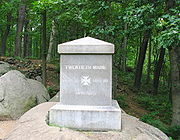
In 1865 during the visits by 13 generals, points were identified on Little Round Top at which markers were subsequently erected, and a 40 ft (12.2 m) observatory had been built by 1886 before the stone 44th NY monument with observation deck was dedicated in 1892. In the late 1880s, the 20th Maine Volunteer Infantry Regiment20th Maine Volunteer Infantry Regiment
The 20th Maine Volunteer Infantry Regiment was a combat unit of the United States Army during the American Civil War, most famous for its defense of Little Round Top at the Battle of Gettysburg, July 1863.-Organization:...
monument on Little Round Top was dedicated with a speech by Joshua Chamberlain. The 1974 novel The Killer Angels
The Killer Angels
The Killer Angels is a historical novel by Michael Shaara that was awarded the Pulitzer Prize for Fiction in 1975. The book tells the story of four days of the Battle of Gettysburg in the American Civil War: June 30, 1863, as the troops of both the Union and the Confederacy move into battle around...
and its 1993 film version, Gettysburg depicted a portion of the Battle of Little Round Top.
Further reading
- Gottfried, Bradley M. Brigades of Gettysburg. New York: Da Capo Press, 2002. ISBN 0-306-81175-8.
- Gottfried, Bradley M. The Maps of Gettysburg: An Atlas of the Gettysburg Campaign, June 3 – June 13, 1863. New York: Savas Beatie, 2007. ISBN 978-1-932714-30-2.
- Grimsley, Mark, and Brooks D. Simpson. Gettysburg: A Battlefield Guide. Lincoln: University of Nebraska Press, 1999. ISBN 0-8032-7077-1.
- Hall, Jeffrey C. The Stand of the U.S. Army at Gettysburg. Bloomington: Indiana University Press, 2003. ISBN 0-253-34258-9.
- Laino, Philip, Gettysburg Campaign Atlas. 2nd ed. Dayton, OH: Gatehouse Press 2009. ISBN 978-1-934900-45-1.
- Norton, Oliver W. The Attack and Defense of Little Round Top: Gettysburg, July 2, 1863. Gettysburg, PA: Stan Clark Military Books, 1992. ISBN 1-879664-08-9. First published 1913 by Neale Publishing Co.
- Petruzzi, J. David, and Steven Stanley. The Complete Gettysburg Guide. New York: Savas Beatie, 2009. ISBN 978-1-932714-63-0. (p. 2)