
Home      Discussion      Topics      Dictionary      Almanac
Signup       Login
Battle of Harpers Ferry

Battle of Harpers Ferry

Overview
The Battle of Harpers Ferry was fought September 12–15, 1862, as part of the Maryland Campaign
Maryland Campaign
The Maryland Campaign, or the Antietam Campaign is widely considered one of the major turning points of the American Civil War. Confederate Gen. Robert E. Lee's first invasion of the North was repulsed by Maj. Gen. George B...

 of the American Civil War
American Civil War
The American Civil War was a civil war fought in the United States of America. In response to the election of Abraham Lincoln as President of the United States, 11 southern slave states declared their secession from the United States and formed the Confederate States of America ; the other 25...

. As Gen. Robert E. Lee
Robert E. Lee
Robert Edward Lee was a career military officer who is best known for having commanded the Confederate Army of Northern Virginia in the American Civil War....

's Confederate
Confederate States Army
The Confederate States Army was the army of the Confederate States of America while the Confederacy existed during the American Civil War. On February 8, 1861, delegates from the seven Deep South states which had already declared their secession from the United States of America adopted the...

 army invaded Maryland
Maryland
Maryland is a U.S. state located in the Mid Atlantic region of the United States, bordering Virginia, West Virginia, and the District of Columbia to its south and west; Pennsylvania to its north; and Delaware to its east...

, a portion of his army under Maj. Gen. Thomas J. "Stonewall" Jackson
Stonewall Jackson
ຄຽשת״ׇׂׂׂׂ֣|birth_place= Clarksburg, Virginia |death_place=Guinea Station, Virginia|placeofburial=Stonewall Jackson Memorial CemeteryLexington, Virginia|placeofburial_label= Place of burial|image=...

 surrounded, bombarded, and captured the Union
Union Army
The Union Army was the land force that fought for the Union during the American Civil War. It was also known as the Federal Army, the U.S. Army, the Northern Army and the National Army...

 garrison at Harpers Ferry
Harpers Ferry, West Virginia
Harpers Ferry is a historic town in Jefferson County, West Virginia, United States. In many books the town is called "Harper's Ferry" with an apostrophe....

, Virginia
Virginia
The Commonwealth of Virginia , is a U.S. state on the Atlantic Coast of the Southern United States. Virginia is nicknamed the "Old Dominion" and sometimes the "Mother of Presidents" after the eight U.S. presidents born there...

 (now West Virginia
West Virginia
West Virginia is a state in the Appalachian and Southeastern regions of the United States, bordered by Virginia to the southeast, Kentucky to the southwest, Ohio to the northwest, Pennsylvania to the northeast and Maryland to the east...

), a major victory at relatively minor cost.
Discussion
Ask a question about 'Battle of Harpers Ferry'
Start a new discussion about 'Battle of Harpers Ferry'
Answer questions from other users
Full Discussion Forum
 
Unanswered Questions
Encyclopedia
The Battle of Harpers Ferry was fought September 12–15, 1862, as part of the Maryland Campaign
Maryland Campaign
The Maryland Campaign, or the Antietam Campaign is widely considered one of the major turning points of the American Civil War. Confederate Gen. Robert E. Lee's first invasion of the North was repulsed by Maj. Gen. George B...

 of the American Civil War
American Civil War
The American Civil War was a civil war fought in the United States of America. In response to the election of Abraham Lincoln as President of the United States, 11 southern slave states declared their secession from the United States and formed the Confederate States of America ; the other 25...

. As Gen. Robert E. Lee
Robert E. Lee
Robert Edward Lee was a career military officer who is best known for having commanded the Confederate Army of Northern Virginia in the American Civil War....

's Confederate
Confederate States Army
The Confederate States Army was the army of the Confederate States of America while the Confederacy existed during the American Civil War. On February 8, 1861, delegates from the seven Deep South states which had already declared their secession from the United States of America adopted the...

 army invaded Maryland
Maryland
Maryland is a U.S. state located in the Mid Atlantic region of the United States, bordering Virginia, West Virginia, and the District of Columbia to its south and west; Pennsylvania to its north; and Delaware to its east...

, a portion of his army under Maj. Gen. Thomas J. "Stonewall" Jackson
Stonewall Jackson
ຄຽשת״ׇׂׂׂׂ֣|birth_place= Clarksburg, Virginia |death_place=Guinea Station, Virginia|placeofburial=Stonewall Jackson Memorial CemeteryLexington, Virginia|placeofburial_label= Place of burial|image=...

 surrounded, bombarded, and captured the Union
Union Army
The Union Army was the land force that fought for the Union during the American Civil War. It was also known as the Federal Army, the U.S. Army, the Northern Army and the National Army...

 garrison at Harpers Ferry
Harpers Ferry, West Virginia
Harpers Ferry is a historic town in Jefferson County, West Virginia, United States. In many books the town is called "Harper's Ferry" with an apostrophe....

, Virginia
Virginia
The Commonwealth of Virginia , is a U.S. state on the Atlantic Coast of the Southern United States. Virginia is nicknamed the "Old Dominion" and sometimes the "Mother of Presidents" after the eight U.S. presidents born there...

 (now West Virginia
West Virginia
West Virginia is a state in the Appalachian and Southeastern regions of the United States, bordered by Virginia to the southeast, Kentucky to the southwest, Ohio to the northwest, Pennsylvania to the northeast and Maryland to the east...

), a major victory at relatively minor cost.

As Lee's Army of Northern Virginia
Army of Northern Virginia
The Army of Northern Virginia was the primary military force of the Confederate States of America in the Eastern Theater of the American Civil War, as well as the primary command structure of the Department of Northern Virginia. It was most often arrayed against the Union Army of the Potomac...

 advanced down the Shenandoah Valley
Shenandoah Valley
The Shenandoah Valley is both a geographic valley and cultural region of western Virginia and West Virginia in the United States. The valley is bounded to the east by the Blue Ridge Mountains, to the west by the eastern front of the Ridge-and-Valley Appalachians , to the north by the Potomac River...

 into Maryland
Maryland
Maryland is a U.S. state located in the Mid Atlantic region of the United States, bordering Virginia, West Virginia, and the District of Columbia to its south and west; Pennsylvania to its north; and Delaware to its east...

, he planned to capture the garrison and arsenal at Harpers Ferry, not only to seize its supplies of rifles and ammunition, but to secure his line of supply back to Virginia. Although he was being pursued at a leisurely pace by Maj. Gen. George B. McClellan
George B. McClellan
George Brinton McClellan was a major general during the American Civil War. He organized the famous Army of the Potomac and served briefly as the general-in-chief of the Union Army. Early in the war, McClellan played an important role in raising a well-trained and organized army for the Union...

's Army of the Potomac
Army of the Potomac
The Army of the Potomac was the major Union Army in the Eastern Theater of the American Civil War.-History:The Army of the Potomac was created in 1861, but was then only the size of a corps . Its nucleus was called the Army of Northeastern Virginia, under Brig. Gen...

, outnumbering him more than two to one, Lee chose the risky strategy of dividing his army and sent one portion to converge and attack Harpers Ferry from three directions. Col.
Colonel (United States)
In the United States Army, Air Force, and Marine Corps, colonel is a senior field grade military officer rank just above the rank of lieutenant colonel and just below the rank of brigadier general...

 Dixon S. Miles
Dixon S. Miles
Dixon Stansbury Miles was a career United States Army officer who served in the Mexican-American War and the Indian Wars. He was mortally wounded as he surrendered his Union garrison in the Battle of Harpers Ferry during the American Civil War.-Early life and military service:Miles was born in...

, Union commander at Harpers Ferry, insisted on keeping most of the troops near the town instead of taking up commanding positions on the surrounding heights. The slim defenses of the most important position, Maryland Heights, first encountered the approaching Confederate on September 12, but only brief skirmishing ensued. Strong attacks by two Confederate brigades on September 13 drove the Union troops from the heights.

During the fighting on Maryland Heights, the other Confederate columns arrived and were astonished to see that critical positions to the west and south of town were not defended. Jackson methodically positioned his artillery around Harpers Ferry and ordered Maj. Gen. A.P. Hill to move down the west bank of the Shenandoah River
Shenandoah River
The Shenandoah River is a tributary of the Potomac River, long with two forks approximately long each, in the U.S. states of Virginia and West Virginia...

 in preparation for a flank attack on the Federal left the next morning. By the morning of September 15, Jackson had positioned nearly 50 guns on Maryland Heights and at the base of Loudoun Heights. He began a fierce artillery barrage from all sides and ordered an infantry assault. Miles realized that the situation was hopeless and agreed with his subordinates to raise the white flag of surrender. Before he could surrender personally, he was mortally wounded by an artillery shell and died the next day. After processing more than 12,000 Union prisoners, Jackson's men then rushed to Sharpsburg, Maryland
Sharpsburg, Maryland
Sharpsburg is a town in Washington County, Maryland, United States, approximately south of Hagerstown. The population was 691 at the 2000 census....

, to rejoin Lee for the Battle of Antietam
Battle of Antietam
The Battle of Antietam , fought on September 17, 1862, near Sharpsburg, Maryland, and Antietam Creek, as part of the Maryland Campaign, was the first major battle in the American Civil War to take place on Northern soil. It was the bloodiest single-day battle in American history, with about 23,000...

.

Background


Harpers Ferry (originally Harper's Ferry) is a small town at the confluence
Confluence
Confluence, in geography, describes the meeting of two or more bodies of water.Confluence may also refer to:* Confluence , a property of term rewriting systems...

 of the Potomac River
Potomac River
The Potomac River flows into the Chesapeake Bay, located along the mid-Atlantic coast of the United States. The river is approximately long, with a drainage area of about 14,700 square miles...

 and the Shenandoah River
Shenandoah River
The Shenandoah River is a tributary of the Potomac River, long with two forks approximately long each, in the U.S. states of Virginia and West Virginia...

, the site of a historic Federal arsenal (founded by President
President of the United States
The President of the United States of America is the head of state and head of government of the United States. The president leads the executive branch of the federal government and is the commander-in-chief of the United States Armed Forces....

 George Washington
George Washington
George Washington was the dominant military and political leader of the new United States of America from 1775 to 1799. He led the American victory over Great Britain in the American Revolutionary War as commander-in-chief of the Continental Army from 1775 to 1783, and presided over the writing of...

 in 1799) and a bridge for the critical Baltimore and Ohio Railroad
Baltimore and Ohio Railroad
The Baltimore and Ohio Railroad was one of the oldest railroads in the United States and the first common carrier railroad. It came into being mostly because the city of Baltimore wanted to compete with the newly constructed Erie Canal and another canal being proposed by Pennsylvania, which...

 across the Potomac. It was earlier the site of the abolitionist John Brown's attack on the Federal arsenal there in 1859.

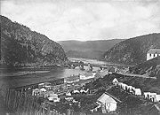
The town was virtually indefensible, dominated on all sides by higher ground. To the west, the ground rose gradually for about a mile and a half to Bolivar Heights, a plateau 668 feet (203.6 m) high, that stretches from the Potomac to the Shenandoah. To the south, across the Shenandoah, Loudoun Heights
Loudoun Heights (Mountain)
Loudoun Heights, sometimes referred to as Loudoun Mountain, is the first peak of the Blue Ridge Mountain south of the Potomac River in Loudoun County, Virginia and Jefferson County, West Virginia...

 overlooks from 1180 feet (359.7 m). And to the northeast, across the Potomac, the southernmost extremity of Elk Ridge
Elk Ridge (Maryland)
Elk Ridge is a mountain ridge of the Blue Ridge Mountains in Maryland. The ridge is located to the west of South Mountain and runs roughly parallel to it from Rohrersville, in the north, to the Potomac River across from Harpers Ferry, West Virginia, in the south. Across the Potomac the ridge...

 forms the 1,476-foot-high crest of Maryland Heights. A Federal soldier wrote that if these three heights could not be held, Harpers Ferry would be "no more defensible than a well bottom."

As Gen. Robert E. Lee
Robert E. Lee
Robert Edward Lee was a career military officer who is best known for having commanded the Confederate Army of Northern Virginia in the American Civil War....

's Army of Northern Virginia
Army of Northern Virginia
The Army of Northern Virginia was the primary military force of the Confederate States of America in the Eastern Theater of the American Civil War, as well as the primary command structure of the Department of Northern Virginia. It was most often arrayed against the Union Army of the Potomac...

 advanced into Maryland
Maryland
Maryland is a U.S. state located in the Mid Atlantic region of the United States, bordering Virginia, West Virginia, and the District of Columbia to its south and west; Pennsylvania to its north; and Delaware to its east...

, Lee expected that the Union garrisons that potentially blocked his supply line in the Shenandoah Valley, at Winchester
Winchester, Virginia
Winchester is an independent city located in the northwestern portion of the Commonwealth of Virginia in the USA. The city's population was 26,203 according to the 2010 Census...

, Martinsburg
Martinsburg, West Virginia
Martinsburg is a city in the Eastern Panhandle region of West Virginia, United States. The city's population was 14,972 at the 2000 census; according to a 2009 Census Bureau estimate, Martinsburg's population was 17,117, making it the largest city in the Eastern Panhandle and the eighth largest...

, and Harpers Ferry, would be cut off and abandoned without firing a shot (and, in fact, both Winchester and Martinsburg were evacuated). But the Harpers Ferry garrison had not retreated. Lee planned to capture the garrison and the arsenal, not only to seize its supplies of rifles and ammunition, but to secure his line of supply back to Virginia.

Although he was being pursued at a leisurely pace by Maj. Gen. George B. McClellan
George B. McClellan
George Brinton McClellan was a major general during the American Civil War. He organized the famous Army of the Potomac and served briefly as the general-in-chief of the Union Army. Early in the war, McClellan played an important role in raising a well-trained and organized army for the Union...

 and the Union Army of the Potomac
Army of the Potomac
The Army of the Potomac was the major Union Army in the Eastern Theater of the American Civil War.-History:The Army of the Potomac was created in 1861, but was then only the size of a corps . Its nucleus was called the Army of Northeastern Virginia, under Brig. Gen...

, outnumbering him more than two to one, Lee chose the risky strategy of dividing his army to seize the prize of Harpers Ferry. While the corps of Maj. Gen. James Longstreet
James Longstreet
James Longstreet was one of the foremost Confederate generals of the American Civil War and the principal subordinate to General Robert E. Lee, who called him his "Old War Horse." He served under Lee as a corps commander for many of the famous battles fought by the Army of Northern Virginia in the...

 drove north in the direction of Hagerstown
Hagerstown, Maryland
Hagerstown is a city in northwestern Maryland, United States. It is the county seat of Washington County, and, by many definitions, the largest city in a region known as Western Maryland. The population of Hagerstown city proper at the 2010 census was 39,662, and the population of the...

, Lee sent columns of troops to converge and attack Harpers Ferry from three directions. The largest column, 11,500 men under Jackson, was to recross the Potomac and circle around to the west of Harpers Ferry and attack it from Bolivar Heights, while the other two columns, under Maj. Gen. Lafayette McLaws
Lafayette McLaws
Lafayette McLaws was a United States Army officer and a Confederate general in the American Civil War.-Early life:...

 (8,000 men) and Brig. Gen. John G. Walker
John George Walker
John George Walker was a Confederate general in the American Civil War.-Early life and military career:Walker was born in Jefferson City, Missouri...

 (3,400), were to capture Maryland Heights and Loudoun Heights, commanding the town from the east and south.

McClellan had wanted to add the Harpers Ferry garrison to his field army, but general-in-chief Henry W. Halleck had refused, saying that the movement would be too difficult and that the garrison had to defend itself "until the latest moment," or until McClellan could relieve it. Halleck had probably expected its commander, Col.
Colonel (United States)
In the United States Army, Air Force, and Marine Corps, colonel is a senior field grade military officer rank just above the rank of lieutenant colonel and just below the rank of brigadier general...

 Dixon S. Miles
Dixon S. Miles
Dixon Stansbury Miles was a career United States Army officer who served in the Mexican-American War and the Indian Wars. He was mortally wounded as he surrendered his Union garrison in the Battle of Harpers Ferry during the American Civil War.-Early life and military service:Miles was born in...

, to show some military knowledge and courage. Miles was a 38-year veteran of the U.S. Army and the Mexican-American War, but who had been disgraced after the First Battle of Bull Run
First Battle of Bull Run
First Battle of Bull Run, also known as First Manassas , was fought on July 21, 1861, in Prince William County, Virginia, near the City of Manassas...

 when a court of inquiry held that he had been drunk during the battle. Miles swore off liquor and was sent to the supposedly quiet post at Harpers Ferry. His garrison comprised 14,000 men, many inexperienced, including 2,500 who had been forced out of Martinsburg by the approach of Jackson's men on September 11.

On the night of September 11, McLaws arrived at Brownsville
Brownsville, Maryland
Brownsville is a small unincorporated community in Washington County, Maryland, United States, near Gapland in an area known as Pleasant Valley.-Geography:...

, 6 miles northeast of Harpers Ferry. He left 3,000 men near Brownsville Gap to protect his rear and moved 3,000 others toward the Potomac River to seal off any eastern escape route from Harpers Ferry. He dispatched the veteran brigades of Brig. Gens. Joseph B. Kershaw
Joseph B. Kershaw
Joseph Brevard Kershaw was a lawyer, judge, and a Confederate general in the American Civil War.-Early life:...

 and William Barksdale
William Barksdale
William Barksdale was a lawyer, newspaper editor, U.S. Congressman, and a Confederate general in the American Civil War...

 to seize Maryland Heights on September 12. The other Confederate columns were making slow progress and were behind schedule. Jackson's men were delayed at Martinsburg. Walker's men were ordered to destroy the aqueduct
Monocacy Aqueduct
The Monocacy Aqueduct — or C&O Canal Aqueduct No. 2 — is the largest aqueduct on the Chesapeake and Ohio Canal, crossing the Monocacy River just before it empties into the Potomac River in Frederick County, Maryland, USA...

 carrying the Chesapeake and Ohio Canal
Chesapeake and Ohio Canal
The Chesapeake and Ohio Canal, abbreviated as the C&O Canal, and occasionally referred to as the "Grand Old Ditch," operated from 1831 until 1924 parallel to the Potomac River in Maryland from Cumberland, Maryland to Washington, D.C. The total length of the canal is about . The elevation change of...

 across the Monocacy River
Monocacy River
The Monocacy River is a free-flowing tributary of the Potomac River, which empties into the Atlantic Ocean via the Chesapeake Bay. The river is long, with a drainage area of about...

 where it empties into the Potomac, but his engineers had difficulty demolishing the stone structure and the attempt was eventually abandoned.

Walker reentered Virginia, in Loudoun County
Loudoun County, Virginia
Loudoun County is a county located in the Commonwealth of Virginia, and is part of the Washington Metropolitan Area. As of the 2010 U.S. Census, the county is estimated to be home to 312,311 people, an 84 percent increase over the 2000 figure of 169,599. That increase makes the county the fourth...

 on the 9th, across from Point of Rocks
Point of Rocks, Maryland
Point of Rocks is a community in Frederick County, Maryland. It is named for the striking rock formation on the adjacent Catoctin Mountain, which were formed by the Potomac River cutting through the ridge in a water gap, a typical formation in the Ridge-and-Valley Appalachians...

. Walker was escorted by Col. E.V. White
Elijah V. White
Elijah Viers "Lige" White was commander of the partisan 35th Battalion of Virginia Cavalry during the American Civil War. His men became commonly known as "White's Comanches" for their war cries and sudden raids on enemy targets.-Early life:Elijah White was born in the area of Poolesville, Maryland...

, Loudoun native, and his 35th Battalion of Virginia Cavalry
35th Battalion of Virginia Cavalry
The 35th Battalion of Virginia Cavalry, also known as White's Battalion, White's Rebels and the Comanches, was a Confederate cavalry unit during the American Civil War raised by Elijah V. White in Loudoun County, Virginia in the winter of 1861-62...

. White was unhappy with the assignment and preferred to be with the rest of the army. Unfortunately White had gotten into an altercation with Maj. Gen. J.E.B. Stuart
J.E.B. Stuart
James Ewell Brown "Jeb" Stuart was a U.S. Army officer from Virginia and a Confederate States Army general during the American Civil War. He was known to his friends as "Jeb", from the initials of his given names. Stuart was a cavalry commander known for his mastery of reconnaissance and the use...

 in Frederick
Frederick, Maryland
Frederick is a city in north-central Maryland. It is the county seat of Frederick County, the largest county by area in the state of Maryland. Frederick is an outlying community of the Washington-Arlington-Alexandria, DC-VA-MD-WV Metropolitan Statistical Area, which is part of a greater...

 and was subsequently ordered back to Virginia by Lee. Whether or not his disposition was to blame, White led Walker on a meandering route around the Short Hill Mountain
Short Hill Mountain
Short Hill Mountain is a mountain ridge of the Blue Ridge Mountains in northwest Loudoun County, Virginia.- Geography :Short Hill rises sharply from the Piedmont countryside of the Loudoun Valley, northwest of Purcellville, as a low-lying ridge barely over above the surrounding area...

 to reach the base of Loudoun Heights four days later on September 13. So the attack on Harpers Ferry that had been planned for September 11 was delayed, increasing the risk that McClellan might engage and destroy a portion of Lee's army while it was divided.

Battle


September 12


Miles insisted on keeping most of the troops near the town instead of taking up commanding positions on the surrounding heights. He apparently was interpreting literally his orders to hold the town. The defenses of the most important position, Maryland Heights, were designed to fight off raiders, but not to hold the heights themselves. There was a powerful artillery
Field artillery in the American Civil War
Field artillery in the American Civil War refers to the important artillery weapons, equipment, and practices used by the Artillery branch to support the infantry and cavalry forces in the field. It does not include siege artillery, use of artillery in fixed fortifications, or coastal or naval...

 battery
Artillery battery
In military organizations, an artillery battery is a unit of guns, mortars, rockets or missiles so grouped in order to facilitate better battlefield communication and command and control, as well as to provide dispersion for its constituent gunnery crews and their systems...

 halfway up the heights: two 9 inches (228.6 mm) naval Dahlgren rifles, one 50-pounder Parrott rifle
Parrott rifle
The Parrott rifle was a type of muzzle loading rifled artillery weapon used extensively in the American Civil War.-Parrott Rifle:The gun was invented by Robert Parker Parrott, a West Point graduate. He resigned from the service in 1836 and became the superintendent of the West Point Foundry in Cold...

, and four 12-pounder smoothbore
Smoothbore
A smoothbore weapon is one which has a barrel without rifling. Smoothbores range from handheld firearms to powerful tank guns and large artillery mortars.-History of firearms and rifling:...

s. On the crest, Miles assigned Col. Thomas H. Ford
Thomas H. Ford
Thomas H. Ford was an American Republican politician who served as the third Lieutenant Governor of Ohio from 1856 to 1858....

 of the 32nd Ohio Infantry
32nd Ohio Infantry
The 32nd Ohio Volunteer Infantry was an infantry regiment in the Union Army during the American Civil War.-Service:The 32nd Ohio Infantry was organized at Mansfield, Ohio August 20-September 7, 1861 and mustered in for three years service under the command of Colonel Thomas H. Ford...

 to command parts of four regiments, 1,600 men. Some of these men, including those of the 126th New York, had been in the Army only 21 days and lacked basic combat skills. They erected primitive breastworks and sent skirmishers a quarter-mile in the direction of the Confederates. On September 12 they encountered the approaching men from Kershaw's South Carolina brigade, who had been moving slowly through the very difficult terrain on Elk Ridge. Rifle volleys
Volley
Volley is the simultaneous firing of a number of missiles.Volley may also refer to:In sports:*Volley , in tennis is a shot that is hit before the ball bounces on the ground*Volley , an air-borne strike in association football...

 from behind abatis
Abatis
Abatis, abattis, or abbattis is a term in field fortification for an obstacle formed of the branches of trees laid in a row, with the sharpened tops directed outwards, towards the enemy. The trees are usually interlaced or tied with wire...

 caused the Confederates to stop for the night.

September 13


Kershaw began his attack at about 6:30 a.m., September 13. He planned to push his own brigade directly against the Union breastworks while Barksdale's Mississippians flanked the Federal right. Kershaw's men charged into the abatis twice and were driven back with heavy losses. The inexperienced New York troops were holding their own. Their commander, Col. Ford, felt ill that morning and stayed back two miles (3 km) behind the lines, leaving the fighting to Col. Eliakim Sherrill
Eliakim Sherrill
Eliakim Sherrill was an antebellum United States Congressman from the state of New York and a brigade commander in the Union Army during the American Civil War. He was mortally wounded during the Battle of Gettysburg defending against Pickett's Charge.-Early life:Sherrill was born in Greenville,...

, the second-ranking officer. Sherrill was wounded by a bullet through the cheek and tongue while rallying his men and had to be carried from the field, making the green troops grow panicky. As Barksdale's Mississippians approached on the flank, the New Yorkers broke and fled rearward. Although Maj. Sylvester Hewitt ordered the remaining units to reform farther along the ridge, orders came at 3:30 p.m. from Col. Ford to retreat. (In doing so, he apparently neglected to send for the 900 men of the 115th New York, waiting in reserve midway up the slope.) His men destroyed their artillery pieces and crossed a pontoon bridge back to Harpers Ferry. Ford later insisted he had the authority from Miles to order the withdrawal, but a court of inquiry concluded that he had "abandoned his position without sufficient cause," and recommended his dismissal from the Army.

During the fighting on Maryland Heights, the other Confederate columns arrived—Walker to the base of Loudoun Heights at 10 a.m. and Jackson's three divisions (Brig. Gen. John R. Jones
John R. Jones
John Robert Jones was a Virginia businessman and soldier who was a controversial brigadier general in the Confederate States Army during the American Civil War.Jones was a native Virginian and a graduate of the Virginia Military Institute...

 to the north, Brig. Gen. Alexander R. Lawton in the center, and Maj. Gen. A.P. Hill to the south) to the west of Bolivar Heights at 11 a.m.—and were astonished to see that these positions were not defended. Inside the town, the Union officers realized they were surrounded and pleaded with Miles to attempt to recapture Maryland Heights, but he refused, insisting that his forces on Bolivar Heights would defend the town from the west. He exclaimed, "I am ordered to hold this place and God damn my soul to hell if I don't." In fact, Jackson's and Miles's forces to the west of town were roughly equal, but Miles was ignoring the threat from the artillery massing to his northeast and south.

Late that night, Miles sent Capt. Charles Russell of the 1st Maryland Cavalry with nine troopers to slip through the enemy lines and take a message to McClellan, or any other general he could find, informing them that the besieged town could hold out only for 48 hours. Otherwise, he would be forced to surrender. Russell's men slipped across South Mountain
South Mountain (Maryland and Pennsylvania)
South Mountain is the northern extension of the Blue Ridge Mountain range in Maryland and Pennsylvania. From the Potomac River near Knoxville, Maryland in the south, to Dillsburg, Pennsylvania in the north, the long range separates the Hagerstown and Cumberland valleys from the Piedmont regions of...

 and reached McClellan's headquarters at Frederick
Frederick, Maryland
Frederick is a city in north-central Maryland. It is the county seat of Frederick County, the largest county by area in the state of Maryland. Frederick is an outlying community of the Washington-Arlington-Alexandria, DC-VA-MD-WV Metropolitan Statistical Area, which is part of a greater...

. The general was surprised and dismayed to receive the news. He wrote a message to Miles that a relief force was on the way and told him, "Hold out to the last extremity. If it is possible, re-occupy the Maryland Heights with your whole force." McClellan ordered Maj. Gen. William B. Franklin
William B. Franklin
William Buel Franklin was a career United States Army officer and a Union Army general in the American Civil War. He rose to the rank of a corps commander in the Army of the Potomac, fighting in several notable early battles in the Eastern Theater.-Early life:William B. Franklin was born in York,...

 and his VI Corps to march from Crampton's Gap to relieve Miles. Although three couriers were sent with this information on different routes, none of them reached Harpers Ferry in time.

September 14


While battles raged at the passes on South Mountain
Battle of South Mountain
The Battle of South Mountain was fought September 14, 1862, as part of the Maryland Campaign of the American Civil War. Three pitched battles were fought for possession of three South Mountain passes: Crampton's, Turner's, and Fox's Gaps. Maj. Gen. George B...

, Jackson had methodically positioned his artillery around Harpers Ferry. This included four Parrott rifles to the summit of Maryland Heights, a task that required 200 men wrestling the ropes of each gun. Although Jackson wanted all of his guns to open fire simultaneously, Walker on Loudoun Heights grew impatient and began an ineffectual bombardment with five guns shortly after 1 p.m. Jackson ordered A.P. Hill to move down the west bank of the Shenandoah in preparation for a flank attack on the Federal left the next morning.

That night, the Union officers realized they had less than 24 hours left, but they made no attempt to recapture Maryland Heights. Unbeknownst to Miles, only a single Confederate regiment now occupied the crest, after McLaws had withdrawn the remainder to meet the Union assault at Crampton's Gap.

Col. Benjamin F. "Grimes" Davis
Benjamin Franklin Davis
Benjamin Franklin "Grimes" Davis was an American military officer who served in Indian wars, and then led Union cavalry in the American Civil War before dying in combat...

 proposed to Miles that his troopers of the 12th Illinois Cavalry
12th Illinois Cavalry
The 12th Illinois Cavalry Regiment was a volunteer cavalry regiment which served in the Union Army during the American Civil War.- History :The 12th Cavalry was organized at Camp Butler in February 1862...

, the Loudoun Rangers
Loudoun Rangers
The Loudoun Rangers, also known as Mean's Rangers for their commander, Samuel C. Means, was a partisan cavalry unit raised in Loudoun County, Virginia, that fought for the Union during the American Civil War...

, and some smaller units from Maryland and Rhode Island, attempt to break out. Cavalry forces were essentially useless in the defense of the town. Miles dismissed the idea as "wild and impractical," but Davis was adamant and Miles relented when he saw that the fiery Mississippian intended to break out, with or without permission. Davis and Col. Amos Voss led their 1,400 cavalrymen out of Harpers Ferry on a pontoon bridge across the Potomac, turning left onto a narrow road that wound to the west around the base of Maryland Heights in the north toward Sharpsburg. Despite a number of close calls with returning Confederates from South Mountain, the cavalry column encountered a wagon train approaching from Hagerstown with James Longstreet's reserve supply of ammunition. They were able to trick the wagoneers into following them in another direction and they repulsed the Confederate cavalry escort in the rear of the column. Capturing more than 40 enemy ordnance wagons, Davis had lost not a single man in combat, the first great cavalry exploit of the war for the Army of the Potomac.

September 15


By the morning of September 15, Jackson had positioned nearly 50 guns on Maryland Heights and at the base of Loudoun Heights, prepared to enfilade
Enfilade and defilade
Enfilade and defilade are concepts in military tactics used to describe a military formation's exposure to enemy fire. A formation or position is "in enfilade" if weapons fire can be directed along its longest axis. A unit or position is "in defilade" if it uses natural or artificial obstacles to...

 the rear of the Federal line on Bolivar Heights. Jackson began a fierce artillery barrage from all sides and ordered an infantry assault for 8 a.m. Miles realized that the situation was hopeless. He had no expectation that relief would arrive from McClellan in time and his artillery ammunition was in short supply. At a council of war
Council of war
A council of war is a term in military science that describes a meeting held to decide on a course of action, usually in the midst of a battle. Under normal circumstances, decisions are made by a commanding officer, optionally communicated and coordinated by staff officers, and then implemented by...

 with his brigade commanders, he agreed to raise the white flag of surrender. But he would not be personally present at any ceremony. He was confronted by a captain of the 126th New York Infantry, who said, "For ——'s sake, Colonel, don't surrender us. Don't you hear the signal guns? Our forces are near us. Let us cut our way out and join them." But Miles replied, "Impossible. They will blow us out of this place in half an hour." As the captain turned away in disdain, a shell exploded, shattering Miles's left leg. So disgusted were the men of the garrison with Miles's behavior, which some claimed involved being drunk again, it was difficult to find a man who would take him to the hospital. He was mortally wounded and died the next day. Some historians have speculated that Miles was struck deliberately by fire from his own men.

Aftermath


Jackson had won a great victory at minor expense. The Confederate Army sustained 286 casualties (39 killed, 247 wounded), mostly from the fighting on Maryland Heights, while the Union Army sustained 217 (44 killed, 173 wounded). The Union garrison also surrendered 12,419 men, 13,000 small arms, 200 wagons, and 73 artillery pieces. It was the largest surrender of Federal forces during the Civil War.

Confederate soldiers feasted on Union food supplies and helped themselves to fresh blue Federal uniforms, which would cause some confusion in the coming days. About the only unhappy men in Jackson's force were the cavalrymen, who had hoped to replenish their exhausted mounts.

Jackson sent off a courier to Lee with the news. "Through God's blessing, Harper's Ferry and its garrison are to be surrendered." As he rode into town to supervise his men, Union soldiers lined the roadside, eager for a look at the famous Stonewall. One of them observed Jackson's dirty, seedy uniform and remarked, "Boys, he isn't much for looks, but if we'd had him we wouldn't have been caught in this trap." By early afternoon, Jackson received an urgent message from General Lee: Get your troops to Sharpsburg as quickly as possible. Jackson left A.P. Hill at Harpers Ferry to manage the parole of Federal prisoners and began marching to join the Battle of Antietam
Battle of Antietam
The Battle of Antietam , fought on September 17, 1862, near Sharpsburg, Maryland, and Antietam Creek, as part of the Maryland Campaign, was the first major battle in the American Civil War to take place on Northern soil. It was the bloodiest single-day battle in American history, with about 23,000...

.

External links