
All Topics  
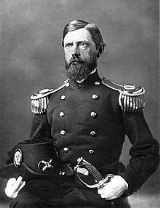
John F. Reynolds

 
John F. Reynolds

   Email Print
   Bookmark   Link


John F. Reynolds


John Fulton Reynolds (September 20, 1820 – July 1, 1863) was a career United States Army
United States Army

The United States Army is the branch of the United States Armed Forces responsible for Army operations. It is the largest and oldest established branch of the U.S....
 officer and a general in the American Civil War
American Civil War

The American Civil War , also known as the War Between the States and several Naming the American Civil War, was a civil war in the United States....
. One of the Union Army
Union Army

The Union Army was the army that fought for the Union during the American Civil War. It was also known as the Federal Army, the U.S....
's most respected senior commanders, despite having a relatively limited amount of combat experience in the war, he played a key role in committing the Army of the Potomac
Army of the Potomac

The Army of the Potomac was the major Union Army in the Eastern Theater of the American Civil War of the American Civil War....
 to the Battle of Gettysburg
Battle of Gettysburg

The Battle of Gettysburg , fought in and around the town of Gettysburg, Pennsylvania, as part of the Gettysburg Campaign, was the battle with the largest number of casualties in the American Civil War and is frequently cited as the war's Turning point of the American Civil War....
 and was killed at the very start of the battle.

olds was born in Lancaster, Pennsylvania
Lancaster, Pennsylvania

Lancaster is a city in the South Central Pennsylvania part of the U.S. state of Pennsylvania and is the county seat of Lancaster County, Pennsylvania....
, one of nine surviving children of John Reynolds (1787–1853) and Lydia Moore Reynolds (1794–1843).


Discussion
Ask a question about 'John F. Reynolds'
Start a new discussion about 'John F. Reynolds'
Answer questions from other users
Full Discussion Forum


Encyclopedia


John Fulton Reynolds (September 20, 1820 – July 1, 1863) was a career United States Army
United States Army

The United States Army is the branch of the United States Armed Forces responsible for Army operations. It is the largest and oldest established branch of the U.S....
 officer and a general in the American Civil War
American Civil War

The American Civil War , also known as the War Between the States and several Naming the American Civil War, was a civil war in the United States....
. One of the Union Army
Union Army

The Union Army was the army that fought for the Union during the American Civil War. It was also known as the Federal Army, the U.S....
's most respected senior commanders, despite having a relatively limited amount of combat experience in the war, he played a key role in committing the Army of the Potomac
Army of the Potomac

The Army of the Potomac was the major Union Army in the Eastern Theater of the American Civil War of the American Civil War....
 to the Battle of Gettysburg
Battle of Gettysburg

The Battle of Gettysburg , fought in and around the town of Gettysburg, Pennsylvania, as part of the Gettysburg Campaign, was the battle with the largest number of casualties in the American Civil War and is frequently cited as the war's Turning point of the American Civil War....
 and was killed at the very start of the battle.

Early life and career

Reynolds was born in Lancaster, Pennsylvania
Lancaster, Pennsylvania

Lancaster is a city in the South Central Pennsylvania part of the U.S. state of Pennsylvania and is the county seat of Lancaster County, Pennsylvania....
, one of nine surviving children of John Reynolds (1787–1853) and Lydia Moore Reynolds (1794–1843). Two of his brothers were James LeFevre Reynolds, Quartermaster General of Pennsylvania, and Rear Admiral
Rear admiral (United States)

The Uniformed services of the United States of the United States have two grades of rear admirals....
 Will Reynolds
William Reynolds (naval officer)

William Reynolds was a Rear Admiral in the United States Navy and served during the American Civil War. His brother was United States Army General John F....
. Prior to receiving his military training, Reynolds was first educated in nearby Lititz
Lititz, Pennsylvania

Lititz is a borough in Lancaster County, Pennsylvania, Pennsylvania, 6 miles north of the city of Lancaster, Pennsylvania....
, about from his home in Lancaster. Next he attended a school located in Longgreen, Maryland
Maryland

Maryland is a U.S. state located in the Mid Atlantic States of the United States, bordering Virginia, West Virginia and the Washington, D.C. to the south and west, Pennsylvania to the north, and Delaware to the east....
, and then at the Lancaster County Academy.

Reynolds was nominated to the United States Military Academy
United States Military Academy

The United States Military Academy at West Point is a four-year coeducational United States Service academies located at West Point, New York, New York....
 in 1837 by Senator James Buchanan
James Buchanan

James Buchanan, Jr. was the List of Presidents of the United States President of the United States and the last to be born in the 18th century....
, a family friend, and graduated 26th of 50 cadets in the class of 1841. He was commissioned a brevet
Brevet (military)

In the U.K. and U.S. military, brevet referred to a warrant authorizing a commissioned officer to hold a higher Military rank temporarily, but usually without receiving the pay of that higher rank....
 second lieutenant
Second Lieutenant

Second Lieutenant is the lowest Officer military rank in many armed forces.In British English the rank is pronounced second /l?f't?n?nt/ , while in American English it is pronounced second /lu't?n?nt/ ....
 in the 3rd U.S. Artillery, assigned to Fort McHenry
Fort McHenry

Fort McHenry, in Baltimore, Maryland, is a Star fort best known for its role in the War of 1812 when it successfully defended Inner Harbor from an attack by the United Kingdom of Great Britain and Ireland Royal Navy in the Chesapeake Bay....
. From 1842 to 1845 he was assigned to St. Augustine, Florida, and Fort Moultrie, South Carolina
Fort Moultrie National Monument

Fort Moultrie is the name of a series of forts on Sullivan's Island, South Carolina, built to protect the city of Charleston, South Carolina. The first fort, built of Cabbage Palmetto logs, inspired the Flag of South Carolina and nickname of South Carolina....
, before joining Zachary Taylor
Zachary Taylor

Zachary Taylor was an Military of the United States and the List of Presidents of the United States President of the United States.Known as "Old Rough and Ready", Taylor had a 40-year military career in the United States Army, serving in the War of 1812, Black Hawk War, and Seminole Wars before achieving fame leading U.S....
's army at Corpus Christi, Texas
Corpus Christi, Texas

Corpus Christi is a coastal city in the South Texas region of the U.S. state of Texas. The county seat of Nueces County, Texas, it also extends into Aransas County, Texas, Kleberg County, Texas, and San Patricio County, Texas counties....
, for the Mexican-American War. He was awarded two brevet promotions in Mexico—to captain for gallantry at Monterrey
Battle of Monterrey

In the Battle of Monterrey during the Mexican-American War, General Pedro de Ampudia and the Mexico Army of the North was defeated by U.S. forces under the command of Zachary Taylor....
 and to major
Major (United States)

In the United States Army, United States Air Force, and United States Marine Corps, major is a field officer United States Military Officer military rank just above the rank of Captain and just below the rank of Lieutenant colonel ....
 for Buena Vista
Battle of Buena Vista

The Battle of Buena Vista , also known as the Battle of Angostura, saw the United States United States Army use artillery to repulse the much larger Mexico army in the Mexican-American War....
, where his section of guns prevented the Mexican cavalry from outflanking the American left. During the war, he became friends with fellow officers Winfield Scott Hancock
Winfield Scott Hancock

Winfield Scott Hancock was a career United States Army officer and the Democratic Party nominee for President of the United States in United States presidential election, 1880....
 and Lewis A. Armistead
Lewis Addison Armistead

Lewis Addison Armistead was a Confederate States Army Brig. Gen. in the American Civil War, mortally wounded in Pickett's Charge at the Battle of Gettysburg....
.

Returning from Mexico, Reynolds was assigned to Fort Preble
Fort Preble

Fort Preble is a military fort in South Portland, Maine, United States. Fort Preble is on the campus of Southern Maine Community College.Henry A....
, Maine
Maine

The State of Maine is a U.S. state in the New England region of the northeastern United States of America, bordering the Atlantic Ocean to the southeast, New Hampshire to the southwest, the Canadian provinces of Quebec to the northwest and New Brunswick to the northeast....
, New Orleans, Louisiana
New Orleans, Louisiana

New Orleans is a major United States port city and the largest city in Louisiana. New Orleans is the center of the New Orleans metropolitan area metropolitan area, the largest metro area in the state....
, and Fort Lafayette
Fort Lafayette

Fort Lafayette was an island coastal fortification in New York Harbor, built next to Fort Hamilton at the southern tip of what is now Bay Ridge, Brooklyn in the New York City borough of Brooklyn....
, New York
New York

The State of New York is a U.S. state in the Mid-Atlantic States and Northeastern United States regions of the United States and is the nation's List of U.S....
. He marched west and was stationed at Fort Orford, Oregon
Oregon

Oregon is a U.S. state in the Pacific Northwest region of the United States. The area was inhabited by many indigenous tribes before the arrival of traders, explorers and settlers....
, in 1855, and participated in the Rogue River Wars
Rogue River Wars

The Rogue River Wars was an armed conflict between the US Army, local militias and volunteers, and the Native Americans in the United States tribes commonly grouped under the designation of Rogue River , in the Rogue River Valley area of what today is southern Oregon in 1855–56....
 of 1856 and the Utah War
Utah War

The Utah War, also known as the Utah Expedition or Buchanan's Blunder, was an armed dispute between Latter-day Saint settlers in Utah Territory and the United States federal government....
 with the Mormon
Mormon

Mormon is a term used to describe the adherents, practitioners, followers or constituents of Mormonism. The term most often refers to a member of The Church of Jesus Christ of Latter-day Saints , which is commonly called the Mormon Church....
s in 1857-58. He was the Commandant of Cadets at West Point
United States Military Academy

The United States Military Academy at West Point is a four-year coeducational United States Service academies located at West Point, New York, New York....
 from September 1860 to June 1861, while also serving as an instructor of artillery, cavalry, and infantry tactics. During his return journey from the West, Reynolds met and became engaged to Katherine "Kate" May Hewitt. Because they came from different religions—Reynolds was a Protestant, Hewitt a Catholic—the engagement was kept a secret and Hewitt's parents did not hear about it until after Reynolds' death.

Civil War


Early assignments and the Seven Days

Soon after the start of the Civil War, Reynolds was offered the position as aide-de-camp to Lt. Gen.
Lieutenant General (United States)

In the United States Army, the United States Marine Corps and the United States Air Force, lieutenant general is a 3 star rank general officer rank, with the U.S....
 Winfield Scott
Winfield Scott

Winfield Scott was a United States Army general, and unsuccessful List of United States Presidential candidates of the Whig Party in 1852. Known as "Old Fuss and Feathers" and the "Grand Old Man of the Army", he served on active duty as a general longer than any other man in American history and many historians rate him the ablest America...
, but declined. He was appointed lieutenant colonel
Lieutenant Colonel (United States)

In the United States Army, United States Air Force, and United States Marine Corps, lieutenant colonel is a field officer United States Military Officer military rank just above the rank of Major and just below the rank of Colonel ....
 of the 14th U.S. Infantry
U.S. 14th Infantry Regiment

The 14th Infantry Regiment is a United States Army light infantry regiment, known as the Golden Dragons. It has been active in every major conflict since the Civil War, except World War I, including the American Civil War, Boxer Rebellion, World War II, Korean War, Vietnam War, Operation Desert Storm, Operation Enduring Freedom, and Operatio...
, but before he could engage with that unit, he was promoted to brigadier general
Brigadier General

Brigadier General is the lowest ranking General Officer in some countries, usually sitting between the ranks of Colonel and Major General.The rank can be traced back to the militaries of Europe where a brigadier general, or simply a brigadier, would command a brigade in the field....
 on August 20, 1861, and ordered to report to Washington, D.C.
Washington, D.C.

Washington, D.C. , formally the District of Columbia and commonly referred to as Washington, the District, or simply D.C., is the Capital of the United States, founded on July 16, 1790....
 While in transit, his orders were changed to report to Cape Hatteras Inlet, North Carolina
Cape Hatteras

Cape Hatteras is a Headlands and bays on the coast of North Carolina. It is the point that protrudes the farthest to the southeast along the northeast-to-southwest line of the Atlantic Ocean coast of North America....
. Maj. Gen.
Major General

Major General or Major-General is a military rank used in many countries. It is derived from the older rank of Sergeant Major General. A Major General is a high-ranking officer, normally subordinate to the rank of Lieutenant General and senior to the ranks of Brigadier and Brigadier General....
 George B. McClellan
George B. McClellan

George Brinton McClellan was a Major general during the American Civil War. He organized the famous Army of the Potomac and served briefly as the general-in-chief of the Union Army....
 intervened with the Secretary of War
United States Secretary of War

File:Swearing in of Secretary Dwight Davis.jpgThe Secretary of War was a member of the United States President of the United States United States Cabinet, beginning with George Washington's administration....
 to get Reynolds's orders changed once again, assigning him to the newly formed Army of the Potomac. His first assignment was with a board that examined the qualifications of volunteer officers, but he soon was given command of a brigade
Brigade

A brigade is a military unit that is typically composed of two to five regiments or battalions, depending on the era and nationality of a given army....
 of Pennsylvania Reserves
Pennsylvania Reserves

The Pennsylvania Reserves was an infantry division in the Union Army during the American Civil War. Noted for its famous commanders and high casualties, it served in the Eastern Theater of the American Civil War, and fought in many important battles, including Battle of Antietam and Battle of Gettysburg....
.

As McClellan's army moved up the Virginia Peninsula
Virginia Peninsula

The Virginia Peninsula is a peninsula in southeast Virginia, bounded by the York River , James River , Hampton Roads and Chesapeake Bay.Hampton Roads is the common name for the metropolitan area that surrounds the body of water of the same name....
 in the 1862 Peninsula Campaign
Peninsula Campaign

The Peninsula Campaign of the American Civil War was a major Union operation launched in southeastern Virginia from March through July 1862, the first large-scale offensive in the Eastern Theater of the American Civil War....
, Reynolds occupied and became military governor of Fredericksburg, Virginia
Fredericksburg, Virginia

Fredericksburg is an independent city in the Commonwealth of Virginia located 50 miles south of Washington, D.C., and 58 miles north of Richmond, Virginia....
. His brigade was then ordered to join the V Corps
V Corps (ACW)

The V Corps was a unit of the Union Army Army of the Potomac during the American Civil War....
 at Mechanicsville
Mechanicsville, Virginia

Mechanicsville is the name of four places in the Commonwealth of Virginia in the United States of America:*Mechanicsville, Hanover County, Virginia...
, just before the start of the Seven Days Battles
Seven Days Battles

The Seven Days Battles was a series of six major battles over the seven days from June 25 to July 1, 1862, near Richmond, Virginia during the American Civil War....
. The brigade was hit hard by the Confederate
Confederate States Army

The Confederate States Army was a military organization whose primary mission was to provide the necessary forces and capabilities to support the National Security and defense of the Confederate States of America during its brief existence from 1861 to 1865....
 attack of June 26 at the Battle of Beaver Dam Creek
Battle of Beaver Dam Creek

The Battle of Beaver Dam Creek, also known as the Battle of Mechanicsville or Ellerson's Mill, took place on June 26, 1862, in Hanover County, Virginia, Virginia as the first major engagement of the Seven Days Battles of the American Civil War....
, but their defensive line held and Reynolds later received a letter of commendation from his division commander, Brig. Gen.
Brigadier General

Brigadier General is the lowest ranking General Officer in some countries, usually sitting between the ranks of Colonel and Major General.The rank can be traced back to the militaries of Europe where a brigadier general, or simply a brigadier, would command a brigade in the field....
 George A. McCall
George A. McCall

George Archibald McCall was a United States Army officer who became a Brigadier general and prisoner of war during the American Civil War....
.

The Confederate attack continued on June 27 and Reynolds, exhausted from the Battle of Gaines' Mill
Battle of Gaines' Mill

The Battle of Gaines' Mill, also known as the First Battle of Cold Harbor or the Battle of Chickahominy River, took place on June 27, 1862, in Hanover County, Virginia, as the third of the Seven Days Battles of the American Civil War....
 and two days without sleep, was captured in Boatswain's Swamp, Virginia. Thinking he was in a place of relative safety, he fell asleep and was not aware that his retreating troops left him behind. He was extremely embarrassed when brought before the Confederate general of the capturing troops; D.H. Hill was an Army friend and colleague from before the war. Hill allegedly told him, "Reynolds, do not feel so bad about your capture, it is the fate of wars." Reynolds was transported to Richmond
Richmond, Virginia

Richmond is the Capital of the Commonwealth of Virginia, in the United States. Like all Virginia municipalities incorporated as cities, it is an independent city and not part of any county....
 and held at Libby Prison
Libby Prison

Libby Prison was a Confederate States of America Prison at Richmond, Virginia, during the American Civil War. It gained an infamous reputation for the harsh conditions under which prisoners from the Union Army were kept....
, but was quickly exchanged on August 15 (for Lloyd Tilghman
Lloyd Tilghman

Lloyd Tilghman was a railroad construction engineer and a Confederate States Army general in the American Civil War, killed at the Battle of Champion Hill....
).

Second Bull Run, Fredericksburg, and Chancellorsville

Upon his return, Reynolds was given command of the Pennsylvania Reserves Division, whose commander, McCall, had been captured just two days after Reynolds. The V Corps joined the Army of Virginia
Army of Virginia

The Army of Virginia was organized as a major unit of the Union Army and operated briefly and unsuccessfully in 1862 in the American Civil War. It should not be confused with its principal opponent, the Confederate States Army Army of Northern Virginia, commanded by Robert E....
, under Maj. Gen. John Pope
John Pope (military officer)

John Pope was a career United States Army officer and Union Army general in the American Civil War. He had a brief but successful career in the Western Theater of the American Civil War, but he is best known for his defeat at the Second Battle of Bull Run in the Eastern Theater of the American Civil War....
, at Manassas
Manassas, Virginia

Manassas is an independent city located in the Commonwealth of Virginia. The population was 35,135 at the United States Census 2000. The Bureau of Economic Analysis combines the city of Manassas with Prince William County, Virginia for statistical purposes....
. On the second day of the Second Battle of Bull Run
Second Battle of Bull Run

The Second Battle of Bull Run, or, as it was called by the Confederate States of America, the Battle of Second Manassas, was fought August 28–30, 1862, as part of the American Civil War....
, while most of the Union Army was retreating, Reynolds led his men in a last-ditch stand on Henry House Hill, site of the great Union debacle at First Bull Run
First Battle of Bull Run

The First Battle of Bull Run, also known as the First Battle of Manassas , was the first major land battle of the American Civil War, fought on July 21, 1861, near Manassas, Virginia....
 the previous year. Waving the flag of the 2nd Reserves regiment, he yelled, "Now boys, give them the steel, charge bayonets, double quick!" His counterattack halted the Confederate advance long enough to give the Union Army time to retreat in a more orderly fashion, arguably the most important factor in preventing its complete destruction.

At the request of Pennsylvania Governor
List of Governors of Pennsylvania

The Governor of the Commonwealth of Pennsylvania is the head of the executive branch of Pennsylvania's government and the commander-in-chief of the U.S....
 Andrew G. Curtin, Reynolds was given command of the Pennsylvania Militia during General Robert E. Lee
Robert E. Lee

Robert Edward Lee , was a career United States United States Army officer , an engineer, and among the most celebrated generals in American history....
's invasion of Maryland
Maryland Campaign

The Maryland Campaign, or the Antietam Campaign, of September 1862 is widely considered one of the major Turning Point of the American Civil War of the American Civil War....
. Generals McClellan and Joseph Hooker
Joseph Hooker

Joseph Hooker was a career United States Army officer, fought in the Mexican-American War, and was a Major general in the Union Army during the American Civil War....
 complained that "a scared governor ought not to be permitted to destroy the usefulness of an entire division," but the governor prevailed and Reynolds spent two weeks in Pennsylvania drilling old men and boys, missing the Battle of Antietam
Battle of Antietam

The Battle of Antietam , fought on September 17, 1862, near Sharpsburg, Maryland, and Antietam Creek, as part of the Maryland Campaign, was the first major battle in the American Civil War to take place on Northern United States soil....
. However, he returned to the Army of the Potomac
Army of the Potomac

The Army of the Potomac was the major Union Army in the Eastern Theater of the American Civil War of the American Civil War....
 in late 1862 and assumed command of the I Corps
I Corps (ACW)

I Corps was the designation of three different corps-sized units in the Union Army during the American Civil War. The units served in the following armies:...
. One of his divisions, commanded by Brig. Gen. George G. Meade, made the only breakthrough at the Battle of Fredericksburg
Battle of Fredericksburg

The Battle of Fredericksburg, fought in and around Fredericksburg, Virginia, from December 11 to December 15, 1862, between General Robert E. Lee's Confederate States Army Army of Northern Virginia and the Union Army Army of the Potomac, commanded by Major general Ambrose E....
, but Reynolds did not reinforce Meade with his other two divisions and the attack failed; Reynolds did not receive a clear understanding from Brig. Gen. William B. Franklin
William B. Franklin

William Buel Franklin was a career United States Army officer and a Union Army general in the American Civil War. He rose to the rank of a corps commander in the Army of the Potomac, fighting in several notable early battles in the Eastern Theater of the American Civil War....
 about his role in the attack. After the battle, Reynolds was promoted to major general
Major general (United States)

In the United States Army, United States Marine Corps, and United States Air Force, major general is a 2 star rank general officer rank, with the U.S....
 of volunteers, with a date of rank of November 29, 1862.

At the Battle of Chancellorsville
Battle of Chancellorsville

The Battle of Chancellorsville was a major battle of the American Civil War, fought near the village of Spotsylvania Courthouse, Virginia, from April 30 to May 6, 1863....
 in May 1863, Reynolds clashed with Maj. Gen. Hooker, his predecessor at I Corps, but by this time the commander of the Army of the Potomac. Hooker originally placed Reynolds's Corps on the extreme left of the Union line, southeast of Fredericksburg, hoping to threaten and distract the Confederate right. On May 2, Hooker changed his mind and ordered the I Corps to conduct a 20-mile daylight countermarch to swing around and become the extreme right flank of the Army, to the northwest of the XI Corps
XI Corps (ACW)

The XI Corps was a corps of the Union Army during the American Civil War, best remembered for its humiliating defeats at the battles of Battle of Chancellorsville and Battle of Gettysburg in 1863....
. The march was delayed by faulty communications and by the need to move stealthily and avoid Confederate contact. Thus, the I Corps was not yet in position when the XI Corps was surprised and overrun by Lt. Gen. Thomas J. "Stonewall" Jackson
Stonewall Jackson

Thomas Jonathan "Stonewall" Jackson was a Confederate States Army general during the American Civil War, and probably the most well-known Confederate commander after General Robert E....
's flank attack, a setback that destroyed Hooker's nerve for offensive action. Hooker called a council of war
Council of war

A council of war is a term in military science that describes a meeting held to decide on a course of action, usually in the midst of a battle....
 on May 4 in which Reynolds voted to proceed with the battle, but although the vote was three to two for offensive action, Hooker decided to retreat. Reynolds, who had gone to sleep after giving his proxy vote to Meade, woke up and muttered loud enough for Hooker to hear, "What was the use of calling us together at this time of night when he intended to retreat anyhow?" The 17,000-man I Corps was not engaged at Chancellorsville and suffered only 300 casualties during the entire campaign.

Reynolds joined several of his fellow officers in urging that Hooker be replaced, in the same way he had spoken out against Maj. Gen. Ambrose Burnside
Ambrose Burnside

Ambrose Everett Burnside was an United States soldier, railroad executive, inventor, industrialist, and politician from Rhode Island, serving as governor and a U.S....
 after Fredericksburg. On the previous occasion, Reynolds wrote in a private letter, "If we do not get some one soon who can command an army without consulting 'Stanton
Edwin M. Stanton

Edwin McMasters Stanton was an American lawyer, politician, United States Attorney General in 1860-61 and United States Secretary of War through most of the American Civil War and Reconstruction era of the United States era....
 and Halleck' at Washington, I do not know what will become of this Army." President
President of the United States

The President of the United States is the head of state and head of government of the United States and is the highest political official in the United States by influence and recognition....
 Abraham Lincoln
Abraham Lincoln

Abraham Lincoln was the List of Presidents of the United States President of the United States. He successfully led the country through its greatest internal crisis, the American Civil War, preserving the Union and ending slavery....
 met with Reynolds in a private interview on June 2 and is believed to have asked him whether he would consider being the next commander of the Army of the Potomac. Reynolds supposedly replied that he would be willing to accept only if he were given a free hand and could be isolated from the political influences that had affected the Army commanders throughout the war. Unable to comply with Reynolds's demand, Lincoln promoted the more junior George G. Meade to replace Hooker on June 28.

Gettysburg

Death of Reynolds Gettysburg
On the morning of July 1, 1863, Reynolds was commanding the "left wing" of the Army of the Potomac, with operational control over the I, III
III Corps (ACW)

There were four formations in the Union Army designated as III Corps during the American Civil War.Three were short-lived:*Army of Virginia:...
, and XI Corps, and Brig. Gen. John Buford
John Buford

John Buford, Jr. was a Union Army cavalry officer during the American Civil War, with a prominent role at the start of the Battle of Gettysburg....
's cavalry
Cavalry

The Cavalry is the second oldest of the Combat Arms, and as soldiers or warriors who fought mounted on horseback in combat, it represents the mobility and offensive power of the armed forces....
 division. Buford occupied the town of Gettysburg, Pennsylvania
Gettysburg, Pennsylvania

Gettysburg is a city located in the state of Pennsylvania, USA. Although known primarily as an attraction because of its proximity to the Gettysburg Battlefield, site of the Battle of Gettysburg, the town is also known for its institutions of higher learning, namely the Lutheran Theological Seminary at Gettysburg, founded in 1826, and Gettys...
, and set up light defensive lines north and west of the town. He resisted the approach of two Confederate infantry brigades on the Chambersburg Pike until the nearest Union infantry, Reynolds's I Corps, began to arrive. Reynolds rode out ahead of the 1st Division, met with Buford, and then accompanied some of his soldiers, probably from Brig. Gen. Lysander Cutler
Lysander Cutler

Lysander Cutler was an United States businessman, educator, politician, and a Union Army General officer during the American Civil War....
's brigade, into the fighting at Herbst's Woods. Troops began arriving from Brig. Gen. Solomon Meredith
Solomon Meredith

Solomon Meredith was a prominent Indiana farmer, politician, and lawman who was a controversial Union Army general in the American Civil War. He gained fame as one of the commanders of the Iron Brigade of the Army of the Potomac, leading the brigade in the Battle of Gettysburg....
's Iron Brigade
Iron Brigade

The Iron Brigade, also known as the Iron Brigade of the West or the Black Hat Brigade, was an infantry brigade in the Union Army Army of the Potomac during the American Civil War....
, and as Reynolds was supervising the placement of the 2nd Wisconsin, he fell from his horse with a wound in the back of the neck, and died almost instantly. Command passed to his senior division commander, Maj. Gen. Abner Doubleday
Abner Doubleday

Abner Doubleday was a career United States Army officer and Union Army general in the American Civil War. He fired the first shot in defense of Battle of Fort Sumter, the opening battle of the war, and had a pivotal role in the early fighting at the Battle of Gettysburg....
.

The loss of General Reynolds was keenly felt by the army. He was loved by his men and respected by his peers. There are no recorded instances of negative comments made by his contemporaries. Historian Shelby Foote
Shelby Foote

Shelby Dade Foote, Jr. was an United States novelist and a noted historian of the American Civil War, writing a massive, three-volume history of the war entitled The Civil War: A Narrative....
 wrote that many considered him "not only the highest ranking [sic] but also the best general in the army." His death had a more immediate effect that day, however. By ratifying Buford's defensive plan and engaging his I Corps infantry, Reynolds essentially selected the location for the Battle of Gettysburg for Meade, turning a chance meeting engagement into a massive pitched battle, committing the Army of the Potomac to fight on that ground with forces that were initially numerically inferior to the Confederates that were concentrating there. In the command confusion that followed Reynolds's death, the two Union corps that reached the field were overwhelmed and forced to retreat through the streets of Gettysburg to the high ground south of town, where they were rallied by his old friend, Maj. Gen. Winfield S. Hancock.

Reynolds's body was immediately transported by from Gettysburg to Taneytown, Maryland
Taneytown, Maryland

Taneytown is a city in Carroll County, Maryland, Maryland, United States. The population was 5,128 at the 2000 census. was founded in 1754....
, and then to his birthplace, Lancaster, Pennsylvania, where he was buried on July 4, 1863. Befitting his importance to the Union and his native state, he is memorialized by three statues in Gettysburg National Military Park
Gettysburg Battlefield

The Gettysburg Battlefield was the site of the Battle of Gettysburg, fought July 1–3, 1863, in and around the borough of Gettysburg, Pennsylvania, the county seat of Adams County, Pennsylvania, which had approximately 2,400 residents at the time....
 (an equestrian statue on McPherson Ridge, one by John Quincy Adams Ward
John Quincy Adams Ward

John Quincy Adams Ward was an United States sculptor, who is most familiar for his over-lifesize standing statue of George Washington on the steps of Federal Hall in Wall Street....
 in the National Cemetery, and one on the Pennsylvania Memorial), as well as one in front of the Philadelphia City Hall
Philadelphia City Hall

Philadelphia City Hall is the seat of government for the city of Philadelphia, Pennsylvania. At 167 m , including the statue, it is the world's tallest masonry building: the weight of the building is load-bearing by granite and brick walls up to thick, rather than steel; the principal exterior materials are limestone, granite, and marbl...
.

Kate Hewitt had agreed with Reynolds that if he were killed in the war and they could not marry, she would join a convent
Convent

A convent may refer to a community of priests, religious brothers, religious sisters, or nuns, or it may refer to the building used by the community, particularly in the Roman Catholic Church and in the Anglican Communion....
. After he was buried, she traveled to Emmitsburg, Maryland
Emmitsburg, Maryland

Emmitsburg was founded in 1785 and is in Frederick County, Maryland, Maryland, just south of the Mason-Dixon line separating Maryland from Pennsylvania....
, and joined the St. Joseph Central House of the Order of the Daughters of Charity (now part of Mount Saint Mary's University
Mount Saint Mary's University

Mount St. Mary's University is a private, liberal arts, Roman Catholic Church university in the Catoctin Mountains near Emmitsburg, Maryland. It was founded by French ?migr? Father John DuBois in 1808 and is the oldest independent Catholic college in the United States....
).

Death controversies

Historians disagree on the details of Reynolds's death, including the specific time (either 10:15 a.m. or 10:40–10:50 a.m.), the exact location (on East McPherson Ridge, near the 2nd Wisconsin Infantry, or West McPherson Ridge, near the 19th Indiana), and the source of the bullet (a Confederate infantryman, a Confederate sharpshooter, or friendly fire
Friendly fire

Friendly fire or non-hostile fire, a term originally adopted by the United States Armed Forces, refers to Shooting from one's own side or allied forces, as opposed to fire coming from enemy forces....
). One primary source was Sergeant Charles S. Veil, Reynolds's orderly, who described the events in a letter in 1864 and then contradicted some of the details in another letter 45 years later. A letter from Reynolds's sister, Jennie, stated that the wound had a downward trajectory from the neck, implying that he was shot from above, presumably a sharpshooter in a tree or barn. Historians Bruce Catton
Bruce Catton

Bruce Catton was a journalist and a notable historian of the American Civil War. He won a Pulitzer Prize for history in 1954 for A Stillness at Appomattox, his study of the final campaign of the war in Virginia....
 and Glenn Tucker make firm assertions that a sharpshooter was responsible; Stephen Sears credits volley fire from the 7th Tennessee against the 2nd Wisconsin; Edwin Coddington cites the sister's letter and finds the sharpshooter theory to be partly credible, but leans towards Sears's conclusion; Harry W. Pfanz agrees that the location was behind the 2nd Wisconsin, but make no judgment about the source of the fire. Steve Sanders, writing in Gettysburg magazine, suggested the possibility of friendly fire based on some accounts, and concludes that it is as equally likely as enemy fire.

In popular media

John F. Reynolds memorials


Reynolds plays a role in Michael Shaara
Michael Shaara

Michael Shaara was an American writer of science fiction, sports fiction, and historical fiction. He was born to Italian immigrant parents in Jersey City, New Jersey, graduated from Rutgers University in 1951, and served as an airborne infantry officer in the Korean War....
's 1974 Pulitzer Prize
Pulitzer Prize

The Pulitzer Prize is an United States award regarded as the highest national honor in newspaper journalism, literary achievements and musical composition....
 winning novel The Killer Angels
The Killer Angels

The Killer Angels is a historical novel by Michael Shaara that was awarded the Pulitzer Prize for Fiction in 1975 in literature. The book tells the story of four days of the Battle of Gettysburg in the American Civil War: June 29, 1863, as the troops of both the United States of America and the Confederate States of America move into bat...
, as well as the 1993 film based on that novel, Gettysburg
Gettysburg (film)

Gettysburg is a 1993 film that dramatizes the decisive Battle of Gettysburg in the American Civil War. It was directed by Ronald F. Maxwell, who also wrote the screenplay, a close adaptation of Michael Shaara's 1974 novel The Killer Angels, winner of the Pulitzer Prize for fiction in 1975....
 (in which he was played by John Rothman
John Rothman

John Mahr Rothman is an American film, television, and stage actor.Rothman was born in Baltimore, Maryland, the son of Elizabeth D. and Donald N....
). The film portrays Reynolds as being deliberately killed by a Confederate sharpshooter, a scene based on the Don Troiani painting of the event. Reynolds is also significant in the prequel
Prequel

A prequel is a work that portrays events and/or aspects of a previously completed narrative, but is set prior to the existing narrative. The word is a neologism, formed as a portmanteau from pre-, meaning before, and sequel, a work which takes place after a previous one ....
 to The Killer Angels, Jeffrey Shaara
Jeffrey Shaara

Jeffrey M. Shaara is an United States Novel, the son of Pulitzer Prize winner Michael Shaara.Jeffrey Shaara was born in New Brunswick, New Jersey and grew up in Tallahassee, Florida....
's novel Gods and Generals
Gods and Generals

Gods and Generals is a novel which serves as a prequel to Michael Shaara's 1974 Pulitzer Prize-winning work about the Battle of Gettysburg, The Killer Angels....
, although his role was deleted from the 2003 film based on the novel.

A significant portion of the song "The Devil to Pay" by Jon Schaffer
Jon Schaffer

Jon Ryan Schaffer is a heavy metal music guitarist and songwriter. He is the founder and only remaining original member of the heavy metal band Iced Earth....
 of Iced Earth
Iced Earth

Iced Earth is an United States Heavy metal music band from Tampa, Florida, Florida that combines influences from thrash metal, power metal, progressive metal, opera, speed metal and New Wave of British Heavy Metal....
 in the Gettysburg trilogy is dedicated to John Reynolds, with the song "When Johnny Comes Marching Home" played and stylized using both electric guitar and an orchestra.

See also


External links

  • Retrieved on 2008-02-12