


Gettysburg Campaign

Encyclopedia
The Gettysburg Campaign was a series of battles fought in June and July 1863, during the American Civil War
. After his victory in the Battle of Chancellorsville
, Confederate
General Robert E. Lee
's Army of Northern Virginia
moved north for offensive operations in Maryland
and Pennsylvania
. The Union
Army of the Potomac
, commanded by Maj. Gen.
Joseph Hooker
and then (from June 28) by Maj. Gen. George G. Meade, pursued Lee, defeated him at the Battle of Gettysburg
, but allowed him to escape back to Virginia.
Lee's army slipped away from Federal contact at Fredericksburg, Virginia
, on June 3, 1863. While they paused at Culpeper
, the largest predominantly cavalry battle of the war was fought at Brandy Station
on June 9. The Confederates crossed the Blue Ridge Mountains
and moved north through the Shenandoah Valley
, capturing the Union garrison at Winchester, Virginia
, in the Second Battle of Winchester, June 13–15. Crossing the Potomac River
, Lee's Second Corps advanced through Maryland and Pennsylvania, reaching the Susquehanna River
and threatening the state capital of Harrisburg
. However, the Army of the Potomac was in pursuit and had reached Frederick, Maryland, before Lee realized his opponent had crossed the Potomac. Lee moved swiftly to concentrate his army around the crossroads town of Gettysburg
.
The Battle of Gettysburg was the largest of the war. Starting as a chance meeting engagement on July 1, the Confederates were initially successful in driving Union cavalry and two infantry corps from their defensive positions, through the town, and onto Cemetery Hill. On July 2, with most of both armies now present, Lee launched fierce assaults on both flanks of the Union defensive line, which were repulsed with heavy losses on both sides. On July 3, Lee focused his attention on the Union center. The defeat of his massive infantry assault, Pickett's Charge
, caused Lee to order a retreat that began the evening of July 4.
The Confederate retreat to Virginia was plagued by bad weather, difficult roads, and numerous skirmishes with Union cavalry. However, Meade's army did not maneuver aggressively enough to prevent the Army of Northern Virginia from crossing the Potomac to safety on the night of July 13–14.
, and allow the Confederates to live off the bounty of the rich northern farms while giving war-ravaged Virginia a much needed rest. Lee's army could also threaten Philadelphia
, Baltimore, and Washington
, and encourage the growing peace movement in the North. Lee had written to his wife on April 19,
The Confederate government wanted Lee to reduce Union pressure threatening their garrison at Vicksburg, Mississippi
, but he declined their suggestions to send troops to provide direct aid, arguing for the value of a concentrated blow in the Northeast.
In essence, Lee's strategy was identical to the one he employed in the Maryland Campaign
of 1862. He had discovered only recently the secret of how Maj. Gen. George B. McClellan
had defeated that invasion, by intercepting Lee's famous lost order
to his corps commanders, which compelled him to fight in the Battle of Antietam
before he could fully concentrate his army. This revelation improved his confidence that he could succeed in a northern invasion against another man he considered a timid and ineffective general, Joseph Hooker. Furthermore, after Chancellorsville he had supreme confidence in the men of his army, assuming they could handle any challenge he gave them.
(Maj. Gen. George G. Meade replaced Hooker in command on June 28), consisted of more than 90,000 men in the following organization:
During the advance on Gettysburg, Maj. Gen. Reynolds was in operational command of the left, or advanced, wing of the Army, consisting of the I, III, and XI Corps. Note that many other Union units (not part of the Army of the Potomac) were actively involved in the Gettysburg Campaign, but not directly involved in the Battle of Gettysburg. These included portions of the Union IV Corps, the militia and state troops of the Department of the Susquehanna
, and various garrisons, including that at Harpers Ferry.
after Chancellorsville, Lee reorganized his 75,000 men from two infantry corps into three.
, leaving A.P. Hill's Corps in fortifications above Fredericksburg to protect the Confederate rear as it withdrew. By June 5, Longstreet's and Ewell's corps were camped in and around Culpeper
, and Hooker had caught wind of the Confederate movement. Accordingly he ordered Sedgwick to conduct a reconnaissance in force across the Rappahannock River
to Hill's line, which resulted in a skirmish
that convinced him Lee still occupied his old line around Fredericksburg. As a precaution, Lee temporarily halted Ewell's Corps, but when he saw that Hooker would not press the Fredericksburg line to bring on a battle, he ordered Ewell to continue. On June 9, Lee ordered Stuart to cross the Rappahannock and raid Union forward positions, screening the Confederate Army from observation or interference as it moved north. Anticipating this imminent offensive action, Stuart ordered his troopers into bivouac around Brandy Station
.
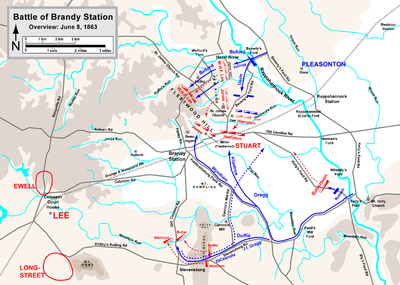 Hooker interpreted Stuart's presence around Culpeper to be indicative of preparations for a raid on his army's supply lines. In reaction to this, he ordered Alfred Pleasonton's combined arms
force of 8,000 cavalrymen and 3,000 infantry on a "spoiling raid," to "disperse and destroy" the 9,500 Confederates. Pleasonton's attack plan called for a double envelopment of the enemy. The wing under John Buford would cross the river at Beverly's Ford, two miles (3 km) northeast of Brandy Station; at the same time, David McM. Gregg's wing would cross at Kelly's Ford, six miles (10 km) downstream to the southeast. However, Pleasonton was unaware of the precise disposition of the enemy and he incorrectly assumed that his force was substantially larger than the Confederates he faced.
About 4:30 a.m. on June 9, Buford's column crossed the Rappahannock River in a dense fog, surprising Grumble Jones's brigade, which rode to the scene partially dressed and often riding bareback. They struck Buford's leading brigade and temporarily checked its progress, just short of where Stuart's Horse Artillery was camped and was vulnerable to capture. The artillery unlimbered on two knolls on either side of the Beverly's Ford Road. Most of Jones's command rallied to the left of this Confederate artillery line, while Hampton's brigade formed to the right. The 6th Pennsylvania Cavalry unsuccessfully charged the guns at St. James Church, suffering the greatest casualties of any regiment in the battle.
Buford tried to turn the Confederate left and dislodge the artillery that was blocking the direct route to Brandy Station and sustained heavy losses displacing Rooney Lee's brigade from a stone wall on Yew Ridge. Then, to the amazement of Buford's men, the Confederates began pulling back. They were reacting to the arrival of Gregg's cavalry division of about 2,800 men, which was the second major surprise of the day. Although Gregg had intended to cross at Kelly's Ford at dawn, in concert with Buford's crossing at Beverly's, his men were delayed two hours. Between Gregg and the St. James battle was a prominent ridge called Fleetwood Hill, which had been Stuart's headquarters the previous night. Stuart and most of his staff had departed for the front by this time, but a few shots from a 6-pounder howitzer delayed the advance of Col. Percy Wyndham's brigade as they sent out skirmishers and returned cannon fire. When Gregg's men charged up the western slope of Fleetwood and neared the crest, the lead elements of Jones's brigade, which had just withdrawn from St. James Church, rode over the crown.
Gregg's next brigade, led by Col. Judson Kilpatrick, swung around east of Brandy Station and attacked up the southern end and the eastern slope of Fleetwood Hill, only to discover that their appearance coincided with the arrival of Hampton's brigade. A series of confusing charges and countercharges swept back and forth across the hill. The Confederates finally cleared the hill. Col. Alfred N. Duffié's small 1,200-man division was delayed by two Confederate regiments in the vicinity of Stevensburg and arrived on the field too late to affect the action. While Jones and Hampton withdrew from their initial positions to fight at Fleetwood Hill, Rooney Lee continued to confront Buford, falling back to the northern end of the hill. Reinforced by Fitzhugh Lee's brigade, Rooney Lee launched a counterattack against Buford at the same time as Pleasonton had called for a general withdrawal near sunset, and the ten-hour battle was over.
Brandy Station was the largest predominantly cavalry fight of the war, and the largest to take place on American soil. It was a tactical draw, although Pleasonton withdrew before finding the location of Lee's infantry nearby and Stuart claimed a victory, attempting to disguise the embarrassment of a cavalry force being surprised as it was by Pleasonton. The battle established the emerging reputation of the Union cavalry as a peer of the Confederate mounted arm.
and headed north, "down" the Shenandoah Valley
. Ewell's Corps, in the lead, crossed at Chester Gap
on June 12 and then through Front Royal
toward Winchester, Virginia
. Longstreet's Corps (accompanied by General Lee) moved to protect Ashby's Gap
and Snicker's Gap. A.P. Hill waited until Hooker had withdrawn from Fredericksburg on June 14 and then followed Ewell's route across the mountains, leapfrogging Longstreet's Corps, which then brought up the rear of the army. Stuart's cavalry remained to the east of the Blue Ridge to screen Lee's army.
The Union garrison at Winchester stood directly in Ewell's path. It was commanded by Maj. Gen. Robert H. Milroy
, who had 7,000 men in three brigades—two in Winchester and one 10 miles to the east at Berryville. Three forts with interconnecting trenches had been constructed to defend the town. General-in-chief Henry W. Halleck had since May ordered Milroy's superior, Maj. Gen. Robert C. Schenck
of the Middle Department
, to withdraw Milroy's men to Harpers Ferry, but Schenck believed that these were only instances of Halleck's typical suggestions rather than direct orders and did not act on them until explicitly threatened with removal on June 14. By then it was too late. As Allegheny Johnson's division approached Winchester from the south on June 14 and Jubal Early approached from the west, Ewell ordered Rodes's division to Berryville and then to Martinsburg, north of Winchester. These movements effectively surrounded the Federal garrison.
At 6 p.m. on June 14, Confederate artillery opened fire on the Union's West Fort and the brigade of Brig. Gen. Harry T. Hays
led the charge that captured the fort and a Union battery. As darkness fell, Milroy belatedly decided to retreat from his two remaining forts. Anticipating the movement, Ewell ordered Johnson to march northwest and block the Union escape route. At 3:30 a.m. on June 15, Johnson's column intercepted Milroy's on the Charles Town Road. Although Milroy ordered his men to fight their way out of the situation, when the Stonewall Brigade
arrived just after dawn to cut the turnpike to the north, Milroy's men began to surrender in large numbers. Milroy escaped personally but the Second Battle of Winchester cost the Union about 4,450 casualties (4,000 captured) out of 7,000 engaged, while the Confederates lost only 250 of 12,500 engaged.
Ewell began crossing the Potomac River near Hagerstown, Maryland
, late on June 15, along with Jenkins's cavalry brigade. Hill's and Longstreet's corps followed on June 24 and June 25.
, the Confederate capital. But President
Abraham Lincoln
sternly reminded him that Lee's army was the true objective. His orders were to pursue and defeat Lee but to stay between Lee and Washington and Baltimore. On June 14, the Army of the Potomac departed Fredericksburg and reached Manassas Junction on June 16. Hooker dispatched Pleasonton's cavalry again to punch through the Confederate cavalry screen to find the main Confederate army, which led to three minor cavalry battles from June 17 through June 21 in the Loudoun Valley.
Pleasonton ordered David McM. Gregg's division from Manassas Junction westward down the Little River Turnpike to Aldie
. Aldie was tactically important in that near the village the Little River Turnpike intersected both of the turnpikes leading through Ashby's Gap and Snickers Gap into the Valley. The Confederate cavalry brigade of Col. Thomas T. Munford
was entering Aldie from the west, preparing to bivouac, when three brigades of Gregg's division entered from the east at about 4 p.m. on June 17, surprising both sides. The resulting Battle of Aldie
was a fierce mounted fight of four hours with about 250 total casualties. Munford withdrew toward Middleburg
.
While the fighting occurred at Aldie, the Union cavalry brigade of Col. Alfred N. Duffié arrived south of Middleburg in the late afternoon and drove in the Confederate pickets. Stuart was in the town at the time and managed to escape before his brigades under Munford and Beverly Robertson routed Duffié in an early morning assault on June 18. The primary action of the Battle of Middleburg
occurred on the morning of June 19 when Col. J. Irvin Gregg's brigade advanced west from Aldie and attacked Stuart's line on a ridge west of Middleburg. Stuart repulsed Gregg's charge, counterattacked, then fell back to defensive positions a half-mile to the west.
On June 21, Pleasonton again attempted to break Stuart's screen by advancing on Upperville
, 9 miles to the west of Middleburg. The cavalry brigades of Irvin Gregg and Judson Kilpatrick were accompanied by infantry from Col. Strong Vincent
's brigade on the Ashby's Gap Turnpike. Buford's cavalry division moved northwest against Stuart's left flank, but made little progress against Grumble Jones's and John R. Chambliss's brigades. The Battle of Upperville
ended as Stuart conducted a fierce fighting withdrawal and took up a strong defensive position in Ashby's Gap.
After successfully defending his screen for almost a week, Stuart found himself motivated to begin the most controversial adventure of his career, Stuart's raid around the eastern flank of the Union Army.
Hooker's significant pursuit with the bulk of his army began on June 25, after he learned that the Army of Northern Virginia had crossed the Potomac River. He ordered the Army of the Potomac to cross into Maryland and concentrate at Middletown
(Slocum's XII Corps) and Frederick
(the rest of the army, led by Reynolds's advance wing—the I, III, and XI Corps).
called for 50,000 volunteers to take arms as volunteer militia
; only 7,000 initially responded, and Curtin asked for help from the New York
State Militia. Gov. Joel Parker
of New Jersey
also responded by sending troops to Pennsylvania. The War Department
created the Department of the Susquehanna
, commanded by Maj. Gen. Darius N. Couch
, to coordinate defensive efforts in Pennsylvania. Pittsburgh, Harrisburg, and Philadelphia were considered potential targets and defensive preparations were made. In Harrisburg, the state government removed its archives from the town for safekeeping. (In much of southern Pennsylvania, the Gettysburg campaign became widely known as the "Emergency of 1863." The military campaign resulted in the displacement of thousands of refugees from Maryland and Pennsylvania who fled northward and eastward to avoid the oncoming Confederates, and resulted in a shift in demographics in several southern Pennsylvania borough
s and counties.)
Although a primary purpose of the campaign was for the Army of Northern Virginia to accumulate food and supplies outside of Virginia, Lee gave strict orders (General Order 72) to his army to minimize any negative impacts on the civilian population. Food, horses, and other supplies were generally not seized outright, although quartermasters reimbursing Northern farmers and merchants using Confederate money were not well received. Various towns, most notably York, Pennsylvania
, were required to pay indemnities in lieu of supplies, under threat of destruction. During the invasion, the Confederates seized some 40 northern African Americans, a few of whom were escaped fugitive slaves
but most were freemen. They were sent south under guard into slavery.
Ewell's corps continued to push deeper into Pennsylvania, with two divisions heading through the Cumberland Valley
to threaten Harrisburg
, while Jubal Early's division of Ewell's Corps marched eastward over the South Mountain
range, occupying Gettysburg
on June 26 after a brief series of skirmishes with state emergency militia and two companies of cavalry. Early laid the borough under tribute but did not collect any significant quantities of supplies. Soldiers burned several railroad cars and a covered bridge
, and they destroyed nearby rails and telegraph lines. The following morning, Early departed for adjacent York County
.
The brigade of Brig. Gen. John B. Gordon of Early's division reached the Susquehanna on June 28, where militia guarded the 5,629-foot-long covered bridge at Wrightsville
. Gordon's artillery fire caused the well fortified militiamen to retreat and burn the bridge. Confederate cavalry under the command of Brig. Gen. Albert G. Jenkins
raided nearby Mechanicsburg
on June 28 and skirmished with militia at Sporting Hill on the west side of Camp Hill
on June 29. The Confederates then pressed on to the outer defenses of Fort Couch, where they skirmished with the outer picket line for over an hour, the northernmost engagement of the Gettysburg Campaign. They later withdrew in the direction of Carlisle
.
and at the end of the Maryland Campaign
. It is possible that he had the same intention when he spoke to Robert E. Lee following the Battle of Upperville. He certainly needed to erase the stain on his reputation represented by his surprise and near defeat at the Battle of Brandy Station. The exact nature of Lee's order to Stuart on June 22 has been argued by the participants and historians ever since, but the essence was that he was instructed to guard the mountain passes with part of his force while the Army of Northern Virginia was still south of the Potomac and that he was to cross the river with the remainder of the army and screen the right flank of Ewell's Second Corps. Instead of taking a direct route north near the Blue Ridge Mountains, however, Stuart chose to reach Ewell's flank by taking his three best brigades (those of Wade Hampton
, Fitzhugh Lee
, and John R. Chambliss
, the latter replacing the wounded W.H.F. "Rooney" Lee
) between the Union army and Washington, moving north through Rockville
to Westminster
and on into Pennsylvania, hoping to capture supplies along the way and cause havoc near the enemy capital. Stuart and his three brigades departed Salem Depot
at 1 a.m. on June 25.
Unfortunately for Stuart's plan, the Union army's movement was underway and his proposed route was blocked by columns of Federal infantry from Hancock's II Corps, forcing him to veer farther to the east than either he or General Lee had anticipated. This prevented Stuart from linking up with Ewell as ordered and deprived Lee of the use of his prime cavalry force, the "eyes and ears" of the army, while advancing into unfamiliar enemy territory.
Stuart's command reached Fairfax Court House
on June 27 and crossed the Potomac River at Rowser's Ford at 3 a.m. on June 28. Upon entering Maryland, the cavalrymen attacked the C & O Canal, one of the major supply lines for the Army of the Potomac, capturing canal boats and cargo. They entered Rockville on June 28, also a key wagon supply road between the Union Army and Washington, tearing down miles of telegraph wire and capturing a wagon train of 140 brand new, fully loaded wagons and mule teams. This wagon train would prove to be a logistical hindrance to Stuart's advance, but he interpreted Lee's orders as placing importance on gathering supplies. The proximity of the Confederate raiders provoked some consternation in the national capital and Meade dispatched two cavalry brigades and an artillery battery to pursue the Confederates. Stuart supposedly told one of his prisoners from the wagon train that were it not for his fatigued horses "he would have marched down the 7th Street Road [and] took Abe & Cabinet prisoners."
Stuart had planned to reach Hanover, Pennsylvania
, by the morning of June 28, but rode into Westminster, Maryland
, instead late on the afternoon of June 29. Here his men clashed briefly with and overwhelmed two companies of the 1st Delaware Cavalry under Maj. Napoleon B. Knight, chasing them a long distance on the Baltimore road, which Stuart claimed caused a "great panic" in the city of Baltimore.
Meanwhile, Union cavalry commander Alfred Pleasonton ordered his divisions to spread out in their movement north with the army, looking for Confederates. Judson Kilpatrick's division was on the right flank of the advance and passed through Hanover on the morning of June 30. The head of Stuart's column encountered Kilpatrick's rear as it passed through town and scattered it. The Battle of Hanover
ended after Kilpatrick's men regrouped and drove the Confederates out of town. Stuart's brigades had been better positioned to guard their captured wagon train than to take advantage of the encounter with Kilpatrick. To protect his wagons and prisoners, he delayed until nightfall and then detoured around Hanover by way of Jefferson
to the east, increasing his march by 5 miles. After a 20-mile trek in the dark, his exhausted men reached Dover
on the morning of July 1, the same time that his Confederate infantry colleagues began to fight Union cavalrymen under John Buford at Gettysburg.
Leaving Hampton's Brigade and the wagon train at Dillsburg
, Stuart headed for Carlisle
, hoping to find Ewell. Instead, he found nearly 3,000 Pennsylvania and New York militia occupying the borough. After lobbing a few shells into town during the early evening of July 1 and burning the Carlisle Barracks
, Stuart concluded the so-called Battle of Carlisle
and withdrew after midnight to the south towards Gettysburg. The fighting at Hanover, the long march through York County with the captured wagons, and the brief encounter at Carlisle slowed Stuart considerably in his attempt to rejoin the main army.
Stuart and the bulk of his command reached Lee at Gettysburg the afternoon of July 2. He ordered Wade Hampton to take a position to cover the left rear of the Confederate battle lines. Hampton moved into position astride the Hunterstown Road four miles (6 km) northeast of town, blocking access for any Union forces that might try to swing around behind Lee's lines. Two brigades of Union cavalry from Judson Kilpatrick's division under Brig. Gens. George Armstrong Custer
and Elon J. Farnsworth
were probing for the end of the Confederate left flank. Custer attacked Hampton in the Battle of Hunterstown
on the road between Hunterstown and Gettysburg, and Hampton counterattacked. When Farnsworth arrived with his brigade, Hampton did not press his attack, and an artillery duel ensued until dark. Hampton then withdrew towards Gettysburg to rejoin Stuart.
, to move on Richmond from its locations on the Virginia Peninsula
(around Yorktown
and Williamsburg
) and near Suffolk
. However, Halleck made the mistake of not explicitly ordering Dix to attack Richmond. The orders were to "threaten Richmond, by seizing and destroying their railroad bridges over the South and North Anna Rivers, and do them all the damage possible." Dix, a well-respected politician, was not an aggressive general, but he eventually contemplated attacking Richmond despite the vagueness of Halleck's instructions. On June 27, his men conducted a successful cavalry raid on Hanover Junction, led by Col. Samuel P. Spear
, which defeated the Confederate regiment guarding the railroad junction, destroyed the bridge over the South Anna River
and the quartermaster's depot, capturing supplies, wagons, and 100 prisoners including General Lee's son, Brig. Gen. W. H. F. "Rooney" Lee
. On June 29, at a council of war
, Dix and his lieutenants express concerns about their limited strength (about 32,000 men) and decided to limit themselves to threatening gestures. Confederate Maj. Gen. D. H. Hill wrote that the Union advance on Richmond was "not a feint but a faint." The net effect of the operation was primarily psychological, causing the Confederates to hold back some troops from Lee's offensive to guard the capital.
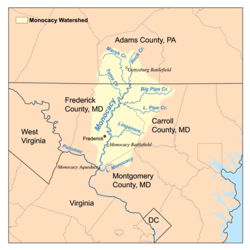 On June 30, Meade's headquarters advanced to Taneytown, Maryland
, and he issued two important orders. The first directed that a general advance in the direction of Gettysburg begin on July 1, a destination that was from 5 to 25 miles away from each of his seven infantry corps. The second order, known as the Pipe Creek Circular, established a prospective line on Big Pipe Creek, which had been surveyed by his engineers
as a strong defensive position. Meade had the option of occupying this position and hoping that Lee would attack him there; alternatively, it would represent a fall back position if the army got into trouble at Gettysburg.
(28 miles (45 km) northwest of Gettysburg) to Carlisle
(30 miles (48 km) north of Gettysburg) to near Harrisburg and Wrightsville
on the Susquehanna River
. Ewell's Corps had almost reached the Susquehanna River and was prepared to menace Harrisburg, the Pennsylvania state capital. Early's Division occupied York
, which was the largest Northern town to fall to the Confederates during the war. Longstreet and Hill were near Chambersburg.
Lee ordered a concentration of his forces around Cashtown
, located at the eastern base of South Mountain and 8 miles (13 km) west of Gettysburg. On June 30, while part of Hill's Corps was in Cashtown, one of Hill's brigades, North Carolinians under Brig. Gen. J. Johnston Pettigrew
, ventured toward Gettysburg. The memoirs of Maj. Gen. Henry Heth
, Pettigrew's division commander, claimed that he sent Pettigrew to search for supplies in town—especially shoes.
When Pettigrew's troops approached Gettysburg on June 30, they noticed Union cavalry under Brig. Gen. John Buford
arriving south of town, and Pettigrew returned to Cashtown without engaging them. When Pettigrew told Hill and Heth about what he had seen, neither general believed that there was a substantial Federal force in or near the town, suspecting that it had been only Pennsylvania militia. Despite General Lee's order to avoid a general engagement until his entire army was concentrated, Hill decided to mount a significant reconnaissance in force
the following morning to determine the size and strength of the enemy force in his front. Around 5 a.m. on Wednesday, July 1, two brigades of Heth's division advanced to Gettysburg.
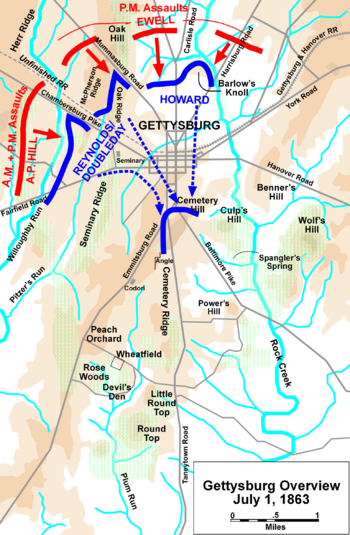

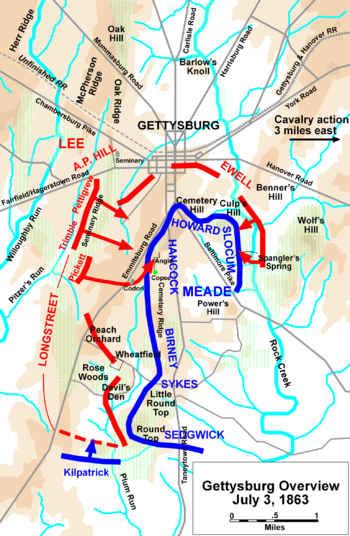
The three-day battle in and around Gettysburg resulted in the largest number of casualties in the American Civil War
—between 46,000 and 51,000. In conjunction with the Union victory at Vicksburg on July 4, Gettysburg is frequently cited as the war's turning point
.
The two armies began to collide at Gettysburg on July 1, 1863. The first day proceeded in three phases as combatants continued to arrive at the battlefield. In the morning, two brigades of Confederate Maj. Gen. Henry Heth
's division (of Hill's Third Corps) were delayed by dismounted Union cavalrymen under Brig. Gen. John Buford. As infantry reinforcements arrived under Maj. Gen. John F. Reynolds
from the I Corps, the Confederate assaults down the Chambersburg Pike were repulsed, although Gen. Reynolds was killed. By early afternoon, the Union XI Corps had arrived, and the Union position was in a semicircle from west to north of the town. Ewell's Second Corps began a massive assault from the north, with Maj. Gen. Robert E. Rodes
's division attacking from Oak Hill and Maj. Gen. Jubal A. Early's division attacking across the open fields north of town. The Union lines generally held under extremely heavy pressure, although the salient at Barlow's Knoll was overrun. The third phase of the battle came as Rodes renewed his assault from the north and Heth returned with his entire division from the west, accompanied by the division of Maj. Gen. W. Dorsey Pender
. Heavy fighting in Herbst's Woods (near the Lutheran Theological Seminary
) and on Oak Ridge finally caused the Union line to collapse. Some of the Federals conducted a fighting withdrawal through the town, suffering heavy casualties and losing many prisoners; others simply retreated. They took up good defensive positions on Cemetery Hill
and waited for additional attacks. Despite discretionary orders from Robert E. Lee to take the heights "if practicable," Richard Ewell chose not to attack. Historians have debated ever since how the battle might have ended differently if he had found it practicable to do so.
On the second day, Lee attempted to capitalize on his first day's success by launching multiple attacks against the Union flanks. After a lengthy delay to assemble his forces and avoid detection in his approach march, Longstreet attacked with his First Corps against the Union left flank. His division under Maj. Gen. John Bell Hood
attacked Little Round Top
and Devil's Den
. To Hood's left, Maj. Gen. Lafayette McLaws
attacked the Wheatfield and the Peach Orchard. Although neither prevailed, the Union III Corps was effectively destroyed as a combat organization as it attempted to defend a salient over too wide a front. Gen. Meade rushed as many as 20,000 reinforcements from elsewhere in his line to resist these fierce assaults. The attacks in this sector concluded with an unsuccessful assault by the Third Corps division of Maj. Gen. Richard H. Anderson
against the Union center on Cemetery Ridge
. That evening, Ewell's Second Corps turned demonstrations against the Union right flank into full-scale assaults on Culp's Hill
and East Cemetery Hill
, but both were repulsed. The Union army had occupied strong defensive positions, and Meade handled his forces well, resulting in heavy losses for both sides but leaving the disposition of forces on both sides essentially unchanged.
After attacks on both Union flanks had failed the day and night before, Lee was determined to strike the Union center on the third day. He decided to support this attack with a renewed thrust on the Union right that was supposed to start in concert with his assault on the center. However, the fighting on Culp's Hill resumed early in the morning with a Union counterattack, hours before Longstreet could begin his attack on the center. The Union troops on fortified Culp's Hill had been reinforced and the Confederates made no progress after multiple, futile assaults that lasted until noon. The infantry assault on Cemetery Ridge known as Pickett's Charge
was preceded by a massive artillery bombardment at 1 p.m. that was meant to soften up the Union defense and silence its artillery, but it was largely ineffective. Approximately 12,500 men in nine infantry brigades advanced over open fields for three quarters of a mile under heavy Union artillery and rifle fire. Although some Confederates were able to breach the low stone wall that shielded many of the Union defenders, they could not maintain their hold and were repulsed with over 50% casualties.
During and after Pickett's Charge on the third day, two significant cavalry battles also occurred: one approximately three miles (5 km) to the east, in the area known today as East Cavalry Field, the other southwest of the [Big] Round Top
mountain (sometimes called South Cavalry Field). The East Cavalry Field fighting was an attempt by Maj. Gen. J.E.B. Stuart
's Confederate cavalry to get into the Federal rear and exploit any success that Pickett's Charge may have generated. Union cavalry under Brig. Gens. David McM. Gregg and George Armstrong Custer
repulsed the Confederate advances. In South Cavalry Field, after Pickett's Charge had been defeated, reckless cavalry charges against the right flank of the Confederate Army, ordered by Brig. Gen. Judson Kilpatrick, were easily repulsed.
and prepared fortifications to receive a counterattack. When the Union attack had not occurred by the evening of July 4, Lee realized that he could accomplish nothing more in his campaign and that he had to return his battered army to Virginia. Lee started his Army of Northern Virginia in motion late the evening of July 4 towards Fairfield and Chambersburg. Cavalry under Brig. Gen. John D. Imboden
was entrusted to escort the miles-long wagon train of supplies and wounded men that Lee wanted to take back to Virginia with him, using the route through Cashtown and Hagerstown to Williamsport, Maryland
. Thousands of more seriously wounded soldiers were left behind in the Gettysburg area, along with medical personnel. However, despite casualties of over 20,000 men, including a number of senior officers, the morale of Lee's army remained high and their respect for the commanding general was not diminished by their reverses.
Unfortunately for the Confederate Army, however, once they reached the Potomac they would find it difficult to cross. Torrential rains that started on July 4 flooded the river at Williamsport, making fording impossible. Four miles downstream at Falling Waters
, Union cavalry destroyed Lee's lightly guarded pontoon bridge on July 4. The only way to cross the river was a small ferry at Williamsport. The Confederates could potentially be trapped, forced to defend themselves against Meade with their backs to the river.
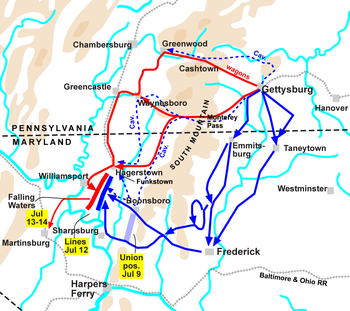 The route of the bulk of Lee's army was through Fairfield
and over Monterey Pass
to Hagerstown. A small but important action that occurred while Pickett's Charge was still underway, the Battle of Fairfield
, prevented the Union from blocking this route. Brig. Gen. Wesley Merritt
's brigade departed from Emmitsburg with orders to strike the Confederate left and rear along Seminary Ridge. Merritt dispatched about 400 men from the 6th U.S. Cavalry under to seize foraging wagons that had been reported in the area. Before they were able to reach the wagons, the 7th Virginia Cavalry
, leading a column under Confederate Brig. Gen. William E. "Grumble" Jones
, intercepted the regulars, but the U.S. cavalrymen repulsed the Virginians. Jones sent in the 6th Virginia Cavalry
, which successfully charged and swarmed over the Union troopers. There were 242 Union casualties, primarily prisoners, and 44 casualties among the Confederates.
Imboden's journey was one of extreme misery, conducted during the torrential rains that began on July 4, in which the 8,000 wounded men were forced to endure the weather and the rough roads in wagons without suspensions. The train was harassed throughout its march. At dawn on July 5, civilians in Greencastle
ambushed the train with axes, attacking the wheels of the wagons, until they were driven off. That afternoon at Cunningham's Cross Roads, Union cavalry attacked the column, capturing 134 wagons, 600 horses and mules, and 645 prisoners, about half of whom were wounded. These losses so angered Stuart that he demanded a court of inquiry to investigate.
Early on July 4 Meade send his cavalry to strike the enemy's rear and lines of communication so as to "harass and annoy him as much as possible in his retreat." Eight of nine cavalry brigades (except Col. John B. McIntosh's of Brig. Gen. David McM. Gregg's division) took to the field. Col. J. Irvin Gregg
's brigade (of his cousin David Gregg's division) moved toward Cashtown via Hunterstown and the Mummasburg Road, but all of the others moved south of Gettysburg. Brig. Gen. John Buford
's division went directly from Westminster
to Frederick, where they were joined by Merritt's division on the night of July 5.
Late on July 4, Meade held a council of war in which his corps commanders agreed that the army should remain at Gettysburg until Lee acted, and that the cavalry should pursue Lee in any retreat. Meade decided to have Brig. Gen. Gouverneur K. Warren
take a division from Sedgwick's VI Corps to probe the Confederate line and determine Lee's intentions. By the morning of July 5, Meade learned of Lee's departure, but he hesitated to order a general pursuit until he had received the results of Warren's reconnaissance.
The Battle of Monterey Pass began as Brig. Gen. Judson Kilpatrick's cavalry division easily brushed aside Brig. Gen. Beverly Robertson
's pickets and encountered a detachment of 20 men from the Confederate 1st Maryland Cavalry Battalion, under Capt. G. M. Emack, that was guarding the road to Monterey Pass. Aided by a detachment of the 4th North Carolina Cavalry and a single cannon, the Marylanders delayed the advance of 4,500 Union cavalrymen until well after midnight. Kilpatrick ordered Brig. Gen. George A. Custer to charge the Confederates with the 6th Michigan Cavalry, which broke the deadlock and allowed Kilpatrick's men to reach and attack the wagon train. They captured or destroyed numerous wagons and captured 1,360 prisoners—primarily wounded men in ambulances—and a large number of horses and mules.
As Meade's infantry began to march in earnest in pursuit of Lee on the morning of July 7, Buford's division departed from Frederick to destroy Imboden's train before it could cross the Potomac. At 5 p.m. on July 7 his men reached within a half-mile of the parked trains, but Imboden's command repulsed their advance. Buford heard Kilpatrick's artillery in the vicinity and requested support on his right. Kilpatrick's men had moved toward Hagerstown and pushed out the two small brigades of Chambliss and Robertson. However, infantry commanded by Brig. Gen. Alfred Iverson
drove Kilpatrick's men through the streets of town. Stuart's remaining brigades came up and were reinforced by two brigades of Hood's Division and Hagerstown was recaptured by the Confederates. Kilpatrick chose to respond to Buford's request for assistance and join the attack on Imboden at Williamsport. Stuart's men pressured Kilpatrick's rear and right flank from their position at Hagerstown and Kilpatrick's men gave way and exposed Buford's rear to the attack. Buford gave up his effort when darkness fell.
Lee's rear guard cavalry clashed with Federal cavalry in the South Mountain passes in the Battle of Boonsboro
on July 8, delaying Union pursuit. In the Battle of Funkstown
on July 10, Stuart's cavalry continued its efforts to delay Federal pursuit in an encounter near Funkstown, Maryland
, which resulted in nearly 500 casualties on both sides. The fight also marked the first time since the Battle of Gettysburg that Union infantry engaged Confederate infantry in the same engagement. Stuart was successful in delaying Pleasonton's cavalry for another day.
By July 9 most of the Army of the Potomac was concentrated in a 5-mile line from Rohrersville
to Boonsboro. Other Union forces were in position to protect the outer flanks at Maryland Heights and at Waynesboro. By July 11 the Confederates occupied a 6-mile, highly fortified line on high ground with their right resting on the Potomac River near Downsville
and the left about 1.5 miles southwest of Hagerstown, covering the only road from there to Williamsport.
Meade telegraphed to general-in-chief Henry W. Halleck on July 12 that he intended to attack the next day, "unless something intervenes to prevent it." He once again called a council of war with his subordinates on the night of July 12, which resulted in a postponement of an attack until reconnaissance of the Confederate position could be performed, which Meade conducted the next morning. By that time, Lee became frustrated waiting for Meade to attack him and was dismayed to see that the Federal troops were digging entrenchments of their own in front of his works. Confederate engineers had completed a new pontoon bridge over the Potomac, which had also subsided enough to be forded. Lee ordered a retreat to start after dark, with Longstreet's and Hill's corps and the artillery to use the pontoon bridge at Falling Waters and Ewell's corps to ford the river at Williamsport.
On the morning of July 14, advancing Union skirmishers found that the entrenchments were empty. Cavalry under Buford and Kilpatrick attacked the rearguard of Lee's army, Maj. Gen. Henry Heth
's division, which was still on a ridge about a mile and a half from Falling Waters. The initial attack caught the Confederates by surprise after a long night with little sleep, and hand-to-hand fighting ensued. Kilpatrick attacked again and Buford struck them in their right and rear. Heth's and Pender's divisions lost numerous prisoners. Brig. Gen. J. Johnston Pettigrew
, who had survived Pickett's Charge with a minor hand wound, was mortally wounded at Falling Waters. This minor success against Heth did not make up for the extreme frustration in the Lincoln administration about allowing Lee to escape. The president was quoted as saying, "We had them within our grasp. We had only to stretch forth our hands and they were ours. And nothing I could say or do could make the Army move."
The two armies did not take up positions across from each other on the Rappahannock River
for almost two weeks. On July 16 the cavalry brigades of Fitzhugh Lee and Chambliss held the fords on the Potomac at Shepherdstown
to prevent crossing by the Federal infantry. The cavalry division under David Gregg approached the fords and the Confederates attacked them, but the Union cavalrymen held their position until dark before withdrawing.
The Army of the Potomac crossed the Potomac River at Harpers Ferry and Berlin (now named Brunswick
) on July 17–18. They advanced along the east side of the Blue Ridge Mountains, trying to interpose themselves between Lee's army and Richmond. On July 23, in the Battle of Manassas Gap
, Meade ordered French's III Corps to cut off the retreating Confederate columns at Front Royal
, by forcing passage through Manassas Gap
. At first light, French began slowly pushing the Stonewall Brigade
back into the gap. About 4:30 p.m., a strong Union attack drove the Confederates until they were reinforced by Maj. Gen. Robert E. Rodes
's division and artillery. By dusk, the poorly coordinated Union attacks were abandoned. During the night, Confederate forces withdrew into the Luray Valley. On July 24, the Union army occupied Front Royal, but Lee's army was safely beyond pursuit.
Meade was severely criticized for allowing Lee to escape, just as Maj. Gen. George B. McClellan
had been after the Battle of Antietam
. Under pressure from Lincoln, he launched two campaigns in the fall of 1863—Bristoe
and Mine Run
—that attempted to defeat Lee. Both were failures. He also suffered humiliation at the hands of his political enemies in front of the Joint Congressional Committee on the Conduct of the War
, questioning his actions at Gettysburg and his failure to defeat Lee during the retreat to the Potomac.
On November 19, 1863, Abraham Lincoln spoke at the dedication ceremonies for the national cemetery created at the Gettysburg battlefield. His Gettysburg Address
redefined the war, named the destruction of slavery
as a specific goal, and called for a "new birth of freedom" in the nation.
American Civil War
The American Civil War was a civil war fought in the United States of America. In response to the election of Abraham Lincoln as President of the United States, 11 southern slave states declared their secession from the United States and formed the Confederate States of America ; the other 25...
. After his victory in the Battle of Chancellorsville
Battle of Chancellorsville
The Battle of Chancellorsville was a major battle of the American Civil War, and the principal engagement of the Chancellorsville Campaign. It was fought from April 30 to May 6, 1863, in Spotsylvania County, Virginia, near the village of Chancellorsville. Two related battles were fought nearby on...
, Confederate
Confederate States Army
The Confederate States Army was the army of the Confederate States of America while the Confederacy existed during the American Civil War. On February 8, 1861, delegates from the seven Deep South states which had already declared their secession from the United States of America adopted the...
General Robert E. Lee
Robert E. Lee
Robert Edward Lee was a career military officer who is best known for having commanded the Confederate Army of Northern Virginia in the American Civil War....
's Army of Northern Virginia
Army of Northern Virginia
The Army of Northern Virginia was the primary military force of the Confederate States of America in the Eastern Theater of the American Civil War, as well as the primary command structure of the Department of Northern Virginia. It was most often arrayed against the Union Army of the Potomac...
moved north for offensive operations in Maryland
Maryland
Maryland is a U.S. state located in the Mid Atlantic region of the United States, bordering Virginia, West Virginia, and the District of Columbia to its south and west; Pennsylvania to its north; and Delaware to its east...
and Pennsylvania
Pennsylvania
The Commonwealth of Pennsylvania is a U.S. state that is located in the Northeastern and Mid-Atlantic regions of the United States. The state borders Delaware and Maryland to the south, West Virginia to the southwest, Ohio to the west, New York and Ontario, Canada, to the north, and New Jersey to...
. The Union
Union Army
The Union Army was the land force that fought for the Union during the American Civil War. It was also known as the Federal Army, the U.S. Army, the Northern Army and the National Army...
Army of the Potomac
Army of the Potomac
The Army of the Potomac was the major Union Army in the Eastern Theater of the American Civil War.-History:The Army of the Potomac was created in 1861, but was then only the size of a corps . Its nucleus was called the Army of Northeastern Virginia, under Brig. Gen...
, commanded by Maj. Gen.
Major general (United States)
In the United States Army, United States Marine Corps, and United States Air Force, major general is a two-star general-officer rank, with the pay grade of O-8. Major general ranks above brigadier general and below lieutenant general...
Joseph Hooker
Joseph Hooker
Joseph Hooker was a career United States Army officer, achieving the rank of major general in the Union Army during the American Civil War. Although he served throughout the war, usually with distinction, Hooker is best remembered for his stunning defeat by Confederate General Robert E...
and then (from June 28) by Maj. Gen. George G. Meade, pursued Lee, defeated him at the Battle of Gettysburg
Battle of Gettysburg
The Battle of Gettysburg , was fought July 1–3, 1863, in and around the town of Gettysburg, Pennsylvania. The battle with the largest number of casualties in the American Civil War, it is often described as the war's turning point. Union Maj. Gen. George Gordon Meade's Army of the Potomac...
, but allowed him to escape back to Virginia.
Lee's army slipped away from Federal contact at Fredericksburg, Virginia
Fredericksburg, Virginia
Fredericksburg is an independent city in the Commonwealth of Virginia located south of Washington, D.C., and north of Richmond. As of the 2010 census, the city had a population of 24,286...
, on June 3, 1863. While they paused at Culpeper
Culpeper, Virginia
Culpeper is an incorporated town in Culpeper County, Virginia, United States. The population was 9,664 at the 2000 census. It is the county seat of Culpeper County. Culpeper is part of the Culpeper Micropolitan Statistical Area, which includes all of Culpeper County. Both the Town of Culpeper and...
, the largest predominantly cavalry battle of the war was fought at Brandy Station
Battle of Brandy Station
The Battle of Brandy Station, also called the Battle of Fleetwood Hill, was the largest predominantly cavalry engagement of the American Civil War, as well as the largest to take place ever on American soil. It was fought at the beginning of the Gettysburg Campaign by the Union cavalry under Maj....
on June 9. The Confederates crossed the Blue Ridge Mountains
Blue Ridge Mountains
The Blue Ridge Mountains are a physiographic province of the larger Appalachian Mountains range. This province consists of northern and southern physiographic regions, which divide near the Roanoke River gap. The mountain range is located in the eastern United States, starting at its southern-most...
and moved north through the Shenandoah Valley
Shenandoah Valley
The Shenandoah Valley is both a geographic valley and cultural region of western Virginia and West Virginia in the United States. The valley is bounded to the east by the Blue Ridge Mountains, to the west by the eastern front of the Ridge-and-Valley Appalachians , to the north by the Potomac River...
, capturing the Union garrison at Winchester, Virginia
Winchester, Virginia
Winchester is an independent city located in the northwestern portion of the Commonwealth of Virginia in the USA. The city's population was 26,203 according to the 2010 Census...
, in the Second Battle of Winchester, June 13–15. Crossing the Potomac River
Potomac River
The Potomac River flows into the Chesapeake Bay, located along the mid-Atlantic coast of the United States. The river is approximately long, with a drainage area of about 14,700 square miles...
, Lee's Second Corps advanced through Maryland and Pennsylvania, reaching the Susquehanna River
Susquehanna River
The Susquehanna River is a river located in the northeastern United States. At long, it is the longest river on the American east coast that drains into the Atlantic Ocean, and with its watershed it is the 16th largest river in the United States, and the longest river in the continental United...
and threatening the state capital of Harrisburg
Harrisburg, Pennsylvania
Harrisburg is the capital of Pennsylvania. As of the 2010 census, the city had a population of 49,528, making it the ninth largest city in Pennsylvania...
. However, the Army of the Potomac was in pursuit and had reached Frederick, Maryland, before Lee realized his opponent had crossed the Potomac. Lee moved swiftly to concentrate his army around the crossroads town of Gettysburg
Gettysburg, Pennsylvania
Gettysburg is a borough that is the county seat, part of the Gettysburg Battlefield, and the eponym for the 1863 Battle of Gettysburg. The town hosts visitors to the Gettysburg National Military Park and has 3 institutions of higher learning: Lutheran Theological Seminary, Gettysburg College, and...
.
The Battle of Gettysburg was the largest of the war. Starting as a chance meeting engagement on July 1, the Confederates were initially successful in driving Union cavalry and two infantry corps from their defensive positions, through the town, and onto Cemetery Hill. On July 2, with most of both armies now present, Lee launched fierce assaults on both flanks of the Union defensive line, which were repulsed with heavy losses on both sides. On July 3, Lee focused his attention on the Union center. The defeat of his massive infantry assault, Pickett's Charge
Pickett's Charge
Pickett's Charge was an infantry assault ordered by Confederate Gen. Robert E. Lee against Maj. Gen. George G. Meade's Union positions on Cemetery Ridge on July 3, 1863, the last day of the Battle of Gettysburg during the American Civil War. Its futility was predicted by the charge's commander,...
, caused Lee to order a retreat that began the evening of July 4.
The Confederate retreat to Virginia was plagued by bad weather, difficult roads, and numerous skirmishes with Union cavalry. However, Meade's army did not maneuver aggressively enough to prevent the Army of Northern Virginia from crossing the Potomac to safety on the night of July 13–14.
Background
Shortly after Lee's Army of Northern Virginia defeated Hooker's Army of the Potomac during the Chancellorsville Campaign (April 30 – May 6, 1863), Lee decided upon a second invasion of the North. Such a move would upset Union plans for the summer campaigning season, give Lee the ability to maneuver his army away from its defensive positions behind the Rappahannock RiverRappahannock River
The Rappahannock River is a river in eastern Virginia, in the United States, approximately in length. It traverses the entire northern part of the state, from the Blue Ridge Mountains in the west, across the Piedmont, to the Chesapeake Bay, south of the Potomac River.An important river in American...
, and allow the Confederates to live off the bounty of the rich northern farms while giving war-ravaged Virginia a much needed rest. Lee's army could also threaten Philadelphia
Philadelphia, Pennsylvania
Philadelphia is the largest city in the Commonwealth of Pennsylvania and the county seat of Philadelphia County, with which it is coterminous. The city is located in the Northeastern United States along the Delaware and Schuylkill rivers. It is the fifth-most-populous city in the United States,...
, Baltimore, and Washington
Washington, D.C.
Washington, D.C., formally the District of Columbia and commonly referred to as Washington, "the District", or simply D.C., is the capital of the United States. On July 16, 1790, the United States Congress approved the creation of a permanent national capital as permitted by the U.S. Constitution....
, and encourage the growing peace movement in the North. Lee had written to his wife on April 19,
The Confederate government wanted Lee to reduce Union pressure threatening their garrison at Vicksburg, Mississippi
Vicksburg, Mississippi
Vicksburg is a city in Warren County, Mississippi, United States. It is the only city in Warren County. It is located northwest of New Orleans on the Mississippi and Yazoo rivers, and due west of Jackson, the state capital. In 1900, 14,834 people lived in Vicksburg; in 1910, 20,814; in 1920,...
, but he declined their suggestions to send troops to provide direct aid, arguing for the value of a concentrated blow in the Northeast.
In essence, Lee's strategy was identical to the one he employed in the Maryland Campaign
Maryland Campaign
The Maryland Campaign, or the Antietam Campaign is widely considered one of the major turning points of the American Civil War. Confederate Gen. Robert E. Lee's first invasion of the North was repulsed by Maj. Gen. George B...
of 1862. He had discovered only recently the secret of how Maj. Gen. George B. McClellan
George B. McClellan
George Brinton McClellan was a major general during the American Civil War. He organized the famous Army of the Potomac and served briefly as the general-in-chief of the Union Army. Early in the war, McClellan played an important role in raising a well-trained and organized army for the Union...
had defeated that invasion, by intercepting Lee's famous lost order
Special Order 191
Special Order 191 was a general movement order issued by Confederate Army General Robert E. Lee in the Maryland Campaign of the American Civil War...
to his corps commanders, which compelled him to fight in the Battle of Antietam
Battle of Antietam
The Battle of Antietam , fought on September 17, 1862, near Sharpsburg, Maryland, and Antietam Creek, as part of the Maryland Campaign, was the first major battle in the American Civil War to take place on Northern soil. It was the bloodiest single-day battle in American history, with about 23,000...
before he could fully concentrate his army. This revelation improved his confidence that he could succeed in a northern invasion against another man he considered a timid and ineffective general, Joseph Hooker. Furthermore, after Chancellorsville he had supreme confidence in the men of his army, assuming they could handle any challenge he gave them.
Opposing forces at the start of the campaign
| Union corps commanders |
|---|
Union
The Army of the Potomac, initially under Maj. Gen. Joseph HookerJoseph Hooker
Joseph Hooker was a career United States Army officer, achieving the rank of major general in the Union Army during the American Civil War. Although he served throughout the war, usually with distinction, Hooker is best remembered for his stunning defeat by Confederate General Robert E...
(Maj. Gen. George G. Meade replaced Hooker in command on June 28), consisted of more than 90,000 men in the following organization:
- I Corps, commanded by Maj. Gen. John F. ReynoldsJohn F. ReynoldsJohn Fulton Reynolds was a career United States Army officer and a general in the American Civil War. One of the Union Army's most respected senior commanders, he played a key role in committing the Army of the Potomac to the Battle of Gettysburg and was killed at the start of the battle.-Early...
, with divisions commanded by Brig. Gen. James S. WadsworthJames S. WadsworthJames Samuel Wadsworth was a philanthropist, politician, and a Union general in the American Civil War. He was killed in battle during the Battle of the Wilderness of 1864.-Early years:...
, Brig. Gen. John C. RobinsonJohn C. RobinsonJohn Cleveland Robinson had a long and distinguished career in the United States Army, fighting in numerous wars and culminating his career as a Union Army brigadier general of volunteers and brevet major general of volunteers in the American Civil War. In 1866, President Andrew Johnson nominated...
, and Maj. Gen. Abner DoubledayAbner DoubledayAbner Doubleday was a career United States Army officer and Union general in the American Civil War. He fired the first shot in defense of Fort Sumter, the opening battle of the war, and had a pivotal role in the early fighting at the Battle of Gettysburg. Gettysburg was his finest hour, but his...
. - II Corps, commanded by Maj. Gen. Winfield S. Hancock, with divisions commanded by Brig. Gens. John C. CaldwellJohn C. CaldwellJohn Curtis Caldwell was a teacher, a Union general in the American Civil War, and an American diplomat.-Early life:Caldwell was born in Lowell, Vermont...
, John GibbonJohn GibbonJohn Gibbon was a career United States Army officer who fought in the American Civil War and the Indian Wars.-Early life:...
, and Alexander HaysAlexander HaysAlexander Hays was a Union Army general in the American Civil War, killed in the Battle of the Wilderness.-Early life and career:...
. - III Corps, commanded by Maj. Gen. Daniel E. Sickles, with divisions commanded by Maj. Gen. David B. BirneyDavid B. BirneyDavid Bell Birney was a businessman, lawyer, and a Union General in the American Civil War.-Early life:Birney was born in Huntsville, Alabama, the son of an abolitionist from Kentucky, James G. Birney. The Birney family returned to Kentucky in 1833, and James Birney freed his slaves...
and Maj. Gen. Andrew A. HumphreysAndrew A. HumphreysAndrew Atkinson Humphreys , was a career United States Army officer, civil engineer, and a Union General in the American Civil War. He served in senior positions in the Army of the Potomac, including division command, chief of staff, and corps command, and was Chief Engineer of the U.S...
. - V Corps, commanded by Maj. Gen. George SykesGeorge SykesGeorge Sykes was a career United States Army officer and a Union General during the American Civil War.-Early life:...
(George G. Meade until June 28), with divisions commanded by Brig. Gens. James Barnes, Romeyn B. AyresRomeyn B. AyresRomeyn Beck Ayres was a Union Army general in the American Civil War.-Early life:Ayres was born at East Creek, New York, along the Mohawk River in Montgomery County. He was the son of a small-town doctor who urged all of his sons into professional careers...
, and Samuel W. CrawfordSamuel W. CrawfordSamuel Wylie Crawford was a United States Army surgeon and a Union general in the American Civil War.-Early life:...
. - VI Corps, commanded by Maj. Gen. John SedgwickJohn SedgwickJohn Sedgwick was a teacher, a career military officer, and a Union Army general in the American Civil War. He was the highest ranking Union casualty in the Civil War, killed by a sniper at the Battle of Spotsylvania Court House.-Early life:Sedgwick was born in the Litchfield Hills town of...
, with divisions commanded by Brig. Gen. Horatio G. Wright, Brig. Gen. Albion P. HoweAlbion P. HoweAlbion Parris Howe was a Union Army general in the American Civil War. Howe's contentious relationships with superior officers in the Army of the Potomac eventually led to his being deprived of division command....
, and Maj. Gen. John Newton. - XI Corps, commanded by Maj. Gen. Oliver O. HowardOliver O. HowardOliver Otis Howard was a career United States Army officer and a Union general in the American Civil War...
, with divisions commanded by Brig. Gen. Francis C. BarlowFrancis C. BarlowFrancis Channing Barlow was a lawyer, politician, and Union General during the American Civil War.-Early life and career:...
, Brig. Gen. Adolph von SteinwehrAdolph von SteinwehrBaron Adolph Wilhelm August Friedrich von Steinwehr was a German-Brunswick army officer who emigrated to the United States, became a geographer, cartographer, and author, and served as a Union general in the American Civil War.-Early life:Steinwehr was born in Blankenburg, in the Duchy of...
, and Maj. Gen. Carl SchurzCarl SchurzCarl Christian Schurz was a German revolutionary, American statesman and reformer, and Union Army General in the American Civil War. He was also an accomplished journalist, newspaper editor and orator, who in 1869 became the first German-born American elected to the United States Senate.His wife,...
. - XII Corps, commanded by Maj. Gen. Henry W. Slocum, with divisions commanded by Brig. Gens. Alpheus S. WilliamsAlpheus S. WilliamsAlpheus Starkey Williams was a lawyer, judge, journalist, U.S. Congressman, and a Union general in the American Civil War.-Early life:...
and John W. GearyJohn W. GearyJohn White Geary was an American lawyer, politician, Freemason, and a Union general in the American Civil War...
. - Cavalry Corps, commanded by Maj. Gen. Alfred PleasontonAlfred PleasontonAlfred Pleasonton was a United States Army officer and General of Union cavalry during the American Civil War. He commanded the Cavalry Corps of the Army of the Potomac during the Gettysburg Campaign, including the largest predominantly cavalry battle of the war, Brandy Station...
, with divisions commanded by Brig. Gens. John BufordJohn BufordJohn Buford, Jr. was a Union cavalry officer during the American Civil War, with a prominent role at the start of the Battle of Gettysburg.-Early years:...
, David McM. Gregg, and H. Judson KilpatrickHugh Judson KilpatrickHugh Judson Kilpatrick was an officer in the Union Army during the American Civil War, achieving the rank of brevet major general. He was later the United States Minister to Chile, and a failed political candidate for the U.S...
. - Artillery Reserve, commanded by Brig. Gen. Robert O. TylerRobert O. TylerRobert Ogden Tyler was an American soldier who served as a general in the Union Army during the American Civil War. He is best known as the commander of the Artillery Reserve of the Army of the Potomac, including at the Battle of Gettysburg in July 1863, where many of his batteries played...
. (The preeminent artillery officer at Gettysburg was Brig. Gen. Henry J. Hunt, chief of artillery on Meade's staff.)
During the advance on Gettysburg, Maj. Gen. Reynolds was in operational command of the left, or advanced, wing of the Army, consisting of the I, III, and XI Corps. Note that many other Union units (not part of the Army of the Potomac) were actively involved in the Gettysburg Campaign, but not directly involved in the Battle of Gettysburg. These included portions of the Union IV Corps, the militia and state troops of the Department of the Susquehanna
Department of the Susquehanna
The Department of the Susquehanna was a military department created by the United States War Department during the Gettysburg Campaign of the American Civil War...
, and various garrisons, including that at Harpers Ferry.
| Confederate corps commanders |
|---|
Confederate
In reaction to the death of Lt. Gen. Thomas J. "Stonewall" JacksonStonewall Jackson
ຄຽשת״ׇׂׂׂׂ֣|birth_place= Clarksburg, Virginia |death_place=Guinea Station, Virginia|placeofburial=Stonewall Jackson Memorial CemeteryLexington, Virginia|placeofburial_label= Place of burial|image=...
after Chancellorsville, Lee reorganized his 75,000 men from two infantry corps into three.
- First CorpsFirst Corps, Army of Northern VirginiaThe First Corps, Army of Northern Virginia was a military unit fighting for the Confederate States of America in the American Civil War. It was formed in early 1861 and served until the spring of 1865, mostly in the Eastern Theater. The corps was commanded by James Longstreet for much of its...
, commanded by Lt. Gen. James LongstreetJames LongstreetJames Longstreet was one of the foremost Confederate generals of the American Civil War and the principal subordinate to General Robert E. Lee, who called him his "Old War Horse." He served under Lee as a corps commander for many of the famous battles fought by the Army of Northern Virginia in the...
, with divisions commanded by Maj. Gens. Lafayette McLawsLafayette McLawsLafayette McLaws was a United States Army officer and a Confederate general in the American Civil War.-Early life:...
, George E. Pickett, and John Bell HoodJohn Bell HoodJohn Bell Hood was a Confederate general during the American Civil War. Hood had a reputation for bravery and aggressiveness that sometimes bordered on recklessness...
. - Second CorpsSecond Corps, Army of Northern VirginiaThe Second Corps of the Army of Northern Virginia was a military organization within the Confederate Army of Northern Virginia during much of the American Civil War. It was officially created and named following the Battle of Sharpsburg in 1862, but comprised units in a corps organization for quite...
, commanded by Lt. Gen. Richard S. EwellRichard S. EwellRichard Stoddert Ewell was a career United States Army officer and a Confederate general during the American Civil War. He achieved fame as a senior commander under Stonewall Jackson and Robert E...
, with divisions commanded by Maj. Gens. Jubal A. Early, Edward "Allegheny" JohnsonEdward Johnson (general)Edward Johnson , also known as Allegheny Johnson , was a United States Army officer and a Confederate general in the American Civil War.-Early life:...
, and Robert E. RodesRobert E. RodesRobert Emmett Rodes was a railroad civil engineer and a promising young Confederate general in the American Civil War, killed in battle in the Shenandoah Valley.-Education, antebellum career:...
. - Third CorpsThird Corps, Army of Northern VirginiaThe Third Corps of the Army of Northern Virginia was a military organization within the Confederate Army of Northern Virginia during much of the American Civil War. The corps was formed in mid-1863 and served until Lee's surrender April 9, 1865, near the end of the war.-Formation:After the death of...
, commanded by Lt. Gen. A.P. Hill, with divisions commanded by Maj. Gens. Richard H. AndersonRichard H. AndersonRichard Heron Anderson was a career U.S. Army officer, fighting with distinction in the Mexican-American War. He also served as a Confederate general during the American Civil War, fighting in the Eastern Theater of the conflict and most notably during the 1864 Battle of Spotsylvania Court House...
, Henry HethHenry HethHenry "Harry" Heth was a career United States Army officer and a Confederate general in the American Civil War. He is best remembered for inadvertently precipitating the Battle of Gettysburg, when he sent some of his troops of the Army of Northern Virginia to the small Pennsylvania village,...
, and W. Dorsey Pender. - Cavalry divisionCavalry Corps, Army of Northern VirginiaThe Cavalry Corps of the Army of Northern Virginia was the only organized cavalry corps in the Confederate Army during the American Civil War. Prior to the establishment of a formal corps, cavalry organization in the Confederacy consisted mostly of partisan ranger units and some battalions, a few...
, commanded by Maj. Gen. J.E.B. StuartJ.E.B. StuartJames Ewell Brown "Jeb" Stuart was a U.S. Army officer from Virginia and a Confederate States Army general during the American Civil War. He was known to his friends as "Jeb", from the initials of his given names. Stuart was a cavalry commander known for his mastery of reconnaissance and the use...
, with brigades commanded by Brig. Gens. Wade HamptonWade Hampton IIIWade Hampton III was a Confederate cavalry leader during the American Civil War and afterward a politician from South Carolina, serving as its 77th Governor and as a U.S...
, Fitzhugh LeeFitzhugh LeeFitzhugh Lee , nephew of Robert E. Lee, was a Confederate cavalry general in the American Civil War, the 40th Governor of Virginia, diplomat, and United States Army general in the Spanish-American War.-Early life:...
, Beverly H. Robertson, Albert G. JenkinsAlbert G. JenkinsAlbert Gallatin Jenkins was an attorney, planter, representative to the United States Congress and First Confederate Congress, and a Confederate brigadier general during the American Civil War...
, William E. "Grumble" JonesWilliam E. JonesWilliam Edmondson Jones, known as Grumble Jones, was a planter, a career United States Army officer, and a Confederate cavalry general, killed in the Battle of Piedmont in the American Civil War.-Early life:...
, and John D. ImbodenJohn D. ImbodenJohn Daniel Imboden was a lawyer, teacher, Virginia state legislator. During the American Civil War, he was a Confederate cavalry general and partisan fighter...
, and Col. John R. ChamblissJohn R. ChamblissJohn Randolph Chambliss, Jr. was a career military officer, serving in the United States Army and then, during the American Civil War, in the Confederate States Army. A brigadier general of cavalry, Chambliss was killed in action during the Second Battle of Deep Bottom.-Early life:Chambliss was...
.
Campaign timeline
The battles of the Gettysburg Campaign were fought in the following sequence; they are described in the context of logical, sometimes overlapping divisions of the campaign.| Action | Dates | Section of campaign |
|---|---|---|
| Battle of Brandy Station Battle of Brandy Station The Battle of Brandy Station, also called the Battle of Fleetwood Hill, was the largest predominantly cavalry engagement of the American Civil War, as well as the largest to take place ever on American soil. It was fought at the beginning of the Gettysburg Campaign by the Union cavalry under Maj.... |
June 9, 1863 | Brandy Station |
| Second Battle of Winchester | June 13–15 | Winchester |
| Battle of Aldie Battle of Aldie The Battle of Aldie took place on June 17, 1863, in Loudoun County, Virginia, as part of the Gettysburg Campaign of the American Civil War.Maj. Gen. J.E.B. Stuart's cavalry screened Gen. Robert E. Lee's Confederate infantry as it marched north in the Shenandoah Valley behind the sheltering Blue... |
June 17 | Hooker's pursuit |
| Battle of Middleburg Battle of Middleburg The Battle of Middleburg took place from June 17 to June 19, 1863, in Loudoun County, Virginia, as part of the Gettysburg Campaign of the American Civil War.... |
June 17–19 | Hooker's pursuit |
| Battle of Upperville Battle of Upperville The Battle of Upperville took place in Loudoun County, Virginia on June 21, 1863 during the Gettysburg Campaign of the American Civil War.-Background:The Union cavalry made a determined effort to pierce Confederate Maj. Gen. J.E.B. Stuart's cavalry screen... |
June 21 | Hooker's pursuit |
| Skirmish of Sporting Hill Skirmish of Sporting Hill The Skirmish of Sporting Hill was a relatively small skirmish during the Gettysburg Campaign of the American Civil War, taking place on June 30, 1863, at various locations in present day Camp Hill, East Pennsboro Township and Hampden Township in Cumberland County, Pennsylvania. It is known as the... |
June 30 | Invasion of Pennsylvania |
| Battle of Hanover Battle of Hanover The Battle of Hanover took place on June 30, 1863, in Hanover in southwestern York County, Pennsylvania, as part of the Gettysburg Campaign of the American Civil War.... |
June 30 | Stuart's ride |
| Battle of Gettysburg Battle of Gettysburg The Battle of Gettysburg , was fought July 1–3, 1863, in and around the town of Gettysburg, Pennsylvania. The battle with the largest number of casualties in the American Civil War, it is often described as the war's turning point. Union Maj. Gen. George Gordon Meade's Army of the Potomac... |
July 1–3 | Gettysburg |
| Battle of Carlisle Battle of Carlisle The Battle of Carlisle was an American Civil War skirmish in Pennsylvania on the same day as the Battle of Gettysburg, First Day. Stuart's Confederate cavalry briefly engaged Union militia under Maj. Gen. William F. "Baldy" Smith at Carlisle and set fire to the Carlisle Barracks... |
July 1 | Stuart's ride |
| Battle of Hunterstown Battle of Hunterstown The Battle of Hunterstown was a minor cavalry engagement in Adams County, Pennsylvania, on July 2, 1863, during the Gettysburg Campaign of the American Civil War... |
July 2 | Stuart's ride |
| Battle of Fairfield Battle of Fairfield The Battle of Fairfield was a cavalry engagement during the Gettysburg Campaign of the American Civil War. It was fought July 3, 1863, near Fairfield, Pennsylvania, concurrently with the Battle of Gettysburg, although it was not a formal part of that battle... |
July 3 | Retreat |
| Battle of Monterey Pass | July 4–5 | Retreat |
| Battle of Williamsport Battle of Williamsport The Battle of Williamsport, also known as the Battle of Hagerstown or Falling Waters, took place from July 6 to July 16, 1863, in Washington County, Maryland, as part of the Gettysburg Campaign of the American Civil War.... |
July 6–16 | Retreat |
| Battle of Boonsboro Battle of Boonsboro The Battle of Boonsboro took place on July 8, 1863, in Washington County, Maryland, as part of the Retreat from Gettysburg during the Gettysburg Campaign of the American Civil War.... |
July 8 | Retreat |
| Battle of Funkstown Battle of Funkstown The Second Battle of Funkstown took place near Funkstown, Maryland, on July 10, 1863, during the Gettysburg Campaign of the American Civil War... |
July 10 | Retreat |
| Battle of Manassas Gap Battle of Manassas Gap The Battle of Manassas Gap, also known as the Battle of Wapping Heights, took place on July 23, 1863, in Warren County, Virginia, at the conclusion of General Robert E. Lee's retreat back to Virginia in the final days of the Gettysburg Campaign of the American Civil War... |
July 23 | Retreat |
Lee's advance to Gettysburg
On June 3, 1863, Lee's army began to slip away northwesterly from Fredericksburg, VirginiaFredericksburg, Virginia
Fredericksburg is an independent city in the Commonwealth of Virginia located south of Washington, D.C., and north of Richmond. As of the 2010 census, the city had a population of 24,286...
, leaving A.P. Hill's Corps in fortifications above Fredericksburg to protect the Confederate rear as it withdrew. By June 5, Longstreet's and Ewell's corps were camped in and around Culpeper
Culpeper, Virginia
Culpeper is an incorporated town in Culpeper County, Virginia, United States. The population was 9,664 at the 2000 census. It is the county seat of Culpeper County. Culpeper is part of the Culpeper Micropolitan Statistical Area, which includes all of Culpeper County. Both the Town of Culpeper and...
, and Hooker had caught wind of the Confederate movement. Accordingly he ordered Sedgwick to conduct a reconnaissance in force across the Rappahannock River
Rappahannock River
The Rappahannock River is a river in eastern Virginia, in the United States, approximately in length. It traverses the entire northern part of the state, from the Blue Ridge Mountains in the west, across the Piedmont, to the Chesapeake Bay, south of the Potomac River.An important river in American...
to Hill's line, which resulted in a skirmish
Battle of Franklin's Crossing
The Battle of Franklin's Crossing, also known as the Deep Run Battle, took place near Fredericksburg, Virginia on June 5, 1863. Union forces under General John Sedgwick skirmished with Confederate troops under General A.P. Hill during a reconnaissance to determine the movements and location of...
that convinced him Lee still occupied his old line around Fredericksburg. As a precaution, Lee temporarily halted Ewell's Corps, but when he saw that Hooker would not press the Fredericksburg line to bring on a battle, he ordered Ewell to continue. On June 9, Lee ordered Stuart to cross the Rappahannock and raid Union forward positions, screening the Confederate Army from observation or interference as it moved north. Anticipating this imminent offensive action, Stuart ordered his troopers into bivouac around Brandy Station
Brandy Station, Virginia
Brandy Station is an unincorporated community in Culpeper County, Virginia, United States. Its original name was Brandy. The name Brandy Station comes from the Orange and Alexandria Railroad station that was constructed in the 19th century....
.
Brandy Station
Combined arms
Combined arms is an approach to warfare which seeks to integrate different branches of a military to achieve mutually complementary effects...
force of 8,000 cavalrymen and 3,000 infantry on a "spoiling raid," to "disperse and destroy" the 9,500 Confederates. Pleasonton's attack plan called for a double envelopment of the enemy. The wing under John Buford would cross the river at Beverly's Ford, two miles (3 km) northeast of Brandy Station; at the same time, David McM. Gregg's wing would cross at Kelly's Ford, six miles (10 km) downstream to the southeast. However, Pleasonton was unaware of the precise disposition of the enemy and he incorrectly assumed that his force was substantially larger than the Confederates he faced.
About 4:30 a.m. on June 9, Buford's column crossed the Rappahannock River in a dense fog, surprising Grumble Jones's brigade, which rode to the scene partially dressed and often riding bareback. They struck Buford's leading brigade and temporarily checked its progress, just short of where Stuart's Horse Artillery was camped and was vulnerable to capture. The artillery unlimbered on two knolls on either side of the Beverly's Ford Road. Most of Jones's command rallied to the left of this Confederate artillery line, while Hampton's brigade formed to the right. The 6th Pennsylvania Cavalry unsuccessfully charged the guns at St. James Church, suffering the greatest casualties of any regiment in the battle.
Buford tried to turn the Confederate left and dislodge the artillery that was blocking the direct route to Brandy Station and sustained heavy losses displacing Rooney Lee's brigade from a stone wall on Yew Ridge. Then, to the amazement of Buford's men, the Confederates began pulling back. They were reacting to the arrival of Gregg's cavalry division of about 2,800 men, which was the second major surprise of the day. Although Gregg had intended to cross at Kelly's Ford at dawn, in concert with Buford's crossing at Beverly's, his men were delayed two hours. Between Gregg and the St. James battle was a prominent ridge called Fleetwood Hill, which had been Stuart's headquarters the previous night. Stuart and most of his staff had departed for the front by this time, but a few shots from a 6-pounder howitzer delayed the advance of Col. Percy Wyndham's brigade as they sent out skirmishers and returned cannon fire. When Gregg's men charged up the western slope of Fleetwood and neared the crest, the lead elements of Jones's brigade, which had just withdrawn from St. James Church, rode over the crown.
Gregg's next brigade, led by Col. Judson Kilpatrick, swung around east of Brandy Station and attacked up the southern end and the eastern slope of Fleetwood Hill, only to discover that their appearance coincided with the arrival of Hampton's brigade. A series of confusing charges and countercharges swept back and forth across the hill. The Confederates finally cleared the hill. Col. Alfred N. Duffié's small 1,200-man division was delayed by two Confederate regiments in the vicinity of Stevensburg and arrived on the field too late to affect the action. While Jones and Hampton withdrew from their initial positions to fight at Fleetwood Hill, Rooney Lee continued to confront Buford, falling back to the northern end of the hill. Reinforced by Fitzhugh Lee's brigade, Rooney Lee launched a counterattack against Buford at the same time as Pleasonton had called for a general withdrawal near sunset, and the ten-hour battle was over.
Brandy Station was the largest predominantly cavalry fight of the war, and the largest to take place on American soil. It was a tactical draw, although Pleasonton withdrew before finding the location of Lee's infantry nearby and Stuart claimed a victory, attempting to disguise the embarrassment of a cavalry force being surprised as it was by Pleasonton. The battle established the emerging reputation of the Union cavalry as a peer of the Confederate mounted arm.
Winchester
After Brandy Station, Lee's infantry forces began crossing the Blue Ridge MountainsBlue Ridge Mountains
The Blue Ridge Mountains are a physiographic province of the larger Appalachian Mountains range. This province consists of northern and southern physiographic regions, which divide near the Roanoke River gap. The mountain range is located in the eastern United States, starting at its southern-most...
and headed north, "down" the Shenandoah Valley
Shenandoah Valley
The Shenandoah Valley is both a geographic valley and cultural region of western Virginia and West Virginia in the United States. The valley is bounded to the east by the Blue Ridge Mountains, to the west by the eastern front of the Ridge-and-Valley Appalachians , to the north by the Potomac River...
. Ewell's Corps, in the lead, crossed at Chester Gap
Chester Gap
Chester Gap, sometimes referred to as Happy Creek Gap for the creek that runs down its western slope, is a wind gap in the Blue Ridge Mountains on the border of Rappahannock County, Fauquier County and Warren County in Virginia. The gap is traversed by U.S. Route 522...
on June 12 and then through Front Royal
Front Royal, Virginia
Front Royal is a town in Warren County, Virginia, United States. The population was 13,589 at the 2000 census. It is the county seat of Warren County.-Geography:Front Royal is roughly west of Washington, D.C....
toward Winchester, Virginia
Winchester, Virginia
Winchester is an independent city located in the northwestern portion of the Commonwealth of Virginia in the USA. The city's population was 26,203 according to the 2010 Census...
. Longstreet's Corps (accompanied by General Lee) moved to protect Ashby's Gap
Ashby's Gap
Ashby Gap, more commonly known as Ashby's Gap is a wind gap in the Blue Ridge Mountains on the border of Clarke County, Loudoun County and Fauquier County in Virginia. The gap is traversed by U.S. Route 50...
and Snicker's Gap. A.P. Hill waited until Hooker had withdrawn from Fredericksburg on June 14 and then followed Ewell's route across the mountains, leapfrogging Longstreet's Corps, which then brought up the rear of the army. Stuart's cavalry remained to the east of the Blue Ridge to screen Lee's army.
The Union garrison at Winchester stood directly in Ewell's path. It was commanded by Maj. Gen. Robert H. Milroy
Robert H. Milroy
Robert Huston Milroy was a lawyer, judge, and a Union Army general in the American Civil War, most noted for his defeat at the Second Battle of Winchester in 1863.-Early life:...
, who had 7,000 men in three brigades—two in Winchester and one 10 miles to the east at Berryville. Three forts with interconnecting trenches had been constructed to defend the town. General-in-chief Henry W. Halleck had since May ordered Milroy's superior, Maj. Gen. Robert C. Schenck
Robert C. Schenck
Robert Cumming Schenck was a Union Army general in the American Civil War, and American diplomatic representative to Brazil and the United Kingdom. He was at both battles of Bull Run and took part in the Shenandoah Valley Campaign of 1862, and the Battle of Cross Keys...
of the Middle Department
Middle Department
The Middle Department was an administrative military district created by the United States War Department early in the American Civil War to administer the troops in the Middle Atlantic states....
, to withdraw Milroy's men to Harpers Ferry, but Schenck believed that these were only instances of Halleck's typical suggestions rather than direct orders and did not act on them until explicitly threatened with removal on June 14. By then it was too late. As Allegheny Johnson's division approached Winchester from the south on June 14 and Jubal Early approached from the west, Ewell ordered Rodes's division to Berryville and then to Martinsburg, north of Winchester. These movements effectively surrounded the Federal garrison.
At 6 p.m. on June 14, Confederate artillery opened fire on the Union's West Fort and the brigade of Brig. Gen. Harry T. Hays
Harry T. Hays
Harry Thompson Hays was an American Army officer serving in the Mexican-American War and a general who served in the Confederate Army during the American Civil War....
led the charge that captured the fort and a Union battery. As darkness fell, Milroy belatedly decided to retreat from his two remaining forts. Anticipating the movement, Ewell ordered Johnson to march northwest and block the Union escape route. At 3:30 a.m. on June 15, Johnson's column intercepted Milroy's on the Charles Town Road. Although Milroy ordered his men to fight their way out of the situation, when the Stonewall Brigade
Stonewall Brigade
The Stonewall Brigade of the Confederate Army during the American Civil War, was a famous combat unit in United States military history. It was trained and first led by General Thomas J. "Stonewall" Jackson, a professor from Virginia Military Institute...
arrived just after dawn to cut the turnpike to the north, Milroy's men began to surrender in large numbers. Milroy escaped personally but the Second Battle of Winchester cost the Union about 4,450 casualties (4,000 captured) out of 7,000 engaged, while the Confederates lost only 250 of 12,500 engaged.
Ewell began crossing the Potomac River near Hagerstown, Maryland
Hagerstown, Maryland
Hagerstown is a city in northwestern Maryland, United States. It is the county seat of Washington County, and, by many definitions, the largest city in a region known as Western Maryland. The population of Hagerstown city proper at the 2010 census was 39,662, and the population of the...
, late on June 15, along with Jenkins's cavalry brigade. Hill's and Longstreet's corps followed on June 24 and June 25.
Hooker's pursuit
"Fighting Joe" Hooker did not know Lee's intentions, and Stuart's cavalry masked the Confederate army's movements behind the Blue Ridge effectively. He initially conceived the idea of reacting to Lee's absence by seizing unprotected Richmond, VirginiaRichmond, Virginia
Richmond is the capital of the Commonwealth of Virginia, in the United States. It is an independent city and not part of any county. Richmond is the center of the Richmond Metropolitan Statistical Area and the Greater Richmond area...
, the Confederate capital. But President
President of the United States
The President of the United States of America is the head of state and head of government of the United States. The president leads the executive branch of the federal government and is the commander-in-chief of the United States Armed Forces....
Abraham Lincoln
Abraham Lincoln
Abraham Lincoln was the 16th President of the United States, serving from March 1861 until his assassination in April 1865. He successfully led his country through a great constitutional, military and moral crisis – the American Civil War – preserving the Union, while ending slavery, and...
sternly reminded him that Lee's army was the true objective. His orders were to pursue and defeat Lee but to stay between Lee and Washington and Baltimore. On June 14, the Army of the Potomac departed Fredericksburg and reached Manassas Junction on June 16. Hooker dispatched Pleasonton's cavalry again to punch through the Confederate cavalry screen to find the main Confederate army, which led to three minor cavalry battles from June 17 through June 21 in the Loudoun Valley.
Pleasonton ordered David McM. Gregg's division from Manassas Junction westward down the Little River Turnpike to Aldie
Aldie, Virginia
Aldie is an unincorporated village located on the John Mosby Highway between Gilbert's Corner and Middleburg in Loudoun County, Virginia. It is located in a gap between the Catoctin Mountain and Bull Run Mountain, through which the Little River flows...
. Aldie was tactically important in that near the village the Little River Turnpike intersected both of the turnpikes leading through Ashby's Gap and Snickers Gap into the Valley. The Confederate cavalry brigade of Col. Thomas T. Munford
Thomas T. Munford
Thomas Taylor Munford was an American farmer and Confederate brigadier general during the American Civil War.-Biography:...
was entering Aldie from the west, preparing to bivouac, when three brigades of Gregg's division entered from the east at about 4 p.m. on June 17, surprising both sides. The resulting Battle of Aldie
Battle of Aldie
The Battle of Aldie took place on June 17, 1863, in Loudoun County, Virginia, as part of the Gettysburg Campaign of the American Civil War.Maj. Gen. J.E.B. Stuart's cavalry screened Gen. Robert E. Lee's Confederate infantry as it marched north in the Shenandoah Valley behind the sheltering Blue...
was a fierce mounted fight of four hours with about 250 total casualties. Munford withdrew toward Middleburg
Middleburg, Virginia
Middleburg is a town in Loudoun County, Virginia, United States with a population of approximately 976 as of July 2010.-History:The town was established in 1787 by American Revolutionary War Lieutenant Colonel and Virginia statesman, Levin Powell. He purchased the land for Middleburg at $2.50 per...
.
While the fighting occurred at Aldie, the Union cavalry brigade of Col. Alfred N. Duffié arrived south of Middleburg in the late afternoon and drove in the Confederate pickets. Stuart was in the town at the time and managed to escape before his brigades under Munford and Beverly Robertson routed Duffié in an early morning assault on June 18. The primary action of the Battle of Middleburg
Battle of Middleburg
The Battle of Middleburg took place from June 17 to June 19, 1863, in Loudoun County, Virginia, as part of the Gettysburg Campaign of the American Civil War....
occurred on the morning of June 19 when Col. J. Irvin Gregg's brigade advanced west from Aldie and attacked Stuart's line on a ridge west of Middleburg. Stuart repulsed Gregg's charge, counterattacked, then fell back to defensive positions a half-mile to the west.
On June 21, Pleasonton again attempted to break Stuart's screen by advancing on Upperville
Upperville, Virginia
Upperville is an unincorporated community in Fauquier County, Virginia, United States, located along U.S. Route 50 fifty miles from downtown Washington, D.C.. Founded in the 1790s along Pantherskin Creek, it was originally named Carrstown by first settler Josephus Carr...
, 9 miles to the west of Middleburg. The cavalry brigades of Irvin Gregg and Judson Kilpatrick were accompanied by infantry from Col. Strong Vincent
Strong Vincent
Strong Vincent was a lawyer who became famous as a U.S. Army officer during the fighting on Little Round Top at the American Civil War Battle of Gettysburg, where he was mortally wounded.-Early life:...
's brigade on the Ashby's Gap Turnpike. Buford's cavalry division moved northwest against Stuart's left flank, but made little progress against Grumble Jones's and John R. Chambliss's brigades. The Battle of Upperville
Battle of Upperville
The Battle of Upperville took place in Loudoun County, Virginia on June 21, 1863 during the Gettysburg Campaign of the American Civil War.-Background:The Union cavalry made a determined effort to pierce Confederate Maj. Gen. J.E.B. Stuart's cavalry screen...
ended as Stuart conducted a fierce fighting withdrawal and took up a strong defensive position in Ashby's Gap.
After successfully defending his screen for almost a week, Stuart found himself motivated to begin the most controversial adventure of his career, Stuart's raid around the eastern flank of the Union Army.
Hooker's significant pursuit with the bulk of his army began on June 25, after he learned that the Army of Northern Virginia had crossed the Potomac River. He ordered the Army of the Potomac to cross into Maryland and concentrate at Middletown
Middletown, Maryland
Middletown is a town in Frederick County, Maryland, United States. The population was 2,668 at the 2000 census. Middletown is a small, rural community steeped in American history...
(Slocum's XII Corps) and Frederick
Frederick, Maryland
Frederick is a city in north-central Maryland. It is the county seat of Frederick County, the largest county by area in the state of Maryland. Frederick is an outlying community of the Washington-Arlington-Alexandria, DC-VA-MD-WV Metropolitan Statistical Area, which is part of a greater...
(the rest of the army, led by Reynolds's advance wing—the I, III, and XI Corps).
The invasion of Pennsylvania
President Lincoln issued a proclamation calling for 100,000 volunteers from four states to serve a term of six months "to repel the threatened and imminent invasion of Pennsylvania." Pennsylvania Governor Andrew CurtinAndrew Gregg Curtin
Andrew Gregg Curtin was a U.S. lawyer and politician. He served as the Governor of Pennsylvania during the Civil War.-Biography:...
called for 50,000 volunteers to take arms as volunteer militia
Militia
The term militia is commonly used today to refer to a military force composed of ordinary citizens to provide defense, emergency law enforcement, or paramilitary service, in times of emergency without being paid a regular salary or committed to a fixed term of service. It is a polyseme with...
; only 7,000 initially responded, and Curtin asked for help from the New York
New York
New York is a state in the Northeastern region of the United States. It is the nation's third most populous state. New York is bordered by New Jersey and Pennsylvania to the south, and by Connecticut, Massachusetts and Vermont to the east...
State Militia. Gov. Joel Parker
Joel Parker
Joel Parker was an American Democratic Party politician, who served as the 20th Governor of New Jersey from 1863–1866 and from 1871-1874.-Early life, family:...
of New Jersey
New Jersey
New Jersey is a state in the Northeastern and Middle Atlantic regions of the United States. , its population was 8,791,894. It is bordered on the north and east by the state of New York, on the southeast and south by the Atlantic Ocean, on the west by Pennsylvania and on the southwest by Delaware...
also responded by sending troops to Pennsylvania. The War Department
United States Department of War
The United States Department of War, also called the War Department , was the United States Cabinet department originally responsible for the operation and maintenance of the United States Army...
created the Department of the Susquehanna
Department of the Susquehanna
The Department of the Susquehanna was a military department created by the United States War Department during the Gettysburg Campaign of the American Civil War...
, commanded by Maj. Gen. Darius N. Couch
Darius N. Couch
Darius Nash Couch was an American soldier, businessman, and naturalist. He served as a career U.S. Army officer during the Mexican-American War, the Second Seminole War, and as a general officer in the Union Army during the American Civil War.During the Civil War, Couch fought notably in the...
, to coordinate defensive efforts in Pennsylvania. Pittsburgh, Harrisburg, and Philadelphia were considered potential targets and defensive preparations were made. In Harrisburg, the state government removed its archives from the town for safekeeping. (In much of southern Pennsylvania, the Gettysburg campaign became widely known as the "Emergency of 1863." The military campaign resulted in the displacement of thousands of refugees from Maryland and Pennsylvania who fled northward and eastward to avoid the oncoming Confederates, and resulted in a shift in demographics in several southern Pennsylvania borough
Borough
A borough is an administrative division in various countries. In principle, the term borough designates a self-governing township although, in practice, official use of the term varies widely....
s and counties.)
Although a primary purpose of the campaign was for the Army of Northern Virginia to accumulate food and supplies outside of Virginia, Lee gave strict orders (General Order 72) to his army to minimize any negative impacts on the civilian population. Food, horses, and other supplies were generally not seized outright, although quartermasters reimbursing Northern farmers and merchants using Confederate money were not well received. Various towns, most notably York, Pennsylvania
York, Pennsylvania
York, known as the White Rose City , is a city located in York County, Pennsylvania, United States which is in the South Central region of the state. The population within the city limits was 43,718 at the 2010 census, which was a 7.0% increase from the 2000 count of 40,862...
, were required to pay indemnities in lieu of supplies, under threat of destruction. During the invasion, the Confederates seized some 40 northern African Americans, a few of whom were escaped fugitive slaves
History of slavery in the United States
Slavery in the United States was a form of slave labor which existed as a legal institution in North America for more than a century before the founding of the United States in 1776, and continued mostly in the South until the passage of the Thirteenth Amendment to the United States Constitution in...
but most were freemen. They were sent south under guard into slavery.
Ewell's corps continued to push deeper into Pennsylvania, with two divisions heading through the Cumberland Valley
Cumberland Valley
The Cumberland Valley is a constituent valley of the Great Appalachian Valley and a North American agricultural region within the Atlantic Seaboard watershed in Pennsylvania and Maryland....
to threaten Harrisburg
Harrisburg, Pennsylvania
Harrisburg is the capital of Pennsylvania. As of the 2010 census, the city had a population of 49,528, making it the ninth largest city in Pennsylvania...
, while Jubal Early's division of Ewell's Corps marched eastward over the South Mountain
South Mountain (Maryland and Pennsylvania)
South Mountain is the northern extension of the Blue Ridge Mountain range in Maryland and Pennsylvania. From the Potomac River near Knoxville, Maryland in the south, to Dillsburg, Pennsylvania in the north, the long range separates the Hagerstown and Cumberland valleys from the Piedmont regions of...
range, occupying Gettysburg
Gettysburg, Pennsylvania
Gettysburg is a borough that is the county seat, part of the Gettysburg Battlefield, and the eponym for the 1863 Battle of Gettysburg. The town hosts visitors to the Gettysburg National Military Park and has 3 institutions of higher learning: Lutheran Theological Seminary, Gettysburg College, and...
on June 26 after a brief series of skirmishes with state emergency militia and two companies of cavalry. Early laid the borough under tribute but did not collect any significant quantities of supplies. Soldiers burned several railroad cars and a covered bridge
Covered bridge
A covered bridge is a bridge with enclosed sides and a roof, often accommodating only a single lane of traffic. Most covered bridges are wooden; some newer ones are concrete or metal with glass sides...
, and they destroyed nearby rails and telegraph lines. The following morning, Early departed for adjacent York County
York County, Pennsylvania
York County is a county in the U.S. state of Pennsylvania. As of 2010, the population was 434,972. It is in the Susquehanna Valley, a large fertile agricultural region in South Central Pennsylvania....
.
The brigade of Brig. Gen. John B. Gordon of Early's division reached the Susquehanna on June 28, where militia guarded the 5,629-foot-long covered bridge at Wrightsville
Wrightsville, Pennsylvania
Wrightsville is a borough in York County, Pennsylvania, United States. The population was 2,310 at the 2010 census. Wrightsville borough has a police department, historic society, and a volunteer fire company.- History :According to a plaque at Samuel S...
. Gordon's artillery fire caused the well fortified militiamen to retreat and burn the bridge. Confederate cavalry under the command of Brig. Gen. Albert G. Jenkins
Albert G. Jenkins
Albert Gallatin Jenkins was an attorney, planter, representative to the United States Congress and First Confederate Congress, and a Confederate brigadier general during the American Civil War...
raided nearby Mechanicsburg
Mechanicsburg, Pennsylvania
Mechanicsburg is a borough in Cumberland County, Pennsylvania, USA, eight miles west of Harrisburg. It is part of the Harrisburg–Carlisle Metropolitan Statistical Area. Mechanicsburg was settled in 1806 and incorporated as a borough on April 12, 1828...
on June 28 and skirmished with militia at Sporting Hill on the west side of Camp Hill
Camp Hill, Pennsylvania
Camp Hill is a borough in Cumberland County, Pennsylvania, 2 miles southwest of Harrisburg. It is part of the Harrisburg–Carlisle Metropolitan Statistical Area. The population was 7,636 at the 2000 census...
on June 29. The Confederates then pressed on to the outer defenses of Fort Couch, where they skirmished with the outer picket line for over an hour, the northernmost engagement of the Gettysburg Campaign. They later withdrew in the direction of Carlisle
Carlisle, Pennsylvania
Carlisle is a borough in and the county seat of Cumberland County, Pennsylvania, United States. The name is traditionally pronounced with emphasis on the second syllable. Carlisle is located within the Cumberland Valley, a highly productive agricultural region. As of the 2010 census, the borough...
.
Stuart's ride
Jeb Stuart enjoyed the glory of circumnavigating an enemy army, which he had done on two previous occasions in 1862, during the Peninsula CampaignPeninsula Campaign
The Peninsula Campaign of the American Civil War was a major Union operation launched in southeastern Virginia from March through July 1862, the first large-scale offensive in the Eastern Theater. The operation, commanded by Maj. Gen. George B...
and at the end of the Maryland Campaign
Maryland Campaign
The Maryland Campaign, or the Antietam Campaign is widely considered one of the major turning points of the American Civil War. Confederate Gen. Robert E. Lee's first invasion of the North was repulsed by Maj. Gen. George B...
. It is possible that he had the same intention when he spoke to Robert E. Lee following the Battle of Upperville. He certainly needed to erase the stain on his reputation represented by his surprise and near defeat at the Battle of Brandy Station. The exact nature of Lee's order to Stuart on June 22 has been argued by the participants and historians ever since, but the essence was that he was instructed to guard the mountain passes with part of his force while the Army of Northern Virginia was still south of the Potomac and that he was to cross the river with the remainder of the army and screen the right flank of Ewell's Second Corps. Instead of taking a direct route north near the Blue Ridge Mountains, however, Stuart chose to reach Ewell's flank by taking his three best brigades (those of Wade Hampton
Wade Hampton III
Wade Hampton III was a Confederate cavalry leader during the American Civil War and afterward a politician from South Carolina, serving as its 77th Governor and as a U.S...
, Fitzhugh Lee
Fitzhugh Lee
Fitzhugh Lee , nephew of Robert E. Lee, was a Confederate cavalry general in the American Civil War, the 40th Governor of Virginia, diplomat, and United States Army general in the Spanish-American War.-Early life:...
, and John R. Chambliss
John R. Chambliss
John Randolph Chambliss, Jr. was a career military officer, serving in the United States Army and then, during the American Civil War, in the Confederate States Army. A brigadier general of cavalry, Chambliss was killed in action during the Second Battle of Deep Bottom.-Early life:Chambliss was...
, the latter replacing the wounded W.H.F. "Rooney" Lee
William Henry Fitzhugh Lee
William Henry Fitzhugh Lee , known as Rooney Lee or W.H.F. Lee, was the second son of Robert E. Lee and Mary Anna Randolph Custis. He was a planter, a Confederate cavalry General in the American Civil War, and later a member of the U.S. Congress.-Early life:Lee was born at Arlington House in...
) between the Union army and Washington, moving north through Rockville
Rockville, Maryland
Rockville is the county seat of Montgomery County, Maryland, United States. It is a major incorporated city in the central part of Montgomery County and forms part of the Baltimore-Washington Metropolitan Area. The 2010 U.S...
to Westminster
Westminster, Maryland
Westminster is a city in northern Maryland, United States. It is the seat of Carroll County. The city's population was 18,590 at the 2010 census. Westminster is an outlying community within the Baltimore-Towson, MD MSA, which is part of a greater Washington-Baltimore-Northern Virginia, DC-MD-VA-WV...
and on into Pennsylvania, hoping to capture supplies along the way and cause havoc near the enemy capital. Stuart and his three brigades departed Salem Depot
Marshall, Virginia
Marshall is an unincorporated village and census-designated place located in the hunt country of northwestern Fauquier County, Virginia. The population as of the 2010 Census was 1,480. Marshall was originally known as Salem. The town became Marshall after a short-lived incorporation...
at 1 a.m. on June 25.
Unfortunately for Stuart's plan, the Union army's movement was underway and his proposed route was blocked by columns of Federal infantry from Hancock's II Corps, forcing him to veer farther to the east than either he or General Lee had anticipated. This prevented Stuart from linking up with Ewell as ordered and deprived Lee of the use of his prime cavalry force, the "eyes and ears" of the army, while advancing into unfamiliar enemy territory.
Stuart's command reached Fairfax Court House
Fairfax, Virginia
The City of Fairfax is an independent city forming an enclave within the confines of Fairfax County, in the Commonwealth of Virginia in the United States. Although politically independent of the surrounding county, the City is nevertheless the county seat....
on June 27 and crossed the Potomac River at Rowser's Ford at 3 a.m. on June 28. Upon entering Maryland, the cavalrymen attacked the C & O Canal, one of the major supply lines for the Army of the Potomac, capturing canal boats and cargo. They entered Rockville on June 28, also a key wagon supply road between the Union Army and Washington, tearing down miles of telegraph wire and capturing a wagon train of 140 brand new, fully loaded wagons and mule teams. This wagon train would prove to be a logistical hindrance to Stuart's advance, but he interpreted Lee's orders as placing importance on gathering supplies. The proximity of the Confederate raiders provoked some consternation in the national capital and Meade dispatched two cavalry brigades and an artillery battery to pursue the Confederates. Stuart supposedly told one of his prisoners from the wagon train that were it not for his fatigued horses "he would have marched down the 7th Street Road [and] took Abe & Cabinet prisoners."
Stuart had planned to reach Hanover, Pennsylvania
Hanover, Pennsylvania
Hanover is a borough in York County, Pennsylvania, southwest of York and north-northwest of Baltimore, Maryland.The town is situated in a productive agricultural region. The population was 15,289 at the 2010 census. The borough is served by a 717 area code and the Zip Codes of 17331-34...
, by the morning of June 28, but rode into Westminster, Maryland
Westminster, Maryland
Westminster is a city in northern Maryland, United States. It is the seat of Carroll County. The city's population was 18,590 at the 2010 census. Westminster is an outlying community within the Baltimore-Towson, MD MSA, which is part of a greater Washington-Baltimore-Northern Virginia, DC-MD-VA-WV...
, instead late on the afternoon of June 29. Here his men clashed briefly with and overwhelmed two companies of the 1st Delaware Cavalry under Maj. Napoleon B. Knight, chasing them a long distance on the Baltimore road, which Stuart claimed caused a "great panic" in the city of Baltimore.
Meanwhile, Union cavalry commander Alfred Pleasonton ordered his divisions to spread out in their movement north with the army, looking for Confederates. Judson Kilpatrick's division was on the right flank of the advance and passed through Hanover on the morning of June 30. The head of Stuart's column encountered Kilpatrick's rear as it passed through town and scattered it. The Battle of Hanover
Battle of Hanover
The Battle of Hanover took place on June 30, 1863, in Hanover in southwestern York County, Pennsylvania, as part of the Gettysburg Campaign of the American Civil War....
ended after Kilpatrick's men regrouped and drove the Confederates out of town. Stuart's brigades had been better positioned to guard their captured wagon train than to take advantage of the encounter with Kilpatrick. To protect his wagons and prisoners, he delayed until nightfall and then detoured around Hanover by way of Jefferson
Jefferson, Pennsylvania
Jefferson, Pennsylvania can refer to:*Jefferson, Greene County, Pennsylvania*Jefferson Township, Somerset County, Pennsylvania*Jefferson, York County, Pennsylvania...
to the east, increasing his march by 5 miles. After a 20-mile trek in the dark, his exhausted men reached Dover
Dover, Pennsylvania
Dover is a borough in York County, Pennsylvania, United States. The population was 2,007 at the 2010 census.-History:James Joner purchased in 1764 and laid out the town of Dover...
on the morning of July 1, the same time that his Confederate infantry colleagues began to fight Union cavalrymen under John Buford at Gettysburg.
Leaving Hampton's Brigade and the wagon train at Dillsburg
Dillsburg, Pennsylvania
Dillsburg is a borough adjacent to Carroll Township in York County, Pennsylvania, United States. The population was 2,563 as of the 2010 census.-Geography:Dillsburg is surrounded by Carroll Township in northwestern York County, Pennsylvania...
, Stuart headed for Carlisle
Carlisle, Pennsylvania
Carlisle is a borough in and the county seat of Cumberland County, Pennsylvania, United States. The name is traditionally pronounced with emphasis on the second syllable. Carlisle is located within the Cumberland Valley, a highly productive agricultural region. As of the 2010 census, the borough...
, hoping to find Ewell. Instead, he found nearly 3,000 Pennsylvania and New York militia occupying the borough. After lobbing a few shells into town during the early evening of July 1 and burning the Carlisle Barracks
Carlisle Barracks
Carlisle Barracks is a United States Army facility located in Carlisle, Pennsylvania. It is part of the United States Army Training and Doctrine Command and is the site of the U.S. Army War College...
, Stuart concluded the so-called Battle of Carlisle
Battle of Carlisle
The Battle of Carlisle was an American Civil War skirmish in Pennsylvania on the same day as the Battle of Gettysburg, First Day. Stuart's Confederate cavalry briefly engaged Union militia under Maj. Gen. William F. "Baldy" Smith at Carlisle and set fire to the Carlisle Barracks...
and withdrew after midnight to the south towards Gettysburg. The fighting at Hanover, the long march through York County with the captured wagons, and the brief encounter at Carlisle slowed Stuart considerably in his attempt to rejoin the main army.
Stuart and the bulk of his command reached Lee at Gettysburg the afternoon of July 2. He ordered Wade Hampton to take a position to cover the left rear of the Confederate battle lines. Hampton moved into position astride the Hunterstown Road four miles (6 km) northeast of town, blocking access for any Union forces that might try to swing around behind Lee's lines. Two brigades of Union cavalry from Judson Kilpatrick's division under Brig. Gens. George Armstrong Custer
George Armstrong Custer
George Armstrong Custer was a United States Army officer and cavalry commander in the American Civil War and the Indian Wars. Raised in Michigan and Ohio, Custer was admitted to West Point in 1858, where he graduated last in his class...
and Elon J. Farnsworth
Elon J. Farnsworth
Elon John Farnsworth was a Union Army cavalry general in the American Civil War, killed at the Battle of Gettysburg.-Early life and career:...
were probing for the end of the Confederate left flank. Custer attacked Hampton in the Battle of Hunterstown
Battle of Hunterstown
The Battle of Hunterstown was a minor cavalry engagement in Adams County, Pennsylvania, on July 2, 1863, during the Gettysburg Campaign of the American Civil War...
on the road between Hunterstown and Gettysburg, and Hampton counterattacked. When Farnsworth arrived with his brigade, Hampton did not press his attack, and an artillery duel ensued until dark. Hampton then withdrew towards Gettysburg to rejoin Stuart.
Dix's advance against Richmond
As Lee's offensive strategy became clear, Union general-in-chief Maj. Gen. Henry W. Halleck planned a countermove that could take advantage of the now lightly defended Confederate capital of Richmond. He ordered the Union Department of Virginia, two corps under Maj. Gen. John A. DixJohn Adams Dix
John Adams Dix was an American politician from New York. He served as Secretary of the Treasury, U.S. Senator, and the 24th Governor of New York. He was also a Union major general during the Civil War.-Early life and career:...
, to move on Richmond from its locations on the Virginia Peninsula
Virginia Peninsula
The Virginia Peninsula is a peninsula in southeast Virginia, USA, bounded by the York River, James River, Hampton Roads and Chesapeake Bay.Hampton Roads is the common name for the metropolitan area that surrounds the body of water of the same name...
(around Yorktown
Yorktown, Virginia
Yorktown is a census-designated place in York County, Virginia, United States. The population was 220 in the 2000 census. It is the county seat of York County, one of the eight original shires formed in colonial Virginia in 1634....
and Williamsburg
Williamsburg, Virginia
Williamsburg is an independent city located on the Virginia Peninsula in the Hampton Roads metropolitan area of Virginia, USA. As of the 2010 Census, the city had an estimated population of 14,068. It is bordered by James City County and York County, and is an independent city...
) and near Suffolk
Suffolk, Virginia
Suffolk is the largest city by area in Virginia, United States, and is located in the Hampton Roads metropolitan area. As of the 2010 census, the city had a total population of 84,585. Its median household income was $57,546.-History:...
. However, Halleck made the mistake of not explicitly ordering Dix to attack Richmond. The orders were to "threaten Richmond, by seizing and destroying their railroad bridges over the South and North Anna Rivers, and do them all the damage possible." Dix, a well-respected politician, was not an aggressive general, but he eventually contemplated attacking Richmond despite the vagueness of Halleck's instructions. On June 27, his men conducted a successful cavalry raid on Hanover Junction, led by Col. Samuel P. Spear
Samuel P. Spear
-External links:...
, which defeated the Confederate regiment guarding the railroad junction, destroyed the bridge over the South Anna River
South Anna River
The South Anna River is a principal tributary of the Pamunkey River, about long, in central Virginia in the United States. Via the Pamunkey and York rivers, it is part of the watershed of Chesapeake Bay....
and the quartermaster's depot, capturing supplies, wagons, and 100 prisoners including General Lee's son, Brig. Gen. W. H. F. "Rooney" Lee
William Henry Fitzhugh Lee
William Henry Fitzhugh Lee , known as Rooney Lee or W.H.F. Lee, was the second son of Robert E. Lee and Mary Anna Randolph Custis. He was a planter, a Confederate cavalry General in the American Civil War, and later a member of the U.S. Congress.-Early life:Lee was born at Arlington House in...
. On June 29, at a council of war
Council of war
A council of war is a term in military science that describes a meeting held to decide on a course of action, usually in the midst of a battle. Under normal circumstances, decisions are made by a commanding officer, optionally communicated and coordinated by staff officers, and then implemented by...
, Dix and his lieutenants express concerns about their limited strength (about 32,000 men) and decided to limit themselves to threatening gestures. Confederate Maj. Gen. D. H. Hill wrote that the Union advance on Richmond was "not a feint but a faint." The net effect of the operation was primarily psychological, causing the Confederates to hold back some troops from Lee's offensive to guard the capital.
Meade assumes command
On the evening of June 27, Lincoln sent orders relieving Hooker. Hooker had argued with Halleck about defending the garrison at Harpers Ferry and petulantly offered to resign, which Halleck and Lincoln promptly accepted. George Meade, a Pennsylvanian who was commanding the V Corps, was ordered to assume command of the Army of the Potomac early on the morning of June 28 in Frederick, Maryland. Meade was surprised by the change of command order, having previously expressed his lack of interest in the army command. In fact, when an officer from Washington woke him with the order, he assumed he was being arrested for some transgression. Despite having little knowledge of what Hooker's plans had been or the exact locations of the three columns moving quickly to the northwest, Meade kept up the pace. He telegraphed to Halleck, in accepting his new command, that he would "Move toward the Susquehanna, keeping Washington and Baltimore well covered, and if the enemy is checked in his attempt to cross the Susquehanna or if he turns toward Baltimore, to give him battle."Taneytown, Maryland
Taneytown is a city in Carroll County, Maryland, United States. The population was 5,128 at the 2000 census. was founded in 1754. Of the town George Washington once wrote "Tan-nee town is but a small place with only the Street through wch. the road passes, built on...
, and he issued two important orders. The first directed that a general advance in the direction of Gettysburg begin on July 1, a destination that was from 5 to 25 miles away from each of his seven infantry corps. The second order, known as the Pipe Creek Circular, established a prospective line on Big Pipe Creek, which had been surveyed by his engineers
Combat engineering
A combat engineer, also called pioneer or sapper in many armies, is a soldier who performs a variety of construction and demolition tasks under combat conditions...
as a strong defensive position. Meade had the option of occupying this position and hoping that Lee would attack him there; alternatively, it would represent a fall back position if the army got into trouble at Gettysburg.
Lee concentrates his army
The lack of Stuart's cavalry intelligence kept Lee unaware that his army's normally sluggish foe had moved as far north as it had. It was only after a spy hired by Longstreet reported in that Lee found out his opponent had crossed the Potomac and was following him nearby. By June 29, Lee's army was strung out in an arc from ChambersburgChambersburg, Pennsylvania
Chambersburg is a borough in the South Central region of Pennsylvania, United States. It is miles north of Maryland and the Mason-Dixon line and southwest of Harrisburg in the Cumberland Valley, which is part of the Great Appalachian Valley. Chambersburg is the county seat of Franklin County...
(28 miles (45 km) northwest of Gettysburg) to Carlisle
Carlisle, Pennsylvania
Carlisle is a borough in and the county seat of Cumberland County, Pennsylvania, United States. The name is traditionally pronounced with emphasis on the second syllable. Carlisle is located within the Cumberland Valley, a highly productive agricultural region. As of the 2010 census, the borough...
(30 miles (48 km) north of Gettysburg) to near Harrisburg and Wrightsville
Wrightsville, Pennsylvania
Wrightsville is a borough in York County, Pennsylvania, United States. The population was 2,310 at the 2010 census. Wrightsville borough has a police department, historic society, and a volunteer fire company.- History :According to a plaque at Samuel S...
on the Susquehanna River
Susquehanna River
The Susquehanna River is a river located in the northeastern United States. At long, it is the longest river on the American east coast that drains into the Atlantic Ocean, and with its watershed it is the 16th largest river in the United States, and the longest river in the continental United...
. Ewell's Corps had almost reached the Susquehanna River and was prepared to menace Harrisburg, the Pennsylvania state capital. Early's Division occupied York
York, Pennsylvania
York, known as the White Rose City , is a city located in York County, Pennsylvania, United States which is in the South Central region of the state. The population within the city limits was 43,718 at the 2010 census, which was a 7.0% increase from the 2000 count of 40,862...
, which was the largest Northern town to fall to the Confederates during the war. Longstreet and Hill were near Chambersburg.
Lee ordered a concentration of his forces around Cashtown
Cashtown-McKnightstown, Pennsylvania
The Cashtown-McKnightstown Census Designated Place was the 2000 United States Census area designated by obsolete Census Code 11588 which has been replaced by the Cashtown and McKnightstown Census Designated Places, which the USGS designated as separate named places on August 30,...
, located at the eastern base of South Mountain and 8 miles (13 km) west of Gettysburg. On June 30, while part of Hill's Corps was in Cashtown, one of Hill's brigades, North Carolinians under Brig. Gen. J. Johnston Pettigrew
J. Johnston Pettigrew
James Johnston Pettigrew was an author, lawyer, linguist, diplomat, and a Confederate general in the American Civil War...
, ventured toward Gettysburg. The memoirs of Maj. Gen. Henry Heth
Henry Heth
Henry "Harry" Heth was a career United States Army officer and a Confederate general in the American Civil War. He is best remembered for inadvertently precipitating the Battle of Gettysburg, when he sent some of his troops of the Army of Northern Virginia to the small Pennsylvania village,...
, Pettigrew's division commander, claimed that he sent Pettigrew to search for supplies in town—especially shoes.
When Pettigrew's troops approached Gettysburg on June 30, they noticed Union cavalry under Brig. Gen. John Buford
John Buford
John Buford, Jr. was a Union cavalry officer during the American Civil War, with a prominent role at the start of the Battle of Gettysburg.-Early years:...
arriving south of town, and Pettigrew returned to Cashtown without engaging them. When Pettigrew told Hill and Heth about what he had seen, neither general believed that there was a substantial Federal force in or near the town, suspecting that it had been only Pennsylvania militia. Despite General Lee's order to avoid a general engagement until his entire army was concentrated, Hill decided to mount a significant reconnaissance in force
Reconnaissance
Reconnaissance is the military term for exploring beyond the area occupied by friendly forces to gain information about enemy forces or features of the environment....
the following morning to determine the size and strength of the enemy force in his front. Around 5 a.m. on Wednesday, July 1, two brigades of Heth's division advanced to Gettysburg.
Battle of Gettysburg
The three-day battle in and around Gettysburg resulted in the largest number of casualties in the American Civil War
American Civil War
The American Civil War was a civil war fought in the United States of America. In response to the election of Abraham Lincoln as President of the United States, 11 southern slave states declared their secession from the United States and formed the Confederate States of America ; the other 25...
—between 46,000 and 51,000. In conjunction with the Union victory at Vicksburg on July 4, Gettysburg is frequently cited as the war's turning point
Turning point of the American Civil War
There is widespread disagreement over the turning point of the American Civil War. The idea of a turning point is an event after which most observers would agree that the eventual outcome was inevitable. While the Battle of Gettysburg is the most widely cited , there are several other arguable...
.
The two armies began to collide at Gettysburg on July 1, 1863. The first day proceeded in three phases as combatants continued to arrive at the battlefield. In the morning, two brigades of Confederate Maj. Gen. Henry Heth
Henry Heth
Henry "Harry" Heth was a career United States Army officer and a Confederate general in the American Civil War. He is best remembered for inadvertently precipitating the Battle of Gettysburg, when he sent some of his troops of the Army of Northern Virginia to the small Pennsylvania village,...
's division (of Hill's Third Corps) were delayed by dismounted Union cavalrymen under Brig. Gen. John Buford. As infantry reinforcements arrived under Maj. Gen. John F. Reynolds
John F. Reynolds
John Fulton Reynolds was a career United States Army officer and a general in the American Civil War. One of the Union Army's most respected senior commanders, he played a key role in committing the Army of the Potomac to the Battle of Gettysburg and was killed at the start of the battle.-Early...
from the I Corps, the Confederate assaults down the Chambersburg Pike were repulsed, although Gen. Reynolds was killed. By early afternoon, the Union XI Corps had arrived, and the Union position was in a semicircle from west to north of the town. Ewell's Second Corps began a massive assault from the north, with Maj. Gen. Robert E. Rodes
Robert E. Rodes
Robert Emmett Rodes was a railroad civil engineer and a promising young Confederate general in the American Civil War, killed in battle in the Shenandoah Valley.-Education, antebellum career:...
's division attacking from Oak Hill and Maj. Gen. Jubal A. Early's division attacking across the open fields north of town. The Union lines generally held under extremely heavy pressure, although the salient at Barlow's Knoll was overrun. The third phase of the battle came as Rodes renewed his assault from the north and Heth returned with his entire division from the west, accompanied by the division of Maj. Gen. W. Dorsey Pender
William Dorsey Pender
William Dorsey Pender was one of the youngest, and most promising, generals fighting for the Confederacy in the American Civil War. He was mortally wounded at the Battle of Gettysburg.-Early life:...
. Heavy fighting in Herbst's Woods (near the Lutheran Theological Seminary
Lutheran Theological Seminary at Gettysburg
The Lutheran Theological Seminary at Gettysburg is America's oldest Lutheran seminary and a site of 1863 Battle of Gettysburg military engagements.-History:...
) and on Oak Ridge finally caused the Union line to collapse. Some of the Federals conducted a fighting withdrawal through the town, suffering heavy casualties and losing many prisoners; others simply retreated. They took up good defensive positions on Cemetery Hill
Cemetery Hill
Cemetery Hill is a Gettysburg Battlefield landform which had 1863 military engagements each day of the July 1–3 Battle of Gettysburg. The northernmost part of the Army of the Potomac defensive "fish-hook" line, the hill is gently sloped and provided a site for American Civil War artillery...
and waited for additional attacks. Despite discretionary orders from Robert E. Lee to take the heights "if practicable," Richard Ewell chose not to attack. Historians have debated ever since how the battle might have ended differently if he had found it practicable to do so.
On the second day, Lee attempted to capitalize on his first day's success by launching multiple attacks against the Union flanks. After a lengthy delay to assemble his forces and avoid detection in his approach march, Longstreet attacked with his First Corps against the Union left flank. His division under Maj. Gen. John Bell Hood
John Bell Hood
John Bell Hood was a Confederate general during the American Civil War. Hood had a reputation for bravery and aggressiveness that sometimes bordered on recklessness...
attacked Little Round Top
Little Round Top
Little Round Top is the smaller of two rocky hills south of Gettysburg, Pennsylvania. It was the site of an unsuccessful assault by Confederate troops against the Union left flank on July 2, 1863, the second day of the Battle of Gettysburg....
and Devil's Den
Devil's Den
Devils Den is a boulder-strewn Gettysburg Battlefield hill used by artillery and infantry during the 1863 Battle of Gettysburg, Second Day...
. To Hood's left, Maj. Gen. Lafayette McLaws
Lafayette McLaws
Lafayette McLaws was a United States Army officer and a Confederate general in the American Civil War.-Early life:...
attacked the Wheatfield and the Peach Orchard. Although neither prevailed, the Union III Corps was effectively destroyed as a combat organization as it attempted to defend a salient over too wide a front. Gen. Meade rushed as many as 20,000 reinforcements from elsewhere in his line to resist these fierce assaults. The attacks in this sector concluded with an unsuccessful assault by the Third Corps division of Maj. Gen. Richard H. Anderson
Richard H. Anderson
Richard Heron Anderson was a career U.S. Army officer, fighting with distinction in the Mexican-American War. He also served as a Confederate general during the American Civil War, fighting in the Eastern Theater of the conflict and most notably during the 1864 Battle of Spotsylvania Court House...
against the Union center on Cemetery Ridge
Cemetery Ridge
Cemetery Ridge is a geographic feature in Gettysburg National Military Park south of the town of Gettysburg, Pennsylvania, that figured prominently in the Battle of Gettysburg, July 1 to July 3, 1863. It formed a primary defensive position for the Union Army during the battle, roughly the center of...
. That evening, Ewell's Second Corps turned demonstrations against the Union right flank into full-scale assaults on Culp's Hill
Culp's Hill
Culps Hill is a Battle of Gettysburg landform south of Gettysburg, Pennsylvania, with a heavily wooded summit of . The east slope is to Rock Creek , 160 feet lower in elevation, and the west slope is to a saddle with Stevens Knoll with a summit lower than the Culps Hill summit...
and East Cemetery Hill
Cemetery Hill
Cemetery Hill is a Gettysburg Battlefield landform which had 1863 military engagements each day of the July 1–3 Battle of Gettysburg. The northernmost part of the Army of the Potomac defensive "fish-hook" line, the hill is gently sloped and provided a site for American Civil War artillery...
, but both were repulsed. The Union army had occupied strong defensive positions, and Meade handled his forces well, resulting in heavy losses for both sides but leaving the disposition of forces on both sides essentially unchanged.
After attacks on both Union flanks had failed the day and night before, Lee was determined to strike the Union center on the third day. He decided to support this attack with a renewed thrust on the Union right that was supposed to start in concert with his assault on the center. However, the fighting on Culp's Hill resumed early in the morning with a Union counterattack, hours before Longstreet could begin his attack on the center. The Union troops on fortified Culp's Hill had been reinforced and the Confederates made no progress after multiple, futile assaults that lasted until noon. The infantry assault on Cemetery Ridge known as Pickett's Charge
Pickett's Charge
Pickett's Charge was an infantry assault ordered by Confederate Gen. Robert E. Lee against Maj. Gen. George G. Meade's Union positions on Cemetery Ridge on July 3, 1863, the last day of the Battle of Gettysburg during the American Civil War. Its futility was predicted by the charge's commander,...
was preceded by a massive artillery bombardment at 1 p.m. that was meant to soften up the Union defense and silence its artillery, but it was largely ineffective. Approximately 12,500 men in nine infantry brigades advanced over open fields for three quarters of a mile under heavy Union artillery and rifle fire. Although some Confederates were able to breach the low stone wall that shielded many of the Union defenders, they could not maintain their hold and were repulsed with over 50% casualties.
During and after Pickett's Charge on the third day, two significant cavalry battles also occurred: one approximately three miles (5 km) to the east, in the area known today as East Cavalry Field, the other southwest of the [Big] Round Top
Big Round Top
Big Round Top is a boulder-strewn hill notable as the topographic high point of the Gettysburg Battlefield and for 1863 American Civil War engagements for which Medals of Honor were awarded...
mountain (sometimes called South Cavalry Field). The East Cavalry Field fighting was an attempt by Maj. Gen. J.E.B. Stuart
J.E.B. Stuart
James Ewell Brown "Jeb" Stuart was a U.S. Army officer from Virginia and a Confederate States Army general during the American Civil War. He was known to his friends as "Jeb", from the initials of his given names. Stuart was a cavalry commander known for his mastery of reconnaissance and the use...
's Confederate cavalry to get into the Federal rear and exploit any success that Pickett's Charge may have generated. Union cavalry under Brig. Gens. David McM. Gregg and George Armstrong Custer
George Armstrong Custer
George Armstrong Custer was a United States Army officer and cavalry commander in the American Civil War and the Indian Wars. Raised in Michigan and Ohio, Custer was admitted to West Point in 1858, where he graduated last in his class...
repulsed the Confederate advances. In South Cavalry Field, after Pickett's Charge had been defeated, reckless cavalry charges against the right flank of the Confederate Army, ordered by Brig. Gen. Judson Kilpatrick, were easily repulsed.
Lee's retreat to Virginia
Following Pickett's Charge, the Confederates returned to their positions on Seminary RidgeSeminary Ridge
Seminary Ridge is a dendritic ridge which was an area of Battle of Gettysburg engagements during the American Civil War and of military installations during World War II.-Geography:...
and prepared fortifications to receive a counterattack. When the Union attack had not occurred by the evening of July 4, Lee realized that he could accomplish nothing more in his campaign and that he had to return his battered army to Virginia. Lee started his Army of Northern Virginia in motion late the evening of July 4 towards Fairfield and Chambersburg. Cavalry under Brig. Gen. John D. Imboden
John D. Imboden
John Daniel Imboden was a lawyer, teacher, Virginia state legislator. During the American Civil War, he was a Confederate cavalry general and partisan fighter...
was entrusted to escort the miles-long wagon train of supplies and wounded men that Lee wanted to take back to Virginia with him, using the route through Cashtown and Hagerstown to Williamsport, Maryland
Williamsport, Maryland
Williamsport is a town in Washington County, Maryland, United States. The population was 1,868 at the 2000 census and 2,278 as of July 2008.-Geography: Williamsport is located at ....
. Thousands of more seriously wounded soldiers were left behind in the Gettysburg area, along with medical personnel. However, despite casualties of over 20,000 men, including a number of senior officers, the morale of Lee's army remained high and their respect for the commanding general was not diminished by their reverses.
Unfortunately for the Confederate Army, however, once they reached the Potomac they would find it difficult to cross. Torrential rains that started on July 4 flooded the river at Williamsport, making fording impossible. Four miles downstream at Falling Waters
Falling Waters, West Virginia
Falling Waters is an unincorporated census-designated place on the Potomac River in Berkeley County, West Virginia. It is located along Williamsport Pike north of Martinsburg. According to the 2010 census, Falling Waters has a population of 876....
, Union cavalry destroyed Lee's lightly guarded pontoon bridge on July 4. The only way to cross the river was a small ferry at Williamsport. The Confederates could potentially be trapped, forced to defend themselves against Meade with their backs to the river.
Fairfield, Pennsylvania
Fairfield is a borough in Adams County, Pennsylvania, United States. The population was 486 at the 2000 census.-History:During the Gettysburg Campaign in the American Civil War, the Battle of Fairfield played an important role in securing the Fairfield pass and the Hagerstown Road, enabling Robert E...
and over Monterey Pass
Monterey pass
Monterey Pass is a mountain pass near Blue Ridge Summit, Pennsylvania, and the Mason-Dixon Line. The saddle area lies near between Monterey Peak and . It was the site of the July 1863 Fight at Monterey Pass during the Retreat from Gettysburg.-Gettysburg Campaign:The first military engagement at...
to Hagerstown. A small but important action that occurred while Pickett's Charge was still underway, the Battle of Fairfield
Battle of Fairfield
The Battle of Fairfield was a cavalry engagement during the Gettysburg Campaign of the American Civil War. It was fought July 3, 1863, near Fairfield, Pennsylvania, concurrently with the Battle of Gettysburg, although it was not a formal part of that battle...
, prevented the Union from blocking this route. Brig. Gen. Wesley Merritt
Wesley Merritt
Wesley Merritt was a general in the United States Army during the American Civil War and the Spanish-American War. He is noted for distinguished service in the cavalry.-Early life:...
's brigade departed from Emmitsburg with orders to strike the Confederate left and rear along Seminary Ridge. Merritt dispatched about 400 men from the 6th U.S. Cavalry under to seize foraging wagons that had been reported in the area. Before they were able to reach the wagons, the 7th Virginia Cavalry
7th Virginia Cavalry
The 7th Virginia Cavalry also known as Ashby's Cavalry was a Confederate cavalry regiment raised in the spring of 1861 by Colonel Angus W. McDonald, Sr. The regiment was composed primarily of men from the counties of the upper Shenandoah Valley as well as from the counties of Fauquier and Loudoun...
, leading a column under Confederate Brig. Gen. William E. "Grumble" Jones
William E. Jones
William Edmondson Jones, known as Grumble Jones, was a planter, a career United States Army officer, and a Confederate cavalry general, killed in the Battle of Piedmont in the American Civil War.-Early life:...
, intercepted the regulars, but the U.S. cavalrymen repulsed the Virginians. Jones sent in the 6th Virginia Cavalry
6th Virginia Cavalry
The 6th Virginia Volunteer Cavalry Regiment was a cavalry regiment raised in Virginia for service in the Confederate States Army during the American Civil War. It fought mostly with the Army of Northern Virginia....
, which successfully charged and swarmed over the Union troopers. There were 242 Union casualties, primarily prisoners, and 44 casualties among the Confederates.
Imboden's journey was one of extreme misery, conducted during the torrential rains that began on July 4, in which the 8,000 wounded men were forced to endure the weather and the rough roads in wagons without suspensions. The train was harassed throughout its march. At dawn on July 5, civilians in Greencastle
Greencastle, Pennsylvania
Greencastle is a borough in Franklin County in south-central Pennsylvania, United States. The population was 3,722 at the 2000 census.-History:...
ambushed the train with axes, attacking the wheels of the wagons, until they were driven off. That afternoon at Cunningham's Cross Roads, Union cavalry attacked the column, capturing 134 wagons, 600 horses and mules, and 645 prisoners, about half of whom were wounded. These losses so angered Stuart that he demanded a court of inquiry to investigate.
Early on July 4 Meade send his cavalry to strike the enemy's rear and lines of communication so as to "harass and annoy him as much as possible in his retreat." Eight of nine cavalry brigades (except Col. John B. McIntosh's of Brig. Gen. David McM. Gregg's division) took to the field. Col. J. Irvin Gregg
John Irvin Gregg
John Irvin Gregg was a career U.S. Army officer. He fought in the Mexican-American War and during the American Civil War as a general officer in the Union army.-Early life and career:...
's brigade (of his cousin David Gregg's division) moved toward Cashtown via Hunterstown and the Mummasburg Road, but all of the others moved south of Gettysburg. Brig. Gen. John Buford
John Buford
John Buford, Jr. was a Union cavalry officer during the American Civil War, with a prominent role at the start of the Battle of Gettysburg.-Early years:...
's division went directly from Westminster
Westminster, Maryland
Westminster is a city in northern Maryland, United States. It is the seat of Carroll County. The city's population was 18,590 at the 2010 census. Westminster is an outlying community within the Baltimore-Towson, MD MSA, which is part of a greater Washington-Baltimore-Northern Virginia, DC-MD-VA-WV...
to Frederick, where they were joined by Merritt's division on the night of July 5.
Late on July 4, Meade held a council of war in which his corps commanders agreed that the army should remain at Gettysburg until Lee acted, and that the cavalry should pursue Lee in any retreat. Meade decided to have Brig. Gen. Gouverneur K. Warren
Gouverneur K. Warren
Gouverneur Kemble Warren was a civil engineer and prominent general in the Union Army during the American Civil War...
take a division from Sedgwick's VI Corps to probe the Confederate line and determine Lee's intentions. By the morning of July 5, Meade learned of Lee's departure, but he hesitated to order a general pursuit until he had received the results of Warren's reconnaissance.
The Battle of Monterey Pass began as Brig. Gen. Judson Kilpatrick's cavalry division easily brushed aside Brig. Gen. Beverly Robertson
Beverly Robertson
Beverly Holcombe Robertson was a cavalry officer in the United States Army on the Western frontier and a Confederate general during the American Civil War.-Early life:...
's pickets and encountered a detachment of 20 men from the Confederate 1st Maryland Cavalry Battalion, under Capt. G. M. Emack, that was guarding the road to Monterey Pass. Aided by a detachment of the 4th North Carolina Cavalry and a single cannon, the Marylanders delayed the advance of 4,500 Union cavalrymen until well after midnight. Kilpatrick ordered Brig. Gen. George A. Custer to charge the Confederates with the 6th Michigan Cavalry, which broke the deadlock and allowed Kilpatrick's men to reach and attack the wagon train. They captured or destroyed numerous wagons and captured 1,360 prisoners—primarily wounded men in ambulances—and a large number of horses and mules.
As Meade's infantry began to march in earnest in pursuit of Lee on the morning of July 7, Buford's division departed from Frederick to destroy Imboden's train before it could cross the Potomac. At 5 p.m. on July 7 his men reached within a half-mile of the parked trains, but Imboden's command repulsed their advance. Buford heard Kilpatrick's artillery in the vicinity and requested support on his right. Kilpatrick's men had moved toward Hagerstown and pushed out the two small brigades of Chambliss and Robertson. However, infantry commanded by Brig. Gen. Alfred Iverson
Alfred Iverson, Jr.
Alfred Iverson, Jr. was a lawyer, an officer in the Mexican-American War, a U.S. Army cavalry officer, and a Confederate general in the American Civil War. He served in the 1862–63 campaigns of the Army of Northern Virginia as a regimental and later brigade commander...
drove Kilpatrick's men through the streets of town. Stuart's remaining brigades came up and were reinforced by two brigades of Hood's Division and Hagerstown was recaptured by the Confederates. Kilpatrick chose to respond to Buford's request for assistance and join the attack on Imboden at Williamsport. Stuart's men pressured Kilpatrick's rear and right flank from their position at Hagerstown and Kilpatrick's men gave way and exposed Buford's rear to the attack. Buford gave up his effort when darkness fell.
Lee's rear guard cavalry clashed with Federal cavalry in the South Mountain passes in the Battle of Boonsboro
Battle of Boonsboro
The Battle of Boonsboro took place on July 8, 1863, in Washington County, Maryland, as part of the Retreat from Gettysburg during the Gettysburg Campaign of the American Civil War....
on July 8, delaying Union pursuit. In the Battle of Funkstown
Battle of Funkstown
The Second Battle of Funkstown took place near Funkstown, Maryland, on July 10, 1863, during the Gettysburg Campaign of the American Civil War...
on July 10, Stuart's cavalry continued its efforts to delay Federal pursuit in an encounter near Funkstown, Maryland
Funkstown, Maryland
Funkstown is a town in Washington County, Maryland, United States. The population was 983 at the 2000 census.-History:Originally were sold to Henry Funk by Frederick Calvert in 1754 and settled as Jerusalem.Funck’s Jerusalem Town...
, which resulted in nearly 500 casualties on both sides. The fight also marked the first time since the Battle of Gettysburg that Union infantry engaged Confederate infantry in the same engagement. Stuart was successful in delaying Pleasonton's cavalry for another day.
By July 9 most of the Army of the Potomac was concentrated in a 5-mile line from Rohrersville
Rohrersville, Maryland
Rohrersville is a census-designated place in Washington County, Maryland, United States. The population was 170 at the 2000 census.-Geography:Rohrersville is located at ....
to Boonsboro. Other Union forces were in position to protect the outer flanks at Maryland Heights and at Waynesboro. By July 11 the Confederates occupied a 6-mile, highly fortified line on high ground with their right resting on the Potomac River near Downsville
Downsville, Maryland
Downsville is an unincorporated community not considered as a census-designated place in southwestern Washington County, Maryland, United States. It is southeast of Williamsport, Maryland on Maryland Route 63 and on Maryland Route 632 southwest of Hagerstown, Maryland...
and the left about 1.5 miles southwest of Hagerstown, covering the only road from there to Williamsport.
Meade telegraphed to general-in-chief Henry W. Halleck on July 12 that he intended to attack the next day, "unless something intervenes to prevent it." He once again called a council of war with his subordinates on the night of July 12, which resulted in a postponement of an attack until reconnaissance of the Confederate position could be performed, which Meade conducted the next morning. By that time, Lee became frustrated waiting for Meade to attack him and was dismayed to see that the Federal troops were digging entrenchments of their own in front of his works. Confederate engineers had completed a new pontoon bridge over the Potomac, which had also subsided enough to be forded. Lee ordered a retreat to start after dark, with Longstreet's and Hill's corps and the artillery to use the pontoon bridge at Falling Waters and Ewell's corps to ford the river at Williamsport.
On the morning of July 14, advancing Union skirmishers found that the entrenchments were empty. Cavalry under Buford and Kilpatrick attacked the rearguard of Lee's army, Maj. Gen. Henry Heth
Henry Heth
Henry "Harry" Heth was a career United States Army officer and a Confederate general in the American Civil War. He is best remembered for inadvertently precipitating the Battle of Gettysburg, when he sent some of his troops of the Army of Northern Virginia to the small Pennsylvania village,...
's division, which was still on a ridge about a mile and a half from Falling Waters. The initial attack caught the Confederates by surprise after a long night with little sleep, and hand-to-hand fighting ensued. Kilpatrick attacked again and Buford struck them in their right and rear. Heth's and Pender's divisions lost numerous prisoners. Brig. Gen. J. Johnston Pettigrew
J. Johnston Pettigrew
James Johnston Pettigrew was an author, lawyer, linguist, diplomat, and a Confederate general in the American Civil War...
, who had survived Pickett's Charge with a minor hand wound, was mortally wounded at Falling Waters. This minor success against Heth did not make up for the extreme frustration in the Lincoln administration about allowing Lee to escape. The president was quoted as saying, "We had them within our grasp. We had only to stretch forth our hands and they were ours. And nothing I could say or do could make the Army move."
The two armies did not take up positions across from each other on the Rappahannock River
Rappahannock River
The Rappahannock River is a river in eastern Virginia, in the United States, approximately in length. It traverses the entire northern part of the state, from the Blue Ridge Mountains in the west, across the Piedmont, to the Chesapeake Bay, south of the Potomac River.An important river in American...
for almost two weeks. On July 16 the cavalry brigades of Fitzhugh Lee and Chambliss held the fords on the Potomac at Shepherdstown
Shepherdstown, West Virginia
Shepherdstown is a town in Jefferson County, West Virginia, United States, located along the Potomac River. It is the oldest town in the state, having been chartered in 1762 by Colonial Virginia's General Assembly. Since 1863, Shepherdstown has been in West Virginia, and is the oldest town in...
to prevent crossing by the Federal infantry. The cavalry division under David Gregg approached the fords and the Confederates attacked them, but the Union cavalrymen held their position until dark before withdrawing.
The Army of the Potomac crossed the Potomac River at Harpers Ferry and Berlin (now named Brunswick
Brunswick, Maryland
Brunswick is a city in Frederick County, Maryland, United States. The population was 5,870 at the 2010 census.- History :The area now known as Brunswick was originally home to the Susquehanna Indians. In 1728 the first settlement was built, and the region became known as Eel Town, because the...
) on July 17–18. They advanced along the east side of the Blue Ridge Mountains, trying to interpose themselves between Lee's army and Richmond. On July 23, in the Battle of Manassas Gap
Battle of Manassas Gap
The Battle of Manassas Gap, also known as the Battle of Wapping Heights, took place on July 23, 1863, in Warren County, Virginia, at the conclusion of General Robert E. Lee's retreat back to Virginia in the final days of the Gettysburg Campaign of the American Civil War...
, Meade ordered French's III Corps to cut off the retreating Confederate columns at Front Royal
Front Royal, Virginia
Front Royal is a town in Warren County, Virginia, United States. The population was 13,589 at the 2000 census. It is the county seat of Warren County.-Geography:Front Royal is roughly west of Washington, D.C....
, by forcing passage through Manassas Gap
Manassas Gap
Manassas Gap is a wind gap of the Blue Ridge Mountains on the border of Fauquier County and Warren County in Virginia. At an elevation of 887 feet above sea level, it is the lowest crossing of the Blue Ridge Mountains in the state....
. At first light, French began slowly pushing the Stonewall Brigade
Stonewall Brigade
The Stonewall Brigade of the Confederate Army during the American Civil War, was a famous combat unit in United States military history. It was trained and first led by General Thomas J. "Stonewall" Jackson, a professor from Virginia Military Institute...
back into the gap. About 4:30 p.m., a strong Union attack drove the Confederates until they were reinforced by Maj. Gen. Robert E. Rodes
Robert E. Rodes
Robert Emmett Rodes was a railroad civil engineer and a promising young Confederate general in the American Civil War, killed in battle in the Shenandoah Valley.-Education, antebellum career:...
's division and artillery. By dusk, the poorly coordinated Union attacks were abandoned. During the night, Confederate forces withdrew into the Luray Valley. On July 24, the Union army occupied Front Royal, but Lee's army was safely beyond pursuit.
Aftermath
The Gettysburg Campaign represented the final major offensive by Robert E. Lee in the Civil War. Afterward, all combat operations of the Army of Northern Virginia were in reaction to Union initiatives. Lee suffered over 27,000 casualties during the campaign, a price very difficult for the Confederacy to pay. The campaign met only some of its major objectives: it had disrupted Union plans for a summer campaign in Virginia, temporarily protecting the citizens and economy of that state, and it had allowed Lee's men to live off the bountiful Maryland and Pennsylvania countryside and collect vast amounts of food and supplies that they carried back with them and would allow them to continue the war. However, the myth of Lee's invincibility had been shattered and not a single Union soldier was removed from the Vicksburg Campaign to react to Lee's invasion of the North. (Vicksburg surrendered on July 4, the day Lee ordered his retreat.) Union campaign casualties were approximately 30,100.Meade was severely criticized for allowing Lee to escape, just as Maj. Gen. George B. McClellan
George B. McClellan
George Brinton McClellan was a major general during the American Civil War. He organized the famous Army of the Potomac and served briefly as the general-in-chief of the Union Army. Early in the war, McClellan played an important role in raising a well-trained and organized army for the Union...
had been after the Battle of Antietam
Battle of Antietam
The Battle of Antietam , fought on September 17, 1862, near Sharpsburg, Maryland, and Antietam Creek, as part of the Maryland Campaign, was the first major battle in the American Civil War to take place on Northern soil. It was the bloodiest single-day battle in American history, with about 23,000...
. Under pressure from Lincoln, he launched two campaigns in the fall of 1863—Bristoe
Bristoe Campaign
The Bristoe Campaign was a series of minor battles fought in Virginia during October and November 1863, in the American Civil War. Maj. Gen. George G. Meade, commanding the Union Army of the Potomac, began to maneuver in an unsuccessful attempt to defeat Gen. Robert E. Lee's Army of Northern...
and Mine Run
Battle of Mine Run
The Battle of Mine Run, also known as Payne's Farm, or New Hope Church, or the Mine Run Campaign , was conducted in Orange County, Virginia, in the American Civil War....
—that attempted to defeat Lee. Both were failures. He also suffered humiliation at the hands of his political enemies in front of the Joint Congressional Committee on the Conduct of the War
United States Congress Joint Committee on the Conduct of the War
The Joint Committee on the Conduct of the War was a United States Congressional investigating committee created to handle issues surrounding the American Civil War. It was established on December 9, 1861, following the embarrassing Union defeat at the Battle of Ball's Bluff, at the instigation of...
, questioning his actions at Gettysburg and his failure to defeat Lee during the retreat to the Potomac.
On November 19, 1863, Abraham Lincoln spoke at the dedication ceremonies for the national cemetery created at the Gettysburg battlefield. His Gettysburg Address
Gettysburg Address
The Gettysburg Address is a speech by U.S. President Abraham Lincoln and is one of the most well-known speeches in United States history. It was delivered by Lincoln during the American Civil War, on the afternoon of Thursday, November 19, 1863, at the dedication of the Soldiers' National Cemetery...
redefined the war, named the destruction of slavery
History of slavery in the United States
Slavery in the United States was a form of slave labor which existed as a legal institution in North America for more than a century before the founding of the United States in 1776, and continued mostly in the South until the passage of the Thirteenth Amendment to the United States Constitution in...
as a specific goal, and called for a "new birth of freedom" in the nation.
Further reading
- Bearss, Edwin C.Ed BearssEdwin Cole Bearss , a United States Marine Corps veteran of World War II, is a military historian and author known for his work on the American Civil War and World War II eras and is a popular tour guide of historic battlefields...
Receding Tide: Vicksburg and Gettysburg: The Campaigns That Changed the Civil War. Washington DC: National Geographic Society, 2010. ISBN 978-1-4262-0510-1. - Boritt, Gabor S.Gabor BorittGabor S. Boritt was the Robert Fluhrer Professor of Civil War Studies and Director of the Civil War Institute at Gettysburg College. Born in World War II Hungary, he participated as a teenager in the 1956 revolution against the Soviet Union. He escaped to the United States, where he received his...
, ed. The Gettysburg Nobody Knows. New York: Oxford University Press, 1997. ISBN 0-19-510223-1. - Desjardins, Thomas A. These Honored Dead: How the Story of Gettysburg Shaped American Memory. New York: Da Capo Press, 2003. ISBN 0-306-81267-3.
- Frassanito, William A. Early Photography at Gettysburg. Gettysburg, PA: Thomas Publications, 1995. ISBN 1-57747-032-X.
- Foote, ShelbyShelby FooteShelby Dade Foote, Jr. was an American historian and novelist who wrote The Civil War: A Narrative, a massive, three-volume history of the war. With geographic and cultural roots in the Mississippi Delta, Foote's life and writing paralleled the radical shift from the agrarian planter system of the...
. The Civil War: A NarrativeThe Civil War: A NarrativeThe Civil War: A Narrative is a three volume, 2,968-page, 1.2 million-word history of the American Civil War by Shelby Foote. Although previously known as a novelist, Foote is most famous for this non-fictional narrative history. While it touches on political and social themes, the main thrust of...
. Vol. 2, Fredericksburg to Meridian. New York: Random House, 1958. ISBN 0-394-49517-9. - Fremantle, Arthur J. L.Arthur FremantleGeneral Sir Arthur James Lyon Fremantle, GCMG, CB was a British soldier, a member of Her Majesty's Coldstream Guards, and a notable British witness to the Battle of Gettysburg during the American Civil War...
The Fremantle Diary: A Journal of the Confederacy. Edited by Walter Lord. Short Hills, NJ: Burford Books, 2002. ISBN 1-58080-085-8. First published 1954 by Capicorn Books. - Freeman, Douglas S.Douglas S. FreemanDouglas Southall Freeman was an American historian, biographer, newspaper editor, and author. He is best known for his multi-volume biographies of Robert E...
Lee's Lieutenants: A Study in Command. 3 vols. New York: Scribner, 1946. ISBN 0-684-85979-3. - Freeman, Douglas S. R. E. Lee, A Biography. 4 vols. New York: Scribner, 1934.
- Gallagher, Gary W., ed. The Third Day at Gettysburg and Beyond. Chapel Hill: University of North Carolina Press, 1998. ISBN 0-80784-753-4.
- Gallagher, Gary W., ed. Three Days at Gettysburg: Essays on Confederate and Union Leadership. Kent, OH: Kent State University Press, 1999. ISBN 0-87338-629-9.
- Gottfried, Bradley M. Brigades of Gettysburg. New York: Da Capo Press, 2002. ISBN 0-306-81175-8.
- Gottfried, Bradley M. The Artillery of Gettysburg. Nashville, TN: Cumberland House Publishing, 2008. ISBN 978-1-58182-623-4.
- Hall, Jeffrey C. The Stand of the U.S. Army at Gettysburg. Bloomington: Indiana University Press, 2003. ISBN 0-253-34258-9.
- Harman, Troy D. Lee's Real Plan at Gettysburg. Mechanicsburg, PA: Stackpole Books, 2003. ISBN 0-8117-0054-2.
- Laino, Philip, Gettysburg Campaign Atlas. 2nd ed. Dayton, OH: Gatehouse Press 2009. ISBN 978-1-934900-45-1.
- Longstreet, JamesJames LongstreetJames Longstreet was one of the foremost Confederate generals of the American Civil War and the principal subordinate to General Robert E. Lee, who called him his "Old War Horse." He served under Lee as a corps commander for many of the famous battles fought by the Army of Northern Virginia in the...
. From Manassas to Appomattox: Memoirs of the Civil War in America. New York: Da Capo Press, 1992. ISBN 0-3068-0464-6. First published in 1896 by J. B. Lippincott and Co. - Petruzzi, J. David, and Steven Stanley. The Complete Gettysburg Guide. New York: Savas Beatie, 2009. ISBN 978-1-932714-63-0.
- Pfanz, Harry W. Gettysburg – The First Day. Chapel Hill: University of North Carolina Press, 2001. ISBN 0-8078-2624-3.
- Pfanz, Harry W. Gettysburg – The Second Day. Chapel Hill: University of North Carolina Press, 1987. ISBN 0-8078-1749-X.
- Pfanz, Harry W. Gettysburg: Culp's Hill and Cemetery Hill. Chapel Hill: University of North Carolina Press, 1993. ISBN 0-8078-2118-7.
- Tagg, Larry. The Generals of Gettysburg. Campbell, CA: Savas Publishing, 1998. ISBN 1-882810-30-9.
- Trudeau, Noah Andre. Gettysburg: A Testing of Courage. New York: HarperCollins, 2002. ISBN 0-06-019363-8.
- Tucker, Glenn. High Tide at Gettysburg. Dayton, OH: Morningside House, 1983. ISBN 978-0-914427-82-7. First published 1958 by Bobbs-Merrill Co.
- Wert, Jeffry D.Jeffry D. WertJeffry D. Wert is an American historian and author specializing in the American Civil War. He has written several books on the subject, which have been published in multiple languages and countries.-Bibliography:...
Gettysburg: Day Three. New York: Simon & Schuster, 2001. ISBN 0-684-85914-9.