

Battle of Seven Pines

Encyclopedia
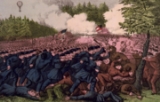
The Battle of Seven Pines, also known as the Battle of Fair Oaks or Fair Oaks Station, took place on May 31 and June 1, 1862, in Henrico County, Virginia
, as part of the Peninsula Campaign
of the American Civil War
. It was the culmination of an offensive up the Virginia Peninsula
by Union
Maj. Gen.
George B. McClellan
, in which the Army of the Potomac
reached the outskirts of Richmond
.
On May 31, Confederate
Gen. Joseph E. Johnston
attempted to overwhelm two Federal corps that appeared isolated south of the Chickahominy River
. The Confederate assaults, although not well coordinated, succeeded in driving back the IV Corps and inflicting heavy casualties. Reinforcements arrived, and both sides fed more and more troops into the action. Supported by the III Corps and Maj. Gen. John Sedgwick
's division of Maj. Gen. Edwin V. Sumner's II Corps (which crossed the rain-swollen river on Grapevine Bridge), the Federal position was finally stabilized. Gen. Johnston was seriously wounded during the action, and command of the Confederate army devolved temporarily to Maj. Gen. G.W. Smith
. On June 1, the Confederates renewed their assaults against the Federals, who had brought up more reinforcements, but made little headway. Both sides claimed victory.
Although the battle was tactically inconclusive, it was the largest battle in the Eastern Theater
up to that time (and second only to Shiloh
in terms of casualties thus far, about 11,000 total) and marked the end of the Union offensive, leading to the Seven Days Battles
and Union retreat in late June.
at Drewry's Bluff, site of the recent Confederate naval victory
, and extended counterclockwise so that his center and left were behind the Chickahominy River, a natural barrier in the spring when it turned the broad plains to the east of Richmond into swamps. Johnston's men burned most of the bridges over the Chickahominy and settled into strong defensive positions north and east of the city. McClellan positioned his 105,000-man army to focus on the northeast sector, for two reasons. First, the Pamunkey River
, which ran roughly parallel to the Chickahominy, offered a line of communication that could enable McClellan to get around Johnston's left flank. Second, McClellan anticipated the arrival of the I Corps under Maj. Gen. Irwin McDowell, scheduled to march south from Fredericksburg to reinforce his army, and thus needed to protect their avenue of approach.
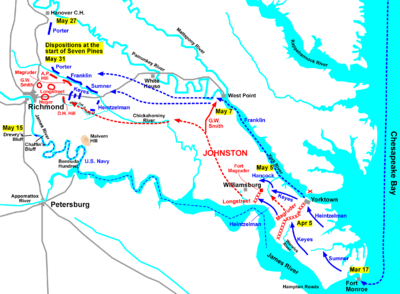 The Army of the Potomac pushed slowly up the Pamunkey, establishing supply bases at Eltham's Landing, Cumberland Landing, and White House Landing. White House, the plantation of W.H.F. "Rooney" Lee
, son of General Robert E. Lee
, became McClellan's base of operations. Using the Richmond and York River Railroad
, McClellan could bring his heavy siege artillery to the outskirts of Richmond. He moved slowly and deliberately, reacting to faulty intelligence that led him to believe the Confederates outnumbered him significantly. By the end of May, the army had built bridges across the Chickahominy and was facing Richmond, straddling the river, with one third of the Army south of the river, two thirds north.
 The Union army of 105,000 men was near the outskirts of Richmond to the northeast, straddling the Chickahominy River. There were three Corps north of the river, protecting the Union railroad supply line: the V Corps under Brig. Gen.
Fitz John Porter
; the VI Corps, under Brig. Gen. William B. Franklin
; and the II Corps, under Brig. Gen. Edwin V. Sumner. South of the river were the IV Corps, under Brig. Gen. Erasmus D. Keyes
, in a position far forward and close to the Confederate lines; and the III Corps, under Brig. Gen. Samuel P. Heintzelman
. At the start of the battle on May 31, McClellan was confined to bed, ill with a flare-up of his chronic malaria
.
Johnston had 60,000 men in his Army of Northern Virginia
protecting the works of Richmond. His command consisted of the Right Wing, under Maj. Gen. James Longstreet
(the divisions of Brig. Gen. Richard H. Anderson
, commanding Longstreet's division, Maj. Gen. D.H. Hill, and Brig. Gen. Benjamin Huger), the Left Wing, under Maj. Gen. G.W. Smith
(the divisions of Brig. Gen. William H. C. Whiting
, commanding Smith's division, and Maj. Gen. A.P. Hill), and the Reserve, under Maj. Gen. John B. Magruder
(the divisions of Brig. Gens. Lafayette McLaws
and David R. Jones).
, could arrive. However, on May 27, the same day the Battle of Hanover Court House was fought northeast of Richmond, Johnston learned that McDowell's corps had been diverted to the Shenandoah Valley
and would not be reinforcing the Army of the Potomac. He decided against attacking across his own natural defense line, the Chickahominy, and planned to capitalize on the Union army's straddle of the river by attacking the two corps south of the river, leaving them isolated from the other three corps north of the river.
If executed correctly, Johnston would engage two thirds of his army (22 of its 29 infantry brigades, about 51,000 men) against the 33,000 men in the III and IV Corps. The Confederate attack plan was complex, calling for the divisions of A.P. Hill and Magruder to engage lightly and distract the Union forces north of the river, while Longstreet, commanding the main attack south of the river, was to converge on Keyes from three directions: six brigades under Longstreet's immediate command and four brigades under D.H. Hill were to advance on separate roads at a crossroads known as Seven Pines (because of seven large pine trees clustered at that location); three brigades under Huger were assigned to support Hill's right; Whiting's division was to follow Longstreet's column as a reserve. The plan had an excellent potential for initial success because the division of the IV Corps farthest forward, manning the earthworks a mile west of Seven Pines, was that of Brig. Gen. Silas Casey
, 6,000 men who were the least experienced in Keyes's corps. If Keyes could be defeated, the III Corps, to the east, could the be pinned against the Chickahominy and overwhelmed.
The complex plan was mismanaged from the start. Johnston chose to issue his orders to Longstreet orally in a long and rambling meeting on May 30. The other generals received written orders that were vague and contradictory. He also failed to notify all of the division commanders that Longstreet was in tactical command south of the river. (This missing detail was a serious oversight because both Huger and Smith technically outranked Longstreet.) On Longstreet's part, he either misunderstood his orders or chose to modify them without informing Johnston. Rather than taking his assigned avenue of advance on the Nine Mile Road, his column joined Hill's on the Williamsburg Road, which not only delayed the advance, but limited the attack to a narrow front with only a fraction of its total force. Exacerbating the problems on both sides was a severe thunderstorm on the night of May 30, which flooded the river, destroyed most of the Union bridges, and turned the roads into morasses of mud.
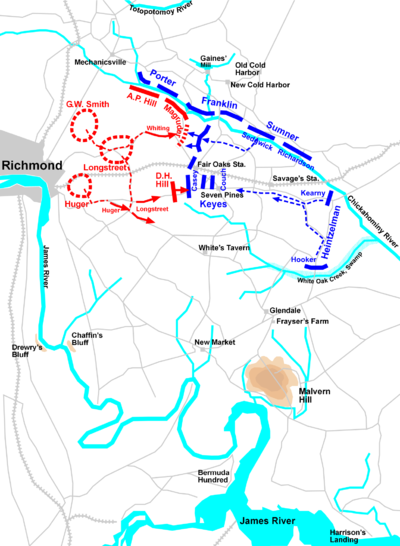 The attack got off to a bad start on May 31 when Longstreet marched down the Charles City Road and turned onto the Williamsburg Road instead of the Nine Mile Road. Huger's orders had not specified a time that the attack was scheduled to start and he was not awakened until he heard a division marching nearby. Johnston and his second-in-command, Smith, unaware of Longstreet's location or Huger's delay, waited at their headquarters for word of the start of the battle. Five hours after the scheduled start, at 1 p.m., D.H. Hill became impatient and sent his brigades forward against Casey's division.
Casey's line, manned by inexperienced troops, buckled with some men retreating, but fought fiercely for possession of their earthworks, resulting in heavy casualties on both sides. The Confederates only engaged four brigades of the thirteen on their right flank that day, so they did not hit with the power that they could have concentrated on this weak point in the Union line. Casey sent for reinforcements but Keyes was slow in responding. Eventually the mass of Confederates broke through, seized a Union redoubt, and Casey's men retreated to the second line of defensive works at Seven Pines. During this period, both of the high commanders were unaware of the severity of the battle. As late as 2:30 p.m., Heintzelman reported to McClellan, still sick in bed, that he had received no word from Keyes. Johnston was only 2½ miles from the front, but an acoustic shadow
prevented him from hearing the sounds of cannons and musketry and he and his staff did not know the battle had begun until 4 p.m.
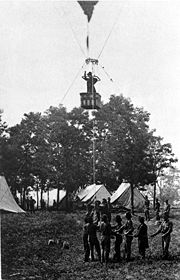
The Army of the Potomac was accompanied by the Union Army Balloon Corps
commanded by Prof. Thaddeus S. C. Lowe
, who had established two balloon camps on the north side of the river, one at Gaines's Farm and one at Mechanicsville. Lowe reported on May 29 the buildup of Confederate forces to the left of New Bridge or in front of the Fair Oaks train station. With constant rain on May 30 and heavy winds the morning of May 31, the aerostat
s Washington and Intrepid did not launch until noon. Lowe observed Confederate troops moving in battle formation and this information was relayed verbally to McClellan's headquarters by 2 p.m. Lowe continued to send reports from the Intrepid via telegraph the remainder of May 31. On June 1, Lowe reported that the Confederate barracks to the left of Richmond as being free from smoke. McClellan did not follow up on this information with a counterattack by his corps north of the Chickahominy River.
 Around 4:40 p.m., Hill, now strengthened by reinforcements from Longstreet, hit the secondary Union line near Seven Pines, which was manned by the remnants of Casey's division, the IV Corps division of Brig. Gen. Darius N. Couch
, and Brig. Gen. Philip Kearny
's division from Heintzelman's III Corps. Hill organized a flanking maneuver, sending four regiments under Colonel Micah Jenkins
from Longstreet's command to attack Keyes's right flank. The attack collapsed the Federal line back to the Williamsburg Road, a mile and a half beyond Seven Pines. The fighting in that part of the line died out by 7:30 p.m.
Just before Hill's attack began, Johnston received a note from Longstreet requesting that he join the battle, the first news he had heard of the fighting. Johnston went forward on the Nine Mile Road with three brigades of Whiting's division and encountered stiff resistance near Fair Oaks Station, the right flank of Keyes's line. Soon heavy Union reinforcements arrived. Brig. Gen. Edwin C. Sumner, II Corps commander, heard the sounds of battle from his position north of the river. On his own initiative, he dispatched a division under Brig. Gen. John Sedgwick
over the sole remaining bridge. The treacherous "Grapevine Bridge" was near collapse from the swollen river, but the weight of the crossing troops helped to hold it steady against the rushing water. When told that the river could not be crossed, Sumner replied "Impossible!? Sir, I tell you I can cross! I am ordered!" After the last man had crossed safely, the bridge collapsed and was swept away. Sedgwick's men provided the key to resisting Whiting's attack. The fighting was costly as Whiting lost three of four brigade commanders. Brig. Gen. Wade Hampton
went down wounded, Robert H. Hatton
was killed, and J. Johnston Pettigrew
was wounded and captured. On the Union side, Brig. Gen. Oliver O. Howard
had his right arm shattered by a Minié ball. The arm was amputated, and he would not return to action for several months.
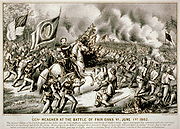 The most historically significant incident of the day occurred around dusk, when Johnston was struck in the right shoulder by a bullet, immediately followed by a shell fragment hitting him in the chest. He fell unconscious from his horse with a broken right shoulder blade and two broken ribs and was evacuated to Richmond. G.W. Smith assumed temporary command of the army. Smith, plagued with ill health, was indecisive about the next steps for the battle and made a bad impression on Confederate President
Jefferson Davis
and General Robert E. Lee
, Davis's military adviser. After the end of fighting the following day, Davis replaced Smith with Lee as commander of the Army of Northern Virginia.
On June 1, the Confederates renewed their assaults against the Federals, who had brought up more reinforcements and fought from strong positions, but made little headway. Brig. Gen. Israel B. Richardson
's division of the II Corps had arrived, along with Brig. Gen. Joseph Hooker
's division of the III Corps. They engaged Huger's and Longstreet's divisions, whose lines finally broke under the attacks. The fighting ended about 11:30 a.m. when the Confederates withdrew. McClellan arrived on the battlefield from his sick bed at about this time, but the Union Army did not counterattack.
Despite claiming victory, McClellan was shaken by the experience. He wrote to his wife, "I am tired of the sickening sight of the battlefield, with its mangled corpses & poor suffering wounded! Victory has no charms for me when purchased at such cost." He redeployed all of his army except for the V Corps south of the river, and although he continued to plan for a siege and the capture of Richmond, he lost the strategic initiative. An offensive begun by the new Confederate commander, Gen. Robert E. Lee, would be planned while the Union troops passively sat in the outskirts of Richmond. The Seven Days Battles
of June 25 through July 1, 1862, drove the Union Army back to the James River
and saved the Confederate capital.
The change in leadership of the Confederate Army in the field as a result of Seven Pines had a profound effect on the war. On June 24, 1862, McClellan's massive Army of the Potomac was within 6 miles (9.7 km) of the Confederate capital of Richmond; Union soldiers wrote that they could hear church bells ringing in the city. Within 90 days, however, Robert E. Lee had driven McClellan from the Peninsula, Pope
had been soundly beaten at the Second Battle of Bull Run
, and the battle lines were 20 miles (32.2 km) from the Union capital in Washington. It would take almost two more years before the Union Army again got that close to Richmond, and almost three years before it finally captured it.
Henrico County, Virginia
Henrico is a county located in the Commonwealth of Virginia, a state of the United States. As of 2010, Henrico was home to 306,935 people. It is located in the Richmond-Petersburg region and is a portion of the Richmond Metropolitan Statistical Area...
, as part of the Peninsula Campaign
Peninsula Campaign
The Peninsula Campaign of the American Civil War was a major Union operation launched in southeastern Virginia from March through July 1862, the first large-scale offensive in the Eastern Theater. The operation, commanded by Maj. Gen. George B...
of the American Civil War
American Civil War
The American Civil War was a civil war fought in the United States of America. In response to the election of Abraham Lincoln as President of the United States, 11 southern slave states declared their secession from the United States and formed the Confederate States of America ; the other 25...
. It was the culmination of an offensive up the Virginia Peninsula
Virginia Peninsula
The Virginia Peninsula is a peninsula in southeast Virginia, USA, bounded by the York River, James River, Hampton Roads and Chesapeake Bay.Hampton Roads is the common name for the metropolitan area that surrounds the body of water of the same name...
by Union
Union Army
The Union Army was the land force that fought for the Union during the American Civil War. It was also known as the Federal Army, the U.S. Army, the Northern Army and the National Army...
Maj. Gen.
Major general (United States)
In the United States Army, United States Marine Corps, and United States Air Force, major general is a two-star general-officer rank, with the pay grade of O-8. Major general ranks above brigadier general and below lieutenant general...
George B. McClellan
George B. McClellan
George Brinton McClellan was a major general during the American Civil War. He organized the famous Army of the Potomac and served briefly as the general-in-chief of the Union Army. Early in the war, McClellan played an important role in raising a well-trained and organized army for the Union...
, in which the Army of the Potomac
Army of the Potomac
The Army of the Potomac was the major Union Army in the Eastern Theater of the American Civil War.-History:The Army of the Potomac was created in 1861, but was then only the size of a corps . Its nucleus was called the Army of Northeastern Virginia, under Brig. Gen...
reached the outskirts of Richmond
Richmond, Virginia
Richmond is the capital of the Commonwealth of Virginia, in the United States. It is an independent city and not part of any county. Richmond is the center of the Richmond Metropolitan Statistical Area and the Greater Richmond area...
.
On May 31, Confederate
Confederate States Army
The Confederate States Army was the army of the Confederate States of America while the Confederacy existed during the American Civil War. On February 8, 1861, delegates from the seven Deep South states which had already declared their secession from the United States of America adopted the...
Gen. Joseph E. Johnston
Joseph E. Johnston
Joseph Eggleston Johnston was a career U.S. Army officer, serving with distinction in the Mexican-American War and Seminole Wars, and was also one of the most senior general officers in the Confederate States Army during the American Civil War...
attempted to overwhelm two Federal corps that appeared isolated south of the Chickahominy River
Chickahominy River
The Chickahominy is an river in the eastern portion of the U.S. state of Virginia. The river rises about northwest of Richmond and flows southeast and south to the James River...
. The Confederate assaults, although not well coordinated, succeeded in driving back the IV Corps and inflicting heavy casualties. Reinforcements arrived, and both sides fed more and more troops into the action. Supported by the III Corps and Maj. Gen. John Sedgwick
John Sedgwick
John Sedgwick was a teacher, a career military officer, and a Union Army general in the American Civil War. He was the highest ranking Union casualty in the Civil War, killed by a sniper at the Battle of Spotsylvania Court House.-Early life:Sedgwick was born in the Litchfield Hills town of...
's division of Maj. Gen. Edwin V. Sumner's II Corps (which crossed the rain-swollen river on Grapevine Bridge), the Federal position was finally stabilized. Gen. Johnston was seriously wounded during the action, and command of the Confederate army devolved temporarily to Maj. Gen. G.W. Smith
Gustavus Woodson Smith
Gustavus Woodson Smith , more commonly known as G.W. Smith, was a career United States Army officer who fought in the Mexican-American War, a civil engineer, and a major general in the Confederate States Army during the American Civil War.-Early life and Mexico:Smith was born in Georgetown,...
. On June 1, the Confederates renewed their assaults against the Federals, who had brought up more reinforcements, but made little headway. Both sides claimed victory.
Although the battle was tactically inconclusive, it was the largest battle in the Eastern Theater
Eastern Theater of the American Civil War
The Eastern Theater of the American Civil War included the states of Virginia, West Virginia, Maryland, and Pennsylvania, the District of Columbia, and the coastal fortifications and seaports of North Carolina...
up to that time (and second only to Shiloh
Battle of Shiloh
The Battle of Shiloh, also known as the Battle of Pittsburg Landing, was a major battle in the Western Theater of the American Civil War, fought April 6–7, 1862, in southwestern Tennessee. A Union army under Maj. Gen. Ulysses S. Grant had moved via the Tennessee River deep into Tennessee and...
in terms of casualties thus far, about 11,000 total) and marked the end of the Union offensive, leading to the Seven Days Battles
Seven Days Battles
The Seven Days Battles was a series of six major battles over the seven days from June 25 to July 1, 1862, near Richmond, Virginia during the American Civil War. Confederate General Robert E. Lee drove the invading Union Army of the Potomac, commanded by Maj. Gen. George B. McClellan, away from...
and Union retreat in late June.
Background
Johnston withdrew his 60,000-man army from the Virginia Peninsula as McClellan's army pursued him and approached the Confederate capital of Richmond. Johnston's defensive line began at the James RiverJames River (Virginia)
The James River is a river in the U.S. state of Virginia. It is long, extending to if one includes the Jackson River, the longer of its two source tributaries. The James River drains a catchment comprising . The watershed includes about 4% open water and an area with a population of 2.5 million...
at Drewry's Bluff, site of the recent Confederate naval victory
Battle of Drewry's Bluff
The Battle of Drewry’s Bluff, also known as the Battle of Fort Darling, or Fort Drewry, took place on May 15, 1862, in Chesterfield County, Virginia, as part of the Peninsula Campaign of the American Civil War. Five American warships, including the ironclads and , steamed up the James River to...
, and extended counterclockwise so that his center and left were behind the Chickahominy River, a natural barrier in the spring when it turned the broad plains to the east of Richmond into swamps. Johnston's men burned most of the bridges over the Chickahominy and settled into strong defensive positions north and east of the city. McClellan positioned his 105,000-man army to focus on the northeast sector, for two reasons. First, the Pamunkey River
Pamunkey River
The Pamunkey River is a tributary of the York River, about long, in eastern Virginia in the United States. Via the York River it is part of the watershed of Chesapeake Bay.-Course:...
, which ran roughly parallel to the Chickahominy, offered a line of communication that could enable McClellan to get around Johnston's left flank. Second, McClellan anticipated the arrival of the I Corps under Maj. Gen. Irwin McDowell, scheduled to march south from Fredericksburg to reinforce his army, and thus needed to protect their avenue of approach.
William Henry Fitzhugh Lee
William Henry Fitzhugh Lee , known as Rooney Lee or W.H.F. Lee, was the second son of Robert E. Lee and Mary Anna Randolph Custis. He was a planter, a Confederate cavalry General in the American Civil War, and later a member of the U.S. Congress.-Early life:Lee was born at Arlington House in...
, son of General Robert E. Lee
Robert E. Lee
Robert Edward Lee was a career military officer who is best known for having commanded the Confederate Army of Northern Virginia in the American Civil War....
, became McClellan's base of operations. Using the Richmond and York River Railroad
Richmond and York River Railroad
Richmond and York River Railroad was completed between Richmond, Virginia and West Point, Virginia in 1861. The western terminus was adjacent to Richmond's Tobacco Row...
, McClellan could bring his heavy siege artillery to the outskirts of Richmond. He moved slowly and deliberately, reacting to faulty intelligence that led him to believe the Confederates outnumbered him significantly. By the end of May, the army had built bridges across the Chickahominy and was facing Richmond, straddling the river, with one third of the Army south of the river, two thirds north.
Opposing forces
Brigadier general (United States)
A brigadier general in the United States Army, Air Force, and Marine Corps, is a one-star general officer, with the pay grade of O-7. Brigadier general ranks above a colonel and below major general. Brigadier general is equivalent to the rank of rear admiral in the other uniformed...
Fitz John Porter
Fitz John Porter
Fitz John Porter was a career United States Army officer and a Union General during the American Civil War...
; the VI Corps, under Brig. Gen. William B. Franklin
William B. Franklin
William Buel Franklin was a career United States Army officer and a Union Army general in the American Civil War. He rose to the rank of a corps commander in the Army of the Potomac, fighting in several notable early battles in the Eastern Theater.-Early life:William B. Franklin was born in York,...
; and the II Corps, under Brig. Gen. Edwin V. Sumner. South of the river were the IV Corps, under Brig. Gen. Erasmus D. Keyes
Erasmus D. Keyes
Erasmus Darwin Keyes was a businessman, banker, and military general, noted for leading the IV Corps of the Union Army of the Potomac during the first half of the American Civil War.-Early life and career:...
, in a position far forward and close to the Confederate lines; and the III Corps, under Brig. Gen. Samuel P. Heintzelman
Samuel P. Heintzelman
Samuel Peter Heintzelman was a United States Army General. He served in the Seminole War, the Mexican-American War, the Yuma War, the Cortina Troubles, and the American Civil War, rising to the command of a corps....
. At the start of the battle on May 31, McClellan was confined to bed, ill with a flare-up of his chronic malaria
Malaria
Malaria is a mosquito-borne infectious disease of humans and other animals caused by eukaryotic protists of the genus Plasmodium. The disease results from the multiplication of Plasmodium parasites within red blood cells, causing symptoms that typically include fever and headache, in severe cases...
.
Johnston had 60,000 men in his Army of Northern Virginia
Army of Northern Virginia
The Army of Northern Virginia was the primary military force of the Confederate States of America in the Eastern Theater of the American Civil War, as well as the primary command structure of the Department of Northern Virginia. It was most often arrayed against the Union Army of the Potomac...
protecting the works of Richmond. His command consisted of the Right Wing, under Maj. Gen. James Longstreet
James Longstreet
James Longstreet was one of the foremost Confederate generals of the American Civil War and the principal subordinate to General Robert E. Lee, who called him his "Old War Horse." He served under Lee as a corps commander for many of the famous battles fought by the Army of Northern Virginia in the...
(the divisions of Brig. Gen. Richard H. Anderson
Richard H. Anderson
Richard Heron Anderson was a career U.S. Army officer, fighting with distinction in the Mexican-American War. He also served as a Confederate general during the American Civil War, fighting in the Eastern Theater of the conflict and most notably during the 1864 Battle of Spotsylvania Court House...
, commanding Longstreet's division, Maj. Gen. D.H. Hill, and Brig. Gen. Benjamin Huger), the Left Wing, under Maj. Gen. G.W. Smith
Gustavus Woodson Smith
Gustavus Woodson Smith , more commonly known as G.W. Smith, was a career United States Army officer who fought in the Mexican-American War, a civil engineer, and a major general in the Confederate States Army during the American Civil War.-Early life and Mexico:Smith was born in Georgetown,...
(the divisions of Brig. Gen. William H. C. Whiting
William H. C. Whiting
William Henry Chase Whiting was an United States Army officer who resigned after 16 years of service in the Army Corps of Engineers to serve in the Confederate States Army during the American Civil War...
, commanding Smith's division, and Maj. Gen. A.P. Hill), and the Reserve, under Maj. Gen. John B. Magruder
John B. Magruder
John Bankhead Magruder was a career military officer who served in the armies of three nations. He was a U.S. Army officer in the Mexican-American War, a Confederate general during the American Civil War, and a postbellum general in the Imperial Mexican Army...
(the divisions of Brig. Gens. Lafayette McLaws
Lafayette McLaws
Lafayette McLaws was a United States Army officer and a Confederate general in the American Civil War.-Early life:...
and David R. Jones).
Johnston's plan
Johnston, who had retreated up the Peninsula to the outskirts of Richmond, knew that he could not survive a massive siege and decided to attack McClellan. His original plan was to attack the Union right flank, north of the Chickahominy River, before McDowell's corps, marching south from FredericksburgFredericksburg, Virginia
Fredericksburg is an independent city in the Commonwealth of Virginia located south of Washington, D.C., and north of Richmond. As of the 2010 census, the city had a population of 24,286...
, could arrive. However, on May 27, the same day the Battle of Hanover Court House was fought northeast of Richmond, Johnston learned that McDowell's corps had been diverted to the Shenandoah Valley
Shenandoah Valley
The Shenandoah Valley is both a geographic valley and cultural region of western Virginia and West Virginia in the United States. The valley is bounded to the east by the Blue Ridge Mountains, to the west by the eastern front of the Ridge-and-Valley Appalachians , to the north by the Potomac River...
and would not be reinforcing the Army of the Potomac. He decided against attacking across his own natural defense line, the Chickahominy, and planned to capitalize on the Union army's straddle of the river by attacking the two corps south of the river, leaving them isolated from the other three corps north of the river.
If executed correctly, Johnston would engage two thirds of his army (22 of its 29 infantry brigades, about 51,000 men) against the 33,000 men in the III and IV Corps. The Confederate attack plan was complex, calling for the divisions of A.P. Hill and Magruder to engage lightly and distract the Union forces north of the river, while Longstreet, commanding the main attack south of the river, was to converge on Keyes from three directions: six brigades under Longstreet's immediate command and four brigades under D.H. Hill were to advance on separate roads at a crossroads known as Seven Pines (because of seven large pine trees clustered at that location); three brigades under Huger were assigned to support Hill's right; Whiting's division was to follow Longstreet's column as a reserve. The plan had an excellent potential for initial success because the division of the IV Corps farthest forward, manning the earthworks a mile west of Seven Pines, was that of Brig. Gen. Silas Casey
Silas Casey
Silas Casey was a career United States Army officer who rose to the rank of Major General during the American Civil War.-Early life and military career:...
, 6,000 men who were the least experienced in Keyes's corps. If Keyes could be defeated, the III Corps, to the east, could the be pinned against the Chickahominy and overwhelmed.
The complex plan was mismanaged from the start. Johnston chose to issue his orders to Longstreet orally in a long and rambling meeting on May 30. The other generals received written orders that were vague and contradictory. He also failed to notify all of the division commanders that Longstreet was in tactical command south of the river. (This missing detail was a serious oversight because both Huger and Smith technically outranked Longstreet.) On Longstreet's part, he either misunderstood his orders or chose to modify them without informing Johnston. Rather than taking his assigned avenue of advance on the Nine Mile Road, his column joined Hill's on the Williamsburg Road, which not only delayed the advance, but limited the attack to a narrow front with only a fraction of its total force. Exacerbating the problems on both sides was a severe thunderstorm on the night of May 30, which flooded the river, destroyed most of the Union bridges, and turned the roads into morasses of mud.
Battle
Casey's line, manned by inexperienced troops, buckled with some men retreating, but fought fiercely for possession of their earthworks, resulting in heavy casualties on both sides. The Confederates only engaged four brigades of the thirteen on their right flank that day, so they did not hit with the power that they could have concentrated on this weak point in the Union line. Casey sent for reinforcements but Keyes was slow in responding. Eventually the mass of Confederates broke through, seized a Union redoubt, and Casey's men retreated to the second line of defensive works at Seven Pines. During this period, both of the high commanders were unaware of the severity of the battle. As late as 2:30 p.m., Heintzelman reported to McClellan, still sick in bed, that he had received no word from Keyes. Johnston was only 2½ miles from the front, but an acoustic shadow
Acoustic Shadow
An acoustic shadow is an area through which sound waves fail to propagate, due to topographical obstructions or disruption of the waves via phenomena such as wind currents. A gobo refers to a movable acoustic isolation panel and that makes an acoustic shadow. As one website refers to it, "an...
prevented him from hearing the sounds of cannons and musketry and he and his staff did not know the battle had begun until 4 p.m.
The Army of the Potomac was accompanied by the Union Army Balloon Corps
Union Army Balloon Corps
The Union Army Balloon Corps was a branch of the Union Army during the American Civil War, established by presidential appointee Thaddeus S. C. Lowe...
commanded by Prof. Thaddeus S. C. Lowe
Thaddeus S. C. Lowe
Thaddeus Sobieski Coulincourt Lowe , also known as Professor T. S. C. Lowe, was an American Civil War aeronaut, scientist and inventor, mostly self-educated in the fields of chemistry, meteorology, and aeronautics, and the father of military aerial reconnaissance in the United States...
, who had established two balloon camps on the north side of the river, one at Gaines's Farm and one at Mechanicsville. Lowe reported on May 29 the buildup of Confederate forces to the left of New Bridge or in front of the Fair Oaks train station. With constant rain on May 30 and heavy winds the morning of May 31, the aerostat
Aerostat
An aerostat is a craft that remains aloft primarily through the use of buoyant lighter than air gases, which impart lift to a vehicle with nearly the same overall density as air. Aerostats include free balloons, airships, and moored balloons...
s Washington and Intrepid did not launch until noon. Lowe observed Confederate troops moving in battle formation and this information was relayed verbally to McClellan's headquarters by 2 p.m. Lowe continued to send reports from the Intrepid via telegraph the remainder of May 31. On June 1, Lowe reported that the Confederate barracks to the left of Richmond as being free from smoke. McClellan did not follow up on this information with a counterattack by his corps north of the Chickahominy River.
Darius N. Couch
Darius Nash Couch was an American soldier, businessman, and naturalist. He served as a career U.S. Army officer during the Mexican-American War, the Second Seminole War, and as a general officer in the Union Army during the American Civil War.During the Civil War, Couch fought notably in the...
, and Brig. Gen. Philip Kearny
Philip Kearny
Philip Kearny, Jr., was a United States Army officer, notable for his leadership in the Mexican-American War and American Civil War. He was killed in action in the 1862 Battle of Chantilly.-Early life and career:...
's division from Heintzelman's III Corps. Hill organized a flanking maneuver, sending four regiments under Colonel Micah Jenkins
Micah Jenkins
Micah Jenkins , was a Confederate general in the American Civil War, mortally wounded by friendly fire at the Battle of the Wilderness.-Early life:...
from Longstreet's command to attack Keyes's right flank. The attack collapsed the Federal line back to the Williamsburg Road, a mile and a half beyond Seven Pines. The fighting in that part of the line died out by 7:30 p.m.
Just before Hill's attack began, Johnston received a note from Longstreet requesting that he join the battle, the first news he had heard of the fighting. Johnston went forward on the Nine Mile Road with three brigades of Whiting's division and encountered stiff resistance near Fair Oaks Station, the right flank of Keyes's line. Soon heavy Union reinforcements arrived. Brig. Gen. Edwin C. Sumner, II Corps commander, heard the sounds of battle from his position north of the river. On his own initiative, he dispatched a division under Brig. Gen. John Sedgwick
John Sedgwick
John Sedgwick was a teacher, a career military officer, and a Union Army general in the American Civil War. He was the highest ranking Union casualty in the Civil War, killed by a sniper at the Battle of Spotsylvania Court House.-Early life:Sedgwick was born in the Litchfield Hills town of...
over the sole remaining bridge. The treacherous "Grapevine Bridge" was near collapse from the swollen river, but the weight of the crossing troops helped to hold it steady against the rushing water. When told that the river could not be crossed, Sumner replied "Impossible!? Sir, I tell you I can cross! I am ordered!" After the last man had crossed safely, the bridge collapsed and was swept away. Sedgwick's men provided the key to resisting Whiting's attack. The fighting was costly as Whiting lost three of four brigade commanders. Brig. Gen. Wade Hampton
Wade Hampton
Wade Hampton may refer to:*Wade Hampton I , American soldier in Revolutionary War and War of 1812*Wade Hampton II , American plantation owner and soldier in War of 1812...
went down wounded, Robert H. Hatton
Robert H. Hatton
Robert Hopkins Hatton was a lawyer, politician, United States Congressman, and Confederate officer during the American Civil War.-Biography:...
was killed, and J. Johnston Pettigrew
J. Johnston Pettigrew
James Johnston Pettigrew was an author, lawyer, linguist, diplomat, and a Confederate general in the American Civil War...
was wounded and captured. On the Union side, Brig. Gen. Oliver O. Howard
Oliver O. Howard
Oliver Otis Howard was a career United States Army officer and a Union general in the American Civil War...
had his right arm shattered by a Minié ball. The arm was amputated, and he would not return to action for several months.
President of the Confederate States of America
The President of the Confederate States of America was the Head of State and Head of Government of the Confederate States of America, which was formed from the states which declared their secession from the United States, thus precipitating the American Civil War. The only person to hold the...
Jefferson Davis
Jefferson Davis
Jefferson Finis Davis , also known as Jeff Davis, was an American statesman and leader of the Confederacy during the American Civil War, serving as President for its entire history. He was born in Kentucky to Samuel and Jane Davis...
and General Robert E. Lee
Robert E. Lee
Robert Edward Lee was a career military officer who is best known for having commanded the Confederate Army of Northern Virginia in the American Civil War....
, Davis's military adviser. After the end of fighting the following day, Davis replaced Smith with Lee as commander of the Army of Northern Virginia.
On June 1, the Confederates renewed their assaults against the Federals, who had brought up more reinforcements and fought from strong positions, but made little headway. Brig. Gen. Israel B. Richardson
Israel B. Richardson
Israel Bush Richardson was a United States Army officer during the Mexican-American War and American Civil War, where he was a major general in the Union Army...
's division of the II Corps had arrived, along with Brig. Gen. Joseph Hooker
Joseph Hooker
Joseph Hooker was a career United States Army officer, achieving the rank of major general in the Union Army during the American Civil War. Although he served throughout the war, usually with distinction, Hooker is best remembered for his stunning defeat by Confederate General Robert E...
's division of the III Corps. They engaged Huger's and Longstreet's divisions, whose lines finally broke under the attacks. The fighting ended about 11:30 a.m. when the Confederates withdrew. McClellan arrived on the battlefield from his sick bed at about this time, but the Union Army did not counterattack.
Aftermath
Both sides claimed victory with roughly equal casualties, but neither side's accomplishment was impressive. George B. McClellan's advance on Richmond was halted and the Army of Northern Virginia fell back into the Richmond defensive works. Union casualties were 5,031 (790 killed, 3,594 wounded, 647 captured or missing) and Confederate 6,134 (980 killed, 4,749 wounded, 405 captured or missing). The battle was frequently remembered by the Union soldiers as the Battle of Fair Oaks Station because that is where they did their best fighting, whereas the Confederates, for the same reason, called it Seven Pines. Historian Stephen W. Sears remarked that its current common name, Seven Pines, is the most appropriate because it was at the crossroads of Seven Pines that the heaviest fighting and highest casualties occurred.Despite claiming victory, McClellan was shaken by the experience. He wrote to his wife, "I am tired of the sickening sight of the battlefield, with its mangled corpses & poor suffering wounded! Victory has no charms for me when purchased at such cost." He redeployed all of his army except for the V Corps south of the river, and although he continued to plan for a siege and the capture of Richmond, he lost the strategic initiative. An offensive begun by the new Confederate commander, Gen. Robert E. Lee, would be planned while the Union troops passively sat in the outskirts of Richmond. The Seven Days Battles
Seven Days Battles
The Seven Days Battles was a series of six major battles over the seven days from June 25 to July 1, 1862, near Richmond, Virginia during the American Civil War. Confederate General Robert E. Lee drove the invading Union Army of the Potomac, commanded by Maj. Gen. George B. McClellan, away from...
of June 25 through July 1, 1862, drove the Union Army back to the James River
James River (Virginia)
The James River is a river in the U.S. state of Virginia. It is long, extending to if one includes the Jackson River, the longer of its two source tributaries. The James River drains a catchment comprising . The watershed includes about 4% open water and an area with a population of 2.5 million...
and saved the Confederate capital.
The change in leadership of the Confederate Army in the field as a result of Seven Pines had a profound effect on the war. On June 24, 1862, McClellan's massive Army of the Potomac was within 6 miles (9.7 km) of the Confederate capital of Richmond; Union soldiers wrote that they could hear church bells ringing in the city. Within 90 days, however, Robert E. Lee had driven McClellan from the Peninsula, Pope
John Pope (military officer)
John Pope was a career United States Army officer and Union general in the American Civil War. He had a brief but successful career in the Western Theater, but he is best known for his defeat at the Second Battle of Bull Run in the East.Pope was a graduate of the United States Military Academy in...
had been soundly beaten at the Second Battle of Bull Run
Second Battle of Bull Run
The Second Battle of Bull Run or Second Manassas was fought August 28–30, 1862, as part of the American Civil War. It was the culmination of an offensive campaign waged by Confederate Gen. Robert E. Lee's Army of Northern Virginia against Union Maj. Gen...
, and the battle lines were 20 miles (32.2 km) from the Union capital in Washington. It would take almost two more years before the Union Army again got that close to Richmond, and almost three years before it finally captured it.
Further reading
- Burton, Brian K. The Peninsula & Seven Days: A Battlefield Guide. Lincoln: University of Nebraska Press, 2007. ISBN 978-0-8032-6246-1.