
All Topics  
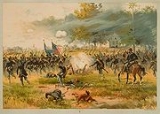
Battle of Antietam


   Email Print
   Bookmark   Link


Battle of Antietam


The Battle of Harpers Ferry was fought from September 12 to September 15, 1862, as part of the Maryland Campaign of the A...
 and McClellan's assault through the Blue Ridge MountainsBlue Ridge Mountains

The Blue Ridge is a mountain chain in the eastern United States, part of the Appalachian Mountains, forming their eastern fr...
 in the Battle of South MountainBattle of South Mountain

's [[Army of Northern Virginia]...
. The former was significant because a large portion of Lee's army was absent from the start of the battle of Antietam, attending to the surrender of the Union garrison; the latter because stout Confederate defenses at two passes through the mountains delayed McClellan's advance enough for Lee to concentrate the remainder of his army at Sharpsburg.
Opposing forcesConfederateGeneral Lee's Army of Northern Virginia was organized into two large infantry corps.

The First Corps, under Maj.


Discussion
Ask a question about 'Battle of Antietam'
Start a new discussion about 'Battle of Antietam'
Answer questions from other users
Full Discussion Forum


Timeline

1862   American Civil War: Battle of Antietam - Union forces defeat Confederate troops at Sharpsburg, Maryland, in the bloodiest day in U.S. history (with over 22,000 casualties).

1862   American Civil War: In the aftermath of the Battle of Antietam, Confederate General J.E.B. Stuart and his men loot Chambersburg, Pennsylvania, during a raid into the north.


Encyclopedia


The Battle of Harpers Ferry was fought from September 12 to September 15, 1862, as part of the Maryland Campaign of the A...
 and McClellan's assault through the Blue Ridge MountainsBlue Ridge Mountains

The Blue Ridge is a mountain chain in the eastern United States, part of the Appalachian Mountains, forming their eastern fr...
 in the Battle of South MountainBattle of South Mountain

's [[Army of Northern Virginia]...
. The former was significant because a large portion of Lee's army was absent from the start of the battle of Antietam, attending to the surrender of the Union garrison; the latter because stout Confederate defenses at two passes through the mountains delayed McClellan's advance enough for Lee to concentrate the remainder of his army at Sharpsburg.

Opposing forces

Confederate

General Lee's Army of Northern Virginia was organized into two large infantry corps.

The First Corps, under Maj. Gen. James LongstreetJames Longstreet

James Longstreet was one of the foremost Confederate generals of the American Civil War, and later enjoyed a successful pos...
, consisted of the divisionsDivision (military)

A division is a large military unit or formation usually consisting of around ten to fifteen thousand soldiers....
 of:
  • Maj. Gen. Lafayette McLawsLafayette McLaws

    Lafayette McLaws was a U.S. Army officer and a Confederate general in the American Civil War. ...
     (brigades of Brig. Gens. Joseph B. KershawJoseph B. Kershaw

    Joseph Brevard Kershaw was a lawyer, judge, and a Confederate general in the American Civil War....
    , Howell CobbHowell Cobb

    Howell Cobb was an American political figure....
    , Paul J. Semmes, and William BarksdaleWilliam Barksdale

    William Barksdale was a lawyer, newspaper editor, U.S....
    ).
  • Maj. Gen. Richard H. AndersonFacts About Richard H. Anderson

    Richard Heron Anderson was a career U.S....
     (brigades of Cols. Alfred Cumming, W.A. Parham, and Carnot PoseyCarnot Posey

    Carnot Posey was lawyer and a Confederate general in the American Civil War....
    , and Brig. Gens. Lewis A. Armistead, Roger A. Pryor,Roger Atkinson Pryor

    Roger Atkinson Pryor was an American jurist, politician, newspaper editor, and Confederate general during the American Civil...
     and Ambrose R. WrightAmbrose R. Wright

    Ambrose Ransom Wright was a lawyer, Georgia politician, and a Confederate general in the American Civil War....
    ).
  • Brig. Gen. David R. JonesFacts About David R. Jones

    David Rumph Jones was a Confederate general in the American Civil War....
     (brigades of Brig. Gens. Robert A. ToombsRobert Toombs

    Robert Augustus Toombs was an American political leader and a Confederate general in the Civil War....
    , Thomas F. Drayton, Richard B. GarnettRichard B. Garnett

    Richard Brooke Garnett was a career U.S....
    , James L. KemperJames L. Kemper

    James Lawson Kemper was a lawyer, a Confederate general in the American Civil War, and a governor of Virginia....
    , and Cols. Joseph T. Walker and George T. AndersonGeorge T. Anderson

    George Thomas Anderson was a general in the Confederate States Army during the American Civil War....
    ).
  • Brig. Gen. John G. Walker (brigades of Colonel Van H. ManningVan H. Manning

    Vannoy Hartrog Manning was a U.S....
     and Brig. Gen. Robert Ransom, Jr.Robert Ransom, Jr.

    Robert Ransom, Jr. was a major general in the Confederate States Army during the American Civil War....
    ).
  • Brig. Gen. John Bell HoodJohn Bell Hood

    John Bell Hood was a Confederate general during the American Civil War....
     (brigades of Cols. William T. WoffordWilliam T. Wofford

    William Tatum Wofford was a general in the Confederate States Army during the American Civil War....
     and Evander M. LawEvander M. Law Overview

    Evander McIvor Law was an author, teacher, and a Confederate general in the American Civil War. ...
    ).
  • Independent brigade under Brig. Gen. Nathan G. "Shanks" EvansNathan George Evans

    Nathan George "Shanks" Evans was a captain in the 2nd U.S....
    .


The Second Corps, under Maj. Gen. Thomas J. "Stonewall" JacksonStonewall Jackson

Thomas Jonathan "Stonewall" Jackson was a Confederate general during the American Civil War....
, consisted of the divisions of:
  • Brig. Gen. Alexander R. Lawton (brigades of Col. Marcellus Douglass, Brig. Gen. Jubal A. Early, Col. James A. WalkerJames A. Walker

    James Alexander Walker was a Virginia lawyer, politician, and Confederate general during the American Civil War, later servi...
    , and Brig. Gen. Harry T. HaysHarry T. Hays

    Harry Thompson Hays was an American Civil War brigadier general who served in the Army of Northern Virginia....
    ).
  • Maj. Gen. A.P. Hill (the Light Division — brigades of Brig. Gens. Lawrence O'Bryan BranchLawrence O'Bryan Branch

    Lawrence O'Bryan Branch was a North Carolina representative in the U.S....
    , Maxcy GreggMaxcy Gregg

    Maxcy Gregg was a lawyer, and Confederate Brigadier General during the American Civil War....
    , James J. ArcherJames J. Archer Summary

    James Jay Archer was a lawyer and an officer in the United States Army during the Mexican War and in the Confederate States ...
    , and William Dorsey PenderWilliam Dorsey Pender

    William Dorsey Pender was one of the youngest, and most promising, generals fighting for the Confederacy in the American Civ...
    , and Cols. John M. BrockenbroughJohn M. Brockenbrough

    John Mercer Brockenbrough was a farmer and a Confederate colonel in the American Civil War....
     and Edward L. ThomasEdward L. Thomas

    Edward Lloyd Thomas was a Confederate Army brigadier general in the American Civil War....
    ).
  • Brig. Gen. John R. JonesJohn R. Jones

    John Robert Jones was Virginia businessman and soldier who was a controversial brigadier general in the Confederate States ...
     (brigades of Cols. A.J. Grigsby, E.T.H. Warren, Bradley T. Johnson, and Brig. Gen. William E. Starke).
  • Maj. Gen. D.H. Hill (brigades of Brig. Gens. Roswell S. RipleyRoswell S. Ripley

    Roswell Sabine Ripley was an officer in the United States Army during the Mexican-American War and, despite being Northern-...
    , Robert E. RodesRobert E. Rodes

    Robert Emmett Rodes was a railroad civil engineer and a promising young Confederate general in the American Civil War, kille...
    , Samuel Garland, Jr.Samuel Garland, Jr.

    Samuel Garland, Jr., was an attorney and Confederate general during the American Civil War....
    , George B. AndersonGeorge B. Anderson Summary

    George Burgwyn Anderson was a career military officer, serving first in the antebellum U.S....
    , and Col. Alfred H. ColquittAlfred H. Colquitt

    Alfred Holt Colquitt was a lawyer, preacher, soldier, Governor of Georgia and two term U.S....
    ).


The remaining units were the Cavalry Corps, under Maj. Gen. J.E.B. StuartJ.E.B. Stuart

James Ewell Brown Stuart was an American soldier from Virginia and a Confederate Army general during the American Civil War...
, and the reserve artillery, commanded by Brig. Gen. William N. PendletonWilliam N. Pendleton

William Nelson Pendleton was an Episcopal priest and a Confederate general in the American Civil War, serving as Robert E....
. The Second Corps was organized with artillery attached to each division, in contrast to the First Corps, which reserved its artillery at the corps level.

Union

Maj. Gen. George B. McClellan's Army of the Potomac, bolstered by units absorbed from John PopeJohn Pope (military officer)

John Pope was a career U.S. Army officer and Union general in the American Civil War....
's Army of VirginiaArmy of Virginia

The Army of Virginia was organized as a major unit of the Union Army and operated briefly and unsuccessfully in 1862 in the ...
, included six infantry corps.

The I CorpsI Corps (ACW)

I Corps was the designation of three different corps-sized units in the Union Army during the American Civil War....
, under Maj. Gen. Joseph HookerJoseph Hooker

Joseph Hooker, known as "Fighting Joe", was a career U.S....
, consisted of the divisions of:
  • Brig. Gen. Rufus KingRufus King (Civil War General)

    Rufus King was a newspaper editor, educator, U.S....
     (brigades of Col. Walter PhelpsWalter Phelps

    Walter Phelps Jr. was an officer in the Union Army throughout the American Civil War, ending the war as commanding general o...
     and Brig. Gens. Abner DoubledayAbner Doubleday

    Abner Doubleday , was a career U.S....
    , Marsena R. PatrickMarsena R. Patrick

    Marsena Rudolph Patrick was a college president and an officer in the United States Army, serving as a general in the Union...
    , and John GibbonJohn Gibbon

    John Gibbon was a career U.S. Army officer who fought in the American Civil War and the Indian Wars....
    ).
  • Brig. Gen. James B. RickettsJames B. Ricketts

    James Brewerton Ricketts was a career officer in the United States Army, serving as a general in the Eastern Theater during ...
     (brigades of Brig. Gen. Abram DuryéeAbram Duryée

    Abram Dury?e was a Union Army general during the American Civil War, the commander of one of the most famous Zouave regimen...
    , Col. William A. Christian, and Brig. Gen. George L. Hartsuff).
  • Brig. Gen. George G. Meade (brigades of Brig. Gen. Truman SeymourTruman Seymour

    Truman Seymour was an a career soldier and an accomplished painter....
     and Col. Thomas F. GallagherThomas F. Gallagher

    Thomas F. Gallagher was a Justice of the Minnesota Supreme Court from 1943 until his retirement in 1967....
    ).


The II CorpsII Corps (ACW)

There were five corps in the Union Army designated as II Corps during the American Civil War....
, under Maj. Gen. Edwin V. Sumner, consisted of the divisions of:
  • Maj. Gen. Israel B. RichardsonIsrael B. Richardson

    Israel Bush Richardson was a United States Army officer during the Mexican-American War and Civil War....
     (brigades of Brig. Gen. John C. CaldwellJohn C. Caldwell

    John Curtis Caldwell was a teacher, a Union general in the American Civil War, and an American diplomat....
    , Brig. Gen. Thomas F. Meagher, and Col. John R. BrookeJohn R. Brooke

    John Rutter Brooke was a Major General in the United States Army during both the American Civil War and the Spanish American...
    ).
  • Maj. Gen. John SedgwickJohn Sedgwick

    John Sedgwick was a teacher, a career military officer, and a Union Army general in the American Civil War, killed by a snip...
     (brigades of Brig. Gens. Willis A. GormanWillis A. Gorman

    Willis Arnold Gorman was an American lawyer, soldier, politician, and a general in the Union Army during the American Civil...
    , Oliver O. HowardOliver O. Howard

    Oliver Otis Howard was a career U.S....
    , and Napoleon J.T. DanaNapoleon J.T. Dana

    Napoleon Jackson Tecumseh Dana was a career U....
    ).
  • Brig. Gen. William H. FrenchWilliam H. French

    and [[Battle of Churubusc...
     (brigades of Brig. Gen. Nathan KimballNathan Kimball

    Nathan Kimball was a physician, politician, postmaster, and military officer, serving as a general in the Union army during ...
    , Col. Dwight Morris, and Brig. Gen. Max WeberMax Weber (general)

    Max Weber was a military officer, most known for serving as a Brigadier General of the Union army during the American Civil ...
    ).


The V CorpsV Corps (ACW)

The V Corps was a unit of the Union Army of the Potomac during the American Civil War....
, under Maj. Gen. Fitz John PorterFitz John Porter

Fitz John Porter was a career U.S....
, consisted of the divisions of:
  • Maj. Gen. George W. MorellGeorge W. Morell

    George Webb Morell was a civil engineer, lawyer, farmer, and a Union general in the American Civil War....
     (brigades of Col. James Barnes, Brig. Gen. Charles Griffin, and Col. T.B.W. Stockton).
  • Brig. Gen. George SykesGeorge Sykes

    George Sykes was a career U.S. Army officer and a Union general during the American Civil War....
     (brigades of Lt. Col.Lieutenant Colonel

    Lieutenant Colonel is a rank of commissioned officer in the armies and most marine corps and air forces of the world, typica...
     Robert C. BuchananRobert C. Buchanan

    Robert Christie Buchanan was an American general who served in wars including the Mexican-American War and the American Civi...
    , MajorMajor

    Major is a military rank the use of which varies according to country....
     Charles S. Lovell, and Col. Gouverneur K. WarrenGouverneur K. Warren

    Gouverneur Kemble Warren was a civil engineer and prominent general in the Union Army during the American Civil War....
    ).
  • Brig. Gen. Andrew A. HumphreysAndrew A. Humphreys

    Andrew Atkinson Humphreys, was a career U.S....
     (brigades of Brig. Gen. Erastus B. TylerErastus B. Tyler

    Erastus Bernard Tyler was an American businessman, merchant, and soldier....
     and Col. Peter H. Allabach).


The VI CorpsVI Corps (ACW)

The VI Corps was a corps of the Union Army during the American Civil War....
, under Maj. Gen. William B. FranklinWilliam B. Franklin Overview

William Buel Franklin was a career U.S....
, consisted of the divisions of:
  • Maj. Gen. Henry W. Slocum (brigades of Col. Alfred T.A. TorbertAlfred Thomas Torbert

    Alfred Thomas Archimedes Torbert was a career U.S....
    , Col. Joseph J. BartlettJoseph J. Bartlett

    Joseph Jackson Bartlett was a New York attorney, brigadier general in the Union Army during the American Civil War, and post...
    , and Brig. Gen. John Newton).
  • Maj. Gen. William F. "Baldy" SmithWilliam Farrar Smith

    William Farrar Smith, was a civil engineer, a police commissioner, and Union general in the American Civil War....
     (brigades of Brig. Gens. Winfield S. Hancock and William T. H. BrooksWilliam T. H. Brooks Overview

    William Thomas Harbaugh Brooks was a career military officer in the U.S....
     and Col. William H. Irwin).
  • A division from the IV CorpsIV Corps (ACW)

    There were two corps of the Union Army called IV Corps during the American Civil War....
     under Maj. Gen. Darius N. CouchDarius N. Couch

    Darius Nash Couch was a United States Army officer, naturalist, and a Union general in the American Civil War....
     (brigades of Brig. Gens. Charles Devens, Jr., Albion P. HoweAlbion P. Howe Overview

    Albion Parris Howe was a Union Army general in the American Civil War....
    , and John Cochran).


The IX CorpsIX Corps (ACW)

IX Corps was a corps of the Union Army during the American Civil War that distinguished itself in combat in multiple theater...
, under Maj. Gen. Ambrose E. Burnside, consisted of the divisions of:
  • Brig. Gen. Orlando B. WillcoxOrlando B. Willcox

    Orlando Bolivar Willcox was an American soldier who served as a general in the Union army during the American Civil War....
     (brigades of Cols. Benjamin C. ChristBenjamin C. Christ

    Benjamin C. Christ was a Union officer in the Union army during the American Civil War....
     and Thomas WelshThomas Welsh (general)

    Thomas Welsh was a soldier in the U.S....
    ).
  • Brig. Gen. Samuel D. SturgisSamuel D. Sturgis

    Samuel Davis Sturgis was an American military officer who served in the Mexican-American War, as a Union general in the Amer...
     (brigades of Brig. Gens. James Nagel and Edward FerreroEdward Ferrero

    Edward Ferrero was one of the leading dance instructors, choreographers, and ballroom operators in the United States....
    ).
  • Brig. Gen. Isaac P. RodmanIsaac P. Rodman

    Isaac Peace Rodman was a Rhode Island banker and politician, and a Union Army brigadier general in the American Civil War, m...
     (brigades of Cols. Harrison S. Fairchild and Edward HarlandEdward Harland

    Sir Edward James Harland, 1st Baronet was a British shipbuilder, Knight Bachelor, baronet and politician....
    ).
  • Kanawha Division, under Brig. Gen. Jacob D. CoxJacob Dolson Cox

    Jacob Dolson Cox, was a lawyer, a Union Army general during the American Civil War, and later a Republican politician from O...
     (brigades of Cols. Hugh Ewing and George CrookGeorge Crook

    George Crook was a career U.S. Army officer, most noted for his distinguished service during the American Civil War and the ...
    ).


The XII CorpsXII Corps (ACW)

The XII Corps was a corps of the Union Army during the American Civil War....
, under Maj. Gen. Joseph K. MansfieldJoseph K. Mansfield

Joseph King Fenno Mansfield was a career U.S....
, consisted of the divisions of:
  • Brig. Gen. Alpheus S. WilliamsAlpheus S. Williams

    Alpheus Starkey Williams was a lawyer, judge, journalist, U.S....
     (brigades of Brig. Gens. Samuel W. CrawfordSamuel W. Crawford

    Samuel Wylie Crawford was a U.S. Army surgeon and a Union general in the American Civil War....
     and George H. Gordon).
  • Brig. Gen. George S. GreeneGeorge S. Greene

    George Sears Greene was a civil engineer and a Union general during the American Civil War....
     (brigades of Lt. Col. Hector Tyndale, Col. Henry J. Stainrook, and Col. William B. Goodrich).
  • Cavalry division of Brig. Gen. Alfred PleasontonAlfred Pleasonton

    Alfred Pleasonton was a U.S. Army officer and general of Union cavalry during the American Civil War....
     (brigades of Maj. Charles J. Whiting and Cols. John F. FarnsworthJohn F. Farnsworth

    John Franklin Farnsworth was a seven-term U.S....
    , Richard H. Rush, Andrew T. McReynolds, and Benjamin F. DavisBenjamin Franklin Davis

    Benjamin Franklin Grimy Davis was an American military officer who served in Indian wars, then led Union cavalry in the ...
    ).

Battle

Near the town of Sharpsburg, Lee deployed his available forces behind Antietam Creek along a low ridge, starting on September 15. While it was an effective defensive position, it was not an impregnable one. The terrain provided excellent cover for infantrymen, with rail and stone fences, outcroppings of limestoneLimestone

Limestone is a sedimentary rock composed largely of the mineral calcite ....
, and little hollows and . The creek to their front was only a minor barrier, ranging from 60 to 100 feet (18-30 m) in width, and was fordable in places and crossed by three stone bridges each a mile (1.5 km) apart. It was also a precarious position because the Confederate rear was blocked by the Potomac RiverPotomac River

The Potomac River flows into the Chesapeake Bay, located along the mid-Atlantic coast of the United States ....
 and only a single crossing point, Boteler's Ford at ShepherdstownShepherdstown, West Virginia

Shepherdstown is a town in Jefferson County, West Virginia, USA....
, was nearby should retreat be necessary. (The ford at Williamsport, MarylandWilliamsport, Maryland

Williamsport is a town in Washington County, Maryland, United States....
, was northwest from Sharpsburg and had been used by Jackson in his march to Harpers Ferry. The disposition of Union forces during the battle made it impractical to consider retreating in that direction.) And on September 15, the force under Lee's immediate command consisted of no more than 18,000 men, only a third the size of the Federal army.

The first two Union divisions arrived on the afternoon of September 15 and the bulk of the remainder of the army late that evening. Although an immediate Union attack on the morning of September 16 would have had an overwhelming advantage in numbers, McClellan's trademark caution and his belief that Lee had over 100,000 men caused him to delay his attack for a day. This gave the Confederates more time to prepare defensive positions and allowed Longstreet's corps to arrive from Hagerstown and Jackson's corps, minus A.P. Hill's division, to arrive from Harpers Ferry. Jackson defended the left (northern) flank, anchored on the Potomac, Longstreet the right (southern) flank, anchored on the Antietam, a line that was about 4 miles (6 km) long. (As the battle progressed and Lee shifted units, these corps boundaries overlapped considerably.)

On the evening of September 16, McClellan ordered Hooker's I Corps to cross Antietam Creek and probe the enemy positions. Meade's division cautiously attacked the Confederates under Hood near the East Woods. After darkness, artillery fire continued as McClellan continued to position his troops. McClellan's plan was to overwhelm the enemy's left flank. He arrived at this decision because of the configuration of bridges over the Antietam. The lower bridge (which would soon be named Burnside Bridge) was dominated by Confederate positions on the bluffs overlooking it. The middle bridge, on the road from BoonsboroBoonsboro, Maryland

Boonsboro lies nestled at the foot of South Mountain in Washington County, Maryland....
, was subject to artillery fire from the heights near Sharpsburg. But the upper bridge was 2 miles (3 km) east of the Confederate guns and could be crossed safely. McClellan planned to commit more than half his army to the assault, starting with two corps, supported by a third, and if necessary a fourth. He intended to launch a simultaneous diversionary attack against the Confederate right with a fifth corps, and he was prepared to strike the center with his reserves if either attack succeeded. The skirmish in the East Woods served to signal McClellan's intentions to Lee, who prepared his defenses accordingly. He shifted men to his left flank and sent urgent messages to his two commanders who had not yet arrived on the battlefield: Lafayette McLaws with two divisions and A.P. Hill with one division.

McClellan's plans were ill-coordinated and were executed poorly. He issued to each of his subordinate commanders only the orders for his own corps, not general orders describing the entire battle plan. The terrain of the battlefield made it difficult for those commanders to monitor events outside of their sectors, and McClellan's headquarters were more than a mile in the rear (at the Philip Pry house, east of the creek), making it difficult for him to control the separate corps. Therefore, the battle progressed the next day as essentially three separate, mostly uncoordinated battles: morning in the northern end of the battlefield, mid-day in the center, and afternoon in the south. This lack of coordination and concentration of McClellan's forces almost completely nullified the two-to-one advantage the Union enjoyed and allowed Lee to shift his defensive forces to meet each offensive.

Morning


The battle opened at dawn (about 5:30 a.m.) on September 17 with an attack down the Hagerstown Turnpike by the Union I Corps under Joseph Hooker. Hooker's objective was the plateau on which the Dunker ChurchChurch of God (New Dunkers)

The Church of God is a now extinct body that divided from the Schwarzenau Brethren in 1848....
 sat, a modest whitewashed building belonging to a local sect of German Baptists. Hooker had approximately 8,600 men, little more than the 7,700 defenders under Stonewall Jackson, and this slight disparity was more than offset by the Confederates' strong defensive positions. Abner Doubleday's division moved on Hooker's right, James Ricketts's moved on the left into the East Woods, and George Meade's Pennsylvania ReservesPennsylvania Reserves

The Pennsylvania Reserves was an infantry division during the American Civil War, noted for its famous commanders and high c...
 division deployed in the center and slightly to the rear. Jackson's defense consisted of the divisions under Alexander Lawton and John R. Jones in line from the West Woods, across the Turnpike, and along the southern end of the Miller Cornfield. Four brigades were held in reserve inside the West Woods.

As the first Union men emerged from the North Woods and into the Cornfield, an artillery duel erupted. Confederate fire was from the horse artillery batteries under Jeb Stuart to the west and four batteries under Col. Stephen D. LeeStephen D. Lee

Stephen Dill Lee was the youngest lieutenant general in the Confederate States Army during the American Civil War, and later...
 on the high ground across the pike from the Dunker Church to the south. Union return fire was from nine batteries on the ridge behind the North Woods and four batteries of 20-pounder Parrott rifleParrott rifle

The Parrott rifle was a type of artillery weapon used extensively in the American Civil War....
s, 2 miles (3 km) east of Antietam Creek. The conflagration caused heavy casualties on both sides and was described by Col. Lee as "artillery Hell."

Seeing the glint of Confederate bayonets concealed in the Cornfield, Hooker halted his infantry and brought up four batteries of artillery, which fired shell and canister over the heads of the Federal infantry, covering the field. The artillery and rifle fire from both sides acted like a scythe, cutting down cornstalks and men alike.

Meade's 1st Brigade of Pennsylvanians, under Brig. Gen. Truman Seymour, began advancing through the East Woods and exchanged fire with Colonel James Walker's brigade of Alabama, Georgia, and North Carolina troops. As Walker's men forced Seymour's back, aided by Lee's artillery fire, Ricketts's division entered the Cornfield, also to be torn up by artillery. Brig. Gen. Abram Duryée's brigade marched directly into volleys from Colonel Marcellus Douglass's Georgia brigade. Enduring heavy fire from a range of and gaining no advantage because of a lack of reinforcements, Duryée ordered a withdrawal.

The reinforcements that Duryée had expected—brigades under Brig. Gen. George L. Hartsuff and Col. William A. Christian—had difficulties reaching the scene. Hartsuff was wounded by a shell, and Christian dismounted and fled to the rear in terror. When the men were rallied and advanced into the Cornfield, they met the same artillery and infantry fire as their predecessors. As the superior Union numbers began to tell, the Louisiana "Tiger" Brigade under Harry Hays entered the fray and forced the Union men back to the East Woods. The casualties received by the 12th Massachusetts Infantry, 67%, were the highest of any unit that day. The Tigers were beaten back eventually when the Federals brought up a battery of 3-inch ordnance riflesField Artillery in the American Civil War

Field Artillery played a crucial role in the American Civil War....
 and rolled them directly into the Cornfield, point-blank fire that slaughtered the Tigers, who lost 323 of their 500 men.

While the Cornfield remained a bloody stalemate, Federal advances a few hundred yards to the west were more successful. Brig. Gen. John Gibbon's 4th Brigade of Doubleday's division (recently named the Iron BrigadeIron Brigade

The Iron Brigade was an infantry brigade in the Union Army during the American Civil War, consisting primarily of Western r...
) advanced down the turnpike, pushing aside Jackson's men. They were halted by a charge of 1,150 men from Starke's brigade, leveling heavy fire from away. The Confederate brigade withdrew after being exposed to fierce return fire from the Iron Brigade, and Starke was mortally wounded. The Union advance on the Dunker Church resumed and cut a large gap in Jackson's defensive line, which teetered near collapse. Although the cost was steep, Hooker's corps was making steady progress.

Confederate reinforcements arrived just after 7 a.m. The divisions under McLaws and Richard H. Anderson arrived following a night march from Harpers Ferry. Around 7:15, General Lee moved George T. Anderson's Georgia brigade from the right flank of the army to aid Jackson.

At 7 a.m., Hood's division of 2,300 men advanced through the West Woods and pushed the Union troops back through the Cornfield again. The Texans attacked with particular ferocity because as they were called from their reserve position they were forced to interrupt the first hot breakfast they had had in days. They were aided by three brigades of D.H. Hill's division arriving from the Mumma Farm, southeast of the Cornfield, and by Jubal Early's brigade, pushing through the West Woods from the Nicodemus Farm, where they had been supporting Jeb Stuart's horse artillery. Hood's men bore the brunt of the fighting, however, and paid a heavy price—60% casualties—but they were able to prevent the defensive line from crumbling and held off the I Corps. When asked by a fellow officer where his division was, Hood replied, "Dead on the field."

Hooker's men had also paid heavily but without achieving their objectives. After two hours and 2,500 casualties, they were back where they started. The Cornfield, an area about deep and wide, was a scene of indescribable destruction. It was estimated that the Cornfield changed hands no fewer than 15 times in the course of the morning. Hooker called for support from the 7,200 men of Mansfield's XII Corps.

Half of Mansfield's men were raw recruits, and Mansfield was also inexperienced, having taken command only two days before. Although he was a veteran of 40 years' service, he had never led large numbers of soldiers in combat. Concerned that his men would bolt under fire, he marched them in a formation that was known as "column of companies, closed in mass," a bunched-up formation in which a regiment was arrayed ten ranks deep instead of the normal two. As his men entered the East Woods, they presented an excellent artillery target, "almost as good a target as a barn." Mansfield himself was felled by a sniperSniper

[Image:01_SNIPERS_.jpg|thumb|right|200px| French Special Forces Sniping Team....
's bullet and died later in the day. Alpheus Williams assumed temporary command of the XII Corps.

The new recruits of Mansfield's 1st Division made no progress against Hood's line, which was reinforced by D.H. Hill's divisions under Colquitt and McRae. The 2nd Division of the XII Corps, under George Sears Greene, however, broke through McRae's men, who fled under the mistaken belief that they were about to be trapped by a flanking attackFlanking maneuver

In military tactics, a flanking maneuver, also called a attack, is an attack on the sides of an opposing force....
. This breach of the line forced Hood and his men, outnumbered, to regroup in the West Woods, where they had started the day. Greene was able to reach the Dunker Church, Hooker's original objective, and drove off Stephen Lee's batteries. Federal forces held most of the ground to the east of the turnpike.

Hooker attempted to gather the scattered remnants of his I Corps to continue the assault, but a Confederate sharpshooter spotted the general's conspicuous white horse and shot Hooker through the foot. Command of his I Corps fell to General Meade, since Hooker's senior subordinate, James B. Ricketts, had also been wounded. But with Hooker removed from the field, there was no general left with the authority to rally the men of the I and XII Corps. Greene's men came under heavy fire from the West Woods and withdrew from the Dunker Church.

In an effort to turn the Confederate left flank and relieve the pressure on Mansfield's men, Sumner's II Corps was ordered at 7:20 a.m. to send two divisions into battle. Sedgwick's division of 5,400 men was the first to ford the Antietam, and they entered the East Woods with the intention of turning left and forcing the Confederates south into the assault of Ambrose Burnside's IX Corps. But the plan went awry. They became separated from William H. French's division, and at 9 a.m. Sumner, who was accompanying the division, launched the attack with an unusual battle formation—the three brigades in three long lines, men side-by-side, with only 50 to separating the lines. They were assaulted first by Confederate artillery and then from three sides by the divisions of Early, Walker, and McLaws, and in less than half an hour Sedgwick's men were forced to retreat in great disorder to their starting point with over 2,200 casualties. Sumner has been condemned by most historians for his "reckless" attack, his lack of coordination with the I and XII Corps headquarters, losing control of French's division when he accompanied Sedgwick's, failing to perform adequate reconnaissance prior to launching his attack, and selecting the unusual battle formation that was so effectively flanked by the Confederate counterattack. Historian M.V. Armstrong's recent scholarship, however, has determined that Sumner did perform appropriate reconnaissance and his decision to attack where he did was justified by the information available to him.

The final actions in the morning phase of the battle were around 10 a.m., when two regiments of the XII Corps advanced, only to be confronted by the division of John G. Walker, newly arrived from the Confederate right. They fought in the area between the Cornfield in the West Woods, but soon Walker's men were forced back by two brigades of Greene's division, and the Federal troops seized some ground in the West Woods.

The morning phase ended with casualties on both sides of almost 13,000, including two Union corps commanders.

Mid-day

By mid-day, the action had shifted to the center of the Confederate line. Sumner had accompanied the morning attack of Sedgwick's division, but another of his divisions, under French, lost contact with Sumner and Sedgwick and inexplicably headed south. Eager for an opportunity to see combat, French found skirmishers in his path and ordered his men forward. By this time, Sumner's aide (and son) located French, described the terrible fighting in the West Woods and relayed an order for him to divert Confederate attention by attacking their center.

French confronted D.H. Hill's division. Hill commanded about 2,500 men, less than half the number under French, and three of his five brigades had been torn up during the morning combat. This sector of Longstreet's line was theoretically the weakest. But Hill's men were in a strong defensive position, atop a gradual ridge, in a sunken road worn down by years of wagon traffic, which formed a natural trench.

French launched a series of brigade-sized assaults against Hill's improvised breastworks at around 9:30 a.m. The first brigade to attack, mostly inexperienced troops commanded by Brig. Gen. Max Weber, was quickly cut down by heavy rifle fire; neither side deployed artillery at this point. The second attack, more raw recruits under Col. Dwight Morris, was also subjected to heavy fire but managed to beat back a counterattack by the Alabama Brigade of Robert Rodes. The third, under Brig. Gen. Nathan Kimball, included three veteran regiments, but they also fell to fire from the sunken road. French's division suffered 1,750 casualties (of his 5,700 men) in under an hour.

Reinforcements were arriving on both sides, and by 10:30 a.m. Robert E. Lee sent his final reserve division—some 3,400 men under Maj. Gen. Richard H. Anderson—to bolster Hill's line and extend it to the right, preparing an attack that would envelop French's left flank. But at the same time, the 4,000 men of Maj. Gen. Israel B. Richardson's division arrived on French's left. This was the last of Sumner's three divisions, which had been held up in the rear by McClellan as he organized his reserve forces. Richardson's fresh troops struck the first blow.

Leading off the fourth attack of the day against the sunken road was the Irish BrigadeIrish Brigade (US)

The Irish Brigade was an infantry brigade that served in the American Civil War, consisting predominantly of Irish immigrant...
 of Brig. Gen. Thomas F. Meagher. As they advanced with emerald green flags snapping in the breeze, a regimental chaplain, Father William CorbyWilliam Corby

Rev. William Corby, CSC was a priest of the Congregation of Holy Cross....
, rode back and forth across the front of the formation shouting words of conditional absolutionAbsolution

Absolution in a liturgical church refers to the pronouncement of God's forgiveness of sins....
 prescribed by the Roman Catholic ChurchRoman Catholic Church

The Roman Catholic Church or Catholic Church is the Christian Church in full communion with the Pope, the Bishop of Ro...
 for those who were about to die. (Corby performed a similar service at GettysburgBattle of Gettysburg Overview

The Battle of Gettysburg , fought in and around the town of Gettysburg, Pennsylvania, as part of the Gettysburg Campaign, wa...
 in 1863.) The mostly IrishIrish people

The Irish are a northwest European ethnic group who originated in Ireland....
 immigrants lost 540 men to heavy volleys before they were ordered to withdraw.

Gen. Richardson personally dispatched the brigade of Brig. Gen. John C. Caldwell into battle around noon (after being told that Caldwell was in the rear, behind a haystack), and finally the tide turned. Anderson's Confederate division had been little help to the defenders after Gen. Anderson was wounded early in the fighting. Other key leaders were lost as well, including George B. Anderson (no relation; Anderson's successor, Col. Charles C. Tew of the 2nd North Carolina, was killed minutes after assuming command) and Col. John B. Gordon of the 6th Alabama. (Gordon received four serious wounds in the fight. He lay unconscious, face down in his cap, and later told colleagues that he should have smothered in his own blood, except for the act of an unidentified Yankee, who had earlier shot a hole in his cap, which allowed the blood to drain.) Rodes was wounded in the thigh but was still on the field. These losses contributed directly to the confusion of the following events.

As Caldwell's brigade advanced around the right flank of the Confederates, Col. Francis C. BarlowFrancis C. Barlow

Francis Channing Barlow was a lawyer, politician, and Union general during the American Civil War....
 and 350 men of the 61st and 64th New York saw a weak point in the line and seized a knoll commanding the sunken road. This allowed them to get enfiladeFacts About Enfilade and defilade

Enfilade and defilade are military tactical concepts used to describe a military formation's exposure to enemy fire....
 fire into the Confederate line, turning it into a deadly trap. In attempting to wheel around to meet this threat, a command from Rodes was misunderstood by Lt. Col. James N. Lightfoot, who had succeeded the unconscious John Gordon. Lightfoot ordered his men to about-face and march away, an order that all five regiments of the brigade thought applied to them as well. Confederate troops streamed toward Sharpsburg, their line lost.

Richardson's men were in hot pursuit when massed artillery hastily assembled by Gen. Longstreet drove them back. A counterattack with 200 men led by D.H. Hill got around the Federal left flank near the sunken road, and although they were driven back by a fierce charge of the 5th New Hampshire, this stemmed the collapse of the center. Reluctantly, Richardson ordered his division to fall back to north of the ridge facing the sunken road. His division lost about 1,000 men. Col. Barlow was severely wounded, and Richardson mortally wounded. Winfield S. Hancock assumed division command. Although Hancock would have an excellent future reputation as an aggressive division and corps commander, the unexpected change of command sapped the momentum of the Federal advance.

The carnage from 9:30 a.m. to 1:00 p.m. on the sunken road gave it the name Bloody Lane, leaving about 5,600 casualties (Union 3,000, Confederate 2,600) along the road. And yet a great opportunity presented itself. If this broken sector of the Confederate line were exploited, Lee's army would have been divided in half and possibly defeated. There were ample forces available to do so. There was a reserve of 3,500 cavalry and the 10,300 infantrymen of Gen. Porter's V Corps, waiting near the middle bridge, a mile away. The VI Corps had just arrived with 12,000 men. Maj. Gen. William B. Franklin of the VI Corps was ready to exploit this breakthrough, but Sumner, the senior corps commander, ordered him not to advance. Franklin appealed to McClellan, who left his headquarters in the rear to hear both arguments but backed Sumner's decision, ordering Franklin and Hancock to hold their positions.

Later in the day, the commander of the other reserve unit near the center, the V Corps, Maj. Gen. Fitz John Porter, heard recommendations from Maj. Gen. George Sykes, commanding his 2nd Division, that another attack be made in the center, an idea that intrigued McClellan. However, Porter is said to have told McClellan, "Remember, General, I command the last reserve of the last Army of the Republic." McClellan demurred and another opportunity was lost.

Afternoon

The action moved to the southern end of the battlefield. McClellan's plan called for Maj. Gen. Ambrose BurnsideAmbrose Burnside

Ambrose Everett Burnside was a railroad executive, an industrialist, and a politician from Rhode Island, serving as governor...
 and the IX Corps to conduct a diversionary attack in support of Hooker's I Corps, hoping to draw Confederate attention away from the intended main attack in the north. However, Burnside was instructed to wait for explicit orders before launching his attack, and those orders did not reach him until 10 a.m. Burnside was strangely passive during preparations for the battle. He was disgruntled that McClellan had abandoned the previous arrangement of "wing" commanders reporting to him. Previously, Burnside had commanded a wing that included both the I and IX Corps and now he was responsible only for the IX Corps. Implicitly refusing to give up his higher authority, Burnside treated first Maj. Gen. Jesse L. RenoJesse L. Reno

Jesse Lee Reno was a Union general during the American Civil War, killed at the Battle of South Mountain. ...
 (killed at South Mountain) and then Brig. Gen. Jacob D. Cox of the Kanawha Division as the corps commander, funneling orders to the corps through him.

Burnside had four divisions (12,500 troops) and 50 guns east of Antietam Creek. Facing him was a force that had been greatly depleted by Lee's movement of units to bolster the Confederate left flank. At dawn, the divisions of Brig. Gens. David R. Jones and John G. Walker stood in defense, but by 10 a.m. all of Walker's men and Col. George T. Anderson's Georgia brigade had been removed. Jones had only about 3,000 men and 12 guns available to meet Burnside. Four thin brigades guarded the ridges near Sharpsburg, primarily a low plateau known as Cemetery Hill. The remaining 400 men—the 2nd and 20th Georgia regiments, under the command of Brig. Gen. Robert Toombs, with two artillery batteries—defended Rohrbach's Bridge, a three-span, 125-foot (38 m) stone structure that was the southernmost crossing of the Antietam. It would become known to history as Burnside's BridgeBurnside's Bridge

Burnside's Bridge is a landmark on the Antietam National Battlefield near Sharpsburg, Maryland....
because of the notoriety of the coming battle. The bridge was a difficult objective. The road leading to it ran parallel to the creek and was exposed to enemy fire. The bridge was dominated by a 100-foot (30 m) high wooded bluff on the west bank, strewn with boulders from an old quarry, making infantry and sharpshooter fire from good covered positions a dangerous impediment to crossing.

Antietam Creek in this sector was seldom more than 50 feet (15 m) wide, and several stretches were only waist deep and out of Confederate range. Burnside has been widely criticized for ignoring this fact, starting with derision from Confederate staff officer Henry Kyd Douglas. However, the commanding terrain across the sometimes shallow creek made crossing the water a comparatively easy part of a difficult problem. Burnside concentrated his plan instead on storming the bridge while simultaneously crossing a ford McClellan's engineers had identified a half mile (1 km) downstream, but when the Burnside's men reached it, they found the banks too high to negotiate. While Col. George Crook's Ohio brigade prepared to attack the bridge with the support of Brig. Gen. Samuel Sturgis's division, the rest of the Kanawha Division and Brig. Gen. Isaac Rodman's division struggled through thick brush trying to locate Snavely's Ford, 2 miles (3 km) downstream, intending to flank the Confederates.

Crook's assault on the bridge was led by skirmishers from the 11th Connecticut, who were ordered to clear the bridge for the Ohioans to cross and assault the bluff. After receiving punishing fire for 15 minutes, the Connecticut men withdrew with 139 casualties, one third of their strength, including their commander, Col. Henry W. Kingsbury, who was fatally wounded. Crook's main assault went awry when his unfamiliarity with the terrain caused his men to reach the creek a quarter mile (400 m) upstream from the bridge, where they exchanged volleys with Confederate skirmishers for the next few hours.

While Rodman's division was out of touch, slogging toward Snavely's Ford, Burnside and Cox directed a second assault at the bridge by one of Sturgis's brigades, led by the 2nd Maryland and 6th New Hampshire. They also fell prey to the Confederate sharpshooters and artillery, and their attack fell apart. By this time it was noon, and McClellan was losing patience. He sent a succession of couriers to motivate Burnside to move forward. He ordered one aide, "Tell him if it costs 10,000 men he must go now." He increased the pressure by sending his inspector general, Col. Delos B. Sackett, to confront Burnside, who reacted indignantly: "McClellan appears to think I am not trying my best to carry this bridge; you are the third or fourth one who has been to me this morning with similar orders."

The third attempt to take the bridge was at 12:30 p.m. by Sturgis's other brigade, commanded by Brig. Gen. Edward Ferrero. It was led by the 51st New York and the 51st Pennsylvania, who, with adequate artillery support and a promise that a recently canceled whiskey ration would be restored if they were successful, charged downhill and took up positions on the east bank. Maneuvering a captured light howitzer into position, they fired double canister down the bridge and got within of the enemy. By 1 p.m., Confederate ammunition was running low, and word reached Toombs that Rodman's men were crossing Snavely's Ford on their flank. He ordered a withdrawal. His Georgians had cost the Federals more than 500 casualties, giving up fewer than 160 themselves. And they had stalled Burnside's assault on the southern flank for more than three hours.

Burnside's assault stalled again on its own. His officers had neglected to transport ammunition across the bridge, which was itself becoming a bottleneck for soldiers, artillery, and wagons. This represented another two-hour delay. Gen. Lee used this time to bolster his right flank. He ordered up every available artillery unit, although he made no attempt to strengthen D.R. Jones's badly outnumbered force with infantry units from the left. Instead, he counted on the arrival of A.P. Hill's Light Division, currently embarked on an exhausting 17 mile (27 km) march from Harpers Ferry. By 2 p.m., Hill's men had reached Boteler's Ford, and Hill was able to confer with the relieved Lee at 2:30, who ordered him to bring up his men to the right of Jones.

The Federals were completely unaware that 3,000 new men would be facing them. Burnside's plan was to move around the weakened Confederate right flank, converge on Sharpsburg, and cut Lee's army off from Boteler's Ford, their only escape route across the Potomac. At 3 p.m., Burnside left Sturgis's division in reserve on the west bank and moved west with over 8,000 troops (most of them fresh) and 22 guns for close support.

An initial assault led by the 79th New York "Cameron Highlanders" succeeded against Jones's outnumbered division, which was pushed back past Cemetery Hill and to within of Sharpsburg. Farther to the left, Rodman's division advanced toward Harpers Ferry Road. Its lead brigade, under Col. Harrison Fairchild, containing several colorful ZouaveZouave

Zouave was the name given to certain infantry regiments in the French army, as well as to units in other armies which imitat...
s of the 9th New York, came under heavy shellfire from a dozen enemy guns mounted on a ridge to their front, but they kept pushing forward. There was panic in the streets of Sharpsburg, clogged with retreating Confederates. Of the five brigades in Jones's division, only Toombs's brigade was still intact, but he had only 700 men.

A. P. Hill's division arrived at 3:30 p.m. Hill divided his column, with two brigades moving southeast to guard his flank and the other three, about 2,000 men, moving to the right of Toombs's brigade and preparing for a counterattack. At 3:40 p.m., Brig. Gen. Maxcy Gregg's brigade of South Carolinians attacked the 16th Connecticut on Rodman's left flank in the cornfield of farmer John Otto. The Connecticut men had been in service for only three weeks, and their line disintegrated with 185 casualties. The 4th Rhode Island came up on the right, but they had poor visibility amid the high stalks of corn, and they were disoriented because many of the Confederates were wearing Union uniforms captured at Harpers Ferry. They also broke and ran, leaving the 8th Connecticut far out in advance and isolated. They were enveloped and driven down the hills toward Antietam Creek. A counterattack by regiments from the Kanawha Division fell short.

The IX Corps had suffered casualties of about 20% but still possessed twice the number of Confederates confronting them. Unnerved by the collapse of his flank, Burnside ordered his men all the way back to the west bank of the Antietam, where he urgently requested more men and guns. McClellan was able to provide just one battery. He said, "I can do nothing more. I have no infantry." In fact, however, McClellan had two fresh corps in reserve, Porter's V and Franklin's VI, but he was too cautious, concerned about an imminent massive counterstrike by Lee. Burnside's men spent the rest of the day guarding the bridge they had suffered so much to capture.


Aftermath

The battle was over by 5:30 p.m. Losses for the day were heavy on both sides. The Union had 12,401 casualties with 2,108 dead. Confederate casualties were 10,318 with 1,546 dead. This represented 25% of the Federal force and 31% of the Confederate. More Americans died on September 17, 1862, than on any other day in the nation's military history, including World War IIWorld War II

World War II, or the Second World War, was a worldwide conflict fought between the Allied Powers and the Axis Powers ,...
's D-Day and the terrorist attacks of September 11, 2001. On the morning of September 18, Lee's army prepared to defend against a Federal assault that never came. After an improvised truce for both sides to recover and exchange their wounded, Lee's forces began withdrawing across the Potomac that evening to return to Virginia.

President Lincoln was disappointed in McClellan's performance. He believed that McClellan's cautious and poorly coordinated actions in the field had forced the battle to a draw rather than a crippling Confederate defeat. Historian Stephen Sears agrees.

The president was even more astonished that from September 17 to October 26, despite repeated entreaties from the War DepartmentUnited States Department of War

The United States Department of War was the department of the United States government's executive branch responsible for th...
 and the president himself, McClellan declined to pursue Lee across the Potomac, citing shortages of equipment and the fear of overextending his forces. General-in-Chief Henry W. Halleck wrote in his official report, "The long inactivity of so large an army in the face of a defeated foe, and during the most favorable season for rapid movements and a vigorous campaign, was a matter of great disappointment and regret." Lincoln relieved McClellan of his command of the Army of the Potomac on November 7, effectively ending the general's military career.

Some students of history question the designation of "strategic victory" for the Union. After all, McClellan performed poorly in the campaign and the battle itself, and Lee displayed great generalship in holding his own in battle against an army that greatly outnumbered him. Casualties were comparable on both sides, although Lee lost a higher percentage of his army. Lee withdrew from the battlefield first, the technical definition of the tactical loser in a Civil War battle. However, in a strategicMilitary strategy

Military strategy is a collective name for planning the conduct of warfare....
 sense, despite being a tactical draw, Antietam is considered a turning point of the warTurning point of the American Civil War

There is widespread disagreement over the turning point of the American Civil War....
 and a victory for the Union because it ended Lee's strategic campaign (his first invasion of the North) and it allowed President Lincoln to issue the Emancipation Proclamation on September 22, which took effect on January 1, 1863. Although Lincoln had intended to do so earlier, he was advised by his Cabinet to make this announcement after a Union victory to avoid the perception that it was issued out of desperation. The Union victory and Lincoln's proclamation played a considerable role in dissuading the governments of FranceSecond French Empire

The Second French Empire or Second Empire was the imperial Bonapartist regime of Napoleon III from 1852 to 1870, betwe...
 and BritainUnited Kingdom of Great Britain and Ireland

| align="center" colspan="2"| United Kingdom ofGreat Britain and Ireland...
 from recognizing the Confederacy; some suspected they were planning to do so in the aftermath of another Union defeat. When the issue of emancipation was linked to the progress of the war, neither government had the political will to oppose the United States. Historian James M. McPhersonJames M. McPherson

James M. McPherson is an American Civil War historian, and is the George Henry Davis '86 Professor Emeritus of United States...
 summed up the importance of Antietam in his Crossroads of Freedom:

The battle is commemorated at Antietam National BattlefieldAntietam National Battlefield

Antietam National Battlefield, along Antietam Creek in Sharpsburg, Maryland, commemorates the American Civil War Battle of A...
.

See also

  • USS AntietamUSS Antietam

    Three ships of the United States Navy have been named USS Antietam, after the Civil War Battle of Antietam....
  • Tietam BrownTietam Brown

    Tietam Brown is World Wrestling Entertainment wrestler Mick Foley's first novel, published in 2003....
  • List of conflicts in the United StatesList of conflicts in the United States

    List of conflicts in the United States is a timeline of events that includes wars, battles, skirmishes, major terrorist atta...


Further reading

  • Frassanito, William A., Antietam: The Photographic Legacy of America's Bloodiest Day, Thomas Publications, 1978, ISBN 1-57747-005-2.
  • Gallagher, Gary W., Ed., Antietam: Essays on the 1862 Maryland Campaign, Kent State University Press, 1989, ISBN 0-87338-400-8.
  • Jermann, Donald R., Antietam: The Lost Order, Pelican Publishing Company Inc., 2006, ISBN 1-58980-366-3.
  • Luvaas, Jay, and Harold W. Nelson, Eds., The U.S. Army War College Guide to the Battle of Antietam: The Maryland Campaign of 1862, University Press of Kansas, 1987, ISBN 0-7006-0784-6.

External links

  • Staff ride guide, Center of Military History, United States Army.
  • article by Ted Alexander