

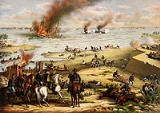
Battle of Hampton Roads

Encyclopedia
The Battle of Hampton Roads, often referred to as either the Battle of the Monitor and Merrimack (or Merrimac) or the Battle of Ironclads, was the most noted and arguably most important naval battle
of the American Civil War
from the standpoint of the development of navies. It was fought over two days, March 8–9, 1862, in Hampton Roads
, a roadstead
in Virginia where the Elizabeth
and Nansemond River
s meet the James River
just before it enters Chesapeake Bay
. The battle was a part of the effort of the Confederacy
to break the Union blockade, which had cut off Virginia's largest cities, Norfolk
and Richmond
, from international trade.
The major significance of the battle is that it was the first meeting in combat of ironclad warships. The Confederate fleet consisted of the ironclad ram CSS Virginia
(built from the remnants of the USS Merrimack
) and several supporting vessels. On the first day of battle, they were opposed by several conventional, wooden-hulled ships of the Union Navy
. On that day, Virginia was able to destroy two ships of the Federal flotilla and was about to attack a third, , which had run aground. However, the action was halted by darkness and falling tide, so Virginia retired to take care of her few wounded — which included her captain, Flag Officer Franklin Buchanan
— and repair her minimal battle damage.
Determined to complete the destruction of the Minnesota, Catesby ap Roger Jones
, acting as captain in Buchanan's absence, returned the ship to the fray the next morning, March 9. During the night, however, the ironclad had arrived and had taken a position to defend Minnesota. When Virginia approached, Monitor intercepted her. The two ironclads fought for about three hours, with neither being able to inflict significant damage on the other. The duel ended indecisively, Virginia returning to her home at the Gosport Navy Yard
for repairs and strengthening, and Monitor to her station defending Minnesota. The ships did not fight again, and the blockade remained in place.
The battle received worldwide attention, and it had immediate effects on navies around the world. The preeminent naval powers, Great Britain and France, halted further construction of wooden-hulled ships, and others followed suit. A new type of warship was produced, the monitor
, based on the principle of the original. The use of a small number of very heavy guns, mounted so that they could fire in all directions was first demonstrated by Monitor but soon became standard in warships of all types. Shipbuilders also incorporated rams into the designs of warship hulls for the rest of the century.
 On April 19, 1861, shortly after the outbreak of hostilities at Charleston Harbor
, President Abraham Lincoln
proclaimed a blockade of ports in the seceded states. On April 27, after Virginia and North Carolina had also passed ordinances of secession, the blockade was extended to include their ports also. Even before the extension, local troops seized the Norfolk area and threatened the Gosport Navy Yard
in Portsmouth. The commandant there, Captain
Charles S. McCauley, though loyal to the Union, was immobilized by advice he received from his subordinate officers, most of whom were in favor of secession. Although he had orders from (Union) Secretary of the Navy
Gideon Welles
to move his ships to Northern ports, he refused to act until April 20, when he gave orders to scuttle the ships in the yard and destroy its facilities. Nine ships were burned, among them the screw frigate . One (the old frigate ) was towed away successfully. Merrimack burned only to the waterline, however, and her engines were more or less intact. The destruction of the navy yard was mostly ineffective; in particular, the large drydock there was relatively undamaged and soon could be restored. Without firing a shot, the advocates of secession had gained for the South its largest navy yard, as well as the hull and engines of what would be in time its most famous warship. They had also seized more than a thousand heavy guns, plus gun carriages and large quantities of gunpowder.
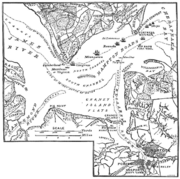
With Norfolk and its navy yard in Portsmouth, the Confederacy controlled the southern side of Hampton Roads. To prevent Union warships from attacking the yard, the Confederates set up batteries at Sewell's Point and Craney Island, at the juncture of the Elizabeth River
with the James. (See map.) The Union retained possession of Fort Monroe
, at Old Point Comfort
on the Virginia Peninsula
. They also held a small man-made island known as the Rip Raps, on the far side of the channel opposite Fort Monroe, and on this island they completed another fort, named Fort Wool
. With Fort Monroe went control of the lower Peninsula as far as Newport News
.
Forts Monroe and Wool gave the Union forces control of the entrance to Hampton Roads. The blockade, initiated on April 30, 1861, cut off Norfolk and Richmond from the sea almost completely. To further the blockade, the Union Navy stationed some of its most powerful warships in the roadstead. There, they were under the shelter of the shore-based guns of Fort Monroe and the batteries at Hampton
and Newport News and out of the range of the guns at Sewell's Point and Craney Island. For most of the first year of the war, the Confederacy could do little to oppose or dislodge them.
, just prior to the American Civil War, and the British and French navies had each built armored ships and were planning to build others. In 1860, the French Navy commissioned , the world's first ocean-going ironclad warship. Great Britain followed a year later with . The use of armor remained controversial, however, and the United States Navy was generally reluctant to embrace the new technology.
.jpg) When the Civil War broke out, Confederate Secretary of the Navy Stephen R. Mallory was an early enthusiast for the advantages of armor. As he looked upon it, the Confederacy could not match the industrial North in numbers of ships at sea, so they would have to compete by building vessels that would be individually superior to those of the Union. The edge would be provided by armor. Mallory gathered about himself a group of men who were able to put his vision into practice, among them John M. Brooke, John L. Porter
When the Civil War broke out, Confederate Secretary of the Navy Stephen R. Mallory was an early enthusiast for the advantages of armor. As he looked upon it, the Confederacy could not match the industrial North in numbers of ships at sea, so they would have to compete by building vessels that would be individually superior to those of the Union. The edge would be provided by armor. Mallory gathered about himself a group of men who were able to put his vision into practice, among them John M. Brooke, John L. Porter
, and William P. Williamson.
When Mallory's men searched the South for factories that could build engines to drive the heavy ships that he wanted, they found no place to do it immediately. At the best facility, the Tredegar Iron Works
in Richmond, building engines from scratch would take at least a year. Upon learning this, Williamson suggested taking the engines from the hulk of Merrimack, recently raised from the bed of the Elizabeth River. His colleagues promptly accepted his suggestion and expanded it, proposing that the design of their projected ironclad be adapted to the hull. Porter produced the revised plans, which were submitted to Mallory for approval. On July 11, 1861, the new design was accepted, and work began almost immediately. The burned-out hull was towed into the graving dock that the Union Navy had failed to destroy. During the subsequent conversion process, the plans were further modified to incorporate an iron ram fitted to the prow. Her offense in addition to the ram consisted of 10 guns: six 9 in (228.6 mm) smooth-bore Dahlgrens, two 6.4 in (162.6 mm) and two 7 in (177.8 mm) Brooke rifles. Trials showed that these rifles firing solid shot would pierce up to eight inches of armor plating. The Tredagar Iron works could produce both solid shot and shell, and since it was believed that Virginia would face only wooden ships, she was given only the shell. Had solid shot been used against the Monitor, the result of the battle might have been different. The armor plating, originally meant to be 1 in (25.4 mm) thick, was replaced by double plates, each 2 in (50.8 mm) thick, backed by 24 in (61 cm) of iron and pine. The armor was pierced for 14 gunports: four on each broadside, three forward, and three aft. The revisions, together with the usual problems associated with the transportation system of the South, resulted in delays that pushed out the launch date until February 3, 1862, and she was not commissioned until February 17, bearing the name CSS Virginia
.
 Intelligence that the Confederates were working to develop an ironclad caused consternation for the Union, but Secretary of the Navy Gideon Welles
waited for Congress to meet to request permission to consider building armored vessels; Congress gave this permission on August 3, 1861. Welles appointed a commission, which came to be known as the Ironclad Board
, of three senior naval officers to choose among the designs that were submitted for consideration. The three men were Captains Joseph Smith and Hiram Paulding
, and Commander
Charles Henry Davis
. The board considered seventeen designs, and chose to support three. First of the three to be completed, even though she was by far the most radical in design, was Swedish engineer and inventor John Ericsson
's .
Ericsson's Monitor, which was built at Ericsson's yard on the East River in Greenpoint, Brooklyn
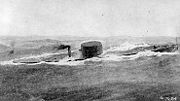
, incorporated new and striking design features, the most significant of which were her armor and armament. Instead of the large numbers of guns of rather small bore that had characterized warships in the past, Ericsson opted for only two guns of large caliber; he wanted to use 15 in (381 mm) guns, but had to settle for 11 in (279.4 mm) Dahlgren guns when the larger size were unavailable. These were mounted in a cylindrical turret, 20 ft (6.1 m) in diameter, 9 ft (2.7 m) high, covered with iron 8 in (203.2 mm) thick. The whole rotated on a central spindle, and was moved by a steam engine that could be controlled by one man. Ericsson was afraid that using the full 30 pounds of black powder to fire the huge cannon would raise the risk of an explosion in the turret. He demanded that a charge of 15 pounds be used to lessen this possibility. As with Virginia, it was found that the full charge would pierce armor plate, a finding that would have affected the outcome of the battle. A serious flaw in the design was the pilot house from which the ship would be conned, a small structure forward of the turret on the main deck. Its presence meant that the guns could not fire directly forward, and it was isolated from other activities on the ship. Despite the late start and the novelty of construction, Monitor was actually completed a few days before her counterpart Virginia, but Virginia was activated first.
. Lieutenant
Catesby ap Roger Jones
had directed much of the conversion of Merrimack to Virginia, and he was disappointed when he was not named her captain. Jones was retained aboard Virginia, but only as her executive officer. Ordinarily, the ship would have been led by a captain of the Confederate States Navy, to be determined by the rigid seniority system that was in place. Secretary Mallory wanted the aggressive Franklin Buchanan
, but at least two other captains had greater seniority and had applied for the post. Mallory evaded the issue by appointing Franklin, head of the Office of Orders and Detail, flag officer in charge of the defenses of Norfolk and the James River. As such, he could control the movements of Virginia. Technically, therefore, the ship went into the battle without a captain.
On the Union side, command of the North Atlantic Blockading Squadron was held by Flag Officer Louis M. Goldsborough
. He had devised a plan for his frigates to engage Virginia, hoping to trap her in their crossfire. In the event, his plan broke down completely when four of the ships ran aground (one of them intentionally) in the confined waters of the roadstead. On the day of battle, Goldsborough was absent with the ships cooperating with the Burnside Expedition in North Carolina. In his absence, leadership fell to his second in command, Captain John Marston
of . As Roanoke was one of the ships that ran aground, Marston was unable to materially influence the battle, and his participation is often disregarded. Most accounts emphasize the contribution of the captain of Monitor, John L. Worden
, to the neglect of others.
and Beaufort
, and was joined at Hampton Roads by the James River Squadron, Patrick Henry
, Jamestown
, and Teaser
. When they were passing the Union batteries at Newport News, Patrick Henry was temporarily disabled by a shot in her boiler that killed four of her crew. After repairs, she returned and rejoined the others.
At this time, the Union Navy had five warships in the roadstead, in addition to several support vessels. The sloop-of-war
and frigate were anchored in the channel near Newport News. Frigate and the steam frigates Roanoke and were near Fort Monroe. The latter three got under way as soon as they saw Virginia approaching, but all soon ran aground. St. Lawrence and Roanoke took no further important part in the battle.
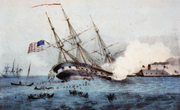
Virginia headed directly for the Union squadron. The battle opened when Union tug Zouave fired on the advancing enemy, and Beaufort replied. This preliminary skirmishing had no effect. Virginia did not open fire until she was within easy range of Cumberland. Return fire from Cumberland and Congress bounced off the iron plates without penetrating. Virginia rammed Cumberland below the waterline and she sank rapidly, "gallantly fighting her guns as long as they were above water," according to Buchanan. She took 121 seamen down with her; those wounded brought the casualty total to nearly 150.
Ramming Cumberland nearly resulted in the sinking of Virginia as well. Virginia's bow ram got stuck in the enemy ship's hull, and as Cumberland listed and began to go down, she almost pulled Virginia under with her. At the time the vessels were locked, one of Cumberland's anchors was hanging directly above the foredeck of Virginia. Had it come loose, the two ships might have gone down together. Virginia broke free, however, her ram breaking off as she backed away.
Buchanan next turned Virginia on Congress. Seeing what had happened to Cumberland, Lieutenant Joseph B. Smith
, captain of Congress, ordered his ship grounded in shallow water. By this time, the James River Squadron
, commanded by John Randolph Tucker, had arrived and joined Virginia in the attack on Congress. After an hour of unequal combat, the badly damaged Congress surrendered. While the surviving crewmen of Congress were being ferried off the ship, a Union battery on the north shore opened fire on Virginia. In retaliation, Buchanan ordered Congress fired upon with hot shot, cannon balls heated red-hot. Congress caught fire and burned throughout the rest of the day. Near midnight, the flames reached her magazine and she exploded and sank. Personnel losses included 110 killed or missing and presumed drowned. Another 26 were wounded, of whom ten died within days.
Although she had not suffered anything like the damage she had inflicted, Virginia was not completely unscathed. Shots from Cumberland, Congress, and Union troops ashore had riddled her smokestack, reducing her already low speed. Two of her guns were disabled and several armor plates had been loosened. Two of her crew were killed, and more were wounded. One of the wounded was Captain Buchanan, whose left thigh was pierced by a rifle shot.
Meanwhile, the James River Squadron
had turned its attention to Minnesota, which had left Fort Monroe
to join in the battle and had run aground. After Virginia had dealt with the surrender of Congress, she joined the James River Squadron despite her damage. Because of her deep draft and the falling tide, however, Virginia was unable to get close enough to be effective, and darkness prevented the rest of the squadron from aiming their guns to any effect. The attack was therefore suspended. Virginia left with the expectation of returning the next day and completing the task. She retreated into the safety of Confederate-controlled waters off Sewell's Point for the night.
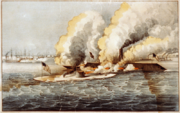 Both sides used the respite to prepare for the next day. Virginia put her wounded ashore and underwent temporary repairs. Captain Buchanan was among the wounded, so command on the second day fell to his executive officer, Lieutenant Catesby ap Roger Jones. Jones proved to be no less aggressive than the man he replaced. While Virginia was being prepared for renewal of the battle, and while Congress was still ablaze, Monitor, commanded by Lieutenant John L. Worden, arrived in Hampton Roads. The Union ironclad had been rushed to Hampton Roads in hopes of protecting the Union fleet and preventing Virginia from threatening Union cities. Captain Worden was informed that his primary task was to protect Minnesota, so Monitor took up a position near the grounded Minnesota and waited.
The next morning, at dawn on March 9, 1862, Virginia left her anchorage at Sewell's Point and moved to attack Minnesota, still aground. She was followed by the three ships of the James River Squadron. They found their course blocked, however, by the newly arrived Monitor. At first, Jones believed the strange craft to be a boiler being towed from the Minnesota, not realizing the nature of his opponent. Soon, however, it was apparent that he had no choice but to fight her. The first shot of the engagement, was fired at Monitor by Virginia. The shot flew past Monitor and struck Minnesota, which answered with a broadside; this began what would be a lengthy engagement.
After fighting for hours, mostly at close range, neither could overcome the other. The armor of both ships proved adequate. In part, this was because each was handicapped in her offensive capabilities. Buchanan, in Virginia, had not expected to fight another armored vessel, so his guns were supplied only with shell rather than armor-piercing shot. Monitors guns were used with the standard service charge of only 15 lb (6.8 kg) of powder, which did not give the projectile sufficient momentum to penetrate her opponent's armor. Tests conducted after the battle showed that the Dahlgren gun
s could be operated safely and efficiently with charges of as much as 30 lb (13.6 kg).
The battle finally ceased when a chance shell from Virginia struck the pilot house of Monitor and exploded, driving fragments through the viewing slits into Worden's eyes and temporarily blinding him. As no one else could see to conn the ship, Monitor was forced to draw off. The executive officer, Lieutenant Samuel Dana Greene
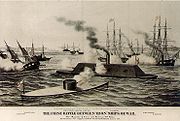
, took over, and Monitor returned to the fight. In the period of command confusion, however, the crew of Virginia believed that their opponent had withdrawn. Although Minnesota was still aground, the falling tide meant that she was out of reach. Furthermore, Virginia had suffered enough damage to require extensive repair. Convinced that his ship had won the day, Jones ordered her back to Norfolk. At about this time, Monitor returned, only to discover her opponent apparently giving up the fight. Convinced that Virginia was quitting, with orders only to protect Minnesota and not to risk his ship unnecessarily, Greene did not pursue. Thus, each side misinterpreted the moves of the other, and as a result each claimed victory.
 Confederate Secretary of the Navy Stephen Mallory
wrote to Confederate President Davis
of the action:
In Washington, belief that Monitor had vanquished Virginia was so strong that Worden and his men were awarded the Thanks of Congress:
system for promotion in the Navy scuttled his chances, however, and the post went to the 67-year-old Commodore Josiah Tattnall
. Monitor, not severely damaged, remained on duty. Like his antagonist Jones, Greene was deemed too young to remain as captain; the day after the battle, he was replaced with Lieutenant Thomas O. Selfridge
. Two days later, Selfridge was in turn relieved by Lieutenant William Nicholson Jeffers
.
By late March, the Union blockade fleet had been augmented by hastily refitted civilian ships, including the powerful SS Vanderbilt, SS Arago, SS Illinois, and SS Ericsson. These had been outfitted with rams and some iron plating. By late April, the new ironclads USS Naugatuck/USRC E. A. Stevens
and USS Galena
and had also joined the blockade.
Each side considered how best to eliminate the threat posed by its opponent, and after Virginia returned each side tried to goad the other into attacking under unfavorable circumstances. Both captains declined the opportunity to fight in water not of their own choosing; Jeffers in particular was under positive orders not to risk his ship. Consequently, each vessel spent the next month in what amounted to posturing. Not only did the two ships not fight each other, neither ship ever fought again after March 9.
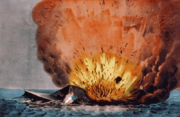 The end came first for Virginia. Because the blockade was unbroken, Norfolk was of little strategic use to the Confederacy, and preliminary plans were laid to move the ship up the James River to the vicinity of Richmond. Before adequate preparations could be made, the Confederate Army under Major General Benjamin Huger abandoned the city on May 9, without consulting anyone from the Navy. Virginias draft was too great to permit her to pass up the river, which had a depth of only 18 ft (5.5 m), and that only under favorable circumstances. She was trapped and could only be captured or sunk by the Union Navy. Rather than allow either, Tatnall decided to destroy his own ship. He had her towed down to Craney Island in Portsmouth, where the crew were taken ashore, and then she was set afire. She burned through the rest of the day and most of the following night; shortly before dawn, the flames reached her magazine, and she blew up.
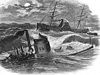 Monitor likewise did not survive the year. She was ordered to Beaufort, North Carolina
, on Christmas Day, to take part in the blockade there. While she was being towed down the coast (under command of her fourth captain, Commander John P. Bankhead
), the wind increased and with it the waves; with no high sides, the Monitor took on water. Soon the water in the hold gained on the pumps, and then put out the fires in her engines. The order was given to abandon ship; most men were rescued by , but 16 went down with her when she sank in the early hours of December 31, 1862.
Evaluation of the strategic results is likewise disputed. The blockade was maintained, even strengthened, and Virginia was bottled up in Hampton Roads. Because a decisive Confederate weapon was negated, some have concluded that the Union could claim a strategic victory. Confederate advocates can counter, however, by arguing that Virginia had a military significance larger than the blockade, which was only a small part of the war in Tidewater Virginia
. Her mere presence was sufficient to close the James River to Federal incursions. She also imposed other constraints on the Peninsula Campaign
then being mounted by the Union Army
under General George B. McClellan, who worried that she could interfere with his positions on the York River. Although his fears were baseless, they continued to affect the movements of his army until Virginia was destroyed.
s, and they played key roles in Civil War battles on the Mississippi
and James rivers. The US immediately started the construction of ten more monitors based on Ericsson's original larger plan, known as the Passaic-class monitors. However, while the design proved exceptionally well-suited for river combat, the low profile and heavy turret caused poor seaworthiness in rough waters. Russia, fearing that the American Civil War would spill into Russian Alaska
, launched ten sister ships
, as soon as Ericsson's plans reached St. Petersburg. What followed has been described as "Monitor mania". The revolving turret later inspired similar designs for future warships, which eventually became the modern battleship
.
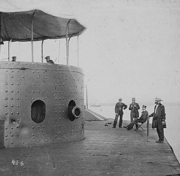 The vulnerability of wooden hulls to armored ships was noted particularly in Britain and France, where the wisdom of the planned conversion of the battle fleet to armor was given a powerful demonstration. Another feature that was emulated was not so successful. Impressed by the ease with which the Virginia had sunk the Cumberland, naval architects began to incorporate rams
into their hull designs. The first purpose-built ram in the modern era was the French armored ram Taureau (1863), whose guns were said to have "the sole function of preparing the way for the ram." The inclusion of rams in warship hull design persisted almost to the outbreak of World War I, despite improvements in naval gunnery that quickly made close action between warships almost suicidal, if not impossible.
carrying the name USS Merrimack
. All parties continued to use the name after her capture by secessionists while she was being rebuilt as an ironclad. When her conversion was almost complete, her name was officially changed to Virginia
. Despite the official name change, Union accounts persisted in calling the Merrimack by her original name, while Confederate sources used either Virginia or Merrimac(k). The alliteration of Monitor and Merrimack has persuaded most popular accounts to adopt the familiar name, even when it is acknowledged to be technically incorrect.
A CSS Merrimac
did actually exist. She was a paddle wheel steamer named for the victor (as most Southerners saw it) at Hampton Roads. She was used for running the blockade until she was captured and taken into Federal service, still named Merrimac. Her name was a spelling variant of the river
, namesake of USS Merrimack
. Both spellings are still in use around the Hampton Roads area.
A small community in Montgomery County, Virginia
near the location where the iron for the Confederate ironclad was forged is now known as Merrimac
. Some of the iron mined there and used in the plating on the Confederate ironclad is displayed at the Norfolk Naval Shipyard
in Portsmouth
. The anchor of the Virginia sits on the lawn in front of the Museum of the Confederacy
http://www.moc.org in Richmond
.
, on a relatively flat, sandy bottom at a depth of about 240 ft (73.2 m). In 1987, the site was declared a National Marine Sanctuary
, the first shipwreck to receive this distinction.
Because of Monitors advanced state of deterioration, timely recovery of remaining significant artifacts and ship components became critical. Numerous fragile artifacts, including the innovative turret
and its two Dahlgren guns, an anchor, steam engine, and propeller, have been recovered. They were transported back to Hampton Roads
to the Mariners' Museum
in Newport News
, Virginia
, where they were treated in special tanks to stabilize the metal. The new USS Monitor Center at the Mariners' Museum officially opened on March 9, 2007, and a full-scale replica of USS Monitor, the original recovered turret, and artifacts and related items are now on display. Some artifacts from CSS Virginia are also on display.
Naval battle
A naval battle is a battle fought using boats, ships or other waterborne vessels. Most naval battles have occurred at sea, but a few have taken place on lakes or rivers. The earliest recorded naval battle took place in 1210 BC near Cyprus...
of the American Civil War
American Civil War
The American Civil War was a civil war fought in the United States of America. In response to the election of Abraham Lincoln as President of the United States, 11 southern slave states declared their secession from the United States and formed the Confederate States of America ; the other 25...
from the standpoint of the development of navies. It was fought over two days, March 8–9, 1862, in Hampton Roads
Hampton Roads
Hampton Roads is the name for both a body of water and the Norfolk–Virginia Beach metropolitan area which surrounds it in southeastern Virginia, United States...
, a roadstead
Roadstead
A roadstead is a place outside a harbor where a ship can lie at anchor. It is an enclosed area with an opening to the sea, narrower than a bay or gulf. It has a surface that cannot be confused with an estuary. It can be created artificially by jetties or dikes...
in Virginia where the Elizabeth
Elizabeth River (Virginia)
The Elizabeth River is a tidal estuary forming an arm of Hampton Roads harbor at the southern end of Chesapeake Bay in southeast Virginia in the United States. It is located along the southern side of the mouth of the James River, between the cities of Portsmouth and Norfolk...
and Nansemond River
Nansemond River
The Nansemond River is a tributary of the James River in the U.S. state of Virginia. The Nansemond River Bridge crosses the river near its mouth. Both it and the former State Route 125 bridge, demolished in 2008, were once toll bridges. The river begins at the outlet of Lake Meade north of...
s meet the James River
James River (Virginia)
The James River is a river in the U.S. state of Virginia. It is long, extending to if one includes the Jackson River, the longer of its two source tributaries. The James River drains a catchment comprising . The watershed includes about 4% open water and an area with a population of 2.5 million...
just before it enters Chesapeake Bay
Chesapeake Bay
The Chesapeake Bay is the largest estuary in the United States. It lies off the Atlantic Ocean, surrounded by Maryland and Virginia. The Chesapeake Bay's drainage basin covers in the District of Columbia and parts of six states: New York, Pennsylvania, Delaware, Maryland, Virginia, and West...
. The battle was a part of the effort of the Confederacy
Confederate States of America
The Confederate States of America was a government set up from 1861 to 1865 by 11 Southern slave states of the United States of America that had declared their secession from the U.S...
to break the Union blockade, which had cut off Virginia's largest cities, Norfolk
Norfolk, Virginia
Norfolk is an independent city in the Commonwealth of Virginia in the United States. With a population of 242,803 as of the 2010 Census, it is Virginia's second-largest city behind neighboring Virginia Beach....
and Richmond
Richmond, Virginia
Richmond is the capital of the Commonwealth of Virginia, in the United States. It is an independent city and not part of any county. Richmond is the center of the Richmond Metropolitan Statistical Area and the Greater Richmond area...
, from international trade.
The major significance of the battle is that it was the first meeting in combat of ironclad warships. The Confederate fleet consisted of the ironclad ram CSS Virginia
CSS Virginia
CSS Virginia was the first steam-powered ironclad warship of the Confederate States Navy, built during the first year of the American Civil War; she was constructed as a casemate ironclad using the raised and cut down original lower hull and steam engines of the scuttled . Virginia was one of the...
(built from the remnants of the USS Merrimack
USS Merrimack (1855)
USS Merrimack was a frigate and sailing vessel of the United States Navy, best known as the hull upon which the ironclad warship, CSS Virginia was constructed during the American Civil War...
) and several supporting vessels. On the first day of battle, they were opposed by several conventional, wooden-hulled ships of the Union Navy
Union Navy
The Union Navy is the label applied to the United States Navy during the American Civil War, to contrast it from its direct opponent, the Confederate States Navy...
. On that day, Virginia was able to destroy two ships of the Federal flotilla and was about to attack a third, , which had run aground. However, the action was halted by darkness and falling tide, so Virginia retired to take care of her few wounded — which included her captain, Flag Officer Franklin Buchanan
Franklin Buchanan
Franklin Buchanan was an officer in the United States Navy who became an admiral in the Confederate Navy during the American Civil War, and commanded the ironclad CSS Virginia.-Early life:...
— and repair her minimal battle damage.
Determined to complete the destruction of the Minnesota, Catesby ap Roger Jones
Catesby ap Roger Jones
Catesby ap Roger Jones was an officer in the U.S. Navy who became a commander in the Confederate Navy during the American Civil War.-Biography:...
, acting as captain in Buchanan's absence, returned the ship to the fray the next morning, March 9. During the night, however, the ironclad had arrived and had taken a position to defend Minnesota. When Virginia approached, Monitor intercepted her. The two ironclads fought for about three hours, with neither being able to inflict significant damage on the other. The duel ended indecisively, Virginia returning to her home at the Gosport Navy Yard
Norfolk Naval Shipyard
The Norfolk Naval Shipyard, often called the Norfolk Navy Yard and abbreviated as NNSY, is a U.S. Navy facility in Portsmouth, Virginia, for building, remodeling, and repairing the Navy's ships. It's the oldest and largest industrial facility that belongs to the U.S. Navy as well as the most...
for repairs and strengthening, and Monitor to her station defending Minnesota. The ships did not fight again, and the blockade remained in place.
The battle received worldwide attention, and it had immediate effects on navies around the world. The preeminent naval powers, Great Britain and France, halted further construction of wooden-hulled ships, and others followed suit. A new type of warship was produced, the monitor
Monitor (warship)
A monitor was a class of relatively small warship which was neither fast nor strongly armoured but carried disproportionately large guns. They were used by some navies from the 1860s until the end of World War II, and saw their final use by the United States Navy during the Vietnam War.The monitors...
, based on the principle of the original. The use of a small number of very heavy guns, mounted so that they could fire in all directions was first demonstrated by Monitor but soon became standard in warships of all types. Shipbuilders also incorporated rams into the designs of warship hulls for the rest of the century.
The blockade at Norfolk
Battle of Fort Sumter
The Battle of Fort Sumter was the bombardment and surrender of Fort Sumter, near Charleston, South Carolina, that started the American Civil War. Following declarations of secession by seven Southern states, South Carolina demanded that the U.S. Army abandon its facilities in Charleston Harbor. On...
, President Abraham Lincoln
Abraham Lincoln
Abraham Lincoln was the 16th President of the United States, serving from March 1861 until his assassination in April 1865. He successfully led his country through a great constitutional, military and moral crisis – the American Civil War – preserving the Union, while ending slavery, and...
proclaimed a blockade of ports in the seceded states. On April 27, after Virginia and North Carolina had also passed ordinances of secession, the blockade was extended to include their ports also. Even before the extension, local troops seized the Norfolk area and threatened the Gosport Navy Yard
Norfolk Naval Shipyard
The Norfolk Naval Shipyard, often called the Norfolk Navy Yard and abbreviated as NNSY, is a U.S. Navy facility in Portsmouth, Virginia, for building, remodeling, and repairing the Navy's ships. It's the oldest and largest industrial facility that belongs to the U.S. Navy as well as the most...
in Portsmouth. The commandant there, Captain
Captain (naval)
Captain is the name most often given in English-speaking navies to the rank corresponding to command of the largest ships. The NATO rank code is OF-5, equivalent to an army full colonel....
Charles S. McCauley, though loyal to the Union, was immobilized by advice he received from his subordinate officers, most of whom were in favor of secession. Although he had orders from (Union) Secretary of the Navy
United States Secretary of the Navy
The Secretary of the Navy of the United States of America is the head of the Department of the Navy, a component organization of the Department of Defense...
Gideon Welles
Gideon Welles
Gideon Welles was the United States Secretary of the Navy from 1861 to 1869. His buildup of the Navy to successfully execute blockades of Southern ports was a key component of Northern victory of the Civil War...
to move his ships to Northern ports, he refused to act until April 20, when he gave orders to scuttle the ships in the yard and destroy its facilities. Nine ships were burned, among them the screw frigate . One (the old frigate ) was towed away successfully. Merrimack burned only to the waterline, however, and her engines were more or less intact. The destruction of the navy yard was mostly ineffective; in particular, the large drydock there was relatively undamaged and soon could be restored. Without firing a shot, the advocates of secession had gained for the South its largest navy yard, as well as the hull and engines of what would be in time its most famous warship. They had also seized more than a thousand heavy guns, plus gun carriages and large quantities of gunpowder.
With Norfolk and its navy yard in Portsmouth, the Confederacy controlled the southern side of Hampton Roads. To prevent Union warships from attacking the yard, the Confederates set up batteries at Sewell's Point and Craney Island, at the juncture of the Elizabeth River
Elizabeth River (Virginia)
The Elizabeth River is a tidal estuary forming an arm of Hampton Roads harbor at the southern end of Chesapeake Bay in southeast Virginia in the United States. It is located along the southern side of the mouth of the James River, between the cities of Portsmouth and Norfolk...
with the James. (See map.) The Union retained possession of Fort Monroe
Fort Monroe
Fort Monroe was a military installation in Hampton, Virginia—at Old Point Comfort, the southern tip of the Virginia Peninsula...
, at Old Point Comfort
Old Point Comfort
Old Point Comfort is a point of land located in the independent city of Hampton. It lies at the extreme tip of the Virginia Peninsula at the mouth of Hampton Roads in the United States....
on the Virginia Peninsula
Virginia Peninsula
The Virginia Peninsula is a peninsula in southeast Virginia, USA, bounded by the York River, James River, Hampton Roads and Chesapeake Bay.Hampton Roads is the common name for the metropolitan area that surrounds the body of water of the same name...
. They also held a small man-made island known as the Rip Raps, on the far side of the channel opposite Fort Monroe, and on this island they completed another fort, named Fort Wool
Fort Wool
Fort Wool was the companion to Fort Monroe in protecting Hampton Roads from seafaring threats. This site was once the dumping place for ships’ ballast....
. With Fort Monroe went control of the lower Peninsula as far as Newport News
Newport News, Virginia
Newport News is an independent city located in the Hampton Roads metropolitan area of Virginia. It is at the southeastern end of the Virginia Peninsula, on the north shore of the James River extending southeast from Skiffe's Creek along many miles of waterfront to the river's mouth at Newport News...
.
Forts Monroe and Wool gave the Union forces control of the entrance to Hampton Roads. The blockade, initiated on April 30, 1861, cut off Norfolk and Richmond from the sea almost completely. To further the blockade, the Union Navy stationed some of its most powerful warships in the roadstead. There, they were under the shelter of the shore-based guns of Fort Monroe and the batteries at Hampton
Hampton, Virginia
Hampton is an independent city that is not part of any county in Southeast Virginia. Its population is 137,436. As one of the seven major cities that compose the Hampton Roads metropolitan area, it is on the southeastern end of the Virginia Peninsula. Located on the Hampton Roads Beltway, it hosts...
and Newport News and out of the range of the guns at Sewell's Point and Craney Island. For most of the first year of the war, the Confederacy could do little to oppose or dislodge them.
Birth of the ironclads
When steam propulsion began to be applied to warships, naval constructors renewed their interest in armor for their vessels. Experiments had been tried with armor during the Crimean WarCrimean War
The Crimean War was a conflict fought between the Russian Empire and an alliance of the French Empire, the British Empire, the Ottoman Empire, and the Kingdom of Sardinia. The war was part of a long-running contest between the major European powers for influence over territories of the declining...
, just prior to the American Civil War, and the British and French navies had each built armored ships and were planning to build others. In 1860, the French Navy commissioned , the world's first ocean-going ironclad warship. Great Britain followed a year later with . The use of armor remained controversial, however, and the United States Navy was generally reluctant to embrace the new technology.
CSS Virginia
John L. Porter
John Luke Porter , whose father was a shipwright at Portsmouth, Virginia, was born in 1813. He became a United States Navy civilian employee during the 1840s and a Naval Constructor in 1859. After resigning from the U.S. Navy in May 1861, he began working for the Confederate States Navy at the...
, and William P. Williamson.
When Mallory's men searched the South for factories that could build engines to drive the heavy ships that he wanted, they found no place to do it immediately. At the best facility, the Tredegar Iron Works
Tredegar Iron Works
The Tredegar Iron Works was a historic iron foundry in Richmond, Virginia, United States of America, opened in 1837. During the American Civil War, the works served as the primary iron and artillery production facility of the Confederate States of America...
in Richmond, building engines from scratch would take at least a year. Upon learning this, Williamson suggested taking the engines from the hulk of Merrimack, recently raised from the bed of the Elizabeth River. His colleagues promptly accepted his suggestion and expanded it, proposing that the design of their projected ironclad be adapted to the hull. Porter produced the revised plans, which were submitted to Mallory for approval. On July 11, 1861, the new design was accepted, and work began almost immediately. The burned-out hull was towed into the graving dock that the Union Navy had failed to destroy. During the subsequent conversion process, the plans were further modified to incorporate an iron ram fitted to the prow. Her offense in addition to the ram consisted of 10 guns: six 9 in (228.6 mm) smooth-bore Dahlgrens, two 6.4 in (162.6 mm) and two 7 in (177.8 mm) Brooke rifles. Trials showed that these rifles firing solid shot would pierce up to eight inches of armor plating. The Tredagar Iron works could produce both solid shot and shell, and since it was believed that Virginia would face only wooden ships, she was given only the shell. Had solid shot been used against the Monitor, the result of the battle might have been different. The armor plating, originally meant to be 1 in (25.4 mm) thick, was replaced by double plates, each 2 in (50.8 mm) thick, backed by 24 in (61 cm) of iron and pine. The armor was pierced for 14 gunports: four on each broadside, three forward, and three aft. The revisions, together with the usual problems associated with the transportation system of the South, resulted in delays that pushed out the launch date until February 3, 1862, and she was not commissioned until February 17, bearing the name CSS Virginia
CSS Virginia
CSS Virginia was the first steam-powered ironclad warship of the Confederate States Navy, built during the first year of the American Civil War; she was constructed as a casemate ironclad using the raised and cut down original lower hull and steam engines of the scuttled . Virginia was one of the...
.
USS Monitor
Gideon Welles
Gideon Welles was the United States Secretary of the Navy from 1861 to 1869. His buildup of the Navy to successfully execute blockades of Southern ports was a key component of Northern victory of the Civil War...
waited for Congress to meet to request permission to consider building armored vessels; Congress gave this permission on August 3, 1861. Welles appointed a commission, which came to be known as the Ironclad Board
Ironclad Board
The Ironclad Board was an advisory board established by the United States in 1861 in response to the construction of the CSS Virginia by the Confederate States. The primary goal of the Ironclad Board was to choose designs of ironclad ships to construct...
, of three senior naval officers to choose among the designs that were submitted for consideration. The three men were Captains Joseph Smith and Hiram Paulding
Hiram Paulding
Hiram Paulding was a Rear Admiral in the United States Navy, who served from the War of 1812 until after the Civil War.-Naval career:...
, and Commander
Commander (United States)
In the United States, commander is a military rank that is also sometimes used as a military title, depending on the branch of service. It is also used as a rank or title in some organizations outside of the military, particularly in police and law enforcement.-Naval rank:In the United States...
Charles Henry Davis
Charles Henry Davis
Charles Henry Davis was a Rear Admiral in the United States Navy, serving primarily during the American Civil War, and with the United States Coast Survey.-Early life and career:...
. The board considered seventeen designs, and chose to support three. First of the three to be completed, even though she was by far the most radical in design, was Swedish engineer and inventor John Ericsson
John Ericsson
John Ericsson was a Swedish-American inventor and mechanical engineer, as was his brother Nils Ericson. He was born at Långbanshyttan in Värmland, Sweden, but primarily came to be active in England and the United States...
's .
Ericsson's Monitor, which was built at Ericsson's yard on the East River in Greenpoint, Brooklyn
Greenpoint, Brooklyn
Greenpoint is the northernmost neighborhood in the New York City borough of Brooklyn. It is bordered on the southwest by Williamsburg at the Bushwick inlet, on the southeast by the Brooklyn-Queens Expressway and East Williamsburg, on the north by Newtown Creek and Long Island City, Queens at the...
, incorporated new and striking design features, the most significant of which were her armor and armament. Instead of the large numbers of guns of rather small bore that had characterized warships in the past, Ericsson opted for only two guns of large caliber; he wanted to use 15 in (381 mm) guns, but had to settle for 11 in (279.4 mm) Dahlgren guns when the larger size were unavailable. These were mounted in a cylindrical turret, 20 ft (6.1 m) in diameter, 9 ft (2.7 m) high, covered with iron 8 in (203.2 mm) thick. The whole rotated on a central spindle, and was moved by a steam engine that could be controlled by one man. Ericsson was afraid that using the full 30 pounds of black powder to fire the huge cannon would raise the risk of an explosion in the turret. He demanded that a charge of 15 pounds be used to lessen this possibility. As with Virginia, it was found that the full charge would pierce armor plate, a finding that would have affected the outcome of the battle. A serious flaw in the design was the pilot house from which the ship would be conned, a small structure forward of the turret on the main deck. Its presence meant that the guns could not fire directly forward, and it was isolated from other activities on the ship. Despite the late start and the novelty of construction, Monitor was actually completed a few days before her counterpart Virginia, but Virginia was activated first.
Command
The Confederate chain of command was anomalousAnomaly
Anomaly may refer to:-Astronomy and celestial mechanics :* In astronomy, an anomaly is a quantity measured with respect to an apsis, usually the periapsis...
. Lieutenant
Lieutenant
A lieutenant is a junior commissioned officer in many nations' armed forces. Typically, the rank of lieutenant in naval usage, while still a junior officer rank, is senior to the army rank...
Catesby ap Roger Jones
Catesby ap Roger Jones
Catesby ap Roger Jones was an officer in the U.S. Navy who became a commander in the Confederate Navy during the American Civil War.-Biography:...
had directed much of the conversion of Merrimack to Virginia, and he was disappointed when he was not named her captain. Jones was retained aboard Virginia, but only as her executive officer. Ordinarily, the ship would have been led by a captain of the Confederate States Navy, to be determined by the rigid seniority system that was in place. Secretary Mallory wanted the aggressive Franklin Buchanan
Franklin Buchanan
Franklin Buchanan was an officer in the United States Navy who became an admiral in the Confederate Navy during the American Civil War, and commanded the ironclad CSS Virginia.-Early life:...
, but at least two other captains had greater seniority and had applied for the post. Mallory evaded the issue by appointing Franklin, head of the Office of Orders and Detail, flag officer in charge of the defenses of Norfolk and the James River. As such, he could control the movements of Virginia. Technically, therefore, the ship went into the battle without a captain.
On the Union side, command of the North Atlantic Blockading Squadron was held by Flag Officer Louis M. Goldsborough
Louis M. Goldsborough
Louis Malesherbes Goldsborough was a rear admiral in the United States Navy during the Civil War. He held several sea commands during the Civil War, including the North Atlantic Blockading Squadron...
. He had devised a plan for his frigates to engage Virginia, hoping to trap her in their crossfire. In the event, his plan broke down completely when four of the ships ran aground (one of them intentionally) in the confined waters of the roadstead. On the day of battle, Goldsborough was absent with the ships cooperating with the Burnside Expedition in North Carolina. In his absence, leadership fell to his second in command, Captain John Marston
John Marston (sailor)
John Marston was an officer in the United States Navy.-Early career:During the War of 1812, Marston served as a messenger and carried the first news of Commander Isaac Hull's capture of HMS Guerriere to John Adams at Quincy, Massachusetts...
of . As Roanoke was one of the ships that ran aground, Marston was unable to materially influence the battle, and his participation is often disregarded. Most accounts emphasize the contribution of the captain of Monitor, John L. Worden
John Lorimer Worden
John Lorimer Worden was a U.S. rear admiral who served in the American Civil War. He commanded Monitor against the Confederate vessel Virginia in first battle of ironclad ships in 1862.-Background and early career:Worden was born in Sparta, Mount PleasantTownship, Westchester County, New York...
, to the neglect of others.
March 8: Virginia wreaks havoc on wooden Union warships
The battle began when the large and unwieldy CSS Virginia steamed into Hampton Roads on the morning of March 8, 1862. Captain Buchanan intended to attack as soon as possible. Virginia was accompanied from her moorings on the Elizabeth River by RaleighCSS Raleigh (1861)
CSS Raleigh was originally a small, iron-hulled, propeller-driven towing steamer operating on the Albemarle and Chesapeake Canal. She was taken over by the State of North Carolina in May 1861, and transferred to the Confederate States the following July. Her commanding officer during 1861-1862 was...
and Beaufort
CSS Beaufort
The CSS Beaufort was an iron hull gunboat that served in North Carolina and Virginia during the Civil War.The Beaufort was originally called the Caledonia. She was built at the Pusey & Jones Company of Wilmington, Delaware in 1854. The Caledonia operated out of Edenton, North Carolina. In 1856...
, and was joined at Hampton Roads by the James River Squadron, Patrick Henry
CSS Patrick Henry
CSS Patrick Henry was built in New York City in 1859 by the renowned William H. Webb for the Old Dominion Steam Ship Line as the civilian steamer Yorktown, a brigantine-rigged side-wheel steamer. She carried passengers and freight between Richmond, Virginia and New York City...
, Jamestown
CSS Jamestown
CSS Jamestown, originally a side-wheel, passenger steamer, was built at New York City in 1853, and seized at Richmond, Virginia in 1861 for the Commonwealth of Virginia Navy...
, and Teaser
CSS Teaser
CSS Teaser had been the aging Georgetown, D.C. tugboat York River until the beginning of the American Civil War, when she was taken into the Confederate States Navy. Later, she was captured by the United States Navy and became the first USS Teaser.-CSS Teaser:Teaser was built at Philadelphia,...
. When they were passing the Union batteries at Newport News, Patrick Henry was temporarily disabled by a shot in her boiler that killed four of her crew. After repairs, she returned and rejoined the others.
At this time, the Union Navy had five warships in the roadstead, in addition to several support vessels. The sloop-of-war
Sloop-of-war
In the 18th and most of the 19th centuries, a sloop-of-war was a warship with a single gun deck that carried up to eighteen guns. As the rating system covered all vessels with 20 guns and above, this meant that the term sloop-of-war actually encompassed all the unrated combat vessels including the...
and frigate were anchored in the channel near Newport News. Frigate and the steam frigates Roanoke and were near Fort Monroe. The latter three got under way as soon as they saw Virginia approaching, but all soon ran aground. St. Lawrence and Roanoke took no further important part in the battle.
Virginia headed directly for the Union squadron. The battle opened when Union tug Zouave fired on the advancing enemy, and Beaufort replied. This preliminary skirmishing had no effect. Virginia did not open fire until she was within easy range of Cumberland. Return fire from Cumberland and Congress bounced off the iron plates without penetrating. Virginia rammed Cumberland below the waterline and she sank rapidly, "gallantly fighting her guns as long as they were above water," according to Buchanan. She took 121 seamen down with her; those wounded brought the casualty total to nearly 150.
Ramming Cumberland nearly resulted in the sinking of Virginia as well. Virginia's bow ram got stuck in the enemy ship's hull, and as Cumberland listed and began to go down, she almost pulled Virginia under with her. At the time the vessels were locked, one of Cumberland's anchors was hanging directly above the foredeck of Virginia. Had it come loose, the two ships might have gone down together. Virginia broke free, however, her ram breaking off as she backed away.
Buchanan next turned Virginia on Congress. Seeing what had happened to Cumberland, Lieutenant Joseph B. Smith
Joseph B. Smith
Joseph B. Smith was an officer in the United States Navy who was killed in action during the American Civil War.-Biography:...
, captain of Congress, ordered his ship grounded in shallow water. By this time, the James River Squadron
James River Squadron
The James River Squadron was formed shortly after the secession of the State of Virginia as part of the Virginia State Navy. The squadron is most notable for its role in patrolling the James River, which was the main water approach to the Confederate capital, Richmond...
, commanded by John Randolph Tucker, had arrived and joined Virginia in the attack on Congress. After an hour of unequal combat, the badly damaged Congress surrendered. While the surviving crewmen of Congress were being ferried off the ship, a Union battery on the north shore opened fire on Virginia. In retaliation, Buchanan ordered Congress fired upon with hot shot, cannon balls heated red-hot. Congress caught fire and burned throughout the rest of the day. Near midnight, the flames reached her magazine and she exploded and sank. Personnel losses included 110 killed or missing and presumed drowned. Another 26 were wounded, of whom ten died within days.
Although she had not suffered anything like the damage she had inflicted, Virginia was not completely unscathed. Shots from Cumberland, Congress, and Union troops ashore had riddled her smokestack, reducing her already low speed. Two of her guns were disabled and several armor plates had been loosened. Two of her crew were killed, and more were wounded. One of the wounded was Captain Buchanan, whose left thigh was pierced by a rifle shot.
Meanwhile, the James River Squadron
James River Squadron
The James River Squadron was formed shortly after the secession of the State of Virginia as part of the Virginia State Navy. The squadron is most notable for its role in patrolling the James River, which was the main water approach to the Confederate capital, Richmond...
had turned its attention to Minnesota, which had left Fort Monroe
Fort Monroe
Fort Monroe was a military installation in Hampton, Virginia—at Old Point Comfort, the southern tip of the Virginia Peninsula...
to join in the battle and had run aground. After Virginia had dealt with the surrender of Congress, she joined the James River Squadron despite her damage. Because of her deep draft and the falling tide, however, Virginia was unable to get close enough to be effective, and darkness prevented the rest of the squadron from aiming their guns to any effect. The attack was therefore suspended. Virginia left with the expectation of returning the next day and completing the task. She retreated into the safety of Confederate-controlled waters off Sewell's Point for the night.
March 9: Monitor engages Virginia
The next morning, at dawn on March 9, 1862, Virginia left her anchorage at Sewell's Point and moved to attack Minnesota, still aground. She was followed by the three ships of the James River Squadron. They found their course blocked, however, by the newly arrived Monitor. At first, Jones believed the strange craft to be a boiler being towed from the Minnesota, not realizing the nature of his opponent. Soon, however, it was apparent that he had no choice but to fight her. The first shot of the engagement, was fired at Monitor by Virginia. The shot flew past Monitor and struck Minnesota, which answered with a broadside; this began what would be a lengthy engagement.
After fighting for hours, mostly at close range, neither could overcome the other. The armor of both ships proved adequate. In part, this was because each was handicapped in her offensive capabilities. Buchanan, in Virginia, had not expected to fight another armored vessel, so his guns were supplied only with shell rather than armor-piercing shot. Monitors guns were used with the standard service charge of only 15 lb (6.8 kg) of powder, which did not give the projectile sufficient momentum to penetrate her opponent's armor. Tests conducted after the battle showed that the Dahlgren gun
Dahlgren gun
Dahlgren guns were muzzle loading naval artillery designed by Rear Admiral John A. Dahlgren USN, mostly used in the period of the American Civil War. Dahlgren's design philosophy evolved from an accidental explosion in 1849 of a 32-pounder being tested for accuracy, killing a gunner...
s could be operated safely and efficiently with charges of as much as 30 lb (13.6 kg).
The battle finally ceased when a chance shell from Virginia struck the pilot house of Monitor and exploded, driving fragments through the viewing slits into Worden's eyes and temporarily blinding him. As no one else could see to conn the ship, Monitor was forced to draw off. The executive officer, Lieutenant Samuel Dana Greene
Samuel Greene
Samuel Dana Greene was an officer in the United States Navy during the American Civil War.-Biography:...
, took over, and Monitor returned to the fight. In the period of command confusion, however, the crew of Virginia believed that their opponent had withdrawn. Although Minnesota was still aground, the falling tide meant that she was out of reach. Furthermore, Virginia had suffered enough damage to require extensive repair. Convinced that his ship had won the day, Jones ordered her back to Norfolk. At about this time, Monitor returned, only to discover her opponent apparently giving up the fight. Convinced that Virginia was quitting, with orders only to protect Minnesota and not to risk his ship unnecessarily, Greene did not pursue. Thus, each side misinterpreted the moves of the other, and as a result each claimed victory.
Stephen Mallory
Stephen Russell Mallory served in the United States Senate as, Senator from Florida from 1850 to the secession of his home state and the outbreak of the American Civil War. For much of that period, he was chairman of the Committee on Naval Affairs...
wrote to Confederate President Davis
Jefferson Davis
Jefferson Finis Davis , also known as Jeff Davis, was an American statesman and leader of the Confederacy during the American Civil War, serving as President for its entire history. He was born in Kentucky to Samuel and Jane Davis...
of the action:
The conduct of the Officers and men of the squadron … reflects unfading honor upon themselves and upon the Navy. The report will be read with deep interest, and its details will not fail to rouse the ardor and nerve the arms of our gallant seamen.
It will be remembered that the Virginia was a novelty in naval architecture, wholly unlike any ship that ever floated; that her heaviest guns were equal novelties in ordnance; that her motive power and obedience to her helm were untried, and her officers and crew strangers, comparatively, to the ship and to each other; and yet, under all these disadvantages, the dashing courage and consummate professional ability of Flag Officer Buchanan and his associates achieved the most remarkable victory which naval annals record.
In Washington, belief that Monitor had vanquished Virginia was so strong that Worden and his men were awarded the Thanks of Congress:
Resolved . . . That the thanks of Congress and the American people are due and are hereby tendered to Lieutenant J. L. Worden, of the United States Navy, and to the officers and men of the ironclad gunboat Monitor, under his command, for the skill and gallantry exhibited by them in the remarkable battle between the Monitor and the rebel ironclad steamer Merrimack.
Spring 1862 — a standoff at Hampton Roads
Virginia remained in drydock for almost a month, getting repairs for battle damage as well as minor modifications to improve her performance. On April 4, she was able to leave drydock. Buchanan, still recovering from his wound, had hoped that Catesby Jones would be picked to succeed him, and most observers believed that Jones's performance during the battle was outstanding. The senioritySeniority
Seniority is the concept of a person or group of people being in charge or in command of another person or group. This control is often granted to the senior person due to experience or length of service in a given position, but it is not uncommon for a senior person to have less experience or...
system for promotion in the Navy scuttled his chances, however, and the post went to the 67-year-old Commodore Josiah Tattnall
Josiah Tattnall
Commodore Josiah Tattnall, Jr. was an officer in the United States Navy during the War of 1812, the Second Barbary War, and the Mexican-American War. He later served in the Confederate Navy during the American Civil War....
. Monitor, not severely damaged, remained on duty. Like his antagonist Jones, Greene was deemed too young to remain as captain; the day after the battle, he was replaced with Lieutenant Thomas O. Selfridge
Thomas O. Selfridge
Rear Admiral Thomas O. Selfridge was an officer in the United States Navy during the Mexican–American War and the American Civil War and was the father of Thomas O. Selfridge, Jr....
. Two days later, Selfridge was in turn relieved by Lieutenant William Nicholson Jeffers
William Nicholson Jeffers
Commodore William Nicholson Jeffers was a U.S. Navy officer of the 19th century. He took part in combat operations during the Mexican-American War and the Civil War, and during the 1870s and early 1880s served as Chief of the Bureau of Ordnance.-Early life and career:Jeffers was born in...
.
By late March, the Union blockade fleet had been augmented by hastily refitted civilian ships, including the powerful SS Vanderbilt, SS Arago, SS Illinois, and SS Ericsson. These had been outfitted with rams and some iron plating. By late April, the new ironclads USS Naugatuck/USRC E. A. Stevens
USS Naugatuck (1844)
USRC Naugatuck was a twin-screw ironclad experimental steamer owned by the US Revenue Cutter Service during the American Civil War. She served the U.S. Treasury Department as the USRC E.A. Stevens , a name she retained until sold in 1890...
and USS Galena
USS Galena (1862)
USS Galena — an ironclad screw steamer — was one of the first three ironclads, each of a different design, built by the Union Navy during the American Civil War....
and had also joined the blockade.
Each side considered how best to eliminate the threat posed by its opponent, and after Virginia returned each side tried to goad the other into attacking under unfavorable circumstances. Both captains declined the opportunity to fight in water not of their own choosing; Jeffers in particular was under positive orders not to risk his ship. Consequently, each vessel spent the next month in what amounted to posturing. Not only did the two ships not fight each other, neither ship ever fought again after March 9.
Destruction of the combatants
Beaufort, North Carolina
Beaufort is a town in Carteret County, North Carolina, United States. Established in 1709, it is the third-oldest town in North Carolina.The population was 4,189 at the 2008 census and it is the county seat of Carteret County...
, on Christmas Day, to take part in the blockade there. While she was being towed down the coast (under command of her fourth captain, Commander John P. Bankhead
John P. Bankhead
John Payne Bankhead was an officer in the United States Navy who served during the American Civil War, and was in command of the ironclad USS Monitor when it sank in 1862.-Biography:...
), the wind increased and with it the waves; with no high sides, the Monitor took on water. Soon the water in the hold gained on the pumps, and then put out the fires in her engines. The order was given to abandon ship; most men were rescued by , but 16 went down with her when she sank in the early hours of December 31, 1862.
Who won?
The victory claims that were made by each side in the immediate aftermath of the Battle of Hampton Roads, based as both were on misinterpretations of the opponent's behavior, have been dismissed by present-day historians. They agree that the result of the Monitor–Merrimack encounter was victory for neither. As the combat between ironclads was the primary significance of the battle, the general verdict is that the overall result was a draw. All would acknowledge that the Southern fleet inflicted far more damage than it received, which would ordinarily imply that they had gained a tactical victory. Compared to other Civil War battles, the loss of men and ships for the Union Navy would be considered a clear defeat. On the other hand, the blockade was not seriously threatened, so the entire battle can be regarded as an assault that ultimately failed.Evaluation of the strategic results is likewise disputed. The blockade was maintained, even strengthened, and Virginia was bottled up in Hampton Roads. Because a decisive Confederate weapon was negated, some have concluded that the Union could claim a strategic victory. Confederate advocates can counter, however, by arguing that Virginia had a military significance larger than the blockade, which was only a small part of the war in Tidewater Virginia
Tidewater region of Virginia
The Tidewater region of Virginia is the eastern portion of the Commonwealth of Virginia formally known as Hampton Roads. The term tidewater may be correctly applied to all portions of any area, including Virginia, where the water level is affected by the tides...
. Her mere presence was sufficient to close the James River to Federal incursions. She also imposed other constraints on the Peninsula Campaign
Peninsula Campaign
The Peninsula Campaign of the American Civil War was a major Union operation launched in southeastern Virginia from March through July 1862, the first large-scale offensive in the Eastern Theater. The operation, commanded by Maj. Gen. George B...
then being mounted by the Union Army
Union Army
The Union Army was the land force that fought for the Union during the American Civil War. It was also known as the Federal Army, the U.S. Army, the Northern Army and the National Army...
under General George B. McClellan, who worried that she could interfere with his positions on the York River. Although his fears were baseless, they continued to affect the movements of his army until Virginia was destroyed.
Impact upon naval warfare
Both days of the battle attracted attention from almost all the world's navies. The USS Monitor became the prototype for the monitor warship type. She thus became one of two ships whose names were applied to entire classes of their successors. The other was . Many more were built, including river monitorRiver monitor
River monitors were heavily armored, and normally mounted the largest guns of all riverine warships. The name originated from the US Navy's Brown Water Navy's USS Monitor, which made her first appearance in the American Civil War, and being distinguished by a single revolving turret.On 18 December...
s, and they played key roles in Civil War battles on the Mississippi
Mississippi River
The Mississippi River is the largest river system in North America. Flowing entirely in the United States, this river rises in western Minnesota and meanders slowly southwards for to the Mississippi River Delta at the Gulf of Mexico. With its many tributaries, the Mississippi's watershed drains...
and James rivers. The US immediately started the construction of ten more monitors based on Ericsson's original larger plan, known as the Passaic-class monitors. However, while the design proved exceptionally well-suited for river combat, the low profile and heavy turret caused poor seaworthiness in rough waters. Russia, fearing that the American Civil War would spill into Russian Alaska
Russian Alaska
Russian America was the name of Russian colonial possessions in the Americas from 1733 to 1867 that today is the U.S. state of Alaska and settlements farther south in California and Hawaii...
, launched ten sister ships
Uragan class monitor
The Uragan class was a class of monitors built for the Baltic Fleet of the Imperial Russian Navy. The ships were built to the plans of the American Passaic-class monitors, a design that was tested on a smaller scale on the USS Monitor...
, as soon as Ericsson's plans reached St. Petersburg. What followed has been described as "Monitor mania". The revolving turret later inspired similar designs for future warships, which eventually became the modern battleship
Battleship
A battleship is a large armored warship with a main battery consisting of heavy caliber guns. Battleships were larger, better armed and armored than cruisers and destroyers. As the largest armed ships in a fleet, battleships were used to attain command of the sea and represented the apex of a...
.
Naval ram
A naval ram was a weapon carried by varied types of ships, dating back to antiquity. The weapon consisted of an underwater prolongation of the bow of the ship to form an armoured beak, usually between six and twelve feet in length...
into their hull designs. The first purpose-built ram in the modern era was the French armored ram Taureau (1863), whose guns were said to have "the sole function of preparing the way for the ram." The inclusion of rams in warship hull design persisted almost to the outbreak of World War I, despite improvements in naval gunnery that quickly made close action between warships almost suicidal, if not impossible.
Commemorating the battle: Virginia
The name of the warship that served the Confederacy in the Battle of Hampton Roads has been a continuing source of confusion and some contention. She was originally a screw frigate in the United States NavyUnited States Navy
The United States Navy is the naval warfare service branch of the United States Armed Forces and one of the seven uniformed services of the United States. The U.S. Navy is the largest in the world; its battle fleet tonnage is greater than that of the next 13 largest navies combined. The U.S...
carrying the name USS Merrimack
USS Merrimack (1855)
USS Merrimack was a frigate and sailing vessel of the United States Navy, best known as the hull upon which the ironclad warship, CSS Virginia was constructed during the American Civil War...
. All parties continued to use the name after her capture by secessionists while she was being rebuilt as an ironclad. When her conversion was almost complete, her name was officially changed to Virginia
CSS Virginia
CSS Virginia was the first steam-powered ironclad warship of the Confederate States Navy, built during the first year of the American Civil War; she was constructed as a casemate ironclad using the raised and cut down original lower hull and steam engines of the scuttled . Virginia was one of the...
. Despite the official name change, Union accounts persisted in calling the Merrimack by her original name, while Confederate sources used either Virginia or Merrimac(k). The alliteration of Monitor and Merrimack has persuaded most popular accounts to adopt the familiar name, even when it is acknowledged to be technically incorrect.
A CSS Merrimac
USS Merrimac (1864)
USS Merrimac was a sidewheel steamer first used in the Confederate States Navy that was captured and used in the United States Navy during the American Civil War.Merrimac was purchased in England for the Confederate government in 1862...
did actually exist. She was a paddle wheel steamer named for the victor (as most Southerners saw it) at Hampton Roads. She was used for running the blockade until she was captured and taken into Federal service, still named Merrimac. Her name was a spelling variant of the river
Merrimack River
The Merrimack River is a river in the northeastern United States. It rises at the confluence of the Pemigewasset and Winnipesaukee rivers in Franklin, New Hampshire, flows southward into Massachusetts, and then flows northeast until it empties into the Atlantic Ocean at Newburyport...
, namesake of USS Merrimack
USS Merrimack (1855)
USS Merrimack was a frigate and sailing vessel of the United States Navy, best known as the hull upon which the ironclad warship, CSS Virginia was constructed during the American Civil War...
. Both spellings are still in use around the Hampton Roads area.
A small community in Montgomery County, Virginia
Montgomery County, Virginia
As of the census of 2000, there were 83,629 people, 30,997 households, and 17,203 families residing in the county. The population density was 215 people per square mile . There were 32,527 housing units at an average density of 84 per square mile...
near the location where the iron for the Confederate ironclad was forged is now known as Merrimac
Merrimac, Virginia
Merrimac is a census-designated place in Montgomery County, Virginia, United States. The population was 1,751 at the 2000 census. It is part of the Blacksburg–Christiansburg–Radford Metropolitan Statistical Area which encompasses all of Montgomery County and the city of...
. Some of the iron mined there and used in the plating on the Confederate ironclad is displayed at the Norfolk Naval Shipyard
Norfolk Naval Shipyard
The Norfolk Naval Shipyard, often called the Norfolk Navy Yard and abbreviated as NNSY, is a U.S. Navy facility in Portsmouth, Virginia, for building, remodeling, and repairing the Navy's ships. It's the oldest and largest industrial facility that belongs to the U.S. Navy as well as the most...
in Portsmouth
Portsmouth, Virginia
Portsmouth is located in the Hampton Roads metropolitan area of the U.S. Commonwealth of Virginia. As of 2010, the city had a total population of 95,535.The Norfolk Naval Shipyard, often called the Norfolk Navy Yard, is a historic and active U.S...
. The anchor of the Virginia sits on the lawn in front of the Museum of the Confederacy
Museum of the Confederacy
The Museum of the Confederacy is located in Richmond, Virginia. The museum includes the former White House of the Confederacy and maintains a comprehensive collection of artifacts, manuscripts, Confederate imprints , and photographs from the Confederate States of America and the American Civil War...
http://www.moc.org in Richmond
Richmond, Virginia
Richmond is the capital of the Commonwealth of Virginia, in the United States. It is an independent city and not part of any county. Richmond is the center of the Richmond Metropolitan Statistical Area and the Greater Richmond area...
.
Commemorating the battle: Monitor
After resting undetected on the ocean floor for 111 years, the wreck of Monitor was located by a team of scientists in 1973. The remains of the ship were found upside down 16 mi (25.7 km) off Cape HatterasCape Hatteras
Cape Hatteras is a cape on the coast of North Carolina. It is the point that protrudes the farthest to the southeast along the northeast-to-southwest line of the Atlantic coast of North America...
, on a relatively flat, sandy bottom at a depth of about 240 ft (73.2 m). In 1987, the site was declared a National Marine Sanctuary
United States National Marine Sanctuary
A U.S. National Marine Sanctuary is a federally-designated area within United States waters that protects areas of the marine environment with special conservation, recreational, ecological, historical, cultural, archeological, scientific, educational, or aesthetic qualities. The National Marine...
, the first shipwreck to receive this distinction.
Because of Monitors advanced state of deterioration, timely recovery of remaining significant artifacts and ship components became critical. Numerous fragile artifacts, including the innovative turret
Turret
In architecture, a turret is a small tower that projects vertically from the wall of a building such as a medieval castle. Turrets were used to provide a projecting defensive position allowing covering fire to the adjacent wall in the days of military fortification...
and its two Dahlgren guns, an anchor, steam engine, and propeller, have been recovered. They were transported back to Hampton Roads
Hampton Roads
Hampton Roads is the name for both a body of water and the Norfolk–Virginia Beach metropolitan area which surrounds it in southeastern Virginia, United States...
to the Mariners' Museum
Mariners' Museum
The Mariners' Museum is located in Newport News, Virginia. It is one of the largest maritime museums in the world as well as being the largest in North America.- History :The museum was founded in 1932 by Archer Milton Huntington, son of Collis P...
in Newport News
Newport News, Virginia
Newport News is an independent city located in the Hampton Roads metropolitan area of Virginia. It is at the southeastern end of the Virginia Peninsula, on the north shore of the James River extending southeast from Skiffe's Creek along many miles of waterfront to the river's mouth at Newport News...
, Virginia
Virginia
The Commonwealth of Virginia , is a U.S. state on the Atlantic Coast of the Southern United States. Virginia is nicknamed the "Old Dominion" and sometimes the "Mother of Presidents" after the eight U.S. presidents born there...
, where they were treated in special tanks to stabilize the metal. The new USS Monitor Center at the Mariners' Museum officially opened on March 9, 2007, and a full-scale replica of USS Monitor, the original recovered turret, and artifacts and related items are now on display. Some artifacts from CSS Virginia are also on display.
External links
- A record of events in Norfolk County, Virginia, online text with an entire chapter on the battle.
- Civil War Naval History
- USS Monitor National Historical Site
- Monitor in the news – Its 'revolutionary' gun turret has been raised from the ocean floor.
- On-line exhibition of the Monitor
- "An original 1862 Chicago Tribune Article!"
- website devoted to CSS Virginia
- Battle of Hampton Road website
- First Edition Report on the Battle of the Monitor and Merrimac
- Newspaper coverage of the Battle of Hampton Roads
- National Park Service Battle Summary
- CWSAC Report Update