

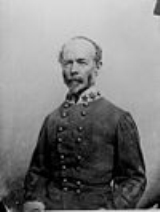
Joseph E. Johnston

Encyclopedia
Joseph Eggleston Johnston (February 3, 1807 – March 21, 1891) was a career U.S. Army
officer, serving with distinction in the Mexican-American War and Seminole Wars
, and was also one of the most senior general officers in the Confederate States Army
during the American Civil War
. He was unrelated to Albert Sidney Johnston
, another high-ranking Confederate general.
Johnston was trained as a civil engineer at the U.S. Military Academy. He served in Florida
, Texas
, and Kansas
, and fought with distinction in the Mexican-American War and by 1860 achieved the rank of brigadier general
as Quartermaster General
of the U.S. Army. When his native state of Virginia seceded from the Union, Johnston resigned his commission, the highest-ranking officer to join the Confederacy. To his dismay, however, he was appointed only the fourth ranking full general in the Confederate Army.
Johnston's effectiveness in the Civil War was undercut by tensions with Confederate President Jefferson Davis
, but he also suffered from a lack of aggressiveness, and victory eluded him in every campaign he personally commanded. He was the senior Confederate commander at the First Battle of Bull Run
in 1861, but the victory is usually credited to his subordinate, P.G.T. Beauregard. He defended the Confederate capital of Richmond, Virginia
, during the 1862 Peninsula Campaign
, withdrawing under the pressure of a superior force under Union
Maj. Gen.
George B. McClellan
. In his only offensive action during the campaign, he suffered a severe wound at the Battle of Seven Pines
, after which he was replaced in command by his classmate at West Point, Robert E. Lee
. In 1863, in command of the Department of the West
, he was criticized for his actions and failures in the Vicksburg Campaign
. In 1864, he fought against Union Maj. Gen. William T. Sherman in the Atlanta Campaign
, but was relieved of command after withdrawing from northwest Georgia to the outskirts of the city. In the final days of the war, he was returned to command of the small remaining forces in the Carolinas Campaign
and surrendered his armies to Sherman on April 26, 1865.
After the war Johnston was an executive in the railroad and insurance businesses. He served a term in Congress
and was commissioner of railroads under Grover Cleveland
. He died of pneumonia after serving in inclement weather as a pallbearer at the funeral of his former adversary, and later friend, William T. Sherman.
, Virginia
. (Longwood House later burned down. The rebuilt house was the birthplace in 1827 of Charles S. Venable
, an officer on the staff of Robert E. Lee
, and is now the home of the president of Longwood University
.) His grandfather, Peter Johnston, emigrated to Virginia from Scotland in 1726. Joseph was the seventh son of Judge Peter Johnston (1763-1831) and Mary Valentine Wood (1769-1825), a niece of Patrick Henry
. He was named for Major Joseph Eggleston
, under whom his father served in the American Revolutionary War
, in the command of Light-Horse Harry Lee. His brother Charles Clement Johnston
served as a congressman
, and his nephew John Warfield Johnston was a senator
; both represented Virginia. In 1811, the Johnston family moved to Abingdon, Virginia
, a town near the Tennessee border, where Peter built a home he named Panecillo.
Johnston attended the United States Military Academy
, nominated by John C. Calhoun
while he was Secretary of War
, days before he was inaugurated as vice president
in 1825. He was moderately successful at academics and received only a small number of disciplinary demerits. He graduated in 1829, ranking 13th of 46 cadets, and was appointed a second lieutenant in the 4th U.S. Artillery. He would become the first West Point graduate to be promoted to a general officer in the regular army, reaching a higher rank in the U.S. Army than did his 1829 classmate, Robert E. Lee
(2nd of 46).
, he was a civilian topographic engineer aboard a ship led by William Pope McArthur
. On January 12, 1838, at Jupiter, Florida
, the sailors who had gone ashore were attacked and Johnston was to claim there were "no less than 30 bullet holes" in his clothing and one bullet creased his scalp, leaving a scar he had for the rest of his life. Having encountered more combat activities in Florida as a civilian than he had had previously as an artillery officer, Johnston decided to rejoin the Army. He departed for Washington, D.C.
, in April 1838 and was appointed a first lieutenant of topographic engineers on July 7; on that same day, he received a brevet
promotion to captain for the actions at Jupiter Inlet and his explorations of the Florida Everglades
.
On July 10, 1845, in Baltimore, Johnston married Lydia Mulligan Sims McLane (1822–1887), the daughter of Louis McLane
, the president of the Baltimore and Ohio Railroad
and a prominent former politician (congressman
and senator
from Delaware
, minister to London
, and a member of President
Andrew Jackson's
cabinet). They had no children.
Johnston was enthusiastic about the outbreak of the Mexican-American War. He served on the staff of Lt. Gen. Winfield Scott
in the Siege of Veracruz
, having been chosen by Scott to be the officer carrying the demand for surrender beforehand to the provincial governor. He was in the vanguard of the movement inland under Brig. Gen. David E. Twiggs
and was severely wounded by grapeshot performing reconnaissance prior to the Battle of Cerro Gordo
. He was appointed a brevet lieutenant colonel
for his actions at Cerro Gordo. After recovering in a field hospital, he rejoined the army at Puebla. During the advance toward Mexico City, he was second in command of a regiment of U.S. "Voltigeurs
", meaning light infantry or skirmishers. He distinguished himself at Contreras
and Churubusco
, was wounded again at Chapultepec
, and received two brevet promotions for the latter two engagements, ending the war as a brevet colonel
of volunteers. (After the end of hostilities, he reverted to his peacetime rank of captain in the topographical engineers.) Winfield Scott remarked humorously that "Johnston is a great soldier, but he had an unfortunate knack of getting himself shot in nearly every engagement." Despite his wounds, however, Johnston's greatest anguish during the war was the death of his nephew, Preston Johnston. When Robert E. Lee informed Johnston that Preston had been killed by a Mexican artillery shell at Contreras, both officers wept, and Johnston grieved for the remainder of his life.
Johnston was an engineer on the Texas-United States boundary survey in 1841 and returned to be chief topographical engineer of the Department of Texas from 1848 to 1853. During the 1850s he displayed an early indication of his sensitivity for rank and prestige, sending letters to the War Department suggesting that he should be returned to a combat regiment with his wartime rank of colonel. Secretary of War Jefferson Davis
, an acquaintance of Johnston's from West Point, rebuffed these suggestions, a practice that he would continue during the Civil War, much to Johnston's irritation. Despite this disagreement, Davis thought enough of Johnston to appoint him lieutenant colonel in one of the newly formed regiments, the 1st U.S. Cavalry
at Fort Leavenworth, Kansas, under Col. Edwin V. "Bull" Sumner
, on March 1, 1855. (At this same time, Robert E. Lee was appointed lieutenant colonel of the 2nd U.S. Cavalry under Col. Albert Sidney Johnston
(no relation).) In this role, Johnston participated in actions against the Sioux
in the Wyoming Territory
and in the violence known as Bleeding Kansas
. He developed a mentor relationship and close friendship with one of his junior officers, Capt. George B. McClellan
, who would become one of his principal opponents during the Civil War.
In the fall of 1856, Johnston was transferred to a depot for new recruits at Jefferson Barracks, Missouri. In 1857 he led surveying expeditions to determine the Kansas border. Later that year, a new Secretary of War replaced Jefferson Davis—John B. Floyd
, a native of Abingdon, a cousin of Johnston's by marriage, and former guardian of Preston Johnston. Floyd overturned Davis's previous decision about Johnston's highest brevet rank and he was listed as a brevet colonel for Cerro Gordo, an action that caused grumbling within the Army about favoritism. In 1859, President James Buchanan
named Johnston's brother-in-law, Robert McLane, as minister to Mexico
, and Johnston accompanied him on a journey to visit Benito Juárez
's government in Veracruz, ordered to inspect possible military routes across the country in case of further hostilities.
Brig. Gen. Thomas S. Jesup, the Quartermaster General
of the U.S. Army, died on June 10, 1860. Winfield Scott was responsible for naming a replacement, but instead of one name, he offered four possibilities: Albert Sidney Johnston, Joseph E. Johnston, Robert E. Lee, and Charles F. Smith. Although Jefferson Davis, now a member of the Senate Military Affairs Committee, favored Albert Sidney Johnston, Secretary of War Floyd chose Joseph E. Johnston for the position. Johnston was promoted to brigadier general
on June 28, 1860. Johnston did not enjoy the position, preferring field command to paperwork in Washington. In addition, he suffered from the pressures of the imminent sectional crisis and the ethical dilemma of administering war matériel that might prove useful to his native South; he did not yield to temptation, however, as Secretary of War Floyd was accused of doing.
from the Union
in 1861, Johnston resigned his commission as a brigadier general in the regular army, the highest-ranking U.S. Army officer to do so. He was initially commissioned as a major general in the Virginia militia
on May 4, but the Virginia Convention decided two weeks later that only one major general was required in the state army and Robert E. Lee was their choice. Johnston was then offered a state brigadier general commission, which he declined, accepting instead a brigadier general commission in the Confederate Army on May 14. Johnston relieved Col. Thomas J. "Stonewall" Jackson
of command at Harpers Ferry
in May and organized the Army of the Shenandoah in July.
In the First Battle of Bull Run
(First Manassas), July 21, 1861, Johnston rapidly moved his small army from the Shenandoah Valley
to reinforce that of Brig. Gen. P.G.T. Beauregard, but he lacked familiarity with the terrain and ceded tactical planning of the battle to the more junior Beauregard as a professional courtesy. At midday, while Beauregard was still unclear about the direction his Union opponent was taking in the battle, Johnston decided that the critical point was to the north of his headquarters (the Lewis house, "Portici"), at Henry House Hill. He abruptly announced "The battle is there. I am going." Beauregard and the staffs of both generals followed his lead and rode off. Johnston encountered a scattered unit, the 4th Alabama, all of whose field grade officers had been killed, and personally rallied the men to reinforce the Confederate line. He consoled the despairing Brig. Gen. Barnard Bee
and urged him to lead his men back into the fight. (General Bee's exhortation to his men was the inspiration for Stonewall Jackson's nickname.) Beauregard then convinced Johnston that he would be more valuable organizing the arrival of reinforcements for the remainder of the battle than providing at-the-front tactical leadership. Although Beauregard managed to claim the majority of public credit, Johnston's behind-the-scenes role was a critical factor in the Southern victory. After Bull Run, Johnston assisted Beauregard and William Porcher Miles
in the design and production of the Confederate Battle Flag
. It was Johnston's idea to make the flag square.
In August, Johnston was promoted to full general—what is called a four-star general in the modern U.S. Army—but was not pleased that three other men he had outranked in the "old Army" now outranked him, even though Davis backdated his promotion to July 4. Johnston felt that since he was the senior officer to leave the U.S. Army and join the Confederacy he should not be ranked behind Samuel Cooper
, Albert Sidney Johnston, and Robert E. Lee. Only Beauregard was placed behind Johnston on the list of five new generals. This led to much bad blood between Johnston and Jefferson Davis, which would last throughout the war. The crux of Davis's counterargument was that Johnston's U.S. commission as a brigadier general was as a staff officer and that his highest line commission was as a lieutenant colonel; both Sidney Johnston and Lee had been full colonels. Johnston sent an intemperately worded letter to Davis, who was offended enough to discuss its tone with his cabinet.
Johnston was placed in command of the Department of the Potomac and the Confederate Army of the Potomac on July 21, 1861, and the Department of Northern Virginia on October 22. The winter of 1861–62 was relatively quiet for Johnston in his Centreville
headquarters, concerned primarily with organization and equipment issues, as the principal Northern army, also named Army of the Potomac
, was being organized by George B. McClellan. McClellan perceived Johnston's army as overwhelmingly strong in its fortifications, which prompted the Union general to plan an amphibious movement around Johnston's flank. In early March, learning of Union offensive preparations, Johnston withdrew his army to Culpeper Court House
. This movement had repercussions on both sides. President Davis was surprised and disappointed by the unannounced move, which he considered a "precipitate retreat." At about this time, Davis moved to restrict Johnston's authority by bringing Robert E. Lee to Richmond as his military adviser and began issuing direct orders to some of the forces under Johnston's ostensible command. On the Northern side, McClellan was publicly embarrassed when it was revealed that the Confederate position had not been nearly as strong as he had portrayed. But more importantly, it required him to replan his spring offensive, and instead of an amphibious landing at his preferred target of Urbanna
, he chose the Virginia Peninsula
, between the James and York Rivers, as his avenue of approach toward Richmond.
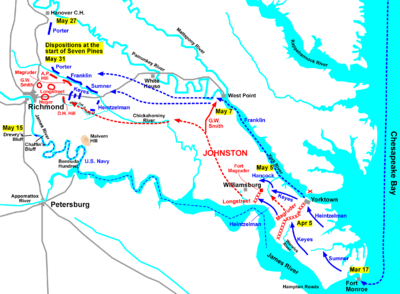 In early April 1862, McClellan, having landed his troops at Fort Monroe at the tip of the Virginia Peninsula, began to move slowly toward Yorktown
. Johnston's plan for the defense of the Confederate capital was controversial. Knowing that his army was half the size of McClellan's and that the Union Navy could provide direct support to McClellan from either river, Johnston attempted to convince Davis and Lee that the best course would be to concentrate in fortifications around Richmond. He was unsuccessful in persuading them and deployed most of his force on the Peninsula. Following lengthy siege preparations by McClellan at Yorktown, Johnston withdrew and fought a sharp defensive fight at Williamsburg
(May 5) and turned back an attempt at an amphibious turning movement at Eltham's Landing
(May 7). By late May the Union army was within six miles of Richmond.
Realizing that he could not defend Richmond forever from the Union's overwhelming numbers and heavy siege artillery and that McClellan's army was divided by the rain-swollen Chickahominy River
, Johnston attacked south of the river on May 31 in the Battle of Seven Pines
or Fair Oaks. His plan was aggressive, but too complicated for his subordinates to execute correctly, and he failed to ensure they understood his orders in detail or to supervise them closely. The battle was tactically inconclusive, but it stopped McClellan's advance on the city and would turn out to be the high-water mark of his invasion. More significant, however, was that Johnston was wounded by an artillery shell on the second day of the battle, hit in his right shoulder and chest. This led to Davis turning over command to the more aggressive Robert E. Lee, who would lead the Army of Northern Virginia for the rest of the war. Lee began by driving McClellan from the Peninsula during the Seven Days Battles
of late June.
, which gave him titular control of Gen. Braxton Bragg
's Army of Tennessee
and Lt. Gen. John C. Pemberton
's Department of Mississippi
and East Louisiana
. (The other major force in this area was the Trans-Mississippi Department, commanded by Lt. Gen. Theophilus H. Holmes
, stationed principally in Arkansas. Johnston argued throughout his tenure that Holmes's command should be combined with Pemberton's under Johnston's control, or at least to reinforce Pemberton with troops from Holmes's command, but he was unable to convince the government to take either of these steps.)
The first issue facing Johnston in the West was the fate of Braxton Bragg. The Confederate government was displeased with Bragg's performance at the Battle of Stones River
, as were many of Bragg's senior subordinates. Jefferson Davis ordered Johnston to visit Bragg and determine whether he should be replaced. Johnston realized that if he recommended Bragg's replacement, he would be the logical choice to succeed him, and he considered that a field army command was more desirable than his current, mostly administrative post, but his sense of honor prevented him from achieving this personal gain at Bragg's expense. After interviewing Bragg and a number of his subordinates, he produced a generally positive report and refused to relieve the army commander. Davis ordered Bragg to a meeting in Richmond and designated Johnston to take command in the field, but Bragg's wife was ill and he was unable to travel. Furthermore, in early April Johnston was forced to bed with lingering problems from his Peninsula wound, and the attention of the Confederates shifted from Tennessee to Mississippi, leaving Bragg in place.
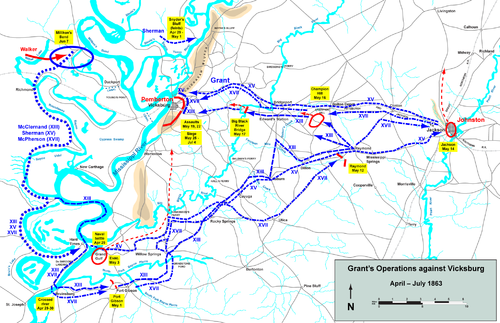 The major crisis facing Johnston was defending Confederate control of Vicksburg, Mississippi
, which was threatened by Union Maj. Gen. Ulysses S. Grant
, first in a series of unsuccessful maneuvers during the winter of 1862–63 to the north of the fortress city, but followed in April 1863 with an ambitious campaign that began with Grant's Union army crossing the Mississippi River
southwest of Vicksburg. Catching Lt. Gen. Pemberton by surprise, the Union army waged a series of successful battles as it moved northeast toward the state capital of Jackson
. On May 9, the Confederate Secretary of War directed Johnston to "proceed at once to Mississippi and take chief command of the forces in the field." Johnston informed Richmond that he was still medically unfit, but would obey the order. When he arrived in Jackson on May 13 from Middle Tennessee, he learned that two Union army corps were advancing on the city and that there were only about 6,000 troops available to defend it. Johnston ordered a fighting evacuation (the Battle of Jackson, May 14) and retreated with his force to the north. Grant captured the city and then faced to the west to approach Vicksburg.
Johnston began to move his force west to join Pemberton when he heard of that general's defeat at Champion Hill
(May 16) and Big Black River Bridge
(May 17). The survivors retreated to the fortifications of Vicksburg. Johnston urged Pemberton to avoid being surrounded by abandoning the city and to join forces with Johnston's troops, outnumbering Grant, but Davis had ordered Pemberton to defend the city as his highest priority. Grant launched two unsuccessful assaults against the fortifications and then settled in for a siege. The soldiers and civilians in the surrounded city waited in vain for Johnston's small force to come to their rescue. By late May Johnston had accumulated about 24,000 men but wanted additional reinforcements before moving forward. He considered ordering Bragg to send these reinforcements, but was concerned that this could result in the loss of Tennessee. He also bickered with President Davis about whether the order sending him to Mississippi could be construed as removing him from theater command; Steven E. Woodworth judges that Johnston "willfully misconstrued" his orders out of resentment of Davis's interference. Pemberton's army surrendered on July 4, 1863. Along with the capture of Port Hudson
a week later, the loss of Vicksburg gave the Union complete control of the Mississippi River and cut the Confederacy in two. President Davis wryly ascribed the strategic defeat to a "want of provisions inside and a general outside [Johnston] who would not fight."
The relationship between Johnston and Davis, difficult since the early days of the war, became bitter as recriminations were traded publicly about who was to blame for Vicksburg. Davis considered firing Johnston, but he remained a popular officer and had many political allies in Richmond, most notably Sen. Louis Wigfall
. Instead, Bragg's army was removed from Johnston's command, leaving him in control of only Alabama and Mississippi.
While Vicksburg was falling, Union Maj. Gen. William S. Rosecrans was advancing against Bragg in Tennessee, forcing him to evacuate Chattanooga
. Bragg achieved a significant victory against Rosecrans in the Battle of Chickamauga
(September 19–20), but he was defeated by Ulysses S. Grant in the Battles for Chattanooga
in November. Bragg resigned from his command of the Army of Tennessee and returned to Richmond in the role as military adviser to the president. Davis offered the position to William J. Hardee
, the senior corps commander, who refused it. He considered P.G.T. Beauregard, another general with whom he had poor personal relations, and also Robert E. Lee. Lee, who was reluctant to leave Virginia, first recommended Beauregard, but sensing Davis's discomfort, change his recommendation to Johnston. After much agonizing, Davis appointed Johnston to command the Army of Tennessee in Dalton, Georgia, on December 27, 1863.
s, causing him to fall back in the general direction of Atlanta. Johnston saw the preservation of his army as the most important consideration, and hence conducted a very cautious campaign. He handled his army well, slowing the Union advance and inflicting heavier losses than he sustained.
Sherman began his Atlanta Campaign
on May 4. Johnston's Army of Tennessee fought defensive battles against the Federals at the approaches to Dalton
, which was evacuated on May 13, then retreated 12 miles south to Resaca, and constructed defensive positions. However, after a brief battle
, Johnston again yielded to Sherman, and retreated from Resaca on May 15. Johnston assembled the Confederate forces for an attack at Cassville, but one of his corps commanders, Lt. Gen. John Bell Hood
, failed to attack as ordered and the opportunity was lost. On May 20 they again retreated 8 miles further south to Cartersville. The month of May 1864 ended with Sherman's forces attempting to move away from their railroad supply line with another turning movement, but became bogged down by the Confederates' fierce defenses at the Battle of New Hope Church
on May 25, the Battle of Pickett's Mill
on May 27, and the Battle of Dallas
on May 28.
In June Sherman's forces continued maneuvers around the northern approaches to Atlanta, and a battle ensued at Kolb's Farm
on June 22, followed by Sherman's first (and only) attempt at a massive frontal assault in the Battle of Kennesaw Mountain
on June 27, which Johnston strongly repulsed. However, by this time Federal forces were within 17 miles of Atlanta, threatening the city from the west and north. Johnston had yielded over 110 miles of mountainous, and thus more easily defensible, territory in just two months, while the Confederate government became increasingly more frustrated and alarmed. Letters to Richmond by Johnston's subordinates, particularly Lt. Gen. Hood, complaining of his lack of aggressiveness, did not help his situation. When Johnston retreated across the Chattahoochee River
, the final major barrier before Atlanta, President Davis lost his patience.
In early July Davis sent Gen. Braxton Bragg
to Atlanta to assess the situation. After several meetings with local civilian leaders and Johnston's subordinates, Bragg returned to Richmond and urged President Davis to replace Johnston. Davis removed Johnston from command on July 17, 1864, just outside of Atlanta. (His replacement, Lt. Gen. Hood, was overly aggressive, but ineffective, losing Atlanta in September and a large portion of his army in the Franklin-Nashville Campaign
that winter.) Davis's decision to remove Johnston was one of the most controversial of the war.
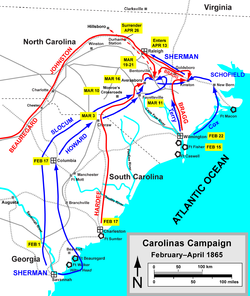 Johnston traveled to Columbia, South Carolina
, to begin a virtual retirement. However, as the Confederacy became increasingly concerned about Sherman's March to the Sea
across Georgia and then north through the Carolinas
, the public clamored for Johnston's return. The general in charge of the Western Theater, P.G.T. Beauregard, was making little progress against the advancing Union force. Political opponents of Jefferson Davis, such as Sen. Louis Wigfall
, added to the pressure in Congress. Diarist Mary Chestnut wrote, "We thought this was a struggle for independence. Now it seems it is only a fight between Joe Johnston and Jeff Davis." In January 1865, the Congress passed a law authorizing Robert E. Lee the powers of general in chief, and recommending that Johnston be reinstated as the commander of the Army of Tennessee. Davis immediately appointed Lee to the position, but refused to restore Johnston. In a lengthy unpublished memo, Davis wrote, "My opinion of General Johnston's unfitness for command has ripened slowly and against my inclinations into a conviction so settled that it would be impossible for me again to feel confidence in him as the commander of an army in the field." Vice President Alexander H. Stephens and 17 senators petitioned Lee to use his new authority to appoint Johnston, bypassing Davis, but the general in chief declined. Instead, he recommended the appointment to Davis.
Despite his serious misgivings, Davis restored Johnston to active duty on February 25, 1865. His new command comprised two military departments: the Department of South Carolina, Georgia, and Florida, and the Department of North Carolina and Southern Virginia; he assumed command of the latter department on March 6. These commands included three Confederate field armies, including the remnants of the once formidable Army of Tennessee, but they were armies in name only. The Tennessee army had been severely depleted at Franklin and Nashville, lacked sufficient supplies and ammunition, and the men had not been paid for months; only about 6,600 traveled to South Carolina. Johnston also had available 12,000 men under William J. Hardee
, who had been unsuccessfully attempting to resist Sherman's advance, Braxton Bragg
's force in Wilmington, North Carolina
, and 6,000 cavalrymen under Wade Hampton
.
Johnston, severely outnumbered, hoped to combine his force with a detachment of Robert E. Lee's army from Virginia, jointly defeat Sherman, and then return to Virginia for an attack on Ulysses S. Grant
. Lee initially refused to cooperate with this plan. (Following the fall of Richmond in April, Lee attempted to escape to North Carolina to join Johnston, but it was too late.) Recognizing that Sherman was moving quickly, Johnston then planned to consolidate his own small armies so that he could land a blow against an isolated portion of Sherman's army, which was advancing in two separated columns. On March 19, 1865, Johnston was able to catch the left wing of Sherman's army by surprise at the Battle of Bentonville
and briefly gained some tactical successes before superior numbers forced him to retreat to Raleigh, North Carolina
. Unable to secure the capital, Johnston's army withdrew to Greensboro
.
After learning of Lee's surrender at Appomattox Court House on April 9, Johnston agreed to meet with General Sherman between the lines at a small farm known as Bennett Place
near present day Durham, North Carolina
. After three separate days (April 17, 18, and 26, 1865) of negotiations, Johnston surrendered the Army of Tennessee and all remaining Confederate forces still active in North Carolina, South Carolina, Georgia, and Florida. It was the largest surrender of the war, totaling 89,270 soldiers. President Davis considered that Johnston, surrendering so many troops that had not been explicitly defeated in battle, to have committed an act of treachery. Johnston was paroled on May 2 at Greensboro.
After the surrender, Sherman issued ten days' rations to the hungry Confederate soldiers, as well as horses and mules for them to "insure a crop." He also ordered distribution of corn, meal, and flour to civilians throughout the South. This was an act of generosity that Johnston would never forget; he wrote to Sherman that his attitude "reconciles me to what I have previously regarded as the misfortune of my life, that of having you to encounter in the field."
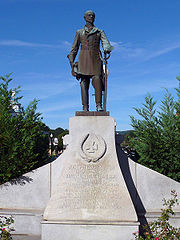 After the war Johnston struggled to make a living for himself and his wife, who was ailing. He became president of a small railroad, the Alabama & Tennessee River Rail Road Company, which during his tenure of May 1866 to November 1867, was renamed the Selma, Rome, & Dalton Railroad. Johnston was bored with the position and the company failed for lack of capital. He established in 1868 an insurance company in Savannah, Georgia, acting as an agent for the Liverpool and London and Globe Insurance Company, and within four years had a network of more than 120 agents across the deep South. The income from this venture allowed him to devote time to his great postwar activity, writing his memoirs. His Narrative of Military Operations, published in 1874, was highly critical of Davis and many of his fellow generals, continuing his grievance about the unfairness of his ranking as a general and attempting to justify his career as a cautious campaigner. The book sold poorly and its publisher failed to make a profit.
Although many Confederate generals were critical of Johnston, the memoirs of both Sherman and Grant put him in a favorable light. Sherman described him as a "dangerous and wily opponent" and criticized Johnston's nemeses, Hood and Davis. Grant supported his decisions in the Vicksburg Campaign: "Johnston evidently took in the situation, and wisely, I think, abstained from making an assault on us because it would simply have inflicted losses on both sides without accomplishing any result." Commenting on the Atlanta Campaign, Grant wrote, "For my own part, I think that Johnston's tactics were right. Anything that could have prolonged the war a year beyond the time that it finally did close, would probably have exhausted the North to such an extent that they might then have abandoned the contest and agreed to a settlement."
Johnston moved from Savannah to Richmond in the winter of 1876–77. He served in the 46th Congress
from 1879 to 1881 as a Democratic
congressman
; he was not a candidate for renomination in 1880. He was a commissioner of railroads in the administration of President Grover Cleveland
. After his wife died in 1887, Johnston spent his remaining years traveling to veterans' gatherings, where he was universally cheered.
Johnston, like Lee, never forgot the magnanimity of the man to whom he surrendered, and would not allow an unkind word to be said about Sherman in his presence. Sherman and Johnston corresponded frequently and they met for friendly dinners in Washington whenever Johnston traveled there. When Sherman died, Johnston served as an honorary pallbearer at his funeral; during the procession in New York City on February 19, 1891, he kept his hat off as a sign of respect in the cold, rainy weather. Someone with concern for the old general's health asked him to put on his hat, to which Johnston replied "If I were in his place and he were standing here in mine, he would not put on his hat." He caught a cold that day, which developed into pneumonia
, and he died several weeks later in Washington, D.C. He was buried next to his wife in Green Mount Cemetery, Baltimore, Maryland. His personal papers are held by the Special Collections Research Center at the College of William & Mary.
, in 1912. On March 20, 2010, a bronze statue of Johnston was dedicated at the site of the Battle of Bentonville in North Carolina. During World War II
, the United States Navy
named a Liberty Ship
in honor of Johnston.
by Robert Skimin
imagines a scenario in which Johnston is left in command during the Atlanta Campaign.
United States Army
The United States Army is the main branch of the United States Armed Forces responsible for land-based military operations. It is the largest and oldest established branch of the U.S. military, and is one of seven U.S. uniformed services...
officer, serving with distinction in the Mexican-American War and Seminole Wars
Seminole Wars
The Seminole Wars, also known as the Florida Wars, were three conflicts in Florida between the Seminole — the collective name given to the amalgamation of various groups of native Americans and Black people who settled in Florida in the early 18th century — and the United States Army...
, and was also one of the most senior general officers in the Confederate States Army
Confederate States Army
The Confederate States Army was the army of the Confederate States of America while the Confederacy existed during the American Civil War. On February 8, 1861, delegates from the seven Deep South states which had already declared their secession from the United States of America adopted the...
during the American Civil War
American Civil War
The American Civil War was a civil war fought in the United States of America. In response to the election of Abraham Lincoln as President of the United States, 11 southern slave states declared their secession from the United States and formed the Confederate States of America ; the other 25...
. He was unrelated to Albert Sidney Johnston
Albert Sidney Johnston
Albert Sidney Johnston served as a general in three different armies: the Texas Army, the United States Army, and the Confederate States Army...
, another high-ranking Confederate general.
Johnston was trained as a civil engineer at the U.S. Military Academy. He served in Florida
Florida
Florida is a state in the southeastern United States, located on the nation's Atlantic and Gulf coasts. It is bordered to the west by the Gulf of Mexico, to the north by Alabama and Georgia and to the east by the Atlantic Ocean. With a population of 18,801,310 as measured by the 2010 census, it...
, Texas
Texas
Texas is the second largest U.S. state by both area and population, and the largest state by area in the contiguous United States.The name, based on the Caddo word "Tejas" meaning "friends" or "allies", was applied by the Spanish to the Caddo themselves and to the region of their settlement in...
, and Kansas
Kansas
Kansas is a US state located in the Midwestern United States. It is named after the Kansas River which flows through it, which in turn was named after the Kansa Native American tribe, which inhabited the area. The tribe's name is often said to mean "people of the wind" or "people of the south...
, and fought with distinction in the Mexican-American War and by 1860 achieved the rank of brigadier general
Brigadier general (United States)
A brigadier general in the United States Army, Air Force, and Marine Corps, is a one-star general officer, with the pay grade of O-7. Brigadier general ranks above a colonel and below major general. Brigadier general is equivalent to the rank of rear admiral in the other uniformed...
as Quartermaster General
Quartermaster general (USA)
The Quartermaster General of the United States Army is a general officer who is responsible for the Quartermaster Corps, the Quartermaster branch of the U.S. Army. The Quartermaster General does not command Quartermaster units, but is primarily focused on training, doctrine and professional...
of the U.S. Army. When his native state of Virginia seceded from the Union, Johnston resigned his commission, the highest-ranking officer to join the Confederacy. To his dismay, however, he was appointed only the fourth ranking full general in the Confederate Army.
Johnston's effectiveness in the Civil War was undercut by tensions with Confederate President Jefferson Davis
Jefferson Davis
Jefferson Finis Davis , also known as Jeff Davis, was an American statesman and leader of the Confederacy during the American Civil War, serving as President for its entire history. He was born in Kentucky to Samuel and Jane Davis...
, but he also suffered from a lack of aggressiveness, and victory eluded him in every campaign he personally commanded. He was the senior Confederate commander at the First Battle of Bull Run
First Battle of Bull Run
First Battle of Bull Run, also known as First Manassas , was fought on July 21, 1861, in Prince William County, Virginia, near the City of Manassas...
in 1861, but the victory is usually credited to his subordinate, P.G.T. Beauregard. He defended the Confederate capital of Richmond, Virginia
Richmond, Virginia
Richmond is the capital of the Commonwealth of Virginia, in the United States. It is an independent city and not part of any county. Richmond is the center of the Richmond Metropolitan Statistical Area and the Greater Richmond area...
, during the 1862 Peninsula Campaign
Peninsula Campaign
The Peninsula Campaign of the American Civil War was a major Union operation launched in southeastern Virginia from March through July 1862, the first large-scale offensive in the Eastern Theater. The operation, commanded by Maj. Gen. George B...
, withdrawing under the pressure of a superior force under Union
Union Army
The Union Army was the land force that fought for the Union during the American Civil War. It was also known as the Federal Army, the U.S. Army, the Northern Army and the National Army...
Maj. Gen.
Major general (United States)
In the United States Army, United States Marine Corps, and United States Air Force, major general is a two-star general-officer rank, with the pay grade of O-8. Major general ranks above brigadier general and below lieutenant general...
George B. McClellan
George B. McClellan
George Brinton McClellan was a major general during the American Civil War. He organized the famous Army of the Potomac and served briefly as the general-in-chief of the Union Army. Early in the war, McClellan played an important role in raising a well-trained and organized army for the Union...
. In his only offensive action during the campaign, he suffered a severe wound at the Battle of Seven Pines
Battle of Seven Pines
The Battle of Seven Pines, also known as the Battle of Fair Oaks or Fair Oaks Station, took place on May 31 and June 1, 1862, in Henrico County, Virginia, as part of the Peninsula Campaign of the American Civil War. It was the culmination of an offensive up the Virginia Peninsula by Union Maj. Gen....
, after which he was replaced in command by his classmate at West Point, Robert E. Lee
Robert E. Lee
Robert Edward Lee was a career military officer who is best known for having commanded the Confederate Army of Northern Virginia in the American Civil War....
. In 1863, in command of the Department of the West
Department of the West
The Department of the West, later known as the Western Department, was a major command of the United States Army during the 19th century. It oversaw the military affairs in the country west of the Mississippi River to the borders of California and Oregon.-Organization:The Department was first...
, he was criticized for his actions and failures in the Vicksburg Campaign
Vicksburg Campaign
The Vicksburg Campaign was a series of maneuvers and battles in the Western Theater of the American Civil War directed against Vicksburg, Mississippi, a fortress city that dominated the last Confederate-controlled section of the Mississippi River. The Union Army of the Tennessee under Maj. Gen....
. In 1864, he fought against Union Maj. Gen. William T. Sherman in the Atlanta Campaign
Atlanta Campaign
The Atlanta Campaign was a series of battles fought in the Western Theater of the American Civil War throughout northwest Georgia and the area around Atlanta during the summer of 1864. Union Maj. Gen. William T. Sherman invaded Georgia from the vicinity of Chattanooga, Tennessee, beginning in May...
, but was relieved of command after withdrawing from northwest Georgia to the outskirts of the city. In the final days of the war, he was returned to command of the small remaining forces in the Carolinas Campaign
Carolinas Campaign
The Carolinas Campaign was the final campaign in the Western Theater of the American Civil War. In January 1865, Union Maj. Gen. William Tecumseh Sherman advanced north from Savannah, Georgia, through the Carolinas, with the intention of linking up with Union forces in Virginia. The defeat of ...
and surrendered his armies to Sherman on April 26, 1865.
After the war Johnston was an executive in the railroad and insurance businesses. He served a term in Congress
United States House of Representatives
The United States House of Representatives is one of the two Houses of the United States Congress, the bicameral legislature which also includes the Senate.The composition and powers of the House are established in Article One of the Constitution...
and was commissioner of railroads under Grover Cleveland
Grover Cleveland
Stephen Grover Cleveland was the 22nd and 24th president of the United States. Cleveland is the only president to serve two non-consecutive terms and therefore is the only individual to be counted twice in the numbering of the presidents...
. He died of pneumonia after serving in inclement weather as a pallbearer at the funeral of his former adversary, and later friend, William T. Sherman.
Early years
Johnston was born at Longwood House in "Cherry Grove", near FarmvilleFarmville, Virginia
Farmville is a town in Prince Edward and Cumberland counties in the U.S. state of Virginia. The population was 6,845 at the 2000 census. It is the county seat of Prince Edward County....
, Virginia
Virginia
The Commonwealth of Virginia , is a U.S. state on the Atlantic Coast of the Southern United States. Virginia is nicknamed the "Old Dominion" and sometimes the "Mother of Presidents" after the eight U.S. presidents born there...
. (Longwood House later burned down. The rebuilt house was the birthplace in 1827 of Charles S. Venable
Charles S. Venable
Charles Scott Venable was a mathematician, astronomer, and military officer. In mathematics, he is noted for authoring a series of publications as a University of Virginia professor.-Biography:...
, an officer on the staff of Robert E. Lee
Robert E. Lee
Robert Edward Lee was a career military officer who is best known for having commanded the Confederate Army of Northern Virginia in the American Civil War....
, and is now the home of the president of Longwood University
Longwood University
Longwood University is a four-year public, liberal-arts university located in Farmville, Virginia, United States. It was founded in 1839 and became a university on July 1, 2002...
.) His grandfather, Peter Johnston, emigrated to Virginia from Scotland in 1726. Joseph was the seventh son of Judge Peter Johnston (1763-1831) and Mary Valentine Wood (1769-1825), a niece of Patrick Henry
Patrick Henry
Patrick Henry was an orator and politician who led the movement for independence in Virginia in the 1770s. A Founding Father, he served as the first and sixth post-colonial Governor of Virginia from 1776 to 1779 and subsequently, from 1784 to 1786...
. He was named for Major Joseph Eggleston
Joseph Eggleston
Joseph Eggleston was an American planter, soldier, and politician from Amelia County, Virginia. He represented Virginia in the U.S. Congress from 1798 until 1801. He was the uncle of William S. Archer....
, under whom his father served in the American Revolutionary War
American Revolutionary War
The American Revolutionary War , the American War of Independence, or simply the Revolutionary War, began as a war between the Kingdom of Great Britain and thirteen British colonies in North America, and ended in a global war between several European great powers.The war was the result of the...
, in the command of Light-Horse Harry Lee. His brother Charles Clement Johnston
Charles Clement Johnston
Charles Clement Johnston was a U.S. Representative from Virginia.Born in Prince Edward County, Virginia, and educated at home, he moved with his parents to Panicello, near Abingdon, Virginia, in 1811. He studied law and was admitted to the bar in 1818 and commenced practice in Abingdon, Virginia...
served as a congressman
United States House of Representatives
The United States House of Representatives is one of the two Houses of the United States Congress, the bicameral legislature which also includes the Senate.The composition and powers of the House are established in Article One of the Constitution...
, and his nephew John Warfield Johnston was a senator
United States Senate
The United States Senate is the upper house of the bicameral legislature of the United States, and together with the United States House of Representatives comprises the United States Congress. The composition and powers of the Senate are established in Article One of the U.S. Constitution. Each...
; both represented Virginia. In 1811, the Johnston family moved to Abingdon, Virginia
Abingdon, Virginia
Abingdon is a town in Washington County, Virginia, USA, 133 miles southwest of Roanoke. The population was 8,191 at the 2010 census. It is the county seat of Washington County and is a designated Virginia Historic Landmark...
, a town near the Tennessee border, where Peter built a home he named Panecillo.
Johnston attended the United States Military Academy
United States Military Academy
The United States Military Academy at West Point is a four-year coeducational federal service academy located at West Point, New York. The academy sits on scenic high ground overlooking the Hudson River, north of New York City...
, nominated by John C. Calhoun
John C. Calhoun
John Caldwell Calhoun was a leading politician and political theorist from South Carolina during the first half of the 19th century. Calhoun eloquently spoke out on every issue of his day, but often changed positions. Calhoun began his political career as a nationalist, modernizer, and proponent...
while he was Secretary of War
United States Secretary of War
The Secretary of War was a member of the United States President's Cabinet, beginning with George Washington's administration. A similar position, called either "Secretary at War" or "Secretary of War," was appointed to serve the Congress of the Confederation under the Articles of Confederation...
, days before he was inaugurated as vice president
Vice President of the United States
The Vice President of the United States is the holder of a public office created by the United States Constitution. The Vice President, together with the President of the United States, is indirectly elected by the people, through the Electoral College, to a four-year term...
in 1825. He was moderately successful at academics and received only a small number of disciplinary demerits. He graduated in 1829, ranking 13th of 46 cadets, and was appointed a second lieutenant in the 4th U.S. Artillery. He would become the first West Point graduate to be promoted to a general officer in the regular army, reaching a higher rank in the U.S. Army than did his 1829 classmate, Robert E. Lee
Robert E. Lee
Robert Edward Lee was a career military officer who is best known for having commanded the Confederate Army of Northern Virginia in the American Civil War....
(2nd of 46).
U.S. Army service
Johnston resigned from the Army in March 1837 and studied civil engineering. During the Second Seminole WarSecond Seminole War
The Second Seminole War, also known as the Florida War, was a conflict from 1835 to 1842 in Florida between various groups of Native Americans collectively known as Seminoles and the United States, part of a series of conflicts called the Seminole Wars...
, he was a civilian topographic engineer aboard a ship led by William Pope McArthur
William Pope McArthur
William Pope McArthur was an American naval officer and hydrologist who was involved in the first surveys of the Pacific Coast for the U.S. Coast and Geodetic Survey.-Early life:...
. On January 12, 1838, at Jupiter, Florida
Jupiter, Florida
Jupiter is a town located in Palm Beach County, Florida. As of the 2000 census, the town had a total population of 39,328. The estimate population for 2009 is 50,606. As of 2006, the population had grown to 50,028, according to the University of Florida, Bureau of Economic and Business Research....
, the sailors who had gone ashore were attacked and Johnston was to claim there were "no less than 30 bullet holes" in his clothing and one bullet creased his scalp, leaving a scar he had for the rest of his life. Having encountered more combat activities in Florida as a civilian than he had had previously as an artillery officer, Johnston decided to rejoin the Army. He departed for Washington, D.C.
Washington, D.C.
Washington, D.C., formally the District of Columbia and commonly referred to as Washington, "the District", or simply D.C., is the capital of the United States. On July 16, 1790, the United States Congress approved the creation of a permanent national capital as permitted by the U.S. Constitution....
, in April 1838 and was appointed a first lieutenant of topographic engineers on July 7; on that same day, he received a brevet
Brevet (military)
In many of the world's military establishments, brevet referred to a warrant authorizing a commissioned officer to hold a higher rank temporarily, but usually without receiving the pay of that higher rank except when actually serving in that role. An officer so promoted may be referred to as being...
promotion to captain for the actions at Jupiter Inlet and his explorations of the Florida Everglades
Everglades
The Everglades are subtropical wetlands in the southern portion of the U.S. state of Florida, comprising the southern half of a large watershed. The system begins near Orlando with the Kissimmee River, which discharges into the vast but shallow Lake Okeechobee...
.
On July 10, 1845, in Baltimore, Johnston married Lydia Mulligan Sims McLane (1822–1887), the daughter of Louis McLane
Louis McLane
Louis McLane was an American lawyer and politician from Wilmington, in New Castle County, Delaware, and Baltimore, Maryland. He was a veteran of the War of 1812 and a member of the Federalist Party and later the Democratic Party. He served as the U.S. Representative from Delaware, U.S. Senator...
, the president of the Baltimore and Ohio Railroad
Baltimore and Ohio Railroad
The Baltimore and Ohio Railroad was one of the oldest railroads in the United States and the first common carrier railroad. It came into being mostly because the city of Baltimore wanted to compete with the newly constructed Erie Canal and another canal being proposed by Pennsylvania, which...
and a prominent former politician (congressman
United States House of Representatives
The United States House of Representatives is one of the two Houses of the United States Congress, the bicameral legislature which also includes the Senate.The composition and powers of the House are established in Article One of the Constitution...
and senator
United States Senate
The United States Senate is the upper house of the bicameral legislature of the United States, and together with the United States House of Representatives comprises the United States Congress. The composition and powers of the Senate are established in Article One of the U.S. Constitution. Each...
from Delaware
Delaware
Delaware is a U.S. state located on the Atlantic Coast in the Mid-Atlantic region of the United States. It is bordered to the south and west by Maryland, and to the north by Pennsylvania...
, minister to London
United States Ambassador to the United Kingdom
The office of United States Ambassador to the United Kingdom was traditionally, and still is very much so today due to the Special Relationship, the most prestigious position in the United States Foreign Service...
, and a member of President
President of the United States
The President of the United States of America is the head of state and head of government of the United States. The president leads the executive branch of the federal government and is the commander-in-chief of the United States Armed Forces....
Andrew Jackson's
Andrew Jackson
Andrew Jackson was the seventh President of the United States . Based in frontier Tennessee, Jackson was a politician and army general who defeated the Creek Indians at the Battle of Horseshoe Bend , and the British at the Battle of New Orleans...
cabinet). They had no children.
Johnston was enthusiastic about the outbreak of the Mexican-American War. He served on the staff of Lt. Gen. Winfield Scott
Winfield Scott
Winfield Scott was a United States Army general, and unsuccessful presidential candidate of the Whig Party in 1852....
in the Siege of Veracruz
Siege of Veracruz
The Battle of Veracruz was a 20-day siege of the key Mexican beachhead seaport of Veracruz, during the Mexican-American War. Lasting from 9-29 March 1847, it began with the first large-scale amphibious assault conducted by United States military forces, and ended with the surrender and occupation...
, having been chosen by Scott to be the officer carrying the demand for surrender beforehand to the provincial governor. He was in the vanguard of the movement inland under Brig. Gen. David E. Twiggs
David E. Twiggs
David Emanuel Twiggs was a United States soldier during the War of 1812 and Mexican-American War and a general of the Confederate States Army during the American Civil War...
and was severely wounded by grapeshot performing reconnaissance prior to the Battle of Cerro Gordo
Battle of Cerro Gordo
The Battle of Cerro Gordo, or Battle of Sierra Gordo, in the Mexican-American War saw Winfield Scott's United States troops flank and drive Santa Anna's larger Mexican army from a strong defensive position.-Battle:...
. He was appointed a brevet lieutenant colonel
Lieutenant Colonel (United States)
In the United States Army, United States Air Force, and United States Marine Corps, a lieutenant colonel is a field grade military officer rank just above the rank of major and just below the rank of colonel. It is equivalent to the naval rank of commander in the other uniformed services.The pay...
for his actions at Cerro Gordo. After recovering in a field hospital, he rejoined the army at Puebla. During the advance toward Mexico City, he was second in command of a regiment of U.S. "Voltigeurs
Voltigeurs
The Voltigeurs were French military skirmish units created in 1804 by Emperor Napoleon I.-Etymology:Voltigeurs hold their name from their originally conceived role of cavalry-transported skirmishers: the voltigeurs were intended to jump onto the croup of cavalry horses in order to advance more...
", meaning light infantry or skirmishers. He distinguished himself at Contreras
Battle of Contreras
The Battle of Contreras, also known as the Battle of Padierna, took place during August 19–20, 1847, in the final encounters of the Mexican-American War. In the Battle of Churubusco, fighting continued the following day.-Background:...
and Churubusco
Battle of Churubusco
The Battle of Churubusco took place on August 20, 1847, in the immediate aftermath of the Battle of Contreras during the Mexican-American War. After defeating the Mexican army at Churubusco, the U.S. Army was only 5 miles away from Mexico City, the capital of the nation...
, was wounded again at Chapultepec
Battle of Chapultepec
The Battle of Chapultepec, in September 1847, was a United States victory over Mexican forces holding Chapultepec Castle west of Mexico City during the Mexican-American War.-Background:On September 13, 1847, in the costly Battle of Molino del Rey, U.S...
, and received two brevet promotions for the latter two engagements, ending the war as a brevet colonel
Colonel (United States)
In the United States Army, Air Force, and Marine Corps, colonel is a senior field grade military officer rank just above the rank of lieutenant colonel and just below the rank of brigadier general...
of volunteers. (After the end of hostilities, he reverted to his peacetime rank of captain in the topographical engineers.) Winfield Scott remarked humorously that "Johnston is a great soldier, but he had an unfortunate knack of getting himself shot in nearly every engagement." Despite his wounds, however, Johnston's greatest anguish during the war was the death of his nephew, Preston Johnston. When Robert E. Lee informed Johnston that Preston had been killed by a Mexican artillery shell at Contreras, both officers wept, and Johnston grieved for the remainder of his life.
Johnston was an engineer on the Texas-United States boundary survey in 1841 and returned to be chief topographical engineer of the Department of Texas from 1848 to 1853. During the 1850s he displayed an early indication of his sensitivity for rank and prestige, sending letters to the War Department suggesting that he should be returned to a combat regiment with his wartime rank of colonel. Secretary of War Jefferson Davis
Jefferson Davis
Jefferson Finis Davis , also known as Jeff Davis, was an American statesman and leader of the Confederacy during the American Civil War, serving as President for its entire history. He was born in Kentucky to Samuel and Jane Davis...
, an acquaintance of Johnston's from West Point, rebuffed these suggestions, a practice that he would continue during the Civil War, much to Johnston's irritation. Despite this disagreement, Davis thought enough of Johnston to appoint him lieutenant colonel in one of the newly formed regiments, the 1st U.S. Cavalry
1st Cavalry Regiment (1855)
1st Cavalry Regiment was a unit of the United States Army, and was the first US Army unit to be designated "Cavalry". Previously, mounted riflemen were called “Dragoons”. In 1833 the "First Regiment of Dragoons" was formed and soon after that the "Second Regiment of Dragoons"...
at Fort Leavenworth, Kansas, under Col. Edwin V. "Bull" Sumner
Edwin Vose Sumner
Edwin Vose Sumner was a career United States Army officer who became a Union Army general and the oldest field commander of any Army Corps on either side during the American Civil War...
, on March 1, 1855. (At this same time, Robert E. Lee was appointed lieutenant colonel of the 2nd U.S. Cavalry under Col. Albert Sidney Johnston
Albert Sidney Johnston
Albert Sidney Johnston served as a general in three different armies: the Texas Army, the United States Army, and the Confederate States Army...
(no relation).) In this role, Johnston participated in actions against the Sioux
Sioux
The Sioux are Native American and First Nations people in North America. The term can refer to any ethnic group within the Great Sioux Nation or any of the nation's many language dialects...
in the Wyoming Territory
Wyoming Territory
The Territory of Wyoming was an organized incorporated territory of the United States that existed from July 25, 1868, until July 10, 1890, when it was admitted to the Union as the State of Wyoming. Cheyenne was the territorial capital...
and in the violence known as Bleeding Kansas
Bleeding Kansas
Bleeding Kansas, Bloody Kansas or the Border War, was a series of violent events, involving anti-slavery Free-Staters and pro-slavery "Border Ruffian" elements, that took place in the Kansas Territory and the western frontier towns of the U.S. state of Missouri roughly between 1854 and 1858...
. He developed a mentor relationship and close friendship with one of his junior officers, Capt. George B. McClellan
George B. McClellan
George Brinton McClellan was a major general during the American Civil War. He organized the famous Army of the Potomac and served briefly as the general-in-chief of the Union Army. Early in the war, McClellan played an important role in raising a well-trained and organized army for the Union...
, who would become one of his principal opponents during the Civil War.
In the fall of 1856, Johnston was transferred to a depot for new recruits at Jefferson Barracks, Missouri. In 1857 he led surveying expeditions to determine the Kansas border. Later that year, a new Secretary of War replaced Jefferson Davis—John B. Floyd
John B. Floyd
John Buchanan Floyd was the 31st Governor of Virginia, U.S. Secretary of War, and the Confederate general in the American Civil War who lost the crucial Battle of Fort Donelson.-Early life:...
, a native of Abingdon, a cousin of Johnston's by marriage, and former guardian of Preston Johnston. Floyd overturned Davis's previous decision about Johnston's highest brevet rank and he was listed as a brevet colonel for Cerro Gordo, an action that caused grumbling within the Army about favoritism. In 1859, President James Buchanan
James Buchanan
James Buchanan, Jr. was the 15th President of the United States . He is the only president from Pennsylvania, the only president who remained a lifelong bachelor and the last to be born in the 18th century....
named Johnston's brother-in-law, Robert McLane, as minister to Mexico
United States Ambassador to Mexico
The United States has maintained diplomatic relations with Mexico since 1823, when Andrew Jackson was appointed Envoy Extraordinary and Minister Plenipotentiary to that country. Jackson declined the appointment, however, and Joel R. Poinsett became the first U.S. envoy to Mexico in 1825. The rank...
, and Johnston accompanied him on a journey to visit Benito Juárez
Benito Juárez
Benito Juárez born Benito Pablo Juárez García, was a Mexican lawyer and politician of Zapotec origin from Oaxaca who served five terms as president of Mexico: 1858–1861 as interim, 1861–1865, 1865–1867, 1867–1871 and 1871–1872...
's government in Veracruz, ordered to inspect possible military routes across the country in case of further hostilities.
Brig. Gen. Thomas S. Jesup, the Quartermaster General
Quartermaster general (USA)
The Quartermaster General of the United States Army is a general officer who is responsible for the Quartermaster Corps, the Quartermaster branch of the U.S. Army. The Quartermaster General does not command Quartermaster units, but is primarily focused on training, doctrine and professional...
of the U.S. Army, died on June 10, 1860. Winfield Scott was responsible for naming a replacement, but instead of one name, he offered four possibilities: Albert Sidney Johnston, Joseph E. Johnston, Robert E. Lee, and Charles F. Smith. Although Jefferson Davis, now a member of the Senate Military Affairs Committee, favored Albert Sidney Johnston, Secretary of War Floyd chose Joseph E. Johnston for the position. Johnston was promoted to brigadier general
Brigadier general (United States)
A brigadier general in the United States Army, Air Force, and Marine Corps, is a one-star general officer, with the pay grade of O-7. Brigadier general ranks above a colonel and below major general. Brigadier general is equivalent to the rank of rear admiral in the other uniformed...
on June 28, 1860. Johnston did not enjoy the position, preferring field command to paperwork in Washington. In addition, he suffered from the pressures of the imminent sectional crisis and the ethical dilemma of administering war matériel that might prove useful to his native South; he did not yield to temptation, however, as Secretary of War Floyd was accused of doing.
Manassas and first friction with President Davis
When his native state secededSecession
Secession is the act of withdrawing from an organization, union, or especially a political entity. Threats of secession also can be a strategy for achieving more limited goals.-Secession theory:...
from the Union
Union (American Civil War)
During the American Civil War, the Union was a name used to refer to the federal government of the United States, which was supported by the twenty free states and five border slave states. It was opposed by 11 southern slave states that had declared a secession to join together to form the...
in 1861, Johnston resigned his commission as a brigadier general in the regular army, the highest-ranking U.S. Army officer to do so. He was initially commissioned as a major general in the Virginia militia
Virginia Militia
The Virginia militia is an armed force composed of all citizens of the Commonwealth of Virginia capable of bearing arms. The Virginia militia was established in 1607 as part of the British militia system. Militia service in Virginia was compulsory for all free males...
on May 4, but the Virginia Convention decided two weeks later that only one major general was required in the state army and Robert E. Lee was their choice. Johnston was then offered a state brigadier general commission, which he declined, accepting instead a brigadier general commission in the Confederate Army on May 14. Johnston relieved Col. Thomas J. "Stonewall" Jackson
Stonewall Jackson
ຄຽשת״ׇׂׂׂׂ֣|birth_place= Clarksburg, Virginia |death_place=Guinea Station, Virginia|placeofburial=Stonewall Jackson Memorial CemeteryLexington, Virginia|placeofburial_label= Place of burial|image=...
of command at Harpers Ferry
Harpers Ferry, West Virginia
Harpers Ferry is a historic town in Jefferson County, West Virginia, United States. In many books the town is called "Harper's Ferry" with an apostrophe....
in May and organized the Army of the Shenandoah in July.
In the First Battle of Bull Run
First Battle of Bull Run
First Battle of Bull Run, also known as First Manassas , was fought on July 21, 1861, in Prince William County, Virginia, near the City of Manassas...
(First Manassas), July 21, 1861, Johnston rapidly moved his small army from the Shenandoah Valley
Shenandoah Valley
The Shenandoah Valley is both a geographic valley and cultural region of western Virginia and West Virginia in the United States. The valley is bounded to the east by the Blue Ridge Mountains, to the west by the eastern front of the Ridge-and-Valley Appalachians , to the north by the Potomac River...
to reinforce that of Brig. Gen. P.G.T. Beauregard, but he lacked familiarity with the terrain and ceded tactical planning of the battle to the more junior Beauregard as a professional courtesy. At midday, while Beauregard was still unclear about the direction his Union opponent was taking in the battle, Johnston decided that the critical point was to the north of his headquarters (the Lewis house, "Portici"), at Henry House Hill. He abruptly announced "The battle is there. I am going." Beauregard and the staffs of both generals followed his lead and rode off. Johnston encountered a scattered unit, the 4th Alabama, all of whose field grade officers had been killed, and personally rallied the men to reinforce the Confederate line. He consoled the despairing Brig. Gen. Barnard Bee
Barnard Elliott Bee, Jr.
Barnard Elliott Bee Jr. was a career United States Army officer and a Confederate States Army general during the American Civil War. He was mortally wounded at the First Battle of Bull Run, one of the first general officers to be killed in the war. During that battle, he was responsible for the...
and urged him to lead his men back into the fight. (General Bee's exhortation to his men was the inspiration for Stonewall Jackson's nickname.) Beauregard then convinced Johnston that he would be more valuable organizing the arrival of reinforcements for the remainder of the battle than providing at-the-front tactical leadership. Although Beauregard managed to claim the majority of public credit, Johnston's behind-the-scenes role was a critical factor in the Southern victory. After Bull Run, Johnston assisted Beauregard and William Porcher Miles
William Porcher Miles
William Porcher Miles was among the ardent States' Rights advocates, supporters of slavery, and Southern secessionists who came to be known as the "Fire-Eaters." Born in South Carolina, he showed little early interest in politics and his early career included the study of law and a tenure as a...
in the design and production of the Confederate Battle Flag
Flags of the Confederate States of America
There were only three flag designs adopted, with later, minor variants made to those designs, that served as the official national flags of the Confederate States of America and used during its existence from 1861 to 1865...
. It was Johnston's idea to make the flag square.
In August, Johnston was promoted to full general—what is called a four-star general in the modern U.S. Army—but was not pleased that three other men he had outranked in the "old Army" now outranked him, even though Davis backdated his promotion to July 4. Johnston felt that since he was the senior officer to leave the U.S. Army and join the Confederacy he should not be ranked behind Samuel Cooper
Samuel Cooper (general)
Samuel Cooper was a career United States Army officer, serving during the Second Seminole War and the Mexican-American War. Although little-known today, Cooper was also the highest ranking Confederate general during the American Civil War...
, Albert Sidney Johnston, and Robert E. Lee. Only Beauregard was placed behind Johnston on the list of five new generals. This led to much bad blood between Johnston and Jefferson Davis, which would last throughout the war. The crux of Davis's counterargument was that Johnston's U.S. commission as a brigadier general was as a staff officer and that his highest line commission was as a lieutenant colonel; both Sidney Johnston and Lee had been full colonels. Johnston sent an intemperately worded letter to Davis, who was offended enough to discuss its tone with his cabinet.
Johnston was placed in command of the Department of the Potomac and the Confederate Army of the Potomac on July 21, 1861, and the Department of Northern Virginia on October 22. The winter of 1861–62 was relatively quiet for Johnston in his Centreville
Centreville, Virginia
Centreville is an unincorporated community in Fairfax County, Virginia, United States. Recognized by the U.S. Census Bureau as a Census Designated Place , the community population was 71,135 as of the 2010 census and is approximately west of Washington, DC.-Colonial Period:Beginning in the 1760s,...
headquarters, concerned primarily with organization and equipment issues, as the principal Northern army, also named Army of the Potomac
Army of the Potomac
The Army of the Potomac was the major Union Army in the Eastern Theater of the American Civil War.-History:The Army of the Potomac was created in 1861, but was then only the size of a corps . Its nucleus was called the Army of Northeastern Virginia, under Brig. Gen...
, was being organized by George B. McClellan. McClellan perceived Johnston's army as overwhelmingly strong in its fortifications, which prompted the Union general to plan an amphibious movement around Johnston's flank. In early March, learning of Union offensive preparations, Johnston withdrew his army to Culpeper Court House
Culpeper, Virginia
Culpeper is an incorporated town in Culpeper County, Virginia, United States. The population was 9,664 at the 2000 census. It is the county seat of Culpeper County. Culpeper is part of the Culpeper Micropolitan Statistical Area, which includes all of Culpeper County. Both the Town of Culpeper and...
. This movement had repercussions on both sides. President Davis was surprised and disappointed by the unannounced move, which he considered a "precipitate retreat." At about this time, Davis moved to restrict Johnston's authority by bringing Robert E. Lee to Richmond as his military adviser and began issuing direct orders to some of the forces under Johnston's ostensible command. On the Northern side, McClellan was publicly embarrassed when it was revealed that the Confederate position had not been nearly as strong as he had portrayed. But more importantly, it required him to replan his spring offensive, and instead of an amphibious landing at his preferred target of Urbanna
Urbanna, Virginia
Urbanna is a town in Middlesex County, Virginia, United States. Urbanna means “City of Anne” and was named in honor of England’s Queen Anne. The population was 543 at the 2000 census.-Geography:Urbanna is located at ....
, he chose the Virginia Peninsula
Virginia Peninsula
The Virginia Peninsula is a peninsula in southeast Virginia, USA, bounded by the York River, James River, Hampton Roads and Chesapeake Bay.Hampton Roads is the common name for the metropolitan area that surrounds the body of water of the same name...
, between the James and York Rivers, as his avenue of approach toward Richmond.
Peninsula Campaign
Yorktown, Virginia
Yorktown is a census-designated place in York County, Virginia, United States. The population was 220 in the 2000 census. It is the county seat of York County, one of the eight original shires formed in colonial Virginia in 1634....
. Johnston's plan for the defense of the Confederate capital was controversial. Knowing that his army was half the size of McClellan's and that the Union Navy could provide direct support to McClellan from either river, Johnston attempted to convince Davis and Lee that the best course would be to concentrate in fortifications around Richmond. He was unsuccessful in persuading them and deployed most of his force on the Peninsula. Following lengthy siege preparations by McClellan at Yorktown, Johnston withdrew and fought a sharp defensive fight at Williamsburg
Battle of Williamsburg
The Battle of Williamsburg, also known as the Battle of Fort Magruder, took place on May 5, 1862, in York County, James City County, and Williamsburg, Virginia, as part of the Peninsula Campaign of the American Civil War...
(May 5) and turned back an attempt at an amphibious turning movement at Eltham's Landing
Battle of Eltham's Landing
The Battle of Eltham's Landing, also known as the Battle of Barhamsville, or West Point, took place on May 7, 1862, in New Kent County, Virginia, as part of the Peninsula Campaign of the American Civil War. Brig. Gen. William B. Franklin's Union division landed at Eltham's Landing and was attacked...
(May 7). By late May the Union army was within six miles of Richmond.
Realizing that he could not defend Richmond forever from the Union's overwhelming numbers and heavy siege artillery and that McClellan's army was divided by the rain-swollen Chickahominy River
Chickahominy River
The Chickahominy is an river in the eastern portion of the U.S. state of Virginia. The river rises about northwest of Richmond and flows southeast and south to the James River...
, Johnston attacked south of the river on May 31 in the Battle of Seven Pines
Battle of Seven Pines
The Battle of Seven Pines, also known as the Battle of Fair Oaks or Fair Oaks Station, took place on May 31 and June 1, 1862, in Henrico County, Virginia, as part of the Peninsula Campaign of the American Civil War. It was the culmination of an offensive up the Virginia Peninsula by Union Maj. Gen....
or Fair Oaks. His plan was aggressive, but too complicated for his subordinates to execute correctly, and he failed to ensure they understood his orders in detail or to supervise them closely. The battle was tactically inconclusive, but it stopped McClellan's advance on the city and would turn out to be the high-water mark of his invasion. More significant, however, was that Johnston was wounded by an artillery shell on the second day of the battle, hit in his right shoulder and chest. This led to Davis turning over command to the more aggressive Robert E. Lee, who would lead the Army of Northern Virginia for the rest of the war. Lee began by driving McClellan from the Peninsula during the Seven Days Battles
Seven Days Battles
The Seven Days Battles was a series of six major battles over the seven days from June 25 to July 1, 1862, near Richmond, Virginia during the American Civil War. Confederate General Robert E. Lee drove the invading Union Army of the Potomac, commanded by Maj. Gen. George B. McClellan, away from...
of late June.
Western Theater
After recovering from his wounds, on November 24, 1862, Johnston was appointed to command the Department of the West, the principal command of the Western TheaterWestern Theater of the American Civil War
This article presents an overview of major military and naval operations in the Western Theater of the American Civil War.-Theater of operations:...
, which gave him titular control of Gen. Braxton Bragg
Braxton Bragg
Braxton Bragg was a career United States Army officer, and then a general in the Confederate States Army—a principal commander in the Western Theater of the American Civil War and later the military adviser to Confederate President Jefferson Davis.Bragg, a native of North Carolina, was...
's Army of Tennessee
Army of Tennessee
The Army of Tennessee was the principal Confederate army operating between the Appalachian Mountains and the Mississippi River during the American Civil War. It was formed in late 1862 and fought until the end of the war in 1865, participating in most of the significant battles in the Western Theater...
and Lt. Gen. John C. Pemberton
John C. Pemberton
John Clifford Pemberton , was a career United States Army officer who fought in the Seminole Wars and with distinction during the Mexican–American War. He also served as a Confederate general during the American Civil War, noted for his defeat and surrender in the critical Siege of Vicksburg in...
's Department of Mississippi
Mississippi
Mississippi is a U.S. state located in the Southern United States. Jackson is the state capital and largest city. The name of the state derives from the Mississippi River, which flows along its western boundary, whose name comes from the Ojibwe word misi-ziibi...
and East Louisiana
Louisiana
Louisiana is a state located in the southern region of the United States of America. Its capital is Baton Rouge and largest city is New Orleans. Louisiana is the only state in the U.S. with political subdivisions termed parishes, which are local governments equivalent to counties...
. (The other major force in this area was the Trans-Mississippi Department, commanded by Lt. Gen. Theophilus H. Holmes
Theophilus H. Holmes
Theophilus Hunter Holmes was a career United States Army officer and a Confederate Lieutenant General in the American Civil War.-Early life and career:...
, stationed principally in Arkansas. Johnston argued throughout his tenure that Holmes's command should be combined with Pemberton's under Johnston's control, or at least to reinforce Pemberton with troops from Holmes's command, but he was unable to convince the government to take either of these steps.)
The first issue facing Johnston in the West was the fate of Braxton Bragg. The Confederate government was displeased with Bragg's performance at the Battle of Stones River
Battle of Stones River
The Battle of Stones River or Second Battle of Murfreesboro , was fought from December 31, 1862, to January 2, 1863, in Middle Tennessee, as the culmination of the Stones River Campaign in the Western Theater of the American Civil War...
, as were many of Bragg's senior subordinates. Jefferson Davis ordered Johnston to visit Bragg and determine whether he should be replaced. Johnston realized that if he recommended Bragg's replacement, he would be the logical choice to succeed him, and he considered that a field army command was more desirable than his current, mostly administrative post, but his sense of honor prevented him from achieving this personal gain at Bragg's expense. After interviewing Bragg and a number of his subordinates, he produced a generally positive report and refused to relieve the army commander. Davis ordered Bragg to a meeting in Richmond and designated Johnston to take command in the field, but Bragg's wife was ill and he was unable to travel. Furthermore, in early April Johnston was forced to bed with lingering problems from his Peninsula wound, and the attention of the Confederates shifted from Tennessee to Mississippi, leaving Bragg in place.
Vicksburg, Mississippi
Vicksburg is a city in Warren County, Mississippi, United States. It is the only city in Warren County. It is located northwest of New Orleans on the Mississippi and Yazoo rivers, and due west of Jackson, the state capital. In 1900, 14,834 people lived in Vicksburg; in 1910, 20,814; in 1920,...
, which was threatened by Union Maj. Gen. Ulysses S. Grant
Ulysses S. Grant
Ulysses S. Grant was the 18th President of the United States as well as military commander during the Civil War and post-war Reconstruction periods. Under Grant's command, the Union Army defeated the Confederate military and ended the Confederate States of America...
, first in a series of unsuccessful maneuvers during the winter of 1862–63 to the north of the fortress city, but followed in April 1863 with an ambitious campaign that began with Grant's Union army crossing the Mississippi River
Mississippi River
The Mississippi River is the largest river system in North America. Flowing entirely in the United States, this river rises in western Minnesota and meanders slowly southwards for to the Mississippi River Delta at the Gulf of Mexico. With its many tributaries, the Mississippi's watershed drains...
southwest of Vicksburg. Catching Lt. Gen. Pemberton by surprise, the Union army waged a series of successful battles as it moved northeast toward the state capital of Jackson
Jackson, Mississippi
Jackson is the capital and the most populous city of the US state of Mississippi. It is one of two county seats of Hinds County ,. The population of the city declined from 184,256 at the 2000 census to 173,514 at the 2010 census...
. On May 9, the Confederate Secretary of War directed Johnston to "proceed at once to Mississippi and take chief command of the forces in the field." Johnston informed Richmond that he was still medically unfit, but would obey the order. When he arrived in Jackson on May 13 from Middle Tennessee, he learned that two Union army corps were advancing on the city and that there were only about 6,000 troops available to defend it. Johnston ordered a fighting evacuation (the Battle of Jackson, May 14) and retreated with his force to the north. Grant captured the city and then faced to the west to approach Vicksburg.
Johnston began to move his force west to join Pemberton when he heard of that general's defeat at Champion Hill
Battle of Champion Hill
The Battle of Champion Hill, or Bakers Creek, fought May 16, 1863, was the pivotal battle in the Vicksburg Campaign of the American Civil War. Union commander Maj. Gen. Ulysses S. Grant and the Army of the Tennessee pursued the retreating Confederate Lt. Gen. John C...
(May 16) and Big Black River Bridge
Battle of Big Black River Bridge
The Battle of Big Black River Bridge, or Big Black, fought May 17, 1863, was part of the Vicksburg Campaign of the American Civil War. Union commander Maj. Gen. Ulysses S. Grant and the Army of the Tennessee pursued the retreating Confederate Lt. Gen. John C...
(May 17). The survivors retreated to the fortifications of Vicksburg. Johnston urged Pemberton to avoid being surrounded by abandoning the city and to join forces with Johnston's troops, outnumbering Grant, but Davis had ordered Pemberton to defend the city as his highest priority. Grant launched two unsuccessful assaults against the fortifications and then settled in for a siege. The soldiers and civilians in the surrounded city waited in vain for Johnston's small force to come to their rescue. By late May Johnston had accumulated about 24,000 men but wanted additional reinforcements before moving forward. He considered ordering Bragg to send these reinforcements, but was concerned that this could result in the loss of Tennessee. He also bickered with President Davis about whether the order sending him to Mississippi could be construed as removing him from theater command; Steven E. Woodworth judges that Johnston "willfully misconstrued" his orders out of resentment of Davis's interference. Pemberton's army surrendered on July 4, 1863. Along with the capture of Port Hudson
Siege of Port Hudson
The Siege of Port Hudson occurred from May 22 to July 9, 1863, when Union Army troops assaulted and then surrounded the Mississippi River town of Port Hudson, Louisiana, during the American Civil War....
a week later, the loss of Vicksburg gave the Union complete control of the Mississippi River and cut the Confederacy in two. President Davis wryly ascribed the strategic defeat to a "want of provisions inside and a general outside [Johnston] who would not fight."
The relationship between Johnston and Davis, difficult since the early days of the war, became bitter as recriminations were traded publicly about who was to blame for Vicksburg. Davis considered firing Johnston, but he remained a popular officer and had many political allies in Richmond, most notably Sen. Louis Wigfall
Louis Wigfall
Louis Trezevant Wigfall was an American politician from Texas who served as a member of the Texas Legislature, United States Senate, and Confederate Senate. Wigfall was among a group of leading secessionists known as Fire-Eaters, advocating the preservation and expansion of an aristocratic...
. Instead, Bragg's army was removed from Johnston's command, leaving him in control of only Alabama and Mississippi.
While Vicksburg was falling, Union Maj. Gen. William S. Rosecrans was advancing against Bragg in Tennessee, forcing him to evacuate Chattanooga
Chattanooga, Tennessee
Chattanooga is the fourth-largest city in the US state of Tennessee , with a population of 169,887. It is the seat of Hamilton County...
. Bragg achieved a significant victory against Rosecrans in the Battle of Chickamauga
Battle of Chickamauga
The Battle of Chickamauga, fought September 19–20, 1863, marked the end of a Union offensive in southeastern Tennessee and northwestern Georgia called the Chickamauga Campaign...
(September 19–20), but he was defeated by Ulysses S. Grant in the Battles for Chattanooga
Chattanooga Campaign
The Chattanooga Campaign was a series of maneuvers and battles in October and November 1863, during the American Civil War. Following the defeat of Maj. Gen. William S. Rosecrans's Union Army of the Cumberland at the Battle of Chickamauga in September, the Confederate Army of Tennessee under Gen...
in November. Bragg resigned from his command of the Army of Tennessee and returned to Richmond in the role as military adviser to the president. Davis offered the position to William J. Hardee
William J. Hardee
William Joseph Hardee was a career U.S. Army officer, serving during the Second Seminole War and fighting in the Mexican-American War...
, the senior corps commander, who refused it. He considered P.G.T. Beauregard, another general with whom he had poor personal relations, and also Robert E. Lee. Lee, who was reluctant to leave Virginia, first recommended Beauregard, but sensing Davis's discomfort, change his recommendation to Johnston. After much agonizing, Davis appointed Johnston to command the Army of Tennessee in Dalton, Georgia, on December 27, 1863.
Atlanta Campaign
Faced with Maj. Gen. William T. Sherman's advance from Chattanooga to Atlanta in the spring of 1864, Johnston conducted a series of withdrawals that appeared similar to his Peninsula Campaign strategy. He repeatedly prepared strong defensive positions, only to see Sherman maneuver around them in expert turning movementTurning movement
In military tactics, a turning movement involves an attacker's forces reaching the rear of a defender's forces, separating the defender from their principal defensive positions and placing them in a pocket...
s, causing him to fall back in the general direction of Atlanta. Johnston saw the preservation of his army as the most important consideration, and hence conducted a very cautious campaign. He handled his army well, slowing the Union advance and inflicting heavier losses than he sustained.
Sherman began his Atlanta Campaign
Atlanta Campaign
The Atlanta Campaign was a series of battles fought in the Western Theater of the American Civil War throughout northwest Georgia and the area around Atlanta during the summer of 1864. Union Maj. Gen. William T. Sherman invaded Georgia from the vicinity of Chattanooga, Tennessee, beginning in May...
on May 4. Johnston's Army of Tennessee fought defensive battles against the Federals at the approaches to Dalton
Battle of Rocky Face Ridge
The Battle of Rocky Face Ridge was fought May 7–13, 1864, in Whitfield County, Georgia, during the Atlanta Campaign of the American Civil War. The Union army was led by Maj. Gen. William Tecumseh Sherman and the Confederate army by Gen. Joseph E. Johnston...
, which was evacuated on May 13, then retreated 12 miles south to Resaca, and constructed defensive positions. However, after a brief battle
Battle of Resaca
The Battle of Resaca was part of the Atlanta Campaign of the American Civil War. The battle was waged in both Gordon and Whitfield counties, Georgia, from May 13 - 15, 1864. It ended inconclusively with the Confederate Army retreating. The engagement was fought between the Military Division of the...
, Johnston again yielded to Sherman, and retreated from Resaca on May 15. Johnston assembled the Confederate forces for an attack at Cassville, but one of his corps commanders, Lt. Gen. John Bell Hood
John Bell Hood
John Bell Hood was a Confederate general during the American Civil War. Hood had a reputation for bravery and aggressiveness that sometimes bordered on recklessness...
, failed to attack as ordered and the opportunity was lost. On May 20 they again retreated 8 miles further south to Cartersville. The month of May 1864 ended with Sherman's forces attempting to move away from their railroad supply line with another turning movement, but became bogged down by the Confederates' fierce defenses at the Battle of New Hope Church
Battle of New Hope Church
The Battle of New Hope Church was fought May 25–26, 1864, between the Union force of Maj. Gen. William T. Sherman and the Confederate Army of Tennessee under Gen. Joseph E. Johnston during the Atlanta Campaign of the American Civil War...
on May 25, the Battle of Pickett's Mill
Battle of Pickett's Mill
The Battle of Pickett's Mill was fought on May 27, 1864, in Paulding County, Georgia during the American Civil War between Union and Confederate forces. Union Maj. Gen. William Tecumseh Sherman attempted an attack on the right flank of Confederate Gen. Joseph E. Johnston.After the Union defeat at...
on May 27, and the Battle of Dallas
Battle of Dallas
The Battle of Dallas was a series of engagements during the Atlanta Campaign of the American Civil War. They occurred between May 26 and June 4, 1864, in and around Dallas, Georgia, between Lt. General William J. Hardee's Confederate corps and the Union defense line, held by the XV Corps under Maj....
on May 28.
In June Sherman's forces continued maneuvers around the northern approaches to Atlanta, and a battle ensued at Kolb's Farm
Battle of Kolb's Farm
The Battle of Kolb's Farm was fought on June 22, 1864, between Union forces under Maj. Gen. Joseph Hooker and Confederate forces under Lt. Gen. John B. Hood. Hood attempted an attack on the Union force, but poor terrain conditions led to its failure....
on June 22, followed by Sherman's first (and only) attempt at a massive frontal assault in the Battle of Kennesaw Mountain
Battle of Kennesaw Mountain
The Battle of Kennesaw Mountain was fought on June 27, 1864, during the Atlanta Campaign of the American Civil War. It was the most significant frontal assault launched by Union Maj. Gen. William T. Sherman against the Confederate Army of Tennessee under Gen. Joseph E...
on June 27, which Johnston strongly repulsed. However, by this time Federal forces were within 17 miles of Atlanta, threatening the city from the west and north. Johnston had yielded over 110 miles of mountainous, and thus more easily defensible, territory in just two months, while the Confederate government became increasingly more frustrated and alarmed. Letters to Richmond by Johnston's subordinates, particularly Lt. Gen. Hood, complaining of his lack of aggressiveness, did not help his situation. When Johnston retreated across the Chattahoochee River
Chattahoochee River
The Chattahoochee River flows through or along the borders of the U.S. states of Georgia, Alabama, and Florida. It is a tributary of the Apalachicola River, a relatively short river formed by the confluence of the Chattahoochee and Flint Rivers and emptying into Apalachicola Bay in the Gulf of...
, the final major barrier before Atlanta, President Davis lost his patience.
In early July Davis sent Gen. Braxton Bragg
Braxton Bragg
Braxton Bragg was a career United States Army officer, and then a general in the Confederate States Army—a principal commander in the Western Theater of the American Civil War and later the military adviser to Confederate President Jefferson Davis.Bragg, a native of North Carolina, was...
to Atlanta to assess the situation. After several meetings with local civilian leaders and Johnston's subordinates, Bragg returned to Richmond and urged President Davis to replace Johnston. Davis removed Johnston from command on July 17, 1864, just outside of Atlanta. (His replacement, Lt. Gen. Hood, was overly aggressive, but ineffective, losing Atlanta in September and a large portion of his army in the Franklin-Nashville Campaign
Franklin-Nashville Campaign
The Franklin-Nashville Campaign, also known as Hood's Tennessee Campaign, was a series of battles in the Western Theater, conducted from September 18 to December 27, 1864, in Alabama, Tennessee, and northwestern Georgia during the American Civil War. The Confederate Army of Tennessee under Lt....
that winter.) Davis's decision to remove Johnston was one of the most controversial of the war.
North Carolina and surrender at Bennett Place
Columbia, South Carolina
Columbia is the state capital and largest city in the U.S. state of South Carolina. The population was 129,272 according to the 2010 census. Columbia is the county seat of Richland County, but a portion of the city extends into neighboring Lexington County. The city is the center of a metropolitan...
, to begin a virtual retirement. However, as the Confederacy became increasingly concerned about Sherman's March to the Sea
Sherman's March to the Sea
Sherman's March to the Sea is the name commonly given to the Savannah Campaign conducted around Georgia from November 15, 1864 to December 21, 1864 by Maj. Gen. William Tecumseh Sherman of the Union Army in the American Civil War...
across Georgia and then north through the Carolinas
Carolinas Campaign
The Carolinas Campaign was the final campaign in the Western Theater of the American Civil War. In January 1865, Union Maj. Gen. William Tecumseh Sherman advanced north from Savannah, Georgia, through the Carolinas, with the intention of linking up with Union forces in Virginia. The defeat of ...
, the public clamored for Johnston's return. The general in charge of the Western Theater, P.G.T. Beauregard, was making little progress against the advancing Union force. Political opponents of Jefferson Davis, such as Sen. Louis Wigfall
Louis Wigfall
Louis Trezevant Wigfall was an American politician from Texas who served as a member of the Texas Legislature, United States Senate, and Confederate Senate. Wigfall was among a group of leading secessionists known as Fire-Eaters, advocating the preservation and expansion of an aristocratic...
, added to the pressure in Congress. Diarist Mary Chestnut wrote, "We thought this was a struggle for independence. Now it seems it is only a fight between Joe Johnston and Jeff Davis." In January 1865, the Congress passed a law authorizing Robert E. Lee the powers of general in chief, and recommending that Johnston be reinstated as the commander of the Army of Tennessee. Davis immediately appointed Lee to the position, but refused to restore Johnston. In a lengthy unpublished memo, Davis wrote, "My opinion of General Johnston's unfitness for command has ripened slowly and against my inclinations into a conviction so settled that it would be impossible for me again to feel confidence in him as the commander of an army in the field." Vice President Alexander H. Stephens and 17 senators petitioned Lee to use his new authority to appoint Johnston, bypassing Davis, but the general in chief declined. Instead, he recommended the appointment to Davis.
Despite his serious misgivings, Davis restored Johnston to active duty on February 25, 1865. His new command comprised two military departments: the Department of South Carolina, Georgia, and Florida, and the Department of North Carolina and Southern Virginia; he assumed command of the latter department on March 6. These commands included three Confederate field armies, including the remnants of the once formidable Army of Tennessee, but they were armies in name only. The Tennessee army had been severely depleted at Franklin and Nashville, lacked sufficient supplies and ammunition, and the men had not been paid for months; only about 6,600 traveled to South Carolina. Johnston also had available 12,000 men under William J. Hardee
William J. Hardee
William Joseph Hardee was a career U.S. Army officer, serving during the Second Seminole War and fighting in the Mexican-American War...
, who had been unsuccessfully attempting to resist Sherman's advance, Braxton Bragg
Braxton Bragg
Braxton Bragg was a career United States Army officer, and then a general in the Confederate States Army—a principal commander in the Western Theater of the American Civil War and later the military adviser to Confederate President Jefferson Davis.Bragg, a native of North Carolina, was...
's force in Wilmington, North Carolina
Wilmington, North Carolina
Wilmington is a port city in and is the county seat of New Hanover County, North Carolina, United States. The population is 106,476 according to the 2010 Census, making it the eighth most populous city in the state of North Carolina...
, and 6,000 cavalrymen under Wade Hampton
Wade Hampton III
Wade Hampton III was a Confederate cavalry leader during the American Civil War and afterward a politician from South Carolina, serving as its 77th Governor and as a U.S...
.
Johnston, severely outnumbered, hoped to combine his force with a detachment of Robert E. Lee's army from Virginia, jointly defeat Sherman, and then return to Virginia for an attack on Ulysses S. Grant
Ulysses S. Grant
Ulysses S. Grant was the 18th President of the United States as well as military commander during the Civil War and post-war Reconstruction periods. Under Grant's command, the Union Army defeated the Confederate military and ended the Confederate States of America...
. Lee initially refused to cooperate with this plan. (Following the fall of Richmond in April, Lee attempted to escape to North Carolina to join Johnston, but it was too late.) Recognizing that Sherman was moving quickly, Johnston then planned to consolidate his own small armies so that he could land a blow against an isolated portion of Sherman's army, which was advancing in two separated columns. On March 19, 1865, Johnston was able to catch the left wing of Sherman's army by surprise at the Battle of Bentonville
Battle of Bentonville
At 3 p.m., Confederate infantry from the Army of Tennessee launched an attack and drove the Union left flank back in confusion, nearly capturing Carlin in the process and overrunning the XIV Corps field hospital. Confederates under Maj. Gen. D.H. Hill filled the vacuum left by the retreating...
and briefly gained some tactical successes before superior numbers forced him to retreat to Raleigh, North Carolina
Raleigh, North Carolina
Raleigh is the capital and the second largest city in the state of North Carolina as well as the seat of Wake County. Raleigh is known as the "City of Oaks" for its many oak trees. According to the U.S. Census Bureau, the city's 2010 population was 403,892, over an area of , making Raleigh...
. Unable to secure the capital, Johnston's army withdrew to Greensboro
Greensboro, North Carolina
Greensboro is a city in the U.S. state of North Carolina. It is the third-largest city by population in North Carolina and the largest city in Guilford County and the surrounding Piedmont Triad metropolitan region. According to the 2010 U.S...
.
After learning of Lee's surrender at Appomattox Court House on April 9, Johnston agreed to meet with General Sherman between the lines at a small farm known as Bennett Place
Bennett Place
Bennett Place, sometimes known as Bennett Farm, in Durham, North Carolina was the site of the largest surrender of Confederate soldiers ending the American Civil War, on April 26, 1865.-History:...
near present day Durham, North Carolina
Durham, North Carolina
Durham is a city in the U.S. state of North Carolina. It is the county seat of Durham County and also extends into Wake County. It is the fifth-largest city in the state, and the 85th-largest in the United States by population, with 228,330 residents as of the 2010 United States census...
. After three separate days (April 17, 18, and 26, 1865) of negotiations, Johnston surrendered the Army of Tennessee and all remaining Confederate forces still active in North Carolina, South Carolina, Georgia, and Florida. It was the largest surrender of the war, totaling 89,270 soldiers. President Davis considered that Johnston, surrendering so many troops that had not been explicitly defeated in battle, to have committed an act of treachery. Johnston was paroled on May 2 at Greensboro.
After the surrender, Sherman issued ten days' rations to the hungry Confederate soldiers, as well as horses and mules for them to "insure a crop." He also ordered distribution of corn, meal, and flour to civilians throughout the South. This was an act of generosity that Johnston would never forget; he wrote to Sherman that his attitude "reconciles me to what I have previously regarded as the misfortune of my life, that of having you to encounter in the field."
Postbellum life
Although many Confederate generals were critical of Johnston, the memoirs of both Sherman and Grant put him in a favorable light. Sherman described him as a "dangerous and wily opponent" and criticized Johnston's nemeses, Hood and Davis. Grant supported his decisions in the Vicksburg Campaign: "Johnston evidently took in the situation, and wisely, I think, abstained from making an assault on us because it would simply have inflicted losses on both sides without accomplishing any result." Commenting on the Atlanta Campaign, Grant wrote, "For my own part, I think that Johnston's tactics were right. Anything that could have prolonged the war a year beyond the time that it finally did close, would probably have exhausted the North to such an extent that they might then have abandoned the contest and agreed to a settlement."
Johnston moved from Savannah to Richmond in the winter of 1876–77. He served in the 46th Congress
46th United States Congress
The Forty-sixth United States Congress was a meeting of the legislative branch of the United States federal government, consisting of the United States Senate and the United States House of Representatives. It met in Washington, D.C. from March 4, 1879 to March 4, 1881, during the last two years of...
from 1879 to 1881 as a Democratic
Democratic Party (United States)
The Democratic Party is one of two major contemporary political parties in the United States, along with the Republican Party. The party's socially liberal and progressive platform is largely considered center-left in the U.S. political spectrum. The party has the lengthiest record of continuous...
congressman
United States House of Representatives
The United States House of Representatives is one of the two Houses of the United States Congress, the bicameral legislature which also includes the Senate.The composition and powers of the House are established in Article One of the Constitution...
; he was not a candidate for renomination in 1880. He was a commissioner of railroads in the administration of President Grover Cleveland
Grover Cleveland
Stephen Grover Cleveland was the 22nd and 24th president of the United States. Cleveland is the only president to serve two non-consecutive terms and therefore is the only individual to be counted twice in the numbering of the presidents...
. After his wife died in 1887, Johnston spent his remaining years traveling to veterans' gatherings, where he was universally cheered.
Johnston, like Lee, never forgot the magnanimity of the man to whom he surrendered, and would not allow an unkind word to be said about Sherman in his presence. Sherman and Johnston corresponded frequently and they met for friendly dinners in Washington whenever Johnston traveled there. When Sherman died, Johnston served as an honorary pallbearer at his funeral; during the procession in New York City on February 19, 1891, he kept his hat off as a sign of respect in the cold, rainy weather. Someone with concern for the old general's health asked him to put on his hat, to which Johnston replied "If I were in his place and he were standing here in mine, he would not put on his hat." He caught a cold that day, which developed into pneumonia
Pneumonia
Pneumonia is an inflammatory condition of the lung—especially affecting the microscopic air sacs —associated with fever, chest symptoms, and a lack of air space on a chest X-ray. Pneumonia is typically caused by an infection but there are a number of other causes...
, and he died several weeks later in Washington, D.C. He was buried next to his wife in Green Mount Cemetery, Baltimore, Maryland. His personal papers are held by the Special Collections Research Center at the College of William & Mary.
In memoriam
A public monument to Johnston was erected in Dalton, GeorgiaDalton, Georgia
Dalton is a city in Whitfield County, Georgia, United States. It is the county seat of Whitfield County and the principal city of the Dalton, Georgia Metropolitan Statistical Area, which encompasses all of both Murray and Whitfield counties. As of the 2010 census, the city had a population of 33,128...
, in 1912. On March 20, 2010, a bronze statue of Johnston was dedicated at the site of the Battle of Bentonville in North Carolina. During World War II
World War II
World War II, or the Second World War , was a global conflict lasting from 1939 to 1945, involving most of the world's nations—including all of the great powers—eventually forming two opposing military alliances: the Allies and the Axis...
, the United States Navy
United States Navy
The United States Navy is the naval warfare service branch of the United States Armed Forces and one of the seven uniformed services of the United States. The U.S. Navy is the largest in the world; its battle fleet tonnage is greater than that of the next 13 largest navies combined. The U.S...
named a Liberty Ship
Liberty ship
Liberty ships were cargo ships built in the United States during World War II. Though British in conception, they were adapted by the U.S. as they were cheap and quick to build, and came to symbolize U.S. wartime industrial output. Based on vessels ordered by Britain to replace ships torpedoed by...
in honor of Johnston.
In fiction
The 1988 alternate history novel Gray VictoryGray Victory
Gray Victory is a 1988 alternate history novel by Robert Skimin, taking place in an alternate 1866 where the Confederacy won its independence.-Plot introduction:...
by Robert Skimin
Robert Skimin
Robert Skirmin is a retired U.S. Army officer, artist, and Pulitzer Prize-nominated and award-winning author of both fiction and historical books. Died May 9, 2011 in El Paso, Texas.-Military career:...
imagines a scenario in which Johnston is left in command during the Atlanta Campaign.
Further reading
- Connelly, Thomas L. Autumn of Glory: The Army of Tennessee 1862–1865. Baton Rouge: Louisiana State University Press, 1971. ISBN 0-8071-2738-8.
- Downs, Alan. "'The Responsibility Is Great': Joseph E. Johnston and the War in Virginia." In Civil War Generals in Defeat, edited by Steven E. Woodworth. Lawrence: University Press of Kansas, 1999. ISBN 0-7006-0943-1.
- Govan, Gilbert E., and James W. Livingood. A Different Valor: The Story of General Joseph E. Johnston C.S.A.. Indianapolis: Bobbs-Merrill, 1956. ISBN 978-0-8371-7012-1.
- Hughes, Robert M. General Johnston. Great Commanders. New York: D. Appleton & Co., 1893. .
- Johnson, Bradley T. A Memoir of the Life and Public Service of Joseph E. Johnston. Baltimore: Woodward, 1891. .
- Johnston, Joseph E. Narrative of Military Operations: Directed, During the Late War between the States. New York: D. Appleton & Co., 1874. .
- Newton, Steven H. Joseph E. Johnston and the Defense of Richmond. Lawrence: University Press of Kansas, 1998. ISBN 978-0-7006-0921-5.
External links
- Finding aid for the Joseph E. Johnston Papers
- Joseph E. Johnston in Encyclopedia Virginia
- CivilWarHome.com: Joseph Eggleston Johnston – a brief biography