

Army of the Potomac

Encyclopedia
The Army of the Potomac was the major Union Army
in the Eastern Theater
of the American Civil War
.
Irvin McDowell
, and it was the army that fought (and lost) the war's first major battle, the First Battle of Bull Run
. The arrival in Washington, D.C.
, of Maj. Gen.
George B. McClellan
dramatically changed the makeup of that army. McClellan's original assignment was to command the Division of the Potomac, which included the Department of Northeast Virginia under McDowell and the Department of Washington under Brig. Gen. Joseph K. Mansfield
. On July 26, 1861, the Department of the Shenandoah, commanded by Maj. Gen. Nathaniel P. Banks, was merged with McClellan's departments and on that day, McClellan formed the Army of the Potomac, which was composed of all military forces in the former Departments of Northeastern Virginia, Washington, Baltimore, and the Shenandoah
. The men under Banks's command became an infantry division in the Army of the Potomac. The army started with four corps, but these were divided during the Peninsula Campaign
to produce two more. After the Second Battle of Bull Run
, the Army of the Potomac absorbed the units that had served under Maj. Gen. John Pope
.
It is a popular, but mistaken, belief that John Pope commanded the Army of the Potomac in the summer of 1862 after McClellan's unsuccessful Peninsula Campaign. On the contrary, Pope's army consisted of different units and was named the Army of Virginia
. During the time that the Army of Virginia existed, the Army of the Potomac was headquartered on the Virginia Peninsula
, and then outside Washington, D.C., with McClellan still in command, although three corps of the Army of the Potomac were sent to northern Virginia and were under Pope's operational control during the Northern Virginia Campaign
.
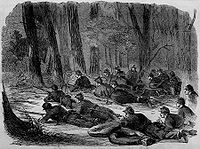 The Army of the Potomac underwent many structural changes during its existence. The army was divided by Ambrose Burnside
into three Grand Divisions of two corps each with a Reserve composed of two more. Hooker abolished the Grand Divisions. Thereafter the individual corps, seven of which remained in Virginia, reported directly to army headquarters. (Joseph Hooker
also created a Cavalry Corps by combining units that previously had served as smaller formations.) In late 1863, two corps were sent West, and—in 1864—the remaining five corps were recombined into three. Burnside's IX Corps
, which accompanied the army at the start of Ulysses S. Grant
's Overland Campaign
, was added later. For more detail, see the section Corps below.
The Army of the Potomac fought in most of the Eastern Theater campaigns, primarily in (Eastern) Virginia, Maryland, and Pennsylvania. After the end of the war, it was disbanded on June 28, 1865, shortly following its participation in the Grand Review of the Armies
.
The Army of the Potomac was also the name given to General P.G.T. Beauregard's Confederate
army during the early stages of the war (namely, First Bull Run; thus, the losing Union Army ended up adopting the name of the winning Confederate army). However, the name was eventually changed to the Army of Northern Virginia
, which became famous under General Robert E. Lee
.
, Philadelphia
, and New York City
, the Army of the Potomac received more contemporary media coverage than the other Union field armies. Such coverage produced fame for a number of this army's units. Individual brigades, such as the Irish Brigade, the Philadelphia Brigade
, the First New Jersey Brigade
, the Vermont Brigade, and the Iron Brigade
, all became well known to the general public, both during the Civil War and afterward.
Abraham Lincoln
established corps as the major subordinate units of the Army of the Potomac. (Up until this time, McClellan resisted the formation of corps, which had been prominent features of Napoleon's army, preferring to see how his division commanders fared in combat on the Peninsula before elevating them to higher command. Lincoln selected the corps commanders based on their seniority, without McClellan's approval.) The original corps were I Corps (McDowell
), II Corps (Sumner
), III Corps (Heintzelman
), and IV Corps (Keyes
). During the Peninsula Campaign, McClellan created two more, commanded by men he considered more loyal to him: V Corps (Porter
) and VI Corps (Franklin
).
For the remainder of the war, corps were added and subtracted from the army. IV Corps headquarters and one division remained on the Virginia Peninsula. Those added to the Army of the Potomac were IX Corps, XI Corps (Sigel's
I Corps in the former Army of Virginia), XII Corps (Banks's II Corps from the Army of Virginia), added in 1862; and the Cavalry Corps, created in 1863. Eight of these corps (seven infantry, one cavalry) served in the army during 1863, but due to attrition and transfers, the army was reorganized in March 1864 with only four corps: II, V, VI, and Cavalry. The IX Corps returned to the army in 1864, after being assigned to the West
in 1863 and then serving alongside the Army of the Potomac in early 1864. Two divisions of the Cavalry Corps were transferred to the Shenandoah Valley, and the 2nd division alone remained under Meade's command.
Union Army
The Union Army was the land force that fought for the Union during the American Civil War. It was also known as the Federal Army, the U.S. Army, the Northern Army and the National Army...
in the Eastern Theater
Eastern Theater of the American Civil War
The Eastern Theater of the American Civil War included the states of Virginia, West Virginia, Maryland, and Pennsylvania, the District of Columbia, and the coastal fortifications and seaports of North Carolina...
of the American Civil War
American Civil War
The American Civil War was a civil war fought in the United States of America. In response to the election of Abraham Lincoln as President of the United States, 11 southern slave states declared their secession from the United States and formed the Confederate States of America ; the other 25...
.
History
The Army of the Potomac was created in 1861, but was then only the size of a corps (relative to the size of Union armies later in the war). Its nucleus was called the Army of Northeastern Virginia, under Brig. Gen.Brigadier general (United States)
A brigadier general in the United States Army, Air Force, and Marine Corps, is a one-star general officer, with the pay grade of O-7. Brigadier general ranks above a colonel and below major general. Brigadier general is equivalent to the rank of rear admiral in the other uniformed...
Irvin McDowell
Irvin McDowell
Irvin McDowell was a career American army officer. He is best known for his defeat in the First Battle of Bull Run, the first large-scale battle of the American Civil War.-Early life:...
, and it was the army that fought (and lost) the war's first major battle, the First Battle of Bull Run
First Battle of Bull Run
First Battle of Bull Run, also known as First Manassas , was fought on July 21, 1861, in Prince William County, Virginia, near the City of Manassas...
. The arrival in Washington, D.C.
Washington, D.C.
Washington, D.C., formally the District of Columbia and commonly referred to as Washington, "the District", or simply D.C., is the capital of the United States. On July 16, 1790, the United States Congress approved the creation of a permanent national capital as permitted by the U.S. Constitution....
, of Maj. Gen.
Major general (United States)
In the United States Army, United States Marine Corps, and United States Air Force, major general is a two-star general-officer rank, with the pay grade of O-8. Major general ranks above brigadier general and below lieutenant general...
George B. McClellan
George B. McClellan
George Brinton McClellan was a major general during the American Civil War. He organized the famous Army of the Potomac and served briefly as the general-in-chief of the Union Army. Early in the war, McClellan played an important role in raising a well-trained and organized army for the Union...
dramatically changed the makeup of that army. McClellan's original assignment was to command the Division of the Potomac, which included the Department of Northeast Virginia under McDowell and the Department of Washington under Brig. Gen. Joseph K. Mansfield
Joseph K. Mansfield
Joseph King Fenno Mansfield was a career United States Army officer, civil engineer, and a Union general in the American Civil War, mortally wounded at the Battle of Antietam.-Early life:...
. On July 26, 1861, the Department of the Shenandoah, commanded by Maj. Gen. Nathaniel P. Banks, was merged with McClellan's departments and on that day, McClellan formed the Army of the Potomac, which was composed of all military forces in the former Departments of Northeastern Virginia, Washington, Baltimore, and the Shenandoah
Shenandoah Valley
The Shenandoah Valley is both a geographic valley and cultural region of western Virginia and West Virginia in the United States. The valley is bounded to the east by the Blue Ridge Mountains, to the west by the eastern front of the Ridge-and-Valley Appalachians , to the north by the Potomac River...
. The men under Banks's command became an infantry division in the Army of the Potomac. The army started with four corps, but these were divided during the Peninsula Campaign
Peninsula Campaign
The Peninsula Campaign of the American Civil War was a major Union operation launched in southeastern Virginia from March through July 1862, the first large-scale offensive in the Eastern Theater. The operation, commanded by Maj. Gen. George B...
to produce two more. After the Second Battle of Bull Run
Second Battle of Bull Run
The Second Battle of Bull Run or Second Manassas was fought August 28–30, 1862, as part of the American Civil War. It was the culmination of an offensive campaign waged by Confederate Gen. Robert E. Lee's Army of Northern Virginia against Union Maj. Gen...
, the Army of the Potomac absorbed the units that had served under Maj. Gen. John Pope
John Pope (military officer)
John Pope was a career United States Army officer and Union general in the American Civil War. He had a brief but successful career in the Western Theater, but he is best known for his defeat at the Second Battle of Bull Run in the East.Pope was a graduate of the United States Military Academy in...
.
It is a popular, but mistaken, belief that John Pope commanded the Army of the Potomac in the summer of 1862 after McClellan's unsuccessful Peninsula Campaign. On the contrary, Pope's army consisted of different units and was named the Army of Virginia
Army of Virginia
The Army of Virginia was organized as a major unit of the Union Army and operated briefly and unsuccessfully in 1862 in the American Civil War. It should not be confused with its principal opponent, the Confederate Army of Northern Virginia, commanded by Robert E...
. During the time that the Army of Virginia existed, the Army of the Potomac was headquartered on the Virginia Peninsula
Virginia Peninsula
The Virginia Peninsula is a peninsula in southeast Virginia, USA, bounded by the York River, James River, Hampton Roads and Chesapeake Bay.Hampton Roads is the common name for the metropolitan area that surrounds the body of water of the same name...
, and then outside Washington, D.C., with McClellan still in command, although three corps of the Army of the Potomac were sent to northern Virginia and were under Pope's operational control during the Northern Virginia Campaign
Northern Virginia Campaign
The Northern Virginia Campaign, also known as the Second Bull Run Campaign or Second Manassas Campaign, was a series of battles fought in Virginia during August and September 1862 in the Eastern Theater of the American Civil War. Confederate General Robert E...
.
Ambrose Burnside
Ambrose Everett Burnside was an American soldier, railroad executive, inventor, industrialist, and politician from Rhode Island, serving as governor and a U.S. Senator...
into three Grand Divisions of two corps each with a Reserve composed of two more. Hooker abolished the Grand Divisions. Thereafter the individual corps, seven of which remained in Virginia, reported directly to army headquarters. (Joseph Hooker
Joseph Hooker
Joseph Hooker was a career United States Army officer, achieving the rank of major general in the Union Army during the American Civil War. Although he served throughout the war, usually with distinction, Hooker is best remembered for his stunning defeat by Confederate General Robert E...
also created a Cavalry Corps by combining units that previously had served as smaller formations.) In late 1863, two corps were sent West, and—in 1864—the remaining five corps were recombined into three. Burnside's IX Corps
IX Corps (ACW)
IX Corps was a corps of the Union Army during the American Civil War that distinguished itself in combat in multiple theaters: the Carolinas, Virginia, Kentucky, Tennessee, and Mississippi.-Formation, Second Bull Run, and Antietam:...
, which accompanied the army at the start of Ulysses S. Grant
Ulysses S. Grant
Ulysses S. Grant was the 18th President of the United States as well as military commander during the Civil War and post-war Reconstruction periods. Under Grant's command, the Union Army defeated the Confederate military and ended the Confederate States of America...
's Overland Campaign
Overland Campaign
The Overland Campaign, also known as Grant's Overland Campaign and the Wilderness Campaign, was a series of battles fought in Virginia during May and June 1864, in the American Civil War. Lt. Gen. Ulysses S. Grant, general-in-chief of all Union armies, directed the actions of the Army of the...
, was added later. For more detail, see the section Corps below.
The Army of the Potomac fought in most of the Eastern Theater campaigns, primarily in (Eastern) Virginia, Maryland, and Pennsylvania. After the end of the war, it was disbanded on June 28, 1865, shortly following its participation in the Grand Review of the Armies
Grand Review of the Armies
The Grand Review of the Armies was a military procession and celebration in Washington, D.C., on May 23 and May 24, 1865, following the close of the American Civil War...
.
The Army of the Potomac was also the name given to General P.G.T. Beauregard's Confederate
Confederate States Army
The Confederate States Army was the army of the Confederate States of America while the Confederacy existed during the American Civil War. On February 8, 1861, delegates from the seven Deep South states which had already declared their secession from the United States of America adopted the...
army during the early stages of the war (namely, First Bull Run; thus, the losing Union Army ended up adopting the name of the winning Confederate army). However, the name was eventually changed to the Army of Northern Virginia
Army of Northern Virginia
The Army of Northern Virginia was the primary military force of the Confederate States of America in the Eastern Theater of the American Civil War, as well as the primary command structure of the Department of Northern Virginia. It was most often arrayed against the Union Army of the Potomac...
, which became famous under General Robert E. Lee
Robert E. Lee
Robert Edward Lee was a career military officer who is best known for having commanded the Confederate Army of Northern Virginia in the American Civil War....
.
Famous units
Because of its proximity to the large cities of the North, such as Washington, D.C.Washington, D.C.
Washington, D.C., formally the District of Columbia and commonly referred to as Washington, "the District", or simply D.C., is the capital of the United States. On July 16, 1790, the United States Congress approved the creation of a permanent national capital as permitted by the U.S. Constitution....
, Philadelphia
Philadelphia, Pennsylvania
Philadelphia is the largest city in the Commonwealth of Pennsylvania and the county seat of Philadelphia County, with which it is coterminous. The city is located in the Northeastern United States along the Delaware and Schuylkill rivers. It is the fifth-most-populous city in the United States,...
, and New York City
New York City
New York is the most populous city in the United States and the center of the New York Metropolitan Area, one of the most populous metropolitan areas in the world. New York exerts a significant impact upon global commerce, finance, media, art, fashion, research, technology, education, and...
, the Army of the Potomac received more contemporary media coverage than the other Union field armies. Such coverage produced fame for a number of this army's units. Individual brigades, such as the Irish Brigade, the Philadelphia Brigade
Philadelphia Brigade
The Philadelphia Brigade was a Union Army brigade that served in the American Civil War. It was raised primarily in the city of Philadelphia, Pennsylvania, with the exception of the 106th regiment which contained men from Lycoming and Bradford counties.The brigade fought with the Army of the...
, the First New Jersey Brigade
First New Jersey Brigade
The First New Jersey Brigade is the common name for an American Civil War brigade of New Jersey infantry regiments in the Union Army of the Potomac...
, the Vermont Brigade, and the Iron Brigade
Iron Brigade
The Iron Brigade, also known as the Iron Brigade of the West or the Black Hat Brigade, was an infantry brigade in the Union Army of the Potomac during the American Civil War. Although it fought entirely in the Eastern Theater, it was composed of regiments from Western states...
, all became well known to the general public, both during the Civil War and afterward.
Corps
Beginning on March 13, 1862, PresidentPresident of the United States
The President of the United States of America is the head of state and head of government of the United States. The president leads the executive branch of the federal government and is the commander-in-chief of the United States Armed Forces....
Abraham Lincoln
Abraham Lincoln
Abraham Lincoln was the 16th President of the United States, serving from March 1861 until his assassination in April 1865. He successfully led his country through a great constitutional, military and moral crisis – the American Civil War – preserving the Union, while ending slavery, and...
established corps as the major subordinate units of the Army of the Potomac. (Up until this time, McClellan resisted the formation of corps, which had been prominent features of Napoleon's army, preferring to see how his division commanders fared in combat on the Peninsula before elevating them to higher command. Lincoln selected the corps commanders based on their seniority, without McClellan's approval.) The original corps were I Corps (McDowell
Irvin McDowell
Irvin McDowell was a career American army officer. He is best known for his defeat in the First Battle of Bull Run, the first large-scale battle of the American Civil War.-Early life:...
), II Corps (Sumner
Edwin Vose Sumner
Edwin Vose Sumner was a career United States Army officer who became a Union Army general and the oldest field commander of any Army Corps on either side during the American Civil War...
), III Corps (Heintzelman
Samuel P. Heintzelman
Samuel Peter Heintzelman was a United States Army General. He served in the Seminole War, the Mexican-American War, the Yuma War, the Cortina Troubles, and the American Civil War, rising to the command of a corps....
), and IV Corps (Keyes
Erasmus D. Keyes
Erasmus Darwin Keyes was a businessman, banker, and military general, noted for leading the IV Corps of the Union Army of the Potomac during the first half of the American Civil War.-Early life and career:...
). During the Peninsula Campaign, McClellan created two more, commanded by men he considered more loyal to him: V Corps (Porter
Fitz John Porter
Fitz John Porter was a career United States Army officer and a Union General during the American Civil War...
) and VI Corps (Franklin
William B. Franklin
William Buel Franklin was a career United States Army officer and a Union Army general in the American Civil War. He rose to the rank of a corps commander in the Army of the Potomac, fighting in several notable early battles in the Eastern Theater.-Early life:William B. Franklin was born in York,...
).
For the remainder of the war, corps were added and subtracted from the army. IV Corps headquarters and one division remained on the Virginia Peninsula. Those added to the Army of the Potomac were IX Corps, XI Corps (Sigel's
Franz Sigel
Franz Sigel was a German military officer, revolutionist and immigrant to the United States who was a teacher, newspaperman, politician, and served as a Union major general in the American Civil War.-Early life:...
I Corps in the former Army of Virginia), XII Corps (Banks's II Corps from the Army of Virginia), added in 1862; and the Cavalry Corps, created in 1863. Eight of these corps (seven infantry, one cavalry) served in the army during 1863, but due to attrition and transfers, the army was reorganized in March 1864 with only four corps: II, V, VI, and Cavalry. The IX Corps returned to the army in 1864, after being assigned to the West
Western Theater of the American Civil War
This article presents an overview of major military and naval operations in the Western Theater of the American Civil War.-Theater of operations:...
in 1863 and then serving alongside the Army of the Potomac in early 1864. Two divisions of the Cavalry Corps were transferred to the Shenandoah Valley, and the 2nd division alone remained under Meade's command.
Commanders
- Brigadier General Irvin McDowellIrvin McDowellIrvin McDowell was a career American army officer. He is best known for his defeat in the First Battle of Bull Run, the first large-scale battle of the American Civil War.-Early life:...
: Commander of the Army and Department of Northeastern Virginia (May 27 – July 25, 1861) - Major General George B. McClellanGeorge B. McClellanGeorge Brinton McClellan was a major general during the American Civil War. He organized the famous Army of the Potomac and served briefly as the general-in-chief of the Union Army. Early in the war, McClellan played an important role in raising a well-trained and organized army for the Union...
: Commander of the Military Division of the Potomac, and later, the Army and Department of the Potomac (July 26, 1861 – November 9, 1862) - Major General Ambrose E. Burnside: Commander of the Army of the Potomac (November 9, 1862 – January 26, 1863)
- Major General Joseph HookerJoseph HookerJoseph Hooker was a career United States Army officer, achieving the rank of major general in the Union Army during the American Civil War. Although he served throughout the war, usually with distinction, Hooker is best remembered for his stunning defeat by Confederate General Robert E...
: Commander of the Army and Department of the Potomac (January 26 – June 28, 1863) - Major General George G. Meade: Commander of the Army of the Potomac (June 28, 1863 – June 28, 1865; Major General John G. Parke took brief temporary command during Meade's absences on four occasions during this period); Lt. Gen.Lieutenant General (United States)In the United States Army, the United States Air Force and the United States Marine Corps, lieutenant general is a three-star general officer rank, with the pay grade of O-9. Lieutenant general ranks above major general and below general...
Ulysses S. GrantUlysses S. GrantUlysses S. Grant was the 18th President of the United States as well as military commander during the Civil War and post-war Reconstruction periods. Under Grant's command, the Union Army defeated the Confederate military and ended the Confederate States of America...
, general-in-chief of all Union armies, located his headquarters with the Army of the Potomac and provided operational direction to Meade from May 1864 to April 1865, but Meade retained formal command.
Major battles and campaigns
- First Bull Run CampaignFirst Battle of Bull RunFirst Battle of Bull Run, also known as First Manassas , was fought on July 21, 1861, in Prince William County, Virginia, near the City of Manassas...
or First Manassas: McDowell - Peninsula CampaignPeninsula CampaignThe Peninsula Campaign of the American Civil War was a major Union operation launched in southeastern Virginia from March through July 1862, the first large-scale offensive in the Eastern Theater. The operation, commanded by Maj. Gen. George B...
, including the Seven Days BattlesSeven Days BattlesThe Seven Days Battles was a series of six major battles over the seven days from June 25 to July 1, 1862, near Richmond, Virginia during the American Civil War. Confederate General Robert E. Lee drove the invading Union Army of the Potomac, commanded by Maj. Gen. George B. McClellan, away from...
: McClellan - Northern Virginia CampaignNorthern Virginia CampaignThe Northern Virginia Campaign, also known as the Second Bull Run Campaign or Second Manassas Campaign, was a series of battles fought in Virginia during August and September 1862 in the Eastern Theater of the American Civil War. Confederate General Robert E...
, including the Second Battle of Bull RunSecond Battle of Bull RunThe Second Battle of Bull Run or Second Manassas was fought August 28–30, 1862, as part of the American Civil War. It was the culmination of an offensive campaign waged by Confederate Gen. Robert E. Lee's Army of Northern Virginia against Union Maj. Gen...
(three corps participated under the control of the Army of VirginiaArmy of VirginiaThe Army of Virginia was organized as a major unit of the Union Army and operated briefly and unsuccessfully in 1862 in the American Civil War. It should not be confused with its principal opponent, the Confederate Army of Northern Virginia, commanded by Robert E...
) - Maryland CampaignMaryland CampaignThe Maryland Campaign, or the Antietam Campaign is widely considered one of the major turning points of the American Civil War. Confederate Gen. Robert E. Lee's first invasion of the North was repulsed by Maj. Gen. George B...
, including the Battle of AntietamBattle of AntietamThe Battle of Antietam , fought on September 17, 1862, near Sharpsburg, Maryland, and Antietam Creek, as part of the Maryland Campaign, was the first major battle in the American Civil War to take place on Northern soil. It was the bloodiest single-day battle in American history, with about 23,000...
or Sharpsburg: McClellan - Fredericksburg CampaignBattle of FredericksburgThe Battle of Fredericksburg was fought December 11–15, 1862, in and around Fredericksburg, Virginia, between General Robert E. Lee's Confederate Army of Northern Virginia and the Union Army of the Potomac, commanded by Maj. Gen. Ambrose E. Burnside...
: Burnside - Chancellorsville CampaignBattle of ChancellorsvilleThe Battle of Chancellorsville was a major battle of the American Civil War, and the principal engagement of the Chancellorsville Campaign. It was fought from April 30 to May 6, 1863, in Spotsylvania County, Virginia, near the village of Chancellorsville. Two related battles were fought nearby on...
: Hooker - Gettysburg CampaignGettysburg CampaignThe Gettysburg Campaign was a series of battles fought in June and July 1863, during the American Civil War. After his victory in the Battle of Chancellorsville, Confederate General Robert E. Lee's Army of Northern Virginia moved north for offensive operations in Maryland and Pennsylvania. The...
: Meade - Bristoe CampaignBristoe CampaignThe Bristoe Campaign was a series of minor battles fought in Virginia during October and November 1863, in the American Civil War. Maj. Gen. George G. Meade, commanding the Union Army of the Potomac, began to maneuver in an unsuccessful attempt to defeat Gen. Robert E. Lee's Army of Northern...
: Meade - Mine Run Campaign: Meade
- Overland CampaignOverland CampaignThe Overland Campaign, also known as Grant's Overland Campaign and the Wilderness Campaign, was a series of battles fought in Virginia during May and June 1864, in the American Civil War. Lt. Gen. Ulysses S. Grant, general-in-chief of all Union armies, directed the actions of the Army of the...
: Meade - Richmond-Petersburg CampaignSiege of PetersburgThe Richmond–Petersburg Campaign was a series of battles around Petersburg, Virginia, fought from June 9, 1864, to March 25, 1865, during the American Civil War...
, including the Battle of the CraterBattle of the CraterThe Battle of the Crater was a battle of the American Civil War, part of the Siege of Petersburg. It took place on July 30, 1864, between the Confederate Army of Northern Virginia, commanded by General Robert E. Lee and the Union Army of the Potomac, commanded by Major General George G. Meade The...
: Meade - Appomattox CampaignAppomattox CampaignThe Appomattox Campaign was a series of battles fought March 29 – April 9, 1865, in Virginia that culminated in the surrender of Confederate General Robert E...
, including Lee's surrender at Appomattox Court HouseAppomattox Court HouseThe Appomattox Courthouse is the current courthouse in Appomattox, Virginia built in 1892. It is located in the middle of the state about three miles northwest of the Appomattox Court House National Historical Park, once known as Clover Hill - home of the original Old Appomattox Court House...
: Meade
Further reading
- Chamberlain, Joshua L.Joshua ChamberlainJoshua Lawrence Chamberlain , born as Lawrence Joshua Chamberlain, was an American college professor from the State of Maine, who volunteered during the American Civil War to join the Union Army...
, The Passing of the ArmiesThe Passing of the ArmiesThe Passing of the Armies is a Civil War memoir written by Joshua Lawrence Chamberlain, a renowned commander most famous for his actions on Little Round Top at the Battle of Gettysburg. It is an autobiographical account describing Chamberlain's experiences throughout the latter half of the Civil...
: An Account of the Final Campaign of the Army of the Potomac, Bantam reprint, 1992, ISBN 0-553-29992-1. - Taaffe, Stephen R., Commanding the Army of the Potomac, University of Kansas Press, 2006, ISBN 0-7006-1451-6.