


Flanking maneuver

Encyclopedia
Military tactics
Military tactics, the science and art of organizing an army or an air force, are the techniques for using weapons or military units in combination for engaging and defeating an enemy in battle. Changes in philosophy and technology over time have been reflected in changes to military tactics. In...
, a flanking maneuver
Maneuver warfare
Maneuver warfare, or manoeuvre warfare , is the term used by military theorists for a concept of warfare that advocates attempting to defeat an adversary by incapacitating their decision-making through shock and disruption brought about by movement...
, also called a flank attack, is an attack on the sides of an opposing force. If a flanking maneuver succeeds, the opposing force would be surrounded from two or more directions, which significantly reduces the maneuverability of the outflanked force and its ability to defend itself. A psychological advantage may also be present, as flank forces usually do not expect to be attacked.
A larger scaled tactical flanking is called a strategic flanking, where the targets of the flanking could be as large as entire divisions.
Tactical flanking
The flanking maneuver is a basic military tacticMilitary tactics
Military tactics, the science and art of organizing an army or an air force, are the techniques for using weapons or military units in combination for engaging and defeating an enemy in battle. Changes in philosophy and technology over time have been reflected in changes to military tactics. In...
, with several variations. Flanking an enemy often refers to staying back and not risking yourself, while at the same time gradually weakening enemy forces. Of course, it may not always work (especially if outnumbered), but for the most part can prove to be effective.
One type is employed in an ambush
Ambush
An ambush is a long-established military tactic, in which the aggressors take advantage of concealment and the element of surprise to attack an unsuspecting enemy from concealed positions, such as among dense underbrush or behind hilltops...
, where a friendly unit performs a surprise attack from a concealed position. Other units may be hidden to the sides of the ambush site to surround the enemy, but care must be taken in setting up fields of fire to avoid friendly fire
Friendly fire
Friendly fire is inadvertent firing towards one's own or otherwise friendly forces while attempting to engage enemy forces, particularly where this results in injury or death. A death resulting from a negligent discharge is not considered friendly fire...
.
Another type is used in the attack, where a unit encounters an enemy defensive position. Upon receiving fire from the enemy, the unit commander may decide to order a flank attack. A part of the attacking unit "fixes" the enemy with suppressive fire
Suppressive fire
In military science, suppressive fire is a fire that degrades the performance of a target below the level needed to fulfill its mission. Suppression is usually only effective for the duration of the fire. Suppressive fire is not always a direct form of fire towards targets; it can be an effective...
, preventing them from returning fire, retreating or changing position to meet the flank attack. The flanking force then advances to the enemy flank and attacks them at close range. Coordination to avoid friendly fire is also important in this situation.
The most effective form of flanking maneuver is the double envelopment
Pincer movement
The pincer movement or double envelopment is a military maneuver. The flanks of the opponent are attacked simultaneously in a pinching motion after the opponent has advanced towards the center of an army which is responding by moving its outside forces to the enemy's flanks, in order to surround it...
, which involves simultaneous flank attacks on both sides of the enemy. A classic example is Hannibal's victory over the Roman
Roman Republic
The Roman Republic was the period of the ancient Roman civilization where the government operated as a republic. It began with the overthrow of the Roman monarchy, traditionally dated around 508 BC, and its replacement by a government headed by two consuls, elected annually by the citizens and...
armies at the Battle of Cannae
Battle of Cannae
The Battle of Cannae was a major battle of the Second Punic War, which took place on August 2, 216 BC near the town of Cannae in Apulia in southeast Italy. The army of Carthage under Hannibal decisively defeated a numerically superior army of the Roman Republic under command of the consuls Lucius...
. Another example of the double envelopment is Khalid ibn al-Walid
Khalid ibn al-Walid
Khālid ibn al-Walīd also known as Sayf Allāh al-Maslūl , was a companion of the Islamic prophet Muhammad. He is noted for his military tactics and prowess, commanding the forces of Medina and those of his immediate successors of the Rashidun Caliphate; Abu Bakr and Umar...
's victory over the Persian Empire
Sassanid Empire
The Sassanid Empire , known to its inhabitants as Ērānshahr and Ērān in Middle Persian and resulting in the New Persian terms Iranshahr and Iran , was the last pre-Islamic Persian Empire, ruled by the Sasanian Dynasty from 224 to 651...
at the Battle of Walaja
Battle of Walaja
The Battle of Walaja was a battle fought in Mesopotamia in May 633 between the Rashidun Caliphate army under Khalid ibn al-Walid and al muthanna ibn haarithah against the Persian Empire and its Arab allies...
.
Despite primarily being associated with land warfare, flanking maneuvers have also been used effectively in naval battles. A famous example of this is the Battle of Salamis
Battle of Salamis
The Battle of Salamis was fought between an Alliance of Greek city-states and the Persian Empire in September 480 BCE, in the straits between the mainland and Salamis, an island in the Saronic Gulf near Athens...
, where the combined naval forces of the Greek
Greece
Greece , officially the Hellenic Republic , and historically Hellas or the Republic of Greece in English, is a country in southeastern Europe....
city-state
City-state
A city-state is an independent or autonomous entity whose territory consists of a city which is not administered as a part of another local government.-Historical city-states:...
s managed to outflank the Persian navy and won a decisive victory.
Flanking in history
Flanking maneuvers played an important role in nearly every major battle in history, and have been used effectively by famous military leaders like Hannibal, Julius CaesarJulius Caesar
Gaius Julius Caesar was a Roman general and statesman and a distinguished writer of Latin prose. He played a critical role in the gradual transformation of the Roman Republic into the Roman Empire....
, Khalid ibn al-Walid
Khalid ibn al-Walid
Khālid ibn al-Walīd also known as Sayf Allāh al-Maslūl , was a companion of the Islamic prophet Muhammad. He is noted for his military tactics and prowess, commanding the forces of Medina and those of his immediate successors of the Rashidun Caliphate; Abu Bakr and Umar...
, Napoleon and Stonewall Jackson
Stonewall Jackson
ຄຽשת״ׇׂׂׂׂ֣|birth_place= Clarksburg, Virginia |death_place=Guinea Station, Virginia|placeofburial=Stonewall Jackson Memorial CemeteryLexington, Virginia|placeofburial_label= Place of burial|image=...
throughout history. Sun Tzu
Sun Tzu
Sun Wu , style name Changqing , better known as Sun Tzu or Sunzi , was an ancient Chinese military general, strategist and philosopher who is traditionally believed, and who is most likely, to have authored The Art of War, an influential ancient Chinese book on military strategy...
's The Art of War
The Art of War
The Art of War is an ancient Chinese military treatise that is attributed to Sun Tzu , a high ranking military general and strategist during the late Spring and Autumn period...
strongly emphasizes the use of flanking, although it does not advocate completely surrounding the enemy force as this may induce it to fight with greater ferocity if it cannot escape.
A flanking maneuver is not always effective, as the flanking force may itself be ambushed while maneuvering, or the main force is unable to pin the defenders in place, allowing them to turn and face the flanking attack.
Maneuvering
Flanking on land in the pre-modern era was usually achieved with cavalryCavalry
Cavalry or horsemen were soldiers or warriors who fought mounted on horseback. Cavalry were historically the third oldest and the most mobile of the combat arms...
(and rarely, chariots) due to their speed and maneuverability, while heavily-armored infantry
Infantry
Infantrymen are soldiers who are specifically trained for the role of fighting on foot to engage the enemy face to face and have historically borne the brunt of the casualties of combat in wars. As the oldest branch of combat arms, they are the backbone of armies...
was commonly used to fix the enemy, as in the Battle of Pharsalus
Battle of Pharsalus
The Battle of Pharsalus was a decisive battle of Caesar's Civil War. On 9 August 48 BC at Pharsalus in central Greece, Gaius Julius Caesar and his allies formed up opposite the army of the republic under the command of Gnaeus Pompeius Magnus...
. Armored vehicles
Armoured fighting vehicle
An armoured fighting vehicle is a combat vehicle, protected by strong armour and armed with weapons. AFVs can be wheeled or tracked....
such as tanks replaced cavalry as the main force of flanking maneuvers in the 20th century, as seen in the Battle of France
Battle of France
In the Second World War, the Battle of France was the German invasion of France and the Low Countries, beginning on 10 May 1940, which ended the Phoney War. The battle consisted of two main operations. In the first, Fall Gelb , German armoured units pushed through the Ardennes, to cut off and...
in World War II
World War II
World War II, or the Second World War , was a global conflict lasting from 1939 to 1945, involving most of the world's nations—including all of the great powers—eventually forming two opposing military alliances: the Allies and the Axis...
.
Defense against
The dangers of being flanked have been realised by commanders since the dawn of warfare, and for two millennia and more, part of the art of being a commander was in the choice of terrain to allow flanking attacks or prevent them.Terrain
A commander could prevent being flanked by anchoring one or both parts of his line on terrain impassable to his enemies, such as gorgesCanyon
A canyon or gorge is a deep ravine between cliffs often carved from the landscape by a river. Rivers have a natural tendency to reach a baseline elevation, which is the same elevation as the body of water it will eventually drain into. This forms a canyon. Most canyons were formed by a process of...
, lakes or mountains, e.g. the Sparta
Sparta
Sparta or Lacedaemon, was a prominent city-state in ancient Greece, situated on the banks of the River Eurotas in Laconia, in south-eastern Peloponnese. It emerged as a political entity around the 10th century BC, when the invading Dorians subjugated the local, non-Dorian population. From c...
ns at Thermopylae
Battle of Thermopylae
The Battle of Thermopylae was fought between an alliance of Greek city-states, led by King Leonidas of Sparta, and the Persian Empire of Xerxes I over the course of three days, during the second Persian invasion of Greece. It took place simultaneously with the naval battle at Artemisium, in August...
, Hannibal at the Battle of Lake Trasimene
Battle of Lake Trasimene
The Battle of Lake Trasimene was a Roman defeat in the Second Punic War between the Carthaginians under Hannibal and the Romans under the consul Gaius Flaminius...
, and the Romans at the Battle of Watling Street
Battle of Watling Street
The Battle of Watling Street took place in Roman-occupied Britain in AD 60 or 61 between an alliance of indigenous British peoples led by Boudica and a Roman army led by Gaius Suetonius Paulinus. Although outnumbered, the Romans decisively defeated the allied tribes, inflicting heavy losses on them...
. Although not strictly impassable, woods, forests, rivers, broken and marshy ground could also be used to anchor a flank, e.g. Henry V
Henry V of England
Henry V was King of England from 1413 until his death at the age of 35 in 1422. He was the second monarch belonging to the House of Lancaster....
at Agincourt
Battle of Agincourt
The Battle of Agincourt was a major English victory against a numerically superior French army in the Hundred Years' War. The battle occurred on Friday, 25 October 1415 , near modern-day Azincourt, in northern France...
. However in such instances it was still wise to have skirmishers covering these flanks.
Fortification
In exceptional circumstances, an army may be fortunate enough to be able to anchor a flank with a friendly castle, fortress or walled city. In such circumstances it was not necessary to fix the line to the fortress but to allow a killing space between the fortress and the battle line so that any enemy forces attempting to flank the field forces could be brought under fire from the garrison. Almost as good was if natural strongholds could be incorporated into the battle line, e.g. the UnionUnion (American Civil War)
During the American Civil War, the Union was a name used to refer to the federal government of the United States, which was supported by the twenty free states and five border slave states. It was opposed by 11 southern slave states that had declared a secession to join together to form the...
positions of Culp's Hill
Culp's Hill
Culps Hill is a Battle of Gettysburg landform south of Gettysburg, Pennsylvania, with a heavily wooded summit of . The east slope is to Rock Creek , 160 feet lower in elevation, and the west slope is to a saddle with Stevens Knoll with a summit lower than the Culps Hill summit...
, and Cemetery Hill
Cemetery Hill
Cemetery Hill is a Gettysburg Battlefield landform which had 1863 military engagements each day of the July 1–3 Battle of Gettysburg. The northernmost part of the Army of the Potomac defensive "fish-hook" line, the hill is gently sloped and provided a site for American Civil War artillery...
on the right flank, and Big Round Top
Big Round Top
Big Round Top is a boulder-strewn hill notable as the topographic high point of the Gettysburg Battlefield and for 1863 American Civil War engagements for which Medals of Honor were awarded...
and Little Round Top
Little Round Top
Little Round Top is the smaller of two rocky hills south of Gettysburg, Pennsylvania. It was the site of an unsuccessful assault by Confederate troops against the Union left flank on July 2, 1863, the second day of the Battle of Gettysburg....
on the left flank, at the Battle of Gettysburg
Battle of Gettysburg
The Battle of Gettysburg , was fought July 1–3, 1863, in and around the town of Gettysburg, Pennsylvania. The battle with the largest number of casualties in the American Civil War, it is often described as the war's turning point. Union Maj. Gen. George Gordon Meade's Army of the Potomac...
. If time and circumstances allowed field fortifications could be created or expanded to protect the flanks, such as the Allied forces did with the hamlet of Papelotte and the farmhouse of Hougoumont
Hougoumont
Hougoumont was a fortified farm held by Wellington's army in the Battle of Waterloo. It may also refer to:* Hougoumont , a convict ship;...
on the left and right flanks at the Battle of Waterloo
Battle of Waterloo
The Battle of Waterloo was fought on Sunday 18 June 1815 near Waterloo in present-day Belgium, then part of the United Kingdom of the Netherlands...
.
Formations
When the terrain favoured neither side it was down to the disposition of forces in the battle line to prevent flanking attacks. For as long as they had a place on the battlefield, it was the role of cavalryCavalry
Cavalry or horsemen were soldiers or warriors who fought mounted on horseback. Cavalry were historically the third oldest and the most mobile of the combat arms...
to be placed on the flanks of the infantry
Infantry
Infantrymen are soldiers who are specifically trained for the role of fighting on foot to engage the enemy face to face and have historically borne the brunt of the casualties of combat in wars. As the oldest branch of combat arms, they are the backbone of armies...
battle line. With speed and greater tactical flexibility, the cavalry could both make flanking attacks and guard against them. It was the marked superiority of Hannibal’s cavalry at Cannae
Battle of Cannae
The Battle of Cannae was a major battle of the Second Punic War, which took place on August 2, 216 BC near the town of Cannae in Apulia in southeast Italy. The army of Carthage under Hannibal decisively defeated a numerically superior army of the Roman Republic under command of the consuls Lucius...
that allowed him to chase off the Roman cavalry and complete the encirclement of the Roman legions. With equally matched cavalry, commanders have been content to allow inaction, with the cavalry of both sides preventing the other from action.
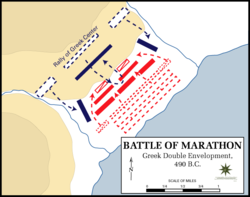
With no cavalry, inferior cavalry or in armies whose cavalry had gone off on their own (a not uncommon complaint) it was down to the disposition of the infantry to guard against flanking attacks. It was the danger of being flanked by the numerically superior Persians that led Miltiades
Miltiades the Younger
Miltiades the Younger or Miltiades IV was the son of one Cimon, a renowned Olympic chariot-racer. Miltiades considered himself a member of the Aeacidae, and is known mostly for his role in the Battle of Marathon; as well as his rather tragic downfall afterwards. His son Cimon was a major Athenian...
to lengthen the Athenian line at the Battle of Marathon
Battle of Marathon
The Battle of Marathon took place in 490 BC, during the first Persian invasion of Greece. It was fought between the citizens of Athens, aided by Plataea, and a Persian force commanded by Datis and Artaphernes. It was the culmination of the first attempt by Persia, under King Darius I, to subjugate...
by decreasing the depth of the centre. The importance of the flank positions led to the practise, which became tradition of placing the best troops on the flanks. So that at the Battle of Platea the Tegea
Tegea
Tegea was a settlement in ancient Greece, and it is also a former municipality in Arcadia, Peloponnese, Greece. Since the 2011 local government reform it is part of the municipality Tripoli, of which it is a municipal unit. Its seat was the village Stadio....
ns squabbled with Athenians as to who should have the privilege of holding a flank; both having conceded the honour of the right flank (the critical flank in the hoplite
Hoplite
A hoplite was a citizen-soldier of the Ancient Greek city-states. Hoplites were primarily armed as spearmen and fought in a phalanx formation. The word "hoplite" derives from "hoplon" , the type of the shield used by the soldiers, although, as a word, "hopla" could also denote weapons held or even...
system) to the Spartans. This is the source of the tradition of giving the honour of the right to the most senior regiment present, that persisted into the modern era.
With troops confident and reliable enough to operate in separate dispersed units, the echelon formation
Echelon formation
An echelon formation is a military formation in which members are arranged diagonally. Each member is stationed behind and to the right , or behind and to the left , of the member ahead...
may be adopted. This can take different forms with either equally strong “divisions” or a massively reinforced wing or centre supported by smaller formations in step behind it (forming either a staircase like, or arrow like arrangement). In this formation when the foremost unit engages with the enemy the echeloned units remain out of action. The temptation is for the enemy to attack the exposed flanks of this foremost unit, however were this to happen the units immediately echeloned behind the foremost unit would push forward taking the flankers themselves in the flank. If this echeloned unit was to be attacked in turn, the unit behind it, would move forward to again attack the flanks of the would be flankers. In theory a cascade of such engagements could occur all along the line, for as many units as there were in echelon. In practise this almost never happened, most enemy commanders seeing this for what it was, resisting the temptation of the initial easy flanking attack. This prudence was utilised, in the manifestation of the oblique order
Oblique order
The Oblique Order is a military tactic where an attacking army focuses its forces to attack a single enemy flank. The force commander concentrates the majority of his strength on one flank and uses the remainder to fix the enemy line. This allows a commander with weaker or equal forces to...
, in which one wing was massively reinforced, creating a local superiority in numbers that could obliterate that part of the enemy line that it was sent against. The weaker echeloned units being sufficient to fix the greater portion of the enemy troops into inaction. With the battle on the wing won the reinforced flank would turn and roll up the enemy battle line from the flank.
In the Roman chequer board formation, readopted by Renaissance militaries, each of the units in the front line can be thought of as having two lines of units echeloned behind it.
As warfare increased in size and scope and armies got bigger it was no longer possible for armies to hope to have a contiguous battle line. In order to be able to manoeuvre it was necessary to introduce intervals between units and these intervals could be used to flank individual units in the battle line by fast acting units such as cavalry. To guard against this the infantry subunits were trained to be able to rapidly form squares
Infantry square
An infantry square is a combat formation an infantry unit forms in close order when threatened with cavalry attack.-Very early history:The formation was described by Plutarch and used by the Romans, and was developed from an earlier circular formation...
that gave the cavalry no weak flank to attack. During the age of gunpowder
Gunpowder warfare
Early modern warfare is associated with the start of the widespread use of gunpowder and the development of suitable weapons to use the explosive, including artillery and handguns such as the arquebus and later the musket, and for this reason the era is also summarized as the age of gunpowder...
, intervals between units could be increased because of the greater reach of the weapons, increasing the possibility of cavalry finding a gap in the line to exploit, and it became the mark of good infantry to be able to form rapidly from line to square and back again.
The First World War
During the First World War and the wars leading up to it the danger of successful flanking attacks was prevented by attacking on a frontage measuring in the tens of miles, and with a sufficient depth that even if an enemy could take the attacking forces in the flank, it could not damage the attackers enough to prevent them carrying their objectives.Blitzkrieg and beyond
With the arrival of tanks and armoured warfare, commanders found that the best way of avoiding being flanked was to maintain the speed and momentum of the attack. If momentum could be maintained the enemy would be too dislocated and disorganised to be able to mount an effective counterattack; and that by the time the enemy could react the attackers would already be elsewhere, and there would be no flank to attack.Operational flanking
On an operational level army commanders may attempt to flank and wrong foot entire enemy armies, rather than just be content with doing so at a tactical battalion or brigade level. The most infamous example of such an attempt is the modified Schlieffen PlanSchlieffen Plan
The Schlieffen Plan was the German General Staff's early 20th century overall strategic plan for victory in a possible future war in which the German Empire might find itself fighting on two fronts: France to the west and Russia to the east...
utilized by the Germans during the opening stages of the First World War
World War I
World War I , which was predominantly called the World War or the Great War from its occurrence until 1939, and the First World War or World War I thereafter, was a major war centred in Europe that began on 28 July 1914 and lasted until 11 November 1918...
; this was an attempt to avoid facing the French armies head on, but instead flank them by swinging through neutral Belgium.
The race to the sea
It was the desire of both sides to gain the flank of the other in the First World WarWorld War I
World War I , which was predominantly called the World War or the Great War from its occurrence until 1939, and the First World War or World War I thereafter, was a major war centred in Europe that began on 28 July 1914 and lasted until 11 November 1918...
that led to the 'race to the sea
Race to the Sea
The Race to the Sea is a name given to the period early in the First World War when the two sides were still engaged in mobile warfare on the Western Front. With the German advance stalled at the First Battle of the Marne, the opponents continually attempted to outflank each other through...
', and marked the lines over which the war in the West would be fought.
Second fronts
Just as at the tactical level a commander will attempt to anchor his flanks, commanders will try to do the same at the operational level. For example the World War IIWorld War II
World War II, or the Second World War , was a global conflict lasting from 1939 to 1945, involving most of the world's nations—including all of the great powers—eventually forming two opposing military alliances: the Allies and the Axis...
German Winter Line
Winter Line
The Winter Line was a series of German military fortifications in Italy, constructed during World War II by Organisation Todt. The primary Gustav Line ran across Italy from just north of where the Garigliano River flows into the Tyrrhenian Sea in the west, through the Apennine Mountains to the...
in Italy anchored by the Tyrrhenian
Tyrrhenian Sea
The Tyrrhenian Sea is part of the Mediterranean Sea off the western coast of Italy.-Geography:The sea is bounded by Corsica and Sardinia , Tuscany, Lazio, Campania, Basilicata and Calabria and Sicily ....
and Adriatic Sea
Adriatic Sea
The Adriatic Sea is a body of water separating the Italian Peninsula from the Balkan peninsula, and the system of the Apennine Mountains from that of the Dinaric Alps and adjacent ranges...
s, or for example the trench systems of the Western Front
Western Front (World War I)
Following the outbreak of World War I in 1914, the German Army opened the Western Front by first invading Luxembourg and Belgium, then gaining military control of important industrial regions in France. The tide of the advance was dramatically turned with the Battle of the Marne...
which ran from the North Sea to the Alps. Attacking such positions were and would be expensive in casualties, and more than likely to lead to stalemate. To break such stalemates flanking attacks into areas outside the main zone of contention may be attempted.
If successful, such as at Inchon
Battle of Inchon
The Battle of Inchon was an amphibious invasion and battle of the Korean War that resulted in a decisive victory and strategic reversal in favor of the United Nations . The operation involved some 75,000 troops and 261 naval vessels, and led to the recapture of the South Korean capital Seoul two...
, such operations can be shattering, breaking into the lightly held rear echelons of an enemy, when its front line forces are committed elsewhere. Even when not entirely successful, for example at Anzio
Operation Shingle
Operation Shingle , during the Italian Campaign of World War II, was an Allied amphibious landing against Axis forces in the area of Anzio and Nettuno, Italy. The operation was commanded by Major General John P. Lucas and was intended to outflank German forces of the Winter Line and enable an...
these operations can relieve pressure on troops on the main battle front, by forcing the enemy to divert resources to contain the new front.
These operations may have strategic objectives such as the Invasion of Italy
Allied invasion of Italy
The Allied invasion of Italy was the Allied landing on mainland Italy on September 3, 1943, by General Harold Alexander's 15th Army Group during the Second World War. The operation followed the successful invasion of Sicily during the Italian Campaign...
itself, the Gallipoli
Battle of Gallipoli
The Gallipoli Campaign, also known as the Dardanelles Campaign or the Battle of Gallipoli, took place at the peninsula of Gallipoli in the Ottoman Empire between 25 April 1915 and 9 January 1916, during the First World War...
, and the Normandy landings.
Such a strategy is not new. Hannibal for example attacked Rome
Ancient Rome
Ancient Rome was a thriving civilization that grew on the Italian Peninsula as early as the 8th century BC. Located along the Mediterranean Sea and centered on the city of Rome, it expanded to one of the largest empires in the ancient world....
by going over the Alps, rather than taking the obvious route. In return Scipio Africanus
Scipio Africanus
Publius Cornelius Scipio Africanus , also known as Scipio Africanus and Scipio the Elder, was a general in the Second Punic War and statesman of the Roman Republic...
was able to defeat Hannibal by first undermining his powerbase in Spain before attacking his home city Carthage
Carthage
Carthage , implying it was a 'new Tyre') is a major urban centre that has existed for nearly 3,000 years on the Gulf of Tunis, developing from a Phoenician colony of the 1st millennium BC...
instead of trying to defeat him in Italy.
Desert Storm
The ground campaign of Desert Storm during the 1991 Gulf WarGulf War
The Persian Gulf War , commonly referred to as simply the Gulf War, was a war waged by a U.N.-authorized coalition force from 34 nations led by the United States, against Iraq in response to Iraq's invasion and annexation of Kuwait.The war is also known under other names, such as the First Gulf...
was characterised by the flanking attack of the Coalition forces, the massive "left hook" which avoided the Iraqi forces dug in along the Kuwait-Saudi border; but instead swept past them in the west.
Strategic flanking
Flank attacks on the strategic level are seen when a nation or group of nations surround and attack an enemy from two or more directions, such as the Allies surrounding Nazi GermanyNazi Germany
Nazi Germany , also known as the Third Reich , but officially called German Reich from 1933 to 1943 and Greater German Reich from 26 June 1943 onward, is the name commonly used to refer to the state of Germany from 1933 to 1945, when it was a totalitarian dictatorship ruled by...
in World War II
World War II
World War II, or the Second World War , was a global conflict lasting from 1939 to 1945, involving most of the world's nations—including all of the great powers—eventually forming two opposing military alliances: the Allies and the Axis...
. In these cases, the flanked country usually has to fight on two fronts at once, placing it at a disadvantage.
The danger of being strategically flanked has driven the political and diplomatic actions of nations even in peace time. For example the fear of being strategically flanked by the other in The Great Game
The Great Game
The Great Game or Tournament of Shadows in Russia, were terms for the strategic rivalry and conflict between the British Empire and the Russian Empire for supremacy in Central Asia. The classic Great Game period is generally regarded as running approximately from the Russo-Persian Treaty of 1813...
'played' by the British and Russian Empires, led to the expansion of both into China, and the British eastwards into South-East Asia. The British feared that British India would be surrounded by a Persia and Central Asia satellite to Russia in the west and north and a Russian dominated China in the east. Whilst to the Russians a China under British influence would mean that the Russian Empire would be penned in from the south and east. Subsequently the Russians were more successful than the British in gaining territorial concessions in China. However the British were able to counteract this through the cultivation of the emerging Empire of Japan
Empire of Japan
The Empire of Japan is the name of the state of Japan that existed from the Meiji Restoration on 3 January 1868 to the enactment of the post-World War II Constitution of...
as a counterweight to the Russians, a relationship which culminated in the Anglo-Japanese Alliance
Anglo-Japanese Alliance
The first was signed in London at what is now the Lansdowne Club, on January 30, 1902, by Lord Lansdowne and Hayashi Tadasu . A diplomatic milestone for its ending of Britain's splendid isolation, the alliance was renewed and extended in scope twice, in 1905 and 1911, before its demise in 1921...
.
The Cold War
Cold War
The Cold War was the continuing state from roughly 1946 to 1991 of political conflict, military tension, proxy wars, and economic competition between the Communist World—primarily the Soviet Union and its satellite states and allies—and the powers of the Western world, primarily the United States...
version of the Great Game was played on a global scale by the United States and the Soviet Union, each seeking to contain
Containment
Containment was a United States policy using military, economic, and diplomatic strategies to stall the spread of communism, enhance America’s security and influence abroad, and prevent a "domino effect". A component of the Cold War, this policy was a response to a series of moves by the Soviet...
the influence of the other.