

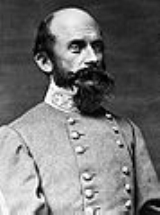
Richard S. Ewell

Encyclopedia
Richard Stoddert Ewell was a career United States Army
officer and a Confederate
general during the American Civil War
. He achieved fame as a senior commander under Stonewall Jackson
and Robert E. Lee
and fought effectively through much of the war, but his legacy has been clouded by controversies over his actions at the Battle of Gettysburg
and at the Battle of Spotsylvania Court House
.
. He was raised in Prince William County, Virginia
, from the age of 3, at an estate near Manassas
known as "Stony Lonesome." He was the third son of Dr. Thomas and Elizabeth Stoddert Ewell, and was the grandson of Benjamin Stoddert
, the first U.S. Secretary of the Navy, and the brother of Benjamin Stoddert Ewell
. He graduated from the United States Military Academy
in 1840, thirteenth in his class of 42 cadets. He was known to his friends as "Old Bald Head" or "Baldy." He was commissioned a second lieutenant in the 1st U.S. Dragoons and was promoted to first lieutenant in 1845. From 1843 to 1845 he served with Philip St. George Cooke
and Stephen Watts Kearny on escort duty along the Santa Fe
and Oregon Trail
s. In the Mexican-American War, serving under Winfield Scott
, he was recognized and promoted to captain for his courage at Contreras
and Churubusco
. At Contreras, he conducted a nighttime reconnaissance with engineer Captain Robert E. Lee, his future commander.
Ewell served in the New Mexico Territory
for some time, exploring the newly acquired Gadsden Purchase
with Colonel Benjamin Bonneville
. He was wounded in a skirmish with Apache
s under Cochise
in 1859. In 1860, while in command of Fort Buchanan, Arizona, illness compelled him to leave the West for Virginia to recuperate. He described his condition as "very ill with vertigo, nausea, etc., and now am excessively debilitated[,] having occasional attacks of the ague." Illnesses and injuries would cause difficulties for him throughout the upcoming Civil War.
sentiments, but when his home state of Virginia seceded
, Ewell resigned his U.S. Army commission on May 7, 1861, to join the Virginia Provisional Army. He was appointed a colonel
of cavalry
on May 9 and was one of the first senior officers wounded in the war, at a May 31 skirmish at Fairfax Court House
. He was promoted to brigadier general in the Confederate States Army
on June 17 and commanded a brigade
in the (Confederate) Army of the Potomac
at the First Battle of Bull Run
, but saw little action.
Ewell inspired his men in spite of, not because of, his appearance. Historian Larry Tagg described him:
during the Valley Campaign
. Although the two generals worked together well, and both were noted for their quixotic personal behavior, there were many stylistic differences between them. Jackson was stern and pious, whereas Ewell was witty and extremely profane. Jackson was flexible and intuitive on the battlefield, while Ewell, although brave and effective, required precise instructions to function effectively. Ewell was initially resentful about Jackson's tendency to keep his subordinates uninformed about his tactical plans, but Ewell eventually adjusted to Jackson's methods.
Ewell superbly commanded a division in Jackson's small army during the Valley Campaign, personally winning quite a few battles against the larger Union armies
of Maj. Gens. John C. Frémont
, Nathaniel P. Banks, and James Shields
. Jackson's army was then recalled to Richmond
to join Robert E. Lee in protecting the city against Maj. Gen. George B. McClellan
's Army of the Potomac
in the Peninsula Campaign
. Ewell fought conspicuously at Gaines' Mill
and Malvern Hill
. After Lee repelled the Union army in the Seven Days Battles
, Union Maj. Gen. John Pope's
Army of Virginia
threatened to attack from the north, so Jackson was sent to intercept him. Ewell defeated Banks again at the Battle of Cedar Mountain
on August 9 and, returning to the old Manassas battlefield, he fought well at the Second Battle of Bull Run
, but was wounded during the battle of Groveton
(or Brawner's Farm) on August 29, and his left leg was amputated below the knee.
While recovering from his injury, Ewell was nursed by his first cousin, Lizinka Campbell Brown, a wealthy widow from the Nashville
area. Ewell had been attracted to Lizinka since his teenage years and they had earlier flirted with romance in 1861 and during the Valley Campaign, but now the close contact resulted in their wedding in Richmond on May 26, 1863.
After his long recovery, Ewell returned to Lee's Army of Northern Virginia
after the Battle of Chancellorsville
. After the mortal wounding of Jackson at that battle, on May 23 Ewell was promoted to lieutenant general and command of the Second Corps (now slightly smaller than Jackson's because units were subtracted to create a new Third Corps, under Lt. Gen. A.P. Hill, also one of Jackson's division commanders). Ewell was given a date of rank one day earlier than Hill's, so he became the third-highest-ranking general in the Army of Northern Virginia, after Lee and James Longstreet
.
, at the Second Battle of Winchester, Ewell performed superbly, capturing the Union garrison of 4,000 men and 23 cannons. He escaped serious injury there when he was hit in the chest with a spent bullet (the second such incident in his career, after Gaines' Mill). His corps took the lead in the invasion of Pennsylvania and almost reached the state capital of Harrisburg
before being recalled by Lee to concentrate at Gettysburg
. These successes led to favorable comparisons with Jackson.
But at the Battle of Gettysburg
, Ewell's military reputation started a long decline. On July 1, 1863, Ewell's corps approached Gettysburg from the north and smashed the Union XI Corps
and part of the I Corps
, driving them back through the town and forcing them to take up defensive positions on Cemetery Hill
south of town. Lee had just arrived on the field and saw the importance of this position. He sent discretionary orders to Ewell that Cemetery Hill be taken "if practicable." Historian James M. McPherson
wrote, "Had Jackson still lived, he undoubtedly would have found it practicable. But Ewell was not Jackson." Ewell chose not to attempt the assault.
Ewell had several possible reasons for not attacking. The orders from Lee contained an innate contradiction. He was "to carry the hill occupied by the enemy, if he found it practicable, but to avoid a general engagement until the arrival of the other divisions of the army." Lee also refused to provide assistance that Ewell requested from the corps of A.P. Hill. Ewell's men were fatigued from their lengthy marching and strenuous battle in the hot July afternoon and it would be difficult to reassemble them into battle formation and assault the hill through the narrow corridors afforded by the streets of Gettysburg. The fresh division under Maj. Gen. Edward "Allegheny" Johnson
was just arriving, but Ewell also received intelligence that heavy Union reinforcements were arriving on the York Pike from the east, potentially threatening his flank. Ewell's normally aggressive subordinate, Maj. Gen. Jubal A. Early, concurred with his decision.
Lee's order has been criticized because it left too much discretion to Ewell. Historians such as McPherson have speculated on how the more aggressive Stonewall Jackson would have acted on this order if he had lived to command this wing of Lee's army, and how differently the second day of battle would have proceeded with Confederate possession of Culp's Hill
or Cemetery Hill. Discretionary orders were customary for General Lee because Jackson and James Longstreet
, his other principal subordinate, usually reacted to them very well and could use their initiative to respond to conditions and achieve the desired results. Ewell's critics have noted that this failure of action on his part, whether justified or not, in all likelihood cost the Confederates the battle. Other historians have noted that Lee, as the overall commanding general who issued discretionary orders to Ewell and then continued the battle for another two days, bears the final responsibility for the Confederate defeat at Gettysburg.
When Ewell's corps did attack these positions on July 2 and July 3, the Union had had time to fully occupy the heights and build impregnable defenses, resulting in heavy Confederate losses. Post-war proponents of the lost cause
movement, particularly Jubal Early, but also Maj. Gen. Isaac R. Trimble
, who had been assigned to Ewell's staff during the battle, criticized him bitterly in attempts to deflect any blame for the loss of the battle on Robert E. Lee. Part of their argument was that the Union troops were completely demoralized by their defeat earlier in the day, but Ewell's men were also disorganized, and decisions such as they were propounding are far simpler to make in hindsight than in the heat of battle and fog of war
.
On July 3, Ewell was once again wounded, but this time only in his wooden leg. He led his corps on an orderly retreat back to Virginia. His luck continued to be poor and he was wounded at Kelly's Ford, Virginia, in November. He was injured again in January 1864, when his horse fell over in the snow.
and performed well, enjoying the rare circumstance of a slight numerical superiority over the Union corps that attacked him. In the Battle of Spotsylvania Court House
, Lee felt compelled to lead the defense of the "Mule Shoe" on May 12 personally because of Ewell's indecision and inaction. At one point Ewell began hysterically berating some of his fleeing soldiers and beating them over the back with his sword. Lee reined in his enraged lieutenant, saying sharply, "General Ewell, you must restrain yourself; how can you expect to control these men when you have lost control of yourself? If you cannot repress your excitement, you had better retire." Ewell's behavior on this occasion undoubtedly was the source of a statement made by Lee to his secretary, William Allan, after the war that on May 12 he "found Ewell perfectly prostrated by the misfortune of the morning, and too much overwhelmed to be efficient." In the final combat at Spotsylvania, on May 19, 1864, Ewell ordered an attack on the Union left flank at the Harris Farm, which had little effect beyond delaying Grant for a day, at the cost of 900 casualties, about one-sixth of his remaining force.
Lee reasoned that Ewell's lingering injuries were the cause of his problems and he relieved him from corps command, reassigning him to command the garrison of the Department of Richmond, which was by no means an insignificant assignment, given the extreme pressure Union forces were applying to the Confederate capital. In April 1865, as Ewell and his troops were retreating a great many fires in Richmond were started, although it is unclear by whose orders the fires were started. Ewell blamed the plundering mobs of civilians for burning a tobacco warehouse, which was a significant source of the fire, but Nelson Lankford, author of Richmond Burning, wrote that "Ewell convinced few people that the great fire had nothing to do with his men or their deliberate demolition of the warehouses and bridges through military orders passed down the chain of command." These fires created The Great Conflagration
of Richmond, which left a third of the city destroyed, including all of the business district. Ewell and his troops were then surrounded and captured at Sayler's Creek
. This was a few days before Lee's surrender at Appomattox Court House
. He was held as a prisoner of war
at Fort Warren
in Boston Harbor
until July 1865.
While imprisoned, Ewell organized a group of sixteen former generals also at Fort Warren, including Edward "Allegheny" Johnson
and Joseph B. Kershaw
, and sent a letter to Ulysses S. Grant
about the assassination of Abraham Lincoln
, for which they said no Southern man could feel anything other than "unqualified abhorrence and indignation" and insisting that the crime should not be connected to the South.
, which he helped to become profitable, and also leased a successful cotton plantation in Mississippi
. He doted on Lizinka's children and grandchildren. He was president of the Columbia Female Academy's board of trustees, a communicant at St. Peter's Episcopal Church in Columbia
, and president of the Maury County Agricultural Society. He and his wife died of pneumonia
within three days of each other. They are buried in Old City Cemetery
in Nashville, Tennessee
. He is the posthumous author of The Making of a Soldier, published in 1935.
; he appears only in the credits and in the Director's Cut release. In that movie, Ewell is criticized for not "taking that hill".
Ewell is the main character in the 1963 gospel film Red Runs the River and is portrayed by Bob Jones, Jr.
The film, directed by Katherine Stenholm, details Ewell's relationship with Stonewall Jackson and Ewell's conversion to Christ following his wound at the Second Battle of Bull Run. It is an Unusual Films production, from the Cinema Department of Bob Jones University
in Greenville, South Carolina. Red Runs the River was the film selected by the University Film Producers Association to represent the United States at the International Congress of Motion-Picture and Television Schools in Budapest, Hungary.
United States Army
The United States Army is the main branch of the United States Armed Forces responsible for land-based military operations. It is the largest and oldest established branch of the U.S. military, and is one of seven U.S. uniformed services...
officer and a Confederate
Confederate States Army
The Confederate States Army was the army of the Confederate States of America while the Confederacy existed during the American Civil War. On February 8, 1861, delegates from the seven Deep South states which had already declared their secession from the United States of America adopted the...
general during the American Civil War
American Civil War
The American Civil War was a civil war fought in the United States of America. In response to the election of Abraham Lincoln as President of the United States, 11 southern slave states declared their secession from the United States and formed the Confederate States of America ; the other 25...
. He achieved fame as a senior commander under Stonewall Jackson
Stonewall Jackson
ຄຽשת״ׇׂׂׂׂ֣|birth_place= Clarksburg, Virginia |death_place=Guinea Station, Virginia|placeofburial=Stonewall Jackson Memorial CemeteryLexington, Virginia|placeofburial_label= Place of burial|image=...
and Robert E. Lee
Robert E. Lee
Robert Edward Lee was a career military officer who is best known for having commanded the Confederate Army of Northern Virginia in the American Civil War....
and fought effectively through much of the war, but his legacy has been clouded by controversies over his actions at the Battle of Gettysburg
Battle of Gettysburg
The Battle of Gettysburg , was fought July 1–3, 1863, in and around the town of Gettysburg, Pennsylvania. The battle with the largest number of casualties in the American Civil War, it is often described as the war's turning point. Union Maj. Gen. George Gordon Meade's Army of the Potomac...
and at the Battle of Spotsylvania Court House
Battle of Spotsylvania Court House
The Battle of Spotsylvania Court House, sometimes simply referred to as the Battle of Spotsylvania , was the second major battle in Lt. Gen. Ulysses S. Grant's 1864 Overland Campaign of the American Civil War. Following the bloody but inconclusive Battle of the Wilderness, Grant's army disengaged...
.
Early life and career
Ewell was born in Georgetown, District of ColumbiaWashington, D.C.
Washington, D.C., formally the District of Columbia and commonly referred to as Washington, "the District", or simply D.C., is the capital of the United States. On July 16, 1790, the United States Congress approved the creation of a permanent national capital as permitted by the U.S. Constitution....
. He was raised in Prince William County, Virginia
Prince William County, Virginia
-National protected areas:* Featherstone National Wildlife Refuge* Manassas National Battlefield Park* Occoquan Bay National Wildlife Refuge* Prince William Forest Park-Government and politics:...
, from the age of 3, at an estate near Manassas
Manassas, Virginia
The City of Manassas is an independent city surrounded by Prince William County and the independent city of Manassas Park in the Commonwealth of Virginia in the United States. Its population was 37,821 as of 2010. Manassas also surrounds the county seat for Prince William County but that county...
known as "Stony Lonesome." He was the third son of Dr. Thomas and Elizabeth Stoddert Ewell, and was the grandson of Benjamin Stoddert
Benjamin Stoddert
Benjamin Stoddert was the first United States Secretary of the Navy from May 1, 1798 to March 31, 1801.-Early life:...
, the first U.S. Secretary of the Navy, and the brother of Benjamin Stoddert Ewell
Benjamin Stoddert Ewell
Benjamin Stoddert Ewell was a United States and Confederate army officer, civil engineer, and educator from James City County, Virginia. He graduated from the U.S...
. He graduated from the United States Military Academy
United States Military Academy
The United States Military Academy at West Point is a four-year coeducational federal service academy located at West Point, New York. The academy sits on scenic high ground overlooking the Hudson River, north of New York City...
in 1840, thirteenth in his class of 42 cadets. He was known to his friends as "Old Bald Head" or "Baldy." He was commissioned a second lieutenant in the 1st U.S. Dragoons and was promoted to first lieutenant in 1845. From 1843 to 1845 he served with Philip St. George Cooke
Philip St. George Cooke
Philip St. George Cooke was a career United States Army cavalry officer who served as a Union General in the American Civil War. He is noted for his authorship of an Army cavalry manual, and is sometimes called the "Father of the U.S...
and Stephen Watts Kearny on escort duty along the Santa Fe
Santa Fe Trail
The Santa Fe Trail was a 19th-century transportation route through central North America that connected Missouri with Santa Fe, New Mexico. Pioneered in 1822 by William Becknell, it served as a vital commercial and military highway until the introduction of the railroad to Santa Fe in 1880...
and Oregon Trail
Oregon Trail
The Oregon Trail is a historic east-west wagon route that connected the Missouri River to valleys in Oregon and locations in between.After 1840 steam-powered riverboats and steamboats traversing up and down the Ohio, Mississippi and Missouri rivers sped settlement and development in the flat...
s. In the Mexican-American War, serving under Winfield Scott
Winfield Scott
Winfield Scott was a United States Army general, and unsuccessful presidential candidate of the Whig Party in 1852....
, he was recognized and promoted to captain for his courage at Contreras
Battle of Contreras
The Battle of Contreras, also known as the Battle of Padierna, took place during August 19–20, 1847, in the final encounters of the Mexican-American War. In the Battle of Churubusco, fighting continued the following day.-Background:...
and Churubusco
Battle of Churubusco
The Battle of Churubusco took place on August 20, 1847, in the immediate aftermath of the Battle of Contreras during the Mexican-American War. After defeating the Mexican army at Churubusco, the U.S. Army was only 5 miles away from Mexico City, the capital of the nation...
. At Contreras, he conducted a nighttime reconnaissance with engineer Captain Robert E. Lee, his future commander.
Ewell served in the New Mexico Territory
New Mexico Territory
thumb|right|240px|Proposed boundaries for State of New Mexico, 1850The Territory of New Mexico was an organized incorporated territory of the United States that existed from September 9, 1850, until January 6, 1912, when the final extent of the territory was admitted to the Union as the State of...
for some time, exploring the newly acquired Gadsden Purchase
Gadsden Purchase
The Gadsden Purchase is a region of present-day southern Arizona and southwestern New Mexico that was purchased by the United States in a treaty signed by James Gadsden, the American ambassador to Mexico at the time, on December 30, 1853. It was then ratified, with changes, by the U.S...
with Colonel Benjamin Bonneville
Benjamin Bonneville
Benjamin Louis Eulalie de Bonneville was a French-born officer in the United States Army, fur trapper, and explorer in the American West...
. He was wounded in a skirmish with Apache
Apache
Apache is the collective term for several culturally related groups of Native Americans in the United States originally from the Southwest United States. These indigenous peoples of North America speak a Southern Athabaskan language, which is related linguistically to the languages of Athabaskan...
s under Cochise
Cochise
Cochise was a chief of the Chokonen band of the Chiricahua Apache and the leader of an uprising that began in 1861. Cochise County, Arizona is named after him.-Biography:...
in 1859. In 1860, while in command of Fort Buchanan, Arizona, illness compelled him to leave the West for Virginia to recuperate. He described his condition as "very ill with vertigo, nausea, etc., and now am excessively debilitated[,] having occasional attacks of the ague." Illnesses and injuries would cause difficulties for him throughout the upcoming Civil War.
Civil War
As the nation moved towards Civil War, Ewell had generally pro-UnionUnion (American Civil War)
During the American Civil War, the Union was a name used to refer to the federal government of the United States, which was supported by the twenty free states and five border slave states. It was opposed by 11 southern slave states that had declared a secession to join together to form the...
sentiments, but when his home state of Virginia seceded
Secession
Secession is the act of withdrawing from an organization, union, or especially a political entity. Threats of secession also can be a strategy for achieving more limited goals.-Secession theory:...
, Ewell resigned his U.S. Army commission on May 7, 1861, to join the Virginia Provisional Army. He was appointed a colonel
Colonel (United States)
In the United States Army, Air Force, and Marine Corps, colonel is a senior field grade military officer rank just above the rank of lieutenant colonel and just below the rank of brigadier general...
of cavalry
Cavalry
Cavalry or horsemen were soldiers or warriors who fought mounted on horseback. Cavalry were historically the third oldest and the most mobile of the combat arms...
on May 9 and was one of the first senior officers wounded in the war, at a May 31 skirmish at Fairfax Court House
Fairfax, Virginia
The City of Fairfax is an independent city forming an enclave within the confines of Fairfax County, in the Commonwealth of Virginia in the United States. Although politically independent of the surrounding county, the City is nevertheless the county seat....
. He was promoted to brigadier general in the Confederate States Army
Confederate States Army
The Confederate States Army was the army of the Confederate States of America while the Confederacy existed during the American Civil War. On February 8, 1861, delegates from the seven Deep South states which had already declared their secession from the United States of America adopted the...
on June 17 and commanded a brigade
Brigade
A brigade is a major tactical military formation that is typically composed of two to five battalions, plus supporting elements depending on the era and nationality of a given army and could be perceived as an enlarged/reinforced regiment...
in the (Confederate) Army of the Potomac
Army of the Potomac (Confederate)
The Confederate Army of the Potomac, whose name was short-lived, was the command under Brig. Gen. P.G.T. Beauregard in the early days of the American Civil War. Its only major combat action was the First Battle of Bull Run. Afterwards, the Army of the Shenandoah was merged into the Army of the...
at the First Battle of Bull Run
First Battle of Bull Run
First Battle of Bull Run, also known as First Manassas , was fought on July 21, 1861, in Prince William County, Virginia, near the City of Manassas...
, but saw little action.
Ewell inspired his men in spite of, not because of, his appearance. Historian Larry Tagg described him:
With Stonewall Jackson
On January 24, 1862, Ewell was promoted to major general, and began serving under Thomas J. "Stonewall" JacksonStonewall Jackson
ຄຽשת״ׇׂׂׂׂ֣|birth_place= Clarksburg, Virginia |death_place=Guinea Station, Virginia|placeofburial=Stonewall Jackson Memorial CemeteryLexington, Virginia|placeofburial_label= Place of burial|image=...
during the Valley Campaign
Valley Campaign
Jackson's Valley Campaign was Confederate Maj. Gen. Thomas J. "Stonewall" Jackson's famous spring 1862 campaign through the Shenandoah Valley in Virginia during the American Civil War...
. Although the two generals worked together well, and both were noted for their quixotic personal behavior, there were many stylistic differences between them. Jackson was stern and pious, whereas Ewell was witty and extremely profane. Jackson was flexible and intuitive on the battlefield, while Ewell, although brave and effective, required precise instructions to function effectively. Ewell was initially resentful about Jackson's tendency to keep his subordinates uninformed about his tactical plans, but Ewell eventually adjusted to Jackson's methods.
Ewell superbly commanded a division in Jackson's small army during the Valley Campaign, personally winning quite a few battles against the larger Union armies
Union Army
The Union Army was the land force that fought for the Union during the American Civil War. It was also known as the Federal Army, the U.S. Army, the Northern Army and the National Army...
of Maj. Gens. John C. Frémont
John C. Frémont
John Charles Frémont , was an American military officer, explorer, and the first candidate of the anti-slavery Republican Party for the office of President of the United States. During the 1840s, that era's penny press accorded Frémont the sobriquet The Pathfinder...
, Nathaniel P. Banks, and James Shields
James Shields
James Shields was an American politician and United States Army officer who was born in Altmore, County Tyrone, Ireland. Shields, a Democrat, is the only person in United States history to serve as a U.S. Senator for three different states...
. Jackson's army was then recalled to Richmond
Richmond, Virginia
Richmond is the capital of the Commonwealth of Virginia, in the United States. It is an independent city and not part of any county. Richmond is the center of the Richmond Metropolitan Statistical Area and the Greater Richmond area...
to join Robert E. Lee in protecting the city against Maj. Gen. George B. McClellan
George B. McClellan
George Brinton McClellan was a major general during the American Civil War. He organized the famous Army of the Potomac and served briefly as the general-in-chief of the Union Army. Early in the war, McClellan played an important role in raising a well-trained and organized army for the Union...
's Army of the Potomac
Army of the Potomac
The Army of the Potomac was the major Union Army in the Eastern Theater of the American Civil War.-History:The Army of the Potomac was created in 1861, but was then only the size of a corps . Its nucleus was called the Army of Northeastern Virginia, under Brig. Gen...
in the Peninsula Campaign
Peninsula Campaign
The Peninsula Campaign of the American Civil War was a major Union operation launched in southeastern Virginia from March through July 1862, the first large-scale offensive in the Eastern Theater. The operation, commanded by Maj. Gen. George B...
. Ewell fought conspicuously at Gaines' Mill
Battle of Gaines' Mill
The Battle of Gaines's Mill, sometimes known as the First Battle of Cold Harbor or the Battle of Chickahominy River, took place on June 27, 1862, in Hanover County, Virginia, as the third of the Seven Days Battles of the American Civil War...
and Malvern Hill
Battle of Malvern Hill
The Battle of Malvern Hill, also known as the Battle of Poindexter's Farm, took place on July 1, 1862, in Henrico County, Virginia, on the seventh and last day of the Seven Days Battles of the American Civil War. Gen. Robert E. Lee launched a series of disjointed assaults on the nearly impregnable...
. After Lee repelled the Union army in the Seven Days Battles
Seven Days Battles
The Seven Days Battles was a series of six major battles over the seven days from June 25 to July 1, 1862, near Richmond, Virginia during the American Civil War. Confederate General Robert E. Lee drove the invading Union Army of the Potomac, commanded by Maj. Gen. George B. McClellan, away from...
, Union Maj. Gen. John Pope's
John Pope (military officer)
John Pope was a career United States Army officer and Union general in the American Civil War. He had a brief but successful career in the Western Theater, but he is best known for his defeat at the Second Battle of Bull Run in the East.Pope was a graduate of the United States Military Academy in...
Army of Virginia
Army of Virginia
The Army of Virginia was organized as a major unit of the Union Army and operated briefly and unsuccessfully in 1862 in the American Civil War. It should not be confused with its principal opponent, the Confederate Army of Northern Virginia, commanded by Robert E...
threatened to attack from the north, so Jackson was sent to intercept him. Ewell defeated Banks again at the Battle of Cedar Mountain
Battle of Cedar Mountain
The Battle of Cedar Mountain, also known as Slaughter's Mountain or Cedar Run, took place on August 9, 1862, in Culpeper County, Virginia, as part of the American Civil War. Union forces under Maj. Gen. Nathaniel P. Banks attacked Confederate forces under Maj. Gen. Thomas J...
on August 9 and, returning to the old Manassas battlefield, he fought well at the Second Battle of Bull Run
Second Battle of Bull Run
The Second Battle of Bull Run or Second Manassas was fought August 28–30, 1862, as part of the American Civil War. It was the culmination of an offensive campaign waged by Confederate Gen. Robert E. Lee's Army of Northern Virginia against Union Maj. Gen...
, but was wounded during the battle of Groveton
Groveton, Virginia
Groveton is a census-designated place in Fairfax County, Virginia, United States. Nearby CDPs are Mount Vernon, Virginia , Belle Haven, Fairfax County, Virginia and Hybla Valley, Virginia . The population was 14,598 at the 2010 census, down from 21,296 in 2000 due to a reduction in area...
(or Brawner's Farm) on August 29, and his left leg was amputated below the knee.
While recovering from his injury, Ewell was nursed by his first cousin, Lizinka Campbell Brown, a wealthy widow from the Nashville
Nashville, Tennessee
Nashville is the capital of the U.S. state of Tennessee and the county seat of Davidson County. It is located on the Cumberland River in Davidson County, in the north-central part of the state. The city is a center for the health care, publishing, banking and transportation industries, and is home...
area. Ewell had been attracted to Lizinka since his teenage years and they had earlier flirted with romance in 1861 and during the Valley Campaign, but now the close contact resulted in their wedding in Richmond on May 26, 1863.
After his long recovery, Ewell returned to Lee's Army of Northern Virginia
Army of Northern Virginia
The Army of Northern Virginia was the primary military force of the Confederate States of America in the Eastern Theater of the American Civil War, as well as the primary command structure of the Department of Northern Virginia. It was most often arrayed against the Union Army of the Potomac...
after the Battle of Chancellorsville
Battle of Chancellorsville
The Battle of Chancellorsville was a major battle of the American Civil War, and the principal engagement of the Chancellorsville Campaign. It was fought from April 30 to May 6, 1863, in Spotsylvania County, Virginia, near the village of Chancellorsville. Two related battles were fought nearby on...
. After the mortal wounding of Jackson at that battle, on May 23 Ewell was promoted to lieutenant general and command of the Second Corps (now slightly smaller than Jackson's because units were subtracted to create a new Third Corps, under Lt. Gen. A.P. Hill, also one of Jackson's division commanders). Ewell was given a date of rank one day earlier than Hill's, so he became the third-highest-ranking general in the Army of Northern Virginia, after Lee and James Longstreet
James Longstreet
James Longstreet was one of the foremost Confederate generals of the American Civil War and the principal subordinate to General Robert E. Lee, who called him his "Old War Horse." He served under Lee as a corps commander for many of the famous battles fought by the Army of Northern Virginia in the...
.
Gettysburg and controversy
In the opening days of the Gettysburg CampaignGettysburg Campaign
The Gettysburg Campaign was a series of battles fought in June and July 1863, during the American Civil War. After his victory in the Battle of Chancellorsville, Confederate General Robert E. Lee's Army of Northern Virginia moved north for offensive operations in Maryland and Pennsylvania. The...
, at the Second Battle of Winchester, Ewell performed superbly, capturing the Union garrison of 4,000 men and 23 cannons. He escaped serious injury there when he was hit in the chest with a spent bullet (the second such incident in his career, after Gaines' Mill). His corps took the lead in the invasion of Pennsylvania and almost reached the state capital of Harrisburg
Harrisburg, Pennsylvania
Harrisburg is the capital of Pennsylvania. As of the 2010 census, the city had a population of 49,528, making it the ninth largest city in Pennsylvania...
before being recalled by Lee to concentrate at Gettysburg
Gettysburg, Pennsylvania
Gettysburg is a borough that is the county seat, part of the Gettysburg Battlefield, and the eponym for the 1863 Battle of Gettysburg. The town hosts visitors to the Gettysburg National Military Park and has 3 institutions of higher learning: Lutheran Theological Seminary, Gettysburg College, and...
. These successes led to favorable comparisons with Jackson.
But at the Battle of Gettysburg
Battle of Gettysburg
The Battle of Gettysburg , was fought July 1–3, 1863, in and around the town of Gettysburg, Pennsylvania. The battle with the largest number of casualties in the American Civil War, it is often described as the war's turning point. Union Maj. Gen. George Gordon Meade's Army of the Potomac...
, Ewell's military reputation started a long decline. On July 1, 1863, Ewell's corps approached Gettysburg from the north and smashed the Union XI Corps
XI Corps (ACW)
The XI Corps was a corps of the Union Army during the American Civil War, best remembered for its involvement in the battles of Chancellorsville and Gettysburg in 1863.-Formation and the Valley Campaign:...
and part of the I Corps
I Corps (ACW)
I Corps was the designation of three different corps-sized units in the Union Army during the American Civil War. The units served in the following armies:...
, driving them back through the town and forcing them to take up defensive positions on Cemetery Hill
Cemetery Hill
Cemetery Hill is a Gettysburg Battlefield landform which had 1863 military engagements each day of the July 1–3 Battle of Gettysburg. The northernmost part of the Army of the Potomac defensive "fish-hook" line, the hill is gently sloped and provided a site for American Civil War artillery...
south of town. Lee had just arrived on the field and saw the importance of this position. He sent discretionary orders to Ewell that Cemetery Hill be taken "if practicable." Historian James M. McPherson
James M. McPherson
James M. McPherson is an American Civil War historian, and is the George Henry Davis '86 Professor Emeritus of United States History at Princeton University. He received the 1989 Pulitzer Prize for Battle Cry of Freedom, his most famous book...
wrote, "Had Jackson still lived, he undoubtedly would have found it practicable. But Ewell was not Jackson." Ewell chose not to attempt the assault.
Ewell had several possible reasons for not attacking. The orders from Lee contained an innate contradiction. He was "to carry the hill occupied by the enemy, if he found it practicable, but to avoid a general engagement until the arrival of the other divisions of the army." Lee also refused to provide assistance that Ewell requested from the corps of A.P. Hill. Ewell's men were fatigued from their lengthy marching and strenuous battle in the hot July afternoon and it would be difficult to reassemble them into battle formation and assault the hill through the narrow corridors afforded by the streets of Gettysburg. The fresh division under Maj. Gen. Edward "Allegheny" Johnson
Edward Johnson (general)
Edward Johnson , also known as Allegheny Johnson , was a United States Army officer and a Confederate general in the American Civil War.-Early life:...
was just arriving, but Ewell also received intelligence that heavy Union reinforcements were arriving on the York Pike from the east, potentially threatening his flank. Ewell's normally aggressive subordinate, Maj. Gen. Jubal A. Early, concurred with his decision.
Lee's order has been criticized because it left too much discretion to Ewell. Historians such as McPherson have speculated on how the more aggressive Stonewall Jackson would have acted on this order if he had lived to command this wing of Lee's army, and how differently the second day of battle would have proceeded with Confederate possession of Culp's Hill
Culp's Hill
Culps Hill is a Battle of Gettysburg landform south of Gettysburg, Pennsylvania, with a heavily wooded summit of . The east slope is to Rock Creek , 160 feet lower in elevation, and the west slope is to a saddle with Stevens Knoll with a summit lower than the Culps Hill summit...
or Cemetery Hill. Discretionary orders were customary for General Lee because Jackson and James Longstreet
James Longstreet
James Longstreet was one of the foremost Confederate generals of the American Civil War and the principal subordinate to General Robert E. Lee, who called him his "Old War Horse." He served under Lee as a corps commander for many of the famous battles fought by the Army of Northern Virginia in the...
, his other principal subordinate, usually reacted to them very well and could use their initiative to respond to conditions and achieve the desired results. Ewell's critics have noted that this failure of action on his part, whether justified or not, in all likelihood cost the Confederates the battle. Other historians have noted that Lee, as the overall commanding general who issued discretionary orders to Ewell and then continued the battle for another two days, bears the final responsibility for the Confederate defeat at Gettysburg.
When Ewell's corps did attack these positions on July 2 and July 3, the Union had had time to fully occupy the heights and build impregnable defenses, resulting in heavy Confederate losses. Post-war proponents of the lost cause
Lost Cause of the Confederacy
The Lost Cause is the name commonly given to an American literary and intellectual movement that sought to reconcile the traditional white society of the U.S. South to the defeat of the Confederate States of America in the American Civil War of 1861–1865...
movement, particularly Jubal Early, but also Maj. Gen. Isaac R. Trimble
Isaac R. Trimble
Isaac Ridgeway Trimble was a United States Army officer, a civil engineer, a prominent railroad construction superintendent and executive, and a Confederate general in the American Civil War, most famous for his leadership role in the assault known as Pickett's Charge at the Battle of...
, who had been assigned to Ewell's staff during the battle, criticized him bitterly in attempts to deflect any blame for the loss of the battle on Robert E. Lee. Part of their argument was that the Union troops were completely demoralized by their defeat earlier in the day, but Ewell's men were also disorganized, and decisions such as they were propounding are far simpler to make in hindsight than in the heat of battle and fog of war
Fog of war
The fog of war is a term used to describe the uncertainty in situation awareness experienced by participants in military operations. The term seeks to capture the uncertainty regarding own capability, adversary capability, and adversary intent during an engagement, operation, or campaign...
.
On July 3, Ewell was once again wounded, but this time only in his wooden leg. He led his corps on an orderly retreat back to Virginia. His luck continued to be poor and he was wounded at Kelly's Ford, Virginia, in November. He was injured again in January 1864, when his horse fell over in the snow.
Overland Campaign and Richmond
Ewell led his corps in the May 1864 Battle of the WildernessBattle of the Wilderness
The Battle of the Wilderness, fought May 5–7, 1864, was the first battle of Lt. Gen. Ulysses S. Grant's 1864 Virginia Overland Campaign against Gen. Robert E. Lee and the Confederate Army of Northern Virginia. Both armies suffered heavy casualties, a harbinger of a bloody war of attrition by...
and performed well, enjoying the rare circumstance of a slight numerical superiority over the Union corps that attacked him. In the Battle of Spotsylvania Court House
Battle of Spotsylvania Court House
The Battle of Spotsylvania Court House, sometimes simply referred to as the Battle of Spotsylvania , was the second major battle in Lt. Gen. Ulysses S. Grant's 1864 Overland Campaign of the American Civil War. Following the bloody but inconclusive Battle of the Wilderness, Grant's army disengaged...
, Lee felt compelled to lead the defense of the "Mule Shoe" on May 12 personally because of Ewell's indecision and inaction. At one point Ewell began hysterically berating some of his fleeing soldiers and beating them over the back with his sword. Lee reined in his enraged lieutenant, saying sharply, "General Ewell, you must restrain yourself; how can you expect to control these men when you have lost control of yourself? If you cannot repress your excitement, you had better retire." Ewell's behavior on this occasion undoubtedly was the source of a statement made by Lee to his secretary, William Allan, after the war that on May 12 he "found Ewell perfectly prostrated by the misfortune of the morning, and too much overwhelmed to be efficient." In the final combat at Spotsylvania, on May 19, 1864, Ewell ordered an attack on the Union left flank at the Harris Farm, which had little effect beyond delaying Grant for a day, at the cost of 900 casualties, about one-sixth of his remaining force.
Lee reasoned that Ewell's lingering injuries were the cause of his problems and he relieved him from corps command, reassigning him to command the garrison of the Department of Richmond, which was by no means an insignificant assignment, given the extreme pressure Union forces were applying to the Confederate capital. In April 1865, as Ewell and his troops were retreating a great many fires in Richmond were started, although it is unclear by whose orders the fires were started. Ewell blamed the plundering mobs of civilians for burning a tobacco warehouse, which was a significant source of the fire, but Nelson Lankford, author of Richmond Burning, wrote that "Ewell convinced few people that the great fire had nothing to do with his men or their deliberate demolition of the warehouses and bridges through military orders passed down the chain of command." These fires created The Great Conflagration
Conflagration
A conflagration or a blaze is an uncontrolled burning that threatens human life, health, or property. A conflagration can be accidentally begun, naturally caused , or intentionally created . Arson can be accomplished for the purpose of sabotage or diversion, and also can be the consequence of...
of Richmond, which left a third of the city destroyed, including all of the business district. Ewell and his troops were then surrounded and captured at Sayler's Creek
Battle of Sayler's Creek
-External links:* * : Maps, histories, photos, and preservation news...
. This was a few days before Lee's surrender at Appomattox Court House
Appomattox Court House
The Appomattox Courthouse is the current courthouse in Appomattox, Virginia built in 1892. It is located in the middle of the state about three miles northwest of the Appomattox Court House National Historical Park, once known as Clover Hill - home of the original Old Appomattox Court House...
. He was held as a prisoner of war
Prisoner of war
A prisoner of war or enemy prisoner of war is a person, whether civilian or combatant, who is held in custody by an enemy power during or immediately after an armed conflict...
at Fort Warren
Fort Warren (Massachusetts)
Fort Warren is a historic fort on the Georges Island at the entrance to Boston Harbor. The fort is pentagonal, made with stone and granite, and was constructed from 1833–1861, completed shortly after the beginning of the American Civil War...
in Boston Harbor
Boston Harbor
Boston Harbor is a natural harbor and estuary of Massachusetts Bay, and is located adjacent to the city of Boston, Massachusetts. It is home to the Port of Boston, a major shipping facility in the northeast.-History:...
until July 1865.
While imprisoned, Ewell organized a group of sixteen former generals also at Fort Warren, including Edward "Allegheny" Johnson
Edward Johnson (general)
Edward Johnson , also known as Allegheny Johnson , was a United States Army officer and a Confederate general in the American Civil War.-Early life:...
and Joseph B. Kershaw
Joseph B. Kershaw
Joseph Brevard Kershaw was a lawyer, judge, and a Confederate general in the American Civil War.-Early life:...
, and sent a letter to Ulysses S. Grant
Ulysses S. Grant
Ulysses S. Grant was the 18th President of the United States as well as military commander during the Civil War and post-war Reconstruction periods. Under Grant's command, the Union Army defeated the Confederate military and ended the Confederate States of America...
about the assassination of Abraham Lincoln
Abraham Lincoln
Abraham Lincoln was the 16th President of the United States, serving from March 1861 until his assassination in April 1865. He successfully led his country through a great constitutional, military and moral crisis – the American Civil War – preserving the Union, while ending slavery, and...
, for which they said no Southern man could feel anything other than "unqualified abhorrence and indignation" and insisting that the crime should not be connected to the South.
Postbellum life
After his parole, Ewell retired to work as a "gentleman farmer" on his wife's farm near Spring Hill, TennesseeSpring Hill, Tennessee
Spring Hill is a city in Maury and Williamson counties in the U.S. state of Tennessee, located approximately south of Nashville. The population was 7,715 at the 2000 census...
, which he helped to become profitable, and also leased a successful cotton plantation in Mississippi
Mississippi
Mississippi is a U.S. state located in the Southern United States. Jackson is the state capital and largest city. The name of the state derives from the Mississippi River, which flows along its western boundary, whose name comes from the Ojibwe word misi-ziibi...
. He doted on Lizinka's children and grandchildren. He was president of the Columbia Female Academy's board of trustees, a communicant at St. Peter's Episcopal Church in Columbia
Columbia, Tennessee
Columbia is a city in Maury County, Tennessee, United States. The 2008 population was 34,402 according to U.S. Census Bureau estimates. It is the county seat of Maury County....
, and president of the Maury County Agricultural Society. He and his wife died of pneumonia
Pneumonia
Pneumonia is an inflammatory condition of the lung—especially affecting the microscopic air sacs —associated with fever, chest symptoms, and a lack of air space on a chest X-ray. Pneumonia is typically caused by an infection but there are a number of other causes...
within three days of each other. They are buried in Old City Cemetery
Old City Cemetery
The Old City Cemetery is a historic cemetery in Lynchburg, Virginia.It has been estimated that over 90% of Lynchburg’s enslaved and free African American population are buried in the Old City Cemetery, the primary burial site for African Americans from 1806 to 1865...
in Nashville, Tennessee
Nashville, Tennessee
Nashville is the capital of the U.S. state of Tennessee and the county seat of Davidson County. It is located on the Cumberland River in Davidson County, in the north-central part of the state. The city is a center for the health care, publishing, banking and transportation industries, and is home...
. He is the posthumous author of The Making of a Soldier, published in 1935.
In popular media
Ewell was portrayed by Tim Scott in the 1993 film Gettysburg, based on Michael Shaara's novel, The Killer AngelsThe Killer Angels
The Killer Angels is a historical novel by Michael Shaara that was awarded the Pulitzer Prize for Fiction in 1975. The book tells the story of four days of the Battle of Gettysburg in the American Civil War: June 30, 1863, as the troops of both the Union and the Confederacy move into battle around...
; he appears only in the credits and in the Director's Cut release. In that movie, Ewell is criticized for not "taking that hill".
Ewell is the main character in the 1963 gospel film Red Runs the River and is portrayed by Bob Jones, Jr.
Bob Jones, Jr.
Robert Reynolds Jones, Jr. was the second president and chancellor of Bob Jones University. Born in Montgomery, Alabama, Jones was the son of Bob Jones, Sr., the university's founder...
The film, directed by Katherine Stenholm, details Ewell's relationship with Stonewall Jackson and Ewell's conversion to Christ following his wound at the Second Battle of Bull Run. It is an Unusual Films production, from the Cinema Department of Bob Jones University
Bob Jones University
Bob Jones University is a private, for-profit, non-denominational Protestant university in Greenville, South Carolina.The university was founded in 1927 by Bob Jones, Sr. , an evangelist and contemporary of Billy Sunday...
in Greenville, South Carolina. Red Runs the River was the film selected by the University Film Producers Association to represent the United States at the International Congress of Motion-Picture and Television Schools in Budapest, Hungary.