
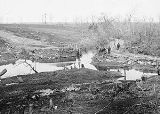
First Battle of Bull Run, also known as
First Manassas (the name used by Confederate forces), was fought on July 21, 1861, in
Prince William County, Virginia-National protected areas:* Featherstone National Wildlife Refuge* Manassas National Battlefield Park* Occoquan Bay National Wildlife Refuge* Prince William Forest Park-Government and politics:...
, near the City of
ManassasThe City of Manassas is an independent city surrounded by Prince William County and the independent city of Manassas Park in the Commonwealth of Virginia in the United States. Its population was 37,821 as of 2010. Manassas also surrounds the county seat for Prince William County but that county...
. It was the first major land battle of the
American Civil WarThe American Civil War was a civil war fought in the United States of America. In response to the election of Abraham Lincoln as President of the United States, 11 southern slave states declared their secession from the United States and formed the Confederate States of America ; the other 25...
.
Just months after the start of the war at
Fort SumterThe Battle of Fort Sumter was the bombardment and surrender of Fort Sumter, near Charleston, South Carolina, that started the American Civil War. Following declarations of secession by seven Southern states, South Carolina demanded that the U.S. Army abandon its facilities in Charleston Harbor. On...
, the
NorthernNorthern United States, also sometimes the North, may refer to:* A particular grouping of states or regions of the United States of America. The United States Census Bureau divides some of the northernmost United States into the Midwest Region and the Northeast Region...
public clamored for a march against the
ConfederateThe Confederate States of America was a government set up from 1861 to 1865 by 11 Southern slave states of the United States of America that had declared their secession from the U.S...
capital of
Richmond, VirginiaRichmond is the capital of the Commonwealth of Virginia, in the United States. It is an independent city and not part of any county. Richmond is the center of the Richmond Metropolitan Statistical Area and the Greater Richmond area...
, which could bring an early end to the war. Yielding to this political pressure, unseasoned
Union ArmyThe Union Army was the land force that fought for the Union during the American Civil War. It was also known as the Federal Army, the U.S. Army, the Northern Army and the National Army...
troops under
Brig. Gen.A brigadier general in the United States Army, Air Force, and Marine Corps, is a one-star general officer, with the pay grade of O-7. Brigadier general ranks above a colonel and below major general. Brigadier general is equivalent to the rank of rear admiral in the other uniformed...
Irvin McDowellIrvin McDowell was a career American army officer. He is best known for his defeat in the First Battle of Bull Run, the first large-scale battle of the American Civil War.-Early life:...
advanced across
Bull RunBull Run is a free-flowing tributary stream of the Potomac River that originates from a spring in the Bull Run Mountains in Loudoun County, Virginia, and flows south to the Occoquan River...
against the equally unseasoned Confederate Army under Brig. Gen. P.G.T. Beauregard near Manassas Junction. McDowell's ambitious plan for a surprise flank attack against the Confederate left was not well executed by his inexperienced officers and men, but the Confederates, who had been planning to attack the Union left flank, found themselves at an initial disadvantage.
Confederate reinforcements under the command of Brig. Gen.
Joseph E. JohnstonJoseph Eggleston Johnston was a career U.S. Army officer, serving with distinction in the Mexican-American War and Seminole Wars, and was also one of the most senior general officers in the Confederate States Army during the American Civil War...
arrived from the
Shenandoah ValleyThe Shenandoah Valley is both a geographic valley and cultural region of western Virginia and West Virginia in the United States. The valley is bounded to the east by the Blue Ridge Mountains, to the west by the eastern front of the Ridge-and-Valley Appalachians , to the north by the Potomac River...
by railroad and the course of the battle changed. A
brigade of VirginiansThe Stonewall Brigade of the Confederate Army during the American Civil War, was a famous combat unit in United States military history. It was trained and first led by General Thomas J. "Stonewall" Jackson, a professor from Virginia Military Institute...
under a relatively unknown colonel from the
Virginia Military InstituteThe Virginia Military Institute , located in Lexington, Virginia, is the oldest state-supported military college and one of six senior military colleges in the United States. Unlike any other military college in the United States—and in keeping with its founding principles—all VMI students are...
,
Thomas J. Jacksonຄຽשת״ׇׂׂׂׂ֣|birth_place= Clarksburg, Virginia |death_place=Guinea Station, Virginia|placeofburial=Stonewall Jackson Memorial CemeteryLexington, Virginia|placeofburial_label= Place of burial|image=...
, stood their ground and Jackson received his famous nickname, "Stonewall Jackson". The Confederates launched a strong counterattack and as the Union troops began withdrawing under pressure, many panicked and it turned into a rout as they frantically ran in the direction of nearby
Washington, D.C.Washington, D.C., formally the District of Columbia and commonly referred to as Washington, "the District", or simply D.C., is the capital of the United States. On July 16, 1790, the United States Congress approved the creation of a permanent national capital as permitted by the U.S. Constitution....
Both sides were sobered by the violence and casualties of the battle, and they realized that the war would potentially be much longer and bloodier than they had originally anticipated.
Background
Brig. Gen. Irvin McDowell was appointed by
PresidentThe President of the United States of America is the head of state and head of government of the United States. The president leads the executive branch of the federal government and is the commander-in-chief of the United States Armed Forces....
Abraham LincolnAbraham Lincoln was the 16th President of the United States, serving from March 1861 until his assassination in April 1865. He successfully led his country through a great constitutional, military and moral crisis – the American Civil War – preserving the Union, while ending slavery, and...
to command the
Army of Northeastern VirginiaThe Army of the Potomac was the major Union Army in the Eastern Theater of the American Civil War.-History:The Army of the Potomac was created in 1861, but was then only the size of a corps . Its nucleus was called the Army of Northeastern Virginia, under Brig. Gen...
. Once in this capacity, McDowell was harassed by impatient politicians and citizens in Washington, who wished to see a quick battlefield victory over the Confederate Army in northern
VirginiaThe Commonwealth of Virginia , is a U.S. state on the Atlantic Coast of the Southern United States. Virginia is nicknamed the "Old Dominion" and sometimes the "Mother of Presidents" after the eight U.S. presidents born there...
. McDowell, however, was concerned about the untried nature of his army. He was reassured by President Lincoln, "You are green, it is true, but they are green also; you are all green alike." Against his better judgment, McDowell commenced campaigning. On July 16, 1861, the general departed Washington with the largest field army yet gathered on the
North AmericaNorth America is a continent wholly within the Northern Hemisphere and almost wholly within the Western Hemisphere. It is also considered a northern subcontinent of the Americas...
n continent, about 35,000 men (28,452 effectives). McDowell's plan was to move westward in three columns, make a diversionary attack on the Confederate line at Bull Run with two columns, while the third column moved around the Confederates' right flank to the south, cutting the railroad to
RichmondRichmond is the capital of the Commonwealth of Virginia, in the United States. It is an independent city and not part of any county. Richmond is the center of the Richmond Metropolitan Statistical Area and the Greater Richmond area...
and threatening the rear of the rebel army. He assumed that the Confederates would be forced to abandon Manassas Junction and fall back to the
Rappahannock RiverThe Rappahannock River is a river in eastern Virginia, in the United States, approximately in length. It traverses the entire northern part of the state, from the Blue Ridge Mountains in the west, across the Piedmont, to the Chesapeake Bay, south of the Potomac River.An important river in American...
, the next defensible line in Virginia, which would relieve some of the pressure on the U.S. capital.
The Confederate Army of the Potomac (21,883 effectives) under Beauregard was encamped near Manassas Junction, approximately 25 miles (40 km) from the United States capital. McDowell planned to attack this numerically inferior enemy army. Union
Maj. Gen.In the United States Army, United States Marine Corps, and United States Air Force, major general is a two-star general-officer rank, with the pay grade of O-8. Major general ranks above brigadier general and below lieutenant general...
Robert PattersonRobert Patterson was a United States major general during the Mexican-American War and at the beginning of the American Civil War...
's 18,000 men engaged Johnston's force (the Army of the Shenandoah at 8,884 effectives, augmented by Maj. Gen.
Theophilus H. HolmesTheophilus Hunter Holmes was a career United States Army officer and a Confederate Lieutenant General in the American Civil War.-Early life and career:...
's
brigadeA brigade is a major tactical military formation that is typically composed of two to five battalions, plus supporting elements depending on the era and nationality of a given army and could be perceived as an enlarged/reinforced regiment...
of 1,465) in the
Shenandoah ValleyThe Shenandoah Valley is both a geographic valley and cultural region of western Virginia and West Virginia in the United States. The valley is bounded to the east by the Blue Ridge Mountains, to the west by the eastern front of the Ridge-and-Valley Appalachians , to the north by the Potomac River...
, preventing them from reinforcing Beauregard.
After two days of marching slowly in the sweltering heat, the Union army was allowed to rest in
CentrevilleCentreville is an unincorporated community in Fairfax County, Virginia, United States. Recognized by the U.S. Census Bureau as a Census Designated Place , the community population was 71,135 as of the 2010 census and is approximately west of Washington, DC.-Colonial Period:Beginning in the 1760s,...
. McDowell reduced the size of his army to approximately 30,000 by dispatching Brig. Gen.
Theodore RunyonTheodore Runyon was a United States politician, diplomat, and Civil War brigadier general in the Union army.-Biography:...
with 5,000 troops to protect the army's rear. In the meantime, McDowell searched for a way to
outflankIn military tactics, a flanking maneuver, also called a flank attack, is an attack on the sides of an opposing force. If a flanking maneuver succeeds, the opposing force would be surrounded from two or more directions, which significantly reduces the maneuverability of the outflanked force and its...
Beauregard, who had drawn up his lines along Bull Run. On July 18, the Union commander sent a
divisionA division is a large military unit or formation usually consisting of between 10,000 and 20,000 soldiers. In most armies, a division is composed of several regiments or brigades, and in turn several divisions typically make up a corps...
under Brig. Gen.
Daniel TylerDaniel Tyler was an iron manufacturer, railroad president, and one of the first generals of the American Civil War.-Biography:...
to pass on the Confederate right (southeast) flank. Tyler was drawn into a
skirmish at Blackburn's Ford over Bull Run and made no headway.
Becoming more frustrated, McDowell resolved to attack the Confederate left (northwest) flank instead. He planned to attack with Brig. Gen.
Daniel TylerDaniel Tyler was an iron manufacturer, railroad president, and one of the first generals of the American Civil War.-Biography:...
's division at the
Stone BridgeStone Bridge crosses Bull Run at the eastern entrance of the Manassas National Battlefield Park in Manassas, Virginia. The original bridge was destroyed during the First Battle of Bull Run on July 21, 1861, the first major land battle of the American Civil War...
on the
Warrenton TurnpikeU.S. Route 29 is a north–south United States highway that runs for from the western suburbs of Baltimore, Maryland, to Pensacola, Florida. This highway's northern terminus is at Maryland Route 99 in Ellicott City, Maryland...
and send the divisions of Brig. Gens.
David HunterDavid Hunter was a Union general in the American Civil War. He achieved fame by his unauthorized 1862 order emancipating slaves in three Southern states and as the president of the military commission trying the conspirators involved with the assassination of President Abraham Lincoln.-Early...
and
Samuel P. HeintzelmanSamuel Peter Heintzelman was a United States Army General. He served in the Seminole War, the Mexican-American War, the Yuma War, the Cortina Troubles, and the American Civil War, rising to the command of a corps....
over Sudley Springs Ford. From here, these divisions could march into the Confederate rear. The brigade of
Col.In the United States Army, Air Force, and Marine Corps, colonel is a senior field grade military officer rank just above the rank of lieutenant colonel and just below the rank of brigadier general...
Israel B. RichardsonIsrael Bush Richardson was a United States Army officer during the Mexican-American War and American Civil War, where he was a major general in the Union Army...
(Tyler's Division) would harass the enemy at Blackburn's Ford, preventing them from thwarting the main attack. Patterson would tie down Johnston in the Shenandoah Valley so that reinforcements could not reach the area. Although McDowell had arrived at a theoretically sound plan, it had a number of flaws: it was one that required synchronized execution of troop movements and attacks, skills that had not been developed in the nascent army; it relied on actions by Patterson that he had already failed to take; finally, McDowell had delayed long enough that Johnston's Valley force was able to board trains at Piedmont Station and rush to Manassas Junction to reinforce Beauregard's men.
On July 19–20, significant reinforcements bolstered the Confederate lines behind Bull Run. Johnston arrived with all of his army, except for the troops of Brig. Gen.
Kirby SmithEdmund Kirby Smith was a career United States Army officer and educator. He served as a general in the Confederate States Army during the American Civil War, notable for his command of the Trans-Mississippi Department of the Confederacy after the fall of Vicksburg.After the conflict ended Smith...
, who were still in transit. Most of the new arrivals were posted in the vicinity of Blackburn's Ford and Beauregard's plan was to attack from there to the north toward Centreville. Johnston, the senior officer, approved the plan. If both of the armies had been able to execute their plans simultaneously, it would have resulted in a mutual counterclockwise movement as they attacked each other's left flank.
McDowell was getting contradictory information from his intelligence agents, so he called for the balloon
EnterpriseThe Enterprise was a gas inflated aerostat built by Prof. Thaddeus S. C. Lowe along with his father Clovis Lowe in 1858. It was the second balloon built by Lowe at his Hoboken, N.J. facility and named with the express approval of his wife Leontine because of the money and time they put into...
, which was being demonstrated by Prof.
Thaddeus S. C. LoweThaddeus Sobieski Coulincourt Lowe , also known as Professor T. S. C. Lowe, was an American Civil War aeronaut, scientist and inventor, mostly self-educated in the fields of chemistry, meteorology, and aeronautics, and the father of military aerial reconnaissance in the United States...
in Washington, to perform aerial reconnaissance.
Battle
On the morning of July 21, McDowell sent the divisions of Hunter and Heintzelman (about 12,000 men) from Centreville at 2:30 a.m., marching southwest on the Warrenton Turnpike and then turning northwest toward
Sudley SpringsSudley Springs is an unincorporated community in Prince William County, in the U.S. state of Virginia.-Reference:...
. Tyler's division (about 8,000) marched directly toward the Stone Bridge. The inexperienced units immediately developed logistical problems. Tyler's division blocked the advance of the main flanking column on the turnpike. The latter units found the approach roads to Sudley Springs were inadequate, little more than a cart path in some places, and did not begin fording Bull Run until 9:30 a.m. Tyler's men reached the Stone Bridge around 6 a.m.
At 5:15 a.m., Richardson's brigade fired a few artillery rounds across Mitchell's Ford on the Confederate right, some of which hit Beauregard's headquarters in the
Wilmer McLeanWilmer McLean was a wholesale grocer from Virginia. It is said that the American Civil War started in his front yard and ended in his front parlor....
house as he was eating breakfast, alerting him to the fact that his offensive battle plan had been preempted. Nevertheless, he ordered
demonstration attacksIn military terminology, a demonstration is an attack or show of force on a front where a decision is not sought, made with the aim of deceiving the enemy....
north toward the Union left at Centreville. Bungled orders and poor communications prevented their execution. Although he intended for Brig. Gen.
Richard S. EwellRichard Stoddert Ewell was a career United States Army officer and a Confederate general during the American Civil War. He achieved fame as a senior commander under Stonewall Jackson and Robert E...
to lead the attack, Ewell, at Union Mills Ford, was simply ordered to "hold ... in readiness to advance at a moment's notice." Brig. Gen. D.R. Jones was supposed to attack in support of Ewell, but found himself moving forward alone. Holmes was also supposed to support, but received no orders at all.
All that stood in the path of the 20,000 Union soldiers converging on the Confederate left flank were Col.
Nathan "Shanks" EvansNathan George "Shanks" Evans was a captain in the 2nd U.S. Cavalry who became a brigadier general in the Confederate States Army during the American Civil War.-Biography:...
and his reduced brigade of 1,100 men. Evans had moved some of his men to intercept the direct threat from Tyler at the bridge, but he began to suspect that the weak attacks from the Union brigade of Brig. Gen.
Robert C. SchenckRobert Cumming Schenck was a Union Army general in the American Civil War, and American diplomatic representative to Brazil and the United Kingdom. He was at both battles of Bull Run and took part in the Shenandoah Valley Campaign of 1862, and the Battle of Cross Keys...
were merely feints. He was informed of the main Union flanking movement through Sudley Springs by Captain
Edward Porter AlexanderEdward Porter Alexander was an engineer, an officer in the U.S. Army, a Confederate general in the American Civil War, and later a railroad executive, planter, and author....
, Beauregard's signal officer, observing from 8 miles (12.9 km) southwest on Signal Hill. In the first use of wig-wag semaphore signaling in combat, Alexander sent the message "Look out for your left, your position is turned." Shanks hastily led 900 of his men from their position fronting the Stone Bridge to a new location on the slopes of Matthews Hill, a low rise to the northwest of his previous position.
Evans soon received reinforcement from two other brigades under Brig. Gen.
Barnard BeeBarnard Elliott Bee Jr. was a career United States Army officer and a Confederate States Army general during the American Civil War. He was mortally wounded at the First Battle of Bull Run, one of the first general officers to be killed in the war. During that battle, he was responsible for the...
and Col.
Francis S. BartowColonel Francis Stebbins Bartow was an attorney, Confederate States of America political leader, and military officer during the early months of the American Civil War...
, bringing the force on the flank to 2,800 men. They successfully slowed Hunter's lead brigade (Brig. Gen. Ambrose E. Burnside) in its attempts to ford Bull Run and advance across Young's Branch, at the northern end of
Henry House HillHenry House Hill is a location near Bull Run in Virginia. Named for the house of the Henry family that sits atop it, the hill begins near the road of Centreville, Virginia, after Warrenton, Virginia, to the today's U.S. Route 29, the Warrenton Turnpike. It is a slow, constant rise toward the south...
. One of Tyler's brigade commanders, Col. William T. Sherman, crossed at an unguarded ford and struck the right flank of the Confederate defenders. This surprise attack, coupled with pressure from Burnside and
Maj.In the United States Army, Air Force, and Marine Corps, major is a field grade military officer rank just above the rank of captain and just below the rank of lieutenant colonel...
George SykesGeorge Sykes was a career United States Army officer and a Union General during the American Civil War.-Early life:...
, collapsed the Confederate line shortly after 11:30 a.m., sending them in a disorderly retreat to Henry House Hill.
As they retreated from their Matthews Hill position, the remainder of Evans's, Bee's, and Bartow's commands received some cover from Capt.
John D. ImbodenJohn Daniel Imboden was a lawyer, teacher, Virginia state legislator. During the American Civil War, he was a Confederate cavalry general and partisan fighter...
and his battery of four 6-pounder guns, who held off the Union advance while the Confederates attempted to regroup on Henry House Hill. They were met by generals Johnston and Beauregard, who had just arrived from Johnston's headquarters at the M. Lewis Farm, "Portici". Fortunately for the Confederates, McDowell did not press his advantage and attempt to seize the strategic ground immediately, choosing to bombard the hill with the batteries of Capts.
James B. RickettsJames Brewerton Ricketts was a career officer in the United States Army, serving as a Union Army general in the Eastern Theater during the American Civil War.-Early life and career:...
(Battery I, 1st U.S. Artillery) and Charles Griffin (Battery D, 5th U.S.) from Dogan's Ridge.
Brig. Gen
Thomas J. Jacksonຄຽשת״ׇׂׂׂׂ֣|birth_place= Clarksburg, Virginia |death_place=Guinea Station, Virginia|placeofburial=Stonewall Jackson Memorial CemeteryLexington, Virginia|placeofburial_label= Place of burial|image=...
's Virginia brigade came up in support of the disorganized Confederates around noon, accompanied by Col.
Wade HamptonWade Hampton III was a Confederate cavalry leader during the American Civil War and afterward a politician from South Carolina, serving as its 77th Governor and as a U.S...
and his
Hampton's LegionHampton's Legion was an American Civil War military unit of the Confederate States of America, organized and partially financed by wealthy South Carolina plantation owner Wade Hampton III...
, and Col.
J.E.B. StuartJames Ewell Brown "Jeb" Stuart was a U.S. Army officer from Virginia and a Confederate States Army general during the American Civil War. He was known to his friends as "Jeb", from the initials of his given names. Stuart was a cavalry commander known for his mastery of reconnaissance and the use...
's cavalry. Jackson posted his five regiments on the reverse slope of the hill, where they were shielded from direct fire, and was able to assemble 13 guns for the defensive line, which he posted on the crest of the hill; as the guns fired, their recoil moved them down the reverse slope, where they could be safely reloaded. Meanwhile, McDowell ordered the batteries of Ricketts and Griffin to move from Dogan's Ridge to the hill for close infantry support. Their 11 guns engaged in a fierce artillery duel across 300 yards (274.3 m) against Jackson's 13. Unlike many engagements in the Civil War, here the Confederate artillery had an advantage. The Union pieces were now within range of the Confederate smoothbores and the predominantly rifled pieces on the Union side were not effective weapons at such close ranges, with many shots fired over the head of their targets.
One of the casualties of the artillery fire was Judith Carter Henry, an 85-year-old widow and invalid, who was unable to leave her bedroom in the Henry House. As Ricketts began receiving rifle fire, he concluded that it was coming from the Henry House and turned his guns on the building. A shell that crashed through the bedroom wall tore off one of the widow's feet and inflicted multiple injuries, from which she died later that day.
"The Enemy are driving us," Bee exclaimed to Jackson. Jackson, a former U.S. Army officer and professor at the
Virginia Military InstituteThe Virginia Military Institute , located in Lexington, Virginia, is the oldest state-supported military college and one of six senior military colleges in the United States. Unlike any other military college in the United States—and in keeping with its founding principles—all VMI students are...
, is said to have replied, "Then, Sir, we will give them the bayonet." Bee exhorted his own troops to re-form by shouting, "There is Jackson standing like a stone wall. Let us determine to die here, and we will conquer. Rally behind the Virginians." There is some controversy over Bee's statement and intent, which could not be clarified because he was mortally wounded almost immediately after speaking and none of his subordinate officers wrote reports of the battle. Major Burnett Rhett, chief of staff to General Johnston, claimed that Bee was angry at Jackson's failure to come immediately to the relief of Bee's and Bartow's brigades while they were under heavy pressure. Those who subscribe to this opinion believe that Bee's statement was meant to be pejorative: "Look at Jackson standing there like a stone wall!"
Artillery commander Griffin decided to move two of his guns to the southern end of his line, hoping to provide
enfiladeEnfilade and defilade are concepts in military tactics used to describe a military formation's exposure to enemy fire. A formation or position is "in enfilade" if weapons fire can be directed along its longest axis. A unit or position is "in defilade" if it uses natural or artificial obstacles to...
fire against the Confederates. At approximately 3 p.m., these guns were overrun by the 33rd Virginia, whose men were outfitted in blue uniforms, causing Griffin's commander, Maj.
William F. BarryWilliam Farquhar Barry was a career officer in the United States Army, serving as an artillery commander during the Mexican-American War and Civil War.-Birth and early years:...
, to mistake them for Union troops and to order Griffin not to fire on them. Close range volleys from the 33rd Virginia and Stuart's cavalry attack against the flank of the
11th New York Volunteer Infantry RegimentThe 11th New York Volunteer Infantry Regiment was an infantry regiment of Union Army in the early years of the American Civil War. The regiment was organized in New York City in May 1861 as a Zouave regiment, known for its unusual dress and drill style, by Colonel Elmer E. Ellsworth, a personal...
(
Ellsworth-External links:* * * * * *...
's Fire
ZouaveZouave was the title given to certain light infantry regiments in the French Army, normally serving in French North Africa between 1831 and 1962. The name was also adopted during the 19th century by units in other armies, especially volunteer regiments raised for service in the American Civil War...
s), which was supporting the battery, killed many of the gunners and scattered the infantry. Capitalizing on this success, Jackson ordered two regiments to charge Ricketts's guns and they were captured as well. As additional Federal infantry engaged, the guns changed hands several times.
The capture of the Union guns turned the tide of battle. Although McDowell had brought 15 regiments into the fight on the hill, outnumbering the Confederates two to one, no more than two were ever engaged simultaneously. Jackson continued to press his attacks, telling soldiers of the
4th Virginia InfantryThe 4th Virginia Volunteer Infantry Regiment was an infantry regiment raised in Virginia for service in the Confederate States Army during the American Civil War. It fought in the Stonewall Brigade, mostly with the Army of Northern Virginia....
, "Reserve your fire until they come within 50 yards! Then fire and give them the bayonet! And when you charge, yell like furies!" For the first time, Union troops heard the disturbing sound of the
Rebel yellThe rebel yell was a battle cry used by Confederate soldiers during the American Civil War. Confederate soldiers would use the yell during charges to intimidate the enemy and boost their own morale, although the yell had other uses. The exact sound of the yell is unknown and the subject of much...
. At about 4 p.m., the last Union troops were pushed off Henry House Hill by a charge of two regiments from Col.
Philip St. George CockePhilip St. George Cocke was a brigadier general in the Confederate States Army during the first year of the American Civil War. He is best known for organizing the defense of Virginia along the Potomac River soon after the state's secession from the Union...
's brigade.
To the west, Chinn Ridge had been occupied by Col.
Oliver O. HowardOliver Otis Howard was a career United States Army officer and a Union general in the American Civil War...
's brigade from Heintzelman's division. Also at 4 p.m., two Confederate brigades that had just arrived from the Shenandoah Valley—Col. Jubal A. Early's and Brig. Gen.
Kirby SmithEdmund Kirby Smith was a career United States Army officer and educator. He served as a general in the Confederate States Army during the American Civil War, notable for his command of the Trans-Mississippi Department of the Confederacy after the fall of Vicksburg.After the conflict ended Smith...
's (commanded by Col.
Arnold ElzeyArnold Elzey , Jr. was a soldier in both the United States Army and the Confederate Army, serving as a major general during the American Civil War...
after Smith was wounded)—crushed Howard's brigade. Beauregard ordered his entire line forward. McDowell's force crumbled and began to retreat.
The retreat was relatively orderly up to the Bull Run crossings, but it was poorly managed by the Union officers. A Union wagon was overturned by artillery fire on a bridge spanning Cub Run Creek and incited panic in McDowell's force. As the soldiers streamed uncontrollably toward Centreville, discarding their arms and equipment, McDowell ordered Col.
Dixon S. MilesDixon Stansbury Miles was a career United States Army officer who served in the Mexican-American War and the Indian Wars. He was mortally wounded as he surrendered his Union garrison in the Battle of Harpers Ferry during the American Civil War.-Early life and military service:Miles was born in...
's division to act as a rear guard, but it was impossible to rally the army short of Washington. In the disorder that followed, hundreds of Union troops were taken prisoner. Expecting an easy Union victory, the wealthy elite of nearby Washington, including congressmen and their families, had come to picnic and watch the battle. When the Union army was driven back in a running disorder, the roads back to Washington were blocked by panicked civilians attempting to flee in their carriages.
Since their combined army had been left highly disorganized as well, Beauregard and Johnston did not fully press their advantage, despite urging from
Confederate PresidentThe President of the Confederate States of America was the Head of State and Head of Government of the Confederate States of America, which was formed from the states which declared their secession from the United States, thus precipitating the American Civil War. The only person to hold the...
Jefferson DavisJefferson Finis Davis , also known as Jeff Davis, was an American statesman and leader of the Confederacy during the American Civil War, serving as President for its entire history. He was born in Kentucky to Samuel and Jane Davis...
, who had arrived on the battlefield to see the Union soldiers retreating. An attempt by Johnston to intercept the Union troops from his right flank, using the brigades of Brig. Gens. Milledge L. Bonham and
James LongstreetJames Longstreet was one of the foremost Confederate generals of the American Civil War and the principal subordinate to General Robert E. Lee, who called him his "Old War Horse." He served under Lee as a corps commander for many of the famous battles fought by the Army of Northern Virginia in the...
, was a failure. The two commanders squabbled with each other and when Bonham's men received some artillery fire from the Union rear guard, and found that Richardson's brigade blocked the road to Centreville, he called off the pursuit.
Aftermath
Bull Run was the largest and bloodiest battle in American history up to that point. Union casualties were 460 killed, 1,124 wounded, and 1,312 missing or captured; Confederate casualties were 387 killed, 1,582 wounded, and 13 missing. Among the latter was Col.
Francis S. BartowColonel Francis Stebbins Bartow was an attorney, Confederate States of America political leader, and military officer during the early months of the American Civil War...
, who was the first Confederate brigade commander to be killed in the Civil War. General Bee was mortally wounded and died the following day.
Union forces and civilians alike feared that Confederate forces would advance on Washington, D.C., with very little standing in their way. On July 24, Prof.
Thaddeus S. C. LoweThaddeus Sobieski Coulincourt Lowe , also known as Professor T. S. C. Lowe, was an American Civil War aeronaut, scientist and inventor, mostly self-educated in the fields of chemistry, meteorology, and aeronautics, and the father of military aerial reconnaissance in the United States...
ascended in the balloon
EnterpriseThe Enterprise was a gas inflated aerostat built by Prof. Thaddeus S. C. Lowe along with his father Clovis Lowe in 1858. It was the second balloon built by Lowe at his Hoboken, N.J. facility and named with the express approval of his wife Leontine because of the money and time they put into...
to observe the Confederates moving in and about Manassas Junction and Fairfax. He saw no evidence of massing Rebel forces, but was forced to land in Confederate territory. It was overnight before he was rescued and could report to headquarters. He reported that his observations "restored confidence" to the Union commanders.
The Northern public was shocked at the unexpected defeat of their army when an easy victory had been widely anticipated. Both sides quickly came to realize the war would be longer and more brutal than they had imagined. On July 22 President Lincoln signed a bill that provided for the enlistment of another 500,000 men for up to three years of service.
The reaction in the Confederacy was more muted. There was little public celebration as the Southerners realized that despite their victory, the greater battles that would inevitably come would mean greater losses for their side as well.
Beauregard was considered the hero of the battle and was promoted that day by President Davis to full general in the Confederate Army. Stonewall Jackson, arguably the most important tactical contributor to the victory, received no special recognition, but would later achieve glory for his 1862 Valley Campaign. Irvin McDowell bore the brunt of the blame for the Union defeat and was soon replaced by Maj. Gen.
George B. McClellanGeorge Brinton McClellan was a major general during the American Civil War. He organized the famous Army of the Potomac and served briefly as the general-in-chief of the Union Army. Early in the war, McClellan played an important role in raising a well-trained and organized army for the Union...
, who was named general-in-chief of all the Union armies. McDowell was also present to bear significant blame for the defeat of Maj. Gen.
John Pope'sJohn Pope was a career United States Army officer and Union general in the American Civil War. He had a brief but successful career in the Western Theater, but he is best known for his defeat at the Second Battle of Bull Run in the East.Pope was a graduate of the United States Military Academy in...
Army of VirginiaThe Army of Virginia was organized as a major unit of the Union Army and operated briefly and unsuccessfully in 1862 in the American Civil War. It should not be confused with its principal opponent, the Confederate Army of Northern Virginia, commanded by Robert E...
by Gen.
Robert E. LeeRobert Edward Lee was a career military officer who is best known for having commanded the Confederate Army of Northern Virginia in the American Civil War....
's
Army of Northern VirginiaThe Army of Northern Virginia was the primary military force of the Confederate States of America in the Eastern Theater of the American Civil War, as well as the primary command structure of the Department of Northern Virginia. It was most often arrayed against the Union Army of the Potomac...
thirteen months later, at the
Second Battle of Bull RunThe Second Battle of Bull Run or Second Manassas was fought August 28–30, 1862, as part of the American Civil War. It was the culmination of an offensive campaign waged by Confederate Gen. Robert E. Lee's Army of Northern Virginia against Union Maj. Gen...
. Patterson was also removed from command.
The name of the battle has caused controversy since 1861. The Union Army frequently named battles after significant rivers and creeks that played a role in the fighting; the Confederates generally used the names of nearby towns or farms. The U.S. National Park Service uses the Confederate name for its
national battlefield parkManassas National Battlefield Park, located north of Manassas, in Prince William County, Virginia preserves the site of two major American Civil War battles: the First Battle of Bull Run on July 21, 1861, and the Second Battle of Bull Run which was fought between August 28 and August 30, 1862...
, but the Union name (Bull Run) also has widespread currency in popular literature.
Battlefield confusion between the battle flags, especially the similarity of the Confederacy's "Stars and Bars" and the Union's "Stars and Stripes" when fluttering, led to the adoption of the
Confederate Battle FlagThere were only three flag designs adopted, with later, minor variants made to those designs, that served as the official national flags of the Confederate States of America and used during its existence from 1861 to 1865...
, which eventually became the most popular symbol of the Confederacy and the
SouthThe Southern United States—commonly referred to as the American South, Dixie, or simply the South—constitutes a large distinctive area in the southeastern and south-central United States...
in general.
In popular media
The First Battle of Bull Run is mentioned in the novel
Gods and Generals, but is depicted more fully in its
film adaptionGods and Generals is a 2003 American film based on the novel Gods and Generals by Jeffrey Shaara. It depicts events that take place prior to those shown in the 1993 film Gettysburg, which was based on The Killer Angels, a novel by Shaara's father, Michael...
. It also appears in the first episode of the second season of the mini-series
North and SouthNorth and South is the title of three American television miniseries broadcast on the ABC network in 1985, 1986, and 1994. Set before, during, and immediately after the American Civil War, they are based on the 1980s trilogy of novels North and South by John Jakes. The 1985 first installment, North...
.
Manassas (1999) is the first volume in the
James Reasoner Civil War SeriesThe American Civil War Battle Series by author James Reasoner is a ten volume series of historical novels about the American Civil War. The series centers on the fictional Brannon family, which resides in Culpeper, Virginia, a village and county in north central Virginia north of the Rapidan River...
of historical novels. The battle is described in
Rebel (1993), the first volume of
Bernard CornwellBernard Cornwell OBE is an English author of historical novels. He is best known for his novels about Napoleonic Wars rifleman Richard Sharpe which were adapted into a series of Sharpe television films.-Biography:...
's
The Starbuck ChroniclesThe Starbuck Chronicles are a series of historical fiction novels by British author Bernard Cornwell set during the American Civil War. They follow the exploits of a young Boston-born Confederate officer, Nathaniel Starbuck....
series of historical novels. The battle is also depicted in
John JakesJohn William Jakes is an American writer, best known for American historical fiction.-Early life and education:...
's
The Titans, the fifth novel in
The Kent Family ChroniclesThe Kent Family Chronicles is a series of eight novels by John Jakes written to commemorate the 200th anniversary of the Declaration of Independence of the United States of America. The books became best sellers, with no novel in the series selling fewer than 3.5 million copies...
, a series that explores the fictional Confederate cavalry officer Gideon Kent. The battle is the subject of the
Johnny HortonJohn Gale "Johnny" Horton was an American country music and rockabilly singer most famous for his semi-folk, so-called "saga songs" which began the "historical ballad" craze of the late 1950s and early 1960s...
song, "Battle of Bull Run".
Sesquicentennial
Prince William County is staging special events commemorating the 150th anniversary of the Civil War through 2011. Manassas has been named the No. 1 tourist destination in the United States for 2011 by the American Bus Association for its efforts in highlighting the historical impact of the Civil War. The cornerstone of the commemoration event featured a reenactment of the battle on July 23–24, 2011. Throughout the year, there will be tours of the Manassas battlefield and other battlefields in the county and a number of related events and activities.
The City of Manassas commemorated the 150th anniversary of the battle July 21–24, 2011.
Further reading
- Davis, William C.
William C. Davis is a professor of history at Virginia Tech University. An expert on the American Civil War, Davis has twice been nominated for a Pulitzer Prize. He has written more than forty books on the American Civil War and other aspects of Southern history. He was twice nominated for a...
Battle at Bull Run: A History of the First Major Campaign of the Civil War. Baton Rouge: Louisiana State University Press, 1977. ISBN 0-8071-0867-7.
- Goldfield, David, et al. The American Journey: A History of the United States. 2nd ed. New York: Prentice Hall, 1999. ISBN 0-13-088243-7.
- Gottfried, Bradley M. The Maps of First Bull Run: An atlas of the First Bull Run (Manassas) Campaign, including the Battle of Ball's Bluff, June–October 1861. El Dorado Hills, CA: Savas Beatie, 2009. ISBN 978-1-932714-60-9.
- Hankinson, Alan. First Bull Run 1861: The South's First Victory. Osprey Campaign Series #10. London: Osprey Publishing, 1991. ISBN 1-85532-133-5.
- Longstreet, James
James Longstreet was one of the foremost Confederate generals of the American Civil War and the principal subordinate to General Robert E. Lee, who called him his "Old War Horse." He served under Lee as a corps commander for many of the famous battles fought by the Army of Northern Virginia in the...
. From Manassas to Appomattox: Memoirs of the Civil War in America. New York: Da Capo Press, 1992. ISBN 0-3068-0464-6. First published in 1896 by J. B. Lippincott and Co.
External links
- Manassas National Battlefield Park website
- First Battle of Manassas: An End to Innocence, a National Park Service Teaching with Historic Places (TwHP) lesson plan
- Battle of Bull Run: Battle maps, photos, history articles, and battlefield news (CWPT)
- Harper's Weekly 1861 Report on the Battle of Bull Run
- Civil War Home website on First Bull Run
- Animated history of the First Battle of Bull Run
- FirstBullRun.co.uk
- The First Battle of Bull Run. General P.G.T. Beauregard. Librivox
LibriVox is an online digital library of free public domain audiobooks, read by volunteers and is probably, since 2007, the world's most prolific audiobook publisher...
audio recording, Public Domain, 2007.
- First Manassas Campaign with Official Records and Reports
- Map of the Battles of Bull Run Near Manassas. Solomon Bamberger. Zoomable high-resolution map.
- Newspaper coverage of the First Battle of Bull Run
- Manassas Civil War 150th Anniversary July 21-24, 2011