

Tiberias

Encyclopedia
Tiberias is a city on the western shore of the Sea of Galilee
(also called the Kinneret), Lower Galilee
, Israel
. Established in 20 CE, it was named in honour of the emperor Tiberius
.
Tiberias has been venerated in Judaism since the middle of the 2nd century CE and since the 16th century has been considered one of Judaism
's Four Holy Cities
, along with Jerusalem, Hebron
and Safed
. In the 2nd-10th centuries, Tiberias was the largest Jewish city in the Galilee and the political and religious hub of the Jews of Palestine. According to Christian tradition, Jesus
performed several miracles in the Tiberias district, making it an important pilgrimage site for devout Christians. Tiberias has historically been known for its hot springs
, believed to cure skin and other ailments, for thousands of years.
Province of Rome by Roman-Jewish client king Herod Antipas
, son of Herod the Great
, who made it the capital of his realm in Galilee. It had a Jewish majority, living alongside a heterogeneous population. It was named in honor of the Roman Emperor
Tiberius
. There is a legend that Tiberias was built on the site of the Israelite village of Rakkat, mentioned in the Book of Joshua
(Joshua 19:35). A discussion of Tiberias as Rakkat appears in the Talmud
. In The Antiquities of the Jews, the Roman Jewish historian Josephus
states that Tiberias was near Emmaus
. This location is repeated in The Wars of the Jews
.
Under the Roman Empire
, the city was known by its Greek
name Τιβεριάς (Tiberiás, Modern Greek
Τιβεριάδα Tiveriáda), an adaptation of the taw
-suffixed Semitic
form that preserved its feminine grammatical gender
.
In the days of Antipas
, the more religious (as opposed to Hellenized) Jews
refused to settle there; the presence of a cemetery
rendered the site ritually unclean. Antipas settled many non-Jews there from rural Galilee and other parts of his domains in order to populate his new capital, and built a palace on the acropolis. The prestige of Tiberias was so great that the sea of Galilee soon came to be named the sea of Tiberias; however, what would now be called Jewish zealots continued to call it 'Yam Ha-Kinerett', its traditional name. The city was governed by a city council of 600 with a committee of 10 until 44 CE when a Roman Procurator was set over the city after the death of Agrippa I
. In 61 CE Agrippa II
annexed the city to his kingdom whose capital was Caesarea Phillippi
. During the First Jewish–Roman War Josephus Flavius took control of the city and destroyed Herod's palace but was able to stop the city from being pillaged by his Jewish army. Where most other cities in Palestine were razed, Tiberias was spared because its inhabitants remained loyal to Rome after Josephus Flavius had surrendered the city to the Roman emperor Vespasian
. It became a mixed city after the fall of Jerusalem; with Judea subdued, the southern Jewish population migrated to Galilee.
In 145 CE, Rabbi Shimon bar Yochai "cleansed the city of ritual impurity allowing Jews to settle in the city in numbers." The Sanhedrin
, the Jewish court, also fled from Jerusalem during the Great Jewish Revolt against the Roman Empire, and after several moves eventually settled in Tiberias in about 150 CE. It was to be its final meeting place before its disbanding in the early Byzantine period. Following the expulsion of all Jews from Jerusalem after 135, Tiberias and its neighbor Sepphoris became the major Jewish centres. From the time when Yochanan bar Nafcha
(d. 279) settled in Tiberias, the city became the focus of Jewish religious scholarship in the land. The Mishnah
along with the Jerusalem Talmud
, (the written discussions of generations of rabbis in the Land of Israel – primarily in the academies of Tiberias and Caesarea), was probably compiled in Tiberias by Rabbi Judah haNasi
in around 200 CE. The 13 synagogues served the spiritual needs of a growing Jewish population.
In the 6th century Tiberias was still the seat of Jewish religious learning. In light of this, Bishop Simeon of Beth Arsham urged the Christians of Palestine to seize the leaders of Judaism in Tiberias, to put them to the rack, and to compel them to command the Jewish king, Dhu Nuwas
, to desist from persecuting the Christians in Najran
.
In 614, Tiberias was the site where during the final Jewish revolt
against the Byzantine Empire
, some of the Jewish population supported the Persian
invaders; the Christians were massacred and the churches destroyed. In 628 the Byzantium army retook Tiberias and the slaughter of the Christians was then reciprocated with a slaughter of the Jews.
conquest. The Caliphate allowed 70 Jewish families from Tiberias to form the core of a renewed Jewish presence in Jerusalem and the importance of Tiberias to Jewish life declined. The caliphs of the Umayyad Dynasty built one of its square-plan palaces on the waterfront to the north of Tiberias, at Khirbat al-Minya
. Tiberias was revitalised in 749 after Bet Shean was destroyed in an earthquake. Jewish scholarship flourished from the beginning of the 8th century to the end of the 10th., when the oral traditions of ancient Hebrew, still in use today, were codified. One of the leading members of the Tiberian masoretic community was Aaron ben Moses ben Asher
, who refined the oral tradition now known as Tiberian Hebrew
. Ben Asher is also credited with putting the finishing touches on the Aleppo Codex
, the oldest existing manuscript of the Hebrew scriptures.
The Arab geographer al-Muqaddasi
writing in 985, describes Tiberias as "the capital of Jordan Province, and a city in the Valley of Canaan...The town is narrow, hot in summer and unhealthy...There are here eight natural hot baths, where no fuel need be used, and numberless basins besides of boiling water. The mosque
is large and fine, and stands in the market-place. Its floor is laid in pebbles, set on stone drums, placed close one to another." According to Muqaddesi, those who suffered from scab or ulcers, and other such diseases came to Tiberias to bath in the hot springs for three days. "Afterwards they dip in another spring which is cold, whereupon...they become cured."
In 1033 Tiberias was again destroyed by an earthquake.
Nasir-i Khusrou
visited in 1047, and describes a city with a "strong wall" which begins at the border of the lake and goes all around the town except on the water-side. Furthermore, he describes
During the First Crusade
it was occupied by the Franks
, soon after the capture of Jerusalem and it was given in fief to Tancred
, who made it his capital of the Principality of Galilee
in the Kingdom of Jerusalem
; the region was sometimes called the Principality of Tiberias, or the Tiberiad. In 1099 the original site of the city was abandoned, and settlement shifted north to the present location. St. Peter's Church, originally built by the Crusaders, is still standing today, although the building has been altered and reconstructed over the years. In the 12th-century, the city was the subject of negative undertones in Islamic tradition. A hadith
recorded by Ibn Asakir of Damascus (d. 1176) names Tiberias as one of the "four cities of hell." This could have been reflecting the fact that at the time, the town had a notable non-Muslim population.
In 1187 Saladin
ordered his son al-Afdal
to send an envoy to Count Raymond of Tripoli
requesting safe passage through his fiefdom of Galilee and Tiberias. Raymond was obliged to grant the request under the terms of his treaty with Saladin. Saladin's force left Caesarea Philippi to engage the fighting force of the Knights Templar
. The Templar force was destroyed in the encounter
. Saladin then besieged
Tiberias; after six days the town fell. On July 4, 1187 Saladin defeated the Crusaders coming to relieve Tiberias at the Battle of Hattin
, 10 km outside the city.
At the beginning of the 12th century the Jewish community numbered about 50 families; and at that time the best manuscripts of the Torah
were said to be found there. Rabbi Moshe ben Maimon, (Maimonides
), a leading Jewish legal scholar, philosopher and physician of his period, died in 1204 in Egypt
and was later buried in Tiberias, now one of the city's important pilgrimage sites.
Yakut
, writing in the 1220s, described Tiberias as a small town, long and narrow. He also describes the "hot salt springs, over which they have built Hammam
s which use no fuel. Tabariyyah was first conquered by (the Arab commander) Shurahbil
in the year 13 (634 AD) by capitulation; one half of the houses and churches were to belong to the Muslims, the other half to the Christians."
In 1265 the Crusaders
were driven from the city by the Mamluks, who ruled Tiberias until the Ottoman conquest in 1516.
expanded along the southern Mediterranean coast under sultan Selim I
, the Reyes Católicos (Catholic Monarchs
) began establishing Inquisition
commissions. Many Conversos
, (Marranos
and Moriscos
) and Sephardi Jews
fled in fear to the Ottoman provinces, settling at first in Constantinople
, Salonika, Sarajevo
, Sofia
and Anatolia
. The Sultan encouraged them to settle in Palestine. In 1558, a Portuguese-born marrano
, Doña Gracia, was granted tax collecting rights in Tiberias and its surrounding villages by Suleiman the Magnificent
. She envisaged the town becoming a refuge for Jews and obtained a permit to establish Jewish autonomy there. In 1561 her nephew Joseph Nasi
, Lord of Tiberias
, encouraged Jews to settle in Tiberias. Securing a firman from the Sultan, he and Joseph ben Adruth rebuilt the city walls and lay the groundwork for a textile (silk
) industry, planting mulberry trees
and urging craftsmen to move there. Plans were made for Jews to move from the Papal States
, but when the Ottomans and the Republic of Venice went to war, the plan was abandoned. No Christians or Jews were mentioned in the Ottoman registers of 1525, 1533, 1548, 1553 and 1572. The registers in 1596 recorded the population to consist of 50 Muslim families and 4 bachelors.
In 1624, when the Sultan recognized Fakhr-al-Din II
as Lord of Arabistan (from Aleppo to the borders of Egypt), the Druze
leader made Tiberias his capital. The 1660 destruction of Tiberias by the Druze
resulted in abandonment of the city by its Jewish community, Unlike Tiberias, the nearby city of Safed
recovered its destruction in 1660, and wasn't entirely abandoned, remaining an important Jewish center in the Galilee.
In the 1720s, the Bedouin
ruler Dhaher al-Omar, fortified the town and signed an agreement with the neighboring Bedouin tribes to prevent looting. Accounts from that time tell of the great admiration people had for Dhaher, especially his war against bandits on the roads. Richard Pococke
, who visited Tiberias in 1727, witnessed the building of a fort to the north of the city, and the strengthening of the old walls, attributing it to a dispute with the pasha (ruler)
of Damascus. In the 1740, Tiberias was under the autonomous rule of Dhaher. Under Dhaher's patronage, Jewish families were encouraged to settle in Tiberias. He invited Chaim Abulafia of Smyrna
to rebuild the Jewish community. The synagogue he built still stands.
Under instructions from the Ottoman Porte, Suleyman Pasha of Damascus laid siege to Tiberias in 1742, with the intention of eliminating Dhaher. However, the siege was unsuccessful. In the following year, Suleyman set out to repeat the attempt with even greater reinforcements, but he died en route.
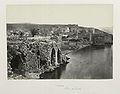 In 1775, Ahmed el-Jazzar "the Butcher", brought peace to the region with an iron fist.
In 1780, many Polish Jews settled in the town. During the 18th and 19th centuries it received an influx of rabbis who re-established it as a center for Jewish learning.
Six hundred people, including nearly 500 Jews, died when the town was devastated by the 1837 Galilee earthquake
. An American expedition found Tiberias still in a state of disrepair in 1847/1848.
In 1842 there were about 4,000 inhabitants, around a third of whom were Jews, the rest being Turks and a few Christians. In 1850 Tiberias contained three synagogues
which served the Sephardi community, which consisted of 80 families, and the Ashkenazim, all Poles and Russians, numbering about 100 families. It was reported that the Jewish inhabitants of Tiberias enjoyed more peace and security than those of Safed
.
In 1863 it is recorded that the Christian and Muslim elements made up three-quarters of the population (2,000 to 4,000). In 1901, the Jews of Tiberias numbered about 2,000 in a total population of 3,600. By 1912 the population reached 6,500. This included 4,500 Jews, 1,600 Muslims and the rest Christians.
In 1885, a Scottish
doctor and minister, David Watt Torrance, opened a mission hospital in Tiberias that accepted patients of all races and religions. In 1894, it moved to larger premises at Beit abu Shamnel abu Hannah. In 1923 his son, Dr. Herbert Watt Torrance, was appointed head of the hospital. After the establishment of the State of Israel, it became a maternity hospital supervised by the Israeli Department of Health. After its closure in 1959, the building became a guesthouse. In 1999, it was renovated and reopened as the Scots Hotel.
and the disturbances throughout Palestine in 1929
.
The landscape of the modern town was shaped by the great flood of Nov. 11, 1934. Deforestation on the slopes above the town combined with the fact that the city had been built as a series of closely packed houses and buildings - usually sharing walls - built in narrow roads paralleling and closely hugging the shore of the lake. Flood waters carrying mud, stones, and boulders rushed down the slopes and filled the streets and buildings with water so rapidly that many people did not have time to escape, The loss of life and property was great. The city rebuilt on the slopes and the British Mandatory government planted the Scottish Forest on the slopes above the town to hold the soil and prevent similar disasters from recurring. A new seawall was constructed, moving the shoreline several yards out form the former shore.
In October 1938 Arab militants murdered 20 Jews
in Tiberias during the 1936-1939 Arab revolt in Palestine.
According to British census data, the population of Tiberias was 4427 Jews, 2096 Muslims, 422 Christians, 5 others in 1922; 5381 Jews, 2645 Muslims, 565 Christians, 10 others in 1931; and 6000 Jews, 4540 Muslims, 760 Christians, 10 others in 1945.
to take over defense of the city, but a small contingent of outside irregulars moved in. During April 10–17, the Haganah attacked the city and refused to negotiate a truce, while the British refused to intervene.
The Arab population (6,000 residents or 47.5% of the population) was evacuated under British military protection on 18 April 1948. No order to expel the population had been given to the Jewish forces and the evacuation seems to have surprised them. Widespread looting of the Arab areas by the Jewish population had to be suppressed by force by the Haganah and Jewish police, who killed or injured several looters.
, with the construction of a waterfront promenade, open parkland, shopping streets, restaurants and modern hotels. Carefully preserved were several churches, including one with foundations dating from the Crusader period, the city's two Ottoman-era mosques, and several ancient synagogues. The city's old masonry buildings constructed of local black basalt with white limestone windows and trim have been designated historic landmarks. Also preserved are parts of the ancient wall, the Ottoman-era citadel, historic hotels, Christian pilgrim hostels, convents and schools.
on one side and the Greek words "Jesus the Messiah King of Kings" on the other. It belongs to a series of coins issued in Constantinople to commemorate the First Millennium of Jesus' birth. Such coins have surfaced in neighboring countries, such as Turkey, but this is the first one found in Israel. It is believed to have been brought to Tiberias by Christian pilgrims.
In 2004, excavations in Tiberias conducted by the Israel Antiquities Authority
uncovered a structure dating to the 3rd century CE that may have been the seat of the Sanhedrin
. At the time it was called Beit Hava'ad.
, between the elevation of -200 to 200 meters. Tiberias has a climate that borders a Hot-summer Mediterranean climate (koppen Csa) and a Hot Semi-arid climate (koppen BSh) with an annual precipitation of about 400 mm (15.75 in)
The summers in Tiberias are very hot with an average maximum temperature of 36C (97F) and average minimum temperature of 21C (70F) in July and August. The winters are mild with temperatures ranging from 18C to 8C (65F and 46F). Extremes have ranged from 0 to 46C (32F to 115F).
, Galilee earthquake of 363
, and Near East earthquake of 1759
.
represented the city in the top division of football for several seasons in the 1960s and 1980s, but eventually dropped into the regional leagues and folded due to financial difficulties. Following Hapoel's demise, a new club, Ironi Tiberias, was established, which currently plays in Liga Alef
. 6 Nations Championship and Heineken Cup
winner Jamie Heaslip
was born in Tiberias.
The Tiberias Marathon
is an annual road race held along the Sea of Galilee in Israel with a field in recent years of approximately 1000 competitors.The course follows an out-and-back format around the southern tip of the sea, and was run concurrently with a 10k race along an abbreviated version of the same route. In 2010 the 10k race was moved to the afternoon before the marathon. At Approximately 200 metres below sea level, This is the lowest course in the world.
Sea of Galilee
The Sea of Galilee, also Kinneret, Lake of Gennesaret, or Lake Tiberias , is the largest freshwater lake in Israel, and it is approximately in circumference, about long, and wide. The lake has a total area of , and a maximum depth of approximately 43 m...
(also called the Kinneret), Lower Galilee
Galilee
Galilee , is a large region in northern Israel which overlaps with much of the administrative North District of the country. Traditionally divided into Upper Galilee , Lower Galilee , and Western Galilee , extending from Dan to the north, at the base of Mount Hermon, along Mount Lebanon to the...
, Israel
Israel
The State of Israel is a parliamentary republic located in the Middle East, along the eastern shore of the Mediterranean Sea...
. Established in 20 CE, it was named in honour of the emperor Tiberius
Tiberius
Tiberius , was Roman Emperor from 14 AD to 37 AD. Tiberius was by birth a Claudian, son of Tiberius Claudius Nero and Livia Drusilla. His mother divorced Nero and married Augustus in 39 BC, making him a step-son of Octavian...
.
Tiberias has been venerated in Judaism since the middle of the 2nd century CE and since the 16th century has been considered one of Judaism
Judaism
Judaism ) is the "religion, philosophy, and way of life" of the Jewish people...
's Four Holy Cities
Four Holy Cities
The Four Holy Cities , is the collective term in Jewish tradition applied to the cities of Jerusalem, Hebron, Tiberias, and Safed: "Since the sixteenth century the holiness of Palestine, especially for burial, has been almost wholly transferred to four cities—Jerusalem, Hebron, Tiberias, and...
, along with Jerusalem, Hebron
Hebron
Hebron , is located in the southern West Bank, south of Jerusalem. Nestled in the Judean Mountains, it lies 930 meters above sea level. It is the largest city in the West Bank and home to around 165,000 Palestinians, and over 500 Jewish settlers concentrated in and around the old quarter...
and Safed
Safed
Safed , is a city in the Northern District of Israel. Located at an elevation of , Safed is the highest city in the Galilee and of Israel. Due to its high elevation, Safed experiences warm summers and cold, often snowy, winters...
. In the 2nd-10th centuries, Tiberias was the largest Jewish city in the Galilee and the political and religious hub of the Jews of Palestine. According to Christian tradition, Jesus
Jesus
Jesus of Nazareth , commonly referred to as Jesus Christ or simply as Jesus or Christ, is the central figure of Christianity...
performed several miracles in the Tiberias district, making it an important pilgrimage site for devout Christians. Tiberias has historically been known for its hot springs
Hot Springs
Hot Springs may refer to:* Hot Springs, Arkansas** Hot Springs National Park, Arkansas*Hot Springs, California**Hot Springs, Lassen County, California**Hot Springs, Modoc County, California**Hot Springs, Placer County, California...
, believed to cure skin and other ailments, for thousands of years.
History
Jewish and Roman period
Tiberias was founded sometime around 20 CE in the JudeaJudea
Judea or Judæa was the name of the mountainous southern part of the historic Land of Israel from the 8th century BCE to the 2nd century CE, when Roman Judea was renamed Syria Palaestina following the Jewish Bar Kokhba revolt.-Etymology:The...
Province of Rome by Roman-Jewish client king Herod Antipas
Herod Antipas
Herod Antipater , known by the nickname Antipas, was a 1st-century AD ruler of Galilee and Perea, who bore the title of tetrarch...
, son of Herod the Great
Herod the Great
Herod , also known as Herod the Great , was a Roman client king of Judea. His epithet of "the Great" is widely disputed as he is described as "a madman who murdered his own family and a great many rabbis." He is also known for his colossal building projects in Jerusalem and elsewhere, including his...
, who made it the capital of his realm in Galilee. It had a Jewish majority, living alongside a heterogeneous population. It was named in honor of the Roman Emperor
Roman Emperor
The Roman emperor was the ruler of the Roman State during the imperial period . The Romans had no single term for the office although at any given time, a given title was associated with the emperor...
Tiberius
Tiberius
Tiberius , was Roman Emperor from 14 AD to 37 AD. Tiberius was by birth a Claudian, son of Tiberius Claudius Nero and Livia Drusilla. His mother divorced Nero and married Augustus in 39 BC, making him a step-son of Octavian...
. There is a legend that Tiberias was built on the site of the Israelite village of Rakkat, mentioned in the Book of Joshua
Book of Joshua
The Book of Joshua is the sixth book in the Hebrew Bible and of the Old Testament. Its 24 chapters tell of the entry of the Israelites into Canaan, their conquest and division of the land under the leadership of Joshua, and of serving God in the land....
(Joshua 19:35). A discussion of Tiberias as Rakkat appears in the Talmud
Talmud
The Talmud is a central text of mainstream Judaism. It takes the form of a record of rabbinic discussions pertaining to Jewish law, ethics, philosophy, customs and history....
. In The Antiquities of the Jews, the Roman Jewish historian Josephus
Josephus
Titus Flavius Josephus , also called Joseph ben Matityahu , was a 1st-century Romano-Jewish historian and hagiographer of priestly and royal ancestry who recorded Jewish history, with special emphasis on the 1st century AD and the First Jewish–Roman War, which resulted in the Destruction of...
states that Tiberias was near Emmaus
Emmaus
Emmaus was an ancient town located approximately northwest of present day Jerusalem...
. This location is repeated in The Wars of the Jews
The Wars of the Jews
The Jewish War , in full Flavius Josephus's Books of the History of the Jewish War against the Romans , also referred to in English as The Wars of the Jews and The History of the Destruction of Jerusalem, is a book written by the 1st century Jewish historian Josephus.It is a description of Jewish...
.
Under the Roman Empire
Roman Empire
The Roman Empire was the post-Republican period of the ancient Roman civilization, characterised by an autocratic form of government and large territorial holdings in Europe and around the Mediterranean....
, the city was known by its Greek
Greek language
Greek is an independent branch of the Indo-European family of languages. Native to the southern Balkans, it has the longest documented history of any Indo-European language, spanning 34 centuries of written records. Its writing system has been the Greek alphabet for the majority of its history;...
name Τιβεριάς (Tiberiás, Modern Greek
Modern Greek
Modern Greek refers to the varieties of the Greek language spoken in the modern era. The beginning of the "modern" period of the language is often symbolically assigned to the fall of the Byzantine Empire in 1453, even though that date marks no clear linguistic boundary and many characteristic...
Τιβεριάδα Tiveriáda), an adaptation of the taw
Taw (letter)
Taw, Tav or Taf is the twenty-second and last letter in many Semitic abjads, including Phoenician, Aramaic, Hebrew Taw and Arabic alphabet .Its original sound value is ....
-suffixed Semitic
Semitic languages
The Semitic languages are a group of related languages whose living representatives are spoken by more than 270 million people across much of the Middle East, North Africa and the Horn of Africa...
form that preserved its feminine grammatical gender
Grammatical gender
Grammatical gender is defined linguistically as a system of classes of nouns which trigger specific types of inflections in associated words, such as adjectives, verbs and others. For a system of noun classes to be a gender system, every noun must belong to one of the classes and there should be...
.
In the days of Antipas
Herod Antipas
Herod Antipater , known by the nickname Antipas, was a 1st-century AD ruler of Galilee and Perea, who bore the title of tetrarch...
, the more religious (as opposed to Hellenized) Jews
Jews
The Jews , also known as the Jewish people, are a nation and ethnoreligious group originating in the Israelites or Hebrews of the Ancient Near East. The Jewish ethnicity, nationality, and religion are strongly interrelated, as Judaism is the traditional faith of the Jewish nation...
refused to settle there; the presence of a cemetery
Cemetery
A cemetery is a place in which dead bodies and cremated remains are buried. The term "cemetery" implies that the land is specifically designated as a burying ground. Cemeteries in the Western world are where the final ceremonies of death are observed...
rendered the site ritually unclean. Antipas settled many non-Jews there from rural Galilee and other parts of his domains in order to populate his new capital, and built a palace on the acropolis. The prestige of Tiberias was so great that the sea of Galilee soon came to be named the sea of Tiberias; however, what would now be called Jewish zealots continued to call it 'Yam Ha-Kinerett', its traditional name. The city was governed by a city council of 600 with a committee of 10 until 44 CE when a Roman Procurator was set over the city after the death of Agrippa I
Agrippa I
Agrippa I also known as Herod Agrippa or simply Herod , King of the Jews, was the grandson of Herod the Great, and son of Aristobulus IV and Berenice. His original name was Marcus Julius Agrippa, so named in honour of Roman statesman Marcus Vipsanius Agrippa, and he is the king named Herod in the...
. In 61 CE Agrippa II
Agrippa II
Agrippa II , son of Agrippa I, and like him originally named Marcus Julius Agrippa, was the seventh and last king of the family of Herod the Great, thus last of the Herodians. He was the brother of Berenice, Mariamne, and Drusilla...
annexed the city to his kingdom whose capital was Caesarea Phillippi
Caesarea Phillippi
Caesarea Philippi was an ancient Roman city located at the southwestern base of Mount Hermon . The city is mentioned in the gospels of Matthew, and Mark. The city was located within the region known as the "Panion" . Named after the deity associated with the grotto and shrines close to the spring...
. During the First Jewish–Roman War Josephus Flavius took control of the city and destroyed Herod's palace but was able to stop the city from being pillaged by his Jewish army. Where most other cities in Palestine were razed, Tiberias was spared because its inhabitants remained loyal to Rome after Josephus Flavius had surrendered the city to the Roman emperor Vespasian
Vespasian
Vespasian , was Roman Emperor from 69 AD to 79 AD. Vespasian was the founder of the Flavian dynasty, which ruled the Empire for a quarter century. Vespasian was descended from a family of equestrians, who rose into the senatorial rank under the Emperors of the Julio-Claudian dynasty...
. It became a mixed city after the fall of Jerusalem; with Judea subdued, the southern Jewish population migrated to Galilee.
In 145 CE, Rabbi Shimon bar Yochai "cleansed the city of ritual impurity allowing Jews to settle in the city in numbers." The Sanhedrin
Sanhedrin
The Sanhedrin was an assembly of twenty-three judges appointed in every city in the Biblical Land of Israel.The Great Sanhedrin was the supreme court of ancient Israel made of 71 members...
, the Jewish court, also fled from Jerusalem during the Great Jewish Revolt against the Roman Empire, and after several moves eventually settled in Tiberias in about 150 CE. It was to be its final meeting place before its disbanding in the early Byzantine period. Following the expulsion of all Jews from Jerusalem after 135, Tiberias and its neighbor Sepphoris became the major Jewish centres. From the time when Yochanan bar Nafcha
Yochanan bar Nafcha
Rabbi Yochanan ;...
(d. 279) settled in Tiberias, the city became the focus of Jewish religious scholarship in the land. The Mishnah
Mishnah
The Mishnah or Mishna is the first major written redaction of the Jewish oral traditions called the "Oral Torah". It is also the first major work of Rabbinic Judaism. It was redacted c...
along with the Jerusalem Talmud
Jerusalem Talmud
The Jerusalem Talmud, talmud meaning "instruction", "learning", , is a collection of Rabbinic notes on the 2nd-century Mishnah which was compiled in the Land of Israel during the 4th-5th century. The voluminous text is also known as the Palestinian Talmud or Talmud de-Eretz Yisrael...
, (the written discussions of generations of rabbis in the Land of Israel – primarily in the academies of Tiberias and Caesarea), was probably compiled in Tiberias by Rabbi Judah haNasi
Judah haNasi
Judah the Prince, or Judah I, also known as Rebbi or Rabbeinu HaKadosh , was a 2nd-century CE rabbi and chief redactor and editor of the Mishnah. He was a key leader of the Jewish community during the Roman occupation of Judea . He was of the Davidic line, the royal line of King David, hence the...
in around 200 CE. The 13 synagogues served the spiritual needs of a growing Jewish population.
In the 6th century Tiberias was still the seat of Jewish religious learning. In light of this, Bishop Simeon of Beth Arsham urged the Christians of Palestine to seize the leaders of Judaism in Tiberias, to put them to the rack, and to compel them to command the Jewish king, Dhu Nuwas
Dhu Nuwas
Yūsuf Dhū Nuwas, was the last king of the Himyarite kingdom of Yemen and a convert to Judaism....
, to desist from persecuting the Christians in Najran
Najran
Najran , formerly known as Aba as Sa'ud, is a city in southwestern Saudi Arabia near the border with Yemen. It is the capital of Najran Province. Designated a New town, Najran is one of the fastest-growing cities in the kingdom; its population has risen from 47,500 in 1974 and 90,983 in 1992 to...
.
In 614, Tiberias was the site where during the final Jewish revolt
Revolt against Heraclius
The Revolt against Heraclius was a Jewish insurrection against the Byzantine Empire across Levant, coming to the aid of the Persian during Byzantine–Sassanid War of 602–628. The revolt began with the Battle of Antioch , culminating with the conquest of Jerusalem in 614 by Persian and Jewish forces...
against the Byzantine Empire
Byzantine Empire
The Byzantine Empire was the Eastern Roman Empire during the periods of Late Antiquity and the Middle Ages, centred on the capital of Constantinople. Known simply as the Roman Empire or Romania to its inhabitants and neighbours, the Empire was the direct continuation of the Ancient Roman State...
, some of the Jewish population supported the Persian
Sassanid Empire
The Sassanid Empire , known to its inhabitants as Ērānshahr and Ērān in Middle Persian and resulting in the New Persian terms Iranshahr and Iran , was the last pre-Islamic Persian Empire, ruled by the Sasanian Dynasty from 224 to 651...
invaders; the Christians were massacred and the churches destroyed. In 628 the Byzantium army retook Tiberias and the slaughter of the Christians was then reciprocated with a slaughter of the Jews.
Middle Ages
In 636 CE Tiberias was the regional capital until Bet Shean took its place following the RashidunRashidun Caliphate
The Rashidun Caliphate , comprising the first four caliphs in Islam's history, was founded after Muhammad's death in 632, Year 10 A.H.. At its height, the Caliphate extended from the Arabian Peninsula, to the Levant, Caucasus and North Africa in the west, to the Iranian highlands and Central Asia...
conquest. The Caliphate allowed 70 Jewish families from Tiberias to form the core of a renewed Jewish presence in Jerusalem and the importance of Tiberias to Jewish life declined. The caliphs of the Umayyad Dynasty built one of its square-plan palaces on the waterfront to the north of Tiberias, at Khirbat al-Minya
Khirbat al-Minya
Khirbat al-Minya is an Umayyad-built palace in the eastern Galilee, Israel, located about west of the northern end of the Lake Tiberias...
. Tiberias was revitalised in 749 after Bet Shean was destroyed in an earthquake. Jewish scholarship flourished from the beginning of the 8th century to the end of the 10th., when the oral traditions of ancient Hebrew, still in use today, were codified. One of the leading members of the Tiberian masoretic community was Aaron ben Moses ben Asher
Aaron ben Moses ben Asher
Aaron ben Moses ben Asher was a Jewish scribe who refined the Tiberian system for writing down vowel sounds in Hebrew, which is still in use today, and serves as the basis for grammatical analysis...
, who refined the oral tradition now known as Tiberian Hebrew
Tiberian Hebrew
Tiberian Hebrew is the extinct canonical pronunciation of the Hebrew Bible or Tanakh and related documents in the Roman Empire. This traditional medieval pronunciation was committed to writing by Masoretic scholars based in the Jewish community of Tiberias , in the form of the Tiberian vocalization...
. Ben Asher is also credited with putting the finishing touches on the Aleppo Codex
Aleppo Codex
The Aleppo Codex is a medieval bound manuscript of the Hebrew Bible. The codex was written in the 10th century A.D.The codex has long been considered to be the most authoritative document in the masorah , the tradition by which the Hebrew Scriptures have been preserved from generation to generation...
, the oldest existing manuscript of the Hebrew scriptures.
The Arab geographer al-Muqaddasi
Al-Muqaddasi
Muhammad ibn Ahmad Shams al-Din Al-Muqaddasi , also transliterated as Al-Maqdisi and el-Mukaddasi, was a medieval Arab geographer, author of Ahsan at-Taqasim fi Ma`rifat il-Aqalim .-Biography:Al-Muqaddasi, "the Hierosolomite" was born in Jerusalem in 946 AD...
writing in 985, describes Tiberias as "the capital of Jordan Province, and a city in the Valley of Canaan...The town is narrow, hot in summer and unhealthy...There are here eight natural hot baths, where no fuel need be used, and numberless basins besides of boiling water. The mosque
Mosque
A mosque is a place of worship for followers of Islam. The word is likely to have entered the English language through French , from Portuguese , from Spanish , and from Berber , ultimately originating in — . The Arabic word masjid literally means a place of prostration...
is large and fine, and stands in the market-place. Its floor is laid in pebbles, set on stone drums, placed close one to another." According to Muqaddesi, those who suffered from scab or ulcers, and other such diseases came to Tiberias to bath in the hot springs for three days. "Afterwards they dip in another spring which is cold, whereupon...they become cured."
In 1033 Tiberias was again destroyed by an earthquake.
Nasir-i Khusrou
Nasir Khusraw
Abu Mo’in Hamid ad-Din Nasir ibn Khusraw al-Qubadiani or Nāsir Khusraw Qubādiyānī [also spelled as Nasir Khusrow and Naser Khosrow] Abu Mo’in Hamid ad-Din Nasir ibn Khusraw al-Qubadiani or Nāsir Khusraw Qubādiyānī [also spelled as Nasir Khusrow and Naser Khosrow] Abu Mo’in Hamid ad-Din Nasir ibn...
visited in 1047, and describes a city with a "strong wall" which begins at the border of the lake and goes all around the town except on the water-side. Furthermore, he describes
- "numberless buildings erected in the very water, for the bed of the lake in this part is rock; and they have built pleasure houses that are supported on columns of marbleMarbleMarble is a metamorphic rock composed of recrystallized carbonate minerals, most commonly calcite or dolomite.Geologists use the term "marble" to refer to metamorphosed limestone; however stonemasons use the term more broadly to encompass unmetamorphosed limestone.Marble is commonly used for...
, rising up out of the water. The lake is very full of fish. [] The Friday Mosque is in the midst of the town. At the gate of the mosque is a spring, over which they have built a hot bath. [] On the western side of the town is a mosque known as the Jasmine Mosque (Masjid-i-Yasmin). It is a fine building and in the middle part rises a great platform (dukkan), where they have their MihrabMihrabA mihrab is semicircular niche in the wall of a mosque that indicates the qibla; that is, the direction of the Kaaba in Mecca and hence the direction that Muslims should face when praying...
s (or prayer-niches). All round those they have set jasmineJasmineJasminum , commonly known as jasmines, is a genus of shrubs and vines in the olive family . It contains around 200 species native to tropical and warm temperate regions of the Old World...
-shrubs, from which the mosque derives its name."
During the First Crusade
First Crusade
The First Crusade was a military expedition by Western Christianity to regain the Holy Lands taken in the Muslim conquest of the Levant, ultimately resulting in the recapture of Jerusalem...
it was occupied by the Franks
Franks
The Franks were a confederation of Germanic tribes first attested in the third century AD as living north and east of the Lower Rhine River. From the third to fifth centuries some Franks raided Roman territory while other Franks joined the Roman troops in Gaul. Only the Salian Franks formed a...
, soon after the capture of Jerusalem and it was given in fief to Tancred
Tancred, Prince of Galilee
Tancred was a Norman leader of the First Crusade who later became Prince of Galilee and regent of the Principality of Antioch...
, who made it his capital of the Principality of Galilee
Principality of Galilee
The Principality of Galilee was one of the four major seigneuries of the crusader Kingdom of Jerusalem, according to 13th-century commentator John of Ibelin. The direct holdings of the principality were around Tiberias, in Galilee proper, but with all its vassals, the lordship covered all Galilee...
in the Kingdom of Jerusalem
Kingdom of Jerusalem
The Kingdom of Jerusalem was a Catholic kingdom established in the Levant in 1099 after the First Crusade. The kingdom lasted nearly two hundred years, from 1099 until 1291 when the last remaining possession, Acre, was destroyed by the Mamluks, but its history is divided into two distinct periods....
; the region was sometimes called the Principality of Tiberias, or the Tiberiad. In 1099 the original site of the city was abandoned, and settlement shifted north to the present location. St. Peter's Church, originally built by the Crusaders, is still standing today, although the building has been altered and reconstructed over the years. In the 12th-century, the city was the subject of negative undertones in Islamic tradition. A hadith
Hadith
The term Hadīth is used to denote a saying or an act or tacit approval or criticism ascribed either validly or invalidly to the Islamic prophet Muhammad....
recorded by Ibn Asakir of Damascus (d. 1176) names Tiberias as one of the "four cities of hell." This could have been reflecting the fact that at the time, the town had a notable non-Muslim population.
In 1187 Saladin
Saladin
Ṣalāḥ ad-Dīn Yūsuf ibn Ayyūb , better known in the Western world as Saladin, was an Arabized Kurdish Muslim, who became the first Sultan of Egypt and Syria, and founded the Ayyubid dynasty. He led Muslim and Arab opposition to the Franks and other European Crusaders in the Levant...
ordered his son al-Afdal
Al-Afdal ibn Salah ad-Din
Al-Afdal ibn Salah ad-din popularly known as Al-Afdal was one of seventeen sons of Saladin. He succeeded his father as the second emir of Damascus. He was the leader of the Ayyubids in the Battle of Cresson.-Biography:...
to send an envoy to Count Raymond of Tripoli
Raymond III of Tripoli
Raymond III of Tripoli was Count of Tripoli from 1152 to 1187 and Prince of Galilee and Tiberias in right of his wife Eschiva.-Early life:...
requesting safe passage through his fiefdom of Galilee and Tiberias. Raymond was obliged to grant the request under the terms of his treaty with Saladin. Saladin's force left Caesarea Philippi to engage the fighting force of the Knights Templar
Knights Templar
The Poor Fellow-Soldiers of Christ and of the Temple of Solomon , commonly known as the Knights Templar, the Order of the Temple or simply as Templars, were among the most famous of the Western Christian military orders...
. The Templar force was destroyed in the encounter
Battle of Cresson
The Battle of Cresson was a small battle fought on May 1, 1187, at the springs of Cresson, or 'Ain Gozeh, near Nazareth. It was a prelude to the decisive defeat of the Kingdom of Jerusalem at the Battle of Hattin two months later.-Background:...
. Saladin then besieged
Siege
A siege is a military blockade of a city or fortress with the intent of conquering by attrition or assault. The term derives from sedere, Latin for "to sit". Generally speaking, siege warfare is a form of constant, low intensity conflict characterized by one party holding a strong, static...
Tiberias; after six days the town fell. On July 4, 1187 Saladin defeated the Crusaders coming to relieve Tiberias at the Battle of Hattin
Battle of Hattin
The Battle of Hattin took place on Saturday, July 4, 1187, between the Crusader Kingdom of Jerusalem and the forces of the Ayyubid dynasty....
, 10 km outside the city.
At the beginning of the 12th century the Jewish community numbered about 50 families; and at that time the best manuscripts of the Torah
Torah
Torah- A scroll containing the first five books of the BibleThe Torah , is name given by Jews to the first five books of the bible—Genesis , Exodus , Leviticus , Numbers and Deuteronomy Torah- A scroll containing the first five books of the BibleThe Torah , is name given by Jews to the first five...
were said to be found there. Rabbi Moshe ben Maimon, (Maimonides
Maimonides
Moses ben-Maimon, called Maimonides and also known as Mūsā ibn Maymūn in Arabic, or Rambam , was a preeminent medieval Jewish philosopher and one of the greatest Torah scholars and physicians of the Middle Ages...
), a leading Jewish legal scholar, philosopher and physician of his period, died in 1204 in Egypt
Egypt
Egypt , officially the Arab Republic of Egypt, Arabic: , is a country mainly in North Africa, with the Sinai Peninsula forming a land bridge in Southwest Asia. Egypt is thus a transcontinental country, and a major power in Africa, the Mediterranean Basin, the Middle East and the Muslim world...
and was later buried in Tiberias, now one of the city's important pilgrimage sites.
Yakut
Yaqut al-Hamawi
Yāqūt ibn-'Abdullah al-Rūmī al-Hamawī) was an Islamic biographer and geographer renowned for his encyclopedic writings on the Muslim world. "al-Rumi" refers to his Greek descent; "al-Hamawi" means that he is from Hama, Syria, and ibn-Abdullah is a reference to his father's name, Abdullah...
, writing in the 1220s, described Tiberias as a small town, long and narrow. He also describes the "hot salt springs, over which they have built Hammam
Hammam
A Turkish bath is the Turkish variant of a steam bath, sauna or Russian Bath, distinguished by a focus on water, as distinct from ambient steam....
s which use no fuel. Tabariyyah was first conquered by (the Arab commander) Shurahbil
Rashidun army
The Rashidun Caliphate Army or Rashidun army was the primary military body of the Rashidun Caliphate's armed forces during the Muslim conquests of the 7th century, serving alongside the Rashidun Navy...
in the year 13 (634 AD) by capitulation; one half of the houses and churches were to belong to the Muslims, the other half to the Christians."
In 1265 the Crusaders
Crusaders
The Crusaders are a New Zealand professional rugby union team based in Christchurch that competes in the Super Rugby competition. They are the most successful team in Super Rugby history with seven titles...
were driven from the city by the Mamluks, who ruled Tiberias until the Ottoman conquest in 1516.
Ottoman era
As the Ottoman EmpireOttoman Empire
The Ottoman EmpireIt was usually referred to as the "Ottoman Empire", the "Turkish Empire", the "Ottoman Caliphate" or more commonly "Turkey" by its contemporaries...
expanded along the southern Mediterranean coast under sultan Selim I
Selim I
Selim I, Yavuz Sultân Selim Khan, Hâdim-ül Haramain-ish Sharifain , nicknamed Yavuz "the Stern" or "the Steadfast", but often rendered in English as "the Grim" , was the Sultan of the Ottoman Empire from 1512 to...
, the Reyes Católicos (Catholic Monarchs
Catholic Monarchs
The Catholic Monarchs is the collective title used in history for Queen Isabella I of Castile and King Ferdinand II of Aragon. They were both from the House of Trastámara and were second cousins, being both descended from John I of Castile; they were given a papal dispensation to deal with...
) began establishing Inquisition
Inquisition
The Inquisition, Inquisitio Haereticae Pravitatis , was the "fight against heretics" by several institutions within the justice-system of the Roman Catholic Church. It started in the 12th century, with the introduction of torture in the persecution of heresy...
commissions. Many Conversos
Converso
A converso and its feminine form conversa was a Jew or Muslim—or a descendant of Jews or Muslims—who converted to Catholicism in Spain or Portugal, particularly during the 14th and 15th centuries. Mass conversions once took place under significant government pressure...
, (Marranos
Marrano
Marranos were Jews living in the Iberian peninsula who converted to Christianity rather than be expelled but continued to observe rabbinic Judaism in secret...
and Moriscos
Morisco
Moriscos or Mouriscos , meaning "Moorish", were the converted Christian inhabitants of Spain and Portugal of Muslim heritage. Over time the term was used in a pejorative sense applied to those nominal Catholics who were suspected of secretly practicing Islam.-Demographics:By the beginning of the...
) and Sephardi Jews
Sephardi Jews
Sephardi Jews is a general term referring to the descendants of the Jews who lived in the Iberian Peninsula before their expulsion in the Spanish Inquisition. It can also refer to those who use a Sephardic style of liturgy or would otherwise define themselves in terms of the Jewish customs and...
fled in fear to the Ottoman provinces, settling at first in Constantinople
Constantinople
Constantinople was the capital of the Roman, Eastern Roman, Byzantine, Latin, and Ottoman Empires. Throughout most of the Middle Ages, Constantinople was Europe's largest and wealthiest city.-Names:...
, Salonika, Sarajevo
Sarajevo
Sarajevo |Bosnia]], surrounded by the Dinaric Alps and situated along the Miljacka River in the heart of Southeastern Europe and the Balkans....
, Sofia
Sofia
Sofia is the capital and largest city of Bulgaria and the 12th largest city in the European Union with a population of 1.27 million people. It is located in western Bulgaria, at the foot of Mount Vitosha and approximately at the centre of the Balkan Peninsula.Prehistoric settlements were excavated...
and Anatolia
Anatolia
Anatolia is a geographic and historical term denoting the westernmost protrusion of Asia, comprising the majority of the Republic of Turkey...
. The Sultan encouraged them to settle in Palestine. In 1558, a Portuguese-born marrano
Marrano
Marranos were Jews living in the Iberian peninsula who converted to Christianity rather than be expelled but continued to observe rabbinic Judaism in secret...
, Doña Gracia, was granted tax collecting rights in Tiberias and its surrounding villages by Suleiman the Magnificent
Suleiman the Magnificent
Suleiman I was the tenth and longest-reigning Sultan of the Ottoman Empire, from 1520 to his death in 1566. He is known in the West as Suleiman the Magnificent and in the East, as "The Lawgiver" , for his complete reconstruction of the Ottoman legal system...
. She envisaged the town becoming a refuge for Jews and obtained a permit to establish Jewish autonomy there. In 1561 her nephew Joseph Nasi
Joseph Nasi
Don Joseph Nasi was a Jewish diplomat and administrator, member of the House of Mendes, and influential figure in the Ottoman Empire during the rules of both Sultan Suleiman I and his son Selim II...
, Lord of Tiberias
Vassals of the Kingdom of Jerusalem
The Crusader state of the Kingdom of Jerusalem, created in 1099, was divided into a number of smaller seigneuries.-Introduction:According to the 13th century jurist John of Ibelin the four highest barons in the kingdom proper were:* the Count of Jaffa and Ascalon...
, encouraged Jews to settle in Tiberias. Securing a firman from the Sultan, he and Joseph ben Adruth rebuilt the city walls and lay the groundwork for a textile (silk
Silk
Silk is a natural protein fiber, some forms of which can be woven into textiles. The best-known type of silk is obtained from the cocoons of the larvae of the mulberry silkworm Bombyx mori reared in captivity...
) industry, planting mulberry trees
Mulberry
Morus is a genus of flowering plants in the family Moraceae. The 10–16 species of deciduous trees it contains are commonly known as Mulberries....
and urging craftsmen to move there. Plans were made for Jews to move from the Papal States
Papal States
The Papal State, State of the Church, or Pontifical States were among the major historical states of Italy from roughly the 6th century until the Italian peninsula was unified in 1861 by the Kingdom of Piedmont-Sardinia .The Papal States comprised territories under...
, but when the Ottomans and the Republic of Venice went to war, the plan was abandoned. No Christians or Jews were mentioned in the Ottoman registers of 1525, 1533, 1548, 1553 and 1572. The registers in 1596 recorded the population to consist of 50 Muslim families and 4 bachelors.
In 1624, when the Sultan recognized Fakhr-al-Din II
Fakhr-al-Din II
Emir Fakhr-al-Din ibn Maan was the 1st prince of the State of Lebanon which has self-governed under the Ottoman Empire between the 17th and 19th centuries. Son of Prince Qorqmaz ibn Maan and Sit Nasab of the Tanukhi family, he was given the title "Emir" or Prince in Arabic because the Maan...
as Lord of Arabistan (from Aleppo to the borders of Egypt), the Druze
Druze
The Druze are an esoteric, monotheistic religious community, found primarily in Syria, Lebanon, Israel, and Jordan, which emerged during the 11th century from Ismailism. The Druze have an eclectic set of beliefs that incorporate several elements from Abrahamic religions, Gnosticism, Neoplatonism...
leader made Tiberias his capital. The 1660 destruction of Tiberias by the Druze
Druze
The Druze are an esoteric, monotheistic religious community, found primarily in Syria, Lebanon, Israel, and Jordan, which emerged during the 11th century from Ismailism. The Druze have an eclectic set of beliefs that incorporate several elements from Abrahamic religions, Gnosticism, Neoplatonism...
resulted in abandonment of the city by its Jewish community, Unlike Tiberias, the nearby city of Safed
Safed
Safed , is a city in the Northern District of Israel. Located at an elevation of , Safed is the highest city in the Galilee and of Israel. Due to its high elevation, Safed experiences warm summers and cold, often snowy, winters...
recovered its destruction in 1660, and wasn't entirely abandoned, remaining an important Jewish center in the Galilee.
In the 1720s, the Bedouin
Bedouin
The Bedouin are a part of a predominantly desert-dwelling Arab ethnic group traditionally divided into tribes or clans, known in Arabic as ..-Etymology:...
ruler Dhaher al-Omar, fortified the town and signed an agreement with the neighboring Bedouin tribes to prevent looting. Accounts from that time tell of the great admiration people had for Dhaher, especially his war against bandits on the roads. Richard Pococke
Richard Pococke
Richard Pococke was an English prelate and anthropologist. He was Protestant Bishop of Ossory and Meath , both dioceses of the Church of Ireland...
, who visited Tiberias in 1727, witnessed the building of a fort to the north of the city, and the strengthening of the old walls, attributing it to a dispute with the pasha (ruler)
Pasha
Pasha or pascha, formerly bashaw, was a high rank in the Ottoman Empire political system, typically granted to governors, generals and dignitaries. As an honorary title, Pasha, in one of its various ranks, is equivalent to the British title of Lord, and was also one of the highest titles in...
of Damascus. In the 1740, Tiberias was under the autonomous rule of Dhaher. Under Dhaher's patronage, Jewish families were encouraged to settle in Tiberias. He invited Chaim Abulafia of Smyrna
Smyrna
Smyrna was an ancient city located at a central and strategic point on the Aegean coast of Anatolia. Thanks to its advantageous port conditions, its ease of defence and its good inland connections, Smyrna rose to prominence. The ancient city is located at two sites within modern İzmir, Turkey...
to rebuild the Jewish community. The synagogue he built still stands.
Under instructions from the Ottoman Porte, Suleyman Pasha of Damascus laid siege to Tiberias in 1742, with the intention of eliminating Dhaher. However, the siege was unsuccessful. In the following year, Suleyman set out to repeat the attempt with even greater reinforcements, but he died en route.
In 1780, many Polish Jews settled in the town. During the 18th and 19th centuries it received an influx of rabbis who re-established it as a center for Jewish learning.
Six hundred people, including nearly 500 Jews, died when the town was devastated by the 1837 Galilee earthquake
Galilee earthquake of 1837
The Galilee earthquake of 1837, often called the Safed earthquake, was a devastating earthquake that shook the Galilee on January 1, 1837.-Impact:...
. An American expedition found Tiberias still in a state of disrepair in 1847/1848.
In 1842 there were about 4,000 inhabitants, around a third of whom were Jews, the rest being Turks and a few Christians. In 1850 Tiberias contained three synagogues
Old synagogues of Tiberias
The Old synagogues of Tiberias are a group of synagoues situated in the old city of Tiberias, Israel, that date form the 18th and 19th centuries.They include:...
which served the Sephardi community, which consisted of 80 families, and the Ashkenazim, all Poles and Russians, numbering about 100 families. It was reported that the Jewish inhabitants of Tiberias enjoyed more peace and security than those of Safed
Safed
Safed , is a city in the Northern District of Israel. Located at an elevation of , Safed is the highest city in the Galilee and of Israel. Due to its high elevation, Safed experiences warm summers and cold, often snowy, winters...
.
In 1863 it is recorded that the Christian and Muslim elements made up three-quarters of the population (2,000 to 4,000). In 1901, the Jews of Tiberias numbered about 2,000 in a total population of 3,600. By 1912 the population reached 6,500. This included 4,500 Jews, 1,600 Muslims and the rest Christians.
In 1885, a Scottish
Scotland
Scotland is a country that is part of the United Kingdom. Occupying the northern third of the island of Great Britain, it shares a border with England to the south and is bounded by the North Sea to the east, the Atlantic Ocean to the north and west, and the North Channel and Irish Sea to the...
doctor and minister, David Watt Torrance, opened a mission hospital in Tiberias that accepted patients of all races and religions. In 1894, it moved to larger premises at Beit abu Shamnel abu Hannah. In 1923 his son, Dr. Herbert Watt Torrance, was appointed head of the hospital. After the establishment of the State of Israel, it became a maternity hospital supervised by the Israeli Department of Health. After its closure in 1959, the building became a guesthouse. In 1999, it was renovated and reopened as the Scots Hotel.
British Mandate
Initially the relationship between Arabs and Jews in Tiberias was good, with few incidents occurring in the Nebi Musa riots1920 Palestine riots
The 1920 Palestine riots, or Nabi Musa riots, took place in British Mandate of Palestine April 4–7, 1920 in and around the Old City of Jerusalem....
and the disturbances throughout Palestine in 1929
1929 Palestine riots
The 1929 Palestine riots, also known as the Western Wall Uprising, the 1929 Massacres, , or the Buraq Uprising , refers to a series of demonstrations and riots in late August 1929 when a long-running dispute between Muslims and Jews over access to the Western Wall in Jerusalem escalated into violence...
.
The landscape of the modern town was shaped by the great flood of Nov. 11, 1934. Deforestation on the slopes above the town combined with the fact that the city had been built as a series of closely packed houses and buildings - usually sharing walls - built in narrow roads paralleling and closely hugging the shore of the lake. Flood waters carrying mud, stones, and boulders rushed down the slopes and filled the streets and buildings with water so rapidly that many people did not have time to escape, The loss of life and property was great. The city rebuilt on the slopes and the British Mandatory government planted the Scottish Forest on the slopes above the town to hold the soil and prevent similar disasters from recurring. A new seawall was constructed, moving the shoreline several yards out form the former shore.
In October 1938 Arab militants murdered 20 Jews
1938 Tiberias massacre
The Tiberias pogrom took place on October 2, 1938 during the 1936–1939 Arab revolt in Palestine, in the city of Tiberias. Tiberias was then located in the British Mandate of Palestine and today is located in the State of Israel.-History:...
in Tiberias during the 1936-1939 Arab revolt in Palestine.
According to British census data, the population of Tiberias was 4427 Jews, 2096 Muslims, 422 Christians, 5 others in 1922; 5381 Jews, 2645 Muslims, 565 Christians, 10 others in 1931; and 6000 Jews, 4540 Muslims, 760 Christians, 10 others in 1945.
1948 Arab-Israeli War
Between the April 8–9, 1948, sporadic shooting broke out between the Jewish and Arab neighbourhoods of Tiberias. On April 10, the Haganah launched a mortar barrage, killing some Arab residents. The local National Committee refused the offer of the Arab Liberation ArmyArab Liberation Army
The Arab Liberation Army , also translated as Arab Salvation Army, was an army of volunteers from Arab countries led by Fawzi al-Qawuqji...
to take over defense of the city, but a small contingent of outside irregulars moved in. During April 10–17, the Haganah attacked the city and refused to negotiate a truce, while the British refused to intervene.
The Arab population (6,000 residents or 47.5% of the population) was evacuated under British military protection on 18 April 1948. No order to expel the population had been given to the Jewish forces and the evacuation seems to have surprised them. Widespread looting of the Arab areas by the Jewish population had to be suppressed by force by the Haganah and Jewish police, who killed or injured several looters.
Urban renewal and preservation
Ancient and medieval Tiberias was destroyed by a series of devastating earthquakes, and much of what was built after the major earthquake of 1837 was destroyed or badly damaged in the great flood of 1934. Houses in the newer parts of town, uphill from the waterfront, survived. During 1949, 606 houses, comprising almost all of the built-up area of the old quarter other than religious buildings, was demolished over the objections of local Jews who owned about half the houses. Wide-scale development began after the Six-Day WarSix-Day War
The Six-Day War , also known as the June War, 1967 Arab-Israeli War, or Third Arab-Israeli War, was fought between June 5 and 10, 1967, by Israel and the neighboring states of Egypt , Jordan, and Syria...
, with the construction of a waterfront promenade, open parkland, shopping streets, restaurants and modern hotels. Carefully preserved were several churches, including one with foundations dating from the Crusader period, the city's two Ottoman-era mosques, and several ancient synagogues. The city's old masonry buildings constructed of local black basalt with white limestone windows and trim have been designated historic landmarks. Also preserved are parts of the ancient wall, the Ottoman-era citadel, historic hotels, Christian pilgrim hostels, convents and schools.
Archaeology
A 2,000 year-old Roman theatre was discovered 15 meters below ground near Mount Bernike in the Tiberias hills. It seated over 7,000 people. Excavations on the shore unearthed a rare coin with the image of JesusJesus
Jesus of Nazareth , commonly referred to as Jesus Christ or simply as Jesus or Christ, is the central figure of Christianity...
on one side and the Greek words "Jesus the Messiah King of Kings" on the other. It belongs to a series of coins issued in Constantinople to commemorate the First Millennium of Jesus' birth. Such coins have surfaced in neighboring countries, such as Turkey, but this is the first one found in Israel. It is believed to have been brought to Tiberias by Christian pilgrims.
In 2004, excavations in Tiberias conducted by the Israel Antiquities Authority
Israel Antiquities Authority
The Israel Antiquities Authority is an independent Israeli governmental authority responsible for enforcing the 1978 Law of Antiquities. The IAA regulates excavation and conservation, and promotes research...
uncovered a structure dating to the 3rd century CE that may have been the seat of the Sanhedrin
Sanhedrin
The Sanhedrin was an assembly of twenty-three judges appointed in every city in the Biblical Land of Israel.The Great Sanhedrin was the supreme court of ancient Israel made of 71 members...
. At the time it was called Beit Hava'ad.
Geography and climate
Tiberias is located between the shore and the slopes of Sea of GalileeSea of Galilee
The Sea of Galilee, also Kinneret, Lake of Gennesaret, or Lake Tiberias , is the largest freshwater lake in Israel, and it is approximately in circumference, about long, and wide. The lake has a total area of , and a maximum depth of approximately 43 m...
, between the elevation of -200 to 200 meters. Tiberias has a climate that borders a Hot-summer Mediterranean climate (koppen Csa) and a Hot Semi-arid climate (koppen BSh) with an annual precipitation of about 400 mm (15.75 in)
The summers in Tiberias are very hot with an average maximum temperature of 36C (97F) and average minimum temperature of 21C (70F) in July and August. The winters are mild with temperatures ranging from 18C to 8C (65F and 46F). Extremes have ranged from 0 to 46C (32F to 115F).
Earthquakes
Tiberias has been severely damaged by earthquakes since antiquity. Earthquakes are known to have occurred in 30, 33, 115, 306, 363, 419, 447, 631-32 (aftershocks continued for a month), 1033, 1182, 1202, 1546, 1759, 1837, 1927 and 1943. See Galilee earthquake of 1837Galilee earthquake of 1837
The Galilee earthquake of 1837, often called the Safed earthquake, was a devastating earthquake that shook the Galilee on January 1, 1837.-Impact:...
, Galilee earthquake of 363
Galilee earthquake of 363
The Galilee earthquake of 363 was a severe earthquake that shook the Galilee and nearby regions in 363 CE.-Impact:* Tzippori was severely damaged.* Nabratein and the Nabratein synagogue were destroyed....
, and Near East earthquake of 1759
Near East earthquake of 1759
The Near East earthquake of 1759 was a devastating earthquake that shook a wide region in November, 1759.-See also:Historical earthquakes...
.
Sports
Hapoel TiberiasHapoel Tiberias F.C.
Hapoel Tiberias was a football club based in Tiberias, Israel. The club spent several seasons in the top division of Israeli football in the 1960s, and made its last appearance in the top flight in 1988.-History:...
represented the city in the top division of football for several seasons in the 1960s and 1980s, but eventually dropped into the regional leagues and folded due to financial difficulties. Following Hapoel's demise, a new club, Ironi Tiberias, was established, which currently plays in Liga Alef
Liga Alef
-History:League football began in Israel in 1949–50, a year after independence. However, the financial and security crises gripping the young nation caused the 1950–51 season to be abandoned before it had started. When football resumed in 1951–52, the new top division went by the name of Liga Alef...
. 6 Nations Championship and Heineken Cup
Heineken Cup
The Heineken Cup is one of two annual rugby union competitions organised by European Rugby Cup involving leading club, regional and provincial teams from the six International Rugby Board countries in Europe whose national teams compete in the Six Nations Championship: England, France, Ireland,...
winner Jamie Heaslip
Jamie Heaslip
James Peter Richard "Jamie" Heaslip is a Leinster & Irish rugby union player.- Early life :Heaslip was born in Tiberias, Israel, while his father, retired Brigadier General Richard Heaslip, was there on duty with UNIFIL. He attended Newbridge College before starring at the 2004 U-21 World Cup in...
was born in Tiberias.
The Tiberias Marathon
Tiberias Marathon
The Tiberias Marathon is an annual marathon road race held along the Sea of Galilee in Israel with a field in recent years of approximately 1000 competitors. The competition was first held in 1977 and also hosts the annual Israeli marathon national championship...
is an annual road race held along the Sea of Galilee in Israel with a field in recent years of approximately 1000 competitors.The course follows an out-and-back format around the southern tip of the sea, and was run concurrently with a 10k race along an abbreviated version of the same route. In 2010 the 10k race was moved to the afternoon before the marathon. At Approximately 200 metres below sea level, This is the lowest course in the world.
Twin towns — sister cities
Tiberias is twinned with:| Córdoba Córdoba, Argentina Córdoba is a city located near the geographical center of Argentina, in the foothills of the Sierras Chicas on the Suquía River, about northwest of Buenos Aires. It is the capital of Córdoba Province. Córdoba is the second-largest city in Argentina after the federal capital Buenos Aires, with... , Argentina Argentina Argentina , officially the Argentine Republic , is the second largest country in South America by land area, after Brazil. It is constituted as a federation of 23 provinces and an autonomous city, Buenos Aires... Montpellier Montpellier -Neighbourhoods:Since 2001, Montpellier has been divided into seven official neighbourhoods, themselves divided into sub-neighbourhoods. Each of them possesses a neighbourhood council.... , France France The French Republic , The French Republic , The French Republic , (commonly known as France , is a unitary semi-presidential republic in Western Europe with several overseas territories and islands located on other continents and in the Indian, Pacific, and Atlantic oceans. Metropolitan France... , since 1983 Worms, Germany Worms, Germany Worms is a city in Rhineland-Palatinate, Germany, on the Rhine River. At the end of 2004, it had 85,829 inhabitants.Established by the Celts, who called it Borbetomagus, Worms today remains embattled with the cities Trier and Cologne over the title of "Oldest City in Germany." Worms is the only... , since 1986 Tudela, Navarre Tudela, Navarre Tudela is a municipality in Spain, the second city of the autonomous community of Navarre. Its population is around 35,000. Tudela is sited in the Ebro valley. Fast trains running on two-track electrified railways serve the city and two freeways join close to it... , Spain Spain Spain , officially the Kingdom of Spain languages]] under the European Charter for Regional or Minority Languages. In each of these, Spain's official name is as follows:;;;;;;), is a country and member state of the European Union located in southwestern Europe on the Iberian Peninsula... Allentown Allentown, Pennsylvania Allentown is a city located in Lehigh County, Pennsylvania, in the United States. It is Pennsylvania's third most populous city, after Philadelphia and Pittsburgh, and the 215th largest city in the United States. As of the 2010 census, the city had a total population of 118,032 and is currently... , Pennsylvania Pennsylvania The Commonwealth of Pennsylvania is a U.S. state that is located in the Northeastern and Mid-Atlantic regions of the United States. The state borders Delaware and Maryland to the south, West Virginia to the southwest, Ohio to the west, New York and Ontario, Canada, to the north, and New Jersey to... , United States United States The United States of America is a federal constitutional republic comprising fifty states and a federal district... , since 1996 |
Milwaukee Milwaukee, Wisconsin Milwaukee is the largest city in the U.S. state of Wisconsin, the 28th most populous city in the United States and 39th most populous region in the United States. It is the county seat of Milwaukee County and is located on the southwestern shore of Lake Michigan. According to 2010 census data, the... , Wisconsin Wisconsin Wisconsin is a U.S. state located in the north-central United States and is part of the Midwest. It is bordered by Minnesota to the west, Iowa to the southwest, Illinois to the south, Lake Michigan to the east, Michigan to the northeast, and Lake Superior to the north. Wisconsin's capital is... , United States United States The United States of America is a federal constitutional republic comprising fifty states and a federal district... Tulsa Tulsa, Oklahoma Tulsa is the second-largest city in the state of Oklahoma and 46th-largest city in the United States. With a population of 391,906 as of the 2010 census, it is the principal municipality of the Tulsa Metropolitan Area, a region with 937,478 residents in the MSA and 988,454 in the CSA. Tulsa's... , Oklahoma Oklahoma Oklahoma is a state located in the South Central region of the United States of America. With an estimated 3,751,351 residents as of the 2010 census and a land area of 68,667 square miles , Oklahoma is the 28th most populous and 20th-largest state... , United States United States The United States of America is a federal constitutional republic comprising fifty states and a federal district... Great Neck Plaza Great Neck Plaza, New York Great Neck Plaza is a village in the town of North Hempstead in Nassau County, New York in the United States. The population was 6,707 at the 2010 census.... , New York New York New York is a state in the Northeastern region of the United States. It is the nation's third most populous state. New York is bordered by New Jersey and Pennsylvania to the south, and by Connecticut, Massachusetts and Vermont to the east... , United States United States The United States of America is a federal constitutional republic comprising fifty states and a federal district... , since 2002 Saint Paul Saint Paul, Minnesota Saint Paul is the capital and second-most populous city of the U.S. state of Minnesota. The city lies mostly on the east bank of the Mississippi River in the area surrounding its point of confluence with the Minnesota River, and adjoins Minneapolis, the state's largest city... , Minnesota Minnesota Minnesota is a U.S. state located in the Midwestern United States. The twelfth largest state of the U.S., it is the twenty-first most populous, with 5.3 million residents. Minnesota was carved out of the eastern half of the Minnesota Territory and admitted to the Union as the thirty-second state... , United States United States The United States of America is a federal constitutional republic comprising fifty states and a federal district... Wuxi Wuxi Wuxi is an old city in Jiangsu province, People's Republic of China. Split in half by Lake Tai, Wuxi borders Changzhou to the west and Suzhou to the east. The northern half looks across to Taizhou across the Yangtze River, while the southern half also borders the province of Zhejiang to the south... , People's Republic of China People's Republic of China China , officially the People's Republic of China , is the most populous country in the world, with over 1.3 billion citizens. Located in East Asia, the country covers approximately 9.6 million square kilometres... , since 2007 Saint-Raphael Saint-Raphaël, Var Saint-Raphaël is a commune in the Var department in the Provence-Alpes-Côte d'Azur region in southeastern France.Immediately to the west of Saint-Raphaël lies another, older, town called Fréjus, and together they form an urban agglomeration known as Fréjus Saint-Raphaël... , France France The French Republic , The French Republic , The French Republic , (commonly known as France , is a unitary semi-presidential republic in Western Europe with several overseas territories and islands located on other continents and in the Indian, Pacific, and Atlantic oceans. Metropolitan France... , since 2007 |